


The notion of ‘background music’ has typically been central to understanding musical encounters in quotidian urban experience — situations involving music but lying on the fringes of conventionally conceived production and performance contexts. But it has also served to obscure the significances of many musical experiences of mundane life behind a status of being a secondary accompaniment to other activity. A contrasting perspective is evoked by the label ‘ubiquitous musics’, which highlights the contemporary omnipresence of encounters with music not necessarily of the hearer’s active choosing or singular concentration.Footnote 1 It also recognizes the consequence of ubiquitous musics in lived experience — their entwinements in emotional life, interpersonal interaction, social-space negotiation, group behavioural dynamics, and so on. When we seek to conceptualize the prevailing forms of participation in situations of ubiquitous music, a natural counterpart is the idea of ‘ubiquitous listening’.Footnote 2 Advocates present this as an alternative to the valorization, in a certain strand of European thinking, of an idealized linear or ‘structural’ listening, where a receiver consciously accounts for the unfolding of musical form.Footnote 3 Ubiquitous listening, by contrast, primarily highlights affect negotiated through sound as embedded in holistic sensory and social environments.
But with the foundational scholarship in this area focused on film and television music, there is untapped potential for considering musical encounters that form part of life in city streets and similar settings.Footnote 4 In many of these contexts, listening is just one dimension of what it means to become involved, to be affected, and to contribute to the unfolding of a meaningful situation in various embodied and spatially significant ways. Even loose or unobtrusive forms of participation, such as communicating a disinclination to engage, seem worth exploring as part of this phenomenon. So a broader concept is required. I propose ubiquitous audiency as an umbrella term for describing a range of fleeting and fluid ways in which people may help perform musical situations through activity broadly involving witnessing. These ways are largely inaccessible to the listening paradigm on its own (Position 1 in ‘Theorizing Audiency’ above) and to models assuming identifiable audience roles (Position 4). Considering musical encounters in everyday public-space life is to explore the margins of the audiency concept, and it points to several mechanisms by which performative witnessing activity (Position 3) deserves to be treated as central to this prevalent but easily overlooked kind of musical encounter.
Understanding ubiquitous audiency matters partly because in almost any contemporary context — especially urban and virtual ones — unplanned and passing encounters in places like city streets and social media account for some of the most common ways in which many people ordinarily come into contact with musical sound. But despite the ubiquity of this kind of encounter, little music-focused scholarship has emulated the interest in the ‘everyday’ found in the broader field of audience research, such as in relation to news media.Footnote 5 In addition, understanding contexts of ubiquitous audiency requires looking beyond the experiences and concerns of a musical encounter’s most obviously active participants (usually performers and committed auditors). This means broadening out the object of study to the wider musical situation, especially as it involves apparently more peripheral auditors such as passers-by and as it features different qualities of engagement. As I justify this position through this article, evidence builds to suggest that understanding the negotiation of interpersonal meaning in any musical encounter — including more conventional scenarios such as concerts, rituals, and so on — demands proper acknowledgement of this situational lens. Thus I position this paper as revealing distilled insights with significances across musical contexts.
Chinese City Streets
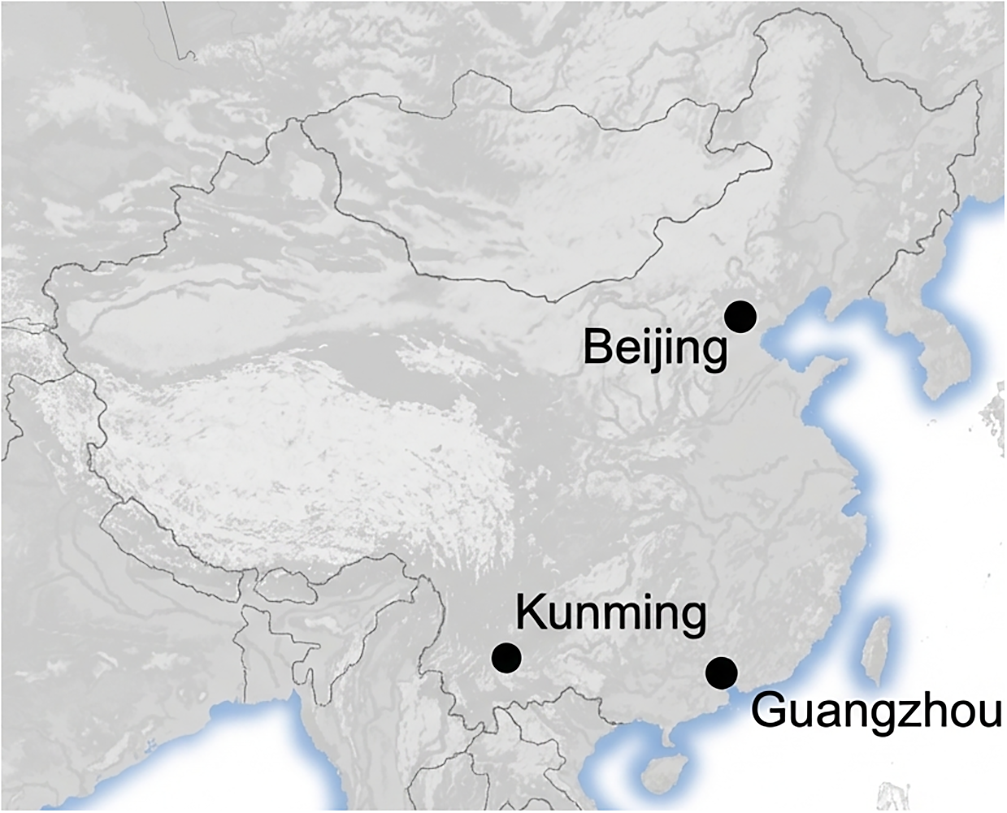
I developed an interest in this subject through various periods of living, working, and travelling in major cities in the People’s Republic of China since 2007, as a teacher visiting from the UK, later to conduct fieldwork, and, for eight months beginning in late 2021, as a research fellow at a Chinese university. During the latter stay, I was originally based in Kunming, the capital of Yunnan province in the country’s southwest (see Figure 5). This part of China has been a consistent draw for ethnomusicologists and others interested in musical practices with the negotiation of (minority) ethnic identities at the fore, not least when this occurs in rural areas.Footnote 6 In contrast, my work there resumed previous exploration of the roles of bodies, movement, and materiality in the construction of social space, something I intuitively thought of as preceding or underpinning more discursive levels of the negotiation of ethnic identity.Footnote 7 My focus fell especially on everyday musical sounds and practices that show a degree of recognizability in their spread across China’s largest cities. This partly responds to research from sound studies, especially that taking up R. Murray Schafer’s interest in soundscapes of quotidian urban experience.Footnote 8 It shares a concern for the street or the plaza as an ‘environment of loosely connected utterances, dialogues, discussions, and sounds all experienced in a flow of collaging acoustic information’.Footnote 9 But rather than ‘tak[ing] sound as its analytical point of departure or arrival’,Footnote 10 my work recognizes that ‘as sound becomes more materially embedded, it becomes mediated by many senses, including seeing and touch’, and this affords exploration of a more integrated picture of sensory modalities, modes of engagement, and actors (Position 1 in ‘Theorizing Audiency’).Footnote 11
Map of China. Image: Samuel Horlor, based on a map by Ian Kiu made available for use under the CC BY 3.0 licence (creativecommons.org/licenses/by/3.0/) via Wikimedia Commons.

Part of the significance of exploring Chinese city streets is connected to sheer weight of numbers; things happening here ‘constitute a substantial slice of the global experience’.Footnote 12 Nonetheless, evidence from Chinese-speaking contexts is only just starting to feed into a broader understanding of ‘music in everyday life’ that has largely been skewed towards Euro-American contexts.Footnote 13 From even casual observation, it is clear that Chinese cities are rich in the kinds of public-space activity that give rise to encounters involving music. Certain groups of people tend to spend their spare time out in parks, squares, and miscellaneous patches of ground, affording emergence of a rich repertory of music- and dance-based leisure activities evident on any given day across the country. One well-known example to which I will return is the square dancing [guangchang wu] enjoyed mainly by retired women in city plazas and similar spaces.Footnote 14 Another important context is commercial practices, noted for their purposeful harnessing of Chinese society’s general valuing of hustle and bustle; music plays a key part in the production of ‘hot and noisy’ [re’nao] atmospheres and soundscapes.Footnote 15
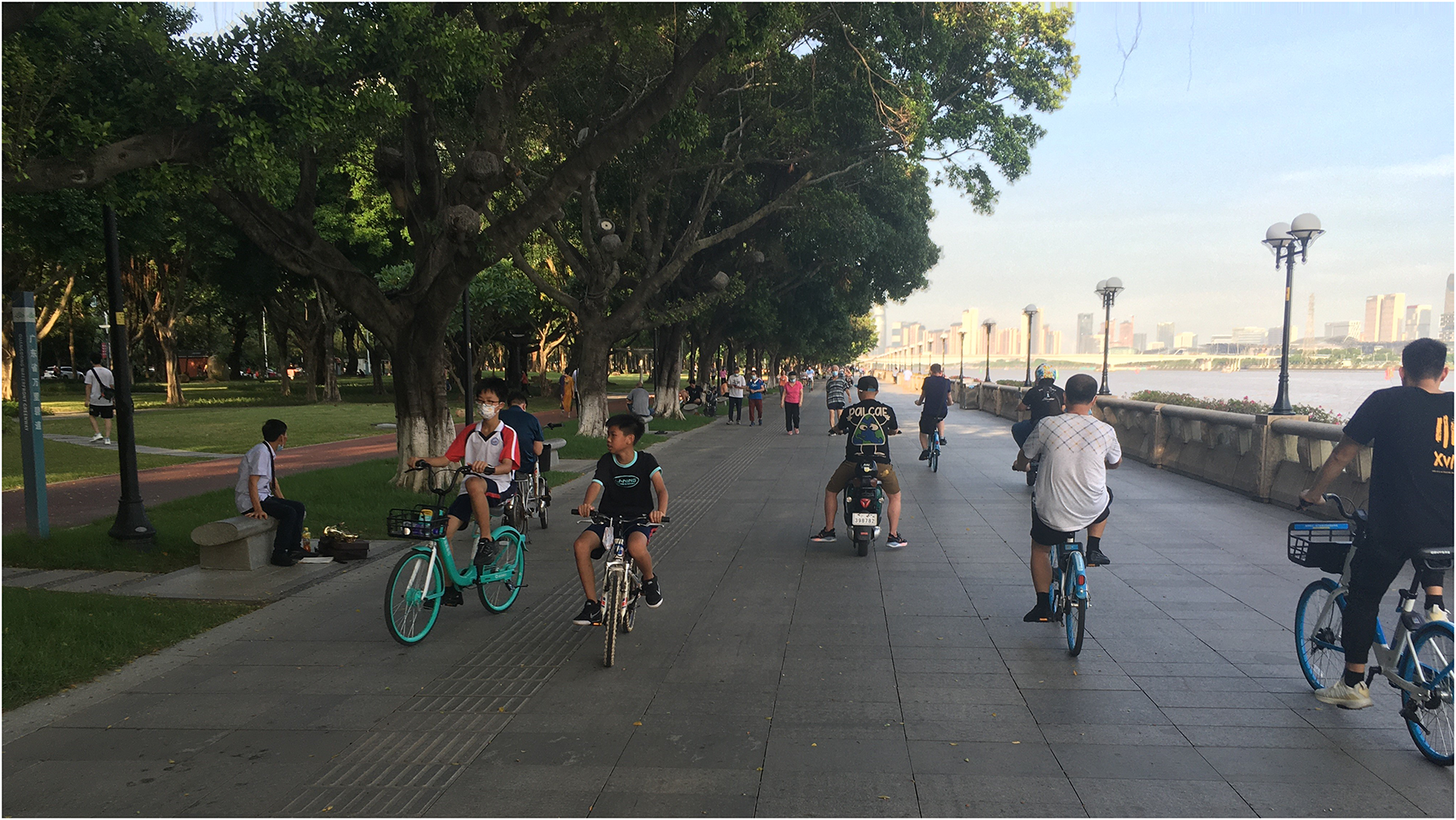
Escaping local authority and institutional movement restrictions imposed in response to COVID-19, I spent most of the second half of this particular stay in China 1500 km to the east of Kunming, in the south’s preeminent metropolis, Guangzhou (see Figure 5). As I begin to write up this article in the city, I start to notice how various manifestations of audiency shape my daily experiences. For instance, I spend one early evening in April 2022 in Zhujiang New Town [Zhujiang xincheng], an ultra-modern commercial area of Guangzhou. Like many others, I stroll along a wide river promenade, with people exercising, playing with children, and picnicking all around. An impression of unusual sound and movement breaks momentarily into my consciousness; loud pop music feels like it is drawing up quickly from behind me. A check over my shoulder reveals it is coming from the sound system attached to a flashy motor scooter that a young man is weaving between the ambling people (Figure 6). Integrating his musical ‘coming through’ message, as if it were the vehicle’s horn, into the dynamic mental map through which other pedestrians, cyclists, and I find mutually compatible routes along the riverside path, I hang to one side in a pocket of space until the bike has safely passed.
The riverside promenade at Zhujiang New Town in Guangzhou. Photograph: Samuel Horlor, 30 June 2022.

As it speeds away, I begin to process the music as the 2014 international hit ‘All about That Bass’ by Meghan Trainor. There may be a certain expression of cosmopolitan status at stake in the broadcasting of English-language songs like this in Guangzhou, although I have heard other riders playing out all kinds of popular songs from repertories in Cantonese (the local language) and Mandarin (the national lingua franca) as well.Footnote 16 To my sensibilities, the biker’s pace and changes of direction are reckless, but there is no indication that anyone around particularly shares my concerns; this kind of riding is not unusual in Guangzhou and beyond. Clearly, then, the whole musical encounter is situated in a context of local norms operating on different levels — from the connotations animated by musical materials to various aspects of public behaviour, such as the spatial dimensions of how people interact.
The episode is over within an instant, perhaps having barely registered in a context where innumerable similar micro-interactions constitute city life. It feels banal to spend time recounting something that is on first glance socially so unremarkable and musically so superficial (by conventional standards, at least). But it does set me thinking about the musical dimensions of mundane episodes like this, those whose apparent triviality is all the more reason to refocus on their roles as building blocks of ordinary experience. My own participation tells me that the motorcyclist’s music had consequences for the interpersonal encounter. Firstly, it did not inspire me to concentrate on the unfolding details of the song so much as to notice certain of its sonic qualities; this was then integrated into how I negotiated a situation with people whose similar interest in smooth use of the path meant a momentary shared investment in taking account of the music. Requiring more thought, however, was how the episode and the notion of ‘audiency’, especially the emphasis on embodied dimensions of witnessing as bound in a mutually constitutive relationship with performance, might comment on each other. In particular, what significances are there in this musically tinged interpersonal interaction being so fleeting, and in it even lacking many typical hallmarks of performance (Position 2 in ‘Theorizing Audiency’)?
My contribution to understanding audiency beyond the concert hall hinges on scrutinizing the phenomenon of attention, which emerges through the discussions as an essential foundation of the audiency concept. What are the relationships of listening to other ways in which people attend in musical situations, and how do these relationships serve in the construction of these situations? And since most of the musical encounters I focus on involve the playback of recorded media, how does the physical presence of musicians as a variable in musical situations test the foundations of ideas constituting audiency? After introducing certain modes of attention and their relationship to the listening paradigm, I focus on further fleeting encounters I observed and participated in during my period in Kunming and consider two key dimensions of attention’s role in ubiquitous audiency: the distribution of attention (across actors, sensory modalities, and a variety of behaviours abounding in the situation) and the direction of attention (especially as it transcends the musician–auditor bilaterality). I also offer thoughts on two further dimensions: aggregation (the sum of simultaneous individual experiences involving attention) and potential (how witnessing does not necessarily have to be actualized to play a meaningful part). I conclude with suggestions for how these ideas may help in approaching other musical contexts.
Everyday Public-Space Musical Encounters
I define the scope of my interest through the heuristic everyday public-space musical encounters — but cautiously so because of debates surrounding different aspects of this formulation. For a start, ‘everyday life’ as a category of social theory has been problematized for its vagueness and its implications of timelessness and homogeneity, conceptual weaknesses blamed in some quarters for no less than the ‘denigration of ordinary experience’.Footnote 17 Likewise, the common sense of separating ‘publicness’ from other modes is complicated by research showing how it intersects or nests with the ‘private’ or the ‘intimate’ in various aspects of musical life.Footnote 18 There is also scepticism about how well the idea of publicness maps onto the ostensibly equivalent Chinese notion of gong (公).Footnote 19 Nonetheless, even critical scholarship understandably resorts to pragmatic use of phrases such as ‘publicly accessible urban spaces’Footnote 20 when pointing to ‘the concrete physical form and social meaning of non-enclosed space such as sidewalks, streets, squares, parks, etc. […] where people come together, a space of socialisation, communication and encounter’.Footnote 21 Defining my interest in this kind of social-space phenomenon is the multiplicity of activities and agendas found. Many people engage in in-between ways, finding themselves simply on the way to somewhere or something else. As such, the relative stasis and commitment to bodily orientations implied by fixed-role identities may be replaced by movement as a key foundation of the phenomenology of these situations.Footnote 22 I am interested in the fluidity that comes from the unpredictable meeting of diverse activities and concerns — or, in more idealistic terms, the ‘active process of urban learning, with inherent uncertainty but also creativity and potentiality’.Footnote 23
Attention
Scholarship on audiency has highlighted the concept’s fundamental dependence on attention. Audiency means ‘acts of attention, of affect, of meaning-making, of memory, of community’, and the audiency lens highlights that ‘attention is a constructive or performative act, that spectators bring performances into being through the nature of their variously active, distractive or contested attention’.Footnote 24 Musical encounters in everyday public-space life, such as that involving the scooter rider’s music described above, illustrate this unusually fully, albeit often hidden in the plain sight of ubiquity. If what is going on here usually involves more than listening alone, then in precisely which other ways in combination might people meaningfully attend, and to what extent may these ways constitute audiency through their performativity? How can the broader qualities and degrees of attention involved be conceptualized, along with their dynamic interpersonal processes, their flows and fluctuations? My approach is built on a broad understanding of attention, one that properly acknowledges the essential intertwinement of ‘cognitive’ and ‘interpersonal’ dimensions. It is about the investment of a person’s capacity to be affected in ways distributed across different facets of a happening, perhaps unconsciously, and as manifest in movement, orientation, or other phenomena. These kinds of attention are witnessed and felt, influencing, spreading, and fizzling out in interpersonally fluid ways, making for their foundational status in audiency.
On some level, the following may be true: ‘Everyone knows what attention is. It is the taking possession of the mind, in clear and vivid form, of one out of what seem several simultaneously possible objects or trains of thought. Focalization, concentration of consciousness are of its essence.’Footnote 25 This way of thinking has been adopted as common sense by scholars interested in kinds of musical encounter where a dynamic negotiation of attention tends to play a prominent part; those looking at performances in pubs, in restaurants, and on streets evoke ideas of the primary and secondary focal points of concentration apparently experienced by people in the vicinity.Footnote 26 Doing so implies the presence of an ‘attention economy’, a basic imperative existing for musicians to establish and maintain their activity as the principal focus of the situation, with any failure to do so lamented as a retreat into the ‘background’.Footnote 27 As such, these musician-focused understandings share an unfortunate premise of the structural-listening ideal: an a priori assumption that the more singular the conscious concentration on relations between unfolding sounds the better.
But a glance through the history of ethnomusicology and related fields reveals an abundance of musics meant not for structural listening but for dance, ritual, work, participation, or numerous other things. Here it is entirely appropriate that ‘our primary focus is elsewhere, or our focus is diffused, but we are still hearing the music and some part of ourselves is paying attention’.Footnote 28 What Judith Becker highlighted as ‘unfocused attention’Footnote 29 in the 1980s is an idea picked up in Anahid Kassabian’s work on ubiquitous listening, a phenomenon which she notes, in the context of film and television music, often implies ‘partially attentive listenings’.Footnote 30 Kassabian outlines, for instance, one kind of media product where the gripping of attention occurs intermittently: ‘These films keep audiences in high-attention mode by keeping our neurochemistry on high alert, keeping us engaged and tense and waiting for the next big loud boom.’Footnote 31 This anticipatory state depends on auditory inputs working in tandem with various other elements of the cinematic experience, and points to a generalizable idea that attention as concentration on sound occurs not in isolation but rather as embedded in wider sensory (and also interactive) environments. It also hints at how attention may involve more than simply the taking of possession of consciousness, and instead that a range of cognitive states and attentional modes (‘conceptual/analytic versus generative/creative, durational (reading) versus pointillist’) may be implicated.Footnote 32
Kassabian’s goal is to understand how engagement with these mass media products resonates on a shared level, to consider the ‘distributed subjectivity’ afforded.Footnote 33 My interest in public-space musical encounters depends heavily on co-presence and real-time interactive dynamics, so it takes up the basic understanding of attention as playing out interpersonally. This might involve, for instance, the interpersonal synchronization of breathing, foot-tapping, procession movements during ritual occasions, or dancing.Footnote 34 Some significances of the latter are revealed in Wendy Fonarow’s observation of different qualities of engagement at indie gigs in the UK: closest to the stage is the place for attendees wishing to dance and mosh energetically, behaviour which becomes a means ‘to positively align oneself and one’s identity within the community with the band on stage’.Footnote 35 Paradoxically, at least as far as structural-listening models may be concerned, the highly committed people in this area appear to engage in concentrated listening much less than those in zones more distant from the stage — than people showing more ambivalent alignment with the fan community. But it would make no sense to deny that the former are attending meaningfully, even if their engagement with the sonic stimulus is bound up inextricably with other dimensions of the experience. Cognitive dimensions alone, then, are not sufficient for understanding attention, considering their situation within a more complex constellation of realms.
The Dynamics of Communicating Attention
As these examples have begun to hint, to find the consequences of attention it is necessary to look not only at how different types are experienced but also at how they may be communicated, recognized, and negotiated — to the performativity that binds attention to the notion of audiency. This has been studied most compellingly with reference to how people in musical situations self-consciously perform gestures to mark beats (among other things, showing others their mastery of the music’s metrical structure), how they orientate their bodies and direct their gaze, or how they manipulate objects like furniture to communicate orientations in more enduring ways.Footnote 36 Some of this work intimates that efforts to communicate non-attention can be just as significant manifestations of audiency’s performativity, equally transmitting information that shapes the situation’s unfolding. Musicians playing in restaurants, for instance, are highly aware of aspects of non-verbal communication apparently meant by diners to convey uninterest.Footnote 37
These experiences emphasize that the interpersonal negotiation of attention is dynamic. Research on Indian classical concerts, for example, finds various actors’ looking, moving, and focusing of the mind to be organized temporally with reference to the music’s metrical framework, affording attention with a ‘quasi-periodic’ nature.Footnote 38 But can similar ideas also be useful in cases where there is no such impulse to demonstrate one’s structural listening? How does this work, not just as it pertains to the musical syntax but also to what might be called the situation’s ‘interactive syntax’? In one such situation, involving busking on UK streets, Paul Simpson has analysed the spatio-temporal progression of crowd formation and dispersal. Against a context of the wider agendas and tasks pursued by passers-by, for a performer to attract, hold, and energize a core group is vital, as displays of audiency from these people are key to building fully fledged crowds ready to engage in ways desired by musicians.Footnote 39 Further research in similar settings adds detail about the precise mechanisms by which attention — embodied and put on display — may or may not spread between people. Tim Smith’s close analysis of video evidence shows, for instance, how the decision to stop and watch a busker or not is negotiated through non-verbal communication between a group of four companions. Of these people, the individual Smith labels P1 seems most interested in stopping:
P1, after a number of steps, positions himself on the edge of the performance pitch; he plants both feet so that they face the busker. At the same time he gazes at his companions […] As it happens, his companions do not collaborate with him and they continue walking […] P1 makes another attempt to stop and watch the busker; again he plants his feet so that they face toward the busking pitch. This is clearly seen by the male companion because he walks past P1 and then turns around to face the busker […] P1 then watches for 13.0 seconds while both the male and female companion move further away […] As P1 continues to watch the busker the three companions stand together approximately four feet away. P1 […] then withdraws from watching as he rejoins his companions and walks away.Footnote 40
This interpersonally performed negotiation, involving the kinds of attention characteristic of audiency for busking, does not imply the redundancy of listening altogether but shows how different forms of attention are intertwined. In one of Smith’s examples, it is possible to isolate the moments in the video material when a particular passer-by shifts from showing loose signs of awareness of the busker’s presence, and thus attending broadly to the happening, to stopping and watching/listening committedly. It coincides with a fast, intricate passage in the busker’s music, a moment that arguably ‘conveys a hearably [sic] higher level of skill and competency of playing, such that [the passer-by] is now interested to see and hear what the busker will play next’.Footnote 41 Indeed, just as Kassabian noted with reference to film and television, the listening part of the equation (if such a thing can be isolated) may itself have different levels and qualities. In this case, much of its situational significance comes from listening as noticing.Footnote 42
Smith’s work seems more interested in how people transition from passer-by to audience member (often as a precursor to offering a tip and acting as a magnet for more people to do the same) and less in the kinds of attention flowing among passers-by who stay far away from making the category transition to becoming audience members.Footnote 43 But the latter certainly do feed into the ongoing unfolding of the interaction in ways that help form its characteristics as a performance; through their sheer presence and movement in the vicinity, they too feed back into the musician’s behaviour. A busker’s perception of their more general impact upon the scene shapes the tone of the performance; the musician might become ‘animated’ or ‘increasingly energetic’ as an ideal crowd gathers, or ‘visibly frustrated’ or even ‘pleading’ when one fails to materialize.Footnote 44 There is reason to think of passers-by as evincing audiency (if not forming part of the audience), since they are taken as witnesses to the moods and activities of other actors, helping constitute performance while shaping the situation in various ways, even if by showing a lack of interest.
Adopting an orientation only to the kinds of witnessing behaviour perhaps desired by the musician (the relatively static and concentrated kinds) risks implying that attention is primarily significant for its direct impacts on the unfolding of the musical performance. Music-related attention can also mediate involvements in wider situations in ways that transcend the immediate musical interaction or the concerns of the musician. This is something brought to the surface by Joseph Browning when he observes the audiencing of visitors to a sound art installation in the garden of an Australian estate: ‘The music altered audience engagements with the plants in the garden. People peered into neglected corners of the planting or stood for long periods facing the tall trees on the upper lawn.’Footnote 45 Musical sound may not draw attention to itself specifically but may still play a part in managing attention to (or away from) other things, forming part of the negotiation of a distributed attentional landscape.
Ubiquitous Audiency and the Playback of Recordings
The kinds of musical encounters under scrutiny here (at the very least), then, depend on attention that does not stop at listening but rather integrates it with various ways people account for aspects of the wider situation of which sound is part (whether this is experienced primarily through conscious focus or embodied attunement). By far the most common way music exerts presence in everyday public-space life in the city of Kunming is through the playback of recorded media. Many of these instances do not share busking’s obvious goal orientation (the stimulation of money gifts), and there might even be no comparable audience role sought out or pertinent to the situation. Instead, phenomena on a level similar to the indirect engagement shown by passers-by (who in the busking scenario described above have no intention of joining the static audience) may constitute the principal or only mode of attending. Bargain fashion stores in Kunming, for instance, often play frenzied techno beats from their thresholds, with no expectation for people passing to adopt explicit audience roles.Footnote 46
But significantly for thinking about audiency in instances of media playback, the much lesser relevance of audience role categories applies to the status of performer as well. With no person present who is singing or playing an instrument in the moment, audiency’s essential function of providing the witnessing and feedback that brings performing into existence (at least as many accounts from concert contexts have it) would seem negated. Can there be audiency when there are no musicians per se to complete the loop? The answer depends partly on how broad or narrow the understanding of performance is. In one way, the playing of recorded media is consistent with Erving Goffman’s understanding of everyday performance, in the sense that face-to-face interaction sees people act in the knowledge of others observing and forming impressions of them. They are thus concerned to project into the world something of themselves likely to be received in ways they desire.Footnote 47 For performance in this sense, it seems to matter less if the music of the scooter rider I encountered comes from the electronic stimulation of components in the bike’s sound system exciting the air, as opposed to through, say, the rider’s vocal cords or his fingers on strings doing the same job. Rather, the simple act of controlling the emission of musical sound — what it is, when it starts and stops, and with which qualities (such as volume) — affects impressions formed of the rider and feeds into other interaction in which he takes part.
If we follow scholars whose work has highlighted the blurred nature of the music categories of ‘live’ and ‘mediated’, perhaps the scooter rider simply exposes complexities in the boundaries of (musical) performance.Footnote 48 When a rock band uses electronic amplification or integrates recorded backing parts into their stage show, when a pop star mimes on television or a club DJ’s set consists entirely of manipulating pre-recorded sounds, the status of what they do as performance is rarely questioned, not least because they are on a literal stage as they do it. Indeed, more widely, the technology through which sound is produced clearly does not have to be the defining factor in how people make meaning with it. Andrew McGraw compares the uses to which US afficionados put the gamelan when it is played conventionally versus mechanically (by a robotic gamelan, the gamelatron), concluding that ‘at the level of affect the gamelatron and gamelan afford similar experiences that I call “atmospheres of felt-relation”’.Footnote 49
But the scooter episode is not identical in its implications for this conversation. A pillar of conventional thinking in areas like performance studies is that the distinctness of performance from other frames stems from its forging of a focus for expression to be evaluated, for the judging of its success in terms of the relevant genre, as opposed to the straightforward conveying of messages.Footnote 50 Unlike for the DJ, miming star, or technologically enabled band, this cannot be taken for granted for the scooter rider. Instead, the sounding of the ‘artistic’ product — the playing of ‘All about That Bass’, presumably for the biker’s own appreciation during his journey — is nested with its more ‘functional’ use as a vehicle horn. While doing something akin to a performing act through his playing out of the media, at the same time he potentially shares audiency with the other path users he hopes to engage (since no one could reasonably disregard the level which sees them all witness a virtual performance constructed by Meghan Trainor and her musicians and producers). As such, the scooter rider accepts neither performer nor audience role.
But regardless of this nesting of functional and expressive aspects, there is something more fundamentally troubling about distinguishing so firmly between utterances intended to be judged on their expressive merits and those more plainly delivering messages. For a start, this denies the levels of rhetorical play inseparable from even the most mundane acts of communication, like ‘everyday’ conversation. Further, there is abundant reason to problematize the privileging of an elusive ‘aesthetic’ mode over other kinds of experience when we consider how ideas of value have formed and spread. Drawing this line above all reinforces the sensibilities and interests held by those in a position to elevate some things and not others to the status of ‘art’, or at least to a status worthy of attention.Footnote 51
These are the kinds of discourse that dismissed ubiquitous musics to the ‘background’ in the first place, so to take them as a reason against finding audiency here would just perpetuate a vicious circle. More realistically, it is not just ubiquitous musical encounters where attunement to sound is embedded in a wider situation; the same is true even for those presented unambiguously for appraisal. This is what makes it evidently different to experience, for instance, a symphony orchestra playing as part of an open-air festival versus the same ensemble preparing for the event in a rehearsal room, even accounting for variances in the acoustic dimensions.Footnote 52 I see no reason to draw hard distinctions between the kinds of attention embraced in the polyvalence of the scooter episode and those underpinning any other musical encounter, nor to accept that the former matter any less. Feedback here may not provide the impetus to shape the details of the utterance, but it still helps define the emission of musical sound as an act with meaning forged between those present (as a performance, on some level), and it plays a part in transforming the situation through influencing, among other things, the movement of people in tandem with each other.
Observing Ubiquitous Audiency in China
If the main episode I have referred to so far, that involving the scooter rider’s music, has played up the aural dimensions of the attention underpinning audiency in the situation, I now turn to several examples from Kunming that explore more fully how attention integrates different sensory modalities of the experience. The fleeting and non-discursive nature of these encounters, and the contention in this article that audiency depends on the performativity of factors such as bodily positioning, orientation, and movement, lend themselves to an observation-based research method. Concentrating on analysis of behaviour on a level immediately observable to participants (without, for instance, inviting their post-hoc reflections) also brings a certain liberation; the typical ethnographic priority of developing personal relationships with key figures can come with the downside of dwelling too much on the experiences of only one kind of participant, those who engage repeatedly and prominently. But people who are apparently more peripheral or uncommitted are equally important in this research. There are, of course, limitations to this decision as well; I note below a few occasions where it may have been useful to ask people about exactly how they were experiencing an ongoing episode of activity, if only it were possible to do so without also interrupting its unfolding.
My aim here is to illuminate the processes whereby the witnessing of directly musical behaviour is entwined with attention distributed fluidly in the wider situation, in order to give a distilled example of the phenomena that mean that, realistically, any musical encounter is forged of sound as a dimension of a larger situation. It is from these examples that I derive my focus on attention’s distribution and its direction (which also leads to ideas on the two further dimensions of aggregation and potential), to help decouple this kind of musical situation from the connotations of ‘background music’. This points to how my perspective may illuminate more conventional musical encounters too, something I return to in the conclusions to this article.
Distribution of attention
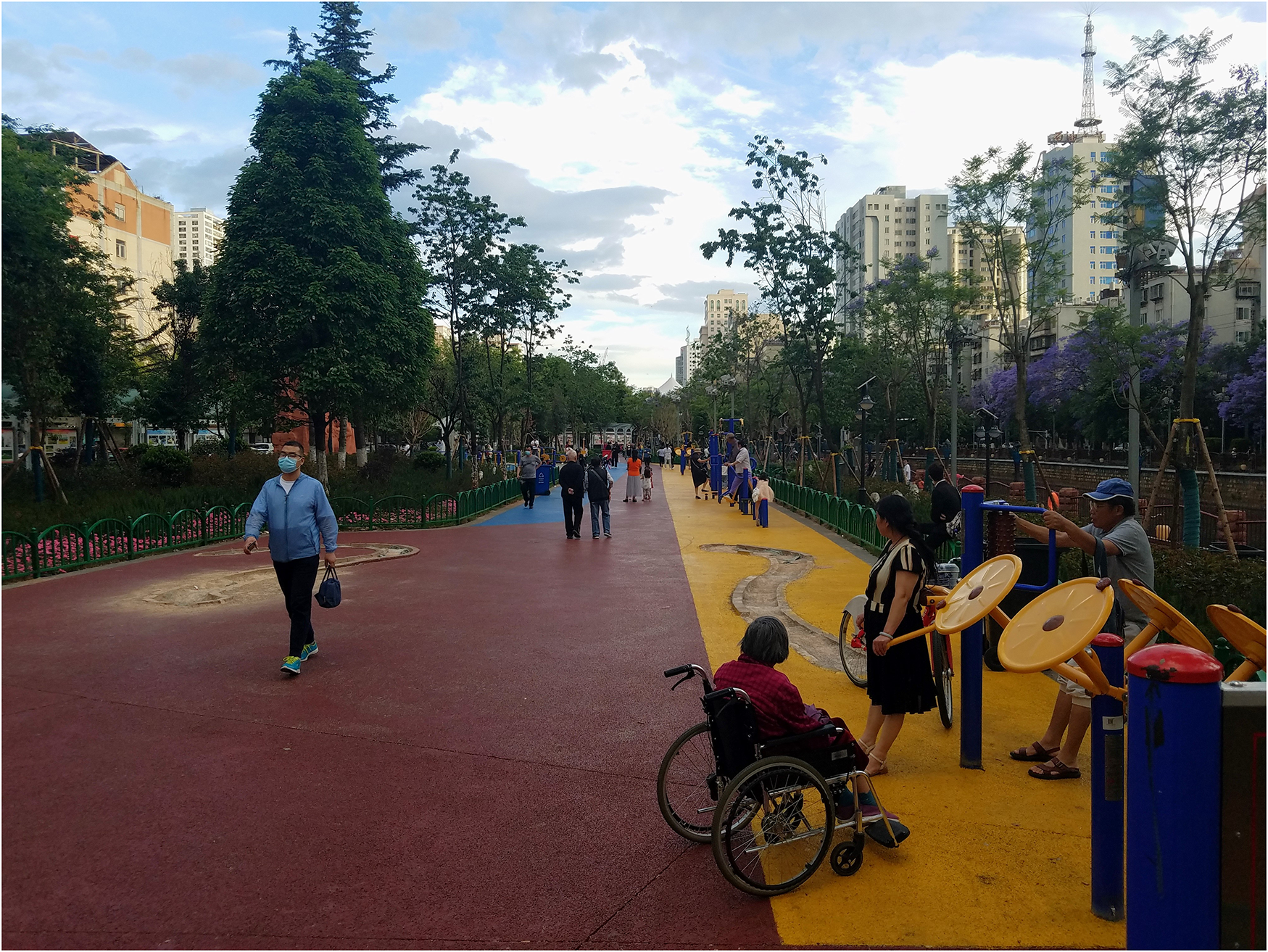
Taoyuan Square [Taoyuan guangchang] (see Figure 7) is an elongated square in multiple sections running alongside a stretch of the Panlong River in the centre of Kunming. In spring 2022, it offers me a focal point for identifying and observing activities featuring the emission of recorded musical sound as part of routine activity, including around the square dancing [guangchang wu] mentioned earlier. From among the several dance sessions operating here each evening, I become interested in one that deviates from the most common arrangement in these city plazas: dancing in lines. Over several evenings, I observe that this session’s dancers instead cohere into a loose circle that expands or contracts, depending on participant numbers, as it slowly rotates. The movement repertory of this dance is also more limited than usual, consisting mainly of dancers bouncing from foot to foot, punctuated by moments where they kick out in front of the body. All dancers face the centre of the ring, and some hold hands. The dance is maintained more or less continuously for the whole session of an hour or more, with people free to join or drop out as they please. Literature leads me to think of it as a version of the classical dance associated with tage (stamping songs), as practised by various ethnic groups of southwest China for nearly 2500 years and still forming an important part of spiritual and festive life in rural Yunnan in the twenty-first century.Footnote 53
A section of Taoyuan Square in Kunming. Photograph: Samuel Horlor, 11 May 2022.

One May evening, I notice that about thirty minutes before the dancing begins, the man who brings the portable equipment for playing the music arrives and sets things up in an open part of the square. The tracks he plays remind me of what some have described in the context of Chinese-language pop as ‘neo-minzu’ music, songs combining on-trend stylistic features, such as rap and R&B elements, with minority-nationality folk [minzu] themes and vocal deliveries.Footnote 54 I hear, for instance, a sped-up dance version of the song ‘2002 nian de diyi chang xue’ [‘The First Snow of 2002’] by Dao Lang (2004). The song’s lyrics conjure images from Urumqi, some 2500 km away to the northwest, the capital of the province known internationally as home to the Uyghur people, Xinjiang. Although the local ethnic mix is different here in Yunnan, it is a place that can sometimes wear a ‘minority’ cultural feeling on its sleeve, being one of the primary focal points for ethnic diversity in the nation’s imagination.Footnote 55
The sounds boom throughout the leisure complex and echo in the streets and buildings all around; this broadcasting of the music seems designed to advertise the activity and its nature as widely as possible, evoking a particular dimension of ubiquitous audiency I will return to later when I touch on ‘potential’. But for now, the music’s only impact on an immediately observable level comes on one or two occasions when grandparents briefly pause nearby to dance with their toddlers, lifting and waving the children’s arms in time with the music. Otherwise, its impacts are less tangible to me.
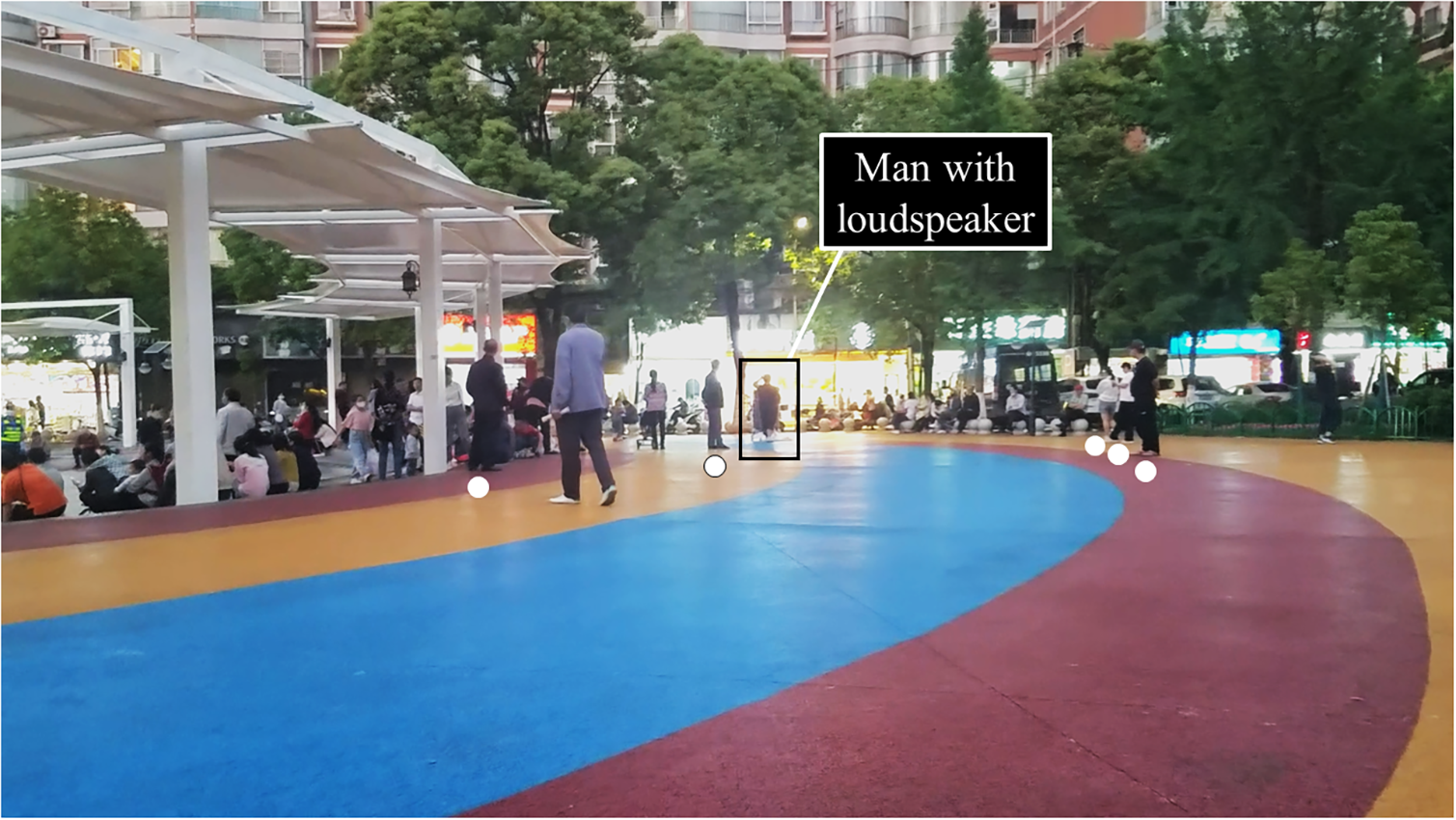
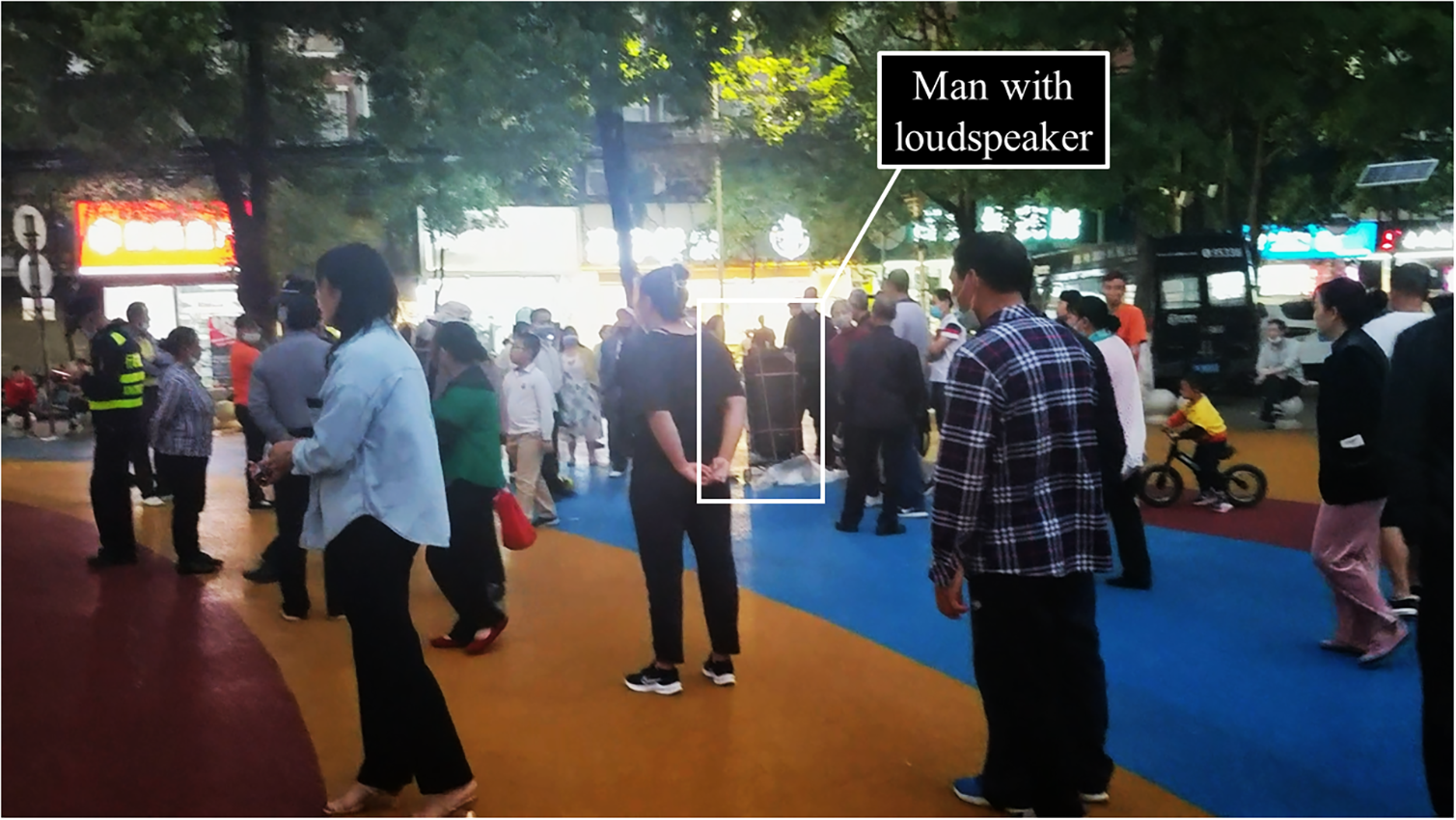
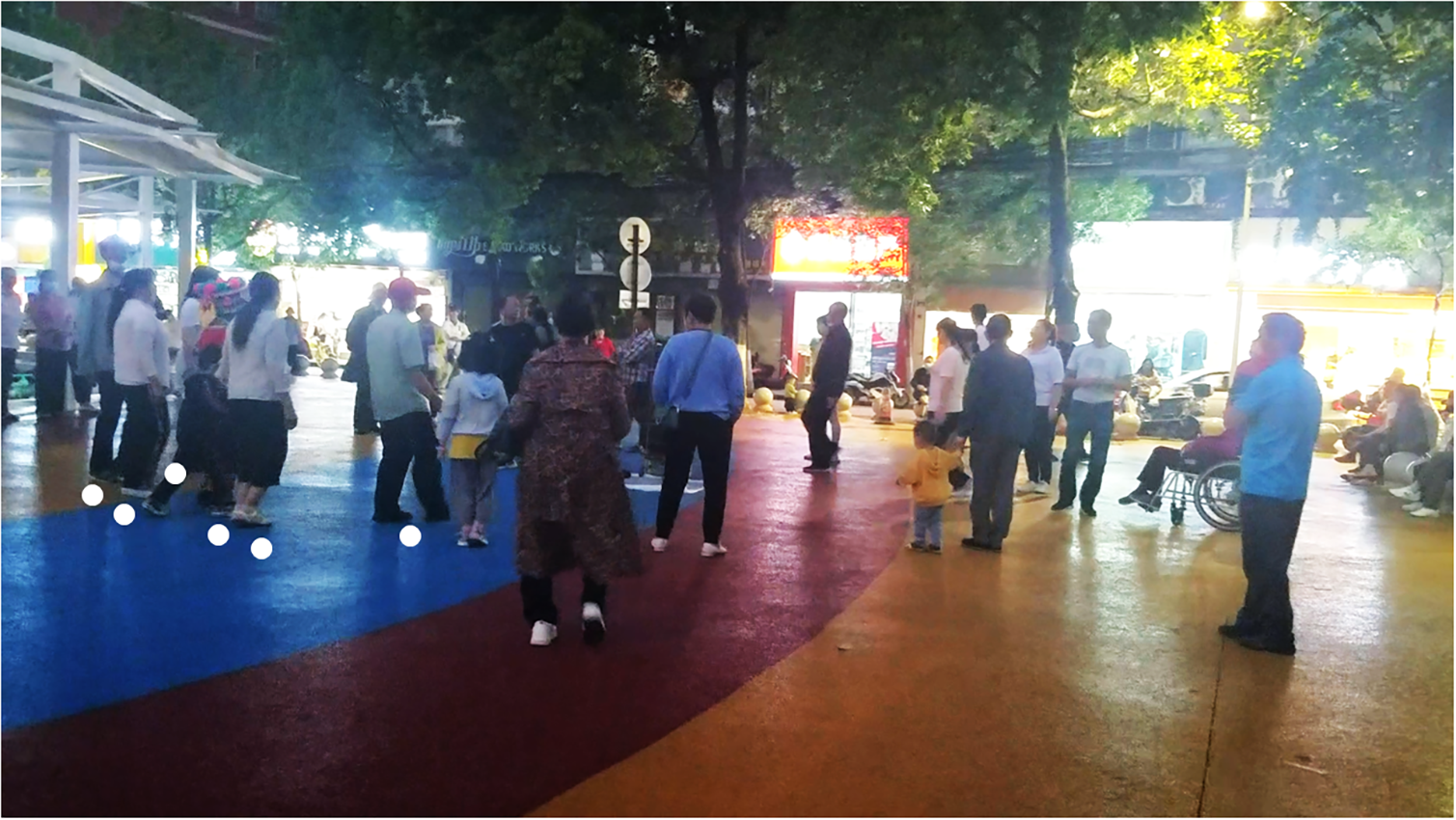
As 20:00 approaches and dusk falls, however, five urban law enforcement agents enter the scene and make a beeline for the man and his loudspeaker (they appear on the left side of the frame from 0:27 in the video I shoot on my mobile phone as I notice this development).Footnote 56 Judging by the orientation of bodies among the people in the video, at this point there are only five people in the vicinity unambiguously waiting for the dancing to begin (highlighted in Figure 8a). I treat the several people who are seated behind and to the right of the loudspeaker as a special case, to be discussed under ‘Direction of attention’ below. There follows a sometimes animated discussion, with the officers appearing to be talking about the apartment buildings lining the square, perhaps making a point about the music’s disturbing impacts on the neighbours. By the time they move on (2′50″ later), thirty people who have gathered within earshot of the exchange are visible in my camera frame, and there are certainly more people around whose interested spectatorship at the commotion is not in shot (see Figure 8b).
The scene, with white markers beneath the five people orientated towards the man with the loudspeaker, ahead of the dancing. Still from video (0:27) by Samuel Horlor, 11 May 2022.

The scene, with around thirty people now visibly engaged. Still from video (2:50) by Samuel Horlor, 11 May 2022.

Figure 8b. Long description
At the center, a man is labeled as holding a loudspeaker, facing away from the camera. He stands on a blue and yellow ground surface. Around him, people of various ages form a loose circle, some standing, some walking, and a few children are present, including one riding a small bicycle at the right edge. To the left, two individuals in reflective vests stand near the group. The background features illuminated storefronts and trees, with most people facing toward the central man. The crowd density is highest near the center and thins toward the edges.
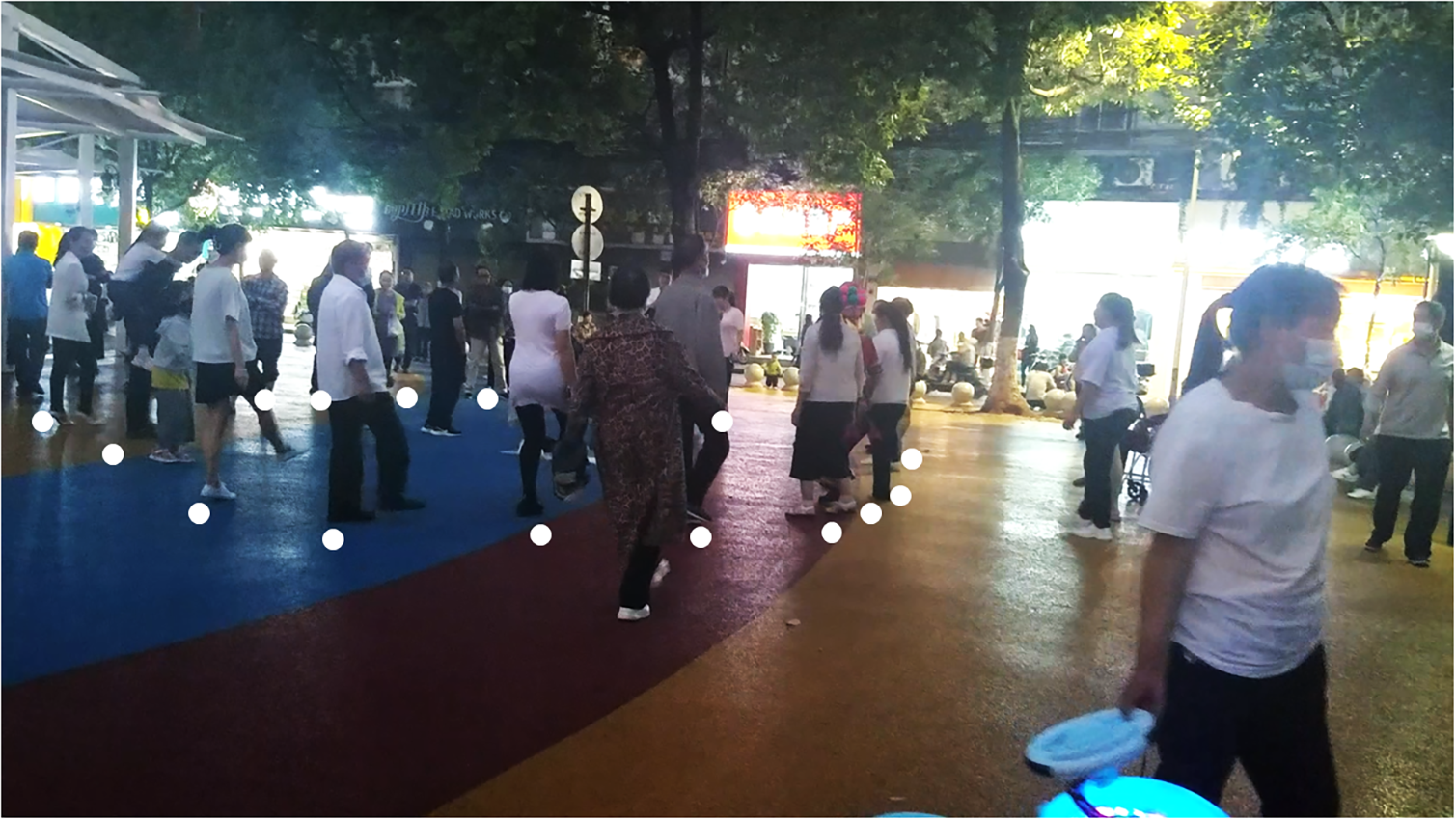
It is from this cluster that the dancing starts to emerge. The mass of people is still together when the track associated with the circular dance begins.Footnote 57 In the period (4′18″) since the officers left, dancing has been isolated and sporadic. But now, the movement of individuals gradually coheres into several nodes of people positioned shoulder to shoulder, until enough of a circular shape is filled out for a common pace to govern everyone’s rotation. Around ninety seconds later, there emerge the first clear signs that a short chain of dancers has formed (these six people are highlighted in Figure 9a).Footnote 58 As soon as twenty-four seconds after that, this chain has connected up with other people who have begun to move, and a complete circle of active participants becomes discernible (see Figure 9b).Footnote 59
White markers highlight a chain of six people on the left side of the frame. Still from video (1:28) by Samuel Horlor, 11 May 2022.

A coherent circle is emerging, as highlighted by white markers under all active dancers. Still from video (1:52) by Samuel Horlor, 11 May 2022.

Of course, as I observed over several days, the emergence of dancing happens slightly differently on each occasion; I take this evening simply as a case study of the kinds of analytical affordances of the audiency lens in such happenings. A prerequisite for the larger-group coordination of movement today is proximity among a critical mass of people, and the latter seems to come about at one step removed from a specifically sound-oriented attention present in most of the examples discussed so far in this article. Sound — in particular its loudness in the context of it potentially bothering neighbours — causes the commotion involving the law enforcement agents, and this in turn attracts people into the proximity from which the dancing emerges. Restating this in terms of the distribution of attention, the officers are attentive to the music’s acoustic characteristics, not in isolated focus but as it relates to a wider awareness of the urban situation; then the gathering of people, as they attend to the semantic details of the dispute, also makes for a positioning and orientation of bodies that functions primarily on a visual level as displays of attention attracting more; and only then does this mutual witnessing become concretely connected to the progress of the music, in the form of dancing that requires an internalizing of the beat while also responding to the pace of bodies rotating in the circle.
As such, the expansion of the structural listening paradigm to one of audiency, implying a broadened notion of attention, brings various auditors’ responses to the specifics of musical sound into proper integration with other pertinent dimensions. In particular, the driving rhythmicity of this music, with a bass drum sound strongly emphasizing every beat (as is characteristic of tracks arranged for square dancing), is an important element enabling people’s mutual orientation to cohere. The kinds of attention constituting the witnessing activity in this episode straddle what might intuitively be categorized as part of the ‘everyday’ realm (the commotion with the officers) and more direct participation in a musical sphere. This again points to the value in seeing the two as part of one process, rather than approaching immediately musical aspects as something separate.
In summary, the unfolding of this short episode rests on different qualities of attention and how they are distributed across different facets of the situation. Firstly, the attention is distributed among the people present; it requires multiple people to be attuned to each other, in mutual awareness of various dimensions of the wider happening. But this is not only a matter of, to borrow Kassabian’s phrase, ‘distributed subjectivity’, which points to meanings negotiated around media expressions on a collective level.Footnote 60 It is also about the interplay of attention involving different senses and multiple dimensions of the experience: from semantically oriented listening, to body positioning, to internalization of a musical beat, to sensing of the coordinated rate of rotation. To understand how something happens with music here, then, it is the larger situation that is the pertinent level.
Direction of attention
It is to be expected that audience-focused music scholarship should be particularly drawn to what audiency does for performance; indeed, Rainer Polak’s article in this round table captures the importance of audiency’s witnessing and validation for bringing performance into being. But the lens of ubiquitous audiency also helps turn the tables; it becomes a destination in its own right to recognize the social consequences of musical sound emission helping to construct audiency. This is evident in examples where audiency emerges from apparent indifference or lack of interest, moods that are especially abundant in everyday public-space encounters.
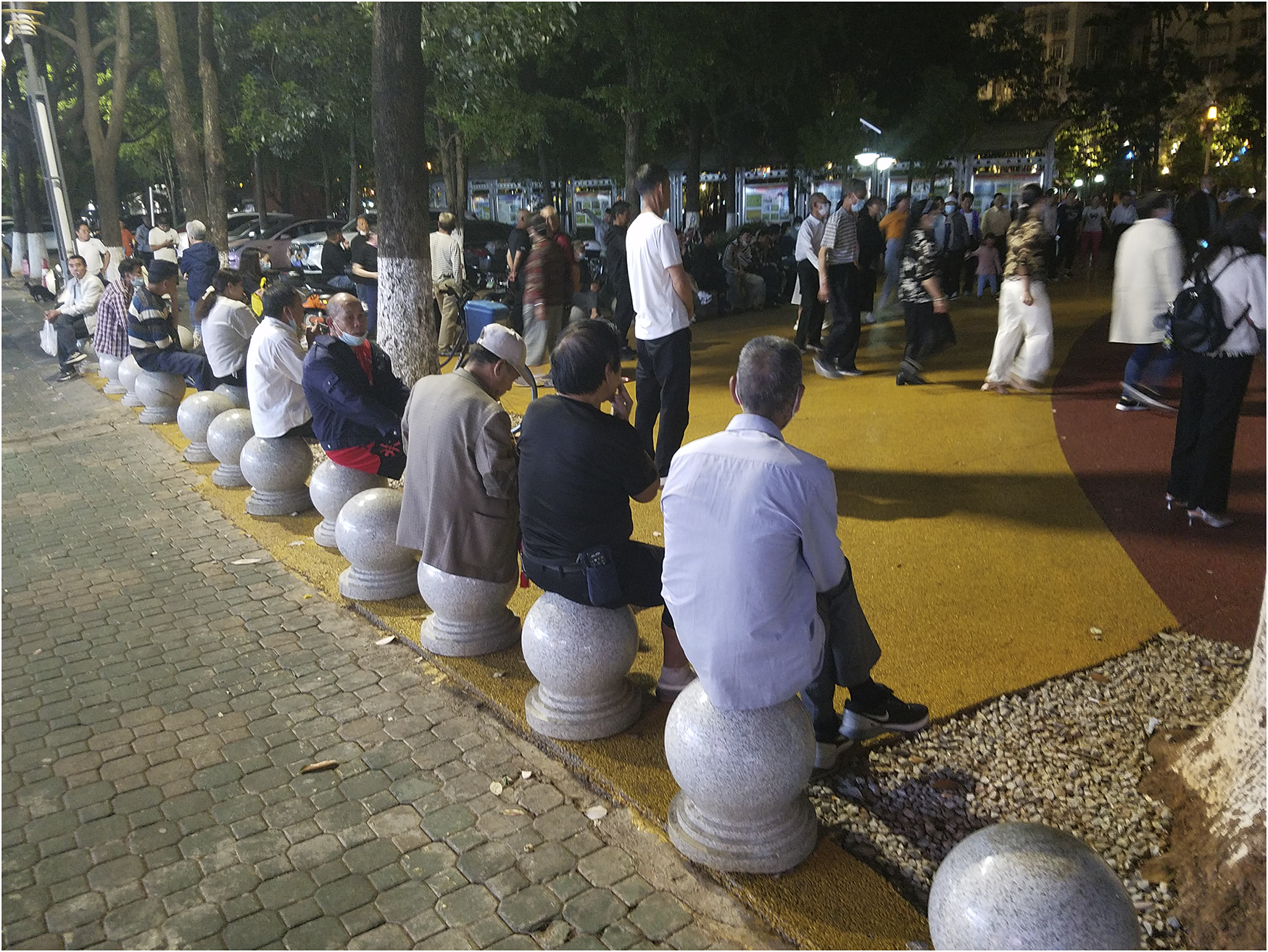
The thirty minutes during which the circle dance group leader plays out recorded music in anticipation of the dancing contributes to a transformation of social space so that dancing becomes the primary activity in this corner. Otherwise, this part of the square is used almost entirely as a place for families with toddlers and young children to play. Each evening I am present, I notice that the peripheral parts of the square adjacent to the dance group fill up with people there apparently on their own. These people perch on walls and other features of the architectural furniture for extended periods, looking at their phones, staring into space, or gazing loosely at the dancing (see Figure 10). They almost all stand or sit facing the activity (rather than towards the outside edges of the square), showing at least some degree of acknowledgement of what is going on in front of them. The existence of inclusive activities like the dancing provides a legitimizing focus for their presence in the otherwise family-oriented environment; they are able to harness a so-called ‘orientation gloss’, whereby the presentation of a justifiable attachment to an activity leaves them free to do nothing in particular for as long as they want without arousing suspicion or resentment.Footnote 61 The kind of attention that is implied, one that largely consists of sustaining physical proximity, would seem to change little about the direct unfolding of the musical encounter, but it may be more consequential in the other direction, whereby performance shapes the experience of these apparently more peripheral actors. This phenomenon is no less significant if things are seen through the wider situational lens.
Peripheral witnesses to the dancing in Taoyuan Square. Photograph: Samuel Horlor, 13 May 2022.

Figure 10. Long description
Starting at the lower left foreground, a row of individuals sit on spherical stone bollards aligned along the border between a paved area and a yellow plaza surface. The seated group faces toward the plaza, with most figures in casual attire, some with hats or jackets. Behind them, trees form a partial canopy, and parked vehicles are visible in the background. To the right, the yellow plaza curves and transitions to a reddish path, where numerous people stand, walk, or converse in small groups. Lighting is artificial, suggesting nighttime, and the plaza is bordered by gravel and tree trunks. The spatial arrangement emphasizes the separation between observers seated along the edge and participants moving within the plaza.
There is no suggestion that the stakes for audiencing as a legitimizing activity are particularly high here, that without it people risk serious accusations of problematic or antisocial behaviour. Nonetheless, the pressure to be occupied in acceptable ways in public space may be an increasingly meaningful concern in public spaces in China, where ‘economic interests associated with privatisation, gentrification, and commercialisation begin to dominate public space and directly or indirectly exclude non-consuming users and undesired activities’.Footnote 62
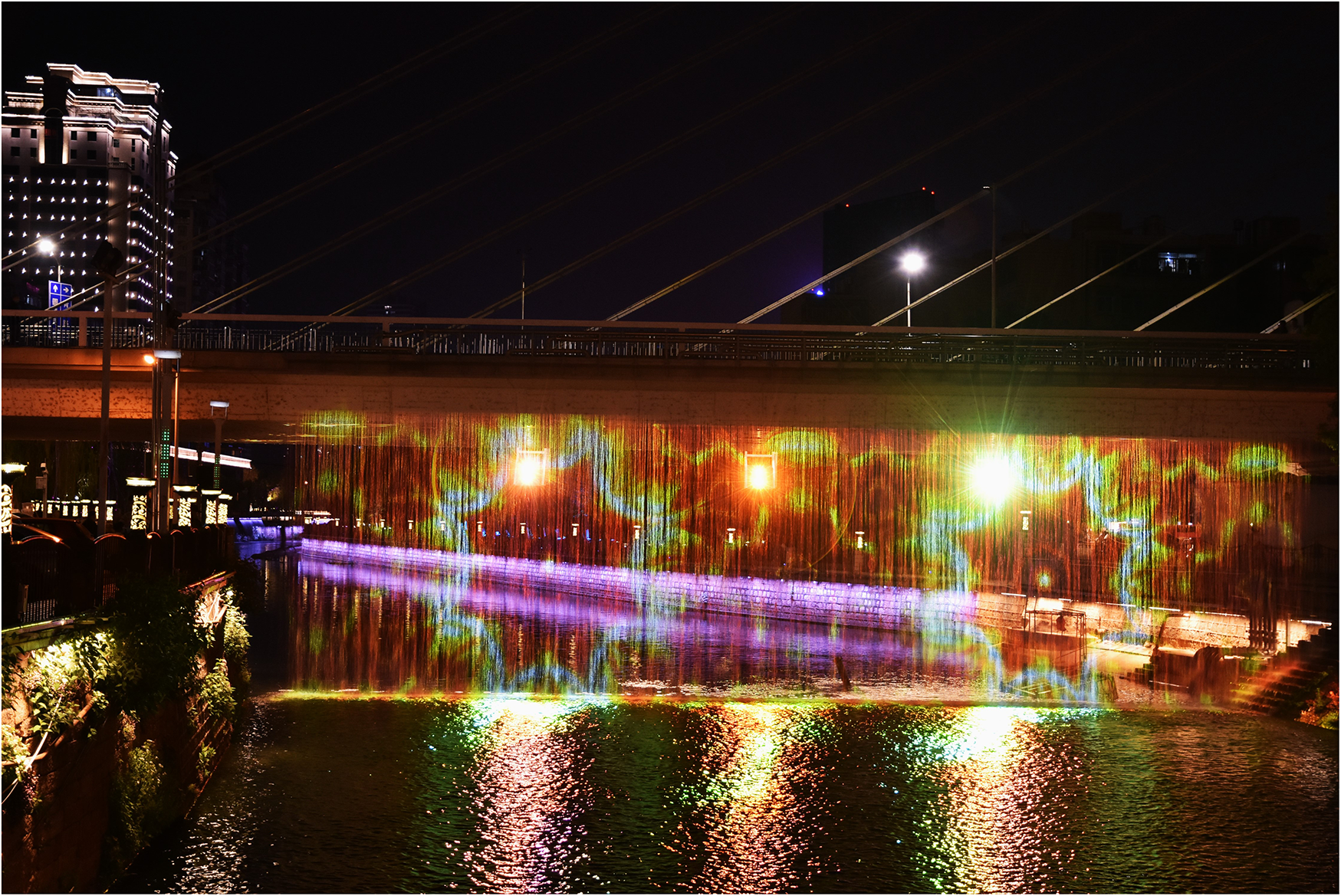
But if this example inspires thoughts about the theoretical implications of direction when considering audiency in general, other activity in Taoyuan Square highlights significances of direction that are specifically related to attention. I am drawn to examples that transcend a performer–audience bilaterality of the kind evoked by musician-oriented, rather than situational, understandings of musical encounters. After recent renovation, the square is painted in bright colours and displays other decorative features, from lanterns and large flower motifs to an artificial waterfall feature descending from the road bridge overlooking one end of the area. Colourful images are projected onto this wall of water, which operates on and off for periods in the evening darkness, and a loudspeaker installed nearby complements the visuals through the sounding of a looped sample of gentle piano music with subtle string support (see Figure 11). This media playback is not initiated by any person present, but instead it comes on automatically at a fixed time, not directly tied to when the waterfall images appear. To distinguish this instance of ubiquitous music from the ‘performance’ of the scooter rider discussed earlier, there is no sense in which a channel of feedback from auditor to sound-emitter is open here — not even with less directly musical consequences. But rather than negating the situation-shaping potential of audiency, I raise the example to highlight the significances of attention being oriented in directions beyond the musician–auditor bilaterality and the range of dimensions implicated in the musical experience.
The waterfall feature at Taoyuan Square in Kunming. Photograph: Samuel Horlor, 26 March 2022.

Nineteen adults pass through my camera’s frame during a sample period (2′17″) while I happen to be filming the stretch of riverside path closest to the waterfall and loudspeaker from a high position on the bridge.Footnote 63 The piano music is playing but the waterfall effect is switched off, and there is very little evidence of any audiency acts occurring on a level visible to the camera, such as people adjusting their agendas by stopping or the nature of their movements obviously constituting attention to this sound. If there is audiency at this moment, it happens on a level that is harder to pin down. As soon as the waterfall is switched on, however, with a sound of cascading water now accompanying the visual spectacle, the situation changes significantly.Footnote 64 Researchers of street performance have used the idea of ‘body torque’ to detail how ‘attentional demands in different parts of the environment’ shift people’s involvement in a situation, especially where there are strong competing draws on a person.Footnote 65 In such instances, different segments of the body (the head and neck, above the waist, below the waist) can briefly become oriented in different directions before they realign as one or another wins out as the primary involvement. This and similar shifts in qualities of movement now fill the riverside path. For the remainder (3′53″) of the video, each of the twenty people who appear in the frame turns their neck or torso in the direction of the waterfall, and at least one person from all but one of the parties who pass through stops to photograph or film the scene.
An advantage of the broad view of attention laid out earlier is that it highlights how musical sound can manage attention to or away from other dimensions of a situation. In this case, however, the phenomenon is reversed: it is the switching on of the waterfall that seems to help point people towards the soft piano music’s presence. Whereas the music might have gone unnoticed before (both in terms of conscious focus and the adjusting of, or responding with, the body), it seems possible that auditory dimensions may now enter the social situation a little more prominently. In particular, the subsequent playback and sharing of these people’s videos when removed from the situation offers further potential for the musical sound to join the integrated sensory experience in ways not likely before the waterfall was turned on. It is difficult to be sure precisely how people experience episodes like this without intervening in the scene and seeking to access their in-the-moment impressions. But this example does hint at the different layers by which elements of the wider situation may help manage attention around the aural dimension of music, whether in the moment or when reviewed on video later.
Prior to the switching on of the waterfall, however, the fact that the presence or absence of the soft piano produces little discernible or specific effect in the situation makes this part of the encounter especially tricky to approach with reference to audiency. Perhaps music that is simply ‘indifferent to any attention it attracts or, perhaps more accurately, tolerates’ forms part of an entire situation indifferent to any music-related attention.Footnote 66 Circumstances like this inspire some thoughts about how to look for impacts on a more elusive level, one I characterize as concerning aggregation.
Aggregation and Potential
The ethnomusicologist Shzr Ee Tan has recently brought to light a relevant phenomenon that is common in scenic spots across China, one of ‘mediated and electronically amplified sounds situated in, interacting with and ventriloquizing for the organic environment’.Footnote 67 The music complementing the artificial waterfall in Taoyuan Square can certainly be thought of along similar lines, not least in the sense of it being part of efforts to manipulate ‘sonic atmospheres’.Footnote 68 In musical contexts, ‘atmosphere’ has been conceptualized as a feeling or mood abounding in a situation or space, as something ‘collectively embodied, spatially extended, material [sic], and culturally inflected’.Footnote 69 Rather than describing a pre-existing environmental condition or a state experienced privately within an individual subject, it is the sum of people’s sense of a situation, one that creates its own dynamics of growth and change as people attune to each other. Atmosphere, then, is essentially about the aggregation of experience, and it is in this sense that I offer brief thoughts on this notion as something potentially commenting on the confluence of the different forms of attention I have discussed, with all their distributed and multidirectional qualities just highlighted.
Part of atmosphere’s significance has been found in its marking of thresholds and its differentiating of spaces.Footnote 70 This may be the level at which it is meaningful to talk about attention around the waterfall’s gentle piano music as one element among many contributing to the affordance of atmosphere felt in this part of the square. Thus audiency here may be about how musical encounters can contribute to people embracing embodied conventions of the given space and situation in which this atmosphere prevails — lowering the pace of movement to a leisurely amble, maintaining an appropriate distance from other people, and so on. Indeed, it could equally mean accelerating out of the area for someone who feels an atmosphere in which they do not wish to participate. This level of activity is, of course, exceptionally difficult to access through observation or testimony.
But other examples from my experiences in China suggest that audiency manifest as this looser participation in aggregation can also intersect with music’s more concretely observable impacts on behaviours and situations, on levels I have been looking at throughout this paper so far. In my experience in various cities during the last fifteen years, it has been commonplace to hear a particular track by American smooth-jazz soprano saxophonist Kenny G played over the sound system of shops or malls, broadcast in subway trains, emanating from schools, and in other contexts. As the track’s name, ‘Going Home’ (‘Hui jia’ in Chinese), suggests, in each of these contexts, it is played at the end of the day (or the end of the subway line) to indicate that it is time for people to leave (or to change trains). Incidentally, something similar often happens in places like restaurants when music is turned off — the sudden silence provoking a spike in attention-as-noticing to communicate the same message. Either way, inevitably people do not immediately drop everything and make for the exits. Instead, the interventions are meant more subtly to colour the feeling prevailing in the space, to condition an atmosphere that may indirectly pull on people’s behaviour so that they become minded of the expectation that they will start wrapping up their business and making their way towards the exit.
But alongside this more intangible atmosphere-related pull, the ‘Going Home’ example simultaneously depends on a level of semiotic specificity surrounding this piece of music. For many people in urban China, an indexical link has been established over time, one that connects recognition of the tune’s identity, the message intended by its playing, and the precise category of social and behavioural response appropriate in the context of the particular situation.Footnote 71 This is not the place to study these behavioural responses in depth. Rather, I make this point to lend further weight to my ongoing case: contexts of ubiquitous audiency emphasize the integration of attention of different kinds and around different dimensions of a situation. In the Kenny G example, participation in atmosphere does not represent a mode of audiency isolated from those already discussed where audiency implies movement and interaction on observable embodied levels. Instead, both manifestations of audiency work together in situations like this.
Before concluding, it is also important to heed one further level that colours ubiquitous audiency: the sense that audiency shapes situations not only through actors’ awareness of actualized mutual witnessing but also through a sense of potential for witnessing to occur. As mentioned earlier, the man in charge of the music for the circular dancing is certainly aware of the impacts of his sonic intervention on a whole category of unseen people, especially those ensconced in the apartment buildings lining the non-river side of Taoyuan Square. The benefit is alerting unwitting auditors to the group’s presence and communicating something about its nature — both important for activity built on openness to all-comers. The other side of the coin is the well-recognized provocation of ‘widespread resentment from urban residents towards [guangchang wu’s] encroachment into other uses of public space and disruptions to private homes because of noisy music’.Footnote 72 In both cases, these auditors are imagined rather than seen or met in a direct feedback loop, but their presence on this level still matters. This can be partially explained with reference to research in psychology interested in precisely how people may behave differently when alone versus when they sense that they are sharing the space with others, even if faced with identical stimuli in both scenarios.Footnote 73
In fact, potential arguably plays a part, on some level at least, in most instances of musical audiency. From a wider theoretical perspective, ‘public’ modes have been distinguished from ‘intimate’ ones insofar as they involve instances of communication uttered on the understanding that they may be received by strangers, as opposed to only by people known on the basis of their individual identities.Footnote 74 The former orientation colours most examples of musical expression imaginable, especially the pop records I have been talking about in this paper. On numerous occasions in China, I have witnessed musicians playing or singing on the thresholds of shops or restaurants, hired as part of the inauguration of a new business. Amusingly to me, these musicians often appear as though they are performing to a grand crowd only they can see, emoting earnestly, while at many moments there may in fact be no one around in their immediate sphere, let alone a large audience responding to their expansive gestures. But it is the underlying public orientation of musical expression like this that means there always exists a potential to engage people (especially strangers) and for a performance, in a conventional sense, to break out (even if only, for example, for the benefit of the restaurant boss who suddenly appears to check they are getting value from the performer they have hired). The idea certainly supports my ongoing intention to challenge models that assume ‘reception’ begins and ends with ‘desirable’ forms of engagement typically preoccupying musicians (such as concentrated listening, enthusiastic dancing, and so on). The audiency model is still active where auditors are hidden or even absent, the very thought of their potential witnessing enough for many of the phenomena I have raised to take effect. This level of potentiality built into musical encounters more generally gives a further hint that the phenomena exposed in ubiquitous audiency may have wider resonances.
Conclusion
Finally, I raise an example from beyond the context of ubiquitous musics to consider how attention’s distribution and direction, plus the underlying effects of aggregation and potential, demand to be brought into understanding musical encounters more broadly. The most notable of any recent music-related performance in China, certainly in terms of international interest, came in the opening ceremony of the Winter Olympics in Beijing in February 2022. As with most of my examples surrounding ubiquitous audiency, the event was built from playback of recorded aural media, mainly orchestral music leading and accompanying various facets of the spectacle, from passages of large-scale choreography to the presentation of Games iconography, the unfolding of ceremonial content, and pyrotechnic displays. Various European classical hits supported the national athletic teams parading around the stadium, and the musical elements culminated in what was presented as the ‘live’ singing of the ceremony’s theme song by a choir of young people.
As a multilayered visual-aural spectacle, the opening ceremony makes attention around the musical sound inextricable from other aspects of the sensory presentation, in much the same way that Kassabian’s idea of ‘ubiquitous listening’ has already highlighted in the context of film and television. But the distribution of attention is also significant here, since specific pieces of aural and visual content play roles in directing attention to each other, especially considering the large number of performers on a stage the size of the stadium’s playing field. Interestingly, though, this phenomenon is further mediated by the fact that most spectators would have witnessed it through television and other media platforms. Indeed, as an event taking place under heavy restrictions related to the containment of COVID-19, the in-person audience in the stadium was much sparser than it otherwise would have been. Thus in-person witnessing behaviour had a much-reduced potential in directly influencing the performers or in constructing atmosphere, with no significant crowd numbers to elevate it above the feeling of a typical dress rehearsal. But awareness of the gaze of hundreds of millions around the world underlines strongly the impact of the imagined and potential dimensions of audiency.
The direction of attention in this event is notable during the part of the ceremony making up the bulk of its duration, when the competing sporting teams are introduced to the spectators. Teams enter the arena one by one, complete a lap, and are then shepherded (with some urgency from the time-conscious organizers) into blocks of crowd seats at one end of the stadium. Most teams and athletes clearly approach this not as time purely to be watched as they parade but more as an opportunity to take in the spectacle themselves, displaying joyful behaviour typical of fans, enjoying the aura of sharing space with star athletes from other sports and, especially, capturing photos and videos on their mobile phones. As such, this phase of the event provides an emblematic example of how multidirectionality of attention, particularly as it complicates role-based understandings, is by no means limited to musical encounters away from conventional performance contexts.
Likewise, in this kind of musical encounter too, an important function of the sonic content is to demarcate sections and moods in the performance, working both on the level of atmosphere and more concretely to manage behaviour as appropriate at different moments. The entry into the stadium of the Chinese team, for example, is marked by the beginning of Wang Shen’s ‘Gechang zuguo’ [‘Ode to the Motherland’], the first time the parade has deviated from a selection of symphonic hits by European composers such as Beethoven, Mozart, Tchaikovsky, and Verdi. While this musical moment forms part of a multimodal raising of the roof in the stadium, the silencing of the music a few minutes later is part of the shift of attention from the mode of embodied celebration to a still and serious semantic orientation as speeches from various dignitaries begin.
A conventional look at a performance event of this kind, one focused on things like how content is chosen, produced, and performed — or indeed one oriented towards ‘reception’ through the paradigms of structural listening or theatrical spectatorship and their corresponding performer/audience roles — seriously underplays the importance of how witnessing activity is integrated into the wider situation. The role of attention in audiency goes far beyond that of attention in listening. It is distributed around all aspects of the social situation in ways that rely fundamentally on contagions, flows, and interplay, whether this means overtly communicating cognitive or embodied engagement through the aggregated effects of spatial positioning, movement, orientation, and gaze, the communication of inattention, or even simply potential attention. All these interlinked possibilities, I argue, evince audiency in ways that highlight the notion’s potential for understanding an expanded range of contexts and phenomena.

 Open access

