

Major depressive disorder (MDD) is a common, recurrent, and debilitating mental illness. MDD affects individuals of all ages, and early onset MDD during childhood and adolescence has been found to be highly recurrent, with 30% of cases extending into adult life (Usala, Clavenna, Zuddas, & Bonati, Reference Usala, Clavenna, Zuddas and Bonati2007). Mid- to late-adolescence, in particular, appears to be a critical period for the onset of MDD, and there is a rise in prevalence from 3% in childhood to 8% during adolescence (March et al., Reference *March, Silva, Petrycki, Curry, Wells, Fairbank and Severe2007). Given the vulnerability of adolescents to MDD (Reinecke & Simons, Reference Reinecke and Simons2005), research has focused on identifying empirically validated treatments for this group. Combination psychosocial therapy with pharmacotherapy has been recommended for the treatment of adolescents with MDD (McDermott et al., Reference McDermott, Baigent, Chanen, Fraser, Graetz, Hayman and Spence2010), following evidence to support the efficacy of combination therapy in the adult population (Pampallona, Bollini, Tibaldi, Kupelnick, & Munizza, Reference Pampallona, Bollini, Tibaldi, Kupelnick and Munizza2004). Despite the established superiority of combination therapy over CBT and SSRI monotherapies in the adult population, there have been contradictory findings regarding its relative efficacy in the treatment of adolescents with MDD.
MDD is clinically characterised by absence of, or reduction in, feelings of pleasure and happiness, accompanied by a variable constellation of other signs and symptoms including: sleep and appetite disturbance, difficulty concentrating, reduced energy and drive, and suicidal ideation (Diagnostic and Statistical Manual, 5th ed., DSM 5, American Psychological Association [APA], 2013). The core features of MDD in children and adolescents are similar to those in adults, although children and adolescents are more likely to exhibit signs of irritability rather than depressed mood, and generally do not experience absence of feelings of pleasure (APA, 2013).
The onset of puberty appears to be a crucial factor contributing to the vulnerability of adolescents to MDD. It has been reported that the risk of depression increases by a factor of two to four from the onset of puberty (Angold, Costello, & Worthman, Reference Angold, Costello and Worthman1998). In Australia, the Mental Health and Wellbeing Survey (Sawyer et al., Reference Sawyer, Arney, Baghurst, Clark, Graetz and Zubrick2000) found that approximately 4% of adolescents aged between 13 and 17 had experienced a depressive disorder (either MDD or dysthymia). An increase in stressors, including changes in school and social environments, are associated with the increased prevalence of MDD during adolescence (Reinecke & Simons, Reference Reinecke and Simons2005).
Early onset of MDD is more recurrent than MDD that emerges in adulthood (Emslie et al., Reference *Emslie, Kennard, Mayes, Nightingale-Teresi, Carmody, Hughes and Rintelman2008; Usala et al., Reference Usala, Clavenna, Zuddas and Bonati2007). Lewinsohn, Rohde, and Seeley (Reference Lewinsohn, Rohde and Seeley1998) reported that 5% of adolescents who recovered from MDD experienced another episode within 6 months. In their combined community and clinical study, Birmaher, Arbelaez, and Brent (Reference Birmaher, Arbelaez and Brent2002) found that relapse rates increased after longer periods without treatment. This study found that the probability of recurrence of MDD in children and adolescents reaches 20% to 60% by 1 to 2 years after remission, and increases to 70% after 5 years (Birmaher et al., Reference Birmaher, Arbelaez and Brent2002).
Not only is adolescent MDD associated with high rates of recurrence, it is also the strongest risk factor for suicide, increasing the risk of a first suicide attempt by 14 times (Beautris, Reference Beautris2000; APA, 2005). Alarmingly, more than half the adolescents diagnosed with a depressive disorder will eventually attempt suicide (APA, 2005). Furthermore, suicide rates increase from mid- to late-adolescence, with 1 in 100,000 deaths a result of suicide among adolescents aged between 12 and 14, compared with 5 in 100,000 for adolescents aged between 15 and 18 years (Beautris, Reference Beautris2000).
Treatment Options
Based on the high prevalence, recurrent nature, and morbidity rates associated with adolescent MDD, considerable research has focused on identifying empirically based treatments. The three main empirically supported treatment strategies for MDD are cognitive-behavioural therapy (CBT), selective serotonin reuptake inhibitor pharmacotherapy (SSRI), and combination CBT psychotherapy with SSRI pharmacotherapy (McDermott et al., Reference McDermott, Baigent, Chanen, Fraser, Graetz, Hayman and Spence2010).
CBT and SSRI treatments address different components of the biopsychosocial aetiology of MDD. SSRI pharmacotherapy aims to rectify the neuro-chemical imbalance of serotonin neurotransmitters, whereas CBT psychotherapy aims to impart knowledge and skills to better manage cognitive distortions, negative automatic thoughts, and social relationships (McDermott et al., Reference McDermott, Baigent, Chanen, Fraser, Graetz, Hayman and Spence2010).
Combination therapy addresses all three components contributing to MDD: biology, psychology, and social environment. Intuitively, combination therapy could be expected to be more effective than monotherapies as it combines the effects of two empirically supported treatments. The benefits of combination therapy may also be enhanced due to an interaction between pharmacotherapy and psychotherapy. Reinecke and Simons’ (Reference Reinecke and Simons2005) review suggested that psychosocial therapy might exert effects on neuro-chemical functioning, as social support has been found to moderate the relationship between serotonin activity and MDD. Their review also proposed that pharmacotherapy could influence psychosocial therapy as antidepressant medication may impact cognitive perceptual processes (Reinecke & Simons, Reference Reinecke and Simons2005).
Despite treatment recommendations suggesting the benefits of psychosocial and pharmacological monotherapies (McDermott et al., Reference McDermott, Baigent, Chanen, Fraser, Graetz, Hayman and Spence2010), treatment response to SSRI pharmacotherapy among adolescents is alarmingly low, with one study reporting that 60% of adolescents respond poorly to SSRI pharmacotherapy (Brent et al., Reference *Brent, Emslie, Clarke, Wagner, Asarnow, Keller and Zelazny2008). Interestingly, poor treatment response is more evident in adolescents than in adults. It has been suggested that this may be due to incomplete development of cognitive capacities and incomplete maturation of the serotonergic neurotransmitter system (Reinecke & Simons, Reference Reinecke and Simons2005).
Empirical Research on Combination Therapy
The efficacy of combination therapy has been thoroughly investigated in the adult population. In comparison, little research has been conducted on combination therapy in the treatment of adolescents with MDD, and the findings of these studies have been contradictory. Some trials have found the efficacy of combination therapy to exceed that of SSRI and CBT monotherapies (Brent et al., Reference *Brent, Emslie, Clarke, Wagner, Asarnow, Keller and Zelazny2008; March et al., Reference *March, Silva, Petrycki, Curry, Wells, Fairbank and McNulty2004), while others have found that combination therapy has no additional benefit over monotherapies (Goodyer et al., Reference *Goodyer, Dubicka, Wilkinson, Kelvin, Roberts, Byford and Harrington2007; Goodyer et al., Reference *Goodyer, Dubicka, Wilkinson, Kelvin, Roberts, Byford and Harrington2008).
The Treatment of SSRI-Resistant Depression in Adolescents study (TORDIA; Brent et al., Reference *Brent, Emslie, Clarke, Wagner, Asarnow, Keller and Zelazny2008) investigated treatment efficacy of combination therapy in adolescents who do not respond to initial SSRI pharmacotherapy. Specifically, the study compared switching from one form of SSRI medication to another, with SSRI switching combined with CBT in 334 adolescents who had a primary diagnosis of MDD. The results demonstrated the superior efficacy of combination therapy, which produced greater clinical response in functioning and reduced symptomatology compared with medication switch alone. The conclusions that can be drawn from this study may be limited, however, as all participants were SSRI resistant (Brent et al., Reference *Brent, Emslie, Clarke, Wagner, Asarnow, Keller and Zelazny2008).
Similarly, the Treatment of Adolescents with Depression Study (TADS; March et al., Reference *March, Silva, Petrycki, Curry, Wells, Fairbank and McNulty2004) reported efficacious combination therapy in a wider group of 439 adolescents with MDD, not just treatment resistant adolescents. This suggests that the findings of TORDIA (Brent et al., Reference *Brent, Emslie, Clarke, Wagner, Asarnow, Keller and Zelazny2008) may be more widely applicable. The TADS study had greater scope, with four 12-week treatment groups: (a) SSRI; (b) 15 sessions of CBT; (c) SSRI combined with 15 sessions of CBT; and (d) placebo pharmacotherapy. The combination treatment group showed statistically significant improvements in depressive symptomatology, including a reduction in suicidal ideation. Of the four interventions investigated, combination therapy was found to result in the highest level of improvements in symptomatology and suicidal ideation.
Despite results supporting the efficacy of combination therapy, some studies have found no evidence of its superiority. In a trial similar to TADS (March et al., Reference *March, Silva, Petrycki, Curry, Wells, Fairbank and McNulty2004), Goodyer et al. (Reference *Goodyer, Dubicka, Wilkinson, Kelvin, Roberts, Byford and Harrington2007) compared CBT monotherapy, fluoxetine (SSRI) monotherapy, and CBT-fluoxetine combination therapy in a sample of 208 adolescents with moderate to severe MDD, who did not respond to an initial intervention. In contrast to the findings of TORDIA (Brent et al., Reference *Brent, Emslie, Clarke, Wagner, Asarnow, Keller and Zelazny2008) and TADS (March et al., Reference *March, Silva, Petrycki, Curry, Wells, Fairbank and McNulty2004), Goodyer et al. (Reference *Goodyer, Dubicka, Wilkinson, Kelvin, Roberts, Byford and Harrington2007) found no evidence for the superiority of combination therapy. This could be partially attributed to the low attendance rates of CBT.
In order to provide a synthesis of a range of disparate findings, meta-analyses collate the results of existing studies in order to re-analyse them statistically to produce an overall finding (Klein, Reference Klein2004). Meta-analyses also provide a means to explore moderator variables that influence the relationship between treatment type and treatment efficacy. These exploratory investigations are important, as crucial variables may be identified that could have important implications for treatment outcome.
Two recent meta-analyses have investigated the effectiveness of combination therapy for adolescents with MDD (Calati et al., Reference Calati, Pedrini, Alighieri, Alvarez, Desideri, Durante and De Girolamo2011; Dubicka et al., Reference Dubicka, Elvins, Roberts, Chick, Wilkinson and Goodyer2010). The first was conducted by Dubicka et al. (Reference Dubicka, Elvins, Roberts, Chick, Wilkinson and Goodyer2010), who found that combination CBT and SSRI therapy had limited advantages over SSRI monotherapy for the treatment of MDD in adolescents. No improvement in functioning, or reduction in depressive symptoms and suicidal ideation was found above that produced by pharmacotherapy alone. Similarly, the second meta-analysis (Calati et al., Reference Calati, Pedrini, Alighieri, Alvarez, Desideri, Durante and De Girolamo2011) found limited evidence for the benefit of combination therapy over SSRI monotherapy. While combination therapy was found to have no effect on depressive symptomatology, it did, however, result in higher global functioning than that observed in the monotherapy condition (Calati et al., Reference Calati, Pedrini, Alighieri, Alvarez, Desideri, Durante and De Girolamo2011).
The conclusions that can be drawn based on both of these meta-analyses are limited, because each included only five randomised controlled trials. Given the small number of studies included in these analyses, their statistical power is limited, and it is possible that a treatment effect was present but not detected. As a rule of thumb, meta-analyses should include at least 20 studies to ensure that the results are valid (Klein, Reference Klein2004). Furthermore, neither of the meta-analyses (Calati et al., Reference Calati, Pedrini, Alighieri, Alvarez, Desideri, Durante and De Girolamo2011; Dubicka et al., Reference Dubicka, Elvins, Roberts, Chick, Wilkinson and Goodyer2010) explored a number of potentially important moderating methodological and treatment variables, such as study design and treatment duration.
Rationale and Aims of the Current Study
This study aimed to build on previous meta-analyses. The current study aimed to inform clinical practice of the most effective treatment for adolescents with MDD by comparing CBT, SSRI pharmacotherapy, and combination therapy. Two main considerations will be addressed.
First, to maximise statistical power, the current meta-analysis incorporates a much larger number of trials than those included in previous meta-analyses (Calati et al., Reference Calati, Pedrini, Alighieri, Alvarez, Desideri, Durante and De Girolamo2011; Dubicka et al., Reference Dubicka, Elvins, Roberts, Chick, Wilkinson and Goodyer2010). This reduces the chance of type II errors and increases the generalisability of results. Second, the current meta-analysis builds on past approaches by including exploratory analyses of clinically and theoretically relevant moderator variables, thus widening the scope of the analysis. By utilising these two strategies, the current meta-analysis aims to improve the understanding of factors that impact treatment outcome for MDD in adolescents.
Based on the theoretical support for combination therapy derived from the biopsychosocial model of MDD, it was hypothesised that combination therapy would be significantly more effective than either CBT psychotherapy or SSRI pharmacotherapy alone in the treatment of MDD. That is to say that combination therapy would more effectively reduce depressive symptomatology, severity of diagnosis, and suicidal ideation, and result in larger improvements in global functioning compared with CBT psychotherapy and SSRI pharmacotherapy alone. Second, exploratory analyses were conducted to determine whether methodological or treatment variables would affect the relationship between treatment type and outcome. As such, it was hypothesised that a number of methodological and treatment variables would significantly moderate the relationships between treatment approach and outcome.
Method
Literature Search
Published data were collected using a comprehensive online search method. Initially, major databases (e.g., PsychInfo, MedLine, and Wiley Science) were searched using the keywords: MDD, adolescents, SSRI, CBT, and combination treatment. Once this search method was exhausted, individual journals relevant to the topic were explored using the same keywords. Journals searched included: Journal of the American Academy of Child and Adolescent Psychiatry, Journal of Child and Adolescent Psychopharmacology, and Journal of Child Psychology and Psychiatry. In addition, the reference lists of identified studies, meta-analyses, and review articles were searched to locate potential studies suitable for analysis.
Finally, an extensive literature search revealed three commissioned clinical trials conducted by GlaxoSmithKline (1998a, 1998b, and 2001) and one unpublished doctoral thesis (Farnum, Reference *Farnum2004) that met the inclusion criteria. To avoid over-representation of unpublished literature, the current study applied Rosenthal's (Reference Rosenthal1979) recommendation that the number of published studies should equal or exceed 5k +10, where k is the number of unpublished studies. This meta-analysis included four unpublished studies and therefore complied with Rosenthal's (Reference Rosenthal1979) guideline.
Inclusion Criteria
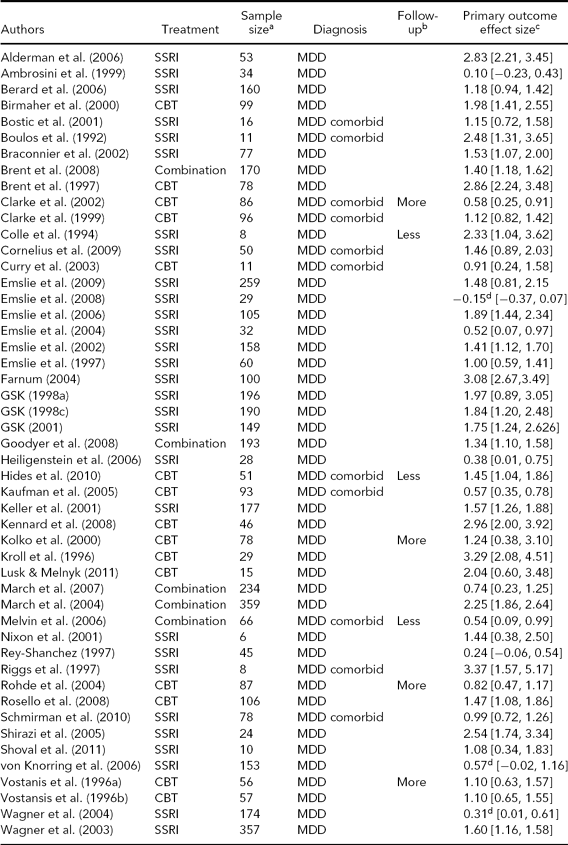
Table 1 lists studies included in the current analysis. To be included, studies had to meet the following selection criteria: (a) studies needed to investigate either CBT, SSRI, or combination therapy; (b) participants had to have a primary diagnosis of MDD; (c) participants had to be aged between 8 and 21; (d) participants had to have no major condition likely to influence the outcome of an intervention (e.g., genetic syndromes or psychosis); (e) studies had to report reliable and valid measures at both pre- and post-treatmentFootnote 1; (f) original articles had to be written in English; and (g) sufficient quantitative information had to be provided to calculate or estimate an appropriate effect size statistic. Where the necessary data required to calculate effect size were not reported, primary investigators were contacted to provide additional information.
Studies Included in the Meta-Analysis

Note: CBT = Cognitive-behavioural therapy; SSRI = Selective serotonin reuptake inhibitors; Combination = Combination therapy; GSK = GlaxoSmithKline; a Sample size at end of acute treatment; b Less than 6 months or more than 6 months; c The figures in parentheses after each effect size are the 95% confidence intervals;d Hedge's g calculated from relapse rate.
Data Coding
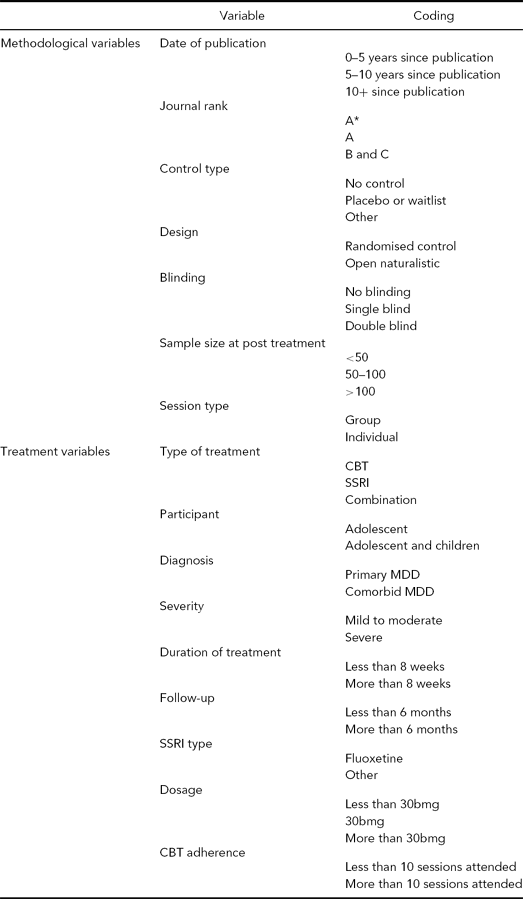
Based on the inclusion criteria and rationale of the current analysis, each study was coded for relevant methodological and treatment characteristics. A small sample of studies was subjected to interrater reliability to ensure that coding of variables were consistent between authors of the study. Although not formally statistically analysed, a descriptive analysis of interrater reliability found a high level of consistency. Table 2 provides a detailed description of coding. The methodological characteristics coded were: date of publication, journal rank,Footnote 2 control type, design, blinding procedure, sample size, and session type. The treatment-related variables were: type of treatment, participant, participant diagnosis, severity of MDD, treatment duration, months to follow-up, SSRI type, SSRI dosage, and CBT adherence.
List of Coded Variables and a Description of the Coding Strategy
Outcome Measures and Meta-Analytic Calculations
Effect size measures were used to test the hypothesis that combination therapy would be significantly more effective than either pharmacotherapy or psychosocial therapy alone. Effect size measures, which are calculated in standarised units, allow comparison between different studies, and were calculated for each study to determine the change from pre-treatment to post-treatment.
The statistical package Comprehensive Meta-Analysis (CMA; Version 2; Borenstein, Hedges, Higgins, & Rothstein, Reference Borenstein, Hedges, Higgins and Rothstein2005) was used to calculate and analyse the effect size measure, Hedge's g, and respective 95% confidence intervals for each assessment measure of MDD.
Hedge's g, a more conservative estimate than other effect size measures for small samples, was derived mainly from descriptive statistics: pre- and post-assessment standard deviations, mean, and post-treatment sample size (Borenstein, Hedges, Higgins, & Rothstein, Reference Borenstein, Hedges, Higgins and Rothstein2009). In studies where this information was unavailable, percentage of relapse and non-relapse rates, or inferential statistics were used to calculate Hedge's g. The magnitude of effect was interpreted as follows: small (0–0.20), moderate (0.21–0.60), large (0.61–1.20), and very large (1.21–∞; Hopkins, Reference Hopkins2009).
Results
Data Preparation
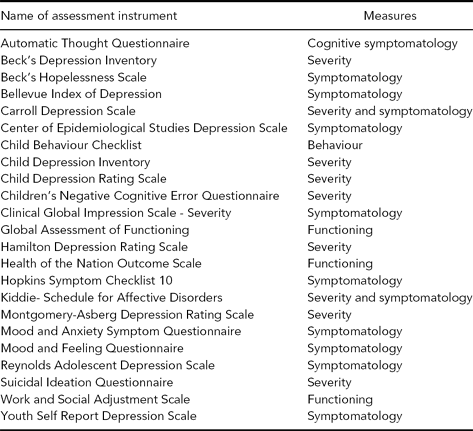
Studies investigating MDD generally include at least two or more assessments of depression measuring different aspects of the condition (i.e., symptomatology, global functioning, and suicidal ideation). To calculate a primary treatment outcome, the current analysis averaged all measurements of depression used in each study. For a list of all assessment measures combined to calculate primary treatment outcome see Table 3.
Assessment Measures Combined to form Primary Treatment Outcome
Preliminary testing revealed that primary treatment outcome for the SSRI and combination treatments satisfied assumptions underlying parametric testing. A small deviation from normality was found for the distribution of CBT. Given that there were 18 trials investigating CBT, parametric tests would be robust against the small deviation, therefore data were analysed in their original form.
Descriptive Statistics
Forty-nine studies meeting the specified criteria were selected. The 49 studies included in the primary treatment outcome analysis were: 14 investigating CBT (Hedge's g effect size M = 1.39, SD = 0.63, 95% CI[1.06, 1.72]Footnote 3, N = 998), 30 investigating SSRI (Hedge's g effect size M = 1.58, SD = 0.71, 95% CI[1.08, 1.70], N = 2,747), and five investigating combination therapy (Hedge's g effect size M = 1.22, SD = 0.51, 95% CI[.82, 1.73], N = 1,022). Notably, very large mean effect sizes were observed for all treatment modalities, showing that the three treatment strategies were highly efficacious.
Inferential Analysis
CMA (Version 2; Borenstein et al., Reference Borenstein, Hedges, Higgins and Rothstein2005) was used to investigate the difference in primary treatment outcome between CBT, SSRI pharmacotherapy, and combination therapy. Data were analysed within a random effects framework, which is based on the assumption that there is a distribution of population parameters, and that different studies estimate different values from that distribution (Borenstein et al., Reference Borenstein, Hedges, Higgins and Rothstein2009). The analysis revealed no statistically significant difference in treatment effect between the three treatment modalities, Q(2, 48) = 0.19, p = .91.
Moderator Variables
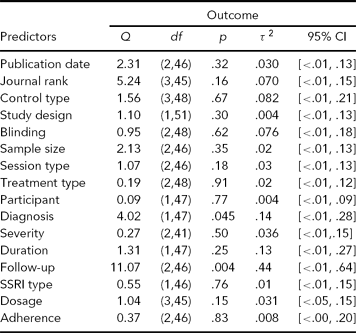
To test the second hypothesis, multiple regression models were used to assess whether the efficacy of the three treatments varied as a function of a coded variable; that is, whether treatment was moderated by any of the methodological and treatment predictors. In order to control the increased family wise error rate resulting from multiple comparison in the moderator analysis, a critical per comparison error rate of p = .01 was used. The multiple regression analyses revealed the variable months to follow-up to have a significant moderating effect on the relationship between treatment type and treatment outcome and Q(2, 5) = 11.07, p = .004 respectively (refer to Table 4 for results of each model). Post hoc analyses were not conducted and therefore the outcome of the analysis is purely descriptive.
Summary of Multiple Regression Model Test for Moderators of the Relationship between Primary Treatment Type and Primary Treatment Outcome
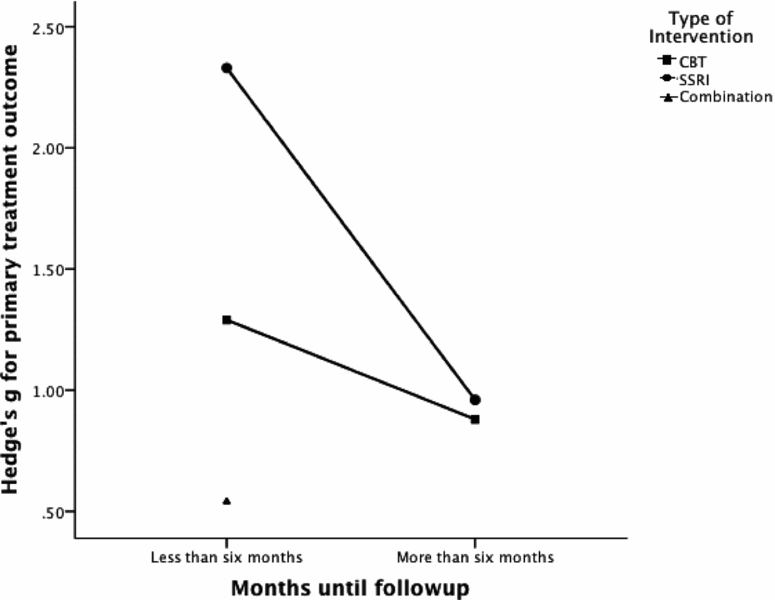
To explore the moderating effect for the variable follow-up, an interaction plot was generated using SPSS statistical package (version 20, 2011). Figure 1 revealed both CBT and SSRI therapy to have decreasing efficacy following treatment. Notably, the interaction plot revealed that the efficacy of CBT decreased at a slower rate than SSRI pharmacotherapy. The conclusions that can be drawn regarding the enduring efficacy of combination therapy are limited as only one trial investigating efficacy at follow-up for combination therapy (Melvin et al., Reference *Melvin, Tonge, King, Heyne, Gordon and Klimkeit2006) was included in the analysis. Figure 1, however, reveals that the efficacy of combination therapy is substantially lower compared with SSRI pharmacotherapy and CBT psychotherapy trials in follow-up periods less than 6 months
The moderating effect of the predictor variable follow-up on the relationship between type of treatment and treatment outcome. The three treatment modalities under investigation were: cognitive-behavioural therapy (CBT), selective reuptake inhibitors (SSRIs), and combination therapy.
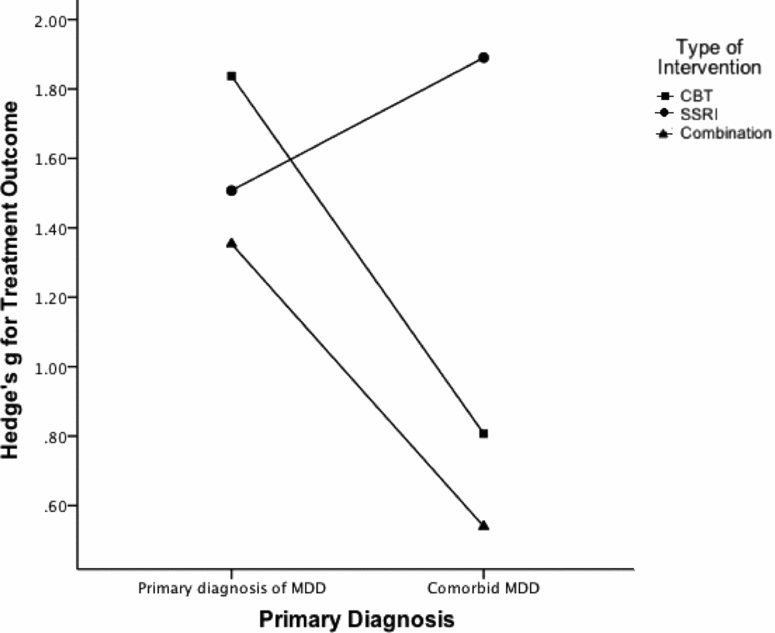
Although diagnosis was not found to significantly moderate the relationship between treatment type and outcome at an adjusted critical per comparison error rate of p < .01, it is worth noting that the effect would have been statistically significant at p < .05, Q = (1,48) = 4.02, p = . 045; hence, this result is worthy of further consideration, with due caution. Figure 2 revealed that for adolescents with primary MDD all three treatments had very large effect sizes, whereas for adolescents with comorbid MDD a very large effect was found for SSRI pharmacotherapy compared with large effects for CBT and moderate effects for combination therapy.
Interaction plot for type of treatment, treatment efficacy, and the treatment variable diagnosis. Diagnosis was coded according to primary diagnosis of major depressive disorder (primary MDD) or comorbid diagnosis of MDD and another axis one disorder (comorbid MDD). The three treatment types are cognitive-behavioural therapy (CBT), selective serotonin reuptake inhibitors (SSRIs), and combination therapy.
Discussion
The present study compared the treatment efficacy of CBT psychotherapy, SSRI pharmacotherapy, and combination therapy for the treatment of adolescents with MDD. Contrary to the prediction that combination therapy would be more effective than either CBT or SSRI pharmacotherapy alone, no significant difference between the effectiveness of the three treatments was found. It should be noted that all three treatments demonstrated very large mean effect sizes, indicating that all are effective treatments. Last, in support of the second hypothesis, one treatment variable (follow-up) was found to significantly moderate the relationship between treatment type and treatment outcome. While the treatment variable diagnosis was not found to be significant at the adjusted per comparison error rate of p < .01, diagnosis was found to have a moderating effect on the relationship between treatment efficacy and treatment type at the more conventional, α = .05, which is worthy to note.
Although some clinical trials have reported combination therapy to be more effective than CBT and SSRI monotherapies for adolescents with MDD (Brent et al., Reference *Brent, Emslie, Clarke, Wagner, Asarnow, Keller and Zelazny2008; March et al., Reference *March, Silva, Petrycki, Curry, Wells, Fairbank and McNulty2004), the current meta-analysis found no evidence for the superiority of combination therapy over monotherapies. This is consistent with previous meta-analyses (Calati et al., Reference Calati, Pedrini, Alighieri, Alvarez, Desideri, Durante and De Girolamo2011; Dubicka et al., Reference Dubicka, Elvins, Roberts, Chick, Wilkinson and Goodyer2010), which found that combination therapy had no benefit over pharmacotherapy alone in improving depressive symptomatology. Calati et al. (Reference Calati, Pedrini, Alighieri, Alvarez, Desideri, Durante and De Girolamo2011), however, found combination therapy to improve functioning more than SSRI monotherapy.
The finding that combination therapy was only as effective as CBT and SSRI monotherapies can be interpreted in terms of a ceiling effect; that is, monotherapies alone reach the maximum possible treatment response. An alternative explanation is that the theorised interaction between CBT psychotherapy and SSRI pharmacotherapy does not result in the additive effect observed in the adult population (Keller et al., Reference Keller, McCullough, Klein, Arnow, Dunner, Gelenberg and Zajecka2000; Pampallona et al., Reference Pampallona, Bollini, Tibaldi, Kupelnick and Munizza2004). It could be that the incomplete development of cognitive capacities and the incomplete maturation of the serotonergic neurotransmitter system in adolescents limits the potentially beneficial interaction.
Investigation of Moderator Variables
To broaden the current understanding of treatment for adolescents with MDD, the current meta-analysis extended on previous analyses to investigate moderator variables. While no significant difference was found among the efficacy of CBT, SSRI, and combination therapy, the treatment variable months to follow-up was found to impact the relationship between efficacy and treatment type.
It is important to investigate follow-up periods, as treatments that continue to be effective during the follow-up phase prevent relapse. Both CBT and SSRI therapies were found to decrease in efficacy with time to follow-up; that is, their sustained efficacy after cessation of treatment appears to be limited. The efficacy of CBT, however, was found to decrease at a rate slower than SSRI therapy, suggesting that the benefits of CBT are more enduring. It is not surprising that CBT has sustained efficacy because participants are taught coping skills that, if maintained, would result in long-term improvements in management of depressive symptoms and functioning (Hollon, Stewart, & Strunk, Reference Hollon, Stewart and Strunk2006). It is not uncommon for SSRI pharmacotherapy to have limited sustained effect because once medication is ceased the chemical balance of serotonin neurotransmitters is disrupted (Therapeutic Guidelines, 2012). It should also be noted that limited numbers of trials across the treatment types with a follow-up period were included in this analysis, particularly for combination therapy, where only one study investigating efficacy at follow-up was included in the moderator analysis (Melvin et al., Reference *Melvin, Tonge, King, Heyne, Gordon and Klimkeit2006). The limited studies included may therefore restrict the conclusions that can be drawn.
Adolescents with a primary diagnosis of MDD and adolescents with comorbid MDD were found to benefit from differing treatment strategies. While adolescents with a primary diagnosis of MDD were found to benefit most from CBT psychotherapy, all three treatments types were shown to benefit this group. On the other hand, adolescents with a comorbid diagnosis of MDD improved more from SSRI pharmacotherapy than other treatments. This result is particularly interesting as it suggests that primary MDD and comorbid MDD may have different underlying aetiology. It could be possible that cognitive distortions are more strongly associated with adolescents with a primary diagnosis, whereas a neuro-chemical imbalance is more pronounced for adolescents with comorbid MDD.
Clinical Relevance and Implications
The treatment recommendations of the National Health and Medical Research Council (McDermott et al., Reference McDermott, Baigent, Chanen, Fraser, Graetz, Hayman and Spence2010) for adolescents with MDD are partially supported by the results of this study. In particular, the results support the recommendation of CBT as a first-line treatment approach for adolescents, but question the value of combination therapy for adolescents who do not respond to first-line treatment.
Given that this study found all three treatments to be equally effective, a strong case can be made in support of CBT over SSRI pharmacotherapy and combination therapy. This argument is based on the points that CBT psychotherapy has no associated side effects, has demonstrated sustained effects (Brent et al, Reference *Brent, Holder, Kolko, Birmaher, Baugher, Roth and Johnson1997; Clarke et al., Reference *Clarke, Rohde, Lewinsohn, Hops and Seeley1999), and that it is the most cost-effective treatment approach, as reported in an Australian review (Haby, Tongue, Littlefield, Carter, & Vos, Reference Haby, Tonge, Littlefield, Carter and Vos2004).
An investigation into the association between SSRI and suicidal ideation and behaviour reported that twice the rate of adolescents receiving pharmacotherapy (4%) experienced suicidal ideation or suicidal behaviour compared with adolescents receiving a placebo pill (United States of America Food and Drug Administration, 2009). SSRI medications are associated with a number of side effects in adolescents, the most common being gastrointestinal symptoms, sleep disturbances, irritability, headaches, and changes in appetite (Birmaher et al., Reference Birmaher, Brent, Bernet, Bukstein, Walter, Benson and Stock2007). While these symptoms are mainly transient, reports that SSRI medications increase suicidal ideation and behaviour in adolescents are of great concern (McDermott et al., Reference McDermott, Baigent, Chanen, Fraser, Graetz, Hayman and Spence2010).
Limitations and Future Directions
The moderating impact of diagnosis on the relationship between treatment efficacy and treatment type, despite being non-significant at p < .01, is a noteworthy finding worthy of further consideration. Given that this result could potentially imply that adolescents with primary MDD and adolescents with comorbid MDD benefit from different treatment approaches, it is suggested that future studies investigate these groups separately, as the difference in treatment response may be indicative of underlying aetiological differences.
While most pharmacotherapy clinical trials assess treatment adherence, using pill counts and diaries, the current meta-analysis did not code SSRI adherence as a potential moderator variable. To investigate the influence of SSRI adherence on treatment outcome it is recommended that future meta-analyses code and investigate SSRI adherence.
The studies included in the current analysis used therapists of varying qualifications and experience. It would be interesting for future studies to investigate the effect of qualifications and experience of therapist on treatment outcome. It is possible that more experienced therapists would be associated with enhanced treatment outcomes.
The current study did not conduct separate meta-analyses for each coded predictor variable. While these analyses would have provided greater depth to the results, it was not possible to investigate the data in this manner. Due to the limited number of studies for each predictor variable, the statistical power of analysis was too low to warrant separate meta-analyses for each variable. Further, a considerable limitation of the current study was that interrater reliability was not formally statistically analysed for the coding of predictor variables.
Additionally, this meta-analysis did not differentiate between assessments of functioning and those of depressive symptomatology. Given that Calati et al. (Reference Calati, Pedrini, Alighieri, Alvarez, Desideri, Durante and De Girolamo2011) found combination therapy improved functioning but not symptomatology, it is recommended that future studies develop a secondary outcome analysis to investigate functioning and symptomatology separately. For greater depth of analyses, it would be recommended that all outcome measures (e.g., functioning, severity and depressive symptomatology) be analysed separately.
To date, the current meta-analysis is the only one to extend its inclusion criteria to incorporate studies other than randomised controlled trials. In support of this, the moderator analysis of the methodological variable design found no difference between the outcomes of randomised controlled trials and open naturalistic trials. Rosenthal and DiMatteo (Reference Rosenthal and DiMatteo2001) support this view and argue that no appropriate collected data should go to waste. Future meta-analyses should also strongly consider the inclusion of non-published articles; however, in doing so, they should be guided by Rosenthal's (Reference Rosenthal1979) ratio to ensure a reasonable ratio of published to unpublished articles.
Finally, although there has been a significant increase in the number of studies investigating combination therapy for adolescents with MDD, the current analysis included only five combination trials. To increase the statistical power of future meta-analyses more combination trials must be conducted. Based on the findings of the current analysis, it would be recommended that these trials consider follow-up and diagnosis, as all have been found to significantly impact treatment outcome.
Conclusion
This meta-analysis found no support for the superiority of combination therapy over either CBT or SSRI monotherapies in adolescents with MDD. A strong case can be made in support of CBT as the first-line treatment for adolescents with MDD, due to its efficacy, sustained treatment effect, lack of side effects, and cost effectiveness. This meta-analysis highlights the valuable role of psychological therapy in treating adolescents with MDD.