Introduction
The Iraqi marshes are the largest ecosystem in the Middle East, and one of the most prominent bodies of water in the alluvial plain in southern Mesopotamia, and they have provided a platform for human interaction with the environment in all its manifestations. Man's interaction with the environment of the marshes has been effective, as it led him to build cities and settlements such as the main cities in southern Mesopotamia, Ur, Eridu, Uruk, Lagash, and dozens of sites that excavations have already provided us with a lot of information about, as well as archaeological discoveries that are still revealing more aspects of the civilization of the region.
Due to a possible risk of flooding, rescue excavations have been conducted in the marshes at several sites with the purpose of revealing the different cultural levels that were occupied there. One of these sites was Tell Abu al-Dhahab, in which evidence was revealed for an important dynasty that ruled Mesopotamia for several centuries (366 years, if we trust Babylonian King List A).Footnote 1 The First Sealand (or Babylon II) Dynasty (1740–1374 BC) established its rule from Babylon to the coasts of the Arabian Gulf up as far as Dilmun (Bahrain). Due to the emergence of the outstanding universal values of the marshes area, both cultural and natural, the area won the honor of being inscribed on the World Heritage List in 2016.
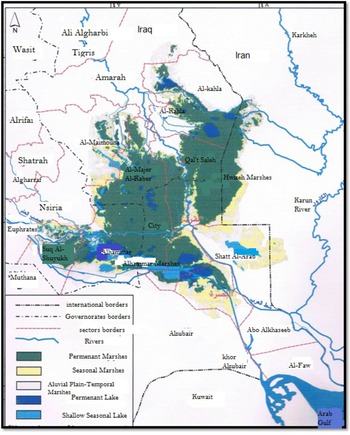
Mesopotamia is a generous land, endowed with the attributes of environmental and human diversity, which led to making it the cradle of ancient dynasties, as well as the of the rise of cities and archaeological sites on its land, and these dynasties have introduced many religious, scientific, literary, artistic and military achievements.Footnote 2 The marshes, this charming and mysterious world, are an important part of Mesopotamian civilization, due to their position, being one of the most prominent of water bodies in the alluvial plain in southern Mesopotamia (Fig. 1). Many archaeological sites with different occupational histories are contained within them.Footnote 3 The importance of the marshes is manifested in several aspects, some of which have been discovered through methods such as archaeological survey and excavation:
1. There has been a close mutual interaction between history and geography (cultural and natural heritage) since ancient historical times in this region.
2. Cuneiform texts reveal many stories and myths relating to the marshes area, among others those associated with Enki and the Creation Myth.
3. The area became a settlement site for different peoples, which resulted in a number of different cultural phases.
4. This region has preserved a continuity of cultural heritage over thousands of years.
5. All this accounts for the fact that the region has become, at the present time, the focus of attention of many Iraqi and foreign researchers.Footnote 4
The marshes of southern Mesopotamia. Source: authors. Implementation: Assist. Prof. Dr. Hussam Fadhel / College of Arts - Department of Geography, Baghdad University.

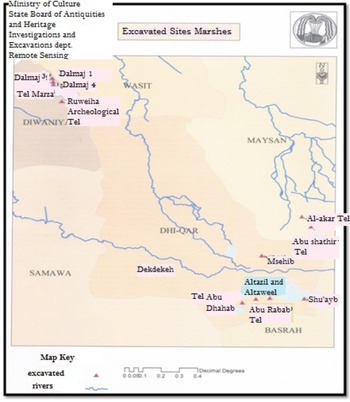
Rescue archaeological excavations have been undertaken at several sites in the marshes region, in order to reveal the different cultural phases that attest to the local settlement history, and among these sites was Tell Abu al-Dhahab (Fig. 2). One of the most important sites of the region, Tell Abu al-Dhahab – al-Hammar al-Gharbi, is located in Hor al-Malih, one of the al-Hammar al-Gharbi marshes, in Dhi Qar governorate, 45 km to the southeast of Suk al-Shuyukh district. The site is almost oval in shape, its area is 6.76 ha and its highest point reaches 5.5 m above the level of the adjacent plain. Iraqi expeditions excavated in it for several seasons between 2011–2013. During these seasons, one phase was revealed, belonging to the first Sealand Dynasty (Babylon II dynasty) (1740–1374 BC).Footnote 5
Map showing Tell Abu al-Dhahab. Source: authors. Executed by: Mrs. Hala Mohammed / State Board of Antiquities and Heritage - Remote Sensing Section.

The First Sealand Dynasty (also known as Babylon II Dynasty; 1740–1374 BC) was an important dynasty that ruled Mesopotamia for several centuries, and established its rule from Babylon to the coasts of the Arabian Gulf and up to Dilmun (Bahrain) in the Arabian Gulf.Footnote 6 This dynasty reigned over central and southern Mesopotamia, and was ruled by 11 or 12 monarchs, beginning with its founder, King Ilīma-Ilum (1740 BC) and ending with the rule of King Ea-gāmil in the 14th century BC.Footnote 7 The Sealand dynasty came to prominence especially during the later reign of Samsuiluna (1749–1712 BC), after there had been a large-scale rebellion against Babylon that started in the old cities of the south in his 8th and 9th years, triggering a decline of Babylonian power that lasted until the city's fall in 1595 BC (Middle Chronology). This Sealand Dynasty was distinguished by a mixed population,Footnote 8 with personal names in several different languages, including Sumerian, Akkadian, and Elamite.Footnote 9 As for the religion of this dynasty, it does not differ from the religion of Mesopotamia throughout its different ages. However, they may have given the Goddess Ishtar a higher status than the rest of the gods.Footnote 10 In economic terms, this dynasty was of great economic strength in terms of agriculture, trade and industry.Footnote 11
Through our study of this dynasty, we found that regular archaeological excavations have thus far only revealed only a small part of it, so the history of this dynasty remains unclear from several cultural perspectives, especially the architectural, literary and artistic aspects. However, a dynasty estimated to be centuries old, must have seen great development. Oates stated that this dynasty had provided a refuge for scholars from the centres of learning of Babylon, that resembled “universities” in our present time, which are the headquarters of science and culture.Footnote 12
As for the construction side, the excavations of Tell Abu al-Dhahab revealed several buildings, some of which are secular, some religious, which were distinguished by their size and beauty.Footnote 13 These can be compared in addition with a huge building found in Tell Khaiber, which was considered a large administrative and regional center.Footnote 14 This is only a brief summary of the marshes area and the ancient dynasty discovered there, and what little has been discovered about them. Perhaps future excavations will show other aspects of this dynasty, especially its cultural side.
The Temple Building
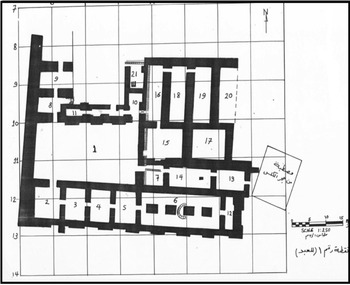
In order to clarify the temple building,Footnote 15 which has an area of 65 x 52 m (see Fig. 3), we compared it with other temples in terms of shape and other structural elements, large area, and the presence of transverse spaces (sacred rooms) and connecting rooms. A group of 5 niches in the rooms 11, 12, 14, 15 indicates the worship of more than one deity in this temple. Additionally, there is an inner courtyard surrounded by smaller rooms, including one columned hall, laid out on both straight and refracted axes. These architectural characteristics can be compared to those in the temple of Ishtar Kititum in Ishchali: the rectangular shape, its large area, the presence of the pillars, and the multiplicity of mainly transverse cellas, as well as the element of niches, with the presence of linking rooms (ante cella), and the presence of one or more squares, in addition to the availability of many rooms and the use of both straight and refracted axis systems. These features and/or elements are found in many Old Babylonian temples, including the main Nissaba temple in Harmal, the Gula Temple in Isin, and the Ishtar and Teshub temple in Nuzi among others.Footnote 16 As for the direction of temple walls towards the four sides and not its corners, this characteristic was found in the Square temple of Abu in Tell Asmar (Eshnunna) from the Early Dynastic III period,Footnote 17 and also in the Šuda Temple in the city of Pašime,Footnote 18 dated to the Old Babylonian period.Footnote 19
Tell Abu al-Dhahab Temple. Source: authors.

Niches first appear in the temples of the Neo-Sumerian era, such as the Temple of Enki in Ur and the temple of Shu-Sin in Eshnunna (Tell Asmar), prior to the old Babylonian era.Footnote 20 After comparing the temple at the site of Abu al-Dhahab with the temples of Shamash at several sites in Mesopotamia, there is some structural similarity between this temple and the other temples of Shamash discovered in Larsa and Ashur,Footnote 21 although in other respects they are different.
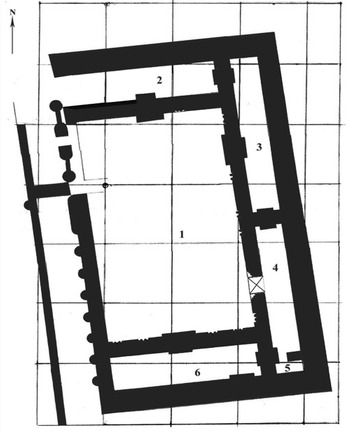
We find that the temple of Tell Abu al-Dhahab is almost no different from the temple at Larsa dedicated to the worship of Shamash, in terms of the large area, the size of the walls, the number of rooms, the central square and the organisation of space with the presence of external as well as internal pillars. It also has an annex, just as an annex to the temple of Abu al-Dhahab was also discovered. It is a large stone building located 5 m west of the main temple with spiral column decorations (Fig. 4), which is believed to be a hall for religious ceremonies. Its dimensions are 59 x 35 m. As for the differences between them, we find that the Larsa Temple has an exterior rectangular shape and a ziggurat in it, and the rooms in it are mostly longitudinal and are located at the edges of the temple walls around the ziggurat. As for the Temple of Abu al-Dhahab, it is probably a rectangular temple, although the fact that its excavation has not been completed means that the building may in fact be square. The rooms are both square and wide rectangular, with more spaces for niches, in addition to the presence of a bench made of limestone on the eastern side.
A representation of the hall attached to the temple. Source: Abboud et al. Reference Abboud, Mirza, Sawadi, Taher, Abdel-Razzaq and Attia2015: 34.

As for the comparison of the Temple of Abu al-Dhahab with the double temple in Ashur, which is dedicated to the worship of the gods Sin and Shamash, we find that the space is converging, and there are many rooms with different shapes. Both these temples included the inner (medial) yard, and we note the presence of more than one cella, as well as for the rooms between (ante cella). As for the differences between them, we find that the external façade of the temple of the city of Ashur is graded, while the main façade of the temple of Tell Abu al-Dhahab is not known due to the fact that the excavation was not completed. In the southern wall of the temple of Shamash in Tell Abu al-Dhahab, there are external pillars, whereas in the temple of Ashur, its walls are devoid of this feature. The frequent cellas in the temple of Abu al-Dhahab could potentially support the worship of more than one god, while the temple of Ashur contains two cellas belonging to the gods Sin and Shamash respectively. The temple of Abu al-Dhahab is larger than the temples at Larsa and Ashur; in terms of the number of worshiped deities, and perhaps even in space, if it were fully exposed.
Also, through excavations in Tell Abu al-Dhahab, many archaeological artefacts were discovered, some of which are distinguished by different technical characteristics, such as jars with cuneiform symbols, cylinder seals, various metal items, ivory pieces, in addition to the bone of an animal leg engraved with the face of a woman. The cylinder seal which is the subject of this study was one of the most important of these finds.
The cylinder seal (Fig. 5–7)
Before entering into the details of the seal, the subject of this article, we should give a brief overview of the seals and their importance in the Mesopotamian civilization on the one hand, and their scientific value in archaeological studies on the other hand. Stamp and cylindrical seals are considered a main subject in the study of archaeology, and they are no less important than the rest of the archaeological materials in providing knowledge of the eras of the Mesopotamian civilization, because they carry accurate and valuable historical information from the religious, political, economic, legal, social, administrative and artistic aspects. Seals carried scenes that represented the various aspects of life of the people of Mesopotamia in their various eras.Footnote 22
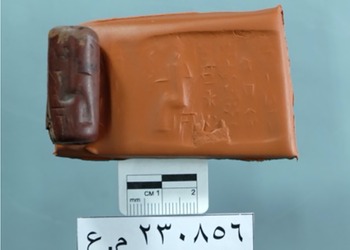
Cylinder seal IM 230856 with impression. Source: authors.

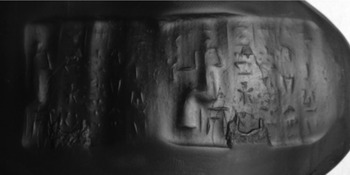
Modern impression of cylinder seal IM 230856. Source: authors.

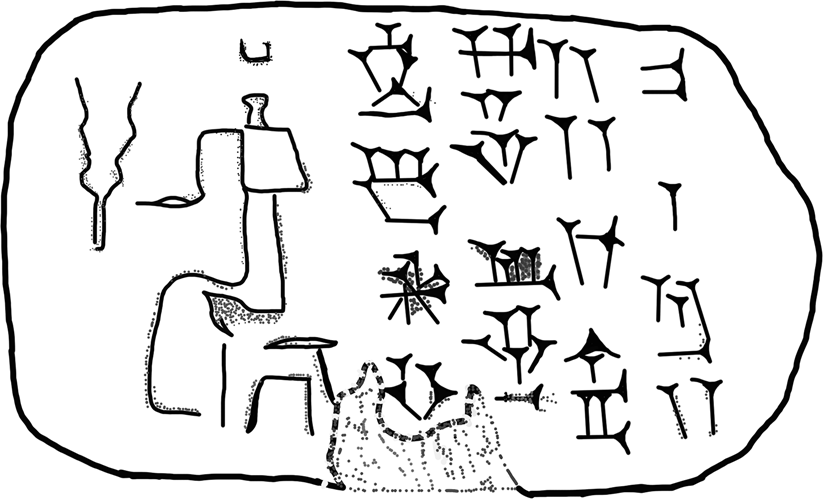
Drawing of cylinder seal impression. Source: Yaser Ammar, State Board of Antiquities and Heritage, Cuneiform Section, 2020.

The cylinder seal is a cylinder or a bead made mostly of different types of stone, metal, baked clay, seashells, ivory, or frit paste, of different sizes and lengths perforated from the middle in a longitudinal way, to make it easy to carry by metal wire or string and attached to the neck or wrist, its outer surface engraved in bas-relief, or scraping, and in reverse shape, scenes and drawings whose themes and artistic styles differ from one age to another, and when rolling the seal on the surface of the soft clay, we notice that its inscriptions and drawings appear prominently and in the correct form that the artist wanted.Footnote 23 Also, the different sizes of seals and the variation of the types of materials they were made of require high precision in their manufacture, in order to demonstrate their high skills in making drawings or engravings, and to show the high technique when rolling the seal or printing it to show their subjects.Footnote 24
The seals, according to the interpretation of specialists, had several purposes, as the seal became the signature of the person who owns the seal, or his identification card, as sometimes the name of the person, the name of his father, and even his profession is engraved on it.Footnote 25 The seals are a serial encyclopedia and illustrate scenes of various aspects of daily life in Mesopotamian society.Footnote 26 The seal is also a veil or a shield for its owner or a means to bring good luck, through the inscriptions and drawings that the seal bears related to the religious aspects, and the various engraved and varied artistic forms on the seal, which differ from one age to another with the presence of the writer in some of them, led to make the seal an important source of history, by helping to distinguish between the cultural stages that Mesopotamian civilization went through.Footnote 27 Through this introduction, we noticed how seals of all kinds have great significance in the history of the Mesopotamian civilization, and how they affect the daily life of the Mesopotamian society.
As for the seal which is the subject of this research (it has the Iraq Museum number IM 230856), we will mention its general characteristics, which are as follows: The cylinder seal is made of red alabaster; it is 3.2 cm in height, and 1.5 cm in diameter. It can be dated to the period of the First Sealand Dynasty (Babylon II Dynasty; 1740–1374 BC.) It was found in the second floor of the first level of the temple, in the middle of room 16.Footnote 28
Design and inscription
In the following description, we will also mention the inscription that the seal included on its surface. The seal is perforated longitudinally; a religious scene is inscribed on it by a non-sunken engraving method. On the left of the scene, a god is depicted seated on a throne or chair without an armrest, crowned with a horned crown, wearing a long garment, placing his left hand under his chest, and his right hand is extended forward. In front of the face of the god on the left side of it, a symbol represents the lightning bolt.Footnote 29 This is one of the symbols of Adad (the storm and rain god), so it is likely that the seated god is Adad because of the presence of his symbol on the seal.Footnote 30
The seal contains on its right side and behind the seated god a cuneiform inscription that consists of four lines with rulings separating them. Some of the writings are unclear or distorted. A transliteration and translation follow:Footnote 31
1. a-⸢×⸣-ba-ni
2. ⸢dumu ṣil 2⸣-li 2-eš 18- tar 2
3. ugula ⸢maš2.šu.gid2.gid2⸣
4. ir3 ša dutu?
1. A-[x]-Bāni
2. offspring of Ṣillī-Ištar
3. Supervisor (of) the divination priests
4. Servant/slave to Shamash?Footnote 32
Discussion
The find of this seal on the floor of room 16 of the large temple discovered at the site (Fig. 3) is of great importance among the discoveries of Tell Abu al-Dhahab, especially given the text that was inscribed on it. The fully preserved name Ṣillī-Ištar seems to be quite common.Footnote 33 However, the use of the word “supervisor” (ugula, and in Akkadian šāpir/wakil), means that the man who is the son of Ṣillī-Ištar, whose name cannot yet be read entirely, is in charge of the group mentioned afterwards (the literal meaning).Footnote 34 According to our interpretation, the signs that follow the word ugula make up the logogram maš2.šu.gid2.gid2 meaning divination priest (Akkadian bārû), so A-[x]-Bāni is the supervisor or overseer of the group of priests of divination. Moreover, the last line of writing possibly stating that A-[x]-Bāni is the servant of Shamash or a servant belonging to the temple of Shamash, leads us to believe that this individual may be responsible for the temple of Shamash, or the temple at Abu al-Dhahab, in addition to his first job, which is to supervise the priests of divination.Footnote 35
The profession of diviner or extispicist was of great importance in Mesopotamian civilization, and indeed it is one of its great achievements, especially from the Old Babylonian era until the Seleucid era, and abundant information has been revealed about divination consisting of collections of omens in cuneiform texts. The extispicist is the point of human contact with the gods, interpreting the messages manifested in the liver through which the gods embodied their decisions.Footnote 36 There is also deductive divination which is common from the Old Babylonian until the Seleucid era.Footnote 37 The diviner has great importance not only in the temple, but even in other state institutions, as he was close to the king, and sometimes accompanied the army because his activity had a psychological effect for the army in terms of reading omens and thus helping to decide strategy. He is also likely to be wealthy because of his sensitive positions in the state and the temple.Footnote 38 Thus the owner of this seal is likely to have possessed an important position in the temple as well as in the state.
Regarding the presentation scene depicted on the cylinder seal: the seated deity is represented with the symbol of the bolt of lightning in front of him. The presentation scene is popular on seals after the Ur III period, while the lightning bolt is not so frequently attested.Footnote 39 Possibly this element could associate the deity with the ‘god of lightning and thunder’ Adad. What is curious though is that the inscription may mention Shamash (God of the sun and justice) and this raises the question of why are they combined? The answer would presumably be that both of these gods are patrons of divination.Footnote 40
We believe that the discovery of the seal in situ on the floor of the temple gives it more significance. The finds discovered on the floors of religious and secular buildings are an integral part of those buildings, unlike those items found in the rubble of buildings, since they may have been moved (or stolen/taken) from elsewhere. Finding it on the floor of the temple is a fact that adds to the importance of the seal, as it may be part of the temple equipment.
Conclusions
Therefore, we note through the presence of the inscription, as well as the discovery of the seal on the floor of the temple, evidence that makes it more likely that the owner of the seal was an important official in the large temple of Tell Abu al-Dhahab, which we believe is the temple of Shamash, based in particular on the last line of the cuneiform text of the seal. It is possible that future excavations, as well as the publication of the cuneiform texts discovered near the temple, will provide us with more detailed information about the temple, in particular, and the site of Tell Abu al-Dhahab in general. When comparing this cylinder seal with the seals of the Old Babylonian period, and the religious scene and the text it bears, we find that it does not differ greatly from those seals dated to either the OldFootnote 41 or Middle Babylonian period.Footnote 42
The mention of Shamash in the inscription and the image of Adad and his symbol of the lightning bolt is a clear indication of the religion of the first Sealand Dynasty and its reverence for the Mesopotamian gods. As additional evidence for the prominence of Shamash one might cite the divine name Šamaš-ana-Gulkišar-kurub “O Šamaš bless Gulkišar”,Footnote 43 which occurs in a list of gods on a tablet from an unprovenanced archive dating to the Sealand Dynasty. The name consists of a blessing on the famous sixth king of the line, Gulkišar.Footnote 44 This may show the importance of worshipping Shamash in the community ruled by this dynasty, and asking him for blessings, which suggests that a temple of this magnitude might have been built for this god due to his elevated status among them.
And even if this temple is not specifically dedicated to Shamash, then given the multiplicity of cellas including the southern part of the temple, which is a miniature temple inside the large temple, we believe that some part of the whole must have been dedicated to this important god. The attribute of worship of more than one deity in a temple is quite widespread in Mesopotamia throughout its historical ages, and it does not diminish the importance of Shamash that we are arguing for here.
We note that the plans of temples in Mesopotamia differ among themselves throughout its historical ages, but this is the first temple which has been discovered in the modern era belonging to the First Sealand Dynasty. It includes many cellas and the find of the cylinder seal may indicate that Shamash was worshipped here either as the main or as a subsidiary god. The temple can be compared with previously excavated examples and is distinguished by the enormity of its walls and a regularly planned structure. It thus becomes clear that this great dynasty paid much attention to the temples and the reverence of the well-known gods in Mesopotamia, especially Shamash as one of the main gods who were worshiped by this dynasty. Therefore, the find of this seal was of great importance. Due to its iconography and inscription, it brought to light data that we think are of significance regarding the architecture and religion of the Sealand Dynasty. Future excavations will hopefully clarify the identity of this temple, especially in combination with reading the cuneiform texts that have been discovered at Tell Abu al-Dhahab.