


Introduction
Obesity is a highly visible and stigmatized disorder and there is copious evidence documenting the ways in which obese individuals experience malign treatment and prejudice in society. Wott and Carels (Reference Wott and Carels2010) identify different levels at which weight stigma is manifested; societal, interpersonal and internalized. Societal and interpersonal levels are conceptualized as external forms of weight stigma which play an influential role in the maintenance of internalized weight stigma. Internalized weight stigma describes the degree to which an obese person endorses weight-based negative stereotypes and attributes these to themselves (Durso et al., Reference Durso, Latner, White, Masheb, Blomquist and Morgan2012). Internalized weight stigma mirrors negative societal attitudes, beliefs and self-criticism expressed about obese individuals, but is self-directed. Whilst there has been much written about the presence and manifestations of weight stigma, there has been little attention paid to formulation and therapeutic interventions with individuals who experience, and internalize, weight stigma. This is a specific and distinct psychological difficulty that could be neglected or overlooked because of the focus on psychological approaches to weight reduction in obesity. The aim of this paper is to propose a formulation model which outlines the processes involved in the maintenance of internalized weight-related stigma. This is relevant to practitioners working in generic psychological services as well as specific weight management/eating disorder services because as obesity rates increase, we are likely to see more people being referred for psychological difficulties associated with weight stigma.
The interplay between external and internal weight stigma
Weight stigma has been described as “negative weight-related attitudes and beliefs that are manifested by stereotypes, rejection and prejudice towards individuals because they are overweight or obese” (Puhl, Moss-Racusin, Schwartz and Brownell, Reference Puhl, Moss-Racusin, Schwartz and Brownell2008). Obese individuals report frequent experiences of weight stigma. Friedman, Ashmore and Applegate (Reference Friedman, Ashmore and Applegate2008) found that 100% of their sample of obese individuals experienced weight stigma in the past month. These included physical barriers, nasty comments and being stared at. Indeed, experiencing weight stigma is negatively associated with self-esteem (Jackson, Grilo and Masheb, Reference Jackson, Grilo and Masheb2000; Friedman et al., Reference Friedman, Ashmore and Applegate2008), which indicates that external devaluation impacts on internal self-evaluation. The individual's self-concept may mirror the way in which they are (or perceive themselves) to be viewed by others. The formulation model, which is based on a hexaflex diagram, is presented in Figure 1. This paper is structured around this model which focuses on: a) the impact of the weight stigmatizing environment on negative evaluations about the self as an obese individual; and b) the maintenance of “internalized weight stigma” through attentional, emotional, cognitive and behavioural factors. The core difficulty of internalized weight stigma and the proposed maintenance factors can influence each other, and therefore the lines on the hexaflex model are interconnected.
A formulation model of internalized weight stigma

External weight stigmatizing environment: social, political and interpersonal context
Although obesity is increasingly common, obese individuals are often the target of denigration and prejudice and have become part of a socially devalued group (Puhl and Brownell, Reference Puhl and Brownell2001). Crandall (Reference Crandall1994) suggested that there is a lack of normative pressure to suppress expression of weight-related prejudice compared to other forms of prejudice. Social desirability does not have the same inhibitory effect on expression of weight-related prejudice and it appears to be a more socially acceptable prejudice. Latner, O'Brien, Durso, Brinkman and MacDonald (Reference Latner, O'Brien, Durso, Brinkman and MacDonald2008) found that stigma towards obese individuals was stronger than other stigmatized target groups (e.g. homosexual and Muslim groups). Indeed, overt hostility towards, and bias against, obese individuals is found in many different environments including social, educational, occupational and medical/health settings (Puhl and Brownell, Reference Puhl and Brownell2006).
There is societal pressure for individuals to be slim (Crandall, Reference Crandall1994) and this ideal creates a visible benchmark for those who are obese. Klaczynski, Goold and Mudry (Reference Klaczynski, Goold and Mudry2004) reported that the more an individual deviates from a societal ideal, the more likely they are to be perceived (by self and others) as personal failures and less physically and socially attractive. Indeed, the higher the individual's body mass index, the greater the frequency of weight related stigmatization (Myers and Rosen, Reference Myers and Rosen1999; Puhl and Brownell, Reference Puhl and Brownell2006). This implies that as an individual's size increases, so does their public visibility and they experience increased weight-focused evaluation and stigma.
Weight stigma is manifested in the opinions that individuals hold about the personality characteristics of obese individuals. Obese individuals are assumed to be unsuccessful, unintelligent, unhappy, sloppy, lack willpower and personal control (Puhl and Brownell, Reference Puhl and Brownell2006). These beliefs form early in life, for example, 3-year-old children attribute characteristics such as stupid, sad and lonely to obese peers (Greenleaf, Chambliss, Rhea, Martin and Morrow, Reference Greenleaf, Chambliss, Rhea, Martin and Morrow2006). Hebl, Ruggs, Singletary and Beal (Reference Hebl, Ruggs, Singletary and Beal2008) used computer software to manipulate images of target individuals so they were slender, large or very large. They asked participants to rate these individuals on six dimensions and found that as target weight increased, ratings of attractiveness, intelligence, happiness, job aptitude, relationship success and popularity/sociability decreased. Interestingly, obese participants did not show any leniency or favourability towards obese targets and rated them just as negatively. This provides an insight into how obese individuals may evaluate their own size and the characterological meaning of this. These studies show that individuals tend to generate global, negative evaluations about an individual's character and life, based purely on their obesity.
One reason why individuals attribute these personality characteristics to obese individuals relates to underlying beliefs about the individual's responsibility for both causing and resolving obesity (Puhl and Heuer, Reference Puhl and Heuer2010). Herek, Capitanio and Widaman (Reference Herek, Capitanio and Widaman2003) suggest that the evaluations we make regarding an individual's personal responsibility for disease leads to affected individuals being judged as culpable or innocent. Weiner, Perry and Magnusson (Reference Weiner, Perry and Magnusson1988) found that people suffering from diseases for which they were perceived to have little responsibility (e.g. Alzheimer's disease) were viewed more sympathetically and elicited stronger intentions to help. However, people who were judged to be highly responsible for their condition (e.g. drug addiction or obesity) elicited negative responses of dislike, blame and low intentions to help.
Whilst there is clear evidence that there are multiple, complex variables associated with obesity (and weight management) including genetics, metabolic and neuroendocrine factors (Karasu and Karasu, Reference Karasu and Karasu2010), this is not a widely recognized discourse or explanation amongst the lay public. Maddox, Back and Liederman (Reference Maddox, Beck and Liederman1968) reported that beliefs about weight controllability can affect how obese individuals are perceived. There is consistent evidence that people have more positive beliefs about obese individuals when they believe that their obesity is attributed to a medical condition beyond the individual's control (DeJong, Reference DeJong1980; Allison, Basile and Yuker, Reference Allison, Basile and Yuker1991). Typically, obesity is attributed to factors that are perceived to be within an individual's control (e.g. overeating, lack of exercise) and therefore obese individuals are viewed as personally responsible for causing and not addressing their weight problems (Bell and Morgan, Reference Bell and Morgan2000).
The model suggests that weight stigma experiences vary in their level of toxicity and impact. Indeed, Puhl et al. (Reference Puhl, Moss-Racusin, Schwartz and Brownell2008) asked obese individuals to describe their worst experience of weight stigmatization and the most common sources of stigma were peers/friends, partners, parents and other relatives. It is likely that the expression of weight stigma from an individual in one's personal network of relationships will have a greater impact on self-esteem. The concept of the external environment impacting upon the individual's self-concept is well established, for example, Cooley (Reference Cooley1956) states that self-concept develops through our interpersonal interactions and reflects one's perception of other's appraisals or evaluations. The relationship between external devaluation and internal evaluation is powerful and can become self-perpetuating. It is noteworthy that studies have found that obese people hold stigmatizing beliefs about peers who are obese (Hebl et al., Reference Hebl, Ruggs, Singletary and Beal2008; Wang, Brownell and Wadden, Reference Wang, Brownell and Wadden2004) and this may provide an insight into how they evaluate themselves (i.e. self-self relationship). The lack of social support to act as a buffer against stigma is a further vulnerability factor. The support networks that are available to other stigmatized groups do not exist in relation to obesity and there is no sense of group pride in identity or membership to counteract stigma (Davison, Schmalz, Young and Birch, Reference Davison, Schmalz, Young and Birch2008).
Internalized weight stigma
What impact do these external weight stigma experiences have on the individual's evaluation of their weight and character? We hypothesize that these external factors predispose or increase an individual's vulnerability to internalized weight stigma. The experience of being identified as belonging to a stigmatized group and being the object of negative evaluation can impact upon the individual's self-evaluation and self-esteem. The combination of negative attributions of personal responsibility and controllability for obesity plus highly visible signs of this stigmatized characteristic means that the conditions are ripe for psychological distress. The key psychological factors that are hypothesized to maintain internalized weight stigma are outlined below. It is important to note that these maintenance factors impact directly on internalized weight stigma and also influence each other to have an indirect impact on weight stigma. For instance, avoidance leads to increased mood difficulties, which in turn could exacerbate internalized weight stigma.
Negative self-evaluation and beliefs about others reactions and evaluations
There is a bi-directional feedback loop between an individual's self-judgements and how they think others view them and this can have a powerful formative effect on self-evaluation and self-esteem (Luke and Stopa, Reference Luke, Stopa and Stopa2009). This is represented in the proposed model whereby negative external judgements become an internalized process of self-judgement that then impacts on how the individual interacts with others and the environment. The cognitive behavioural models of low self-esteem (Fennell, Reference Fennell1997) and social anxiety (Clark and Wells, Reference Clark, Wells, Heimberg, Liebowitz, Hope and Schneier1995) both emphasize the role of self-representation and evaluation and are used as a framework for understanding the maintenance of internalized weight stigma. Negative self-perception is often maintained through social comparisons of social status and rank (Luke and Stopa, Reference Luke, Stopa and Stopa2009) and judgements of inferiority and inadequacy are associated with shame and low self-esteem (Gilbert, Reference Gilbert1997). This is pertinent in relation to obesity as this is a highly visible marker of a socially undesirable characteristic. Klaczynski et al. (Reference Klaczynski, Goold and Mudry2004) suggest that obese individuals may devalue themselves because they are aware that they fall into a socially devalued group. Studies demonstrate that negative beliefs about the meaning of being obese develop early in life and impact on various psychological domains. For example, Davison et al. (Reference Davison, Schmalz, Young and Birch2008) reported that obese 11 year old girls who scored highly on a scale assessing stereotyped beliefs about being fat, had significantly lower global self-worth and perceived attractiveness and more maladaptive eating attitudes than all other groups of girls, and these effects were maintained two years later.
The literature on social anxiety highlights the importance of adverse interpersonal feedback on the formation of negative self-evaluation and negative observer-perspective images. Hackmann, Clark and McManus (Reference Hackmann, Clark and McManus2000) investigated the relationship between imagery and early memories in social anxiety. These early memories tended to focus on being the recipient of negative evaluation (e.g. being bullied, criticized, shamed or embarrassed) by people who were perceived to be critical and judgemental. Reynolds and Brewin (Reference Reynolds and Brewin1999) suggest that if experiences of feeling shamed, rejected and criticized are internalized they can result in viewing and relating to the self in the same way that others have. Indeed, this is supported by Carr and Friedman (Reference Carr and Friedman2005) who reported that obese individuals (compared to normal weight individuals) had lower levels of self-acceptance. This relationship was fully mediated by the perception that they had been discriminated against because of their weight. This suggests that obese individuals may view themselves negatively because they believe that others perceive them negatively due to their weight. Fennell and Jenkins (Reference Fennell, Jenkins, Bennett-Levy, Butler, Fennell, Hackmann, Muellerand and Westbrook2004) highlight the interaction between beliefs about the self and beliefs that the individual holds about how others evaluate them. For example, in relation to weight, the belief that “I am weak because I cannot control my weight” combined with the belief that “Others will think I am unattractive and lacking in self-discipline because I am obese” is likely to have a compound effect on self-esteem.
The model of social anxiety by Clark and Wells (Reference Clark, Wells, Heimberg, Liebowitz, Hope and Schneier1995) proposes that when socially anxious individuals are in anxiety-provoking situations, they process information about themselves as “social objects”, which means that they use internal cues (e.g. intrusive images, feelings of self-consciousness) to generate biased perceptions of how they think others view them. We propose that individuals who have internalized weight stigma process themselves as “stigmatized social objects” as a reflection of their socially devalued identity. One of the divergences between internal weight stigma and social anxiety relates to the accuracy and reality of the individual's perception of how others view them. As outlined previously, there is considerable evidence that there is a reality base to the concerns and predictions expressed by obese individuals about how others view them. Individuals with social anxiety tend to have strong conviction in their beliefs about how others see them yet these are often inaccurate. The “observer perspective” images and beliefs generated by socially anxious individuals are often inaccurate and tend to be a representation of their own self-view (e.g. Christensen, Stein and Means-Christensen, Reference Christensen, Stein and Means-Christensen2003). Naturally, these negative self-images and beliefs form a bi-directional relationship with low self-esteem. With regard to obese individuals, it is likely that some of the predictions they make about how others view them are based in reality (and experience) and that this external feedback also impacts upon self-esteem. In terms of intervention approaches, there is a need for a delicate balance between acknowledging potentially realistic appraisals of how others evaluate them versus the potential traps of over-generalizing. The approach used by Moorey (Reference Moorey and Salkovskis1996) when working with seriously ill individuals whose distress is rooted in realistic appraisals of an adverse situation involves focusing on the impact and utility of negative cognitions and is highly applicable. However, there is also a tendency for individuals to make overgeneralized predictions about others’ reactions after having stigmatizing experiences and, as with social anxiety, misinterpret ambiguous social/environmental cues (Luke and Stopa, Reference Luke, Stopa and Stopa2009). It is helpful for individuals to start questioning whether they are making realistic judgements versus making overgeneralized predictions. Other helpful interventions include compassionate mind therapy to reduce self-criticism, increase self-compassion and self-soothing strategies (Gilbert, Reference Gilbert2010). This is particularly important as Lehman and Rodin (Reference Lehman and Rodin1989) found that individuals with bulimia, versus non-bulimics, differ in their ability to self-nurture and self-soothe in ways that do not involve eating.
Images can be extremely powerful sources of distress, particularly in relation to weight, shape and size as these naturally lend themselves to visual mental representation. Many clients have traumatic and shameful images related to their weight, for example a client had an image of everyone staring and talking about her when she could not fasten the aeroplane seatbelt. Another client had an image of herself as a child getting stuck when trying to crawl through a tunnel in an obstacle course and her peers laughing and ridiculing her. Imagery rescripting techniques, as used in post-traumatic stress disorder, are effective. This helps individuals emotionally process and update these powerful and shameful memories so that they do not remain “stuck” at hotspots and are able to update the images and the outcome of the situation. This intervention has been applied successfully to individuals with social anxiety whose negative self-imagery when anxious was related to early traumatic social or interpersonal experiences (Wild, Hackmann and Clark, Reference Wild, Hackmann and Clark2008).
Clearly there is a delicate balance to strike between intervention approaches that focus on decreasing avoidance whilst simultaneously increasing resilience due to the potential reality of the weight stigmatizing social environment.
Attentional processing
The negative impact of stigma and ostracism is influenced by how individuals recall that experience. Field perspective involves recalling an event through one's own eyes whereas observer perspective involves recalling an event from the perspective of a spectator. Research shows that if individuals recall stigmatizing experiences from an observer perspective (compared to field perspective) it has more negative impact on psychological wellbeing (Lau, Moulds and Richardson, Reference Lau, Moulds and Richardson2009). In social anxiety disorder, observer perspective images are central to the maintenance of distress (Wells, Clark and Ahmad, Reference Wells, Clark and Ahmad1998). We hypothesize that individuals who have had experiences of weight-stigma are likely to recall these from an observer perspective. Further research could usefully explore the impact of recalling external weight stigma experiences on internalized weight stigma. Furthermore, Lau et al. (Reference Lau, Moulds and Richardson2009) demonstrated that changing the vantage perspective from which an episode of ostracism was recalled led to different emotional responses (field perspective was associated with psychological recovery). This study also demonstrates that it is possible to train individuals to change vantage perspective. Helping individuals develop ways of processing from a field perspective may be a useful intervention route in future in order to reduce distress associated with weight stigma.
It is plausible that those individuals who have internalized weight stigma hold overvalued beliefs regarding weight and shape; this involves judging self-worth in terms of shape and weight and the ability to control them and is important in the formulation of eating disorders (Waller et al., Reference Waller, Cordery, Corstorphine, Hinrichsen, Lawson, Mountford and Russell2007). Obese individuals who are judged because of their weight may become hyper-focused and attach a disproportionate amount of importance to their weight. This constricted focus on weight, and subsequent neglect of other positive or neutral domains and attributes, may maintain negative self-evaluation (Fennell and Jenkins, Reference Fennell, Jenkins, Bennett-Levy, Butler, Fennell, Hackmann, Muellerand and Westbrook2004). It is helpful to define and evaluate different domains in the individual's life that contribute to their sense of self-evaluation in order to provide contextual information and weaken the linear relationship between weight/shape and self-esteem (Fairburn, Reference Fairburn2008). The approach used in Acceptance and Commitment Therapy (ACT) (Hayes, Luoma, Bond, Masuda and Lillis, Reference Hayes, Luoma, Bond, Masuda and Lillis2006) also addresses this issue. Individuals are encouraged to notice and decentre from difficult thoughts and feelings to reduce cognitive fusion whilst focusing their attention on identifying and directing their energy towards broader value-based actions. Indeed, this approach may have multiple benefits as Lillis, Hayes, Bunting and Masuda (Reference Lillis, Hayes, Bunting and Masuda2009) reported improvements in a variety of measures amongst individuals who were randomized to a 6-hour ACT workshop targeting internalized weight stigma compared to those who did not receive this workshop following a 6-month weight loss program. The group receiving ACT demonstrated improvements in internalized weight stigma, psychological wellbeing and distress tolerance. Interestingly, at a 3-month follow-up a greater number had lost a further 5lbs (35% in ACT versus 11% in the control group) although weight loss was not targeted directly in the ACT intervention. This suggests that targeting internalized weight stigma may weaken relationships with other maintaining factors and this may lead to significant psychological benefits as well as weight loss.
Mood
There is compelling evidence that obesity is a cause, and consequence, of depression (Roberts, Kaplan, Shema and Strawbridge, Reference Roberts, Kaplan, Shema and Strawbridge2000; Atlantis and Baker, Reference Atlantis and Baker2008) and there is often a vicious maintaining cycle between depression and obesity. Weight stigma has a negative impact on mood. Friedman et al. (Reference Friedman, Ashmore and Applegate2008) reported a positive correlation between increased frequency of weight-stigma experiences and higher levels of depression, self-esteem and anxiety. Rosenberger, Henderson, Bell and Grilo (Reference Rosenberger, Henderson, Bell and Grilo2007) found that a history of experiencing weight-based teasing was associated with greater levels of depression, body image dissatisfaction, and poorer self-esteem in bariatric surgery patients. There is evidence that low mood is often a trigger for binge-eating episodes and that mood improves for a brief period after bingeing (Almeida, Savoy and Boxer, Reference Almeida, Savoy and Boxer2011). Furthermore, mood has an impact on specific food choices; for example, Gariepy, Nitka and Schmitz (Reference Gariepy, Nitka and Schmitz2010) reported that anxiety is associated with appetite dysregulation and leads to cravings for high-sugar, high-fat foods. It is possible that pre-existing negative mood and/or low-self-esteem may increase the likelihood that negative attitudes are internalized or magnify the impact of discriminatory experiences. Studies that have focused on internalized stigma in relation to other stigmatized conditions (e.g. mental illness) have found that low self-esteem actually predicts internalized stigma (Livingston and Boyd, Reference Livingston and Boyd2010). Clearly, this is an area where longitudinal research is required but one could hypothesize that by treating an individual's low mood/self-esteem directly, the intensity of their internalized weight stigma may decrease. This may lead to positive changes in the other maintaining factors outlined in the internalized weight stigma model.
Impact of weight stigma on eating behaviours and weight management
Weight stigma experiences have a significant impact on eating behaviour and are a risk factor for binge eating disorder (Fairburn, Welch, Doll, Davies and O'Connor, Reference Fairburn, Welch, Doll, Davies and O'Connor1997; Almeida et al., Reference Almeida, Savoy and Boxer2011). Friedman et al. (Reference Friedman, Ashmore and Applegate2008) found that a one standard deviation increase on a questionnaire measuring frequency of weight stigma experiences was associated with a three-fold increase in meeting diagnostic criteria for binge eating disorder. Benas and Gibb (Reference Benas and Gibb2008) reported that childhood experiences of weight related teasing were specifically associated with dysfunctional eating cognitions. Indeed, Davison et al. (Reference Davison, Schmalz, Young and Birch2008) suggested that young girls who internalize fat stereotypes try to prevent association with the stigmatized group by engaging in maladaptive, restrictive and unsustainable dieting strategies. It is likely that this could have the unintended consequence of triggering binge eating (Mathes, Brownley, Mo and Bulik, Reference Mathes, Brownley, Mo and Bulik2009).
Weight stigma is clearly a vulnerability factor for the development of disordered eating but what are the likely mechanisms of action? Puhl and Brownell (Reference Puhl and Brownell2006) found that encountering negative assumptions or comments from others was related to increased negative self-talk and avoidance. A frequent coping strategy to deal with stigma was to eat more food with over 75% of the sample reporting this. Obese people who experience stigma or who are exposed to weight stigmatizing material, consume more calories in response to this. Schvey, Puhl and Brownell (Reference Schvey, Puhl and Brownell2011) compared obese women with normal weight women who watched a video containing either weight-stigmatizing material or neutral material, and measured the number of snacks that the individuals consumed afterwards. Obese women who watched the stigmatized video ate more than three times as many calories as the obese women who watched the neutral video. It is clear that weight stigmatization may increase vulnerability to overeating. As a result of weight stigma, shame and self-consciousness about eating in front of others is likely to increase and binge eating is more likely to occur when individuals are alone (Stein et al., Reference Stein, Kenardy, Wiseman, Dounchis, Arnow and Wilfley2007).
Whilst weight stigma can lead to over-eating and bingeing, Puhl and Brownell (Reference Puhl and Brownell2006) also found that 75% of obese individuals coped with stigma on at least one occasion by refusing to diet. This indicates that weight stigma affects engagement in weight management behaviours. Wott and Carels (Reference Wott and Carels2010) found that individuals who have experienced interpersonal weight stigma have worse outcomes from a weight management programme. Interpersonal weight stigma experiences are related to increased avoidance of exercise and less strenuous exercise (Vartanian and Shaprow, Reference Vartanian and Shaprow2008) and this is likely to reflect shame and embarrassment. However, these avoidance behaviours are likely to maintain negative self-evaluation as well as weight. The combination of weight stigma leading to increased binge eating and reduced engagement in weight management strategies is likely to lead to increased weight. Obesity itself is a factor that plays a significant predisposing and maintaining role in internalized weight stigma.
It is obvious that interventions that weaken the links between weight stigma and eating behaviour are needed. Perhaps one way of achieving this would be to address body image concerns amongst the obese in order to increase self-acceptance and resilience. However, interventions that focus on addressing body image concerns in obese individuals do not appear to be particularly effective and weight loss appears to be the most significant factor leading to improved body image (Ramirez and Rosen, Reference Ramirez and Rosen2001). This emphasizes the importance of weakening automatic eating responses to emotional triggers and therefore, mindfulness interventions that help people pause before responding are helpful (Kristeller and Hallett, Reference Kristeller and Hallett1999). Also, helping individuals clarify and maintain focus on their values and future goals, both in relation to their weight and wider life, is a helpful way of weakening the need for instant relief.
Avoidance and safety seeking behaviours
Weight stigma does not just impact on weight-management behaviours but can also be associated with anxiety, which leads to avoidance of activities associated with daily functioning. Friedman et al. (Reference Friedman, Ashmore and Applegate2008) found that phobic anxiety was more common in obese individuals who had experienced weight stigma experiences. For example, they reported that these individuals were more likely to report feeling afraid to travel, feeling uneasy in crowds, feeling self-conscious with others, and having to avoid certain things or places because they are frightening. The fear of specific situations may develop through negative reinforcement and is maintained by repeated exposure to stigmatization. Furthermore, as individuals start to avoid situations, the opportunity for obtaining evidence that challenges or disconfirms their beliefs about others’ reactions diminishes. This serves to maintain their negative view of the self and perception of how others may perceive them. Safety behaviours can play an important role in maintenance of negative self-evaluations and also beliefs about how others evaluate them. For example, an obese client tended to keep her head down in order to avoid eye contact but this meant that she was unable to obtain objective feedback about her prediction that “everyone” was staring at her. Another client wore black clothes all the time in order to camouflage herself but it became apparent that this drew more attention to her as colleagues would make comments about her “Gothic” appearance. Encouraging individuals to reduce avoidance behaviours, plus careful analysis of the impact of safety behaviours, is important.
Summary of treatment implications
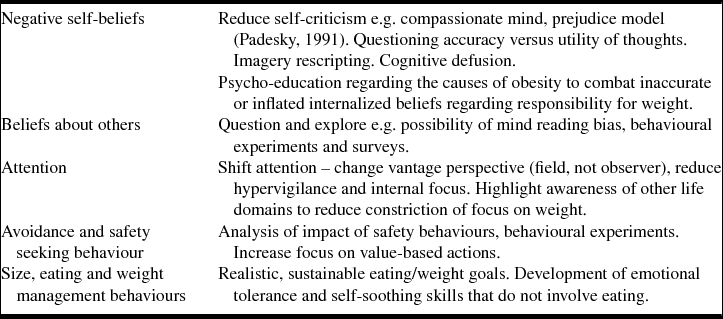
The model of internalized weight stigma is a useful psycho-education tool that can be used as an intervention in its own right to help individuals contextualize and make sense of their experiences as well as identifying modifiable factors that maintain internalized weight stigma. The model strikes a balance between acknowledging the reality of external weight stigma as well as helping the individual become aware of their role in perpetuating internalized weight stigma and ways in which they can change this. Obviously, there will be individual differences in the prominence of specific maintenance factors and clinicians may need to add idiosyncratic maintenance factors that are not included in the general model. Table 1 summarizes potential interventions for each factor.
Summary of intervention options for each maintenance factor
Existing interventions designed to ameliorate the effects of internalized stigma amongst individuals with severe and enduring mental illness have had mixed results. While two group treatments based on a cognitive behavioural approach have shown promising results (e.g. Knight, Wykes and Hayward, Reference Knight, Wykes and Hayward2006; MacInness and Lewis, Reference MacInnes and Lewis2008), others have either only found small effects (Griffiths, Christensen, Jorm, Evans and Groves, Reference Griffiths, Christensen, Jorm, Evans and Groves2004) or no changes (Link, Struening, Neese-Todd, Asmussen and Phelan, Reference Link, Struening, Neese-Todd, Asmussen and Phelan2002). This proposed internalized weight stigma model and ensuing treatment implications addresses the limitations of these existing interventions. Most importantly, through the development of a disorder-specific and theoretically driven maintenance model, interventions are targeted and based on sound rationale. Existing interventions have either been targeted at mental illness in general, rather than at specific disorders, or have not been based on an explicit theoretical formulation. Given the success of existing group interventions for internalized mental illness stigma (e.g. Knight et al., Reference Knight, Wykes and Hayward2006; MacInness and Lewis, Reference MacInnes and Lewis2008), clinicians may also want to consider the application of this model and treatment strategies in a group setting. This would have the added benefit of reducing social isolation and exclusion, a factor likely to exacerbate internalized weight stigma. Finally, it will be important to demonstrate the efficacy of a clinical intervention based on this model. Future research should prioritize the development of a treatment protocol and piloting this.
In addition to the technical aspects of therapy, it is also important for clinicians to reflect on their own attitudes and beliefs about obesity as this could have an impact on the therapeutic relationship, formulation of difficulties (e.g. over-emphasizing beliefs about responsibility, controllability and motivation) and beliefs about prognosis (Davis-Coelho, Waltz and Davis-Coelho, Reference Davis-Coelho, Waltz and Davis-Coelho2000) in order to avoid the delivery of sub-optimal therapy.
Conclusion
The increasing prevalence of obesity raises significant challenges as well as opportunities for psychological therapists working in a range of specialties. Given that the current environment perpetuates weight stigma, interventions that address the psychological consequences of weight stigma are just as important as finding interventions that are directed at the primary causes of these difficulties, particularly given that there is a lack of promising, consistent evidence to support these. Psychological interventions for obesity have not resulted in significant or sustained weight loss (Cooper et al., Reference Cooper, Doll, Hawker, Byrne, Bonner and Eeley2010) and the outlook for this approach is questionable (Brownell, Reference Brownell2010). Furthermore, whilst there is clearly a need for societal interventions that educate about the causes of obesity, interventions to reduce weight stigma have had mixed outcomes (Daníelsdóttir, O'Brien and Ciao, Reference Daníelsdóttir, O'Brien and Ciao2010). Whilst these primary interventions are being developed and honed, there is a pressing need for a pragmatic intervention that focuses on ameliorating the psychological impact of the stigmatizing environment to reduce distress and improve functioning. Although this model of internalized weight stigma highlights a relatively new clinical challenge, this model utilizes therapeutic skills that CBT therapists already have in their repertoire.
Acknowledgements
We would like to acknowledge the input of Dr Rukshana Ali, Clinical Psychologist, and Mahbuba Khatun, Assistant Psychologist.




Comments
No Comments have been published for this article.