

1. Introduction
The recent years have shown an increasing interest in the topic of flexible retirement. Flexibility refers to the possibility to combine part-time work and partial retirement or to fully retire before the statutory retirement age. More flexible forms of retirement are regarded as advantageous in order to deal with the challenges of aging since they allow a better differentiation according to individual circumstances, needs, and preferences. Eurofound (2012), e.g., report that almost two-thirds of European Union (EU) citizens would prefer a more flexible form of retirement. The Organisation for Economic Co-operation and Development (OECD) has taken up this issue in the second chapter of Pensions at a Glance 2017 which provides an extensive overview of retirement flexibility across member countries and also discusses advantages and challenges of this policy. It is emphasized, however, that “flexibility should be conditional on ensuring the financial balance of the pension system, which implies that pension benefits should be actuarially adjusted in line with the flexible age of retirement” [OECD (2017), p. 67]. In this paper, I focus on this latter aspect. In particular, I discuss how pay-as-you-go (PAYG) pension systems have to determine actuarial deductions for early retirement and actuarial supplements for late retirement in order to remain financially balanced in the long run. Despite the fact that these actuarial adjustments are crucial parameters for pension design the existing literature on this issue is rather small and sometimes controversial. In order to provide some clarifications to the controversies involved I use a simple model that facilitates a systematic and comprehensive discussion.
Deductions are necessary since an insured person who retires at an earlier age pays less contributions into the pension system than an otherwise identical individual and he or she also receives more installments of (monthly or annual) pension payments.Footnote 1 The standard approach of the literature focuses on the situation of a single individual and stipulates that appropriate deductions should balance the net present value of these different payment streams. This calculation depends on two crucial factors. The first one is the definition of the pension formula. Many pension systems take the difference between the actual retirement age R and the target (or “statutory”) retirement age R* into account when assigning the pension payment. The stronger pension benefits react to the difference between the actual and the target age the weaker the need for additional deductions. In the paper I focus on three variants of PAYG systems: a defined benefit (DB) system that does not react to the actual retirement age R; an accrual rate (AR) system (as it is, e.g., in place in Germany or France) where the basic pension formula already implies a lower pension payment for earlier retirement; and a notional defined contribution (NDC) system (introduced in countries like Sweden, Italy, or Poland) which is based on a formula that adjusts pension payments to the fact that early retirement is associated with fewer years of contributions and with more years of pension payments.
The second important factor to calculate budget-neutral deductions is the discount rate that is used to equalize the present value of costs and benefits. In the related literature there exists a controversy about the appropriate choice of the discount rate. The most common suggestion is to use the market interest rate as is, e.g., argued by Werding (Reference Werding2007, p. 21) on the grounds that the “government has to borrow the funds for premature pensions.”Footnote 2 Other authors, however, have countered that the market interest rate is the wrong concept in this context and that one should instead use the internal rate of return (IRR) of the PAYG system [Ohsmann et al. (Reference Ohsmann, Stolz and Thiede2003)]. The IRR is given by the growth rate of the wage bill and it is typically—i.e., in normal times—lower than the interest rate [Diamond (Reference Diamond1965)]. This whole discussion is somewhat confusing, since for the purpose of calculating budget-neutral deductions the discount rate should not be a choice variable but should rather be determined by the budgetary costs caused by early retirement. In the paper I argue that this confusion stems mainly from the fact that the standard set-up of the literature uses the case of a single individual to calculate the budget-neutral deduction of the entire pension system. This “isolated,” single-individual budget constraint is, however, ill-suited to study the issue at hand. In order to calculate the deductions that are required to implement a stable PAYG system one has to use a set-up that is based on an intertemporal budget constraint with multiple generations and explicit assumptions about the collective retirement behavior extending to past, present and future cohorts. In the standard approach based on the single-individual budget constraint this assumption is only made in an implicit manner.
In the paper I elaborate on this issue in various ways. The main argument of the paper is built on the result that if retirement follows a distribution which is stationary over time then a NDC system leads to a stable budget. The costs of early retirement by some are exactly offset by cost savings of late retirement by others and there is no financial need for additional deductions or supplements. In this case the market interest rate thus does not play a role. I show that this corresponds to a situation where the discount rate in the standard approach with a single-individual budget constraint is equal to the IRR of the PAYG system. This finding, however, could be misleading since the appropriate concept to discount budgetary imbalances in the multi-generational intertemporal budget constraint is still the market interest rate. It is only the case that for a stationary retirement distribution there are no imbalances and thus no need to access the capital market. This is different for the thought experiment which is typically used in the standard approach of the literature and which assumes that everybody retires at the target retirement age R* while only one individual retires at an earlier age (“one-time shock scenario”). In this hypothetical scenario the behavior of the “deviant” individual does in fact cause an extra financing need. I calculate the budget-neutral deductions based on the (correct) multi-generational intertemporal budget constraint and I show that in this case they coincide with the deductions of the single-individual budget constraint if the discount rate is set equal to the market interest rate. This correspondence, however, only holds for this specific one-time shock scenario and is not true in general. Contrary to wide-spread claims in the literature, it is thus not necessary or “evident” to use the market interest rate for the determination of budget-neutral deductions. All depends on the assumptions about collective retirement behavior. The rest of the paper adds elaborations, extensions and discussions of the central result.
First, I show that the basic results of the paper also hold for the two other PAYG systems (DB and AR). In this case, however, the budget-neutral deduction rates involve additional factors that have the effect that these alternative systems “mimic” the NDC system.Footnote 3 Second, for illustrative purposes I also calculate deduction rates for realistic demographic scenarios. For a discount rate that is equal to the IRR of the PAYG system the deductions are between 5.5% and 7.0% (DB system) and 4.2% and 4.9% (AR system) while they are 0% for the NDC system. The use of higher discounts rates increases the annual deduction rates, but slightly less than proportional. In particular, for an interest rate that is 2% higher than the IRR they range from 7.3% to 8.7% (for the DB system), 5.7% to 6.6% (for the AR system) and 1.8% to 1.9% (for the NDC system). Third, I discuss additional assumptions about collective retirement behavior for which it is no longer possible to use the single-individual set-up to derive budget-neutral deductions. Also in these cases the appropriate deductions are typically below the value that are associated with the one-time shock scenario. In particular, numerical simulations show that for situations where the actual retirement distributions fluctuate randomly around a stable distribution a pure NDC system is basically sufficient to guarantee a balanced budget and the additional deductions can be close to zero.
Fourth, I discuss situations that involve long-run shifts in demographic or economic variables that often pose a challenge for PAYG systems. An increase in the average retirement age, e.g., leads to a constellation where none of the common deduction rates (neither the one based on market interest rates nor the one based on the IRR) are able to implement a balanced budget. These long-run changes have to be reflected in the design of the basic pension formulas and they require more thorough considerations about intergenerational risk-sharing and redistribution. These difficult issues have to be treated separately from the more modest topic of how to determine actuarial deduction rates.
Finally, I turn to the question of how to determine real-world deductions in light of the main results. Since for this task one has to weight different aspects and since it also involves value judgments there is no straightforward or unequivocal answer. In my opinion, however, a number of reasons suggest that the stationary retirement distribution is the most reasonable reference point. Conceptually, the one-time shock scenario does not seem to be a natural starting point since it cannot be extended over time. Empirically, real-world retirement patterns are typically rather stable (absent significant pension reforms). From a normative perspective it seems questionable to use deduction rates that are larger than what is necessary for budgetary stability since it implies that early retirees implicitly pay for the larger-than-necessary supplements of late retirees.
The paper is organized as follows. In section 2, I discuss the related literature and I also present various concepts of actuarial adjustment. In section 3, I introduce the single-individual deduction equation and I focus on a simple model that allows for analytical solutions. In section 4, I derive the level of budget-neutral deductions for two basic scenarios concerning collective retirement behavior. Section 5 discusses extensions, section 6 policy implications and section 7 concludes.
2. Related literature and main concepts
In the literature one can find two concepts of actuarial adjustment that are sometimes used interchangeably and have caused some terminological confusion. These two concepts have been called “incentive neutrality” and “budget neutrality” [Gasche (Reference Gasche2012)] or “marginal individual neutrality” and “marginal system neutrality” [Freudenberg et al. (Reference Freudenberg, Laub and Sutor2018)], respectively. The concept of incentive neutrality approaches the issue of actuarial adjustments from the perspective of the insured individuals. In particular, it focuses on the determination of deductions that leave an individual indifferent between retiring at the target or at an alternative age and could thus also be called a “microeconomic viewpoint” [cf. Börsch-Supan (Reference Börsch-Supan2004), Queisser and Whitehouse (Reference Queisser and Whitehouse2006)]. This individual perspective has been used to study the impact of non-actuarial adjustments on early retirement [Stock and Wise (Reference Stock and Wise1990), Gruber and Wise (Reference Gruber and Wise2000)], the incentives to delay retirement [Coile et al. (Reference Coile, Diamond, Gruber and Jousten2002), Shoven and Slavov (Reference Shoven and Slavov2014)] and the simultaneous decisions on retirement, benefit claiming and retirement in structural life cycle models [Gustman and Steinmeier (Reference Gustman and Steinmeier2015)]. The determination of incentive-compatible adjustment rates are important if one wants to increase the retirement age or—put differently—to remove incentives to retire early. It has to be emphasized, however, that the individual retirement decision depends on many factors including preferences for leisure, the status of health and social norms. Financial incentives are only one among these factors and the same level of adjustment rates will lead to different retirement behavior for different individuals.Footnote 4
For the design of financially stable pension systems in the presence of a flexible retirement regime the second concept of “budget neutrality” is appropriate. Under this “macroeconomic viewpoint” individual preferences and circumstances are irrelevant and the focus is only on the implication of individual retirement behavior for the budget of the pension system. In particular, “system neutrality is achieved when the individual decision on early retirement does not have any effect on the budget of the pension system as a whole” [Freudenberg et al. (Reference Freudenberg, Laub and Sutor2018), p. 37]. The literature on this topic is smaller than the one on incentive-compatibility. In pioneering work Queisser and Whitehouse (Reference Queisser and Whitehouse2006) offer terminological discussions and they present evidence on the observed rates of adjustments. For a sample of 18 OECD countries they report an average annual deduction for early retirement of 5.1% and an average annual supplement of 6.2% for late retirement. They conclude that “most of the schemes analysed fall short of actuarial neutrality [and that] as a result they subsidize early retirement and penalize late retirement” (p. 29). This work was taken up in OECD (2017) and Freudenberg et al. (Reference Freudenberg, Laub and Sutor2018) which also contain values for actual deductions and supplements and for actuarially required rates. It has to be noted, however, that both of these publications take a microeconomic viewpoint and focus on the individual, incentive neutral adjustment rates.Footnote 5 An intensive debate about the accurate level of budget-neutral adjustment rates can be observed in Germany where the rather low annual deduction rates of 3.6% are frequently challenged. A number of researchers have supported higher rates of deductions based on market interest rates [Borsch-Supan and Schnabel (Reference Borsch-Supan and Schnabel1998), Fenge and Pestieau (Reference Fenge and Pestieau2005), Werding (Reference Werding2007), Brunner and Hoffmann (Reference Brunner and Hoffmann2010)] while other participants have argued for keeping rates low stressing the lower IRR of the PAYG system [Ohsmann et al. (Reference Ohsmann, Stolz and Thiede2003)]. Overviews of the debate can be found in Börsch-Supan (Reference Börsch-Supan2004) and Gasche (Reference Gasche2012). The latter, e.g., has shown that the main difference between the two concepts of incentive neutral and budget neutral adjustment rates is the choice of the underlying discount rate, where a risk-free rate is the appropriate choice for the first and the IRR for the second concept. As stated above, this view is not shared by Werding (Reference Werding2007) who has argued that the risk-free market interest rate should be used for both concepts. In this paper I offer a systematic treatment of this controversy and I will come back to this issue repeatedly below.
Before starting the analysis I want to note, however, that the two concepts of actuarial neutrality (either incentive or budget neutrality) have to be distinguished from the notion of “actuarial fairness.” The latter concept is often used to describe a system in which the present value of expected contributions is ex-ante equal to the present value of expected pension payments [cf. Börsch-Supan (Reference Börsch-Supan2004), Queisser and Whitehouse (Reference Queisser and Whitehouse2006)]. This is therefore a life-cycle concept while actuarial neutrality can be regarded as a “marginal concept” that focuses on the effect of postponing retirement by an additional year.
3. Simple framework
3.1 Set-up
I start with the benchmark approach of the related literature. In order to fix ideas I focus on the simple case with a constant wage W and a stable demographic structure where all individuals start to work at age A, are continuously employed and die at age ω.Footnote 6
There exists a PAYG pension system with a constant contribution rate τ, a target (or reference) retirement age R* and a pension formula that determines the regular pension for each admissible retirement age R. In the most simple form the system only determines the pension level P* that is promised for a retirement at the target age R*. In this case the pension deductions are the only instrument to implement appropriate adjustments for early retirement. Many real-world pension systems, however, are based on a “formula pension” that depends on the target retirement age R* and on the actual retirement age R thereby accounting (at least partially) for early retirement. This formula pension is denoted by $\hat{P}( {R, \;R^\ast } )$ and I will discuss below various possibilities for its determination. For the moment, however, I leave it unspecified. Furthermore, for brevity I will often omit the arguments of $\hat{P}( {R, \;R^\ast } )$
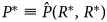
 and other functions whenever there is no risk of ambiguity. Finally, the pension level at the target retirement age is given by $P^\ast\;{\equiv}\; \hat{P}( {R^\ast , \;R^\ast } )$
 .
3.2 Deductions based on the budget constraint of a single individual
The standard approach focuses on the effects of a single individual. If the individual chooses to retire before the target age (i.e., R < R*) then this impacts the budget of the social security system in two ways. First, for the periods between R and R* the individual does not pay pension contributions and thus the system has a shortfall of revenues. Second, in these periods of early retirement the individual already receives pension payments and thus the system has to cover additional expenditures. There are two mechanisms how this can be accomplished: by adjustments that are directly stipulated by the pension formula $\hat{P}$ (an “implicit reduction”) and (if the former is not sufficient) by the use of an explicit deduction factor X (that is valid for the entire pension period). The final pension will thus be given by $P = \hat{P}X$
 . Using a continuous time framework the additional actuarial deduction factor X is implicitly defined as follows:

where δ is the discount rate used to evaluate future payment streams. The left-hand side of equation (1) contains the twofold costs to the system due to early retirement (i.e., the period loss of contributions τW and the additional period expenditures $\hat{P}X$ ). The right-hand side captures the benefits to the system since in the case of a retirement at the target age the pension without deductions would be P* for all periods between R* and ω which is now reduced to $P = \hat{P}X$
 .Footnote 7
Equation (1) is the basic expression to define deductions that can be found in the literature. It is, however, not yet sufficiently specified in order to calculate the budget-neutral deductions for a particular pension system. For this two additional elements have to be determined. First, it is necessary to specify the details of the pension formula $\hat{P}$ that varies widely between different countries. In section 3.2 I will provide three examples for the determination of $\hat{P}$
 . Second, one has to choose the discount rate δ that is used to evaluate future payment streams. If one were not concerned with the issue of budget-neutrality then it would be possible to choose any arbitrary number for δ (perhaps justifying it with regard to “incentive compatibility”). For illustrative purposes this is done in section 3.4. The central task of this paper, however, is to find the appropriate budget-neutral discount rate, i.e., the rate that guarantees that the individual retirement behavior does not have any long-run effects on the budget of the social security system. This, however, implies that the budget-neutral deductions depends on the collective retirement behavior of past, present, and future cohorts (as will be argued below in detail). For this the formulation in (1) is in fact not suitable since it contains only a snap-short, i.e., only the intertemporal budget constraint of one single individual. In order to determine the budget-neutral deductions it is necessary to specify the intertemporal budget constraint for the entire system which involves a “triple integral”: across individual members of each generation, across generations, and across time. For this one also needs to make specific assumptions about the distribution of retirement behavior and about a start and end point of the analysis. Budgetary imbalances will have to be financed on the capital market and thus in this case the market interest rate is the appropriate discount rate. This multigenerational intertemporal budget constrained is specified in section 4. I show there that the budget-neutral deductions that emerge for specific assumptions concerning the collective retirement behavior correspond to solutions for X in the single-individual equation (1) for specific choices of the “single-individual” deduction rate δ. This correspondence between budget-neutral deduction rates, collective retirement behavior and the discount rate δ is, however, only immediate for certain special cases. For other patterns of collective retirement it is not straightforward to determine a value of δ that rationalizes these deduction rates within the framework of the “reduced-form,” single-individual equation (1). This crucial distinction and the relation between the individual (or “microeconomic”) deduction equation (1) and collective (or “macroeconomic”) retirement behavior has so far not been emphasized in the literature. In fact, typically the related research uses thought experiments about a single deviating individual without stressing the underlying assumption about collective behavior.
3.3 Different PAYG systems
As stated above, in order to calculate the deduction factor according to (1) one has to specify how the formula pension level $\hat{P}$ is determined. There exist various possibilities and I will discuss three variants that are often used in existing pension systems:
• DB system: in this case there exists a target replacement rate q* that is promised if an individual retires at the target retirement age R*. In the generic DB case the pension formula is independent of the actual retirement age and does not reduce the target replacement rate, i.e., $\hat{P}_{{\rm DB}}( {R, \;R^\ast } ) = q^\ast W$
 .
• AR system: many countries have PAYG pensions systems in place that are somewhat more sensitive to actual retirement behavior than the DB system. In particular, in these systems the formula pension is reduced if retirement happens before the target age R*. One popular example of such a system is built on the concept of an “AR”. For each period of work the individual earns an AR κ* that is specified in a way that the system promises the full replacement rate q* only if the individual retires at the target retirement age R = R*. This means that κ* = q*(1/(R* − A)) and $\hat{P}_{{\rm AR}}( {R, \;R^\ast } ) = \kappa ^\ast ( {R-A} ) W = q^\ast ( {( R-A) /( R^\ast{-}A) } ) W$
.Footnote 8• NDC system: this scheme has been established in Sweden and in a number of other countries and is often regarded as a reference case for PAYG systems. Its main principle is that at the moment of retirement at age R the total of contributions that an individual has accumulated over the working life τW(R − A) is transformed into a period pension by dividing it by the remaining life expectancy ω − R. This means that $\hat{P}_{{\rm NDC}}( {R, \;R^\ast } ) = \tau W\,( ( R-A) /( \omega -R) )$
.Footnote 9 Therefore in the NDC system the target retirement age R* does not play a role and the formula pension just reacts to the actual retirement age R.



The pension for early (or late) retirement in each of the three cases j ∈ {DB, AR, NDC} is then given by $P_j = \hat{P}_jX_j$ (where I skip again the function values). I call the ratio of the final pension P j to the target pension $P_j^\ast$
 the total pension reduction. This reduction might be either due to stipulations of the formula pension $\hat{P}_j$
 or due to the influence of the explicit deductions X j. For the DB system, e.g., the entire reduction follows from the effect of the deductions X j while for a NDC system the reduction is (primarily) due to the effect of the formula pensions.
In order to delve deeper into this issue it is useful to calculate an approximate expression for the deduction factor $\tilde{X}_j$ based on the solution of equation (1). After inserting the pension levels for $\hat{P}_j$
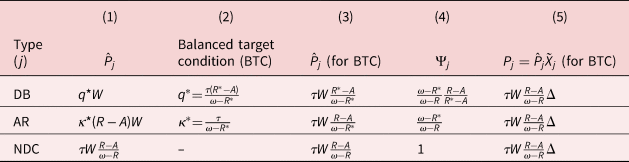
 into this approximation it is then possible to derive explicit expressions for the budget-neutral deduction factors for the three systems j ∈ {DB, AR, NDC}. This is done in Appendix A where I also show that these approximated deduction factors can be written as: $\tilde{X}_j = \Psi _j\Delta$
 , where Ψj is a “structural part” that just depends on the demographic and economic variables ω, A, R and R*, while Δ = 1 + (δ/2)(R − R*) ((ω − A)/(R − A)) is a “financing” part that also depends on the discount rate δ. The “structural parts” for the three systems (under the assumption of a balanced budget for R = R*) come out as ΨDB = ((ω − R*)/(ω − R)) ((R − A)/(R* − A)), ΨAR = (ω − R*)/(ω − R) and ΨNDC = 1. These results are collected in Table 1. The last column of the table shows that the application of the deduction factor $\tilde{X}_j$
 leads to an identical final pension payment P j for all three systems.
Three simple PAYG systems

Note: This table shows the formula pension $\hat{P}_j$ , the demographic deduction factor Ψj, and the total pension $P_j = \hat{P}_j\tilde{X}_j$
 for three variants of PAYG schemes: DB, AR, and NDC. The balanced target condition (BTC) has to hold if the system has a balanced budget in the case that all individuals retire at the target retirement age R = R*. The expression in column (3) follows from inserting column (2) into column (1). The values for Ψj in column (4) follow from inserting $\hat{P}_j$
 from column (3) into equation (A.1) in Appendix A and noting that one can write $\tilde{X}_j = \Psi _j\Delta$
 where Δ = 1 + (δ/2)(R − R*) ((ω − A)/(R − A)). Column (5) is the multiple of columns (3), (4), and Δ.
3.4 Deductions for different discount rates
When using the single-individual framework of equation (1) the discount rate is the crucial magnitude for the level of deductions. As stated above, this equation for itself is not sufficient to calculate the budget-neutral deductions since in addition one also has to make specific assumptions about collective retirement behavior. This will be discussed in detail in section 4. For the moment I just want to illustrate quantitatively how the deduction rates look like for some commonly made assumptions about δ without discussing whether (and under which circumstances) these values are reasonable choices for budget-neutral deductions. As a first possibility it is often assumed that δ = r, i.e., the discount rate is set equal to the market interest rate. As a second possibility it is argued that the social discount rate should be set to the IRR of a PAYG pension system. In the simple example of this section without economic or population growth the IRR is zero and thus δ = 0.
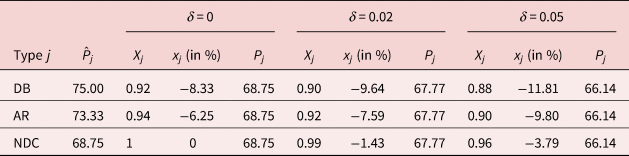
In Table 2 I illustrate deduction rates for a realistic numerical example. In particular, I assume that people start to work at the age of A = 20, that they die at the age of ω = 80, that the contribution rate is τ = 0.25, the constant wage W = 100, the target retirement age R* = 65 and the early retirement age R = 64. In Table 2 I show the magnitude of the necessary budget-neutral deductions for three values of the discount rate δ (0%, 2%, and 5%). The annual (or rather period) deduction rate x is derived from the total deduction factor X via the linear formula x = (X − 1)/(R* − R).Footnote 10
Deductions for R = 64 and R* = 65

Note: This table shows the actuarial deduction factors X j, the annual deductions rates x j (based on the linear relation x j = (X j − 1)/(R* − R)), and the final pension $P_j( {R, \;R^\ast } ) = \hat{P}_j( {R, \;R^\ast } ) X_j$ for three pension schemes and three discount rates. The numerical values are: A = 20, ω = 80, τ = 0.25, W = 100, R* = 65, and R = 64. All cohort members are assumed to reach the maximum age (rectangular survivorship).
All three systems promise a pension of $\hat{P}( {R^\ast , \;R^\ast } ) = 75$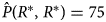 for a retirement at age R* = 65. For early retirement at R = 64 the formula pension is reduced to $\hat{P}_{{\rm NDC}}( {R, \;R^\ast } ) = 68.75$
 for the NDC system. As can be seen in the last line of Table 2 if the discount rate is δ = 0 then the basic formula of the NDC system $P_{{\rm NDC}} = \hat{P}_{{\rm NDC}} = \tau W\,( ( R-A) /( \omega -R) )$
 is sufficient to implement the necessary reduction in the pension payment. There is no need for additional deductions and X NDC = 1. In fact, I show in Appendix A that this is not an artifact of the specific numerical example but rather true in general. This is different for the two other variants where the pension formula does not suffice to stipulate the necessary reductions even when δ = 0. In particular, the additional deduction has to be such that the final pension is exactly equal to P NDC = τW ((R − A)/(ω − R)). In particular, for the AR system the formula pension is only reduced to $\hat{P}_{{\rm AR}}( {R, \;R^\ast } ) = 73.33$
 and the system thus needs additional deductions in order to guarantee stability. For the current example the necessary annual deduction rate is 6.25%. For the traditional DB system the annual deduction rate is even larger (8.33%) since there is no adjustment of the pension $\hat{P}_{{\rm DB}}( {R, \;R^\ast } )$
 . For discount rates above 0 also the NDC needs extra deductions. For δ = 0.02, e.g., the annual deductions are 1.43% and for δ = 0.05 they are 3.79%. For the DB and the AR systems the annual deductions also increase by an amount that is somewhat smaller than the extent of δ.
Summing up, one can conclude that the levels of actuarial deductions depend both on the exact pension formula and on the choice of the discount rate. For δ = 0 the basic formula of the NDC system is sufficient and no additional deductions are necessary. For the DB and AR systems, however, even for δ = 0 one needs deductions that depend on the demographic structure and on the rules of the pension system. These “structural deduction factors” are sizable (for our numerical examples between 5% and 8%) and typically larger than the additional deductions that are necessary if one chooses a positive discount rate.
4. Budget-neutral deductions
In the previous section I have discussed the rates of deduction for different values of the discount rate δ without looking at the budgetary implications of the various choices. The three choices of δ in Table 2 were only used as a quantitative illustration. In this section I now tackle the central issue of this paper and focus on the appropriate choice to implement a PAYG system that runs a balanced budget. “Budgetary neutrality” requires that retirement before and after the target retirement age does not have an effect on the budget of the pension system in the long run. This requirement implies that one has to consider the collective retirement behavior in order to be able to evaluate the budgetary consequences. The look at individual retirement decisions is not sufficient since early retirement of one group might be accompanied by late retirement of another group such that the average retirement age stays unchanged. Furthermore, even if the average retirement age in a certain period is below the target age this might still be counterbalanced by higher average retirement ages in later periods. The assessment of budgetary neutrality is thus impossible without the consideration of the intratemporal and intertemporal distribution of retirement ages. Deductions (over and above the reductions implemented by the normal pension formulas) are only needed insofar as the system has to take out loans in order to finance additional expenditures. If the system can use the intra- and intertemporal variations to provide the necessary funds then these additional financing needs can be reduced or completely avoided. If this internal financing is not sufficient, however, then the system has to access the capital market in order to cover financial shortfalls. In this case the market interest rate is thus the correct choice for the discount rate in the intertemporal budget constraint.
In the following I discuss this issue for two interesting cases. In the first case the distribution of retirement ages is assumed to be stationary over time. For this case it can be shown that a NDC system is always balanced. Since there are no extra financing needs this finding corresponds to a discount rate of δ = 0 in the single-individual equation (1). In the second case it is assumed that everybody retires at the target age and only one individual of one cohort at a lower age. This one-time shock scenario represents the simplest example of a non-stationary retirement distribution and is the benchmark case of the related literature. I derive that in this case the correct choice of the discount rate is given by δ = r. In section 5 (“extensions”) I look at various additional non-stationary distributions and calculate the appropriate budget-neutral deductions for these situations.Footnote 11
4.1 Set-up and budget
In order to calculate the level of budget-neutral deductions one first has to define the budget of the pension system. I stick to the simplified model of the previous section, i.e., to a model in continuous time with the assumption of rectangular survivorship where all members of a cohort reach the maximum age ω. The wage is fixed at W and the contribution rate at τ.Footnote 12 In every instant of time a cohort of equal size N is born. The length of the working life (and thus the number of contribution periods) depends on the starting age and the retirement age. For sake of simplicity I assume that all individuals start to work at age A and are continuously employed up to their individual retirement age R. For the latter I assume that the age-specific probability density function to retire for generation t is given by f(a, t) for a ∈ [A, ω]. The cumulative distribution function F(a, t) indicates the fraction of cohort t that is already retired at age a. It holds that F(A, t) = 0 and F(ω, t) = 1. In the simple model of this section retirement fluctuations are the only possible source of non-stationarity.
The total (adult) population Q(t) is constant and given by:

The size of the retired population M(t) can be derived from the following considerations. For a given retirement age R there are individuals of ages a ∈ [R, ω] that are in retirement. Their relative frequencies are given by f(R, t − a).Footnote 13 Integrating over all possible retirement ages R ∈ [A, ω] leads to:

The total size of the active population L(t) can be calculated as:

Turing to the budget of the system, total revenues I(t) are given by:

Total expenditures E(t), on the other hand, can be written as:

where P(R, a, t − a) stands for the pension payment of a member of cohort t − a. The size of the pension can depend on the payment period t, on the individual's age a and also on the time of his or her retirement R ≤ a. As in the previous section the pension P is the product of the formula pension $\hat{P}$ and the deduction factor X. In particular, one can write $P_j( {R, \;a, \;t-a} ) = \hat{P}_j( {R, \;a, \;t-a} ) X( R )$
 for j ∈ {AR, DB, NDC}.Footnote 14 As discussed in section 3.3 the AR and DB system can be transformed into a NDC system by the use of the demographic adjustment factors ΨAR and ΨDB. The following results of this section thus are also valid for the alternative PAYG systems (and the corresponding deduction factors). In general, however, it is important to note that this equivalence only holds for the specific deterministic and stationary structure that is the focus of these sections. In the presence of economic and demographic shocks or heterogeneous wage patterns the systems will react differently and entail different patterns of adjustments and intergenerational distribution [on this see, e.g., Auerbach and Lee (Reference Auerbach and Lee2011)]. In the following I will therefore concentrate on the NDC system. For the sake of readability I leave out the subscript “NDC” and thus write $\hat{P}( {R, \;a, \;t-a} ) = \hat{P}( R ) = \tau W\,( ( R-A) /( \omega -R) )$
 and also the deduction factor X(R) refers to the NDC system. It can be written as X(R) = (1 + x(R − R*)) where x is the time-invariant deduction rate. This is the specification that is employed in the related literature and that also corresponds to the design of real-world deduction rates.
The deficit in period t is defined as:

and the deficit ratio as:

A balanced budget in period t thus requires D(t) = 0 or d(t) = 0. The multigenerational intertemporal budget constraint between some periods t 0 and t T, on the other hand, reads as:

where r is the capital market interest rate that has to be used to finance possible budgetary shortfalls (or at which possible surpluses can be invested). In this context it is clear that the interest rate r is the appropriate measure to discount future financial flows. Equation (9) is the central equation to calculate the level of budget-neutral deductions while the commonly used equation (1) is appropriate if one takes a “micro view” based on individual fairness. Which of these two approaches is the correct one is a deep question (to which we will return in section 6). At this stage I only want to emphasize that budget-neutral deductions are defined as the value of x such that equation (9) is fulfilled. In the following, I will investigate how this budget-neutral deduction rate x depends on the assumption concerning the collective retirement behavior as captured by the density functions f(R, t).
4.2 Case 1: a stationary distribution of retirement ages
I start with the natural benchmark case of a stationary retirement distribution, i.e., f(R, t) = f(R) and F(R, t) = F(R). The main result is summarized in the following proposition.
Proposition 1 Assume a situation with a constant wage rate W, a constant cohort size N, a constant entry age A, a constant longevity ω, rectangular mortality and a retirement age that is distributed according to the probability density function f(R) for R ∈ [A, ω]. In this case a NDC system will be in continuous balance $( D( t ) = 0, \;\forall t)$ without the need of additional deductions (X(R) = 1 or x = 0).
Proof. In order to see this I first assume that the proposition is correct (i.e., x = 0) and then show that this in fact leads to a balanced budget with D(t) = 0. To do so one can insert the NDC pension P(R) = τW((R − A)/(ω − R)) (assuming x = 0) into (6) which leads to

where $\bar{R}\equiv \mathop \int \nolimits_A^\omega \;Rf( R ) \;{\rm d}R$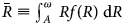 stands for the average retirement age. This is the same as total revenues since

For a stationary distribution of retirement ages f(R) a pure NDC system is thus balanced in every period $( D( t) = 0, \;\forall t)$ . There is no need for loans to finance the early retirement of some individuals, the capital market interest rate is irrelevant and extra deductions are unnecessary (x = 0). Using the results of section 3 (see Tables 1 and 2) this also implies that the corresponding discount rate for the standard single-individual deduction equation (1) is δ = 0.
The intuition behind this result is straightforward. The system needs money to finance the pension of the early retirees with a $R^L < \bar{R}$ . This is available, however, since in the previous periods the early retirees did not get the full pension that would be paid for retirement at the average age $\bar{R}$
 (i.e., $P = \tau W\,( ( \bar{R}-A) /( \omega -\bar{R}) )$
 ) but rather the smaller pension P = τW((R L − A)/(ω − R L)). A similar argument holds for the late retirees where their higher pension can be financed by the extra contributions of the late retirees of future generations.
4.3 Case 2: a one-time shock in retirement ages
This case is dominant in the related literature on actuarial deductions [Börsch-Supan (Reference Börsch-Supan2004), Werding (Reference Werding2007), Gasche (Reference Gasche2012), Freudenberg et al. (Reference Freudenberg, Laub and Sutor2018)]. In particular, the situation is based on the thought experiment that everybody retires at the target retirement age R* except one individual who chooses a lower retirement age.Footnote 15 To be more precise, I assume that there is a small mass θ of members of cohort $\hat{t}$ who retire at R L < R*. All other individuals retire at the target age. The question is how to choose the deduction factor X(R L) (or the deduction rate x) such that the intertemporal budget constraint (9) $( \mathop \int \nolimits_{t_0}^{t_T} \;D( t ) {\rm e}^{{-}r( {t-t_0} ) }{\rm d}t = 0)$
 is fulfilled (for $t_0 < \hat{t} < t_T-\omega$
 ).
The first thing to note is that in all periods before $( {\hat{t} + R^L} )$ the deficit is balanced. From periods $( {\hat{t} + R^L} )$
 to $( {\hat{t} + R^\ast } )$
 the revenues of the system are lower than normal due to the early retirement of the deviating group of mass θ. For these periods the deficit D(t) is further increased due to the fact that the early retirees already receive a pension payment $P^L = \hat{P}^LX( {R^L} ) = \tau W( ( R^L-A) /( \omega -R^L) ) X( {R^L} )$
 which would not be the case had they stayed employed until the target retirement age R*. On the other hand, the expenditures of the system are lower than normal for the time periods between $( {\hat{t} + R^\ast } )$
 and $( {\hat{t} + \omega } )$
 due to the fact that the pension of the early retirees is lower than the target pension. After the early retirees have died in period $( {\hat{t} + \omega } )$
 the pension system is back to the normal mode with a continuous balance of D(t) = 0. The intertemporal budget constraint (9) only involves non-zero values for these exceptional periods and can thus be written as:

Choosing $\hat{t} = 0$ and canceling θ one can observe that this is exactly the same expression as the standard, single-individual deduction equation (1) with the choice of a discount rate δ = r.
In this one-time shock scenario the size of the interest rate has an impact on the budget-neutral deduction rate since the pension system has to take out a loan at the interest rate r > 0 in order to deal with the financial consequences of the early retirement decisions.Footnote 16
5. Extensions
So far I have focused on a simple economic and demographic set-up in order to derive the main results in an intuitive and analytical manner. In order to achieve this I had to abstract from many interesting aspects that are important for real-world systems. In this section I offer a number of extensions of the basic set-up.
5.1 Non-rectangular mortality, growing wages, and heterogeneities on the labor market
In the benchmark model of sections 3 and 4 I have used a model with rectangular mortality (all cohort members die at the same age ω) and with constant wages. In the Supplementary appendix I show that the main results carry over to a set-up with non-rectangular survivorship S(a) (where S(0) = 1 and S(ω) = 0) and wages W(t) that grow at rate g. Since this general case involves longer and somewhat more complicated expressions I have relegated them to the Supplementary appendix and report here only the main result. In particular, in the appendix I proof that one can generalize Proposition 1 as follows:
Proposition 2 Assume a stationary demographic situation where the size of birth cohorts is constant (N(0, t) = N), people start to work at age A, the maximum age is ω, mortality is described by the survivorship function S(a) for a ∈ [0, ω], retirement age is distributed according to the probability density function f(R) for R ∈ [A, ω] and wages grow with rate g(t). In this case a NDC system will be in continuous balance $( E( t ) = I( t ) , \;\forall t)$ if two basic parameters of a NDC systems (the notional interest rate and the adjustment factor) are chosen in an appropriate manner and if there are no additional deductions (X NDC(R, t) = 1).
The exact specification necessary for the notional interest rate and the adjustment factor are stated in the appendix. Second, I also show there that for a stationary retirement distribution the discount rate that corresponds to these budget-neutral deduction factors is given by the IRR (i.e., now the growth rate of wages).
In the appendix I also show that the main results of sections 3 and 4 of the paper will continue to hold in a set-up that allows for heterogeneity in labor market entry age and in the average lifetime wage. If these variables follow a stationary distribution then one can use the same arguments as above to conclude that a pure NDC system without additional deductions is compatible with a stable budget if retirement ages follow a stationary distribution. In fact, one can regard the formulation with fixed A and W as referring to one specific constellation. Since the pure NDC system leads to a balanced budget for this (as for any other) specific subgroup one can conclude that also the aggregate budget will be in balance.
5.2 Alternative assumptions about retirement behavior: no permanent increase in the average retirement age
The discussion of section 4 has shown that the derivations of actuarial deduction rates crucially depend on the assumption about the retirement behavior. They came out lower for a stationary distribution of the retirement age (section 4.2) and higher for the one-time shock scenario (section 4.3). Both of these cases were, however, rather stylized and it is interesting to study how the results change for other—arguably more realistic—assumptions about the retirement behavior. In this section I focus on situations where the average retirement age stays constant over time (as has been true for the cases in sections 4.2 and 4.3) while in section 5.3 I will discuss the situation with long-run changes in the average retirement age.
A natural example for fluctuating retirement ages without long-run shifts is the situation where the cohort-specific retirement densities f(R, t) are random draws from a stable distribution f*(R). In order to discuss this case I have to revert to numerical simulations in a discrete-time framework, since analytical solutions are no longer possible. Appendix C contains a detailed description of the discrete-time model. There I also discuss the results of an example where this stable retirement distribution is triangular between the ages 60 and 70 with a mean at $\bar{R} = 65$ that is also the target age R*. The parameters of the simulation are chosen in such a way that fluctuations in the retirement age roughly correspond to real-world data. For each simulation I calculate the deduction rate x that solves the discrete-time equivalent of equation (9) and I verify that this value manages to keep the budget in balance. Figure A.2 in the appendix illustrates this for one specific simulation. Over 100 simulation runs the average of these budget-neutral deduction rates x is close to zero. In particular, it comes out as $\bar{x} = 0.0002$
 with a standard deviation of 0.003.
This shows that the result of Proposition 1 also holds approximately true for time-variant retirement distributions. A pure NDC system with only minimal additional deductions will be compatible with a stable long-run budget as long as the retirement ages fluctuate around a stationary target distribution.Footnote 17
5.3 Alternative assumptions about retirement behavior: a permanent increase in the average retirement age
The situation is more challenging when the non-stationary distribution of retirement ages also involves a shift in the average retirement age. In this case the budgetary imbalances cannot be corrected by the use of standard rates of deduction.
This can be seen by looking at a slight variant of the basic one-time shock scenario of section 4.3. While in the basic scenario there are only some members of one cohort who choose a different retirement age R ′, it is now assumed that from time $\hat{t}$ onward all cohorts increase their retirement age from R* to R ′. In Appendix B I look at this case in detail. It can be shown that the standard deductions based on equation (1) are not sufficient to guarantee budgetary balance. For example, with A = 20, ω = 80, and a shift from R* = 65 to R ′ = 66 this standard deduction rate would be given by 1.4% (for r = 0.02). This, however, would lead to a massive surplus of the pension system. The deduction rate (and also supplement rate for late retirement) that balances the pension system at some point in time is in this case given by the much larger value of 8.9%. After the system has achieved this balance it would be necessary, however, to either reduce the deduction rate again to x = 0 or change the target retirement age to the new common value of R* = R ′ = 66.
The reason why this permanent increase in the average retirement age requires such a huge deduction rate (or rather supplement rate) in order to balance the budget is the following. The situation can be viewed as an extension of the PAYG system since in the new stationary situation the total steady state revenues and expenditures have increased. The transition thus can be compared to the introduction of a new PAYG system that is associated with windfall gains that can be distributed among the insured population according to some chosen mechanism. A reduction in the average retirement age, on the other hand, corresponds to a downsizing of the PAYG system and leads to transition costs that have to be borne by some cohorts. This requires an approach with time-varying adjustment factors (e.g., a time-varying target retirement age R*) and the choice of the adjustment mechanism has consequences for the intra- and intergenerational distribution of the windfall gains and losses. It will depend on various considerations, e.g., on an assessment to which degree individuals can be held “responsible” for their early or late retirement and on principles of intra- and intergenerational risk-sharing and fairness. This issue goes beyond the scope of this paper. In general, the reaction to long-run shifts in the environment is the responsibility of the basic formulas of the pension system and not the task of the deduction rates.
5.4 Long-run demographic changes
Similar difficulties arise if there are long-run shifts in the demographic or economic environment, like increasing life expectancy or changing fertility patterns. In fact, it has been shown by a number of authors [see Valdés-Prieto (Reference Valdés-Prieto2000), Alonso-Garcia et al. (Reference Alonso-Garcia, Boado-Penas and Devolder2018)] that the basic NDC formulas are unable to provide automatic financial equilibrium when they face a situation with non-continuous demographic (or economic) changes.Footnote 18 There exist various possibilities how to amend the basic system in order to guarantee financial stability. In Sweden, e.g., the “automatic balance mechanism” (ABM) stipulates changes in the notional interest rate and the adjustment rate as a reaction to budgetary imbalances and thus involves both active workers and retirees [Settergren (Reference Settergren2001)]. In Germany, on the other hand, the “sustainability factor” triggers changes in both the contribution rate and the replacement rate in order to keep the balance of the system in balance. These adjustment mechanisms have different implications for the inter- and intragenerational distribution and for risk-sharing. For example, the Swedish ABM strives for intertemporal budgetary balance while the German sustainability factor aims for a continuous balance. The choice between different adjustment mechanisms is a complex issue that depends on social preferences and political constraints. It has to be stressed, however, that one should not mix the adjustment to long-run demographic changes with the determination of appropriate budget-neutral deductions for early retirement. While the first point involves difficult questions, the latter is a rather straightforward technical issue.
6. Discussion and policy implications
In this paper I have used various examples to emphasize a crucial point: the level of budget-neutral deductions depends on the assumptions concerning the collective retirement behavior. For a stationary economic and demographic environment and a stationary retirement distribution the formula pension of a standard NDC system is sufficient to guarantee a balanced budget and there is no need for additional deductions. This corresponds to the choice of a discount rate δ = 0 in the commonly used single-individual equation (1). For the often used thought experiment of a one-time shock there are additional financing needs and the formula pension has to be amended by a deduction rate that follows from equation (1) by setting δ = r. In these two examples the budget-neutral deductions can be derived from the individual deduction equation (1) by choosing an appropriate value for δ. This, however, is not true for less stylized and more realistic examples where one has to use the multigenerational intertemporal budget constraint (9) (and often numerical simulations) in order to derive the budget-neutral values of x. The simple examples help to qualify some common claims of the related literature. First, it turns out that the market interest is not always the appropriate choice to calculate budget neutral deductions as argued, e.g., by Werding (Reference Werding2007). Second, for the popular scenario of a one-time shock even the NDC system is not automatically providing a budgetary balance as is sometimes implicitly or explicitly assumed in the related literature [see, e.g., Freudenberg et al. (Reference Freudenberg, Laub and Sutor2018), footnote 5)]. As shown in Table 2 the required additional deductions amount to 1.5% (for r = 0.02) or 3.8% (for r = 0.05).
Given the different results for different assumptions concerning collective retirement behavior this leads to the crucial question how real-world deduction rates should be determined. The stylized examples do not give a definitive answer to this question since they are based on the assumption that processes underlying the development of the demography and the retirement behavior are known by the policymaker. This of course, does not correspond to the real-world situation in which the retirement pattern only unfolds slowly over time. It will often be necessary to make small adaptions to the deduction rates in order to preserve budget neutrality. This fact, however, makes it even more important to choose the right default values on which the system should be based in normal times. For this choice of the basic reference case the simple examples of sections 4.2, 4.3, and 5.2 can in fact provide some guidance. In the following I want to discuss a number of conceptual, empirical, and normative issues that are involved in these considerations. Overall I will argue that I regard the scenario with a stationary retirement distribution as the more appropriate reference point for this endeavor. At the same time it has to be emphasized that this assessment is not straightforward since it involves a number of aspects and is ultimately based on a value judgment.
Conceptually, one has to note that the one-time shock scenario is not an ultimately convincing benchmark case since it cannot be extended over time. In the year after the single early retiree left the labor market there will no longer be a situation where all individuals have an identical retirement age (which has been the initial situation of the thought experiment). One could assume that a constant fraction of each cohort chooses the early retirement age but this would then correspond to the alternative situation of a retirement distribution that is stationary over time. What is more, one could also argue that all of the scenarios considered so far are unconvincing since they are based on exogenously given retirement distributions and do not involve any modeling of the retirement decision. It is true that it would be interesting to set-up a model where individuals react optimally to the design of the pension system and the existing level of deduction rates [cf. Sheshinski (Reference Sheshinski1978), Crawford and Lilien (Reference Crawford and Lilien1981), Bloom et al. (Reference Bloom, Canning and Graham2003), Heijdra and Romp (Reference Heijdra and Romp2009), Kalemli-Ozcan and Weil (Reference Kalemli-Ozcan and Weil2010)]. The retirement distribution then becomes the endogenous outcome of the individual optimization problems. In order to allow for a non-degenerate distribution of retirement ages one could, e.g., assume individual differences in health status or in the preferences for leisure. In the typical class of models, however, the outcome will again be a distribution of retirement that is stable over time or—if the model involves stochastic elements—that is ergodic. But this suggests again that the case of a stationary retirement distribution is the most reasonable benchmark case.
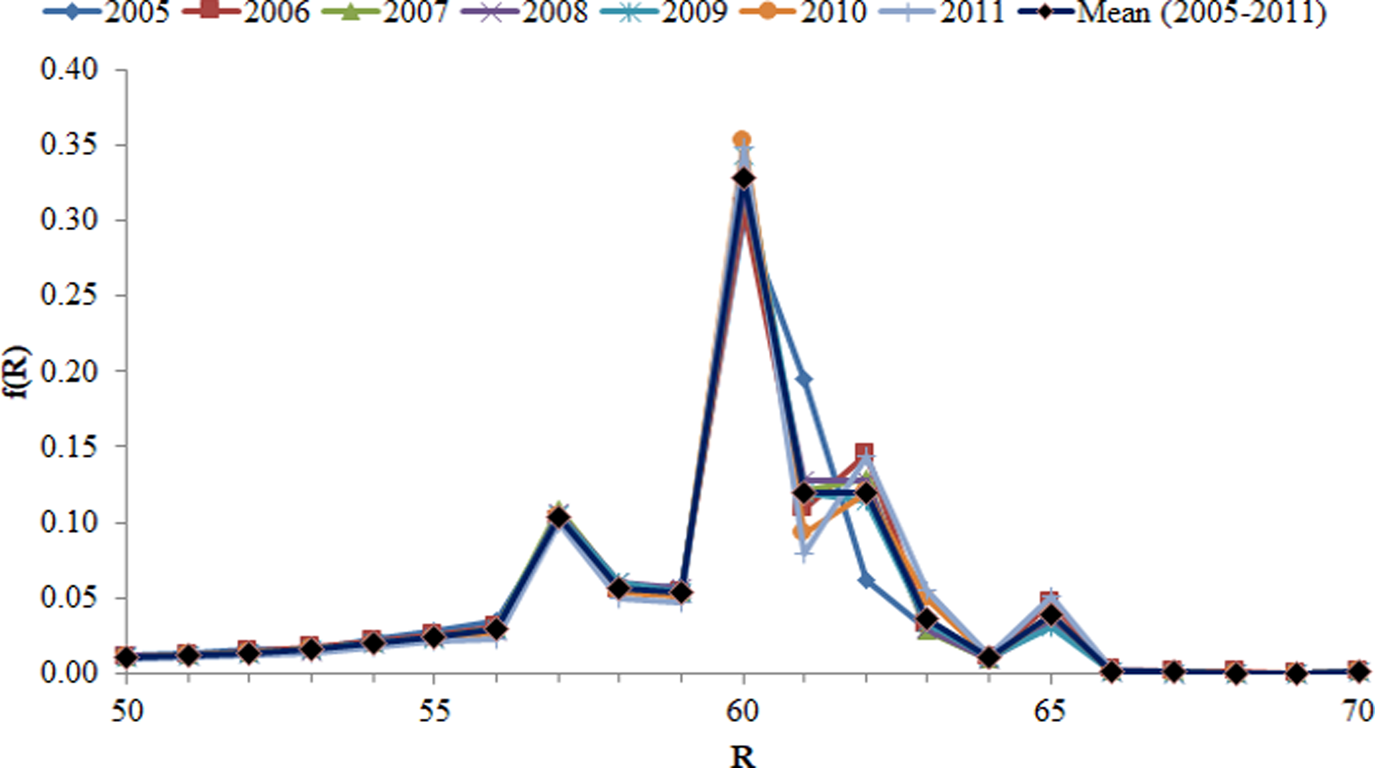
As a second argument one could look at empirical data of retirement distributions. In Appendix C I provide data from Austria that suggest that—absent radical policy reforms—the retirement distribution is rather constant and changes only slowly over time. In particular, I show there that between 2005 and 2011 the retirement probability for males has been roughly triangular with a peak at the age of 60 and a mean retirement age of 59.5. Furthermore, the annual mean retirement age has been fairly constant across the seven years (with a standard deviation of 0.15) and the same is true for the entire distribution. The scenario of a stable target distribution with random fluctuations around this distribution thus seems to be an appropriate approximation of real-world behavior. The results of section 5.2 then suggest that the use of a NDC system without additional deductions (x = 0) will guarantee an approximately balanced budget in this situation.
Finally, one can ask which deduction regime should be preferred from a normative perspective. This perspective clearly involves the most difficult considerations. The deductions based on the one-time shock framework are sometimes supported because they guarantee a balanced budget while at the same time also allowing to incentivize later retirement behavior. The first of these claims, however, has been refuted in section 5.2. The second claim involves two issues. First the reaction of retirement behavior to the size of deductions (which is an empirical issue) and second the reasons behind the desirability to increase the retirement age in the first place. The latter point is particularly virulent when considering the use of “excessive deductions,” i.e., the use of deductions that are based on the choice of δ = r despite the fact that a deduction rate of x = 0 (corresponding to a discount rate of δ = 0) would be sufficient to hold the budget stable. The choice of x (or of the underlying discount rate δ) is highly relevant from a distributional perspective since the higher supplements for late retirees are financed by the higher deduction rates for early retirees. Whether this is a reasonable and fair property is a difficult normative decision that depends on the preferences of the policymaker (and the insured population at large) and on the underlying structure and characteristics of the economic system (e.g., on the reasons behind the phenomenon of early and late retirement). Given that the retirement age is often not a true choice variable but is crucially influenced by the individual health status and labor market conditions and is furthermore strongly correlated with lifetime income it thus looks reasonable to opt for a system with lower deductions and supplements such as to minimize the impact of factors that are beyond individual control. I want to emphasize, however, that this conclusion does not follow directly from the analytical results but is merely based on my assessment based on the conceptual, empirical, and normative considerations.
7. Conclusions
A pension regime that allows for flexible retirement requires actuarial adjustments in order to keep a balanced budget. A crucial question therefore is how large the adjustments have to be in order to guarantee this financial stability. I have shown that the answer to this question depends on two crucial issues. First, it depends on the nature of the pension system. The rate of deduction can be lower in systems where the formula pension is already leading to a reduction in pension benefits (like in NDC or AR systems). Second, the level of budget-neutral deductions also depends on the collective retirement behavior over time. In particular, I have shown that a NDC system is stable just by following the pension rule without the need for any further deductions if the retirement distribution is stable or if it fluctuates around a stationary distribution. The assumption of collective retirement behavior has implications for the associated choice of the discount factor δ in the standard, single-individual budget constraint. In situations with a stable retirement distribution it can be chosen to be equal to the IRR. This is in contrast to the benchmark scenario in the literature that is based on a one-time shock, i.e., on a constellation where everybody retires at the target age and only one individual at a lower age. In this case the budget-neutral deductions correspond to a specification of the single-individual budget constraint with δ = r.
In the last section of the paper I have given conceptual, empirical, and normative reasons why the scenario with a stationary retirement distribution appears to be a better benchmark to guide real-world policy. These conclusions, however, do not directly follow from the analysis and they are certainly up for discussion. For future research it would be interesting to use numerical methods to calculate the budget-neutral deductions in larger models that include many of the economic, demographic, and policy details of real-world systems.
Supplementary material
The supplementary material for this article can be found at https://doi.org/10.1017/dem.2020.17
Acknowledgements
I thank two anonymous referees for valuable comments and suggestions. The views expressed in this paper do not necessarily reflect those of the Oesterreichische Nationalbank.
Appendix A: Analytical expressions for the deduction
In this appendix I provide various additional calculations for the basic model of section 3. First, it is possible to derive an approximated solution for the deduction factor X that is helpful for later discussions. In particular, one can solve equation (1) for X which gives rise to a rather complicated expression. Linearization of this result (around δ = 0) leads to the approximated value $\tilde{X}_j$ given by:

where $\hat{P}_j$ stands for the formula pension in systems j ∈ {AR, DB, NDC}. These have been specified in the paper as: $\hat{P}_{{\rm DB}} = q^\ast W$
 , $\hat{P}_{{\rm AR}} = \kappa ^\ast ( {R-A} ) W$
 and $\hat{P}_{{\rm NDC}} = \tau W( ( R-A) /( \omega -R) )$
 .
The formula pension levels in the DB and the AR system are based on target parameters q* and κ*, respectively. It is reasonable to assume that these parameters are fixed in such a fashion that the PAYG system would be balanced in the case when every individual retires at the target retirement age R* with a target pension P*.Footnote 19 For a constant cohort size N the revenues of the system are in this case given by I = τW(R* − A)N while the expenditures amount to E = P*(ω − R*)N. A balanced budget with E = I thus implies P* = τW((R* − A)/(ω − R*)). For the DB system, this implies a balanced-budget replacement rate of q* = P*/W = τ((R* − A)/(ω − R*)). Using this relation in the expressions above one can summarize the formula pension level $\hat{P}_j$ for the three systems as: $\hat{P}_{{\rm DB}}( {R, \;R^\ast } ) = \tau W( ( R^\ast{-}A) /( \omega -R^\ast ) )$
 , $\hat{P}_{{\rm AR}}( {R, \;R^\ast } ) = \tau W( ( R-A) /( \omega -R^\ast ) )$
 , and $\hat{P}_{{\rm NDC}}( {R, \;R^\ast } ) = \tau W( ( R-A) /( \omega -R) )$
 . Note that the balanced budget target pension P* (at R = R*) is the same in all three systems. Table 1 in the main text contains these expressions in columns (1)–(3). Inserting the pension levels for $\hat{P}_j$
 (column (3) of Table 1) into equation (A.1) leads to the (approximated) expressions for the budget-neutral deduction factor $\tilde{X}_j$
 for the three systems j ∈ {DB, AR, NDC}. These are collected in column (4) of Table 1 where column (5) shows that the application of the deduction factor $\tilde{X}_j$
 leads to an identical final pension payment P j for all three systems.
Appendix B: Retirement distributions with a change in the average retirement age (section 5.3)
In this appendix I present a simple example of a distribution of retirement ages that involves a shift in the average retirement age.Footnote 20 In particular, I assume that up to cohort $\hat{t}$ all members of the cohort (with total size N) retire at age R 1 while from then on they retire at the later age R 2 ≥ R 1. Before the occurrence of the shock the NDC pension system is in continuous balance. This changes, however, after the cohort of the shock period enters retirement. This can be discussed in more detail by looking at the size of the retired population M(t) and total expenditures E(t). For the definitions one has to distinguish four intervals. Before time $\hat{t} + R_1$
 and after period $\hat{t} + \omega$
 one is in a steady state situation:


where the pension levels are given by:

with j ∈ {1, 2} and x is the deduction rate that is applied between periods $\hat{t} + R_1$ and $\hat{t} + \omega$
 .
The expressions for the size of the labor force L(t) and the total revenues I(t) are simpler:


The deficit ratio is given by:

For $t < \hat{t} + R_1$ and $t > \hat{t} + \omega$
 it holds that D(t) = 0. The present value of the deficit in the intermediate periods is given by:

The budget-neutral value of x is given by the value for which $\bar{D}$ in equation (B.4) is equal to zero. This value will therefore depend on the market interest rate r. It can be calculated that for r = 0 and x = 0 it holds that:

This means that for an upward jump in the retirement age (R 2 > R 1) even for r = 0 the system will not return to balance if x = 0. The pure NDC system will thus not be able to stabilize the budget in this case. One can derive an approximated expression for $\bar{D}$ and solve this for x to derive an approximated solution for the budget neutral deduction rate. It comes out as:

This can be compared to the standard value for budget neutral deductions x s that is implied by the deduction equation (1) and setting δ = r. Using the fact that for a NDC system one can write X = 1 + x(R* − R) and Δ = 1 + (r/2)(R − R*) ((ω − A)/(R − A)) (see Table 1) one can derive that:

This implies that even for r = 0 the budget neutral deduction rate is not x = 0 [as suggested by (B.7)] but rather x* = −((ω − A)/(R 2 − A)(ω − R 2)) as given by (B.6). For A = 20, ω = 80, and a shift from R 1 = 65 to R 2 = 66 implies for example that x* = −0.089 (exact value). The deduction rate had to be almost 9% in order to balance the budget over the shock interval. The level of r has not much effect on this magnitude. For r = 0.02 it is, e.g., given by x* = −0.098. This is much larger than the standard deduction given by x s = −0.014.
Appendix C: The framework with fluctuating retirement (section 5.2): a discrete-time version of the model and the results of numerical simulations
C.1 Set-up
For the numerical simulations I have to use a discrete-time version of the model. I focus here on the simple model with rectangular mortality and zero growth. The cohort born in time t has N(t) members. Each individual i ∈ [0, N(t)] starts to work after the same age A, is continuously employed and dies at the same age ω. Individuals, however, might differ in the length of their working life. C i(t) denotes the number of years a person contributes to the pension system, while R i(t) is the age when the individual enters retirement. I assume that each individual has at least one period in the labor market and one period in retirement, i.e., 1 ≤ C i(t) < ω. It holds that R i(t) = A + C i(t) + 1. To give an example, assume that A = 20 and C i(t) = 45. In this case the individual works between his 20th and 21st, 21st and 22nd etc. birthdays up to the period between his 64th and 65th birthday, a total of 45 period. The first retirement period is then between his 65th and 66th birthday or R i(t) = 66.
One can define a variable $I_i^W ( {a, \;t} )$ that indicates whether individual i, born in period t is working (and paying contributions) at the adult age $a\equiv \tilde{a}-A$
 (where $\tilde{a}$
 stands for the biological age). In particular, $I_i^W ( {a, \;t} ) = 1$
 for 1 ≤ a ≤ C i(t) and $I_i^W ( {a, \;t} ) = 0$
 elsewhere. The density function of contribution years is then given by

One could also specify a density function of retirement ages that is defined in an analogous manner to (C.1), but I prefer the specification based on contribution years since it is more directly related to the calculation of pension benefits.
For an individual with contribution years C i(t) = C and target contribution years C* > C the discrete-time equivalent to the continuous-time deduction equation (1) can be written as:

where for the NDC system $\hat{P} = C/( \omega -C)$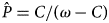 and P* = C*/(ω − C*). I have written here χ(C, t) for the deductions in order to indicate that they might depend on the specific time period and on the number of contribution years (or the retirement age). The values for χ(C, t) based on this discrete-time expression (C.2) are close to the ones reported in Table 2 for the continuous-time framework. In order to derive deduction factors that are able to stabilize the budget in the long-run I look at a multiperiod intertemporal budget constraint like in equation (9) for the continuous-time framework. In order to do so it is helpful to first define the period deficit as:

where the first term in (C.3) refers to expenditures and the second equals revenues. The intertemporal balanced budget condition can then be expressed as:

C.2 Simulation runs
In the paper I sketch the results of one particular numerical simulation. I have also performed simulations for different assumptions that have led to similar results (that are not reported in the following).
In the simulation I start from a target distribution of contribution years which is (symmetrically) triangular between 40 and 50 with a mean at $\bar{C}^\ast{ = } 45$ that is also assumed to represent the target contribution years C*. In the simulations the contribution years for the individuals are set in such a manner that the target distribution resembles the triangular benchmark as closely as possible. The simulations start in a stationary situation (where the actual distribution is identical to the target distribution). From a specific cohort $\hat{t}$
 onward, however, the actual distribution is given by random draws from the target distribution until at the end the actual distribution again returns to the target. This benchmark simulation scenario is repeated 100 times.
The parameters of the simulations are chosen in such a way that the retirement fluctuations during the shock periods roughly correspond to realistic values. In particular, I only use 100 individuals for each simulation run. The larger the sample size the more the actual distributions coincide with the target distribution thereby returning to the case of a stationary distribution. For the one-hundred simulations runs I get the following summary statistics: The target distribution has (per assumption) mean contribution years of 45 with a standard deviation of 2.04.Footnote 21 Since the actual distributions are random draws from this target, one would expect that the average values over the shock periods correspond to the summary statistics of the target distribution. This is in fact the case in the simulated data where the average contribution years (over all shock periods and all simulation runs) is exactly 45 with an average standard deviation of 2.05. The average standard deviation over these shock periods is 0.18 for the mean of the contribution years and 0.11 for the standard deviation.
These values can be compared to real-world data. In particular, I use data from Austria from the years 2005 to 2011 [Statistics Austria (Reference Statistics Austria2013)]. In Figure A.1 I illustrate the retirement probabilities for males in these 7 years together with their means. The shape of the distribution loosely resembles a triangle. One can observe that around one third of all individuals enter retirement at the age of 60 while there is an additional spike at age 57 and a small one at the statutory retirement age 65. This highlights the prevalence of early retirement in Austria (at least for this time period). This, however, is not the topic of the present paper. For the question of accurate deductions it is more interesting to note the relative stability of the actual distributions of retirement ages around the mean values (from 2005 to 2011) which could be assumed to correspond to the target distribution. The average retirement age over these years is given by 59.5 with a standard deviation (from 2005 to 2011) of 0.14. The average standard deviation of the retirement ages (between 50 and 70) comes out as 2.98 with a standard deviation (from 2005 to 2011) of 0.053. These values are broadly comparable to the ones used in the simulation above.Footnote 22
The figure shows the retirement probability for Austrian males in the years 2005 to 2011 (i.e., the values f(R, 2005 − R), f(R, 2006 − R), …, f(R, 2011 − R)). The average retirement age over the years is given by 59.5 with a standard deviation (from 2005 to 2011) of 0.14. The standard deviation of the retirement ages (between 50 and 70) comes out as 2.98 with a standard deviation (from 2005 to 2011) of by 0.053.

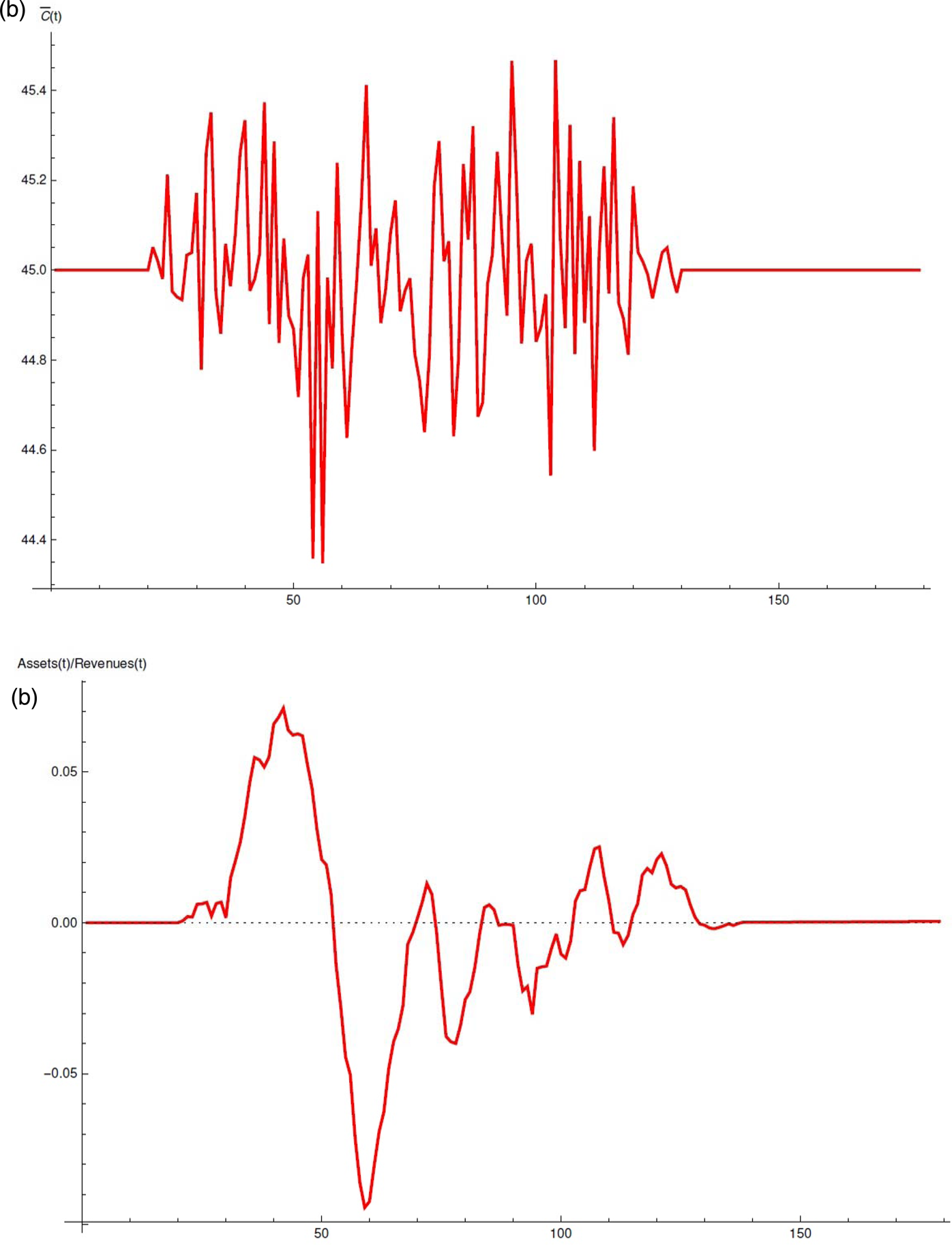
For each of the 100 simulations runs I calculate x. The average value over the 100 simulations runs comes out as $\bar{x} = 0.0002$ which is very close to the value of stationarity (where one has no extra deductions, i.e., x = 0). In Figure A.2 I illustrate the fluctuations in the average contribution years together with the budgetary implications for one specific simulation (that is associated with a deduction rate x that is close to 0). In particular, I show the development of the assets-to-revenues level of the pension system (i.e., the negative of the debt-to-revenues stock) for the use of a NDC system together with a deduction rate of x = −0.0000325. The interest rate is assumed to be given by r = 0.02. As can be seen, the asset stock fluctuates quite a bit even though average contribution years $\bar{C}( t )$
 only fluctuate between 44.4 and 45.5. In the end, however, the asset level returns to zero and the pension system is again in balance. If the pension system had instead used deductions that are based on the benchmark approach (i.e., given by values around −0.0145, see Table 2) then the picture is different. The simulations indicate (not shown) that in this case the pension system does not return to balance but rather shows a permanent (and exploding) surplus.
Panel (a) shows the fluctuations of the average contribution years for one specific simulation where from some cohort onward the contribution years are random draws from a triangular distribution. Panel (b) shows the implied fluctuations in the asset-to-revenues-ratio if pensions are based on a NDC system with a deduction rate of x = −0.0000325 and the interest rate is given by r = 0.02.