Trinitarians believe that there are three distinct, Divine Persons: the Father, the Son, and the Holy Spirit. Trinitarians claim each of these is God,Footnote 1 yet exactly one God exists. But this seems to produce an immediate contradiction: that there are three Gods, and also that there is only one God.
Responses to the Puzzle of the Trinity tend to endorse a straightforward, foundational assumption about the Trinitarian sentences: ‘The Father’, ‘the Son’, ‘the Holy Spirit’, and ‘God’ are each taken to refer to individual entities that exist. There is then disagreement on which sorts of entities these are, and how they relate to one another. For instance, according to ‘One-Self’ accounts,Footnote 2 God has one centre of consciousness and plays distinct roles or has different parts. The Father, the Son, and the Holy Spirit may be identified with God, or may be identified with aspects, or something else altogether. Alternatively, Social Trinitarian accounts posit multiple centres of consciousness. Each centre of consciousness is had by one of the Divine Persons, and God may be identified with a fusion of those persons or, if there are three Gods, each Divine Person may be identified with a God. There are well-known objections to each of these views: One-Self theorists are often accused of conflating the Persons or denying their Divinity, while Social Trinitarians are accused of multiplying Gods.
I propose exploring a new kind of response to the puzzle of the Trinity, according to which we reject the common, initial assumption about the existential import of Trinitarian sentences. There are many ways in which we might carry this out, and a wide variety of ontologies with which it is compatible. To make vivid just how far one can go with such a strategy, I will apply it to the ontology Simple Trinitarianism. The Simple Trinitarian follows Thomas AquinasFootnote 3 in claiming that God exists and has no parts distinct from Himself, and then makes an additional claim (one Aquinas would not endorse), that ‘the Father’, ‘the Son’, and ‘the Holy Spirit’ do not refer to entities that exist. The Simple Trinitarian wishes to capture the spirit behind the central tenets of creedal Trinitarianism in spite of a sparse ontology. They need to explain the complexity of the Trinity without complexity in their ontology. For inspiration on how to do so, we may look to similar moves made in debates in other areas of ontology, semantics, and logic.Footnote 4
In this article, I will present just one way of endorsing Simple Trinitarianism, by appealing to a positive Free Logic. That is, we may take ‘The Father’, ‘The Son’, and ‘The Holy Spirit’ to be empty names, and thereby deny that they refer to entities in our ontology. Still, we may take those empty names to make important semantic contributions to sentences containing them, and we may think those sentences can often be true. They could enable us to say that the sentence ‘The Father created the world’ is true in spite of ‘The Father’ failing to refer to something that exists. This will allow us to endorse the truth of Trinitarian sentences while denying inference such as the one from ‘The Father is God and the Son is God, and the Father is distinct from the Son’ to ‘There are at least two Gods’.
In what follows, I will begin in the first section by describing the general view of Simple Trinitarianism, and contrasting it with One-Self views and Social Trinitarianism. Then in the second section, I will describe one option for a semantics and accompanying logic that a Simple Trinitarian may use to allow her view to make the right predictions about Trinitarian sentences. Though this article will include a proposal and defence of a new view of the Trinity, my aim here is not to suggest that the view I'm proposing is the correct one; there are reasons why Trinitarians may want to resist Simple Trinitarianism, and there are reasons why even Simple Trinitarians may wish to resist applying a positive, free logic to Trinitarian sentences. Instead, my aim in this article is simply to show that denying our foundational assumptions about ‘The Father’, ‘The Son’, and ‘The Holy Spirit’ opens up new and interesting options for response to the puzzle of the Trinity. Simple Trinitarianism is just one example of how one might attempt to use this new strategy for responding to the problem of the Trinity.
Simple Trinitarianism
In presenting Simple Trinitarianism, it will help to start by briefly describing two sorts of view it is intended to contrast with: One-Self views, and Social Trinitarianism.Footnote 5
One-Self theorists take God to be one Person who plays three distinct roles or has three distinct aspects. Karl Barth (Reference Barth, Thomson, Knight, Bromiley and Torrance1956) and Karl Rahner (Reference Rahner and Donceel1997) have, according to some interpretations, presented views on which the Father, Son, and Holy Spirit are numerically identical to one another and to God. God stands in a wide variety of relations to Himself, such as begetting Himself, loving Himself, and so on. The Trinity is not a trinity of Persons, but rather a trinity of modes of being, or roles that God plays. Alternatively, if we do not wish to identify God with each of the Father, Son, and Holy Spirit, we can identify each of the members of the Trinity with modes or events or the roles God plays. We might interpret Aquinas's view of the Trinity this way. Or we may choose to identify the members of the Trinity with fusions of God with these modes/events/roles. Regardless of whether we identify the members of the Trinity with God or with other entities such as modes, One-Self views say that just one Divine Person exists, though that Person may relate to His creation in a variety of ways.Footnote 6
In contrast, Social Trinitarians posit three distinct, Divine centres of consciousness, each of which is a Person. Richard Swinburne (Reference Swinburne1994) claims that each of the Divine Persons can be said to be a God in the sense of possessing the Divine attributes. When we say that exactly one God exists, we mean that one Divine community exists, but strictly speaking, ‘God’ is actually a collection of three Divine Persons rather than a singular entity. There is not merely one Divine substance, and multiple bearers of Divine attributes exist rather than just one. Moreland and Craig (Reference Moreland and Craig2003) offer a more clearly monotheisticFootnote 7 picture of the Trinity in claiming that God is a single substance with three centres of consciousness or Persons as parts. The Persons have many of the Divine attributes, but no Person (identified with a centre of consciousness) is numerically identical to God. Again, ‘God’ refers to a trinity of Persons (though the Persons share a single substance).
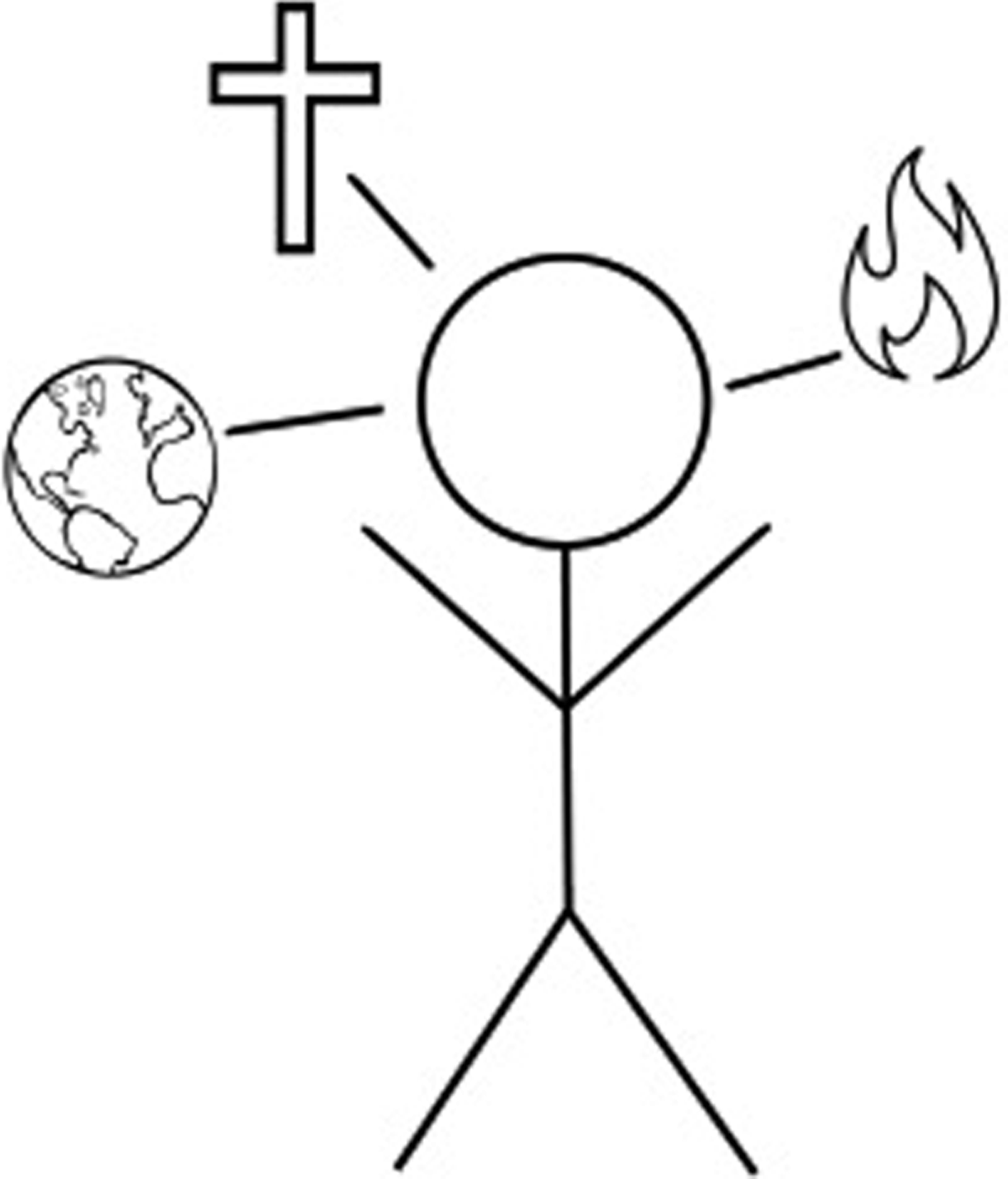
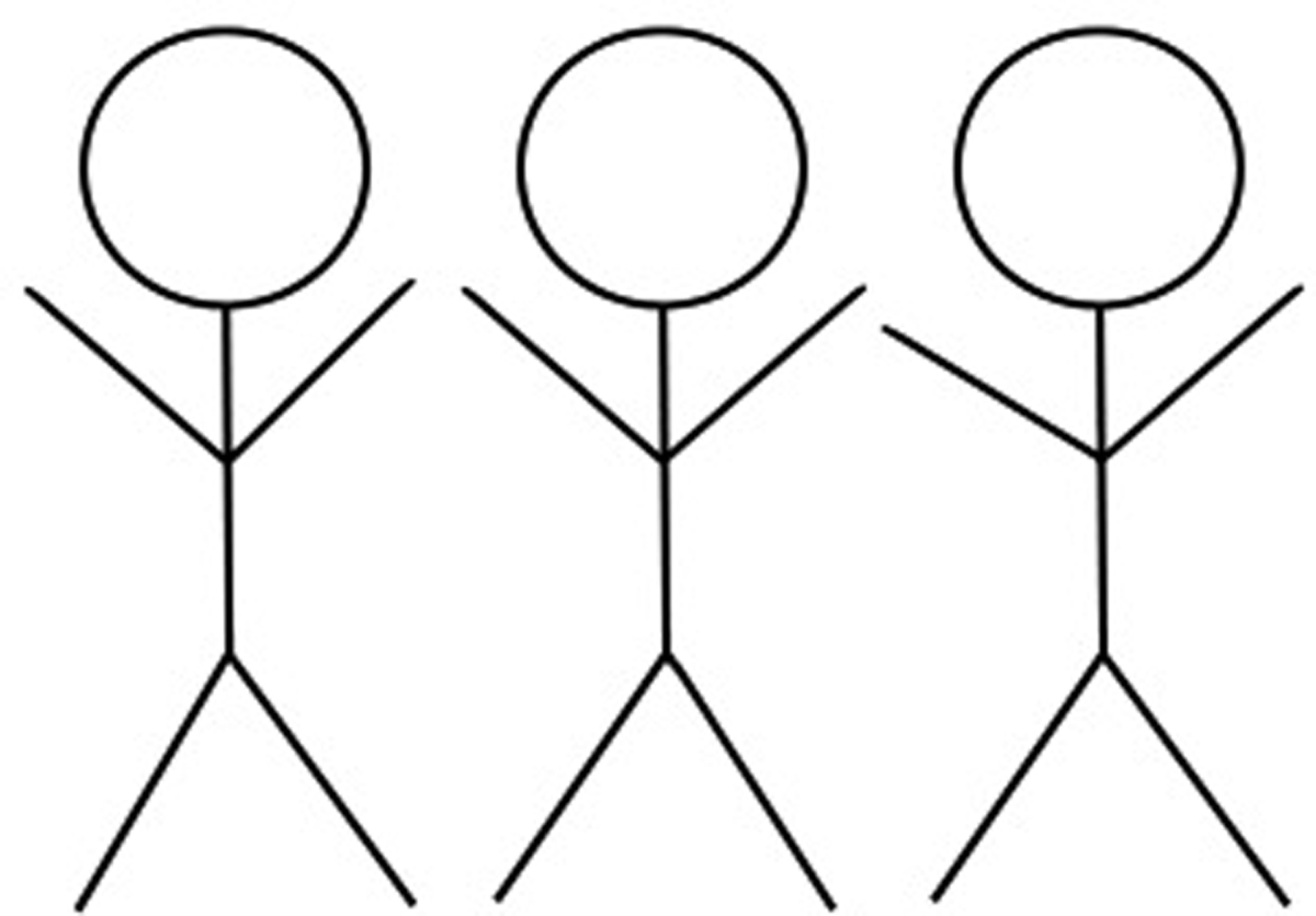
In thinking about how these views differ from one another, suppose we ask a Trinitarian to draw God – that is, suppose we ask that they generate a visual representation of God's structural features. There are different sorts of pictures that Trinitarians might produce. For instance, a One-Self theorist may present us with a picture of one stick-figure person with many accessories, symbolizing one ‘self’ and the multiple roles that self plays (see Figure 1). Or the One-Self theorist could give us a three-aspect version of the duck/rabbit image, capturing a single thing that can play multiple roles. A Social Trinitarian, on the other hand, may present us with a picture of three stick-figures, symbolizing a community of three distinct ‘selves’ (see Figure 2). (Alternatively, following Moreland and Craig,Footnote 8 the Social Trinitarian may produce a picture of one stick-figure with three heads corresponding to the three centres of consciousness.) Importantly, these two sorts of pictures of the Trinity correspond to two very different ways of thinking about what God is like.
One-self views.

Social views.

Once we have these pictures, we can instruct our Trinitarian to circle the portions of the picture that correspond to entities in their domain, to say which of these entities are identical to which others, and to then say which of these entities is God, which are Divine, which are Persons, etc. With this second step, two views (corresponding to the two different pictures) will be multiplied into many. For instance, some One-Self theorists with the first, one-stick-figure picture, will circle the stick-figure and also each of the accessories, and will indicate that the stick-figure is God, but then there are some options: she may identify the stick-figure with each of the members of the Trinity, or she may identify each member with one of the accessories, or she may identify each member of the Trinity with an accessory/stick-figure combination, etc. And the Social Trinitarian who adopts the picture with three stick-figures has a choice between saying that each stick-figure represents a God, or that only the collection of all three stick-figures together corresponds to God.
Simple Trinitarianism involves opting for the second picture of God: if you ask a Simple Trinitarian to draw God, they will give you a drawing of three stick-figures. Their picture will be just like the Social Trinitarian's. But for the second step, when asked to circle each of the bits of the picture corresponding to entities in their domain, the Simple Trinitarian will draw only one circle, surrounding everything in their picture. They will take that one circled entity to be God, but will have no additional, circled entities for each of the Father, the Son, and the Holy Spirit, because those do not appear in the Simple Trinitarian's ontology. The Simple Trinitarian may believe that other things also exist, such as puppies and protons, but when it comes to God, exactly one entity exists. This entity will be extended (since, at least in the incarnation but perhaps via the Holy Spirit as well, God has filled extended regions of space and time), but simple.Footnote 9 God will not have any distinct parts that make Him up. There are no other candidates for Divine entities, and there is certainly not room in this ontology for multiple Gods. In this way, Simple Trinitarianism is similar to One-Self views.
However, unlike both Social Trinitarians and One-Self theorists, the Simple Trinitarian will not identify any of the objects in their picture (or in their domain) with the Father, the Son, or the Holy Spirit. Because the Simple Trinitarian takes God to be simple, they cannot identify any of the members of the Trinity with distinct parts of God. And the Simple Trinitarian resists identifying the members of the Trinity with things external to God, such as events or properties (even though some of those things are importantly related to God). And, maintaining the transitivity of numerical identity, the Simple Trinitarian will not take each of the Persons to be numerically identical to something in common, such as God. So there is nowhere in the Simple Trinitarian's ontology for the Persons of the Trinity to appear.
Still, this Trinitarian wants our ordinary statements about the members of the Trinity to come out true. Simple Trinitarianism is intended to be a genuine form of Trinitarianism, in the sense that the picture of the world the Simple Trinitarian endorses looks exactly like the picture the Social Trinitarian endorses: they posit the same complex variety of properties and events, for instance. But the Simple Trinitarian attempts to endorse this complex, full picture while endorsing a strikingly more sparse ontology. So the Simple Trinitarian needs something to bridge the gap between their sparse ontology and the truth of the Trinitarian sentences. There are many ways we might do this, one of which I discuss in Kleinschmidt (Reference Kleinschmidt2016). In the next section, I will look at how we might use a semantics involving empty names to give Simple Trinitarians the tools they need.
Free logic and empty names
We want to be able to truly say ‘The Father begot the Son’, ‘The Father and the Son are distinct’, ‘The Son is God’, and ‘Exactly one God exists’. We also want to be able to maintain the falsity of ‘The Son begot the Father’ and ‘There are three Gods’. Here is one option for how we might strive to do all of these things.
Simple Trinitarian semantics will posit Trinitarian sentences that have subject terms that fail to refer to entities in our ontology. There is a widely discussed sort of sentence that has this feature: sentences with empty names.Footnote 10 Examples of this sort of sentence include:
1. Sherlock Holmes is a detective.
2. Vulcan is a planet between Mercury and the Sun.
Sentences with empty names raise problems for Classical Logic and for semantics. Classical Logic allows us to move from the use of a name to the existence of something that is the referent of the name. That is, the following are inference rules of Classical Logic:
• Existential Generalization (EG): ϕa implies ∃xϕx
• Universal Instantiation (UI): ∀x ϕx implies ϕa
EG tells us that if we have a true statement where a predicate is applied to a name, then it follows that something exists that has the feature picked out by the predicate. UI tells us that if a predicate picks out a property had by each entity that exists, then the predicate can be truly applied to any name whatsoever. Thus, Classical Logic gives false results in cases of use of empty names, such as ‘Pegasus’: Truly saying ‘Pegasus is a winged horse’, or even truly saying ‘Pegasus does not exist’,Footnote 11 entails by EG that a referent of ‘Pegasus’ exists. This is the well-known problem of empty names.
Andrew Bacon (Reference Bacon2013) notes that this problem of empty names is one instance of a larger problem involving quantification. To show this, he notes that we face similar problems with non-empty names. For instance, it follows from everything's existing (a theorem of logic) that ‘Timothy Williamson exists’ is true. But it seems that whether Timothy Williamson exists is something we learn empirically; it should not follow from our logic. The problem of empty names and the problem of non-empty names seem to have a common source.Footnote 12
A common response to these problems is to adopt a Free Logic. For instance, Saul Kripke (in response to problems with non-empty names) and Karel Lambert (in response to the problem of empty names)Footnote 13 have suggested that we replace UI with:
• Free Universal Instantiation (FUI): ∀y(∀x ϕx implies ϕy)Footnote 14
That is: for any property that everything in our domain has, we can truly predicate it of anything we pick out with a name that refers to something in our domain. Instead of being able to truly apply the predicate to any name whatsoever, we're now only guaranteed to be able to truly apply the predicate to names that pick out things we've already taken to exist. EG would become:
• Free Existential Generalization (FEG): (ϕa ^ ∃x(a = x) ) implies ∃y ϕy
Bacon argues that not only should we adopt such a Free Logic, we should adopt a positive Free Logic, which takes at least some statements involving empty names to be true. For instance, Bacon claims we can truly assert:
3. Botticelli drew Venus.
4. The ancient Greeks worshipped Zeus.Footnote 15
He notes that often when people claim such sentences are false, they are motivated by thinking empty names make no semantic contribution to the sentences they appear in. But we commonly think there is a difference between the meanings of:
5. Pegasus lives at 221B Baker Street.
6. Sherlock Holmes lives at 221B Baker Street.Footnote 16
If we wish to preserve this intuition, the puzzle is not whether empty names make a semantic contribution, but how they do so and what it is.
Bacon's first step in responding to this puzzle is to establish that empty names can be referential. Bacon thinks referring to is similar to depicting. It does not entail the existence of the referent. He thinks that, insofar as it is plausible to claim that Botticelli's art depicts Venus, it is plausible to think the ancient Greeks referred to Zeus. He notes that, with this non-existential notion of reference, we can only infer (8) from (7) if we endorse EG from Classical Logic:
7. ‘Zeus’ refers to Zeus.
8. There exists something that is the referent of ‘Zeus’.
Thus, while it is true that ‘Zeus’ succeeds in referring, it is false that a referent of ‘Zeus’ exists.Footnote 17
Establishment of reference of empty names can work much as the establishing of reference of non-empty names. At some point, there is a dubbing or an initial baptism, ‘achieved by a gesture, a definite description, or just a network of initial uses of the name’, often done under some supposition.Footnote 18 Thus, the initial use(s) of ‘Zeus’ may have made it clear that the name was to pick out the god of sky and thunder and ruler of Olympus, under the supposition that such a person exists or that basic claims of Greek mythology were accurate. The name, Bacon points out, has remained in use even after the supposition has been lifted, and the things that we take ourselves to be able to truly predicate of Zeus depend on the initial stipulations about how the name was to be used and how that relates to the way the world is. Thus, it would be true to say (4) but false to say:
9. Zeus was a human with a short lifespan.
When using empty names, many of the predicates we apply may be taken to be conditional upon related suppositions; for instance, we might take (9) to include a silent ‘according to Greek mythology’, which may lead us to think (9) is best translated as:
10. If Greek mythology were true, then Zeus would be a human with a short lifespan.
And this statement is false.Footnote 19
One final note: we may take this sort of theory to apply to all sorts of empty names, not merely to empty names of fictional or mythical entities. For instance, suppose that your theory rules out the existence of any entity that is the referent of ‘The University of Southern California’, or ‘the democratic party’.Footnote 20 For instance, you might think that if things like universities or political parties really exist, they must have a collection of properties that no existent entities actually have. Still, you would want many of our sentences using these noun-phrases, such as ‘The University of Southern California is in Los Angeles’, to come out true. You may think that, strictly speaking, universities do not exist, but the picture of the world that you would produce, were you asked to draw one, would look exactly like the picture produced by the university-realist. And in evaluating sentences about the University of Southern California, you would (using information you have about how the name is intended to be used) look to the portion of the world containing university buildings or university-related institutions, or collections of university students, and see what was true of that portion of the world. Importantly, you may believe that no individual object corresponding to that portion of the world exists, but you would still be able to talk as if there is such an object.
Here is how we might apply this picture to Simple Trinitarianism. The Simple Trinitarian will take ‘the Father’, ‘the Son’, and ‘the Holy Spirit’ to be empty names, and would like to say true things using these names without entailing that referents of those names exist.Footnote 21 This allows that the logical form of many sentences with these subject-terms is exactly what it seems to be: for instance, when I say ‘The Holy Spirit is not begotten’, this can be symbolised as ~Bh. To block the entailment that there thus exists something that is identical to the Holy Spirit, we must reject Classical Logic. Further, to claim (as the Simple Trinitarian would like to) that we can still truly predicate things of the members of the Trinity, we must adopt a positive free logic. With this picture, we can say:
11. The Father is distinct from the Son.
And translate that as:
12. f ≠ s
Without being committed to the claim that:
13. ∃x f = x
This is especially relevant when it comes to counting the number of Gods we have. We can say:
14. The Father is a God, and the Son is a God.
15. Gf ^ Gs Footnote 22
But, even in combination with (12), we cannot yet conclude:
16. There are at least two Gods.
17. ∃x, y | x ≠ y ^ (Gx ^ Gy)
For to conclude this from (12) and (15) we would need Existential Generalization.
It is also very clear, at least broadly speaking, how the names ‘the Father’, ‘the Son’, and ‘the Holy Spirit’ are intended to be used. We may lack information about initial dubbings of these terms, but we are reminded regularly of what their referents are taken to correspond to. ‘The Father’ is taken to refer to what created the material world. ‘The Son’ is taken to refer to that which is begotten by the Father. And ‘the Holy Spirit’ is taken to refer to that which proceeds from the Father and the Son. Perhaps all of this is done under the supposition that there are objects corresponding to these states of the world. But it seems clear what the meaning of these terms is intended to be.
There is also a close connection between the properties we can truly predicate of the members of the Trinity and the way the world is; to determine whether, for instance, the Son gave the Sermon on the Mount, we look for the portion of the world that has the feature of being (divinely) begotten, not made, and see whether that portion of the world also has the property gave the Sermon on the Mount.Footnote 23 In this way, the Simple Trinitarian can take talk of the members of the Trinity to be quite different from talk of fictional entities such as Sherlock Holmes or mythological entities such as Zeus, and more like talk of universities or political parties. What we can predicate of the members of the Trinity is very closely related to a wide variety of features of the world, rather than mainly determined by what is taken to be true in a fiction. The divide between the way the world actually is and the way it has been supposed to be is minor: there are simply fewer entities available in our ontology, but all of the complexity of states of affairs, properties, and events is still present. Returning to the two pictures discussed in the first section, this is why it is important that the Simple Trinitarian produces a picture with all of the complexity of the picture endorsed by the Social Trinitarian: that complexity is what allows the Simple Trinitarian to ground the truth of Trinitarian sentences in the way the world actually is, in spite of her sparse ontology.
There are two shortcomings of this semantics, however. We will not be able to truly assert:
18. The Father is identical to God.
19. The Father exists.
We may regret being unable to assert (18) if we took ‘The Father is God’ to be making a claim involving strict identity. However, we can still truly assert ‘The Father is God’ when that statement is taken to involve predicating Godhood of the Father, or Divinity of the Father. And our reasons for regretting being unable to truly assert (19) seem less related to some shortcoming of semantics and more closely related to the difficulty of accepting a central premise of Simple Trinitarianism, namely, that the members of the Trinity aren't really present in our ontology. To see this, imagine that we had given a semantics on which we could truly say ‘The Father exists’, but it was strictly speaking true that no object in our ontology corresponded to the Father. Those who think that Trinitarians must endorse the strong ontological claim about the Father would continue to be bothered by the view, in spite of the semantics producing a friendly result. And the Simple Trinitarian might resist this reluctance, insisting that one can be a Trinitarian while saying that a portion of the world corresponding to creator of the material world exists, even if no individual object corresponding to it exists.
There are, of course, many other options for how a Simple Trinitarian semantics could go, and I do not wish to suggest that I have even begun to give a comprehensive picture of the interesting semantic views that have been presented in metaphysics and philosophy of language.Footnote 24 But my hope is that I have shown that it is possible to find a semantics that does the needed work, and that this provides us with options for our ontology that we may have previously thought unavailable to us.Footnote 25