Introduction
Pediatric palliative care (PPC) is a unique specialty that focuses on care for children and families facing serious, potentially life-limiting illness. PPC providers are continuously exposed to emotionally demanding clinical experiences. These providers may be asked to join a child's primary healthcare team to explore goals of care and help with critical decision-making, often surrounding ethically complex issues that potentially involve end-of-life care. PPC providers are frequently involved when a family's suffering is particularly intense (Berger et al., Reference Berger, Polivka and Smoot2015; Korones, Reference Korones2007; Rourke, Reference Rourke2007). Although experiencing the death of any patient is traumatic, facing the death of a child is more distressing than the death of an adult (Christ et al., Reference Christ, Bonanno and Malkinson2003; Fromer, Reference Fromer2004). Yet, despite these many challenges, PPC providers frequently report high levels of job satisfaction. PPC providers play a key role in alleviating pain and managing patient distress while helping families navigate complex medical conditions. Often, PPC providers follow children and families over long periods and develop close provider-patient relationships. Thus, although PPC may be distressing at times, providers find it to be a rewarding specialty given the profound impact that they make on the lives of children facing life-threatening illness (Korones, Reference Korones2007; Korzeniewska-Eksterowicz et al., Reference Korzeniewska-Eksterowicz, Przysło and Grzelewski2010; Liben et al., Reference Liben, Papadatou and Wolfe2008).
Compassion fatigue (CF) is secondary traumatic stress experienced by providers through repeated exposure to their patients' suffering (Figley, Reference Figley and Figley1995a, Reference Figley1995b, Reference Figley and Stamm1999). Burnout (BO) is occupational distress because of uncontrollable workplace factors that manifest as career dissatisfaction and the sentiment of being overworked (Kamal et al., Reference Kamal, Bull and Wolf2016; Kavalieratos et al., Reference Kavalieratos, Siconolfi and Steinhauser2017; Lee et al., Reference Lee, Brown and Cabrera2016; Maslach & Jackson, Reference Maslach and Jackson1981). In healthcare providers, CF and BO can independently lead to emotional exhaustion, depression, frustration, depersonalization, and sense of loss in one's achievements, as well as adversely affect patient care (Meadors & Lamson, Reference Meadors and Lamson2008; Sanchez-Reilly et al., Reference Sanchez-Reilly, Morrison and Carey2013; van Mol et al., Reference van Mol, Kompanje and Benoit2015). In contrast, compassion satisfaction (CS) has been defined as emotional fulfillment derived from caring for patients (Stamm, Reference Stamm and Figley2002).
These three phenomena can have a profound impact on both the personal well-being and professional performance of healthcare providers. Although the body of literature on BO in healthcare providers is vast, CF and CS have not yet been comprehensively studied (Baer et al., Reference Baer, Feraco and Sagalowsky2017; Dréano-Hartz et al., Reference Dréano-Hartz, Rhondali and Ledoux2015; Dyrbye et al., Reference Dyrbye, Varkey and Boone2013, Reference Dyrbye, West and Satele2014; El-bar et al., Reference El-bar, Levy and Wald2013; Garcia et al., Reference Garcia, Garcia and Molon2014; Parola et al., Reference Parola, Coelho and Cardoso2016; Shanafelt et al., Reference Shanafelt, Boone and Tan2012, Reference Shanafelt, Hasan and Dyrbye2015). The prevalence of CF, BO, and CS in PPC providers is not currently known. Because of frequent exposure to patient and family distress, PPC providers may be at particularly high risk for CF. Because one-third to one-half of all physicians experience BO at some point in their careers (Shanafelt et al., Reference Shanafelt, Hasan and Dyrbye2015), PPC providers may experience BO to a similar extent. As job satisfaction and positive professional experiences have been linked to higher CS (Hooper et al., Reference Hooper, Craig and Janvrin2010; Smart et al., Reference Smart, English and James2013) and PPC providers generally report high job satisfaction and find their work rewarding (Beaune et al., Reference Beaune, Muskat and Anthony2017; Korzeniewska-Eksterowicz et al., Reference Korzeniewska-Eksterowicz, Przysło and Grzelewski2010), PPC providers may experience high CS despite the challenges of their discipline. We conducted a cross-sectional pilot study with the goals to (1) determine the prevalence of CF, BO, and CS among PPC providers and (2) identify potential predictors of these phenomena in this population.
Methods
Participants
A list of potential study participants was created from a list of accredited programs for PPC available from the American Academy of Pediatrics, Section on Pediatric Hospice and Palliative Care, and from the Children's Hospital Directory (Denney-Koelsch, Reference Denney-Koelsch2015). Internet websites for 248 institutions nationwide were searched for current PPC provider e-mail addresses; 96 of these institutions did not list any PPC providers.
Instruments
The Compassion Fatigue and Satisfaction Self-Test for Helpers (CFST) is a validated and reliable 66-item instrument with three subscales designed to measure potential for CF, BO, and CS (Figley, Reference Figley and Figley1995a, Reference Figley1995b, Reference Figley and Stamm1996; Stamm, Reference Stamm and Figley2002). For the current study, some language in the CFST was modified to appropriately reflect the role of the participant as a medical caregiver, rather than a “helper” to a “victim” (Figley, Reference Figley2014; Weintraub et al., Reference Weintraub, Geithner and Stroustrup2016). In addition, items that used the words “violence” or “perpetrator” were eliminated because these statements were not germane to the practice of medicine. As previously described in Weintraub et al. (Reference Weintraub, Geithner and Stroustrup2016), the final modified CFST was composed of 54 statements, with 18, 13, and 23 items on the CF, BO, and CS subscales, respectively (Appendix 1). In addition, as previously described in Weintraub et al. (Reference Weintraub, Geithner and Stroustrup2016), a 38-item questionnaire of professional details and personal characteristics was used to identify potential risk factors for development of CF and BO (Appendix 2). The elements of the questionnaire were developed by a focus group of senior neonatology faculty (Weintraub et al., Reference Weintraub, Geithner and Stroustrup2016). The CFST and questionnaire were modified for use in the current study by a focus group of PPC providers; in particular, discipline-specific attention was paid to adapting the four hypothetical difficult clinical scenarios included in the questionnaire for use in PPC providers.
A brief description of the study with a hyperlink to the CFST and questionnaire was distributed electronically via SurveyMonkey. The invitation to participate was re-sent to non-responders every 2 weeks for a total of five attempts. The individual survey responses were collected anonymously by SurveyMonkey.
Data analysis
Individual survey responses were downloaded, coded, and entered into SPSS Statistics, version 22 (IBM, Armonk, NY). As previously described by Weintraub et al. (Reference Weintraub, Geithner and Stroustrup2016), subscale scores for CF, BO and CS were summed. For each subscale, reliability was evaluated using Cronbach's alpha and normality was assessed by kurtosis, skew, and histogram analysis. Descriptive statistics were calculated for subscale scores and questionnaire responses. Pearson's r and Spearman's rho were used to examine correlations between subscales and to identify relationships between study variables.
Subscale scores were analyzed two ways: as dichotomous outcomes with a defined high-end cutoff point for each scale, and as continuous outcomes, as previously described by Weintraub et al. (Reference Weintraub, Geithner and Stroustrup2016). To set the cutoff point for each scale, a numeric score 1 standard deviation above the subscale mean, a numeric score greater than the 75th percentile for each subscale, and visual inspection of the histogram generated for each subscale were each evaluated. Appraisal of the histogram for each subscale revealed a natural high-end cut point that fell between 1 standard deviation above the mean and the 75th percentile. These natural cutoff points were used to define the presence or absence of CF, BO, and high CS for categorical analyses. For each subscale, univariate analyses of personal and professional characteristics as a function of scores above and below the cutoff point were performed using chi-square, Fisher's exact, or independent t tests as appropriate. Both logistic (using score dichotomized at the cutoff point) and linear regression (using score as a continuous variable) models for CF, BO, and CS as a function of predictors found to be significant in univariate analysis were constructed (Weintraub et al., Reference Weintraub, Geithner and Stroustrup2016). For each model, each factor found to be significant at p < 0.1 in univariable analyses was added one after the other, and if the model improved significantly (p < 0.05) with its inclusion, was retained.
This project was designated as exempt human research by the Institutional Review Board at the Icahn School of Medicine at Mount Sinai.
Results
Of the 520 surveys delivered by SurveyMonkey, 202 responses were returned (39% response rate). Of these, one individual declined to participate and eight participants returned a blank survey. Forty-three surveys were excluded because the participant had not completed the CFST and thus the study phenomena could not be evaluated. This left a final study population of 150 individuals (physicians, n = 102; nurses/nurse practitioners, n = 43; chaplains, n = 2; psychologists, n = 2; child life, n = 1).
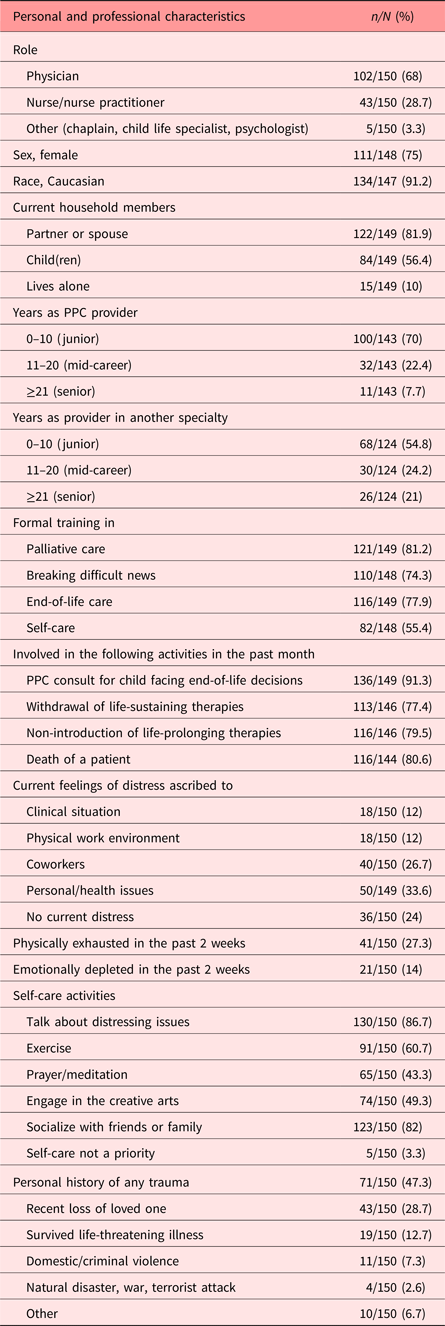
Characteristics of the study population are shown in Table 1. The majority of participants were female, Caucasian, and lived with a partner and/or children. Sixty-eight percent were physicians, more than half of whom were board-certified in Hospice and Palliative Medicine. Seventy percent of participants had been PPC providers for less than 10 years. The overwhelming majority of participants reported having received some type of formal training in breaking difficult medical news (74%), palliative care (81%), and end-of-life decision-making (78%). Nearly three-quarters of participants reported feeling “currently distressed” about some aspect of their personal or professional lives, and concurrent physical exhaustion and emotional depletion were reported by 27.3% and 14% of participants, respectively. These percentages for physical fatigue and emotional depletion are comparable to those reported in our recent survey of neonatal intensive care physicians (Weintraub et al., Reference Weintraub, Geithner and Stroustrup2016). The scope of self-care activities practiced by the study population is provided in Table 1. Because survey data were collected without any participant identifiers, no characterization of non-responders could be undertaken.
Characteristics of the study population
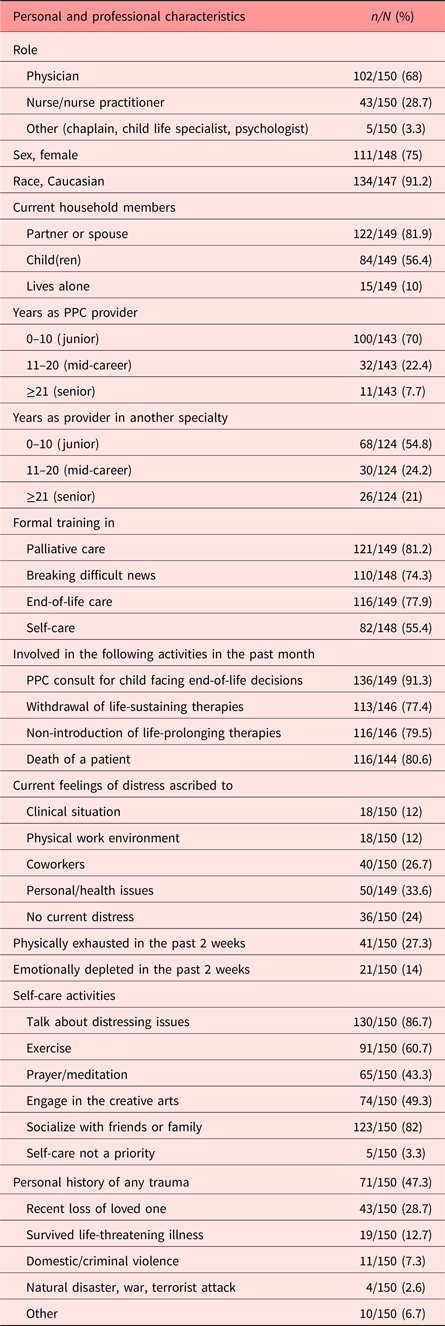
PPC, pediatric palliative care.
The characteristics of the modified CFST are presented in Table 2. Cronbach alpha values were 0.857 for CF, 0.795 for BO, and 0.904 for CS, which indicated reliable scales and were comparable to the alpha values obtained for the both original instrument (Stamm, Reference Stamm and Figley2002) and our previously described modified instrument (Weintraub et al., Reference Weintraub, Geithner and Stroustrup2016). Scores on the three subscales were normally distributed. Not surprisingly, a strong positive correlation was identified between CF and BO scores (shared variance = 48%), and strong negative correlations were demonstrated between CS and BO scores and between CF and CS scores (shared variances = 43% and 25.6%, respectively). Because of the large shared variance between physical exhaustion and emotional depletion (21%), each of these risk factors was tested separately in all models.
Characteristics of the modified CFST

CI 95%, 95% confidence interval; CFST, Compassion Fatigue and Satisfaction Self-Test for Helpers; IQR, interquartile range; SD, standard deviation.
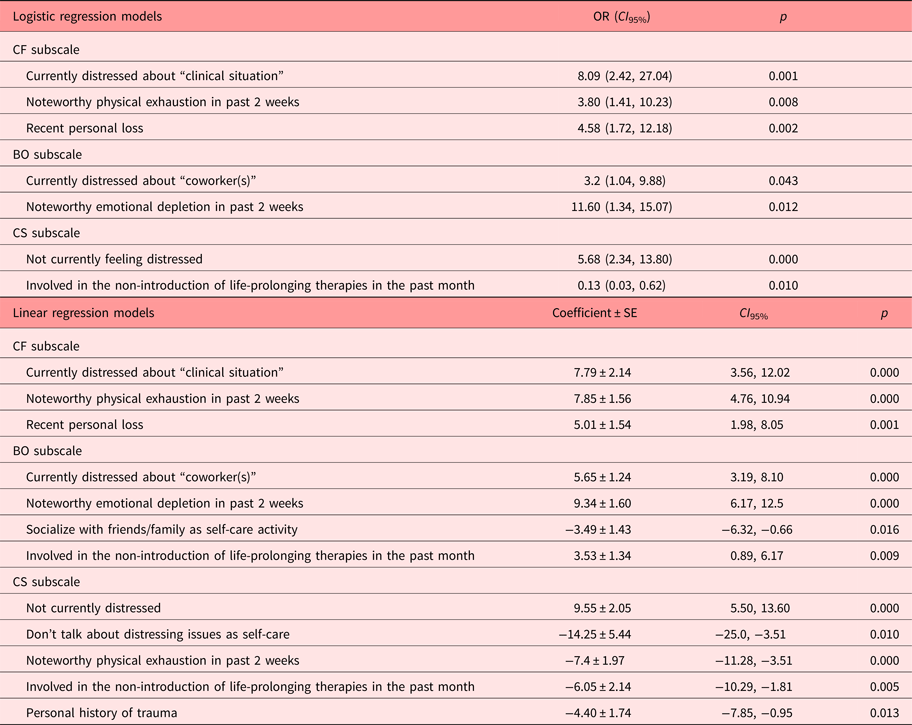
The prevalence of CF in the study population was 18% (95% confidence interval [CI 95%], 12, 24), with no significant difference in prevalence between physicians and nurses (15.7% vs. 20.9% respectively, p = 0.60). In univariable analyses, the following personal and professional factors were significantly different in individuals with and without CF: distress from “a clinical situation” or “coworkers,” recent physical exhaustion and/or emotional depletion, recent personal loss, and personal history of trauma. Logistic and linear regression analyses to assess the impact of factors found to be significant in univariate analyses of CF are presented in Table 3. The logistic regression model for CF contained three independent variables (distress from a “clinical situation,” physical exhaustion, and recent personal loss). The full model containing all predictors was statistically significant (chi-square [3, n = 150] = 27.31, p < 0.001), indicating that the model was able to distinguish between respondents who scored above and below the high-end cutoff score for CF. Pseudo R 2 measures (Cox and Snell's R 2 and Nagelkerke R 2) explained between 16.6% and 27.3% of the variance in CF, and correctly classified 83.3% of cases. All three factors made a unique statistical contribution to the model. The strongest predictor for CF was distress from a “clinical situation” (odds ratio [OR], 8.09; CI 95%, 2.42, 27.04; p < 0.001), followed by physical exhaustion (OR, 3.8; CI 95%, 1.41, 10.23; p < 0.008), and recent personal loss (OR, 4.58; CI 95%, 1.72, 12.18; p < 0.002). When the numeric CF score was modeled by linear regression (using CF score as a continuous variable) as a function of significant predictors, all three factors found to be significant in the logistic model remained significant predictors in the linear model. The total variance explained by the linear model was 25.5%, and the model as a whole was statistically significant (analysis of variance [ANOVA] [F 3, 146] = 16.68, p < 0.001).
Logistic and linear regression analyses associated with CF, BO, and CS in the study population
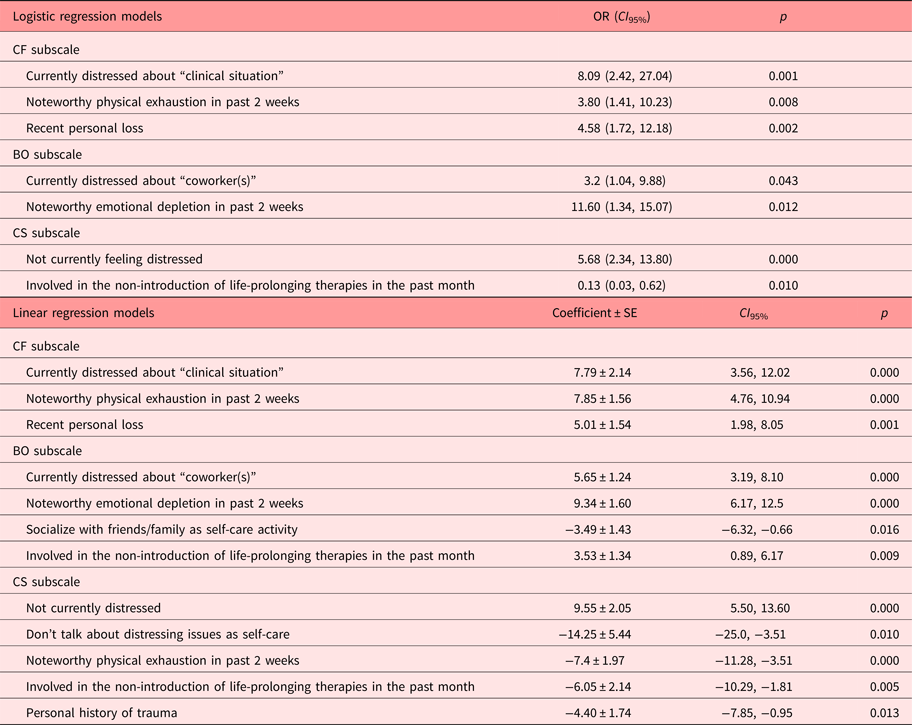
Abbreviations: BO, burnout; CF, compassion fatigue; CI 95%, 95% confidence interval; CS, compassion satisfaction; OR, odds ratio; SE, standard error. Significant at p < 0.05.
The prevalence of BO in the study population was 12% (CI 95%, 6.8, 17.2), again with no significant difference in prevalence between physicians and nurses (14.7% vs. 4.7% respectively, p = 0.15). In univariable analyses, the following factors were significantly different in individuals with and without BO: distress from “the physical work environment” or “coworkers,” recent physical exhaustion and/or emotional depletion, children in the household, personal history of criminal or domestic violence, and social interaction as a self-care activity. Regression analyses to assess the impact of factors significant in univariate analyses of BO are presented in Table 3. The logistic model for BO contained two independent variables (distress attributed to “coworkers” and emotional depletion). The full model was statistically significant (chi-square [2, n = 150] = 25.05, p < 0.001). Pseudo R 2 measures (Cox and Snell's R 2 and Nagelkerke R 2) explained between 15.4% and 29.6% of the variance in BO, and correctly classified 89.3% of cases. Both predictors made a unique statistical contribution to the model. When the numeric BO score was modeled by linear regression, feelings of distress attributed to “coworkers,” emotional depletion, and “recent involvement in a clinical situation in which life-prolonging activities were not introduced” were determinants of higher BO scores, whereas social interaction as a self-care activity was predictive of lower scores. The total variance explained by the linear model was 37.5%, and the model as a whole was statistically significant (ANOVA [F 4, 141] = 21.11, p < 0.001).
The prevalence of high CS in the study population was 25% (CI 95%, 18, 32%), with no significant difference in prevalence between physicians and nurses (5.9% vs. 7% respectively, p = 0.725). In univariable analyses, the following predictors were significantly different in individuals with and without high CS: self-report of “no current distress,” physical exhaustion and/or emotional depletion, and “recent involvement in a clinical situation in which life-prolonging activities were not introduced.” Regression analyses to evaluate the impact of factors significant in univariate analyses of high CS are presented in Table 3. The logistic model for high CS contained two independent variables (self-report of “no current distress” and “recent involvement in a clinical situation in which life-prolonging activities were not introduced”). The full model was statistically significant (chi-square [2, n = 150] = 22.86, p < 0.001). Pseudo R 2 measures (Cox and Snell's R 2 and Nagelkerke R 2) explained between 14.5% and 21.7% of the variance in high CS, and correctly classified 78.1% of cases. Both predictors made a unique statistical contribution to the model. When the numeric CS score was modeled by linear regression as a function of significant factors, self-report of “no current distress” was a significant predictor of higher CS scores, whereas physical exhaustion, personal history of trauma, “recent involvement in a clinical situation in which life-prolonging activities were not introduced,” and not talking about distressing issues were significant determinants of lower CS scores. The total variance explained by the linear model was 32.9%, and the model as a whole was statistically significant (ANOVA [F 4, 140] = 13.75, p < 0.001).
Discussion
In this cross-sectional pilot study of PPC physicians and nurses, we identified the prevalence of CF, BO, and high CS as 18%, 12%, and 25%, respectively. We present the first evaluation of potential predictors of these phenomena in this population.
Although studies have suggested risk factors for CF in adult PPC providers, prevalence and potential predictors of CF in PPC providers have not been previously reported (Galiana et al., Reference Galiana, Arena and Oliver2017; Sanso et al., Reference Sanso, Galiana and Oliver2015; Slocum-Gori et al., Reference Slocum-Gori, Hemsworth and Chan2011). In studies of mixed populations of pediatric healthcare providers, the prevalence of CF has been reported at 10–40% (Berger et al., Reference Berger, Polivka and Smoot2015; Branch & Klinkenberg, Reference Branch and Klinkenberg2015; El-bar et al., Reference El-bar, Levy and Wald2013; Meadors et al., Reference Meadors, Lamson and Swanson2009; Robins et al., Reference Robins, Meltzer and Zelikovsky2009; Sinclair et al., Reference Sinclair, Raffin-Bouchal and Venturato2017; Weintraub et al., Reference Weintraub, Geithner and Stroustrup2016). At 18%, the prevalence of CF in our study population was quite low and fell slightly below the mid-range presented previously for pediatric providers. This suggests our original concern that PPC providers are at particularly high risk for CF may not be warranted.
We found that feeling distressed about a “clinical situation,” physical exhaustion, and recent personal loss were each unique predictors of CF. Because clinical situations involving children with life-limiting or terminal illness can be traumatic for any member of the healthcare team, it is not surprising that PPC providers reported distress about such situations. Interestingly, despite the established connection between CF and one's emotional state, in our study, emotional depletion and involvement in the emotionally challenging clinical scenarios we posed were not predictors of CF. It may be that PPC providers routinely engage in self-care activities that help ameliorate the emotional burden common to the sub-specialty (Kobler, Reference Kobler2014; Maytum et al., Reference Maytum, Heiman and Garwick2004; Rourke, Reference Rourke2007; Sanchez-Reilly et al., Reference Sanchez-Reilly, Morrison and Carey2013).
The prevalence of BO in pediatric generalists and sub-specialists has been cited at 27–50%, with the highest prevalence in pediatric intensivists (Baer et al., Reference Baer, Feraco and Sagalowsky2017; Garcia et al., Reference Garcia, Garcia and Molon2014; Shanafelt et al., Reference Shanafelt, Hasan and Dyrbye2015; Starmer et al., Reference Starmer, Frintner and Freed2016). At 12%, the prevalence of BO in our study population was extremely low, and fell well below this range. Feelings of distress about “coworkers,” emotional depletion, social isolation, and “recent involvement in a clinical situation in which life-prolonging activities were not introduced” were each identified as unique predictors of BO.
Some studies have suggested that collegial professional relationships among PPC providers are protective against the negative aspects of demanding clinical work (Beaune et al., Reference Beaune, Muskat and Anthony2017), which may help account for the low prevalence of BO in our study population. However, in our study population, distress related to “coworkers” was an independent predictor of BO. How can we reconcile this finding? Members of the primary healthcare team may be uncomfortable dealing with end-of-life care issues in children with chronic illness (Zimmermann, Reference Zimmermann2007). As a result, despite supportive relationships among PPC colleagues, PPC providers may face oppositional attitudes from the primary healthcare team regarding a patient's end-of-life care, which, over time, could contribute to BO. Surprisingly, we found only one of the four challenging clinical scenarios to be predictive of BO. Why only one of four scenarios was predictive is unclear. PPC providers may have a protective innate level of resilience that counterbalances the challenging nature of these clinical situations. Further study is needed to understand how strengthening resilience may offset BO (Mehta et al., Reference Mehta, Perez and Traeger2016). Finally, in our population, BO was not related to objective indices of perceived work demands, as has been previously reported (Dyrbye et al., Reference Dyrbye, Varkey and Boone2013; Lee et al., Reference Lee, Brown and Cabrera2016).
Few studies have examined the prevalence and predictors of CS in healthcare providers; therefore, we cannot frame our prevalence of high CS within the context of other pediatric populations at this time. Because PPC providers tend to report high levels of job satisfaction and find their work rewarding (Beaune et al., Reference Beaune, Muskat and Anthony2017; Korzeniewska-Eksterowicz et al., Reference Korzeniewska-Eksterowicz, Przysło and Grzelewski2010), it is possible that they may be able to experience high CS despite the challenges of the discipline. Not surprisingly, self-report of “no current distress” and “not physically exhausted” were predictive of high CS in our study population. Of note, no “recent involvement in a clinical situation in which life-prolonging activities were not introduced” was also an independent predictor of high CS. This relationship is curious, and it is not entirely clear why this one particular challenging clinical scenario was predictive. Last, in our population, we observed a negative correlation between CS and CF and between CS and BO, which has been previously reported in other populations (Meadors & Lamson, Reference Meadors and Lamson2008; Meadors et al., Reference Meadors, Lamson and Swanson2009; Slocum-Gori et al., Reference Slocum-Gori, Hemsworth and Chan2011; El-bar et al., Reference El-bar, Levy and Wald2013; Weintraub et al., Reference Weintraub, Geithner and Stroustrup2016).
Self-care activities are a critical counterbalance to both recurrent traumatic clinical experiences and occupational angst (Sanchez-Reilly et al., Reference Sanchez-Reilly, Morrison and Carey2013; Sanso et al., Reference Sanso, Galiana and Oliver2015). Our data further this understanding by illustrating that social engagement may help ameliorate BO, and “talking about distressing issues” as a self-care activity may independently enhance CS. In our study population, almost all individuals who reported “talking about distressing” issues as a self-care activity confided in colleagues (95%); fewer individuals reported confiding in partners (58.5%), friends (38.5%), family members (26.2%), mental health professionals (15.4%), and clergy (4.6%). Unfortunately, we do not have data on the content of these conversations, nor do we know what providers found most helpful about these discussions. This is an area that should be explored further.
The goals of interventions that reduce CF and BO and enhance CS are to bolster provider well-being and improve patient care (Slocum-Gori et al., Reference Slocum-Gori, Hemsworth and Chan2011; Stamm, Reference Stamm and Figley2002; Tremblay & Messervey, Reference Tremblay and Messervey2011). Successful intervention strategies may not be “one size fits all” for every provider across disciplines. Scheduled group “debriefings” after challenging clinical situations to provide a safe environment to frame and process distress may be one strategy to strengthen CS, while decreasing CF and BO. Additionally, mindfulness exercises have been shown to reduce BO in healthcare providers (Back et al., Reference Back, Steinhauser and Kamal2016; O'Mahony et al., Reference O'Mahony, Gerhart and Grosse2016; Panagioti et al., Reference Panagioti, Panagopoulou and Bower2017; West et al., Reference West, Dyrbye and Erwin2016). Despite the positive impact of self-care activities on well-being, training programs have been slow to emphasize self-care (Sanchez-Reilly, Reference Sanchez-Reilly, Morrison and Carey2013). To better prepare providers for potentially traumatizing clinical experiences, the American Academy of Pediatrics established the “Resilience in the Face of Grief and Loss Curriculum” (Serwint et al., Reference Serwint, Bostwick and Burke2016). However, the effects of such programs on CF, BO, and CS in populations such as PPC providers are unknown and require further investigation.
There are several limitations to our study. Of the 248 institutions searched for PPC provider contacts, only 152 facilities had accessible information. Because of the nature of how SurveyMonkey collects anonymous responses, it was not possible to determine how many of the 152 institutions were represented in our sample. In addition, contact information listed online may be outdated; as such, despite a decent survey response rate, it is possible that our response rate was actually higher than our calculation (Cunningham et al., Reference Cunningham, Quan and Hemmelgarn2015). There is a risk of non-response bias. Because survey data were collected without participant identifiers, no characterization of non-responders could be undertaken, so it was not possible to compare those who responded to the survey with those who did not. It may be that individuals at greatest risk for CF or BO were less likely to participate in the study, or the reverse may be true. Our use of the CFST to study CF, BO, and CS precludes the direct comparison of our BO data to BO studies that use the Maslach Burnout Inventory. The generalizability of our findings is limited by the small sample size and by the fact that the majority of respondents were physicians, Caucasian, female, and PPC providers for less than 10 years. Because of the time frame of self-reflection imposed by the survey instrument, there may be bias toward more acute symptoms. Because of the need to limit the survey length, some potentially significant predictors may not have been included. Although identified factors accounted for 25.5%, 37.5%, and 33% of the variance in CF, BO, and CS scores, respectively, two-thirds to three-quarters of the variance in these scores has yet to be explained. Finally, our findings are observed associations to which causality cannot be applied.
In conclusion, we have identified the prevalence of CF, BO, and CS, and determined independent significant predictors of these phenomena in our study population of PPC providers. To provide compassionate and effective patient care, PPC providers must be attentive to predictors of these phenomena. To promote provider well-being, it is critical to not just prevent/reduce CF and BO, but also to promote CS. Lack of understanding and education about these phenomena may result in a myriad of personal and professional problems (e.g., provider health, decreased quality of care offered to patients, medical errors, personal and professional dissatisfaction) (Dyrbye et al., Reference Dyrbye, Varkey and Boone2013; Figley, Reference Figley and Figley1995a, Reference Figley1995b; Lee et al., Reference Lee, Brown and Cabrera2016; Maslach & Jackson, Reference Maslach and Jackson1981; Shanafelt et al., Reference Shanafelt, Boone and Tan2012; Zeidner et al., Reference Zeidner, Hadar and Matthews2013). Further work is needed to explore additional causes of CF, BO, and CS in PPC providers as well as potential interventions in the hope of decreasing distress, improving well-being, and enhancing satisfaction among providers.
Supplementary material
The supplementary material for this article can be found at https://doi.org/10.1017/S1478951517001237.