Introduction
Phytoseiid mites are important predators of phytophagous mites on many crops worldwide (McMurtry & Croft, Reference McMurtry and Croft1997). The Phytoseiidae includes 89 genera and more than 1980 species (Chant & McMurtry, Reference Chant and McMurtry2003; Moraes et al., Reference Moraes, McMurtry, Denmark and Campos2004; Chant & McMurtry, Reference Chant and McMurtry2004a,Reference Chant and McMurtryb, Reference Chant and McMurtry2005a,Reference Chant and McMurtryb). The genus KampimodromusNesbitt (Reference Nesbitt1951) belongs to the Amblyseiinae subfamily and contains 15 species, nearly all from the West Palearctic (Moraes et al., Reference Moraes, McMurtry, Denmark and Campos2004; Kolodochka, Reference Kolodochka2005). Kampimodromus aberrans (Oudemans), the most studied species in the genus, is an efficient natural enemy of mites in vineyards of southern Europe (Barret & Kreiter, Reference Barret and Kreiter1992; Duso, Reference Duso1992; Camporese & Duso, Reference Camporese and Duso1996; Kreiter et al., Reference Kreiter, Tixier, Auger and Weber2000) and occurs mostly on plants with domatia and ‘hairy leaves’ (Duso et al., Reference Duso, Torresan and Vettorazzo1993; Tixier et al., Reference Tixier, Kreiter and Auger2000; Kreiter et al., Reference Kreiter, Tixier, Croft, Auger and Barret2002). It is also reported from the USA on hazelnut (Corylus avellana L.) (Krantz, Reference Krantz1973; Moraes et al., Reference Moraes, McMurtry, Denmark and Campos2004); there its phoretic dispersal was observed on female aphids of Myzocallis coryli (Goeze) (Krantz, Reference Krantz1973).
Although Kampimodromus on hazelnut in the USA are recognized as K. aberrans, there is evidence that this may not be so. Phoretic dispersal reported for K. aberrans in the USA has not been seen among K. aberrans in Europe (Krantz, Reference Krantz1973). Morphological differences between larval stages of European and USA populations have been noted (Croft, unpublished data). Adult female K. aberrans from the USA have five solenostomes (glandular pores) on the dorsal shield, whereas K. aberrans have only four (Ragusa & Tsolakis, Reference Ragusa and Tsolakis1994). According to the last world revision of the genus (Ragusa & Tsolakis, Reference Ragusa and Tsolakis1994), this latter morphological difference would not key the USA specimens to K. aberrans. However, solenostomes are difficult to observe and their use for species diagnostics is controversial (Athias-Henriot, Reference Athias-Henriot1969, Reference Athias-Henriot1971, Reference Athias-Henriot1975; Chant & McMurtry, Reference Chant and McMurtry1994, Reference Chant and McMurtry2003). The aim of this study was to determine species identification of USA K. aberrans and assess morphological characters used to separate Kampimodromus species.
Material and methods
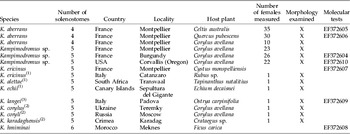
Species and populations studied (table 1)
K. aberrans were collected in Montpellier (south of France) from European hackberry (Celtis australis L.), downy oak (Quercus pubescens Willdenow) and hazelnut (Corylus avellana) (table 1). Morphological and molecular studies were carried out on the two former populations, whereas only morphological analysis was conducted on hazelnut specimens. On hazelnut mites, Kampimodromus with four solenostomes (identified as K. aberrans) and with five solenostomes (Kampimodromus sp.) were observed, and it was impossible to separate them for DNA typing. Specimens of Kampimodromus sp. with five solenostomes from hazelnut in Burgundy were measured and DNA typed.
Characteristics of the mite species and populations studied within the genus Kampimodromus. For molecular tests, the accession numbers reported in the Genbank data base are given.

(1) Measurements of a holotype; (2)Measurements from the published descriptions (holotype); (3)Measurements from non-holotype specimens.
Kampimodromus sp. mites from the USA, taken from the same hazelnut tree in Corvallis, Oregon, where K. aberrans had been reported by Krantz (Reference Krantz1973), were measured and DNA typed. To identify mites with five solenostomes from hazelnut in France and the USA, seven species of Kampimodromus having five solenostomes were examined. Morphological measurements (see below) were carried out on holotypes of K. ericinus Ragusa (University of Palermo, Italy), K. alettae Ueckermann & Loots (Agriculture Research Council, Plant Protection Research Institute, Pretoria, South Africa) and K. echii Ferragut & Pena-Estevez (Universita Politecnica de Valencia, Spain). Similar measurements of K. langei Wainstein & Arutunian were based on non-holotype specimens collected in Italy by Carlo Duso on Ostrya carpinifolia Scopoli, and those of K. coryli Meshkov, K. corylosus Kolodochka and K. karadaghensis Kolodochka were from the original published descriptions (Meshkov, Reference Meshkov1999; Kolodochka, Reference Kolodochka2003, Reference Kolodochka2005).
It was impossible to get live or alcohol-preserved specimens of the seven described species having five solenostomes to sequence DNA (described below). Only DNAs of K. langei and K. ericinus were sequenced. Specimens of K. langei were collected on O. carpinifolia in Padova (Italy) and those of K. ericinus in Villeneuvette (France) from rockrose, Cystus monspelliensis L. Two other species were also sequenced: Kampimodromus hmiminai McMurtry & Bounfour from Moroccan fig trees with six solenostomes, and Typhlodromus pyri Scheuten (Phytoseiidae: Typhlodrominae) from southern France on Rubus sp. (berries). Mites belonging to sequenced populations were mounted on slides and deposited in the Agro-M/INRA Acarology collection in Montpellier, France.
Morphological analysis
Terminology for chaetotaxy and adenotaxy follow those of Rowell et al. (Reference Rowell, Chant and Hansell1978) and Athias-Henriot (Reference Athias-Henriot1975), respectively. Between 8 and 34 female specimens of each population or species of Kampimodromus were mounted on slides in Hoyer's medium.
Dorsal seta length is a useful trait in species identification of Kampimodromus. Thus, 18 idiosomal dorsal setae of females were measured: j1, j3, j4, j5, j6, J2, J5, z2, z4, z5, Z1, Z4, Z5, s4, S2, S5, r3, R1. Lengths of macroseta on basitarsus IV and the numbers of solenostomes on dorsal shield and teeth on the movable digit of chelicera were also recorded.
Molecular analysis
DNA extraction
DNA was extracted from eggs, when possible, or starved females to avoid contamination from ingested prey. CTAB extraction was used. Several individuals (3–10 eggs, 5 females) were crushed and homogenized in 75 μl extraction buffer (2% CTAB, 1.4 M NaCl, 0.2% 26-mercaptoethaol, 100 mM EDTA, 100 mM Tris-HCl, and pH 8.0). Tubes were incubated for one hour at 65°C. Later, 75 μl of chloroform:isoamyl alcohol mixture (24:1) was added and tubes were centrifuged at 6°C for 5 min at 1000 g. Forty μl of isopropanol was added to the decanted aqueous phase and chilled at –20°C for 20 min for DNA precipitation. After centrifugation (15 min, 6°C, 1000 g), the pellet was suspended in 100 μl of 96% alcohol at 4°C. After a final centrifugation of 10 min (6°C, 1000 g), the dried pellet was suspended in 20 μl of de-ionized water.
Marker used
Many molecular markers have been used in entomology (Loxdale & Lushai, Reference Loxdale and Lushai1998) while few have been used for mites (Navajas & Fenton, Reference Navajas and Fenton2000; Cruickshank, Reference Cruickshank2002). Mitochondrial DNA (mt-DNA) has been widely used for studies with insects (Simon et al., Reference Simon, Frati, Beckenbach, Crespi, Liu and Flook1994; Roehrdanz & Degrugillier, Reference Roehrdanz and Degrugillier1998) and for some mites (Navajas et al., Reference Navajas, Guttierrez and Lagnel1996; Navajas & Fenton, Reference Navajas and Fenton2000; Toda et al., Reference Toda, Osakabe and Komazaki2000, Reference Toda, Osakabe and Komazaki2001; Otto & Wilson, Reference Otto, Wilson, Halliday, Walter, Proctor, Norton and Colloff2001; Cruickshank, Reference Cruickshank2002; Evans & Lopez, Reference Evans and Lopez2002). The sequence variability of the mt-marker allows separation of genetic entities at species or subspecies levels (Harrison, Reference Harrison1989; Loxdale & Lushai, Reference Loxdale and Lushai1998) and has been used to study synonymy of mites (Navajas et al., Reference Navajas, Gutierrez, Bonato, Bolland and Manpagou-Divasse1994, Reference Navajas, Gutierrez, Lagnel, Fauvel and Gotoh1999; Anderson & Trueman, Reference Anderson and Trueman2000; Toda et al., Reference Toda, Osakabe and Komazaki2000; Cruickshank, Reference Cruickshank2002).
DNA amplification and electrophoresis
The primers used to amplify a fragment of COI were the same as those used by Navajas et al. (Reference Navajas, Guttierrez and Lagnel1996) for Tetranychidae: 5′-3′, TGATTTTTTGGTCACCCAGAAG and 5′-3′ TACAGCTCCTATAGATAAAAC. PCR was performed in a total volume of 25 μl containing 2 μl of mite DNA, 1 μl of dNTP (2.5 mm for each nucleotide), 2.5 μl of Taq buffer, 1μl of each primer (100 μM), 0.5 μl of Taq polymerase (Quiagen, 5 U μl−1) and 18.9 μl of water. Thermal cycling conditions were as follow: 95°C for 1 min followed by 40 cycles of 92°C for 1 min, 45°C for 1 min and 72°C for 1 min. An additionnal 5 min at 72°C was allowed for final strand elongation. Electrophoresis was carried out in a 1.5% agarose gel in 0.5 X TBE buffer for 30 min at 100 volts.
DNA sequencing
PCR products were sequenced using the dynamic ET terminator cycle sequencing kit. Purification of DNA was carried out with Exosap-IT (Amersham). The sequencer used was the Megabase 1000 apparatus. All DNA fragments were sequenced along both strands.
Data analysis
Morphological data
Multiple variance (and Newman and Keuls means comparison test) and multifactorial analyses (Statistica®, 2001) were performed to assess morphological differences between the different populations and species studied.
Molecular data
Sequences were checked and read manually using bioedit® (Hall, Reference Hall1999). They were aligned using ClustalW® (1997) (Higgins et al., Reference Higgins, Thompson and Gibson1994) and tested with Mega3.1® (Kumar et al., Reference Kumar, Tamura and Nei2004). A distance matrix was constructed with the Jukes & Kantor model because the rate transition/reversion is near 1 (0.9). A Neighbour Joining tree was constructed with a 1000 bootstrap.
Results
Morphological data
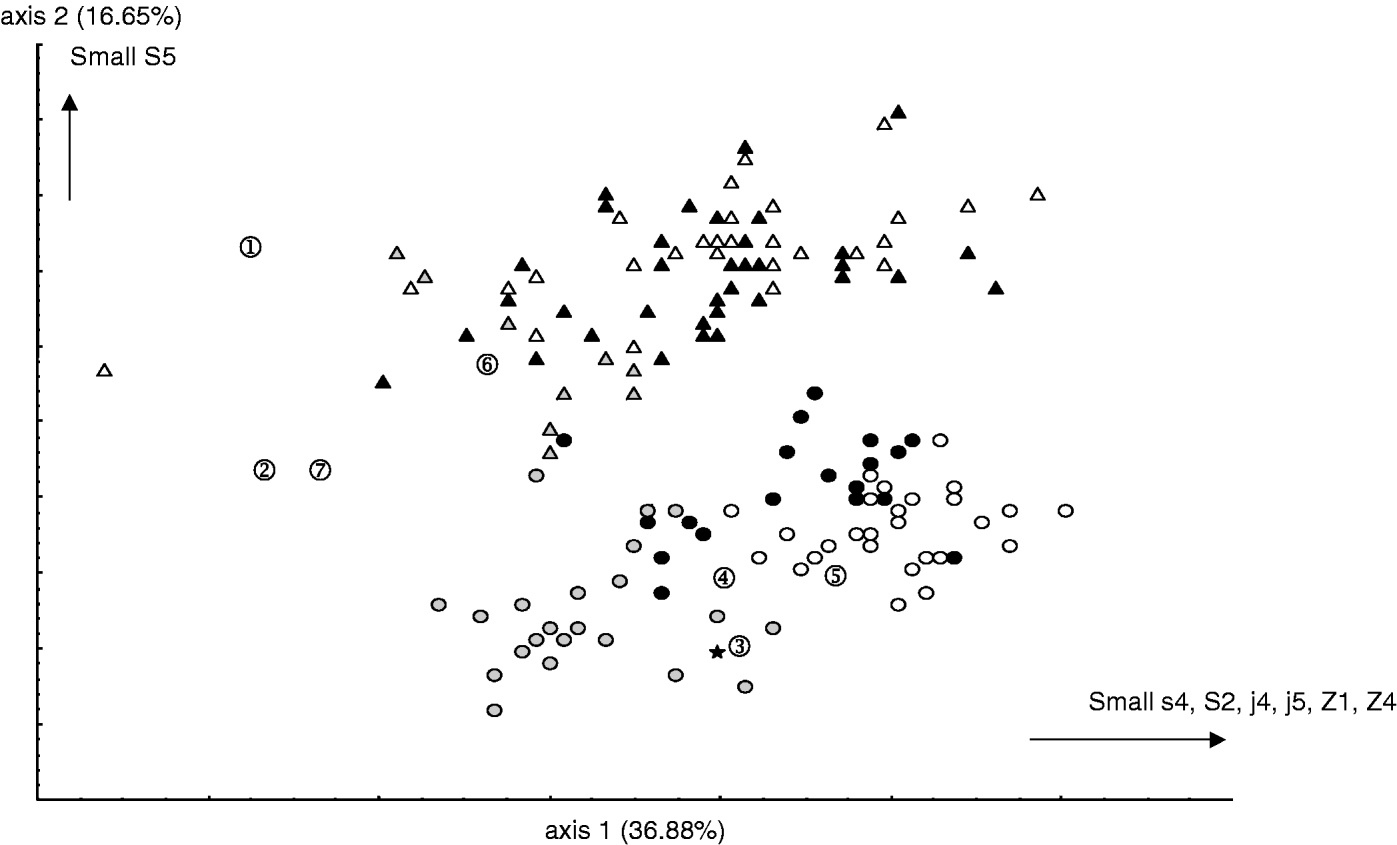
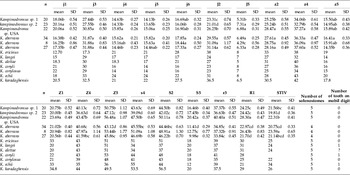
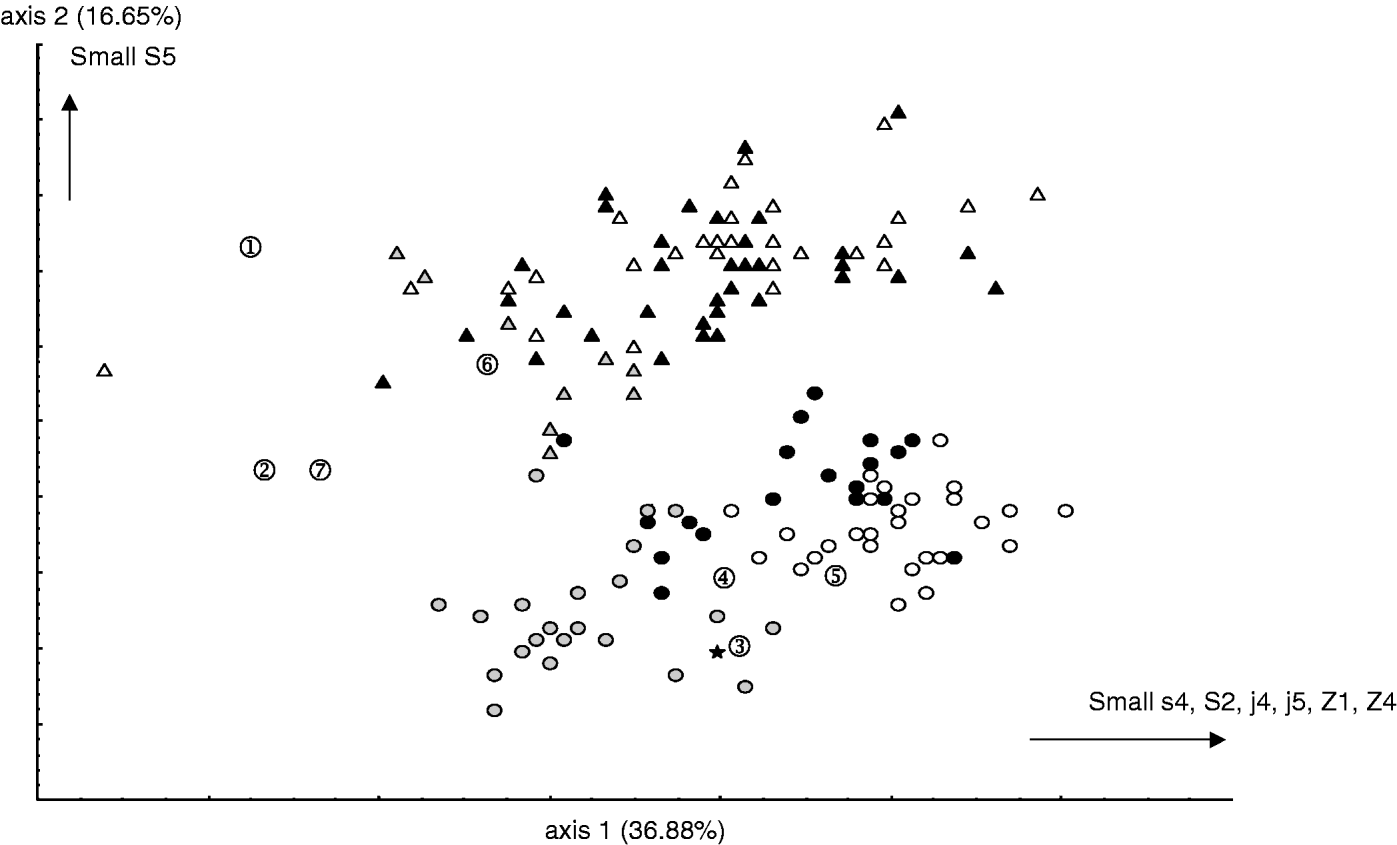
Significant differences were observed between K. aberrans and Kampimodromus sp. for all the characters (P<0.05) (table 2). However, these differences were very small, and a great homogeneity within the populations was observed (low standard errors). No notable morphological differences were observed between the French and USA populations having five solenostomes and between K. aberrans and the US population, except for setae j3, J2 being slightly longer for K. aberrans and seta S5 being slightly smaller for K. aberrans. The multifactorial analysis confirms these results (fig. 1). The first factorial component (axis 1), explained by s4, j5, S2, Z1 and Z4, did not separate K. aberrans populations from each other and from the USA population. On this axis, the USA population has a similar position as populations with five solenostomes from hazelnut in Burgundy and Montpellier. The second factorial component (axis 2), mainly explained by seta S5, identified two groups. One was for all K. aberrans; the second was for French and USA populations with five solenostomes.
Multifactorial analysis based on seta lengths of all the populations tested and of paratypes of several species of the genus Kampimodromus. ①, K. echii; ②, K. ericinus; ③, K. coryli; ④, K. langei; ⑤, K. corylosus; ⑥, K. alattae; ⑦, K. karadaghensis;  , Kampimodromus sp. USA, 5 solenostomes; ●, Kampimodromus sp. C. avellanae 5 solenostomes Montpellier;
 , Kampimodromus sp. C. avellanae 4 solenostomes Montpellier; △, K. aberrans Q. pubescens; ▲, K. aberrans C. australis; ○, Kampimodromus sp. C. avellanae 5 solenostomes Burgundy.
Values of the seta measurements and of other morphological characters of the populations and species of Kampimodromus (SD=standard deviation). Letters correspond to the results of the mean comparison test (Newman & Keuls).

According to our analyses, seta measurements did not separate K. aberrans from Kampimodromus sp. with five solenostomes from France and USA. Only seta S5 showed this separation, having a value <14 μm for K. aberrans and >14 μm for Kampimodromus sp. No morphological character (seta lengths, solenostomes or occurrence of a tooth on the mobile digit) differentiated populations of Kampimodromus sp.
Kampimodromus ericinus and K. karadaghensis differed from other species, but were similar to each other in morphological measurements (table 2); only setae j1 and j3 differed in length. They also differed from other specimens in the multifactorial analysis (fig. 1). K. echii was also different from all other species (table 2, fig. 1). Seta measurements would, thus, give an accurate diagnostic for identification of these species. However, K. alettae, K. coryli, K. langei and K. corylosus, K. aberrans and Kampomidromus sp. had similar seta measurements (table 2, fig. 1).
Molecular data
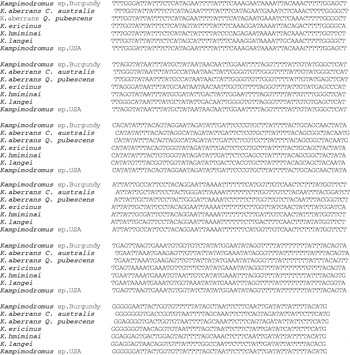
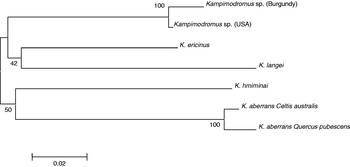
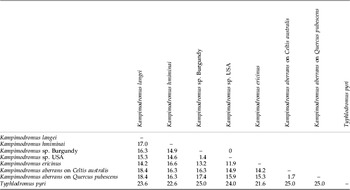
Actual lengths of DNA fragments amplified from each species and isolate could not be determined, as the 5′ and 3′ ends of the sequences could not be read. Nonetheless, we could align 355 nucleotides of the sequences for analysis. A Blast search of the Genbank database showed that the sequences blasted with other COI sequences, and the best query coverage was obtained with Varroa sp. (Acari: Mesostigmata). The best score was 77% with K. aberrans. DNA analysis showed a high percentage of adenine and thymine (fig. 2) and these rates were constant for all species and populations. Pairwise (uncorrected) distances between sequences are shown in table 3. The greatest distance was between the out-group, T. pyri and Kampimodromus spp. (table 3). The greatest distances among Kampimodromus spp. were between K. langei and K. aberrans, and K. ericinus and K. langei. The smallest genetic distance was between two populations of K. aberrans (1.7%) and between specimens with five solenostomes from France and USA on hazelnut (1.4%) (table 3). The Neighbour Joining tree is in fig. 3. The groupings between Kampimodromus sp. from France and USA, and between the two populations of K. aberrans were confirmed by a high bootstrap value. Kampimodromus langei and K. ericinus (five solenostomes) were grouped with Kampimodromus sp., whereas K. himiminai was most related to K. aberrans. Bootstrap values for these latter groupings were low.
Alignment of the sequences of the CoI gene for the following Kampimodromus species: K. langei, K. ericinus, K. aberrans (Celtis australis and Quercus pubescens), Kampimodromus sp. (Hazelnut: USA and France, Burgundy) and K. hmiminai.

Neighbour Joining tree based on genetic distances between the different Kampimodromus species. The numbers at nodes correspond to bootstrap values.

Distances of Jukes and Cantor for the gene studied (part of mt-COI) for the populations and species within the genus Kampimodromus and Typhlodromus pyri.

The Kampimodromus CO-I sequences were submitted to Genbank data base under their accession numbers (table 1). The accession number of T. pyri was EF372611.
Discussion
Similarities between USA and French Kampimodromus populations
The USA Kampimodromus sp. was morphologically like the French Kampimodromus sp., both with five solenostomes. Their genetic distance (based on CO-I sequence) was 1.4%, which is less than the intraspecific distance detected between two populations of K. aberrans (1.7%) and far higher than between different Kampimodromus species (11.9–18.4%). These small and large distances also match levels of intraspecific and interspecific divergence observed in other mites (Anderson & Trueman, Reference Anderson and Trueman2000; Salomone et al., Reference Salomone, Emerson, Hewitt and Bernini2002; Walter & Campbell, Reference Walter and Campbell2003). Hence, we conclude that the small genetic distance between the USA and French Kampimodromus sp. represent intraspecific diversity and both belong to the same species, which we hereafter refer to as Kampimodromus sp.
Identity of the USA population: usefulness of morphological characters and DNA sequencing
The genetic distances detected among species of Kampimodromus (13.2–18.4%) are high compared to among Tetranychids (Navajas et al., Reference Navajas, Gutierrez, Lagnel, Fauvel and Gotoh1999; Hinomoto et al., Reference Hinomoto, Osakabe, Gotoh and Takafuji2001) but similar to those for species of Dermassynae (genus Stratiolaelaps) (Walter & Campbell, Reference Walter and Campbell2003) and Oribatidae mites (Salomone et al., Reference Salomone, Emerson, Hewitt and Bernini2002). Based on COI sequence differences (from 14.9–17.4%), Kampimodromus sp. specimens did not belong to K. aberrans, despite their small differences in seta length. Our results confirm the lack of importance of these characters for differentiation and the value of solenostome numbers to separate K. aberrans from Kampimodromus sp. Furthermore, results indicate that morphologically similar species, Kampimodromus sp. and K. aberrans, co-habit hazelnut trees in France.
Seven species, K. langei, K. alettae, K. coryli, K. corylosus, K. echii, K. karadaghensis and K. ericinus, have five solenostomes like Kampimodromus sp. However, Kampimodromus alettae differs by having two pairs of preanal setae instead of three like all of the former. According to this difference, Kampimodromus sp. should not belong to this species. However, nothing is known about the reliability of the number of preanal setae for species identification, and molecular tests with this species would be required to conclude on this point.
Molecular differences between K. ericinus and Kampimodromus sp. suggest that specimens of Kampimodromus sp. do not belong to K. ericinus. Lengths of seta j3, j6, j4, j5 and J2 can separate them. Small morphologic differences (lengths of j1 and j3) were noted between K. ericinus and K. karadaghensis; these two species do not bear tooth on the movable digit and have similar seta lengths. Kolodochka (Reference Kolodochka2005), in the original description of K. karadaghensis, emphasized that K. ericinus had different serration of setae J5 and S5. According to these small differences, synonymy between K. ericinus and K. karadaghensis could be suspected.
Genetic distances between K. langei and Kampimodromus sp. are great, suggesting they are separate species. The only morphologic difference between them is the presence of a tooth on the movable digit for K. langei.
Kampimodromus sp. differs from K. echii for some seta lengths (S5, Z5, STIV and to a lesser extent j4, j5 and J2) and a tooth occurrence of the mobile digit. In the absence of molecular data to ascertain reliability of these characters, we conclude, based on morphological characteristics and data concerning importance of tooth presence, that Kampimodromus sp. does not belong to K. echii.
The two other species having five solenostomes are K. coryli and K. corylosus. The setae lengths of these species are similar to those of specimens of Kampimodromus sp. The only difference between K. coryli and K. corylosus is the presence of a tooth on the mobile digit. According to the importance of digit dentition trait, we assume that K. coryli and K. corylosus are valid species. Furthermore, as no morphologic differences separate K. coryli and K. corylosus from Kampimodromus sp., specimens of Kampimodromus sp. without a tooth are assumed to be K. corylosus. As such, Kampimodromus sp. from France and USA will be called K. corylosus hereafter.
Justification for species status for Kampimodromus species
This study emphasizes the value of morphological characters, especially the solenostome gd8, setal length and occurrence of a tooth on the movable digit of the chelicerae, for identification within Kampimodromus. The presence of gd8 seems to be of primary importance. It allows distinction of specimens having only slight differences in setae lengths and sharing the same chelicera dentition, such as K. corylosus and K. langei from K. aberrans. We emphasize the reliability of tooth occurrence on the movable cheliceral digit for differentiation when the number of solenostome is similar. Indeed, molecular analysis showed that K. langei and K. corylosus only differed by this character. It is also assumed that K. ericinus and K. echii, which have similar seta lengths but different cheliceral dentation, are also valid species. However, cheliceral dentation is not easy to assess, especially when chelicerae are closed. At last, for species having the same numbers of solenostomes and teeth on the mobile digit, seta lengths may allow differentiation, as shown for K. ericinus and K. corylosus. However, this paper confirms that this criterion must not be considered as a major trait, because of high variations between and within species (Tixier et al., Reference Tixier, Kreiter, Cheval and Auger2003). Kampimodromus echii, K. langei and K. coryli all have the same number of solenostomes and one tooth on the movable digit. Kampimodromus echii differs from the two in seta measurements, especially Z5, s4 and S5. Considering these differences, we suggest that K echii is a valid species, with molecular tests needed to confirm this hypothesis. No notable morphological differences were seen between K. coryli and K. langei (five solenostomes, one tooth on the mobile digit and identical setal lengths) nor between K. ericinus and K. karadaghensis (five solenostomes, absence of tooth on the mobile digit and identical setal lengths). Synonymy is, thus, suspected between these species that are only differentiated by serration of some setae. Molecular investigations would be needed to test these possible synonymies.
Key to identifying all species of Kampimodromus
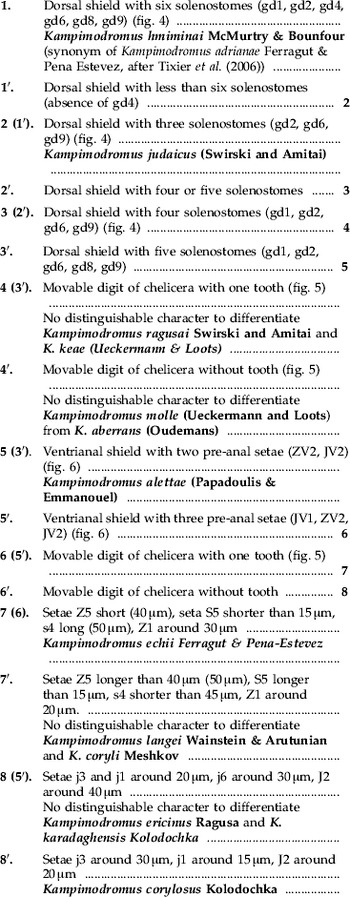
Considering our results and those for Kampimodromus species bearing three, four and six solenostomes (Ragusa & Tsolakis, Reference Ragusa and Tsolakis1994; Cargnus et al., Reference Cargnus, Zandigiacomo and Girolami2002; Tixier et al., Reference Tixier, Kreiter, Cheval and Auger2003, Reference Tixier, Kreiter, Ferragut and Cheval2006), we propose a diagnostic key for Kampimodromus spp. This key emphasizes the importance of the characters listed above, as well as the need for further molecular studies to evaluate the reliability of setae on the ventrianal shield and the synonymy between K. aberrans and K. molle, K. ragusai and K. keae, K. langei and K. coryli, and K. ericinus and K. karadaghensis.
Key to species of the genus Kampimodromus
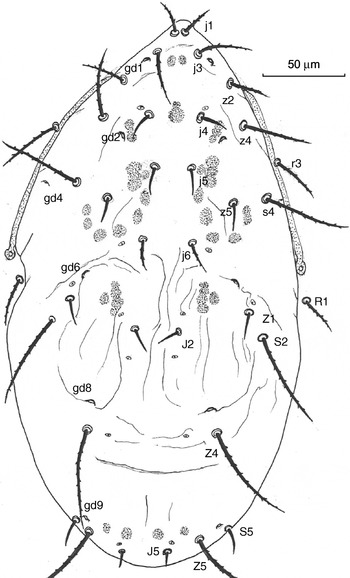
Dorsal shield of Kampimodromus sp. with seta and solenostome nomenclatura.

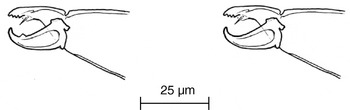
Chelicera of the females of Kampimodromus sp. with one tooth or without tooth on the movable digit.

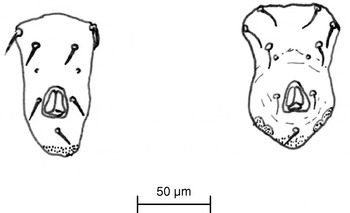
Ventrianal shield of the females of Kampimodromus sp. with two (ZV2, JV2) or three setae (JV1, ZV2, JV2) on.

Acknowledgements
We are very grateful to Eddie Ueckermann, Francisco Ferragut and Salvatore Ragusa who lend us the paratypes. We also thank Carlo Duso for the shipment of specimens of K. langei from Italy.