Introduction
The most common cancer diagnosed in women worldwide is breast cancer, and even in Indian women, the incidence rate of breast cancer has surpassed cervical cancer.Reference Bray, Ferlay, Soerjomataram, Siegel, Torre and Jemal1 Randomised clinical trials in early stage breast cancer patients have demonstrated that adjuvant irradiation lowers the relative risk of ipsilateral breast tumour recurrence by approximately 70% at 5 years with a 5% absolute improvement in 15-year overall survival, following breast conserving surgery.Reference Clarke, Collins and Darby2 Multiple randomised studies have also reported low α/β value in the range of 3–4 for breast cancer that predict a potential radiobiological advantage for hypofractionated radiotherapy.Reference Yarnold, Ashton and Bliss3–Reference Hennequin and Dubray5 Recently, there has been a renewed interest worldwide in hypofractionated radiotherapy schedules for breast cancer,Reference Yarnold, Ashton and Bliss3, Reference Bentzen and Agrawal4, Reference Owen, Ashton and Bliss6–Reference Whelan, Pignol and Levine8 which reduce the overall treatment time and consequently are resource sparing and beneficial, both for the patients, as well as for the hospitals with heavy patient load that can treat larger number of patients. These schedules have now become standard of care in many centers across the world. Intensity Modulated Radiation Therapy (IMRT) technique has been successfully used for radiation treatment of many disease sites and has also been found to improve the dose distribution between the target and non-target tissues in breast cancer patients with decrease in the dose to critical normal tissues such as heart and lung, which come in the path of radiation beams.Reference Borghero, Salehpour and McNeese9 IMRT also provides the possibility to integrate the boost [simultaneous integrated boost (SIB)] in daily radiation sessions by increasing the dose per fraction within the boost volume with added advantage of completion of treatment schedule within a short period of three weeks.Reference Teh, Walsh and Purdie10, Reference Scorsetti, Alongi and Fogliata11 Volumetric modulated arc therapy (VMAT) is a novel technique of delivering radiotherapy that reduces treatment delivery time, requires less monitor units (MU) and offers good conformity. The mean dose to normal tissue may be minimised using this technique although there will be inferior sparing if we consider the low-dose volume such as V 5, the effect of which is not quantifiable yet.Reference Teoh, Clark, Wood, Whitaker and Nisbet12
This report analyses data of 44 patients of early breast cancer who underwent breast conserving surgery (BCS), treated in this hospital with adjuvant hypofractionated VMAT and SIB, in the context of toxicity, cosmetic effects and quality of life.
Material and Methods
This retrospective, observational study was done at the Department of Radiation Oncology, Chittaranjan National Cancer Institute (CNCI), Kolkata, which is a Regional Cancer Center of Eastern India located in the state of West Bengal. The treatment records of 44 eligible Breast Cancer (Infiltrating Duct Carcinoma/other subtypes) patients registered at the Radiation Oncology Department between August 2014 and December 2015 for adjuvant radiation therapy with hypo-fractionated VMAT and SIB, after margin negative BCS, with pTNM T1–T3 and/or N0–N1, aged between 18 and 60 years with ECOG performance status 0–2, baseline hematological and biochemical parameters within normal limit and having no pulmonary or cardiac morbidity were included in the present analysis. Due approval of the institutional Ethical Committee was obtained and informed consent was taken from all the eligible patients before analysing their data. Data collection from patient follow-up data was done up to March 2018.
Radiation therapy
The CT-Simulation was performed with the patient lying in supine position on a breast board, with both arms raised above the head. Radio-opaque wires were placed to identify the outline of the clinically palpable breast. CT dataset was acquired with 3-mm-thick adjacent slices. No respiratory gating was adopted.
The breast Clinical Target Volume (CTVWB) included the palpable breast tissue demarcated with radio-opaque markers at CT Simulation and was delineated in accordance with Radiation Therapy Oncology Group (RTOG) Breast Cancer AtlasReference White, Tai and Arthur13 and consensus guidelines. It was limited anteriorly within 3 mm from the skin and posteriorly to the anterior surface of the pectoralis major and serratus anterior muscles excluding the chest wall.
The breast Planning Target Volume (PTVWB) was created by 3D expansion of the CTV by 7 mm (excluding heart and did not cross midline) and anteriorly covering up to skin.
The boost Clinical Target Volume (CTVBOOST) was defined as 1 cm of breast tissue beyond the delineated surgical cavity to include possible microscopic disease, and was limited posteriorly at anterior surface of the pectoralis major and antero-laterally 3 mm from the skin.
PTVBOOST was created by 7 mm 3D expansion of CTVBOOST. Figure 1 displays the dose distribution in target volumes in different planes.
Dose distribution in target volumes in axial, coronal and sagittal planes.

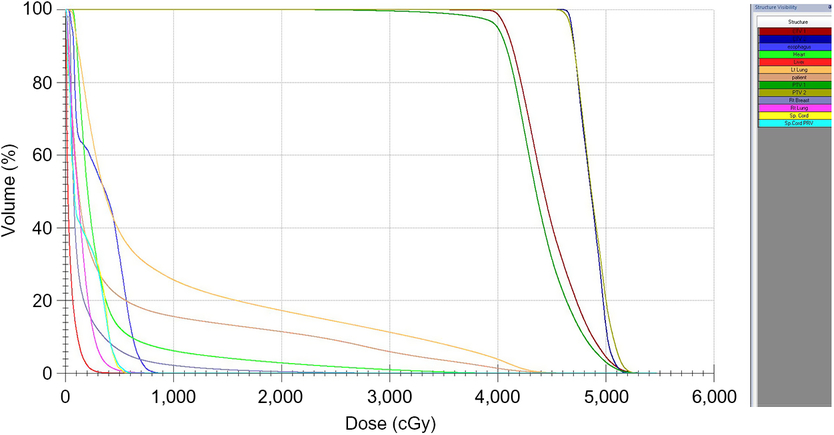
VMAT treatment planning using a 3D treatment planning system (CMS MONACO v.5.00.04, ELEKTA, Stockholm, Sweden) was performed. One or two partial arcs were used for a particular plan. The plans were approved when at least 90% of the PTVWB received at least 90% of the prescription dose (40 Gy/15#), although the goal was to deliver minimum 95% of the prescription dose to 95% of the PTVWB. For PTVBOOST, the goal was to deliver the 95% of the prescription dose (48 Gy/15#) to minimum 98% of the PTV. Figure 2 is a representative Dose Volume Histogram (DVH) from our study series.
DVH.

Dose prescriptions and constraints
Prescribed doses to different target volumes and dose constraints for organ at risk (OAR) are summarised in Table 1.
Dose prescription

Before each treatment, the set-up reproducibility was checked daily with the patients’ position being verified using Image-guided radiotherapy (IGRT) with kV cone beam CT.
External skin localising marks, which included permanent tattoos, were used for radiation localization and for set-up accuracy.
Radiation-induced acute toxicities were reported and analysed using CTCAE v4.0314 during treatment and follow-up period by history taking and clinical examination by the physicians. All patients were called for monthly follow-up for first 3 months and thereafter 3 monthly as per institutional protocol. Cosmetic outcomes were assessed using Harvard scale, while quality of life outcomes were assessed using EORTC scales and Health-Related quality of life (HRQOL) questionnaires (QLQ-C3015 and QLQ-BR2316) at baseline and at 6 months, 1 year and 2 years post treatment by the physicians.
Results
Clinical profile
The median age of our study population was 48·5 years. Among 44 total patients, 28 patients presented with stage II disease, 27 patients had left-sided breast cancer and 43 patients had invasive ductal carcinoma. The clinical profile is depicted in Table 2.
Clinical profile

Dose distribution
Satisfactory target coverage was achieved with optimal sparing of organ at risks.
Table 3 shows the doses received by heart, ipsilateral and contralateral lung.
Dose to OAR

Acute toxicity
Acute toxicity was graded according to CTCAE criteria v4.03.14 The parameters taken into account were skin toxicity (dermatitis), breast pain, fatigue and hematological abnormalities. Skin toxicity was the most common acute toxicity followed by hematological toxicity and fatigue. Table 4 demonstrates the distribution of different toxicities with grades.
Acute toxicity profile

Cosmetic outcome
Cosmetic outcomes were assessed according to Harvard scale at baseline and at 6 months, 1 year and 2 years post treatment. Most patients had good or excellent cosmesis. Table 5 demonstrates the cosmetic outcomes observed in our patients.
Cosmesis at different time period


Discussion
Acute toxicity
In this study, Grade 2 or higher skin toxicity was not recorded and Grade 1 Breast Pain was recorded in only 13·8% of patients. Scorsetti et al.Reference Scorsetti, Alongi and Fogliata11 conducted a study with over 50 patients with early breast cancer post BCS. A hypofractionated VMAT with SIB was used and the dose used was 40·5 Gy in 15 fractions to the whole breast with SIB of 48 Gy in 15 fractions over 3 weeks. Grade 2 skin toxicity was not found in any patients. In that study, a single Grade 3 skin toxicity was recorded, which was one of the three cases where a bilateral breast irradiation was performed. Formenti et al.Reference Formenti, Gidea-Addeo and Goldberg17 had already confirmed the feasibility of hypofractionated breast radiotherapy using a 3-week schedule with similar results. In a study published by Chadha et al.,Reference Chadha, Vongtama and Friedmann18 there was no significant difference in acute toxicities between the conventional arm and the hypofractionated arm (40·5 Gy in 2·7 Gy per fraction to whole breast with a concomitant surgical bed boost of 4·5 Gy in 0·3 Gy per fraction in 15 total fractions). In the hypofractionated arm of Chadha et al., Grade 2 or higher skin toxicity was seen in 4% of the patients and breast pain of Grade 1 or higher was recorded in 32% patients. Fatigue is one of the most bothersome symptoms during radical breast radiotherapy. Fatigue persists due to an uncertain etiology. There is no identified method to assign the patients at high risk of developing significant fatigue after the completion of treatment. Cancer-related fatigue generally runs a self-limiting course.Reference Goldstein, Bennett and Webber19 Jagsi et al.Reference Jagsi, Griffith and Boike20 compared acute toxic effects including fatigue, in patients receiving hypofractionated radiotherapy and conventional fractionation following BCS. Patients treated in hypofractionated arm of the above study had presented with a fatigue of 18·9%, which was almost similar to the present study showing fatigue in order of Grade 1 or higher in 18·2% of patients. Grade 2 fatigue was not recorded. The proportion of patients with no fatigue was 81·8%. Haematological abnormality was Grade 0 in 79·5% and Grade 1 in 20·5%, which was easily manageable.
Cosmesis
The most widely used scaling method in most of the published papers following breast conservative procedure till today is the Harvard Scale,Reference Harris, Levene, Svensson and Hellman21 introduced in 1979 by Jay Harris. The Harvard scale classifies cosmesis into excellent, good, fair and poor to compare the treated breast with the contralateral or untreated breast. Based on this scale, the cosmetic outcome was assessed by a panel of observers independently. The outcomes at baseline, 6 months, 1 year and at 2 years were compared. In this study, 88·6% of the patients had an excellent or good cosmesis at the baseline which was similar even at 6 months at 88·7%, improving to 90·9% at 1 year and it further improved to 95·4% at 2 years. Fair cosmesis in 11·4% (5) patients was registered at the baseline, and poor cosmesis was seen in one patient (2·3%), which continued to be poor at 1 year and at 2 years as well although the incidence of fair cosmesis decreased to 2·3% at the end of 2 years. Whelan et al.Reference Whelan, Pignol and Levine8 had already reported a non-significant relation in cosmetic outcomes between conventional radiotherapy arm (50 Gy in 25 fractions) and hypofractionated arm (42·5 Gy in 16 fractions) at 10 years, being a 71·3% in conventional arm and a 69·8% in the hypofractionated arm, with a good or excellent cosmetic outcome. Mc Donald et al.Reference McDonald, Godette, Whitaker, Davis and Johnstone22 had reported a 3 year outcome of global breast cosmesis in early stage breast cancer patients as 96·5% in good to excellent category using IMRT-SIB technique. Scorsetti et al.Reference Scorsetti, Alongi and Fogliata11 reported all patients with an excellent to good cosmesis compared with baseline. Ghannam and KhedrReference Ghannam and Khedr23 used accelerated hypofractionated radiotherapy with concomitant boost to 122 patients who had undergone breast conserving surgery. The proportion of excellent or good cosmesis was 95% at 6 months compared to 97% at 1 year.
Quality of life
QOL assessment in breast cancer patients has been the focus of clinical practice and research in recent times and also for assessing treatment outcomes. The reason could be the dismal effect of multi-modality therapy with respect to QOL, seen in various parts of the world.
EORTC QLQ BR 23 consisted of 23 questions that assessed four functioning scores (body image, sexual functioning, sexual enjoyment and future perspective) and four symptom scores (systemic side effects, upset by hair loss, breast symptoms and arm symptoms). Patients were given the option to or not to answer the questionnaires regarding sexual functioning and sexual enjoyment.
Both of the questionnaires were graded on a four-point response scale (not at all, a little, quite a bit and very much) to assess every functional or symptom item, and a seven-point response scale was used to assess global health status from very poor to excellent. Raw scores were linearly transformed to a score of 0–100 for processing according to the EORTC scoring manual. Higher the scores in the functioning and global health status scales, better the QOL, whereas higher the scores in the symptom scales, greater the problems. Patients usually completed the HRQOL questionnaires during their hospitals visits, but if they did not have time, they were asked to return them by mail or were attended by individual house visit. The mean (± standard error) of each score was calculated. The higher scores in functional scales and lower scores in symptom scales correlated to a better QOL outcome.Reference Fayers, Aaronson and Bjordal24 Multi-centric START trialsReference Bentzen and Agrawal4, Reference Bentzen and Agrawal7 had already shown assessment of QOL post radiotherapy in early stage breast cancer. In this study, QOL when reviewed at 6 months post radiotherapy, high functional scale scores were noted which could be attributed to shorter duration of treatment causing less fatigue, which also decreased with time but the low score in social functioning can be related purely to the individual background and psycho-social environment. Fatigue was found to be a strong predictor of quality of life in this present study, throughout the first three months of treatment schedule. At 6 months of assessment, the fatigue scores had subsequently decreased, although persistent fatigue was prevalent in a few. Exercise was advised to patients during radiotherapy and advised to be followed post radiotherapy to overcome fatigue. Patients who had continued exercise after radiotherapy as well were found to have higher functional scores with lesser fatigue, sleep disturbances, depression and anxiety than those who did not, similar to certain studies.Reference Mock, Dow and Meares25 These four parameters had a close inter-relation, which could be correlated to the present study. Fatigue that was persistent at 6 months could not be related to any treatment involved factors, although the possible reason may be early induction of menopause due to prior chemotherapy which was found in some of the patients in our study. It could also have had a relation with anemia or related haematological abnormalities, which is quite common in an Indian scenario. Breast symptoms were less, owing to lesser proportion of acute toxicity. These symptoms were found to be transient. Arm symptoms such as lymphoedema of the ipsilateral arm and reduced range of mobility were slightly higher compared to literature. The sexual functioning and sexual enjoyment scores were assessed only if the patients were willing to answer the 2 specific questions related to it. Body image differences had a high score relating to higher satisfaction in cosmesis at 6 months. Future perspective worries were to a lesser extent. Versmessen et al.Reference Versmessen, Vinh-Hung and Van Parijs26 concluded that hypofractionated tomotherapy patients had a clinically significant increase in role and social functioning scores and decrease in fatigue, which was clinically significant when compared to conventional arm and the functioning scores particularly physical, cognitive and emotional function post radiotherapy, improved faster in tomotherapy arm.
A Randomised Multicenter Phase III Clinical Trial (RTOG 1005, ‘A Phase III Trial of Accelerated Whole Breast Irradiation with Hypofractionation plus Concurrent Boost Versus Standard Whole Breast Irradiation plus Sequential Boost for Early-Stage Breast Cancer’) is underway since late 2013, and the results of this trial will likely confirm benefits of whole breast Radiotherapy with concurrent/simultaneous integrated boost.
Conclusion
This study showed that hypofractionated radiotherapy using VMAT with SIB is quite feasible for the treatment of early stage breast cancer with breast conserving approach in Indian scenario where not many radiation oncologists are practicing this novel technique as routine as of now. It is associated with the achievement of minimum acute toxicity, good to excellent cosmesis, acceptable quality of life and more convenience to the patients. Lower doses to OAR, could be achieved by VMAT, which would be highly beneficial as the incidences of late toxicities would be restricted to a lower level. A longer period of follow up will be required to assess the real impact with respect to late toxicities and survival data. No Grade 3 or more late toxicities were reported till the last follow up although we have not yet analysed the late toxicity profile of our patients.
Author ORCIDs
Debarshi Lahiri 0000-0002-6343-0361
Acknowledgements
The authors thank all the resident doctors and nursing officers of Department of Radiation Oncology, Chittaranjan National Cancer Institute, Kolkata, India.