INTRODUCTION
Mechanised sowing of crops is spreading across Asia and Africa, but in these regions four-wheel tractors (4WT) with planters are often too expensive for most smallholder farmers. Moreover, since average field sizes are typically smaller than 1000 m2, 4WT are generally too large to manoeuvre and provide effective tillage at acceptable cost (Johansen et al., Reference Johansen, Haque, Bell, Thierfelder and Esdaile2012). For these reasons, 2WT have become very popular in China (10 million), Thailand (2.6 million), Philippines (1.5 million), Bangladesh (700 000) and India (117 000) (Haque et al., Reference Haque, Bell, Kassam and Mia2016a). Presently, the 2WT are mostly operated in fully rotary tillage mode (Johansen et al., Reference Johansen, Haque, Bell, Thierfelder and Esdaile2012). However, there are promising developments in minimum soil disturbance planters for 2WT (Haque et al., Reference Haque, Bell, Kassam and Mia2016a; 2018; Johansen et al., Reference Johansen, Haque, Bell, Thierfelder and Esdaile2012). The one widely used option in Bangladesh to date is the Single Pass Shallow Tillage planter (SPST), also known as the Power Tiller Operated Seeder (PTOS), involving shallow full rotary tillage of the top soil (up to 0.04 m) (Roy et al., Reference Roy, Haque, Justice, Hossain and Meisner2009; Wohab et al., Reference Wohab, Roy, Haque and Amin2007). Full tillage such as this can be harmful to soil structure and soil health (Johansen et al., Reference Johansen, Haque, Bell, Thierfelder and Esdaile2012). In addition, the shallow depth of tillage results in shallow seed placement that makes rainfed crops more vulnerable to drought (Baker and Saxton, Reference Baker, Saxton, Baker and Saxton2007a).
Mechanised tillage and row sowing with 2WT-mounted planters can be adapted for minimum soil disturbance operations by strip planting (SP) or zero tillage (ZT) (Johansen et al., Reference Johansen, Haque, Bell, Thierfelder and Esdaile2012; Krupnik et al., Reference Krupnik, Santos Valle, McDonald, Justice, Hossain and Gathala2013). Planting crops such as wheat on shallow raised beds (called Bed planting (BP) here) is also common in the North-West of Bangladesh (Krupnik et al., Reference Krupnik, Santos Valle, McDonald, Justice, Hossain and Gathala2013; Miah et al., Reference Miah, Moniruzzaman, Duxbury and Lauren2014). Disturbance of the surface soils decreases in the sequence from SPST and BP to SP to ZT. These mechanised planting operations allow sowing in a single pass and therefore decrease time from harvest of one crop to sowing the next. In intensive cropping systems that are common in the Eastern Gangetic plain (EGP), there is limited time between harvest and planting of the next crop and delays due to tillage are harmful for timely sowing of the next crop. Any delays to planting may lead to limiting conditions (soil, temperature, water) for either crop establishment or for subsequent crop growth and yield (e.g. for chickpea, see Vance et al., Reference Vance, Bell, Johansen, Haque, Musa, Shahidullah and Mia2014; for wheat, see Kamruzzaman et al., Reference Kamruzzaman, Fakhrul Islam, Begum, Shiblee, Kibria and Ray2001).
One option for decreasing costs of production is mechanised single pass planting that allows for the concurrent sowing of the seed and placement of fertiliser into rows. In addition, minimum soil disturbance planting and other single pass tillage operations save seed, fuel and labour costs and allow a higher net income (Gathala et al., Reference Gathala, Timsina, Islam, Rahman, Hossain, Harun-Ar-Rashid, Ghosh, Krupnik, Tiwari and McDonald2015; Johansen et al., Reference Johansen, Haque, Bell, Thierfelder and Esdaile2012). Tillage costs using CT are relatively high (Lal, Reference Lal2009) and costs of crop production in Bangladesh are high relative to other countries (Roy et al., Reference Roy, Haque, Justice, Hossain and Meisner2009). Decreasing costs of crop production through mechanised single pass sowing will make locally grown crops more competitive with cheap imports.
In the diversified cropping systems of the EGP, characterised by small and fragmented land holdings, farm managers benefit if they have a choice of crop establishment options (ZT, SP, SPST and BP). Across the lowlands of the EGP, a diverse range of crops are grown in the cool, dry season after rice harvest and in the pre-monsoon season, notably wheat, maize, rice, lentil, chickpea, jute, mustard (Brassica juncea (L.) Czern) and mung bean. These crops vary not only in seed size and seed rate but also row spacing and plant-to-plant spacing. Until recently, all planters mounted on 2WT were capable of planting in only one or two of these planting modes (commonly SPST, BP and/or SP), limiting the planting choices (tillage type and crop) of farmers and the options for local service providers to hire out their planter for contract sowing (Johansen et al., Reference Johansen, Haque, Bell, Thierfelder and Esdaile2012). With the advent of the Versatile Multi-crop Planter (VMP), multiple planting options including ZT, SP, SPST on the flat together with BP (both new and permanent beds), and even conventional tillage (CT) seeding options and the capacity to handle variations in seed size, seed rate and row spacing are now available in a single planter (Haque et al., Reference Haque, Bell, Islam, Sayre and Hossain2011a). Both Dongfeng and Saifeng 2WT that are widely available in Bangladesh can be hitched to VMPs (Haque et al., Reference Haque, Bell, Islam, Sayre and Hossain2011a). The redesigned square rotary shaft and easily adjustable and removable blades are novel features of the VMP allowing rapid set up for the different planting options (Haque et al., Reference Haque, Bell, Islam, Sayre and Hossain2011a). The flexible blade adjustment system enables row spacing to be adjusted for varied crop establishment options among fields by the operators with minimal time delay. However, until now there was limited experimental evidence that planters for 2WT such as the VMP are able to establish satisfactory crop stands in different tillage modes and with different crops.
The aims of the present study were to (i) evaluate establishment of a wide range of non-rice crops sown with the VMP under diverse conditions, with single pass and minimum soil disturbance planting in dry, early wet and main wet seasons; (ii) determine in a selection of cases whether the yield is comparable to existing planting practices involving multiple-pass full tillage operations and broadcast seeding; and (iii) quantify the associated costs and labour requirements of crop establishment with the different planting modes.
MATERIALS AND METHODS
The experiments
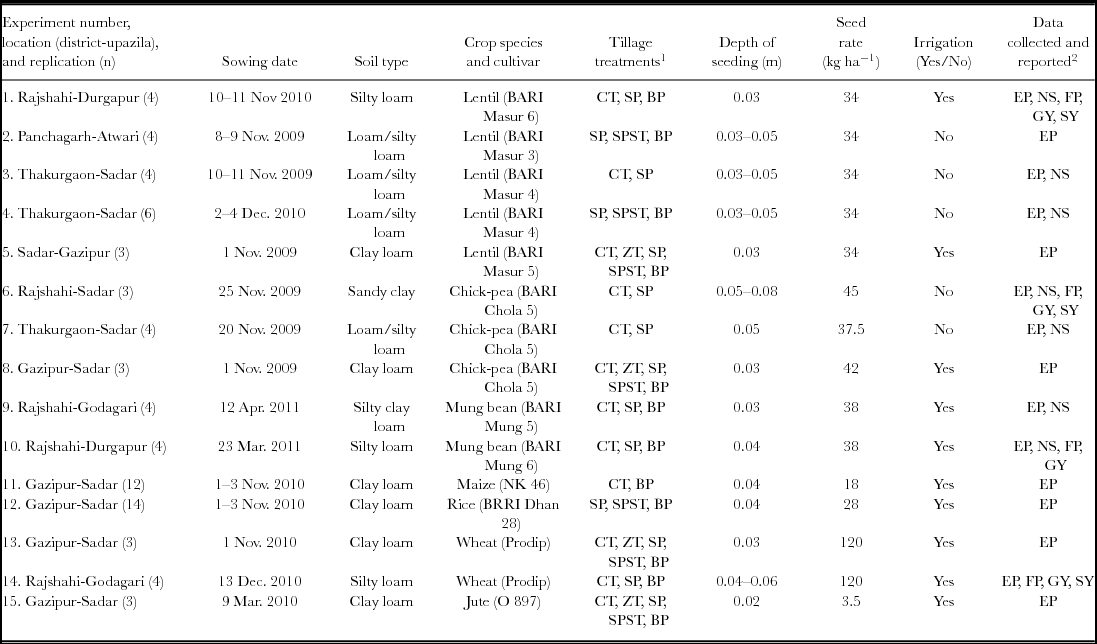
The VMP was evaluated with various crops and soils across 17 districts of Bangladesh. However, data for this paper are based on 15 experiments in Rajshahi, Thakurgaon, Panchagarh and Gazipur districts with seven crop species (Supplementary Figure S1 (available online at https://doi.org/10.1017/S0014479717000370); Table 1). These districts of Bangladesh are situated in the North (Thakurgaon and Panchagarh), Northwest (Rajshahi) and central (Gazipur) parts of the country, creating a range of weather conditions, soil types, sowing times and cropping rotations over which the VMP was tested. Since the aim of the study was to assess the crop establishment performance with the VMP, 12 of experiments only reported on VMP operations for crop establishment and the plant populations while only three determined crop yield. Subsequent papers will focus on crop growth and yield. The configuration of the four different planting types and the conventional tillage are as follows: SP: 0.02–0.04 m wide and 0.04–0.05 m deep tilled strips were made (that preserved about 80% of untilled soil) in untilled flat land by VMP. Seed and fertilizers were placed at the base of the strips by a tyne opener in single pass operation; SPST: up to 0.06 m depth of surface soil was fully disturbed by rotary tynes operated by the VMP that placed basal fertilizers and seed in rows in a single pass operation; ZT: deep slits (0.06 m) up to 0.04 m wide were made (about 80% undisturbed soil) with tyne openers in untilled flat land by VMP. Seed and fertilizers were placed simultaneously behind tyne openers in a single pass operation; BP: beds 0.25–0.30 m wide at the top and 0.58–0.60 m wide at the base (height from the furrow to the bed top was about 0.18–0.20 m) were made by VMP and seed and fertilizers were placed in rows near the two edges of the beds in single pass with the VMP; and Conventional tillage and planting (CT): Land preparation was done by locally hired 2WT using four rotary tillage passes in dry land followed by two levelling passes. Seed and basal fertilizers were broadcast manually before the last tillage operation.
Details of field trials sown with the Versatile Multi-crop Planter (VMP) in different tillage modes. 1CT = conventional tillage; SP = strip planting; BP = bed planting; SPST = single pass shallow tillage; 2EP = emergence population; NS = nodulation scoring; FP = final plant count, GY = grain yield, SY = straw yield.

Rajshahi district
The experiments were conducted in Digram and Choighati (in Godagari upazila), Agoilpur (Rajshahi Sadar upazila) and Alipur (Durgapur upazila) villages in Rajshahi district. The average annual rainfall of Rajshahi district is 1200 mm of which 80% falls during June to September (Mazid et al., Reference Mazid, Bhuiyan, Mannan, Wade, Pandey, Mortimer, Wade, Tuong and Hardy2002). Monthly mean temperatures during November, December, January, February, March and April for Durgapur upazila and Godagari upazila are shown in Table S1 (Anonymous, 2017). In the High Barind Tract (HBT) of Rajshahi, grey terrace soils are predominant (Brammer, Reference Brammer1996). The HBT soils (Godagari site) had silty clay texture while those from the Durgapur site were sandy loam.
Dry and cool season lentil, chickpea and wheat were grown from November–December to March–April. All crops were grown in farmer's fields. Details of the experiments are reported in Table 1.
Thakurgaon and Panchagarh districts
Three experiments were conducted in Thakurgaon district in Sadar upazila, and one experiment in Panchagarh district of Atwari upazila. The average annual rainfall of Thakurgaon and Panchagarh districts is 2147 mm of which about 90% occurs during May to September (weather data reported from nearest weather station at Dinajpur district). Monthly mean temperatures during November, December, January, February, March and April for In Sadar upaliza, Thakurgaon are shown in Table S1 (Anonymous, 2017). The soil texture at the trial sites in farmers’ fields was sandy loam. Details of the trials are shown in Table 1. Dry and cool season lentil and chickpea were planted during November.
Gazipur district
The average annual rainfall of Gazipur district is about 2036 mm of which about 80% rainfall occurs during May to September. Monthly mean temperatures during November, December, January, February, March and April for Gazipur, upaliza are shown in Table S1 (Anonymous, 2017). In 2009, a lentil trial (Experiment 5, Table 1) was carried out at the Bangladesh Sugarcane Research Institute (BSRI), Joydebpur, Gazipur. In addition, four on-station trials (Experiments 8, 11, 12 and 13, Table 1) examined the crop establishment performance of VMP for wheat, chickpea, lentil and jute. A separate trial (Experiment 12 in Table 1) was conducted at BSRI to establish direct seeded rice (DSR) using a vertical disk seed meter.
Crop establishment and management practices
In all experimental sites, the lentil, mung bean and DSR were sown by VMP at 0.2 m row spacing except in BP systems, where considering the whole planted area, including the inter-bed space, the effective row spacing was 0.29 m. The maize seed was planted in rows 0.6 m apart, and 0.18–0.25 m plant-to-plant spacing. Before sowing, the lentil, chickpea and mung bean seeds were primed with sodium molybdate and Rhizobium at 1.5 g kg−1 and 10 g kg−1, respectively, following the practice of Johansen et al. (Reference Johansen, Musa, Kumar Rao, Harris, Ali, Shahidullah and Lauren2007). Plot size for all crops was in the range 100 to 1750 m2.
At planting, triple super phosphate fertiliser (20% P, 1.3% S and 20% Ca) was used as basal P fertiliser for all lentil, chickpea and mung bean crops at the rate of 100 kg ha−1. For wheat, 150 kg of diammonium phosphate ha−1 (18% N and 20% P), 110 kg of muriate of potash ha−1, 123 kg of gypsum ha−1, 6 kg of boron ha−1 were applied as basal fertiliser. For rice 27, 10, 30, 5, 2 and 1 kg ha−1 of N, P, K, S, Zn and B, respectively, were applied using the same fertilisers as for wheat. The basal fertiliser applied in the maize crops was 185, 275, 275, 185, 17 and 12 kg ha−1 of urea, triple super phosphate, muriate of potash, gypsum, zinc sulphate and boric acid, respectively. In the case of direct-seeded rice, topdressings of urea fertiliser at the rate of 58 kg ha−1 were applied at 30 days and 55 days after sowing. Two urea top dressings at the rate of 185 kg ha−1 were applied to maize at 38 and 62 days after sowing.
Generally, no irrigation was applied for lentil and chickpea cultivation. Before emergence, a light irrigation was applied to rice, wheat, maize, mung bean and lentil plots of the Godagari site; and all crops at Sadar upazila in Gazipur district to ensure favourable moisture for plant establishment. Wheat was irrigated at 21, 49 and 68 days after sowing. The maize crop was irrigated four times at 26, 48, 67 and 84 days after sowing. In Gazipur, the rice field was irrigated twice at 14 and 20 days after sowing.
In case of lentil, mung bean and chickpea, weeds were hoed when shoots were about 0.1 m tall. The first hoeing of weeds was done in the wheat, maize and rice fields at 22–30, 25 and 20 days after sowing, respectively. A second-hand weeding was done in maize and rice fields at 48 and 40–45 days after sowing, respectively.
At early seedling stage, Rovral® (Iprodione) at the rate of 0.5 kg ha−1 and Bavistin® (Carbendazim 50%) at the rate of 0.75 kg ha−1 were applied 2–4 times in lentil and chickpea plots of Thakurgaon Sadar (Experiments 3, 4, 7, Table 1) and Atwari upazila (Experiment 2, Table 1) to control root disease. Ripcord® (21.1% Cypermethrin, 70.5% Xylene) at the rate of 250 mL ha−1 and Helicoverpa Nuclear Polyhedrosis Virus (HNPV) was applied in Rajshahi chickpea fields (Experiment 6, Table 1) to control pod borer (Helicoverpa armigera). The HNPV was sprayed at the time the small size larvae (<1.5 cm) appeared in the fields.
Plant population
For the evaluation of crop establishment after sowing with the VMP in different soils, we collected emergence data from 15 experimental locations with seven crop species (Tables 1 and 2). In addition, final plant population was counted in lentil plots during harvesting at Durgapur upazila (Experiment 1, Table 3). In the case of chickpea, the final plant population was recorded at the trial of Rajshahi Sadar (Experiment 6, Table 3). The mung bean (Experiment 10, Table 3) and wheat final plant populations were recorded from the trials at Durgapur (Experiment 14, Table 3). The data were collected from three or four quadrats (each quadrat was 0.5 m2), randomly selected from locations in each plot.
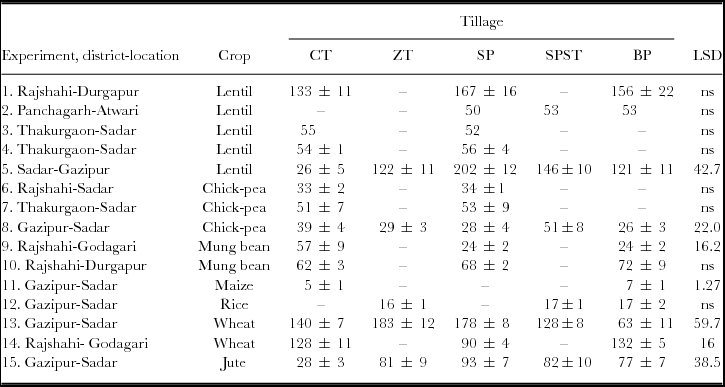
Emergence of crop species (plants m−2) under different tillage systems with the Versatile Multi-crop Planter. Values are means of 3–4 replicates (n) (± standard errors). CT = conventional tillage; ZT = zero tillage; SP = strip planting; SPST = single pass shallow tillage; BP = bed planting.

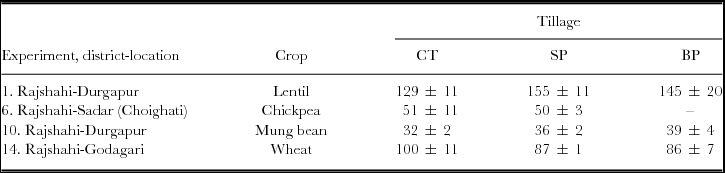
Final plant count (plants m−2) of lentil, chickpea, mung bean and wheat under different tillage methods. Values are means of 3–4 replicates (n). CT = conventional tillage; SP = strip planting; BP = bed planting.

Evaluation of crop growth, yield and yield contributing characters
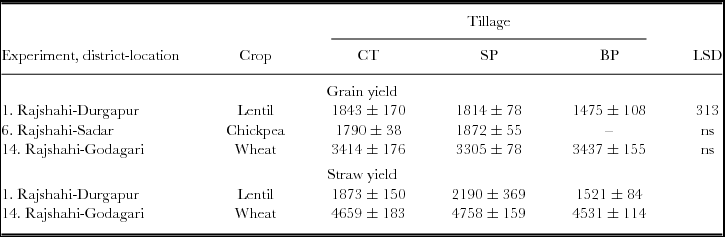
In addition to crop establishment and VMP performance, which was the main purpose of this study, at three experiments (Experiments 1, 6 and 14, Tables 1 and 5) we evaluated the tillage effect on grain and straw yield at harvest. The above-ground biomass was split into grain, and stem plus leaf recorded from quadrats (0.5 m wide and 1 m long in three or four locations from each plot) of lentil plots in Durgapur upazila (Experiment 1, Tables 1 and 5) and wheat in Godagari upazila of Rajshahi (Experiment 14, Tables 1 and 5) While only yield was obtained for chickpea in Rajshahi Sadar (Experiment 6, Tables 1 and 5).
Twenty legume plant (lentil, chickpea and mung bean) roots were excavated from 1 m2 quadrats placed randomly within experimental plots. The nodulation score was rated on the basis of nodule number and mass by using visual rating criteria proposed by Rupela (Reference Rupela1990).
Machine performance data collection
The VMP was used to establish all crops for all planting modes except for CT. As the seed meter of VMP was connected by a chain-sprocket arrangement to the 2WT wheel axle, the speed of the tiller was not a factor in seed calibration, unless there was wheel slippage. The wheel slippage and operating speed were calculated according to Michael and Ojah (Reference Michael and Ojha1978). Data on labour requirement, operational time, time loss and field capacity were recorded during the field operation. The time losses due to turning, clogging and operators' personal needs were also recorded. Field capacity (the field area covered per unit time, ha hr−1) was determined using the formulae of Hunt (Reference Hunt1973).
Data analysis
Data for each species were analysed as a one-way analysis of variance (for planting type effects) using MSTATC and Excel programs for mean and standard error (SE) calculation.
RESULTS
Crop establishment
Plant population for lentil at Durgapur (Experiment 1) was similar at emergence (133–167 plants m−2) for CT, SP and BP planting methods with very little loss of emerged plants by harvest (Tables 2 and 3). At the Gazipur trial (Experiment 6, Table 2), planting by single pass methods increased lentil plant populations from 26 to 121–202 plants m−2, with maximum population obtained with SP. By contrast, in the Northern districts of Thakurgaon (Experiments 3 and 5, Table 2), and Panchagarh (Experiments 2 and 4, Table 2), plant populations with CT and single pass planting methods were < 55 plants m−2. Foot rot diseases (caused by Fusarium oxysporum and Sclerotium rolfsii) were observed in lentil with all planting methods in the Northern locations, attributed in part to high soil water at sowing and during emergence.
In all chickpea experiments, the plant populations after emergence ranged between 26 and 57 plant m−2. Recommended plant populations for chickpea across the region are 18 to 33 plants m−2 (Ali et al., Reference Ali, Ahmed, Johansen, Harris and Rao2007; Johansen et al., Reference Johansen, Bakr, Sirajul Islam, Mondal, Afzal, MacLeod, Pande and Siddique2008a; Saxena, Reference Saxena, Saxena and Johansen1987). In chickpea experiments, planting by CT produced satisfactory plant populations (Experiments 6, 7 and 8, Table 2). Single pass planting likewise produced satisfactory plant populations that were not significantly different from CT in most cases. Chickpea at Gazipur (Experiment 8, Table 2) had significantly higher plant populations (51 plants m−2) emerging from SPST than other planting methods (Table 2).
The mung bean plant population in CT (Experiment 9, Table 2) was twice as high as SP and BP both of which had unsatisfactorily low populations. By crop maturity, the mung bean plant populations in Experiment 10 dropped by about 50% compared to emergence, but the decline was similar for all planting methods (Table 3). In experiment 10 at Durgapur, all planting methods (CT, SP and BP) produced similar and adequate plant populations (Table 3).
With CT planting, the emerged maize population was 75% of the optimal population of 6.7 plants m−2 in Bangladesh (Haque et al., Reference Haque, Elahi, Waddington, Sarker and Sarker2006), while the target populations were achieved by the BP system using the VMP (Experiment 11, Table 2).
For direct seeding of rice, there is no basis for comparison to the CT as planting involves full puddling and transplanting. The emergence count of direct-seeded rice was between 16 and 17 plants m−2 with no significant difference between planting methods (Experiment 12, Table 2).
When sown by CT, wheat achieved 128–140 plants m−2 (Experiments 13 and 14, Table 2). The SP and ZT planting operations produced similar plant populations as CT at Gazipur (Experiment 13, Table 2). At Durgapur, BP gave the same wheat plant population as CT, while SP had 30% fewer plants. However, wheat plant populations at maturity were comparable for all planting methods on account of greater loss of plants in CT and BP than SP (Experiment 14, Table 3).
At the Gazipur experiment, the jute plant population of all single pass sowing methods ranged from 77 to 93 plant m−2 which was about three fold higher than planting by CT (Experiment 15, Table 2).
Nodulation of pulse crops
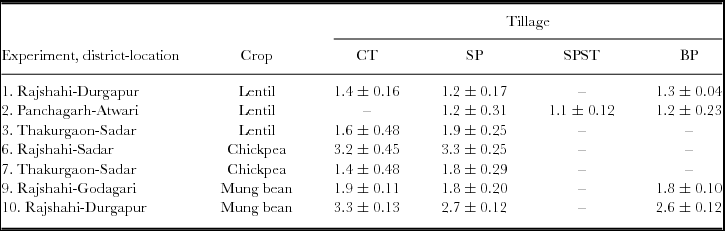
A nodulation score of 3 or more is associated with vigorous legume growth in soils of low mineral nitrogen status (Rupela Reference Rupela1990 and subsequent experience in using that methodology; C. Johansen personal communication). There was limited nodulation of lentil with scores between 1.1 and 2 across all planting methods (Experiment 1, Table 4). The nodulation score of chickpea was adequate in all planting methods at Rajshahi sites (2.47 to 4.2, Experiment 6) while the score was < 2 at Thakurgaon (Experiment 7), where excessive soil water at planting may have inhibited nodule formation (Table 4). At Rajshahi, chickpea nodulation scores in SP were similar to CT (Experiments 6 and 7). During 2010, the mung bean at Godagari had a low nodulation score in all planting types (Experiment 9, Table 4). Mung bean at Durgapur in CT had a nodulation score which was 20% and 25% higher than the SP and BP, respectively (Experiment 10, Table 4).
Nodulation scoring of lentil, chickpea, mung bean roots under different tillage systems. Values are means of 3–4 replicates. Scoring of nodulation (1–5 scale, with 1 = minimal nodulation and 5 = supra-nodulation) on the basis of nodule number and mass by using visual rating criteria given by Rupela (Reference Rupela1990). CT = conventional tillage; SP = strip planting; SPST = single pass shallow tillage; BP = bed planting.

Grain and straw yield of lentil, chickpea and wheat
Lentil planted by CT at Durgapur had a grain yield of 1843 kg ha−1, which was similar to SP, but 25% higher than BP (Experiment 1, Table 5). By contrast, SP produced higher straw yield than CT while straw yield in BP was lower than CT (Experiment 1, Table 5). Chickpea in the Rajshahi Sadar produced 1790 kg of grain ha−1 in CT, which was comparable to that with SP planting (Experiment 6, Table 5). Wheat grain and straw yield were not significantly different between CT, SP and BP in Durgapur (Experiment 14, Table 5).
Grain and straw yield (kg ha−1) of lentil, chickpea and wheat under different tillage methods. Values are means of 3–4 replicates ± standard errors. CT = conventional tillage; SP = strip planting; BP = bed planting.

Costs and labour inputs at crop establishment
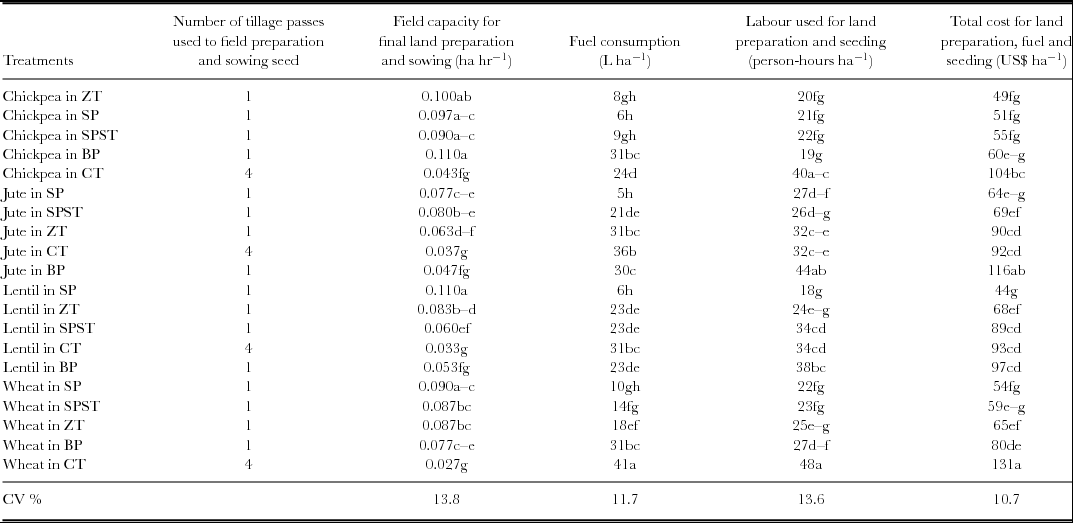
The field capacity for CT-planted crops was lower than for all single pass planting except for BP with jute and lentil (Table 6). Where single pass planting treatments (SP, ZT, SPST) were used to sow chickpea, jute and wheat, the field capacity was similar (Table 6). The field capacity for lentil and jute establishment using SP was higher than for BP but for other crops it was similar. Indeed the field capacity for lentil SP was significantly higher than all other planting methods and was never lower than other single pass planting methods for other crops. Single pass planting methods had a field capacity of 0.08 to 0.11 ha hr−1 for chickpea and wheat, while they were lower for jute (0.06–0.08 ha hr−1) and lentil (0.06–0.11) (Table 6).
Performance evaluation of the Versatile Multi-crop Planter for the field capacity, fuel consumption, labour use for land preparation and total cost of land preparation (fuel plus labour usage) to establish wheat, chickpea, lentil and jute at the Sadar upazila, Gazipur district, Bangladesh, 2010. ZT = zero tillage; SPST = single pass shallow tillage; SP = strip planting; BP = bed planting; CT = conventional tillage.

Values in a column followed by a common letter are not significantly different at p < 0.01 by least significant difference test. Labour use includes cost of hand broadcasting seed and fertiliser in the case of CT.
Under CT, highest fuel consumption was reported for planting wheat (41 L ha−1) followed by jute, lentil and chickpea (Table 6). The CT fuel consumption exceeded that for SP and SPST for all crop species. The relative fuel consumption for SP compared to CT ranged from 14% in jute to 19% in lentil, 24% in wheat and 25% in chickpea. ZT also reduced fuel consumption relative to CT in all crops except jute. The relative fuel consumption in BP was 76% of CT for wheat, 74% for lentil, 83% for jute and 129% for chickpea (Table 6). The lowest fuel consumption was recorded for SPST, SP and ZT with chickpea, SP with jute and lentil and SPST and SP with wheat.
Total labour use for land preparation and seeding in CT ranged from 48 person-hours ha−1 for wheat to 32–34 person-hours ha−1 for jute and lentil (Table 6). Single pass planting decreased the labour requirements by 45–50% in chickpea and wheat. For jute, labour requirements for single pass planting were not significantly different to CT. For lentil, only SP significantly decreased labour requirements, which were roughly halved compared to CT.
The total cost for land preparation, fuel and seeding was highest for CT in wheat and chickpea followed by lentil and jute. Relative to CT, total cost was approximately halved for wheat and chickpea by planting using SPST, SP or ZT (Table 6). By contrast, in these crops BP only reduced total costs by 38–42%. For lentil planting, only SP (by 53%) and ZT (by 27%) decreased total costs of land preparation, fuel and seeding. For jute, BP increased total costs compared to CT, while only SP (by 25%) and SPST (29%) decreased total costs (Table 6).
DISCUSSION
The efficacy of mechanised single pass planting compared to conventional tillage and broadcast sowing of seeds is judged first by whether it reliably achieves satisfactory plant populations after emergence, and does so at least as well as with CT. In addition, with single pass planting the aim was to decrease time needed for planting operations and the labour requirements, which, in turn, will decrease overall costs of planting. In the experiments described here, all of these criteria were met as planting by VMP equalled or exceeded the performance of CT. The VMP has capability for seed and fertilizer application in variable row spacing (0.20–0.60 m) and plant-to-plant spacing using SPST, SP, ZT, BP and even CT mode line sown, and was evaluated on many soil types in Bangladesh (Figure S1). In addition to the direct savings of cost and labour for in-field operations, the planter has flexibility for multi-crop planting and capacity for rapid adjustment of row spacing on a field-by-field basis, which may increase the business profitability of planting operations by local service provider. By using the VMP, the establishment costs for various crops in different tillage systems were significantly reduced compared to CT (Table 6), as also found by Haque et al. (Reference Haque, Bell, Islam, Sayre and Hossain2018).
Crop establishment
Planting by SP gave comparable or greater plant populations after emergence to CT in 12 out of 15 experiments. Similarly, SP gave comparable or greater plant populations than SPST and BP planting methods. The exception to this was in one chickpea experiment at Gazipur, where SP had only 28 plants m−2 compared to 51 plants m−2 with SPST (Table 2). However, the lower population with SP was still within the range that is considered adequate for chickpea (Johansen et al., Reference Johansen, Bakr, Sirajul Islam, Mondal, Afzal, MacLeod, Pande and Siddique2008a). There is emerging evidence that the planters for 2WT achieve variable plant populations. In the present study, the BP system had a higher wheat population of 132 plants m−2 than the SP had a plant population of 90 plants m−2. However, Hossain et al. (Reference Hossain, Meisner, Rashid, Justice, Sayre and Haque2004) reported lower plant population compared to CT for wheat (−32%), mung bean (−67%) and maize (−29%) while using a 2 WT-mounted bed planter. Across all evaluations of SP by VMP, the plant populations were generally greater than the recommended minimum for the growing environment and at least as good as CT except in 3 out of 15 cases with chickpea, wheat and mung bean. These findings suggest that the VMP can reliably establish target plant populations of numerous crops from the small seeded jute to the large maize and chickpea seeds.
Planting wheat on beds was gained popularity in Durgapur and Charghat upazilas in Rajshahi district with about 98% of farmers using this procedure (Miah et al., Reference Miah, Moniruzzaman, Duxbury and Lauren2014). However, due to unavailability of mechanised planters, 96% of those farmers prepared land by CT and then formed the beds manually, which is costly and labour intensive (Miah et al., Reference Miah, Moniruzzaman, Duxbury and Lauren2014). BP using the VMP was able to achieve satisfactory plant density in most cases, although the plant population was lower than other single pass tillage options, for example, with wheat at Godagari in Rajshahi district. The lower plant population in BP compared to the other planting methods may partly reflect the wider row spacing as the inter-bed space is not planted. In addition, observations at planting suggest that when soil water is marginal, the extra drying that occurs during bed forming may reduce germination of wheat seeds due to water deficit, especially if seeds are sown close to the edge of the bed that dries most rapidly. However, in principle, these are operational constraints that experienced operators should be able to avoid in future by better judgement on the optimal soil moisture for bed forming and by seeding closer to the bed centre when water content is marginal.
Minimum soil disturbance planting systems allow for better control of seeding depth, seed drop and, depending on operator skill, the ability to place seed in a zone of optimum soil water content for crop establishment and emergence (Baker and Saxton, Reference Baker, Saxton, Baker and Saxton2007a). For hand broadcast seeding under CT, the recommended seed rate for lentil is 34 kg ha−1 (Sarker et al., Reference Sarker, Bakr, Afzal, Erskine, Rahman and Saxena2004). In the case of CT, this seed rate is justified as hand broadcasting results in seeds being incorporated at a range of depths and soil water contents in the seed bed. Under higher soil moisture, deeply placed seed may rot before germination, while surface-placed seed may fail to germinate under conditions of soil dryness; it is mostly the seeds buried at optimum moisture level that germinate in CT. The seed rate of 34 kg ha−1 may be higher than necessary when the VMP is used for single-pass planting and can result in excessive plant populations of lentil. In the case of sowing a crop with the VMP and minimum soil disturbance, the seed is placed under optimum soil water contents and placed at a uniform depth in the soil. In addition, the roller attachment to the machine is designed to improve seed soil contact and enhance seedling germination and emergence. Excessively high plant populations of lentil can increase the risk of stemphylium disease and hence are undesirable (C. Johansen, personal communication). Haque et al. (Reference Haque, Meisner, Hossain, Justice, Sayre, Zhicai, Huanwen, Anning and Hongwen2004) reported that compared to CT the seed rate could be minimized under different tillage systems using planting machinery. The results of a number of experiments (Bell et al., Reference Bell, Johansen, Haque, Musa and Hossain2013) in different sites confirmed that reducing seed rate to 83% of the recommended seed rate for chickpea and lentil provided sufficient plant population when sown by SP. Further study to optimize seed rate under different minimum soil disturbance planting using machinery for different crops would be advisable.
Seed sowing with consistent and optimal depth is vital to avoid planting too shallow in dry soil conditions or too deep in wet condition. Heege (Reference Heege1993) reported that within seeding depths from 25 to 45 mm, the emergence of wheat dropped by 30% when the depth increased or decreased by 6 mm from optimum. In the case of machine sowing, the depth of seeding should be optimized depending on soil moisture content, soil texture, relative humidity, evaporation, tillage methods, seed size and seed treatment methods (Baker and Saxton, Reference Baker and Saxton2007b). Seed placement at optimum depth is a critical factor for germination, plant stand, vigour and grain yield (Campbell et al., Reference Campbell, McDonald and Baker1985). Mechanised row sowing with planters such as the VMP allows greater control and consistency in depth of seed placement.
Seed sowing by ZT and SP at high soil water content in clay soils that dry rapidly can create hard smeared layers that restrict plant root proliferation in the inter-row space as well as into the sub-soil (Bell et al., Reference Bell, Johansen, Haque, Musa and Hossain2013). In Thakurgaon district, machine planting on sandy soil at relatively higher moisture and low temperature resulted in root rot that killed a substantial proportion of lentil seedlings or resulted in stunted growth in the case of chickpea (Bell et al., Reference Bell, Johansen, Haque, Musa and Hossain2013). Hence, on wet soils further refinement of mechanised planting may be needed to optimise plant populations using minimum soil disturbance.
Crop yield
In three experiments where grain yield was reported in this study, the minimum soil disturbance planting had similar yields to the CT system for lentil, chickpea and wheat (experiments 1, 6, 14; Table 5). For the chickpea sown in Rajshahi Sadar, the grain yield was comparable to the yields reported by other researchers and higher than chickpea yields in farmers’ fields that are typically 500 to 700 kg ha−1 (Ali et al., Reference Ali, Ahmed, Johansen, Harris and Rao2007; Johansen et al., Reference Johansen, Musa, Harris, Islam, Ali, Riches, Harris, Johnson and Hardy2008b; Musa et al., Reference Musa, Harris, Johansen and Kumar2001; Vance et al., Reference Vance, Bell, Johansen, Haque, Musa, Shahidullah and Mia2014). The national wheat grain yield and lentil seed yield of Bangladesh are close to 3 and 0.92 Mg ha−1, respectively (BBS, 2009, 2013). In the present study, minimum soil disturbance planting by SP or ZT has produced higher than average wheat and lentil grain yield (Table 5). Baker and Saxton (Reference Baker and Saxton2007b) suggests that some yield reduction in the first few years is likely after implementing the minimum tillage, largely because it takes time for the soil to re-establish favourable soil structure after minimum soil disturbance is implemented. Salahin et al. (Reference Salahin, Jahiruddin, Bell, Haque, Alam, Vance, Bell and Haque2014) reported significantly higher crop yield from the third continuous crop under all minimum soil disturbance planting options by VMP, which was similar to a report by Islam et al. (Reference Islam, Haque, Hossain, Saleque and Bell2011). Results from many trials in Bangladesh with other minimum soil disturbing planters also supported the yield increases (Johansen et al., Reference Johansen, Haque, Bell, Thierfelder and Esdaile2012; Miah et al., Reference Miah, Haque, Baksh and Hossain2010; Vance et al., Reference Vance, Bell, Johansen, Haque, Musa, Shahidullah and Mia2014).
The BP method for lentil at Durgapur upazila during 2010 and 2011 had lower grain yield compared to SP and CT (Table 5). When considering the whole planted area, including the inter-bed space, the effective row spacing in BP was 29 cm compared to 20 cm with SP and this may explain the decreased grain yield. Narrower bed width or suitable cultivars with greater branching or tillering might increase grain yield in BP by compensating for the lower plant density (Feng et al., Reference Feng, Li, Wang, Kang, Duan and Guo2015). Villaseñor-Mir (Reference Villaseñor-Mir2008) reported that the planting on narrow raised beds is a variety-specific technology in the case of bread and durum wheat. Sayre (Reference Sayre1998) reported that the crucial step in initiating research on bed-planting of wheat is to test a wide spectrum of varieties with differing morphology and phenology. Sayre (Reference Sayre1998) also recommended that wheat breeders and agronomists jointly identify and understand the proper plant type needed for optimum performance on beds. Hence, there may be scope for further selection of crop varieties for improved performance on BP.
Costs and labour inputs at crop establishment
Crop establishment by VMP in different single pass planting systems significantly reduced the crop establishment cost (Table 6). In traditional systems, 4 to 8 tillage passes are preferred to establish the major crops in Bangladesh (Wohab et al., Reference Wohab, Roy, Haque and Amin2007). The amount of fuel used and the time, labour and cost requirements are related to the number of tillage operations performed (Baker and Saxton, Reference Baker and Saxton2007b; Derpsch et al., Reference Derpsch, Friedrich, Kassam and Hongwen2010; Gathala et al., Reference Gathala, Timsina, Islam, Rahman, Hossain, Harun-Ar-Rashid, Ghosh, Krupnik, Tiwari and McDonald2015). While the effective area coverage per unit time of a single pass with the CT systems was higher compared to all other single pass tillage types, after four tillage operations (preferred for CT) there was greater fuel consumption, labour and machinery use than with single pass operations (Table 6). Cost reductions in the experiments in this study were comparable with many studies where single pass planting systems reduced the crop establishment cost significantly including those with small 4WT (Erenstein and Laxmi, Reference Erenstein and Laxmi2008; Haque et al., Reference Haque, Meisner, Hossain, Justice, Sayre, Zhicai, Huanwen, Anning and Hongwen2004; Reference Haque, Esdaile, Kabir, Vance, Bell, Musa, Shahidullah, Maruffuzaman, Johansen and Gilkes2010; Reference Haque, Bell, Islam, Sayre and Hossain2011; Reference Haque, Bell, Islam and Rahman2016b; Islam et al., Reference Islam, Haque, Hossain, Saleque, Bell and Gilkes2010).
The present study has examined crop establishment and yield of single crops in rice-based cropping systems using the VMP, a mechanised row sowing planter. Depending on the mode of minimum soil disturbance planting implemented by the VMP, SP or ZT may be applied to the field. This allows the potential for conservation agriculture (CA) practices to be followed in these regions. However, full adoption of CA practices under rice-based rotations remains a challenge. Soil puddling for rice often causes subsurface compaction, which may adversely affect the yield of the succeeding crop due to reduction in root penetration through the shallow plough pan (Hobbs and Moris, Reference Hobbs and Morris1996). Amelioration of the soil compaction requires additional tillage and energy for succeeding crops. The minimum soil disturbance crop establishment of rice can be achieved using direct seeding or by a novel non-puddled transplanting technique where VMP were used to prepare the strip (Haque et al., Reference Haque, Bell, Islam and Rahman2016b). Thus, the VMP or similar planters could be used for major rice growing areas where transplanting of the rice seedlings is commonly practiced and ultimately remove further barriers to adoption of CA in rice-based systems.
CONCLUSION
Across several soil types and agro-ecological zones, reliable establishment of seven crop species was achieved with the two types of single pass minimum soil disturbance planting systems (SP, ZT). Plant populations after crop establishment with conventional tillage were less than or equal to the plant populations when compared to one or more of the single pass minimum soil disturbance planting methods in 12 of 15 experiments. Total costs of land preparation, fuel and seeding were also less with ZT, SP and single-pass shallow tillage than with BP and conventional tillage in most cases. These two parameters, plant population and total cost, indicate that the use of minimum soil disturbance techniques for mechanised crop establishment will benefit the production systems of smallholder farmers in rice-based systems. From this study it can be concluded that single pass minimum soil disturbance planting by VMP mounted on a 2WT will allow adoption of conservation agriculture techniques, reduce crop production cost and maintain grain yield at levels reached with conventional tillage Thus, the VMP for single pass minimum soil disturbance planting should be a suitable planter for smallholder farmers in rice-based cropping systems in Bangladesh and similar agro-ecologies.
Acknowledgements
The authors gratefully acknowledged the funding contribution of ACIAR (LWR 2005/001) and CIMMYT for research and development of the VMP. The authors also acknowledge the following persons who continuously supported through technical advice and feedback on performance and development of VMP: RJ Esdaile, Raj K Gupta, MA Wohab, M Marufuzzaman, MA Rahman, Mahbub Engineering Workshop, Alam Engineering Workshop, service providers and VMP users.
SUPPLEMENTARY MATERIAL
For supplementary material for this article, please visit https://doi.org/10.1017/S0014479717000370