The role of women in labor markets, and the determination of female salaries in particular, is the subject of a vast and growing literature. In recent times, women have broken into occupations traditionally reserved for men and have made substantial progress in reducing salary gaps, at least in the developed world.Footnote 1 These advances highlight the stark differences in the occupational domain, skills, and earnings potential between genders in virtually every country and historical period before the twentieth century. The study of such differences, and their variation across time and space, is crucial to understanding the functioning of labor markets and the role of women in society through history.
Female wage records are widely available from the onset of industrialization, and numerous studies have examined the magnitude of women's earnings, their determinants, their relationship with male compensation, and their implications for female living standards.Footnote 2 The primary sources, however, quickly thin out as we delve further back into the past, to the point that data on early modern female wages are notoriously scarce. Even when available, several problems hinder their use in constructing series comparable to those for male workers, and hence in identifying differences in wage-setting practices and the source of gender gaps.Footnote 3 Women were often compensated as part of teams, or their employment was accessory to their husbands’. When paid a daily wage, it is often impossible to establish whether they worked the same number of days, or hours per day, as men—and quite frequently it is clear they did not.Footnote 4 Even when their job title was the same as that of male workers, women often did not perform the same tasks. In addition, when employed for an annual wage, a large part of their compensation (and sometimes all of it) could be in kind, further complicating the calculation of total earnings.
The lack of data on female labor is particularly acute for early modern Spain. The comparative literature has relied on scant published series of daily wages from construction records, largely collected by Earl Hamilton more than eight decades ago. These studies suggest that, in the late medieval and early modern periods, Spanish women were paid about 50 percent of male wages, a level that is seen to be dictated by “custom” (a term that is typically not further defined).Footnote 5 As we argue in more detail below, construction was a very marginal activity for Castilian women and the tasks assigned to them were not comparable to those carried out by men. Similar ideas about the “customary” nature of women's labor market participation in other periods of Spanish history have been proven wrong when comprehensive data sources have been brought to bear on the issue. Work on the basis of the 1750s Catastro de Ensenada, for example, has shown that women's labor market participation was much higher than previously assumed, shattering stereotypes of a largely inactive female population.Footnote 6 The use of thin, decades-old data from the construction sector is not a good omen for the robustness of pre-eighteenth-century female wage estimates.
We exploit the payroll, storehouse, purchasing, and admissions records of a large Toledan hospital to identify the gender wage gap between contemporary male and female nurses from 1553 to 1650. Nursing was a non-gendered occupation, as hospitals required that patients be assisted exclusively by nurses of their same gender. We present detailed information on both cash and in-kind compensation and recover the necessary data to accurately estimate the value of the latter. We also use data on the ratio of nurses to patients to show that productivity levels differed little by gender. We find that female compensation fluctuated between 70 percent and 100 percent of male levels and that the hospital responded swiftly to acute episodes of labor scarcity or abundance when setting wages.
Our analysis has two main limitations: it relies on a single source and it covers a single occupation. This reflects the nature of primary sources from the early modern period, for which the combination of a long payroll series, accurate information on in-kind payments, and non-gendered occupations in which men and women performed the exact same tasks is an extremely rare find. In exchange, it arguably offers the cleanest possible setting to study the gender wage gap in pre-industrial times. Their circumscribed nature notwithstanding, our results are a pointed counterexample to some common assumptions regarding female work and compensation in Southern Europe during this period. With our evidence pointing to substantially smaller and far more variable gender gaps than those implied by problematic construction day wages, it appears necessary to re-evaluate the use of the latter in cross-country studies, as well as to qualify any associated conclusions on Southern European female labor patterns. Our work also contributes to the current debate on the measurement of real wages in pre-modern times, with a particular focus on the nature of in-kind compensation.Footnote 7 Contrary to current assumptions in the literature, we show that payments in kind far exceeded subsistence requirements and played an important role in shielding workers’ earnings from inflation.
HISTORICAL CONTEXT
In the mid-sixteenth century, Toledo had a population of around 47,000 inhabitants, second only to Seville among Castilian cities.Footnote 8 Located almost at the geographical center of the Iberian Peninsula, it had been a key crossroads since pre-Roman times. It hosted the Primatial See of Spain and was the richest diocese in Christendom after Rome.Footnote 9 It benefited from a fertile countryside, an important trade in textiles, a famous iron and leather manufacturing industry, and the large economic stimulus provided by the frequent presence of the king and his entourage.Footnote 10 The permanent establishment of the capital in Madrid in 1561 would deal a substantial blow to the long-term fortunes of the city.Footnote 11 However, for the remainder of the sixteenth century, Toledo remained a vibrant center for trade, industry, and the arts. Large construction projects continued apace, and a number of charitable institutions opened their doors during this time. In the last decade of the sixteenth century, a series of plagues, famines, and ill-considered municipal policies started a process of depopulation that would, in time, prove irreversible. By 1645, the population of the city had fallen by half relative to its sixteenth-century peak.Footnote 12
Construction Workers
Construction wages have long been the focus of regional, national, and comparative studies of labor compensation.Footnote 13 The sources are relatively plentiful, construction projects tend to last for a long time, and it is relatively simple to identify skill categories, at least within comfortable periods and geographical areas. Naturally, scholars have sought to tap into the same sources to study female wages. De Pleijt and van Zanden (Reference De Pleijt and van Zanden2018), who attempt to build a long-run series of the gender wage gap in Spain in order to compare it with those of other countries, rely exclusively on published data for male and female construction workers.Footnote 14 They find that, for the late medieval period, women in Northern Spain were paid 50 percent of male wages, a point also echoed by Lanza García (Reference Lanza García2008, p. 4) for Cantabria in the early modern period. Van Zanden, De Moor, and Carmichael (2019, ch. 5) claim that female unskilled laborers—construction workers—in early modern Southern Europe were paid approximately 50 percent of male wages, while the gap was much smaller in Norther Europe at the time. We initially approached our research using construction records but quickly discovered them to be an extremely problematic source to study female work, at least in Spain.Footnote 15
The first problem is that female construction workers were unlikely to perform the same tasks as men. In the daily wage payments collected by Orcástegui Gros (Reference Orcástegui Gros1985) for Zaragoza around the year 1300, for example, women that worked in construction sites were always said to have “helped” with various activities, a term also used for child workers. The most common of these tasks was amasar—mixing the plaster to be applied in interior finishing and decorations—which required little physical effort. Their daily wages match exactly the “norm” of 50 percent of male wages identified by de Pleijt and van Zanden, but their activities were clearly not comparable to those of men working at the same site. Even in those cases where women performed hard physical labor, such as the instances documented by Humphries and Weisdorf (Reference Humphries and Weisdorf2015, p. 409), differences in physical strength between the genders raise questions of productivity, precluding the identification of the various components of the wage gap.
More crucially, construction work seems to have been a very marginal source of employment for Castilian women. For a related project, we have sampled the daily wage payments at the construction works of Tavera's hospital, then one of the largest construction sites in Toledo, between 1552 and 1637, at a bi-weekly frequency.Footnote 16 Of the 23,073 individual daily payments in that database, only 27 were issued to women, all of them in the peón (unskilled laborer) category.Footnote 17 Women's daily wages varied between 50 percent and 75 percent of those of the male laborers that worked on the site on the same dates, with an average ratio of 63 percent. Although our sample covers 85 years, women appear in it only during the boom period between 1573 and 1578, and then exclusively on days when there were very few men on site.Footnote 18 Taken together, the very low prevalence of women in Castilian construction sites and the different tasks they were assigned relative to men strongly advise against using construction wages as the basis for studying the overall female labor market participation or the gender pay gap.
The Nurses of Tavera's Hospital
Controlling for employer, task, worker characteristics, and productivity is key to identifying the various components of gender wage gaps. The standard tools of analysis are decomposition techniques, which require modern firm and worker-level data. The nature of historical sources, however, means that precise identification is only possible in the context of a very close matching exercise, with male and female workers performing the exact same task, one at which both genders were equally productive. There are precious few such examples and, to our knowledge, none providing comprehensive annual earnings for the period before 1650.Footnote 19
The payroll records of the Hospital of San Juan Bautista (better known as Tavera's Hospital after its founder, Cardinal Juan Pardo de Tavera) offer an ideal setting to address the issues of selection and comparability that normally affect attempts to decompose gender gaps. Founded in 1541, and operational from 1553, the hospital's chief mission was to tend to poor people affected by acute, non-contagious diseases.Footnote 20 In order to fulfill it, it admitted patients into gender-segregated wards with a comprehensive capacity of about 100 beds.Footnote 21 The medical staff consisted of a chief physician, a surgeon, and a barber/bleeder, who assessed the medical condition of the patients and performed procedures.Footnote 22 The nursing staff was under the direction of a (male) head nurse, whose responsibilities were largely administrative and spiritual. He was to accompany the physician on his rounds, keep abreast of the status of each patient, and ensure that the sick received the prescribed sacraments, especially if they were in danger of dying.Footnote 23 The day-to-day care of the sick, which included serving their meals, administering medicines, and assisting with their hygiene, was the responsibility of the regular nurses. The bylaws specified that only nurses of the same gender as the patients were allowed to care for them.Footnote 24 Nurses of both genders lived at the hospital and were not allowed to leave the premises at any time, likely restricting the position to either unmarried or widowed men and women.Footnote 25
COMPENSATION
In order to calculate the total compensation of the nursing staff for a period of almost 100 years, we collected data on both monetary wages and food rations. In addition, we obtained a new, direct measure of the cost of bread and relied on published sources and our own previous work to calculate the value of the remaining food items, as well as that of lodging. The result is a direct, precise estimate of annual earnings and one of the first such exercises for any pre-modern wage series.Footnote 26
Monetary Wages
The main sources for monetary wages are the payroll records, which are available with few gaps between the hospital's inception and 1650.Footnote 27 Payroll accounting and payout was conducted three times a year, at the end of April, August, and December. We collected the names and annual cash wage rates of the nurses listed on the August payroll each year when available, using the April or the December ones as backup.Footnote 28 Between 1575 and 1624, the payroll records list no female nurses. We traced the recording of their wage payments to the hospital's regular account books, from where we obtained their names and annual wage rates as well.Footnote 29 We also recorded the names and wages of the head nurses and those of a few nurse helpers (always female). In total, our database contains 728 individual entries, of which 414 correspond to male nurses, 217 to female nurses, 89 to (male) head nurses, and the remaining 8 to nurse helpers.
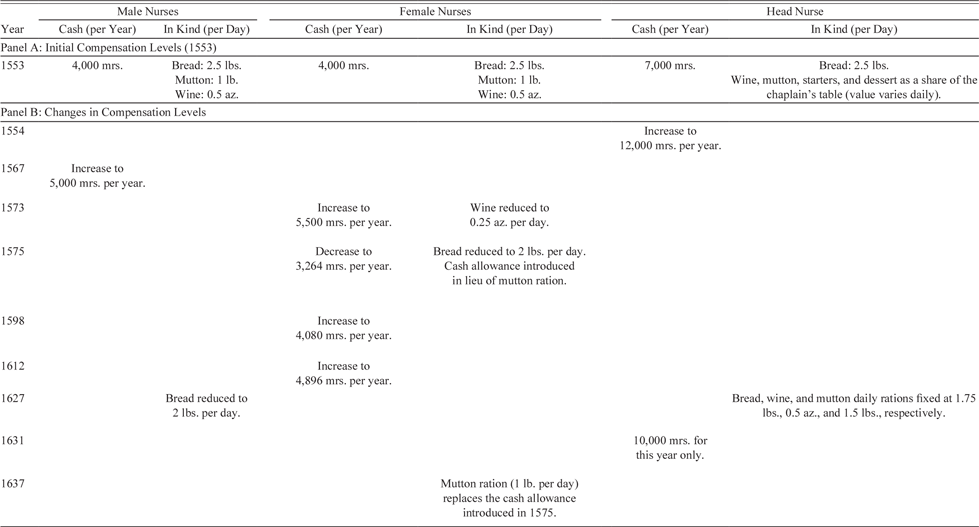
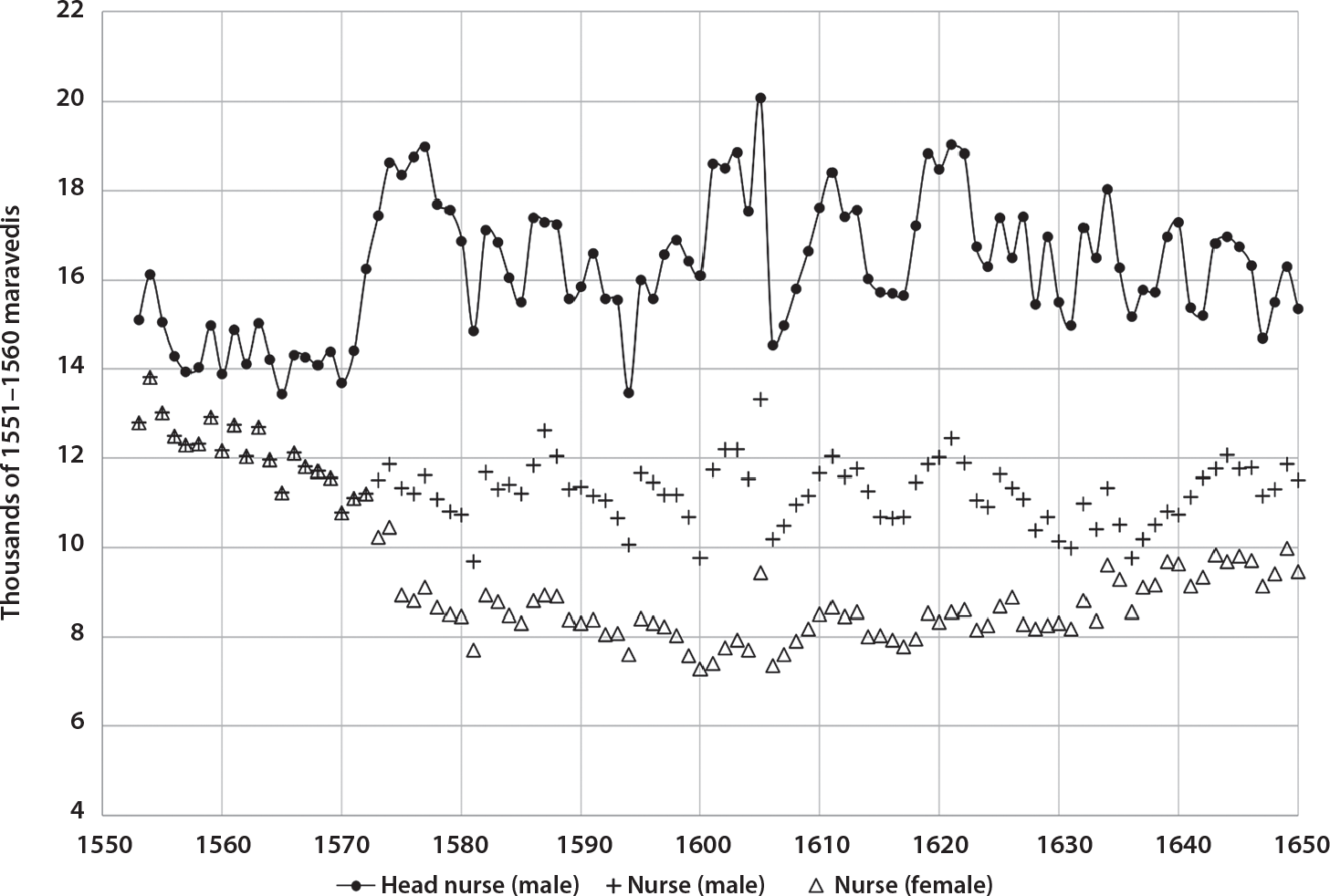
In any given year, all regular nurses of each gender were paid the same nominal wage rate. Changes in these rates were rare, and so the data are easily described. The Castilian monetary unit was the maravedi. The head nurse earned 7,000 maravedis (mrs.) in 1553 and 12,000 mrs. every year thereafter (with the exception of the single year of 1631, when he was paid 10,000 mrs.). Regular male nurses earned 4,000 mrs. per year between 1553 and 1566 and 5,000 mrs. per year thereafter. Female nurses’ cash wages started out on par with those of male nurses. They were set at 4,000 mrs. per year between 1553 and 1574, dropping to 3,264 mrs. per year between 1575 and 1596. They were increased to 4,080 mrs. between 1598 and 1611 and further raised to 4,896 mrs. in 1612.Footnote 30
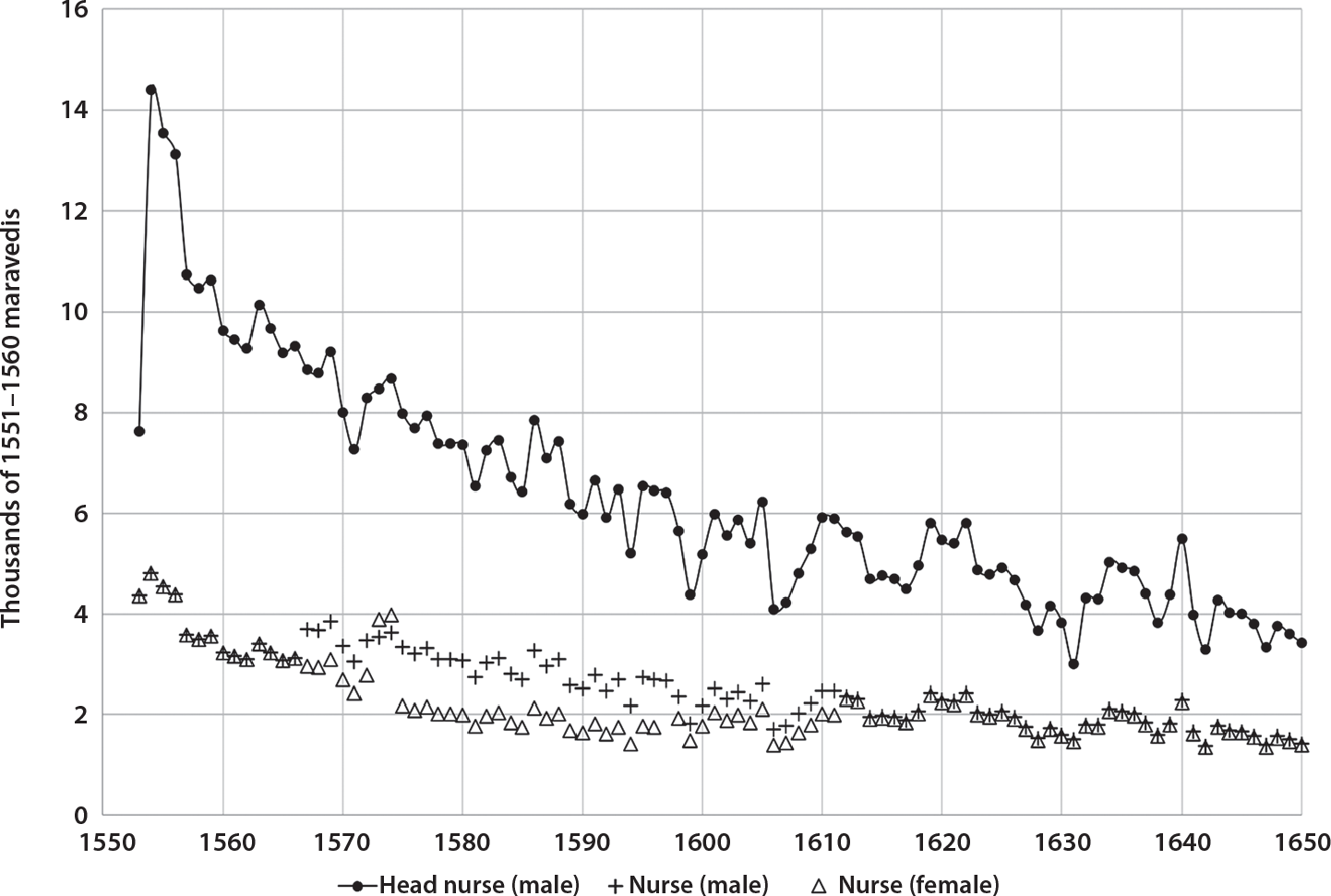
Figure 1 shows the evolution of the monetary component of wages, deflated by the Toledo price index from González Agudo (Reference Agudo2019).Footnote 31 Between 1550 and 1650, the purchasing power of cash wages fell by more than two thirds (three quarters in the case of the head nurse) as a result of the price revolution and, starting in 1603, the issuance of copper coinage. The jagged profile of the series reflects the jumpiness of the consumer price index, itself the result of the large year-to-year variation in the price of key staples. This made the in-kind components of workers’ pay especially valuable, as they provided insurance against fluctuations in the price of basic foodstuffs.
CASH WAGES (IN 1551–1560 CONSTANT MARAVEDIS)

In-Kind Compensation
In addition to their monetary wages, nurses received food and lodging. Since the design of the wards did not differ by gender, we assign equal value to the lodging of both men and women, using the annual rental cost of the average living space in a poor neighborhood in Toledo.Footnote 32 The imputed value of rent averages 4.5 percent of the total compensation of female nurses, peaking at 6.8 percent in 1595 and reaching a nadir of 1.7 percent at the very end of the period, when the Toledo rental market was in freefall because of sustained emigration.Footnote 33 Since the monetary amounts imputed are the same for men and women, they have no bearing on the level of the wage gap and little impact on its relative magnitude. To estimate the value of the lodging cost of the head nurse, we relied on a housing allowance given to the pharmacist, an employee of similar rank, in 1600 and 1601. The amount—4,500 mrs. per year—was equivalent to the rental cost of a 32-square-meter apartment in an upmarket neighborhood. We, therefore, imputed the cost of similar lodgings during the entire period as part of the head nurses’ in-kind bundle.
Food, either served at meals or handed out as rations, accounted for the largest share of total compensation. Meals and rations for rank and file employees consisted almost exclusively of bread, wine, and mutton—any additional items had to be purchased separately.Footnote 34 The head nurse had the privilege of sitting at the chaplains’ table, where starters (including various vegetables and soups) and dessert were also served.
Two different offices managed food and meals. The botillería was in charge of purchasing all types of foodstuffs, as well as of arranging the bread supplies. Acquisitions were transferred to the despensa, or storehouse, which was responsible for supplying the kitchen and keeping track of the meals given to patients, the rations served or handed out to employees, and, in some cases, cash allowances given in lieu of rations. Accounting for the various items served or handed out was shared between the two offices, with their responsibilities varying throughout the period. Properly valuing meals and rations required collecting and cross-validating a substantial amount of data from both the botillería and despensa books, which are available in largely complete series.Footnote 35 A full description of the methodology is given in the Appendix.
Bread, the most important staple in early modern diets, deserves special attention. The scarcity of early modern bread prices has prompted scholars to come up with workarounds and innovative solutions intended to approximate the price-setting policies of local authorities. These include the use of a rule of thumb on the basis of wheat prices (De Vries Reference De Vries2008; López Losa and Piquero Zaráuz 2018) and Allen's (Reference Allen2001) regression and retrocasting approach. Our sources offer a direct measure of the wholesale price of bread, which can be obtained at annual (or higher) frequency. We can also identify and account for the impact of changes in the local institutional environment at different stages of the production process, which is not possible when relying on estimates based solely on wheat prices and labor costs. Our series of bread prices is one of the earliest available direct measures for Castile and joins just a handful of others predating 1600 in Europe.Footnote 36 The Appendix describes the sources and methodology in full.
As in the case of monetary wages, in-kind compensation bundles experienced few changes throughout the period. Between 1553 and 1626, the daily ration for male nurses consisted of 2.5 pounds of bread, 1 pound of mutton, and 1.025 liters of wine (half an azumbre). In 1627, the bread ration was reduced to two pounds per day. Female nurses were initially issued the same ration as their male counterparts. In 1573, the single female nurse on staff negotiated an increase of 1,500 mrs. in her cash compensation in exchange for reducing her wine ration in half. Her departure, two years later, marked a drastic reduction in the compensation of female nurses. Not only was the original wine ration not restored, but the bread ration of her successors was cut to two pounds per day. As there was often only a single one of them of staff, female nurses stopped eating their meals in the refectory to avoid leaving the wards unattended, which led to them being issued a cash allowance instead of cooked mutton. Despite occasional adjustments, this amount tended to lag behind the actual value of the meat. In 1637, mutton rations for female nurses were restored.
Head nurse rations were more variable, as they included a share of the food served at the chaplains’ table. In general, they contained an extra half pound of mutton relative to the regular male nurses’ rations and, in the seventeenth century, somewhat less bread. Head nurses also benefited from a variety of prepared dishes, vegetables, and desserts, which the storehouse books do not itemize but for which they provide a monetary value (see the Appendix for more details on this point).
Table 1 lists the initial cash wages and food rations given in 1553 to all three types of employees, as well as their changes throughout the following century. While the quantities of food given as rations changed on only a handful of occasions, it is worth noting that cash allowances in lieu of food, as well as the offerings at the chaplains’ table, varied constantly. Fully accounting for the value of in-kind compensation, therefore, still required frequent sampling from the relevant sources.
CASH AND IN-KIND COMPENSATION SUMMARY

Notes: Cash amounts in current maravedis (mrs.). Bread and mutton amounts in Castilian pounds (lbs.), equivalent to 0.460 kg. Wine amounts in Castilian azumbres, equivalent to 2.05 L.
Source: Archivo Ducal de Medinaceli, Hospital de San Juan Bautista (Tavera), Nóminas, Libros de Gasto, Libros de Botillería, Libros de Despensa (1553–1650).
To obtain a comprehensive monetary equivalent for in-kind compensation, we first need to select suitable price series. For mutton we have only one option, Hamilton's (Reference Hamilton1934) prices, which were sourced from Tavera's botillería books and, therefore, reflect the hospital's acquisition cost. Our new series of bread prices also reflects the hospital's acquisition cost. An alternative is to use Allen's (Reference Allen2001) estimates, which, until 1618, are about one third higher than our prices. For wine, we similarly have a choice between Hamilton's series as a cost indicator or González Agudo's (Reference Agudo2019) data on prices regulated by City Hall as an estimate of retail prices. We can, therefore, value the in-kind bundles at what it cost the hospital to buy them, or at something closer to what a regular person might have paid for them on the street. The latter approach poses two problems. First, as discussed in the Appendix, Allen's methodology for estimating bread prices does not do a good job of accounting for structural breaks, at least one of which is present in our period. Second, employees probably could not have sold their surpluses of bread, wine, or mutton at retail prices and might well have chosen to purchase different bundles if they had been compensated in cash. These issues may lead to overestimating the value of in-kind compensation if the higher prices were used. To err on the side of caution, and to use consistent, high-quality data, we rely on cost of acquisition as our preferred price measure. In the Appendix, we discuss the results obtained using the alternative price series for robustness.
VALUE OF IN-KIND COMPENSATION, AT COST OF ACQUISITION

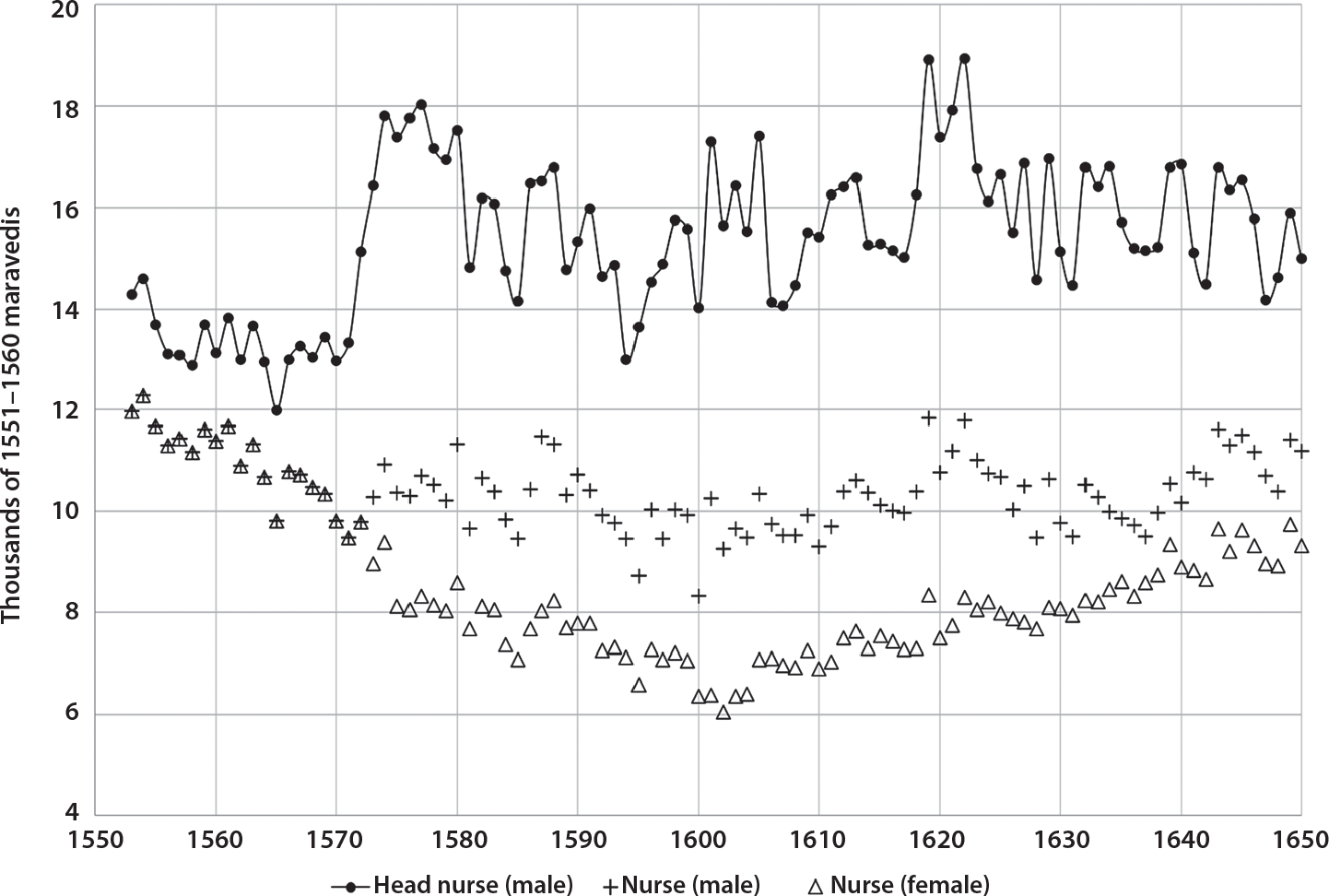
Figure 2 shows the value of in-kind compensation for the three types of employees, in real terms, at cost of acquisition. At the start of hospital operations, their bundles were very similar, with the valuation for the head nurse reflecting the higher value of lodging. In the early 1570s, the head nurse's compensation increased substantially, largely as a result of improvements in the chaplain's dinner and of more generous wine rations. At the same time, the reduction in the amounts of wine and bread given to female nurses, as well as the switch to a cash allowance in lieu of mutton (still added to the in-kind compensation for comparability), opened up a substantial gap between male and female nurses. The gap increased until 1601, when female nurses’ in-kind compensation was worth only 62 percent of the one received by their male counterparts. By 1606, progressive increases in the cash allowance of female nurses started to reduce the difference. The 20 percent cut in the bread allowance of male nurses in 1627 and the reinstatement of mutton rations for females in 1637 brought the gap to its lowest value since the 1570s, with the only remaining difference being half a liter of wine per day.
Total Compensation and the Gender Gap
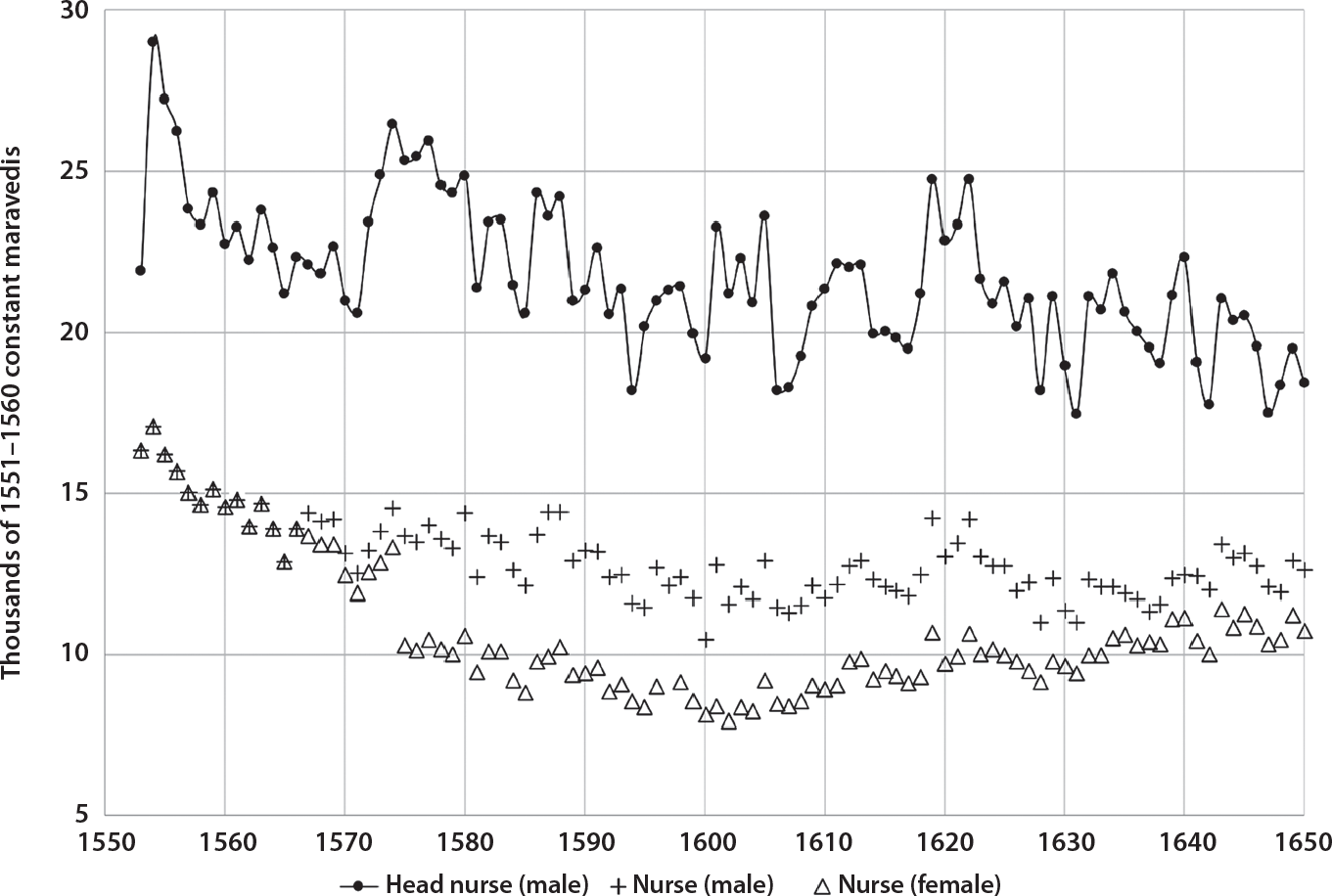
Summing the cash and in-kind compensation components yields an estimate of total compensation, as presented in Figure 3.
TOTAL COMPENSATION (REAL TERMS, IN-KIND COMPONENTS AT ACQUISITION COST)

Considering the period 1550–1650 as a whole, the total compensation of male nurses fell by 26 percent, while that of female nurses fell by 37 percent, reflecting the difference in the rations at the end of the period. The head nurse's total compensation also fell by 37 percent, in this case reflecting the larger initial weight of his cash wages, which depreciated substantially. Since monetary wages virtually did not change between 1550 and 1650, the rapid inflation of the period quickly eroded their value.
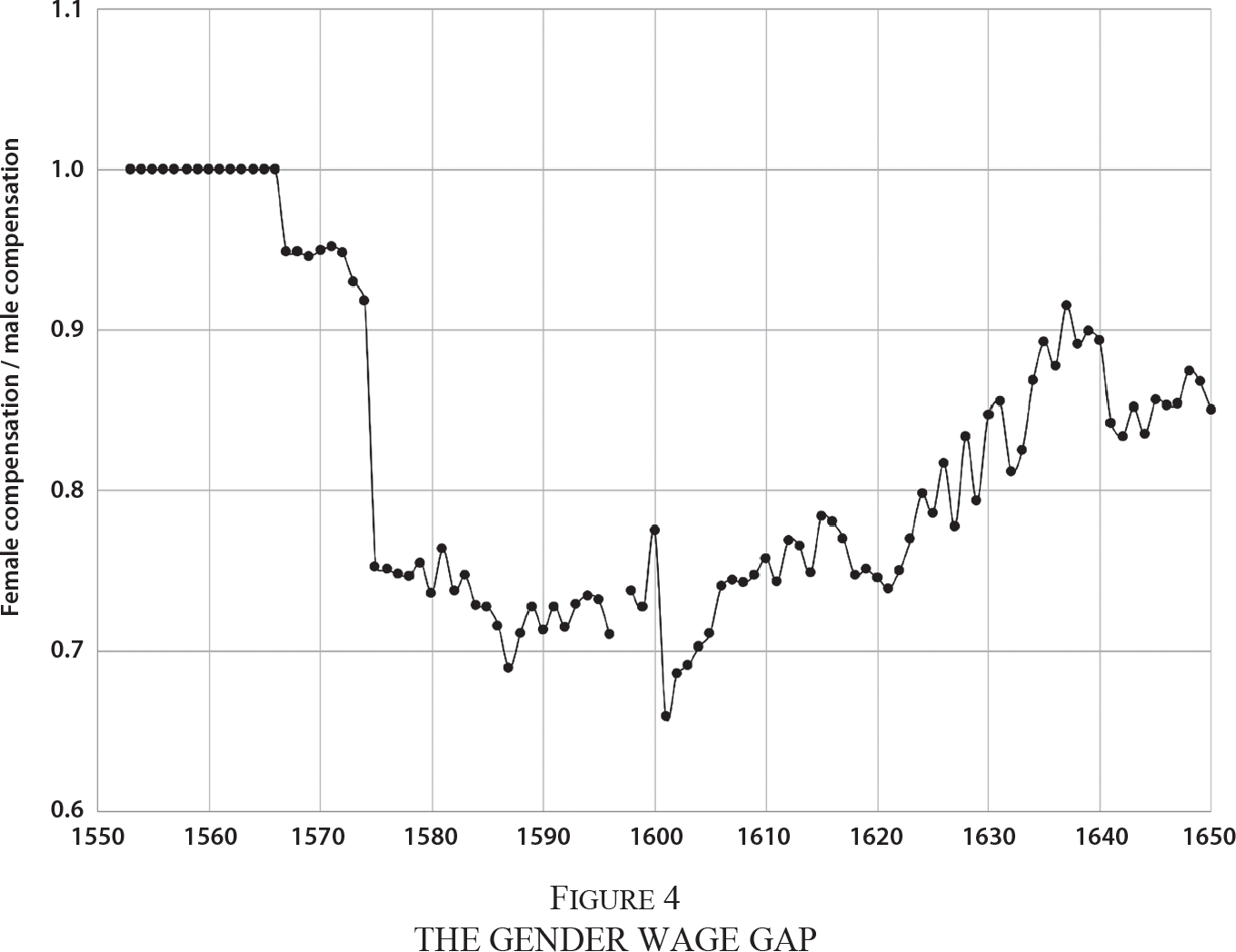
With estimates of total compensation in hand, calculating the wage gender gap between male and female nurses is a matter of dividing one series by the other. The result is shown in Figure 4.
THE GENDER WAGE GAP

For the first 12 years after the hospital began operations, male and female nurses received identical compensation. The relative position of female nurses deteriorated soon after. First, the men's monetary wages were increased in 1566; next, women's wages and rations were both cut in 1575. The ratio between female and male wages hovered between 0.7 and 0.75 for almost half a century, before progressively easing up through a series of monetary wage increases for women and a decrease in the male bread ration. By the end of our period of analysis, the annual compensation of women had stabilized at around 85 percent of male earnings.
PRODUCTIVITY
The relative productivity of male and female workers is a key input in evaluating the gender wage gap. Given the nature of nursing work, there is a priori no reason to expect productivity differentials by gender. The job descriptions for male and female nurses were identical, and the hospital's bylaws established that the hospital should have one nurse every five or six patients, regardless of gender.Footnote 37
To calculate productivity, we need measures of input and output. Since the nurses’ job consisted in caring for patients, the ideal output measure is the total number of days female and male patients stayed at the hospital in a year. The hospital admission records provide the names of patients admitted each day, thus making it possible to calculate the total number of admissions per year by gender.Footnote 38 With few exceptions, these records do not provide information on the length of stay. The number of admissions should still be a suitable proxy for nurse workload as long as the duration of patients’ stay did not vary much by gender. Zamorano Rodríguez (Reference Zamorano Rodríguez1997, pp. 219–227) provides data on admissions for seven different years between 1562 and 1600. We added our own patient counts for 1611 (when female nurse salaries were increased for the second time) and 1630.
To calculate the nurses’ labor input, we tracked down every monetary wage payment issued to each individual nurse in the years for which we have patient data. We noted the exact number of days for which the employee was being paid and summed them to calculate the total number of days worked by nurses of each gender in the year. This exercise was only possible in those years for which we could be sure that both payroll records and ordinary account books were complete, thus reflecting every day worked.
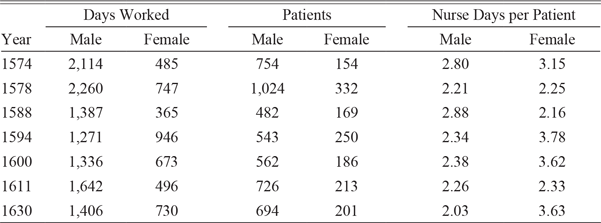
Table 2 reports days worked and patient numbers for the seven years in our sample that had both complete patient records and employment data. The last two columns show our productivity measure, calculated as the number of days worked by nurses of each gender divided by patient admissions of the same gender—higher numbers imply lower productivity. The high end of the productivity range is essentially the same for men and women (2.03 and 2.16 nurse days per patient, respectively). Female productivity is much more variable, though, with three years showing values above three nurse days per patient. The lowest productivity level for female nurses is 3.78 nurse days per patient, while male productivity is never lower than 2.88.
PATIENTS, DAYS WORKED, AND PRODUCTIVITY

Sources: Days worked calculated from payrolls and ordinary account books for listed years: Archivo Ducal de Medinaceli, Hospital de San Juan Bautista (Tavera), Nóminas; Libros de gasto. Patient numbers for 1574–1600 from Zamorano Rodríguez (Reference Zamorano Rodríguez1997, pp. 219–27). Patient numbers for 1611 and 1630 collected from hospital admission records: Archivo Ducal de Medinaceli, Hospital de San Juan Bautista (Tavera), Libros de recepción de enfermos.
The measured productivity of female nurses was, on average, both lower and more variable than that of their male counterparts. The difference, nonetheless, should be interpreted with caution, as it is likely the result of an indivisibility situation. Table 2 shows how male patients accounted for 76 percent of all admissions in our sample of years, reflecting a well-documented pattern of women seeking or receiving a substantially lower amount of medical attention than men in pre-modern times.Footnote 39 As a result, female patient numbers were often too low to support the work of two full-time female nurses but too high for one to be sufficient. This resulted in dramatically varying measured productivity figures in response to what could amount to small random variations in the number of patients. For example, in both 1578 and 1630, the hospital employed the equivalent of two full-time female nurses throughout the year (747 and 730 days worked, respectively). In 1578, there were 332 female patient admissions, which resulted in measured female productivity essentially matching male productivity that year (2.25 vs. 2.21). In 1630, 131 fewer female patients were admitted, pushing the measured productivity of female nurses to 3.63 nurse days per patient, the second worst reading in the sample. Yet, if only one female nurse had been on staff, the value would have been 1.81, a reading exceeding the highest measured productivity in our sample by more than 10 percent and possibly quite difficult to achieve while still providing patients with acceptable service.
It is also helpful to illustrate how the much higher numbers of male patients made it easier to manage male staffing levels and maintain a consistent productivity profile. In 1578, the busiest year in our sample, the hospital employed the equivalent of 6.2 full-time male nurses, achieving a measured productivity of 2.21 nurse days per patient. If the number of male patients had dropped by 131 (as it did for females in our example above), the productivity of male nurses would have only worsened to 2.53 nurse days per patient (rather than 3.63). But then the hospital could have fired a male nurse, thus increasing the productivity reading to 2.12 nurse days per patient, a level that still falls within the observed range. Unlike in the female example, it would have been possible to continue to provide service to patients at the lower staffing levels.
Overall, the data in Table 2 suggest that female nurses were capable of delivering the same levels of output per unit of work as male nurses, something that is observed in three out of seven years in the sample. Low and variable numbers of female patients likely resulted in staffing situations that led to lower measured productivity for female nurses in the remaining years.
DISCUSSION
Wage Setting
An oft-repeated motive in the literature is that women's wages in Southern Europe were set customarily, possibly as a fixed percentage of male wages, or that they were ex-gratia payments. De Pleijt and van Zanden argue that Spanish (and other Southern European) female wages in the late middle ages were almost uniformly set by custom at 50 percent of male wages.Footnote 40 Lanza García also mentions that women earned half as much as men in construction.Footnote 41 Zamorano Rodríguez, writing precisely about Tavera's hospital, laments the “undervaluation of female work in those times, when women received a monetary amount for their work, not as compensation, but almost as a form of charity.”Footnote 42
The works referenced above do not explicitly define what they mean by “custom,” a term that can have a large number of connotations. What they have in common, however, is that they dismiss a role for market forces in setting female compensation other than as a fixed percentage of male wages. Our data and analysis speak forcefully against this view. The first piece of evidence is our gender gap series. While women were not paid the same as men for most of our period of analysis, they almost always received more than 70 percent of male compensation, on occasion achieving parity or getting close to it. More importantly, there is clear evidence that female wages responded to labor market tightness, as illustrated by the events surrounding the 1611 salary increase. In that year, there were three female nurses on staff, working for a monthly cash salary of 10 reales (equivalent to an annual salary of 4,080 maravedis), plus the usual food ration. In August, two of them left and the hospital could not find suitable replacements. The account book documents the successive hiring of two women for 8 reales a month on an emergency basis “to serve as nurses, because no suitable nurse could be found.” The second of these, Francisca García, was described as “the daughter of the water carrier” of the hospital, likely no more than a girl. By November 1611, the cash salary of female nurses was raised by 20 percent. A new employee promptly joined the hospital, followed by another in early 1612. The one nurse from 1611 that had not quit received the same increase, retroactive to 1 September 1611.
While the documentation is less clear on the point, the 1575 reduction in the cash and in-kind compensation of female nurses also appears to be the result of market forces at work. That particular change was part of a large realignment in the compensation of almost all categories of hospital employees, prompted by the adoption of a new set of bylaws in 1569 and the advent of a new patron of the hospital.Footnote 43 While several categories of employees received raises, many others, including the chief physician, the entire chapel staff, the cook, and the female nurses, had their earnings cut within a few years of the bylaw and patronage change. The bread rations of several high-ranking employees were also tightened, with those of the chaplains reduced by up to one third. The salary of the single female nurse employed at the hospital at the time of the realignment remained unchanged until her departure in 1575. Her replacement, however, was hired for a lower cash salary, and her bread ration was 20 percent lower as well. The hospital was able to hire female nurses at the same lower compensation rate for the following 23 years, before market pressures forced it to start raising it again.
Female labor markets were almost certainly subject to tighter cultural and institutional constraints than those for male labor, and these may well have been customary in nature. Such strictures, however, did not prevent the laws of supply and demand from operating within the labor market categories that were open to women.
Productivity and the Gender Gap
Can the lower measured productivity of female nurses explain the observed wage gap? An argument could be made that, because of the indivisibility issue resulting from the low numbers of female patients, the productivity of the marginal female nurse was bound to be lower than that of the marginal male nurse. While this might have held true if Tavera's hospital had been the only employer for nurses, Tavera's was only one of many employers. With 27 hospitals in operation and nearly 1,000 beds available in Toledo in the 1570s, it is unlikely that the specific staffing challenges unique to one hospital's situation could dictate nurses’ wage levels.Footnote 44 As demonstrated above, market forces were very much in operation in wage setting, so the particular nurse-to-patient ratio of a single employer likely did not carry much weight.
Matching the measured productivity figures to the changes in wage rates also fails to reveal a consistent pattern. The compensation for female nurses was first cut in 1575. As the wage gap continued to increase, female nurses posted their best productivity readings, matching those of male nurses in 1578 and substantially exceeding them in 1588. In 1600, two years after the first increase in female compensation, female nurses had much worse measured productivity than men. In 1611, when female compensation was still 75 percent of male levels, the measured productivity of men and women was almost equal. Overall, there does not seem to be a relationship between measured productivity and compensation changes. It is much more plausible that the baseline productivity of men and women was the same all along, with the variance in measured values reflecting the impact of low and variable female patient numbers.
The Role of In-Kind Compensation
Owing to a lack of necessary information to properly estimate the value of its components, especially lodging, in-kind compensation has been traditionally understudied. Humphries and Weisdorf propose a workaround by assuming that payments in kind covered subsistence needs, which they interpret as a “respectability” consumption basket.Footnote 45 Such an assumption is not inconsequential; since women have, on average, lower caloric requirements than men, it suggests the construction of the labor contract in a manner that considers a lower compensation level for women as both normal and fair. It also implies dissociating compensation from marginal productivity. While both these conceptions were certainly possible in early modern labor markets, they should not be accepted without evidence.
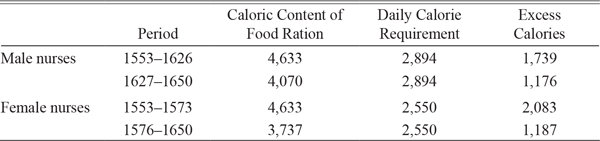
One way of evaluating the Humphries and Weisdorf assumption is to contrast the caloric content of the foodstuffs in in-kind bundles with subsistence caloric requirements. Unfortunately, no anthropometric data are available for sixteenth- and seventeenth-century Castile. The closest data by gender in the literature are those provided by Humphries for nineteenth-century British men and women.Footnote 46 While almost certainly too high for sixteenth-century Castilian dwellers, these values will bias the results against our argument, and hence are sufficient for our exercise.Footnote 47 In consideration of the very long shifts worked by nurses and the necessity to move and assist infirm patients, we adopt the caloric requirements for “moderate” work. We use Allen's values for the caloric contents of meat and bread (2500 and 2450 kcal/kg, respectively), and a more conservative figure of 650 kcal/L for wine.Footnote 48
CALORIC CONTENT OF FOOD RATIONS

Sources: Daily calorie requirement from Humphries (Reference Humphries2013, p. 702). Male values are for individuals born in 1850, 23 years of age, height of 172.87 cm, and BMI of 20.73. Female values are for individuals born in 1817–40, 23 years of age, height of 154.3 cm, and BMI unknown. Caloric content of bread and meat from Allen (Reference Allen2001, p. 421). Caloric content of wine from Mataix-Verdú (Reference Mataix-Verdú2009). Food rations from Table 1.
Table 3 lists the caloric content of the food rations issued to male and female nurses. The analysis is subdivided into two major periods for each gender; the composition of food rations was largely unchanged within each of these periods.Footnote 49 The daily calorie requirements, at 2,894 for men and 2,550 for women, are consistent with virtually any standard of respectability for workers who did not engage in strenuous physical activity. The food rations issued to both men and women amply satisfied those requirements and provided a substantial amount of “excess” calories, as illustrated in the last column of Table 3. This runs counter to the view that in-kind compensation was only meant to provide subsistence. Even after adopting very generous estimates of calorie requirements, and conservative assumptions of the caloric content of foodstuffs, the nurses of Tavera's hospital had plenty of food left over.Footnote 50
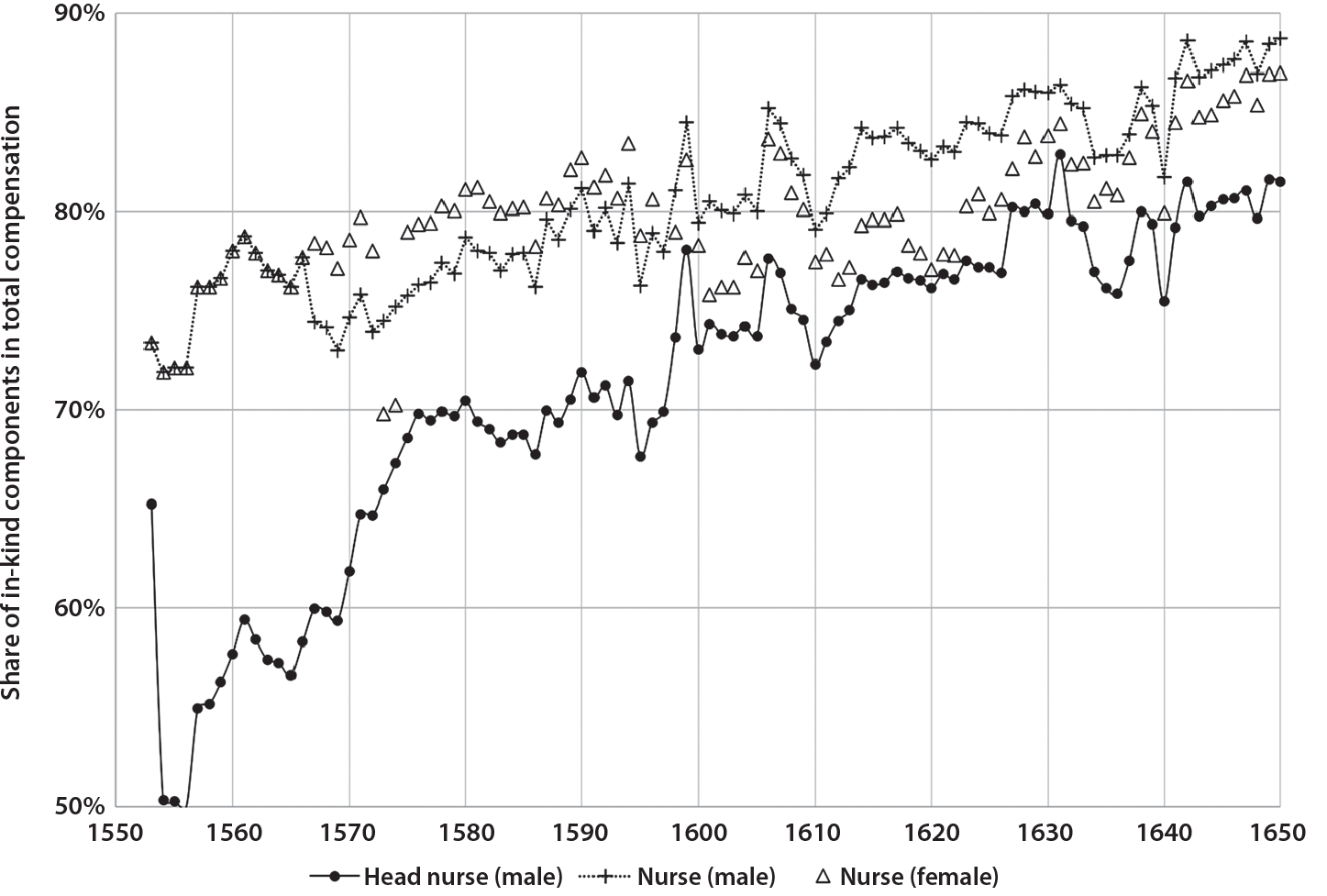
Why were nurses issued such large rations? As illustrated in Figure 5, in-kind compensation accounted for between 70 percent and 90 percent of total nurse earnings throughout the period. These ration levels were maintained even as the hospital weathered several crises and curtailed other expenses.Footnote 51 By 1650, with inflation having eroded a substantial part of the value of monetary wages, the value of food and lodging exceeded 80 percent of total earnings for all three types of employees.
SHARE OF IN-KIND COMPONENTS IN TOTAL COMPENSATION

In a time of rapid price growth, a generous food bundle provided a robust inflation-proof compensation package, while also insulating employees from the large year-to-year volatility in the cost of basic foodstuffs.Footnote 52 The food not consumed by employees could be passed on to family members outside the hospital, traded for other foodstuffs, or sold.Footnote 53 A second rationale stems from hospitals being funded by a combination of fixed income instruments with invariant nominal yields, as well as by rents often collected in kind.Footnote 54 Labor contracts composed of a rarely changing monetary portion plus an in-kind component matched the hospitals’ income profile, and hence reduced financial risk.
Occupational Crowding, Duration of Employment, and Job Separation
One way in which cultural and institutional constraints on female employment manifest themselves is occupational crowding, the exclusion of women from a large number of professions. The resulting reduction in opportunities for female employment depresses wages in those professions women do have access to, even when wage-setting practices are not discriminatory. Occupational crowding is widely documented in several early modern economies and was likely important in Toledo as well.Footnote 55 The construction examples mentioned above are just one instance of an occupation where women found the doors closed or were only offered jobs comparable to those of young boys. Women were virtually never employed in skilled occupations.
Data on the duration of nurses’ employment can be used to test one implication of occupation crowding. By definition, workers subjected to occupational crowding will have fewer outside options. Standard job ladder models have ambiguous predictions on the impact of outside options on the rate of job separation, but this is mainly because a worker's current employer can increase the wages of individual employees for retention purposes.Footnote 56 This was never the practice in our setting—every nurse employed in a given year was paid the same, and no one threatening to leave was given a retention offer. Without the possibility of wage renegotiation, more outside options for one group would result in higher job separation rates, holding wages constant.
The duration of employment (as measured by our data) for male and female nurses was virtually identical. Men held their nursing jobs for an average of 1.71 years, while women did so for 1.78 years. The difference is not significant at any conventional confidence level (two-tailed t-test p-value = 0.699). Male employment length had a standard deviation of 1.74 years, slightly more volatile than female employment, with a standard deviation of 1.5 years. While the difference between the two is significant at the 5 percent confidence level (F-test for two sample variances p-value = 0.03), this is driven by three male nurses with very long tenures. Other than those three outliers, the male and female distributions have no appreciable differences.
There are two possible explanations for men and women exhibiting, on average, the same completed job tenure. The first one is that men and women had outside options of the same quality, and hence there was no occupational crowding. Given that we failed to find any women employed in occupations that paid better than nursing, this is unlikely. The second potential explanation is that women had fewer outside options that men but that, since they were also paid lower wages than men in nursing, they still left their jobs at similar rates. This would be consistent with the hospital paying female nurses market wages, as our earlier findings suggest. There were also many other drivers of job separation beyond alternative employment opportunities. The requirement to live at the hospital, for example, meant that nurses had to be almost exclusively single or widowed. Differences in ages of first employment and in ages of marriage between men and women may have differentially affected employment duration. On the demand side, variation in patient admission rates by gender also would have influenced rates of job separation, as the hospital hired or fired nurses to meet changing demand levels. We do not observe nurse age or the reasons for termination of employment, so any further considerations would be speculative in nature.
CONCLUSION
The employment records of the nurses of Tavera's hospital offer a unique laboratory to study female wage determination patterns and the gender wage gap in early modern Castile. We established that male and female nurses performed identical tasks and were capable of identical productivity levels given adequate patient numbers. Our reconstruction of their compensation history, combining detailed data on monetary payments and in-kind rations, shows that female nurses received between 70 percent and 100 percent of male total earnings.
It is hard to construe the compensation practices of Tavera's hospital as evidence of gender discrimination in wage setting. While female wages were reduced in 1575, so were those of several other categories of male employees. Similarly, the in-kind compensation of male nurses was cut in 1627, at a time when the earnings of female nurses had been rising consistently for several decades. Variations in female compensation levels were dictated by the relative shortage or abundance of female labor, as clearly spelled out in the hospital's account books. The roots of the wage gap, therefore, must be found in the actual structure of the labor market, as well as other social constraints on female workers (which might be called “pre-market discrimination”). While our data fail to confirm one of the testable implications of occupational crowding, it is almost certain that women faced a more restricted occupational domain than men. The large literacy gap observed between men and women could also have played a role—almost 70 percent of the male nurses could sign their name next to their payroll entries, while none of the women could. Though literacy was not required for nursing work, the difference in skills could have meant that female nurses had fewer outside options than male ones, and were hence willing to work for lower wages.
Our results are a pointed counterexample to the idea that Castilian women were paid a fixed share of male wages. We also show how in-kind compensation was an essential part of the labor contract in high-inflation settings, far exceeding subsistence requirements and, in some periods, accounting for almost 90 percent of all earnings. Therefore, a robust valuation methodology for food and lodging issued as part of payment for services, such as the one employed in this study, seems an essential component of any comprehensive exploration of premodern incomes.
Quantitative evidence on female labor before the industrial revolution is rare, and scholarly work on the subject if often beset by a lack of comparability with male activities or by fragmentary data from unrepresentative occupations. Our research opens a new window by studying a line of work in which men and women were expected to perform the exact same tasks and achieve the same outcomes, thus allowing for a clean comparison of their terms of employment. Our results help dispel stereotypes of women workers as subject to customary contracts or as recipients of handouts. While gender disparities persisted, their sources are likely to be found in the broader social and cultural environment of the time.
APPENDIX
Valuation Methodology for Meals and Storehouse Rations
The botillería and the storehouse jointly accounted for bread, wine, mutton, and other food items provided to employees. The botillería always kept the bread accounts; responsibility for the other items resided originally with the storehouse but shifted to the botillería over time. Wine accounting passed from the storehouse to the botillería in 1571. Mutton accounting followed in 1627 for the employees that ate meals in the refectory (which included male nurses) and in 1637 for those that took rations to eat elsewhere (which included female nurses). After this date, the storehouse only accounted for meals served to patients, as well as for occasional items given to employees (mostly candles).
The botillería books listed the quantities of specific goods to be given to each employee each day. Calculating their annual value is a matter of multiplying by 365 (for nurses were expected to work every day of the year) and selecting a suitable price series. We used the wine and mutton price series from Hamilton (Reference Hamilton1934), themselves sourced from these very same botillería books. We also used the wine price series from González Agudo (Reference Agudo2019), obtained from the Toledo City Hall, as a measure closer to market (rather than wholesale) prices. The bread price calculation is discussed in the next section of this Appendix.
Storehouse books recorded the value of the meals and rations handed out each day (exclusive of items accounted for by the botillería). Because the price of foodstuffs varied seasonally, estimating the annual value of a storehouse ration required collecting several observations throughout the year. Given the amount of documentation involved, we sampled storehouse books every five years. Additionally, we made sure to sample the years in which the quantity of food included in storehouse rations changed. For the years before 1600, we recorded the value of each employee's ration on the first day of each month and then calculated an annual average. For the period after 1600, when the value of the storehouse rations had decreased somewhat, we increased the sampling interval to two months. This yielded estimates of the annual value of the food rations for each type of employee at five-year intervals between 1553 and 1627. We then interpolated values linearly to fill in the unsampled years.
Estimating the value of the head nurses’ ration required an additional step. The head nurse was seated at the chaplain's table and shared in the bread, wine, starters, and desserts. The storehouse books disaggregate the value of some of these items per employee, while giving a global amount for others (which ones are disaggregated and which are listed globally varies over time). In order to calculate the value of the head nurse's ration on each day we sampled, we first summed the value of the items assigned to him specifically. We then added the value of the items served “for the table,” divided by the number of people listed as attending the chaplains’ dinner.
Bread Prices
Tavera's hospital did not bake its own bread; it rather obtained the necessary wheat and then contracted out the entire process of turning it into table bread to local bakeries. The hospital received some wheat as rent payment for properties it owned and purchased the remainder on the market in several large transactions per year. These purchases, meticulously recorded in the wheat accounts of the botillería books, were the basis for Hamilton's (Reference Hamilton1934) wheat price series, on which we also rely. Wheat was delivered to several bakeries, which were responsible for all aspects of the bread-making process, from milling the grain to delivering the final product. Contracts existed for both candeal (high-quality) bread, reserved for the top management, and common bread, called pan de Toledo.Footnote 57 We focus on the latter, which was served to the rank and file employees, as well as patients, and is representative of the bread consumed by the working classes.Footnote 58
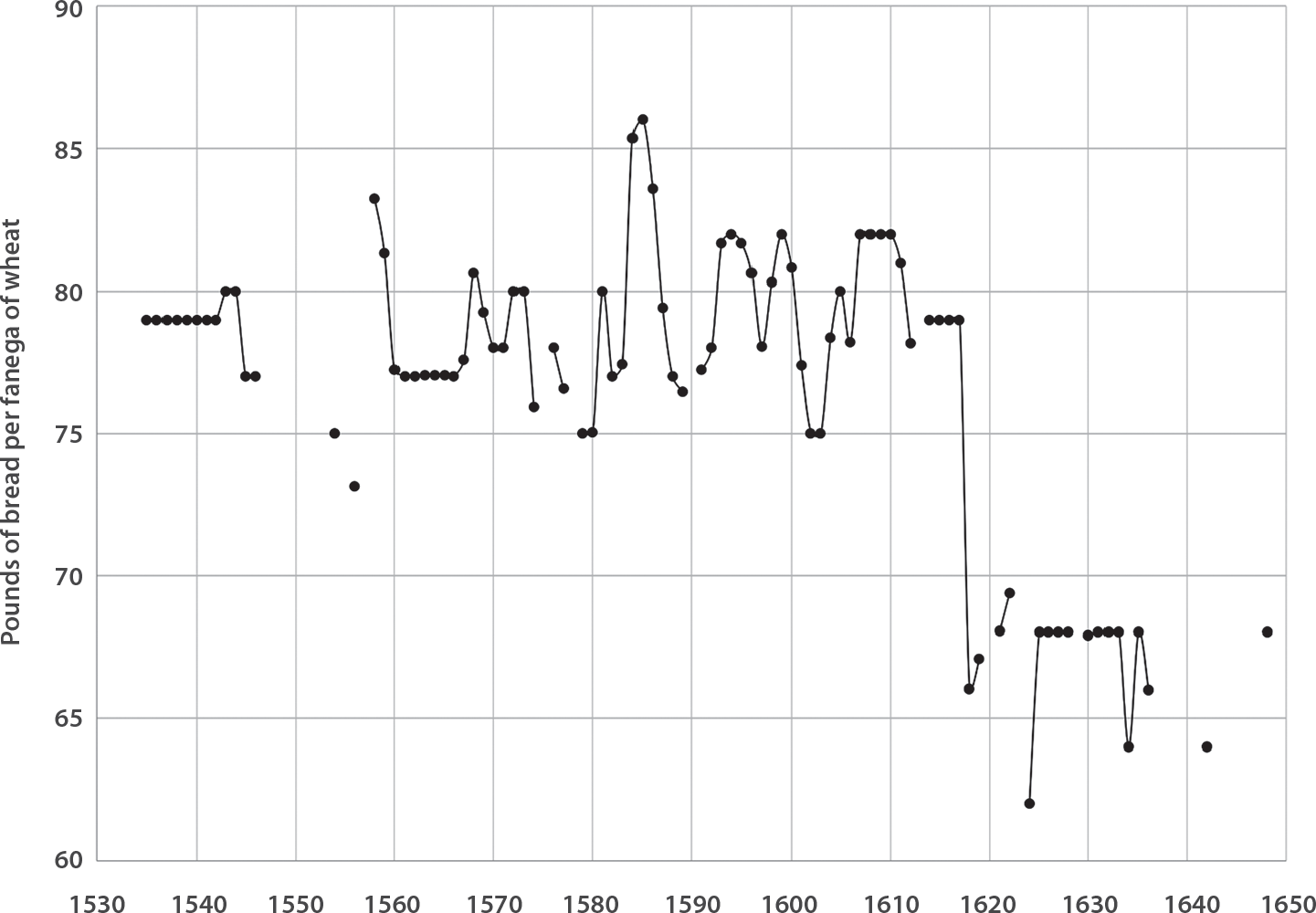
Once they received the wheat, the bakeries would keep part of it as payment for their services and process the remainder into standard one-pound loaves. All transactions detailing the number of fanegas of wheat delivered and the number of pounds of bread received in exchange are recorded in the bread accounts of the botillería books throughout the year, allowing us to calculate an annual weighted average of the wheat/bread ratio. Multiplying it by the price paid for wheat and dividing by the number of pounds of bread received gives a straightforward measure of the wholesale price of a pound of bread. For the years 1535–1546, we obtained similar data from the Hospital del Nuncio, while the 1573, 1574, and 1588 data points are from the Colegio de Infantes.Footnote 59 Their ratios correspond quite closely to those of Tavera's hospital in neighboring dates. As a further check, we retrieved the regulated prices of bread set by the city government for 1617 and 1618. These are reflected in the minutes of the bread commission and preserved in Toledo's municipal archive. The regulated prices are essentially identical to Tavera's cost of acquisition calculated as described above.Footnote 60
POUNDS OF BREAD PER FANEGAS OF WHEAT

Figure A1 shows the average annual ratio between pounds of bread and fanegas of wheat delivered to the bakeries. López Losa and Piquero Zaráuz (2018, p. 19) estimate the physical yield of one fanega of wheat at 87.13 pounds of common bread, which puts the bakeries’ average gross margin at 9.4 percent before 1618 and at 23.1 percent thereafter. Such a steep increase almost certainly stemmed from institutional reasons related to the baking industry. We have combed the minutes of Toledo's Bread Commission, which was part of the town government, between 1617 and 1619, to search for the motives of such an abrupt change. The documents reflect two issues that point to potential explanations. First, part of Toledo's jurisdiction became comprised in the area subject to pan de registro, a requirement to sell specific quotas of bread in Madrid, the growing capital, at regulated rates (Castro Reference Castro1987; Bernardos Sanz Reference Bernardos Sanz1997). The requirement to supply Madrid applied within a variable radius of the capital. This was initially established at ten leagues in the late sixteenth century and formally expanded to twenty leagues in 1630. In practice, however, it was adjusted more or less constantly, avoiding areas that had experienced a bad harvest, while including others outside the formal limits (Lanza García and Andrés Ucendo 2012, p. 70). In 1618, Toledo's Bread Commission conducted extensive discussions on how to minimize the impact of the recent inclusion of parts of its jurisdiction in the pan de registro requirements. Particular emphasis was placed on the provision of subsidized wheat (trigo del pósito) to area bakeries, reflecting the concern that this would end up benefiting Madrid rather than the local population.Footnote 61 In this context, it is quite likely that bakeries would have increased their gross margin in order to meet their quotas of subsidized bread to be sold in Madrid. Second, starting in July 1618, the city began restricting the entrance of bread from neighboring areas in an apparent attempt to favor the local bakeries (though restrictions were sometimes lifted when prices increased too much).Footnote 62 This would also have resulted in an increase in their gross margins.
Whatever the ultimate reasons that resulted in the discrete jump in 1618, they are problematic for the Allen (Reference Allen2001) methodology, which consists of performing regressions of eighteenth- and nineteenth-century bread prices on wheat prices, masons’ wages, and city fixed effects, and retrocasting prices using the estimated coefficients. This technique can yield plausible estimates for retail bread prices in the absence of changes in unobservables. Intra-period variations in the institutional environment or other unaccounted for determinants of bread prices, however, can lead to biased estimates.
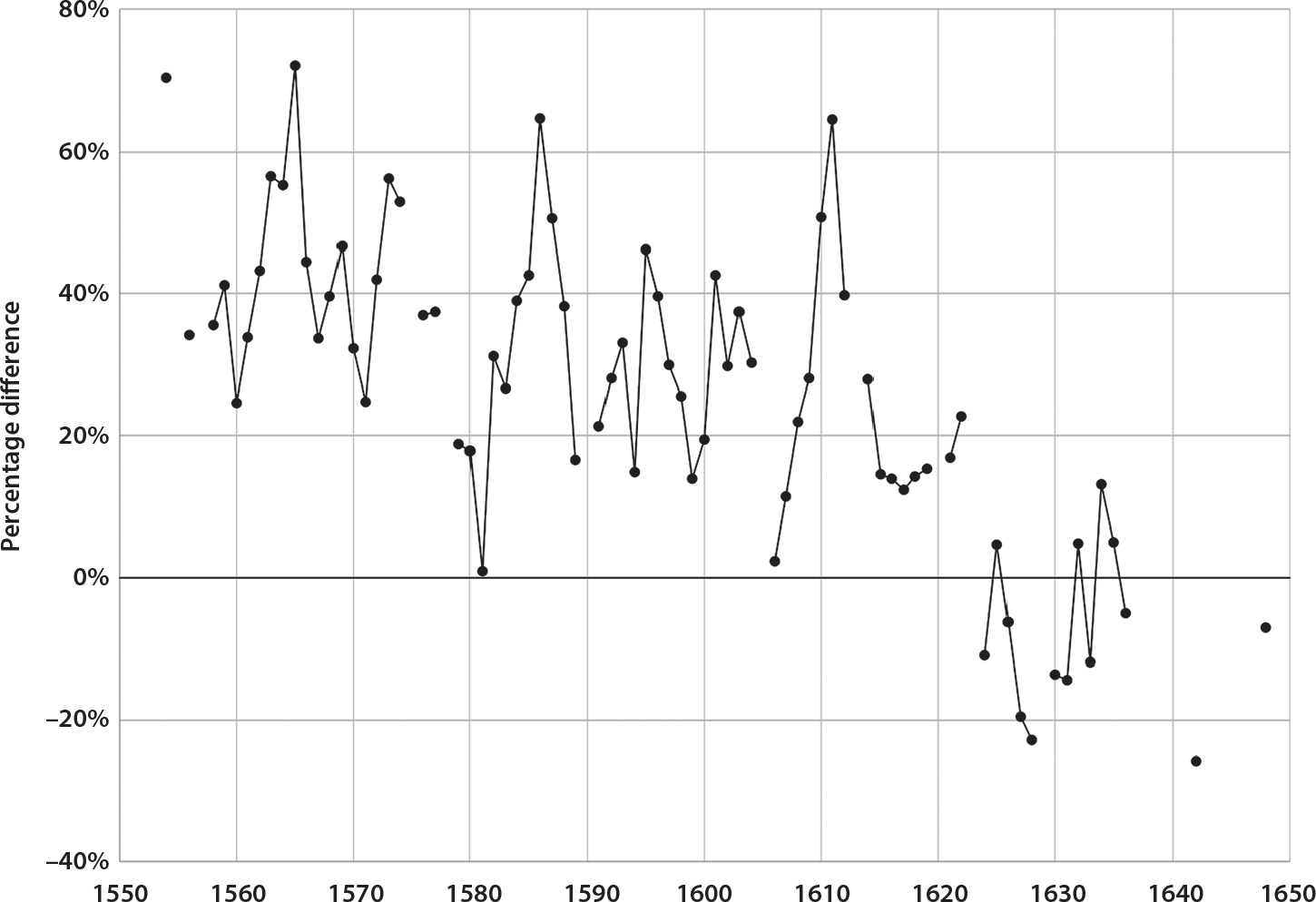
COMPARISON OF ALLEN'S BREAD PRICE ESTIMATES AND TOLEDO'S WHOLESALE COST

Allen used Hamilton's “New Castile” price and wage data to estimate his “Madrid” bread price series. Since the price data are actually from Tavera's botillería books, his estimates are for Toledo, not Madrid, and wholly comparable to ours. Figure A2 shows the percentage difference between Allen's bread price estimates and our wholesale cost. Until 1617, Allen's series is, on average, 34 percent higher than ours. From 1618 onward, however, Allen's price estimates are lower than the hospital's wholesale cost of bread. This implausible situation is likely the result of the 1618 institutional changes, which cannot be accounted for with a time-invariant city fixed effect. Similarly, rules of thumb based on the price of wheat may also miss institutional changes affecting gross margins in the baking of bread, such as the introduction of pan de registro requirements or a policy increasing the market power of bakers. In any case, our estimates are a direct measure of the actual price paid for bread and closely match the regulated prices observed in a number of years, eliminating the need to resort to alternative methodologies.
Valuing In-Kind Compensation at Retail Prices
As discussed above, while Allen's estimates of bread prices suffer from the inability to account for structural breaks, at least until 1618, they are probably an acceptable approximation to retail bread prices. Similarly, González Agudo's (Reference Agudo2019) wine price series, though affected by significant gaps that have been filled with Hamilton's data, is likely a usable approximation to retail values. Though we do not have mutton retail prices, using these alternative sources to estimate the value of in-kind compensation can still nudge the estimates toward what employees could have expected to pay had they wished to purchase the same bundles on the street.
VALUE OF IN-KIND COMPENSATION, AT RETAIL PRICES

Relative to the estimates at acquisition cost presented in Figure 2, the values in Figure A3 are higher and more volatile, reinforcing the notion that in-kind compensation served to insulate employees from the effects of large fluctuations in the price of basic foodstuffs.
The Role of the Head Nurse
The hospital bylaws (constituciones) provide for the hiring of a male and a female head nurse. Based on them, Zamorano Rodríguez (Reference Zamorano Rodríguez1997, pp. 27, 127–129) describes the head male nurse and the head female nurse as being on equal footing and sharing the same responsibilities. Our analysis of the payroll, expenditure, and storehouse records is at odds with this assessment. The payroll records only list a head female nurse in 1552–1554 and 1573–1974. In those years, the salary of the head female nurse was the same as that of regular female nurses between 1555 and 1572. In the five specific years when a head female nurse was present, there were no female employees listed as regular nurses so the task of tending to the female patients would have been discharged by the “head” nurse. Additionally, the (male) head nurse post was often filled by a chaplain, who could conveniently administer the sacraments himself, something that women, unable to be ordained as clergy, could never do. Regular male nurses were designated as “minor nurses” in order to differentiate them from the head nurse, while the same distinction is only very occasionally made for women. We conclude that, despite the formal distinction drawn in the bylaws, there were no actual differences between the positions of head female nurse and regular female nurse.