Implications
Stillbirth is believed to be a multifactorial problem, and little is known of the risk factors affecting the occurrence of stillborn piglets in organic pig production. In the current study, it was found that thin sows with parity above 4 had a substantially increased risk of stillborn piglets compared with normal and fat sows with parity above 4. This study is the first large-scale observational study performed to identify risk factors for stillbirth in Danish organic pig production. A better understanding of the causes of stillbirth will potentially help decrease piglet mortality and improve animal welfare in the future.
Introduction
The total piglet mortality in Danish organic pig production is high with an estimated average of 33% of total born piglets dying before weaning (Sorensen and Pedersen, Reference Sorensen and Pedersen2013). Consumers expect a high level of animal welfare in organic pig production (Zander and Hamm, Reference Zander and Hamm2010). High piglet mortality is, therefore, a major problem for further development of organic pig production, as it affects both farm economy and animal welfare. In a study performed in 2007/08 in seven Danish organic sow herds, an approximation on stillbirths was done using results from two independent studies estimating that 9% of total born piglets were stillborn and thus accounting for 27% of the total preweaning mortality (Sorensen and Pedersen, Reference Sorensen and Pedersen2013). This is in accordance with a study by Baxter et al. (Reference Baxter, Jarvis, Sherwood, Farish, Roehe, Lawrence and Edwards2011) who found that stillbirths accounted for 22% to 30% of the total preweaning mortality in sows housed under outdoor conditions in England. A positive relationship between stillbirth and preweaning mortality of live-born piglets has been demonstrated by Leenhouwers et al. (Reference Leenhouwers, van der Lende and Knol1999) and Kilbride et al. (Reference Kilbride, Mendl, Statham, Held, Harris, Marchant-Forde, Booth and Green2014). Besides being a direct cost due to loss of stillborn piglets, the underlying causes may affect live-born preweaning mortality. Stillbirth in commercial pig production is a multifactorial problem (Vanderhaeghe et al., Reference Vanderhaeghe, Dewulf, de Kruif and Maes2013), and there is a need for identifying important risk factors and possible interactions to help organic pig farmers improve management around parturition and culling. Vanderhaeghe et al. (Reference Vanderhaeghe, Dewulf, De Vliegher, Papadopoulos, de Kruif and Maes2010a) showed an association between an increase in litter size and an increase in stillborn piglets, and Canario et al. (Reference Canario, Cantoni, Le Bihan, Caritez, Billon, Bidanel and Foulley2006) showed a non-linear effect of litter size on the probability of stillbirth with an increase in risk of stillbirth in small and large litters. An important factor influencing stillbirth is parity of the sow (Zaleski and Hacker, Reference Zaleski and Hacker1993; Leenhouwers et al., Reference Leenhouwers, van der Lende and Knol1999; Vanderhaeghe et al., Reference Vanderhaeghe, Dewulf, De Vliegher, Papadopoulos, de Kruif and Maes2010a). A study by Wientjes et al. (Reference Wientjes, Soede, van der Peet-Schwering, van den Brand and Kemp2012) showed that the proportion of stillborn piglets increased with parity in organic sows which has also been demonstrated in conventional Danish pig herds (Hales et al., Reference Hales, Moustsen, Nielsen and Hansen2015). A positive association between a high body condition score (BCS) and stillbirth was reported by Le Cozler et al. (Reference Le Cozler, Guyomarc’h, Pichodo, Quinio and Pellois2002) and Maes et al. (Reference Maes, Janssens, Delputte, Lammertyn and de Kruif2004), whereas other studies did not find this association (Lucia et al., Reference Lucia, Correa, Deschamps, Bianchi, Donin, Machado, Meincke and Matheus2002; Borges et al., Reference Borges, Bernardi, Bortolozzo and Wentz2005). In a study by Vanderhaeghe et al. (Reference Vanderhaeghe, Dewulf, De Vliegher, Papadopoulos, de Kruif and Maes2010a), it was found that thin sows with back fat levels beneath 16 mm at the end of gestation have an increased risk of stillbirth compared with sows with back fat levels between 16 and 23 mm. Temperatures above 27°C to 30°C negatively affect the productivity of sows, and a temperature between 18°C and 23°C is usually recommended in farrowing units. A survey by Vanderhaeghe et al. (Reference Vanderhaeghe, Dewulf, Ribbens, de Kruif and Maes2010b) showed that the risk of stillbirth increased with temperatures above 22°C at parturition.
In outdoor production systems, options to provide manual birth assistance, supervise parturition and control ambient temperature are limited. Identification of risk factors for stillbirth in an organic commercial setting is, therefore, important for development of best practical management procedures in order to decrease stillbirths. The objective of this study is to evaluate summer season, litter size, parity and body condition of the sow as risk factors for stillbirth in nine commercial Danish organic pig herds.
Material and methods
The study was performed over a 1-year period in nine commercial Danish organic pig herds of variable size ranging from 80 to 910 productive sows per year.
In total, nine herds were included in the project based on their interest in the outcome of the study and were not randomly selected. Willingness and ability to take on the extra workload associated with participating in the study was a precondition. During the time period of the study, the total number of productive sows in Danish commercial organic pig herds amounted to around 6000 of which approximately half were included in the study.
Study design
The study was an observational prospective study including all farrowings in the nine herds throughout a 1-year period from June 2014 until May 2015. One herd collected data from July 2014 until June 2015. All recordings were conducted by the producers and their employees. Depending on the herd size, the number of observers in each herd varied from one to five people. All observers were carefully instructed in how to perform the registrations and how to distinguish between live-born and stillborn piglets before the start of the data collection. Guidance and practical instructions were done in the farrowing unit to test and adjust the observers’ ability to perform the registrations correctly. During the 1-year period, the farms were visited five times, and procedures regarding registrations were discussed continuously to assure the quality of the collected data.
Animals and housing
The majority of the sows were Danish Landrace–Yorkshire (LY) crossbred from DanBred and farrowed outdoors all year around. During gestation, sows were typically kept in three separate groups according to their size: small sows and gilts, medium-sized sows and larger older sows. In small herds, all sows were kept in the same group. Housing of the gestation groups was either on pasture with access to shelter or indoors on deep straw bedding with access to an outdoor enclosure. Sows were moved into the farrowing unit 10 to 14 days before expected date of parturition and kept in individual paddocks of varying size (approximately between 270 and 450 m2) with a hut (~4 m2) with deep straw bedding. In one herd, two to four huts, each containing one sow, were situated in the same paddock. The sows were not restrained at any time during their stay in the farrowing field.
Registrations
Upon transfer of each sow to the farrowing unit, the sow number, parity and BCS were recorded. The date of parturition was recorded along with the number of piglets that were live-born, stillborn and live-born dead. The registrations on live-born dead piglets are not included in the analysis. As previously stated, the observers in all nine herds were instructed in distinguishing stillborn from live-born piglets before the start of the registrations. A wide and uncontracted umbilical cord, in combination with the presence of cabbed hoofs with no sign of wear or intact or partial intact fetal membrane covering the piglet, was defined as sufficient evidence of the piglet being stillborn. The BCS scale was modified from the scale available at ProPig (Holinger et al., Reference Holinger, Edwards, Illmann, Leeb, Milsova, Prunier, Rudolph and Früh2015), and the categories were defined as follows: (2) thin – ribs, backbone and hip bones are obvious or easily detected with pressure, (3) moderate – ribs, backbone and hip bones are barely visible or are barely felt with firm pressure, (4) fat – ribs, backbone and hip bones cannot be seen or felt when firm pressure is applied, or fat deposits are clearly visible. The description was supplemented by pictures to emphasize the visible differences between the groups.
Statistical analysis
The relationship between the outcome variable, the proportion of stillborn piglets within litter, and the explanatory predictors presented below was analyzed with a logistic analysis with the logit transform as the link function using the GLM function in R. For the model fitted, a strategy with a backward elimination of variables was applied using the deviance test with a significance level of 5% to exclude the variables and interactions. During sequential backward elimination, the parameter estimates for the model were accessed to evaluate model stability and to detect possible confounders.
Herd was included as a factor with nine levels, one for each herd. This approach was chosen because of the limited number of herds, making it questionable if the herds in the study could be considered a random sample of the population of Danish organic pig herds. Also, the data included one large herd that would influence the estimation of the variance component disproportionately. Season was included as a factor with two levels: summer (May to August) and the remaining part of the year (September to April). Parity was included as an ordinal variable (1 to >4) with both first- and second-order term. Body condition score of the sow was included as a factor with three levels: 2=thin, 3=moderate, 4=fat. Total born piglets was included by a new variable created as the grand mean centered total born (cLS). This, along with the quadratic grand mean centered total born (cLS2), was included as a continuous variable. Total born were included in this manner to increase the speed of convergence and stability in the parameter estimates and to facilitate the interpretation of the intercept. In the statistical analysis, sow was not included as a random effect. The effect of neglecting the correlation between litters within sow has been examined by analyzing a reduced data set including only one litter (randomly selected) per sow. The parameter estimates and P-values were similar to the parameter estimates and P-values from the analysis on the full data set and therefore the analysis was done on the latter.
The initial full model included the following variables and interactions: herd, season, parity, parity2, BCS, cLS, cLS2 and parity×BCS, parity×cLS and BCS×cLS.
The model analysis relies on these assumptions
Let y i =observed number of stillborn piglets in litter i
We now consider y i as a realization of the random variable Y i that can take the values {0, 1, 2, 3, …, n i }. Then Y i is binomial with parameters π i and n i . That is Y i ~Bin(n i , π i ). This provides the stochastic basis for the model. Then assume that the logit of the underlying probability (π i ) can be described by a linear function of the predictive variables. So what we model here is the probability of stillbirth within each litter.
The final reduced model was as follows:
 $$\eqalignno{ {\rm logit}\,(\pi _{i} )\,{\equals}\,\beta _{0} {\plus}\beta _{1} \,Herd_{i} {\plus}\beta _{2} \,Season_{i} {\plus}\beta _{3} \,parity_{i} \cr{\plus}\beta _{4} \,BCS_{i} {\plus}\beta _{5} \,cLS_{i} {\plus}\beta _{6} \,cLS_{i}^{2} {\plus}\beta _{7} \,parity{\times}BCS_{i} $$
Model assumptions were checked by plots of Pearson’s residuals against the predictive values.
Results
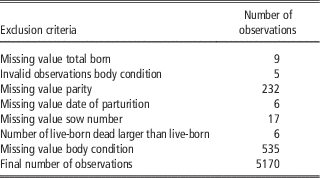
The data included registrations from 5980 farrowings of which 810 were subsequently removed because of insufficient quality of the registrations. The order and the criteria of the removal of observations are shown in detail in Table 1.
Exclusion criteria of observations

Invalid observations, missing values and nursing sows were removed from the data set before analysis.
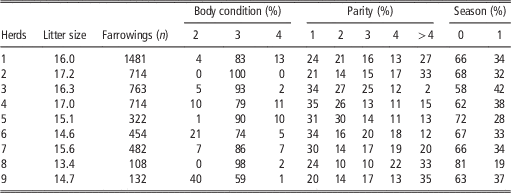
The distribution between the nine herds of the 5170 farrowings included in the analysis is shown in Table 2. No stillborn pigs occurred in 2901 litters (56%). One herd (herd 1) differed markedly in size from the rest of the herds, contributing approximately one-third of the total number of observations and having almost twice as many observations as the second largest herd. The smallest herd contributed 108 observations.
Characteristics of the study herds and the percentage of sows, stratified by herd, in different categories of body condition score, parity and season of farrowing

Litter size=number of total born piglets (live-born+stillborn piglets).
Body condition: 2=thin, 3=moderate and 4=fat.
Season: 1=summer (May to August) and 0=remaining part of the year (September to April).
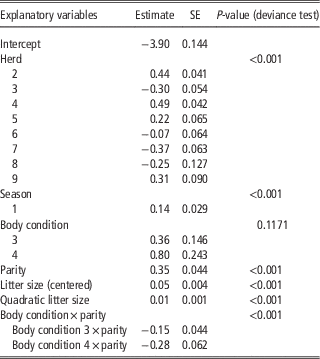
The proportion of first parity sows varied from 20% to 35% between the herds, and the proportion of sows with parity above 4 ranged from 2% to 35%. In total, 59% to 100% of the sows had moderate body condition (score 3), 0% to 40% were thin (score 2) and 0% to 13% were fat (score 4). Sows from herd two were all given a BCS of 3. The farrowings were distributed evenly throughout the year with a variation between the herds of 19% to 42% of farrowings occurring during the summer months (May to August). During the 1-year study period, there were 82 906 piglets (both live-born and stillborn) giving an average total litter size of 16.0 ranging from 13.4 to 17.2 within the nine herds. On an average, 1.1 piglets/litter were stillborn with a range of 0.7 to 1.9 between the herds. Table 3 summarizes the parameter estimates, standard errors and the P-values of the level of significance of the logistic analysis.
Parameter estimates from the logistic analysis describing the effects of the explanatory variable on the probability of a piglet being stillborn

Litter size=number of total born piglets (live-born+stillborn piglets).
Quadratic litter size=quadratic grand mean centered litter size.
Season: 1=summer (May to August) and 0=remaining part of the year (September to April).
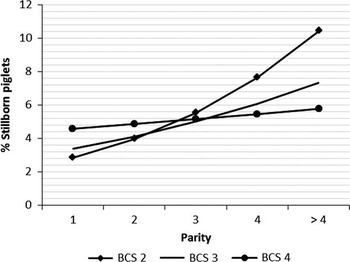
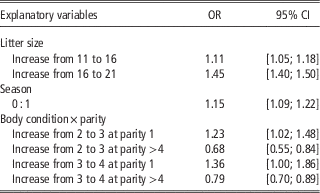
The logistic analysis showed a significant effect of season with an increase of the probability of stillbirth during the summer months (May to August) compared with the remaining part of the year with an odds ratio of 1.15. A non-linear effect of litter size was seen where an increase in litter size from 11 to 16 resulted in an odds ratio of stillbirth of 1.11. An increase in litter size from 16 to 21 resulted in an odds ratio of stillbirth of 1.45. This effect was greatest in litters of 17 and above. Table 4 presents an overview of the odds ratios of stillbirth. A significant interaction between parity and body condition was found. In first parity sows, an increase in BCS from 2 to 3 and from 3 to 4 increased the probability of stillbirth with an odds ratio of 1.23 and 1.36, respectively. In sows with parity above 4, an increase in BCS from 2 to 3 and from 3 to 4 decreased the probability of stillbirth with an odds ratio of 0.68 and 0.79, respectively. The interaction between body condition and parity and the effect on the probability of stillbirth are shown in Figure 1.
The percentage of stillborn piglets for each body condition score (BCS) stratified on parity. Thin first parity sows have a lower proportion of stillborn piglets compared with fat first parity sows. On the contrary, fat sows with parity above 4 have a lower proportion of stillborn piglets compared with thin sows with parity above 4. BCS where 2=thin, 3=moderate and 4=fat. The percentage was calculated using the parameter estimates from the logistic analysis (Table 3).

Selected odd ratios (ORs) for stillbirth of piglets

Season: 1=summer (May to August) and 0=remaining part of the year (September to April).
Discussion
The sow lines used in both conventional and organic farming in Denmark are Danish LY crossbred from DanBred with a high genetic potential to produce large litters (Su et al., Reference Su, Lund and Sorensen2007) which is a well-known risk factor for stillbirth (Lucia et al., Reference Lucia, Correa, Deschamps, Bianchi, Donin, Machado, Meincke and Matheus2002; Hales et al., Reference Hales, Moustsen, Nielsen and Hansen2014). The average of 16.0 total born piglets per litter in the present study is lower than the average number of total born piglets of 17.6 seen in commercial conventional Danish sow herds in 2015 (Olsen, Reference Olsen2016). In the present study, the average number of stillborn piglets was 1.1 piglets/litter, which is less than 1.7 reported from the conventional Danish production in 2015 (Olsen, Reference Olsen2016). A reason for these differences could be that dead organic piglets, compared with conventional piglets, have greater risk of disappearing in the time span from parturition until the first check-up, thereby reducing the number of total born piglets. The number of total born piglets in some of the herds included in the present study resembles the average number of total born piglets of 17.6 seen in commercial conventional Danish sow herds in 2015. Thus, it is reasonable to assume that the difference between the average of 16.0 total born piglets found in this study compared with the average of 17.6 in the Danish conventional production is not due to genetic factors, but relies more on the difference in management procedures and housing in the two production systems.
The association between litter size and stillbirth is well known and has been demonstrated in previous studies (Fraser et al., Reference Fraser, Phillips and Thompson1997; Leenhouwers et al., Reference Leenhouwers, van der Lende and Knol1999; Hales et al., Reference Hales, Moustsen, Nielsen and Hansen2014). A non-linear significant effect of litter size was found in the present study, which is in accordance with the findings of Canario et al. (Reference Canario, Cantoni, Le Bihan, Caritez, Billon, Bidanel and Foulley2006). The association between a high number of total born piglets and stillbirth is believed to be due to prolonged parturition resulting in a higher risk of hypoxia in the piglets and, thereby, also a higher risk of stillbirth (Herpin et al., Reference Herpin, Le Dividich, Hulin, Fillaut, De Marco and Bertin1996). The lower number of stillborn piglets per litter could, besides the risk of dead piglets disappearing (predation, getting lost in the straw bedding, eaten by the sow, etc.), also be attributed to the fact that organic sows have greater possibilities to nest build and exercise before parturition which have previously been associated with a decrease in the risk of stillbirth (Oliviero et al., Reference Oliviero, Heinonen, Valros, Halli and Peltoniemi2008 and 2010). The percentage of stillborn out of total born piglets was 7.0% which is in accordance with other studies where piglets were necropsied, both in a conventional and organic production setting (Damm et al., Reference Damm, Pedersen, Heiskanen and Nielsen2005; Baxter et al., Reference Baxter, Jarvis, Sherwood, Robson, Ormandy, Farish, Smurthwaite, Roehe, Lawrence and Edwards2009; Wientjes et al., Reference Wientjes, Soede, van der Peet-Schwering, van den Brand and Kemp2012). Stillbirths can be classified into two types based on the time of death (Sprecher et al., Reference Sprecher, Leman, Dziuk, Cropper and Dedecker1974). Type I include deaths that occur before the end of gestation and is most commonly attributed to infectious causes. Type II includes deaths during parturition and is often associated with non-infectious causes such as dystocia and intrauterine asphyxia. Of all piglets classified as stillborn, type I accounts for 10% and type II accounts for 75%. The remaining 15% of piglets are not truly stillborn, but die immediately after birth (Leenhouwers et al., Reference Leenhouwers, van der Lende and Knol1999) and share physical appearance with type II piglets. They can only be distinguished from type II piglets by postmortems. These piglets that are not truly stillborn present the same disease ethology as type II piglets and, therefore, preventive measures to reduce stillbirths can be applied to both groups. In this study, the categorization of a piglet as being stillborn was done by the producers, and the quality of the data was, therefore, highly dependent on their ability to distinguish between stillborn and dead live-born piglets. It has been demonstrated that 9% of piglets classified as stillborn by producers were found at necropsy to have been live-born (inflated lungs) (Vaillancourt et al., Reference Vaillancourt, Stein, Marsh, Leman and Dial1990). Therefore, Vaillancourt et al. (Reference Vaillancourt, Stein, Marsh, Leman and Dial1990) emphasize that causes of mortality assessed by producers should be interpreted with caution. However, the producers in the Vaillancourt et al. (Reference Vaillancourt, Stein, Marsh, Leman and Dial1990) study were not instructed in the recognition of stillborn piglets before the beginning of data collection. In the present study, producers and employees were carefully instructed and received practical guidance in the correct classification of stillborn piglets before the study period and it is, therefore, believed that the classification has been performed with sufficient accuracy. Also, the fact that the level of stillborn piglets in the present study was similar to the level found in studies where the piglets were necropsied (Damm et al., Reference Damm, Pedersen, Heiskanen and Nielsen2005; Baxter et al., Reference Baxter, Jarvis, Sherwood, Robson, Ormandy, Farish, Smurthwaite, Roehe, Lawrence and Edwards2009; Wientjes et al., Reference Wientjes, Soede, van der Peet-Schwering, van den Brand and Kemp2012) indicates that stillborn piglets were correctly categorized in the present study. Because of the large study population and practical limitations, it was not possible to collect valid information about inter-observer differences and include it in the analysis.
The risk of stillbirth was higher during the summer months (May to August) compared with the remaining part of the year with an odds ratio of 1.15. This is in accordance with Vanderhaeghe et al. (Reference Vanderhaeghe, Dewulf, Ribbens, de Kruif and Maes2010b) where an association was found between stillbirths and ambient temperatures at parturition above 22°C in the farrowing unit and Odehnalova et al. (Reference Odehnalova, Vinkler, Novak and Drabek2008) showing an increase in stillbirths with temperatures >28°C. As all the organic sows from this study were housed in outdoor huts, possibilities to control the ambient temperature were limited. According to The Danish Meteorological Institute, the summer months (June to August) of 2014 in Denmark had an average temperature of 16.8°C which is 1.6°C higher than the normal average for those months (Cappelen, Reference Cappelen2014). It is, therefore, reasonable to assume that the increase in stillbirths during the summer months could be explained by high ambient temperatures at parturition. An effect of body condition was seen which is in accordance with other studies (Le Cozler et al., Reference Le Cozler, Guyomarc’h, Pichodo, Quinio and Pellois2002; Maes et al., Reference Maes, Janssens, Delputte, Lammertyn and de Kruif2004; Vanderhaeghe et al., Reference Vanderhaeghe, Dewulf, De Vliegher, Papadopoulos, de Kruif and Maes2010a). In the present study, the effect of body condition interacted with the effect of parity. Increasing parity is a well-known risk factor for stillbirths (Zaleski and Hacker, Reference Zaleski and Hacker1993; Leenhouwers et al., Reference Leenhouwers, van der Lende and Knol1999; Wientjes et al., Reference Wientjes, Soede, van der Peet-Schwering, van den Brand and Kemp2012). The interaction between body condition and parity in the present study showed that being thin compared with being fat increases the risk of stillbirth in sows with parity above 4. This is in accordance with the results of Vanderhaeghe et al. (Reference Vanderhaeghe, Dewulf, De Vliegher, Papadopoulos, de Kruif and Maes2010a) who found that thin sows have a higher risk of getting stillborn piglets. On the other hand, the present study also showed that fat parity 1 sows have an increased risk of stillbirth compared with thin and normal parity 1 sows. This is in accordance with common knowledge of farmers to avoid fat gilts. The increased risk of stillbirth could be explained by excessive amounts of adipose tissue surrounding the birth canal providing a physical obstruction in the pelvic region at parturition potentially resulting in a prolonged farrowing, which is a well-known risk factor for stillbirth (Oliviero et al., Reference Oliviero, Heinonen, Valros and Peltoniemi2010). When interpreting parity, it is important to be aware that sows with high parity have been selected by the producer to continue in the production because of their performance in the preceding parities and are, therefore, not a randomly selected group. A low BCS in old sows might suggest an underlying problem such as disease or production exhaustion increasing the risk of stillbirth.
Conclusion
The study showed that being born during the summer months (May to August) and a litter size of more than 17 piglets are risk factors for stillbirth in nine organic pig herds in Denmark. An interaction between body condition and parity was present showing that thin sows with parity above 4 had a substantially increased risk of stillbirth compared with normal and fat sows with parity above 4. In contrast, for parity 1 sows risk of stillbirth was increased in fat sows compared with thin parity 1 sows.
Acknowledgment
The authors would like to thank technician Pia Haun Poulsen for planning the start-up of the study and all herd owners and their employees for their dedication and hard work during the 1-year study period.