In my understanding, Germany will not yet for a long time achieve the proportion of trade with the Balkans that should be commensurate with our favourable location in the region and our highly developed industry. Prejudices, ignorance of local business practices, and a sluggishness in German industry, and occasionally trade, during the post-war period are probably the reasons for this.Footnote 1
On the eve of the Second World War German trade with south-eastern Europe reached a level that for many contemporaries heralded a ‘bloodless invasion’.Footnote 2 Trade with Germany accounted for 30 to 60% of the exports and imports of Yugoslavia, Romania and Bulgaria. The Third Reich dominated the supply of strategic goods to the Balkans, such as consumer wares, capital equipment and weapons. Germany provided the largest market for the region's primary exports – grains and oil from Romania, bauxite, copper, manganese and other heavy elements from Yugoslavia, tobacco and oil seed crops from Bulgaria – essential components for Hitler's rearmament campaign. In the estimation of German leaders, by 1940 south-eastern Europe had become a crucial pillar of their continental economic bloc, or Großraumwirtschaft.Footnote 3 And for many of the business elites in Yugoslavia, Romania and Bulgaria, participation in Germany's economic bloc seemed to offer their best hope for economic development.Footnote 4
Just fifteen years earlier, however, in the first half of the 1920s, German commerce with Yugoslavia, Romania and Bulgaria was plagued with severe difficulties. Following the treaty of Versailles, German investment in the region had been confiscated. German bank branches in Bucharest, Sofia and Belgrade had been nationalised. Germany's consular system and its network of trade agents in the region had been dismantled at the end of the war. Inflation had damaged the reputation of German merchants abroad. And in the new Yugoslavia and the expanded Romania the legacy of the Central Powers’ harsh occupation left many leaders ill-disposed towards economic co-operation with the Weimar republic. As a consequence, in 1925 German trade with south-eastern Europe was small in comparison to what it would be fifteen years later, both absolutely and relative to other countries. Italy, Austria and Czechoslovakia, for example, all ranked higher than Germany in the percentage of Yugoslavia's exports and imports.Footnote 5
How, then, did Germany rise from such a poor economic relationship with the Balkan states in the 1920s to such a dominating one less than a decade and a half later? How were German merchants able to overcome the numerous disadvantages that beset them in the early 1920s to become the strongest presence in this region on the eve of the Second World War?
Scholars have conventionally offered two lines of explanation for these questions. Diplomatic historians have shown how the German state in the 1930s, and particularly after the Nazi seizure of power in 1933, actively cultivated closer ties with south-eastern Europe through a complex series of bilateral agreements and clearing accounts. In 1934 Hjalmar Schacht, Reichsbank director and Economics Minister, codified these treaties and Germany's new dirigiste foreign trade regime in the New Plan, which he announced at the Leipzig fair in August.Footnote 6 In contrast, some economic historians have argued that Germany's large domestic market was in many ways a natural centre of gravitation for the developing economies of south-eastern Europe. As the only country able and willing to buy the agricultural surplus of Yugoslavia, Romania and Bulgaria in substantial quantities during the 1930s, Germany provided these states with a resolution to the agricultural crises they faced during the Great Depression.Footnote 7
Indeed, Germany's commercial relations with south-eastern Europe matter for two reasons: diplomatic leverage and the supply of war materials. As Albert Hirschman pointed out in 1945, large economies can exert leverage over smaller ones if they occupy a dominant position in the trade of the latter. Hirschman himself, alongside other early critics of Nazi trade policy, argued that this was in fact the case during the late 1930s. Germany used its large domestic market to exploit the terms of trade and force the neutral states of Yugoslavia, Romania and Bulgaria to accept German economic leadership on the continent.Footnote 8 More recent research, however, has cast doubt on the degree to which Germany was actually able to manipulate these small Balkan economies. David Kaiser has shown how Romania and Yugoslavia, to a certain extent, were able to play Germany off against Great Britain and France and preserve a fair degree of autonomy in their foreign policy until the Wohlthat treaty of March 1939, which ushered in a qualitatively different kind of German influence in the region. Alan Milward and Albrecht Ritschl have argued that Germany did not actually exploit these small agrarian economies, or extract more resources and money from them than it gave back. On the whole, the Balkan countries may in fact have benefited from their close commercial relationship with Germany.Footnote 9 These states, along with Denmark, were the only countries in Europe and among the only primary product exporters in the world to increase their share of international trade during the 1930s. And they did so because of the German market.Footnote 10
What stands out in more recent accounts, however, is the abiding importance of south-eastern Europe as a key supply source, one immune from blockade and one that enabled Hitler to rearm Germany during an era of rising tensions and protectionism in the global market.Footnote 11 Despite Hitler's drive for autarchy, as one of the most industrialised countries of the world Germany continued to need substantial imports both to feed its population and to fuel its modern economy. According to a report conducted by the Institute for Business Cycle Research in 1938, of all the zones in the Third Reich's potential sphere of influence, south-eastern Europe had the greatest potential agricultural surplus that could be diverted to Germany.Footnote 12 Outside the Soviet Union, moreover, Romania housed the largest source of oil in continental Europe. Yugoslavia's mines contained many of the minerals needed for industrial processes. And Bulgaria was slowly becoming an important exporter of oil seed crops for industrial lubricants.
Yet, too often, existing narratives do not explain Germany's success in the markets of south-eastern Europe; rather they start from the premise that such success already existed. The history of commercial treaties, diplomatic negotiations and resource endowments help us make sense of how Germany's economic relationship with south-eastern Europe evolved in the 1930s, but it does not explain how German merchants overcame the lingering problems of the First World War, how Germans co-operated with Yugoslavs, Romanians, or Bulgarians to expand commercial links, and how specific institutions and regions within Germany drove this entire process.
In order to answer these questions, scholars have turned to the history of firms, interest groups and other private organisations to understand both the incentives among the business communities of Germany and south-eastern Europe to expand commercial ties with one another, and the reasons driving other groups to oppose further economic integration. The most influential and thoroughly studied of these organisations include IG Farben and the Berlin and Ruhr-based Mitteleuropäische Wirtschaftstag, both of which turned their attention to south-eastern Europe before 1933.Footnote 13 As accounts of these two organisations suggest, there is a longer history to be told. The story of Germany's rise to commercial predominance in the Balkans cannot be understood without first looking back to the 1920s and examining the problems that debilitated regional trade following the First World War. In this decade a variety of private institutions arose – trade fairs, research and academic institutes, news reporting services and publicity organisations – that operated above the level of the firm and that helped overcome problems of information and uncertainty in commerce. Footnote 14
One of the largest of these organisations was the Leipzig trade fair, which supported one of Germany's most extensive networks of commercial agents in south-eastern Europe in the 1920s. This article examines the activities of the Leipzig fair in the context of Germany's economic relationship with a single Balkan state, Yugoslavia, from the end of the First World War to the 1930s. It shows, first, how acquiring reliable economic information and establishing reputable business contacts were the two major problems German merchants faced in south-eastern Europe in the 1920s. How did buyers find sellers? How did exporters and importers find business opportunities in a foreign land? International trade has historically been characterised by problems of information, uncertainty and high transaction costs.Footnote 15 Merchants buying or selling in foreign markets need to cope with issues of distance and time and must operate between different legal codes, languages and cultures. During the 1920s and 1930s these issues were particularly pressing in south-eastern Europe, and they could not be ameliorated by trade treaties, bilateral currency agreements and diplomatic negotiations.Footnote 16
Second, this article shows how the Leipzig trade fair built institutions that overcame many of these problems by the end of the 1920s. In doing so it draws on a variety of sources – consular reports from Belgrade and Zagreb, regional and national business journals, and the files of the Leipzig fair – to move the historical focus beyond the state and to get at the daily practice of commerce in central and south-eastern Europe.
Scarce information, uncertainty and the problems of German–Balkan commerce
In 1919 the economic situation in the new Yugoslavia was grim. Four years of war had decimated economic life, led to mass migration and resettlement, and brought commerce with other states to a standstill. Over the next two years Yugoslavia subsisted only with the help of international aid from American organisations and food relief loans from Great Britain and Canada.Footnote 17 In 1920, however, commerce began again as capital from Paris, London and Vienna moved into south-eastern Europe.Footnote 18 Economic recovery and reconstruction slowly followed, but given Yugoslavia's location along the rift lines of the fallen Ottoman and Habsburg empires, its dependence on foreign capital, and its own internal political tensions, this region once again became the site of great power rivalry, as it had been before 1914.Footnote 19
In the race to capture the markets and investment opportunities of south-eastern Europe, Germany quickly fell behind. German exporters faced a variety of challenges, from the deteriorated railways of central Europe to the complicated question of shipping rights on the Danube. Yet for many businessmen, one of the most intractable problems was acquiring reliable information about commercial opportunities in the region. In the spring of 1924 Rudolf Eberhardt, a manufacturer of agricultural equipment from Ulm, took a month-long journey through south-eastern Europe to assess the region's economic conditions. Eberhardt returned deeply dismayed by what he saw: the creeping domination of the region's markets by Britain, France and Italy. His livelihood depended on sales to south-eastern Europe, and he relied on information provided by the Foreign Office and Germany's official business journals to stay abreast of the local conditions, since so few German agents were now based in the region. These sources, he claimed, had left him entirely unaware of the deteriorated state of Germany's economic position and reputation. Nor could he imagine that ‘any other [German] industrial producer interested in the Balkans’ could possibly be better informed without taking a comparable study trip, since the reports by Germany's consulates were simply filling the ‘filing cabinets’ of the Foreign Office in Berlin, ‘without being furnished to German industrial and commercial enterprises that could utilise them.’Footnote 20
The problems faced by Eberhardt were not isolated. Numerous reports from Weimar's consuls in Yugoslavia confirmed that German ‘commerce [was] made difficult by scarce information about the local circumstances.’Footnote 21 Before 1914 German merchants such as Erberhardt had acquired economic news and information about business opportunities in Croatia, Bosnia and Serbia primarily from four different sources. First, larger firms had their own agents who would keep them abreast of local opportunities. Second, a few German banks owned shares in Serbian financial institutions and provided German importers and exporters with information as well as credit. Third, the German consulate in Belgrade supplemented these banks and agents by answering inquiries about the region's economic conditions. Fourth, merchants and banks based in Vienna and Budapest functioned as middlemen for firms that could not afford their own agent in region.Footnote 22
With the exception of the latter, all of the conventional information conduits for businessmen such as Eberhardt broke down following the First World War and the treaty of Versailles. Larger firms such as Siemens AG, AEG Electric or the new chemical combine IG Farben took a decade to reconstitute or create anew their own sales networks in central and south-eastern Europe.Footnote 23 Meanwhile, Germany's wide array of smaller firms lacked the means to support their own agents abroad.Footnote 24 As the Foreign Office reported in 1926,
because Germany's economic circles are often still not in a position to support their own representatives abroad, they are therefore relying more than before the war on news coverage from our foreign missions . . . Many of the sources from which our commerce and industry could draw their information before the war are still closed to them today.Footnote 25
In addition to the dearth of German agents, German banks and their subsidiaries had practically no presence in south-eastern Europe in the 1920s. The few German banks in the region before 1914 were either nationalised by Serbia during the war or transferred to the allies following the treaty of Versailles.Footnote 26 According to Weimar's consular officials, this represented a monumental setback in Germany's quest to re-establish commercial relations with Yugoslavia.Footnote 27 Reparations and hyperinflation, moreover, had severely weakened the balance sheets of banks back in Germany, particularly the larger ones that had traditionally financed exports. Between 1913 and 1929 the average capitalisation of German banks declined from 22% to 9%, and by one estimate bank capital in 1924 was only one third of what it had been a decade earlier. Consequently, the market for financing trade in risky regions, including south-eastern Europe, collapsed and only slowly recovered after the stabilisation of the currency in 1924.Footnote 28
While German firms and banks were slow to reconstruct their networks, the road was just as rocky for Weimar's consular system, which now carried a greater burden for collecting and disseminating information about economic conditions. Before 1914 Germany's 141 full consulates were supplemented by 614 consular agents, of which only half had been re-established by 1926. These positions were usually staffed by honorary officials, but after the war the Foreign Office had difficulty filling them with experienced people in formerly hostile countries since so many of Germany's overseas agents never returned to their pre-war positions. The availability of personnel with a genuine understanding of the local economic conditions was extremely limited, and the Foreign Office turned increasingly to local businessmen, who often did not speak German: in 1926 nearly half of Germany's honorary consuls were non-Germans.Footnote 29 According to a confidential Foreign Office report circulated in 1926, ‘under such circumstances there can be no discussion at all about reliable and objective economic news coverage and information distribution, upon which the domestic economy can build their export and import business.’ The Foreign Office hoped to transform these honorary consular agents into paid representatives, yet the financial means for this was largely absent. Until 1926 it devoted merely 50,000 RM a year to its news collection services. As a consequence, German consuls frequently lacked the resources to gather economic information: only the largest missions possessed the newspapers, journals, statistical yearbooks and export handbooks needed effectively to promote exports.Footnote 30
The problem was particularly acute in south-eastern Europe, where the Foreign Office had to create a brand new infrastructure to collect information in these recently formed states.Footnote 31 The legation in Belgrade was too under-staffed to respond to the numerous inquiries for export-related information, and frequently had to point firms towards alternative sources of information.Footnote 32 Unlike other regions of Europe, until 1929 the Balkans had no trade journals dedicated specifically to economic news. Exporters had to rely on the general overview provided by commercial journals such as Das Nachrichtenblatt für Ausfuhr und Einfuhr, which, as Eberhardt and others attested, was often too general to be of use.Footnote 33 Nor did Germany establish a chamber of commerce in Yugoslavia until 1933.Footnote 34
Because German firms lacked agents, had few banks, and were supported by an under-funded and under-staffed consular system in south-eastern Europe, they relied even more on Austrian intermediaries than they did before 1914. The major Viennese banks all remained heavily involved in south-eastern Europe throughout the 1920s, and the majority of firms, even larger ones such as Siemens AG and IG Farben, often worked through Austrian banks or Austrian firms and their subsidiaries in Yugoslavia.Footnote 35
The need for accurate information about business opportunities in Yugoslavia was more pressing than elsewhere because the new state's cumbersome legal system and its high level of corruption made commerce an endeavour filled with uncertainty and risk. Throughout the 1920s complaints about profiteering, corruption and bribery among Yugoslav merchants and officials abounded. Although Germany and Yugoslavia negotiated a provisional trade treaty in 1921, this regulated only the most basic aspects of inter-state commerce and left wide latitude for how customs agents dealt with importers and exporters. In 1922 the Foreign Office estimated that bribery at the Yugoslav border routinely amounted to 50% of the already large, 30% toll applied to German goods.Footnote 36 As with other Balkan states, only Yugoslav merchants could bring goods into their countries without risking the possibility of being charged arbitrary fees or bribes.Footnote 37
To compound this problem, for outsiders the Yugoslav legal system appeared complicated and riddled with corruption. Germans had difficulty extracting payment when their Yugoslav debtors reneged on their contract. The commercial treaty of 1921 permitted German merchants to take their claims before Yugoslav courts, but according to the Zagreb consul, Gottfried Walbeck, ‘here the legal process does not lead to the goal’. The number of Yugoslav judges was too small and their pay too poor for them to be either able or willing to process trials quickly. As a rule, cases where foreigners tried to extract credit due to them lasted at least a year, often dragging out for two or three before a verdict was reached.Footnote 38 When a foreign creditor finally received the right of enforcement, the local debtor could often delay the collection process for another year or two. Walbeck, along with many local businessmen, found this situation to be ‘intolerable for trade and business development’.Footnote 39 Moreover, German exporters in general did not command Serbo-Croat and were unfamiliar with the court system.Footnote 40As the Deutscher Wirtschaftdienst, a pillar of economic news reporting in Germany, pointed out in 1926, Germans new to the Yugoslav market had frequently had their fingers burnt by making deals with local firms that were ‘unworthy of credit’. The journal strongly advised German traders, unless dealing with trusted agents in Yugoslavia, to request payment in advance of making any deliveries.Footnote 41 German charges of baksheesh – bribery to facilitate transactions – and ‘oriental sloppiness’ among Balkan traders surfaced in this context, and Germany's Foreign Trade Association warned their members to trade in south-eastern Europe at their own risk.Footnote 42
Yet the problem of uncertainty and mistrust ran the other direction as well. Between 1919 and 1924 the hyperinflation in Germany devastated the reputation of its merchants abroad. Inflation introduced unpredictability into international transactions, and ‘endless delays in delivery, contract annulments, and retroactively applied surcharges’ became common practice among German exporters.Footnote 43 These problems were particularly acute in Yugoslavia, where German and Austrian carpet-baggers, speculators and profiteers had been operating during the years of reconstruction immediately following the war.Footnote 44 As a consequence, Yugoslav importers demanded that their goods be delivered before they would pay their German counterpart. By 1923 Germany's consular officials in Yugoslavia reported that, ‘the former German reliability [was] disappearing’, the inflation having spawned a ‘lack of trust’ that had a ‘sickening’ effect on the merchant communities of Germany and Yugoslavia.Footnote 45
The Leipzig Trade Fair in the 1920s
The year 1925, then, represents a nadir of sorts for Germany's commercial relationship with south-eastern Europe in general, and Yugoslavia in particular. Germany's commercial reputation lay in ruins and its merchants faced apparently insurmountable obstacles to acquiring timely economic news and operating in the local market. With a consular network that was only slowly being rebuilt and a banking presence that was almost non-existent, German merchants would have to find alternative institutions to remain competitive in the highly contested region of south-eastern Europe.
While larger firms were slowly reconstructing their trade network in south-eastern Europe, small and medium-sized German firms, which in the 1920s still comprised a very large fraction of the German economy, were facing challenges abroad and at home.Footnote 46 Not only could they ill afford their own commercial agents in foreign countries, domestically they had to manage inflation, social turmoil and an increasingly powerful labour movement. As a consequence, both small and larger businesses turned to corporatist institutions – umbrella organisations that co-ordinated the interests of firms within a given sector or region – to help them meet the new demands of the dawning age of mass production.Footnote 47 Indeed, Germany's corporatist institutions, which had assumed a modern form during the depression and backlash against globalisation of the 1880s, expanded their fields of operation throughout the 1920s.Footnote 48
Smaller firms co-operated with one another not just in domestic commerce, but also in the field of foreign trade. And for small retailers and wholesalers with a desire to export and import, Germany's premier corporatist institution was the Leipzig trade fair. Leipzig had ascended the ranks of the great European fairs upon receiving a grant of privileges from Emperor Maximilian I in 1497, and it soon became a centre of east–west commerce. The Leipzig Fair, like all fairs, declined with the advances in communication and transportation during the nineteenth century, but following the First World War it transformed itself to take advantage of the new mobility of goods.Footnote 49 Indeed, a renaissance of model fairs – where merchants brought models or exhibitions for display rather than actual products – occurred after the First World War, as new exhibitions arose in London, Maastricht, Paris, Lyon, Milan, Zagreb and many German cities. But after 1918 Leipzig could claim to host Europe's largest fair: in 1928 it attracted over 10,000 official exhibitors to its spring fair and 8,000 to its autumn fair, each of which would last a week to ten days. In comparison, Europe's next largest fair, in Paris, numbered some 7,000 exhibitors in total.Footnote 50 By 1928, the city's autumn and spring fairs brought some 42,000 registered foreign business visitors to Leipzig, twenty-five times as many as all other German fairs combined.Footnote 51
The Leipzig fair was the crown jewel of Saxony's export-oriented economy. Exports accounted for 40% of Saxony's overall output, well above the German average of 20–25%.Footnote 52 Saxony suffered more than any other German region from the disruption of foreign trade following the war, proving highly vulnerable to the international economic shocks of the 1920s.Footnote 53 The slow recovery of German exports led the businessmen of Leipzig, Dresden and Chemnitz to fear that their old and once stable industrial region had now become vulnerable and anemic, the problem child of an ailing German economy.Footnote 54
The fair, many hoped, could be the panacea to their region's economic woes and an engine for their region's prosperity. As early as 1917, Raimund Köhler, the future director of the fair, in conjunction with the city of Leipzig and the Leipzig chamber of commerce, had formed the Messeamt (Leipzig Fair Office), an office dedicated to modernising the fairgrounds in Leipzig and promoting the fair abroad.Footnote 55 Throughout the 1920s, Köhler used the Messeamt to attract visitors from abroad. He placed an extremely high value on foreign merchants since he saw the fair's raison d'être, to a large extent, to be the promotion of German exports. In 1927 Germany's Institute for Business Cycle Research estimated that between 31% and 34% of all sales at the fair were export-related. This lay well above the average for German firms, which in 1928 was approximately 19%.Footnote 56 From the same survey the Institute initially estimated that between half a billion and one billion RM worth of export orders were made annually at Leipzig's fairs. By the fair's own estimate, it accounted for roughly 40% of Germany's exports of finished goods.Footnote 57 These figures are probably exaggerated; a more conservative estimate drawn from later studies suggests that the export trade connected with the fair was closer to 200 million RM annually, or roughly 2% of all German exports.Footnote 58
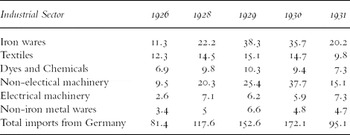
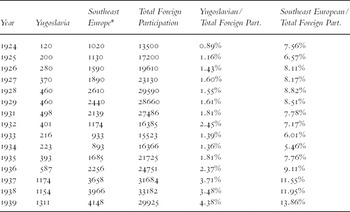
The high volume of trade at Leipzig and its large contingent of foreign participants attracted merchants from Yugoslavia because it offered them one of their only opportunities to market goods to both a German and an international audience. Just as important, the technical fair, which first opened in 1918, housed some of Germany's largest exhibition spaces where firms such as AEG, Siemens and Krupp, along with smaller producers, displayed Germany's technical advances and capital equipment. This portion of the fair soon became the most attractive for Yugoslav importers, where they could purchase the advanced machinery, farm equipment and specialised machine tools that they needed to modernise their economy but that were too expensive to produce domestically.Footnote 59 These were the very sectors – iron and steel products, non-electrical machinery and electrical machinery – among Yugoslavia's imports from Germany that expanded the most rapidly in the 1920s (see Table 1). Between 1925 and 1931 the number of official business participants from Yugoslavia more than doubled, rising from 200 to 498, a rate of increase that was quicker than that of foreign participants in general (see Table 2).
Yugoslavian Imports from Germany by Sector (in millions of RM)

Source. Figures taken from the annual reports Deutsche Aussenhandel unter besonderer Berüchsichtigung Bezugs und Absatzländer from 1926 to 1930 in Wirtschaft und Statistik; Die Stellung Deutschlands im Aussenhandel Jugoslawiens, in Wirtschaft und Statistik, 8 (1928), 539–40. Wirtschaft und Statistik does not have figures for 1925 or 1927.
Participation at the Spring Fair in Leipzig by country or region (in number of registered merchants).

* Bulgaria, Hungary, Romania and Yugoslavia
Source. Figures taken from Zahlen von der Leipziger Messe, DS 923–37, LMA, SSAL.
But even more important than the fairground itself was the network of agents that the Messeamt supported in Yugoslavia. In 1925–6 Köhler and the other directors founded a new business office in Belgrade, which co-ordinated the activities the fair's eight to ten agents in Yugoslavia.Footnote 60 The agents collected information about local market conditions such as prices, sales opportunities, relative demand, and even fashion or taste in clothing and other goods.Footnote 61 Whereas Germany's foreign consular service focused only on the general economic structure of local countries, the fair's directors argued that sectoral-level information could be better collected by its own agents, who had extensive local experience and connections. The fair's business office in Belgrade received information from its agents in Skopje, Sarajevo, Split, Zagreb, Maribor, Ljubljana, Osijek and Novi Sad, which it passed along to the head offices in Leipzig.Footnote 62 There the fair had established eighteen subcommittees, each of which co-operated with a particular industrial sector. The Messeamt would pass this market information along through the subcommittees directly to the relevant German industries, or would publish it in their weekly journal Wirtschafts- und Export Zeitung.Footnote 63
The task of collecting information was especially difficult in Yugoslavia; several years after the war Belgrade still lacked a ‘functioning statistical service’ that could provide reliable macro-economic information.Footnote 64 To improve the collection of information Hans Schuster, the director and co-founder of the fair's Belgrade office, formed a new institution in 1926, the German-Yugoslav Committee on Industry and Trade. This became a collaborative effort to pool information between the trade fair, some of Germany's leading industrial associations, and the Leipzig chamber of commerce on the German side, and the Central Association of Yugoslav Industrialists, the offices for trade in Belgrade, and the chambers of commerce in Ljubljana, Osijek and Belgrade on the Yugoslav side.Footnote 65
To provide information about German products to Yugoslav merchants, the fair's agents also engaged in extensive advertising. The Messeamt gave its agents wide latitude to select the type of publicity they preferred, with the aim of suiting ‘the distinct culture, habits, and economic conditions of the target audience’.Footnote 66 In 1926 Schuster's office in Belgrade had a budget of 45,100 RM, which increased to 70,600 RM over the following years, to advertise with methods that ranged from promotional films about the fair and about German industrial sectors, to radio and newspaper ads.Footnote 67 The content promoted the fair as a venue for Yugoslav merchants to establish contacts with German businessmen. But it also advertised Germany's high-quality manufactured goods and capital equipment, especially through films that showcased German technology.Footnote 68 To encourage more Yugoslavs to come to the fair, Schuster also organised five official exhibitions from Yugoslavia. These ‘calling cards for the economy of a country’ were intended to display a state's ‘economic capabilities’. In the 1920s the Yugoslav exhibitions consisted mostly of tobacco products, fine carpet wares and other artisanal specialties, along with a selection of agricultural goods and other raw materials.Footnote 69
In advertising for the fair Schuster and his colleagues frequently collaborated with ethnic German organisations in Yugoslavia. Agents in Maribor and Novi Sad, for instance, worked with the Political Association of Germans in Slovenia and the German Foundation to organise a collective trip by Slovenian Germans to visit Leipzig in 1927.Footnote 70 The Political Association was dedicated to maintaining the cultural heritage and economic viability of the German minority in Slovenia, but according to their reports only a small number of German businessmen in Slovenia actually ‘knew and valued their German motherland and its business life through their own experience there’. Other accounts reinforced the observation that German minorities in Slovenia relied almost exclusively on Yugoslav or Viennese rather than German agents.Footnote 71 To remedy this the association hoped to organise a study trip of thirty local merchants and artisans to visit the Leipzig fair in 1927.Footnote 72 By obtaining and distributing visas, arranging group travel and rail discounts, and negotiating a reduced fair entry fee, the Maribor agent reduced the financial burden of visiting the fair to well below the normal cost.Footnote 73
In addition to advertising and organising study trips, the fair's agents helped locate importers in Yugoslavia with solid reputations who would be willing to act as representatives for German exporters. Indeed, commentators frequently complained about the difficulty of finding reliable agents.Footnote 74 According to Consul Walbeck, one of the most engaged observers of German–Balkan commerce, ‘the knowledge of how to do business here cannot be acquired by the mere operation of a single transaction’. Rather one needed ‘to have a trusted representative who lives in the country, keeps his head offices abreast of the various business fluctuations, and remains in continual contact with the clientele. For most German firms it is too costly to maintain such a representative.’Footnote 75 Walbeck and Germany's legation in Belgrade were willing to help solicit such representatives, but with their limited budget and work-force they were incapable of responding to every inquiry. Instead they passed these on to the fair's agents.Footnote 76 Milan Lujanovitz, for example, the director of the fair's Belgrade office after 1928, frequently advised German merchants about prospective agents. As a Belgrade Serb with connections to the Economics Ministry, the Yugoslav national chamber of commerce, and as a director of one of Belgrade's largest banks, he had numerous contacts in Belgrade, which through his office as trade fair agent he could communicate to Germans. Finally, the fair also offered recourse to an informal court of arbitration in Leipzig, and its agents provided advice and assistance to German merchants trying to navigate the legal system in Yugoslavia.Footnote 77
The impact of the Fair
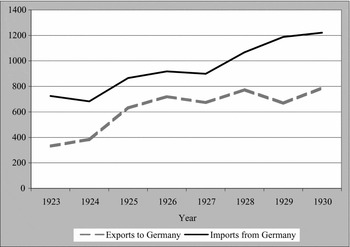
Measuring the fair's direct impact on German–Yugoslav commerce during the 1920s is difficult to do. But the evidence suggests that the standard history of German–Balkan commerce, told primarily from the perspective of trade agreements, is incomplete. Most tellingly, Germany's major trade agreement with Yugoslavia during the 1920s was not concluded until the very end of 1927, and historians frequently point to this as the pivotal moment when the legacies of the First World War were left behind.Footnote 78 German imports from and exports to Yugoslavia, however, saw their largest jump two years earlier, in 1925 and 1926, when the fair opened its business office in Belgrade and began to co-ordinate its reporting and advertising in south-eastern Europe. Yugoslav trade in general, moreover, actually slumped in 1927, due in large part to the conflict with Italy over Albania (see Figure 1).
German–Yugoslav Trade
Source: Figures taken from B.R. Mitchell, International Historical Statistics, Europe 1750–2005 (New York: Palgrave Macmillan, 2007), 728.

As a point of comparison, Yugoslavia's trade with Switzerland grew much more slowly during the 1920s than it did with Germany. The level of industrial development in Switzerland was roughly comparable to that in Germany, and the two countries had a similar incentive to exchange manufactured goods and capital equipment for agricultural products. Swiss traders commanded the German language, the business lingua franca in much of Yugoslavia. And, as with Germany, Swiss merchants were not traditional intermediaries in the Balkans, as those from Vienna were. Swiss firms even enjoyed the added advantage of financial support, since they had a stronger banking presence in Yugoslavia than did Germany. The main institutional difference between Germany and Switzerland, in this respect, was that the former had the Leipzig fair and its network of agents while the latter did not. And this seemed to matter. Yugoslavia's exports to Switzerland were actually lower in 1928 than they were in 1923, whereas its exports to Germany had doubled. Evaluating the performance of Yugoslavia's imports is more difficult. According to figures produced by the Yugoslav government, imports from Switzerland and Germany both doubled between 1923 and 1928. According to German figures, Yugoslav imports from Germany more than quadrupled in the same period.Footnote 79
But the Leipzig fair had its greatest impact on German–Balkan trade in immeasurable areas, for it provided critical services that were found wanting during the 1920s. The fairgrounds themselves provided a venue for Germans to make personal and commercial connections with foreign merchants, as well as a place for the latter to display and market their goods. The Messeamt filled a sizeable hole in Weimar's system of economic news reporting, as its subcommittees passed information directly to Germany's industrial associations. The fair's agents generated a robust advertising presence in Yugoslavia through film, radio ads, newspapers and posters. They helped German firms locate trusted representatives in Yugoslavia and navigate the country's legal system.
The Leipzig Trade Fair under National Socialism
After 1933, all the services provided by the fair proved to be invaluable for the German economy, and indirectly so for Germany's rearmament programme. Nazi Germany's vast demand for foreign agricultural goods to feed its population and for raw materials to fuel its modern military machine meant that it struggled to finance its appetite for imports throughout the 1930s. Indeed, for the Foreign Office after 1934, ‘the supply of indispensable foreign raw materials [was] the most important task for German economic policy’.Footnote 80 But Hitler's drive to rearm Germany at all costs led to a string of foreign currency and foreign trade crises – in 1934, 1936 and 1937 – that threatened to send the economy into freefall. To manage these recurring crises Germany's economic leadership, first under the New Plan in 1934, then under Hermann Göring's Four-Year Plan in 1936, heavily regulated foreign trade and signed bilateral clearing agreements with the countries of south-eastern Europe.Footnote 81 By rationing trade licenses, this dirigiste system privileged the import of goods for military production, but it also favoured the import of goods for export industries in the hopes that a strong export sector would prevent Germany's trade deficit from expanding.
The New Plan and the Four-Year Plan, however, profoundly altered the nature of commerce in central and south-eastern Europe, particularly for smaller firms, generating a host of immediate problems that the German state proved unable to ameliorate. The clearing agreements were cumbersome and frequently ineffective in matching buyers and sellers.Footnote 82 The byzantine regulations imposed serious costs and created massive impediments in the flow of information.Footnote 83And as the bilateral treaties increasingly redirected trade away from Germany's traditional markets in America and Great Britain and towards south-eastern Europe, Germany's chain of importers and distributors now had to accommodate new and unfamiliar products from south-eastern Europe.
After 1933, then, the reputation and the trade network that the Leipzig fair had built in south-eastern Europe during the previous decade enabled it to manage many of the new problems generated by Germany's foreign trade system. By 1938 not only Yugoslavia, but also Romania, Bulgaria, Hungary and Greece had all organised collective exhibitions in Leipzig.Footnote 84 In addition to its artisanal products, Yugoslavia displayed goods that were crucial for the German military machine: chrome, manganese, zinc, bauxite and copper from the major production sites – the Trepca mines for example.Footnote 85 By marketing the raw materials of south-eastern Europe to German consumers, these exhibitions performed a crucial service the German state had assumed in theory under the bilateral treaties but which it failed to fulfil in practice.Footnote 86 The fair's agents helped place Yugoslav bauxite producers in contact with German aluminium manufacturers.Footnote 87 Through its advertising and information services the Messeamt promoted exports of capital equipment and machinery at a time when the Third Reich needed foreign sales more than ever to surmount its systemic foreign currency crises. By 1938 Germany had become by far the largest supplier of machinery, iron products, engineering equipment and motor vehicles to Yugoslavia, and many of these products flowed through the technical fair in Leipzig.Footnote 88 And by functioning as an entrepot for the scarce import and export licenses, the fair enabled an otherwise neglected strata of small and medium businesses based in Saxony to participate in the Third Reich's commercial drive to the south-east.Footnote 89 The fair thus became a crucial link connecting the Nazi domestic economy to south-eastern Europe.
Overall attendance at the fair paralleled Germany's turn inward to the continent as participation by merchants from America, Britain, France and other nations outside of Germany's continental bloc declined. By the late 1930s Yugoslavia was sending more official exhibitions to Germany than in the previous decade, and its overall participation at the fair recovered more quickly than the rest of Europe, surpassing pre-depression levels by 1936 (see Table 2). By 1939 merchants from south-eastern Europe – Yugoslavia, Hungary, Romania and Bulgaria – accounted for 15% of all foreign participants at the fair, roughly twice as many as in 1929, while the region now accounted for 10% of Germany's trade in comparison with only 4% in 1929.Footnote 90
In 1938 German–Balkan commerce reached a plateau, and many German planners thought only a long-term investment policy that improved south-eastern Europe's productivity and enhanced its purchasing power would fully integrate this region into Germany's Großraumwirtschaft.Footnote 91 But despite these limitations, Germany's close commercial ties with the states of south-eastern Europe during the 1930s enabled the Third Reich to stumble from foreign currency crisis to foreign currency crisis without suffering a severe economic collapse, as many contemporaries feared might be the case.Footnote 92 For certain strategic imports – grains and livestock, bauxite for the aircraft industry or oil for Germany's motor vehicles – south-eastern Europe proved to be an essential supplier. Over 80% of Germany's barley imports, over 60% of its bauxite, and roughly 30% of its wheat, corn, meat, timber and lead imports came from south-eastern Europe.Footnote 93
The Leipzig trade fair, the commercial network it had built in the 1920s, and the services it provided during the 1930s were a key reason why German foreign trade under the New Plan and the Four-Year Plan functioned as well as it did. The Messeamt directors saw the Leipzig fair first and foremost as an institution of international trade, something to further Germany's interconnection with the global economy. Yet by expanding the fair's activities in south-eastern Europe they ultimately helped construct the continental economic bloc so desired by Nazi economic planners.Footnote 94 In doing so, the Leipzig trade fair proved to be an important pillar in Hitler's quest to mobilise and equip a modern army that required the resources of a continent to support it.