1. BACKGROUND AND MOTIVATION
1.1. Function-based design
Many design processes prescribe a function-first approach to conceptual design, where designers establish the function of the product after identifying engineering requirements (Ullman, Reference Ullman1992; Otto & Wood, Reference Otto and Wood2001; Pahl et al., Reference Pahl, Beitz, Feldhusen and Grote2007; Ulrich & Eppinger, Reference Ulrich and Eppinger2008). There are many differing definitions of the term function (Chandrasekaran & Josephson, Reference Chandrasekaran and Josephson2000; Hubka & Eder, Reference Hubka and Eder2001; Brown & Blessing, Reference Brown and Blessing2005; Pahl et al., Reference Pahl, Beitz, Feldhusen and Grote2007; Vermaas, Reference Vermaas2007), but all function-based approaches focus on what the designed product should do to satisfy the requirements instead of what the design will look like. For example, if a designer is designing an electric drill, he will focus on the necessity for the drill to create rotational output instead of focusing on using a motor, allowing him to explore ideas other than a motor to accomplish the task of creating rotation. In this manner, a designer may be able to develop ideas such as a pneumatic or gas-powered drill, both of which exist in the consumer market.
The definition of function pursued in this research is a transformation of a set of inputs to a set of outputs (Ullman, Reference Ullman1992; Otto & Wood, Reference Otto and Wood2001; Pahl et al., Reference Pahl, Beitz, Feldhusen and Grote2007; Ulrich & Eppinger, Reference Ulrich and Eppinger2008). In this approach, functions are often represented using a verb–object form, where the verb is the function and the object is a flow. Flows are broadly classified as materials, energies, and signals (Pahl et al., Reference Pahl, Beitz, Feldhusen and Grote2007). A function can be represented graphically using a function block shown in Figure 1 (Pahl et al., Reference Pahl, Beitz, Feldhusen and Grote2007).
The generic function block. Adapted from G. Pahl, W. Beitz, J. Feldhusen, and K.H. Grote, 2007, Engineering Design: A Systematic Approach, 3rd ed., p. 30, figure 2.2. London: Springer–Verlag. Copyright 2007 by Springer Science+Business Media B.V. Adapted with permission.

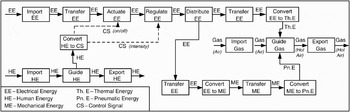
A product can have many functions with various inputs and outputs to each function that can be arranged and linked together by the flows to create a function structure. A sample function structure of a hair dryer is shown in Figure 2 (Design Engineering Lab, 2008). As shown in the figure, a hair dryer has the functions of converting electrical energy to thermal energy, converting electrical energy to mechanical energy, converting mechanical energy to pneumatic energy, and guiding gas, which correspond to the heating coils, electric motor, fan blade, and housing, respectively. Many other functions are shown in the model, which represent wires, switches, and human interactions. The hair dryer's functions have been linked together in series and parallel to show the precedence and dependence among the functions. For example, the electrical energy must be imported and transferred before it can be actuated. In addition, the actuation requires human energy to first be imported, guided, and converted to a control signal. The graphical layout and connectivity of functions via flows in the function structure enables this representation to capture these dependencies.
The hair dryer function structure. Adapted from the Design Engineering Lab, 2008, Design Repository. Rolla, MO: Missouri University of Science and Technology, Design Engineering Lab. Copyright 2008 Missouri University of Science and Technology. Adapted with permission.

The intent of function-based design is to assist the designer in moving from a list of requirements to concepts when designing mechanical products. The initial function structure created in the design process is a solution-independent representation, enabling the designer to generate many potential solutions and solution variants for the design. As the design progresses, solution-specific details can be specified in the function structure, leading to design concepts (Pahl et al., Reference Pahl, Beitz, Feldhusen and Grote2007).
The use of function analysis as a conceptual design tool is discussed in design texts (Hubka & Eder, Reference Hubka and Eder1988; Ullman, Reference Ullman1992; Pahl et al., Reference Pahl, Beitz, Feldhusen and Grote2007) and other literature as a means of broadening the search for solutions. Significant advances in function-based design have been made by Collins et al. (Reference Collins, Hagan and Bratt1976), Hundal (Reference Hundal1990), Kirschman and Fadel (Reference Kirschman and Fadel1998), Szykman et al. (Reference Szykman, Racz and Sriram1999), Otto and Wood (Reference Otto and Wood2001), and Stone and colleagues (Stone & Wood, Reference Stone and Wood2000; Hirtz et al., Reference Hirtz, Stone, McAdams, Szykman and Wood2002; Bohm et al., Reference Bohm, Stone and Szykman2005). Much of this research is applied to existing products that have been studied through reverse engineering, which is the analysis of existing products through dissection (Otto & Wood, Reference Otto and Wood2001). This paper systematically explores the expressiveness of the functional basis (FB) and two function representations (function structures and function lists) through an empirical study of a design repository, specifically investigating the role that functions and flows, as defined in the FB, play in describing consumer products.
1.2. The FB
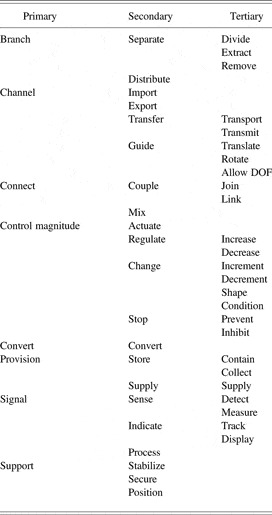
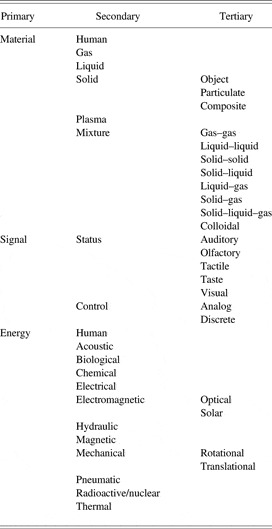
Recent research efforts have identified the need for a finite vocabulary of terms to increase consistency in function models (Kirschman & Fadel, Reference Kirschman and Fadel1998; Szykman et al., Reference Szykman, Racz and Sriram1999; Stone & Wood, Reference Stone and Wood2000). One vocabulary, the FB, consists of 53 functions and 45 flows that can be used to describe mechanical systems (Hirtz et al., Reference Hirtz, Stone, McAdams, Szykman and Wood2002). The FB uses a verb–object form to describe product functionality, which consists of an action verb and an object or objects to which the verb is acting upon (e.g., guide gas in Fig. 2). The FB seeks to support the archiving of design knowledge and comparison of products functionally (Hirtz et al., Reference Hirtz, Stone, McAdams, Szykman and Wood2002). The FB shown in Table 1 and Table 2 is organized into a three-level hierarchy.
Functional basis function hierarchy

Note: DOF, degree of freedom.
Functional basis flow hierarchy

The hierarchy was created to allow designers to describe function at various levels of detail. Hirtz and colleagues (2002) state that original design problems may use higher level terms as the details of the product are not known. Adaptive and variant designs, however, may use more specific, lower level terms because the details about a function model are already known. In addition, the authors of the FB state that the secondary level provides the most specific function detail that is practical for engineering design (Hirtz et al., Reference Hirtz, Stone, McAdams, Szykman and Wood2002).
1.3. Design repository
The FB and related research has led to the development of a function-based design repository at Missouri University of Science and Technology, which we refer to as the Design Repository (http://repository.designengineeringlab.org). This Web-based repository, populated through reverse engineering and disassembly of consumer products, contains functional descriptions of 130 products employing the FB as the underlying vocabulary (Bohm et al., Reference Bohm, Stone and Szykman2005).
1.4. Research focus
The FB and Design Repository have been evolving for over a decade (Szykman et al., Reference Szykman, Racz and Sriram1999; Stone & Wood, Reference Stone and Wood2000; Hirtz et al., Reference Hirtz, Stone, McAdams, Szykman and Wood2002; Bohm et al., Reference Bohm, Stone and Szykman2005). Several tools have been developed that operate on information stored in the Design Repository, including automated concept generation (Vucovich et al., Reference Vucovich, Bhardwaj, Ho, Ramakrishna, Thakur and Stone2006; Bohm et al., Reference Bohm, Vucovich and Stone2008), function-based similarity measures (McAdams et al., Reference McAdams, Stone and Wood1999), failure and risk analysis (Stone et al., Reference Stone, Turner and Stock2005; Grantham Lough et al., Reference Grantham Lough, Stone and Tumer2008), and biomimicry (Nagel et al., Reference Nagel, Midha, Tinsley, Stone, McAdams and Shu2008; Stroble et al., Reference Stroble, Watkins, Stone, McAdams and Shu2008). Despite these applications and the use of the vocabulary in the Design Repository models, the adequacy of the FB to model electromechanical products has never been objectively evaluated. The FB was aimed to ensure that the terms provide adequate coverage (Hirtz et al., Reference Hirtz, Stone, McAdams, Szykman and Wood2002), and previous research has explored the theoretical foundations of the FB (Garbacz, Reference Garbacz2006; Vermaas, Reference Vermaas2007). To supplement this theoretical exploration, this research focuses on assessing the coverage of the vocabulary by empirically measuring the usage of the terms in repository models. Specifically, this research is a first attempt to answer fundamental questions such as the following: “Is the vocabulary used by modelers?” Is the vocabulary adequate?” “Does the vocabulary allow modelers to express what a product does?” This examination provides insight to the possible extensions of this vocabulary for improving its expressive power.
1.5. Rationale
Two underlying assumptions must be made in this research. The researchers who have developed the FB and Design Repository have published a method for creating function structures through product dissection (Kurfman et al., Reference Kurfman, Stone, VanWie, Wood and Otto2000; Stone et al., Reference Stone, Wood and Crawford2000; Stone & Wood, Reference Stone and Wood2000). Because this method was published before the repository was developed, it is assumed that this method has been used to create all of the models in the repository.
Assumption 1: Modelers used a published method (Kurfman et al., Reference Kurfman, Stone, VanWie, Wood and Otto2000; Stone & Wood, Reference Stone and Wood2000; Stone et al., Reference Stone, Wood and Crawford2000), which prescribes the use of FB terms, when creating the models in the repository.
The published modeling method instructs the modeler to create a black box model of the product and identify “function chains” by following the path of each input as it is transformed through the product. After creating these function chains, the method instructs the modeler to express all subfunctions and flows using the FB vocabulary (Kurfman et al., Reference Kurfman, Stone, VanWie, Wood and Otto2000; Stone & Wood, Reference Stone and Wood2000; Stone et al., Reference Stone, Wood and Crawford2000). Because this method is assumed to have been used, it is assumed that each modeler attempted to express the functions and flows using the FB. The second underlying assumption is that, if the terms available in the vocabulary were adequately expressive, then the modelers would have described the function of the product using only FB terms.
Assumption 2: A modeler used a term from outside the FB in a model only if an adequately expressive term was not available in the vocabulary.
However, the modeling method does not prescribe a specific hierarchical level for modelers to use or provide details about when to use specific terms. The modeler uses his or her knowledge of the product and the definitions provided with the FB vocabulary to select the proper terms. This freedom given to the modelers to choose a term is being analyzed in this research to understand the usage of the vocabulary by modelers.
The primary objective of this research is to evaluate the expressiveness of the FB for describing the functionality of mechanical devices. The null hypothesis is that the vocabulary provides adequate coverage, but the research hypothesis is that the vocabulary does not provide adequate coverage.
Null hypothesis: The FB provides adequate coverage for describing the functionality of mechanical products.
Research hypothesis: The FB does not provide adequate coverage for describing the functionality of mechanical products.
In order to test the hypotheses, the frequency of use of FB terms within the Design Repository is measured. It is important to note that this metric can only be used to either reject the null hypothesis or fail to reject the null hypothesis. It cannot be used to prove the null hypothesis and validate that the coverage provided by the FB is adequate. If the study reveals instances in which the FB did not provide adequate coverage for modelers, then the null hypothesis can be rejected.
Frequency analyses are used in text processing and ontology development to identify relevant terms in a set of documents. The lexical entry frequency, document frequency, and corpus frequency are often used to determine the weight of a term by computing the term frequency inverted document frequency (tfidf), which penalizes terms that appear in most of the documents (Salton, Reference Salton1988; Staab & Studer, Reference Staab and Studer2004). In this research, a term weighting scheme such as tfidf is not used because the value of individual terms in the vocabulary is not being assessed. Further, the scope of products in the repository is expanding, so a weighting based on the repository's current state may lead to low values for terms that may be of greater value in the future. Therefore, the unweighted term frequency count is used to assess the coverage of the vocabulary being studied. The focus of the analysis is on what terms are not used because a lack of use of terms by modelers may indicate that the terms are not adequately expressive.
2. REPRESENTATIONS IN THE DESIGN REPOSITORY
The Design Repository contains two separate representations of product functionality: graph and matrix. Approximately half of the products in the Design Repository contain graph-based representations, and all of the products in the Design Repository contain matrix-based function–component relationships and component–assembly relationships. It is important to establish the similarities and differences between these two representations in what information each captures, how the information is captured, and the consistency between the representations.
2.1. Graph-based function structures
In this paper, a function structure is defined as a graphically organized functional description that contains more than one function block (see Fig. 1) and is linked together by flows of material, energy, and/or signals. This definition is consistent with many design texts (Ullman, Reference Ullman1992; Otto & Wood, Reference Otto and Wood2001; Pahl et al., Reference Pahl, Beitz, Feldhusen and Grote2007). An example of a function structure is shown in Figure 2. Function structures of approximately half of the products in the Design Repository can be downloaded as either PDF or ConceptDraw software .cdd files. The function and flow information contained in these function structures is not “known” by the database. The files are uploaded as images and are not generated or parsed by the Design Repository. Function structures in the Design Repository are therefore unrestricted and are not required to follow any guidelines, allowing frequent use of terms that are not part of the FB. For these reasons, graph-based function structures cannot be used by tools that use the Design Repository as a source of functional information.
2.2. Matrix-based function lists
The Design Repository also contains functional information about products and their components in a database. Individual components are entered into the Design Repository, and each component is then assigned a single function or many functions. A function can exist only if it is assigned to a component; each function consists of the following:
1. an input flow chosen from the FB flow vocabulary,
2. a function chosen from the FB function vocabulary,
3. an output flow chosen from the FB flow vocabulary,
4. an artifact from which the input flow enters, and
5. an artifact to which the output flow exits.
If a function has multiple input or output flows, then multiple function instances must be entered. For example, a motor in the Design Repository from the Black and Decker Sliceright has four functions, two of which are convert electrical energy to mechanical energy and convert electrical energy to thermal energy. These two functions represent the single function block shown in Figure 3.
The motor function block. EE, electrical energy; ME, mechanical energy.

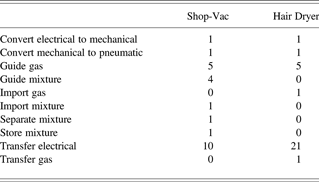
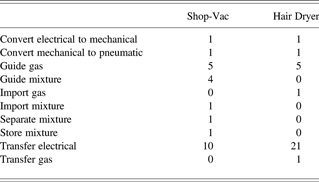
Several matrices can be generated from the information stored in the Design Repository, including the product function matrix (PFM). A PFM for a hair dryer and Shop-Vac is provided in Table 3. The PFM contains functions in the first column and products across the top row. The values in the cells of the PFM represent the number of times that the given product performs the specific function. For example, the hair dryer transfers electrical energy 21 times and guides gas 5 times. The functions in PFMs are verb–object phrases that contain either one or two objects. If the phrase contains one object, then that object is both the input and output flows for the function (e.g., guide gas). If the phrase contains two objects, then the first object is the input and the second object is the output to the function (e.g., convert electrical energy to mechanical energy). All unique function phrases used in any of the products contained in the PFM are listed in the matrix.
Product function matrix example
The matrices generated by the Design Repository do not directly contain information about the path of flows between functions. Connectivity is captured only through the input and output artifacts, so the Design Repository is not capable of recreating function structures based on information in the matrices. Thus, the topology of the graph-based function structure is not included in the matrix-based representation, decreasing the amount of information contained in this representation. For this reason, the matrix-based function representations obtained from the Design Repository are referred to as function lists in this article.
2.3. Function representation comparison
The fundamental difference between function structures and PFMs is that function structures contain function connectivity using flows. This enables function structures to capture additional information, such as the precedence of functions in relation to each other. PFMs do not capture these details and are limited to a flat list with no connectivity among functions. In addition, the repository restricts the vocabulary of function lists to the FB and allows one input and output flow per function. Function structures are unrestricted in both the vocabulary and the number of inputs and outputs of each function.
3. FUNCTION STRUCTURE STUDY
3.1. Objective
The Design Repository is the largest implementation of the FB, so it is appropriate to analyze models stored in the Design Repository. The intent of this study is to understand how the FB is currently being used within the repository's function structures. By exploring how each term is used, the expressiveness of the FB can be assessed for reverse engineering and archiving of consumer products.
3.2. Protocol
In this study, the hair dryer and 10 additional products were analyzed. The hair dryer was chosen because it has been studied in previous research (Leung et al., Reference Leung, Ishii and Benson2005; Mocko et al., Reference Mocko, Summers, Fadel, Teegavarapu, Maier and Ezhilan2007; Sen et al., Reference Sen, Caldwell, Summers and Mocko2009, Reference Sen, Caldwell, Summers and Mocko2010) and combines several mechanical engineering domains. The remaining 10 products were chosen so that the sample of 11 products best represents the entire population in the repository based on two criteria: the type of product and the size of the model. The 10 additional products chosen were the Black and Decker Jigsaw attachment, Brother Sewing Machine, cassette player, Delta Circular Saw, Delta Nail Gun, dryer, Digger Dog, garage door opener, Oral B Toothbrush, and Shop-Vac.
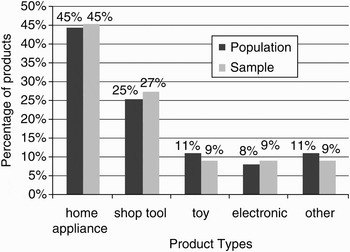
To evaluate the first selection criterion, the products were grouped according to the following common categories that were determined empirically: home appliances, shop tools, toys, electronics, and all other products. The sample was selected to match the population's distribution, as shown in Figure 4. The sample contains five home appliances (hair dryer, sewing machine, dryer, toothbrush, and vacuum), three shop tools (jigsaw attachment, nail gun, circular saw), one toy (Digger Dog), one electronic (cassette player), and one other type of product (garage door opener). Because the sample contains only 11 products, the sample's distribution has as resolution of 9%. The percentage of products from each category in the sample is within 2% of that of the population, so the number of products chosen from each category for the sample is optimal based on the categories identified in the population.
The distribution of product types in the population and sample.

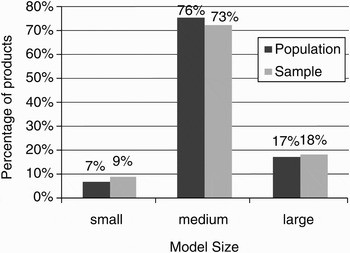
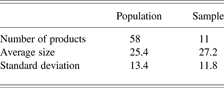
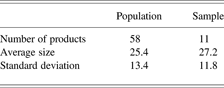
The second criterion for choosing the sample is the size of the graphical function structure, which is defined as the number of functions. The products chosen were selected from a set of 58 products with a downloadable graphical function structure available in the repository. The 58 function structures were classified as small, medium, and large sized. The limits of small, medium, and large were based on the average and standard deviation of the number of functions. Models that were within one standard deviation of the average were medium sized; small and large models were outside this range. It is important to note that the average and standard deviation are used only to establish the small, medium, and large categories of models; statistical arguments are not made on these values, as the size is not a normal distribution. The average and standard deviation of the population and sample are shown in Table 4, and the distribution of model size is shown in Figure 5. The sample of products chosen contains an optimal size distribution of products because the resolution of the sample distribution is 9%.
The distribution of the model size in the population and sample.

Average and standard deviation of model size in population and sample
Using the two criteria of product type and model size, the 11 products chosen for this study are representative of the entire population of 110 products in the repository. Thus, the observations and conclusions drawn on the sample of 11 products are extended to the entire population in the repository. Traditional statistical methods used to compute sample size are predicated on a priori knowledge of distribution and confidence and are not relevant in this calculation.
These 11 function structures are analyzed by counting the frequency of use of each term instance in the collection of models. The terms are categorized as functions verbs, function nouns, or flows according to the guidelines defined in this section. A sample function block with input and output flows, taken from the hair dryer function structure shown in Figure 6, is used to explain the experimental procedure. Articles, prepositions, and conjunctions are ignored in this experiment, which is indicated in Figure 6 by strikethrough text.
A sample function block from a hair dryer. Articles, prepositions, and conjunctions are ignored in this experiment, which is indicated by strikethrough text. The two function nouns are electrical energy and thermal energy, which are indicated by single underscored text.

Function verbs are inside a function block and are part of the FB's function vocabulary (see Table 1). Function verbs were always the first word inside a function block. In the example (Fig. 6), the only function verb is convert, which is indicated by bold text. Function nouns are inside a function block, may include an adjective describing the noun, and are usually part of the FB's flow vocabulary (see Table 2). A function can contain more than one function noun. In the example (Fig. 6), the two function nouns are electrical energy and thermal energy, which are indicated by single underscored text. Flows are arrows that enter or exit function blocks and are usually part of the FB's flow vocabulary (see Table 2). Any label associated with an arrow was considered a flow. In some cases, an arrow had more than one label, separated by a comma, probably for the purpose of reducing the number of arrows in the function structure. In these cases, each label was considered a flow. In some cases, flows were not labeled in the function structure; unlabeled flows were counted the same as their most recently labeled flow. Flows were counted each time they entered a function block; flows that exited a block but did not enter another block (outputs of the entire system) were also counted. For example, in the hair dryer function structure (see Fig. 2) the flow human energy is counted five times because it enters four function blocks (import, guide, export, and convert) and it is an output of the system (via export). Two flows are included with the sample function block shown in Figure 6: electrical energy and thermal energy. These flows are indicated by double underscored text in the figure.
Data are collected according to the descriptions above for all functions and flows in the function structures. Some terms are used that are not part of the FB vocabulary (non-FB terms), so they are translated into FB terms. Non-FB terms can be included in the graphical function structures because the repository does not enforce the use of the vocabulary for this representation (see Section 2.1). The terms are translated to the secondary level because it is the most commonly used level. After translating the non-FB terms to the FB, the function structures are referred to as translated function structures.
3.3. Results of function structure study
3.3.1. Function structure translation
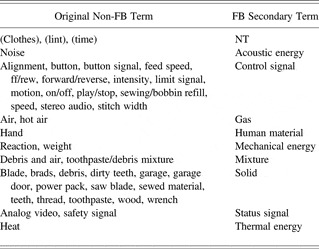
In the 11 function structures, 45 unique non-FB terms are used as either a noun or a flow. Each of these terms is translated to FB terms using the correspondent list provided with the FB vocabulary (Hirtz et al., Reference Hirtz, Stone, McAdams, Szykman and Wood2002) as well as design knowledge about the product that has been modeled. An example of translation required in the hair dryer function structure, shown in Figure 2, is the translation of air and hot air to gas. The original terms used in the 11 products, shown in the first column of Table 5, are translated to FB terms, shown in the second column of the table. The terms marked NT in the table are not translated because they are used in addition to an FB term [e.g., “solid (clothes)”]. If these terms are translated, then the FB term will be counted twice for a single instance.
Non-FB term translation to secondary level

Note: FB, functional basis; NT, not translated.
3.3.2. FB term frequencies within function structures
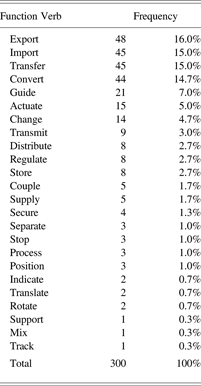
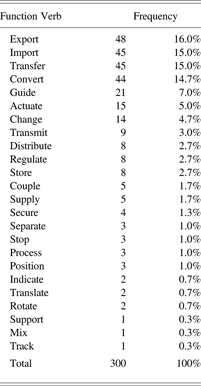
The term frequencies for the original function structure verbs are shown in Table 6. The first column in the table shows the term used in the function structure, the second column shows the total number of instances in which the term was used, and the third column gives the frequency of use as a percentage of the total number of instances. Non-FB terms were never used as a function verb, so function verbs did not need to be translated into FB terms.
Statistical analysis results for original function structure verbs
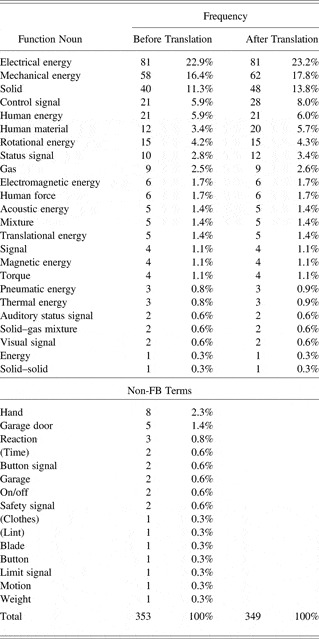
The term frequencies for the original and translated function structure nouns are shown in Table 7. The first column in the table shows the exact term used in the function structure, the second column shows the total number of instances in which the term was used, and the third column gives the frequency of use as a percentage of the total number of instances. The non-FB terms are also indicated.
Statistical analysis results for original and translated function structure nouns

Note: FB, functional basis.
All non-FB nouns in the 11 function structures were translated into secondary-level FB terms according to the mapping shown in Table 5. The term frequencies for nouns after this translation are shown in the fourth and fifth columns in Table 7. The fourth column shows the total number of instances in which the term was used and the fifth column gives the frequency of use as a percent of the total number of instances.
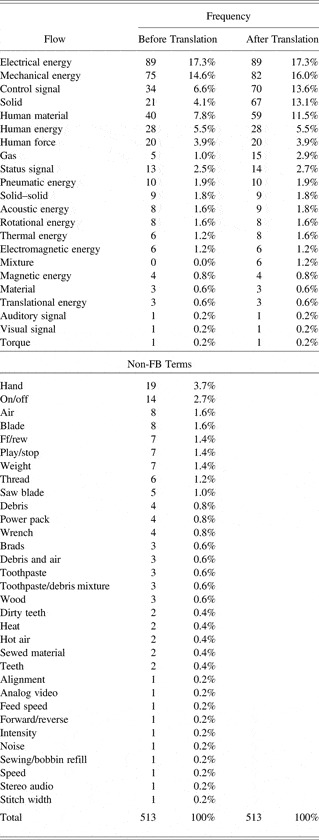
The term frequencies for the original function structure flows are shown in Table 8. The first column in the table shows the exact term used in the function structure, the second column shows the total number of instances in which the term was used, and the third column gives the frequency of use as a percent of the total number of instances. The non-FB terms are also indicated.
Statistical analysis results for original and translated function structure flows

Note: FB, functional basis.
All non-FB flows in the 11 function structures were translated into secondary-level FB terms according to the mapping shown in Table 5. The term frequencies for flows after this translation are shown in the fourth and fifth columns in Table 8. The fourth column shows the total number of instances in which the term was used and the fifth column gives the frequency of use as a percentage of the total number of instances.
3.4. Observations from function structure study
The following observations are made on the results of the frequency analysis of function structures:
• All function verbs are FB terms, but some nouns and flows are not. All verbs used in these 11 function structures are FB terms; however, 15 unique non-FB nouns and 32 unique non-FB flows are used. Of the 353 instances of function nouns, 90.7% are FB terms; of the 513 flow instances, only 75% of the flow instances use the FB vocabulary.
• A few terms are used in a majority of instances. The five most frequent verbs (import, export, transfer, convert, and guide) account for 67.7% of all verb instances. The five most frequent nouns after translation (electrical energy, mechanical energy, solid, control signal, and human energy) account for 68.8% of all noun instances, and the five most frequent flows after translation (electrical energy, mechanical energy, control signal, solid, and human material) account for 71.5% of all flow instances. Thus, over two-thirds of verbs, nouns, and flows can be accounted for by five FB terms in their respective categories.
• The secondary level of the hierarchy is used most often. Secondary terms are used 95%, 79%, and 66% of the time for verbs, nouns, and flows, respectively. If non-FB terms are ignored (translating is not acceptable because a level must be chosen during translation), then these values increase to 95%, 87%, and 88%, respectively. Thus, when an FB term is selected, approximately 90% of the time the term chosen is at the secondary level.
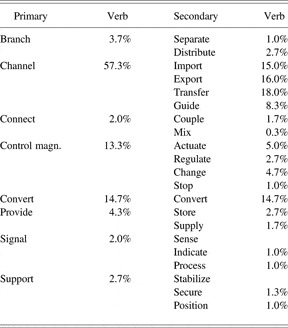
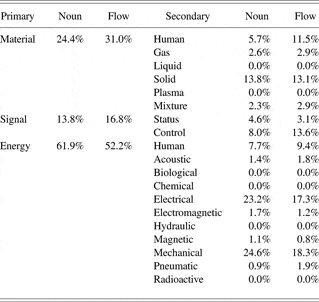
• Most verbs are a type of channel, and most nouns and flows are a type of energy. Table 9 and Table 10 further demonstrate how the FB is used in these 11 function structures. The percentages in these tables represent the number of nouns, verbs, or flows that are labeled with the term or its hierarchical child or grandchild. For example, in Table 10, the noun status signal (secondary) is composed of 0.6% auditory status signal (tertiary), 0.6% visual status signal (tertiary), and 3.4% status signal (secondary), for a total of 4.6%. Similarly, the 13.8% signal (primary) is the total of 4.6% status signal (secondary), 8.0% control signal (secondary), and 1.1% signal (primary). It can be seen from these tables that 57.3% of all verbs are types of channel, 61.9% of all nouns are types of energy, and 52.2% of all flows are types of energy.
Table 9.Hierarchy distribution of verb usage within translated function structures
 Table 10.
Hierarchy distribution of translated function structure nouns and flows


4. FUNCTION LIST STUDY
4.1. Objective
The objective of this study it to understand how the FB is used within function lists in the Design Repository. Function lists enforce the use of the FB, so the trends may be different from those found in function structures.
4.2. Protocol for function list study
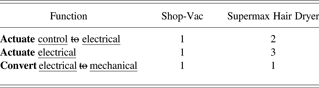
In this study, the function lists in the Design Repository are analyzed by counting the frequency of use of FB terms. The function lists are obtained by downloading the PFM for the products. At the time of the download, the repository contained 110 products. In the first part of this study, each unique phrase in the PFM for all products is counted to determine the frequency of use of the phrases within the repository. This required summing the values in the rows of the PFM to determine the total number of instances in which the phrase appears in the Design Repository. A portion of a PFM is shown in Table 11 and used to illustrate the experimental procedure. In Table 11, the phrase actuate control to electrical has a total of three instances: one in the Shop-Vac and two in the hair dryer.
Sample of functions from Shop-Vac and Supermax Hair Dryer PFM
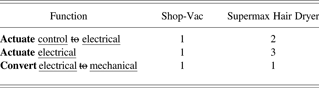
Note: PFM, product function matrix. The function verbs are in bold, the function nouns are underscored, and the prepositions are ignored and indicated by strikethrough text.
In the second part of this study, the terms in the function phrases are categorized as function verbs or function nouns. Flows are not counted in this study because flow information is not available in the function lists. Articles, prepositions, and conjunctions are ignored as indicated in Table 11 by strikethrough text.
Function verbs are the first term in each function phrase and are part of the FB's function set. The frequency of each verb is calculated by summing the values in the entire row for each row in which the verb is used. In the example (Table 11), the function verbs are actuate and convert, indicated by bold text in the figure; the verb actuate has a frequency of seven because it is used once in the Shop-Vac to actuate control to electrical, twice in the hair dryer to actuate control to electrical, once in the Shop-Vac to actuate electrical, and three times in the hair dryer to actuate electrical. Similarly, convert has a frequency of two in this example.
Function nouns are the object of the function phrase and are part of the FB's flow set. The function phrases may contain one or two function nouns. The frequency of each noun is calculated by summing the values in the entire row for each row in which the noun is used. In the example, the function nouns are control signal, electrical energy, and mechanical energy, indicated by underscored text in the figure; the noun control signal has a frequency of three because it is used once in the Shop-Vac and twice in the hair dryer. Electrical energy has a frequency of nine because it is used by both products in all function phrases. Mechanical energy has a frequency of two because it is used one time in each product.
4.3. Results of function list study
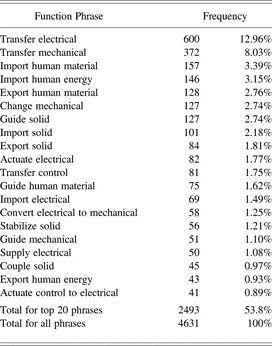
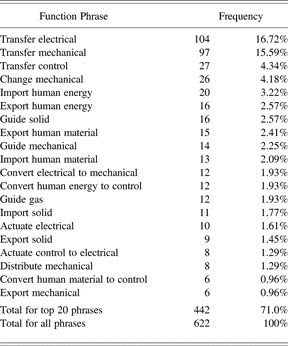
The results of the function list study are summarized because of their length; the 20 most frequent phrases are shown in Table 12. There are 438 unique phrases and 4631 phrase instances.
Top 20 phrase frequencies

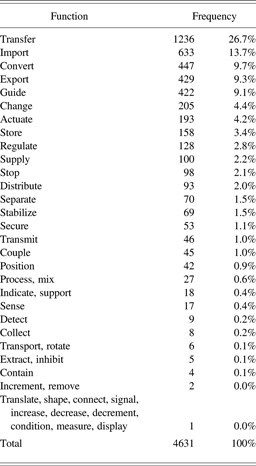
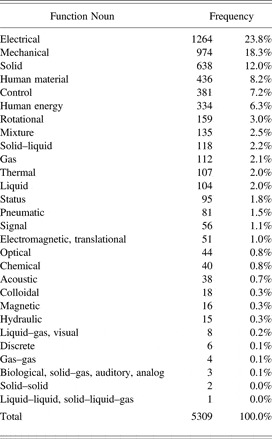
The individual term frequencies for the verbs and nouns in the function lists are delineated in Table 13 and Table 14, respectively. The results also show the frequency as a percent of the total number of instances of verbs or nouns in the given set of products.
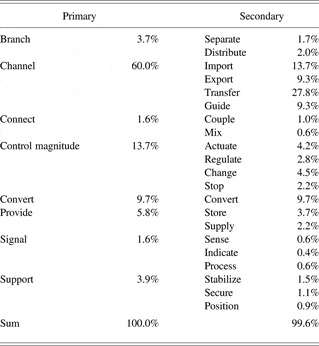
Function list verb results
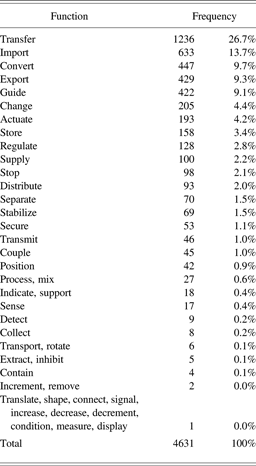
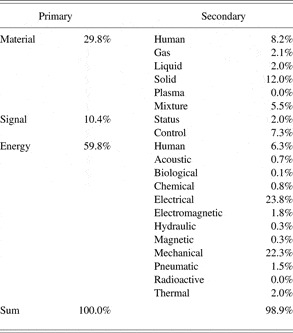
Function list noun results

The function list analysis was also completed on the sample of 11 products studied previously in Section 3 in order to compare the function list representation with function structures. Of note are the most frequent phrases shown in Table 15.
Top 20 phrase frequencies in 11-product sample

4.4. Observations from function list study
The following observations are made on the results of the frequency analysis of function lists:
• A few phrases are used frequently. The top 10 phrases account for 42% of all phrase instances, and the top 20 phrases account for 54% of instances (see Table 12). Only 17 phrases are used more than 1% of the time. Furthermore, of the 438 unique phrases, 320 phrases (73%) are used only once or twice, accounting for only 6.9% of the total number of phrase instances.
• A few terms are used in a majority of verb instances. The five most frequent verbs (transfer, import, convert, export, and guide) account for 68.4% of all verbs. Similar to the function structure results, over two-thirds of verbs, nouns, and flows can be accounted for by 5 FB verbs. Furthermore, the 20 most frequent verbs account for 97.6% of all verbs instances.
• A few terms are used in a majority of noun instances. The five most frequent nouns (electrical energy, mechanical energy, solid, human material, and control signal) account for 69.6% of all nouns. Similar to the function structure results, over two-thirds of nouns can be accounted for by 5 FB flow terms. In addition, the 20 most frequent nouns account for 98.3% of all noun instances.
• Approximately three-fourths of the vocabulary is used in the repository. The function lists used only 42 of the 53 verbs in the vocabulary and 34 of 45 function nouns.
• The secondary level of the hierarchy is used most often. Secondary terms are used 97.4% of the time for verbs and 90.9% of the time for nouns. These frequencies are slightly higher than the frequencies observed in the graphical function structures.
• Function lists contain approximately twice as many functions as function structures. The function structures of the 11-product sample studied previously contained 300 functions, but the function lists of the same products contained 622 functions.
• Most verbs are a type of channel, and most nouns and flows are a type of energy. Table 16 and Table 17 show the types of terms that are being used in the Design Repository, grouped according to the FB hierarchy. The percentages in these tables represent the number of nouns, verbs, or flows that are labeled with the term or its hierarchical child or grandchild (because of the high number of instances, values of 0.0% may correspond to an actual frequency of 0, 1, or 2). Similar to the function structures, 60.0% of the verbs are a type of channel and 59.8% of nouns are a type of energy.
Hierarchy distribution of function list verbs

Hierarchy distribution of function list nouns

5. ANALYSIS OF TERM USAGE STUDY
This study focuses on three key areas of analysis: the hierarchical organization of the FB vocabulary, the expressiveness of the vocabulary, and the expressiveness of the two function representations.
5.1. Hierarchical organization of the FB
In the 110 repository models, the primary, secondary, and tertiary terms are used approximately 1%, 94%, and 5% of the time, respectively. The high use of secondary verbs, nouns, and flow terms by the modelers implicitly suggests that the modelers recognized a greater value in the secondary level than the other levels. In addition, if the secondary and tertiary terms used within the models are abstracted to their primary-level parents, 60% of the flows are energy and 60% of the functions are channel. Thus, if the modeler had used primary terms, channel energy could be used to describe the majority of the functions carried out by the products. The major difference between function models, then, would be the number of functions and flows, not the type of functions and flows. Because the repository models were created from existing products through reverse engineering, the modelers knew more specific information about the product than provided by the primary level. For example, in the hair dryer function structure (see Fig. 2), the modeler knows from the product that the output flow of the electric motor is mechanical energy. It is likely that the modeler used mechanical energy (secondary) rather than energy (primary) to improve the benefits of design archiving and reuse as the secondary-level description captures more detail than the primary. Conversely, even though the product could be described using tertiary terms when available, modelers chose not to publish function structures using these terms. In 25% of the flow instances and 9.3% of the function nouns, modelers instead chose to use non-FB terms even when corresponding tertiary terms were available. This deviation from the vocabulary indicates that, although the tertiary does provide additional detail over the secondary level, it did not provide either enough detail or the right type of detail preferred by the modelers. For example, in the hair dryer model the modeler deviated from the vocabulary, labeling a discrete control signal (tertiary) as on/off (non-FB), which is a more expressive description; in the motor, the modeler chose to represent the output flow as mechanical energy rather than rotational energy, suggesting that the tertiary level did not provide additional detail of use to the modeler. Overall, the modeling resolution provided by the hierarchy, especially the tertiary level, is inadequate and inappropriate for capturing product functionality with sufficient details necessary for design archiving and reuse. Thus, the claim made by Hirtz and colleagues (2002) that the secondary level provides the most specific function detail that is practical for engineering design is neither fully supported nor rejected through this study. The high use of the secondary level supports this claim, suggesting that the secondary level is the most practical level within the current vocabulary. However, the need for a more adequate or more appropriate tertiary level suggests that, through further development of the vocabulary, a more practical level of detail may be achieved.
5.2. Expressiveness of the FB vocabulary
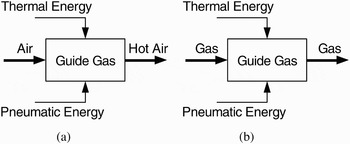
The non-FB terms are also more expressive than the FB terms because they can contain qualifiers of the flows, such as hot air or dirty teeth. For example, the hair dryer function model includes the qualifier hot to capture the difference between the input and output flows of the function guide gas, as shown in Figure 7a. The corresponding FB term, however, is gas for both air and hot air, as shown in Figure 7b, which cannot express the change of state of the flow. Therefore, the use of qualifiers makes it possible to represent the different states of input and output flows, thus making the flows more expressive than the flows presently allowed in the FB. The use of non-FB terms as flows and flow qualifiers leads to the rejection of the null hypothesis for the noun vocabulary, and the acceptance of the research hypothesis, “The FB does not provide adequate coverage for describing the functionality of mechanical products.”
Hair dryer function (a) with non functional basis qualifiers and (b) without qualifiers.

Conversely, non-FB terms were not used in any of the verb instances in the 11 function structures. For example, the modelers could have used the adverb quickly to capture the level of performance of the heating element modeled by the function convert electrical energy to thermal energy in the hair dryer function structure (Fig. 2); however, modelers did not use verb qualifiers in this manner. This absence of use of non-FB terms as function verbs causes the researchers to fail to reject the null hypothesis, “The FB provides adequate coverage for describing functionality of mechanical products.” This observation leads to new research areas to examine if the verb vocabulary is more mature than the flow vocabulary and/or if the verbs are less important for modeling products for design archiving and reuse.
5.3. Expressiveness of function representations
This study leads to the analysis of the two representations (function structures and function lists) in terms of three different measures of expressiveness: representational efficiency, coverage of function to component mapping, and coverage of design intent. Of the two representations, the function structure provides a higher representational efficiency than the function lists. Although function structures allow multiple flows to enter or exit a function block, function lists allow only one input and one output flow per function. For functions that have multiple inputs or outputs, the function is repeated in the function list to capture the additional flows (see Section 2.2). As a result, the function lists for the 11 products contain more than twice as many functions (618) as the function structures (300) and are thus less efficient.
Conversely, function lists are more expressive than function structures in terms of the coverage of function to component mapping. Function lists capture the functionality of each component found in the product dissection, whereas function structures capture functional details without explicitly mapping them to components, resulting in fewer functions. For example, because the modeler is required by the reverse engineering protocol to catalog the functionality of each component, the function of a screw in the hair dryer is captured in the list as couple solid, where the solids are the left and right housing of the product. However, because function structures do not require this explicit mapping between functions and components, this functionality is not typically captured in the function structure representation because it does not contribute to the main flow of energy and material through the product. It is interesting that, because the solids are components of the system, the model implies that portions of the product itself flow through it, making the function structure logically inconsistent. These logical inconsistencies in function structures within the Design Repository are outside the scope of this paper and are reserved for future explorations.
Function structures are more expressive than function lists because they are capable of capturing intended flows through a product. Most function blocks contain only one or two nouns: up to one input flow and one output flow. For blocks with multiple inputs or outputs, the nouns in the block are used to describe only the intended transformative action of the block, rather than accounting for all of the inputs and outputs associated with the block. For example, in the function of an electric motor (see Fig. 3), the nouns electrical energy and mechanical energy show the intent of the motor, whereas the flow of thermal energy is not included in the block. For this reason, there is a higher number of flow instances (513) compared to noun instances (353) within the 11 examined products.
6. CONCLUSIONS AND RECOMMENDATIONS FOR FUTURE WORK
The Design Repository is the largest function-based product database available to the design research community and captures a large amount of knowledge about existing products. The repository has been developed through extensive effort by several universities and research groups, and many researchers across different academic institutions have both authored and used Design Repository data for concept generation, failure analysis, behavior modeling, and biomimicry. However, the findings from this study indicate that the FB and function representations can be further formalized to increase their usefulness for reverse engineering and information archiving in design.
The usage study suggests that the FB verb vocabulary provides better coverage than the noun vocabulary for consumer, electromechanical products. Further, modelers desire additional expressiveness in the flow vocabulary, as demonstrated by the use of non-FB terms and flow qualifiers. The desired expressiveness can be realized by
1. an additional vocabulary of flow qualifiers, enabling designers to show qualitative differences between input and output flows of a function;
2. an extended tertiary-level vocabulary, providing detail beyond the secondary level that is more useful than the existing tertiary terms for modeling function; or
3. both.
The non-FB terms identified in this study can serve as a reference for more specific terms that will provide the necessary expressiveness desired by the modelers. For example, on/off, which occurred 14 times in 8 of the 11 function structures, may provide more useful detail than discrete control signal (tertiary).
The high usage of a few functions leads to new research areas that are currently being pursued by the authors. For example, import and export are used in approximately 31% and 23% of functions in function structures and lists, respectively. If most products in the repository import and export human material, then it may not be useful for a designer to include these functions in each model because, from an information point of view, they do not add value to the model. However, high-frequency functions may be useful to designers for idea generation and other design activities, warranting their inclusion in the function model. In order to address the usefulness of these high-frequency functions, user studies are currently being conducted to understand if these functions affect the interpretability of function structures (Thomas et al., Reference Thomas, Sen, Mocko, Summers and Fadel2009) and if they enhance designer's creativity in conceptual design.
Function structures and function lists have both been used to model the functionality of consumer products, but each captures different information about the product. Function structures capture a product's intended flows, use a more expressive language of flows, and allow multiple inputs and outputs to individual functions, but they capture only system-level functions. Function lists do not capture designer's intent, the connectedness between functions, and free language terms, but they do support both system-level and component-level functions. The differences between these representations are being further explored to understand the usefulness of the information to designers. The two distinct representations may be combined into a single representation, potentially increasing the reasoning capabilities of repository tools.
Benjamin W. Caldwell is a PhD student at Clemson University and an ASME Graduate Teaching Fellow. He completed his master's degree in May 2009 at Clemson University, where he also attained his bachelor's degree in mechanical engineering. Before entering graduate school, he worked at Electrolux Major Appliances where he gained design experience in refrigerator components. He is currently conducting research on consumer product functionality and usage in the field of mechanical design, specifically addressing the interactions among products and users and the relationship between these interactions and product functionality.
Chiradeep Sen is a PhD candidate in mechanical engineering at Clemson University. Chiradeep obtained an MS from Clemson University in 2009 and a BS in mechanical engineering from Jadavpur University, India, in 1995. Between 1995 and 2007 Chiradeep worked in industry where he designed plastic and metal parts; lightweight packaging; injection molding systems; and design automation software for hot runners, centrifugal and reciprocating compressors, and steam turbines. His research interests are the automation of conceptual design; formal representation and reasoning in design; design experiments; knowledge-based and rule-based design; information, uncertainty, and complexity in design; and design education. Chiradeep is a student member of ASME.
Gregory M. Mocko is an Assistant Professor of mechanical engineering at Clemson University. He received his PhD in mechanical engineering from the Georgia Institute of Technology in 2006 with a concentration in computer-aided engineering and design, an MS in mechanical engineering from Oregon State University in 2001 with a focus on system health and failure, and a BS in mechanical engineering and material science from the University of Connecticut in 1999. The focus of his research is on aspects of information management, systems engineering, functional modeling and analysis, engineering requirements, and natural language processing. Dr. Mocko's research is supported by the National Institute of Standards and Technology, US National Science Foundation, BMW North America, Johnson Controls, and US Army TACOM.
Joshua D. Summers is an Associate Professor in mechanical engineering and IDEaS Professor at Clemson University, where he also codirects the Clemson Engineering Design Applications and Research Group. He earned his PhD in mechanical engineering from Arizona State University (design automation) and his MS (submarine design) and BS (fluidized bed design) from the University of Missouri. Dr. Summers previously worked at the Naval Research Laboratory (Virtual Reality Lab and Navy Center for Applied Research in Artificial Intelligence). His research has been funded by government, large industry, and small- to medium-sized enterprises. His areas of interest include collaborative design, knowledge management, and design enabler development with the overall objective of improving design through collaboration and computation.