Introduction
Fitness estimates the reproductive success and it is equal to the average contribution of the next generation to the gene pool (Benton et al., Reference Benton, Lundberg, Dall, Kendall and Gaillard2006). Its careful measure represents a crucial target in crop pest insects. For instance, in the case of highly prolific phytophagous insects, such as aphids, these data become fundamental, as they allow to assess the extent of infestations thus enabling proper pest management strategies.
Literature shows a large amount of studies on the adaptive success of many aphid species with an agronomic and/or forestry impact, in connection with both abiotic factors, such as temperature, photoperiod, presence of pollutants, volatile compounds (Kieckhefer & Elliott, Reference Kieckhefer and Elliott1989; Michels & Behle, Reference Michels and Behle1989; Girma et al., Reference Girma, Wilde and Reese1990; Hildebrand et al., Reference Hildebrand, Brown, Jackson and Hamilton-Kemp1993; Nowierski et al., Reference Nowierski, Zeng and Scharen1995; Hughes & Bazzaz, Reference Hughes and Bazzaz2001; Merrill et al., Reference Merrill, Holtzer and Peairs2009; Conti et al., Reference Conti, Bueno, Sampaio and Sidney2010), and biotic factors, such as different host plants and crowding (Judge & Schaefers, Reference Judge and Schaefers1971; Kidd & Tozer, Reference Kidd and Tozer1984; Behle & Michels, Reference Behle and Michels1990; Ronquist & Ahman, Reference Ronquist and Ahman1990; Miller et al., Reference Miller, Randolph and Peairs2003; Merrill et al., Reference Merrill, Peairs, Miller, Randolph, Rudolph and Talmichm2008; Randolph et al., Reference Randolph, Merrill and Peairs2008; Ma & Bechinski, Reference Ma and Bechinski2009; Takalloozadeh, Reference Takalloozadeh2010; Taheri et al., Reference Taheri, Razmjou and Rastegari2010; Pucherelli et al., Reference Pucherelli, Peairs, Merrill and Randolph2011; Mehrparvar et al., Reference Mehrparvar, Zytynska and Weisser2013; Soffan & Aldawood, Reference Soffan and Aldawood2013; Lu et al., Reference Lu, Yang, Xu, Luo, Zhu, Cui, Kang and Cui2016). The effects of ants, predators, parasitoids and symbionts on aphid fitness have also been analyzed (Costello & Altierim, Reference Costello and Altierim1995; Chen et al., Reference Chen, Montllor and Purcell2000; Asin & Pons, Reference Asin and Pons2001; Giles et al., Reference Giles, Madden, Stockland, Payton and Dillwith2002; Stadler et al., Reference Stadler, Dixon and Kindlmann2002; Leonardo, Reference Leonardo2004; Sakurai et al., Reference Sakurai, Koga, Tsuchida, Meng and Fukatsu2005; Stadler & Dixon, Reference Stadler and Dixon2005; Merrill et al., Reference Merrill, Holtzer and Peairs2009; Ramalho et al., Reference Ramalho, Malaquias, Lira, Oliveira, Zanuncio and Fernandes2015).
The ideal approach to study animal fitness consists of monitoring the biological adaptive traits and reproductive habits of a species within the environment that it naturally inhabits. This method has intrinsic limitations since both the high complexity of ecosystems and the relationships among organisms do hamper a precise evaluation of all the elements influencing the adaptive success of the target. For these reasons, many studies have been based on well-established rearing protocols that allow to control all the external factors, such as weather conditions or presence of predators and parasitoids, enabling to build up representative life tables (i.e., Lu et al., Reference Lu, Yang, Xu, Luo, Zhu, Cui, Kang and Cui2016).
Two common fitness indices are the intrinsic rate of population increase r m , scaled to time and estimated according to the iterative bisection method from the Euler-Lotka formula (Birch, Reference Birch1948), and the net reproductive rate R 0 (Stadler et al., Reference Stadler, Dixon and Kindlmann2002) that is scaled per generation and it is independent of the generation time (Stadler et al., Reference Stadler, Dixon and Kindlmann2002).
Aphids have one of the shortest generation times among insects (Taylor, Reference Taylor1981) and therefore the intrinsic rate of increase is the most representative index for measuring their fitness (Taylor, Reference Taylor1981; Tukjapurkar, Reference Tukjapurkar1990). However, similarly with other fitness indices, r m can vary widely depending on numerous factors, firstly the host plant where aphids are reared (i.e., Lu et al., Reference Lu, Yang, Xu, Luo, Zhu, Cui, Kang and Cui2016). Measuring aphid fitness on different host plants in respect to field conditions could therefore lead to under or overestimate their invasiveness. On the other hand, in most natural field settings, the intrinsic rate of increase is problematic to quantify, and so many studies have been carried out till now on aphids considering other fitness components, such as the mean generation time (d) and the mean daily fecundity (f), or simply comparing the population sizes at different times (Ronquist & Ahman, Reference Ronquist and Ahman1990; Hildebrand et al., Reference Hildebrand, Brown, Jackson and Hamilton-Kemp1993; Costello & Altierim, Reference Costello and Altierim1995; Hughes & Bazzaz, Reference Hughes and Bazzaz2001; Hawley et al., Reference Hawley, Peairs and Randolph2003). Several other indices have also been applied in aphids, such as the finite rate of increase λ, calculated as λ = erm , the age at which maximum fecundity is achieved, X max and the maximum daily fecundity, Y max (Stadler et al., Reference Stadler, Dixon and Kindlmann2002), making difficult the comparison of the available data on fitness so that a standardization of the aphid fitness measurement is still missing.
In the present paper we describe a standardized rearing protocol for aphids and a bioinformatics tool (called Afit) to calculate aphid fitness indices and invasiveness starting from life table data. In this regard, we developed a new algorithm able to calculate all previously cited indices and specifically: (i) a realistic population size prediction; (ii) a new intrinsic rate of increase of the population (r a ); (iii) the crowding effect on population increase (r c ).
Materials and methods
Pea rearing protocol for Myzus persicae
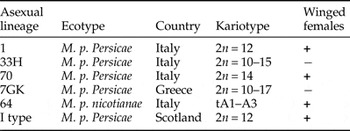
Myzus persicae asexual lineages are maintained on pea (Pisum sativum) seedlings in a thermostatic room (18 ± 1°C), as a colony of parthenogenetic females (16 h light and 8 h dark). M. persicae asexual lineages 1 and 70 were originally collected on peach Prunus persica, lineage 64 was sampled from Nicotiana tabacum and 33H was derived from the lineage US1L collected in UK. M. persicae asexual lineage 7GK was collected on Lepidium sp. in Greece, whereas asexual lineage I-type was collected on Solanum tuberosum in Scotland (table 1).
M. persicae asexual lineages used for the fitness evaluation.

The aphid rearing protocol generally involves a weekly replacement of sprouts. Considering that plants replacement could influence aphid fitness and count, we used plants with a single leaf (the others were removed) and we replaced plants after 12 days. In this way, considering that M. persicae usually does not live more than 20 days, we made a single pea plant replacement.
Life table construction
All the fitness measurements have been carried out on synchronized specimens. To synchronize aphid lineages, we put 10 adult females in jars containing 3 pea shoots. After 24 h we removed them and left new-born nymphs in the jar. In this way we get a nymphs pool for which we know the age with 24 h accuracy.
We carried out 5 replicates for each asexual lineage, with each replica consisting of a single synchronized aphid maintained on a plant for each jar. New-born should be removed daily and their number noted. The experiment ended at the death of the F0 female (table 2). Levene's test was used to assess the equality of variances, precondition to carry out analysis of variance (ANOVA) test.
Upper: daily activities resume needed to set up the life table experiment and collect daily aphid fecundity data. Bottom: daily activities resume needed to set up the experiment and collect aphid crowding data (i: seeds imbibition; s: synchronization; x: jar preparation; ps: plantlets substitution; f: measure fecundity; E: attended end of the experiment).

Python Afit tool input
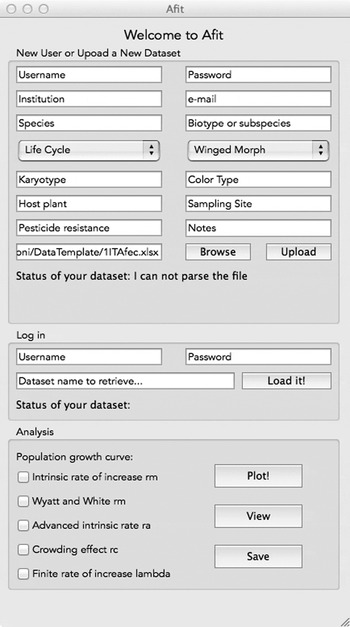
The Python bioinformatic tool Afit was developed to easily calculate and compare aphid fitness and invasiveness. The tool (freely available at the address https://moreinsects.net/afit-tool/) gathers information about the user (name, username, password, name of the institution, email address and notes about the aim of the project), the samples (species, ecotype/subspecies, asexual lineage ID, morph and colour type, host plant, presence of winged morphs, life cycle, insecticide resistance, karyological profile), the sampling locality (State, Province, GPS N-E coordinates) and date and the rearing conditions (host plant, temperature °C and photoperiod as daylight length in hours) (fig. 1).
The Afit tool input window where users can upload their data.

Daily fecundity and crowding data (life tables and population size of each replica) must be recorded on an Excel spreadsheet following the template available as online supplementary material in the downloadable Afitool.zip file.
Python Afit tool output
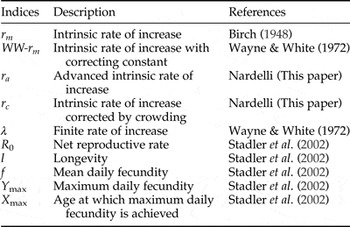
The tool generates daily fecundity and population growth curve of the asexual lineage starting from life table data. It calculates clonal fitness indices as a mean of the replicate indices and the SE. Moreover, the tool uses the population size data (obtained starting from any aphid number and measuring at any day) to generate a population growth curve corrected by crowding effect and an advanced intrinsic rate of increase r c , corrected by crowding, representative of the crowding sensibility of the asexual lineage (table 3).
Fitness indices calculated by the Afit tool and their references and explanation. The software produces a spreadsheet, csv or tsv file for each asexual lineage analyzed where it is possible to find all the biological traits previously uploaded, the daily fecundity and population growth curves and all the fitness indices calculated.

Measuring crowding effect
To assess how crowding affects aphid fecundity, we selected 10 synchronized parthenogenetic females and maintained them in a single jar containing 3 pea plants (3 replicates per asexual lineage).
After 15 days we counted how many aphids were present. The time frame was established on the basis of the average M. persicae lifespan in order to obtain a F2 generation.
The sprouts were weekly replaced to minimize the plant response to aphid colonization. Experimental crowding data were compared with those predicted by the Python Afit tool, by uploading them and let the software to calculate the percentage decrease of the expected population size at a chosen time. Afit calculated both the population growth curve and the intrinsic rate of increase r c corrected by crowding.
Results
The pea rearing protocol and the Afit tool have been tested using six M. persicae asexual lineages to investigate the effect of different karyotypes rearrangements on their fitness and invasiveness.
A large majority of the analysed M. persicae specimens has a lifespan of 15–18 days (l) and give birth for the first time (d) at day 8 (table 4). Only specimens of the asexual lineage 64 give birth for the first time at day 7 and only I type lives longer than 18 days. The daily mean fecundity (f) reaches the highest values with the 64-ita specimens and the lowest with 70.
Life-table and Fitness indices (mean ± SE) produced by Afit.

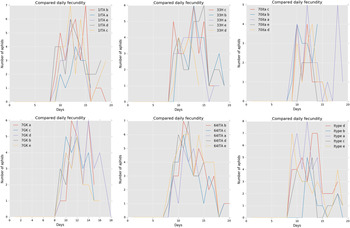
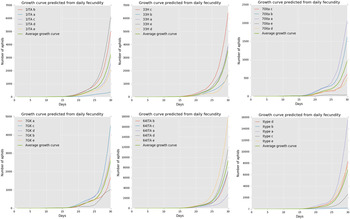
Clonal daily fecundity curves showed two peaks in the asexual lineages: the first around day 11 and the second one at days 16–17 (fig. 2).
Fecundity curves of the six M. persicae clones produced by Afit tool (replicates shown with different colours).

Starting from one aphid, the predicted population growth curves of the six M. persicae asexual lineages at day 30 indicated that lineage 64 achieved the highest performance followed by I-type, while 70 had the worst (fig. 3). The asexual lineage 64 reached earlier the highest daily fecundity (X max), while the maximum daily fecundity, Y max, has been achieved by I-type. The asexual lineage 64 reached the highest values for the net reproductive rate value (R 0), the intrinsic rate of increase (r m and r a ) and the finite rate of increase λ, while 70 had the lowest. Intragroup variance is equal according to Levene's test for homogeneity of variance from means and medians (P-value = 0.2612; P-value = 0.4114). ANOVA analysis put in evidence statistically significant differences (F rm = 2.899; P-value r m = 0.03475) in fitness costs comparing asexual lineage 64 (which belongs to M. persicae nicotianae ecotype) to the other asexual lineages (which belong to M. persicae persicae ecotype).
Population growth curves of the six M. persicae clones produced by Afit tool.

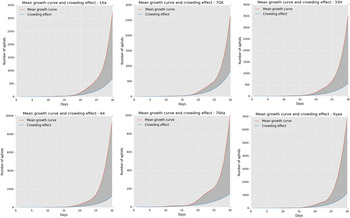
We also evaluated the crowding effect on female fecundity among aphid lineages (fig. 4) and we noticed an higher population percentage decrease in asexual lineages 64 and I-type (−49.18 and −40.72%, respectively). The lowest value was reached by the asexual lineage 1 (−16.54%). r c index followed the r a and r m trends among asexual lineages (highest within 64 and lower within 70 asexual lineage).
Population size percentage decrease in a crowded aphid population and the corrected by crowding population growth curve.

Discussion
Up till now different parameters have been evaluated in order to adequately explain aphid fitness (e.g., Chen et al., Reference Chen, Montllor and Purcell2000; Stadler et al., Reference Stadler, Dixon and Kindlmann2002; Merrill et al., Reference Merrill, Holtzer and Peairs2009; Conti et al., Reference Conti, Bueno, Sampaio and Sidney2010; Lu et al., Reference Lu, Yang, Xu, Luo, Zhu, Cui, Kang and Cui2016). Mean generation time d, for instance, strongly affects adaptive success because it confers a lead time during habitat colonization. Longevity is also an important factor because fitness is positively affected when a longer lifespan means a higher net reproductive rate R 0. On the contrary, if a female lives longer without new-borns, longevity negatively affects fitness, because the female itself could consumes nutritional resources with no regards for her nymphs. The highest values of r m and r a are achieved by the asexual lineage 64, showing that earliness has greater weight on adaptive success than longevity. Indeed, the asexual lineage I-type lived longer but spawned the same new-borns number compared with other asexual lineages, so that it does not achieve significantly higher fitness indices.
The lowest r m and r a belong to the asexual lineage 70, while other lineages are on the same, mean equal footing. These features are confirmed by population growth curve trends produced by the Afit tool. Although the population percentage decrease are higher in 64 asexual lineage, this lineage has achieved the best fitness performances in crowding conditions.
Fitness indices obtained in this study reached values comparable with those available in literature, however, the diverse rearing and environmental conditions at the basis of the measurement of these indices do not permit a proper comparison between our data and other author's ones.
The use of Afit on six different asexual lineages showed similar results also comparing different karyotypes. In particular it has been interesting to evaluate the fitness rate of the two asexual lineages 33H and 7GK possessing recurrent intra-individual chromosomal rearrangements (Manicardi et al., Reference Manicardi, Nardelli and Mandrioli2015). Chromosome instability is a typical feature of malignant cells, whereas it is a rare condition in physiological situations to such an extent that chromosome number variations are largely utilized for taxonomic and phylogenetic speculations. Aphids represent an exception, since the holocentric nature of their chromosomes could favour karyotype rearrangements. The evidence that fitness rate of 33H and 7GK strains does not differ significantly from asexual lineage 1 (which has a normal karyotype) could result surprising but represent an important demonstration of the potentiality of holocentric chromosomes to reduce the effects of chromosome rearrangements that will be not viable in the presence of monocentric chromosomes.
A further element of interest is related to the presence of the highest fitness rate in the asexual lineage 64 confirming previous field observations concerning the high invasive potential of M. persicae nicotianae ecotype (i.e., Kati et al., Reference Kati, Mandrioli, Skouras, Malloch, Voudouris, Venturelli, Manicardi, Tsitsipis, Fenton and Margaritopoulos2014). Indeed, Kati et al. (Reference Kati, Mandrioli, Skouras, Malloch, Voudouris, Venturelli, Manicardi, Tsitsipis, Fenton and Margaritopoulos2014) reported a rapid spread of this lineage in Greece and provided evidence about rapid evolution in nicotianae, which has been suggested as a species ‘in the making’.
The Afit tool herein described could be used also for analysis of other parameters such as r m established by Wyatt & White (Reference Wyatt and White1977). Wayne & White (1972) tried to simplify fitness measuring protocol and proposed a faster method to calculate r m assuming that specimens produced in the first 2d time frame, contribute most to the value of r m (ca. 95%) (De Loach, Reference De Loach1974). Moreover, they analyzed life table data from four aphid species including M. persicae and obtained a correcting constant c = 0.738. Unfortunately, WW-r m cannot be used in the same way as a ‘standard’ r m . It is pivotal that the patterns of the initial rise and fecundity curves trends among samples should be similar, since the earliest progeny produces the greatest influence on population growth. On the contrary, the value of c might vary widely. For these reasons White and Wyatt r m index tends to be not so representative when used to compare different species or clones with diverse and unpredictable daily fecundity curve trends.
The analysis of the SE within asexual lineages suggests the presence of an intra-clonal variability in the fitness indices. Clonal fitness is therefore not merely a function of survival and fecundity of the daughters alone, but depends on the performance of all descendants up to the time when eggs are fertilized. It means, in other words, that the intrinsic rate of increase only accounts for offspring number, but not for offspring quality. Starting from these assumptions, individual morphs r values should be carefully considered when an aphid asexual lineage's life-history is to be explained (Weisser & Stadler, Reference Weisser and Stadler1994). This confirms literature data (Lushai & Loxdale, Reference Lushai and Loxdale2002; Erlykova, Reference Erlykova2003; Loxdale et al., Reference Loxdale, Vorwek and Forneck2013) suggesting that intra-clonal variability may have effect on different phenotypes, including fitness.
Aphids can produce winged offspring in response to different stimuli, such as crowding (Sutherland Reference Sutherland1969a , Reference Sutherland b ; Shaw, Reference Shaw1970), presence of parasitoids (Sloggett & Weisser, Reference Sloggett and Weisser2002), pathogens (Hatano et al., Reference Hatano, Baverstock, Kunert, Pell and Weisser2012) and natural predators of aphids (Weisser et al., Reference Weisser, Braendle and Minoretti1999; Kunert & Weisser, Reference Kunert and Weisser2003). Since winged and un-winged phenotypes are produced by the same genotype, a question for aphid fitness is related to the intrinsic rate of increase r (r m & r a ) comparing lineages with different propensity to generate winged offspring. In this view, one of the most interesting applications of our bioinformatics tool will be the measure of the contribution of winged females to population fitness, as well as other parameters, which could influence aphid fitness.
Acknowledgements
We would like to thank Dr Daniele Baschieri for his support on Phyton scripting and Dr Roberto Simonini for his precious support in the data analysis. We are indebted to colleagues who provided us with M. persicae aphid lineages and in particular to Emanuele Mazzoni (Università Cattolica di Piacenza, Italy) for lineages 1, 70, 64 and 33H, John Margaritopoulos (University of Thessaly, Greece) for the lineage 7GK and Brian Fenton (Scotland's Rural College, Scotland) for the lineage I-type.