INTRODUCTION
Early development of vocabulary and gestures has been in the focus of research for decades. Extensive research has been carried out to describe infants' vocabulary composition or gestural repertoire by means of parental reports using the MacArthur-Bates Communicative Development Inventory: Words and Gestures (CDI) that has been adapted into more than thirty languages (Fenson, Dale, Reznick, Bates, Thal & Pethick, Reference Fenson, Dale, Reznick, Bates, Thal and Pethick1994). The present study concerns Estonian-speaking children. The first purpose of the study was to describe the proportional acquisition of different word classes in early vocabulary in Estonian children between the ages of 0 ; 8 and 1 ; 4. The second purpose was to investigate the concurrent associations between Estonian-speaking children's early gestural repertoire and comprehension vocabulary with their production vocabulary. The third purpose of our study was to study the effects of the child's age, gender, birth order and maternal education on infants' production vocabulary. With these aims, the Estonian adaptation of the MacArthur-Bates Communicative Development Inventory: Words and Gestures (ECDI Infant Form) was used (Schults & Tulviste, Reference Schults and Tulviste2008).
Word comprehension and production
Comprehension of words used to label objects or to designate actions appears in a child's development between the age of 0 ; 8 and 0 ; 10, before they have started to produce any words (Fenson et al., Reference Fenson, Dale, Reznick, Bates, Thal and Pethick1994; Stolt, Haataja, Lapinleimu & Lehtonen, Reference Stolt, Haataja, Lapinleimu and Lehtonen2008). Children comprehend more words than they are able to produce up to the age of three (Fenson et al., Reference Fenson, Dale, Reznick, Bates, Thal and Pethick1994). Before the age of 1 ; 0 the production of words is minimal (Bates et al., Reference Bates, Marchman, Thal, Fenson, Dale, Reznick, Reilly and Hartung1994; Fenson et al., Reference Fenson, Dale, Reznick, Bates, Thal and Pethick1994; Stolt et al., Reference Stolt, Haataja, Lapinleimu and Lehtonen2008). The onset of speech is followed by a period of quite steady growth in the size of the vocabulary. Still, there are individual differences which lead to the variability in the size of production vocabulary after the age of 1 ; 1 (Fenson et al., Reference Fenson, Dale, Reznick, Bates, Thal and Pethick1994). Accelerated growth (the so-called ‘spurt’) in early production vocabulary, especially after the age of 1 ; 3, has been demonstrated, among many other languages, in Finnish – a language that is closely related to Estonian (Stolt et al., Reference Stolt, Haataja, Lapinleimu and Lehtonen2008). Both Estonian and Finnish belong to the Finno-Ugric languages. Both are agglutinating languages in which mainly suffixes are used to express grammatical relations. Estonian has a large number of cases – fourteen – to inflect nominals, and verbs are inflected as well for subject – verb agreement, tense, etc. Estonian as well as Finnish lacks grammatical future and grammatical gender. We expected to find the accelerated growth pattern after the age of 1 ; 3 to apply also to Estonian-speaking children and we explored the ratio between comprehension and production of words in Estonian-speaking children in the age range of 0 ; 8 to 1 ; 4.
When the size of the vocabulary is less than fifty words, social terms are used proportionally more by the children than words belonging to other categories (e.g. common nouns, predicates) (Caselli, Casadio & Bates, Reference Caselli, Casadio and Bates1999; Stolt et al., Reference Stolt, Haataja, Lapinleimu and Lehtonen2008). At the early stages of vocabulary production the acquisition of predicates is at a low level but shows a slow and steady growth pattern; at the same time the acquisition of function words stays at a constant low level (Caselli et al., Reference Caselli, Casadio and Bates1999; Bates et al., Reference Bates, Marchman, Thal, Fenson, Dale, Reznick, Reilly and Hartung1994). As the vocabulary grows to between 50 and 200 words nouns form the majority of production vocabulary items (Caselli et al., Reference Caselli, Casadio and Bates1999; Bates et al., Reference Bates, Marchman, Thal, Fenson, Dale, Reznick, Reilly and Hartung1994). Since the studies of Nelson (Reference Nelson1973) it has been known that for English-speaking children nouns, compared to non-nouns, form the larger proportion of the early vocabulary that contains fifty words. Research on early vocabulary has found this pattern of nouns forming the largest proportion of the early production vocabulary in several languages, including Finnish (Bornstein et al., Reference Bornstein, Cote, Maital, Painter, Park, Pascual, Pêcheux, Ruel, Venuti and Vyt2004a; Caselli et al., Reference Caselli, Bates, Casadio, Fenson, Fenson, Sanderl and Weir1995; Fenson et al., Reference Fenson, Dale, Reznick, Bates, Thal and Pethick1994; Stolt et al., Reference Stolt, Haataja, Lapinleimu and Lehtonen2008; Wehberg, Vach, Bleses, Thomsen, Madsen & Basbøll, Reference Wehberg, Vach, Bleses, Thomsen, Madsen and Basbøll2007). Still, noun dominance is not universal. There are reported findings about Korean and Mandarin that have shown that more verbs as compared to nouns can be produced by children in the phase of early vocabulary development (e.g. Tardif, Reference Tardif1996). One possible explanation for the noun bias has been differences in child-directed speech (Hart, Reference Hart2004). For instance, it has been found that North American mothers' speech contains a high proportion of nouns whereas Asian mothers' speech contains proportionally more verbs (see Hoff, Reference Hoff2006). It is also possible that parents from different cultural background may use different strategies directed towards leading their child either to produce more nouns or to produce more words belonging to the predicates category such as verbs (Fernald & Morikawa, Reference Fernald and Morikawa1993; Tardif, Reference Tardif1996). Comparative studies of mother – child interaction have found that the speech directed towards Estonian children is more directive than the speech of American English, Finnish and Swedish mothers (Junefelt & Tulviste, Reference Junefelt and Tulviste1997; Tulviste, Mizera & De Geer, Reference Tulviste, Mizera and De Geer2004) . Taking into account that a positive relationship has been found between maternal use of directives and the proportion of verbs in a child's early vocabulary (Tomasello & Kruger, Reference Tomasello and Kruger1992), and that the noun bias has been found using parental report in Finnish (Stolt et al., Reference Stolt, Haataja, Lapinleimu and Lehtonen2008), we were interested in exploring the proportions of nouns and predicates in Estonian children's early comprehension and production vocabularies. Because of that we focused on different categories of words (common nouns, predicates, social terms and function words). In addition to that, we looked into the possible connections between the comprehension and production of words belonging to different categories.
Gesture production
Gestures can be categorized into three types: deictic gestures, object gestures and gestural routines.
Deictic gestures are among the first signs of intentional communication and are used to point out an object or to draw someone's attention to an object (Bates et al., Reference Bates, Camaioni and Volterra1975; McNeill, Reference McNeill1992). Deictic gestures are prelinguistic, as they accompany word comprehension and emerge before the onset of word production between the ages of 0 ; 9 and 1 ; 1 (Bates, Camioni & Volterra, Reference Bates, Camaioni and Volterra1975; Bates, Benigni, Bretherton, Camaioni & Volterra, Reference Bates, Benigni, Bretherton, Camaioni, Volterra and Bates1979). Harris, Barlow-Brown and Chasin (Reference Harris, Barlow-Brown and Chasin1995) found that pointing gesture production and object name comprehension both emerge around the age of 0 ; 10 or 0 ; 11. The more primitive types of these gestures (e.g. requesting via reaching) start to decline in usage frequency as early as around the age of 0 ; 11 (Blake & Dology, Reference Blake and Dology1993), whereas pointing persists in the communication repertoire throughout life.
Object gestures convey the idea of object's function (e.g. holding a phone against one's ear), and they are executed with appropriate objects in the hand (Bates, Thal, Whitesell, Fenson & Oakes, Reference Bates, Thal, Whitesell, Fenson and Oakes1989). Children start to produce object gestures around the same time as they start to name objects, approximately around their first birthday. Children with more object gestures have larger vocabularies and they reach the 10-word milestone earlier than children with fewer object gestures (Acredolo & Goodwyn, Reference Acredolo and Goodwyn1988). The positive correlation between object gestures and naming will persist for about six months, approximately until the child reaches the age of 1 ; 6 (Acredolo & Goodwyn, Reference Acredolo and Goodwyn1988; Bates & Dick, Reference Bates and Dick2002; Bates et al., Reference Bates, Thal, Whitesell, Fenson and Oakes1989; Bretherton, Bates, McNew, Williamson & Beeghly-Smith, Reference Bretherton, Bates, McNew, Shore, Williamson and Beeghly-Smith1981; Goodwyn & Acredolo, Reference Goodwyn and Acredolo1993; Iverson, Capirci & Caselli, Reference Iverson, Capirci and Caselli1994; Nelson, Reference Nelson1973).
Gestural routines
This third type of gestures addressed in the study are culturally appropriate routine behavioural patterns associated with certain events or interaction routines, and rather than referring to common objects (e.g. waving goodbye or playing pat-a-cake) (Acredolo & Goodwyn, Reference Acredolo and Goodwyn1988; Bates et al., Reference Bates, Thal, Whitesell, Fenson and Oakes1989; Iverson et al., Reference Iverson, Capirci and Caselli1994). Gestural routines are sometimes accompanied by words or phrases, e.g. saying bye-bye while waving goodbye.
Inter-relatedness of vocabulary and gestures
There has been a long theoretical debate about what kind of relationship exists between early language and gesture development: is language development parallel to gesture development, independent from it, or do the relationships vary across language components (see Bates et al., Reference Bates, Thal, Whitesell, Fenson and Oakes1989; Goodwyn & Acredolo, Reference Goodwyn and Acredolo1993). It is known that children start to gesture before they produce their first words, that early verbal vocabulary is correlated with gestures, and that gestures predict later gestural and language development (Bates et al., Reference Bates, Camaioni and Volterra1975; Bates & Dick, Reference Bates and Dick2002; Volterra, Caselli, Capirci & Pizzuto, Reference Volterra, Caselli, Capirci, Pizzuto, Tomasello and Slobin2005). Recent studies carried out by Rowe and Goldin-Meadow (Reference Rowe and Goldin-Meadow2009a; Reference Rowe and Goldin-Meadow2009b) found that children who produced more gestures with different meanings at 1 ; 2 had larger vocabularies at 4 ; 6.
It is not known whether infants' comprehension of different types of words is related to concurrent use of various types of gestures and to what extent gesture production and word comprehension are connected to the concurrent word production. The study aims to explore relationships between infants' gestural repertoire (deictic gestures, object gestures and gestural routines) and his/her concurrent comprehension and production vocabularies.
Child's gender, birth order, socioeconomic status and early communication development
In this study we were also interested in the effect of factors such as the child's gender, birth order and maternal education on the production of words from different categories (common nouns, predicates, social terms and function words) in the child's early vocabulary.
Existing gender differences have been found to be modest. Girls tend to produce slightly more words than boys from the ages of two to five years (see Bornstein, Hahn & Haynes, Reference Bornstein, Hahn and Haynes2004b). There is less information about younger children. Fenson and colleagues (Reference Fenson, Dale, Reznick, Bates, Thal and Pethick1994) reported a slight advantage in girls for gesture production, word comprehension and word production in American children aged 0 ; 8–2 ; 6. A study with European children from ten non-English language communities showed that girls were slightly ahead of boys in early communicative gestures, in productive vocabulary and in combining words from age of 0 ; 8 to 2 ; 6 (Eriksson et al.,Reference Eriksson, Marschik, Tulviste, Almgren, Pérez Pereira, Wehberg, Marjanovič Umek, Gayraud, Kovacevic and Gallegoin press).
Some studies of birth order and language development have found that first-born children have larger vocabularies and that they acquire language in a different manner than later-borns (see Hoff, Reference Hoff2006). The vocabularies of first-born children are more dominated by object labels than the vocabularies of later-borns (Goldfield & Reznick, Reference Goldfield and Reznick1990). At the same time, later-born children have been found to have an advantage in some other aspects of language, for instance in the development of conversational skills (Fenson et al., Reference Fenson, Dale, Reznick, Bates, Thal and Pethick1994; Bornstein, Leach & Haynes, Reference Bornstein, Leach and Haynes2004c).
It is known that parental socioeconomic status (SES), frequently associated with the level of maternal education, has an impact on a child's language development. Higher SES mothers have been found to talk more, to use a larger vocabulary and to expect more verbalization from their children than lower SES mothers. SES-related differences have been found both in measures of children's comprehension and in production vocabularies (Hoff, Reference Hoff2006). In addition, Rowe and Goldin-Meadow (Reference Rowe and Goldin-Meadow2009a) found high SES parents to be likely to use more gestures while communicating with their children and that that was in turn positively related to more gestures used by children. However, other research has not supported the effect of parental SES on children's vocabulary and gestures at the earliest stages of language development. For instance, Fenson and colleagues (Reference Fenson, Dale, Reznick, Bates, Thal and Pethick1994) found no significant SES-related differences in infants' very early word and gesture production.
We assumed that word comprehension had a positive effect on word production (Fenson et al., Reference Fenson, Dale, Reznick, Bates, Thal and Pethick1994; Stolt et al., Reference Stolt, Haataja, Lapinleimu and Lehtonen2008) and studied the inter-relations of word comprehension and production within each of the word categories. We expected children with more gestures to have more words in their production vocabulary (Bates et al., Reference Bates, Camaioni and Volterra1975; Bates & Dick, Reference Bates and Dick2002; Volterra et al., Reference Volterra, Caselli, Capirci, Pizzuto, Tomasello and Slobin2005) and especially children with more objects gestures to produce more common nouns (Acredolo & Goodwyn, Reference Acredolo and Goodwyn1988; Bates & Dick, Reference Bates and Dick2002; Bates et al., Reference Bates, Thal, Whitesell, Fenson and Oakes1989; Bretherton et al., Reference Bretherton, Bates, McNew, Shore, Williamson and Beeghly-Smith1981; Goodwyn & Acredolo, Reference Goodwyn and Acredolo1993; Iverson et al., Reference Iverson, Capirci and Caselli1994; Nelson, Reference Nelson1973). We expected higher average vocabulary scores for girls than boys, for first-borns than later-borns, and for children of mothers with a higher level of education, in keeping with findings from previous studies.
METHOD
Participants and materials
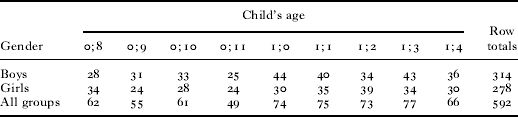
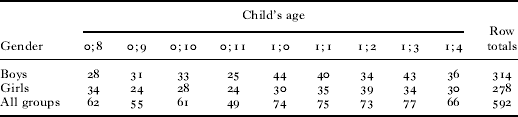
The data for this study were gathered using the Estonian adaptation of the MacArthur-Bates Communicative Development Inventory: Language and Gestures (ECDI Infant Form) for 592 children between the age of 0 ; 8 and 1 ; 4 (M=1 ; 0, SD=0 ; 0·2) (see Table 1).
The number of children by age and gender
Children and their parents were recruited through paediatricians, play-group teachers, Internet forums and the parents who had already completed the inventory by themselves recruited other parents, too. Parents who agreed to participate were handed out or sent copies of the ECDI Infant Form. A subject information sheet that contained questions about the child's developmental history, language(s) spoken in the home and parents' education was also included. All children chosen for the present study were acquiring Estonian as their first language. In addition, the inclusion criteria stated that the children had to be healthy (not born prematurely, without significant birth trauma and without serious medical problems according to parental report). Also, the parental report instruments had to be completed by the parent about the child's language and communicative development for the first time. Most of the participants (96·3%) were from higher or middle SES homes (mothers having at least a high school education, that is at least twelve years of schooling).
The ECDI Infant Form consists of two main parts. The first part contains a list of 347 words, organized into semantic categories (e.g. words for toys, words for people, etc.). Parents were asked to note the words that their children comprehended or comprehended and produced. We followed the approach of Bates et al. (Reference Bates, Marchman, Thal, Fenson, Dale, Reznick, Reilly and Hartung1994); Caselli et al. (Reference Caselli, Bates, Casadio, Fenson, Fenson, Sanderl and Weir1995; Reference Caselli, Casadio and Bates1999) and Stolt et al. (Reference Stolt, Haataja, Lapinleimu and Lehtonen2008) in defining the categories of words. The category of common nouns included the following parts of the ECDI Infant Form: animals' names, vehicles, toys, food and drink, clothing, body parts, furniture and rooms, small household items. There were 175 common nouns, thus representing 50·4% of the 347 words. The category of predicates included verbs (‘action words’) and adjective (‘descriptive words’), 88 words altogether, representing 25·4% of the words. The social terms category combined sound effects and animal sounds, people, and games and routines. The social terms category had 50 words, representing 14·4% of the words in ECDI Infant Form. The category of function words included pronouns, question words, prepositions and locations, and quantifiers, totalling 34 words, representing 9·8% of the words in the checklist.
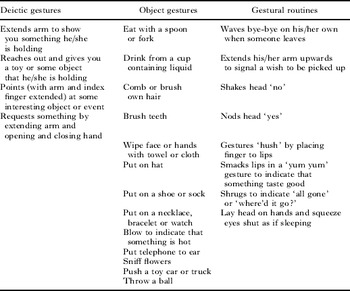
The second part of the ECDI Infant Form consists of a list of 60 actions and gestures. Parents were asked to note the gestures and actions they had seen their child produce. From the list of 60 actions and gestures 25 items were used in this study and categorized as deictic gestures, object gestures or gestural routines. The deictic gestures category included four gestures from the list of first communicative gestures, namely requesting, showing, giving and pointing. The object gestures category included 13 items, including the items from the list of actions with objects. The category of gestural routines included eight items – all of the first communicative gestures but the above-mentioned deictic gestures and the item ‘Lay head on hands and squeeze eyes shut as if sleeping’ was included from the list of actions with objects (see Table 2).
The items belonging to the gesture groups

Scoring
The following subscale scores were used from ECDI Infant Form:
1. Word comprehension – the number of total words comprehended. We separated common nouns, predicates, social terms and function words. Numbers of words comprehended in each category were calculated as well as proportion scores. Words which were noted by parents as produced were added to the total for words comprehended.
2. Word production – the numbers and proportion scores of total words, common nouns, predicates, social terms and function words produced.
3. Gestural production – the number of total gestures, deictic gestures, object gestures and gestural routines produced.
Analyses
Age and gender differences are described. Analyses of variance and Scheffé post hoc analyses were used to this end. Pearson correlations between vocabulary comprehension, vocabulary production and gesture production are shown. In addition, models of factors predicting the production of words belonging to different categories are presented.
RESULTS
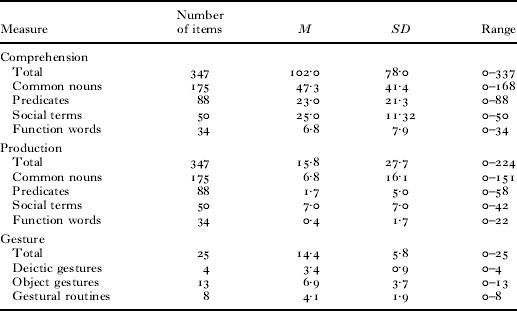
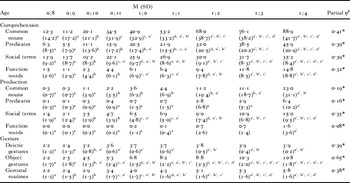
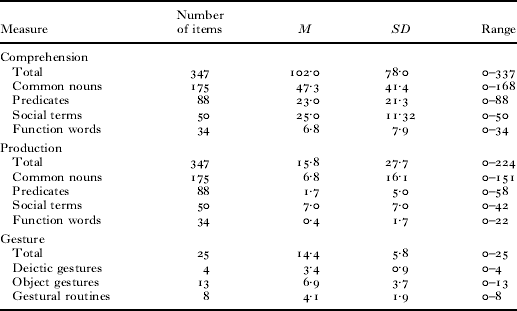
Table 3 presents the number of items in the ECDI and summarizes the descriptive statistics for word comprehension, word production and gesture production. According to parental reports the number of words comprehended exceeds the number of words produced by 6·5 times. The number of words comprehended exceeded the number of words produced in all four categories: by 6·8 times in common nouns, by 13·7 times in predicates, by 3·6 in social terms, and by 16·5 times in function words.
Descriptive statistics for parental report of words and gestures
Proportions of words from different categories
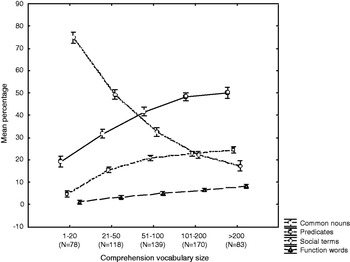
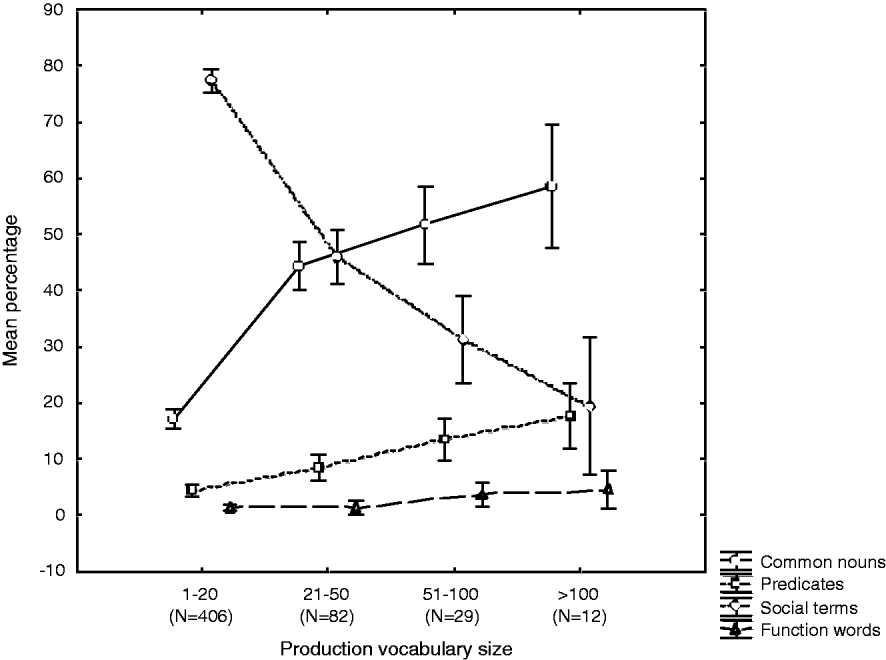
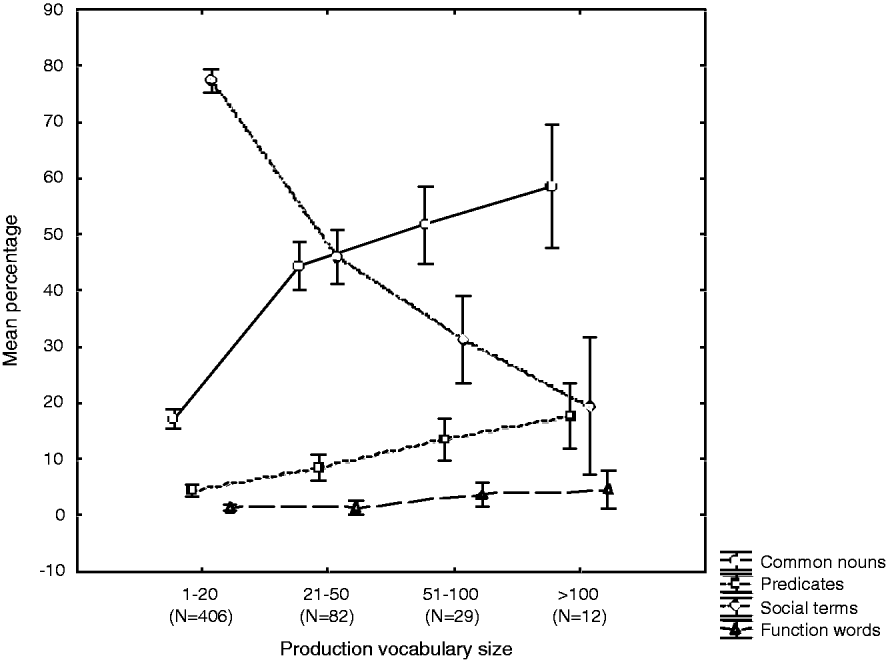
As to vocabulary composition, the proportions of common nouns, predicates, social terms and function words according to the size of vocabulary are shown in Figure 1 for comprehension and in Figure 2 for production. The percentages were calculated from the total number of words in the child's comprehension and production vocabulary, respectively.
The compostion of the comprehension vocabulary as the proportional function of the comprehension vocabulary size.

The compostion of the production vocabulary as the proportional function of the production vocabulary size.
Comprehension
Children who were reported to comprehend no words (N=4) were omitted from this analysis.
As Figure 1 shows, the proportion of social terms decreases significantly as the child starts to comprehend more words (F(1,4)=402·98, p<0·001, ηp2=0·73). It decreases continuously throughout the range of vocabulary covered by the EDCI (Scheffé tests p<0·05). At the same time, the proportions of common nouns (F(1,4)=114·25, p<0·001, ηp2=0·44) and predicates (F(1,4)=113·60, p<0·001, ηp2=0·44) increase. The proportion of common nouns increases until the child understands more than 200 words (Scheffé tests p<0·001). The proportion of predicates rises until the child has started to use up to 100 words (Scheffé tests p<0·01). Function words are at a low proportional level but still rise significantly as more words are comprehended (F(1,4)=42·64, p<0·001, ηp2=0·23). The proportion of function words increases until the child has started to use up to 200 words (Scheffé tests p<0·05).
Production
Children who were reported to produce no words (N=63) were omitted from this analysis.
As Figure 2 shows, the children's production vocabulary increases mainly by the addition of common nouns. The proportions of common nouns (F(1,3)=81·65, p<0·001, ηp2=0·32) and predicates (F(1,3)=15·67, p<0·001, ηp2=0·08) increase as the child's production vocabulary grows bigger. The proportion of common nouns starts to rise after the child has started to use more than 20 words (Scheffé tests p<0·001). Also, the proportion of predicates starts to rise after the child has started to use more than 20 words (Scheffé tests p<0·05). The proportion of social terms decreases constantly (F(1,3)=102·24, p<0·001, ηp2=0·37) until the child has started to use more than 100 words (Scheffé tests p<0·05). Function words remain constantly at a very low proportional level at this early age (F(1,3)=1·43, n.s.).
Inter-relatedness of vocabulary and gestures
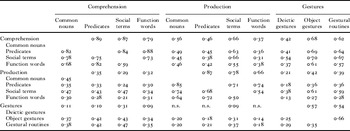
Table 4 summarizes the correlations among all of the scores of categories of vocabulary comprehension and production, and gesture production. The correlations with age partialled out are also shown. All of the significant correlations were positive. The only non-significant results were found between deictic gesture production and the production of common nouns, predicates and function words. This finding can be attributed to the ceiling effect in deictic gesture production (M=3·4, SD=0·9, ranging from 0 to 4).
Pearson's correlations and correlations with age partialled out for vocabulary comprehension, vocabulary production and gesture production

note: Partial correlations are represented below the diagonal formed by the empty cells, and correlations above the diagonal. Presented correlations are significant at p<0·05.
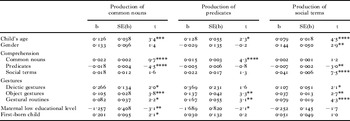
To describe the concurrent effects of the different factors (child's age, gender, birth order and maternal education, as well as the number of words from multiple categories comprehended and gestures used) on the production of words belonging to the different categories (common nouns, predicates, social terms), three models were created using Poisson regression. Poisson regression (allowing for overdispersion) was used because the dependent variables were absolute numbers that were, in essence, count data, and the distribution was very far from normality. The modelling was carried out using R version 2.9.0 (R Development Core Team, 2009). The models for three categories of vocabulary production are shown in Table 5. The production of function words was not modelled due to the very low numbers produced (M=0·4, SD=1·7, ranging from 0 to 22).
Models of the factors influencing the production of vocabulary

notes: * p<0·05; ** p<0·01; *** p<0·001; **** p<0·0001. Mothers' low educational level is coded as 1, higher educational levels are coded as 0.
As multiple factors are contributing simultaneously to the size of the child's production vocabulary, the discussion is based on the results from the regression models, not on the single correlations. If we compare the correlations with the results of regression models it is noteworthy that while all of the significant single correlations were positive, the same did not hold true for the regressions. Interpretation of the individual effects of different factors on the production of words is based on the premise that during this interpretation the effects of all of the other factors are kept at a constant level. The child's age, object gesture production and gestural routine production contribute positively to the scores of production of common nouns, predicates and social terms (see Table 4). The child's gender predicts only social term production, due to the fact that girls produce more social terms than boys. The number of common nouns comprehended by the child is positively correlated to the number of common nouns and predicates produced. The number of predicates comprehended by the child is negatively correlated with the numbers of common nouns and social terms produced. Social terms comprehension is positively correlated to social word production. As to gesture production, all of the types of gestures were positively correlated with the production of words from all of the categories with the single exception of deictic gesture production, which had no effect on predicate production. Mothers' educational level had an effect on common noun and predicate production. Children from the families where mothers had at least high school education produced more common nouns and predicates than the children of less educated mothers. Birth order had an effect on common noun production as the first-born children produced more common nouns than the later-born children.
The effects of the child's age and gender
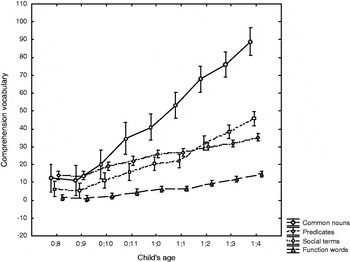
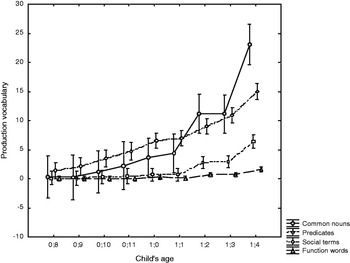
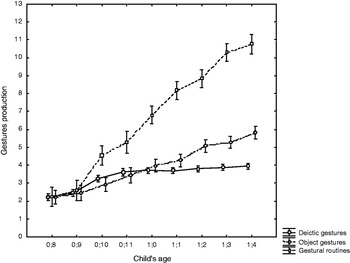
Detailed descriptions for the differences between age groups for numbers of words comprehended, words produced and gestures produced by categories according to the analysis of variance are presented in Figures 3 to 5.
The subscale scores of the comprehension vocabulary by age group.

The subscale scores of the production vocabulary by age group.

The subscale scores of the gesture production by age group.

Table 6 presents the age differences in the numbers of words comprehended, words produced and gestures produced by categories.
Age differences in word comprehension and production and gesture production

note: Significant (p<0·05) differences between age groups according to ANOVA post hoc comparisons (Scheffé test) are indicated with the superscript letters and the same letters with apostrophe. * p<0·0001.
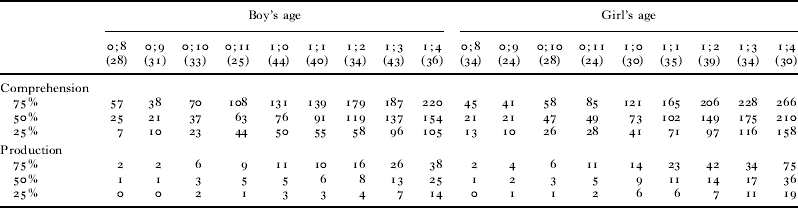
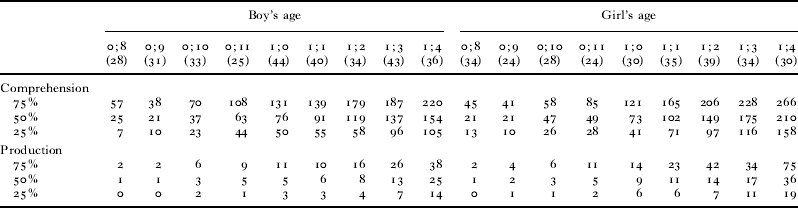
Table 7 presents the quantile scores for vocabulary comprehension and production for girls and boys separately because the girls have more words in their production vocabulary (F(1,1)=8·11, p<0·005, ηp2=0·01). It can be noted that both comprehension and production vocabularies grow as the children's age grows (for comprehension vocabulary: F(1,8)=55·04, p<0·001, ηp2=0·43; for production vocabulary: F(1,8)=22·71, p<0·001, ηp2=0·24).
Percentile scores for children's vocabulary comprehension and production
DISCUSSION
The main goal of the present study was to explore early communicative development in Estonian-speaking infants with an Estonian version of the CDI. We were interested in the composition of early comprehension and production vocabularies and gestural repertoire as well as the relationships between different word categories in Estonian infants' comprehension vocabulary and the use of different types of gestures with the production vocabulary.
Proportions of words from different categories
The first purpose of the study was to describe the proportional use of different word classes in early vocabulary in Estonian children between the ages of 0 ; 8 and 1 ; 4. According to the parental reports, social terms dominate in Estonian-speaking children's vocabulary when it is smaller than 20 words and common nouns start to dominate in their vocabulary after it has grown larger than 50 words. These findings are in accord with previous findings showing that as the size of the vocabulary is less than 50 words children use proportionally more social terms (Caselli et al., Reference Caselli, Casadio and Bates1999; Stolt et al., Reference Stolt, Haataja, Lapinleimu and Lehtonen2008). As these words are used to refer to daily games and routines, people who are participating in the child's daily activities and sound effects, these are likely to be used often and during the times when the child pays attention to the object or activity. Also, the sound patterns of social terms tend to be phonologically repetitive, which may make it easier for the child to say these words. Our findings also support the noun bias in early vocabulary, in both comprehension and production, found in several other languages (Bornstein et al., Reference Bornstein, Cote, Maital, Painter, Park, Pascual, Pêcheux, Ruel, Venuti and Vyt2004a; Caselli et al., Reference Caselli, Bates, Casadio, Fenson, Fenson, Sanderl and Weir1995; Fenson et al., Reference Fenson, Dale, Reznick, Bates, Thal and Pethick1994; Gentner, Reference Gentner and Kuczaj1982; Nelson, Reference Nelson1973; Stolt et al., Reference Stolt, Haataja, Lapinleimu and Lehtonen2008; Wehberg et al., Reference Wehberg, Vach, Bleses, Thomsen, Madsen and Basbøll2007). When the child's productive vocabulary size is between 21 and 50 words, social terms and nominals are used in equal proportions. As the vocabulary increases there will be proportionally less social terms and more nominals. It might be easier for a child to learn to name a particular object than an event or to describe an object. In addition, using the parental report as a means of data gathering might be partly responsible for this finding of proportionally more common nouns in children's vocabulary as it might be easier for the parents to notice and remember the words their children use to name objects than those used to label actions or to describe objects.
The inter-relatedness of vocabulary comprehension, gestures production and vocabulary production
Our second purpose was to investigate the concurrent associations between Estonian-speaking children's early gestural repertoire and comprehension vocabulary with their production vocabulary. According to the results from regression modelling, one of the findings was that the more common nouns infants comprehended the more common nouns and predicates they produced. The infant's comprehension of more social terms was positively related only to the concurrent use of more words from the same category. At the same time, the infants who comprehended more predicates were reported to produce less common nouns and social terms than the others. Maternal high use of directives has been shown to be typical of Estonian mothers (Junefelt & Tulviste, Reference Junefelt and Tulviste1997; Tulviste et al., Reference Tulviste, Mizera and De Geer2004). Tomasello and Kruger (Reference Tomasello and Kruger1992) found that the frequent use of directives by the mother is positively related to the relatively higher proportion of verbs in the child's vocabulary. High use of directives is also correlated with talking less and expecting less verbalization from children (Tulviste et al., Reference Tulviste, Mizera and De Geer2004). Mothers who have been found to talk more, to use a larger vocabulary and to expect more verbalization from their children have been shown to have children with larger comprehension and production vocabularies (Hoff, Reference Hoff2006). Thus it might be plausible that while a child is being exposed to more words from the predicates category (i.e. verbs and adjectives), the exposure to the words from other categories is diminished, which might be one possible explanation for the negative correlation between comprehension of predicates and production of social terms and nominals found in this study. It is noteworthy that comprehension of words belonging to different categories can be correlated positively as well as negatively with the production of different types of words. These findings indicate the importance of considering specific types of words rather than whole vocabulary while searching for predictors of production vocabulary development.
Another important finding was that gesture production was positively linked to the production vocabulary as expected. The infants with more gestures had larger production vocabularies. Somewhat unexpected was the finding that a positive link exists regardless of the categories of gestures and words (except for the lack of association between the production of deictic gestures and predicates). The finding that object gestures are positively related to predicate and social term production as well as to common noun production was unexpected because in previous research it has been shown that object gestures are positively related to noun production (Acredolo & Goodwyn, Reference Acredolo and Goodwyn1988; Bates & Dick, Reference Bates and Dick2002; Bates et al., Reference Bates, Thal, Whitesell, Fenson and Oakes1989; Bretherton et al., Reference Bretherton, Bates, McNew, Shore, Williamson and Beeghly-Smith1981; Iverson et al., Reference Iverson, Capirci and Caselli1994; Nelson, Reference Nelson1973). The results showed that the type of words and gestures has to be taken into account when studying the associations between early gestures and comprehension with concurrent productive vocabulary.
The effects of background factors on vocabulary
The third goal of the study was to explore the role of the child's age, gender and birth order and maternal education in the size of an infant's production vocabulary. As expected, the older the children were the more words they comprehended and produced, and this finding held for all of the word categories. Up to the age of 0 ; 10 children comprehend and produce very few words. From that point onwards the number of words comprehended and produced starts to increase in all of the word categories except the function words. According to the data from parental reports the number of common nouns comprehended increases more rapidly than the number of words in other categories. At the same time the reported number of common nouns produced exceeds the number of social terms produced only at the age of 1 ; 4. Older children produced more of each type of gestures compared to the younger children, in this particular age range. Production of deictic gestures reaches ceiling at the age of 0 ; 11, whereas the production of object gestures increases rapidly throughout this age range and the production of gestural routines continues to grow at a slower rate as well.
Our conclusions here are based on the regression models that showed the effects of the background variables on the production of words from different categories. Several researchers have suggested that girls have slightly larger vocabularies than boys (Bornstein et al., Reference Bornstein, Hahn and Haynes2004b; Eriksson et al.,Reference Eriksson, Marschik, Tulviste, Almgren, Pérez Pereira, Wehberg, Marjanovič Umek, Gayraud, Kovacevic and Gallegoin press; Fenson et al., Reference Fenson, Dale, Reznick, Bates, Thal and Pethick1994). The current study shows that this also holds true in Estonian-speaking children. Girls did have more words in their productive vocabulary (but not in their comprehension vocabulary) as compared to boys. As to the specific word groups, according to our data, at this early age girls had an advantage over boys only in the production of social terms. It is likely that an advantage for girls did not emerge in common nouns or predicates because our participants were very young (between the ages of 0 ; 8 and 1 ; 4.) and only 31% of them had a production vocabulary larger than 20 words. Future studies should establish whether there are more common nouns and/or more predicates in the girls' productive vocabulary as compared to the boys after the 50-word milestone has been reached.
As to birth order, our study partly replicated previous findings. We found as expected an advantage for first-born children as compared to the later-borns in productive vocabulary but only in the use of common nouns (Goldfield & Reznick, Reference Goldfield and Reznick1990). It has been pointed out in previous studies that later-born children have better conversational skills as compared to first-borns (Fenson et al., Reference Fenson, Dale, Reznick, Bates, Thal and Pethick1994; Bornstein et al., Reference Bornstein, Leach and Haynes2004c). We did not find an advantage for later-born children in the production of any word category. The lack of any advantage for later-borns in this study might be due to the fact that there was no specific word category that might be linked to the development of overall conversational skills.
Before children's second birthday, SES-related differences do not emerge consistently (Fenson et al., Reference Fenson, Dale, Reznick, Bates, Thal and Pethick1994). After reaching the age of 2 ; 0 toddlers of more educated mothers produce slightly more words compared to the toddlers of less educated mothers (Hoff, Reference Hoff2006; Rowe & Goldin-Meadow, Reference Rowe and Goldin-Meadow2009a). Our study found that infants aged 0 ; 8 to 1 ; 4 of more educated mothers produced more common nouns and predicates as compared to the infants of less educated mothers.
Finally, the study has some limitations. The ECDI is a parent report instrument and not a direct measure of child language. It is possible that some mothers overestimate their children's overall gesture repertoire or the size of their vocabulary, particularly when reporting words as being understood by young children. To improve our understanding of the developmental links between comprehension and production of different types of words and production of different types of gestures longitudinal data and data gathered with different methods are needed.