Ever since theatres were built the stage-struck girl, often a runaway from home, has added her portion of drama to that of New York and every big city. Some stage-struck have succeeded far beyond their fondest dreams, while many others have met a sad and violent end. … But all that has happily been changed thanks to a young woman who knows the pitfalls of the theatrical world through personal experience. Her name is Mabel Rowland and the society she founded is called the Woman's Institute of the Theatre [sic].
—Advertisement for “For Stage-Struck Girls,”Philadelphia Inquirer, 9 January 1927.By Mabel Rowland's public accounting, the Institute of the Woman's Theatre helped hundreds of so-called stagestruck girls realize their ambitions by providing a safety net for the pitfalls of the commercial theatre. The organization, officially established in 1926 and in operation until roughly 1930, was said to have begun years earlier, “the outgrowth of a group which was formed in 1910 and used to meet in the Fitzgerald Building.”Footnote 1 As president, Rowland—a press agent, well-known comedic monologist, and all-around theatre factotum—was supported by society women and a cadre of famous female writers and performers, including Florence Reed, who served as Vice President, and charter members Julia Arthur, Irene Castle, Rachel Crothers, Helen Hayes, Violet Heming, Elsie Janis, Anita Loos, Mary Pickford, and Mary Shaw, plus about a dozen more.Footnote 2 At the time of its official founding, the institute announced that it would undertake three activities. First, it sought to establish a professional Broadway theatre as exclusively a women's operation, employing female playwrights, designers, directors, managers, producers, box-office staff, and so forth: “The only men who will be connected with the enterprise … are the actors and stagehands.”Footnote 3 Second and third, the institute would give “aid and advice to girls from out of town who think they have something to offer the theater, read scripts and give opinions thereon, and in other ways labor in behalf of the feminine side of the stage.”Footnote 4 The institute's goal of a theatre in tandem with discovering talented women looked to create a meaningful shift in women's inclusion and power within commercial theatre.
Yet this collective effort of established theatre women on behalf of stagestruck girls has not been recorded or examined. Explanations for its omission from theatre history include the brevity of the institute's existence, the fact that they never realized a professional theatre, the obscurity of nontheatrical endeavors in performing arts repositories, the perception of such work as insignificant relative to artistic accomplishments, as well as the feminization of these activities in a male-dominated industry and historiography. The following analysis of the motivations for such an organization in 1920s New York City, the reasons behind its dedication to commercial theatre, and its mission and methods renders the institute visible in the historical record. In doing so, this essay discloses what professional theatre women identified as gender discrimination, what they accepted as unproblematic practices and values of the early twentieth-century commercial theatre industry, and the ways in which they redressed and perpetuated the pejorative conceptualization of stagestruck girls. While the Institute of the Woman's Theatre was by no means the only enterprise organized by women to help the stagestruck girl, its overt commercial interests and emphasis on professionalism sets apart its objectives from both social reform endeavors and the artistic reforms of the Little Theatre movement. It also led to serious contradictions in its practices and point of view about women's and girl's places in the commercial theatre. On the one hand, the established women artists of the institute legitimized stagestruck girls’ ambitions in a cultural moment when they were perceived as a social problem, and labored to ameliorate the gendered obstacles many girls faced. Yet even as the institute staked a claim for women's equality in the commercial theatre, the standards by which they judged talent and facilitated or dashed girls’ aspirations sustained the hierarchal principles and objectifying practices of theatrical culture that ultimately undercut its liberal feminist aims.
There is a caveat: my thesis regarding the contradictions between the institute's goals and its practices is provisional because of the nature and limited availability of documents on the institute's activities. In the case of the institute, like that of many other ancillary theatrical initiatives led by women, nonpublic organizational records of its activities are absent from or undiscoverable if in repositories. Thus, this analysis proceeds by employing what Chaudhuri, Katz, and Perry call an “alternative archive,” “a fragmented yet coherent body of material” necessary to recover unpreserved historical subjects once considered historically insignificant.Footnote 5 My archive of the institute coheres mainly around Mabel Rowland—her writings and experiences—and media on the institute, that is, notices of performances and meetings, performance reviews, articles, and pieces on the organization—some authored by Rowland herself. All of this evidence was published; more accurately, it is mainly publicity appearing in newspapers, theatre industry publications, and women's periodicals. From one perspective, the institute is visible in the historical record via media. This mode of representation, of course, also speaks to its founding members’ relatively privileged status as white, wealthy, well-connected theatre professionals, as well as the racial and ethnic exclusions of their vision. Additionally, while Rowland's public accounts of her experiences in the decades prior to founding the institute align noticeably with its practices and goals, her dominance in this alternative archive risks overstating a single historical actor's influence on a collective endeavor, in turn, eliding the contributions of other institute members. However, discovering these women's level of involvement, whether they dedicated their time or just their names to the institute, thus far has proven unfeasible in the context of archival cataloging and preservation practices. The women affiliated with the institute were highly celebrated figures; their success as Broadway performers and authors has determined much about the materials preserved: their kinds, their accumulation, the manner of their cataloging, and descriptions in finding aids, when finding aids exist. Although documents pertaining to the institute may be contained within individual personality files, locating them requires paging through thousands of items at different repositories throughout the United States. Another way of putting it: the institute may be buried under the weight of its associated historical celebrities.
Given the public nature of available documents, I interpret this evidence from a perspective similar to those of Pamela Cobrin and Jason Barrett-Fox, both of whom identify a feminist strategy of indirection used subtly to contest gender norms among early twentieth-century female artists in the commercial theatre. Writing about directors, Cobrin identifies an “implicit feminist theater” that “manifested little to no outward affiliation with the feminist or suffragist causes, yet the underlying values of its productions were steeped in feminism.”Footnote 6 Jason Barrett-Fox argues that (institute member) Anita Loos's plays, novels, and screenplays exemplify “indirect feminist rhetoric,” which “is characterized by the omission, misdirection, or explicit denial of its situational exigence as well as its enormous popular appeal.”Footnote 7 In the postsuffrage context, evidence of the institute's activities and philosophy written for the public requires a similar reading between the lines and against the grain, particularly when much of the information is given by a press agent. This is not an admission of bias against that profession, but recognition of Rowland's skilled evasion of clear political alignments when discussing gender politics, as well as her practiced hand at telling a good story in her role as a press agent, once called a “Maker of Men and Women.”Footnote 8 Here, I argue first for the necessity of a palatable narrative to facilitate the institute's goal to push the boundaries of women's roles within the commercial theatre. Second, I acknowledge the lack of firsthand accounts by the girls that the institute served. Instead, Rowland ventriloquizes the girls’ hardships, desires, and successes under the institute's guidance. In Rowland's own words, “[Publicity's] charm and value lie in the fact that publicity of the best kind is not easily recognized by the layman. … [T]he lay reader is apt to think just what he is intended to think.”Footnote 9 Limited to the institute's public face, Rowland sometimes appears like an unreliable narrator, pointing up possible differences between public positioning of the institute, what its members wanted to accomplish, and my theorization that the efforts of these professional theatre women on behalf of female stage aspirants were feminist-minded, even if fraught with commercial values.
The Stagestruck Epidemic
When Rowland and company founded the Institute of the Woman's Theatre in 1926 they were answering a widespread societal call to curb the crisis of the stagestruck girl. According to popular media, “stage fever” had supposedly afflicted innumerable individuals during a centuries-long epidemic that showed no signs of abating. From the late 1600s to the turn of the twentieth century, the illness did not target a single population; people of all racial and ethnic backgrounds, young and old, male and female, uneducated and lettered, small town and city dwellers, rich and poor alike were said to be vulnerable.Footnote 10 Yet as is suggested by the epigraph's apocryphal history, by the early twentieth century (white, middle-class) girls were made out to be its most vulnerable victims, thought to suffer stage fever's highest incidence and most detrimental effects. The stagestruck girl, also called a “matinee girl,” was usually portrayed as white, in her midteens to early twenties, of modest means, and far out of her depth. With the rise of silent film and its cultivation of a fan culture via movie magazines, “screen-struck girls” paralleled and by some accounts began to outpace their stagestruck counterparts. Girls’ unbridled devotion to theatre and/or film was considered a nuisance, purportedly disrupting audiences and degrading the art forms themselves as producers pandered to girls’ supposed sentimentality and star worship.Footnote 11 Yet it was the girls whose obsession with the stage or cinema led them actually to pursue a theatrical or film career who were perceived as a real social problem. Popular culture as well as social welfare, criminal justice, and psychiatric communities delegitimized these young women's ambitions for a theatrical career by producing a gendered vulnerability toward irrational aspirations and attaching the pitiable proclivity to unavoidably tragic ends.
Long established as an injurious preoccupation, stage fever converged with early twentieth-century sociological and psychiatric studies of adolescent girls and causes of their “waywardness” and “delinquency,” otherwise known as the “girl problem.”Footnote 12 Elizabeth Lunbeck shows that this Progressive Era social problem developed, in large part, out of psychologist G. Stanley Hall's and psychiatrist William Healy's explanations for “the emergence of the independent, sexually assertive woman in American society at the turn of the century” that accompanied the changing nature of work in industrial society, which granted young unmarried women unprecedented and unsupervised access to public life and its many diversions.Footnote 13 In their studies and others, the period of pubescence and emotional maturation was rife with dangers for girls, “the curiosity, experimentation, and satiation of desire [sexual or otherwise] that was symptomatic of gross defect in a girl was but the commendable manifestation of the boy's natural drive for self-expression and mastery.”Footnote 14 The national trend from the 1910s to the 1930s was to incarcerate delinquent girls or those who showed signs of “predelinquency” because courts “aimed to ‘save’ girls once it became apparent they were ‘on the road to ruin.’”Footnote 15 They sought to rehabilitate girls’ desires and redirect their energies toward jobs and/or domestic situations deemed more socially and morally productive choices. Mrs. Martha P. Falconer, Superintendent of the Girls’ Department for the House of Refuge in Darling, Pennsylvania, conveys the dire consequences of any (perceived) sexual impropriety for girls in distinction from boys:
A boy may be grossly immoral and his immorality does not always find him out and follow him; it is not so easy for the girl who has been immoral to be helped back to a normal place in society. This is a factor in the situation which we will always have to meet, and which makes the work with girls so much less hopeful.Footnote 16
So too with the stagestruck. Though stagestruck young men might wind up humiliated and broke, they were not morally or socially destroyed by theatrical aspirations as were girls, nor were their trials widely reported. On their own in the city, however, stagestruck girls’ lack of experience and single-mindedness unwittingly invited moral hazard, economic ruin, and a miserable end, or so the public and experts thought. In her history of the pathologization of screen-struck girls, and their stagestruck predecessors, Diana Anselmo-Sequeira elaborates how press and pop-culture writers “infused so-called extreme manifestations of girl fandom with these medical interpretations of female adolescence.”Footnote 17 Epidemiological metaphors in news, opinion pieces, advice columns, and fiction about the stagestruck abound in the 1910s, but also predate the formative studies on adolescence, suggesting media and popular culture likely influenced psychological thinking as well. On its own, “stage fever”—a term dating from at least the 1700s—characterizes interest in the stage as unhealthy.Footnote 18 However, print media was instrumental in establishing the epidemic proportions and moral urgency of stage fever as it affected girls through the sheer number of sensational stories of fortunate if sobering reunions between parents and runaway stagestruck girls, cases of ruined girls tricked into prostitution by “white slave” traffickers posing as theatrical agents, and murdered young actresses who had lived alone in the city.Footnote 19 Even for the rare few who achieved some success as chorus girls, “stage-door johnnies” reportedly lurked; infatuated with actresses, these men seduced stagestruck girls with high living. Popular feminist writer Fannie Hurst's opening to her 1924 defense of stagestruck girls’ morality is telling in this regard: “The stage-struck girl—there is one on every street. And in the eyes of the community she is Hell-bent for Destruction. The home town visualizes her, always, in an aura of illicit limousines and pearl necklaces of iniquity.”Footnote 20
Simultaneously, the entertainment industry capitalized on and catered to young working women's newfound social mobility: “an emergent group of leisure entrepreneurs encouraged that [‘heterosocial, sexually expressive’] culture, played with its forms, and ultimately popularized it for a broad mass audience.”Footnote 21 Stage and silent film scenarios also exploited cities’ thrills and dangers as well as theatre's most dazzling aesthetics and sensational reputation to comedic, romantic, titillating, and/or didactic ends, playing out the distinct consequences of pursuing the stage for the inept girls, the naïve ones, the pleasure-seekers and the gold diggers, as well as the virtuous, gifted, and beautiful. In turn, the medical community and reformers identified theatre as one factor contributing to girls’ delinquency. In psychiatrist Anne T. Bingham's 1910s study of five hundred cases of female adolescent sexual delinquents—girls incarcerated in a reformatory—she names theatre as an obvious motivator for runaways: “The lure of big wages or the adventurous spirit characteristic of adolescence has led some of our girls to leave their homes in country communities and seek their fortunes in the city, and, of course, there are always the stage-struck girls with whose aspirations families are seldom sympathetic.”Footnote 22 Even if they didn't wind up in custody, court, or weren't quite young enough to be considered delinquents, it was commonly assumed that stagestruck girls were on this dark road.
Motivated to the Broadway Stage
What caused girls to chase their theatrical dreams? In 1925, the disproportionate number of runaways seeking stage careers was explained for readers of the New York Times by “the deep psychological fact” that girls “desire to find self-expression.”Footnote 23 Likewise, according to Healy's 1915 diagnostic textbook, self-expression caused naturally excitable girls to mistake this need for theatrical ability. The stagestruck girl was a gendered strain of a broader nongendered type of the midadolescent “mental peculiarity” called “love of excitement and adventure.” Regardless of girls’ particular susceptibility, and in line with conventional wisdom about the stagestruck, Healy also found no connection to talent: “The glamour of the footlights may appear to arouse dramatic instinct and desire for self-expression, and perhaps it does to a certain extent, but the arousal of such desire does not imply any special dramatic talent. … The possession of real talent, then, has here little or nothing to do with the development of waywardness.”Footnote 24 Experts like Healy medicalized a girl's expressed interest in a theatrical career as an innately feminine condition that was simultaneously illegitimate because of her predictable lack of talent and inevitable failure. Reformer Stella A. Miner, director of the Girls’ Service League, boasted in 1925 that during the previous year, her organization had turned around roughly three thousand girls “on the brink of some physical or moral danger,” one-third of whom she identified as stagestruck.Footnote 25
Yet this 1920s influx of stagestruck girls can also be explained by the broad educational and civic institutionalization of the theatre as an ideal outlet for self-expression. Girls may have earnestly felt this desire and developed a drive to act because educators integrated dramatics into their experiential pedagogy: “‘education as experience’ rather than book learning became the new way of thinking about how children should be taught. … ‘Freedom,’ ‘self expression,’ and ‘activity,’ became the shibboleths of progressivism.”Footnote 26 During the first quarter of the twentieth century, dramatics shifted from a cocurricular activity to become fully integrated into elementary and high-school curricula; most students who graduated high school had participated in theatre.Footnote 27 Literature, speech, cooperation, and citizenship were all taught via dramatics courses and educational or community theatrical productions; in a 1928 survey, educators chose “personal development” as the primary educational benefit of theatre in schools.Footnote 28 Schools and Little Theatres nationwide acquainted children firsthand with the satisfactions of performance and their own abilities, unwittingly growing the numbers of children who might aspire to a theatrical career. Popular and expert pathology of stage interest identified this exposure, particularly participation in community performance and accompanying praise, a significant factor in stage fever: “they know, because they once recited the ‘Wreck of Hesperus’ or ‘The Death of Little Jim,’ that they ‘have talent.’ Of course, some one [sic] has told them. Some idiot of a man or fool woman has breathed into their ears that poisonous query, ‘Why don't you go on to the stage?’”Footnote 29 Such interest became problematic when a girl endeavored to put the Progressive Era value of self-expression to her own use professionally, rather than develop it toward the domestic sphere or her community.
The principle of self-expression also infused consumerism to situate consumption as a social good. Advertisers tapped into the notion of self-expression to distinguish nearly identical products in the mass market; multiple brands presented consumers with the freedom of choice to select the brands that conveyed their values and aspirations.Footnote 30 Featured in myriad advertising campaigns, actresses were integral to the rise of consumer culture, lending their images as endorsements and helping to graft personality onto products. Susan A. Glenn argues that “[s]imultaneously acknowledging and undercutting the concept of independent female agency, the visual representations in the popular theater and in advertising merged the female form with material objects.”Footnote 31 Although these representational practices ultimately rendered actresses sexualized commodities, the autonomy that these actresses appeared to possess was likely also a powerful aspirational model for many girls, particularly when paired with the strong economic and social motives to pursue theatrical careers. A theatre career held out the twinned incentives of “the growing respectability and glamour of the acting profession” and the (illusory) promise of better pay under better labor conditions with a chance to move up; possibilities that factory, shop, or domestic employment did not offer.Footnote 32 Though a stagestruck girl's determination was characterized as a delusion of exceptionalism, in addition to the foregoing reasons, magazines’ “profiles of players [that] stressed their wholesome, small-town American roots (real or imagined),” may have helped make unlikely odds seem nevertheless possible for girls and worth a shot given the alternatives.Footnote 33
Meanwhile, there was a lot to draw a girl to a city in the 1920s. Its abundance of consumer-oriented entertainments and the whirl of modernism offered freedoms and opportunities for self-expression largely unavailable in rural or small-town America. Urban life promised escape from the watchful eyes of parents, independence from family obligations and conservative social mores, a host of entertainments, as well as access to the latest consumer goods and fashions. Of girls growing up in the city, Kathy Peiss found that “Many young women, particularly daughters of immigrants, came to identify ‘cheap amusements’ as the embodiment of American urban culture, particularly its individualism, ideology of consumption, and affirmation of dating and courtship outside of parental control.”Footnote 34 Girls from small towns would, likewise, be well acquainted with the excitement of the urban landscape, whether they learned about it from magazines, combination tours, or the silent films that spectacularized urban and stagestruck narratives. Due to the steady stream of runaway girls in Chicago, in 1912, police and theatrical booking agents “adopted resolutions agreeing to discourage the attempts of girls without theatrical experience to obtain stage engagements through their offices.”Footnote 35 Mass circulation of movies attracted girls to Hollywood in the 1910s in numbers that caused numerous commentators to declare that the perennially problematic matinee girls had a new “rival.”Footnote 36 Nevertheless, New York City stayed the capital of the stagestruck girl: “Hollywood has its lure for the stage-struck girl, but New York remains the mecca.”Footnote 37 As for New York's draw, by the 1920s, the centralization of theatre business operations and the marketing of combination tours “direct from New York” had transformed Broadway from a thoroughfare into a brand itself.Footnote 38 As such, it stood not only for fame, glamour, wealth, and beauty, but for theatrical talent par excellence. Additionally, and even as movies were displacing theatre as the path to stardom, Broadway theatre was booming—averaging more than two hundred productions each season throughout the 1920s—seeming to provide plenty of opportunities for girls.Footnote 39 Given that first-class managers, agents, producers, and theatres were located in New York City, moving there was not merely logical but necessary for a girl with theatrical career ambitions, regardless of whether other desires also motivated the decision.
In turn, girls faced tremendous odds. Lopsided numbers of job seekers to employment opportunities in theatre were well publicized (and promulgated as the cause of many girls’ downfalls). Educators Helen Hoerle and Florence Saltzberg in their 1919 career guide, The Girl and the Job, are not at all moralistic about girls’ interests in theatre; they describe the skills and worklives of agents, actors, and playwrights. On acting, however, they warn that “The profession is very much overcrowded, that is, there are a great many more girls wanting parts than there are parts to be played.” Playwriting was also to “be approached timidly until one is sure of sufficient revenue from other fields.”Footnote 40 A number of organizations and clubs aided girls working in the theatre (or trying to). These largely served as support networks and economic bridges to help girls make ends meet.Footnote 41 For instance, the now-legendary Rehearsal Club founded in 1913 originally offered working actresses an inexpensive “place to lunch, to rest and even to refresh herself between rehearsals, avoiding the garishness and expense of the great hotels on Broadway.”Footnote 42 In 1922, the National Stage Woman's Exchange opened the Stage Door Inn, giving out-of-work actresses jobs as hostesses and waitresses in a restaurant open to the public. The National Stage Woman's Exchange also gave girls access to everyday but costly theatre industry essentials, such as clothing and manicures.Footnote 43 Like the aforementioned initiatives, the institute's services also appear to be modeled after the first theatrical women's club, the Professional Women's League, founded in 1892, and its rival, the Gamut Club. The membership of the Professional Women's League largely comprised women in theatre, music, and literature, but it was also open to women in other professional fields who had an interest in the arts. By the 1910s, following Mary Shaw's tumultuous departure from the organization after losing her bid for president, its popularity and legitimacy among influential theatrical professionals waned.Footnote 44 Shaw founded the elitist and explicitly feminist Gamut Club, which also appears influential for the institute. It restricted membership by invitation only extended to women “actively engaged with the arts or ‘white collar’ professions and/or intellectually involved in the social, cultural and political world.”Footnote 45 The Gamut Club used the stage as a political platform for efforts such as suffrage and war relief; it sought to bring an overtly feminist perspective and feminist producing practices to the stage in direct opposition to commercial theatre, which it openly critiqued. The accomplishment of suffrage, viewed by many members as an achievement of its major goal, and the death of Shaw in 1929 would contribute to its decline.Footnote 46 The Institute of the Woman's Theatre emerged just as these organizations flagged, and it both merged and tempered these predecessors’ philosophies and strategies. Like the Professional Women's League, the institute aimed to help girls navigate the business and served as a stopgap for the employment problems girls faced. The institute's solution, however, reflects the pretensions of Shaw's Gamut Club, though not its feminist anticommercialism, in its intention to winnow the untalented from the talented and actually put girls to work in the theatre.
A Woman's Theatre Forestalled
Saving these stagestruck girls was not the original, primary aim of the Institute of the Woman's Theatre; rather, the mentorship of girls was in service of a professional theatre. The institute pronounced its commercial interests by making crystal clear that the impetus for the organization had nothing to do with the Little Theatre movement, despite its free services to stage aspirants. Numerous announcements of the organization in June 1926 stated the institute's insistence that it was of a different class than this other largely woman-led community enterprise. For example: “The Institute asserts that it is not to be considered as a ‘little theater’ movement” and “Its sponsors are emphatic in denying that the institute will be fashioned on Little Theater lines.”Footnote 47 With this active disassociation from amateur civic, educational, even the experimental “art” theatres and the edifying theatricals of settlement houses, the institute also distanced itself from becoming a target of the contemporary critiques about the feminization of the stage and declared its desire to be judged by the standards of the commercial theatre industry of which its founders were elite members. In turn, it characterized its work with stagestruck girls as foremost a professionalization project.
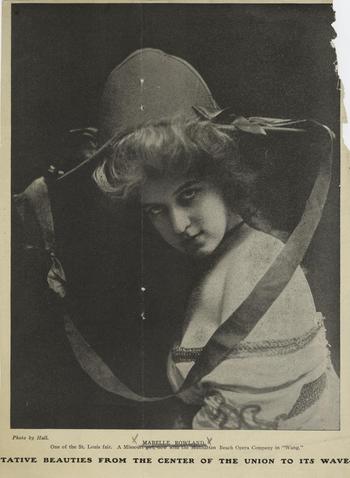
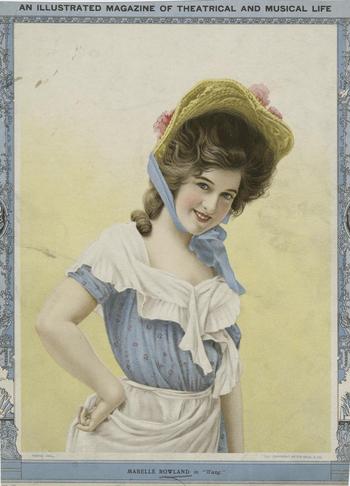
The theatrical “education” of Mabel Rowland offers one explanation for the institute's dismissive attitude toward the Little Theatre. Rowland's training in theatre occurred as commercial theatre operations concentrated in New York City and on the cusp of the stock system's demise.Footnote 48 She learned the business by performing before the footlights and working offstage at the same time. At twenty, in 1902, Rowland wrote a weekly Sunday column “Mabelle's Letter on Fashion and Frivolity” for the Cincinnati Inquirer and took on publicity for members of (the late) Augustin Daly's musical stock company when they landed on tour in Washington, DC. Though she was trying to get her sister, Adele Rowland, a role in the company, producer-manager J. C. Duff convinced Mabel to join the tour too.Footnote 49 As this was Rowland's first acting engagement, experienced company members may have mentored her during rehearsal, “under conditions of actual productions” (à la stock practices), but she would have also been subject to Duff's directorial authority.Footnote 50 The networks of contacts Rowland created through press agentry probably gave her a distinct advantage above other newbies, as she quickly found positions with major producers. Rowland won the ingénue role in Sam S. Shubert's 1904 revival of Wang. Though Rowland said that Shubert was the “dearest boy God ever loaned the profession,” she was convinced that her performance was terrible, and that she was paid only “really for exhibiting that V-shaped back.”Footnote 51 Like other young actresses, Rowland's portraits circulated in theatre and cultural magazines, promoting her personality along the lines of her type: funny, fetching, and girlish. She is posed in the typical manner explained by David Mayer, “with no visible agenda apart from presenting an image of an attractive, well-gowned woman”; a participant in the circulation of theatre's glamour and her own objectification, about which she expresses some misgivings (Figs. 1,2).Footnote 52 Meanwhile, throughout her early acting career, which she referred to as “only sort of a side line,” Rowland continued to write personal publicity for actors and developed her stock-in-trade comedic “cartoon-o-logues” or “polylogues”Footnote 53—topical monologues about women's foibles or burlesques of legitimate shows in which Rowland played all of the characters—on major vaudeville stages. By the early 1910s, Rowland worked for the United Booking Office (UBO) as a press and booking agent; she also represented Bert Williams, the Bahamian-American star of the Ziegfeld Follies. Upon his untimely death, in 1922, she wrote the (still oft-cited) volume, Bert Williams: Son of Laughter, for which she secured tributes from major figures, among them David Belasco, George M. Cohan, E. F. Albee, and W. E. B. DuBois. Like any other (female) press agent, “she played an active role in the objectification and commodification of female performers,” just as she shaped Williams's minstrel image.Footnote 54 She matured in the theatre business as a business, performing in and promoting the most popular forms of theatre and their problematic gendered and racist representations, at a level of bald commercialism against which Little Theatre advocates railed as “mindless, bloated, and detrimental to psychic well-being.”Footnote 55 Rowland's fellow institute members, most of whom were of the same generation as Rowland, were also creators and stars of the popular genres of movies, musical comedy, “legit” theatre, and vaudeville. It was their lives’ work and formed their understanding of professionalism, much as it shaped how they “labored in behalf of the feminine side of the stage.”Footnote 56
Seductive portrait of young Rowland with a caption that falsely advertises her wholesome Midwest roots. Rowland was born and raised in Washington, DC. Photo by Hall, published in unknown periodical, 1904. Billy Rose Theatre Division, New York Public Library for the Performing Arts.

Publicity photograph of a comely, costumed Rowland for the 1904 Shubert revival of Wang. Photo by Hall, in The Theatre: An Illustrated Magazine of Theatrical and Musical Life, July 1904. Billy Rose Theatre Division, New York Public Library for the Performing Arts.

The geography of the institute also speaks to its members’ show-business mind-set. The institute had set its sights on owning a Broadway theatre to “be located somewhere in the vicinity of 8th ave. in the 50's.”Footnote 57 Likewise, its offices’ locations signal a stark difference in its philosophy from that of Little Theatre groups that “set up shop in small venues [and repurposed spaces] that were geographically close to the groups they served rather than being in traditional entertainment districts,” in the interest of “a communitarian ideal.”Footnote 58 By setting up shop in the heart of commercial theatre operations, the institute was, in fact, readily accessible to the stagestruck girls and popular theatre audiences it wished to serve. It developed out of, and positioned itself in the midst of, girls making rounds to agents to seek engagements part-by-part and production-by-production. The institute women's informal gatherings and advising of others in the years prior to the institute's official founding occurred in the Fitzgerald Building at 1482 Broadway, the location of Mabel Rowland's personal publicity office.Footnote 59 This building was a show-business hub. Attached to the George M. Cohan's Theatre, it housed “Broadway” Joe Leblang's discount ticket operation, the Central Ticket Agency, known as “Gray's.”Footnote 60 Chamberlain Brown, a major booking agency for legit theatre, vaudeville, and motion pictures was also located there. This agency represented institute member Florence Reed, as well as Rowland's sister—a now-famous musical comedy actress—and (Adele's future husband) stage and movie star Conway Tearle.Footnote 61 Upon its official establishment, the institute was headquartered at 40 Gramercy Park; numerous theatre personalities resided in this affluent neighborhood, adjacent to Greenwich Village.Footnote 62 By the following fall, of 1927, the institute moved to the Metropolitan Opera Building—back to Broadway —where it would stay until its demise.Footnote 63 Both the location of its offices and the anticipated purpose-built playhouse put the institute literally and ideologically within the commercial theatre milieu.
In June 1926, notices of the new organization promised a benefit revue in autumn and shortly thereafter a fully produced comedy, with the intention of owning a theatre run by women and featuring women's artistic work as soon as possible. On 31 October 1926, the institute held its first benefit performance to raise monies for the playhouse. Staged at the Klaw Theatre, Florence Reed, who had just closed the successful orientalist melodrama Shanghai Gesture, hosted the event; Elsie Janis returned from Los Angeles to open the show with a comic poem she composed for the occasion; and among the numerous acts, the company of Anita Loos's currently running Gentleman Prefer Blondes performed a sketch called “Wallpapers.”Footnote 64 This was to be the first of a national tour of benefit performances. From the limited evidence, however, it seems that only one additional benefit performance was held: in Washington, DC, in March 1927, there was a recital featuring Rowland's “cartoon-o-logues” with Kate McComb as a soloist. Press notices and reviews appear in DC society pages, listing the event's politically elite patrons, including Mrs. Calvin Coolidge.Footnote 65 Following this, it appears that the institute produced one other Broadway recital/revue, a “Soiree Artistique” in March 1929 at the Booth Theatre.Footnote 66 It is unclear if this was a benefit performance. The institute never delivered on its promised comedy or any other full-length play during its existence, nor did it build a theatre of its own.
At the start, the institute appeared confident that mentorship of female neophytes would benefit their theatre, not defeat it. The morning following its inaugural performance, the New York Sun ran an article outlining the institute's ambitions for a Broadway theatre and for theatrical aspirants. Titled “Feminism and Altruism in Theater—Woman's Institute to Erect Theater Soon to Be Run Entirely by Women,” it described plans to name (instead of number) house seats for contemporary theatrical luminaries, such as Ethel Barrymore and Lillian Russell; its mission to expand “their professional success to their sisterhood”; as well as its origins a decade prior, when “a band of professionally prominent women met to discuss the prospect of organizing into a group to foster women's work in every department of theatrical endeavor.”Footnote 67
This band of women came of age and came together in a centralized commercial theatre industry dominated by businessmen and the perspective that women lacked the necessary attributes to lead aesthetically or operationally. For instance, a 1918 article in The Nation regarding “[o]ur feminized stage” concluded that among women playwrights, “few have shown the necessary command”; in the role of producer, “women have not yet exerted any marked influence”; and as actors “[w]hat one misses is a sense of intellectual distinction and patient, devoted study of the instruments of her art.”Footnote 68 Though Crothers is the only (future) institute member named by the author as one of the few exceptions, other women affiliated with the institute could also be considered exceptions, at least in terms of their success within this environment. Many did not claim feminism outright, but they were paradigms of the New Woman, and not just by virtue of being working women.Footnote 69 Most were in their thirties and forties when they founded the institute; born in 1882, Rowland was forty-four years old. The most senior member, Mary Shaw, at seventy-two, exemplified the overt feminism of the suffrage era; she was far more outspoken and activist than many of her younger colleagues.Footnote 70 Yet their careers and the institute's initial mission reflects “the distinguishing feature of modern [postsuffrage] feminism [which] was the assertion of an essential sameness between women and men and the ensuing demand that women have equal access to the public marketplace.”Footnote 71 Indeed, Crothers's plays grappled with the New Woman's struggle to maintain both career and family; Mary Pickford created her own production company; and Irene Castle literally embodied the active, independent, athleticism of the New Woman, creating a sensation when she bobbed her hair.Footnote 72 Meanwhile, Rowland's experiences as an actor led her to advocate publicly for women producers and managers as early as 1910; by way of justification, she pointed to an aborted audition with Harrison Grey Fiske. After looking her over, he denied her the audition for a part she was convinced she could play. “Now if a woman had been producing that play she would have taken no account of my years or cheers. She would have interviewed me and if she thought I would do, she would have ‘tried me out.’ Women don't take so much stock in the apparent youth and cheerfulness of their sisters as do men.”Footnote 73
Florence Reed's elaboration of the principles and central practices underlying the institute's educational “altruism” further distinguishes the need they perceived to give women a chance in a very difficult industry:
The universal human impulse to act attracts yearly to New York many thousands of women of all ages. The percentage of those whose equipment fits them for the terrific competition on the modern stage is very small. One of the most important phases of our work is to look a woman aspirant straight in the face and tell her frankly what we think her chances are. We want to be sure that real talent always finds its place, but we want to spare women who apply to us the prolonged agony and expense of job hunting on the stage. … If a woman has a play that she has written and desires to have read, if she has a voice to be heard, or if she wishes to act or paint scenery—a letter from her and we assist her without charge.Footnote 74
Though Reed uncritically rehearses the gendered belief that most stagestruck lack the required attributes for success, she promises applicants a real chance—a sincere evaluation—and aid in navigating the industry. The stress laid on opening doors for talented applicants may have stemmed from charter members’ firsthand experiences of the difficulties gaining a foothold as actresses, let alone in the other male-dominated theatrical professions.
In a 1916 New York Sunday Telegraph profile, “Mabel Rowland—Maker of Men and Women,” Rowland acknowledges the constraints placed on women on the other side of the footlights by societal misconceptions. Rowland recounted that she was made to justify her occupation of the lucrative role of press agent: “A man came into my office one day and said: ‘Do you know you are taking a man's place?’ ‘What man's?’ I asked. Women arrive at success with a great handicap, so all the more power to them.”Footnote 75 Rowland would publicly correct her own misconceptions about women's abilities after being “assailed with protests from husky and energetic ladies in all parts of the country who insisted there was no reason why we should call in men to act as stagehands [for the institute's theatre] when they were perfectly able and ready to perform such work.”Footnote 76 Rowland's stereotypic portrait of female technicians quickly exposes one of her blind spots. Nevertheless, it shows the institute's mentorship interests as part of the long-term expansion and sustainment of women's occupation of prominent and respected roles, or any role they please, in the commercial theatre.
Rowland, however, eschewed charges of gender discrimination when discussing the institute's origins. According to Marion Clyde McCarroll, who interviewed Rowland about the institute for the New York Evening Post in 1928, Rowland was “careful to make clear” that this organization wasn't formed because women had been denied opportunities, but because Rowland “thought it would be just another development in the progress of the theatre” and she believed people would be interested in the “novelty.”Footnote 77 McCarroll's characterization suggests that she queried Rowland about gender bias in the theatre industry or that Rowland anticipated politicization of the project, perhaps in light of the legacy of all-women's suffrage theatres. Rowland's flat-out denial of sexism directly contradicts her statements about experiencing it in the 1910s and the fact that the institute women had been meeting during the previous decade. Rowland displaces the controversial topic with a vague nod to “progress” and the proven profitability of giving audiences something new, depoliticizing the institute through terms most everybody in the Progressive Era and commercial theatre could agree upon as socially and economically positive.
For as apolitical as Rowland renders the enterprise, she did, however, offer a proviso, with underlying feminist implications:
Perhaps, though, there was just one direction in which I thought women might have a better chance than they have now, and that was in comedy parts. Women, you know, aren't supposed to have a sense of humor. For some reason, the men seem to think, they practically have a corner on that quality. So, women find it difficult to get parts of this kind.Footnote 78
This issue was one near the bone for Rowland as a comedienne; it may have also mattered to the other members associated with comedy, such as May Buckley and Elsie Janis. In the early twentieth century, cultural critics debated whether women were funny. Like those raising questions about women's natural capacities in other male-dominated theatre disciplines, using the trope of female exceptions they frequently concluded that comedy was a properly masculine genre. Comediennes transgressed the boundaries of gendered behavior whether engaged in topical parody or slapstick. Critics attempted to rein in women by gendering comedy itself. They defined women's humor as gentler narrative-based forms and expressed that acerbic wit and rough physical forms compromised femininity.Footnote 79 The institute's planned first production of a comedy and benefit revue performances refuted the second-class status of funny women as an anomaly. Rowland asserted, “In our theatre, our plan is to bring out women in such parts and show what they can actually do”Footnote 80—much as every role to be occupied by women in the institute's theatre would.
On the one hand, Rowland framed the institute's style of comedy as properly feminine by stating that the institute “will show beyond the vestige of a doubt by our very first production, the revue, that laughs may be produced by wholesome comedy written by women.”Footnote 81 Rowland's published monologues stay within the feminine realm by targeting women and their weaknesses through speech, not physical forms. (The following section offers a representative excerpt.) In 1922, though, a critic accused Rowland of a level of “suggestiveness” that would keep her off of Broadway stages.Footnote 82 On the other hand, framing the institute's comedy in this manner and moment also resounded with Florenz Ziegfeld's declaration that “[t]he stage must be cleaned from within our own ranks.”Footnote 83 Ziegfeld issued his antinudity statements in late June 1926 in what appeared to be a moral reversal of his famously suggestive stagings. Rowland's announcement appeared one month later, on 27 July 1926, under the headline, “Actresses Take Hand in Clean Theatre Move.” Clean revue positioned the institute's aesthetic in opposition to the innuendo, scenarios, and costuming that coded chorus girls as sexualized commodities. It also put the institute in step with the “new” Ziegfeld, who promised to quit nudity on his stages both because imitators had vulgarized his undressed “glorification of womanhood beautiful” and “in behalf of chorus girls, who, he said, must do as producers direct or find themselves without jobs.”Footnote 84 Competitors and the New York Society for the Suppression of Vice saw through Ziegfeld's stated motives, recasting his moralism as marketing and slander.Footnote 85 Rowland's statements may be sincere, but they are multivalent. Her stance is neither fully feminized nor overtly feminist given the context. Even as Rowland professes a potentially feminist ethic to mitigate against the exploitation of chorus girls and prove actresses in feminized “clean” comedy, the institute gains cover or famous professional company, ironically, courtesy of Ziegfeld.
Beyond Rowland's statement that the woman's theatre would produce “wholesome” comedy, there are no other signs that the institute was interested in reforming representations of women onstage or elevating popular fare from entertainment to “art.” While many of the institute women were powerhouses offstage, they did not necessarily overtly disrupt status quo types onstage. In fact, Rowland played the stagestruck type in her 1908 sketch “Stage-struck Slavey.”Footnote 86 The script is lost, but given the title and vaudeville context the sketch would have featured an Irish/Scottish maid with thick brogue, unattractive features, an uncouth manner, and dreams beyond reach. That is, Rowland likely combined popular stereotypical ethnic impersonation with the belief that most stagestruck girls’ desires and inflated self-images were incongruous with the elegance of speech, countenance, and physique necessary for success on Broadway stages. Similarly, Anita Loos's novel Gentleman Prefer Blondes was such a runaway hit in 1925 that within a year of its debut this satire of a stage-door johnny and aspiring actress turned full-time gold digger was adapted for the stage. As previously mentioned, this company performed to benefit the institute. Susan A. Glenn argues that Loos's savvy protagonist, Lorelei Lee, advanced pejorative stereotypes about chorus girls, a population that “Hollywood [also] had a field day with,” producing multiple storylines about girls morally compromised by the theatre and the search for an easy life.Footnote 87 Barrett-Fox admits that, in the case of Anita Loos's work, the “strategy of indirection” caused “its radical feminism to be missed.”Footnote 88 If such indirect feminism is not only easily missed but also misunderstood in Loos's representations, Rowland's use of this furtive mode in discussing the institute raises and leaves questions unsettled about the political payoff for women and girls in the long run.
Overwhelmed by or Creating Its Own Necessity?
Within months of the institute's official founding, the philanthropic efforts of the organization overtook its ability to establish a Broadway woman's theatre. In 1928, in an article asking for new members outside the profession to support the woman's theatre financially, Rowland attributed the then “delay” in building a Broadway playhouse and producing to the overwhelming demands of stagestruck girls:
[A] “big sister” role to the girls who flock to New York by the thousands … has kept us so busy that we haven't had time or money for anything else! No one who isn't right in the theatrical profession can possibly have any idea of the hundreds of thousands of young girls—yes, and older women, too—who come to New York with the firm belief that they are embryonic stars. … But it is my hope that eventually in some way we may be able to reach these girls before they leave home and at least let them know just what they will be up against. In the meantime, while we are doing this job, we are looking hopefully forward to the time when we shall be able to achieve our main purpose.Footnote 89
Despite Rowland's expressed frustrations with the diversion from the institute's foremost intention, a shift in headlines and story content from its announcement in June 1926 to stories that start appearing in January 1927 suggests that the institute may have been, in fact, cultivating girls’ interest in the institute to justify its necessity. Announcements of the institute published in June 1926 show slight variations from paper to paper, suggesting that these are press releases, tweaked and placed beneath eye-catching headlines by newspaper editors. They focus on the commercial theatre-building enterprise: “A Woman's Theater”; “Women to Enter Producing Field”; “Women Stage Stars to Build a Theater.”Footnote 90 Beginning as early as January 1927, however, at least according to the headlines, the institute's primary purpose qualitatively changes; the story “For Stage-Struck Girls” ran in the Philadelphia Inquirer, the Detroit Free Press, the Louisville Courier-Journal, and likely other major regional newspapers.Footnote 91 The week prior, on 9 January 1927, the Brooklyn Daily Eagle published an interview with Rowland by Hazel Canning entitled “Protects the Stage-Struck Girls.” Then for the September 1928 issue of the Woman's Journal, Rowland penned “Saving the Stage-Struck.” Her lede marks what had become the institute's purpose in practice: “What Happens to the Women and Girls Who Flock into New York Every Day to Go on the Stage? Thanks to the Woman's Theatre Many Go Home and Others Turn to Other Work.”Footnote 92 In each of these articles, the ultimate goal of a professional women's theatre is reiterated, in words to this effect: “they all agreed that their duty to the theatrically ambitious woman can never be fully discharged until they have a theatre of their own in which women playwrights can get a hearing for their works and where inexperienced girls can have the opportunity to show what, if any, talent they possess.”Footnote 93 Yet the playhouse and commercial productions are no longer the principal subjects; rather, the pieces are almost wholly devoted to how the institute has intervened in the unhappy fates of stagestruck girls or transformed her into a working theatre professional.
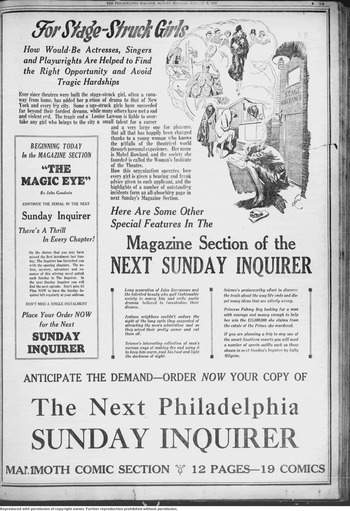
These few pieces comprise the bulk of evidence on the institute's view of and practices to professionalize stagestruck girls. They attend almost entirely to would-be actresses, and Rowland voices their stories of trial and triumph. Moreover, the described methods of evaluation and aid rendered to girls by the institute lie within dramatic portrayals that raise the specter of the dark road visually and narratively; that is, they smack of marketing. For instance, the syndicated article “For Stage-Struck Girls” juxtaposes portraits of institute members Cecil Arden, Julia Arthur, Rowland, and purported institute protégée Jeanette MacDonald with “[a]n artist's conception of the heartbreaking disappointment that awaits the stage-struck girl who finds after all her hardships and painful efforts that it is impossible to make realities of the rosy dreams of her ambition.”Footnote 94 Shut out of the stage entrance, she sits on the curb with her head in her knees while visions of what she thought it would be like play in her mind: she is tossed bouquets across the footlights, clothed in head-turning fashion, and chauffeured to the next exciting event (Fig. 3). Invoking dangers such as “the wolves which prey on the silly little girl away from home and longing to go on the stage,” these articles capitalize on long-standing fears associated with the stagestruck girl to represent the institute as the solution and its president as “the greatest living authority on the girl from the small town who wants to become a glittering star of the stage.”Footnote 95 Aggrandizement of the institute via the depths of the stagestruck girl's despair presents some difficulty in discerning whether Rowland intended, as she professed, to dissuade unprepared and underfunded girls from coming to New York, or if she was courting them in an effort to make the institute a popular first stop for new arrivals, or both.
Advertisement for a feature story on the Institute of the Woman's Theatre, vividly depicting the typical symptoms and consequences of stage fever. “For Stage-Struck Girls,” Philadelphia Inquirer, 9 January 1927, B13.

At the same time, Rowland pointedly refuted negative conceptions of stagestruck girls and theatrical culture as morally suspect:
[W]e are speaking now of the usual, well-reared and earnest type of girl—the girl in the majority among those who seek us. Naturally, there is a percentage who are not honest or earnest. … These girls are just moral outlaws posing as stage-struck. Unfortunately, the theatre, the hardest working workshop in the world, is blamed for luring these women to disaster. It is most unjust.Footnote 96
In contrast to common maligning of stagestruck girls, Rowland attributes responsibility for any immorality or endangerment upon the perpetrators, not the victims. A story she tells about a girl named Jean McPherson indicts the disreputable theatrical agent who sexually harassed McPherson, and the dishonest proprietors of the third-rate boardinghouse who told McPherson that coerced sex “was the ‘price’ all women paid for stage success,” while she faced increasing hunger and desperation.Footnote 97 As for Jeanette MacDonald, Rowland helped her secure legal assistance during a contract dispute with an agent who demanded 25 percent of MacDonald's earnings when she became successful; the lawyer discovered that the contract was invalid because MacDonald had been a minor at the time of signing.Footnote 98 The problems Rowland represents are not the girls themselves, but those who would take advantage of a girl's inexperience in an industry comprising incredible competition, difficult labor, and very precarious employment.
Rowland considered her “chief” talent getting work in theatre and stated that she established the institute because she wanted to do this for girls. She spent most mornings of the week interviewing applicants.Footnote 99 Other institute members active in this process are unknown, but professional women worked with aspirants on a volunteer basis.Footnote 100 Institute members’ perspective about the equipment for success as a professional actress adhere to the values of the commercial theatre. Abilities necessary for other theatrical fields are nowhere described, perhaps because would-be actresses had become the institute's primary clientele. For these girls, Rowland lists “a special fitness of art, training, health, courage, adaptability, authority, diction, good looks—and for success, a real feeling for the theatre.”Footnote 101 By way of example of ill-equipped applicants, and through a series of questions that Rowland tells girls to answer frankly for themselves, it is apparent that successful applicants must be capable of a standard American accent, possess physical grace or ability to dance, and show a willingness to begin in the chorus or stock. They must also be young, in their late teens to mid-twenties—“This is our toughest job—telling the older woman that the boat has gone.”Footnote 102 Rowland characterizes chorus engagements as the training ground for future actors. Rowland attributes girls’ resistance to the chorus to their unearned pretensions. Here, she clearly reinforces the belief that actresses are artists, superior in talent to chorus girls. By positioning the chorus as an apprenticeship for legitimate theatre, she simultaneously raises the job above popular imaginings of it as solely requiring a pretty face, charming shape, and sexual availability. However, she does not dispute that it, indeed, requires the first two of these attributes. Finally, girls needed enough money to support themselves for a minimum of six months due to the difficulty of obtaining work and the low pay they should expect.Footnote 103
If the institute judged a girl as wanting in these regards, institute members would recommend that she abandon her goal. By 1928, Rowland prescribed the “little theatre cure” for those without the necessary qualities for a professional career; she even promised that the institute would help a girl to start a Little Theatre in her hometown and support her efforts via correspondence.Footnote 104 Rowland characterized the Little Theatre as the proper place for those who desired self-expression but didn't have the chops to make it in show business. With utter sincerity, Rowland encourages women to “establish a laboratory of little theatre in which to ‘cure’ young women,” and reiterates a belief that “little” meant amateurish: “We sympathize with any burning passion she [the stagestruck] may have to act, but tell her frankly she will be happier with the theatre as a hobby, like golf, than struggling with poor equipment to make a living out of it.”Footnote 105
Rowland portrayed those struggling with poor equipment in a far less than sympathetic manner as part of her performance of monologues at the National Theatre in 1923. Women's Wear counted “School of Rhythm” as one of the standouts of the evening.Footnote 106 In it, Rowland portrays a teacher-director barely managing her bumbling students during the final “dress rehearsal of an out-door class in Expression at the School of Rhythm.”Footnote 107 The scenario they are enacting is of tragic proportions, performed in a Delsartian style: a woman at the bedside of her dying husband is set free from her grief by his spirit and those of other widows. The ensemble consists of embodied “spirits-of-gloom,” “waves-of-the-shore,” “flowers-in-a-wind-storm,” and “spirits-of-joy,”Footnote 108 each in a symbolically appropriate color of cheesecloth drapery. Laughs are gotten at the expense of schools of expression/“theatre” in the hands of those who know nothing about professional standards:
Now circle round the tree ladies, and bend and blow. Bend and blow, you know how flowers are in a windstorm. Now ready joys, and ready glooms. Come on Mr. Lavender, discover Mrs. Bunce grieving. … Oh wait a minute. … What's the matter Mrs. Bunce? … Oh yes, he HAS to touch you, he takes you by the elbows and raises you to your feet … you thought what? That he would fly down from one of the trees and touch you with his. … Oh no, we couldn't have anything like that. That would be too much like Peter Pan.Footnote 109
The rehearsal proceeds in fits and starts, with players breaking basic theatre rules (for example, one wears galoshes with her costume), asking inane questions (e.g., the implicitly homosexual Mr. Lavender requests a turban to cover his balding head), or misinterpreting direction (e.g., Mrs. Bunce staggers drunkenly rather than gliding gracefully). Miss Bloom's complaint of seasickness after performing as a wave encapsulates the primary message of Rowland's ribbing: most people are constitutionally incapable of good acting, and self-expression does not make for good theatre. Rowland critiques the private theatre schools that emerged to fill the void in theatrical training left by the death of the stock system and the pretensions of the Delsarte system to “natural” expression.Footnote 110 Though, of course, successful professional theatre schools and schools of expression developed from community beginnings, Rowland mocks these schools’ instructors as amateurs masquerading as gurus, who are responsible for the woefully ill-prepared and overconfident stagestruck aspirants. Ironically, women predominated as the instructors in these Little Theatre schools, as well as in high-school and university theatres. Joseph Fahey explains that widespread lampooning of American Delsartism in popular entertainment not only confirms its tremendous popularity, but also showed tremendous antipathy for women in/with power. Delsartism “provided women in American theater a more equitable relationship to men than could be expected under the apprentice system,” and thus threatened the “male-centered” approach to actor training and men's control over theatre.Footnote 111 Treating Rowland's comedy as a direct reflection of her beliefs is overly simplistic. However, Rowland's prerogative to return untalented female aspirants home to become community players and wives confirms the distance she perceived between NYC show business and Little Theatres and schools, as well as Rowland's ignorance of the misogyny deeply embedded within the commercial practices and popular aesthetics, even when within women's control. While Rowland's own “education” in theatre helps to explain her false consciousness, and reflects the shortcomings of liberal feminism more generally, it also explains the emphasis the institute put on on-the-job training for those it deemed talented.
Despite the institute's aim to save girls from unnecessary hardships when they lacked apparent talent or grit, it sometimes would yield to a girl's persistence and arrange an on-the-job trial, affording girls the opportunity to realize their talent or see for themselves what it really meant to work in the theatre. Rowland recounted referring McPherson for stock engagements. According to Rowland, McPherson possessed ability and persevering spirit but after a few weeks decided that the lifestyle was not for her and asked for fare to return home. In other instances, Rowland demonstrated exasperation with the stagestruck and utilized condescending expressions regarding their numbers, their blind determination, egoism, and hubris: “They have played ‘Portia’ in the home town and been complimented by the home-folk—they have even had a wonderful notice in the home-town paper! Why should they hesitate?”Footnote 112 Their questioning of Rowland's expertise—she, the maker of men and women—causes the irritation. Fevered as these girls were with unrealistic expectations, Rowland proudly attested to “curing” them through doses of reality.
Rowland's admission of being proven wrong on occasion, however, also signals a practical artistic philosophy that only through experience can theatrical ability or fitness for theatrical working conditions be truly known and shown. She thrilled at a markedly different case, which given the thinly veiled reference to theatre manager Al Hayman, a member of the powerful Theatrical Syndicate, must have occurred in the early, unofficial days of the institute. Convinced that the girl, Helen, was too sheltered and delicate for stage life, Rowland sent the girl to her friend “Al,” and asked him to treat the girl more harshly and work her harder than all the others to see if she could bear the worst of it. He obliged, and when Helen called on Rowland again, she told how awful the manager was to her, and yet beamed:
“I'm just crazy over that little vaudeville act—and my small part. The manager abuses me—actually—he works me twice as hard as anybody else—but I never say a word! I want to succeed badly enough to stand even brickbats—when he gets ready to throw them.”
There was a moment to make a stage woman's heart sing out loud. Miss Rowland rose to her feet. She put her hands on Helen's shoulders.
“God bless you, my little girl,” [Rowland] said solemnly. “Contrary to what I thought at first, you are the stuff of which real actresses are made.”Footnote 113
Rowland's experiment to test the toughness of this aspirant is disturbing by current standards. It is significant, however, that it was within Rowland's control and enacted by a trusted male colleague. Equally important is the “slip” of the vaudeville manager's name, which would call to readers’ minds the late Hayman and, in doing so, highlight Rowland's power and connections. At the same time, the triumphant tone of the story and an accompanying illustration of a grizzled man barking at a slender young woman awkwardly executing choreography speaks to the institute's subscription to the power dynamics of the commercial theatre, in which the manager reigned over the talent. Even if institute members didn't subscribe to the roles’ gendered distribution, from this example, they seem to accept the hierarchy unquestioningly. Additionally, these trial practices and initial adjudications suggest that the institute took for granted verbal abuse, inequitable treatment of company members, low pay, and subpar work spaces as natural to theatrical working conditions as well as the professional theatre's objectification of female performers.
As described by Rowland, the institute's straightforward assessment and disappointment angered many women. Its reputation for such frank advice also kept girls away from the institute “until they are up against some difficulty. Perhaps this is because even though they have heard of us and the way we function, they may fear to be discouraged,” wrote Rowland.Footnote 114 Yet by interceding in typical mixed-gender agency interactions, the institute also made a fundamentally feminist mark:
[An agent] is not an altruist nor in business for his health, so why should he trouble to make himself unpleasant by being truthful? … If a girl actually sees a manager, and looks absolutely hopeless to him, he does not take the trouble to tell her so either. He says, “There is nothing just now, Miss Jones, but you never can tell, so you might keep in touch with the office.” This is intended as a decent “out,” but it doesn't discourage her.Footnote 115
Rowland characterizes this politeness as cruel in that it operates in the interest of these men's immediate comfort and professional reputation to the long-term detriment of the girl, who mistakes manners for possibility. Even more, Rowland acknowledges the immediate pain the institute's candor causes these girls, expresses deep sympathy for them, and intimates feeling duty-bound to bear this emotionally taxing burden. The institute women knowingly carried the weight of being the bad guy when the men with power did what was easiest for them.
Conclusion
It is uncertain how long the Institute of the Woman's Theatre operated to set up girls for the best possibility for success at the least personal cost, or to spare them from the hustle and being hustled. Yet as the scant traces of the institute dry up, they leave signs that it changed into the very thing that Rowland and company struggled to define it against: an amateur(ish) enterprise. In August 1929, the institute invited nonprofessional women to a free meeting to learn the concentration techniques used by actresses in order to apply the skills in business or their homes.Footnote 116 Then, in June 1931, audition notices appeared that called for amateurs to perform in recitals and a series of plays under Rowland's direction in partnership with her new company, the Metropolitan Players. In one, the institute is referred to as “The Women's Theatre Club,” and another calls the Metropolitan Players “an amateur group under the direction of the Women's Theatre.”Footnote 117 Rowland and her husband, Jay Strong, founded the Metropolitan Players, located, like the institute, in the Metropolitan Opera Building. It appears to have been a semiprofessional theatre, school, and new-play tryout house for possible Broadway runs.Footnote 118 Though offering training, the Metropolitan Players seems to have left behind the feminist objective to advance women in theatre, and according to one reviewer, it also lacked the professionalism of the institute:
With all the good will in the world they played at their little sketches, sang their sad songs, even danced a turn or two. And, when it was over, the Heckscher [Theatre] still seemed a long way from Broadway, as it is. … Mr. Strong's revue is like nothing so much as a graduation exercise for students he has been training faithfully. Some who have not already done so may take the bus downtown, a very pleasant ride, and get somewhere some day. They aren't quite ready yet.Footnote 119
Thick with condescension, the critic's words ironically rehearse the distance the institute tried to place between itself and amateurs, just as they echo Rowland's mockery of instructors and their students for earnest but wanting attempts. Rowland continued to train novices into the 1940s. After separating from Strong, she kept the headquarters of her acting and writing school, the Monologue Theatre of America, in the Metropolitan Opera Building. She ran this school until 1942, when she took ill and moved to the Los Angeles home of her sister, Adele Rowland Tearle, where she died in early 1943. Upon Rowland's death, the New York Times characterized her as “a former actress, writer and Little Theatre director.”Footnote 120 On the one hand, in this description Rowland's work with the Metropolitan Players simply comes after her professional credentials. On the other, it reinforces the boundaries of a woman's scope in the commercial theatre by burying Rowland's activism within a properly feminine theatrical realm.
Officially, the institute “was dissolved by proclamation of the New York Secretary of State on October 15, 1952 for failure to file a report of corporate existence.”Footnote 121 The verifiable reason for its end is a perfunctory bureaucratic matter; existence requires proper paperwork on file. Yet to my mind, it encapsulates activism's ill fit with the archive. Documenting their work with stagestruck girls may not have been foremost on the minds of the professional women of the institute, especially because donating one's time and name for philanthropy was “anything but peripheral to actresses’ day-to-day professional lives.”Footnote 122 Further, if we take Rowland at her word, institute women also may have been simply too busy playing the “‘big sister’ role to the girls” for “anything else.” The demands and tacit expectations of theatre women's auxiliary labor help to explain why endeavors like the institute fade from the historical record, just as it calls on the feminist historian to report what can be known in spite of its partialness and uncertainties.
Reliant on a media-based archive, the question of whether Rowland and colleagues were aware of the contradictions of their actions yet made strategic choices given the circumstances in which they operated is unresolvable. Publicity purposefully offers an uncomplicated picture in the interest of broad appeal, while obscuring doubts, compromises, and tactics. Viewed from a contemporary perspective, this type of documentation lays bare the prejudicial attitudes of the institute and the dominant values of its historical professional context. The institute's publicized solutions to the problem(s) of stagestruck girls typify the attitude and skill set of its president—a booking and press agent for the commercial theatre. Rowland, it seems, could not envision a legitimate or significant theatre that was not Broadway bound. She could not see potential outside of accepted “equipment,” which reiterated a racialized, classist, heterosexist, cisgendered vision of womanhood. She could not imagine business and aesthetic practices that would level theatrical hierarchy. Finally, Rowland could not make a case for the institute beyond moral rhetoric that called upon the popular conceptualization of girls. Despite what the evidence shows, Rowland and colleagues’ chosen course exceeded professionally expected and acceptable charitable work to a level of industry activism entailing professional risk. The possible reasons behind the institute's equivocations are illuminated when reflected against the 2018 collective statement of Time's Up:
Dear Sisters,
We write on behalf of over 300 women who work in film, television and theater. … We have similarly [to farmworker women] suppressed the violence and demeaning harassment for fear that we will be attacked and ruined in the process of speaking out. We share your feelings of anger and shame. We harbor fear that no one will believe us, that we will look weak or that we will be dismissed; and we are terrified that we will be fired or never hired again in retaliation.
We also recognize our privilege and the fact that we have access to enormous platforms to amplify our voices … that farmworker women and countless individuals employed in other industries have not been afforded.Footnote 123
Unlike their twenty-first-century counterpart, the myopic perspective of Rowland and company prevented them from recognizing common interest with girls that they could not see as younger versions of themselves. Notwithstanding this impediment to progress, the institute women acted on the obligations of their privilege in an industry where the suppression of gender discrimination was, and remained for a subsequent ninety years, a perceived necessity among even the most powerful women.