As COVID-19 ravaged through the United States, face coverings were ultimately recognized as critical tools in reducing its transmission (Prather et al., Reference Prather, Wang and Schooley2020). When the full weight of the outbreak first hit the United States in March of 2020, however, the U.S. Surgeon General and other public health officials warned against wearing them. Only in April did the Center for Disease and Prevention Control recommend them for use in public spaces. Because of the limited supply of surgical masks at the time, most Americans relied on less effective cloth and fabric masks. Eventually, more than three-fourths of states would mandate that people wear masks in public.
As is too often the case, this ostensibly race-neutral policy may not have had race-neutral consequences. White conservatives have been most likely to resist mask wearing for political reasons, but black Americans are the ones who have reported actual mistreatment when masked. Anecdotes are widespread. In one account, guards ordered two black men to leave a store because they were wearing protective masks (Jan, Reference Jan2020). In another, a black state senator, who was wearing a mask as mandated by his state, had his shopping cart searched while white shoppers in masks streamed past the same security guard without being searched. Teresa Haley, president of the NAACP's Illinois conference, put it this way: “It used to be driving while black, walking while black, now it's this other thing – wearing a mask while black” (Jan, Reference Jan2020).
The notion that mask wearing might affect black and white people differently is consistent with many other public policies in America. For example, felony disenfranchisement laws limit the ability of convicted felons to vote in 48 of the 50 states, a policy that disproportionately depresses voter turnout among black people (McLeod et al., Reference McLeod, White and Gavin2003; Manza and Uggen, Reference Manza and Uggen2006; Ochs, Reference Ochs2006; King and Erickson, Reference King and Erickson2016). Because black people are less likely than white people to have access to state-recognized forms of photo-identification, voter identification laws also discriminate by race (Barreto et al., Reference Barreto, Nuno and Sanchez2009). Indeed, black people are less likely to vote in states that have strict photo-identification laws than those that do not (Hajnal et al., Reference Hajnal, Lajevardi and Nielson2017). Further, black people are disproportionately policed and imprisoned relative to whites (Alexander, Reference Alexander2020; Baumgartner et al., Reference Baumgartner, Epp and Shoub2018; Christiani, Reference Christiani2020; Epp et al., Reference Epp, Maynard-Moody and Haider-Markel2014; Muhammad, Reference Muhammad2019). In short, mask wearing is perhaps best seen as the latest in a long list of public policies that are ostensibly race-neutral, but in practice, may not be.
In this study, we theorize that many Americans will use—perhaps unconsciously—a double standard when making judgments about people wearing masks that disadvantages black people. Given the historical association between masks and criminality, the connotation of a man wearing a mask—particularly a non-surgical one—is ambiguous, especially early in the pandemic when masking was yet not an established norm. Are wearers protecting themselves against COVID or preparing to perpetrate a crime? We expect Americans will be more likely to resolve that ambiguity to the detriment of a black male wearer than a white male wearer. That is because long-standing and pernicious stereotypes associate black (but not white) men with criminality (Schultz, Reference Schultz1999). These deeply ingrained stereotypes result from centuries of strategic campaigns from white elites who intentionally sought to sow feelings of threat and mistrust of blacks in much of the American electorate to retain political, economic, and social power (Mendelberg, Reference Mendelberg2001). Because non-surgical face coverings have been historically associated with criminality, we pose that mask wearing during a pandemic may cause people to evaluate a black person wearing a mask more negatively than a white person wearing one.
We designed and implemented a survey experiment that revealed non-black respondents—especially those who have higher levels of racial resentment—perceive a young black male wearing either a bandana or a cloth mask as more threatening and less trustworthy than when he is wearing either a surgical mask or is not wearing his face covering. When presented with a white male of similar age and build, however, respondents provided more favorable evaluations of him when he is wearing any of three types of masks (surgical, cloth, and bandana) than when he is not wearing his face covering.
As disquieting as these findings are, we also find something encouraging. Respondents evaluated the black model the same when he was wearing a surgical mask as when he was not wearing his face covering. Since surgical masks, specifically, are not associated with crime, they appear to dampen the implicit stereotypical link between mask wearing and criminality. This is not to suggest that black men can avoid being seen as threats by wearing surgical masks; unfortunately, they tend to be perceived by non-black people as threats regardless of what they are wearing (Welch, Reference Welch2007). Moreover, the onus should not be on black men to work around anti-black prejudice. However, these results do indicate that wearing a surgical mask does not increase the perception of threat and untrustworthiness for a young, black man, compared with when his face is not covered.
1. Racial stereotypes and the ambiguity of masks
The unequal perceptions of black and white mask wearers should emerge from two negative associations. First, Americans tend to perceive black people—especially those who are young and male—as more likely to be criminals than others. Second, mask wearing has long been associated with criminality.Footnote 1 During the pandemic, the reason people might be wearing masks went from being almost certainly negative to ambiguous. Are they wearing it to protect themselves from the virus, or are they preparing to commit a crime? Because black people are more likely than white people to be perceived as criminal, citizens are more likely to resolve that ambiguity by attributing malign intent to a black man in a mask than a white man in a mask.
It is well known that standard criminal profiles in the United States tend to characterize criminals as young, poor, black, men (Hurwitz and Peffley, Reference Hurwitz and Peffley1997). These profiles are used and reinforced in many aspects of society, including policing (Epp et al., Reference Epp, Maynard-Moody and Haider-Markel2014), in the media (Gilliam and Iyengar, Reference Gilliam and Iyengar2000; Entman and Rojecki, Reference Entman and Rojecki2000), and in political campaigns (Mendelberg, Reference Mendelberg2001). In fact, a higher proportion of young black men in one's neighborhood leads residents to perceive higher levels of criminal activity in their community, even when controlling for the actual crime rate (Quillian and Pager, Reference Quillian and Pager2001).Footnote 2 Indeed, the link between black people and criminality has become so strong that the term “criminal predator” is now essentially a synonym for “young, black, male” (Welch, Reference Welch2007). These stereotypes can evoke a sense of threat, but also mistrust. Scholars have found that those with stereotypically more Afrocentric features are perceived to be less trustworthy (Wilson and Rule, Reference Wilson and Rule2015) and those with more Afrocentric features received harsher criminal sentences in the United States (Blair et al., Reference Blair, Judd and Chapleau2004). Notably, white men do not face the same level of scrutiny that black men do. For example, while white criminals are seen as capable of rehabilitation, black criminals are seen as inextricably linked with crime and as inherently criminal (Muhammad, Reference Muhammad2019).
Not only are black men associated with explicit negative perceptions, but these associations appear to manifest themselves implicitly as well. One experimental study found that through an immediate, unconscious process, subjects associated black faces with weapons more than they associated white faces with weapons (Payne, Reference Payne2001). This behavior persists even when participants are instructed not to think about race (Payne et al., Reference Payne, Lambert and Jacoby2002). These associations are so embedded in the nation's collective unconscious that researchers have found black men capture attention immediately, a reaction similar to how humans have evolved to respond to spiders and snakes (Trawalter et al., Reference Trawalter, Todd, Baird and Richeson2008). Because the relationship between black men and criminality is implicit (as well as explicit), it is a process that would require conscious effort for people to overcome.
Not only do negative racial stereotypes directly affect assessments of group members, they can cause people to resolve ambiguous situations to the detriment of people of color. The classic psychological experiment illustrating the phenomenon involves a picture of two children, one white and one black, and a swing set (McGlothlin and Killen, Reference McGlothlin and Killen2006). In one condition, subjects see a picture of a white child with a neutral expression standing behind the swing with a black child, frowning, on the ground in front of the swing. In the other condition, subjects see a picture in which the roles are reversed—the black child is standing behind the swing and the white child is frowning on the ground in front of it. Based on the pictures, it is ambiguous whether the child who is standing pushed the other child off the swing purposefully or whether the child on the ground simply fell off the swing herself. When subjects were asked what they thought probably happened to produce the scene, racial stereotypes played a profound role in resolving the ambiguity. Subjects were much more likely to attribute a negative motive to the black child when the white child was on the ground than to the white child when the black child was on the ground (McGlothlin and Killen, Reference McGlothlin and Killen2006).Footnote 3
Mask wearing during the pandemic, at least in the United States, creates similar ambiguity about a wearer's motives because masks have long been associated with deviant and criminal behavior. Stagecoach raiders, bank robbers, and street muggers provide vivid and accessible examples of wrongdoers wearing facial coverings to shield their identity. In fact, before COVID-19 arrived in the United States, nearly half of states banned mask wearing in public with exceptions for costumes, religious rituals, and the like. The scope of these laws ranges across states, from “general” anti-mask laws (wearing a mask that may conceal one's identity) to “criminal” anti-mask laws (wearing a mask while committing or intending to commit a crime) (Simoni, Reference Simoni1992).
Given this historical understanding of masks, a man wearing one during the pandemic produces the same kind of ambiguity that the frowning child in front of the swing does. Is the person wearing the mask to protect themselves and their community from the COVID-19 virus, or are they wearing it to disguise their identity to perpetrate a crime? Because of stereotypes about black criminality, we expect that people will be more likely to resolve that ambiguity in a way that is detrimental to a black man in a mask than a white man in a mask. This will produce more negative perceptions of the masked black man, but not the masked white man. Indeed, given that the alternative explanation for mask wearing is that wearers are protecting themselves and those around them from the virus, people may even perceive a white person in a mask more positively than without a mask.
Importantly, we do not expect all face coverings to have the same effect, nor do we expect all people will respond equally negatively to a black man wearing one. As for the type of face covering, surgical masks—unlike makeshift face coverings—have a longstanding history of cultural significance tied to health professionals and concerns about disease (Neilson, Reference Neilson2016). These types of masks are not tied to stereotypes of violence, threat, or crime. Whether it is in real life or a fictionalized account, robbers tend not to wear surgical masks to perpetrate bad acts. As such, a surgical mask in a pandemic does not create the kind of ambiguity that a makeshift face covering does, which ought to lessen the negative connection that people have about the motives of a young black man wearing a mask. In contrast, non-surgical masks run the risk of sending an unintentional signal. As such, we expect that black men who wear any type of non-surgical masks run a greater risk of being perceived more negatively than if they are wearing surgical masks.Footnote 4
Similarly, not all Americans harbor the same negative stereotypes about black people, which should affect who is likely to react especially negatively to a black man in a non-surgical mask. Negative stereotypes about black criminality are likely to be especially accessible to those who express negative assessments of black people in general compared with those who do not express such generally negative assessments.Footnote 5 That higher level of accessibility, in turn, ought to make negative stereotypes easier to retrieve from memory when forming an impression. As evidence, respondents are consistently more fearful of being victimized by black strangers than by white strangers in various hypothetical situations, with the difference strongest among those with higher levels of reported racial prejudice (St. John and Heald-Moore, 1996). Hence, the negative effect of masks ought to manifest most strongly among those with more hostile racial attitudes.
Racial resentment is a commonly used measure of anti-black racial attitudes that contains elements of anti-black affect and pro-individualism sentiment (Kinder and Sanders, Reference Kinder and Sanders1996). It is linked to opposition to welfare (DeSante, Reference DeSante2013), race-based college scholarships (Feldman and Huddy, Reference Feldman and Huddy2005), and myriad other variables of normative import (Kinder and Sanders, Reference Kinder and Sanders1996). For those high in racial resentment, stereotypical images of blacks cue their negative racial attitudes (Valentino et al., Reference Valentino, Hutchings and White2002). Because racial resentment is grounded in stereotypical beliefs about blacks, the more racially resentful likely have these stereotypes more readily accessible in evaluating politicians, policies, and—we expect for this study—everyday black citizens.Footnote 6
In sum, young black men are stereotyped as criminal, and non-surgical masks, historically, have been worn by criminals. For those encountering a mask wearer during the pandemic, this combination creates ambiguity about the intention of the wearer. We expect that people will resolve that ambiguity in part based on the wearer's race, causing them to perceive black men more negatively when they are wearing masks to protect against COVID-19 transmission. Because surgical masks are associated with medicine and health rather than crime, they should not have the same adverse effect that non-surgical masks have. To the extent that people react negatively to black men wearing non-surgical masks, effects should be stronger among those who view black people less positively in the first place. We do not expect to find the same relationship between mask wearing and perceptions of a young white male. Because whites are not subject to the same stereotypes about criminality that blacks are, people may be more likely to believe that a white male is wearing the mask because of COVID-19.
2. Data and methods
Our data come from a survey experiment conducted from June 10 to June 18, 2020. Approximately 2,400 respondents were recruited online from an opt-in panel by the survey firm Qualtrics. Respondents matched national census distributions of age, education, income, and race. All descriptive statistics and quality control measures that were used in the survey are reported in the Supplementary appendix. Because we expect that non-black respondents are more likely than black respondents to be troubled by a young black male wearing a mask, we restrict our analysis to non-black respondents.Footnote 7 In addition to measuring demographic characteristics and political attitudes, we also included the four-item racial resentment battery (Kinder and Sanders, Reference Kinder and Sanders1996). We measured all moderators pre-treatment, eliminating concerns about post-treatment bias (Montgomery et al., Reference Montgomery, Nyhan and Torres2018).
We asked subjects to read a short fictitious news story. The text read:
Today, we caught up with Americans from all walks of life to see how they have been coping during the coronavirus pandemic. We spoke with Michael Smith outside his local grocery store. Smith is one of the tens of millions of Americans who have been recently laid off due to the pandemic. He said, “I mean, times are really tough. Honestly, I'm starting to feel pretty desperate.”
We chose a grocery store because people commonly frequent them, even during a pandemic. We used the phrase “I'm feeling desperate” to arouse the reader and to direct focus to Smith's internal subjective state, leaving substantial uncertainty as to whether Smith presents any threat as a result. Importantly, all respondents, regardless of the type of mask Smith was wearing, received this same cue. Finally, to avoid any associations between race and welfare dependencies, we noted that Smith was in the same position as “tens of millions of Americans” who have been laid off due to the pandemic, rather than due to any personal shortcomings.
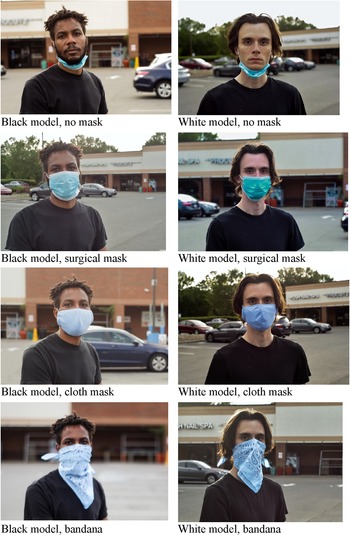
Although respondents read the same text, they were randomly assigned to treatment conditions that varied the photo of Michael Smith that accompanied the text.Footnote 8 We recruited a white and black model both in their mid to late 20s. We chose young-adult male models, specifically, given that stereotypes connecting young black men with criminality are especially strong (Gilliam and Iyengar, Reference Gilliam and Iyengar2000). Both models were similar in height and build. For each model, we have four treatments: (1) no mask, (2) surgical mask, (3) cloth mask, and (4) bandana. We display the eight images in Figure 1. For the no mask condition, models wore their mask around their neck to demonstrate that they possessed a mask, so people did not perceive unmasked models as threatening for not taking proper precautions.Footnote 9 We used a similar color of light blue for all masks, had each model wear a black shirt, and cropped the photos to encourage respondents to focus on the model's face. We chose a light shade of blue for the cloth and bandana face coverings, so they approximated the color of the surgical mask.Footnote 10 The use of a baby blue mask, especially for the cloth and bandana conditions, likely under-estimates any true effect that may exist, as it is a particularly non-threatening color (and relatively uncommon for a bandana).
Experimental conditions.

All photos were taken on a relatively sunny day in the same grocery store parking lot. We suspect the effects of the masks would be more pronounced if we took the photos at night.Footnote 11 After subjects read this story, we asked them two questions. “How trustworthy does Michael Smith seem to be?” using a scale ranging from very trustworthy to not very trustworthy, and “How threatening does Michael Smith seem to be?” using a scale ranging from very threatening to very unthreatening. We recoded all scales onto (0,1) intervals. While these two items tap a similar construct—the extent to which respondents view Michael Smith negatively—they tap different elements of that construct: trustworthiness and threat.Footnote 12
In the analysis below, we split our sample into two groups—whether respondents saw a picture of the black or white model. Although we chose models who were about the same age, height, and weight, it was not practical to identify two who had near identical facial features or hair styles as well, which also could affect evaluations. Software can simulate such similarities, but the resultant images tend to look less realistic than actual human models.
Lastly, although it is possible that black respondents may feel threatened by black men in masks, we expect that a shared racial identity and group consciousness (Dawson, Reference Dawson1994; White et al., Reference White, Laird and Allen2014) should restrain black people from stereotyping masked, black men. Indeed, black people are more likely to use other individuating information in making judgments about the dangerousness of young, black men (Anderson, Reference Anderson2013), which likely helps explain why the mental association between black people and criminality is much weaker for blacks than it is for whites (Quillian and Pager, Reference Quillian and Pager2001). Hence, we focus our analysis on non-black respondents.Footnote 13 This decision is also informed by a literature that illustrates the implications of outgroup racial attitudes among non-black racial minorities. For example, Krupnikov and Piston (Reference Krupnikov and Piston2016) show that not only do Latinos report levels of anti-black prejudice comparable to those of whites, the effect of measures of individual prejudice on their policy opinions (e.g., affirmative action) is also similar. Filindra and Kaplan (Reference Filindra and Kaplan2017) likewise find that Latinos' gun policy preferences are nearly indistinguishable from those of whites, and similarly strongly influenced by racial resentment. In short, our decision to study the racial attitudes of non-black respondents is consistent with extant research. Model results for only white respondents, which are consistent with the findings presented here, are provided in the Supplementary appendix.Footnote 14
3. Results
Despite our best efforts to choose models of different races who were as similar as possible, the experimental conditions in which the two models are not wearing their face coverings—what we use as the baseline condition below—elicited very different and unexpected reactions from respondents. Running counter to decades of research on the perceived threateningness and untrustworthiness of young black men, non-black respondents who saw the black model perceived him as about 12 percentage points less threatening and nine percentage points more trustworthy than those who saw the white model. This reminds us that, although race is an important factor in forming trust and threat judgments, it is not the only factor. Indeed, a burgeoning literature on how different facial features affect perceptions of how trustworthy and hostile people are now exists (see, e.g., Oosterhof and Todorov, Reference Oosterhof and Todorov2008). Whatever the specific explanation, we are quite confident that the disparity results from some feature these two, specific, models possess, not that black men are now generally perceived as less threatening and more trustworthy than white men in the aggregate.
Fortunately, the divergent evaluations of our two models without their masks on do not undermine either of the main thrusts of our analyses. First, we can still compare whether subjects perceive the black model differently depending on what type of mask he is wearing. Statistically different coefficients for the treatment conditions for the black model can establish whether people perceive a young black male more favorably when he is wearing a surgical mask than when he is wearing a cloth or bandana-style mask. Second, we can still assess whether people resolve the ambiguity associated with seeing a man in a mask based on the race of the wearer. The signs on the treatment conditions' coefficients will reveal whether the meaning respondents attribute to masks differs by the race of the wearer. If the coefficients for the mask treatment conditions carry positive signs for the black model and negative signs for the white model, as we expect, it would indicate that masks increase negative perceptions when a black person is wearing them but decrease such perceptions when a white person is wearing them.Footnote 15
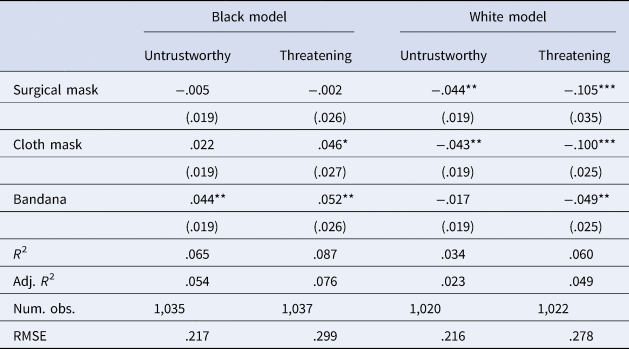
Table 1 includes estimates of treatment effects, using ordinary least squares regressions. We report the results of regression models that do not include any control variables in Supplementary Appendix C. The no mask condition is the reference category, so the coefficient estimates for the three mask conditions represent their effects relative to the model not wearing his face covering. We expect positive signs on the mask conditions for the black model, indicating more negative evaluations of him, with the exception of the surgical mask. Because whites are not associated with criminality, the effects of the various mask conditions for the white model ought to be either insignificant or negative, indicating that they either have no effect or decrease negative perceptions of him.
Treatment effects, among non-black respondents

Note: *p < .10, **p < .05, ***p < .01, two tailed. Model controls for respondent gender, race/ethnicity, ideology, education, income, age, and R's level of racial resentment. Supplementary appendix reports full model results. All variables are scaled 0–1.
Note first that, for the black model, four of the six mask condition coefficients carry a positive sign, suggesting more negative perceptions relative to the no mask condition. The two exceptions are, as expected, the surgical mask entries, which are both statistically insignificant. This implies that a surgical mask does not make the black model appear more threatening or more untrustworthy compared with when he is wearing no mask. For the white model, all six mask condition coefficients are negative, indicating that all the masks decrease negative perceptions of him. Moreover, most of these coefficients are statistically significant.
As for the magnitude of the effects, respondents perceive the black model wearing a bandana mask about four to five percentage points more threatening and untrustworthy than when he is wearing no mask. The cloth mask has about the same adverse effect, but only on perceived threateningness. Also noteworthy, the vanishingly small negative coefficients for the surgical mask condition further imply that, in a statistical sense, respondents perceive a black male in a surgical mask as less threatening than if he is wearing either a cloth or bandana mask, a point we will return to below.
The results for the white model, which appear on the right side of the table, are dramatically different. Not only do all masks make him appear less threatening and more trustworthy compared to the baseline no mask condition, the effects are often quite large. A surgical or cloth mask makes him about ten points less threatening and about four points more trustworthy relative to having no mask. The effect of the bandana mask on perceptions of the white model produces a roughly five-point decrease in perceived threateningness, while its impact on trustworthiness is statistically insignificant.
The results in Table 1 suggest that non-surgical masks increase negative perceptions when worn by a black male, but they do not address all expectations. Specifically, we hypothesized that the negative effects of cloth and bandana masks should manifest more strongly among those with more negative racial attitudes than among those with more positive ones. Although all non-black Americans tend to hold negative stereotypes about black people, the former group is likely to have these negative stereotypes more available in memory, which, we suspect, encountering a young black man in a cloth mask or bandana might cause them to retrieve. Again, consistent with the results in Table 1, we do not expect surgical masks to have the same adverse effect among the highly racially resentful because surgical masks are not connected to criminality, which eliminates the ambiguity attached to why the person is wearing the mask. To test this hypothesis, we split the sample in two—those who scored at or below the median level of racial resentment (.5 on a 0–1 scale) and those who scored above that median—and estimated separate regressions for each.Footnote 16
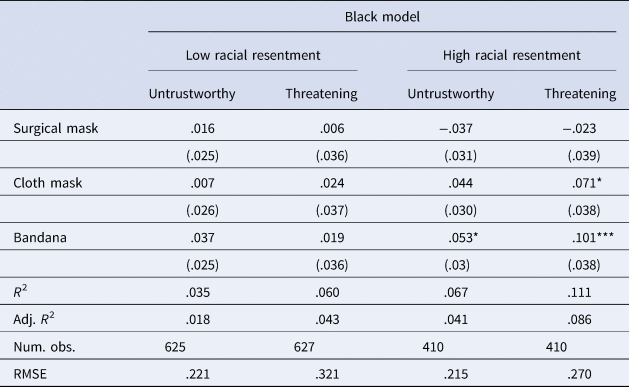
The results for those who saw photos of the black model, which appear in Table 2, generally comport with expectations. They suggest that the treatment effects in Table 1 are largely driven by the more racially resentful. For this group, the effects of the two types of non-surgical masks relative to no mask are substantively large and statistically significant.Footnote 17 For perceptions of threateningness, the cloth and bandana masks increase negative evaluations by 7.1 and 10.1 percentage points, respectively, relative to no mask. Similarly, the bandana boosts perceptions of untrustworthiness by about 5 points relative to the no mask condition. The effect of the cloth mask relative to the model wearing no mask is not statistically significant in the untrustworthiness regression, although it carries the correct sign and approaches conventional levels of significance.
Treatment effects, among non-black respondents by racial resentment level, for black model

Note: *p < .10, **p < .05, ***p < .01, two tailed. Model controls for respondent gender, race/ethnicity, ideology, education, income, and age. Supplementary appendix reports full model results. All variables are scaled 0–1.
A common way to evaluate the substantive significance of treatment effects is to divide their coefficient by the pooled standard deviation of the dependent variable, which produces a value known as Cohen's D, or a d-value. The d-value for the threateningness of a bandana mask relative to no mask, for example, is .101 (its treatment effect) divided by .282 (its pooled standard deviation), yielding a d-value of .36, which is a hearty effect when the data are generated by a survey experiment as ours is. Consistent with the notion that surgical masks carry a different societal connotation than masks in general, the surgical mask condition carries a negative sign in both models, indicating that they lead to less threatening and more trustworthy evaluations.
While the effect of the surgical mask condition does not achieve statistical significance in either model, this judgment reflects its effect relative to the no mask condition, specifically, because we assigned no mask as the reference category. In other words, we cannot be confident in a statistical sense that wearing a surgical mask increases or decreases negative perceptions of the black model compared with when he is not wearing a mask. However, the effects of the surgical mask condition compared with both the cloth and bandana mask conditions are, in fact, substantively large and statistically significant in both judgments of threat and trustworthiness. For threat judgments, these effects can be calculated by taking the signed difference between the surgical and cloth mask conditions (−.023 to .071 = −.094, s.e. = .038, p < .05), and the signed difference between the surgical and bandana mask conditions (−.023 to .101 = −.124, s.e. = .038, p < .01). This indicates that respondents perceive the black model 9.4 percentage points less threatening when in a surgical mask than in a cloth mask and 12.4 percentage points less threatening when in a surgical mask than in a bandana mask. We can also calculate d-values for the surgical mask compared with cloth mask treatment effects (−.094) and the surgical mask compared with the bandana mask treatment effects (−.124) by dividing their respective treatment effects by the pooled standard deviation of the dependent variable. These calculations yield d-values of .33 and .44, respectively, which are again robust.
The same pattern holds for trustworthiness evaluations, although the results are not as strong as they are for perceptions of being threatening. Relative to the no mask condition, specifically, only the bandana mask produces a statistically significant effect. The black model wearing the bandana mask is perceived as 5.3 percentage points less trustworthy than when he is not wearing a mask. However, the effects of both the cloth mask and bandana mask conditions relative to the surgical mask condition are again large and statistically significant as was the case for perceptions of threat. In other words, people perceive the black model as more trustworthy when he is wearing a surgical mask than when he is wearing either a cloth or bandana mask.
To calculate these effects, we again take the difference between the coefficients for the effect of a surgical mask and the cloth mask (−.037 to .044 = −.081, s.e. = .030, p < .01) and the difference between the effect of the surgical mask and bandana mask (−.037 to .053 = −.090, s.e. = .031, p < .01). This indicates that people perceive the black model 8.1 points less untrustworthy if he is wearing a surgical mask compared with when he is wearing a cloth one, and they perceive him as 9.0 percentage points less untrustworthy when he is wearing a surgical mask relative to when he is wearing a bandana mask. Both effects are statistically different from 0 and produce strong d-values of .37 and .41, respectively. Taken together, these results suggest that a surgical mask appears to send an important signal to more racially resentful people who would judge a black mask wearer more negatively in a different type of mask. Not only is a black man in a surgical mask no more or less threatening or trustworthy than a black man without a mask, he is significantly less threatening in a surgical mask than he is in a cloth or bandana mask.
In contrast to the effects among those scoring above the median in racial resentment, the mask conditions have no effect among those who score at or below the racial resentment median. None of the six coefficients approach statistical significance, despite the fact that this category includes 250 cases more than the higher racial resentment category. Indeed, only one coefficient for the low resentment respondents even exceeds its standard error, with the other five usually a small fraction of it.
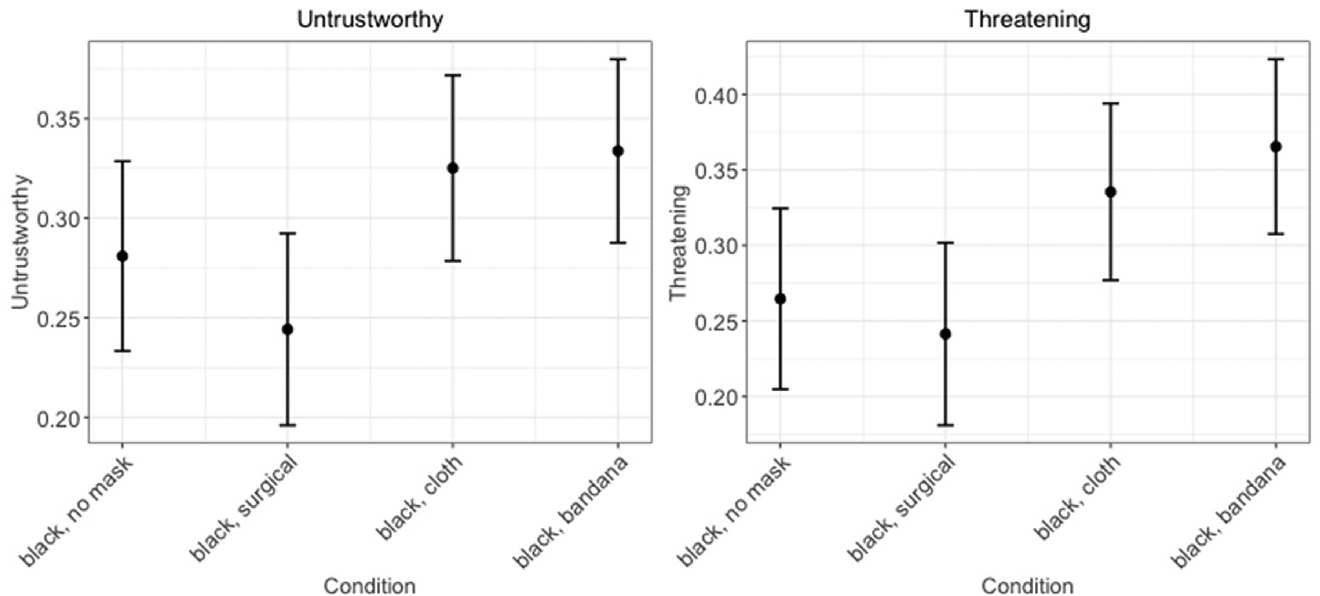
To visualize the substantive implications of these treatment effects among those who score higher on the resentment scale, Figure 2 plots the predicted response to whether the model was perceived as untrustworthy (left panel) or threatening (right panel) by treatment condition. The bandana and mask conditions significantly affect perceptions of untrustworthiness and threat and in the eyes of non-black respondents who score higher in racial resentment.
Predicted response to whether the black model was “untrustworthy” or “threatening” among non-black respondents with higher levels of racial resentment (above the median).

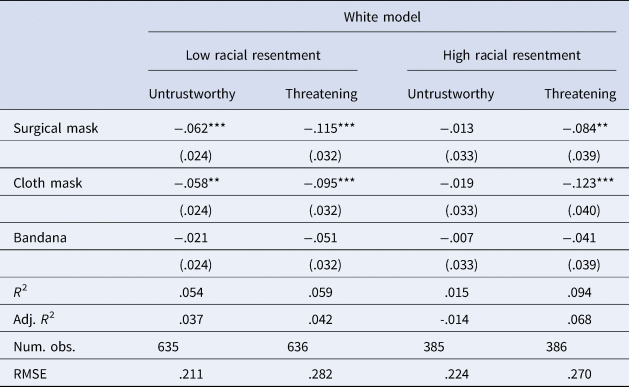
In Table 3, we turn to the results for the white model, with the same non-black respondents split at the racial resentment median. Our aim here is to rule out that those high in racial resentment simply do not react well to cloth and bandana masks no matter the race of the model. If the masks had the same effect regardless of the model's race, it would leave open the possibility that the mask type alone was triggering the treatment effect rather than the combination of the race of the model and the mask type. The results in Table 3 would seem to rule out this possibility. They reveal that all mask types decrease perceptions of threateningness for the white model relative to him not wearing a face covering, with two types of mask achieving statistical significance. Non-black respondents who are higher in racial resentment evaluate the white model as about 12 and 8 percentage points less threatening when wearing a cloth or surgical mask, respectively, than when he is not wearing his mask. The bandana mask condition also carries a negative sign, although it fails to reach statistical significance. As for untrustworthiness, none of the mask conditions exert a statistically significant effect, although again all carry a negative sign.
Treatment effects, among non-black respondents by racial resentment level, for white model

Note: *p < .10, **p < .05, ***p < .01, two tailed. Model controls for respondent gender, race/ethnicity, ideology, education, income, and age. Supplementary appendix reports full model results. All variables are scaled 0–1.
In sum, for non-black respondents who score high in racial resentment, race matters considerably for how models are perceived. Cloth and bandana masks increase perceptions of threateningness and untrustworthiness when the model is a young black man. When the model is a young white man, however, cloth and bandana masks decrease negative perceptions of him.
4. Discussion
In this study, we find that bandana and cloth masks increase negative perceptions of black wearers while surgical masks do not—especially among those who score above the median in racial resentment. Although the differences are not statistically significant, the negative effects of bandanas are consistently larger than those of cloth masks. As is true for many aspects of American life, racial prejudice shapes peoples' perceptions and judgments, even during a global pandemic. Contributing to a wide literature that illustrates how the link between race and criminality has been reinforced through American policing (e.g., Epp et al., Reference Epp, Maynard-Moody and Haider-Markel2014), incarceration (e.g., Alexander Reference Alexander2020), the media (e.g., Gillium and Iyengar Reference Gilliam and Iyengar2000), and electoral politics (e.g., Mendelberg Reference Mendelberg2001), our research suggests COVID-19 is just one of the most recent settings in which criminal tropes affect perceptions of black people. Our findings speak to the tenacious nature of prejudice. In 2020, mask wearing joined a long list of activities that each of us do daily, but that black and white people cannot do equally: “driving while black,” “walking while black,” and now, “wearing a mask while black.” Even in circumstances where not only is everyone mandated to wear a mask, but wearing a mask is a tool for survival and protections of others, prejudice has a persistent hold on the judgement of young black men in the minds of many non-black Americans. As with election administration laws (Ochs, Reference Ochs2006; Hajnal et al., Reference Hajnal, Lajevardi and Nielson2017), police traffic stops (Baumgartner et al., Reference Baumgartner, Epp and Shoub2018), and school dress codes (Pavlakis and Roegman, Reference Pavlakis and Roegman2018), the implications of mask wearing affect black and white people differently.
Insofar as a wide swath of Americans holds negative beliefs about black people—whether it is those in law enforcement or just fellow shoppers—the choice of mask may put black men at further risk. A black man perceived as more threatening and untrustworthy could potentially increase the chances of deadly violence being perpetrated against him. Other scenarios are less deadly but more likely: seeing a woman clutching her purse, being followed at a store, being asked if you are lost in a predominately white neighborhood. From micro-aggressions to physical violence, there are deep consequences to being perceived as a threat and distrusted. This is common knowledge in the black community and group members are doing all that they can to stay safe—both from the virus and from the everyday implications of racist perceptions (Thomas-Deveaux and Butchireddygari, Reference Thomson-DeVeaux and Butchireddygari2020).
Importantly, our results also reveal that some masks should be safer for black people to wear than others. A black model wearing a surgical mask does not enhance negative perceptions compared with being unmasked, and people perceive our black model as more trustworthy and less threatening when he is pictured in a surgical mask than in a cloth or bandana mask. We do not mean to suggest that surgical masks guarantee safety for black wearers. Americans' stereotypes are sure to persist, and surgical masks do not reduce perceptions of threat or untrustworthiness below the baseline condition of not wearing a face covering. Rather, while bandanas and cloth masks enhance perceptions that black men are threatening, surgical masks do not.
Of course, the onus should not be on black people to ensure that non-black people do not see them as threats—and that should not be the takeaway from this work. Instead, we hope that this study serves to help validate what black people already know: wearing a mask can make them seem more threatening to some non-black people, due to negative racial stereotypes. This is not a figment of their imaginations, as Michael Jeffries has noted (Thomas-Deveaux and Butchireddygari, Reference Thomson-DeVeaux and Butchireddygari2020).
Ours should not be the last word on the matter. Idiosyncrasies in the appearances of our models or the details of our fictional news story may have affected our results. Future research might vary the appearance of the model as well as use additional settings. Likewise, Latino men might face biases as well, which should be investigated. Future research might also benefit from including a truly maskless condition where the model neither wears a mask nor visibly possess one.
It is also possible that, to some degree, these results may be time-bound to the beginning of the pandemic when widespread mask-wearing was new, causing ambiguity about the intentions of mask wearers to be high. As masks have become a part of daily life for some time, it may be that seeing a black person in a mask no longer causes the same level of ambiguity. It is also possible that our respondents were influenced by other unique circumstances that were occurring when this survey was fielded, during the first weeks of June 2020. Following the murder of George Floyd by a police officer in MN on May 25, 2020, unprecedented anti-racist protests persisted for weeks throughout the nation. These uprisings were coupled with shifts in public sentiment: more Americans, even across partisan and racial lines, began to recognize the prevalence of police violence toward African Americans and the problems associated with implicit racial bias. In addition, support for the Black Lives Matter movement surged (Parker et al., Reference Parker, Menasce Horowitz and Anderson2020). However, this rising national consciousness of racial bias would have worked against our theoretical expectations, by making it less likely that respondents would rate the black model as threatening and untrustworthy and more likely that they would monitor their prejudices.
There is thus more reason to continue to explore these relationships, as they may have evolved. Nonetheless, in a post-COVID-19 world where masking may well remain a long-term component of daily American life (Crist, Reference Crist2020), we believe these findings should be a call for ongoing research and a guide to individuals and policymakers in thinking about masks.
Supplementary material
The supplementary material for this article can be found at https://doi.org/10.1017/rep.2021.9.
Author contributions
All authors contributed equally to this work.