1. Introduction
Parentheticals are expressions of varying length and complexity, syntactic category and function, which are interpolated into the current string of the utterance. According to many authors, they are linearly, but not hierarchically, integrated into the structure of the host clause. Among the elements that have been considered parentheticals in the literature are such elements as one-word expressions (e.g. what; see (1a)), sentence adverbials (e.g. however, unfortunately; see (1b)) and adverbial clauses, comment clauses (e.g. I think, I believe, I suppose; see (1c)), reporting verbs (e.g. he said, said she; see (1d)), vocatives, nominal appositions, non-restrictive relative clauses (NRRC; see (1e)), question tags, and full or elliptical clauses (see (1f, g)). See Dehé & Kavalova Reference Dehé, Kavalova, Dehé and Kavalova2007, Kaltenböck Reference Kaltenböck, Dehé and Kavalova2007 for recent overviews. In the examples given in (1), the parentheticals are in bold.Footnote 2
(1) Parentheticals
(a) uh you get it out of the computer every what six months or something and have a look at it
(Dehé & Kavalova Reference Dehé and Kavalova2006: 290)(b) He is, unfortunately, ill.
(Urmson Reference Urmson1952: 486)(c) There were no other applicants, I believe, for that job.
(Quirk et al. Reference Quirk, Greenbaum, Leech and Svartvik1985: 1113)(d) The reason for the Prime Minister's resignation she said was to enable Cabinet colleagues to enter the ballot
(ICE-GB: s2b-020 #13)(e) so the word disability which is this nebulous thing that exists somewhere between the two people has a part on each side
(ICE-GB: s1a-001 #59)(f) […] if the plaintiff has succeeded on those four points then he or she will get damages because there's no defence like justification or truth I shall say a little bit more about that later put forward
(ICE-GB: s2a-061 #85)(g) For those of us who remember nineteen sixty-five one or two of our listeners may Tory party leadership contests used to be as the cardinals in Rome and leaders would emerge
(ICE-GB: s1b-024 #1)
It is a common assumption that intonation is a defining feature of parenthetical interpolations (see Astruc Reference Astruc2005 for a recent overview). Parentheticals are marked by variations in pitch, tempo and loudness (Crystal Reference Crystal1969; Bolinger Reference Bolinger1989; Wichmann Reference Wichmann2000, Reference Wichmann and Aijmer2001; among many others). Most importantly in the present context, NRRCs and parentheticals are assumed to be obligatorily phrased in a separate Intonational Phrase (Nespor & Vogel Reference Nespor and Vogel1986: 188–190; see also Selkirk Reference Selkirk1984: 295–296, Reference Selkirk and Goldsmith1995a: 567; Truckenbrodt Reference Truckenbrodt2005: 275; the assumption goes back at least to Downing Reference Downing1970). Intonational separateness is also commonly taken for granted among linguists discussing the syntax or semantics of parentheticals (e.g. Haegeman Reference Haegeman, Chiba, Ogawa, Fuiwara, Yamada, Koma and Yagi1991: 250; Potts Reference Potts2002, Reference Potts2005; D'Avis Reference D'Avis and D'Avis2005: 262; Burton-Roberts Reference Burton-Roberts and Brown2006: 180; among others). The idea is mainly based on syntactic criteria: parentheticals are commonly argued to be either external to the syntactic structure of their host (e.g. Haegeman Reference Haegeman, Chiba, Ogawa, Fuiwara, Yamada, Koma and Yagi1991, Espinal Reference Espinal1991, Peterson Reference Peterson, Collins and Lee1999, Burton-Roberts Reference Burton-Roberts, Collins and Lee1999, Haider Reference Haider and D'Avis2005, though naturally these accounts differ in the way they handle the lack of structural relation), or only very loosely related to it, e.g. in terms of adjunction (e.g. Emonds Reference Emonds, Corum, Smith-Stark and Weiser1973, Reference Emonds1976, Reference Emonds1979; Ross Reference Ross, Gross, Halle and Schützenberger1973; McCawley Reference McCawley1982; Corver & Thiersch Reference Corver, Thiersch, Oostendorp and Anagnostopoulou2002; Potts Reference Potts2002; D'Avis Reference D'Avis and D'Avis2005), insertion (Ackema & Neeleman Reference Ackema and Neeleman2004), or adjunction of a maximal projection which involves the application of b-Merge (de Vries Reference Vries2005, Reference Vries, Dehé and Kavalova2007).Footnote 3 Similarly, NRRCs have often been assumed to be outside the syntactic representation of the embedding sentence (e.g. Safir Reference Safir1986, Fabb Reference Fabb1990, Espinal Reference Espinal1991, Burton-Roberts Reference Burton-Roberts, Collins and Lee1999, Peterson Reference Peterson2004; see Arnold Reference Arnold2007 for an overview and critical account). The idea is that a constituent that is at best loosely related to the syntactic structure of the host cannot be prosodically integrated at the same time. Among the attested cues to intonation breaks around parentheticals are pauses (e.g. Altmann Reference Altmann1981, Bolinger Reference Bolinger1989, Taglicht Reference Taglicht1998, Payà Reference Payà2003, Astruc Reference Astruc2005), a falling–rising pitch at the end of the immediately preceding domain (Local Reference Local, Auer and Luzio1992), and the blocking of sandhi rules (e.g. Frota Reference Frota2000). Experimental work using read speech has confirmed the idea about separate phrases (e.g. Frota Reference Frota2000, Fagyal Reference Fagyal2002, Astruc Reference Astruc2005).
However, it has long been understood that prosodic phrasing in general and Intonation Phrase boundary placement in particular are not determined by syntax alone, even if the syntactic boundaries are strong (i.e. if they are clause boundaries). Other relevant factors include syntactic and prosodic length/complexity/weight, balanced prosodic constituent size, performance factors such as speech rate and style, focus, contrastive prominence, and semantic coherence (see e.g. Cooper & Paccia-Cooper Reference Cooper and Paccia-Cooper1980; Gee & Grosjean Reference Gee and Grosjean1983; Selkirk Reference Selkirk1984, Reference Selkirk and Horne2000, Reference Selkirk and Frota2005; Nespor & Vogel Reference Nespor and Vogel1986; Ferreira Reference Ferreira1991, Reference Ferreira1993; Ghini Reference Ghini1993; Frota Reference Frota2000; Sandalo & Truckenbrodt Reference Sandalo and Truckenbrodt2002; Jun Reference Jun2003; Frazier et al. Reference Frazier, Clifton and Carlson2004; Watson & Gibson Reference Watson and Gibson2004; D'Imperio et al. Reference D'Imperio, Elordieta, Frota, Prieto, Vigário and Frota2005; Elordieta et al. Reference Elordieta, Frota and Vigário2005; Prieto Reference Prieto2005; Hellmuth 2008).
Moreover, the intonational features of parentheticals have been argued to depend on a variety of factors, among them their length/relative weight, syntactic make-up and position (e.g. Bolinger Reference Bolinger1989). Certain types of relatively short parentheticals such as comment clauses, reporting verbs, question tags and vocatives may be prosodically integrated into either the preceding or the following intonation domain (e.g. Armstrong & Ward Reference Armstrong and Ward1926, Schubiger Reference Schubiger1958, Crystal Reference Crystal1969, Taglicht Reference Taglicht1998, Wichmann Reference Wichmann and Aijmer2001, Gussenhoven Reference Gussenhoven2004, Peters Reference Peters2006, Wells Reference Wells2006, Dehé Reference Dehé, Dehé and Kavalova2007, Dehé & Wichmann to appear). Peters' (Reference Peters2006) data reveal a link between prosodic integration and the size of the interpolation in terms of number of syllables, such that shorter parentheticals are more likely to be prosodically integrated than longer ones. For NRRCs, psycholinguistic research has shown that the placement of an intonational boundary before the NRRC is far from obligatory; instead, it depends on position in the sentence along with discourse status (Watson & Gibson Reference Watson and Gibson2004).
The present study focuses on three types of expressions commonly considered parentheticals in previous research: comment clauses (CCs), non-restrictive relative clauses (NRRCs), and sentential parentheticals. The study makes use of a large set of data from spoken British English. It is based on corpus material taken from the British Component of the International Corpus of English (ICE-GB, version 3.0; see Nelson, Wallis & Aarts Reference Nelson, Wallis and Aarts2002). The use of spoken corpus data is particularly valuable for the following reasons. From an empirical perspective, most previous studies on parentheticals have been based on native speaker intuition, on a relatively small number of made-up examples, or on carefully manipulated experimental data. The present study investigates whether the assumptions about the behaviour of parentheticals prove to be true for actual spoken language. From a theoretical perspective, data from natural speech, as archived in corpus material, has not yet been systematically exploited in prosodic theory. This study therefore represents an important contribution to the debate in this area, in particular the discussion on intonational phrasing. The remainder of the paper is organised as follows. Section 2 introduces the prosodic theoretical background. Section 3 provides details on the nature of the data, their source, retrieval and analysis. In section 4, the results of the analysis are presented. The findings are discussed against the background of prosodic theory in section 5. Section 6 serves as a conclusion and outlook.
2. Background
2.1 Intonational phrasing
As outlined above, parentheticals have been argued to be phrased in a separate prosodic constituent, specifically the Intonational Phrase (IP) or intonation domain. Therefore, a word is in order on the nature of the relevant prosodic constituent, and on intonational phrasing in general.
Prosodic constituents have been defined in a number of different approaches (see Shattuck-Hufnagel & Turk Reference Shattuck-Hufnagel and Turk1996 for an overview). In the framework of Pierrehumbert (Reference Pierrehumbert1980), Beckman & Pierrehumbert (Reference Beckman and Pierrehumbert1986) and Pierrehumbert & Hirschberg (Reference Pierrehumbert, Hirschberg, Cohen, Morgan and Pollack1990), the IP is intonationally defined. It is the domain of a complete intonational contour, i.e., it has at least one nuclear pitch accent and it is terminated by a boundary tone (T%). English has two types of boundary tones: high (H%) and low (L%) (Beckman et al. Reference Beckman, Hirschberg, Shattuck-Hufnagel and Jun2005, Jun Reference Jun and Jun2005, and much previous work). H% serves to indicate continuation as well as the end of yes-no questions, while L%, if in sentence-final position, typically terminates declaratives and wh-questions (see Pierrehumbert & Hirschberg Reference Pierrehumbert, Hirschberg, Cohen, Morgan and Pollack1990, Hirschberg Reference Hirschberg, Horn and Ward2004, Nolan Reference Nolan, Aarts and McMahon2006 among others). In the prosodic hierarchy, the IP is dominated by the Phonological Utterance. Each IP is made up of one or more prosodic constituents one level down in the hierarchy: the intermediate phrase (ip) in Pierrehumbert's and related work, which in turn is made up of one or more prosodic words (PWd). Like Pierrehumbert and colleagues, Nespor & Vogel (Reference Nespor and Vogel1986: 188) see the IP as the domain of an intonation contour. Moreover, in their framework IP edges are defined along the lines of segmental rule application (Nespor & Vogel Reference Nespor and Vogel1986: 205–216; see also Frota Reference Frota2000).
A root clause in syntax is commonly assumed to correspond to an IP in prosody (e.g. Downing Reference Downing1970; Emonds Reference Emonds1976, Reference Emonds1979; Nespor & Vogel Reference Nespor and Vogel1986). According to Selkirk (Reference Selkirk1984) the IP is semantically rather than syntactically constrained, such that it is subject to the Sense Unit Condition. More recently, Selkirk (Reference Selkirk and Frota2005) identifies the IP with a Comma Phrase, which is marked by the comma feature (Potts Reference Potts2005). Semantically speaking, the Comma Phrase is independent of the at-issue entailments of the sentence to which it is adjoined.
An intonation domain (or tone unit, or tone group) in the British tradition of intonation analysis is similar to the IP in that it, too, is defined in terms of a complete tonal contour. It consists of an obligatory nucleus, which is optionally preceded by a prehead (any unstressed syllables preceding the head) and head (reaching from the first accented syllable preceding the nucleus to the nucleus), and followed by the tail (any unstressed syllables following the nucleus before the end of the domain); see e.g. Crystal (Reference Crystal1969, Reference Crystal and Bolinger1972), and see Gussenhoven (Reference Gussenhoven2004: chapter 15) for a recent description of tonal contours occurring in English. Along with a complete tonal contour and phonological rule application, a number of other internal and external criteria have been identified which help to determine the extension of an intonation domain/IP. Domain-internally, there must be pitch movement to or from at least one accented syllable. The major patterns of nuclear tones identified in the British tradition of intonation analysis include the fall (from a high accented syllable), rise (from a low accented syllable), fall–rise, and rise–fall. Nuclear tones begin on the nucleus and cover the stretch of utterance up to the right-hand boundary of an intonation domain.
Whereas the British tradition makes reference to the shape of the tonal contour, Pierrehumbert's system uses tonal targets to describe pitch accents. A fall would correspond to H*L (a high, stressed target followed by a fall to a low target), while a rise corresponds to L*H (a low, stressed target followed by a rise). There is no equivalent for T% in the British tradition. Instead, ‘British nuclear tones such as fall–rise conflate the pitch movement on the last accent (e.g. fall) with the pitch movement at the end of the phrase (e.g. rise)’ (Ladd Reference Ladd1996: 88). At the end of an intonation domain, a fall–rise would thus correspond to H*L+H%, and a rise–fall to L*H+L%.
Pauses, both filled (e.g., uh, uhm) and silent, have also been considered boundary markers (e.g. Nespor & Vogel Reference Nespor and Vogel1986: 188). However, since they are not obligatory and their occurrence, length and position depend on a number of factors (see Krivokapić Reference Krivokapić2007 for a recent overview), pauses cannot be considered reliable cues. It is therefore important to distinguish between structure-related (breath-)pauses on the one hand, and hesitational or performance-related stretches on the other hand. Potentially more reliable cues include pitch reset (Gussenhoven Reference Gussenhoven2004 and references given there) and domain-final lengthening (e.g. Vaissière Reference Vaissière, Cutler and Ladd1983, Gussenhoven & Rietveld Reference Gussenhoven and Rietveld1992, Ferreira Reference Ferreira1993). Furthermore, the change in pitch level and/or direction on unaccented syllables following a nuclear tone has been seen as ‘a fairly clear boundary marker’ (Cruttenden Reference Cruttenden1997: 34). Specifically, after a falling tone followed by a low unaccented syllable there will be a step-up to the pitch level of the unaccented syllable at the beginning of a new intonation domain, while after a rising tone, there is ‘a step-down to the pitch level of any unaccented syllables at the beginning of the following [domain]’ (Cruttenden Reference Cruttenden1997: 34).
Of further interest in the present context is the work documenting the prosodic transcription and labelling in the Lancaster/IBM Spoken English Corpus (see Knowles Reference Knowles, Johansson and Stenström1991). The boundary cues fall into three categories: temporal discontinuities, which essentially include silent and filled pauses and final lengthening, and combinations of these; pitch discontinuities, which essentially correspond to Cruttenden's (Reference Cruttenden1997) changes in pitch level as outlined above; and segmental discontinuities, which refer to processes of connected speech such as the blocking vs. presence of assimilation, elision, r-linking, [j, w] glides after close vowels, gemination of stop phases, and contraction (Knowles Reference Knowles, Johansson and Stenström1991: 151ff.).
2.2 Parentheticals in prosodic theory
The idea that parentheticals are obligatorily phrased into their own IP is mostly based on the assumption that IPs are syntactically constrained and parentheticals are syntactically independent. Selkirk (Reference Selkirk1984: 295) gives this idea a semantic grounding: IP formation is constrained by the Sense Unit Condition. A sense unit is defined in terms of modifier–head and argument–head relations (Selkirk Reference Selkirk1984: 291). Since elements such as ‘vocatives, certain types of parentheticals, tag questions, and other sorts of nonargument, nonmodifier expressions’ do not form a sense unit with the host or any of its parts, they ‘should be fated to constitute IPs on their own’ (Selkirk Reference Selkirk1984: 295).
Nespor & Vogel (Reference Nespor and Vogel1986: 189–190) assume that the strings preceding and following a parenthetical also form IPs on their own, even if they would not do so otherwise. This yields the phrasing patterns in (2). The examples in (3) (from Nespor & Vogel Reference Nespor and Vogel1986: 189, 190) serve to illustrate (2a).
- (2)
(a) … IP[…]IPIP[parenthetical]IPIP[…]IP …
(b) IP[parenthetical]IPIP[…]IP …
(c) … IP[…]IPIP[parenthetical]IP
- (3)
(a) IP[Isabelle is]IPIP[as you know]IPIP[an artist]IP
(b) IP[Charles wouldn't]IPIP[I imagine]IPIP[have done such a thing]IP
Elsewhere in the literature, it has been argued that the presence of the parenthetical does not force preceding and following material into separate IPs; i.e., a non-recursive structure such as (2a) is not mandatory. Specifically, experimental research by Cooper & Sorensen (Reference Cooper and Sorensen1981) using data of the kind given in (5a) shows that the presence of a parenthetical does not affect the overall declination, i.e. the gradual lowering of pitch, of the utterance. Rather, the downward trend begun on material preceding the parenthetical is continued after the end of the parenthetical insertion. Ladd (Reference Ladd1986, Reference Ladd1996) argues that under the assumption that declination applies across an intonational domain of type IP (see also section 3.2.2 below), Cooper & Sorensen's findings can be accounted for in terms of limited recursivity in prosodic structure. Specifically, he suggests an analysis in terms of a Compound Prosodic Domain (CPD; see (4)), a structure which is analogous to a compound in morphosyntax. The phrasing in (5b) illustrates the non-recursive (default) structure as suggested by Nespor & Vogel; (5c) gives the CPD structure as suggested by Ladd. In a CPD structure, the matrix clause forms a single domain (i.e. the outer IP) across which declination applies, regardless of whether or not it is interrupted by another domain (here: the parenthetical). Further empirical support for the CPD has been provided by Frota (Reference Frota2000: 60–77), also using data involving parenthetical insertions. She finds that the IP which embeds the parenthetical, i.e. the outer IP, has one intonational contour, while sandhi processes bound by the IP apply at the boundary separating the IP spanning the parenthetical from the matrix IP. Dehé & Kavalova (Reference Dehé and Kavalova2006) argue for an analysis of the prosodic phrasing of parenthetical what along the lines of the CPD.
(4) Compound Prosodic Domain (Ladd Reference Ladd1996: 244)
A CPD is a prosodic domain of a given type X whose immediate constituents are themselves of type X.
- (5)
(a) The book on the table, it seems to me, was a gift from my mother.
(b) [The book on the table] [it seems to me] [was a gift from my mother]
(c) [The book on the table [it seems to me] was a gift from my mother]
Also relevant is Gussenhoven's (Reference Gussenhoven2004: 290–292) analysis of certain ‘extra-sentential elements’, including reporting verbs, comment clauses, and vocatives among others (Bing's Reference Bing1985 ‘Class 0 expressions’). According to Gussenhoven (Reference Gussenhoven2004: 291), these elements come in two types, both of which are unaccented: (i) they may be included in the preceding IP (‘incorporation’), or (ii) they may be encliticised. By contrast, accented extra-sentential elements are phrased separately. The respective phrasings are given in (6), with examples in (7).
- (6)
(a) IP[… ES]IP incorporation
(b) IP[IP[…]IP ES]IP encliticisation
(c) IP[…]IPIP[ES]IP separation
(adapted from Gussenhoven Reference Gussenhoven2004: 291; ES=extra-sentential element)
- (7)
(a) IP[Is it TRUE she asked]IP incorporation
(b) IP[IP[Is it TRUE]IPshe asked]IP encliticisation
(c) IP[It's TRUE]IPIP[ISn't it]IP separation
(adapted from Gussenhoven Reference Gussenhoven2004: 292)
Unlike incorporated material, enclitised material is set off from preceding material by a boundary tone (Gussenhoven Reference Gussenhoven and Ramsaran1990). It receives a copy of the tones after the last stressed syllable. For example, if the nuclear pattern is H*LL% (fall), then LL is copied onto the encliticised material. If the nuclear pattern is H*LH% (fall–rise), then LH is copied onto the encliticised material. This has been referred to as ‘tone copy’ (see Gussenhoven Reference Gussenhoven and Ramsaran1990, Reference Gussenhoven2004).
Under the assumption that parentheticals are hierarchically unintegrated constituents of their host sentence, it is not clear whether current prosodic theory covers parentheticals at all. Prosodic theory has as its input the output of the syntactic component. If parenthetical and host are separate syntactic structures and linearisation is a matter of one of the interface modules, in particular if this is the interpretational module, prosodic theory will not have access to both the host and the parenthetical in the same mapping process. Prosodic integration will thus be hard to explain. De Vries (Reference Vries, Dehé and Kavalova2007: 220) arrives at the same conclusion. He argues that since parentheticals ‘are interpreted as well as pronounced … they must be present at the LF interface and at the PF interface’ and that ‘[a]ccording to standard assumptions about the organisation of the grammar, there is only one way to get at these interfaces, namely via the overt syntax’. He concludes that ‘parataxis must be represented in syntax’.
Under the assumption of syntactic integration of any kind, on the other hand, parentheticals will be subject to the interface constraints of prosodic theory. The types of parentheticals investigated here have been conceived as root clauses (e.g. Downing Reference Downing1970, Emonds Reference Emonds1979, Nespor & Vogel Reference Nespor and Vogel1986, Safir Reference Safir1986, Fabb Reference Fabb1990 for NRRCs, Espinal Reference Espinal1991) or as sentence adverbials (e.g. Jackendoff Reference Jackendoff1972 for CCs). A root clause in syntax corresponds to an IP in prosody (see also Downing Reference Downing1970; Emonds Reference Emonds1976, Reference Emonds1979; Nespor & Vogel Reference Nespor and Vogel1986; (8) is from Truckenbrodt Reference Truckenbrodt2005: 275).
(8) Root clauses (but not embedded clauses) are bounded by obligatory intonation phrases boundaries.
In Selkirk (Reference Selkirk and Frota2005), it is the Comma Phrase (see Potts Reference Potts2005) rather than the root clause that corresponds to the IP. Parentheticals are a type of Comma Phrase. The relation between Comma Phrase and IP, Selkirk argues, can be captured in terms of the alignment constraint given in (9), which belongs to the family of well-known prosodic edge alignment constraints and aligns the right edge of a Comma Phrase with the right edge of an IP. This constraint predicts an IP boundary at the right edge but not the left edge of a parenthetical, and thus predicts the structures in (10) along with (2) above. In a footnote, Kratzer & Selkirk (Reference Kratzer and Selkirk2007: 125) suggest that there might be full correspondence between CommaP and IP.
(9) Align R (CommaP, IP)
Align the right edge of a constituent of type Comma Phrase in syntactic representation with the right edge of an Intonational Phrase in phonological representation.
- (10)
(a) IP[…]IPIP[… parenthetical]IPIP[…]IP
(b) IP[… IP[… parenthetical]IP …]IP
(c) IP[… part of parenthetical]IPIP[part of parenthetical]IPIP[…]IP
For Complementiser Phrases (CPs), Truckenbrodt's (Reference Truckenbrodt2005) WrapCP constraint demands that each CP be contained in a single IP. It is tied to an AlignCP constraint which requires the right edge of a CP to coincide with the right edge of an IP. This pair of constraints thus predicts phrasing of NRRCs and other sentential parentheticals in one IP, but allows for additional material in the same domain at its left periphery; accordingly, it predicts (2) and (10a, b), but not (10c).
Under the assumption that sentence adverbials project their own phrase in syntax which is adjoined to the clause they modify, they will also be mapped onto their own intonation domain.
Based on this background, the predictions for the data analysis can be summarised as follows:
(11) Predictions
(a) The right edge of a parenthetical coincides with the right edge of an IP.
(b) According to Nespor & Vogel's (Reference Nespor and Vogel1986) obligatory phrasing of parentheticals, the left edge of a parenthetical should also coincide with an IP boundary, and phrasing is non-recursive. However, according to Selkirk's (Reference Selkirk and Frota2005) align constraint and Truckenbrodt's (Reference Truckenbrodt2005) constraint tie, the left edge of a parenthetical does not have to coincide with the left edge of an IP unless preceded by a clausal boundary in syntax.
(c) According to Ladd's (Reference Ladd1986, Reference Ladd1996) CPD analysis, the parenthetical may form a separate IP which is embedded in the IP of the host material.
(d) The prosodic properties of parentheticals and the relation between their syntax and prosody provide supportive evidence for syntactic integration of parentheticals.
3. Data analysis
The current section provides details on the nature, source and treatment of the data that will be used here to find out more about the intonational phrasing of parentheticals and to test the predictions based on previous research in prosodic theory.
3.1 Data: types of parentheticals under investigation
The following three types of parenthetical elements as used in actual spoken language are investigated: non-restrictive relative clauses (NRRCs), sentential parentheticals, and comment clauses (CCs).
3.1.1 Non-restrictive relative clauses (NRRCs)
NRRCs function as modifiers that add information to the constituent they modify. Examples are given in (12) (from Quirk et al. Reference Quirk, Greenbaum, Leech and Svartvik1985: 1257, Arnold Reference Arnold2007: 272).
(12) NRRCs
(a) I spoke to Dr. Spolsky, who was unwilling to give further details.
(b) I bought the cheapest book, which was not a paperback.
(c) Kim won the race, which was a relief.
As opposed to restrictive relative clauses, NRRCs do not delimit the interpretation of their referent (Arnold Reference Arnold2007: 272). Often, NRRCs modify proper nouns, which have a single referent by their very nature, and the function of the NRRC is to add further information about this referent (see (12a)). NRRCs are often optional, and they can usually occur as a separate clause (e.g. Quirk et al. Reference Quirk, Greenbaum, Leech and Svartvik1985: 1258–1259, Arnold Reference Arnold2007: 272). They are used to modify not only noun phrases but other categories as well. In (12c), for example, the NRRC modifies the clausal constituent Kim won the race (see Arnold Reference Arnold2007: 274 for examples of NRRCs modifying PP, AP, and VP). In writing, NRRCs are typically separated from their host by commas (Arnold Reference Arnold2007: 272, Quirk et al. Reference Quirk, Greenbaum, Leech and Svartvik1985: 1258). In prosody, they are commonly assumed to be phrased in a separate domain (Selkirk Reference Selkirk1984, Arnold Reference Arnold2007: 272). NRRCs have often been assumed to be outside the syntactic structure of their containing host, and to be structurally identical to parentheticals (e.g. Emonds Reference Emonds1979: 216, Safir Reference Safir1986).
3.1.2 Sentential parentheticals
A sentential parenthetical belongs to one of the following types:
(i) interpolations which are syntactically complete and could stand alone as independent sentences (see (13a) for a declarative, (13b) for an interrogative)Footnote 4
(ii) clausal as-parentheticals (e.g. Potts Reference Potts2002; see (14))
(iii) and-parentheticals (e.g. Blakemore Reference Blakemore2005, Kavalova Reference Kavalova, Dehé and Kavalova2007; see (15)).
(13) Complete, independent sentences
(a) Newcastle and North you find uhm there's a marvellous walled garden I don't know where it is with hyacinths (ICE-GB: s1a-065 #298)
(b) Well esterases are able in organic solvents to carry out a number of useful can you hear me all right now organic uhm processes to produce things like food products (ICE-GB: s2a-034 #13)
(14) Clausal as-parentheticals
(a) Ames, as the FBI eventually discovered, was a spy. (Potts Reference Potts2002: 624)
(b) Heliopolis today is effectively a suburb a north-eastern suburb of Cairo and is as you can see perhaps from this slide remarkably industrial wasteland …
(ICE-GB: s2a-026 #54)
(15) And-parentheticals
(a) In fact I was very candidly told and I repeat my acknowledgement of the candour that it was placed before him in January last (ICE-GB: s2a-063 #83)
(b) Will the Minister confirm that come the single uh Common Market that three hundred million EEC nationals could and I emphasise could seek employment in this country without the need to obtain a work permit
(ICE-GB: s1b-059 #40)
Other types of sentential parentheticals, such as elliptical parenthetical clauses (see (1g)), were disregarded for the purposes of the present analysis in order to keep this data set as homogenous as possible.
3.1.3 Comment clauses (CCs)
Comment clauses (CCs) are elements such as I think, I suppose, I imagine, I'm afraid, etc. (e.g. Quirk et al. Reference Quirk, Greenbaum, Leech and Svartvik1985: 1112ff.). They typically consist of a first-person pronoun and a verb of knowledge, belief or conjecture or a corresponding adjectival construction.Footnote 5 CCs occur sentence-finally and sentence-medially between or within syntactic constituents (see (16); examples from Emonds Reference Emonds, Corum, Smith-Stark and Weiser1973: 333, Quirk et al. Reference Quirk, Greenbaum, Leech and Svartvik1985: 1113, Nespor & Vogel Reference Nespor and Vogel1986: 190).
(16) CCs
(a) John came later than Sue, I think.
(b) John came, I think, later than Sue.
(c) John, I think, came later than Sue.
(d) There were no other applicants, I believe, for that job.
(e) Charles wouldn't, I imagine, have done such a thing.
Due to their nature as incomplete clauses, the parenthetical analysis of CCs, which goes back at least to Jespersen (Reference Jespersen1937), is more controversial than that of NRRCs and sentential parentheticals. The parenthetical analysis is common in the semantic-pragmatic literature (e.g. Urmson Reference Urmson1952, Thompson & Mulac Reference Thompson, Mulac, Traugott and Heine1991, Aijmer Reference Aijmer, Swan and Westvik1997), and recent work has added prosodic evidence for their parenthetical status (Dehé & Wichmann to appear). In the syntactic literature, however, there has been a debate as to whether CCs are best analysed as base-generated parentheticals (e.g. Jackendoff Reference Jackendoff1972: 94–100; Emonds Reference Emonds, Corum, Smith-Stark and Weiser1973, Reference Emonds1976; Peterson Reference Peterson, Collins and Lee1999) or whether they should be derived by some syntactic movement operation from an underlying structure which features the CC as a main clause taking the rest of the sentence as its complement (e.g. Ross Reference Ross, Gross, Halle and Schützenberger1973).Footnote 6 Arguments in favour of the movement analysis include the superficial relation between sentences such as (16a, b, c) on the one hand and (17) on the other hand, which seems to suggest that (17) is the underlying structure and (16a, b, c) are derived from it by syntactic movement across the CC, for example under topicalisation or focus movement, or some other stylistically driven operation.
(17) I think (that) John came later than Sue. (from Emonds Reference Emonds, Corum, Smith-Stark and Weiser1973: 333)
Other cases that seem structurally ambiguous between a parenthetical and a structure derived by movement include relative clauses such as those given in (18). According to standard syntactic assumptions, the relative pronoun ends up in the clause-initial position as a result of wh-movement into the specifier of a functional projection. A structure where the relative pronoun moves not only across material inside its own clause but also across the CC (as main clause) can therefore not be entirely ruled out.
- (18)
(a) And he said I can well believe that you've gone through an exhaustive search because you've made a choice of candidate which I think is brilliant (ICE-GB: s2a-028 #134)
(b) I think it is far better to increase the amount of democracy rather than to go ahead and reduce it which I believe would be wrong at this time (ICE-GB: s1b-053 #46)
However, often the string preceding the CC is not a syntactic constituent; see (16b, d, e). Surface structures like these cannot reasonably be seen as the result of syntactic movement (see also Jackendoff Reference Jackendoff1972: 96–97). Further arguments in favour of the parenthetical analysis include the fact that CCs do not lend themselves to certain main clause phenomena. In (19), for example, the main verb left and its complement, but not the interpolated CC, can be questioned. In (20), the simple present tense can be used for future reference only when the futurity of the event is predictable due to the presence of the matrix verb hope, but not when hope is part of a CC (see Peterson Reference Peterson, Collins and Lee1999). This also holds when the string preceding the CC is a constituent, such as the subject in (20e).
(19) A: Mary, I think, left early. B: #Do you?
B: Did she?
(20) Tense
(a) The rain will stop before Sunday.
(b) *The rain stops before Sunday.
(c) I hope the rain stops before Sunday.
(d) *The rain stops, I hope, before Sunday.
(e) *The rain, I hope, stops before Sunday.
((a)–(d) from Peterson Reference Peterson, Collins and Lee1999: 235; examples reordered)
Moreover, CCs can occur with interrogatives and imperatives, but the respective host clauses cannot occur as subordinate clauses in Standard English (see the contrasts in (21) and (22), respectively; examples from And Rosta, personal e-mail). Jackendoff (Reference Jackendoff1972: 97) notes that ‘the parenthetical must be of “positive” import, and there is no convenient way’ to account for this under a movement analysis (see (23), from Jackendoff Reference Jackendoff1972: 97).
- (21)
(a) Will she, I wonder, be late?
(b) *I wonder will she be late.
- (22)
(a) Do not, I beg you, be late.
(b) *I beg you do not be late.Footnote 7
- (23)
(a) John is, I think, a fink.
(b) *John is, I don't think, a fink.
(c) *John is, I doubt, a fink.
(d) John is, I don't doubt, a fink.
Finally, according to Quirk et al. (Reference Quirk, Greenbaum, Leech and Svartvik1985: 1113), (24b) is not an exact paraphrase of (24a). While the CC in (24b) has a hedging meaning, they argue, the main clause in (24a) may have ‘a more definite meaning’. That the alleged ‘transformation does not preserve meaning’ has also been noted by Jackendoff (Reference Jackendoff1972: 97). Quirk et al. (Reference Quirk, Greenbaum, Leech and Svartvik1985: 1113) suggest a ‘reversal of syntactic roles’, i.e. a reversal of ‘the relationship of subordination between the two clauses’. This implies that (24b) cannot have been derived from (24a) by a syntactic movement operation, since movement may not alter the underlying relation between constituents (see Emonds' Reference Emonds1976 Structure-Preserving Constraint).
- (24)
(a) I believe (that) there were no other applicants for that job.
(b) There were no other applicants, I believe, for that job.
In light of all this evidence, intermediate and final CCs are considered parentheticals in this paper. However, in order to remove any remaining ambiguity in syntactic structure, all CCs occurring in a position preceded by a syntactic constituent such as a subject (see (25a)), a full clause (see (25b)) or a relative pronoun (see (18)) were discarded from the analysis.
- (25)
(a) The voters I think just have an opportunity to stick two fingers up to whoever seems to be on top at the moment (ICE-GB: s1b-029 #92)
(b) The rice is marvellous I think (ICE-GB: s1a-022 #92)
3.2 Data source and data treatment
3.2.1 Data source and retrieval
The data for this study were drawn from the spoken part of the British Component of the International Corpus of English (ICE-GB; Release 1, ICE-CUP version 3.0; see Nelson et al. Reference Nelson, Wallis and Aarts2002). The spoken part contains approximately 640,000 words from various text types, ranging from direct casual conversations and private telephone calls, public dialogues and discussions, to unscripted and scripted monologues and broadcast news, all recorded in the 1990s.Footnote 8 The corpus is fully parsed syntactically, but not prosodically, except that pauses (i.e., silent stretches of all kinds) are indicated in the transcriptions.Footnote 9 The corpus comes with accompanying sound files which can be used for prosodic analysis. The NRRCs, sentential parentheticals and CCs studied here were retrieved together with other types of parenthetical expressions, using a systematic search followed by manual sorting. The ICE-GB grammar contains a number of functions and categories, among them Detached Function (DEFUNC), which includes parentheticals. The automatic search was for this category. During the manual sorting procedure, items were excluded for which the author did not agree with the corpus annotators as to the syntactic status of the target elements.
Fifty-seven utterances containing 63 NRRCs, 74 utterances containing 77 sentential parentheticals, and 397 utterances containing 402 CCs in medial or final position were initially retrieved from the corpus. Given the limited availability and varying quality of the sound files, not all items retrieved from the corpus entered the analysis.
Of the 57 utterances containing 63 NRRCs, the sound clips of 3 utterances (3 NRRCs) were unavailable. Of the remaining 54, 5 utterances were discarded because of unclear structure or unclear words in the target area (3 items), or because the right edge of the NRRC was unclear due to the end of the sound file, and the right edge of the target domain could thus not be identified (2 items). The remaining 49 utterances containing 55 NRRCs entered the analysis.
Of the 74 utterances containing 77 sentential parentheticals, the sound files of 19 utterances (19 parentheticals) were unavailable or useless due to bad recording quality.Footnote 10 The remaining 55 utterances contained 58 sentential parentheticals consisting of 14 declarative independent sentences, 3 interrogative independent sentences, 35 and-parentheticals and 6 as-parentheticals.
Of the 397 utterances containing 402 CCs initially retrieved from the corpus, 226 utterances (229 CCs) were discarded because they were syntactically ambiguous between a parenthetical and a structure derived by movement. Of the remaining 171 utterances (173 CCs), the sound files of 33 utterances (34 CCs) were either unavailable or defective, or essentially useless due to their bad recording quality. The remaining 138 utterances containing 139 CCs entered the analysis.
3.2.2 Data treatment
All items were analysed auditorily, and, if at all possible, instrumentally. In the auditory analysis, the locations and types of pitch accents and pauses were identified, and the overall prosodic structure of the utterance was described. For the purposes of the instrumental analysis, the larger sound files retrieved from the corpus materials were edited into individual files containing the parenthetical and as much surrounding material as necessary for the analysis. The instrumental analysis was done in Praat (Boersma Reference Boersma2001, Boersma & Weenink Reference Boersma and Weenink2008), which was also used to visualise and print the tonal contour. Praat was used to measure the length of pause(s) preceding and/or following each target parenthetical, and to identify the tonal contours associated with the parenthetical and the material in its immediate environment, including pitch accents in the parenthetical string and boundary tones at the edges of the parenthetical or in the immediate vicinity. If boundaries could not be identified in the target position, the boundaries nearest to the target position were identified and the occurring pattern was described. The criteria for IPs followed those discussed in the literature (see section 2.1). They are given in (26) and addressed in turn below.
(26) Criteria for the identification of an IP/intonation domain
(a) domain-internal criteria: a1. complete tonal contour (CTC)
a2. domain across which declination applies
(b) external criteria: b1. presence and nature of pauses
b2. pitch on unaccented syllables following a nuclear tone
b3. domain-final lengthening
b4. presence or absence of segmental processes
The domain-internal criteria in (26a) are tonal features which apply across the target domain. As outlined in section 2.1, the IP/intonation domain is defined intonationally in terms of a complete tonal contour (CTC). The pitch accents and boundary tones were identified for each target domain, i.e., the domain spanning the parenthetical, as well as for the two adjacent (preceding and following) domains. The IP/intonation domain is also the domain across which declination applies, such that later pitch peaks within an IP are downstepped with regard to earlier ones, and pitch reset indicates a new domain (see Ladd Reference Ladd1986, Reference Ladd1996). This has to be seen in context: parentheticals have often been argued to be realised at lower pitch; moreover, pitch peaks in later domains may not be reset to the same maximum level as pitch peaks in earlier domains (Ladd Reference Ladd1986).
The external criteria listed in (26b) apply at boundaries between domains. First, all pauses were identified and their length measured. They were carefully studied as to their nature. In particular, structure-related breath pauses, but not pauses due to performance factors such as hesitational stretches, were interpreted as a boundary marker. Second, the pitch on unaccented syllables following a nuclear tone was studied. Pitch discontinuities and a step-up in pitch on an unaccented syllable after a nuclear fall, and a step-down in pitch on an unaccented syllable following a rise, were seen as evidence for a boundary. Pitch continuity, i.e. a continuous rise or fall or no change in pitch level/direction in the target position, was taken as evidence against a boundary. Third, final lengthening, in particular lengthening of the very last syllable of a domain, the last stressed syllable and the last word, was taken into account but served only as an impressionistic factor. A systematic analysis of this factor was impossible due to the nature of the data. Finally, the presence or absence of segmental processes was taken into account, but not analysed systematically, since due to the nature of the corpus data, it was impossible to control for environments in which either the blocking or the application of certain segmental processes would be predicted (see also Knowles Reference Knowles, Johansson and Stenström1991: 155).
All items were analysed by the author. Cases that remained unclear were given to another experienced linguist trained in intonational analysis. Items for which a final analysis could not be agreed upon were coded ‘unclear’. The analytic procedure is exemplified for the and-parenthetical in (27)/figure 1, and for the CC in (28)/figure 2. Dashed vertical lines represent word or syllable boundaries. Solid vertical lines mark a relevant tonal landmark where appropriate. Square brackets in the examples mark IP boundaries.
- (27)
(a) One crucial difference it seems to me and this is where the parallel between Yiddish and English breaks down is that whereas English speakers have been overwhelmingly monolingual since the disappearance of Anglo-Norman at least Yiddish speakers like Jews everywhere since the Babylonian exile have been predominantly bilingual if not polylingual (ICE-GB: s2b-042#32)
(b) IP1[One crucial difference it seems to me]IP1IP2[and this is where the parallel between Yiddish and English breaks down]IP2IP3[is that whereas English speakers have been overwhelmingly monolingual]IP3 …
Figure 1a shows the three adjacent IPs given in (27b), figure 1b zooms in on the parenthetical and this is where the parallel between Yiddish and English breaks down, the preceding domain and the boundary between the two; and figure 1c focuses on the same parenthetical and the following domain and the respective boundary. The auditory analysis suggested a series of IPs as indicated in (27b), with the parenthetical phrased separately in a non-recursive structure. This finding was based predominantly on perceived pauses before and after the parenthetical, and complete tonal contours with H% terminating IP1 and IP2. The instrumental analysis confirms these findings:Footnote 11
1. Cf. (26a1): All three IPs are the domain of a CTC. IP1 has a prenuclear pitch peak on the first syllable of crucial and a downstepped nuclear fall associated with the first syllable of difference, followed by a rise terminating in H%. IP2, spanning the parenthetical, has a series of prenuclear accents followed by a nuclear fall–rise (H*LH%) associated with down. IP3 has three prenuclear pitch peaks followed by a nuclear fall associated with the first syllable of lingual and terminating in L%.
2. Cf. (26a2): Although pitch peaks in the parenthetical do not reach the high level of peaks in the preceding and following domains, each IP is a domain across which declination applies. We observe pitch reset in the domain following the parenthetical (see the local peak on where in whereas as compared to pitch peaks in IP2). The fact that the pitch is lower in the parenthetical is consistent with previous research results.
3. Cf. (26b1): There are structure-related pauses of 0.298 seconds before and 0.47 seconds after the parenthetical.
4. Cf. (26b2): At the boundaries, there are pitch discontinuities (related to the pauses) such that there is (i) a step-down in pitch on and as the first syllable of IP2 following the H% terminating IP1 (see figure 1b), and (ii) a slight step-down in pitch associated with the first syllable of the IP3 after the H% terminating IP2 (see figure 1c).
5. Cf. (26b3): The (prominent) final syllable of the target IP (down) is lengthened.
6. Cf. (26b4): The presence of silent pauses blocks the application of any segmental processes between segments on either side of the IP boundaries.
The second example illustrating the criteria used for boundary identification is one where a CC is integrated in another IP:
- (28)
(a) The second thing that's happened is I fear even more disturbing
(ICE-GB: s2b-050 #75)
(b) IP1[The second thing that's happened is I fear]IP1IP2[even more disturbing]IP2
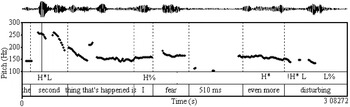
For the CC in (28)/figure 2, the auditory analysis suggested an intonational pattern such that I fear is the intonational tail in its domain, i.e. part of unstressed material following the nuclear syllable (the first syllable of second). The CC is associated with the final rise towards H%. IP1 is followed by a structure-related pause of noticeable length. The instrumental analysis confirms these results. The key criteria for the phrasing given in (28b) are as follows.
1. Cf. (26a1): Each of the two adjacent IPs is the domain of a CTC: IP1 has a nuclear fall–rise terminating in H%; IP2 has a prenuclear H* followed by a downstepped nuclear !H*L and a domain-final L%.
2. Cf. (26a2): Declination applies across each domain, even though the maximum pitch level in the second IP does not reach the height of the maximum pitch level in the first IP.
3. Cf. (26b1): There is a structure-related pause of 0.51 seconds following the CC, but no pause before the CC.
4. Cf. (26b2): There is no pitch discontinuity before the CC. Instead, there is a continuous falling–rising pattern, which spans the whole string from the nuclear syllable up to and including fear. After the pause separating the two IPs, there is a step-down in pitch from the high level reached on fear.
All parentheticals for which sound files of sufficiently good quality were available were analysed in this way. The results are reported in the next section.
Example (27).

Example (28).

4. Results
4.1 Non-restrictive relative clauses (NRRCs)
Of the 49 utterances (55 NRRCs) that entered the analysis, four utterances (five NRRCs) could only be analysed auditorily but not instrumentally due to the bad quality of the sound files. However, since in the auditory analysis these NRRCs turned out to be clearly separate on the basis of perceived boundary criteria, these items were not discarded from the analysis. For two NRRCs, the position of right and/or left boundaries remained unclear after auditory and instrumental analysis, and they were therefore discarded. Of the 53 NRRCs that were conclusively analysed, 48 (90.5%) followed pattern (2a), i.e. they were clearly separate, and were preceded and followed by separate IPs. None of the utterances containing NRRCs showed prosodic recursion of the kind suggested by Ladd (Reference Ladd1986, Reference Ladd1996). Typical cues to intonational separateness included a CTC, boundary tones at the end of the IP spanning the NRRC and at the end of the preceding IP, pauses in target position, and changes in pitch level/direction.
Only five out of the 53 NRRCs (9.5%) turned out to be nonseparate on the surface. All five non-separate NRRCs showed the same phrasing pattern: while the right syntactic edge of the NRRC coincided with an IP boundary, the left edge did not. Specifically, the relative pronoun which, or a pied-piped preposition along with which, is part of unstressed material at the end of the preceding domain and is followed by an IP boundary separating the relative pronoun from the rest of the NRRC. The pattern is given in (29) (parentheses indicate optional material; P=preposition).
(29) IP[… (P) which]IPIP[NRRC]IP (IP[…]IP)
By way of illustration, consider example (39), plotted in figure 3.Footnote 12 The nuclear syllable of IP1 is the second syllable of Pascal. The nuclear fall continues on the relative pronoun which. No pitch discontinuity or change in pitch level or direction can be found on the relative pronoun. The IP is terminated by L%, which is followed by a pause of 185 ms. There is a step-up in pitch on the first syllable of really at the beginning of IP2. The two domains show tonal parallelism (see Bolinger Reference Bolinger1989: 205ff., Wichmann Reference Wichmann2000). They begin at approximately the same mid pitch level, which rises towards the peak on the nuclear syllable (-cal- and -ci-, respectively). The nuclear tone is a fall (H*L) associated with the nuclear syllable and continued on the immediately adjacent syllable (which and -ting, respectively). Both domains are terminated by a low boundary tone, and they both have the same number of syllables.
- (30)
(a) I was programming in Pascal which really wasn't very exciting I'm afraid
(ICE-GB: s1a-008#1)
(b) IP1[I was programming in Pascal which]IP1IP2[IP3[really wasn't very exciting]IP3 I'm afraid]IP2
The results for NRRCs are summarised in table 1.
Example (30).

Non-restrictive relative clauses (NRRCs): results.

Note. The number in parentheses represents items which were analysed instrumentally.
4.2 Sentential parentheticals
Of the 55 utterances containing 58 sentential parentheticals that entered the acoustic analysis, 52 utterances (55 parentheticals) were analysed instrumentally while 3 could only be analysed auditorily due to the quality of the sound files. Since these were clearly phrased separately, they were not discarded from the analysis. Overall, 52 parentheticals (90%) were phrased according to (2a), i.e. separately in a non-recursive structure. Of the remaining six parentheticals, three were phrased in a CPD structure (Ladd Reference Ladd1986, Reference Ladd1996; see (31) and the example in (32)), while the other three were phrased in such a way that material from the parenthetical formed an IP with material from the host.Footnote 13
(31) CPD structure
… IP1[… IP2[parenthetical]IP2 …]IP1 …
- (32)
(a) In all across the world we employ directly some six hundred and fifty people in our various activities including and Jimmy's put this in fifty chartered surveyors (ICE-GB: s2a-045 #62)
(b) … IP1[including IP2[and Jimmy's put this in]IP2 fifty chartered surveyors]IP1
The sentential parentheticals in a CPD structure all have their own CTC, while another contour spreads across the surrounding material making up the matrix phrase IP1. Crucially, the first part of the embedding IP, i.e. the part preceding the parenthetical, is not terminated by a boundary tone, and while there may be prenuclear accents in the first part of IP1, the nuclear accent falls in the second part. We also find pauses before and/or after the parenthetical.
Only three out of 58 parentheticals (5.2%) were phrased such that material from the parenthetical formed a domain with material from the host utterance. These were the and-parenthetical given in (33) and the two as-parentheticals given in (34) and (35).Footnote 14
- (33)
(a) He was and I think you would agree with me at the outset looking at expanding his business at that time not selling it (ICE-GB: s1b-064 #172)
(b) IP1[He was IP2[and I think you would agree with me at the outset]IP2 looking at expanding his business]IP1 […]
- (34)
(a) It was much the same as my right honourable friend the Prime Minister will recall in Milan some five years befo five years ago (ICE-GB: s2b-050 #32)
(b) IP1[It was much the same as my right honourable friend the Prime Minister will recall]IP1IP2[in Milan]IP2IP3[some five years before five years ago]IP3
- (35)
(a) We commit a serious error if we think always in terms of surrendering sovereignty and seek to stand pat for all time on a given deal by proclaiming as my right honourable friend the Prime Minister did two weeks ago that we have surrendered enough (ICE-GB: s2b-050 #46)
(b) IP[We commit a serious error]IPIP[if we think always in terms of surrendering sovereignty]IPIP[and seek to stand pat for all time on a given deal]IPIP[by proclaiming as my right honourable friend the Prime Minister did two weeks ago]IPIP[that we have surrendered enough]IP
In (33), the string and I think you would agree with me at the outset forms one IP with a prenuclear accent on think and a nuclear accent (fall) on outset. Looking at the syntactic structure, there is an attachment ambiguity concerning at the outset. It can either modify the VP agree with me of the parenthetical, or the following VP looking at expanding his business of the host clause. The corpus annotation is such that at the outset modifies and is syntactically related to the main clause VP (looking at expanding his business). However, under this interpretation, the intonational phrasing produced by the speaker is odd: the right edge of the parenthetical and I think you would agree with me is not separated from the following host clause material at the outset by an intonational break (see (33b)). It is well known that prosody helps to disambiguate structurally ambiguous sentences, among them sentences containing PP attachment ambiguities (see e.g. Schafer et al. Reference Schafer, Speer, Warren and White2000, Warren et al. Reference Warren, Schafer, Speer and White2000, and references given there; see also Hirschberg Reference Hirschberg, Horn and Ward2004). If the PP at the outset modified the main clause VP, an IP boundary preceding this PP would be expected. In light of this, and given the actual intonational phrasing, it would perhaps be more appropriate to reanalyse the structure so that the PP at the outset forms part of the parenthetical, with an interpretation along the following lines. The host clause means that ‘he was at that time looking at expanding the business rather than selling it’, and the parenthesis is ‘I am pretty sure you will agree with me also that this was so from the outset’ (Anne Wichmann, p.c.). This interpretation, which phrases at the outset with the parenthetical also syntactically, results in a CPD structure with the parenthetical corresponding to an IP. This reduces the number of prosodically non-separate ones to two, namely (34) and (35).
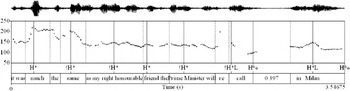
IP1 and IP2 of example (34) are plotted in figure 4. The as-parenthetical together with the preceding material forms one large IP. Across this IP, declination applies. There is pitch reset in the following IP spanning in Milan, though not complete pitch reset. The target IP (IP1) has a series of prenuclear peaks followed by a nuclear fall–rise (H*LH%) associated with the second syllable of recall. There is lengthening of the final syllable of the target IP (-call) and a structure-related pause of 0.397 seconds after recall. The data provide no reason to assume an IP boundary in the expected position between same and as: there is no pitch discontinuity or tonal landmark such as a boundary tone, and pitch reset does not occur until the peak on the second syllable of Milan. Nor is there any articulatory offset between same and as, such as would be indicated by a glottalised onset on as.
Example (34).

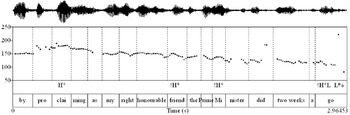
Finally, the parenthetical as my right honourable friend the Prime Minister did two weeks ago in (35)/figure 5 forms one long IP together with by proclaiming from the host. This IP (the target IP) is preceded and followed by silent pauses (727 ms and 433 ms, respectively; not plotted here for reasons of space). Other boundary markers include the fact that declination applies across the whole target IP, the distinctive nuclear fall to L% on the preceding word deal (not plotted here), a step-up in pitch on unaccented by at the beginning of the target IP, and the nuclear fall on ago to L% terminating the target IP, with subsequent pitch reset. In the target IP, the prenuclear peaks are followed by a nuclear fall associated with the second syllable of ago. There is no pitch discontinuity or any other prosodic cue before or inside the parenthetical that would justify the assumption of an additional IP boundary. In particular, there is no reason to assume an IP boundary between proclaiming and as.
Example (35); target IP.

The results for sentential parentheticals are summarised in table 2.
Sentential parentheticals (SPs): results.

Note. The number in parentheses represents items which were analysed instrumentally.
4.3 Comment clauses (CCs)
Of the 138 utterances (139 CCs) that entered the acoustic analysis, the sound files of 95 utterances (95 CCs) were of good enough quality to be analysed instrumentally. The results were much more varied than for the other two groups. The phrasing of two CCs (1.4%) remained unclear. The intonational phrasings found with all other CCs are summarised in (36). As will be outlined below, (36c–e) correspond to more than one intonational pattern.
(36) CC phrasing


Of the 139 CCs that entered the analysis, only 26 (19%) followed pattern (2a) (=(36a)). They are clearly separate: they have their own CTC with a nuclear accent on either the pronoun or the verb/lexical element, and an IP boundary before and after the CC. The preceding material and following material are also phrased each in a separate domain. An example is given in (37). IP1 has a final nuclear fall–rise, terminating in H% (see (37b)). This is followed by a pitch discontinuity and break (but no measurable pause) before the pronoun I. The pronoun bears the nuclear accent of the IP spanning I believe, which is also a fall–rise, so that the IP terminates in H%. I believe is followed by a pause of 0.633 seconds. The following IP3 has a prenuclear peak associated with the first syllable of underestimating and a final nuclear fall on scale. The final IP4 shows a similar pattern.
- (37)
(a) But we have lost a tremendous amount of time time in which the Western powers simply failed to respond time that went on through the whole of nineteen ninety and nineteen ninety-one and where we are still effectively I believe underestimating the scale of what is required for us (ICE-GB: s2b-047 #30)
(b) … IP1[and where we are still ef fectively ]IP1IP2[ I believe ]IP2
H*L H% H*L H%
IP3[underestimating the scale]IP3IP4[of what is re quired for us]IP4
H* !H*LL% H* !H*L%
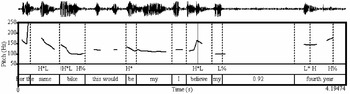
Nine CCs (6.5%) were phrased in a CPD pattern (see (36b)). An example is given in (38)/figure 6. The host clause this would be my fourth year is the domain of one CTC with a prenuclear H* associated with be and a nuclear rise at the end of the domain. The CC I believe has its own CTC with a nuclear fall associated with the verb and terminating in L%. This does not affect the contour of the host. The parenthetical, together with the repeated possessive pronoun my with which it is phrases, is also produced at higher speech rate. Discourse-functionally, the CC is inserted into a hesitation phase, which also explains the lengthening of the first occurrence of my: the speaker seems unsure about the number of years.
- (38)
(a) For the same bike this would be my I believe my fourth year
(ICE-GB: s1b-074 #221)
(b) IP[For the same bike]IPIP[this would be my IP[I believe my]IP fourth year]IP
Example (38).

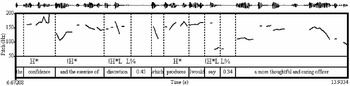
All the remaining phrasing patterns, 102 items (74.5%) overall, are such that the CC is not phrased in its own domain, regardless of whether or not it is prominent. In (36c), the CC may either have nuclear prominence and be preceded by unstressed or prenuclear material from the host clause in its IP, or it may be unstressed, representing a nuclear tail. An example of the former is given in (39)/figure 7. The target IP2, spanning which produces I would say, is set off from the preceding and following IPs by structure-related pauses of 0.45 and 0.34 seconds, respectively. IP1 has a CTC and is terminated by L%. IP2 has a prenuclear pitch peak associated with material from the host, viz. the second syllable of produces, and a nuclear fall on say, and is terminated by L%. There is no reason to assume another IP boundary anywhere within the target IP – in particular, not between produced and the pronoun I of the CC, i.e. at the left edge of the CC.
- (39)
(a) The restructured and reformed training systems which seek to inculcate at an early stage the confidence and the exercise of discretion which produces I would say a more thoughtful and caring officer attuned to the needs of his changing community (ICE-GB: s2b-031 #75)
(b) IP[…]IPIP1[… the confidence and the exercise of discretion]IP1IP2[which produces I would say]IP2 IP3[a more thoughtful …]IP3
Example (39).

Examples of the second intonational variant of (36c), the unstressed tail, are given in (40) through to (42). (40) represents those CCs which either continue a nuclear fall or are realised at the low pitch level reached by a nuclear fall. In (41), the CC is associated with the final rise in the nuclear H*LH%. These two patterns have been analysed by Gussenhoven (Reference Gussenhoven2004: 291) as incorporation. In (42), the CC is unstressed and follows the nuclear accent, but it is also preceded by a boundary tone indicating the end of a domain and by a pause. This pattern represents encliticisation in the sense of Gussenhoven (Reference Gussenhoven2004: 291). The encliticised material, the CC I don't think, receives a copy of the tones that directly follow the last stressed syllable on; since the nuclear pattern is H*LL%, this means that LL% is copied onto I don't think.Footnote 15
(40) Low tail
(a) It's not recognised I think that many poor countries like China are going to have vast numbers of persons as dependent on the second age as the first is dependent on them … (ICE-GB: s2a-038 #76)
(b) IP[It's not recognised I think]IPIP[that many poor countries]IP
H*L L% H*L L%
(41) Rising tail
(a) But we managed to find somewhere on the motorway I think at this service station (ICE-GB: s1a-021 #45)
(b) IP[But we managed to find somewhere on the motorway I think]IPIP[at this service station]IP
H*L !H*L !H*L H%
(42) Encliticisation
(a) I wouldn't put anything on it I don't think because two feet isn't very high
(ICE-GB: s1b-025 #12)
(b) IP[IP[I wouldn't put anything on it]IPI don't think]IPIP[because …
H*L !H*L L% L L%
IP[because …
L%
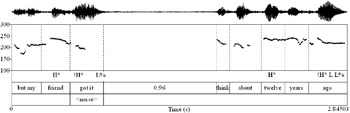
In (36d), the CC is preceded, but not immediately followed, by an IP boundary. Again, the CC may in principle have nuclear prominence, followed by an intonational tail made up of material from the host clause, or it may be unstressed preceding any prominent material, or it may bear a prenuclear pitch accent. An example of an unstressed CC in this position, representing (part of) the prehead of its domain, is given in (43)/figure 8. IP1 terminates with L%, followed by a pause of almost a full second. (Note that the fall is in fact to a lower pitch level than appears from the contour in figure 8. The continued fall is invisible in the plotted contour due to overlapping noise.) The CC I think at the beginning of IP2 is unstressed and reduced phonetically to think. On think there is a step-up in pitch from the level of the preceding L%.
- (43)
(a) But my friend got it I think about twelve years ago (ICE-GB: s1a-071 #90)
(b) IP1[But my friend got it]IP1IP2[I think about twelve years ago]IP2
Example (43).

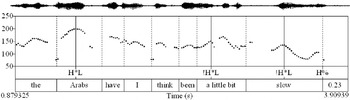
In (36e) the CC is neither directly preceded nor directly followed by an IP boundary. The CC may be part of the unstressed prehead, optionally preceded by unstressed material from the host clause and followed by more material, or it may be integrated as a stressed or unstressed head preceded and followed by material from the host clause, or it may be part of a hesitation stretch inside an IP. Examples of CCs representing (part of) the intonational head of their domain are given in (44) and (45). The target IP in (44) has a prenuclear H* associated with the pronoun I of the CC, followed by another, downstepped pitch peak associated with the first syllable of people, and a downstepped nuclear H*L on country (see (44b)). It is terminated by L%. The CC I think in (45)/figure 9 is part of unstressed material between two prenuclear pitch accents (on Arabs and little) preceding the nuclear fall–rise associated with slow. Declination applies across the plotted IP. The following IP starts after the pause.
- (44)
(a) but that could not be done without a decision coming back to this House and I believe to the people of this country (ICE-GB: s1b-053 #37)
(b) … IP[and Ibelieve to the people of this country]IP
H*L !H*L !H*L L%
- (45)
(a) the Arabs have I think been a little bit slow with the sole exception of Syria of President Assad of Syria (ICE-GB: s2b-012 #109)
(b) IP[the Arabs have I think been a little bit slow]IPIP[with the sole exception of Syria of President Assad of Syria]IP
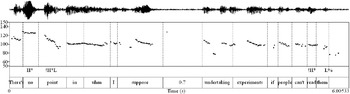
The example utterance in (46), plotted in figure 10, provides an example of a hesitation CC (see also Dehé & Wichmann to appear). The utterance is phrased in one IP with a performance-related, hesitational pause between in and undertaking. Specifically, we find a sequence of filled pause (uhm), CC (I suppose), and then a silent pause. The CC is thus part of a hesitation stretch. The pitch on uhm I suppose is maintained at the level reached on in and changes only after the transitional phase.Footnote 16
(46) There's no point in uhm I suppose [silent stretch] undertaking experiments if people can't read them (ICE-GB: s1a-059 #286)
Example (45).

Example (46).

These examples serve to illustrate the variety of intonational patterns found with CCs. What is important in the present context is that the majority of CCs, 74.5%, fail to be phrased in their own separate IP. This result is in contrast to the findings for NRRCs and sentential parentheticals, for which a large majority were phrased according to the predictions of intonational separation. These results and their implications for prosodic theory will be discussed in the next section.
5. Discussion
The findings for NRRCs and sentential parentheticals largely confirm the general assumption of intonational separateness, which is so often found in the literature but has not previously been based on a systematic study of data from actual spoken language. For these two types, the right edge was found to coincide with the right edge of an IP across the board, and in a very high percentage of the data the left edge also coincided with an IP boundary. The default phrasing is thus as given in (47), confirming the pattern (2a) suggested as default for parentheticals by Nespor & Vogel (Reference Nespor and Vogel1986), repeated in (48).
- (47)
(a) … IP[…]IPIP[which NRRC]IPIP[…]IP …
(b) … IP[…]IPIP[sentential parenthetical]IPIP[…]IP …
(48) IP[…]IPIP[parenthetical]IPIP[…]IP …
Due to the fact that the data were taken from a corpus of actual spoken language, the target items were not controlled or even manipulated for factors such as the speech rate or length of the parenthetical or preceding material. However, given that such a high percentage of NRRCs and sentential parentheticals follow the phrasing pattern in (48), it seems safe to conclude that the syntactic and/or semantic nature of the interpolation demands a separate IP in a non-recursive context, and that other factors play only a minor role in the intonational phrasing of these two types of parentheticals. This is despite the fact that variation in intonational phrasing can be found elsewhere as a result of a variety of factors (as outlined in section 1).
Furthermore, as was also observed by Nespor & Vogel (Reference Nespor and Vogel1986: 189–190), the string preceding the parenthetical interpolation does not have to be a syntactic constituent of the kind predicted to correspond to an IP otherwise. Consider the attested phrasing of the utterances in (49) and (50), and in particular the IP boundaries following applications in (49) and acquire in (50). Looking at the syntactic structure and ignoring the parenthetical insertions, applications in (49) is followed by its complement of the research …, and acquire in (50) is followed by its complement Iraqi territory. According to prosodic theory, an IP boundary would not be predicted between a noun and its complement or between a verb and its complement. The respective attested IP boundaries, therefore, have been inserted purely as a result of the presence of the parenthetical.
- (49)
(a) However the Danzig said report said that there were sufficient potential applications these are monolingual as well as multilingual of the research that had been done to justify the work that'd already been completed
(ICE-GB: s2a-032 #76)
(b) IP[… that there were sufficient potential applications]IPIP[these are monolingual as well as multilingual]IPIP[of the research that had been done]IP
- (50)
(a) nor is it uh legitimate for us to acquire and I underline the word acquire Iraqi territory (ICE-GB: s1b-027 #54)
(b) IP[nor is it uh legitimate for us to acquire]IPIP[and I underline the word acquire]IPIP[Iraqi territory]IP
The claim that parentheticals do not affect the intonation of the host (e.g. de Vries Reference Vries, Dehé and Kavalova2007: 219) thus does not hold true. The insertion of IP boundaries where there would be no boundaries otherwise is one of several ways in which the intonational pattern of the host is affected by the parenthetical.
Only a small number of utterances containing NRRCs or sentential parentheticals were not phrased according to (48). The relevant NRRCs were phrased such that the relative pronoun, a functional element, did not phrase with the rest of the NRRC, but with preceding material.Footnote 17 For four sentential parentheticals, but for none of the NRRCs in the data set, the CPD structure was observed. Two sentential parentheticals were phrased such that they formed a large IP together with material from the host clause. These patterns are summarised in (51), (52) and (53), respectively.
(51) … IP[…(of) which]IPIP[NRRC]IPIP[…]IP …
(52) IP[…IP[parenthetical]IP …]IP
(53) (IP[…]IP) IP[… parenthetical]IPIP[…]IP
Pattern (53) was discussed for examples (34)/figure 4 and (35)/figure 5 in section 4.2. The two examples are from the same corpus text, a scripted speech.Footnote 18 Several reasons may account for the attested phrasing. First, in both cases the parenthetical is a variation of the phrase as my right honourable friend the Prime Minister plus a VP. The as-phrase is thus a set phrase which is a routinised part of parliamentary debates and speeches. Intonation therefore does not have to serve the function of indicating a true aside. Second, the speaker produces the utterance at a high speech rate. As Nespor & Vogel (Reference Nespor and Vogel1986: 195) note, ‘the faster the rate of speech, the longer the [IPs] of a given utterance tend to be’. The IP boundary preceding the parenthetical thus falls victim to the high speech rate. In (35), the boundary terminating IP3, i.e. the IP preceding the target IP, is predicted by syntactic structure, since by proclaiming that … is a complex adjunct. The remaining host material preceding the parenthetical, i.e. by proclaiming, would then form a small IP on its own. The speaker might wish to avoid this, given that all other IPs are considerably longer; previous research has shown that speakers tend to prefer a series of prosodic constituents that are balanced in size (e.g. Gee & Grosjean Reference Gee and Grosjean1983, Nespor & Vogel Reference Nespor and Vogel1986, Ghini Reference Ghini1993, Frota Reference Frota2000). Furthermore, an IP boundary in the position following proclaiming, i.e. between a verb and its (clausal) complement, would not be predicted in the absence of the parenthetical.
How can the observed patterns be accounted for in prosodic theory? Given that (48) is the default phrasing pattern for NRRCs and sentential parentheticals in actual spoken English, Selkirk's (Reference Selkirk and Frota2005) AlignR (CommaP, IP) constraint given in (9) above is not enough to account for the data. This constraint allows for the lack of an IP boundary at the left edge of the parenthetical unless the parenthetical is preceded by another phrase of type CommaP. In the present data, however, the absence of a left boundary is the exception rather than the rule. Right-alignment will therefore have to be complemented by other constraints. Similarly, Truckenbrodt's (Reference Truckenbrodt2005) constraint tie between WrapCP and AlignCP seems too weak to predict the boundary at the left edge. While WrapCP demands that each CP should be contained in a single IP, it allows for additional material in the same domain. Under AlignCP, additional material at the right edge is banned, but the inclusion of material at the left edge is still possible.
The present results are consistent with Kratzer & Selkirk's (Reference Kratzer and Selkirk2007: 125) proposal of a direct correspondence between CommaP (Potts Reference Potts2005, Selkirk Reference Selkirk and Frota2005) and IP. Instead of CommaP, de Vries (Reference Vries, Dehé and Kavalova2007: 228–230) assumes a parenthetical projection ParP which embeds a parenthetical phrase via b-Merge. In an account like this, it must be the ParP that corresponds to an IP. In any case, what is needed to derive the default structure is a set of constraints which result in (i) alignment of the right edge of a parenthetical with the right edge of an IP; (ii) alignment of the left edge of a parenthetical with the left edge of an IP; and (iii) alignment of the right edge of the material preceding the parenthetical with the right edge of an IP. (i) may be achieved by Selkirk's AlignR (CommaP, IP) constraint; (ii) follows from an analogous left-alignment constraint; (iii) follows if recursivity is disallowed, e.g. by the Nonrecursivity constraint of Selkirk (Reference Selkirk, Morgan and Demuth1995b) and related work. Note that (i) and (ii) allow for both the default case in (48) and the CPD structure in (52), while (iii) rules out (52). The corresponding constraints are given in (54). Unlike in Selkirk's (Reference Selkirk and Frota2005) version of (54a), Potts' (Reference Potts2005) CommaP has been replaced by de Vries' (Reference Vries, Dehé and Kavalova2007) ParP, but nothing hinges on this assumption.
(54) Constraints deriving default structure (48)
(a) Align R (ParP, IP) (adapted from Selkirk Reference Selkirk and Frota2005): Align the right edge of a constituent of type ParP in syntactic representation with the right edge of an IP in phonological representation.
(b) Align L (ParP, IP): Align the left edge of a constituent of type ParP in syntactic representation with the left edge of an IP in phonological representation.
(c) Nonrecursivity (Selkirk Reference Selkirk, Morgan and Demuth1995b: 190): No Ci dominates Cj, j=i (where Cn=some prosodic category).
The recursive structure in (52) follows if CPD formation is allowed. This can in principle be achieved by a separate constraint (see (55)), or by allowing a violation of Nonrecursivity. The structure in (51) must be seen as the result of a constraint allowing the left edge of a parenthetical IP to shift to the right, but not beyond the initial functional element (see (56)).
(55) Allow CPD formation.
(56) Shift IP boundary: Shift the left edge of an IP rightwards beyond an initial element of type F, but not beyond (where F∊{relative pronouns, coordinating conjunctions, connectives}).
While the constraints in (54) derive the default pattern, the additional constraints in (55) and (56) may take the structure resulting from (54) as input. In particular, shifting a boundary according to (56) implies that the boundary already exists in an underlying structure. Factors that drive the boundary shift specified in (56) may include constraints involving prosodic length and weight, as well as tonal parallelism. For example, the discussion of example (30)/figure 3 in section 4.1 revealed an equal number of syllables and tonal parallelism in the adjacent IPs. However, the phrasing of other utterances from the data set do not lend themselves to explanation along these lines. In (34), for example, the number of syllables would predict a different phrasing pattern.
It is also possible for the discourse situation to play a role in the derivation of the surface pattern in (51). Consider once again the example in (30)/figure 3. The conversational context of this utterance, retrieved from the ICE-GB, is such that after the end of this, i.e. after I'm afraid, an interlocutor steps in saying ‘What do you mean by programming in Pascal?’, which connects with the head noun of the utterance (Pascal) rather than the content of the NRRC. It seems likely, therefore, that the speaker places the prosodic break after the relative pronoun as a floor-holding device, while the listener signals his wish to ask a question about the content of the main clause. The relation between intonational phrasing and pragmatic factors and the corresponding implications for prosodic theory are important topics for future research. Current prosodic theory does not allow for an interface between prosodic structure and pragmatics.
The observed patterns of deviation from the default pattern (48) are reminiscent to some extent of Nespor & Vogel's (Reference Nespor and Vogel1986: 193ff.) concept of restructuring of the IP. Restructuring applies to form larger or shorter IPs. It is determined by factors such as length, speech rate, style of speech and semantic considerations, and is limited by the syntactic structure of the string involved. Restructuring in Nespor & Vogel's (Reference Nespor and Vogel1986) sense involves an increase or reduction of the number of IPs in an utterance; hence the boundary shift to the right of the relative pronoun observed in (30) cannot be explained by IP restructuring, since here the shift does not change the number of IPs but only concerns the precise position of one single IP boundary. What can be explained in terms of IP restructuring, however, is the phrasing in (53), observed for the two sentential parentheticals in (34) and (35). Here the phrasing can indeed be seen as the result of restructuring such that IP boundaries have been removed. Specifically, the IP boundaries between same and as in (34), and between proclaiming and as in (35), have been removed as a result of rapid speech rate, and, in the case of (35) at least, length considerations as well. Also, as mentioned above, a boundary after proclaiming would be due solely to the presence of the parenthetical and avoidance of recursivity, but would not occur in this position otherwise. It therefore seems a likely candidate to be removed in the process of IP-restructuring in the sense of Nespor & Vogel (Reference Nespor and Vogel1986). Restructuring in this sense will also play a key role in the discussion of the phrasing patterns observed with CCs.
A comparison is in order between the results reported here for NRRCs and Watson & Gibson's (Reference Watson and Gibson2004) findings in their experimental reading study of the intonational phrasing of restrictive and non-restrictive relative clauses. In their study, almost 40% of all tested NRRCs were not directly preceded by an intonational boundary. Watson & Gibson (Reference Watson and Gibson2004: 749) speculate that ‘[t]he absence of commas in the stimuli may have biased the speakers against producing more intonational breaks’ and that ‘[i]n spontaneous speech, speakers’ performance may more closely match' the intuition that NRRCs must be preceded by an intonational break. The present results seem to support this idea of speaker behaviour in spontaneous speech. Note also that Watson & Gibson (Reference Watson and Gibson2004) only report on the percentages of test items lacking a phrasal boundary in the position directly preceding the relative pronoun, but do not detail the actual positions of attested boundaries.
Moving on to the findings for CCs, they show the range of phrasing patterns already summarised in (36), and repeated in (57).
(57) CC phrasing
CCs phrased as in (57a) show the default phrasing for parentheticals. They thus follow the constraints in (54) and so need not be considered further, except that it is worth mentioning once again that, unlike NRRCs and sentential parentheticals, this is not the most frequent pattern for CCs. The CCs phrased in CPD structures (see (57b)) follow the structure in (52), which was also discussed above. The phrasing patterns in (57c–e) involve the absence of one or both of the IP boundaries around the CC. These patterns can plausibly be accounted for along the lines of Nespor & Vogel's (Reference Nespor and Vogel1986) restructuring of the IP. Consider the CC examples in (58)–(60), taken from the present data set ((59) is repeated from (43) above). They correspond to the patterns in (57c–e), respectively.
(58) Compare (57c)
(a) Joe Haines you were the Press Secretary at Number Ten at the time and indeed had been I think since nineteen sixty-nine (ICE-GB: s1b-040 #5)
(b) (predicted phrasing according to (48); no restructuring)
IP[Joe Haines]IPIP[you were the Press Secretary at Number Ten at the time]IPIP[and indeed had been]IPIP[I think]IPIP[since nineteen sixty-nine]IP
(c) (attested phrasing: application of IP restructuring)
IP[Joe Haines]IPIP[you were the Press Secretary at Number Ten at the time]IPIP[and indeed had been I think]IPIP[since nineteen sixty-nine]IP
(59) Compare (57d)
(a) But my friend got it I think about twelve years ago (ICE-GB: s1a-071 #90)
(b) (predicted phrasing according to (48); no restructuring)
IP[But my friend got it]IPIP[I think]IPIP[about twelve years ago]IP
(c) (attested phrasing: application of IP restructuring)
IP1[But my friend got it]IP1IP2[I think about twelve years ago]IP2
(60) Compare (57e)
(a) It will not I believe be a long conflict but it may be a fierce one
(ICE-GB: s2b-014 #44)
(b) (predicted phrasing according to (48); no restructuring)
[It will not]IPIP[I believe]IPIP[be a long conflict]IPIP[but it may be a fierce one]IP
(c) (attested phrasing: application of IP restructuring)
IP[It will not I believe be a long conflict]IP
H* !H*L L%
IP[but it may be a fierce one]IP
H* !H*L L%
With CCs in general, length is one likely factor that is to be involved in IP restructuring. A CC typically consists of a combination of pronoun and verb (I think, I believe, etc.), or pronoun, auxiliary and verb or adjective (I would say, I'm afraid, etc.), i.e. it constitutes one prosodic word (PWd) (and up to four syllables) only. The sole exception is I'm glad to say which consists of two PWds but occurs only once in the data set. With CCs, accordingly, series of very short IPs and series of IPs of unbalanced size would be very likely to surface under phrasing according to (48). But this goes against the general tendency to avoid IP series of this kind (Nespor & Vogel Reference Nespor and Vogel1986). It follows that a short IP such as that spanning a CC is likely to be restructured. For example, the predicted phrasing in (60b) involves a series of very short IPs, followed by a longer one. Restructuring as in (60c) leads to a series of IPs that are more balanced in size.
At least three other factors may play a role in the restructuring of these and similar examples. First, IP-restructuring may help to achieve tonal parallelism between two adjacent IPs. In (60), for example, a prenuclear peak on not/may is followed by a downstepped fall associated with long and fierce, respectively (see (60c)). Second, IP restructuring can occur where the presence of an IP boundary has been forced by the CC in a position where it would not occur otherwise. In (58), for instance, the presence of the CC forces an IP boundary after been. This boundary disappears after restructuring. Similarly, the IP preceding the CC in (60) would not form a separate IP if the CC were absent. Since all CCs following a constituent of type NPSubject or S were removed from the data set in advance in order to avoid syntactic ambiguity between a CC and a main clause analysis (see section 3.1.3), the great majority of all remaining CCs occur within a syntactic constituent, and thus in a position where an IP boundary would not be predicted otherwise. Third, restructuring may be due to semantic considerations such as semantic scope. In principle, a CC may have semantic scope over either what precedes or what follows. In (59), for example, I think may relate to my friend got it (as in I think my friend got it, but it may have been a person she knew) or to the following phrase. Erasing the IP boundary before about helps to disambiguate between these two meanings. Without the boundary, the CC unambiguously refers to about twelve years ago.
Restructuring is often avoided if the CC carries heavy stress. In (61), for example, I think is phrased in a separate IP with an H*LH% nuclear accent, structure-related pauses before and after the CC, and the pronoun I as the nuclear syllable of its IP.
- (61)
(a) So uh I would also add that our armed services are a brilliant exception I think to the uh neglect of training which we have in this country because the armed services uh clearly do uh believe deeply in training and are committed to do it
(ICE-GB: s2a-031 #81)
(b) IP[I would also add]IPIP[that our armed services]IPIP[are a brilliant exception]IPIP[I think]IPIP[to the uh neglect of training]IPIP[which we have in this country]IP […]
Other kinds of semantic/pragmatic considerations may also play a role in determining restructuring such that the CC loses its status as a separate IP. CCs are semantically and pragmatically variable (see e.g. Aijmer Reference Aijmer, Swan and Westvik1997, Dehé & Wichmann to appear). They may function as epistemic adverbials, in which case they carry prominence and may be prosodically separated; but they may also participate in hesitational phases or function as interpersonal markers. In the latter two cases, they will not bear prosodic prominence, hence will not have a CTC, and will therefore be likely to join another IP.
According to Nespor & Vogel (Reference Nespor and Vogel1986: 193), ‘[IP] restructuring depends largely on rather global aspects of the speech situation, [and] it is [therefore] not possible to predict exactly when it will occur’. Factors that play a role in the application or non-application of restructuring IPs formed by CCs have been discussed in this section. Crucially, the grammar provides the formal device of IP-restructuring, together with the factors governing it, as a tool for the speaker to produce her/his utterance in a way serving the intended purpose.
The present data thus provide ample evidence for the option of IP-restructuring of IPs involved in parentheticals. This contradicts the assumption that parentheticals are obligatorily phrased separately. If that were the case, they should resist restructuring. To the contrary, IP restructuring is frequently employed for CCs, and it has also been attested for more complex parentheticals (see, in particular, examples (34) and (35)). The fact that restructuring is more common for CCs is likely due to their length (by their very nature, CCs are shorter and less complex than sentential parentheticals and NRRCs), and possibly to their function. The fact that in previous research other types of short parentheticals – for example, English question tags, reporting verbs, vocatives and other one-word parentheticals – have been argued to often be prosodically integrated rather than separate (see section 1) further supports the finding that IPs spanning parentheticals may undergo restructuring just like IPs of other constituents and in non-parenthetical contexts. In addition, restructuring of parenthetical IPs seems to follow the same constraints, i.e. it is due to the same factors, as restructuring of IPs of other syntactic strings. These results will now be couched in a model of prosodic theory.
Kratzer & Selkirk (Reference Kratzer and Selkirk2007) suggest a model proceeding along the following lines. Prosodic phrasing is assigned as part of the phase-based spellout of syntactic structure. According to Chomsky (Reference Chomsky and Kenstowicz2001, Reference Chomsky2004, Reference Chomsky2005 and related work), phases are syntactic phrases of category vP and CP. The transition to the phonological component of the grammar, i.e. the sound interface, is referred to as spellout. As Kratzer & Selkirk (Reference Kratzer and Selkirk2007: 131) argue, it is conceivable that ‘during spellout only a partial phonological representation would be defined, precisely that which allows satisfaction of the interface constraints on prosodic phrasing and stress’. The constraints on prosodic phrasing include the conditions on major and minor phrasing and prosodic words, and, crucially, the constraints on intonational phrasing. While major phrases (roughly equivalent to intermediate phrases in Pierrehumbert's framework and phonological phrases in Nespor & Vogel's framework, and in any case one level down in the prosodic hierarchy from Intonational Phrases) are the output of phase-based spellout, IPs and prosodic words are produced by independent principles of spellout (Kratzer & Selkirk Reference Kratzer and Selkirk2007: 125). These independent spellout principles include the spellout of CommaP as IP.
Kratzer & Selkirk (Reference Kratzer and Selkirk2007: 132) further suggest that the above-mentioned partial phonological representation ‘could be the input to the actual phonological component’. At this stage, a ‘full surface phonological representation’ would be defined, for example as the result of an optimality-theoretic ranking of prosodic constraints. This representation would in turn serve as the input to phonetics.
If constraints on intonational phrasing are at work to derive the partial phonological representation, the default prosodic structure observed with sentential parentheticals and NRRCs follows straightforwardly under the assumption that the constraints given in (54) are all part of the set of constraints on intonational phrasing that define the partial phonological representation during spellout. At this stage, which has access to syntactic information, parenthetical phrases are parsed into IPs, and IPs are nonrecursive. Structures that deviate from this initial representation may be conceived of as the result of constraint interaction at a later stage, i.e. as part of the definition of the phonological surface structure. Here, boundary shift, CPD formation and IP restructuring, driven by the factors outlined above, apply in a given linguistic and discourse context to derive structures such as (51), (52) and (57c–e). This supports the view that syntax has a restricted role to play in determining sentence phonology (see Kratzer & Selkirk Reference Kratzer and Selkirk2007: 132), in particular in determining intonational phrasing. The difference between NRRCs and sentential parentheticals on the one hand and CCs on the other hand, such that CCs more readily undergo prosodic integration, follows easily from IP-restructuring as a result of prosodic length considerations, as well as other non-syntactic factors. This could be achieved in a model that allows for a postsyntactic, fully phonological component. At the same time, restructuring is syntactically constrained such that (i) IP boundaries may not be introduced in an arbitrary position (Nespor & Vogel Reference Nespor and Vogel1986), and (ii) IP boundaries can readily be deleted in positions which do not coincide with the edges of major syntactic constituents (see the discussion of (35), (58) and (60) above).
At first sight this would seem to imply that the phonological component must have access to some syntactic information. However, a closer look reveals that IP restructuring can in fact proceed just on the basis of phonological information. Recall that in Nespor & Vogel's (Reference Nespor and Vogel1986) account, IP-restructuring involves the introduction of IP boundaries to form smaller IPs, as well as the erasure of IP boundaries to form larger IPs. The introduction of IP boundaries is constrained in their framework (i) by prosodic structure, such that IP restructuring must occur at the juncture between two phonological phrases, and (ii) by syntactic structure, such that restructuring is avoided in any position other than at the end of noun phrases (Nespor & Vogel Reference Nespor and Vogel1986: 196–197). In a phase-based prosodic theory, these syntactic edges will likely coincide with the edges of prosodic constituents of type major/intermediate phrase, and thus with boundaries that are part of the partial phonological representation. This representation in turn serves as input to the definition of the full surface structure. Thus, the full surface structure is built on the basis of phonological information alone. Boundaries of type major/intermediate phrase present in the partial phonological representation are strengthened to type IP on the surface. The opposite process, which removes IP boundaries in order to form larger IPs, removes boundaries introduced by the constraints on intonational phrasing as part of spellout; hence it does not access syntactic information, either. In the case of the parentheticals investigated here, IP-restructuring only involves the latter process: the removal of IP boundaries.
It remains to be explained why boundary shifts of the kind observed with NRRCs must obey the constraint in (56), in particular why the boundary is not shifted rightwards beyond an initial functional element. It is conceivable that this relates to the constraints on prosodic phrasing such that a boundary may not be shifted beyond the edge of a spellout domain. For illustration, consider the NRRC example in (30) above, repeated in (62), and (63). In (62) and (63), (b) represents the intonational phrasing and (c) indicates the syntactic structure which is relevant here. Remember that CP is a phase, and C its head. As the result of syntactic movement, (of) which is situated in SpecCP, i.e., in the specifier of the phase head C. The rest of the NRRC is part of the complement of the phase head. Shifting the boundary to the right beyond the relative pronoun would mean to shift it beyond the edge of the spellout domain of CP.
- (62)
(a) I was programming in Pascal which really wasn't very exciting I'm afraid
(ICE-GB: s1a-008#1)
(b) IP[I was programming in Pascal which]IPIP[IP[really wasn't very exciting]IP I'm afraid]IP
(c) I was programming in Pascal CP[which C TP[which really wasn't very exciting]]
- (63)
(a) First then the context the wider context within which discussion on education of which uh teacher education's only a part but I can't disentangle it is taking place (ICE-GB: s2a-021 #17)
(b) … IP[the wider context]IPIP[within which discussion on education of which]IP
IP[uh teacher education's only a part]IPIP[but I can't disentangle it]IPIP[is taking place]IP
(c) within which discussion on education CP[of which C TP[teacher education is only a part of which]]
Moreover, Kratzer & Selkirk (Reference Kratzer and Selkirk2007: 106) have a Highest Phrase Condition, which says that ‘[t]he highest phrase within the spellout domain of a phase corresponds to a prosodic major phrase in phonological representation’. Given that the complement of v is itself another spellout domain, the noun phrase teacher education in (63) would be the highest phrase in its spellout domain and would thus correspond to a prosodic major phrase. The IP boundary that is shifted to the position following the relative pronoun thus coincides with the left edge of a major phrase.
Further research remains to be done to find out whether this is the correct explanation for (56), and what the consequences (desired as well as undesired) of this apparent relation between spellout domains and intonational phrasing would be. Recall that according to Kratzer & Selkirk (Reference Kratzer and Selkirk2007) the constraints on intonational phrasing are independent of those on prosodic phrasing.
6. Summary and conclusion
This study set out to investigate the intonational phrasing of parentheticals in actual spoken language, specifically in a corpus of spoken British English from the 1990s. Its aim was twofold: first, to evaluate the correctness of previous claims about the intonational phrasing of parentheticals; second, to analyse the implications of the actual intonational phrasing of parentheticals for prosodic theory.
In the past, parentheticals have often been argued to be obligatorily phrased separately on the surface, while IPs spanning non-parenthetical material have been seen as open to restructuring. In addition, each of the strings of material from the host clause preceding and following the parenthetical has been argued to be phrased separately, resulting in a non-recursive prosodic structure. This, the argument goes, holds true even if these strings would not form separate IPs otherwise. Another common assumption in the literature is that parentheticals do not affect the intonation of their host. These two views, however, are contradictory: if an IP boundary may be inserted because of the presence of the parenthetical, but the boundary clashes with the overall structure of the host clause, then this is one way in which the parenthetical affects the intonation of the host. This is not only a matter of temporal structure. Boundaries, in the present framework, are also identified on the basis of tonal features, for example the presence of a boundary tone. The parenthetical thus also affects the melodic features of the host utterance.
The assumption that host and parenthetical are syntactically unrelated poses another problem for the derivation of prosodic structure. If host and parenthetical are syntactically unrelated, they should, in a model of grammar which takes syntactic structure as input to prosodic structure, not be part of the same mapping process. Given that host and parenthetical are linearised, and that parentheticals affect the prosodic phrasing of the host, this is implausible. Prosodic evidence thus provides support for any kind of ‘integrated’ syntactic approach.
If there is indeed a syntactic relation between parenthetical and host, and if the two are part of the same mapping procedure from syntactic structure onto prosodic surface structure, then they should be subject to the same mapping constraints that apply elsewhere. De Vries (Reference Vries, Dehé and Kavalova2007) sees ParP as a clausal adjunct whose internal structure is invisible to the rest of the utterance, but whose linear position in the host is accounted for by an analysis in terms of adjunction. Such an adjunct, like other adjuncts, should be visible in the mapping from syntactic to prosodic structure. That this is the case follows from the results of the prosodic analysis: ParP forms its own IP, which may in principle be restructured in line with the same constraints as non-parenthetical IPs. However, part of the exceptional status of parentheticals remains: contraints applying specifically to ParP demand both right- and left-alignment of this type of constituent with the respective edges of an IP. It is surely bold at this stage to also posit left-alignment for intonational phrasing in general.
One of the major results of this study is that IPs spanning parentheticals may undergo restructuring. Another important result is that spontaneous spoken language data confirm previous research using made-up or experimental data, in that there is a strong tendency for longer parentheticals (sentential parentheticals and NRRCs) to be mapped onto separate IPs. Comment clauses, on the other hand, behave differently. The results confirm earlier intuitive studies claiming that shorter parentheticals such as CCs, reporting verbs, vocatives and question tags do not show a strong tendency to be phrased separately. They also confirm the findings of Peters (Reference Peters2006), which show a relation between the length of a parenthetical and its phrasing. In the future, it will be important to study in more detail the factors that lead to IP-restructuring, as well as their interaction. Several such factors have been described; others still remain to be studied, such as, for spoken language in particular, the role of the discourse situation, utterance planning, and the like. This might also involve the modeling of a possible interface between surface prosodic structure and discourse context.
As for parentheticals in particular, a number of members of this heterogeneous class have been ignored here, among them reporting verbs, vocatives, sentence adverbs, nominal appositions, and question tags; these remain to be investigated along the same lines. It is more than likely that due to their length, reporting verbs, vocatives, sentence adverbs and question tags will behave similarly to CCs, such that prosodic integration, i.e. IP-restructuring, will be the rule rather than the exception.
For a model of prosodic theory, the implication seems to be such that syntactic information is relevant at a first stage, namely that of spellout, while restructuring is based only on phonological information and thus constitutes evidence for a post-syntactic, phonological level. Future research will need to look in more detail at the nature of the phonological component and the constraints operating there.