Introduction
Maternal and child mortality rates are well-established indices of population health status, particularly for the developing world (United Nations Population Fund, 2007; United Nations, 2007a). South Asia and sub-Saharan Africa continue to lead the world in maternal and child mortality, with India and Nigeria being the major contributors to the regional and global burden (WHO et al., 2007; UNICEF, 2008). The availability of facility-based maternity services and/or the presence of skilled attendants at delivery, particularly in rural areas, which traditionally account for the vast majority of the populations in these regions, are considered major determinants of any effective reduction in maternal and child mortality (Campbell et al., Reference Campbell and Graham2006; Koblinsky et al., Reference Koblinsky, Matthews, Hussein, Mavalankar, Mridha and Anwar2006; United Nations, 2007a). However, several reports have highlighted the crucial role the choices made by women have on the uptake of services and health outcomes regardless of availability and access to services (Koblinsky et al., Reference Koblinsky, Matthews, Hussein, Mavalankar, Mridha and Anwar2006; Kerber et al., Reference Kerber, Graft-Johnson, Bhutta, Okong, Starrs and Lawn2007). For instance, there is growing evidence that a high proportion of women in urban areas well served by hospitals still opt for non-facility-based services with or without skilled attendants for reasons poorly understood (Bolam et al., Reference Bolam, Manandhar, Shrestha, Ellis, Malla and Costello1998; Harpham & Molyneux, Reference Harpham and Molyneux2001; Chhabra et al., Reference Chhabra, Sharma and Tupil2006; Onah et al., Reference Onah, Ikeako and Iloabachie2006; Fotso et al., Reference Fotso, Ezeh and Oronje2008). However, compared with their rural counterparts, few studies, and with relatively small sample sizes, have explored health-seeking behaviours of urban women in developing countries (Bolam et al., Reference Bolam, Manandhar, Shrestha, Ellis, Malla and Costello1998; Onah et al., Reference Onah, Ikeako and Iloabachie2006; Fotso et al., Reference Fotso, Ezeh and Oronje2008).
The world's population is expected to grow by about 40% from 6514 million in 2005 to 9191 million by 2050, with urban population rising from 48.6% to 69.6% (United Nations, 2007b). Over the same period the total population in sub-Saharan Africa will more than double from 769 million to 1760 million with the percentage of urban population rising from 35% to 60.5% (United Nations, 2007b). By 2030, each of the major regions of the developing world will have more urban than rural dwellers, with urban women of reproductive age accounting for a significant proportion of this growth besides the contribution from rural–urban migration (United Nations, 2007b; United Nations Population Fund, 2007). The upward trend in urbanization and the concomitant growth of urban slums in South Asia and sub-Saharan Africa is therefore likely to undermine global improvement in maternal and child health if the needs of urban women are not addressed (Gupta & Mitra, Reference Gupta and Mitra2002; Vlahov et al., Reference Vlahov, Freudenberg, Proietti, Ompad, Quinn and Nandi2007).
In a recently concluded child health programme in inner-city Lagos, an area well-served by several public and private hospitals, the majority of mothers were found to have delivered outside hospitals (Olusanya et al., Reference Olusanya, Wirz and Luxon2008). The emerging evidence also suggests that the risk of developmental disability such as sensorineural hearing loss is higher among children born outside hospitals (Olusanya & Somefun, Reference Olusanya and Somefun2009). Against the backdrop of Nigeria's position as a leading contributor to the global burden of maternal and child mortality, this study set out to establish the determinants of non-facility-based delivery in this inner-city community to identify women that need to be targeted for special support and counselling under current initiatives to improve uptake of modern obstetric services (WHO, 2007; UNICEF, 2008). Since it was not uncommon for services in non-hospital facilities to be provided by skilled attendants, the aim was also to set out to identify factors associated with failure to use skilled attendants when mothers chose to deliver outside hospitals.
Methods
Setting
Nigeria (administratively made up of six geo-political regions, 36 states and 774 local government areas) is the most populous African nation with an estimated population of 140 million people. The population is currently 48% urbanized and is expected to grow more than two-fold to 289 million by 2050, with a majority of urban dwellers as from 2020 (United Nations, 2007b). National estimates show that only one-third of deliveries occur in health facilities (National Population Commission & ORC Macro, 2004). The study location is an inner-city area of Lagos with a population of 243,777. The area is known in local parlance as Isale Eko (literally ‘downtown Lagos’) and it is perhaps the oldest urban slum in Nigeria, served by one general hospital, one children's hospital, one specialist maternity hospital and seven primary health care centres, all of which are state-owned, as well as several private hospitals and traditional maternity homes. The city of Lagos itself was the capital of Nigeria until 1991, but remains the nation's commercial and financial hub. It is 94% urbanized and is reputed to have the best and highest number of health care facilities in the country.
Study population
All mothers attending four of the seven community health centres that administered routine Bacille Calmette-Guérin (BCG) immunization from July 2005 to December 2007 were enlisted for the study. Routine immunization clinics are widely acknowledged as providing a cost-effective platform for other primary health care services in developing countries with a unique advantage of attracting babies born outside hospitals who cannot be reached by hospital-based interventions (Shearley, Reference Shearley1999). The uptake for BCG immunization in Lagos is about 75–98% compared with the national average of 69% (Babalola & Adewuyi, Reference Babalola and Adewuyi2005). The four immunization clinics chosen accounted for over 75% of BCG vaccinations in this study location and vaccination was administered on separate weekdays, which allowed a single team to cover the four sites. Ethical approval wasobtained from the Lagos State Health Management Board, Nigeria, and University College London, UK, as part of a wider pilot study on universal infant hearing screening (Olusanya et al., Reference Olusanya, Wirz and Luxon2008).
Procedures
Mothers were interviewed by a team of two trained testers using a standardized questionnaire to elicit socio-demographic and obstetric history at the clinics. The selection of variables was guided by the analytical framework provided by the Behavioural Model of Health Services described by Andersen (Reference Andersen1995) and factors in published literature that could be reliably elicited from participants. These included maternal age, ethnicity, marital status, parity, religion, educational attainment, occupation, type of accommodation (rented or owned) and quality of accommodation (with own or shared sanitation facilities). The social classes of the participants were determined based on mother's education and father's occupation (Olusanya et al., Reference Olusanya, Okpere and Ezimokhai1985). Social class I was termed as ‘high’, II or III as ‘middle’ and IV or V as ‘low’. Obstetric explanatory variables studied were history of having received antenatal care before the most recent delivery, use of herbal drugs in pregnancy, prior Caesarean operation and multiple gestations. Deliveries outside public or private hospitals were considered as non-hospital-based deliveries and included deliveries at family homes, herbal/traditional maternity homes, church premises and before arrival in hospitals, usually in cars or public transport. Hospitals owned and/or run by religious organizations were classified under private hospitals. ‘Skilled birth attendants’ consisted of doctors, midwives and trained nurses, while unskilled birth attendants comprised traditional birth attendants, auxiliary nurses lacking formal training, neighbours and relations (WHO, 2007).
Statistical analysis
The continuous variables (chronological age and age at marriage) were categorized in line with reported thresholds in similar studies reflecting sub-groups most at risk of poor obstetric outcomes, while Student's t-test was used to compare mean values. Univariate associations between explanatory variables and outcome variables (choice of non-hospital-based facility or having a skilled attendant at delivery outside hospital) were explored with Pearson χ 2 or Fisher's exact tests as appropriate. The strength of the association was estimated by odds ratios (OR) and the corresponding 95% confidence intervals (CI). Missing data were managed by exclusion in all analyses. Significant factors (p≤0.10) from univariate analyses were entered into multivariable logistic regression models and factors that did not significantly (p>0.05) contribute to the models were eliminated by backward stepwise method using the Wald statistic to derive the adjusted odds ratios for variables in the final models. In each model, socio-demographic variables were first entered (block 1) and subsequently adjusted for significant obstetric variables in the second block. Interaction effects of parity and social class on maternal age, age at marriage, ethnicity and religion were assessed with likelihood ratio test while potential collinearity between maternal age and age at marriage was assessed by tolerance value and variance inflation factor. Model performance was assessed by Nagelkerke Pseudo-R 2 statistic (a measure of explained variation in the model) and the c-statistic (as shown by the area under the receiver operating characteristic (ROC) curve). The Hosmer–Lemeshow test was used to evaluate model fit. There was no need to stratify the results across the four centres as they were all located within a 2-mile radius and did not differ by the population served. SPSS for Windows version 16.0 (SPSS Inc, Chicago, IL, USA) was used for all statistical analyses.
Results
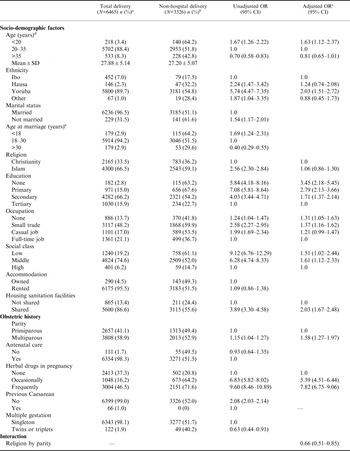
A total of 6465 mothers of 6558 infants attending the four immunization clinics were enrolled and none withheld consent to participate. They had a mean age of 27.9 years (range 13–48 years) and were predominantly (89.7%) of the Yoruba ethnic group (Table 1). The majority (82.1%) had a minimum of a secondary education, 65.2% were engaged in small-trade or casual work and 93.8% belonged to the middle or high social class. Some 13.7% were unemployed compared with 2% of their spouses. The majority (95.5%) lived in rented apartments with shared sanitation facilities. A few (2.9%) either married quite young (below 18 years) or late (above 30 years).
Determinants of non-hospital delivery among 6465 mothers in inner-city Lagos, Nigeria

a Column percentages;
b row percentages.
c Adjusted for all factors (except accommodation: p=0.456, and antenatal care: p=0.687) and interaction term of parity by religion.
Missing data: d12 (0.2%);
e 193 (3.0%).
Hosmer–Lemeshow test: p=0.173; Nagelkerke Pseudo-R 2=0.348; c-statistic=0.791; 95% CI: 0.780–0.802.
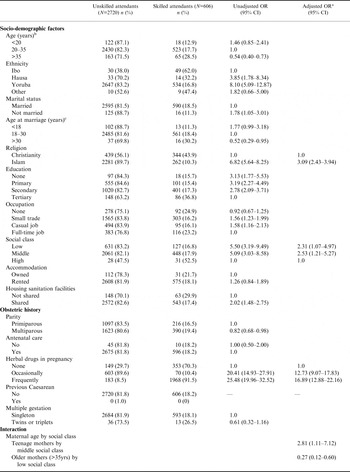
Some 51.4% of the mothers delivered outside hospital facilities with traditional maternity homes accounting for 39.7% (2566/6465) of total deliveries or 77.1% (2566/3326) of non-hospital deliveries. More than half of those who delivered outside hospitals were 20–35 years old (51.8%), of the Muslim faith (59.1%), had at least secondary education (76.9%) and were mostly petty-traders (59.9%). Over half (57.4%) of deliveries were attended by skilled health workers and deliveries at traditional maternity homes were least attended by skilled health workers (Fig. 1). The majority (81.8%) of non-hospital deliveries were attended by unskilled workers. Although almost all (98.3%) mothers had antenatal care, about two-thirds used traditional herbs during pregnancy. None of those with a previous history of Caesarean section delivered outside hospital facilities and a lower proportion of those who sought skilled attendants at delivery used herbal drugs in pregnancy. The proportion of mothers who delivered outside hospitals with and without skilled attendants is presented in Table 2. As expected, deliveries outside hospital were less likely to be attended by skilled workers as only 18.2% were attended by skilled professionals.
Places of delivery by 6465 mothers in inner-city Lagos, Nigeria, and type of birth attendants at delivery.

Determinants of use of unskilled attendants among 3326 mothers who delivered outside hospitals in inner-city Lagos, Nigeria

a Adjusted for all factors (except accommodation: p=0.273, antenatal care: p=0.994, multiple gestations: p=0.129, and previous Caesarean section) and interaction term of maternal age by social class.
Missing data: b5 (0.2%);
c 112 (3.4%).
Hosmer–Lemeshow test: p=0.076; Nagelkerke Pseudo-R 2=0.411; c-statistic=0.811; 95% CI: 0.788–0.834.
In the univariate analyses, all socio-demographic variables except accommodation type and all obstetric variables except antenatal care were associated with non-hospital delivery. There was also a significant interaction between parity and religion (p=0.002). Similarly, all socio-demographic variables except accommodation type as well as parity and herbal drug use in pregnancy were associated with lack of skilled attendants at delivery, while there was a significant interaction between maternal age and social class (p=0.003).
After multivariable logistic regression analysis and the inclusion of the appropriate interaction term in the first model for place of delivery, mothers who were teenagers (OR: 1.63; CI: 1.12–2.37), of Yoruba tribe (OR: 2.03; CI: 1.51–2.72), with no education (OR: 3.45; CI: 2.18–5.45), primary education (OR: 2.19; CI: 2.13-3.66) or secondary education (OR: 1.71; CI: 1.37–2.14), unemployed (OR: 1.31; CI: 1.05–1.63) or engaged in small trade (OR: 1.37; CI: 1.16–1.62), belonging to low (OR: 1.51; CI: 1.02–2.44) or middle (OR: 1.61; CI: 1.12–2.33) social class, living in accommodation with shared sanitation facilities (OR: 2.03; CI: 1.67–2.48), being multiparous (OR: 1.58; CI: 1.27–1.97) and using herbal drugs occasionally (OR: 5.58; CI: 4.50–6.44) or frequently (OR: 7.81; CI: 6.74–9.05) were more likely to deliver outside hospitals. Parity was found to modify the association between religion and non-hospital delivery (exponentiated interaction term coefficient: 0.66; CI: 0.51–0.85). The Hosmer–Lemeshow test did not indicate a lack of model fit (p=0.173). The final model showed good discriminatory powers (c-statistic=0.791) and explained 35% of the variation in maternal choice of non-hospital delivery (Nagelkerke Pseudo-R 2=0.348).
Similarly, after multivariable logistic regression analysis and the inclusion of the significant interaction term in the second model for type of attendant at delivery, being a Muslim (OR: 3.09; CI: 2.43–3.94), belonging to low (OR: 2.31; CI: 1.07–4.97) or middle (OR: 2.53: CI: 1.21–5.27) social class and occasional (OR: 12.73; CI: 9.07–17.83) or frequent (OR: 16.89: CI: 12.88–22.16) use of herbal drug in pregnancy were predictive of lack of skilled attendants at delivery. Social class modified the association between maternal age and unskilled attendant at delivery (exponentiated interaction term coefficient of 2.81, CI: 1.11–7.12, for teenage mothers; and 0.27, CI: 0.12–0.60, for older mothers (>35years)). There was no evidence of lack of model fit (Hosmer–Lemeshow test: p=0.076) while the final model showed good discriminatory powers (c-statistic=0.811) and explained 41% of the variation in maternal choice of non-hospital delivery (Nagelkerke Pseudo-R 2=0.411). There was no evidence of collinearity between maternal age and age at marriage in either model.
Discussion
A major finding in this study is that the majority of mothers in this most developed and urbanized city in Nigeria delivered outside hospital facilities despite access to several private and public hospitals and regardless of their educational status or social class. This is consistent with other reports from major cities in the country (Onah et al., Reference Onah, Ikeako and Iloabachie2006) and other African countries (Fotso et al., Reference Fotso, Ezeh and Oronje2008) but contrasts reports suggesting that the majority of urban women in Africa deliver in hospital facilities (Ronsmans et al., Reference Ronsmans, Etard, Walraven, Høj, Dumont and de Bernis2003; National Population Commission & ORC Macro, 2004). The majority of non-hospital deliveries were attended by traditional birth attendants (TBAs) in traditional maternity homes. Evidently, the availability of health facilities does not guarantee their utilization, particularly if they do not address the perceived needs, fears and expectations of the patients. The study further suggests that the positive impact of higher health expenditures for the provision of skilled birth attendants or modern obstetric services in developing countries may be jeopardized if determinants of maternal health-seeking behaviour are not addressed appropriately (Kruk et al., Reference Kruk, Galea, Prescott and Freedman2007). This study has also highlighted relevant factors that may help in identifying women, particularly during antenatal clinics, who are likely to deliver outside hospitals and without skilled birth attendants for whatever reasons based on the satisfactory discriminatory powers of the final models.
It was not unlikely that mothers who chose to deliver outside hospitals did so to avoid possible Caesarean section, as suggested by other reports from this population (Onah et al., Reference Onah, Ikeako and Iloabachie2006; Aziken et al., Reference Aziken, Omo-Aghoja and Okonofua2007). Caesarean section is not culturally acceptable to Nigerian mothers as non-vaginal delivery is often viewed as a sign of maternal laziness, reproductive failure or a curse from perceived enemies or deity, while TBAs pride themselves in their ability to deliver every baby vaginally irrespective of the risks to the babies. Many mothers are also attracted to the more personalized care and emotional support offered by TBAs during childbirth, which is a period of great anxiety for mothers and their families in contrast to certain practices by hospital staff, which are considered disrespectful or embarrassing. For example, evidence from comparable studies suggests that offensive language by health personnel or ridiculing of women's poverty, clothing, parity, smell, personal hygiene, cries of pain or desire to remain clothed are common and undesirable experiences of women who delivered in some hospitals, and these may partly explain why less than half of multiparous mothers delivered in hospitals in this study (Grossmann-Kendall et al., Reference Grossmann-Kendall, Filippi, De Koninck and Kanhonou2001; D'Ambruoso et al., Reference D'Ambruoso, Abbey and Hussein2005; Koblinsky et al., Reference Koblinsky, Matthews, Hussein, Mavalankar, Mridha and Anwar2006). Favourable experience with previous non-hospital delivery builds trust and is a significant predictor of subsequent preference for this choice of delivery, especially among multiparous mothers (Etuk & Ekanem, Reference Etuk and Ekanem2001; Ezechi et al., Reference Ezechi, Fasubaa, Obiesie, Kalu, Loto and Dubub2004). It was not possible to determine if the place of last delivery or which past delivery experiences, including adverse outcomes, influenced the choices of these mothers.
Consistent with findings by other researchers, religion was predictive of health choices among mothers with the combined and synergistic effects of parity (Ezechi et al., Reference Ezechi, Fasubaa, Obiesie, Kalu, Loto and Dubub2004; Onah et al., Reference Onah, Ikeako and Iloabachie2006). In fact, there was an 11.0% increase in odds of delivering outside hospitals among multiparous Muslim mothers compared with primiparous Christian mothers. This may also explain why the vast majority of mothers, regardless of their place of delivery, still found it necessary to use herbal drugs during pregnancy, which is often underpinned by strong cultural and superstitious beliefs, particularly among the predominant (Yoruba) ethnic group (Adetunji, Reference Adetunji1996). In fact, almost 40% of mothers who delivered in hospitals reported using herbal drugs in pregnancy and the odds of using unskilled attendants at delivery were substantially elevated among mothers who used herbal drugs in pregnancy. It was not uncommon for some mothers in this population to attribute complications during childbirth to evil forces, ancestral roots or providence and therefore considered modern obstetric care as ineffective or inadequate in averting or dealing with these risks (Adetunji, Reference Adetunji1996; Etuk & Ekanem, Reference Etuk and Ekanem2001; Ezechi et al., Reference Ezechi, Fasubaa, Obiesie, Kalu, Loto and Dubub2004). For example, TBAs frequently use patient reaction to local herbs and mystic powers to detect and manage pregnancy while those who used faith-based facilities were also likely to have sought protection from spiritual influences (Harrison, Reference Harrison2003; Ahmed et al., Reference Ahmed, Odunukwe, Akinwale, Raheem, Efienemokwu and Ogedengbe2005). It was striking that no mother with a previous Caesarean section delivered outside hospital facilities and this may be due to the fact that TBAs often refuse to accept mothers they considered as high risk because of possible labour complications (Ahmed et al., Reference Ahmed, Odunukwe, Akinwale, Raheem, Efienemokwu and Ogedengbe2005). Previous Caesarean section or any major surgery has also been found to correlate with acceptability of Caesarean section, and by implication, the decision to deliver in hospitals (Awoyinka et al., Reference Awoyinka, Ayinde and Omigbodun2006).
The 63% increased odds of non-hospital delivery among teenage mothers compared with the older or more experienced mothers may be attributed to the fact that these teenage mothers were mostly students who may be ashamed of their pregnancies or ignorant of the risks of non-hospital delivery and the benefit of good obstetric care (Etuk & Ekanem, Reference Etuk and Ekanem2001). This age group accounts for a disproportionately high maternal mortality rate in developing countries (WHO et al., 2007) and merits closer attention, also considering that the odds of delivering without skilled attendants were almost three times higher among teenagers in the predominant middle social class (Table 2).
In line with other reports within and outside Nigeria, mothers without tertiary education were more likely to choose non-hospital delivery and less likely to seek skilled attendants at delivery (Raghupathy, Reference Raghupathy1996; Celik & Hotchkiss, Reference Celik and Hotchkiss2000; Onah et al., Reference Onah, Ikeako and Iloabachie2006). Education facilitates autonomy of women in making better health decisions, although some highly educated mothers also seek the services of TBAs and use herbal drugs as much as less-educated mothers in the study population. Mothers without full-time employment were more likely to use non-hospital facilities for a number of possible reasons, which may include affordability. In contrast, women with full-time employment are likely to have been registered with their employers' accredited private hospitals as part of their fringe benefits. These factors may also explain the association between low and middle social class with non-hospital delivery. The high proportion of those residing in rented apartments with shared sanitation facilities reflects the living conditions of the vast majority of mothers in inner-city communities in developing countries. These conditions foster communal life-style and socio-cultural bonding that may exert an overbearing influence on health-seeking behaviours regardless of an individual's educational attainment (Montgomery & Hewett Reference Montgomery and Hewett2005). It is therefore not altogether strange that most urban women, despite the availability of and access to modern health services, bear a lot of similarities with their rural counterparts and may even actively seek rural-based facilities (Izugbara & Afangideh, Reference Izugbara and Afangideh2005).
Another notable finding is this study is that three factors – religion, social class and use of herbal drugs during pregnancy – could explain 41% of the non-use of skilled attendants at delivery. The training of TBAs as part of the overall strategy to scale-up skilled attendants at delivery in non-hospital settings continues to be a subject of debate (Campbell et al., Reference Campbell and Graham2006; Koblinsky et al., Reference Koblinsky, Matthews, Hussein, Mavalankar, Mridha and Anwar2006). However, it is evident from this and other comparable studies that a significant proportion of women will continue to deliver in non-hospital settings without skilled attendants for a variety of reasons, some of which may not be readily modifiable such as religion and social class. It is therefore necessary to minimize the potential risks that may be associated with this choice through a combination of approaches that include the training of TBAs as a stop-gap measure as well as improving maternal education with special attention to the contextual factors underpinning preference for non-hospital delivery regardless of the availability of facility-based services.
A few limitations of this cross-sectional study are worth noting for future studies. For example, because of the lack of a systematic qualitative component it was not possible to ascertain participants' perspectives on the choice of delivery place and the impact of the (perceived) quality of services. Also, the obstetric profile of mothers did not include a detailed account of previous delivery experiences or possible medical conditions that would have influenced the choice of delivery place. The proportion of women who planned to deliver outside hospital but who eventually were referred to hospitals, possibly as a result of intrapartum obstetric complications, was not explored. Some of the explanatory variables were not sufficiently discriminatory due to limitation in the data collection. For example, there was no information on the number of antenatal visits made by the mothers to determine the adequacy of antenatal care received. Although social class and occupation were significant predictors of non-hospital delivery, it was difficult to ascertain the direct impact of both official and unofficial costs of services on maternal choice. However, the impact on maternal choice is likely to be moderated by the trade-off between the perceived benefits of the services by different providers and the overall costs within the context of the range of choices open to mothers in an urban setting such as this. While uptake of BCG immunization is generally high compared with that of other routine childhood vaccinations, the use of this platform excluded mothers without surviving newborns and those who did not seek immunization for their children (though only a small proportion of live births may be so affected), so this is susceptible to selection bias compared with a house-to-house survey. Notwithstanding these limitations, this study has provided valuable insights into the profile of mothers living in urban areas who are most likely to opt for non-hospital delivery and without skilled attendants regardless of the availability of facility-based services. Such mothers deserve special attention and counselling, particularly during antenatal visits, in any efforts aimed at improving maternal and child health in this and comparable populations in the developing world.
Conclusions
Despite the higher level of formal education, social class, adequate and proximity to hospital facilities and skilled attendants, the majority of urban women in Nigeria deliver in non-hospital facilities predominantly comprising of traditional maternity homes managed by unskilled attendants or TBAs. The imminent urban transition in Nigeria, as in many other developing countries, makes the health of urban mothers an important determinant of improvement in maternal and child health care at the population level. Hence, current initiatives to strengthen existing health care systems in urban areas or scale-up skilled attendants at delivery and expand facility-based services for rural women, though essential, would need to be complemented by community-oriented initiatives that will effectively address the socio-cultural dynamics that underpin maternal health-seeking behaviour, particularly in urban areas. Such interventions would need to be targeted at both the providers of services and the women, particularly during antenatal clinics.
Acknowledgments
The authors are grateful for the kind support of all the staff and management of the health centres used in this study, as well as all the participating mothers. The support of Linda Luxon and Sheila Wirz of University College London on the substantive project that preceded this post-doctoral work is gratefully acknowledged. The authors also benefited from very useful comments from two anonymous reviewers. The authors are grateful to the Education Trust Fund (ETF), an agency of the Federal Government of Nigeria, for educational materials for all participating mothers; and Hearing International Nigeria, a local charity, for funding support for this project. None of the sponsors was involved in the study design, collection, analysis and interpretation of data; the writing of the manuscript; or the decision to submit these results for publication. The authors declare that they have no competing interests.