INTRODUCTION
In a review of place of death preferences, Higginson and Sen-Gupta (Reference Higginson and Sen-Gupta2000) found that many of those with advanced cancer would choose to die at home if given the option. Despite the drive to enable home deaths, another review found that most cancer deaths occur within the walls of an institution (Murray & Young, Reference Murray and Young2009). There is thus an apparent discrepancy between preferred and actual place of death for some (Ellershaw & Ward, Reference Ellershaw and Ward2003). According to Gott (Reference Gott2008), this is partially due to palliative home care provision still being inadequate, resulting in the need for hospital admission toward the end of life. Others have found that specific and specialist-driven home care services can help realize the preference to die at home (Bell et al., Reference Bell, Somogyi-Zalud and Masaki2010). Thus, the addition of professional support in the home may enhance a person's chance to die there, but there are potentially other factors involved.
With families being relied upon during palliative home care, their input is essential to the success of such a service (Hinton, Reference Hinton1994). Furthermore, Grande and Ewing (Reference Grande and Ewing2008) argue that a major barrier to home death is the potential discrepancy between the patient and family's preferred place of care. Similarly, a study looking at home death possibility found that the family's willingness to provide care at home was central to whether or not this happened (Thomas et al., Reference Thomas, Morris and Clark2004). Families may experience difficulty when coping with aspects of acute medical decline such as breathlessness (Gysels & Higginson, Reference Gysels and Higginson2009), or be unsure about managing terminal delirium (Namba et al., Reference Namba, Morita and Imura2007). Alternatively, home caring may result in the informal carer becoming exhausted, leading to hospice or hospital admission (Bramwell et al., Reference Bramwell, MacKenzie and Laschinger1995).
Stajduhar and Davies (Reference Stajduhar and Davies2005) described some family members committing to supporting a home death without fully realizing the impact of their decision. For example, one participant talked about a “romanticized” view of death at home, coming from the media, when in fact the reality was felt to be “horrendous” (p. 24). Thus, a home death may be perceived as traumatic by some. In addition, being a carer at the palliative stage may result in a more difficult bereavement experience (Carter et al., Reference Carter, Mikan and Simpson2009). This highlights the difficult balance that providers of services face, between providing person-centered care for the individual with cancer while considering the well-being of the family, believed to be a significant ethical dilemma by some (Randall & Downie, Reference Randall, Downie, Randall and Downie2009).
The findings outlined above indicate a need to better understand the reasons behind the inability to secure a home death. The aim of the present study was to understand family members' experiences of providing care for a loved one with cancer during the last phase of their life when those family members had been unable to fulfill their loved one's wish to die at home.
METHOD
Participants
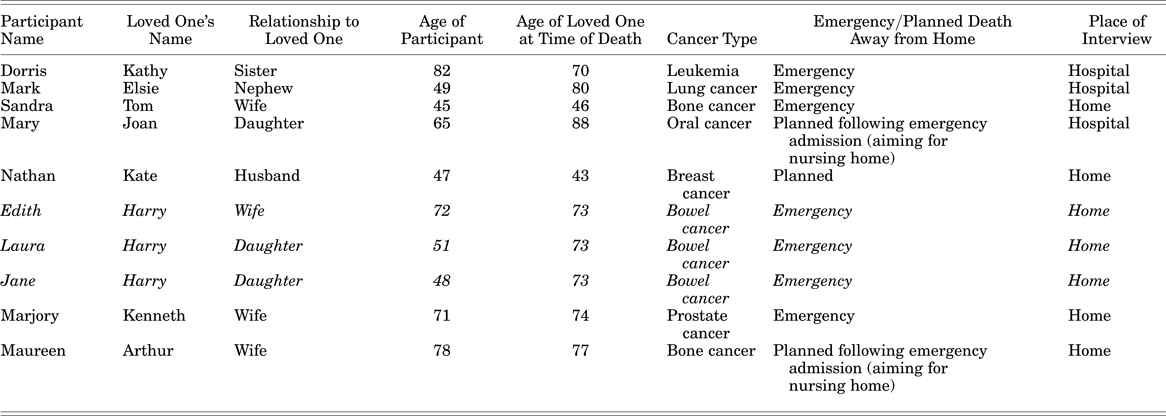
Staff working in a palliative care service in the north of England identified potential participants on the basis of the following criteria. All participants had lost a loved one to cancer who had expressed a wish to die at home. So as to minimize problems with recalling more factual information, only those who had lost a loved one during the previous three years were contacted. Study invitation letters were sent to 29 family members, and 10 people agreed to take part (2 men and 8 women). This resulted in a total of eight separate interviews, including one in which three members of one family were interviewed together. Ages ranged from 45 to 82 (mean, 60.8). The age of the loved one at the time of death ranged from 33 to 88 (mean, 69.7). The length of time since death varied from one to three years.
Procedure
Ethical approval was obtained prior to commencing the study. Following identification of potential participants by staff in the palliative care service, information letters and consent forms were sent out. Interviews were conducted either at the hospital in a clinic room or at the participant's home (see Table 1 for details) depending on their preference. Interviews generally took the form of a single starting question, and then inviting the interviewee to share their story. On several occasions predetermined follow-up questions were added to aid participants if they appeared uncomfortable with the single-question format. Interviews lasted 64 minutes on average.
Participant characteristics

Note. Italicized text represents three family members contributing to one story.
Analysis
Narrative analysis was used in data collection and analysis and drew upon the work of McAdams (Reference McAdams1993), Crossley (Reference Crossley2000), and McCormack (Reference McCormack2004). A narrative approach argues that people derive meaning from experience by placing life events within an unfolding story that has a cast of characters and a discernible plot with a beginning, middle, and end. Therefore, by focusing on the way people narrate their experiences it is possible to learn how they reconstruct meaning and reorient following major life events. For this reason, it is important to understand events preceding, during, and following the topic of research concern (in this case, being unable to fulfill a loved one's wish to die at home). Transcripts were first read several times to facilitate familiarity with the content. Next, transcripts were focused upon in depth to consider tone, metaphor, imagery, and any key themes. Further, key points of convergence and divergence within the narrative plot were identified. Finally, key characters were noted, along with their development throughout each story. At this stage, a summary story was completed for each interview (McCormack, Reference McCormack2004), placing events chronologically and using extracts from the transcript, ensuring that they were in the participant's own words. These summaries were then compared with a focus on how they converged and diverged across the narratives to produce a composite story that encapsulated these features.
RESULTS
The following presents a narrative synthesis based upon shared plots across the 8 interviews involving 10 participants, organized into four main chapters. The narrative summaries began chronologically at the cancer diagnosis, moving onto the terminal stage, before progressing to the experience of death itself. Finally, narrators ended by deconstructing their experience as a whole, providing reflections upon their story, with particular reference to how it was still being shaped at that time. A shared plot was chosen to present the study findings, in which both differences and similarities across participants were emphasized.
The Cancer Diagnosis: “It Will Crumble Your World”
Typically, the story began with a description of ill health leading up to the cancer diagnosis. Thus, comments such as “she hadn't been so well that summer” (Dorris) and “I just thought there was a change” (Edith) highlighted the starting point of the journey. Each account had a different course up to the point of diagnosis, with some describing a sudden decline, while others told a much slower and more progressive story.
Underlying the narratives of some appeared to be a sense of guilt, the fact that symptoms had been ignored for some time potentially weighing heavily. For instance, delaying going to the doctors was coupled with the statement “not that he was ill” (Edith), perhaps as a way of justifying the postponement of medical advice. Indeed, guilt was a theme running through many of the stories and became more apparent later on, although rarely stated explicitly.
Following on from noticing ill health came the diagnosis of cancer, a turning point in the lives of all those affected. A multitude of imagery was presented by narrators to describe this moment. This came in tandem with a change in tone, which became more urgent and rapid, mirroring their real-life experience. For example, the majority of stories had elements of “shock” and “devastation” at the cancer diagnosis, worsened when cancer had not been expected: “It was a body blow really; it hadn't occurred to us that it could be anything like that” (Maureen). Other descriptions of the point of diagnosis were equally emotive: “That one word destroys a family; it destroys everything” (Nathan).
Not every story depicted the cancer diagnosis as being unexpected. For example, Mark said that the family had “an inkling” and “it wasn't a bolt out of the blue.” This was in part due to Elsie's age, as she “knew she was going to die of something, so she was fine with it.” Additionally, Mark felt that Elsie's lifestyle of “smoking” and “drinking whiskey” meant that they were “waiting for something like [the cancer].” This stoical attitude toward the cancer diagnosis resonated in those stories where the loved one died at an older age. Indeed, there seemed to be a sense of acceptance and gratitude for the long life that had preceded ill health, highlighted in the following extract: “I've had such a wonderful life (. . .) how would I dare be miserable and moan?” (Edith). In contrast, a sense of injustice arose from the stories where death occurred at a young age, with a feeling of a half-lived life. However, the notion of cancer barging its way into each narrator's life was apparent, irrespective of age or circumstances, shattering future dreams and irrevocably altering the present.
The initial cancer diagnosis did not equate to death for some, recovering from a first cancer before their prognosis became terminal. In such stories, there was a feeling that families had moved on following the first battle and had banished cancer from their lives: “It was kind of over and done with really” (Sandra) and “Everything was going lovely; it was a new start, a new life” (Nathan). The return of cancer was presented as a second invasion, contributing to the definite battle metaphor running through each story. Alternatively, some knew from the point of diagnosis that the cancer was terminal: “He knew from the beginning, from five years previous that his days were numbered” (Marjory). However, in each story the point of terminal prognosis signified the start of the fight. This was despite the knowledge that life would ultimately be lost: “She said, ‘I'm going to beat this.’ She knew she couldn't (. . .) that [the Doctor] wouldn't say that she had terminal cancer if she hadn't” (Nathan). As time progressed, the battle would potentially encounter more opponents, not only fighting the cancer, but also its wider effects upon the family.
The narrators presented many examples of how they and their support networks coped with the challenges that cancer and terminal illness present. Some conjured up an image of families coping with cancer together, while others had diametrically opposite experiences. In some circumstances, families appeared to enter into battle with each other. However, for those able to face cancer openly together, this led to an easier discussion of difficult issues, such as death and the preferences regarding it: “It wasn't something that was taboo; there were no whispers (. . .) We could have a laugh and joke about it” (Mark). Conversely, some preferred not to talk to their loved one about their concerns regarding the future: “You almost think, ‘Okay, okay, I'll stick my face up to it, don't make an issue, carry on as if it's not happening really’ ( . . .) We just carried on doing everything we could do, as normally as we could, as much as we could” (Sandra).
At times this “facing up to cancer” approach seemed to be adaptive, enabling life to continue on as positive a note as possible: “I said, ‘Just forget it and live life as normal,’ which we did (. . .) All you want to do is make the most of the time they have left” (Marjory). However, at times it could shift into denial, such as in Sandra's story, when talking about avoiding discussing death preferences with her husband Tom: “I wouldn't necessarily have wanted to have that conversation. Would I have said to him, ‘I don't want you to [die at home] so therefore you'll go to hospital?’ I don't know if that would have been a very nice conversation.”
In addition to managing one's own coping, the narrators described having to adapt to meet the emotional needs of their loved ones. While some were able to face cancer and death with a determined “fighting spirit” (Nathan, about Kate), others described a different reaction: “Fear struck, and she got that she would not be left, day or night. She was just terrified, I think, of dying on her own” (Mary, about Joan). It appeared that bearing witness to such fear and pain could have a significant impact upon the narrator, leading them to go to great lengths to ensure their loved one was as happy and comfortable as possible: “I had to sleep with her, every night, in the same bed” (Mary).
The Terminal Stage and the Advancement of Death: “It Was All Very Traumatic”
Following the diagnosis, the majority of the stories included some description of treatments. For instance, Ted had an ileostomy, which was felt to be a “traumatic” time for the family. It was during difficult procedures, along with general disease progression, that narrators tended to step into a different role. Specifically, there was a shift in identity from partner or daughter to “caregiver.” For some this was an easy transition: “He couldn't have coped without me (. . .) It wasn't anything for me to do it; it was no different to me than a child” (Edith). Thus, being able to draw upon prior chapters of life and their experiences of looking after children enhanced their ability to manage the provision of care.
However, others were less able to cope with the alterations needed to perform care tasks: “That was making it difficult for me, the changing and things (. . .) For me that wasn't a nice thing to do; it's not very nice for your relationship (. . .) When it's your husband, it just didn't feel right for that to be part of it, really” (Sandra). Conversely, others were able to blend their identity to incorporate the caring role within their role as spouse: “I had to do everything for her (. . .) I had one thing set in my mind and that was to get my wife through this” (Nathan).
As the cancer progressed and the loved one became more unwell, families were having to adjust to rapid changes in functioning, highlighted in the following extract: “It came too quick; the cancer spread too fast; it was just like a whirlwind. It went so fast, your head was spinning” (Nathan). In terms of coping with the unknown and ever-changing situation that the narrators found themselves in, the majority of stories had a day-by-day feel. This left little time to adjust to the present before the next change came: “You just sort of adapt as you go along to the different stages. I think that's why in a way you almost forget it's [death] going to happen” (Sandra).
As described above, the adoption of the “carer” role is potentially difficult. Indeed, many will have no practical experience or training for how to perform care tasks, leading to a lack of self-efficacy. Therefore, agreeing to look after someone at home during the initial stages of disease can take on a new meaning as symptoms progress: “They didn't realize the ins and outs. When she was relatively well it was easy then (. . .) I don't think they fully understood what death and dying was” (Mark). This description resonates with a cultural preference to maintain the sacredness of death, with most never encountering the practicalities of what is involved.
Furthermore, a lack of self-confidence in the ability to provide adequate care, or simply to know what to do when things went wrong, could result in home care ceasing due to a belief that the hospital would be better equipped to help the loved one. Certainly, witnessing such suffering was difficult for families, who wanted the best for the dying person at all times: “Suddenly, when somebody can't breathe to that extent, I think in desperation you think hospital might be able to do something” (Edith).
As well as feeling unable to manage at home for the above-mentioned reasons, some became exhausted by the responsibility of care. In particular, coping with care tasks was particularly arduous when the narrators themselves were elderly: “[The doctor] said, ‘you've had enough,’ and he went in the hospice on the Monday, so that was a relief, really” (Maureen). Similarly, Marjory struggled with care provision, with the following extract highlighting the extraordinary burden placed upon families: “It didn't go on for very long. So you can cope with anything, can't you, on a temporary basis?” These quotations have a real sense of sadness, as relief was felt when the loved one was no longer at home. This suggests difficult dissonance between wanting the loved one to be happy and no longer being able to cope. For Marjory, the will to care was ever present, but she found it “draining” and “quite emotional.” When coupled with a perceived lack of professional support, the need to care appeared entirely encompassing and overwhelming: “Until four weeks before, we didn't get any help at all, and I was getting quite upset.”
In addition to the narrator feeling essentially burned out, other factors influenced the ability to continue home care. For the majority of participants, the loved one stayed at home until a medical crisis, making the situation suddenly feel out of control. In fact, the decision to take the loved one into hospital was often not in the hands of the narrator; rather, medical staff deemed an admission necessary: “Apparently, if you mention breathing that's it; ambulance straight away” (Sandra). Hence, although there was some regret at the inability to fulfill the loved one's wish, feelings of guilt appeared to be minimal. However, Mary still blamed herself after realizing the consequences of her initial actions: “It's the guilt (. . .) In one respect, I didn't call the ambulance, but in another I called the person that called the ambulance (. . .) So in a roundabout way it was my actions that actually brought her here (. . .) It's something you have to live with.”
Central to this section of the story was a shared frustration with the unpredictability of death. Although a rough prognosis may be offered, the actual timing of death cannot be foreseen. This lack of control over the unraveling of events appeared to make it particularly difficult for some. For example, Nathan struggled following his wife's admission to hospital after a seizure when the opportunity to bring her home again arose: “At first I said yes, but we didn't know when. It would have been lovely if they'd have said she's definitely got six months; I'd have had her home—no ifs, no buts.”
The main reason for Nathan's turmoil, shared by Sandra, was the conflict between the roles of parent and partner. Both described the terrible position they found themselves in, struggling to comprehend whose needs to put first. They were aware of their loved one's wish to die at home but also were acutely protective of their children's well-being. The tone of their stories became quite pained at this point, not quite able to fully verbalize the regret of needing to place the needs of their surviving children over those of their dying spouse: “If it had just been me and her, I'd definitely have had her home and let her die at home. But I had to think of the welfare of my children more than anything else, more than [pause] I don't know” (Nathan). This offers an insight into the incredibly difficult decision that Nathan had to make and is still living with.
Similarly, Sandra felt the need to protect her children from the unbearable pain of loss, attempting to avoid the shattering of “home” as a safe place for them by ensuring that their father's death occurred elsewhere: “If he had died at home, I would have worried about the whole of it (. . .) The fact that it would have happened here (. . .) I think they [children] would have found that difficult.” Nathan elaborated upon this: “I didn't really want [my daughter] to come downstairs thinking her mummy's down here, and then she finds I can't let her in because she's died. That would upset her even more.”
Death Itself: “I'd Have Fallen to Pieces a Lot More if She Was at Home When She Died”
Despite the differing reasons for care ceasing at home, the peak of each story was the same: the death of the loved one in hospital, instead of at home as they had wished. At this point, there is divergence within the stories, as three deaths occurred in hospital in a more planned way, while five were medical emergencies. All three of the deaths that were planned to occur outside the home were a result of the narrator feeling unable to provide care for the reasons outlined above. In these instances, the sense of guilt appeared to arrive earlier in the story, at the point when the decision was made. For Nathan, Kate's hospital death was expected and gradual, resulting in a sense of peace at this stage of his story: “She knew she wasn't going to last long. As the kids came in, they all gave her a kiss and she said, ‘I love you all.’ (. . .) Then, as I stood at the bottom of the bed, she looked up at me and smiled. I knew that she was saying that she loved me. I knew with that smile she was saying goodbye.”
Additionally, the reduction in guilt in Nathan's story appeared to arise from the acceptance of his wife that she would be unable to remain at home, with them reaching the decision together. Certainly, Kate seemed to place her role as a parent above all else: “Her most important things in life was [sic] her kids.” Furthermore, Nathan felt supported in his decision by hospital staff: “Even the nurse said the trauma of moving her would have been a lot on her body.” Being able to justify his decision in this way seemed to help Nathan reduce his sense of control in the events leading up to Kate's death, again leading to reduced feelings of guilt. A similar effect with respect to a personal lack of control in events was present in Sandra's story, potentially enabling her to see Tom's hospital death as a relief: “I'm pleased he was there.” Furthermore, Tom was expected to return home, and his sudden death was a shock: “There was no reason for anybody to think he wasn't just coming back out the next day.”
Mary's experience of her mother's hospital death was quite different from Nathan's, despite both deciding several weeks before that a home death was not possible. Mary felt that the staff were less supportive, trying to discharge her mother home without a sufficient package of care. Furthermore, unlike Kate, Joan clearly still wanted to return home to be cared for, adding to the sense of guilt that Mary was already carrying. This is highlighted in the following extract: “She said I hadn't kept my promise to her. She said ‘You promised you'd take me home.’” Mary described a turbulent relationship with her mother prior to her ill health, which could have affected her ability to cope with such comments. However, before Joan died, Mary described the following: “She said ‘I'm dying,’ and I said, ‘I really love you, mum.’ She said, ‘I love you Mary.’ It was the first time in my life that she'd told me she loved me, the very first time.” This poignant moment in Mary's story appeared to be the part she clung to in order to confirm that she had done all she could for her mum. It also highlights the possibility for a positive moment to punctuate stories essentially replete with loss.
For those who died in hospital as a result of an emergency admission, the pace of the story became rushed with imagery such as “whipped her into A&E [Accident and Emergency department]” (Mark) being used to depict the hurried nature of this section. The tone became depressed in most of the stories (e.g., “things began to fall apart” [Marjory]) and the dying person was “shipped” into hospital. There was a real sense of being unprepared for the physical complications arising in someone with cancer nearing death. Mark described his nieces' reactions to their mum's sudden change in health: “It all goes pear-shaped and they panic (. . .) thinking something drastic is going to happen. I don't think they fully understood what death and dying was.” This led to the end feeling very traumatic for narrators, being faced with a loved one struggling to breathe, or in immense pain. Indeed, this can lead to a sense of helplessness as narrators felt completely at a loss to know what to do as their loved one fought for breath: “Even in the hospital you're just there, aren't you? Well, there's nothing you can do. It's just awful” (Sandra).
Unfortunately, in several of the stories, the sense of trauma was not relieved upon entering hospital. In some ways, the treatment there worsened it. Marjory used emotive imagery to describe her experience in hospital: “That was a horrible business, lying on that awful bed in A&E for five hours before a bed is available. (. . .) He was obviously in great pain by that stage. I found that very, very unnerving. That really blew my mind.”
This traumatic experience was mirrored in the story of Edith, Laura, and Jane, who described Harry being “plonked in the middle” of a ward with “loads of people packed in it.” Having no peace at the time of death clearly affected the three narrators, who reported, “The end was traumatic, so bad.” Hence, the knowledge they were unable to provide a home death was coupled with the trauma of a rushed hospital death. This is in contrast to the images that a “good death” summons and seemed to be a difficult memory for them to live with.
Reflections on the Whole Experience: “Nobody Will Know the Pain of Losing Somebody”
Each story ended with narrators looking back on their experience, sharing what they had learned about themselves and others, along with any issues still pertinent in their present life. Here the battle metaphor continued, with reflections about the impact of events upon the wider family. For instance, in Nathan's story, Kate's sisters had contested their decision to remain in hospital, preferring for her to return home or go to the local hospice. Similarly, Mary's experience had the effect of “tearing” her “family apart,” and relationships with her sisters were still strained. Central to her experience was blame: “One of me sisters even said to me, ‘it's your fault she won't stay on her own.’” Similarly, blame ran from Mary to her sisters: “Things are strained now with me sisters (. . .) There will never be a closeness again. I blame them.” Thus, the inability of families to continue to care for their loved one at home until death can have wide-reaching implications, not only in terms of the well-being of the dying person, but also as a source of antagonism for future family conflicts.
In contemplating their experience, some narrators reflected upon the meaning of home for the dying person. For instance, it may have been more important that the dying person was at home for as long as possible before their death: “He was not even in hospital 24 hours, so it worked. He was at home for all intents and purposes” (Sandra). It is potentially the case that constructing the experience in this way is protective for the narrator, emphasizing that the wish was partially met.
Nathan reflected further upon the meaning of “home,” a word that can elicit feelings of warmth, comfort, and familiarity. However, the following extract suggests that, in order to facilitate a home death, the need for aids and adaptation to the physical environment may lead to the environment being altered beyond all recognition. Thus, the implication is that home is no longer home in the true sense of the word; rather, it becomes a substitute medical facility: “It's the fact that you're having a lot of intrusion into your house. You're having that balance thrown everywhere (. . .) and it won't feel like home anyway, to the person.” This intrusion was also described by Sandra, who struggled to cope with the presence of the equipment needed to support Tom at home. It was apparent that for her it was a stark reminder of cancer and its debilitating power, along with being confronted with what was to come, something she tried to avoid in order to cope with the present: “We had a lot of equipment at home (. . .) I hated it when it was first put upstairs in the bedroom. It was too much.”
Following the death of the loved one, there was again divergence in coping, potentially due to the differing relationships to and ages of the lost loved ones. For instance, Nathan, who lost his wife to cancer at 43, said that following her death, “It was just a rollercoaster of emotions, up and down, wishing I could have done it another way. But we know wishes don't come true.” Thus, there was a real sense of Nathan's world shattering, with him feeling full of regret and losing hope for the potential of future dreams. Alternatively, Mark told the story of his elderly aunt's death thus: “There's no use going round in circles, making yourself ill thinking ‘What if this,’ ‘What if that.’ You could ‘what if’ yourself to death.” These extracts highlight the various coping styles employed, with each person processing their experience and moving forward differently.
Some stories incorporated a positive aspect of the narrator's experience. For most, being able to care for their loved one for a period of time at home before their death was exceptionally meaningful. Being at home meant a freedom that the hospital could not afford. For instance, Marjory was able to share a tender moment with her husband the night before he died: “I had got up at three o'clock that morning, and we had a lovely chat, as if he must have known.” Others talked about their experience changing them as a person: “It's made me a stronger person; it's made me realize a lot of things in life are not important” (Nathan). Nathan also talked about how looking after his wife impacted their relationship: “That love you get from that one person when they're dying, it's just immense.” Family relationships were also strengthened in some stories, enhancing hope for the future: “I think it's kept everybody close; you know, the family's there to support you if there's things that go wrong” (Mark).
In conclusion, it is clear that supporting a dying loved one at home can be difficult for family members, particularly when they themselves are elderly. Moreover, other factors affect caring ability and in turn the likelihood of the dying person remaining at home until their death. It is clear that in the stories of these interviews, being unable to support this wish has the potential of enhancing feelings of guilt and regret.
DISCUSSION
The present study obtained the stories of ten individuals whose loved one's wish to die at home was not fulfilled. It thus provides a novel and valuable insight into the experiences of this specific set of people. Using a narrative approach, a shared plot with four chapters (the cancer diagnosis; the terminal stage and advancement of death; death itself; reflections on the whole experience) was constructed. In summary, it appears that family members of those with terminal cancer describe a similar process of adjustment as their loved one with respect to the diagnosis, coupled with adoption of various coping strategies. Furthermore, the inability to support a home death arose for various reasons, including medical admissions, exhaustion, and worries about the emotional well-being of children. It is apparent that the impact of being unable to meet their loved one's desire was significant for some, who described feeling guilty as a result. Additionally, the experience had the potential to adversely affect family relationships. Several metaphors ran through the stories, with the battle metaphor remaining the strongest: initially fighting the cancer, then battling with one's own emotions and guilt, and finally potentially battling with family. The pertinent findings of the present study will be highlighted below in comparison to previous literature, and clinical implications will be discussed.
Adjustment to cancer, such as having a “fighting spirit,” avoidance or denial, responses of fatalism, helplessness, and hopelessness, along with anxious preoccupation, has been documented in those with cancer diagnoses (Moorey & Greer, Reference Moorey, Greer, Moorey and Greer2002). However, in the present study, it appeared that family members also experienced similar responses. Additionally, various coping strategies have been used by family members when a loved one has terminal cancer (Benkel et al., Reference Benkel, Wijk and Molander2010), some of which may negatively influence adjustment. For instance, in relation to approach–avoidance coping (Suls & Fletcher, Reference Suls and Fletcher1985), more avoidant strategies have been found to relate to greater distress (McCaul et al., Reference McCaul, Sandgren and King1999). Conversely, the “fighting spirit” is a more approach-based strategy, talked about by Nathan, and is associated with more effective adjustment (Classen et al., Reference Classen, Koopman and Angell1996). However, Benkel and colleagues (Reference Benkel, Wijk and Molander2010) suggest that coping is individualized, and rather than focusing on coping style per se, services need to support the individual irrespective of their presentation. Indeed, the perception of security, that services will be there when needed, is deemed to be imperative for family caregivers to have a positive palliative experience (Funk et al., Reference Funk, Allan and Stajduhar2009).
It therefore follows that enhancing adjustment to and coping with cancer in families will positively influence well-being. Various therapies have been found to be effective for those with cancer, likely to have similar benefits to their carers experiencing a similar impact on their lives. These include cognitive-behavioral therapy aimed at challenging negative thoughts (Moorey & Greer, Reference Moorey, Greer, Moorey and Greer2002), narrative approaches to enhance meaning making (Carlick & Biley, Reference Carlick and Biley2004), and meaning-centered psychotherapy, which targets spiritual well-being and meaning for patients with advanced cancer (Breitbart et al., Reference Breitbart, Poppito and Rosenfeld2012). Additionally, coping within the dyad can affect well-being, particularly when methods are incongruent with one another (Skerrett, Reference Skerrett1998). For instance, Bodenmann (Reference Bodenmann1997) suggested in systemic-transactional theory that couples either react or ignore each other's signals, with each member's well-being being reliant upon the other. Kayser and coworkers (Reference Kayser, Watson and Andrade2007) found that couples tended to cope openly together in a pattern of “mutual responsiveness,” as seen in Nathan's story. Alternatively, there was a pattern of “disengaged avoidance,” where each individual coped alone, as seen in Sandra's story. The latter is deemed to have a more negative effect upon the relationship and well-being (Ptacek et al., Reference Ptacek, Ptacek and Dodge1994). Thus, enabling couples to work together should enhance well-being and potentially facilitate discussion of difficult issues, such as death preferences. One means by which this may be achieved is couples-based therapy (Mohr et al., Reference Mohr, Moran and Kohn2003).
Increased confidence in performance of care tasks can further enhance coping. Providing family members with information and knowledge about what to expect and how to act may enhance self-efficacy (Friedrichsen, Reference Friedrichsen2003). This was seen as being central to Mark's story, with a lack of understanding and preparedness leading to his aunt's hospital admission. Thus, group-based approaches (Harding et al., Reference Harding, Higginson and Leam2004) or individual sessions (Walsh et al., Reference Walsh, Estrada and Hogan2004) that have an element of psycho-education combined with support may enhance the perceived ability to cope with a home death in family carers. In addition, although participants' self-generated stories in the present study did not include accounts of finding meaning in the caregiver role, recent research has indicated that such caregivers do find meaning in this process and may benefit from psychological interventions designed to address this (e.g., Hasson-Ohayon et al., Reference Hasson-Ohayon, Goldzweig and Sela-Oren2013).
Another factor leading to cessation of home care was exhaustion. Certainly, providing care may be particularly difficult for those who are themselves elderly (Currow et al., Reference Currow, Burns and Agar2011). The burnout experience is widely documented in professionals working in the palliative care setting (Italia et al., Reference Italia, Favara-Scacco and Di Cataldo2008). In exploring “burnout syndrome,” Maslach (Reference Maslach1982) suggests several negative outcomes in caring for a loved one, including emotional exhaustion, guilt, and lowered self-esteem. Thus, it is again imperative to support those providing care, potentially by offering some respite (Bramwell et al., Reference Bramwell, MacKenzie and Laschinger1995).
With respect to place of death preference, it may be that the dying person's wish is not always appropriate and may cause additional distress for family members (Stajduhar & Davies, Reference Stajduhar and Davies2005). This was particularly resonant in the stories of those considering children's needs in their decision making. Indeed, some studies have found a home death to negatively affect the bereavement process (Addington-Hall & Karlsen, Reference Addington-Hall and Karlsen2000), making the concerns of the present narrators potentially valid. Conversely, other studies have determined that a home death may lead to more positive psychological adjustment post-death for carers (Carlsson & Rollison, Reference Carlsson and Rollison2003).
Essentially, the focus of this discrepancy may be related to the preference of carers themselves. For instance, if the carer is in agreement with the dying person, a home death may be seen as positive and vice versa. This was supported in Mary's story, who wanted her mother to die at home, but other factors affected this possibility. As a result, Mary described struggling with grieving, particularly due to the presence of guilt. A similar finding was described by Andershed and Harstade (Reference Andershed and Harstade2007), who reported feelings of guilt and shame in a sample of next of kin. In particular, their participants reflected upon feeling that they had not done enough or had made errors in decision making. It is known that guilt can affect bereavement (Parkes, Reference Parkes1972), potentially making it more “complicated” (Prigerson et al., Reference Prigerson, Frank and Kasl1995). Thus, to ensure carer well-being, services should aim to minimize the sense of guilt, either by supporting those lacking the confidence to care at home or by facilitating open conversations among families when a home death is not possible. Certainly, Kate's acceptance of a hospital death appeared to ease Nathan's sense of guilt. Therefore, services must balance this complex ethical dilemma, determining who will be most affected by the location of death (Randall & Downie, Reference Randall, Downie, Randall and Downie2009).
Some narrators talked about positive gains following their experience of caring for their loved one at home. Growth through coping with a negative or traumatic experience has been described by several authors, leading to the theory of posttraumatic growth (Tedeschi & Calhoun, Reference Tedeschi and Calhoun1995). Interestingly, the individual discussing the greatest growth through his experience was Nathan, who described a very strong relationship with his wife. This experience is mirrored by the findings of Weiss (Reference Weiss2004), who found depth of marital commitment to be the greatest predictor of posttraumatic growth in husbands of breast cancer survivors. Some argue that the ability to find positive benefits in the caring experience enables the individual to process it in a meaningful manner (Wong et al., Reference Wong, Ussher and Perz2009). Thus, the encouragement of growth could be beneficial for later psychotherapeutic techniques (Calhoun & Tedeschi, Reference Calhoun and Tedeschi1999).
Overall, narrators described themselves being adversely affected by their experience of their loved one's cancer and death. While it is beneficial to aim for person-centered palliative care, it is apparent that cancer in one also influences the well-being of those around them. The need to adopt a wider focus is consistent with family systems theory, asserting that change in one family member will affect the system as a whole (Wright & Leahey, Reference Wright and Leahey2005). Indeed, some authors argue that adopting a more systemic approach to palliative care is essential (Mehta et al., Reference Mehta, Cohen and Chan2009).
CONCLUSIONS AND LIMITATIONS
While it is indeed important to consider the wishes of the dying person with respect to place of death, the findings of the present study, along with those of previous research, suggest that enabling this desire may not always be possible or straightforward. Essentially, family members must provide an element of care within the home, rendering their views on such matters equally important. Some family members, despite best intentions, are simply unable to continue caring. Others must place the needs of children above those of the dying person. Others feel no control over the end-of-life experience, perhaps with a lack of self-efficacy in coping with death, resulting in the turn toward professionals for help. Whatever the reason for the home death failing, those family members left behind will potentially suffer adversely as a result. The present research suggests that services should use different forms of psychotherapy at different points of this process: at diagnosis (e.g., couples therapy), during caregiver roles (to find meaning in this activity), and leading up to and beyond the death of the loved one (to focus on effective coping strategies). Such interventions can be expected to aid the aims of eliciting, reconciling, and achieving the death preferences of loved ones and family members.