





1. Introduction
Verbal communication requires speakers to quickly translate their thoughts into words, often leading them to omit nuances, use ambiguous expressions, or leave out details that listeners need to understand their communicative intentions. The ability to clarify one’s discourse is therefore essential for maintaining effective communication. Clarifications may be prompted by conversational partners through explicit requests or signs of confusion or misunderstanding. In other cases, however, clarifications occur in the absence of such cues, potentially because speakers recognise that their message requires revision or additional detail. Although these two types of clarifications may involve different communicative skills, both require speakers to monitor message adequacy in relation to their audience’s presumed knowledge or understanding (Clark & Brennan, Reference Clark, Brennan, Resnick, Levine and Teasley1991). Thus, clarifications in spontaneous conversation provide a naturalistic window into how children’s sensitivity to common ground is deployed and refined in everyday interaction.
1.1. Tracking and repairing common ground in early childhood
A large body of research shows that young children communicate differently based on what their interlocutor knows. By 30 months of age, children adapt their vocalisations and pointing depending on whether an adult is knowledgeable or ignorant about an object’s location (Behne et al., Reference Behne, Carpenter and Tomasello2014; Knudsen & Liszkowski, Reference Knudsen and Liszkowski2012; O’Neill, Reference O’Neill1996). By age 3, they offer more specific descriptions when requesting an object that is unfamiliar to the listener (Nayer & Graham, Reference Nayer and Graham2006) and more complex expressions when a referent requires disambiguation (Abbot-Smith et al., Reference Abbot-Smith, Nurmsoo, Croll, Ferguson and Forrester2016). Three-year-olds also produce more elaborated narratives with more explicit references when addressing naïve versus well-informed listeners (Menig-Peterson, Reference Menig-Peterson1975; Perner & Leekam, Reference Perner and Leekam1986).
Young children can also adjust their communicative actions in real time when they realise that their interlocutor lacks knowledge (see Harris, Reference Harris2017, for a review). When an adult misnames a common object or makes an unusual request, two- and three-year-olds frequently provide corrections, express disagreement, ask for clarification, or express doubt (Wellman et al., Reference Wellman, Song and Peskin-Shepherd2019), and these detections are often followed by repair attempts, even when there is no benefit at stake (Grosse et al., Reference Grosse, Behne, Carpenter and Tomasello2010). With age, children become increasingly competent in using their interlocutors’ feedback to detect and repair shortcomings in their own messages. Although preschoolers often produce egocentric and ambiguous referential descriptions (e.g., saying “the blue one” when more than one option fits that description), by ages 4–5 they generally provide adequate repairs when given explicit feedback (Bacso & Nilsen, Reference Bacso and Nilsen2017; Nilsen & Mangal, Reference Nilsen and Mangal2012). However, their ability to repair utterances remains fragile, particularly when feedback is nonverbal (Bacso & Nilsen, Reference Bacso and Nilsen2022) or vague (Matthews et al., Reference Matthews, Butcher, Lieven and Tomasello2012). Research suggests that improvements in children’s clarification abilities are supported by feedback from communicative partners (Ju et al., Reference Ju, San Juan, Nilsen and Graham2025; Matthews et al., Reference Matthews, Lieven and Tomasello2007), as well as by developing theory-of-mind and executive functioning skills (Khu et al., Reference Khu, Chambers and Graham2020; Matthews et al., Reference Matthews, Biney and Abbot-Smith2018; Nilsen & Graham, Reference Nilsen and Graham2009).
1.2. The current study
In sum, considerable research has examined children’s ability to tailor their utterances based on their listeners’ informational needs, yet these studies have typically relied on constrained experimental tasks that do not reflect everyday communicative contexts. Moreover, developmental inferences have been drawn primarily from cross-sectional comparisons. We addressed these gaps by using naturalistic, longitudinal transcripts to examine children’s use of the discourse marker but to elaborate a prior statement with clarifying information. These clarifications are relevant because they may reveal how children adjust their speech to their listeners’ informational needs as they arise in everyday conversation.
Although speakers use various discourse markers for clarification (e.g., because, well, so; Schiffrin, Reference Schiffrin2012), examining multiple markers would have produced an unwieldy and heterogeneous dataset, complicating reliable coding. We focused on but for two reasons. First, prior research has documented young children’s spontaneous use of but. Children use it to elaborate or qualify prior statements and to serve pragmatic functions in conversational narratives (Bloom et al., Reference Bloom, Lahey, Hood, Lifter and Fiess1980; Peterson & McCabe, Reference Peterson and McCabe1991). Second, unlike because or so, which often introduce explanations, reasons, or consequences, but is especially useful for identifying instances in which speakers revisit a prior utterance and add information that constrains its interpretation (e.g., I’ll just go walking around, but not far). Recent work, however, suggests that young children may not fully grasp all contrastive meanings of but, despite producing it in apparently sophisticated ways (Skarabela et al., Reference Skarabela, Cuthbert, Rees, Rohde and Rabagliati2023). For example, in the phrase James is tall, but he is not good at basketball, the listener must infer that height creates an expectation of being good at basketball. According to Skarabela et al. (Reference Skarabela, Cuthbert, Rees, Rohde and Rabagliati2023), children do not begin to grasp these uses of but in an adult-like way until the school years. Our focus was therefore not on whether children possess an adult-like semantic understanding of but, but on whether they use it interactionally to elaborate or qualify prior utterances.
Accordingly, we developed a coding scheme to identify cases where children’s but-statements provided clarifying information in response to a perceived gap in the listener’s knowledge or understanding. This included cases where listeners signalled confusion or ignorance, as well as cases where children provided information plausibly unavailable to the listener.
2. Methods
2.1. CHILDES corpus
The current study utilised language samples from the Child Language Exchange System (CHILDES; MacWhinney, Reference MacWhinney2000). We systematically searched for North American English transcripts that provided dense, longitudinal language samples collected regularly between ages 2 and 5 in comparable naturalistic contexts (i.e., at-home conversations with a parent or researcher). Only seven datasets met these criteria: Abe (Kuczaj, Reference Kuczaj1977), Emily, Emma, Matt, Roman (Weist & Zevenbergen, Reference Weist and Zevenbergen2008), and Adam and Sarah (Brown, Reference Brown1973). See the Supplementary Materials for additional details about the transcripts.
2.2. Procedure
2.2.1. Search for relevant “but” statements
We searched the transcripts for instances in which children used the word but, yielding a total of 1,446 cases for coding. Relevant cases were defined as instances in which but was used to elaborate on a previous statement made by the child. Specifically, these instances included: (1) an initial statement, (2) the connective but, and (3) a second statement elaborating on the initial one. The two statements needed to be close in proximity (within the same sentence or a few lines apart in the transcript) and to concern the same topic as, or be related to, the child’s initial statement. The following interaction is illustrative:
Father: yeah, what did you do at school today?
Child: we made a little snowman.
Child: it was a snowman. (initial statement)
Child: but it didn’t have much snow (elaboration on initial statement)
All other uses of but were coded as Other. This included cases in which: (a) but was used to change the topic or respond directly to an adult’s statement (e.g., expressing a different desire or belief), (b) but was not produced spontaneously (e.g., imitation, reading, or singing), or (c) the context was unclear.
To assess reliability, two of the authors independently coded the utterances of four children (Adam, Abe, Matt, and Sarah), representing 40% of the dataset. Inter-rater agreement was excellent (Cohen’s κ = .84), and disagreements were resolved through discussion. The remaining 60% of cases were coded by one author. Nearly half of the utterances (781 of 1,446) met the criteria for relevant but statements and were retained for the remaining analyses.
2.2.2. Coding for clarification cases
Once relevant instances were identified, we established two independent criteria to determine which but statements constituted clarifications aimed at filling a perceived knowledge gap or resolving confusion on the part of the adult listener. To be counted as a clarification, the child’s but statement needed to either (a) be preceded by implicit or explicit expressions of ignorance or confusion from the adult, signalling a need for clarification, or (b) include information that was unlikely to be shared by the listener, thereby justifying the addition of details to build common ground.
Based on these criteria, we devised a two-step coding scheme. In Step 1, we coded whether the immediate conversational context preceding the child’s but statement included knowledge-gap cues from the adult, such as expressions of ignorance, confusion, or misunderstanding related to the child’s prior statements (see Table 1). These cases were coded as Prompted. When no such cues were identified, statements were coded as Unprompted. This distinction captured whether the child’s elaboration was motivated by a knowledge gap that had either been signalled by the listener or presumed by the child.
Coding scheme

Table 1. Long description
This table presents the coding scheme used to classify children’s but statements in two sequential steps. Step 1 classifies each statement according to whether the clarification was prompted by the adult or produced without prompting. Prompted clarifications follow explicit or implicit indications of the adult’s ignorance, confusion, or misunderstanding, whereas unprompted clarifications occur without such cues. Step 2 classifies the conversational content as either privileged information or other information. Privileged information includes content not readily accessible to the listener, such as non-current events, the child’s internal subjective states, and non-real events including dreams, make-believe stories, or pretend play. Other information includes content that does not meet the criteria for privileged information.
Step 2 assessed whether the child’s but statement involved the provision of privileged information – information unlikely to be known by the adult listener. Although determining what a listener knows can be difficult, we focused on cases where such an inference could be reliably made. Specifically, information was coded as privileged when it involved (a) non-shared personal experiences (e.g., past events the listener did not witness), (b) private internal states (e.g., sensations, intentions, emotions, dreams), or (c) imagined events or pretend scenarios. These three subcategories involve information that is either private or unobservable to the listener, or information to which the child has privileged access based on their own perspective or role in the interaction, even when some shared background knowledge already exists. We limited our analysis to these three subcategories because they involve minimal coder inference about common ground (see Table 1 for detailed descriptions and Table 2 for illustrative examples).
Examples of conversations coded into each coding category

Table 2. Long description
This table provides representative conversation excerpts illustrating how children’s but statements were coded using the coding scheme described in Table 1. Each example includes the conversation excerpt, its coding classification, and the rationale for the classification. The examples demonstrate both prompted and unprompted clarifications, as well as statements coded as privileged information. The accompanying explanations show how coding decisions were based on whether the adult’s prior utterance prompted the clarification and whether the child’s but statement referred to information that was not readily accessible to the listener, such as future events, internal beliefs or intentions, or make-believe scenarios.
To ensure consistency, two authors independently coded all but statements. Inter-rater agreement for Step 1 (Prompted vs. Unprompted) was substantial (Cohen’s κ = 0.70). For Step 2, agreement was assessed separately for each subcategory, yielding κ = 0.82 for non-current personal experiences, κ = 0.79 for internal subjective states, and κ = 0.80 for non-real events. Disagreements were resolved through discussion. Statements meeting the criteria for at least one subcategory were coded as Privileged Information; all others were coded as Other.
Combining the two coding steps yielded four types of but statements: (1) Unprompted + Other, (2) Unprompted + Privileged Information, (3) Prompted + Other, and (4) Prompted + Privileged Information. Statements coded as Unprompted + Other were not considered clarifications, as neither the conversational context nor the content justified providing additional information to the listener. The remaining three categories were treated as clarifications.
2.3. Data preparation and analysis
For each identified but statement, we used the exact age (years, months, and days) as reported in the CHILDES transcript at the time the utterance was produced. These age values were used in all analyses and, where relevant, were grouped into 12-month age ranges for statistical modelling.
All analyses were conducted in R 4.4.3 (R Core Team, 2025). Interrater agreement was assessed with Cohen’s kappa using the irr package (Gamer et al., Reference Gamer, Lemon, Fellows and Singh2019). Remaining analyses used generalised linear mixed-effects models (GLMMs) fit with lme4 (Bates et al., Reference Bates, Maechler, Bolker and Walker2015) using maximum likelihood estimation with the Laplace approximation. Wald chi-square tests were computed using the Anova function in car (Fox & Weisberg, Reference Fox and Weisberg2019). Predictor effects were further evaluated with likelihood ratio tests comparing full models to null models that excluded the predictors of interest but retained the same random-effects structure (Dobson, Reference Dobson2002; Forstmeier & Schielzeth, Reference Forstmeier and Schielzeth2011). Estimated marginal means and post hoc pairwise comparisons were obtained using emmeans (Lenth, Reference Lenth2025). Full regression tables are provided in the Supplementary Materials. ChatGPT (GPT-5.5; OpenAI, 2026) was used to assist with constructing and troubleshooting R code for data analysis.
3. Results
3.1. How often did children clarify their utterances using “but”?
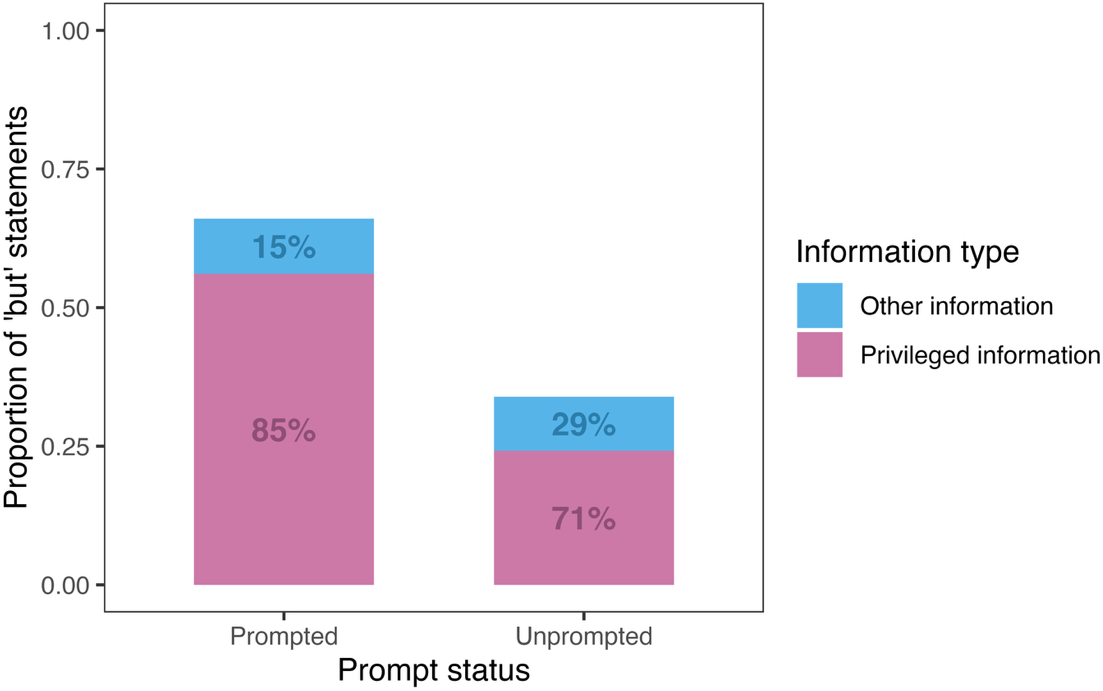
As shown in Figure 1, 66% of relevant but statements (n = 781) were prompted by knowledge-gap cues, and 85% of these involved privileged information. In total, 90% of relevant but statements met our criteria for clarification: but statements prompted by knowledge-gap cues, containing privileged information, or both. While two-thirds were prompted, the remaining third were unprompted; of these, 71% still qualified because they contained privileged information. Overall, these patterns suggest that although children sometimes provided clarifying information spontaneously, they more often did so in response to adult knowledge-gap cues.
Proportion of relevant “but” statements by prompt status and information type. Percentages inside each bar segment indicate the proportion of privileged versus other information within each prompt-status category.

Figure 1. Long description
Stacked bar chart showing the distribution of information types within prompted and unprompted relevant “but” statements. The x-axis represents prompt status (prompted and unprompted), and the y-axis represents the proportion of relevant “but” statements. Each bar is divided into privileged information (pink) and other information (blue). For prompted statements, most responses contain privileged information (85%), with the remaining 15% containing other information. For unprompted statements, privileged information also predominates (71%), while other information accounts for 29% of responses. Overall, privileged information is the dominant information type regardless of prompt status, but unprompted statements contain a larger share of other information than prompted statements.
3.2. Did children’s tendency to clarify increase with age?
To evaluate whether children’s tendency to clarify increased with age, we fitted a linear mixed-effects regression model predicting the proportion of clarifications per 1,000 words spoken from age range (12-month intervals), with a random intercept for participant to account for the nested structure of the data. The full model fit the data significantly better than the null model including only the random intercept, χ 2(2) = 9.7, p < 0.01. This model yielded a significant main effect of age range, Wald χ 2(2) = 11.99, p < 0.01.
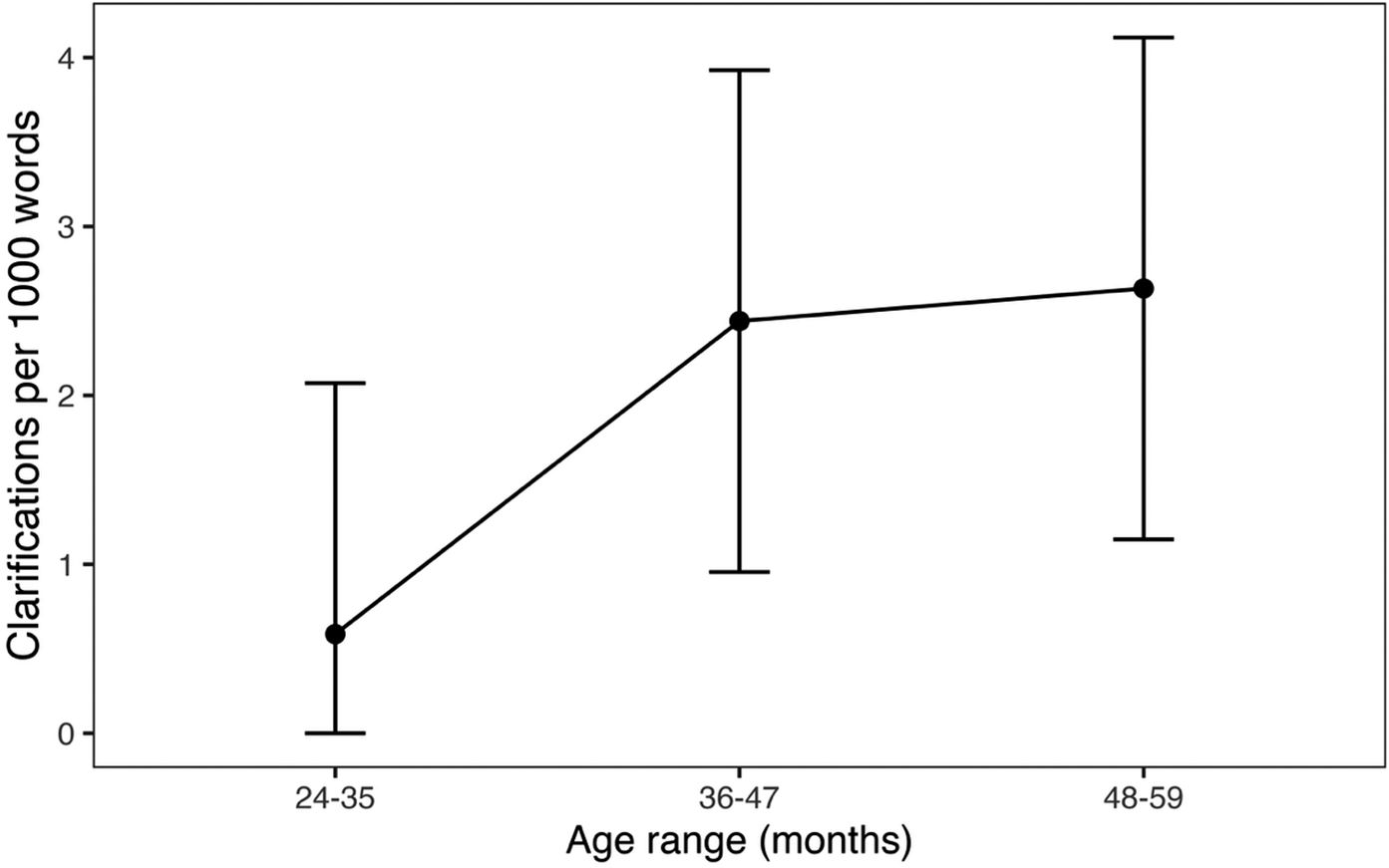
The model’s conditional R 2, reflecting both fixed (age) and random (participant) effects, accounted for 64% of the variance, whereas the marginal R 2, reflecting the fixed effects alone, explained 22% of the variance in clarification rates. As shown in Figure 2, children produced increasingly more clarifications with age, with a relatively marked increase between ages 2 and 3. Prior to age 3, children rarely clarified (0.58 clarifications per 1,000 words between 24 and 35 months); this rate increased by about 2.5 times during age 3 (36–47 months), reaching approximately 2.6 clarifications per 1,000 words during age 4 (48–59 months).
Estimated marginal means of clarification proportions per 1,000 words spoken from ages 2 to 5 years (95% confidence intervals).

Figure 2. Long description
Line graph showing the estimated marginal means of clarifications per 1,000 words across three age ranges in the same longitudinal sample, with 95% confidence intervals. The x-axis represents age in months (24–35, 36–47, and 48–59), and the y-axis represents the estimated number of clarifications per 1,000 words. The estimated clarification rate increases from approximately 0.6 at 24–35 months to about 2.4 at 36–47 months and 2.6 at 48–59 months. The largest increase occurs between the first and second age ranges, with relatively little change between the second and third. Vertical error bars indicate 95% confidence intervals.
3.3. Did the frequency of different types of clarification change with age?
We also examined whether age predicted changes in the three clarification types: Prompted + Privileged Information, Prompted + Other, and Unprompted + Privileged Information. We fitted a mixed-effects linear regression predicting the proportion of clarifications per 1,000 words from age range, clarification category, and their interaction, with a random intercept for participant ID. Model diagnostics indicated approximate normality of residuals but mild heteroskedasticity. Given the exploratory nature of these analyses and the robustness of mixed-effects models to mild assumption violations, we retained the linear model for ease of interpretation. The full model fit the data significantly better than the null model with only the random intercept, χ 2(11) = 45.48, p < 0.001. The model revealed no significant main effects of Category or Age Range, but a significant Category × Age Range interaction, χ 2(6) = 11.03, p = 0.03, indicating that developmental trajectories differed by clarification type. Simple effects analyses showed that only the Prompted + Privileged Information category increased significantly from 24–35 months to 36–47 months (p < 0.001), whereas the Unprompted + Privileged Information and Prompted + Other categories remained relatively stable (see Figure 3).
Estimated marginal means of clarification type proportions per 1,000 words spoken from ages 2 to 5 years (95% confidence intervals).

Figure 3. Long description
Line graph showing the estimated marginal means of three clarification types per 1,000 words across three age ranges in the same longitudinal sample, with 95% confidence intervals. The x-axis represents age in months (24–35, 36–47, and 48–59), and the y-axis represents the estimated number of clarifications per 1,000 words. The three lines represent prompted clarifications containing privileged-access information, unprompted clarifications containing privileged-access information, and prompted clarifications containing other information. Prompted clarifications with privileged-access information increase markedly across age ranges, from approximately 0.3 at 24–35 months to about 1.8 at 48–59 months. Unprompted clarifications with privileged-access information increase from approximately 0.2 to 0.8 between the first and second age ranges, then decrease slightly to about 0.6 at the third. Prompted clarifications containing other information remain relatively infrequent, increasing only slightly from about 0.1 to 0.3. Vertical error bars indicate 95% confidence intervals.
3.4. Did children talk differently about the various types of privileged information?
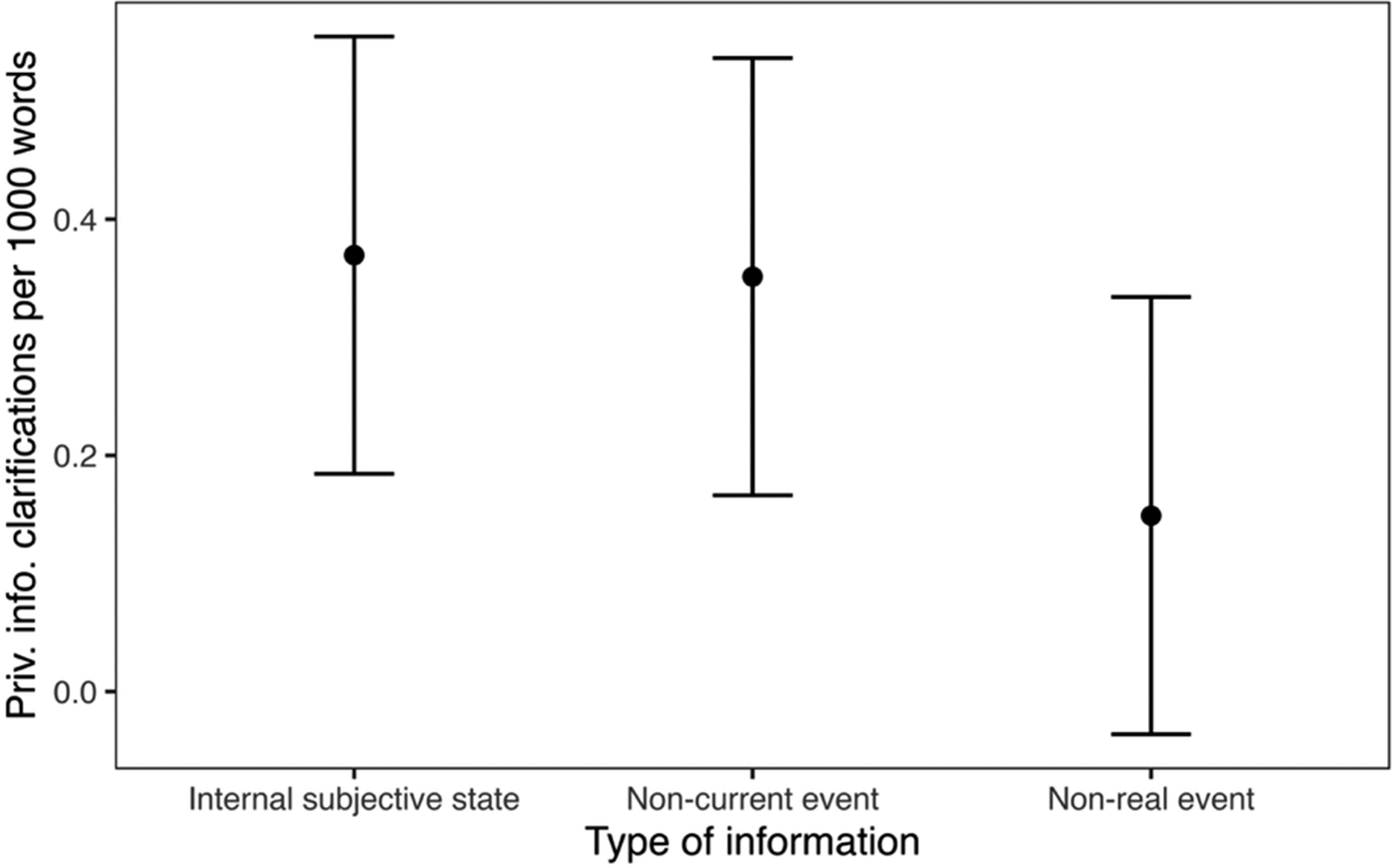
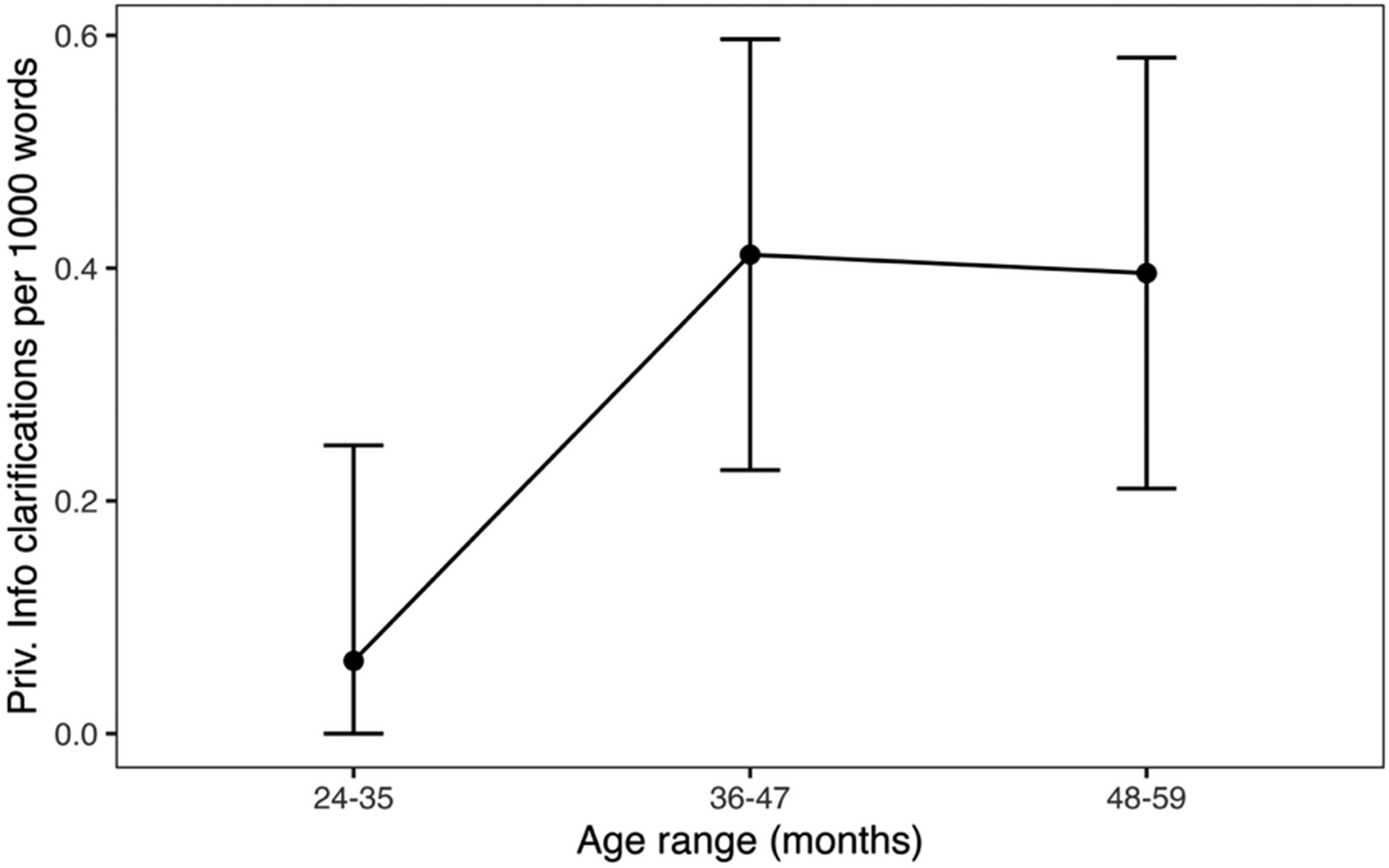
Among clarifications involving privileged information, internal subjective states were most common (52%), closely followed by non-current events (49%) and non-real events (23%). To examine age-related changes in the type of privileged information children provided, we fitted a mixed-effects linear regression predicting the proportion of privileged-information clarifications per 1,000 words from age range, privileged information subcategory, and their interaction, with a random intercept for participant ID. Because the interaction was not significant, it was removed. Model diagnostics indicated approximate normality of residuals but mild heteroskedasticity. The final model revealed significant main effects of Privileged Information Subcategory, Wald χ 2(2) = 7.51, p = 0.02 (see Figure 4), and Age, Wald χ 2(2) = 19.46, p < 0.001 (see Figure 5). Pairwise comparisons showed that clarifications involving non-real events were less frequent than those involving non-current events (p = 0.04), with no other significant differences between subcategories. Overall, children produced more privileged-information clarifications with age, and the frequency of these clarifications varied by subcategory.
Estimated marginal means of privileged-information clarifications per 1,000 words spoken by subcategory (95% confidence intervals).

Figure 4. Long description
Point plot showing the estimated marginal means of privileged-information clarifications per 1,000 words spoken for three information subcategories, with 95% confidence intervals. The x-axis represents the type of privileged information (internal subjective state, non-current event, and non-real event), and the y-axis represents the estimated number of privileged-information clarifications per 1,000 words. Estimated clarification rates are highest for internal subjective states (approximately 0.37 per 1,000 words) and non-current events (approximately 0.35 per 1,000 words), which have similar values. Clarifications involving non-real events occur less frequently, at approximately 0.15 per 1,000 words. Vertical error bars indicate the 95% confidence intervals for each estimated mean.
Estimated marginal means of privileged-information clarifications per 1,000 words spoken from ages 2 to 5 years (95% confidence intervals).

Figure 5. Long description
Line graph showing the estimated marginal means of privileged-information clarifications per 1,000 words across three age ranges in the same longitudinal sample, with 95% confidence intervals. The x-axis represents age in months (24–35, 36–47, and 48–59), and the y-axis represents the estimated number of privileged-information clarifications per 1,000 words. The estimated rate increases from approximately 0.06 at 24–35 months to about 0.41 at 36–47 months, then remains similar at approximately 0.40 at 48–59 months. The largest increase occurs between the first and second age ranges, with little change thereafter. Vertical error bars indicate 95% confidence intervals.
4. Discussion
We examined children’s use of but to clarify messages in everyday conversations with adults, focusing on the development of their ability to monitor and address listeners’ informational needs by adding details to build common ground. Using naturalistic, longitudinal transcripts, we identified instances in which children used but to elaborate on a prior statement. These utterances were coded for: (1) whether the conversational context included a prompt from the adult and (2) whether the child provided information that was not readily accessible to the listener.
Among but statements that children used to elaborate a prior utterance, 90% functioned as clarifications. The frequency of these clarifications increased substantially between ages 2 and 4. At age 2, children rarely used but to clarify statements. By age 3, they produced nearly 2.5 clarifications per 1,000 words. This increase was primarily driven by cases in which the adult cued a knowledge gap, and the child responded with privileged information.
Prior work has shown that preschoolers are sensitive to the importance of shared knowledge in communication (see Bohn & Köymen, Reference Bohn and Köymen2018; Harris, Reference Harris2017, for reviews) and adjust their utterances based on listeners’ informational needs to establish common ground (Abbot-Smith et al., Reference Abbot-Smith, Nurmsoo, Croll, Ferguson and Forrester2016; Bacso & Nilsen, Reference Bacso and Nilsen2017, Reference Bacso and Nilsen2022; Matthews et al., Reference Matthews, Butcher, Lieven and Tomasello2012; Nayer & Graham, Reference Nayer and Graham2006; Nilsen & Mangal, Reference Nilsen and Mangal2012). The current research extends this literature by showing that three- to four-year-olds spontaneously clarify their utterances in conversational contexts where shared knowledge is incomplete. These naturalistic findings suggest that preschoolers’ sensitivity to common ground emerges in everyday interaction without the explicit epistemic asymmetries typically used in experimental tasks.
The rapid increase in clarifications between ages 2 and 4 is likely driven by intertwined developmental mechanisms that support children’s ability to track and respond to gaps in shared understanding with conversational partners, including theory of mind (ToM) and executive functions (Khu et al., Reference Khu, Chambers and Graham2020; Matthews et al., Reference Matthews, Biney and Abbot-Smith2018; Nilsen & Graham, Reference Nilsen and Graham2009). Although the present study did not directly measure these capacities, children’s ability to tailor clarifications to adult knowledge gaps has direct implications for research on ToM development. Specifically, the age-related changes in privileged-information clarifications suggest that children’s performance reflects more sophisticated knowledge-state tracking than standard ToM tasks would predict. Wellman and Liu’s (Reference Wellman and Liu2004) scale assesses differential knowledge access in perceptual, here-and-now scenarios, whereas the privileged-information clarifications in our study often involved non-real content, non-current events, and internal subjective experiences. The latter two in particular showed substantial age-related increases between ages 2 and 4. These aspects of differential knowledge access may be particularly important for everyday conversation, as they require speakers to share information inaccessible to the listener through direct observation.
What specific ToM understanding supports such clarifications? Recent work suggests that children’s early recognition of first-person authority – the understanding that speakers have privileged access to their own mental states – may be one key component (Yang et al., Reference Yang, Jeffries, Zheng and Harris2025). Recognising first-person authority may help children understand that their subjective experiences and memories of past events are unavailable to others, allowing them to identify situations in which clarification is needed.
Research also shows that clarification skills improve with listener feedback (Ju et al., Reference Ju, San Juan, Nilsen and Graham2025; Matthews et al., Reference Matthews, Lieven and Tomasello2007), suggesting that repeated exposure to communicative failures and input from others helps children learn when and how to repair their speech. Consistent with this idea, bilingual toddlers – who are more likely to encounter misunderstanding than their monolingual peers – tend to show more advanced clarification skills (Wermelinger et al., Reference Wermelinger, Gampe and Daum2017). Misunderstandings and clarification requests of the kind observed in our study may create a tutoring context that helps children recognise that others do not always know what they know, and that some types of information are unlikely to be mutually shared. For example, children may encounter more clarification requests in conversations about past experiences compared to conversations about the here and now, because past events often require more contextual details to establish common ground with others. These conversations may offer opportunities for children to practice tracking others’ epistemic states, thereby scaffolding their ToM development. This proposal aligns with a large body of work showing that conversation plays a critical role in children’s ToM development (see de Rosnay & Hughes, Reference de Rosnay and Hughes2006; Harris et al., Reference Harris, de Rosnay and Pons2005; Slaughter & Peterson, Reference Slaughter, Peterson, Siegal and Surian2011; Symons, Reference Symons2004, for reviews). Future research could investigate how individual differences in children’s conversational experience and ToM jointly shape the frequency and manner of their clarifications.
The current findings should be interpreted in light of some important limitations. First, our study was limited to a small sample of North American children from predominantly highly educated families. Second, we focused on a particular type of pragmatic move – using the discourse marker but – to add detail or nuance to a previous statement. Although but is a common means of clarification in English, other discourse markers (e.g., well, so) can serve related functions and also appear in early speech (e.g., Choi, Reference Choi2007; Sprott, Reference Sprott1992). Finally, because our analyses were based on verbal transcripts, they lacked information about nonverbal cues (e.g., facial expressions, intonation), and some parent–child interactions may have involved common ground established outside the recorded interaction. Despite these limitations, the data indicate that there are marked gains in children’s tendency to offer clarifications, especially when prompted to supply otherwise privileged or opaque information.
Supplementary material
The supplementary material for this article can be found at http://doi.org/10.1017/S0305000926100920.
Disclosure of use of AI tools
This project incorporated the use of generative artificial intelligence. OpenAI’s ChatGPT was used for refining language and ensuring clarity of expression (GPT-5.5; OpenAI, 2026). AI-generated input was minimal and limited to wording or technical suggestions; it was reviewed and edited by the authors to ensure its accuracy, alignment with scholarly standards, and suitability for publication.
Competing interests
The authors declare that there is no conflict of interest regarding the publication of this article. Luis De la Viña’s research was conducted with the support of the Connaught Scholarship for International students at the University of Toronto.





 Open access

