Coarctation of the aorta is rare in adolescents. Without correction, most patients die before the age of 50 years owing to hypertension and related problems.Reference Alejandro, Teresa, Pere and Miguel Torner 1 As related morbidities are not irreversible in early stages of the condition, appropriate treatment modalities should be tried in order to decrease mortality before complications occur. Adolescents with coarctation of aorta may require different surgical methods from children.
Materials and methods
We report three cases of adolescents – two girls and one boy – with aortic coarctation, operated at our department of cardiovascular surgery of hospital La Rabta between January, 2012 and December, 2013.
The median age at operation was 16.33 years. In all cases, computed tomography angiography was performed as an essential diagnostic procedure.
Results
Clinical presentation was hypertension in all cases. On physical examination, a systolic murmur was audible at the paravertebral interscapular area, and weaker arterial pulses in the lower extremities were noted.
Echocardiography revealed no valvular pathology in patient 1 and bicuspid aortic valve and aortic root dilatation in patient 3.
The diagnosis of aortic coarctation was made following investigation of a finding on computed tomography scan examination in all cases.
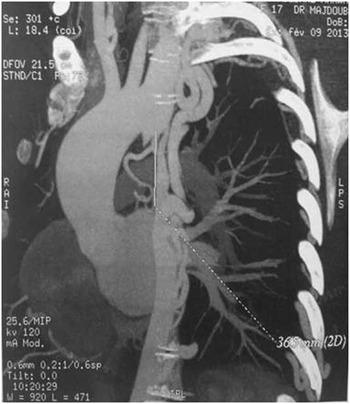
The computed tomography scan showed a long segment of severe aortic coarctation measuring 36 mm, with large collateral circulation and pre-stenotic dilatation of the aorta and the left subclavian artery in patient 1 (Fig 1) and aortic coarctation measuring 22 mm just after the left subclavian artery with a 60 mmHg pressure gradient in patient 3. The diameters of the subclavian artery and descending aorta measured 17 and 15 mm in patient 1 and 15 and 14 mm in patient 3, respectively.
Three-dimensional computed tomogram showing significant coarctation of the thoracic aorta beyond the origin of the left subclavian artery with a long stenotic aortic portion measuring 36 mm and developed collateral arteries.

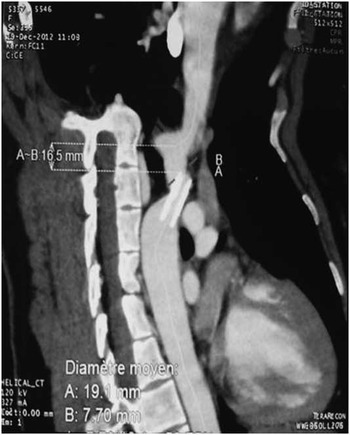
Patient 2 underwent balloon angioplasty with stent placement at the coarctation site. At the 12-month-follow-up visit, she had critical systolic hypertension and intermittent claudication. No pulse was found at the palpation of the femoral arteries or distal to that level. The diagnosis of re-coarctation was confirmed on computed tomography scan that revealed patent implanted stent with post-stenotic dilatation and developed arterial collaterals (Fig 2). The coarcted segment’s length was 17 mm. The diameters of the subclavian artery and descending aorta measured 17 and 18 mm, respectively.
Angiography computed tomography showing re-coarctation above the stent with post-stenotic dilatation.

All operations were performed on an elective basis via left posterolateral thoracotomy through the fourth intercostal space. A 16-mm Dacron® tube graft was interposed between the left subclavian artery and the mid-descending thoracic aorta using a partial occlusion clamp in patient 1. Similarly, we elected to correct the re-coarctation in patient 2, with an 18-mm Dacron® tube (France) graft bypass between left subclavian artery and descending aorta, under aortic partial clamping. The procedure was simple, required less dissection, and did not compromise arterial blood flow to the spinal cord. In patient 3, and taking into account of the tight native coarctation of the aorta and post-stenotic dilatation of the descending aorta, a bypass graft using a 14-mm Dacron® tube between the left subclavian artery and the descending thoracic aorta was the best choice because of the high risk of dissection or rupture with end-to-end repair.
Postoperative course was uneventful in all cases with no upper–lower limb pressure gradient remaining and using low doses of antihypertensive therapy.
Discussion
Coarctation of the aorta in adolescent patients is a CHD that most frequently represents cases of re-coarctation or missed cases of native coarctation. Hypertension is usually the first revealing sign.
There are different methods employed for the treatment of aortic coarctation, including surgery, percutaneous balloon angioplasty with or without stent placement, and medical therapy.Reference Anagnaostopoulos–Tzifa 2
Surgical repair still remains the most valid option because of the low morbidity and mortality. Several surgical techniques such as resection of the coarcted segment and end-to-end anastomosis, interposition of a graft, patch aortoplasty, and bypass procedures with a synthetic graft between the proximal and distal segments can be used in treatment.Reference Manganas, Iliopoulos, Chard and Nunn 3 Subclavian-aortic bypass grafting is a safe and reliable approach that is recommended for complex aortic coarctation with long stenotic segment in older children.
Re-coarctation following previous transcatheter or surgical therapy, calcification of the aorta, and post-stenotic dilatation with a high risk of aortic rupture are other indications for subclavian-descending aorta bypass graft.
Compared with the aorta of infants and children, the aorta of the older patient with coarctation is relatively immobile, and there are frequently large collaterals immediately adjacent to the narrow segment. This makes bypass grafting from the left subclavian or distal aortic arch to the descending aorta an attractive option.
The use of extra-anatomic graft interposition was first described in 1980.Reference Vijayanagar, Natarajan, Eckstein, Bognolo and Toole 4 Bypassing the coarcted segment with a tube graft between left subclavian artery and descending aorta, as used in our three patients, has been described with good long-term results.Reference Elkerdany, Hassouna, Elsayegh, Azab and Bassiouni 5 , Reference Koller, Rothlin and Senning 6 The size of the tube is selected according to the diameter of the descending aorta. The use of anticoagulation therapy after surgery is not necessary.
This technique avoids extensive dissection and total cross-clamping of the aorta. It is recommended as an elective method of repair in re-do cases and in high-risk patients.Reference Izhar, Schaff, Mullany, Daly and Orszulak 7 , Reference Arakelyan, Spiridonov and Bockeria 8 The advantages include access to the descending thoracic aorta above the diaphragm in a segment with less collateral circulation and avoids manipulation of a coarctation segment in which the aortic wall has structural alterations and extensive collateral circulation frequently found in older patients.
Partial aortic cross-clamp and developed collateral arteries maintain adequate perfusion of the spinal cord. The risk of postoperative paraplegia due to spinal cord ischaemia is very rare. This risk may, however, increase when the collateralisation network is poor.
The major drawback of subclavian-descending aorta bypass graft, which is shared with all the surgical techniques, is aortic dissection that can occur even late after surgical repair. Surgical mortality is rare. Morbidity includes early postoperative paradoxical hypertension, left recurrent laryngeal nerve paralysis, phrenic nerve injury, and subclavian steal.Reference Manganas, Iliopoulos, Chard and Nunn 3
Conclusion
Coarctation of the aorta is a congenital cardiac malformation that can go undiagnosed until old age, having only hypertension as a marker of its presence.
Treatment strategies consist of surgery or endovascular management. The extra-anatomic subclavian-descending aortic conduit with an adequately sized tube graft would appear to be a simple, effective, and reliable method, with less morbidity and mortality in older patients, although the procedure may be complicated by the presence of calcification of the aorta and the left subclavian artery.
Acknowledgements
This paper was written by a group of surgeons working in the Department of Cardiovascular Surgery in Rabta Hospital and developed with University of Tunis El Manar, college of Medicine, Tunis. The authors of this paper have made a substantial contribution to the concept, analysis, and interpretation of data. The authors of this article, revised the article critically and approved the version to be published. They affirm that this work is original, has never been published, even partially, and cede all copyright to the publisher of “Cardiology in the Young” journal in case of publication.
Financial Support
This research received no specific grant from any funding agency in the public, commercial, or not-for-profit sectors.
Conflicts of Interest
None.