Introduction
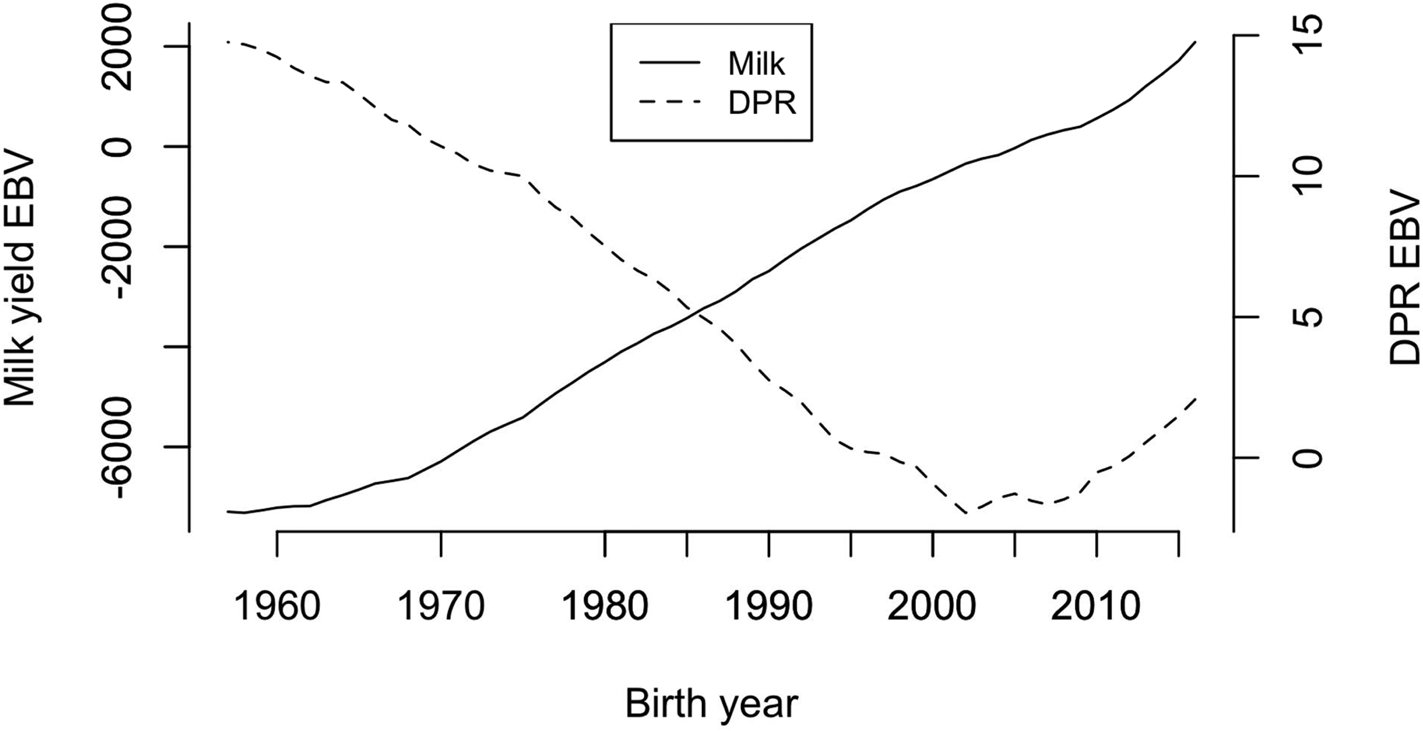
Up until the 1990s, selection of dairy cattle in the U.S. placed a strong emphasis on improving yield traits. While selection emphasis was only on production, undesirable trends became apparent with functional traits, such as reproduction and health (Rauw et al., Reference Rauw, Kanis, Noordhuizen-Stassen and Grommers1998). Since this antagonistic relationship was identified, the emphasis has shifted away from solely increasing profit through increased production. Economic indices now consider decreased management costs from superior fertility and disease resistance in addition to income from production. Beginning in 1994, productive life was included into the Net Merit $ selection index (NM$), allowing producers to include consideration of overall health. Figure 1 depicts an example of the negative trend in a reproductive trait, in this case, daughter pregnancy rate (DPR), occurring concurrently with improvement for production, in this case, milk yield, through the early 2000s. Beginning in 2003, this trait was incorporated into the NM$, with a reversal in the trend beginning shortly after that (VanRaden and Seykora, Reference VanRaden and Seykora2003). Since the early 2000s, there has been an improvement in both milk yield as well as DPR. This illustrates that it is possible to improve functional traits while also continuing to improve production.
Comparison of trends of estimated breeding values (EBV) for milk yield and daughter pregnancy rate (DPR) from 1957 through 2016 in U.S. Holstein sires (Source: Council on Dairy Cattle Breeding, https://www.uscdcb.com).

The economic considerations of dairy production are becoming increasingly important. In 2018, dairy farmers received the lowest milk payments since 2009, continuing 4 years of poor dairy prices (Geiger, Reference Geiger2019). Animals that are not healthy or have poor reproductive performance cost producers due to increased management costs (e.g. increased handling, veterinary treatments), decreased production, and possible replacement costs. Treatment for bovine respiratory disease (BRD) can require the use of antibiotics, which results in additional costs for the producer, as well as potentially contributing to concerns regarding antibiotic usage. Pre-weaning calf diseases, one of the most common being respiratory problems, have been associated with increased risk of morbidity prior to first calving, increased age at first calving, and decreased lifetime profitability (Henderson et al., Reference Henderson, Miglior, Sewalem, Wormuth, Kelton, Robinson and Leslie2011). Heifers experiencing BRD are also less likely to complete their first lactation (Bach, Reference Bach2011). While societal pressures from consumers are increasing for animal handling and welfare, a reduction in the incidence of BRD will benefit multiple aspects of dairy production.
The incidence of BRD varies depending on factors including the population and how the trait is defined. The 2014 U.S. National Animal Health Monitoring Survey (NAHMS) reported that the incidence of weaned heifers reported with respiratory problems was 5.1%; however, the overall percent of cows affected by respiratory problems as reported by producers was 2.8% (USDA, 2018). Respiratory events are not a focus in adult dairy animals because they are not as common as mastitis, metabolic diseases, or lameness (Norström et al., Reference Norström, Edge and Jarp2001). The current incidence rate across cows of parities 1–5 is approximately 1% using data currently available in the cooperator database available at the Council on Dairy Cattle Breeding (CDCB; Bowie, MD, USA). This is similar to that reported previously using similar data (Parker Gaddis et al., Reference Parker Gaddis, Cole, Clay and Maltecca2012). These data clearly indicate the need for heifer records, as the incidence rate (0.1%) and event count (n = 441) are much lower compared to cow records, while respiratory events are expected to be more common among young animals.
Genetic improvement of health
Genetic selection is one solution to improve the health of dairy animals. It is possible to select animals that have a favorable combination of alleles that are both positive for production traits and positive for health or disease resistance. The caveat to this is that disease resistance traits typically have low heritabilities. Heritability indicates the proportion of an animal's phenotype – the observable trait – which can be attributed to its genetics. An animal's phenotype can be very broadly defined as the sum of the genetic component and the environmental component. A low heritability indicates that the portion of the phenotype controlled by the animal's genetics is small compared to that controlled by non-genetic factors, such as management or the environment. Despite this, genetic improvement is an attractive solution because the gains are cumulative and permanent. A producer that selects for improved disease resistance for several generations will not immediately lose the progress made if that strategy is discontinued. The same cannot be said for changes in management or nutrition: if a herd reverts from a specific nutrition protocol, any improvement obtained will likely be lost once that protocol is discontinued.
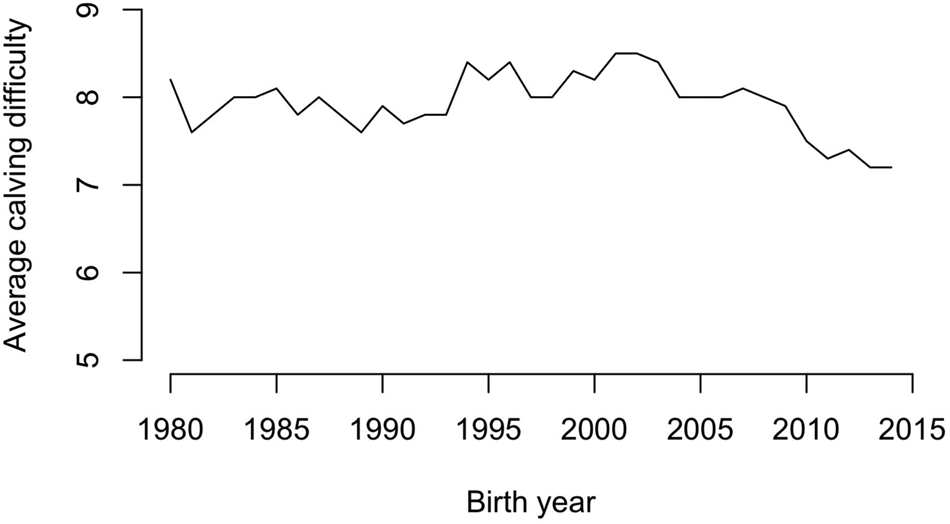
Previous work has shown that selection for low heritability health traits is possible. The best example of this strategy is from Nordic countries, where selection for mastitis resistance has occurred since the 1980s with positive results documented (Philipsson and Lindhe, Reference Philipsson and Lindhe2003). The recording of health event data is mandated, making the collection of data less of a hurdle compared to the U.S. The inclusion of other lowly heritable functional traits in selection strategies has shown to slow or reverse unfavorable trends. An example of this is shown in Fig. 2 with sire calving ease, which was included in the Net Merit indices beginning in 2006 (VanRaden and Multi-State Project S-1008, Reference VanRaden2006). Selection of direct health traits that are most common in dairy herds, such as clinical mastitis and metritis, has shown to be feasible in the U.S. through the use of event data recorded on farms by producers, especially since the introduction of genomic selection (Parker Gaddis et al., Reference Parker Gaddis, Cole, Clay and Maltecca2014; Vukasinovic et al., Reference Vukasinovic, Bacciu, Przybyla, Boddhireddy and DeNise2016). Genomic selection results in more rapid genetic improvement by decreasing the generation interval and increasing the accuracy of predictions. It does this by taking advantage of the associations between a trait of interest and many genetic markers spread throughout an animal's genome. These genetic markers can be identified at birth, thus reducing the time required to estimate an animal's genetic value for the trait.
Trend of sire calving ease PTA in U.S. Holsteins from 1980 through 2014 (Source: Council on Dairy Cattle Breeding, https://www.uscdcb.com).

Beginning in April 2018, CDCB released genomic evaluations for six common health events that provide U.S. dairy producers with genomic evaluations for resistance to milk fever, displaced abomasum, ketosis, mastitis, metritis, and retained placenta (Parker Gaddis et al., Reference Parker Gaddis, Tooker, Wright, Megonigal, Clay, Cole and VanRaden2018). These traits have similar heritabilities to those estimated for BRD among dairy calves. Henderson et al. (Reference Henderson, Miglior, Sewalem, Wormuth, Kelton, Robinson and Leslie2011) estimated a heritability of 0.09 using data collected from Holstein calves in New York State. A heritability equal to 0.04 was estimated using data from Holstein heifers in Ontario (McCorquodale et al., Reference McCorquodale, Sewalem, Miglior, Kelton, Robinson, Koeck and Leslie2013). Significant incidences of BRD are not common among Norwegian Red dairy calves; however, a heritability of 0.05 has been estimated (Heringstad et al., Reference Heringstad, Chang, Gianola and Østerås2008). A case/control study conducted with Holstein calves in two locations (California and New Mexico) estimated heritabilities ranging from 0.13 to 0.21, depending on the population. A study conducted using records of heifer respiratory problems reported by producers on-farm estimated a heritability ranging from 0.04 to 0.10, depending on the time frame used after birth (Vukasinovic et al., Reference Vukasinovic, Gonzalez-Pena, Brooker, Desai and DeNise2018). The above selected studies all indicate that genetic improvement through selection of animals more resistant to BRD is feasible.
Phenotypes critical
Accurate genomic predictions cannot be estimated without a large number of phenotypic records. This is even more important for lowly heritable traits such as BRD. A data pipeline for reporting respiratory problems in dairy animals already exists. This is the same pipeline utilized for the previously mentioned six health traits that are currently evaluated. Data are recorded with on-farm herd management software and flow through the Dairy Herd Improvement (DHI) system. It is ultimately included in the dairy cooperator database maintained by CDCB. The data are sent to CDCB as ‘Format 6’ records (https://redmine.uscdcb.com/projects/cdcb-customer-service/wiki/Format_6) from the dairy records processing centers (DRPC). Format 6 can be used to submit all health events (up to 20 in a single record) that a cow experiences throughout a lactation. Uniform abbreviations are currently available for 20 different events (e.g. MAST for mastitis, RESP for respiratory problems) and four management traits (e.g. BCS for body condition score). Standardization from the acronym used by the farm to that accepted in a Format 6 record is performed by the DRPC. An animal with BRD can be indicated in Format 6 with the health event acronym ‘RESP’. In reporting a respiratory problem in Format 6, there is also the availability to report specific scores for rectal temperature, cough, nasal discharge, eye discharge, and ear tilt following the McGuirk scoring system (McGuirk, Reference McGuirk2008) if producers collect those details, however these additional details are not currently required.
Currently, the CDCB cooperator database includes approximately 11,000 health events described as a respiratory problem. These events occurred from 2005 to present in heifers and cows through the ninth parity. This underlines the primary impediment to having a national genomic evaluation for BRD resistance, which is having sufficient data. This is likely partially due to the fact that there has not been a strong emphasis on heifer records. In earlier years, there were no incentives for a producer to send heifer records. In the late 1990s to early 2000s, several national projects were initiated to encourage sending additional data, such as health and calving records. This is when heifer records began to be submitted to the dairy cooperator database. A broad overview of records indicates approximately 16.6 million heifer records compared to 98.6 million cow records since 1990 to present, although the number of heifer records submitted increases each year. Specifically considering health records, compared to milk fever, which has the fewest records of the six health traits currently evaluated, RESP has approximately 25% the amount of records. As producers begin or continue to collect respiratory event data and the dataset increases, it is very feasible to develop a genomic evaluation for BRD resistance, given the significant genetic component. Evaluations for BRD resistance would allow dairy producers to select animals genetically more resistant to developing a respiratory problem. Recording incidences of health events not only benefits genetic evaluations. Having a good recording system for health events can be used to improve management aspects. This benefits the ‘environment’ component of phenotypic expression, which can be especially important for lowly heritable traits.
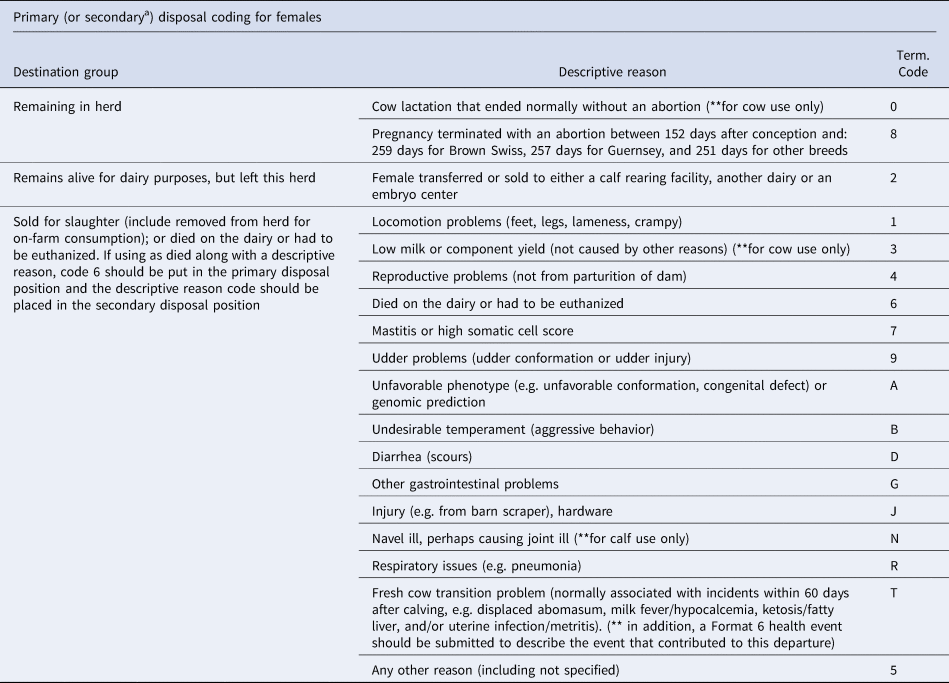
In addition to direct health event records, additional information routinely flows through the DHI system that could be exploited and/or expanded to help producers reduce the incidence of BRD. Termination codes are reported to indicate why a cow left the herd and included in test day milk records sent to CDCB. Also included in this information is the date of termination or when the animal left the herd. Currently, reasons for termination include being sold for dairy purposes, being sold for problems such as locomotion, poor production, or mastitis, or dying on the dairy (available at https://redmine.uscdcb.com/projects/cdcb-customer-service/wiki/REFERENCES#Ref10). These were developed focusing on reasons for cow termination and not considering heifer-specific reasons for leaving the herd. Termination codes to include reasons for termination in heifers have been proposed as shown in Table 1. Dairy calf death losses were estimated at $327.3 billion in 2015 (Lombard et al., Reference Lombard, Garry, Urie, McGuirk, Godden, Sterner, Earleywine, Catherman and Maas2019). Common health events that are encountered in heifers could be incorporated to increase available data for events such as BRD. One system was recently proposed by Lombard et al. (Reference Lombard, Garry, Urie, McGuirk, Godden, Sterner, Earleywine, Catherman and Maas2019). Collection of these data could aid in providing benchmarks for the dairy industry, and potentially be included with data of specific health events for genetic evaluations.
Proposed termination codes for lactation data sent to the Council on Dairy Cattle Breeding

Heifer refers to a young female, i.e. newborn through one day prior to first calving. Cow refers to a female that calved at least once.
a Any secondary coding provides only a termination code, not a destination-group code.
Despite the limited data available, there does seem to be an association between animals with recorded respiratory problems and reported termination codes compared to their contemporaries. Among animals with RESP events reported, 14% had a termination code indicating that they died on the farm, compared to 3.9% among contemporaries not recorded as having an RESP event. This may be biased by the fact that a producer is more likely to record a health event if it is more serious and an animal with a more serious health problem is less likely to survive. Further analysis is warranted as additional data become available; however, it is an initial indication that the termination codes could be useful in conjunction with direct health records.
Conclusions
Multiple studies have indicated that BRD in dairy calves has a significant genetic component that could be exploited to select animals that have increased resistance. This strategy has the benefit of producing permanent and cumulative improvement. The challenge remains that health traits such as BRD resistance are lowly heritable and largely influenced by non-genetic factors. Thus, progress will be slow. Genomic data can aid in reducing the time required to make genetic progress compared to traditional selection. A large collection of phenotypic BRD incidence data is still required to utilize the benefits of genomic selection. This remains a hurdle in providing national evaluations for BRD resistance to dairy producers. Pipelines are currently in place that would facilitate providing these evaluations; however, emphasis should be placed on increasing the amount of data available.