Healthcare facilities are well-known reservoirs for antibiotic-resistant pathogens. Methicillin-resistant Staphylococcus aureus (MRSA) and vancomycin-resistant enterococci (VRE) prevalence is 10%–20% in intensive care units, and carriage of MRSA and extended-spectrum β-lactamase (ESBL)–producing Escherichia coli and Klebsiella pneumoniae approaches 50% in skilled nursing facilities.Reference Huang, Rifas-Shiman and Warren 1 – Reference Pop-Vicas, Mitchell, Kandel, Schreiber and D’Agata 6 Estimates of Clostridium difficile surpass 2% in general inpatients and 25% in long-term care residents, and C. difficile infection (CDI) is now the most common cause of healthcare-associated infection.Reference Campbell, Giljahn and Machesky 7 – Reference Magill, Edwards and Bamberg 12 Patients harboring these pathogens are often transferred between facilities or readmitted for additional care.Reference Huang, Hinrichsen and Datta 13 – Reference Prabaker, Lin and McNally 17 This results in the exposure of regional medical centers to antibiotic-resistant pathogens because they are shed into the environment and onto healthcare worker hands by carriers.Reference Otter, Yezli and French 18 – Reference Landelle, Verachten, Legrand, Girou, Barbut and Buisson 20 Furthermore, patients may harbor these pathogens for prolonged periods, up to 24 months for VRE, 30 months for ESBL, and 40 months for MRSA.Reference Byers, Anglim, Anneski and Farr 21 – Reference Sanford, Widmer, Bale, Jones and Wenzel 24 In 1 county over 1 year, 67 of 72 nursing homes directly transferred residents to another nursing home, and hospitals shared patients with nearly 30 other hospitals.Reference Lee, Song and Bartsch 25 , Reference Huang, Avery and Song 26 Such high connectivity between healthcare facilities has already been associated with multicenter and regional outbreaks.Reference Won, Munoz-Price, Lolans, Hota, Weinstein and Hayden 27
Despite the high degree of patient sharing, most studies evaluating the transmission of antibiotic-resistant pathogens have focused on single or small groups of hospitals.Reference van Rijen, Bosch, Heck and Kluytman 28 – Reference Lee, McGlone and Wong 30 Most reports have described MRSA spread within or between hospital wards.Reference van Rijen, Bosch, Heck and Kluytman 28 , Reference Monsen, Karlsson and Wistrom 29 Occasionally, affiliated healthcare facilities have been evaluated during outbreaks.Reference Ostrowsky, Trick and Sohn 14 , Reference Lin, Lyles-Bank and Lolans 16 Little is known regarding the spread of MRSA, VRE, ESBL, and CDI across healthcare facilities during non-outbreak periods.
Recent studies have demonstrated the substantial connectivity among hospitals and nursing homes in a large metropolitan county in southern California.Reference Lee, Song and Bartsch 25 , Reference Huang, Avery and Song 26 , Reference Lee, McGlone and Wong 30 , Reference Lee, McGlone and Song 31 These data reveal not only the magnitude of patient sharing, but also the directionality and speed of patient sharing.Reference Lee, Song and Bartsch 25 , Reference Huang, Avery and Song 26 Nevertheless, these reports included only facilities from 1 county.Reference Lee, Song and Bartsch 25 , Reference Huang, Avery and Song 26 , Reference Lee, McGlone and Wong 30 , Reference Lee, McGlone and Song 31 The extent of patient sharing across broader regions remains unknown.
In this study, we sought to quantify the time-dependent exposure of all hospitals and nursing homes in California to patients with MRSA, VRE, ESBL, and CDI discharging from a single medical center using hospital microbiology data and mandatory hospitalization and nursing home data. We further sought to compare the frequency and duration of days that carriers versus noncarriers were subsequently admitted to any hospital or nursing home in California within 1 year of discharge for MRSA, VRE, and ESBL and 90 days of discharge for CDI, consistent with Centers for Disease Control and Prevention definitions of hospital-associated infection with multidrug-resistant organisms and C. difficile.Reference McDonald, Coignard, Dubberke, Song, Horan and Kutty 32 – Reference Horan, Andrus and Dudeck 35
METHODS
We conducted a retrospective multiple-cohort study of all adults admitted from January 1, 2005, through December 31, 2009, to the University of California Irvine Medical Center (UCIMC), a 400-bed tertiary care academic medical center in Orange, California, to evaluate the time-dependent exposure of all California hospitals and nursing homes to patients harboring antibiotic-resistant pathogens from a single hospital. We identified all adults admitted to UCIMC using the 2005–2010 mandatory hospitalization data set from the California Office of Statewide Health Planning and Development. 36 This data set contains line-item data from all California acute care centers, including hospital identification numbers, admission and discharge dates, date of birth, demographic and insurer information, residential ZIP code, location before and after admission, International Statistical Classification of Disease, Ninth Revision, procedure and diagnostic codes, and an encrypted record linking number that enables patient tracking across hospitals. Patients lacking encrypted record linking numbers were excluded.
For all inpatients, we used hospital microbiology and infection prevention records to determine the first known positive culture for MRSA, VRE, CDI, or ESBL. Patient data were linked between state hospitalization and microbiological data using date of birth, sex, hospital identification number, and hospital admission and discharge dates. The first known positive culture for MRSA and VRE was based on any positive clinical or surveillance culture. Active surveillance for MRSA and VRE was performed during the study period. ESBL identification was based on any positive clinical culture, and CDI on a positive assay for C. difficile toxin A and/or B or the isolation of toxin-producing C. difficile from a stool sample. Positive microbiological findings reflected both community-acquired and hospital-acquired MRSA, VRE, ESBL, and CDI. For patients with MRSA, VRE, ESBL, and CDI, we defined the index admission as the hospitalization associated with the first known positive culture. For patients with positive cultures before 2005, and for patients with no evidence of MRSA, VRE, ESBL, or CDI, the index admission was defined as the first UCIMC hospitalization between January 1, 2005, and December 31, 2009. Carbapenem-resistant Enterobacteriaceae was uncommon at UCIMC and therefore not assessed.
Owing to the known duration of MRSA carriage among inpatients (half-life 6 months to 5 years)Reference Scanvic, Denic, Gaillon, Giry, Andremont and Lucet 23 , Reference Sanford, Widmer, Bale, Jones and Wenzel 24 and the Centers for Disease Control and Prevention definition of healthcare-associated transmission that includes healthcare facility exposure in the past year,Reference Cohen, Gerding and Johnson 33 , Reference Cohen, Calfee and Fridkin 34 we evaluated all hospital and nursing home readmissions occurring within 1 year of discharge from the index admission for MRSA, VRE, and ESBL cohorts. For the CDI cohort, because recurrent disease is common within 3 months of an event, we assessed readmissions within 90 days of discharge.Reference Cohen, Gerding and Johnson 33 , Reference Cohen, Calfee and Fridkin 34 Patients who died within 1 year of discharge for MRSA, VRE, and ESBL cohorts and 90 days of discharge for CDI cohorts were excluded to prevent bias from differential loss to follow-up. By means of patient-specific record linking numbers from the mandatory hospitalization data set, all subsequent readmissions in any licensed California acute care medical center were identified among carriers and noncarriers. Noncarriers were defined as patients lacking positive cultures for MRSA, VRE, ESBL, and CDI for their respective cohorts.
To evaluate all nursing home readmissions within 1 year of discharge from the index admission, we used the 2005–2010 Minimum Data Set. 37 This data set contains line-item data on all admissions from Medicare- and Medicaid-licensed nursing homes in the United States, including nursing home identification number, admission and discharge dates, date of birth, demographic information, residential ZIP code, location category before and after admission (eg, home, nursing facility, acute care hospital), health assessments, and an encrypted resident identification number that enables tracking of residents across nursing homes. Patients were linked between hospitalization and nursing home data sets using date of birth, sex, discharge date, and location category data. Hospital discharge dates were matched to nursing home admission or reentry dates using a 2-day interval. Duplicate patient-resident linkages were adjudicated by comparing residential ZIP code and comorbidities. Quarterly assessments in the minimum care data set were used to verify continued nursing home residence during nursing home readmissions.
This study was approved by the institutional review boards of the University of California Regents and the California Committee for the Protection of Human Subjects. Special permission was granted by the California Committee for the Protection of Human Subjects to link encrypted data from the Office of Statewide Health Planning and Development mandatory patient discharge data set and Centers for Medicare and Medicaid Services long-term care minimum data set.
For descriptive purposes, Elixhauser comorbidities were determined using standardized algorithms based on International Statistical Classification of Disease, Ninth Revision, codes from the index admission.Reference Elixhauser, Steiner, Harris and Coffey 38 International Statistical Classification of Disease, Ninth Revision, codes were also used to determine the cause and source of the index admission and whether patients underwent surgery during the index admission. We further characterized the residential ZIP code from which patients were admitted using 2006–2010 American Community Survey Data from the US Census Bureau with respect to the following variables: household descriptors (percent with pre-1939 construction, percent of households with >1 person per room, percent of household that are vacant), and socioeconomic factors (percent of adults who have not completed high school, are unemployed, and live below the federal poverty level, as well as per capita income). All socioeconomic variables were aggregated from the census-tract level to the ZIP-code level to provide residential ZIP code characteristics of hospitalized patients.
Statistical Methods
For comparing carriers with noncarriers, we assessed patient characteristics as the proportion of total patients with the specified attribute. Residential ZIP code characteristics among patients with residential ZIP codes in California were evaluated as the mean percent of the specified attribute. Baseline demographic, comorbidity, and ZIP code characteristics were compared between groups using the t test for continuous variables and the χ2 test for categorical variables.
We determined the total number and the length of stay of all hospital and nursing home readmissions in California within 1 year of discharge for MRSA, VRE, and ESBL cohorts, and 90 days of discharge for CDI cohorts. For all cohorts, we also assessed the time to first readmission and time to any readmission. Total exposures of California healthcare facilities among patients with MRSA, VRE, ESBL, and CDI were identified by location and days-of-exposure (eg, duration of admission to hospitals or nursing homes) by patient and across each cohort overall. Time-dependent patient-day exposures across each cohort were then illustrated using Geospatial Area and Information Analyzer software. 39 Differences in readmissions, length of stay, and total patient-day exposures between independent cohorts with and without MRSA, VRE, ESBL, and CDI were assessed using the Wilcoxon Mann-Whitney Test. We also determined the total number of distinct hospitals and nursing homes to which carriers versus noncarriers were readmitted and compared differences using the Wilcoxon Mann-Whitney test. We further assessed the number of distinct cities and counties to which carriers were readmitted.
For each cohort, we used separate multivariate linear regression models to evaluate whether carriage of antibiotic-resistant pathogens was independently associated with the total number of hospital and nursing home readmissions during follow-up as well the total number of distinct facilities to which patients were readmitted. Linear regression models were adjusted for the above-mentioned demographic, comorbidity, and socioeconomic variables as well as insurance status and index hospital length of stay. All analyses were performed in SAS, version 9.3 (SAS Institute).
RESULTS
After excluding 14,769 children and newborns and 9,564 adults without record linking numbers, we evaluated a total of 45,772 adults admitted to UCIMC during the study period. After excluding both carriers (209 MRSA, 253 VRE, 37 ESBL, and 54 CDI patients) and noncarriers who died during follow-up, we identified the following cohorts: MRSA: 1,198 carriers (3%) vs 35,648 noncarriers (97%); VRE: 547 carriers (1%) vs 36,336 noncarriers (99%); ESBL: 121 carriers (<1%) vs 36,820 noncarriers (100%); CDI: 300 carriers (1%) vs 42,164 noncarriers (99%). The proportion of all carriers identified before 2005 was minimal (MRSA: 52 [4%]; VRE: 5 [1%]; ESBL: 0 [0%]; CDI: 0 [0%]).
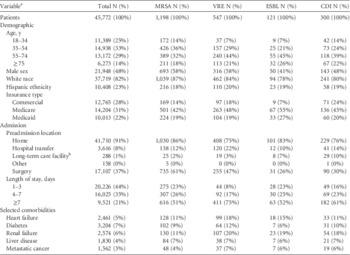
Cohort characteristics are summarized in Table 1. Compared with pathogen-specific noncarriers, carriers had significantly greater age (MRSA: 55 vs 49 years, VRE: 60 vs 49 years, ESBL: 63 vs 49 years, CDI: 58 vs 50 years; all P<.001) and length of stay (MRSA: 13 vs 6 days, VRE: 20 vs 6 days, ESBL: 12 vs 6 days, CDI: 15 vs 6 days; all P<.001) at the time of index admission. Overall, 3% (41/1,198) of MRSA, 3% (18/547) of VRE, 4% (5/121) of ESBL, and 2% (6/300) of CDI patients had non-California residential ZIP codes. Among remaining patients harboring antibiotic-resistant pathogens, characteristics of patient ZIP codes were as follows: percent of households built pre-1939, MRSA: 4%, VRE: 4%, ESBL: 4%, CDI: 3%; percent of households with more than 1 person/room, MRSA: 13%, VRE: 12%, ESBL: 14%, CDI: 12%; percent of households that were vacant, MRSA: 6%, VRE: 7%, ESBL: 5%, CDI 6%. With respect to population factors in patient residential ZIP codes, descriptive characteristics were as follows: not completing high school, MRSA: 22%, VRE: 22%, ESBL: 23%, CDI: 22%; unemployment, MRSA: 12%, VRE: 8%, ESBL: 8%, CDI: 9%; persons living below federal poverty level: 12% for all pathogens. The mean per capita income was $27,100 for MRSA, $27,200 for VRE, $27,200 for ESBL, and $28,700 for CDI patients.
Descriptive Characteristics of Adult Patients Harboring Antibiotic-Resistant Pathogens at a Single Medical Center, 2005–2009

NOTE. CDI, Clostridium difficile infection; ESBL, extended-spectrum β-lactamase–producing Escherichia coli and Klebsiella pneumoniae; MRSA, methicillin-resistant Staphylococcus aureus; VRE, vancomycin-resistant enterococci.
a Based on index admission, defined as the hospitalization associated with the first positive culture for carriers and first hospitalization during the study period for noncarriers.
b Includes skilled nursing and residential care facilities.
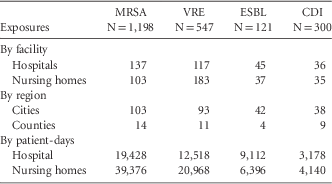
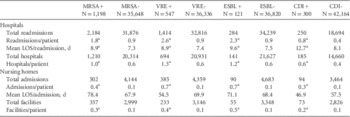
Carriers were significantly more likely than noncarriers to be admitted to any hospital or nursing home during the follow-up period (MRSA: 65% vs 41%, VRE: 76% vs 41%, ESBL: 75% vs 42%; CDI: 66% vs 31%; all P<.001) after discharge from the index hospitalization. MRSA, VRE, ESBL, and CDI carriers generated a total of 58,804 patient-days, 33,486 patient-days, 15,508 patient-days, and 7,318 patient-days, respectively, of exposure in hospitals and nursing homes across a mean of 69 cities and 10 counties (Table 2). A substantial fraction of total patient-day exposures occurred in nursing homes for MRSA (70%), VRE (63%), ESBL (41%), and CDI (57%) cohorts. In addition to having a higher likelihood of any readmission, carriers also had significantly higher numbers of readmissions than noncarriers to hospitals and nursing homes, and hospital readmissions were also longer among carriers compared with noncarriers (Table 3). The median time to first hospital or nursing home readmission (MRSA, 7 days [interquartile range, 0–72 days]; VRE, 2 days [0–22 days]; ESBL, 0 days [0–45 days]; CDI, 8 days [2–23 days]) and median time to any readmission (MRSA, 102 days [interquartile range, 23–215 days]; VRE, 87 days [19–196 days]; ESBL, 115 days [19–239 days]; CDI, 23 days [7–47 days]) varied across cohorts.
Total Statewide Facility Exposures to Patients Harboring Antibiotic-Resistant Pathogens Within 1 Year (MRSA, VRE, ESBL) and 90 Days (CDI) and of Being Discharged From a Single Medical Center, 2005–2009

NOTE. CDI, Clostridium difficile infection; ESBL, extended-spectrum β-lactamase–producing Escherichia coli and Klebsiella pneumoniae; MRSA, methicillin-resistant Staphylococcus aureuλs; VRE, vancomycin-resistant enterococci.
Readmission Outcomes Among Patients Harboring MRSA, VRE, ESBL and CDI at a Single Medical Center, 2005–2009

NOTE. CDI, Clostridium difficile infection; ESBL, extended-spectrum β-lactamase–producing Escherichia coli and Klebsiella pneumoniae; LOS, length of stay; MRSA, methicillin-resistant Staphylococcus aureus; VRE, vancomycin-resistant enterococci.
aSignificantly greater (P<.05) than patients who do not harbor the specified pathogen.
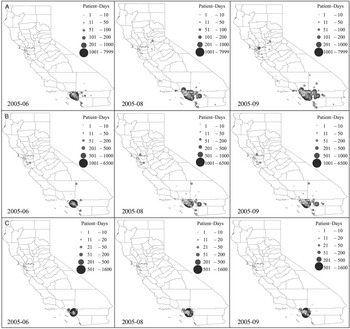
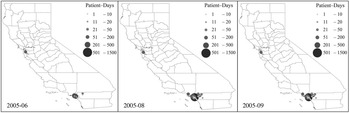
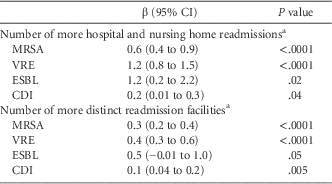
The time-dependent spread of patients harboring antibiotic-resistant pathogens across California healthcare facilities is shown in Figures 1 and 2. In multivariate models, carriage of antibiotic-resistant pathogens was found to be an independent predictor of increased number of combined readmissions as well as an increased number of distinct readmission facilities (Table 4).
Time-dependent spread of patients harboring methicillin-resistant Staphylococcus aureus (A, N=778), vancomycin-resistant enterococci (B, N=415), and extended-spectrum β-lactamase-producing Escherichia coli and Klebsiella pneumonia (C, N=91) across hospitals and nursing homes in California in the year following discharge from a single medical center as measured by patient-days of exposure in 2005–2009.

Time-dependent spread of patients with Clostridium difficile infection across hospitals and nursing homes in California in the 90 days following discharge from a single medical center as measured by patient-days of exposure in 2005–2009 (N=179).

Predictors of Hospital and Nursing Home Readmissions and Distinct Readmission Facilities Following Discharge From a Single Medical Center in Multivariate Linear Regression Testing

NOTE. CDI, Clostridium difficile infection; ESBL, extended-spectrum β-lactamase–producing Escherichia coli and Klebsiella pneumoniae; MRSA, methicillin-resistant Staphylococcus aureus; VRE, vancomycin-resistant enterococci.
a Among patients with similar demographic, comorbidity, hospitalization, and residential ZIP code characteristics, those with the specified pathogen are associated with β more hospital or nursing home readmissions (or β more unique hospitals and nursing homes) during follow-up compared with those without the specified pathogen.
DISCUSSION
In this study, we show that California healthcare facilities incur rapid and prolonged exposure to patients known to harbor MRSA, VRE, ESBL, and CDI who are discharged from a single medical center. Overall, 69% of these carriers were readmitted within the specified follow-up period of 1 year for MRSA, VRE, and ESBL and 90 days for CDI, which represented a 2-fold increase in readmission risk compared with noncarriers. In addition, carriers experienced over 2-fold more readmissions per year and longer exposure times, approximately 70 more days of hospital exposure-days, and 130 more days of nursing home exposure-days per year. Our results build upon existing modeling dataReference Lee, McGlone and Wong 30 and underscore the need for regional collaboration among healthcare facilities to mitigate the transmission of MRSA, VRE, ESBL, and CDI.
Unsurprisingly, most patient sharing occurred at sites that were geographically proximal to the study hospital.Reference Prabaker, Lin and McNally 17 , Reference Otter, Yezli and French 18 These findings are consistent with Orange County referral patterns wherein hospitals share 1 or more patients with nearly all hospitals and nursing homes within 12 months.Reference Lee, Bartsch and Wong 40 Nevertheless, over the 5-year study period, 25% of all counties in California were exposed to patients harboring antibiotic-resistant pathogens from our institution. With respect to patient-day exposures, up to 30% of total exposures occurred in healthcare facilities outside of Orange County. Such widespread exposures suggest regional control programs are needed to monitor and intervene in the spread of MRSA, VRE, ESBL, and CDI between healthcare facilities.
Importantly, nursing homes were a critical reservoir for patients discharged from our hospital. Over the 5-year study period, nearly 70% of total patient-day exposures due to MRSA carriers occurred in statewide nursing homes. In contrast, only 40% of patient-day exposures due to ESBL patients were in nursing homes. This finding may reflect the increased comorbidities and severity of illness among ESBL carriers that require frequent hospitalization. Regardless, the substantial fraction of exposures in nursing homes is concerning given the necessarily less stringent infection prevention policies in nursing homes. In the absence of effective alternative infection prevention strategies, nursing homes may continue to play a significant role in the regional dissemination of antibiotic-resistant pathogens. Hospitals with significant proportions of admissions from nursing homes may benefit from considering and even including nursing homes in infection prevention interventions.
Although the causes of widespread patient sharing were not studied, these factors may be relevant to public health responses to regional dissemination of antibiotic-resistant pathogens. For example, patients may choose to be cared for in a facility in a different region to be closer to family members who can care for them. We found that patient-day exposures in northern California commonly involved nursing homes. In contrast, patients were rarely discharged to northern California hospitals, a finding that may reflect the availability of high-acuity services among hospitals closer to Orange County. Regional control efforts may benefit from future studies evaluating the cause of admission to geographically distant facilities.
Our study has important limitations. First, numbers reported are likely underestimates of the actual extent of antibiotic-resistant bacteria patient-day exposures since we excluded carriers who died during follow-up. Additionally, nearly 10% of patients admitted to our hospital lacked encrypted identifiers based on social security numbers, which precluded tracking across institutions. Second, we evaluated exposures to patients from only 1 facility. All area and regional facilities are likewise discharging patients who harbor these pathogens such that the amount of statewide total exposure-days would be far greater than reported here. However, as a tertiary care medical center, it is likely that our patient sharing across institutions exceeds patient sharing in smaller, non–tertiary care community hospitals.
Third, our analysis involved the linkage of hospitalization and nursing homes data sets based upon sex, date of birth, matching of discharge dates from 1 facility and admission dates to another facility, and, if needed, comorbidities. To the extent that the use of these variables resulted in inaccurate tracking of individuals, our results would reflect these inaccuracies since validation by medical chart review was not performed. In addition, 15% of hospitalized patients discharged to a nursing home could not be matched. This could be due to a change in disposition where a patient was scheduled to transfer to a nursing home, but then chose to return home instead, or this could be an error. Nevertheless, this match rate is comparable with other studies that have linked hospitalization and nursing home data sets.Reference Cai, Mukamel, Veazie and Temkin-Greener 41
In summary, through routine patient sharing, we show that patients with MRSA, VRE, ESBL, and CDI from a single institution are more frequently and widely admitted to healthcare facilities throughout California compared with patients without these organisms. Our findings suggest that control and potential eradication of antibiotic-resistant pathogens will require coordinated, regional, and lasting efforts among hospitals, nursing homes, and public health departments throughout the state. Additional studies are needed to assess the degree to which MRSA, VRE, ESBL, and CDI exposures through patient sharing generate secondary transmission in receiving institutions.
ACKNOWLEDGMENTS
Financial support. Department of Medicine, University of California Irvine School of Medicine.
Potential conflicts of interest. All authors report no conflicts of interest relevant to this work.