Introduction
As the number of patient visits to the Emergency Department (ED) increases, the ability to expand services beyond the physical space of the ED during times of unusual surge is imperative.1 This requirement for expanded services became particularly apparent with the appearance of H1N1 influenza in April 2009. Because it is anticipated that urban populations likely will utilize EDs for their medical care during a pandemic, it is has been proposed that those who seek care in the ED, but are “walking well,” could be managed best in low-acuity extension areas of the hospital.Reference Rust, Melbourne and Truman2 By providing standard assessment and treatment algorithms, it was hypothesized that patient care could be streamlined and the quality of care maintained.
In September 2009, a pandemic H1N1 surge plan within the framework of a pediatric hospital’s emergency operations plan (EOP) was implemented. The objectives of this plan were to: (1) minimize the spread of illness within the hospital; (2) provide rapid and appropriate care to an increased volume of patients; (3) maintain an acceptable level of patient satisfaction; (4) minimize the number of patients who left without being seen (LWBS); and (5) avoid substantial increases in the cost of care delivery. The purpose of this paper is to describe the utility of the H1N1 surge plan, with particular emphasis on the use of extension areas within the hospital during periods of patient surge.
Methods
Hospital Setting
The hospital is a free-standing, urban, academic children’s hospital in the Midwest United States, with an annual ED census of >44,000 patients. The metropolitan area has a population of 2.9 million, and is serviced by three pediatric hospitals, two of which are in urban locations. The standard ED space in the hospital consists of 34 rooms, including four triage rooms, four trauma resuscitation bays, six fast-track rooms (staffed daily by pediatric nurse practitioners from 12 noon to 12 midnight), and 20 acute care treatment rooms (staffed by pediatric and pediatric emergency medicine-trained attending physicians, as well as residents and fellows in training).
Influenza-Like-Illness (ILI) Surge Plan
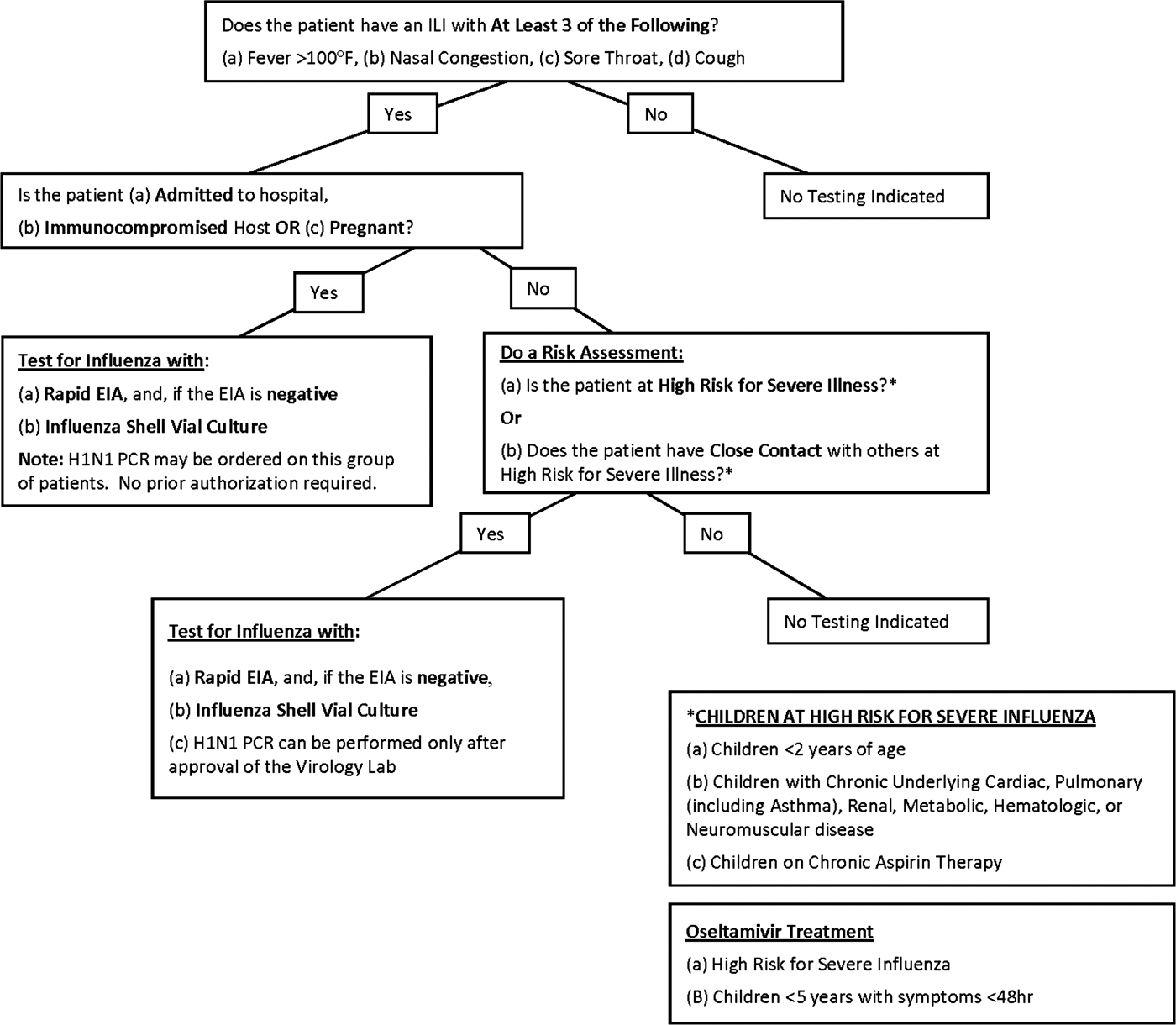
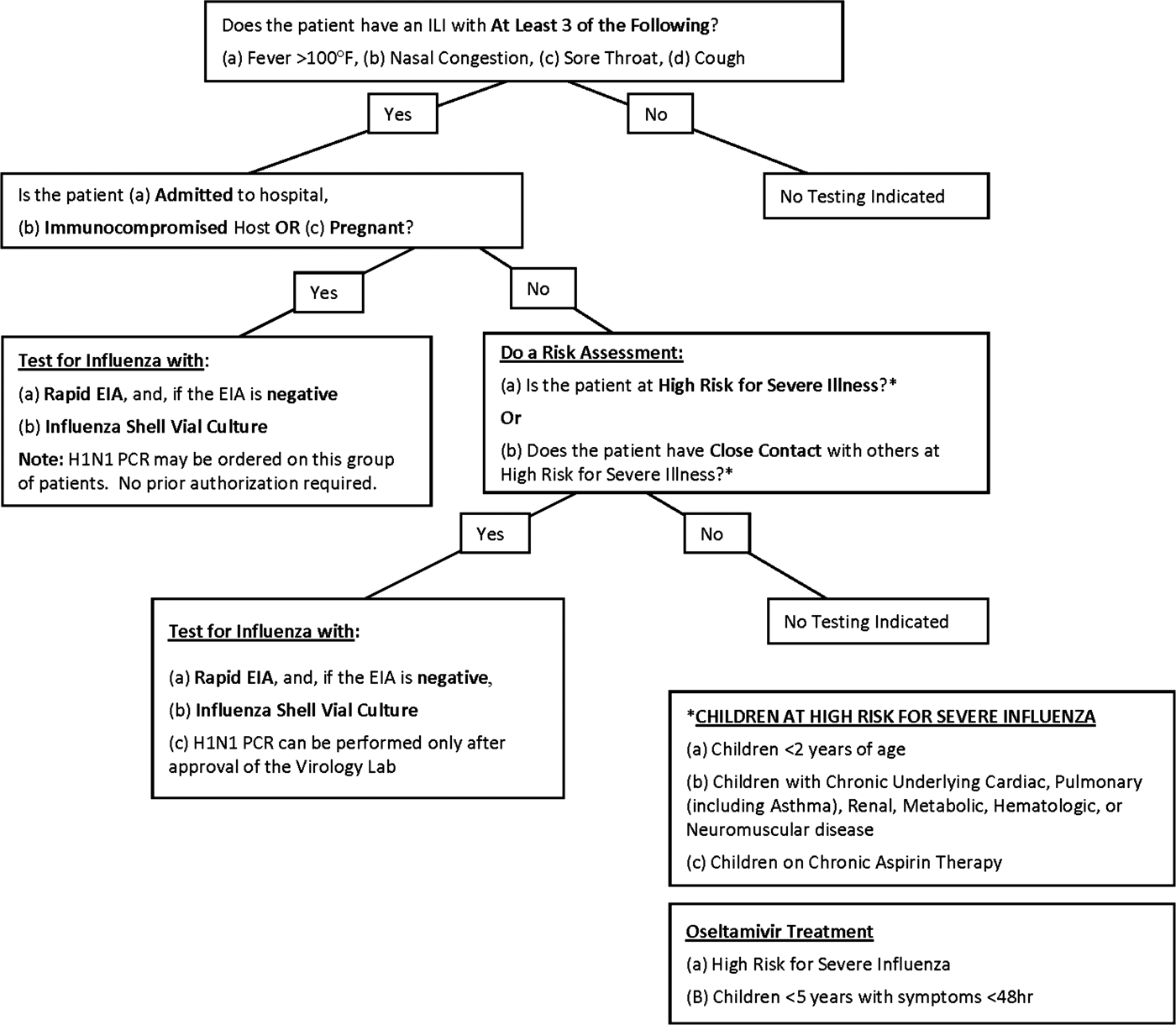
In the summer of 2009, hospital administrators within the health system modified the pandemic flu surge plan of their EOP to address the anticipated surge in low-acuity patients with symptoms of H1N1 influenza. First, the health system created, and then modified weekly, a standard diagnostic algorithm for patients with H1N1, based on the latest recommendations from the US Centers for Disease Control and Prevention (CDC). The final version of this algorithm is in Figure 1. Next, a three-phase surge plan was designed and implemented based on the number of patient visits to the ED. In the first phase, separate waiting areas for patients with symptoms of an ILI were created within the ED department, and nursing and physician staffing was maximized to provide care within the ED. The second phase comprised a two-pronged approach of extending patient care coverage by: (1) staffing the ED fast-track area for four additional hours per weekday (8 AM to 12 noon); and (2) opening an overflow area (the “ILI Clinic”) from 6 PM to 11 PM on weekdays and from 11 AM to 11 PM on weekends within the nearby outpatient, ambulatory care clinic. The expanded ED fast-track hours and the ILI Clinic, together referred to as the “ILI Extension Areas,” were staffed by non-Pediatric Emergency Department (PED) physicians, nurses, and support staff, but were under the supervision of the PED attending physician. The third phase of the surge plan, which was not implemented, involved expansion into additional spaces both within and outside the hospital.
Testing algorithm for children with influenza-like-illness (ILI)
ILI Extension Areas
One additional pediatrician staffed the fast-track area during weekdays from 8 AM to 12 noon. In the ILI Clinic area, five patient rooms were opened on evenings and weekends in the ambulatory care clinic located on the same floor as the PED. A resuscitation cart, oxygen, and suction equipment were available immediately within the clinic. Additional staffing on each shift included one pediatrician, one registered nurse (RN), and one registration clerk. All patients presented to the ED waiting area, and were immediately screened by an ED RN for symptoms of H1N1, including the presence of a fever ≥101 degrees Fahrenheit, cough, sore throat, body aches, headache, chills, and fatigue. If two or more of these symptoms were present, face masks were placed on the patient and family members, a brief assessment of overall appearance, breathing, and circulation was performed, and the patient’s information was entered into the PED’s medical record system. Patients were then directed to one of several newly created waiting rooms that were physically separated from the ED waiting area. From there, if no emergency condition was apparent, patients and family members were directed, via signage and staff instruction, to either the fast-track area, or to the ILI Clinic, where further triage was performed by the nurse in the ILI Extension Area.
A standardized testing protocol (Figure 1) and discharge information handouts were utilized by the medical staff in both the ED and in the ILI Extension Areas. The PED attending physician was available by phone for immediate consultation, and any patient deemed too ill for the ILI Extension Areas was transferred to a patient care room within the ED. The number of patients was monitored, and the ILI Extension Areas were closed when census returned to levels that could be managed within the department.
Data Sources and Analysis
Administrative computer systems recorded each patient visit to the PED and ILI Extension Areas. This data source was used to measure service utilization when the ILI Extension Areas were active (i.e., the 25 days from September 21 through October 25, 2009) and provided historical context for understanding patient visits during corresponding time periods in prior years (2007 and 2008), and a comparison period comprising the month in the same year (March 2009) with the greatest number of patient visits. Administrative computer systems also were used to obtain data and describe the frequency of diagnoses of “febrile illness,” “viral illness,” “viral syndrome,” “influenza,” or “ILI.” While routine testing was not part of the assessment algorithm, the number of STAT influenza tests conducted at the hospital from September 1 through October 31, 2009 also was tracked. Descriptive statistics were calculated and graphics were created to show the number of patient visits and the corresponding mean length of stay (LOS) over time.
The effectiveness of the ILI Extension Area model was evaluated using four different outcomes: (1) length of stay (LOS); (2) left without being seen (LWBS); (3) patient satisfaction; and (4) financial performance. Each outcome was assessed as follows:
Length of Stay (LOS) — Information obtained from the administrative computer systems provided mean LOS for five-day increments during three periods of time consisting of the active ILI Extension Area dates (September 22 through October 26, 2009), and corresponding time periods in the two prior years (2007 and 2008). The ILI Extension area functioned from September 22 through October 26; however, LOS data for comparison purposes for 2007 and 2008 was available only in the five day increments from September 21 through October 25. The data are presented as means and standard deviations (SD). Analysis of variance was used to examine differences in the mean LOS values for seven consecutive five-day periods during these times.Reference Iversen and Norpoth3 Because LOS data were available only in five-day increments during prior years, October 26, 2009 was not included in the LOS analysis in order to compare the LOS using similar five-day increments for data analysis purposes (four patients were seen in the ILI Extension Area on October 26th.) A P value of ≤.05 was considered statistically significant.
Patients Who Left Without Being Seen (LWBS) — Information obtained from administrative computer systems provided the daily count of patients who LWBS during 2009 (LWBS is defined as patients who sign into the ED but leave prior to evaluation by either a physician or a nurse practitioner). The proportion of patients who LWBS over the total number of PED encounters for September and October of 2009 was compared to corresponding time periods in the two prior years (2007 and 2008), and to the month with the highest number of visits in the same year (i.e., March 2009). Hospital administrators provided historical information on patients who LWBS as a composite measure by month. A z-test for two independent proportions was conducted to assess differences in the number of patients who LWBS between the ILI Clinic and the three comparison periods.Reference Dawson and Trapp4
Patient Satisfaction — Patient satisfaction surveys are a part of the standard hospital quality measurements and are conducted by Press-Ganey (www.pressganey.com) for the hospital’s PED. A predetermined number of discharged patients (43% up to a maximum of 987 per year) are selected randomly each month to receive, via the US Postal Service, a survey questionnaire with a pre-addressed, stamped return envelope. Surveys were sent out and reported in one week increments. Each survey consists of 37 questions to be rated on an ordinal scale of 1 (least favorable) to 5 (most favorable). The question regarding “likelihood of recommending” is utilized as the benchmark measure of overall performance. The mean response score, standard deviation, and survey reply count for the benchmark measure of “likelihood of recommending” were calculated for the period when the ILI Extension Areas were active (September 21 through October 31). These data were compared to the survey scores obtained for the entire year of 2009, and those obtained in March 2009. The mean “likelihood of recommending” scores were compared using a t-test for two independent samples to assess differences in satisfaction scores between the ILI Extension Areas and March 2009; a z-test was also employed to compare ILI Extension Areas and entire year of 2009.Reference Dawson and Trapp4,Reference Norman and Streiner5 Admitted patients were not included in this analysis.
Cost Analysis—Professional costs were estimated based on the additional staffing provided by the physicians, nurses, and unit secretaries. All other projected costs, including cleaning services, utilities, and supplies, were not included in this analysis. Revenue (i.e., fee collections) for facility and professional fee charges for each day of the active ILI Extension Areas was determined from hospital administration data. Gross profit or loss was calculated for each day, and summarized in aggregate and on a per visit basis.
Results
ILI Surge Plan
Phase 1 of the H1N1 surge plan was put into effect on September 9, 2009. As a steadily increasing volume of patients was noted, Phase 2 of the plan was implemented on September 22. During Phase 2, the ILI Extension Areas were open on consecutive days from September 22 through October 8, and then as needed through October 26, for a total of 25 days of operation. Six hundred twelve patients were triaged to these areas, with a median of 24 (mean 24) patients per day, representing a range of 2.6%–25.2% of the total PED patient presentations during those days.
Patient Diagnosis
In September, 791 patients were diagnosed with febrile or viral illnesses or syndrome, and 242 patients (30.6%) were diagnosed with influenza or ILI. In October, 662 patients were diagnosed with febrile or viral illnesses or syndrome, and 546 patients (82.5%) were diagnosed with influenza or ILI.
Influenza Testing
Influenza testing was not a routine part of the evaluation of patients with ILI. From September 1, 2009 through October 31, 2009, a total of 394 STAT Influenza tests were conducted; 122 (31.0%) of these were confirmed positive for influenza A.
Patient Visits
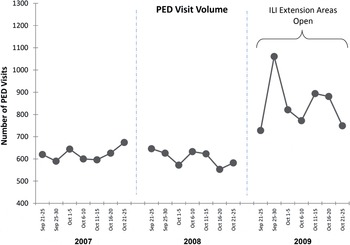
Compared to 2007 and 2008, PED visits were elevated during September and October of 2009 (including the ILI Extension Area volumes). In September, 2009, 5,256 patients were seen, representing a 44.9% increase over the number seen in 2007, and a 42.0% increase over the number seen in 2008. In October, 4,815 patients were seen; this represented a 25.6% increase from 2007, and a 32.7% increase from 2008. Comparatively, in March of 2009, the month with the highest number of patient visits, 4,304 patients were seen. Compared to the next busiest month of the same year, an average of 36 (26.2%) and 32 (22.7%) more patients were seen each day in September and October 2009, respectively. Pediatric Emergency Department visits for the periods when the ILI Extension Areas were open were higher than comparable periods in the two prior years (Figure 2).
Number of Pediatric Emergency Department (PED) visits for seven consecutive five-day increments from September 21 through October 25 over three years (2007, 2008, and 2009)

Outcome Measures
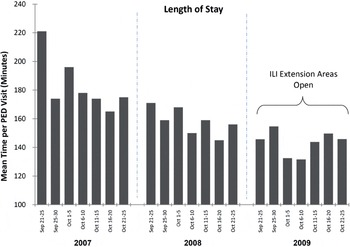
The mean LOS in the ED from September 21 through October 25, 2009 was 143 ± 9 minutes. During the same time periods in 2007 and 2008, the mean LOS was 183 ± 19 minutes and 158 ± 9 minutes, respectively (Figure 3). Results of the ANOVA, and subsequent Tukey post hoc comparison, revealed that the mean LOS for the ILI time period (September 21 through October 25, 2009) was significantly shorter than for the comparable period in 2007 (P <.001), and not significantly different than the average LOS for this same time period in 2008 (P = .122).
Mean length of stay (in minutes) of Pediatric Emergency Department (PED) visits for seven consecutive five-day increments from September 21 through October 25 over three years (2007, 2008, and 2009)

The percentage of patients who LWBS for those days in which the ILI Extension Areas were operational was 4.3%. For the time period of September 1 through October 31, 2009, this rate also was 4.3%, compared to the average rates of 2.9% (P = .49) and 3.6% (P = .12) in the years 2008 and 2007, respectively. The LWBS rate during the ILI Extension Area active period was significantly higher (P <.001) than the overall average for the year 2009 (3.2%). The LWBS rate of 4.3% during the ILI Extension Area active period was not significantly different (P = .11) from the 5.9% rate during March, the busiest month in 2009 prior to the arrival of H1N1 to the region.
In 2009, 773 of the 11,875 (6.5%) mailed surveys were completed and returned. The “likelihood of recommending” for the PED was 83.3 ± 27.4, using a standardized scale on which a score of 100 indicates respondents were “likely” or “very likely” to recommend the PED, as reported on a 5-point Likert scale. During the time period in which the ILI Extension Areas were active (September 20 through October 31, 2009), 75 satisfaction surveys were returned regarding the time period in which the ILI Extension Areas were active. Those surveys had a mean score of 81.3 ± 29.4, which was not significantly different from the mean value for 2009 (P = .537). During March 2009, 73 satisfaction surveys were returned, with a mean score of 79.8 ± 29.4, which also was not significantly different from the scores reported during the period of time for the ILI Extension Area period (P = .76).
Professional costs (i.e., physician wages) for the ILI Extension Areas were US $17,416. Professional collections during this time period totaled US $43,494, resulting in a net profit of US $26,078. Professional collection data were unavailable for 16 patients. Facility costs (i.e., nursing and secretarial wages) totaled US $16,258, and collections totaled US $155,566, resulting in a net profit of US $139,308. Thus, the total net profit for the ILI Extension Areas was US $165,386.
Discussion
Planning for pandemic influenza outbreaks is an important and necessary part of a hospital’s EOP. In 2009, The Australasian Surge Strategy Working Group recommended a scalable plan, capable of being executed for a variety of surge needs, and including an extra-ED diversion area for stable patient evaluation and treatment.Reference Bradt, Aitken and Fitzgerald6 The flexible, multi-phase approach to surge allows for an adaptable response during sudden-onset disasters as well as during unexpected volume increases.Reference Asplin, Flottemesch and Gordon7
In the past few years, several other hospitals have described EOPs for surge. The Cook Children’s Medical Center in Ft. Worth, Texas USA, which experienced one of the earliest H1N1 surges in April 2009, opened an Incident Command Center and coordinated with local hospitals.Reference Hood and LaCoe8 Texas Children’s Hospital in Houston, Texas, created a tent-based clinic in its parking lot, which operated for one week in May of 2009, caring for an average of 48 patients per day, which helped alleviate the surge in the hospital’s ED.Reference Cruz, Patel and DiStefano9 The Boston Medical Center (Boston, Massachusetts USA) successfully operated an extension pediatric clinic in a single room space during the H1N1 pandemic in June 2009.Reference Cooper, Walz and Brown10
As per the Emergency Medical Treatment and Labor Act (EMTALA), extra-ED areas for patient care may be utilized with following stipulations: (1) a hospital may set up an alternative medical screening site on the existing hospital campus, but patients must be directed to this area by a person qualified to identify patients needing immediate, standard ED treatment; and (2) off-campus areas can be operated, but patients presenting to the ED cannot be directed to these areas for a medical screening exam.Reference Roszak, Jensen and Wild11 The ILI Extension Areas described in this study were fully compliant with EMTALA standards, as the initial medical screening of patients in the PED waiting area was performed by an ED nurse, and the ambulatory care clinic was adjacent to the PED.
Of the stated objectives of the described H1N1 surge plan, minimizing the exposure of patients and staff was of paramount importance, but not possible to measure. Patients were carefully screened upon entry into the PED waiting area, and masks were placed on all those with ILI symptoms, and their families. Additional patient waiting areas also were created to segregate patients and families based on the patient’s symptoms.
Despite the dramatic increase in ED visits during this time period, average LOS, the number of patients who LWBS, and patient satisfaction were not significantly different than those experienced in the past. These measures likely represent the efficiency of services provided by the overall surge plan. On the other hand, as described in prior studies of patient satisfaction in emergency departments, shunting patients to a separate extension area for care not only reduces crowding in the standard ED waiting and treatment areas, but also may lead to improved patient perception of care.Reference Pines, Garson and Baxt12 Finally, the use of the ILI Extension Areas resulted in a net financial profit for the institution.
This retrospective review has several limitations. First, it was impossible to measure the impact of the infection control measures implemented. Also, patient satisfaction scores for the exact time periods were difficult to report since the response rate for returned surveys was low, and there is a variable time lag between the ED visit and the return of the completed surveys. As such, the analysis represents only an estimation of patient satisfaction. Finally, the cost analysis did not include all of the indirect and facility costs including those related to space usage, cleaning staff, or material goods used; thus, the financial benefit likely is overestimated. Despite these limitations, it is possible that the data presented may have minimized the true impact of the ILI Extension Areas, since it did not take into account the projected LOS, LWBS, satisfactions scores, and financial impact that would have had occurred had the plan not been implemented.
Conclusion
The implementation of the pandemic influenza surge plan at an urban pediatric hospital, with an emphasis on the use of ILI Extension Areas, facilitated the delivery of efficient, cost effective care during an H1N1 influenza pandemic.
Abbreviations:
CDC = Centers for Disease Control and Prevention
ED = Emergency Department
EMTALA = Emergency Medical Treatment and Labor Act
EOP = emergency operations plan
JCAHO = Joint Commission of Healthcare Organizations
ILI = influenza-like-illness
LWBS = left without being seen
LOS = length of stay
PED = Pediatric Emergency Department