INTRODUCTION
Large cities such as Amsterdam in the Netherlands are confronted by serious criminal problems caused by groups of severe and persistent juvenile offenders, who come from families, which frequently operate off the radar from health, educational, and social services. While these children might have behavioral problems, they often have no diagnosis because they have not seen a mental health professional, nor do their families actively seek help from social services or clinicians, which substantially increases the risk of an unfavorable social developmental trajectory (Farrington et al., Reference Farrington, Piquero and Jennings2013; Loeber & Stouthamer-Loeber, Reference Loeber and Stouthamer-Loeber1998). The Preventive Intervention Trajectory (PIT) is a project of the municipality of the city of Amsterdam that targets young children who are at risk of future criminal behavior (van Zonneveld et al., Reference Van Zonneveld, Platje, de Sonneville, van Goozen and Swaab2017). The motivation behind the project is to get this group on the radar to obtain insight into their socioemotional functioning in order to prevent antisocial development in an effort to take a generation out of crime.
To understand socioemotional functioning, it is crucial to investigate how social stimuli are processed (Corden et al., Reference Corden, Critchley, Skuse and Dolan2006). In a recent study with the same population of high risk children, evidence was found for impaired affective empathy but intact social attention and cognitive empathy (van Zonneveld et al., Reference Van Zonneveld, Platje, de Sonneville, van Goozen and Swaab2017). Emotion recognition is another important aspect of emotion processing. Evidence has been found that impairments in emotion processing contribute to behavioral and social problems in at-risk children (Izard et al., Reference Izard, Fine, Schultz, Mostow, Ackerman and Youngstrom2001). Emotion recognition is particularly crucial when it comes to engaging in social behavior; it is fundamental for normal social interaction and socialization (Blair et al., Reference Blair, Colledge, Murray and Mitchell2001; Montagne et al., Reference Montagne, van Honk, Kessels, Frigerio, Burt, van Zandvoort and de Haan2005). The aim of the present study was to examine the role of emotion recognition in children at high risk of developing future criminal behavior, which may serve as an underlying mechanism of antisocial behavior. It is proposed that aggression or antisocial behavior is the result of an inability to be led by the social cues of others (Blair, Reference Blair2003; Montagne et al., Reference Montagne, van Honk, Kessels, Frigerio, Burt, van Zandvoort and de Haan2005). This assumption is supported by the Integrated Emotion System (IES) model of Blair (Reference Blair2005). The IES model explains that aversive stimuli, such as expressions of fear and sadness, serve as social reinforcements and that individuals who do not recognize these cues cannot take advantage of these cues to adapt their behaviors in a socially appropriate manner (Blair, Reference Blair2005; Blair, Reference Blair2003; Marsh & Blair, Reference Marsh and Blair2008). Adequate recognition of fear and sadness evokes empathy and inhibits aggressive and/or antisocial behavior (Marsh et al., Reference Marsh, Adams and Kleck2005; Marsh & Blair, Reference Marsh and Blair2008), whereas someone will continue with behavior that causes distress when that individual is unable to recognize distress in others (Hubble et al., Reference Hubble, Bowen, Moore and van Goozen2015). One of the best-replicated findings is the inability to recognize fear and sadness in facial expressions across populations of children and (early) adolescents presenting with behavioral problems (Blair & Coles, Reference Blair and Coles2000; Schwenck et al., Reference Schwenck, Gensthaler, Romanos, Freitag, Schneider and Taurines2014; Walker & Leister, Reference Walker and Leister1994), conduct disorder (CD) (Fairchild et al., Reference Fairchild, Stobbe, van Goozen, Calder and Goodyer2010; Fairchild et al., Reference Fairchild, Van Goozen, Calder, Stollery and Goodyer2009; Martin-Key et al., 2015; Sully et al., Reference Sully, Sonuga-Barke and Fairchild2015), psychopathic tendencies (Blair et al., Reference Blair, Colledge, Murray and Mitchell2001; Montagne et al., Reference Montagne, van Honk, Kessels, Frigerio, Burt, van Zandvoort and de Haan2005; Stevens et al., Reference Stevens, Charman and Blair2001), young offenders (Bowen et al., Reference Bowen, Morgan, Moore and van Goozen2014; Carr & Lutjemeier, Reference Carr and Lutjemeier2005; Hubble et al., Reference Hubble, Bowen, Moore and van Goozen2015), or callous/unemotional (CU) traits (Dadds et al., Reference Dadds, Perry, Hawes, Merz, Riddell, Haines, Solak and Abeygunawardane2006; Leist & Dadds, Reference Leist and Dadds2009; Woodworth & Waschbusch, Reference Woodworth and Waschbusch2008). Székely et al. (Reference Székely, Tiemeier, Jaddoe, Hofman, Verhulst and Herba2014) found that preschoolers with externalizing problem behaviors were generally less skilled in emotion recognition, but did not find any emotion-specific deficits. The current study extends the current literature by investigating facial affect recognition in a non-clinical sample of children who are at risk of future antisocial or criminal behaviors.
Another phenomenon with respect to facial affect recognition is the hostile attribution bias, which has been linked to aggression and antisocial behavior (De Castro et al., Reference De Castro, Veerman, Koops, Bosch and Monshouwer2002). Individuals who have a hostile attribution bias attribute hostile intent to others when the stimulus or situation is actually neutral or ambiguous (De Castro et al., Reference De Castro, Veerman, Koops, Bosch and Monshouwer2002; Dodge, Reference Dodge2006; Schönenberg & Jusyte, Reference Schönenberg and Jusyte2014). Research into this phenomenon in children is scarce (Mellentin et al., Reference Mellentin, Dervisevic, Stenager, Pilegaard and Kirk2015). The result of a study, which used ambiguous stimuli showed that antisocial children were less skilled in interpreting neutral faces and often misinterpret them as anger (Dadds et al., Reference Dadds, Perry, Hawes, Merz, Riddell, Haines, Solak and Abeygunawardane2006). In the current study, the existence of a hostile attribution bias was investigated using neutral faces to find out whether at-risk children interpret these faces in a negative way.
In contrast to facial affect recognition, affective prosody recognition is an understudied area of research in antisocial or aggressive populations, and research seems to be limited to the study of children or adults with psychopathic tendencies. From a meta-analysis by Dawel et al. (Reference Dawel, O’Kearney, McKone and Palermo2012), it appears that affective prosody recognition in psychopathic individuals is impaired in positive as well as negative emotions. However, in one of these studies in boys with psychopathic tendencies, impairments in sadness recognition were observed (Stevens et al., Reference Stevens, Charman and Blair2001), whereas another of these studies found impairments in fear recognition (Blair et al., Reference Blair, Budhani, Colledge and Scott2005).
The main aim of the present study was to investigate facial affect and affective prosody recognition in children at high risk of developing future criminal behaviors. In line with previous research (Bowen et al., Reference Bowen, Morgan, Moore and van Goozen2014; Dawel et al., Reference Dawel, O’Kearney, McKone and Palermo2012; Marsh & Blair, Reference Marsh and Blair2008), we predicted that high-risk children would have impaired facial affect and prosody recognition, and show specific impairments in fear and sadness recognition. We also predicted a hostile attribution bias in response to neutral faces compared with typical control children (Mellentin et al., Reference Mellentin, Dervisevic, Stenager, Pilegaard and Kirk2015).
METHODS
Participants
Data were gathered from children recruited through the PIT. This is a large ongoing project of the municipality of the city of Amsterdam, the Netherlands. Participants were the underage siblings of young offenders, children of delinquent parents (N=45, familial high-risk), or children who fail at school due to severe unauthorized absenteeism (e.g., truancy) or because of extreme antisocial behavior (N=174, school high-risk). The total sample consisted of 262 participants (213 boys and 49 girls) with a mean age of 10.46 years (SD=1.34). The high-risk group consisted of 219 participants (182 boys and 37 girls) with a mean age of 10.49 years (SD=1.35). The control group {N=43; 31 boys and 12 girls; mean age of 10.27 years [SD=1.29]} was recruited through the same schools that were attended by the participants in the high-risk group, which make them a representative group. The Dutch version of the Teacher Report Form (TRF; Achenbach & Rescorla, Reference Achenbach and Rescorla2001; Verhulst et al., Reference Verhulst, Van der Ende and Koot1997) was used to confirm risk status of the participants and to include children into the study; all participants in the high-risk group scored in the borderline or clinical range on the aggression and/or rule breaking behavior scales (T-score ≥ 65); and their average internalizing problem behavior score was in the normal range. All participants in the control group scored on average within the normal range on all problem scales (T-score < 65). The Dutch version of the Child Behaviour Checklist (CBCL; Achenbach & Rescorla, Reference Achenbach and Rescorla2001; Verhulst et al., Reference Verhulst, Van der Ende and Koot1996) was used to identify the problem behavior reported by the parents of the high-risk group.
Children were eligible to participate if they were between 8 and 13 years old and spoke and understood the Dutch language. No exclusion criteria were used. Written informed consent was obtained from the parents and from the children if they were 12 years or older. Ethical approval for this study was obtained from Leiden University’s Education and Child Studies Ethics Committee.
Procedure
Following informed consent, an appointment was made at school, where the tests were administered following a standard protocol. All participants were individually assessed in a quiet room. The assessors were two trained graduate students under supervision of a clinical investigator (LvZ).
Instruments
Facial emotion recognition
Facial emotion recognition was assessed with the Facial Emotion Recognition (FER) test (Bowen et al., Reference Bowen, Morgan, Moore and van Goozen2014). This computerized task consists of 108 slides presented on a laptop, displaying facial expressions. Six target faces, three male and three female, were used. Each target displayed a neutral expression or one of six basic emotions (happy, sad, anger, fear, disgust, or surprise). The intensity of the emotional expression varies between 25%, 50%, 75%, and 100%, because they are morphed with their corresponding neutral expression (0% intensity). The question “What emotion is this person showing?” accompanies the target face, along with numbered and labeled options. Percentage correct recognition scores (accuracy) was calculated for each emotion at every intensity.
Affective prosody recognition
Affective prosody recognition was assessed with the subtest “Prosody” of the computerized test battery Amsterdam Neuropsychological Tasks (ANT; De Sonneville, Reference De Sonneville1999, Reference De Sonneville2014; Oerlemans et al., Reference Oerlemans, Van der Meer, Van Steijn, De Ruiter, De Bruijn, De Sonneville, Buitelaar and Rommelse2014). This test consists of 48 sentences of neutral content (12 for each basic emotion: happy, sad, anger, fear; 6 spoken by a male and 6 spoken by a female) and presented through a headphone. The original material, used in previous studies (Van Rijn et al., Reference Van Rijn, Aleman, Swaab, Krijn, Vingerhoets and Kahn2007; Van Rijn et al., Reference Van Rijn, Aleman, Van Diessen, Berckmoes, Vingerhoets and Kahn2005), consisted of 24 sentences that are presented twice in random order to obtain more observations. Sentences were spoken with a happy, sad, angry, or frightened intonation. The participants were asked to verbally (into a microphone) identify the emotion expressed in the sentence spoken. Reaction times of the correct responses were recorded using a voice-key response. The mean reaction time (speed) and percentage correct recognition scores (accuracy) were calculated for each emotion.
Intellectual functioning
Intellectual functioning was assessed with the Dutch version of the Wechsler Intelligence Scale for Children (WISC-III; Kort et al., Reference Kort, Schittekatte, Dekker, Verhaeghe, Compaan, Bosmans and Vermeir2005). Two subtests, Block Design (perceptual organization skills) and Vocabulary (verbal skills), were used to estimate full scale intelligence quotient (FSIQ; Campbell, Reference Campbell1998).
Statistical Analysis
There were no outliers or violations of statistical assumptions. Facial emotion recognition data were not available for five participants (high-risk group), and affective prosody recognition data were not available for two participants (high-risk group) due to time restrictions. For another 11 participants (high-risk group), one or more of the mean reaction times on the prosody test could not be calculated because they did all 12 trials of one emotion wrong. For these 11 participants, the accuracy data were available. A priori, the high-risk group, and control groups were compared on age, sex, estimated FSIQ, Vocabulary, Block Design, and the different TRF scales. Since estimated FSIQ was significantly different between the groups, correlations with affective facial and prosody recognition were computed, resulting in three significant but small correlations (.19 < r <.26) out of 12. Repeating the analyses with estimated FSIQ as covariate resulted in two non-significant effects of the covariate and one significant effect, but, in this case, the outcome did not change. We decided to not include estimated FSIQ as covariate in subsequent analyses based on these results and the arguments of Dennis et al. (2009). We have examined whether there was a differential relationship between estimates of verbal and nonverbal ability (Vocabulary and Block Design) between groups as well as whether the nonverbal measure related to the facial and prosody scores. Furthermore, preliminary analyses revealed that the 25% intensity recognition and the emotions, disgust and surprise, of FER were too difficult for this age group and we decided to exclude these from our analyses. Because we were interested in specific emotion recognition and not in emotion specific intensity recognition, we calculated a mean emotion recognition score for each of the four emotions across the three intensities (50%, 75%, and 100%). Next, we performed three two-way repeated measures analyses of variance (RM-ANOVAs) to investigate differences between groups in facial affect and affective prosody recognition. Mean reaction times and percentage correct were calculated for Emotion (happiness, sadness, fear, anger) as within-subjects’ factors and Group as between-subjects’ factor. Post hoc group differences by emotions were examined in case of a significant interaction effect. Two RM-ANOVAs were performed to examine the distribution of the selected emotions in case the target emotion was not recognized, for facial as well as vocal affect recognition. Emotion (target emotion) and Confusion type as within-subjects’ factors and Group as between-subjects factor were used. The existence of a hostile attribution bias was examined with a t-test by using the responses when neutral was the target emotion. Because antisocial behavior is notoriously heterogeneous post hoc, analyses were performed to compare control participants, familial high-risk, and school high-risk participants. Effect sizes were calculated using partial eta squared (ηp 2) with ηp 2~.03 representing a small effect, ηp 2 ~.06 representing a moderate effect, and ηp 2~.14 a large effect (Cohen, Reference Cohen1992).
RESULTS
Descriptive Statistics
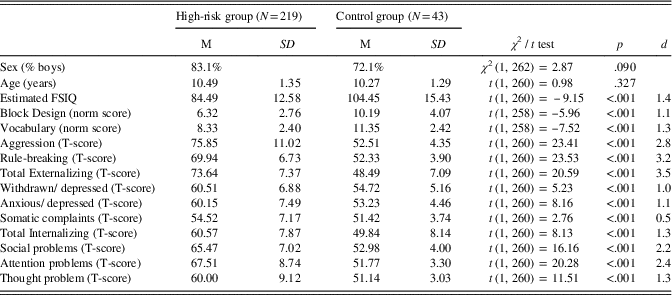
Descriptive data for sex, age, estimated FSIQ, and the different scales of the TRF are shown in Table 1. The high-risk and control groups did not differ in age or sex. However, the high-risk group had a significantly lower estimated FSIQ and scored lower on Vocabulary and Block Design, but group differences were independent of the subtest. Furthermore, the nonverbal measure was not significantly correlated to the facial and prosody scores. Last, the high-risk group scored significantly higher on the different TRF scales (Table 1). As expected, parents of the high-risk group reported fewer problem behaviors on the CBCL (M aggression=59.31, SD=8.53; M rule-breaking=58.19, SD=7.05) compared with teachers for aggression {t[1,215]=18.47, p <.001, d=1.7) and rule-breaking behavior {t[1,215]=19.74, p <.001, d=1.7}.
Descriptive statistics for sex, age, estimated FSIQ, Vocabulary, Block Design, and TRF scales for the two groups

Facial Emotion Recognition
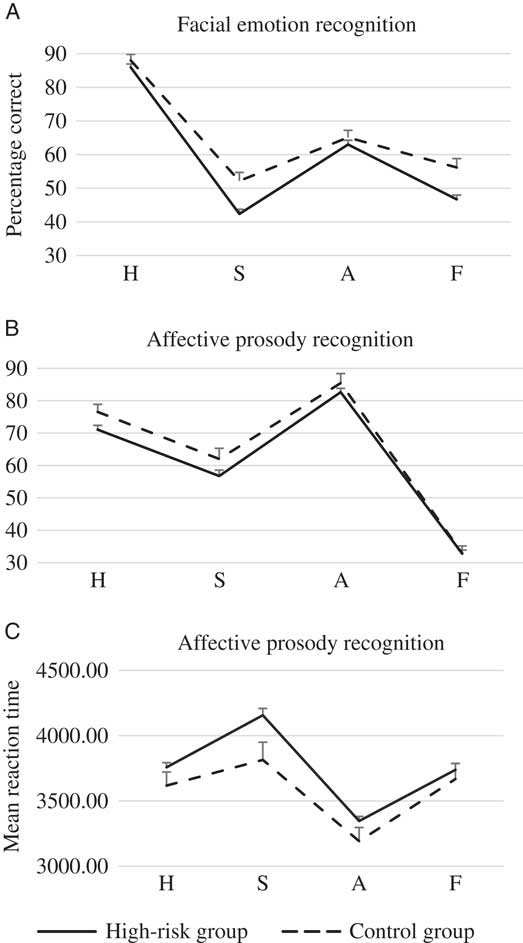
The results showed a significant main effect of Group {F[1,255]=9.37, p=.002, ηp 2=.035}, of Emotion {F[3,765]=187.32, p <.001, ηp 2=.423}, and a significant Emotion by Group interaction {F[3,765]=2.82, p=.038, ηp 2=.011}. As shown in Figure 1, Panel A, the results indicate that the high-risk group generally performed less accurate compared to the control group, that there were clear differences between the emotions in recognition rates, and that the high-risk group performed particularly worse compared to the control group with respect to sadness and fear (significant interaction, confirmed by post hoc analyses, p ≤.003). In case the target emotion was not recognized, the groups did not differ in distribution of the errors across the non-target emotions (p=.484).
Means and standard errors of the means (SEM) for percentage correct of facial emotion recognition (Panel A; N=214 high-risk and 43 control), percentage correct of affective prosody recognition (Panel B; N=217 high-risk and 41 control) and for the mean reaction time (Panel C; N=208 high-risk and 41 control). H=happiness, S=sadness, A=anger, F=fear.

Hostile Attribution Bias
No group difference in neutral recognition was found; the high-risk and control group also did not differ in the number of times they misattributed a neutral face for another emotion (see Table 2).
Means and standard deviations for the percentage response by emotion when neutral was the target emotion

Affective Prosody Recognition
Regarding accuracy, no Group effect (p=.124) was found. The results show a significant main effect of Emotion {F[3,774]=234.84, p <.001, ηp 2=.477}, indicating that both groups were less accurate in sadness and especially fear recognition (see Figure 1, Panel B). There was no Emotion by Group interaction (p=.536). In case the target emotion was not recognized, the groups did not differ in the distribution of errors across the non-target emotions (p=.364). In terms of speed, a significant effect of Group {F[1,247]=4.43, p=.036, ηp 2=.018} and Emotion {F[3,741]=50.84, p <.001, ηp 2=.171} was found, but there was no Emotion by Group interaction (p=.117). These results indicate that the high-risk group responded significantly slower across emotions compared with the control group (see Figure 1, Panel C).
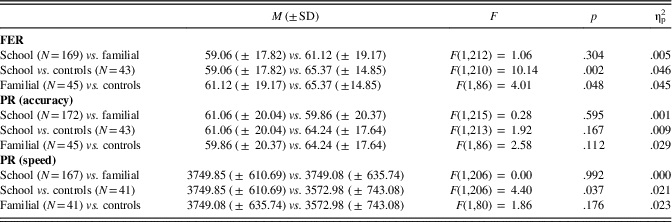
The comparisons between the control participants, familial high-risk, and school high-risk participants are shown in Table 3. The results indicate that the school group and the familial group do not differ from each other on both tasks. In case the familial and school group differ from the control group, effect sizes were comparable. On Prosody (speed) the school group differed from the control participants, while the familial group versus the control group did not differ (p=.176), although effect sizes were of similar magnitude.
Post hoc group comparisons for the facial emotion recognition (FER) task and the prosody (PR) tasks with the means (M) and standard deviations (SD) calculated over the four emotions

DISCUSSION
The aim of the present study was to examine evidence for weaknesses in facial and vocal emotion recognition in a sample of children at high risk of future criminal behavior. Emotion recognition is an important underlying mechanism of emotion processing and related to social interaction and socialization (Blair et al., Reference Blair, Colledge, Murray and Mitchell2001; Montagne et al., Reference Montagne, van Honk, Kessels, Frigerio, Burt, van Zandvoort and de Haan2005). The present study is embedded within the PIT project that targets children with behavioral problems who often have no diagnosis or whose families do not actively seek help. It is of great importance to examine emotion recognition in these children, because their behavior is characterized by inappropriate social behavior, including problems with social interaction. Early intervention may prevent these children from developing in an antisocial way and protect society from its detrimental effects (Van Goozen, Reference Van Goozen2015). The results of the study indicate that the high-risk group performed less accurately in facial affect recognition, in particular fear and sadness recognition, while they performed equally accurate in affective prosody recognition, although they needed significantly more time than controls to correctly identify these emotions. No hostile attribution bias was found.
The present findings are consistent with previous research showing impaired fear and sadness recognition in populations of children and (early) adolescents with CD, high levels of psychopathic tendencies, and young offenders (e.g., Blair & Coles, Reference Blair and Coles2000; Dadds et al., Reference Dadds, Perry, Hawes, Merz, Riddell, Haines, Solak and Abeygunawardane2006; Fairchild et al., Reference Fairchild, Van Goozen, Calder, Stollery and Goodyer2009; Hubble et al., Reference Hubble, Bowen, Moore and van Goozen2015). The results of the present study strongly suggest that children who are at high risk of developing criminal behavior, because they are the underage siblings or children of delinquents and those failing primary school, exhibit emotion-specific deficits in facial emotion recognition that could impair their prosocial development leading to future antisocial behavior. Recognition of others’ emotions is learned through experience and based on the gradual refinement with age of children’s production and recognition of emotional signals (van Goozen, Reference Van Goozen2015). Caregivers play a substantial role in developing their child’s emotion recognition proficiency. The influence of parenting on the development of emotion recognition may help explain why children who show aggressive and antisocial behavior have emotion recognition impairments (Bowen et al., Reference Bowen, Morgan, Moore and van Goozen2014). Poor parenting is a known risk factor in the development of aggressive behavior, affecting – among others – emotional appraisal processes and predisposing children to attribute hostile intent (Dishion et al., Reference Dishion, French and Patterson1995; Nelson & Coyne, Reference Nelson and Coyne2009). These results underpin the importance of early detection of at-risk children in order to provide tailored interventions to prevent them from drifting toward a criminal career (Van Goozen & Fairchild, Reference Van Goozen and Fairchild2008).
In the literature, explanations for the emotion-specific impairments can be found in the IES model of Blair (Reference Blair2005). Fear and sadness should serve as social reinforcements leading to appropriate social behavior and evoking empathy (Marsh et al., Reference Marsh, Adams and Kleck2005; Marsh & Blair, Reference Marsh and Blair2008). The current findings, together with the earlier reported impairments in affective empathy (van Zonneveld et al., Reference Van Zonneveld, Platje, de Sonneville, van Goozen and Swaab2017), help explain problems in socioemotional functioning in these children. The high-risk group appears to have problems with empathizing and experiencing others’ negative emotions, but they are also less able to recognize the distress-related emotions in others. When a child does not empathize and recognize the distress of another caused by their behavior, it is likely that they will not be able to adapt their behavior (Marsh & Blair, Reference Marsh and Blair2008).
In contrast to our hypothesis, the results showed no hostile attribution bias. The high-risk group and the control group did not differ in the number of times they misinterpreted a neutral face as angry. Although the literature on this phenomenon in children is scarce, previous studies have linked this bias to aggression and antisocial behavior (De Castro et al., Reference De Castro, Veerman, Koops, Bosch and Monshouwer2002). A plausible explanation for the absence of a hostile attribution bias might be ascribed to the different methods used across studies. For example, some studies used videos, others vignettes, or morphed faces from one emotion to another (De Castro et al., Reference De Castro, Veerman, Koops, Bosch and Monshouwer2002). In our study, we used neutral faces and emotions were morphed with their corresponding neutral face. Because of this method, we were able to differentiate between neutral faces and emotional ones. Another possible explanation is the existence of a publication bias, since non-significant results happen to be underreported in the literature. Future studies in this area need to examine this issue further in a range of high-risk groups.
To the authors’ knowledge, this is the first study that examined affective prosody recognition in a group at high risk of future criminal behavior. Although in previous studies impairments in sadness and fear recognition were found in populations of children with psychopathic tendencies (Blair et al., Reference Blair, Budhani, Colledge and Scott2005; Stevens et al., Reference Stevens, Charman and Blair2001), the present study found that both the high-risk group and control group showed significant difficulties in the vocal recognition of sadness and fear, but only the high-risk group needed significantly more time to accurately recognize emotions in voices. Social situations are complex in nature; they often involve implicit information and are dynamic, fast, and expire under time pressure. Since social communication often develops in a time frame, the delay in emotion recognition might compromise the possibility of these children to effectively adjust their behavior, which results in difficulties with social interaction.
This study has some limitations that should be addressed. It would have been worthwhile to differentiate within the high-risk group using a measure of CU-traits, and explore the effect of CU traits on affect recognition. We did not include a measure of CU-traits, or any other self-report measures, due to time limitations related to testing in schools, but future studies should aim to do this. Another limitation is the heterogeneity in our sample, which makes it more difficult to generalize to the general population. For instance, the small amount of girls in our sample, especially in the control group, makes it difficult to examine the possible influence of sex in our sample. Also, the participants are recruited in two ways; one group also had a familial risk factor. Nevertheless, a post-hoc analyses between the “familial” and “school” risk groups resulted in non-significant outcomes on the variables of interest.
For the clinical practice, the results clearly indicate a need for early screening and a focus on training of emotion recognition skills. The current study adds to knowledge about the characteristics of antisocial behavior by finding emotion-specific recognition impairments in children with externalizing behavior problems at high risk of developing future criminal behavior. Research challenges the notion that high-risk children inevitably mature into adult offenders, thereby raising the possibility that well-targeted treatments could create a turning-point in the development of antisocial behavior in high-risk children. The period between childhood and early adolescence is a time when children are particularly receptive to social and emotional learning. This provides a natural opportunity to promote prosocial development in high-risk children and creates a window of opportunity for intervention. Emotion recognition training programs are beginning to show reductions in antisocial behavior in samples of young offenders (Hubble et al., Reference Hubble, Bowen, Moore and van Goozen2015).
CONCLUSION
This study found emotion-specific impairments in facial emotion recognition, particularly fear and sadness recognition, but intact affective prosody recognition in a sample of children considered to be at high risk of future criminal behavior, even though they needed significantly more time to recognize the vocal emotions, compared with control children. These findings may partly explain the problems they experience with social communication, which is frequently reflected in the occurrence of inadequate behavior. There are currently interventions available that target these impairments and strengthen emotion recognition skills. For now, more research is needed to investigate whether these well-targeted treatments can create a turning-point in the development of antisocial behavior in high-risk juveniles.
ACKNOWLEDGMENTS
The authors gratefully acknowledge the municipality of the city of Amsterdam, RVE Onderwijs, Jeugd en Zorg/ Preventief Interventie Team (PIT), and particularly Rosaly Brandon, in facilitating and funding our research. This research is financially supported by the municipality of the city of Amsterdam. They had no further role in study design, collection, analysis, and interpretation of data, nor in the writing of the manuscript or in the decision to submit the paper for publication. There are no other financial interests or potential conflicts of interest to report.