Introduction
Rameau's 1745 opera Platée derives its uniqueness from a complex of sources which reference at some point nearly every corner of the theatrical world. Strictly classified as a ballet bouffon, or comic ballet, which emphasises its many dances, its plot contains elements related to both the tragédie lyrique and the opéra comique. It also comments in places on French classical tragedy. The subject is derived from antiquity, and its views of comedy, stretching back to its origins in ancient Greece, are – as I will show in this essay – heavily coloured by Aristophanes, notably The Frogs. Exploring the obligation that Platée owes to the latter source will help us develop a better understanding of a work which has often suffered critical misapprobation in modern times.
The work's generic amalgam coalesces in the nature of the main character, the nymph Platée, queen of a patch of wetlands with a variety of indigenous creatures, notably birds and frogs, as her subjects. The needy Platée has been searching for a mate and believes that neighbouring King Cithéron (Cythaeron) is infatuated with her; however, he treats her with indifference. Meanwhile, Jupiter, weary of his wife Juno's jealousy over his many affairs with mortals, decides to teach her lesson. At the suggestion of Cithéron, he sends Mercury as a messenger to approach Platée to tell her that she has found favour with the great god, and Platée is enraptured with the prospect. Jupiter descends to earth, transforming himself into various animals on the way down, alternately terrifying and confusing Platée. Finally in human form, he woos her, knowing that Juno will hear of this romance, and in her efforts to put a stop to it, will realise, seeing the undesirability of Platée, that she has been fooled. On the wedding day the prenuptial entertainments are interminable, as Juno, who has been alerted to the impending marriage, is slow in arriving. Platée becomes increasingly impatient, but finally the wedding can be delayed no longer. Just as Jupiter begins his nuptial vows, Juno arrives and halts the proceedings. When she sees Platée, she breaks into laughter, and Jupiter and Juno are reconciled. Rejected, the angry nymph is mocked by the people, and, with a series of curses aimed at Cithéron, whom she views as the instigator, retreats to her abode.
The role of Platée is sung by a man dressed as a woman, whose appearance is clearly undesirable, although nowhere in the livret does it specifically state that she is ugly.Footnote 2 A painting of Pierre de Jelyotte, the actor and celebrated hautcontre for whom the role was written, dressed and made up as Platée, shows a middle-aged, somewhat heavy woman with a coquettish expression.Footnote 3 Obviously, a mannish element manages to creep through, adding to her general unattractiveness.Footnote 4 These features combine to present the perfect parody of the portrait of an operatic heroine. In contrast, modern productions have pushed the boundary of the grotesque in costuming the actor as part amphibian, or clown, tending to over-emphasise the comedic nature of the character.Footnote 5
The opera was pressed into service at the last minute as an entertainment to celebrate the marriage of the Dauphin Louis and Maria Theresa of Spain in March 1745, when the planned opera by Pancrace Royer was not completed in time. Later in 1749, when it was finally performed at the Paris Opéra, it was popular. Some reviewers were put off by the lowly and often offensive language which violated bienséance, prescribed by Aristotle, and followed faithfully by official theatrical productions, since Platée used language and exhibited behaviour inappropriate to her station.Footnote 6 Others were unreservedly enthusiastic.Footnote 7
After 1749 Platée was revived several times in its entirety, although in later years only the prelude was performed.Footnote 8 After its last appearance in 1773, Platée disappeared from the stage for 128 years.Footnote 9 The publication of the opera in the Œuvres complètes of Rameau in 1907 resulted in a few performances in the first decades of the century, but the revival began in earnest with its production at Aix-en-Provence in 1956 under the direction of Hans Rosbaud, who later made its first recording.Footnote 10 It received its first English performance in 1983 and its first American performance in 1987.Footnote 11 The performance which has received the most attention in the English-speaking world is that staged by Mark Morris. Jointly produced by the Edinburgh Festival and the New York City Opera in 1997, it was a resounding success. The 1999 Paris Opéra production was released on DVD, and this production was imported by the Santa Fe Festival in the summer of 2007.Footnote 12
Platée has thus assumed a solid place in the operatic repertory and has become one of Rameau's best-known stage works. Audiences have enjoyed Rameau's witty evocation of animals, attractive dance music, and the amusing delusions of the main character, the nymph Platée.Footnote 13 In order to appeal to an audience bred on Mozart and Verdi, many recent productions seek to humanise Platée and, in doing so, set themselves a trap, because the unsympathetic way in which the main character is treated in the plot serves to leave audiences with a sense of ambivalence towards the work as a whole. Girdlestone's 1957 rant is typical:
an unlovely physique is a crime in the erotic and hedonistic world of opera … Even the climate of unreality in which this story unfolds cannot make us forget entirely that the basis of the comedy is physical ill-favour. That the unsightliness of an unweddable female should be the ground of such prolonged sport is not wholly pleasing, and it is hard not to be repelled in the long run by the inhumanity of the theme.Footnote 14
In a more moderate way, the New York Times critic Anthony Tommasini expresses the typical reactions of audience members to the Mark Morris production: ‘If there is some degree of cruelty in all comedy, there is more than some in Platée, Jean-Philippe Rameau's comédie-lyrique from 1745 … you feel a little guilty laughing at the fate of Platée, which is just, I'm sure, as Rameau intended.’Footnote 15
As the above citations indicate, the cruelty inherent in the opera's conclusion has been discussed at length without definitively resolving its purpose, but I believe the true nature of Platée, indeed the message of the opera, has been misunderstood. I propose to explore this question by returning to one of the principal sources of the opera, old Greek comedy, and, in particular, Aristophanes' play The Frogs. Footnote 16 The frog chorus in Platée is an overt reference to Aristophanes and direct evidence that the composer and, probably, the librettist were familiar with The Frogs. An understanding of the relationship between the play and the opera provides a window into the inspiration and motivation for the latter work's composition and for understanding Platée herself.
Rameau was not the first to create a stage work using Aristophanes as a model. In 1668 the great tragedian Jean Racine (1639–99) wrote Les Plaideurs, a comedy that satirised the judiciary, deriving the main character and many of the plot elements from Aristophanes' play Wasps.Footnote 17 He felt it necessary to provide a defensive justification for his choice, saying that Aristophanes offered greater freedom than the more common comic models, such as the Roman playwright Terence, in ‘pushing things beyond the plausible’.Footnote 18 Racine had good reason to be defensive. Aristophanes was playwright-non-grata among dramatic critics, because his language was often vulgar, he failed to ‘obey’ Aristotelian principles (applied retroactively), and his mockery of individuals and institutions was regarded as a threatening precedent.Footnote 19 Indeed, Racine's play was initially a failure in Paris, because it scored a direct hit on lawyers and members of the judiciary. Only after its success at court did it become a permanent part of the repertory at the Comédie-Française, and has remained so to this day.
It is probable that Rameau took on the challenge of creating comedy with the same thought and preparation that had characterised his tragedies and it is natural that he should have considered the origins and nature of the genre. The Querelle des anciens et des modernes in the early eighteenth century over the relevance of ancient works as aesthetic models had amply demonstrated the strengths and weaknesses of using them as a springboard for creation. The works of Aristophanes became more prominent in France in the late seventeenth and early eighteenth centuries when Mme Dacier and Pierre Brumoy helped to popularise Greek drama, with considerable attention to comedy, by translating some plays into French and providing summaries of others.Footnote 20The Frogs (Ranae) had been translated into Latin in the sixteenth century and was not translated into French until later in the eighteenth, but the large majority of educated people had some Latin fluency, and Rameau, with his Jesuit training, had no problems with the language.Footnote 21
Platée
The product of the playwright Jacques Autreau (1657–1745), the Platée livret initially had no connection with Aristophanes or The Frogs.Footnote 22 Autreau derived the basic plot from the ancient travel writer Pausanias. In his version of the story, Jupiter tricks Juno into believing that a wooden statue hidden by a veil is his new love. Autreau replaced the statue with a character who was essentially his own invention.Footnote 23 No direct evidence exists as to when or how Rameau came to know Autreau and when he became involved in the livret for Platée. Bartlett hypothesises a three-step timeline which suggests Rameau's involvement almost from the beginning:Footnote 24
(1) In the mid 1730s Autreau began work on the Platée livret, perhaps hoping that Jean-Joseph Mouret, a former collaborator, would set it. Autreau's friend and patron La Poplinière (also Rameau's patron) may have contributed verses to the work. Autreau and Rameau became acquainted through their mutual association.
(2) In the late 1730s, Autreau began to revise the livret to meet the demands of Rameau (perhaps following suggestions of La Poplinière and members of his circle), but work was halted when Rameau had a falling out with Thuret, the Director of the Opéra, thus eliminating for the time being the possibility of a performance.
(3) When it became clear that Thuret would no longer continue as director for the Opéra, Rameau returned to the livret again, buying the work from Autreau no later than 1743.
According to this hypothesis, Rameau may have become involved in the work as early as the mid 1730s, but there is good reason to question his contribution prior to 1743.
Autreau's Œuvres were published posthumously in 1748, most likely edited by Charles-Étienne Pelissier, and included an early version of Platée, probably from early 1743. It is therefore possible to compare the early-1743 version of the livret with the final one set by Rameau. As Bartlett notes, ‘the Prologue, as published in the Œuvres, is quite close, but the three acts differ widely from the version Rameau set’.Footnote 25 Those differences are so extensive that they suggest a fundamental shift in concept. If Rameau had been involved in the work for perhaps seven years, it seems unlikely that he would have so completely changed direction at this late stage. In Autreau's early version, Jupiter, Juno and Platée form a dramatic triangle, as the alternative title ‘Junon jalouse’ suggests. Juno has ample opportunity to reveal her point of view, and it is easy to understand and sympathise with her attitude towards Jupiter's philandering. Rameau and Autreau eliminated much of her part, leaving her a monologue in Act III and a brief appearance at the moment of discovery when she realises that Jupiter has put one over on her, and to emphasise this point they eliminated ‘Junon jalouse’ from the title.Footnote 26 By contrast Platée's role is greatly increased, moving her to the centre of the drama. She is rarely off stage, even when she functions as an observer. The wedding scene and the conclusion are vastly extended, with the addition of the curse and the mockery of the people.
All of the above has not escaped notice and some of these changes might be attributable to the exigencies of the first performance, but the movement of Platée to the centre coincides with a fundamental change in the way the character is conceived. In the early version, Platée is a nymph who behaves according to her station; she speaks correctly and acts appropriately. She is deluded in her relationship with Jupiter, but there are plenty of aristocratic heroines who have suffered from delusions and paid the price. The post-1743 Platée becomes an object of mockery through her speech and through behaviour inappropriate to her station in life. In short, the early Platée observes bienséance, while the final version of the character does not. In the early livret Platée retains some dignity. She often speaks eloquently in the language of tragedy, while in the later version her speech is filled with linguistic horrors. Her age (she is immortal) is a source of humour, and her interaction with Jupiter is much less comic. Finally, the mockery to which she is subjected is simply absent prior to 1743. A fine example of these changes is found at the end of the opera with her final exit. In response to the revelation of Jupiter's deception, she gives a speech worthy of a tragic heroine.

This speech has been eliminated in the final version and replaced by Platée's attack on Cithéron, whom she blames for the deception. As Jupiter and Juno depart, the following stage directions have been added: ‘Platée is brought back on stage by a group of country people, their wives and children who surround her and mock her.’Footnote 29
The crowd prevents Platée from escaping until they have mocked her in a series of choruses. This scene, the culmination of Platée's humiliation, is generally regarded as the most ‘cruel’ in the opera. It removes any dignity which Platée might have retained in the speech originally written for her by Autreau. It encapsulates the changes which occurred at the time that Rameau purchased the work.
Once he had control of the work, Rameau probably became fully involved in the preparation of the libretto. The composer had a long history of interfering in the preparation of the livret. Librettists of the stature of Louis Cahusac and Voltaire gave way before his demands, and Autreau, in desperate need of Rameau's money, and lacking the stature of either of the other librettists, was in no position to offer resistance.Footnote 30 Although Autreau probably made the changes himself, it was almost certainly under the direction of the composer, and thus Rameau must be considered fully responsible.Footnote 31 I will argue that all of these changes are, at least in part, influenced by Aristophanes' The Frogs.
The Frogs
In order to establish the relationship between The Frogs and Platée, the salient features of Aristophanes' play that are relevant to the opera require some explanation. The Frogs was created for the Lenaea, a festival in honour of the god of theatre Dionysus (also known as Bacchus). The year was 405 BC, shortly after the death of the tragic genius Euripides, and a period of great peril for Athens as a result of its losses in the Peloponnesian War. During the composition of the play the last of the great tragedians, Sophocles, died, leaving no comparable figure to carry on a tradition that stretched back to Aeschylus half a century before. Indeed, for Aristophanes, the revered institution of tragedy, then only a century old, was in danger of a decline into oblivion.
In the Poetics, Aristotle derives the word ‘comedy’ from the Greek Komos, a drunken party often closely associated with the symposium, and also with religious ritual.Footnote 32 The wine served at a banquet or symposium causes the drinker to lose himself, to adopt another persona, as the actor adopts a different persona on stage. Wine may thus be a springboard for inspiration by freeing the individual of the inhibitions of daily existence.Footnote 33 Dionysus (Bacchus) became strongly associated with comedy – and performances thereof at the annual festival in his honour – as a result of his association with wine. The Frogs is a play about ‘plays and playwrights’ and it is only natural that Dionysus, the god of ‘dramatic poetry and of dramatic performances as theatrical events’ should be at the centre.Footnote 34
During the Lenaea, it was assumed that the god, often associated with disorder and chaos, enjoyed seeing himself mocked, in keeping with the topsy turvy nature of the festival.Footnote 35 To cite two examples, he had been portrayed in previous plays as a paunchy, ridiculous competitor in the Olympics (Aristomenes' Dionysus the Athlete), and a clumsy, incompetent sailor in Athens's great navy (Eupolis' Taxiarchs).Footnote 36 When he appeared at the beginning of The Frogs dressed as the celebrated hero and strong man of antiquity, Heracles (Hercules), whom he wishes to impersonate, wearing a woman's saffron robes with Heracles' iconic lion skin around his neck, and walking while his slave rode on the back of a donkey, the audience immediately recognised that he would not be spared in this production.Footnote 37 The symbolism associated with this costume is multi-layered and filled with tradition, but for the purposes of this essay it is enough to observe that it emphasises the discordant nature of Dionysus' role.Footnote 38 The costume is, in any case, associated with Heracles, and throughout the first part of the play Dionysus is compared unfavourably with the latter; in fact he is the exact opposite of the hero. The mockery of Dionysus is central to the first part of the play. ‘He is the person to whom things happen, and we laugh more at him than with him.’Footnote 39
Dionysus' reason for his disguise is, he tells us, to bring Euripides back from the underworld, and he believes, wrongly, that he will be safer in this disguise, as he will spark fear in potential adversaries. Since Heracles has previously made the journey, Dionysus visits the ‘real’ Heracles at his house to ask him for directions to Hades; then Dionysus and his slave, Xanthus, travel to the body of water that separates the underworld from the world of the living to seek passage from the ferryman Charon.Footnote 40 Since Dionysus – although he is the god of wealth in addition to his other duties – does not have the requisite fee, Charon insists that Dionysus do the rowing, a task for which he is both incompetent and out of shape.Footnote 41 Meanwhile the frogs on the bank recognise Dionysus, who, as god of marshlands, is their patron, and begin to sing a hymn in his honour, the chorus of which is the repetitive phrase ‘Brekekekéx, kowáax, kowáax’.Footnote 42 The frogs and Dionysus engage in a singing contest, which the god loses to his subjects as he becomes more winded by his rowing and finally falls into their cadence and adopts their song. This scene is the inspiration for the frog chorus in Platée, the refrain of which is also based on a repetitive pattern ‘Quoi, quoi, quoi’.Footnote 43 The chorus was a late (post-1743) addition and therefore directly attributable to Rameau's intervention in the livret.
That Rameau understood the context of this chorus as it occurred in The Frogs is suggested by the stage directions of the opera, which state that the frogs sing behind the scenes, as they are hidden in the marsh behind the nymph and only approach when bidden. A debate that began in ancient times and that continues today is whether or not Aristophanes' frogs were visible in the 405 BC production.Footnote 44 In Rameau's day, Pierre Brumoy addressed the controversy in his popular Théâtre des grecs (1730) and decided that the frogs were probably visible.Footnote 45 Greek comedies were normally given only one chorus, and The Frogs has two which play different roles and which would thus have required additional costumes. But the 405 BC production would have had available only limited funds, making such an extravagance especially unlikely. Since the second chorus plays a highly visible role, it has been argued that the frogs would have sung off stage. At the core of this scene is the mockery of Dionysus. The skill of rowing was a matter of pride to the Athenians, and it was especially on their minds after recent naval victories.Footnote 46 Dionysus' complaints about his chafed bottom must have been especially amusing to Athenians who had rowed many hours, sometimes to the point of exhaustion, in naval campaigns.Footnote 47
Heracles had warned Dionysus that he would encounter monsters, a warning to which Dionysus replies with bluster and bravery, but he soon reveals his cowardice, for after crossing the river he encounters the monster Empusa, who transforms herself into a cow, a mule, a beautiful woman and a dog. Her face blazes with fire. Dionysus is terrified, wetting himself and trying to pass it off as a libation.Footnote 48 But he is also fascinated by her beauty, as he is always on the lookout for a beautiful woman – just as Platée seeks a husband – although his ineptness (like hers) invariably leads to failure.Footnote 49
The second part of the play is, in the words of Alan Sommerstein, ‘the earliest sustained piece of literary criticism surviving in the Western tradition’.Footnote 50 It is an extensive parody of traditions associated with Greek tragedy and the work of two playwrights generally acknowledged by the Athenians and subsequent generations as the greatest: Aeschylus and Euripides.Footnote 51 Euripides was especially well known to French classic tragedians, some of whose writings are essentially retellings of his works.Footnote 52 The two playwrights had considerably different approaches to their subjects, which are highlighted in what follows. With Dionysus as judge, the two tragedians vie for the seat of honour and the crown of tragedy. Aeschylus and Euripides artfully dissect each other's work. The entire play is peppered with mangled quotations from the works of both playwrights, with the assumption that the audience would recognise the references and their appearance in a vulgar and mundane context as trivialising them.
To summarise, three features that dominate The Frogs form the basis of Rameau's involvement with the play. First, there is the element of mockery which plays a defining role in the treatment of Dionysus. Second, there are the multiple aspects and functions of the character of Dionysus, his traditional roles as god of marshlands and animals, and as god of the theatre. He plays the latter role as an avid theatre-goer. It is his desire to see more Euripides, after all, that sets the drama in motion. After his arrival in the underworld, he serves as arbiter in the debate between Aeschylus and Euripides.Footnote 53 The third element is the discussion of tragedy, framed as a debate between Aeschylus and Euripides using parodic techniques. These elements resonated with French authors such as Rameau, engaged as they were in debates over genre.
Throughout the first part of the eighteenth century, parody was at the forefront of critical dialogue concerning the tragédie lyrique and the opéra-ballet, and, therefore, it is not surprising that Rameau turned to parody to convey his reflections on these genres.Footnote 54 Almost from the first appearance of the tragédie lyrique, comic allusions to opera began to appear on the stage. By the eighteenth century, parodies of both plays and operas appeared regularly at the Théâtres de la Foire and after 1719 at the Nouveau Théâtre Italien alongside other types of comic operas. That parody had become an institution in its own right is demonstrated by a large body of contemporary critical literature both pro and con the mode. Those who attacked parody regarded it as threatening to moral values, since it undermined the noble messages affirmed by tragedy. Tragedy presented the message of the establishment, the status quo, and attacks on it could be regarded as subversive. The supporters of parody, on the contrary, argued that it upheld moral values by keeping the feet of the authors of tragedy to the fire.Footnote 55 Nevertheless, hard-pressed to justify their work, parodists turned to antiquity in search of a philosophical and historical basis in order to achieve respectability, and they found what they were looking for in old Greek comedy. Such groups as the Société du Caveau (1729–39), which included Rameau himself, Rameau's associate Alexis Piron, Charles Collé, the novelist and satirist Crébillon fils, and the Abbé Sallier, discussed these issues.Footnote 56 Noteworthy in this respect is the Abbé Sallier's history and analysis of parody published in 1733, in which he defined the term first as a genre and then as a mode, ‘a work in verse composed on an entire play … that is diverted to another subject and in another direction, by changes in some phrases … [Parody is] the torch that illuminates the faults of an author that has astonished admiration.’Footnote 57 The latter phrase became a battle cry for those who argued that, far from denigrating moral values, parody upheld them by pointing out the inconsistencies of the plot and the hypocrisies of the deities and heroes who populate the dramas of Lully and his early eighteenth-century successors.Footnote 58 The characters' love lives in these works provided particularly satisfactory material for ridicule, because many critics felt that they were diversions from the central function of tragedy and caused characters to behave in unconvincing ways.Footnote 59 Sallier demonstrated that many of the techniques associated with the eighteenth-century parodists can be traced to ancient sources, notably Aristophanes.Footnote 60 Sallier says, ‘Aristophanes provides an infinity of examples of it [parody]’, but he focuses on one drawn from the debate between Aeschylus and Euripides in The Frogs. Footnote 61 Given Rameau's general interest in parody and the particular prominence of Aristophanes in justifications for parody, it is not surprising that Platée, with its relationship to The Frogs, presents a synthesis of the eighteenth-century approaches to the practice of parody.
Dionysus, Platée and the swamp
In several regards, there are strong similarities between Aristophanes' depiction of Dionysus and Rameau's treatment of the character Platée, which suggest that the former provided the model for many of the latter's attributes. There is a direct correspondence between Dionysus, god of the marshlands and patron of nature and animals, and Platée, queen of the swamp and her subjects, the animals that inhabit it. A typical technique in parody is to reduce the rank of the characters so that they are portrayed as ‘worse than they are’.Footnote 62 For example, an author might represent ‘Aeneas as a vagabond and Dido as a fishwife’.Footnote 63 Conversely, those of lower estate may act in ways ill-suited to their station in life. The character of Don Quixote attempting to play the epic hero is an oft-cited example, and we might also cite Dionysus in the role of Heracles as belonging in this category. People of high rank populate the tragédie lyrique; sorceresses such as Armide or Melissa are queens who rule over magic kingdoms, palaces, castles and armies. Platée's kingdom is a swamp, and her subjects are animals who are elevated to the role normally played by human subjects, or, in magic kingdoms, spirits. Platée's swamp reduces the idealised pastoral images so prevalent in the tragédie lyrique to mud. The birds used so often to enhance pastoral imagery in a programmatic way are also inhabitants of the swamp, and so serve to call attention to that connection.Footnote 64Platée is unique in French opera in the prominence given to animals and references to them, from the inhabitants of the swamp to the transformations of Jupiter in his descent from a small four-legged creature to an owl.Footnote 65 This feature was so prevalent in the works of Aristophanes and his contemporaries, however, that it has become a fertile subject for research into its symbolism and dramatic purpose.Footnote 66
Finally, Platée functions as a sort of goddess of the tragédie lyrique, as Dionysus functioned as god of theatre. She serves as a visual metaphor for opera. Charles Dill points out that labelling a work ‘monstrous’ was the easiest way to dismiss it as a distortion of its genre.Footnote 67 He quotes a number of eighteenth-century definitions of the word that include such phrases as ‘contrary to the order of nature’. He goes on to catalogue critics who describe opera, itself notorious for being a concatenation of existing genres, as ‘a monstrous jumble’ and attack the presence of ‘monstrous heroes’.Footnote 68 Where ugliness may not specifically define Platée's appearance, Coypel's portrait of the actor Jelyotte, for whom Rameau conceived the part, suggests that he played the role in such a way that there was little doubt that he was a man playing a woman.Footnote 69 In this sense he/she becomes a freakish distortion of the operatic heroine. An actor playing Dionysus playing Heracles creates a distance which enables laughter at the god without fear of sacrilege, just as presenting Platée as a male in feminine dress similarly helps to distance the audience from her, thus objectifying her and emphasising her symbolic significance.
The sensuous nature of opera, its stimulation of eyes and ears, led to the use of feminine metaphors in discussing it. Such metaphors were reinforced by opera's popularity with women. Female personifications of opera thus occur in the parodies of the opéra comique from time to time.Footnote 70 The characterisation of opera as feminine within French criticism went back at least to the beginning of the century, in the writings of such figures as Lecerf de la Viéville.Footnote 71 In his Comparaison de la musique italienne et de la musique françoise of 1704, Lecerf mixes traits related to appearance with those of character, French opera being described as ‘a young person with a noble bearing … tall and slender … with a reasonable plumpness and beautiful natural colours’.Footnote 72 If Platée is also meant to represent French opera, nonetheless most of these visual characteristics would not apply to her. She is certainly not young (she is immortal), and while she might not be ugly the inference to be derived from others’ reaction to her is that she is not visually appealing.Footnote 73 The irony of Platée's appearance in relation to positive personifications of French opera must have played a part in the creation of this work. The disjunction between this visual image and the musical appeal of Platée lies behind many of the criticisms of the opera.Footnote 74
Dionysus and Platée thus share a number of features in common: both rule over a swamp and its animal inhabitants and both have a strong symbolic association with the theatre; and, as noted above, both are interested in forging romantic liaisons, but are ultimately unsuccessful. Further, both serve as objects of mockery which is mitigated by some distancing mechanism. In part, the nature of the mockery is based on their inability to measure up to a heroic figure. For Dionysus this figure is Heracles, for Platée it is the operatic heroine of the tragédie lyrique. Since the speech and actions of Platée invite comparison with the most revered characters of the genre, this similarity must be explored further.
Platée as the tragic heroine
It is widely accepted that Platée is a parody of the tragédie lyrique, but Catherine Kintzler has suggested more specifically that some of the plot points, such as the wedding, as well as the conflict between Jupiter and Juno, come from Lully's Isis (1677), a work of which there were several opera parodies in the eighteenth century.Footnote 75 Kintzler points out, for example, that the descent of Jupiter plays a role in both Isis and Platée. However, the transformations into various animals that occur during Jupiter's descent in Platée are not found in Isis; indeed, they are unique. They may instead have been inspired by the transformations of the monster Empusa in The Frogs.
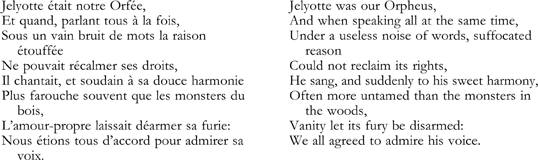
If Isis might be seen as one possible source of inspiration, Armide could be another. It is possible to make the case that much of Platée's character is based on that of Lully's sorceress-heroine Armide, and that Platée suffers from this comparison in much the same way Dionysus suffers from comparison with the hero Heracles. Instead of a magic kingdom, Platée rules over a swamp. Instead of commanding armies, she rules frogs and birds. The first suggestion of this comparison occurs in her first moments on the stage. When Platée emerges from her swamp, and in effect introduces herself to us, she sings an air that begins, ‘Que ce séjour est agréable’. We are immediately aware of her lack of grace, as the accents of the music fall on the wrong syllables, creating disjunction between music and text.Footnote 76 This line is a parody of a verse from the famous passacaille for dancers and orchestra with soloist and chorus in Act V of Armide. Footnote 77 Here are the three versions of this verse: Quinault's for Armide, the original verse of Autreau for Platée, and the revision made under Rameau's direction:

Although both Autreau and Rameau clearly reference Quinault's text, Rameau's substitution of ‘agréable’ for ‘tranquille’ arguably brings the text closer to the original so that this connection will not be missed. In highlighting the connection, Rameau enhanced Platée's comedy. Lully's original lines described a magic place created by Armide to indulge her love for Renaud, but, for Platée, this will be no magic kingdom. Nor will it prove a paradise for lovers as far as Platée is concerned, as she is quickly rejected by Cithéron, the first man she encounters. Further, she has just stepped out of her swamp, a dark and damp habitation, and anywhere else might seem ‘agréable’.Footnote 78
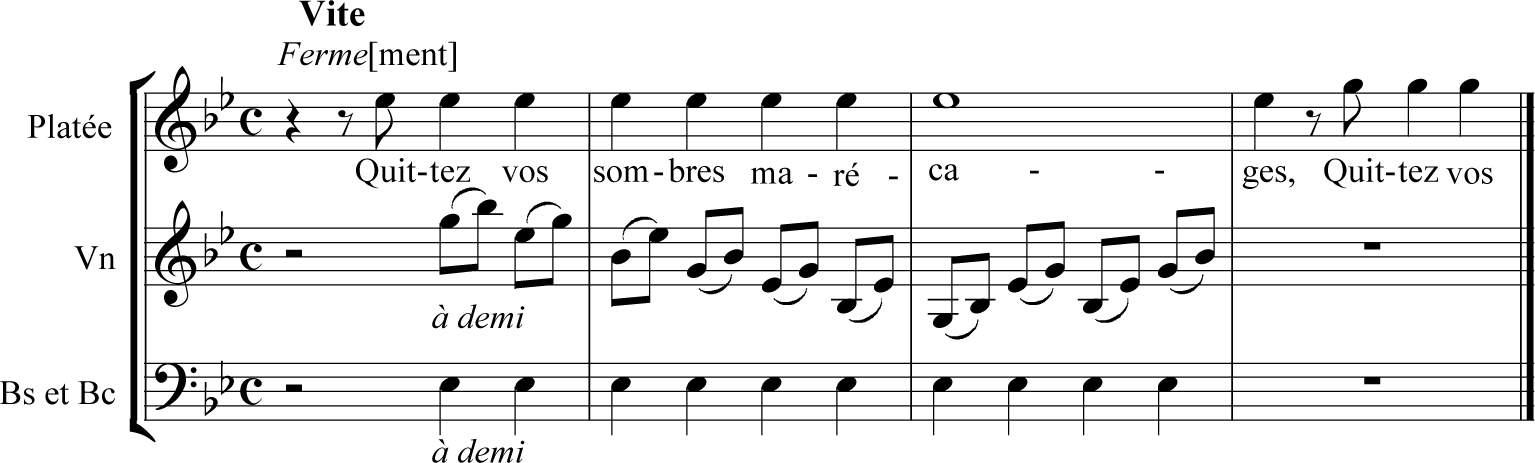
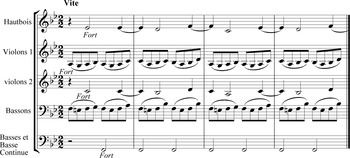
A series of references to the various conventions associated with the operas of Lully and Rameau follow in which they, like dramatic conventions in The Frogs, are refunctioned to trivialise them. Some allude to instances involving the presence of supernatural forces, or gods. Platée summons her subjects, frogs and birds, using a monotonal topic often described as oracular, and found in scenes where gods are called upon for divine assistance, or sorcerers summon spirits (Ex. 1).Footnote 79 It is supported by scurrying figures in the lower parts, depicting her subjects rushing to her side (Ex. 2). Textually, the passage references the ‘summons’ found in a number of operas. For example, at the beginning of Atys, Act I, Atys calls to the Phrygians to witness the descent of the goddess Cybele. Another example is Armide's summoning of the spirits of hate:

Platée, Act I, scene 3, bars 280–3
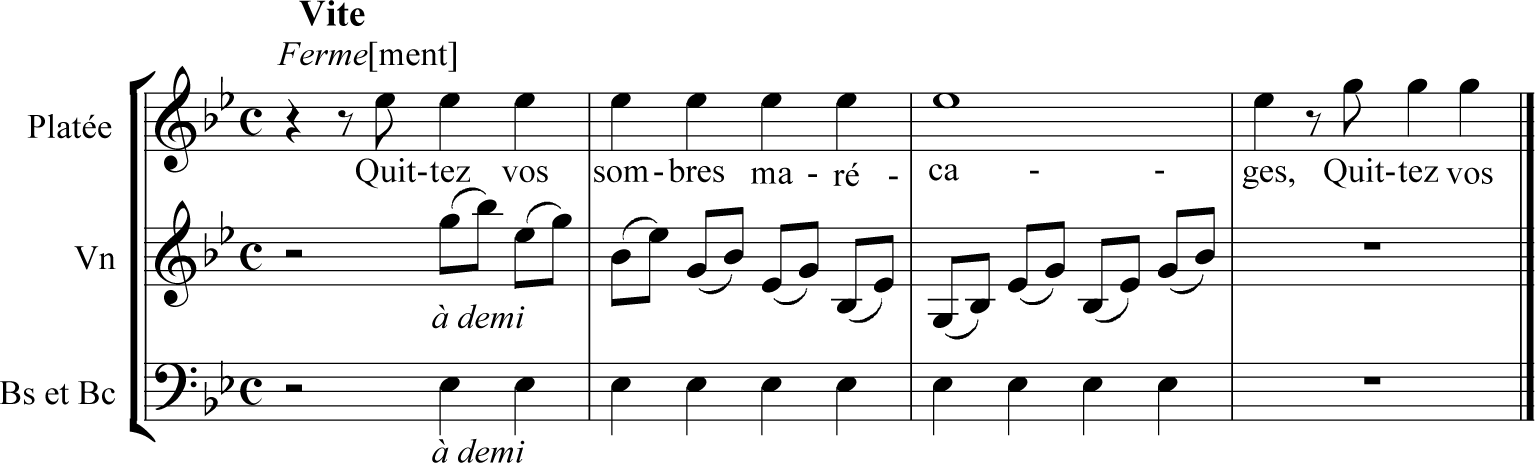
Platée, Act I, scene 3, bars 305–8

In each case, these summonses precede and prepare a momentous event, the arrival of Cybele (in Atys), or the appearance of the spirits of hate (in Armide). In Platée we hear the sound of her subjects, the birds and frogs, who sing a chorus glorifying their queen:

Girdlestone and Jacques Van Heuvel have both pointed out that this chorus resembles the Chorus of Troezens, who come together to welcome and praise the heroic king Thesée, home from the underworld in Rameau's Hippolyte et Aricie. Footnote 80 It is one of the most extensive and bombastic choruses in Rameau's stage works, criticised for its interruption of the action:Footnote 81

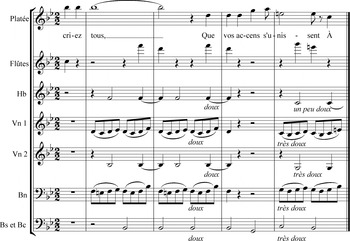
Both choruses proceed in fugal fashion, but the triumphal instrumental passages in Hippolyte are replaced by cuckoo calls in the flutes in Platée, while the animals continue to scurry around in the background (Ex. 3). The cuckoo has its own set of associations which are completely out of place in this context.Footnote 83
Platée, Act I scene 3, bars 315–19

Platée's rejection by Jupiter and her angry reaction provide a fitting finale to her Armide impersonation. Armide surrenders to her passion for the hero Renaud and to the delusion that he truly loves her, although he is under her spell. In the final act, when Renaud rejects her, she reacts with rage. As the palace disappears, Armide exits on a chariot pulled by dragons.

Like Armide, Platée has deluded herself into believing that Jupiter truly loves her. Her reaction to his deception, and to the part that Cithéron has played in it, is similar to that of Armide in her threats of vengeance employing supernatural powers. Armide has demonstrated that she has the power to be dangerous, and might still remain a formidable adversary, although she has failed to maintain Renaud's bewitched ardour through her magic. There is no evidence, on the other hand, that Platée has the capability to carry out her threats, so she appears laughable when she makes them: she is merely adopting the persona of a sorceress.
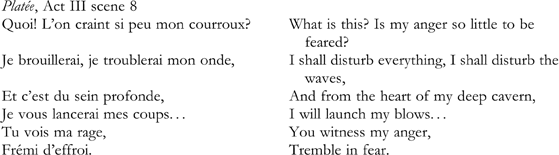
Instead of flying away in a chariot like Armide, she rushes into her swamp, accompanied by the mockery of the people, bringing the opera full circle. This exit had already been the subject of parody. In the opéra comique Armide, produced at the Nouveau Théâtre Italien on 21 March 1725, Renaud the hero flees followed by Armide's curses.Footnote 84 The stage directions then say, ‘The demons transformed into bailiffs and policemen, destroy the palace of Armide, and instead of departing in her flying chariot, as in the opera, she flies off in a sedan chair, and the play concludes.’Footnote 85
In Baron Grimm's 1753 essay, Le Petit prophète de Boehmischroda, the title narrator is magically transported to a French opera and observes an angry sorceress:
I saw a woman come striding in, and she came down to the front of the stage, and she frowned and shook her fists, and I judged that she was in a bad temper. And it seemed to me that she was making threats. And she had in her hand a wand which was mysterious, because the poet had said so, and by means of that wand she could do everything and know everything, except how to sing, which she did not know at all, although she thought she did. And I heard her utter frightful shrieks, and her veins became swollen and her face became as red as Tyrian purple … And with her voice which was off the pitch, she called up the dead, even though she put the living to flight.Footnote 86
Platée's curse scene caricatures the reactions of the audience, as well as those of the characters on stage. From the beginnings of opera, critics noted the genre's seductive power, the overwhelming effect on the listener being surrender to the emotions and a resulting inability to think clearly.Footnote 87 The result of this obsession was often the failure to separate reality from operatic fiction. The ensuing delusional behaviour was played out on stage on several occasions. Florian Carton Dancourt's play Renaud et Armide (1686) tells the story of an elderly widow Mme Jacquinet, who is enthralled with the opera Armide and acts it out in real life by falling for a young man, Clitandre, whom she refers to as her ‘Renaud’. Clitandre is in fact in love with her niece, but realises that Mme Jacquinet possesses the money he needs to further his military career, so he feeds her delusions by pretending to return her affections. When she discovers that she has been duped and abandoned by her Renaud, she reprises Armide's curse in the final scene of the play. The potential cruelty of this scene is mitigated by unattractive features in Mme Jacquinet's character and the absurdity of her delusion.Footnote 88 John Powell suggests that Mme Jacquinet's ‘opera obsession may well have been modelled after that of contemporaneous, real-life fanatics'.Footnote 89 The stage character who has delusions of being Armide may occur frequently enough to be described as a type.Footnote 90 Although Platée presumably has neither seen an opera nor is familiar with the character Armide, she behaves in much the same way as Mme Jacquinet, or, put another way, as an avid theatre-goer caught up in the emotions of the operatic world. The idea that she is a potential mate for Jupiter, who is of course already married to Juno, is as absurd as Mme Jacquinet's amorous interest in a young man – and the curse scene functions in Dancourt's play and in Platée similarly.
Aeschylus vs. Euripides
The Frogs provides the pre-eminent model for the exposition of critical literary commentary using the techniques of parody in the context of a comic stage work.Footnote 91 This factor may have contributed to Rameau's interest in the play. At the core of The Frogs is the debate between Aeschylus and Euripides over the relative merits of their tragedies. This confrontation has elements which are reflected both in Platée and in the tragédie lyrique more generally. Substantial elements which make up the debate between the two playwrights resonate with the discussions surrounding the operas of Rameau and Lully, which were carried on within the framework of the dispute between the Lullistes and the Ramistes. It is easy to imagine that Rameau recognised in Euripides’ contributions to Greek drama something of his own contribution to French opera, and Aeschylus’ role as the founder of Greek tragedy can be compared to that of Lully in the creation of the tragédie lyrique. Euripides presented his first play in 456/5 BC, the year of Aeschylus’ death, and thus was regarded as his successor.Footnote 92 Euripides goes on to credit himself with ‘introducing a rational, critical spirit into my drama’.Footnote 93 Rameau could easily identify with Euripides' characterisation of his contribution in that he regarded himself as a musical philosophe.Footnote 94 He established a theory of music that was as rational and systematic as those of the natural scientists of his period, and considered his work on a level with that of his intellectual contemporaries, such as Leonhard Euler (1707–83) and Daniel Bernoulli (1700–82), both noted mathematicians and physicists, with whom he corresponded.Footnote 95 Both Euripides and Rameau introduced considerably more music into their works than their predecessors, interfering, in the eyes of some, with the unfolding drama and the text itself.Footnote 96
Euripides leads off the debate by defending his work, characterising the tragedy he inherited as a sick patient.
as soon as I first took over the art from you, swollen as it was with bombast and overweight vocabulary, I began by reducing its swelling and removing its excess weight with a course of bite-size phrases, walking exercise and small white beets … then I fed it up again with a diet of arias.Footnote 97
The metaphor exploited by Euripides is much the same as that found in a work entitled Les spectacles malades by Alain-René Lesage (1668–1747), produced in 1729, in which he personified all the theatres of Paris as sick patients.Footnote 98 Asked by a doctor what medicines he has been taking, the opéra responds, ‘the rhubarb of Amadis, the true catholicon of Armide, with the preparation of Atys, the elixir of Proserpine, but these do not work any more’.Footnote 99 Like the plays of Aeschylus, Lully's operas were increasingly regarded as monumental and boring. Diderot suggested that there was a certain sameness to them.Footnote 100 Rameau may well be credited with breathing new life into French opera, as Euripides did for Greek tragedy.
Turning to Aeschylus, the parallel with Lully could be drawn on several grounds. The progressive dominance of romantic intrigue over heroism was a feature of the eighteenth-century musical stage, particularly in the opéra-ballet. Rameau's Les Indes galantes, which comprises four amorous episodes in exotic locations, is a prime example. The struggle between the demands of love (l'amour), or one's personal desires, and one's duty to the state to give battle and defeat enemies (la gloire) is the major conflict faced by French operatic heroes,Footnote 101 but the balance had shifted more in the direction of l'amour since Lully's time. The call to glory certainly had patriotic overtones, as the central duty of the nobility (and the justification for their privileges) was military service. While the love interest, at least in eighteenth-century terms, is absent from the plays of Aeschylus, the call to arms certainly plays an important role and is the justification for Aeschylus' eventual victory in the debate. In The Frogs Aeschylus boasts of the military virtues he glorified: ‘my art created many portraits of courage – of men like Patroclus or the lion-hearted Teucer – in the hope of inspiring every man in the citizen body to measure up to their standard every time he hears the trumpet’.Footnote 102 He then turns to the attack: ‘But Zeus, I never used to create trollops like Phaedra or Stheneboea; in fact no one can point to any instance, in any of my compositions, of a woman in love.’Footnote 103 While the comparison may be a bit less cut and dried, Rameau would probably have identified with Euripides' emphasis on the heroines of his plays rather than with the stark patriotism of Aeschylus, whereas Lully might have been more strongly linked to the latter.
Comedy and language
In the seventeenth and eighteenth centuries the livret was considered at least equal to, if not more important than, the music itself. The music and livret were often considered separately. Charles Collé gave faint praise to the music of Platée while criticising the text, ‘I will believe there is some magic in the composition of Rameau if the ballet succeeds: The words could not be more low class, silly, stupid, and dull than they are.’Footnote 104 Given the importance of language, what Platée says is as important as the music she sings or how she looks.Footnote 105 Her inappropriate speech would have grated on the ears of a French audience in a way equivalent to singing out of tune. The nature of her utterances provides a prime source for mockery and would have distanced her from an eighteenth-century audience which prided itself on the art of conversation.Footnote 106 Platée is, after all, the ruler of a ‘humide empire’ and as a member of the upper classes should know how to speak. When those expectations are not met, she invites humiliation.Footnote 107
An obvious example of her inability to respond appropriately occurs when Jupiter, in his most courtly manner, asks her, ‘Would you be insensitive to my tender wishes?’Footnote 108 All she can manage is, ‘Ouffe’, an exclamation akin to breaking wind. When Jupiter presses his case, ‘I offer you my vows of constancy. You have nothing to say?’ she manages, ‘Excuse me, I am suffocating.’Footnote 109 These scenes of courtly romance were often dramatic highpoints in the tragédie lyrique. Platée reduces them to triviality through inarticulate dialogue. Elsewhere she mispronounces words by changing their accents.Footnote 110
The axiom that characters should speak a language appropriate to their station (bienséance) plays a part in the debate between Aeschylus and Euripides. The latter attacks Aeschylus for his high-flown words in providing moral guidance for his audience: ‘Shouldn't your guidance have been given in the language of human beings?’Footnote 111 Aeschylus responds: ‘It is absolutely imperative, you wretched fool, when expressing great thoughts and ideas, to create words that measure up to them … it's only natural that the demigods should use words bigger than ours, just as they wear more splendid clothes than we do.’Footnote 112 In the following passages they dissect the prologues to each others’ tragedies word by word, destroying metaphors and pointing out redundancies.Footnote 113 These prologues are composed in the highest form of poetry and prepare the audience for what is to come. One means of attack is to insert meaningless phrases into high-flown speeches, rendering them trivial. To demonstrate the rigidness and interchangeability of stock phrases with the same metre, Aeschylus inserts a phrase dealing with an everyday object, the oil flask (equivalent to today's bar of soap), into Euripides’ high-flown poetry, thus trivialising it:
This type of bathetic parody begins early in the play, when Dionysus attempts to explain his fascination with Euripides by misquoting passages from the latter's plays, replacing one word with a mundane or everyday expression (for example, ‘the dwelling place of the gods’ becomes ‘the bedroom of the gods’).Footnote 115 The insertion of a word never used in the language of tragedy challenges the genre's solemnity and authority, characteristics which most often stood for the established order. The juxtaposition of the elevated language of tragedy with the mundane is a feature not only of Aristophanes but of many other comic writers as well.
While differing in the particulars, Platée's speech, like the debate in The Frogs, challenges the language of tragedy. Her everyday language, never used in tragedy, was regarded as vulgar and served to distance the audience from her and her eventual fate. The humour in these instances derives not only from the language itself, as spoken by Platée, but also from its juxtaposition with the higher style spoken by the other characters. If the other characters had engaged in the same language as the main character, the mockery of Platée would be almost pointless. This juxtaposition is deeply subversive in that Platée's language, by its very existence, challenges the effect of heightened speech in tragedy and the noble (and moral) values it represents. Through her language, she defines herself against tragedy, as all parody must.Footnote 116 It has, therefore, political overtones in the highly repressive society of eighteenth-century France, and, for this reason alone, Platée must pay a price.Footnote 117
Few eighteenth-century critiques of Platée discussed the origins of the work and its connections with Greek comedy, but one exception stands out. Elizabeth Bartlett cites passages from the memoirs of Edmond-Jean-François Barbier, no lover of this opera, and his handwritten remarks on his copy of the printed score: ‘There are beautiful musical passages, but the topic, though taken from Aristophanes, is ridiculous and bad.’Footnote 118 On the contrary, however, we might say that Rameau's choice of Dionysus, in his role as prime mover and object of mockery in Aristophanes' The Frogs, as a partial model for Platée, a character unique in opera, is one of his most original and inspired strokes.