Introduction
In Alzheimer's disease (AD), episodic memory is affected at the onset of the disease, particularly autobiographical memory. Indeed, AD patients have difficulties relating to personal memories, which are composed of many sensory and phenomenological details (Piolino, Reference Piolino2008). AD patients have few autobiographical memories (Rubin and Kozin, Reference Rubin and Kozin1984), which are formed earlier in life (particularly between 10 and 30 years) when the context of acquisition is particularly charged emotionally, and few flashbulb memories, which concern a public event when the context of acquisition is particularly unexpected, dramatic and charged emotionally (Brown and Kulik, Reference Brown and Kulik1977). When recalling a flashbulb memory, a normal subject can relate the exact circumstances in which he/she experienced the event. The contextual information is composed of the canonical dimensions: what, where, and when. AD patients especially fail to recall memories of public events and the situational and emotional context in which they were when they learned of those events. Conway et al. (Reference Conway1994) and Thomas-Antérion et al. (Reference Thomas-Antérion, Borg, Vioux and Laurent2010) showed that the creation of a flashbulb memory is associated with the emphasis placed on the event and the level of emotional response the event generates. Studies (e.g. Amieva et al., Reference Amieva2008) have shown semantic impairment, with precursors appearing at least ten years before diagnosis. Implicit memory is relatively preserved. Musical memory is considered to be spared, at least at the beginning of the disease. It tends to mediate behavior, especially in the case of anxiety and depression, even at the mild to moderate stages of the disease (Guétin et al., Reference Guétin2009).
The first studies of musical processing were conducted by Kimura (Reference Kimura1961), who distinguished language from musical processing and localized the latter in the right hemisphere of the brain. According to Gosselin et al. (Reference Gosselin, Peretz, Clément, Dalla Bella, Lechevalier, Platel and Eustache2006), several auditory recognition systems specialize in processing different kinds of stimuli. Right hemispheric damage leads to an impairment of the perception of melodic contour, that is to say, the inability to detect a change in the direction of the frequency of successive notes. Right or left hemispheric damage can induce a deficit in the processing of intervals, that is, the incapacity to detect a difference in frequency between two notes (Peretz, Reference Peretz1990). The superior temporal area is involved in music recognition (Liégeois-Chauvel et al., Reference Liégeois-Chauvel, Peretz, Babai, Laguitton and Chauvel1998), which proceeds through several stages. First comes the perceptual stage, when musical information is processed according to its melodic and temporal organization. The melodic organization stage processes information concerning the melodic contour (the notes’ directions), intervals (difference in frequency between two notes) and tonality (scale) (Peretz, Reference Peretz, McAdams and Bigand1993). Then, during the memory stage, the processed musical information is transferred to the melodic memory store.
The recognition of words also contributes to the recognition of a popular song. According to Samson and Zatorre (Reference Samson and Zatorre1991), word processing occurs in the left temporal lobe. Crowder et al. (Reference Crowder, Serafine and Repp1990) showed that melody and words are integrated in memory. Indeed, recognition is better when melody and words are combined in a single stimulus. We can distinguish two processes affecting long-term musical memory: semantic musical memory, which deals with the ability to identify well-known musical extracts, and episodic musical memory, which is linked to contextual information that can be associated with melodic representations during their acquisition (Platel, Reference Platel, Lechevalier, Platel and Eustache2006b). Platel et al. (Reference Platel, Baron, Desgranges, Bernard and Eustache2003) showed that episodic tasks activate medial and superior frontal areas and the precuneus bilaterally, although there are more activations in the right hemisphere. Semantic tasks activate bilateral medial frontal areas and the angular gyrus and middle and superior temporal gyri in the left hemisphere.
Music is often used in therapy for AD. Thompson et al. (Reference Thompson, Moulin, Hayre and Jones2005) reported that music has a positive effect on category fluency. These authors showed that exposure to music, enhances cognitive performance. Raglio et al. (Reference Raglio2008) found that specific behavioral and psychological symptoms, such as delusions, agitation, anxiety, apathy, irritability, aberrant motor activity, and night-time disturbances, are significantly improved with music therapy. Chang et al. (Reference Chang, Huang, Lin and Lin2009) showed that music is able to reduce the degree of problem behaviors, which helps nurses in institutions. Sacks (Reference Sacks2009) reported that music therapy can implicitly stimulate autobiographical memory. Guétin et al. (Reference Guétin2009) showed that music therapy has a valuable effect on behavior, especially in anxiety and depression. Simmons-Stern et al. (Reference Simmons-Stern, Budson and Ally2010) pointed out that music could heighten arousal in patients with AD, allowing for better attention and improved memory. Sung et al. (Reference Sung, Chang and Lee2010) found that listening to favorite music had a positive impact on AD patients with dementia by reducing their level of anxiety. Familiarity seems to be preserved in AD, even in the later stages, but verbal identification is altered (Bartlett et al., Reference Bartlett, Halpern and Dowling1995), and results depend on the progression of the AD. These studies also emphasized that AD patients have worse episodic memory performance than healthy elderly people. Concerning autobiographical retrieval in AD, Foster and Valentine (Reference Foster and Valentine2001) submitted an autobiographical questionnaire to 23 patients in four situations (silence, noisy cafeteria, familiar music, and unfamiliar music). Performance was better with a musical background, whether familiar or unfamiliar.
Episodic memory is deeply affected in the early stages of AD. Nevertheless, it has been shown that music can give access to some autobiographical memories which have not emerged spontaneously, particularly in music therapy or testing in a musical environment. There is a real improvement in performance on autobiographical memory tasks (Foster and Valentine, Reference Foster and Valentine1998; Reference Foster and Valentine2001). This emphasizes that musical memory has a specific status or that musical clues are less vulnerable than others and/or more closely related to autobiographical memories.
Listening to music, particularly to popular songs, can improve the ability to recall autobiographical events. In their study, Janata et al. (Reference Janata, Tomic and Rakowski2007) indicated that excerpts of popular music serve as potent stimuli for studying the structure of autobiographical memories. Schulkind et al. (Reference Schulkind, Hennis and Rubin1999) showed the link between music, emotion, and autobiographical memory.
By using neuroimaging, Janata (Reference Janata2009) reinforced the view that a neural substrate associating music, emotions, and some memories is preserved in AD: the medial prefrontal cortex may support self-referential processes, including the retrieval of autobiographical information. The results of his study suggested that the dorsal medial prefrontal cortex associates music and memories when emotionally salient episodic memories are experienced. Ford et al. (Reference Ford, Addis and Giovanello2011) identified activity in specific regions such as the ventromedial prefrontal cortex, posterior cingulate, and right medial temporal lobe during searches for specific and general autobiographical memories elicited by musical cues.
In this paper, we will concentrate, on the one hand, on AD patients’ memories for popular songs, and on the other hand, on their ability to recall personal memories directly related to a musical cue. Our study was designed to check the preservation of musical memory and to show that popular songs can efficiently aid reminiscence in AD. Thus, we examined different musical memory systems (melodic, semantic, and autobiographical) for popular songs with the POP 10, which we developed specifically to carry out this study. We hypothesized that melodic memory would to be preserved for AD patients. We further hypothesized that AD patients’ performance would be significantly impaired on the semantic knowledge subtest and they would be able to recall vivid memories, but less than control subjects.
Method
Subjects
All the participants were born in France. None of them had specific musical knowledge but all of them like popular songs, listened regular music in their life, and were able to sing accurately (questionnaire carried out). Individuals were excluded if they had a history of cerebrovascular accident or psychiatric illness. All the subjects were living at home, came from the same geographic region and had been exposed to the same media in recent years.
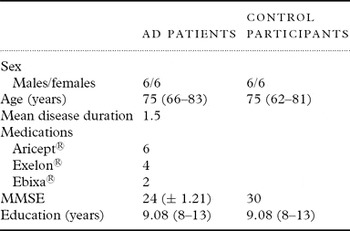
The AD group was recruited from the memory unit of a French university hospital. This group included 12 individuals, 6 females and 6 males, between the ages of 66 and 83 years (mean age = 75.83, SD = 5.41). . All these people were evaluated using standard neurological and neuropsychological test procedures and they were diagnosed as suffering from AD, according to the Diagnostic and Statistical Manual of Mental Disorders (DSM-IV, 1994), the National Institute of Neurological and Communicative Disorders and Stroke and the Alzheimer's Disease and Related Disorders Association criteria (McKhann et al., Reference McKhann, Drachman, Folstein, Price and Stadlan1984). AD patients were required to be in the mild stage of the disease, as assessed by scores on the Mini-Mental State Examination (MMSE) (Folstein et al., Reference Folstein, Folstein and McHugh1975). The AD patients’ mean score on the MMSE was 24 (SD = 1.21) and a neuropsychological assessment was clearly established by a complete neuropsychological evaluation (standard tests of episodic memory, executive functions, and language). Concerning amnesia, all patients had classical amnesic AD with pattern of lost of episodic memory in tests. We did not explore autobiographical assessment with classical task or interview to limit interferences with original paradigm. We only controlled with their family using a list of ten questions that patients very often forget past and recent family's events as reported in literature. The demographic and clinical characteristics of the AD patients are presented in Table 1.
Demographic and clinical characteristics of AD patients and control participants

Abbreviation: AD: Alzheimer's disease.
Twelve healthy volunteers (6 females and 6 males) who ranged in age from 62 to 81 (mean age = 75.58, SD = 5.33) comprised the control group. These control participants were free from neuropsychological dysfunctioning. Mild cognitive impairment persons were excluded. The two groups did not differ significantly in terms of sex, age, and years of education. The demographic and clinical characteristics of the control group are presented in Table 1.
Material
To carry out this study, we created the POP 10, an evaluation of the memory for ten popular songs in AD (ten popular songs), inspired by the EVE 30 and TOP 30, which evaluate memory for public events and famous faces (Thomas-Antérion et al., Reference Thomas-Antérion, Collomb, Borg and Laurent2006; Thomas-Antérion and Puel, Reference Thomas-Antérion and Puel2006) and a book about popular songs entitled: “La grande anthologie de la chanson française” (Saka, Reference Saka2001). . With the POP 10, melodic, semantic and autobiographical memories can be evaluated.
selection of songs
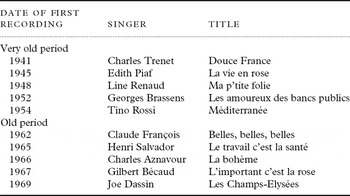
We selected ten well-known songs that met several criteria: the period (1940s–1950s: five very old songs from when the participants were young; 1960s: five old songs from when the participants were adults); their universal characteristics (the songs must be familiar to all the participants, so elitist songs, for example, were not selected); their lyrics (it was assumed that the participants would easily be able to give the words of the chorus and of the first verse; moreover, the title of the song should only occur in the chorus, or it would be too easy to recognize the words of the verse in a recognition test); their structure (it should be standard, with a verse and a chorus, which can be easily distinguished); their interpreters (we avoided selecting songs that have been sung by several interpreters in order to avoid a frequency effect). We selected ten songs respecting these criteria that date from between 1941 and 1969 (Table 2). Regarding pilot testing of the instrument, volunteers with above-average education, average education and underaverage education levels participated to a pretesting of the instrument.
The French songs in the POP 10

Then, concerning the evaluation, we used a questionnaire to be sure that all of participants had listened these well-known songs for the first time at the same period, as we wanted to evaluate the first learning of song, as it is possible.
subtests strategy
We chose to explore melodic, semantic, and episodic musical memory. First, we evaluated memory for the melody and words of songs by evocation and by recognition. Then, we explored semantic knowledge in relation to interpreters. Lastly, we evaluated autobiographical memory.
For each song, the subjects had to carry out four subtests: evocation, recognition, semantic knowledge, and autobiographical recall. Concerning the evocation of melody, subjects were asked: “I'm going to give you the title of a song you certainly know: (title). Can you hum the chorus without singing the words of the song?” This instruction, proposed to encourage patient as this kind of evaluation is rather difficult, may not induce suggestibility as a questionnaire was realized to select participants. The titles of the target song were always present under the eyes of the participants. To evoke words, subjects were asked: “Now, can you give me the words of the chorus without singing it?”
The recognition subtest was also composed of two questions. We aimed to see whether the participant could recognize the chorus of the song being hummed among two lures. We asked: “You're going to hear three melodies. Listen to them carefully, because after that, I'm going to ask you which one corresponds to the song I gave you the title of.” We composed these lures so that they resembled the selected songs either in their morphology (similarities at the level of the tune contour) or in their melody (similarities between notes but differences in the contour). Then we assessed the ability to recognize the verse of the song, also with two lures: “You're going to hear three verses without music. You have to say which one corresponds to the right song.” The lures were selected based on their semantic proximity, and more rarely phonological proximity, among songs sung by the same interpreter, in the same period and on the same topic as the target song. To create the lures, we used Audacity® software. They were interpreted by the same female voice, which did not alter subjects’ ability to identify the target melody, as revealed by Peretz (Reference Peretz, McAdams and Bigand1993) in her Music Recognition System model (perceptual level).
The semantic knowledge subtest explored the participant's knowledge of the interpreter with four questions: firstly we asked about his/her gender, secondly his/her name, then there was a general knowledge question and finally the participant was asked to identify another song by the interpreter presented along with two lures, which were real songs: one was the title of a song that was phonologically or semantically similar to the target song and the other one was a song interpreted by a singer of the same musical type and of the same period.
The autobiographical recall subtest explored the participant's ability to call to mind an autobiographical memory about the song: “Can you remember a particular detail related to this song?” In relation to the interpreter, we asked: “Can you call to mind some specific event in your life associated with this interpreter?” We asked for several specific recollections, namely, four canonical dimensions: “where was it,” “when was it,” “how did you feel,” and “what were you doing at that moment?”
Procedure
All the AD patients were informed that they were taking part in a survey about collective memory. They were given the POP 10 in an office of the Memory Unit. The control participants were evaluated at home.
Each subject was alone for this evaluation, seated comfortably, with no visible cues such as music or pictures of singers. The evaluation lasted about one hour. We recorded each evaluation.
Scoring
The POP 10 is composed of ten songs. The maximum score is 26 for each song, so the maximum total score is 260 points. The following criteria were used for the scoring: melodic free recall (2 points for the chorus melody, 1 point for a partial answer, and 0 points for no recall or no recognition of the melody); chorus free recall (the same scoring, that is to say, 2, 1, or 0); melodic recognition (1 point for recognizing the melody, 0 for not recognizing it or for choosing a lure melody); chorus recognition (1 point for recognizing the verse, 0 for not recognizing it or for choosing a lure verse); semantic knowledge (1 point for each correct answer, 0 in case of no answer or an incorrect answer); autobiographical recall about the song (2 points for a vivid memory, 0 for no recall; the scoring of each canonical dimension is 1.5; this subtest can have a maximum score of 2 + (4*1.5) = 8); autobiographical recall in relation to the interpreter (2 points for a vivid memory, and 0 for no recall; the scoring of each canonical dimension is 1.5; this subtest can also have a maximum score of 8).
Results
We used non-parametric tests due to the small size of our samples and because their distribution did not follow the normal distribution. We followed a plan consisting of two variables: the between-subjects variable was group (AD vs. NC) and the within-subjects variable was subtest (melodic free recall, chorus free recall, melodic recognition, chorus recognition, semantic knowledge, autobiographical recall about the song, and autobiographical recall in relation to the interpreter). We used the M–W test to compare the groups. In addition, we used the Friedman test (Fm) as well as the a posteriori Wilcoxon test (Wx) to compare subtests for each group.
Previously, we investigated the effect of the time period of the songs (very old for the songs written from 1941 to 1954 and old for the songs written from 1962 to 1969) but we found no significant effect.
Comparisons for all subtests
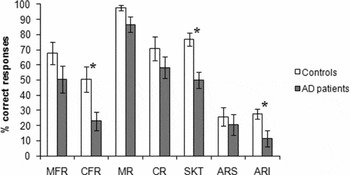
The M–W test revealed significant differences between groups for the subtests of chorus free recall (z = −2.37, p = .01), semantic knowledge (z = −2.37, p = .01) and autobiographical recall in relation to the interpreter (z = −2.80, p = .005); for each subtest, the AD patients were less accurate than the healthy controls. However, AD patients did not differ significantly from the controls on the subtests of melodic recognition, chorus recognition, autobiographical recall about the song and melodic free recall. This pattern of results is illustrated in Figure 1.
Results of AD patients and controls for POP 10 subtests. Abbreviations: MFR, melodic free recall; CFR, chorus free recall; MR, melodic recognition; CR, chorus recognition; SKT, semantic knowledge total; ARS, autobiographical recall about the song; ARI, autobiographical recall in relation to the interpreter.

We also contrasted the subtests for each group. The Fm test was performed and the results showed a difference between the subtests for control participants (χ2(6) = 53.25, p = 0.001) and AD patients (χ2(6) = 55.12, p = 0.001). A post hoc comparison with the Wx test showed that control participants were more efficient at recalling a melody than at recalling semantic knowledge (z = 2.80, p = 0.005). By contrast, there was no difference between the free recall of autobiographical knowledge specific to the song and to the interpreter. The AD group's performance was better for the melodic free recall than for the semantic free recall (z = 2.75, p = 0.006). Similarly, they were better at the melodic recognition task than the chorus recognition task (z = 3.06, p = 0.002). By contrast, there was no difference between the free recall of autobiographical knowledge specific to the song and to the interpreter.
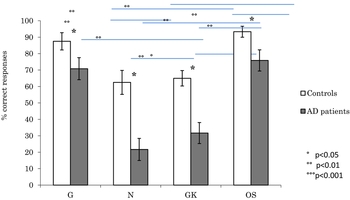
We conducted a more qualitative analysis on the intersubject effect with regard to the semantic knowledge subtest including four modalities. Differences appeared between AD patients and healthy controls for each subtest, with poorer performance by the AD patients for the interpreter's gender (z = −2.07, p = 0.04), for the interpreter's name (z = −3.26, p = 0.001), for general knowledge (z = −3.23, p = 0.001), and for other songs (z = −2.69, p = 0.01). The results of the AD and control participants on semantic knowledge are shown in Figure 2.
Performance of AD patients and controls on the four questions of the semantic knowledge subtest. Abbreviations: G, gender of the interpreter; N, name of the interpreter; GK, general knowledge; OS, other songs.

In addition, the analysis with the Fm test revealed a significant effect for control participants (χ2(3) = 23.91, p = 0.0003) and AD patients (χ2(3) = 29.15, p = 0.0001). For the control group specifically, significant differences were shown between the subtests relating to the gender and the name of the interpreter (z = 2.80, p = 0.005), the gender of the interpreter and general knowledge (z = 2.57, p = 0.009), general knowledge and other songs (z = 3.06, p = 0.002), and the name of the interpreter and other songs (z = 2.80, p = 0.005). But no significant difference appeared between the subtests relating to the interpreter's gender and other songs (z = 1.42, p = 0.155) and between general knowledge and the interpreter's name (z = 0.41, p = 0.683). In the AD patients, the same significant differences were revealed: gender of the interpreter and name of the interpreter (z = 3.05, p = 0.002), gender of the interpreter and general knowledge (z = 2.90, p = 0.003), general knowledge and other songs (z = 3.05, p = 0.002), and name of the interpreter and other songs (z = 3.05, p = 0.002). A significant difference was also revealed between the subtests relating to the name of the interpreter and general knowledge (z = 1.96, p = 0.05), but no difference was found between the subtest relating to the interpreter's gender and other songs.
Autobiographical memories
Concerning autobiographical recall, the results on the subtests showed no significant difference between AD patients and controls. Both groups produced more recollections of youth and adult life, F (2,44) = 4.45, p = 0.01.
As for autobiographical recall about the songs, control participants produced memories related to 26% of the songs, against 21% for AD patients. We did not find a significant difference between the two groups. In fact, we found that AD patients were able to recall vivid memories, with several canonical dimensions: details of the event, when and where it occurred, and the emotions experienced. For example, for the song “Les Champs Elysées,” a patient recalled a walk on the Champs Elysées with his wife: “It was in 1941. I was feeling very happy.” For the same song, a control participant recalled a meeting of support for Jacques Chirac, the French president at the time, who was visiting his town; he remembered being very excited. Concerning autobiographical recall about the interpreters, control participants responded to 28% of instances, against only 11% for AD patients. AD patients produced fewer autobiographical memories about the interpreter but could evoke the four canonical dimensions: details, when, where, and emotion. Moreover, their autobiographical memories did not concern the same interpreters as those mentioned by the control participants. Claude François, Tino Rossi, and Georges Brassens were the singers recalled most often by control participants. For example, one of them recalled an argument with a friend about Claude François; the friend loved this singer, whereas he hated him and felt very angry. AD patients recalled Line Renaud, Charles Aznavour, and Charles Trenet most often. For example, one patient recalled a concert by Charles Trenet he attended with his wife; it was in 1962 and he was very moved to see him.
Correlation analyses
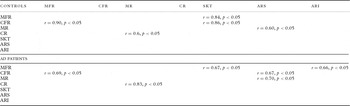
The Spearman analysis revealed correlations for the controls and for the AD patients. They are shown in Table 3.
Correlations for the controls and for AD patients

Abbreviations: MFR, melodic free recall; CFR, chorus free recall; MR, melodic recognition; CR, chorus recognition; SKT, semantic knowledge total; ARS, autobiographical recall about the song; ARI, autobiographical recall in relation to the interpreter.
Regarding recall strategies, half of the controls used the words of a song to find the melody, and 9 of the 12 did not use any strategy when they had to recall the words of the song. All but one AD patient often used the words of a song to find the melody. On the other hand, they could find the words of the song more easily without using a melodic strategy.
Discussion
Clinical studies have highlighted the favorable role of music therapy in the management of AD (Koger, Chapin, and Brotons, Reference Koger, Chapin and Brotons1999; Lou, Reference Lou2001; Guétin et al., Reference Guétin2009). Receptive music therapy is one such therapy. We can distinguish between music used to aid relaxation and music used as a medium for analytical psychotherapy. This method is able to reduce the frequency and extent of affective and psychological/behavioral disorders.
Similarly, Irish et al. (Reference Irish2006) observed considerable improvements in autobiographical recall on the Autobiographical Memory Interview (Kopelman et al., Reference Kopelman, Wilson and Baddeley1989) when the interview was accompanied by music (Vivaldi's Four Seasons) as opposed to without music. Music may encourage autobiographical memory recall but also cognitive performance in category fluency (Thompson et al., Reference Thompson, Moulin, Hayre and Jones2005). This study suggests that music improves not only memory access but also speech content and fluency.
The most beneficial responses to listening to music are elicited when older adults listen to music that is familiar, pleasant, and meaningful to them (Lee et al., Reference Lee, Henderson and Shum2004). Popular music from their own country was frequently the favorite type of music, as assessed by patients or family members or formal caregivers in a recent study (Sung et al., Reference Sung, Chang and Lee2010). Lord and Garner (Reference Lord and Garner1993) reported that exposure to big band music produced long-lasting positive benefits for social activity and mood. As well, AD patients had a higher recall of past personal history than control AD patients who had performed puzzles or drawing tasks.
Listening to music, in particular popular songs, can stimulate memory by evoking autobiographical events. The aim of this study was to explore the recall of popular songs in AD. The first and most important result of this study is that melodic memory seems to be spared in early-stage AD. The AD patients’ melodic free recall and recognition performance did not show any significant difference from that of controls. This is similar to the language/music distinction established by Kimura (Reference Kimura1961) and Gosselin et al. (Reference Gosselin, Peretz, Clément, Dalla Bella, Lechevalier, Platel and Eustache2006). Melodic memory is preserved in recall tasks, whereas recall in several visual or verbal tasks is affected at the onset of AD. Ten of the 12 AD patients used a specific strategy (words of the song) to find the melody, but only 6 controls did this. The association of melody/words is stronger than each isolated component, as Crowder et al. (Reference Crowder, Serafine and Repp1990) observed about the combined integration of melody and words in memory. This task is very easy and controls did not need this strategy so much, but the AD patients benefited from using it. The preservation of melodic memory may be due to the particular way in which popular melody is encoded. Indeed, a “hit” is heard very often and its many years as a successful song create a timeless effect. This repeated encoding certainly enforces the consolidation of the melodic information. On the topic of semantic and melodic memory, Platel (Reference Platel2006a) explains that AD patients in the early stages are still able to identify the melody of a popular song. If we distinguish non-verbal representations of music from verbal ones, these results show that non-verbal representations of music are still preserved at the onset of AD. They exist in the form of an independent musical memory that is resistant to time, at least at the beginning of AD. These results suggest that popular songs could be very useful for music intervention (Lee et al., Reference Lee, Henderson and Shum2004; Sung et al., Reference Sung, Chang and Lee2010) because patients retain at least some of their melodic elements.
Chorus free recall was impaired in the AD group. Moreover, the chorus free recall was the subtest that both groups most frequently failed. We noted that only six AD participants used a melodic strategy. They often used words, which are affected by the disease, to find the melody, whereas melody seemed to be less helpful in evoking words. This may be explained by the fact that this subtest was carried out just after the melodic free recall subtest. As AD patients often used a specific strategy to answer (words of the song), a previous full and complete reminder, that is to say, the melody associated with the words, could occur. It could also be explained by the fact that a successful melodic evocation helps semantic memory. The responses to chorus recognition are weaker than those to the melodic recognition subtest. Verbal memory for songs is weaker than melodic memory during aging. But there was no significant difference between the performance of the control group and the AD patients. This result is in accordance with studies demonstrating that implicit memory is preserved in AD (Baird and Samson, Reference Baird and Samson2009). It distinguishes POP 10 from other tests of collective memory. In fact, in the EVE 30 (and EVE 10) and TOP 30 (and TOP 10), we showed that the recognition of public events (e.g. the first man on the moon) and celebrities (e.g. identification of Marilyn Monroe) is altered rather early in AD and is already slightly affected in mild cognitive impairment (Thomas-Antérion and Puel, Reference Thomas-Antérion and Puel2006; Thomas-Antérion et al., Reference Thomas-Antérion, Collomb, Borg, Nevers and Laurent2007).
AD patients’ performance was significantly impaired on the semantic knowledge subtest. This is in accordance with studies like that of Amieva et al. (Reference Amieva2008 observed a considerable deficit of semantic memory at the early stages of the AD before dementia. Collective memory seems to be altered at the onset of the disease (Thomas-Antérion and Puel, Reference Thomas-Antérion and Puel2006; Thomas-Antérion et al., Reference Thomas-Antérion, Collomb, Borg, Nevers and Laurent2007). The AD patients’ results were sometimes three times worse than those of the control group but they had the same pattern. Naming the interpreter was the hardest task. This result reinforces studies specifying an access deficit for proper nouns in AD and the difficulty of this task even for healthy elderly people (Wilson et al., Reference Wilson, Kasniak and Fox1981). The gender of the interpreter was easier to find than the name. This process is called the “tip-of-the-tongue” phenomenon (Delazer et al., Reference Delazer, Semenza, Rener, Hofer and Benke2003), that is, identifying a person is possible but naming that person is quite impossible. Moreover, as Valentine et al. (Reference Valentine, Brennen and Brédart1996) explain, a person who is famous for his/her name or face is first identified by his/her job, then by semantic knowledge (dead or alive, gender, and nationality). Access to the name comes later. Performance on the other songs subtest was the most successful, which is consistent with the studies specifying preservation of implicit memory in AD (Baird and Samson, Reference Baird and Samson2009). All these results confirm that there is no specific semantic preservation for popular songs.
Furthermore, the correlation analysis showed that performance on the semantic knowledge subtest was correlated with the accuracy of chorus and melodic recall in the control group. The better the controls remembered popular songs (music and text), the more things they knew about the song or the interpreter. In AD patients, semantic knowledge performance was only correlated with preserved melodic evocation.
Several studies (e.g. Foster and Valentine Reference Foster and Valentine1998; Reference Foster and Valentine2001) have shown that autobiographical memories are retrieved better after listening to a piece of music. Foster and Valentine (Reference Foster and Valentine1998) propose that the observed improvement is due to reduced anxiety or increased arousal. In our study concerning the autobiographical recall generated by a song, we found no significant difference between patients and controls. Both groups were able to remember autobiographical episodic memories after listening to a song and answering a few questions concerning melody, chorus, and knowledge. In this study, the POP 10 songs were able to trigger vivid memories based on the inclusion of familiar popular songs without control materials or regard for personal music preferences. The AD patients were able to recall vivid memories with several canonical cues: details of the event, when and where it occurred, and emotions experienced. Patients, like control subjects, could remember memories both from earlier in their life and from recent periods. This is a surprising result because vivid memories are particularly altered in AD; thus, it seems to confirm the experience of music therapy and nurses’ observations in nursing homes after music activities (or only passive listening). So using popular songs could be a good way of inducing reminiscence in AD, especially if it is possible to choose the patients’ favorite music before intervention (Guétin et al., Reference Guétin2009; Sung et al., Reference Sung, Chang and Lee2010). This result is consistent with the work of Foster and Valentine (Reference Foster and Valentine2001), specifying that even though persons with AD have difficulties accessing their autobiographical memories, they are still able to recall vivid memories with the help of a song's contextual information. In the absence of control autobiographical assessment in “silence” – but after interview with caregiver confirmed lost of past and recent family's events – we have to qualify these results even if autobiographical is the most often previously impaired in AD.
Lastly, our study showed a significant difference between the generation of autobiographical memories by songs (melody and lyrics) and by interpreter. For the control group, both procedures produced the same percentage of recall, but AD patients produced fewer responses with this paradigm than in the public event memories task (Thomas-Antérion and Puel, Reference Thomas-Antérion and Puel2006; Thomas-Antérion et al., Reference Thomas-Antérion, Collomb, Borg, Nevers and Laurent2007). These results can be explained by the fact that a song (particularly the melody) does not leave the same trace in memory as the interpreter does.
Evoking an autobiographical memory about the interpreter, involving personal events, is called a flashbulb memory: for example, participants were able to relate in exact detail when they had learned of a singer's death. One participant, for instance, recalled the death of a friend just after the death of Claude François. He remembered where he was and who he was with. Moreover, participants’ memories were particularly accurate when the celebrity had died tragically. This observation is consistent with studies of flashbulb memories (Thomas-Antérion and Puel, Reference Thomas-Antérion and Puel2006).
In conclusion, in our study, musical semantic knowledge of a popular song seems to be relatively well preserved in AD patients in the mild or moderate stages and seems to be associated with relatively preserved capacity of access to autobiographical memories. These results suggest that music can enhance cognitive performance and can be used for reminiscence therapy.
Conflict of interest
None.
Description of authors’ roles
C. Thomas-Antérion and S. Basaglia-Pappas designed the study, supervised the data collection and wrote the paper. M. Laterza collected the data. E. Favre and A. Richard-Mornas assisted with writing the paper. C. Borg was responsible for the statistical design of the study and for carrying out the statistical analysis.
Acknowledgments
This research was carried out in the Memory Unit of Saint Etienne, France. We are grateful to all the individuals who volunteered to participate in this study and kindly gave of their time. We are also grateful to the English persons who proofread the manuscript.