INTRODUCTION
Human communication requires processing of relevant social information beyond the information given in a signal. This is perhaps most apparent in infants' deictic gestural communication, like pointing, where sender and recipient have to work together to express and figure out a meaning of the otherwise ambiguous attention-directing act. Most evidence on infants' meaningful comprehension and production of pointing comes from experiments which have systematically manipulated the preceding shared action contexts and joint attentional scenes, revealing that infants interpret and use pointing in different ways, depending on the relevant socially shared situations. In this view, infants express several layers of intentionality when pointing, including communicative, referential, and social intentions (Tomasello, Carpenter, & Liszkowski, Reference Tomasello, Carpenter and Liszkowski2007). Following Bates, Camaioni, and Volterra (Reference Bates, Camaioni and Volterra1975), who distinguished imperative and declarative performatives, subsequent experimental manipulations established different social intentions, revealing that 12-month-old infants point imperatively to request help in retrieving an object that is out of reach, inaccessible, or perceptually absent (requestive pointing; e.g., Carpenter, Nagell, & Tomasello, Reference Carpenter, Nagell and Tomasello1998; Camaioni, Perucchini, Bellagamba, & Colonnesi, Reference Camaioni, Perucchini, Bellagamba and Colonnesi2004; Liszkowski, Schäfer, Carpenter, & Tomasello, Reference Liszkowski, Schäfer, Carpenter and Tomasello2009), and declaratively to express their interest in events (expressive pointing; Camaioni et al., Reference Camaioni, Perucchini, Bellagamba and Colonnesi2004; Liszkowski, Carpenter, Henning, Striano, & Tomasello, Reference Liszkowski, Carpenter, Henning, Striano and Tomasello2004; Liszkowski, Carpenter, & Tomasello, Reference Liszkowski, Carpenter, Striano and Tomasello2007; Liebal, Carpenter, & Tomasello, Reference Liebal, Carpenter and Tomasello2010), or to help others by providing them with needed information (informative pointing; Liszkowski, Carpenter, Striano, & Tomasello, Reference Liszkowski, Carpenter, Striano and Tomasello2006; Liszkowski, Albrecht, Carpenter, & Tomasello, Reference Liszkowski, Albrecht, Carpenter and Tomasello2008; Knudsen & Liszkowski, Reference Knudsen and Liszkowski2012).
An important communication skill to effectively use points and instigate relevant inferences is thus to situate one's act appropriately within a social context. In addition to situating communicative acts in context, another source of information about underlying social intentions can derive from behaviors that are produced along with a communicative act, and which mark its underlying intentions concurrently and perhaps more directly. This may be especially useful in novel, less routinized situations, which do not easily lend themselves to distinguishing meaning sufficiently. Infants' communicative competencies increase rapidly over the first year of life, and one possibility is that when infants point they do not only situate the act appropriately in the right contexts, but also express their social intentions in a more direct manner through accompanying behavioral characteristics, like hand shapes and vocalizations. If this was the case, it would not only support claims of different social intentions underlying pointing; it would also relativize conceptualizations of pointing as fully ambiguous and interpretable only on the backdrop of shared preceding action contexts. Unraveling the various cues to prelinguistic meaning is an important endeavor in understanding the origins of human communication and social cognition.
Different functions of infants' whole-hand and index-finger points have been suggested by Franco and Butterworth (Reference Franco and Butterworth1996). In that and in subsequent studies, however, hand shape and distance to referent were usually confounded, so that it has remained unclear whether differences in infants' pointing hand shapes are possibly caused by distance (i.e., proximal reaching). Infants also frequently accompany their pointing with vocalizations (Franco & Butterworth, Reference Franco and Butterworth1996; Liszkowski & Tomasello, Reference Liszkowski and Tomasello2011). Experimental evidence shows that these accompanying vocalizations are used intentionally, because when a recipient does not react to infants' pointing, infants not only increase their pointing but also their vocalizations (Liszkowski et al., Reference Liszkowski, Albrecht, Carpenter and Tomasello2008; see also Gros-Louis & Wu, Reference Gros-Louis and Wu2012). Two recent studies, one based on natural observations (Cochet & Vauclair, Reference Cochet and Vauclair2010a), the other one on experimental elicitation (Cochet & Vauclair, Reference Cochet and Vauclair2010b) have reported on toddlers' point-accompanying vocalizations in imperative, informative, and expressive situations. A common finding was that infants vocalized apparently significantly less with imperative gestures compared to expressive and informative gestures. This is a somewhat surprising finding given that infants voice their acquisitive needs from early on. One possible explanation is that Cochet and Vauclair (Reference Cochet and Vauclair2010a) measured words, pseudo-words or speech sounds as vocalizations, leaving open the possibility that imperative gestures are accompanied by other kinds of vocalizations, e.g., grunts (see McCune, Vihman, Roug-Hellichius, Delery, & Gogate, Reference McCune, Vihman, Roug-Hellichius, Delery and Gogate1996).
Although the experimental study (Cochet & Vauclair, Reference Cochet and Vauclair2010b) included apparently any accompanying vocalizations, one difficulty in interpreting those findings is that the experimenter always reacted immediately to infants' pointing. As a consequence, vocalizations could not be measured within the usual 2-second interval around a pointing gesture (e.g., Franco & Butterworth, Reference Franco and Butterworth1996) because the experimenter's verbal reaction presumably overlapped with infants' gestures. Further, the vocalizations had to coincide with the stroke of the point, which was fairly short because the majority of imperative points lasted less than one second and were significantly shorter than the declarative points. Another difficulty in interpreting these prior findings is that most imperative gestures were apparently short abbreviated reaches with the open hand, which differed from index-finger pointing morphologically. Finally, the participants were on average two years old (with an age range of 15 months from 1;3 to 2;6), an age at which toddlers can already verbalize their requests, often even with two-word utterances. Thus, despite several findings on how infants or toddlers accompany their pointing with vocalizations, it has remained unclear whether infants accompany their pointing with different kinds of vocalizations that can indicate different underlying social intentions.
A related line of research has analyzed the acoustic parameters of infants' vocalizations in the first two years of life (e.g., Dore, Franklin, Miller, & Ramer, Reference Dore, Franklin, Miller and Ramer1976; D'Odorico, Reference D'Odorico1984; Furrow, Reference Furrow1984; Galligan, Reference Galligan1987; Marcos, Reference Marcos1987; Furrow, Podrouzek & Moore, Reference Furrow, Podrouzek and Moore1990; D'Odorico & Franco, Reference D'Odorico and Franco1991; Flax, Lahey, Harris, & Boothroyd, Reference Flax, Lahey, Harris and Boothroyd1991). However, a challenge to most of these studies has been to establish unambiguously an intentional communicative use of vocalizations, or distinct pragmatic intentions, based on behaviors other than prosody alone, in order to avoid circular judgments about situational and prosodic characteristics (Snow & Balog, Reference Snow and Balog2002). Further, most of these studies were based on observations of only a few children. Papaeliou and Trevarthen (2006) found that infants between 0;7 to 0;11 accompany investigative activities (object-directed, non-communicative actions) with different prosodic patterns than communicative actions involving gestures directed to a receiver, suggesting a communicative function of vocalizations (see also Esteve-Gibert & Prieto, Reference Esteve-Gibert and Prieto2012). Prosodic characteristics in four- to nine-month-old infants were also found to co-vary with different communicative contexts, perhaps suggesting a sound–meaning relation, which disappeared apparently after age 0;9 (D'Odorico & Franco, Reference D'Odorico and Franco1991).
Snow and Balog (Reference Snow and Balog2002) have argued that prosodic variations before the onset of intentional communication around 0;8 to 0;10 may reflect emotional information and physical constraints best characterized in terms of perlocutionary effects (see Bates et al., Reference Bates, Camaioni and Volterra1975), while intentional pragmatic modulation of prosody indicating different pragmatic intentions becomes apparent around the one-word stage, when infants start producing prosodic characteristics of their native language. For example, Marcos (Reference Marcos1987) analyzed the pitch direction in infants at the age of 1;2–1;10 in different situations (requests, repeated requests, labeling, and showing), suggesting that rising contours are more common for requests and falling contours for labeling. Halliday (Reference Halliday1975) reported that his son Nigel used different kinds of vocal expressions at 0;10, like the ‘interactional’, which conveyed the motive for companionship, characterized by a mid falling tone, and the ‘personal’ conveying interest in the modifications of an object and characterized by a low falling tone of narrower range. Only later, at age 1;4, did Nigel systematically use a rising tone on utterances which served a ‘pragmatic’ function, i.e., requiring a response from the person addressed, and a falling tone on utterances serving a ‘learning’ function requiring no response. Esteve-Gibert and Prieto (Reference Esteve-Gibert and Prieto2012) found that infants at a slightly earlier age of 0;11 already use distinct prosodic patterns for different pragmatic functions: Vocalizations occurring in a situation judged to involve requests and expressions of discontent displayed wider pitch range and longer duration than responses or statements. Broadly, these findings thus reveal variation in infants' prosodic repertoire that have been suggested to be related to pragmatic functions, although methodological caveats have also led to more cautious interpretations, in particular regarding younger infants' pre-intentional vocalizations.
While the intentional and pragmatic use of the pointing gesture, and the intentional use of point-accompanying vocalizations, have been established experimentally, it has remained less clear whether the point-accompanying vocalizations also provide a source of information for distinguishing the different pragmatic meanings of pointing. In the current study, we therefore asked whether infants' pointing acts, which direct others' attention but appear otherwise ambiguous, are distinct in their characteristics, potentially providing clues to the underlying social intentions. To systematically compare matched situations we capitalized on previous experiments which have established three different contexts yielding different pragmatic functions of pointing: (i) imperative pointing (infant wants to obtain a toy); (ii) expressive pointing (infant expresses interest in an event); and (iii) informative pointing (infant helps a searching adult to find an object). We measured the hand shape of pointing and the occurrence of point-accompanying vocalizations and their prosodic characteristics in terms of speech-like appearance, intonation, and intensity. In contrast to previous work on prosody, we were careful to measure any kind of vocalization, including non-speech-like vocalizations (see McCune et al., Reference McCune, Vihman, Roug-Hellichius, Delery and Gogate1996), because these too may be indicative of social intentions, and because we were not concerned with the acquisition of linguistic prosody alone (see Wilson & Wharton, Reference Wilson and Wharton2006, for different types of prosody).
In addition, in a second experiment we were careful to distinguish between index-finger and hand pointing, while equating for the physical properties of the experimental situations, to test whether differences in vocal accompaniments would remain when the pointing shape was identical.
We expected that infants would make their requestive motive in imperative communicative acts apparent with accompanying characteristics, because their intention was not only to direct attention to a change in the environment but also to signal a change in their desire. With regard to expressive and informative acts, one possibility was that they would involve different forms of vocalizations because a situation eliciting expressive pointing may be more exciting than a situation of informative pointing. Alternatively, the two types of pointing could elicit similar kinds of vocalizations, because their basic common function is to direct attention to a change in the environment, and they both belong to the same general class of what has conventionally been termed declarative pointing.
EXPERIMENT 1
METHOD
Participants
We tested eighteen 14-month-old infants (age range 1;02·5–1;03·1, mean = 1;02·8; 7 boys and 7 girls). All participants were Dutch monolinguals, came from a medium-sized Dutch city, and were born and raised in the same dialectical environment. Two infants were excluded from the study because they showed lack of interest in the test objects (1) or were fussy (1). Another two infants were excluded from the analysis because they pointed in less than 50% of all trials, rendering within-subject analyses impossible. Infants were recruited from a database of parents from diverse socio-economic backgrounds who had volunteered to participate in psychological studies.
Set-up
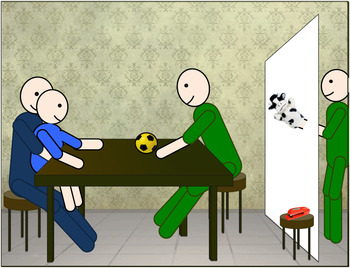
Testing took place in a 4 × 3 m testing room. Figure 1 displays the general set-up. The infant sat on her mother's lap at a table. E1 sat at the opposite side of the table in front of the infant. E2 hid behind a large screen made of white cloth sheets which blocked the back side of the testing room. The screen was positioned in front of the infant at a distance of 2·5 m behind E1. It measured 3·5 × 2,1 m, and had two evenly spaced window openings (0·5 × 0·5 m, 100 cm apart, 90 cm from the floor). These openings were positioned at about 25 degrees left and right from the infant's midline and were covered with curtains which could be raised and lowered from behind. Two infant chairs were positioned, one below each of the two openings in the curtains. All sessions were audio-recorded with a digital microphone (Olympus LS-10), which was positioned on the table 50 cm in front of the infant. Additionally, all sessions were video-taped with two cameras, one focusing on the infant, the other one on the experimenter.
The testing set-up. In the requestive condition, objects were presented to the infant on the table, in the expressive condition via a second experimenter through the sheet, and in the informative condition on a stool in the corner of the room.

Materials
For each of the three test conditions, we used different toys and objects. For the expressive condition, we used three hand puppets (a black and white cow, a yellow chicken, and a pink pig) and an orange car. For the informative condition, we used a pair of socks, a stapler with a piece of paper, a slide and marble, and a pen and paper. For the requestive condition, we chose a ladder-climbing toy figure, a wind-up toy caterpillar, a wind-up toy insect, and a toy hammer board.
Procedure
Infants were tested in a within-subject design in three conditions. The order of the conditions was counterbalanced. Each of the three conditions consisted of four trials. The test session lasted for approximately 20 minutes and followed a standardized script. Prior to the study, the experimenter (E1) played with each infant in a playroom until she was comfortable with the situation. Mothers were instructed not to initiate any communicative behavior toward infants during testing.
The test session began with a brief play period on the table with a moving toy woodpecker to keep the infant interested in E1 as a social partner (this type of play was also randomly repeated between test trials if infants lost interest). When E1 judged that the infant was relaxed and attentive, she put the toy away from the table, addressed the infant verbally, and established eye contact. Then, the test began.
Expressive condition: The procedure was adopted from Liszkowski et al. (Reference Liszkowski, Carpenter, Henning, Striano and Tomasello2004). E1 signaled by coughing to E2 behind the sheet, to start the test trial. E2 showed the first of the four objects through one of the two windows in the sheets in a counterbalanced order. E1 looked the infant in her eyes but never looked to the objects behind her. If the infant pointed to the object E1 looked surprised towards the infant for 4 seconds, and then moved around to look at the object for 2 seconds, vocalizing happily. Then she turned back to the infant and talked to her for about 4 seconds (e.g., “That is a nice cow, isn't it?”). If the infant just looked at the object, but did not point, within 30 seconds, or when the infant did not pay attention to the stimulus for more than 5 consecutive seconds, the object was removed (this happened in 24% of all cases). If infants pointed outside of the test event, E1 did not follow the point but briefly commented on the behavior (e.g., “Hmm, that was a nice point”), remaining interactive and responsive.
Informative condition: In each trial, E1 was searching for an object of which the infant knew the location (following Liszkowski et al., Reference Liszkowski, Carpenter, Striano and Tomasello2006). In two of the trials (blocked and counterbalanced for order), E1 first acted on an object (e.g., she drew a picture with a pen on paper). At some point during this action she pretended to sneeze, and the object (e.g., the pen) fell down from the table. The object fell so the infant could clearly see it. In the other two trials, E1 wanted to perform an action for which she needed two objects (e.g., folding a pair of socks). She had only one of the two objects at hand but the other one was lying in a corner of the room. E1 stood up to get the other object, commenting on what she was doing (e.g., “Look, there is the other sock! That's a nice sock, isn't it!”). While getting the object, her back was turned to the infant and test scene. At this moment, E2 appeared from behind the curtain, snatched the object which remained on the table, and displaced it on one of the two chairs underneath the openings in the curtain. He then returned behind the curtain. E1 turned around and sat down at the table. She pretended to resume the action but then noticed the missing object and began searching for it. She addressed the infant, first non-verbally, looked around in mild puzzlement, and then asked more explicitly for the object (see Liszkowski et al., Reference Liszkowski, Carpenter, Striano and Tomasello2006). The search episode lasted for approximately 30 seconds. If the infant pointed at any time during the search, E1 looked surprised for 4 seconds towards the infant, moved around, looked towards the object for 2 seconds and vocalized happily, and then took the object. If the infant never pointed, E1 pretended to find the object herself after about 30 seconds (this happened in 23% of all cases).
Requestive condition: In each trial E1 brought out the first object, put it on the table and showed it enthusiastically to the infant. She then demonstrated how one could play with it (e.g., winding it up and letting it twist) four times, always commenting positively about it. After this, E1 put the objects out of the infants' reach on the table at a distance of approximately 0·3 m away from the infant (roughly adapted from Carpenter et al., Reference Carpenter, Nagell and Tomasello1998; Camaioni et al., Reference Camaioni, Perucchini, Bellagamba and Colonnesi2004). She then looked at the infant and commented on the play, in order to remain interactive. For example she said “That was nice, wasn't it?” If the infant pointed to the object, E1 looked surprised for 4 seconds towards the infant, looked towards the object for 2 seconds and vocalized happily. Then, the infant received the object and could play with it. If the infant did not point within 30 seconds, or looked away for more than 5 seconds, the toy was removed (this never happened). Then, the next trial started.
Coding and reliability
The occurrence of a point was coded when the infant extended the arm (either fully or slightly bent) towards the test object. Points were coded as index-finger points when the index finger was clearly extended relative to all other fingers, and as a hand point when not. If there were multiple points in a trial, only the first was coded (this happened rarely because the experimenter reacted in every trial after 4 seconds). Points were coded from the close-up video of the infant, not revealing the experimental condition. Vocalizations were coded when they accompanied the point, either before (2 seconds), during, or after the point, within the 4 seconds before E1 reacted. If more than one vocalization accompanied the point (separated by at least 500 ms), the first of these was analyzed. All vocalizations were coded in the absence of the visual scene, not revealing the experimental condition. A phonetically trained expert (first author) judged each vocalization to be speech-like or non-speech-like. The judgments followed those from Snow (Reference Snow2004), and were based on phonetic similarity to adult-based words. Speech-like vocalizations consisted of one or more vowels or syllabic consonants (i.e., CV, VC, or CVC, e.g., [ga], [baga]), or syllables with glides or glottal consonants (e.g., [le], [wa]). Non-speech-like vocalizations were coded when they had no speech-like transcription, or were schwa-like single long vowels (e.g., sounds of comfort).
Additionally, the phonetically trained expert (first author) rated the intonational pattern of the vocalizations, that is, whether they were realized with a falling, rising, or flat intonational contour, using Praat software (Boersma & Weenink, Reference Boersma and Weenink2010). The intonational contour was coded as rising if the fundamental frequency (F0) was characterized by a rise from low to a high target, and as falling if the fundamental frequency was characterized by a low target with a preceding fall. Intonational contours that were relatively flat with no low or high F0-target were coded as flat (less than 2 semitones difference). Complex contours like rise–fall, etc. were rare and not further coded (see Marcos, Reference Marcos1987), given that vocalizations were fairly short. The program was also used to calculate the mean intensity (in decibels) of infants' vocalizations. While the vocalization measures are not necessarily independent of each other, they could be in principle, and therefore provide valid ways of independently measuring and testing differences between experimental conditions.
All infants were coded by the first author, and an additional coder coded 20% of all trials for testing reliability in terms of the occurrence of a point (Cohen's kappa = 0·902) and a vocalization (Cohen's kappa = 0·85), the kind of point (hand point or index-finger pointing; Cohen's kappa = 0·923), as well as kind of vocalization (speech-like, non-speech-like; Cohen's kappa = 0·949). For the intonational pattern, an additional phonetically naive listener was trained in analyzing intonational contours and coded 20% of all trials for testing reliability ( = complete session of three randomly selected infants). This additional reliability judgment revealed high agreement with the first coder (Cohen's kappa = 0·904). We analyzed all data with repeated measures ANOVAs. Because we expected differences between imperative and declarative pointing, but were less sure about differences in our measures between expressive and informative acts, we also compared the conditions directly to each other using Bonferroni corrections.
RESULTS
Points and vocalizations
All infants participated in four valid trials of each condition. Infants pointed on average in 3·36 trials (84%). A one-factorial repeated measures ANOVA on the mean proportion of trials with a point revealed statistically significant differences between conditions (F(2,26) = 12·138; p < ·01). Infants pointed in significantly more trials in the requestive condition (100%) than in both the expressive condition (76%; t(13) = 4·192; p = ·001) and the informative condition (77%; t(13) = 5·643; p < ·001). Infants coupled on average 87% of their points with vocalizations. A one-factorial repeated measures ANOVA on the mean proportion of points coupled with a vocalization revealed no statistical differences between conditions (F(2,26) = 0·11; p = ·9) (expressive condition: 88%; informative condition: 86%; requestive condition: 89%). Our subsequent analyses focused on the characteristics of the vocalizations that accompanied infants' points
Type of vocalizations
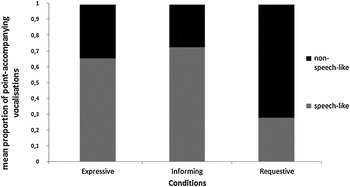
A one-factorial repeated measures ANOVA on the mean proportion of point-coupled vocalizations that were speech-like revealed significant differences between conditions (F(2,26) = 6·339, p = ·006) (see Figure 2).
Mean proportion of infant's point-accompanying vocalizations as either speech-like or non-speech-like across the three conditions in Experiment 1.

Infants used significantly more speech-like vocalizations in both the expressive and informative conditions compared to the requestive condition (vs. expressive: t(13) = 2·870; p = ·013; vs. informative: t(13) = 3·345; p = ·005). The expressive and the informative conditions did not differ significantly from one another (t(13) = 0·927; p = ·371).
Intonation
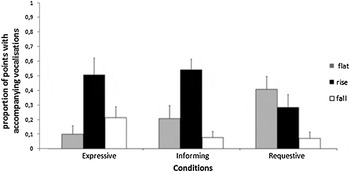
To analyze the intonational pattern of infants' vocalizations we conducted a 3 (condition) x 3 (intonation pattern) repeated measures ANOVA on the proportion of points that were accompanied by either flat, rising, or falling intonation per condition. All point-accompanying vocalizations were included in the analyses. We found a main effect of intonation pattern (F(2,26) = 5·499; p = ·017), but not of condition (F(2,26) = 0·336; p = ·718). Additionally, we found a significant interaction between condition and intonation (F(4,52) = 5·207; p = ·004) (see Figure 3).
Mean proportion of points that were accompanied by vocalizations with either flat, rising, or falling intonation in Experiment 1.

One-factorial repeated measures ANOVAs for each intonational contour revealed overall differences between conditions for all three contours (flat: F(2,26) = 6·732; p = ·005; rising: (F(2,26) = 3·629; p = ·044; falling: (F(2,26) = 3·505; p = ·045). Direct comparisons between conditions showed that flat intonation occurred significantly more often in the requestive condition as compared to both the expressive condition (t(13) = 3·536; p = ·004) and the informative condition (t(13) = 2·517; p = ·026), with no significant difference between the latter two (t(13) = 1·206; p = ·249). Rising intonation occurred significantly less often in the requestive condition as compared to both the expressive condition (t(13) = 2·359; p = ·035) and the informative condition (t(13) = 2·572; p = ·023), with no significant difference between the latter two (t(13) = 0·304; p = ·77). Falling intonation occurred significantly more often in the expressive condition compared to the requestive condition (t(13) = 2·258; p = ·04). The differences between the expressive and informative conditions did not reach statistical significance (t(13) = 1·4; p = ·183), and neither did the differences between the requestive and informative conditions (t(13) = 0·221; p = ·83).
One-factorial repeated measures ANOVAs for each condition revealed significant differences between intonational contours in all three conditions (expressive: F(2,26) = 4·521; p = ·021, informative: F(2,26) = 6·842; p = ·004; requestive F(2,26) = 4·744; p = ·018). Direct comparisons revealed that in the expressive condition, rising intonation occurred significantly more often than both other intonation types (vs. flat: t(13) = 1·796; p = ·021; vs. fall: t(13) = 3·026; p = ·010), and the latter two were not different from each other (t(13) = 1·297; p = ·21). Similarly, in the informative condition, rising intonation occurred significantly more often than both other intonation types (vs. flat: t(13) = 2·460; p = ·03; vs. fall: t(13) = 4·007; p = ·001), and the latter two were not significantly different from each other (t(13) = 0·888; p = ·39). However, in the requestive condition, both flat and rising intonation occurred significantly more often than falling intonation (vs. flat: t(13) = 3·177; p = ·007; vs. rising: t(13) = 2·604; p = ·022). Flat and rising intonation did not differ from each other (t(13) = 0·905; p = ·382).
When running these analyses on points with speech-like vocalizations only, there was a main effect of intonation (F(2,24) = 12·535, p < ·001), with more rising intonation compared to both flat (t(13) = 6·59, p < ·001) and falling intonation (t(13) = 3·28; p < ·001), and more falling intonation than flat intonation(t(13) = 2·73; p = ·025). However, these analyses need to be treated with caution because there were only few speech-like vocalizations in the requestive condition, thus severely limiting any interpretation of the absence of condition effects.
Intensity
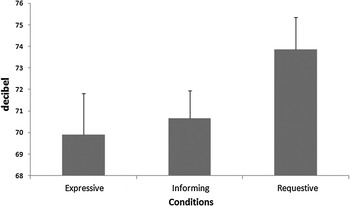
We analyzed the intensity with which infants vocalized using a one-factorial repeated measure ANOVA. This revealed significant differences between conditions (F(2,112) = 3·137; p = ·047) (see Figure 4).
Intensity of point-accompanying vocalizations in decibels across the three conditions in Experiment 1.

Paired sample t-tests showed that infants vocalized with a significantly higher intensity in the requestive condition compared to both the expressive condition (t(13) = 2·342; p = ·037) and the informative condition (t(13) = 2·179; p = ·05). The expressive and informative conditions did not differ substantially from one another (t(13) = 0·196; p = ·848).
Hand shape
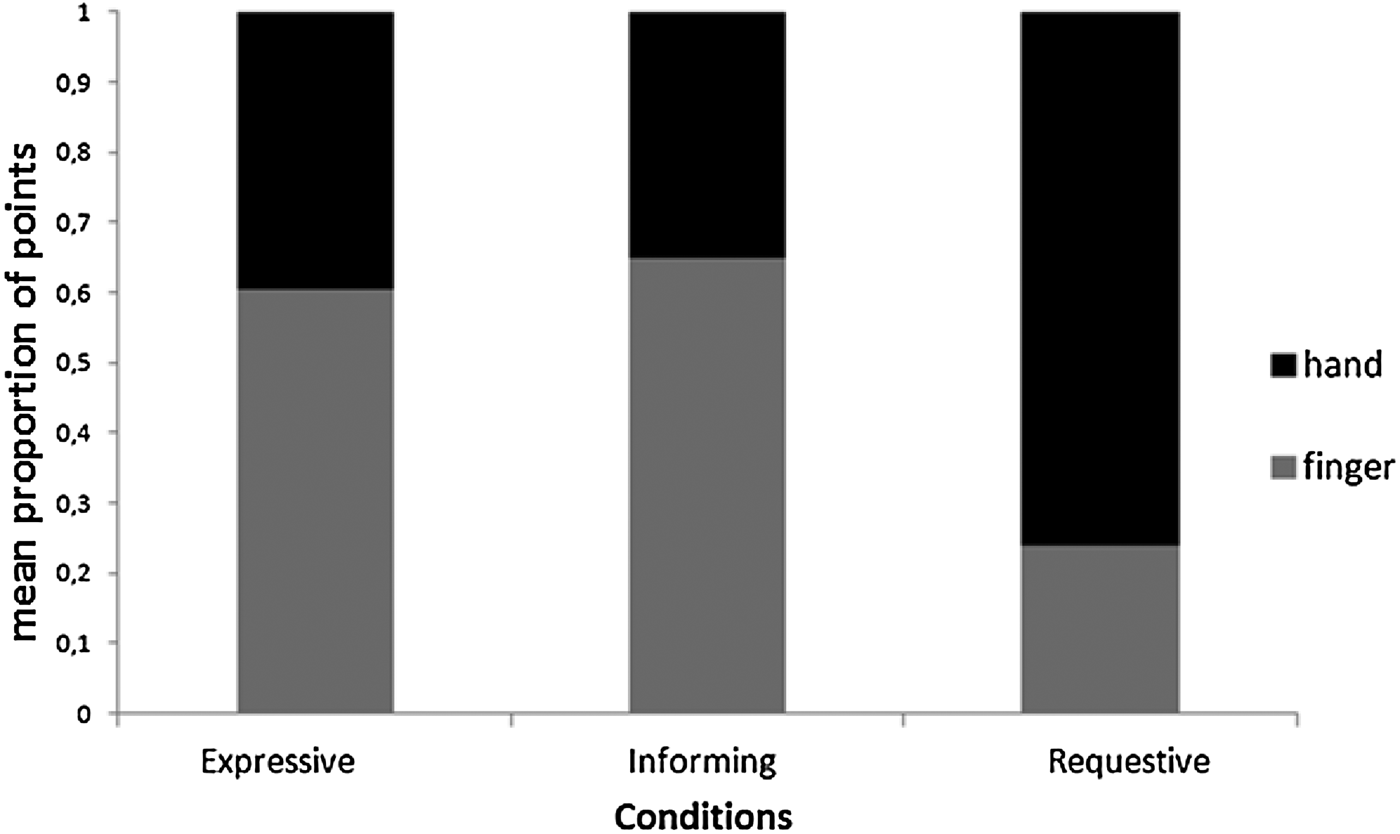
In a final analysis we tested whether infants used index-finger and whole-hand pointing equally across conditions (see Figure 5).
Mean proportion of points in which infants either used the index finger or the whole hand across the three conditions in Experiment 1.
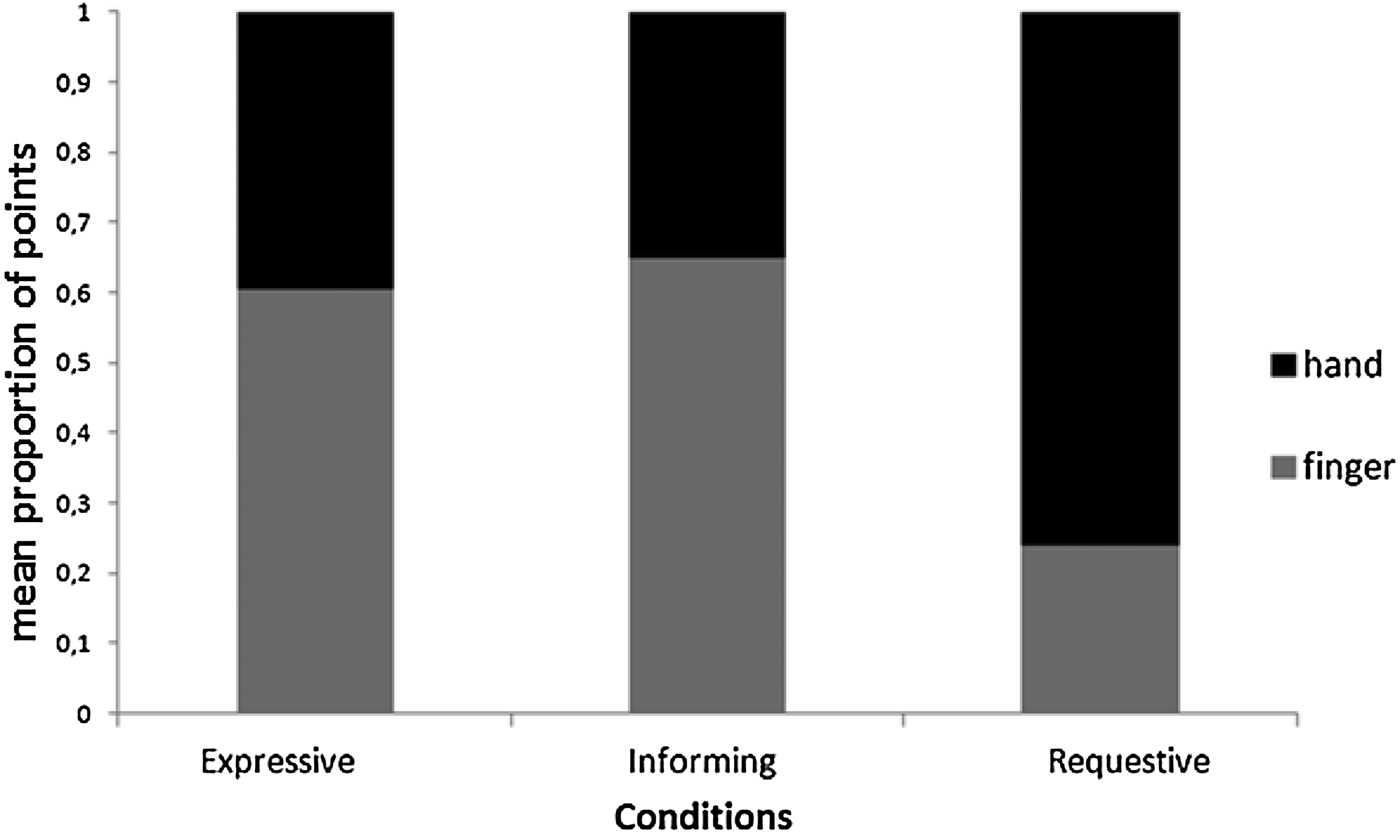
A one-factorial repeated measures ANOVA on the mean proportion of index-finger points revealed significant differences between conditions (F(2,26) = 7·781; p = ·002). Paired-sample t-tests revealed that infants pointed significantly less often with the index finger in the requestive condition compared to both the expressive condition (t(13) = 4·032; p = ·002) and the informative condition (t(13) = 3·175; p = ·007). There was no difference between the expressive and the informative conditions (p = ·761).
DISCUSSION
Infants' vocalizations differentiated requestive from expressive and informative acts. Vocalizations accompanying requestive acts were less often speech-like, the intonation involved both rising and flat patterns, and the intensity was high. In contrast, vocalizations accompanying expressive and informative acts were rather speech-like, had a rising intonation, and were of lower intensity. Infants' vocalizations thus provide clues to the underlying intentions of the act, distinguishing in particular so-called proto-imperatives from proto-declaratives (Bates et al., Reference Bates, Camaioni and Volterra1975). The difference between expressive and informative acts within declarative pointing was not apparent in our measures of accompanying cues. This supports the idea that a common primary function of declarative pointing is to inform (Liszkowski et al., Reference Liszkowski, Carpenter and Tomasello2007), while secondary underlying motives like sharing interest or helping to find something then follow from a given interactive situation (Tomasello et al., Reference Tomasello, Carpenter and Liszkowski2007).
A second finding was that the hand shape similarly differentiated requestive from expressive or informative acts. Whereas infants in the expressive and the informative conditions pointed mainly with the index finger, infants in the requestive condition mostly used the whole hand. This is in line with previous findings on infants' imperative and declarative pointing (e.g., Franco & Butterworth, Reference Franco and Butterworth1996). One caveat of previous and current findings, however, is that requestive pointing has routinely been elicited in proximal situations, affording reaching movements. If infants' gestures were indeed rather reaching attempts, then this may have also influenced their vocalizations, possibly reflecting signs of effort and affect, as the flat intonation could suggest. However, it seems unlikely that infants attempted to reach the toy, because infants know about the limits of their action capabilities much earlier and have been shown to refrain from reaching for out-of-reach toys (Rochat & Goubet, Reference Rochat and Goubet1995). To test this we conducted a second experiment in which we increased the distance to the referent in the requestive condition clearly beyond reach, equating it with the distances of the declarative conditions.
EXPERIMENT 2
Experiment 2 addressed the question of whether the accompanying characteristics of requestive pointing differed from those accompanying the declarative types for reasons other than the expression of underlying intentions. The main concern was that the pointing hand shape rather resembles a reach, and that the flat vocalizations could stem from signs of effort and affect rather than signal specific communicative intent. Manipulating the distance of the referent would provide a test for this hypothesis. By placing the to-be-requested object in the same location as the referents of the declarative conditions, this would present infants with a situation in which the object is clearly out of reach by a few meters. Further, the object would not immediately be in the focus of attention. If infants wanted the adult to help them retrieve the object, they would first have to direct her attention and point to the object. It is possible that this pointing would take on the form of index-finger pointing more often than in a proximal requestive condition, if the function of index-finger pointing was first and foremost to direct attention to an object. However, if the open hand was characteristic of conveying the intention to wanting to obtain the object, then the open-hand shape should still occur more often in requestive situations than in informative situations. Similarly, if the vocalizations expressed the underlying intention of wanting to obtain the object, rather than expressing effort, then the pattern of vocalizations should remain the same even when the distance to the object increased. Another crucial test would be to focus only on index-finger points, so that both the behavior and the physical constraints would be identical across conditions. If the vocalizations were signaling a requestive motive, the prosodic characteristics should be different from those in the informative condition, even if the pointing behavior looked identical.
We used the same basic design and method as in Experiment 1. However, in addition to the previous requestive condition, we administered a distal requestive condition, in which we equated the distance of the referent to the informative condition. We decided to drop the expressive condition for three reasons: first, the expressive and the informative condition yielded similar results; second, we felt that twelve trials would be the maximum for infants of this age; third, we reasoned that the displacement of objects in the informative and requestive conditions is more similar to each other than to the sudden appearance of the puppets in the expressive condition, thus yielding a better match for our experimental manipulation.
METHOD
Participants
We tested sixteen 14-month-old infants (age range 1;02·2–1;02·9, mean = 1;02·5; 6 boys and 8 girls). All participants were recruited and tested as in Experiment 1. None of the infants had to be excluded.
Set-up and materials
The same set-up was used as in Experiment 1. For the informative condition, the same materials were used as in Experiment 1. For the two requestive conditions, we used the same materials as in Experiment 1, and added four new objects. These were a woodpecker, a spinning-top, a glitter wand, and a ball.
Procedure
The procedure for the proximal requestive condition and the informative condition were identical to Experiment 1. The distal requestive condition proceeded like the proximal requestive condition except that E1 demonstrated the toys at a distance. She used the same locations to demonstrate the toys as in the Informative conditions where the objects would be hidden. Proximal and distal requestive conditions alternated on each trial, beginning with the proximal condition. The informative condition always followed the requestive conditions
Coding and reliability
Coding and reliability were done as in Experiment 1. Agreements were excellent for the occurrence of points (Cohen's kappa = 1·0) and vocalizations (Cohen's kappa = 0·923), kind of point (Cohen's kappa = 0·85), and kind of vocalization (Cohen's kappa = 0·88). Reliability for the intonational pattern yielded a good agreement with a Cohen's kappa of 0·770.
RESULTS
Points and vocalizations
All infants participated in four valid trials of each condition. Infants pointed on average in 3·16 trials (79%). A one-factorial repeated measures ANOVA on the mean proportion of trials with a point revealed statistically significant differences between conditions (F(2,28) = 21·77; p < ·01). As in Experiment 1, infants pointed most in the proximal requestive condition (94%), but also significantly more in the distal requestive condition (87%) compared to the informative condition (57%; respectively, t(14) = 5·916; p < ·001; t(14) = 4·644; p < ·001). There was no statistical difference between the two requestive conditions (p = ·186).
Infants coupled on average 72% of their points with vocalizations. As in Experiment 1, a one-factorial repeated measures ANOVA on the mean proportion of points coupled with a vocalization revealed no statistical differences between conditions (F(2,26) = 0·933; p = ·406) (proximal requestive condition: 76%; distal requestive condition: 79%; informative condition: 71%).
When looking only at index-finger points, the mean proportion of points with an index finger differed significantly between conditions (one-factorial ANOVA on the mean proportion of index finger points, F(2,26) = 17·869; p < ·001), with significantly more index-finger points in the informative condition (82·7%) compared to the distal requestive condition (41·1%; t(13) = 3·844; p = ·002) and proximal requestive condition (26·7%; t(13) = 10·08; p < ·001). The within-subject difference between the two requestive conditions did not reach statistical significance (t(13) = 1·71; p = ·111). Infants pointed significantly more often with the index finger in the distal requestive condition of Experiment 2 compared to the proximal requestive condition of Experiment 1 (t(13) = 2·446; p = ·029), while there was no statistical difference between the proximal requestive condition of Experiment 1 and the similar proximal requestive condition of Experiment 2 (t(13) = 0·434; p = ·671).
When analyzing the vocalizations coupled with index-finger points, infants produced vocalizations with 64·7% of the index-finger points. A one-factorial repeated measures ANOVA on the mean proportion of index-finger points coupled with a vocalization revealed no significant differences between conditions (F(2,14) = 0·368; p = ·563) (proximal requestive condition: 60%; distal requestive condition: 70%; informative condition: 64%).
In the subsequent sections we report first on the accompanying vocalizations of all points for the three conditions, and then on the vocalizations coupled with index-finger points. The latter analyses focus on the crucial comparison between the informative condition and the distal requestive condition because they were matched for distance to the referent, and on the same behavioral form of pointing in these two conditions.
Type of vocalization
All points
As in Experiment 1, a one-factorial repeated measures ANOVA on the mean proportion of speech-like vocalizations that accompanied all points revealed statistical significant differences across conditions (F(2,26) = 7·266; p = ·005). In particular, infants accompanied significantly more pointing gestures with speech-like vocalizations in the informative condition (71%) as compared to both the proximal requestive condition (29%; t(13) = 3·503; p = ·004) and the distal requestive condition (28%; t(13) = 2·646; p = ·002). There was no statistical difference between the proximal and the distal condition (t(13) = 0·479; p = ·64).
Index-finger points
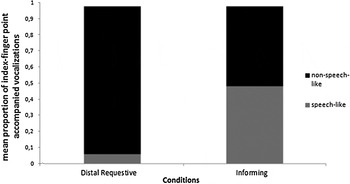
When comparing the proportion of speech-like vocalizations coupled with index-finger points in the distal requestive and the informative conditions, a paired sample t-test revealed that speech-like vocalizations accompanied index-finger points significantly more often in the informative condition compared to the distal requestive condition (t(13) = 2·757; p = ·016; see Figure 6).
Mean proportion of index-finger points accompanied with either speech-like or non-speech-like vocalizations in Experiment 2. The figure displays the comparison between the two crucial conditions matched by distance to the referent and the behavioral form of the point.

Intonation
All points
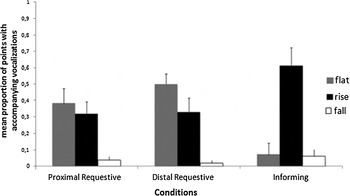
To analyze the intonational pattern of infants' vocalizations we conducted a 3 (condition) x 3 (intonation pattern) repeated measures ANOVA on the proportion of points that were accompanied by either flat, rising, or falling intonation (see Figure 7). As in Experiment 1, we found a main effect of intonation pattern (F(2,26) = 15·116; p < ·001), no main effect of condition (F(2,26) = 0·705; p = ·454), and a significant interaction between condition and intonation (F(4,52) = 6·142; p < ·001).
Mean proportion of points that were accompanied by vocalizations with either flat, rising, or falling intonation in Experiment 2.

One-factorial repeated measures ANOVAs for each intonational contour revealed condition differences for points that were accompanied by flat and rising intonational contours (respectively, F(2,26) = 7·478; p = ·004; F(2,26) = 4·124; p = ·042), but not for falling contours (F(2,26) = 0·450; p = ·601).
Direct comparisons between conditions supported our findings from Experiment 1 and showed that flat intonation occurred significantly more often in both the proximal and the distal requestive condition as compared to the informative condition (respectively, t(13) = 2·365; p = ·034; t(13) = 4·482; p < ·001), with no significant difference between the two requestive conditions (t(13) = 1·034; p = ·32). Rising intonation occurred significantly less often in the proximal requestive condition as compared to the informative condition (t(13) = 2·393; p = ·033), and also less often in the distal requestive condition as compared to the informative condition, although the difference to the informative condition only approached significance (t(13) = 2·037; p = ·063). There was no difference between the proximal and the distal requestive condition (t(13) = 0·152; p = ·882). For falling intonation, there were no significant differences between conditions.
One-factorial repeated measures ANOVAs for each condition revealed significant differences between intonational contours in all three conditions (proximal requestive: F(2,26) = 5·573; p = ·01; distal requestive: F(2,26) = 10·528; p = ·004; informative: F(2,26) = 11·92; p < ·001). Supporting the main findings of Experiment 1, direct comparisons revealed that in the proximal requestive condition, falling intonation occurred significantly less often as compared to both rising (t(13) = 3·785; p < ·005) and flat intonation (t(13) = 5·653; p < ·005), with no differences between rising and flat intonation (t(13) = 0·445; p = ·66). Similarly, in the distal requestive condition, rising and flat intonation occurred significantly more often than falling intonation (both ps < ·006), with no differences between rising and flat intonation (t(13) = 1·186; p = ·25). In the informative condition, rising intonation occurred significantly more often than both flat (t(13) = 3·473; p = ·004) and falling intonation (t(13) = 4·047; p < ·001), with no difference between the latter two (t(13) = 0·138; p = ·89).
Index-finger points
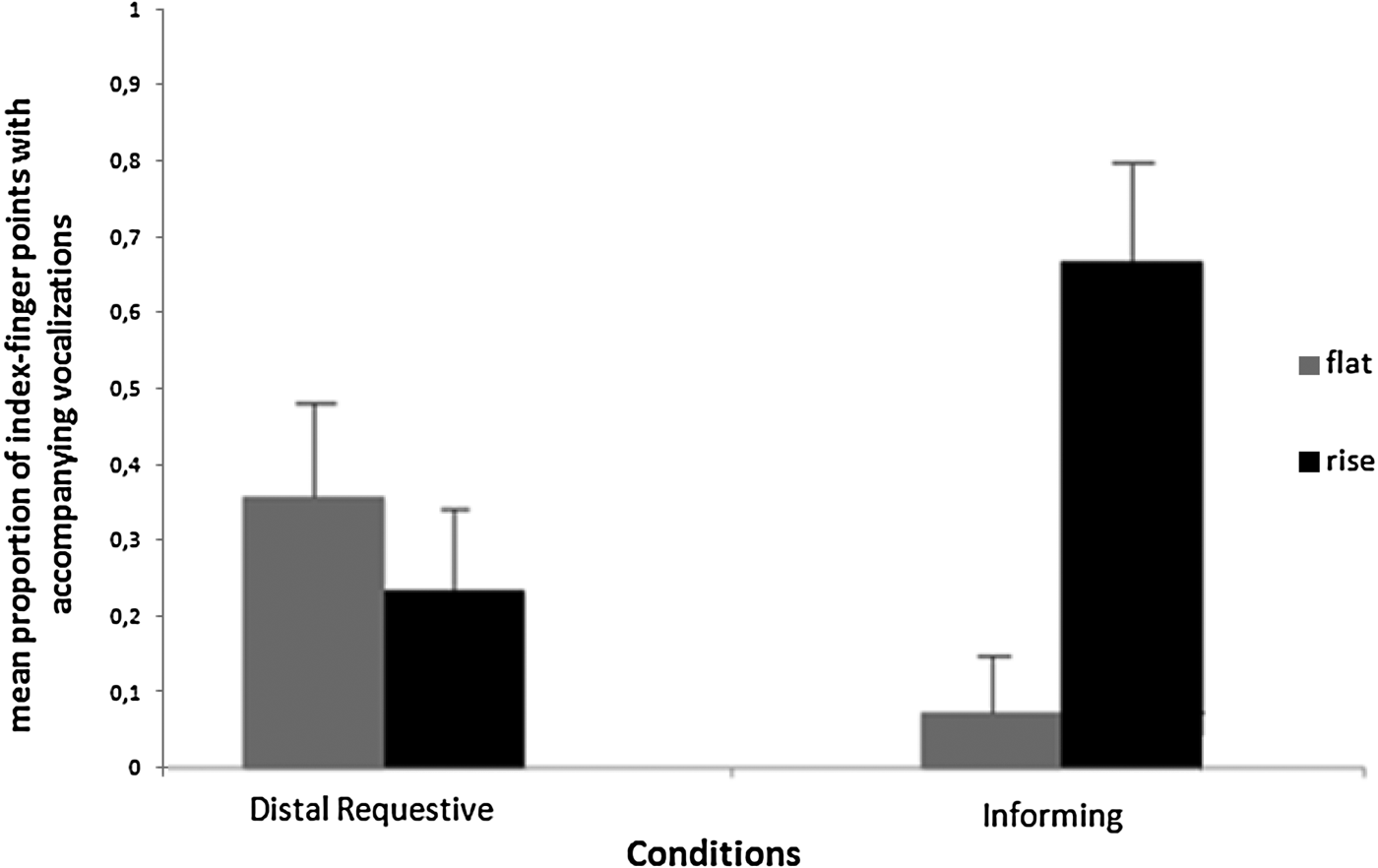
There were overall fewer index-finger points in the distal requestive condition, and none of the index-finger points in that condition were accompanied by vocalizations with a falling intonation. In the informative condition, only one child vocalized in one trial using a falling intonation. Therefore we dropped the falling intonation contour from the analyses. A 2 (condition) x 2 (intonation pattern) repeated measures ANOVA revealed a main effect of intonation pattern (F(1,13) = 4·634; p = ·05), no effect of condition (F(1,13) = 1·38; p = ·716), and a significant interaction between the two factors (F(1,13) = 18·293; p = ·001; see Figure 8).
Mean proportion of index-finger points that were accompanied by vocalizations with either flat or rising intonation in Experiment 2 (no falling intonation was used). The figure displays the comparison between the two crucial conditions matched by distance to the referent and the behavioral form of the point.
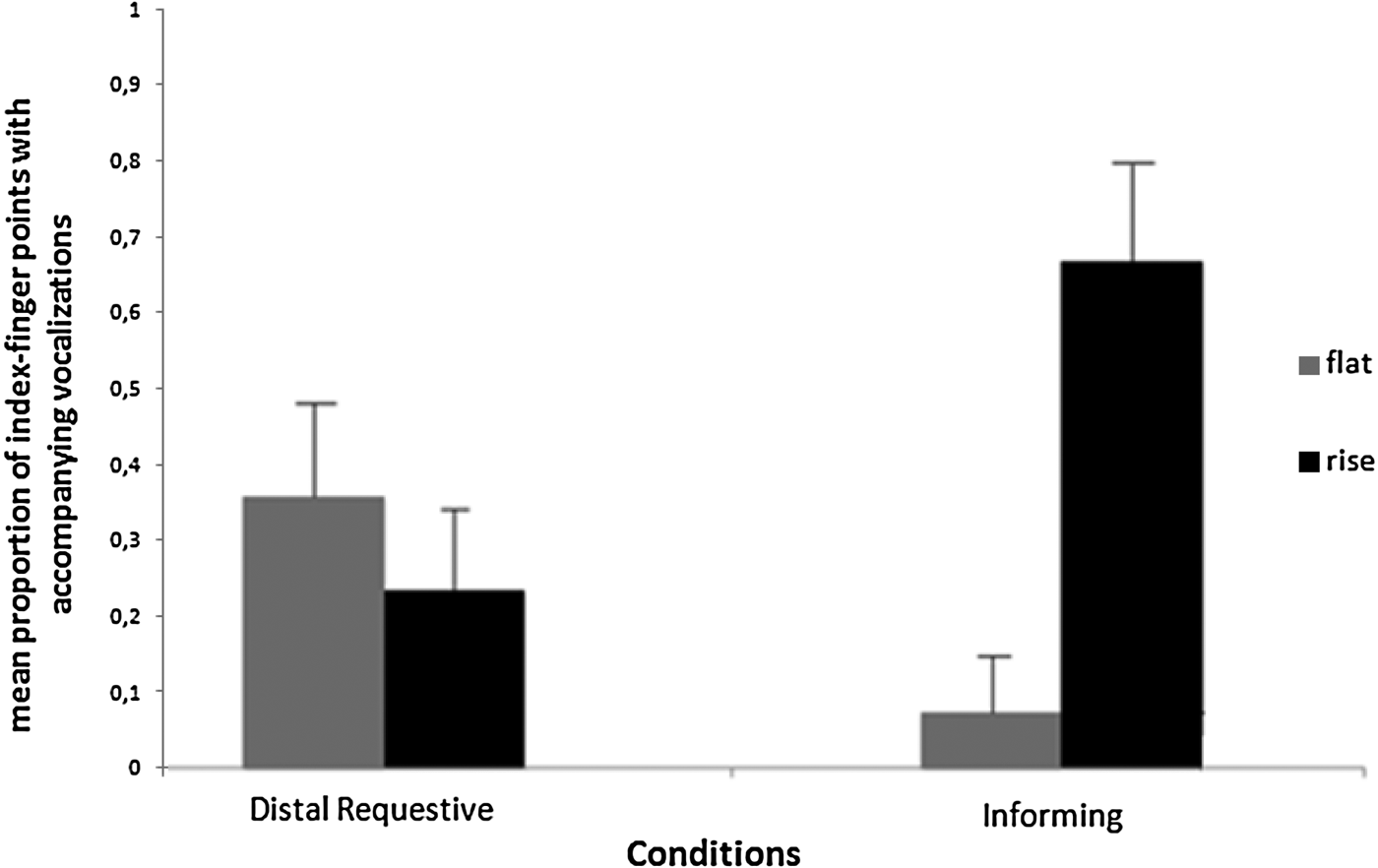
Comparing across conditions, rising intonation was used more often in the informative condition compared to the distal requestive condition (t(12) = 2·332; p = ·036). Flat intonation was used more often in the distal requestive condition than in the informative condition (t(12) = 2·832; p = ·014).
The pattern for each intonation contour confirmed our previous results. In the distal requestive condition, there was no difference between rising and flat intonations (t(12) = 0·737; p = ·48). In the informative condition, rising intonation was used more often than flat intonation (t(12) = 3·969; p = ·002).
DISCUSSION
Experiment 2 confirmed the findings of Experiment 1, revealing similar patterns of intonation contours, speech-like vocalizations, and hand shapes across conditions. Infants vocalized significantly differently when pointing to request than when pointing to inform. Increasing the distance to the referent in the requestive condition did not change infants' vocalizing when pointing. Further, infants still pointed more often with the hand in the requestive condition than in the informative condition, even when the distances to the referents were equated. These findings thus clarify that the accompanying characteristics of requestive points did not simply reflect signs of effort in retrieving an object. In fact, increasing the distance to the to-be-requested object increased the likelihood that infants pointed with the index finger instead of the whole hand. Presumably, the increased distance to the referent made it more necessary to first single out the referent by directing attention to it. The requestive vocalizations then clarified the acquisitive motive underlying the index-finger point. Importantly, when comparing only index-finger pointing across the distance-matched requestive and informative conditions, results confirm that infants still vocalize differently when their motivation is to request than when it is to inform, and that this difference is not mediated by distance or hand shape.
GENERAL DISCUSSION
Pointing is an inherently arbitrary communicative act which requires sender and recipient to work together to achieve mutual understanding. The recipient must infer, based on social contextual information, to what and why someone else is pointing, and the sender must enable the recipient to draw the right inferences by situating the act within the appropriate social contextual information. Previous research has demonstrated that infants modify their use of pointing across various social contexts, enabling inferences about distinct social intentions. However, apart from situating the gesture within the relevant social context, another way to differentiate underlying intentions is to accompany the act with distinct expressions indicative of one's intentions. The current study demonstrates that infants modify their pointing acts through distinct vocalizations and hand shape, which differentially mark distinct motives underlying their pointing.
The vocalizations that accompanied the pointing gestures distinguished most clearly requestive from expressive and informative pointing. Our controls showed that this difference was not due to the spatial distance of the referent or the motor pattern of the act, making it unlikely that the characteristics stemmed from direct effort. It is possible that differences in vocalizations in part reflect differences in affect, because affect is inextricably mixed with motivations and underlying intentions. According to Wilson and Wharton's (Reference Wilson and Wharton2006) conceptual distinction between prosodic signs and signals, prosodic characteristics could be signs of affective states like effort or surprise in the sense of providing evidence for it (like smoke relates to fire). In this case, we would not need to conceive of these as intentionally communicative at all. Alternatively, however, prosodic characteristics are used to signal these states. Bruner (Reference Bruner1975) noted that natural signs can turn into communicative signals through the developmental process of ontogenetic ritualization. Based on the available evidence alluded to in the ‘Introduction’, infants certainly vocalize intentionally to communicate. Recent evidence further suggests that four-month-old infants vocalize flexibly, using the same vocalization with different facial emotion expressions, which would suggest against a fixed coded meaning (Oller, Buder, Ramsdell, Warlaumont, Chorna, & Bakeman, Reference Oller, Buder, Ramsdell, Warlaumont, Chorna and Bakeman2013). While this flexibility is also apparent in infants' use of pointing, our study did not investigate whether infants also flexibly use the same point-accompanying characteristics in very different situations, like, for example, when joking or pretending. It is currently unknown when exactly these abilities emerge, but fifteen-month-olds have been shown to distinguish humorous from sweet-sincere actions based on prosody (Hoicka & Gattis, Reference Hoicka and Gattis2012), and it is not much later that infants engage in pretend acts marking their intentions in prosody.
Regarding the lack of differences between the declarative types, it is possible that more sensitive measures would reveal further subtle differences between expressive and informative acts. However, it is also possible that the subtypes of declarative acts, as elicited in our study, share a deeper general feature that is different from imperative acts. In declarative acts, typically the contextual situation offers an interpretation, either because something noteworthy just happened (e.g., puppets appear/objects get misplaced), or because the recipient had provided evidence of his attitudinal or epistemic states before (e.g., interest or ignorance). In contrast, in imperative acts, the infant changes her mental state (i.e., desire), which is not apparent from the contextual situation alone but must be communicated on top. In this sense, requestive acts must achieve more than just informing the recipient about a referent – in addition, they must express a change in the mindset that is not immediately apparent from the contextual scene.
The rising intonation featured most prominently in the declarative acts, although it was present also in imperative acts, and it was the most frequent intonation when analyzing point-accompanying vocalizations that were speech-like only. Infants' rising intonation has been associated with addressing others. Galligan (Reference Galligan1987) studied two infants at the age of 1;2–1;3 and 1;7–1;8 and found more rises than falls in vocalizations that were directed to mothers than in utterances not directed to mothers, presumably indicating communicative intent. Similarly, Marcos (Reference Marcos1987) reported more rising contours when infants repeated requests compared to their initial requests. Perhaps at odds with our findings, Marcos (Reference Marcos1987) also suggested more rising contours for request and more falling contours for labeling contexts. However, this pattern became only weakly significant in older children, at around age 1;6 to 1;8, and it referred to proper word use, excluding other vocalizations which made up a large portion of initial request vocalizations in the current study. Further, it is important to recall the difficulties and disparities in comparing and defining natural contextual scenes across various infant prosody studies (Snow & Balog, Reference Snow and Balog2002). For example, the falling contour in Marcos’ (Reference Marcos1987) labeling contexts presumably often applied to test questions, as in book reading, when interactant and infant both see and point to a picture and the infant then responds to a question about the label. The declarative contexts in the current study were not labeling situations in that sense but involved directing attention to novel aspects. Differences in the intonational patterns of given and new information have also been reported in adults who prefer rising intonation for new information and deaccentuation for given referents (Pierrehumbert & Hirschberg, Reference Pierrehumbert, Hirschberg, Cohen, Morgan and Pollack1990; Baumann & Grice, Reference Baumann and Grice2006). Based on our findings, it is possible that the rising intonation in infants' attention-directing declarative acts reflect in part their communication about new environmental information, whereas the grunts reflect a change in their acquisitive desire. In all cases, affect presumably accompanies the acts, but we have argued that the expressions are rather a signal, and not a sign of it.
Infants' use of non-speech-like grunts has been reported previously (see also Ferguson, Peizer, & Weeks, Reference Ferguson, Peizer and Weeks1973; Bates et al., Reference Bates, Camaioni and Volterra1975; Bates, Benigni, Bretherton, Camaioni, & Volterra, Reference Bates, Benigni, Bretherton, Camaioni and Volterra1979; Vihman & Miller, Reference Vihman, Miller, Smith and Locke1988). There appears to be a developmental shift from its use in effortful activity, possibly as part of a respiratory challenge, to a ritualized communicative function and a precursor to linguistic reference (McCune et al., Reference McCune, Vihman, Roug-Hellichius, Delery and Gogate1996). While a host of research shows that infants are sensitive to, and can produce phonetic aspects of, language in the first year of life, it is important to note that in our study infants used both speech-like vocalizations and grunts in parallel. Their grunts were thus not just a precursor to the development of communication and speech-like vocalizations. Instead, the co-existence of grunts and speech-like vocalizations suggests that infants pragmatically use various means in parallel, including non-linguistic ones, to make themselves understood. A similar argument applies to infants' use of the open hand when pointing. On some accounts the open hand is simply a precursor to, or a simpler version of, pointing, originating in non-communicative reaching (Vygotsky, Reference Vygotsky1978; Camaioni et al., Reference Camaioni, Perucchini, Bellagamba and Colonnesi2004). Our findings of a co-existence of index-finger and hand points suggest that infants produce different hand shapes that are generally associated with different motives to make themselves understood appropriately.
Before they speak, infants' communicative means are restricted to vocalizations and deictic gestures. Research has established independently that infants use these intentionally to communicate. But beyond mere communicative intent, infants have different reasons, that is, motives or social intentions, why they communicate. The current study suggests that infants not only embed their acts appropriately in interactive contexts to make their acts meaningful on the background of a shared common ground, but also modify their acts by changing intonations and hand shape to express their intentions. From early on, infants' communicative development is driven by the pragmatic goal of making themselves understood, long before linguistic discourse has emerged in earnest.