Antisocial personality disorder (ASPD) and borderline personality disorder (BPD) are among the most costly public health concerns confronting the US criminal justice and healthcare systems. Although ASPD affects only 3–6% of adult males and 1% of adult females (American Psychiatric Association, 2000; Kessler et al., Reference Kessler, McGonagle, Zhao, Nelson, Hughes and Eshlemen1994; Robins, Tipp, & Przybeck, Reference Robins, Tipp, Przybeck, Robins and Regier1991), many if not most property offenses and violent crimes are committed by individuals with the disorder. Indeed, lifetime prevalence rates in incarcerated samples approach 50% (Teplin, Reference Teplin1994). Thus, roughly 1 million of the 2.3 million incarcerated individuals in the United States have ASPD. With the cost of imprisoning one person per year at about $25,000, ASPD accounts for $25 billion per year in corrections expenditures alone, which is about $200 for each US taxpayer (Bureau of Justice Statistics, 2007). This of course does not include the costs associated with crimes that led to incarceration.
BPD and its associated features are also quite costly (Bender et al., Reference Bender, Dolan, Skodol, Sanislow, Dyck and McGlashan2001). According to most estimates, the prevalence rate of BPD is about 2–3% among adult females and 1% among adult males (Swartz, Blazer, George, & Winfield, Reference Swartz, Blazer, George and Winfield1990), although some recent surveys yield slightly higher numbers (Grant et al., Reference Grant, Chou, Goldstein, Huang, Stinson and Saha2008). Despite a relatively moderate prevalence rate, however, BPD is the most common Axis II disorder observed in inpatient psychiatric settings (Trull, Stepp, & Durrett, Reference Trull, Stepp and Durrett2003; Skodol et al., Reference Skodol, Gunderson, Pfohl, Widiger, Livesley and Siever2002). Among adolescents with borderline traits, intentional self-injury (a cardinal feature of BPD) costs the US healthcare system $150 million per year in inpatient hospitalization costs alone (Olfson et al., Reference Olfson, Gameroff, Marcus, Greenberg and Shaffer2005). Moreover, adolescents and adults who engage in self-injury are at high risk for eventual suicide, with an 8–10% lifetime completion rate (e.g., American Psychiatric Association [APA], 2000; Berman, Jobes, & Silverman, Reference Berman, Jobes and Silverman2006).
Although these statistics only partially capture the extent of the personal and societal costs of antisocial personality disorder (ASPD) and BPD, they demonstrate the potential importance of furthering our understanding of both disorders in efforts to mitigate risk. As we outline in later sections, ASPD and BPD are disorders for which biological vulnerabilities interact with potentiating environments to produce debilitating and enduring personality disturbance. Understanding the precise nature of these vulnerabilities and risk factors may provide opportunities for early interventions that alter developmental trajectories toward severe psychopathology. The behavior patterns characteristic of ASPD and BPD are very difficult to treat once canalized (see, e.g., Burke, Reference Burke, Freeman and Reinecke2007; Linehan, Reference Linehan1993). Thus, earlier identification of vulnerability may be necessary to prevent the significant costs of ASPD and BPD to individuals, their family members, and society (Crowell, Beauchaine, & Lenzenwger, Reference Crowell, Beauchaine, Lenzenwger, Beauchaine and Hinshaw2008; Crowell, Beauchaine, & Linehan, Reference Crowell, Beauchaine and Linehan2009).
In this article, we present a common developmental model of antisocial and borderline personality development that captures important biological vulnerabilities and environmental risk factors for both disorders. Although at first glance it might seem odd that we present a single model of two disorders with different symptoms and sex distributions, we are not the first authors to do so. For example, Paris (Reference Paris1997) reviewed a number of common etiological factors and overlapping features of ASPD and BPD, concluding that the two disorders reflect the same underlying trait with different behavioral expressions for males versus females.
Paris' (1997) contention that ASPD and BPD share a common etiology was based on several observations. First, both disorders are characterized by significant risk for depression and suicide. As noted above, 8–10% of those with BPD eventually commit suicide (APA, 2000). Those with ASPD are also at much higher suicide risk than the general population, with a completion rate of approximately 4–5% (Dyck, Bland, Newman, & Orn, Reference Dyck, Bland, Newman and Orn1988; Robins, Reference Robins1966). Second, ASPD and BPD are both characterized by impulsivity, a trait that is about 80% heritable (e.g., Krueger et al., Reference Krueger, Hicks, Patrick, Carlson, Iacono and McGue2002), conferring general rather than specific risk for psychopathology (see Beauchaine & Neuhaus, Reference Beauchaine, Neuhaus, Beauchaine and Hinshaw2008; Beauchaine, Neuhaus, Brenner, & Gatzke-Kopp, Reference Beauchaine, Neuhaus, Brenner and Gatzke-Kopp2008). Finally, ASPD and BPD have similar prevalence rates in the community, and nearly identical sex distributions of about 3–4:1 favoring males for ASPD and females for BPD.Footnote 1 This set of observations led Paris to suggest that ASPD and BPD are sex-moderated manifestations of a single underlying pathology (see also Lyons-Ruth, Reference Lyons-Ruth2008).
In addition to the observations offered by Paris (Reference Paris1997), other findings also point toward a shared etiology for both disorders. For example, ASPD and BPD are highly comorbid in clinical samples (e.g., Becker, Grilo, Edaell, & McGlashan, Reference Becker, Grilo, Edell and McGlashan2000). Furthermore, affected individuals often come from the same families (Goldman, D'Angelo, & DeMaso, Reference Goldman, D'Angelo and DeMaso1993), and increased prevalence of ASPD is observed in the first-degree relatives of those with BPD (Schulz et al., Reference Schulz, Soloff, Kelly, Morgenstern, DiFranco and Schulz1989). In addition, disturbed parent–child relationships, disrupted attachment, family discord, and traumatic experiences including abuse are common in the life histories of those with ASPD and those with BPD (e.g., Lyons-Ruth, Reference Lyons-Ruth2008; Norden, Klein, Donaldson, Pepper, & Klein, Reference Norden, Klein, Donaldson, Pepper and Klein1995).
All of these findings are derived from symptom patterns and life histories of individuals with ASPD, individuals with BPD, and their family members. However, in the last decade much more has been learned about the molecular genetics and neurobiology of ASPD, BPD, and related traits, providing for a more comprehensive account of common vulnerabilities and risk factors for both disorders. Our primary objective in writing this article is to provide an updated model of shared etiology for ASPD and BPD that accounts for both biological vulnerabilities and environmental risk. Taken together, literature addressing the development of these PDs supports the following set of conjectures, which we present here as an organizing framework for the remainder of this article:
1. Both ASPD and BPD are disorders for which trait impulsivity is the principal predisposing vulnerability.
2. Trait impulsivity derives primarily from heritable compromises in central dopaminergic and serotonergic function.
3. For both disorders, impulsivity is potentiated by high risk family environments in which emotional lability is shaped and maintained by operant reinforcement contingencies.
4. Over time, these reinforcement contingencies result in enduring patterns of emotion dysregulation, leading to ASPD and/or BPD in vulnerable individuals.
5. Sex effects moderate the behavioral expression of Biology × Environment interactions to produce ASPD disproportionately in males and BPD disproportionately in females.
In the sections to follow, we present a common developmental model of ASPD and BPD, drawing attention to etiological commonalities across disorders. In doing so, we first discuss several issues and problems associated with classifying and studying PDs, particularly among children and adolescents. Such a discussion is necessary because nosologic and diagnostic conventions affect (a) how atypical personality development is conceptualized, (b) whether diagnoses of PDs are considered in childhood and adolescence, and (c) whether children and adolescents with antisocial and borderline traits are studied in the same way as adults with PDs. Next, we briefly describe different approaches to studying antisocial and borderline pathologies. We then discuss impulsivity as the principal vulnerability to both PDs, before turning to the molecular genetic bases of impulsive behavior. During this discussion, we highlight important Gene × Sex interactions that may confer differential vulnerability to aggression and mood dysregulation among males versus self-injury and mood dysregulation among females. Next, we outline environmental risk factors for antisocial and borderline personality development, again pointing to commonalities across disorders.
Issues and Problems in the Classification of PDs
There are a number of issues in the classification of PDs that have created considerable dissatisfaction and controversy with the current nosology (Clark, Reference Clark2007; Widiger & Trull, Reference Widiger and Trull2007). In this section, we briefly consider these problems and their implications for PDs in youth.
Definition of PD
PDs are defined in the Diagnostic and Statistical Manual of Mental Disorders, Fourth Edition (DSM-IV; APA, 2000) as the following: (a) an enduring pattern of experience and behavior that deviates markedly from societal expectations, which is manifested in at least two of the following domains: cognition, affect, interpersonal functioning, or impulse control; (b) the pattern is inflexible and pervasive across a broad range of situations; (c) it leads to clinically significant distress or impairment in functioning; and (d) it is stable and of long duration, and its onset can be traced back to at least adolescence or early adulthood.
Several aspects of this definition are noteworthy. First, it is not included explicitly in the criteria for individual PD; hence, it is often ignored (Johnson, First, Cohen, & Kasen, Reference Johnson, First, Cohen and Kasen2008). Second, as discussed below, this definition is not specific to PDs; disorders in other sections of the DSM also exhibit these features. Third, as will also be discussed, it makes strong assumptions about the age of onset and development of PDs that recent studies have called into question. With the exception of ASPD, which the DSM does not permit to be diagnosed before age 18, PDs can be diagnosed in children and adolescents. However, the DSM indicates that PDs are unusual in childhood and adolescence, and to rule out transient developmental disturbances, a duration of at least 1 year is required. Contrary to the DSM perspective, however, there is growing evidence that PDs (a) can be identified in adolescents (Westen & Chang, Reference Westen and Chang2000); (b) are generally as common in adolescents as in adults (Grilo et al., Reference Grilo, McGlashan, Quinlan, Walker, Greenfield and Edell1998); and (c) are largely similar in adolescence compared with adulthood in terms of structure (Westen, Shedler, Durrett, Glass, & Martens, Reference Westen, Shedler, Durrett, Glass and Martens2003), concurrent validity (Levy et al., Reference Levy, Becker, Grilo, Mattanah, Garnet and Quinlan1999), and stability (Johnson et al., Reference Johnson, Cohen, Kasen, Skodol, Hamagami and Brook2000).
Distinction between Axis I and Axis II
DSM-III (APA, 1980) introduced a multiaxial system that distinguished PDs from other mental disorders by placing them on separate axes. In part, this was intended to force clinicians to pay greater attention to personality pathology, which is often overshadowed by acute episodes of Axis I psychopathology. This proved highly successful, as the prevalence of PD diagnoses increased dramatically after the introduction of DSM-III (Loranger, Reference Loranger1990).
However, the conceptual basis for the Axis I–Axis II distinction has always been problematic (Krueger, Reference Krueger2005; Livesley, Reference Livesley1998; Widiger, Reference Widiger2003). For example, many if not most Axis I disorders (e.g., schizophrenia, dysthymic disorder, obsessive–compulsive disorder, generalized social phobia, substance use disorders, anorexia nervosa, somatization disorder) meet the general criteria for PDs summarized above, with an adolescent or early adult onset, chronic course, and pervasive effects on psychological and social functioning. In addition, at least several PDs appear to have etiological influences that overlap with Axis I disorders, and can be conceptualized as lying on a spectrum that cuts across the Axis I–Axis II boundary (e.g., schizotypal PD and schizophrenia, avoidant PD, and generalized social phobia). From another perspective that will be discussed below, this reflects the significant heterotypic continuity that exists between many PDs and Axis I disorders. As a result of these problems, many investigators have argued that the Axis I–Axis II distinction, at least as currently defined, should be abandoned and PDs should be classified on the same axis as other psychiatric disorders (Clark, Reference Clark2007; Livesley, Reference Livesley1998; Krueger, Reference Krueger2005).
Dimensional versus categorical classification
Perhaps the strongest criticisms of the DSM-IV classification of PDs concern the use of a categorical diagnostic format (Clark, Reference Clark2007; Widiger & Trull, Reference Widiger and Trull2007). As DSM itself suggests, most PDs are probably the extreme end of a continuum of normally distributed personality traits. Hence, selecting a boundary between normal and pathological is somewhat arbitrary. Moreover, dichotomizing a continuous variable reduces the amount of information contained within that variable, attenuating reliability (MacCallum, Zhang, Preacher, & Rucker, Reference MacCallum, Zhang, Preacher and Rucker2002). Indeed, there is extensive evidence that when the DSM PDs are treated as continuous variables by summing criteria, increases are observed in interrater reliability (Zimmerman, Reference Zimmerman1994), agreement between patients and other informants (Riso, Klein, Anderson, Crosby Ouimette, & Lizardi, Reference Riso, Klein, Anderson, Crosby Ouimette and Lizardi1994), and stability over time (Durbin & Klein, Reference Durbin and Klein2006; Grilo et al., Reference Grilo, Sanislow, Gunderson, Pagano, Yen and Zanarini2004).
Following from these and other arguments, a number of dimensional classification systems of PDs have been proposed (Shedler & Westen, Reference Shedler and Westen2004; Trull & Durrett, Reference Trull and Durrett2005; Widiger & Simonsen, Reference Widiger and Simonsen2005). One of the major approaches uses the “Big Five” taxonomy of general personality dimensions (Widiger & Trull, Reference Widiger and Trull2007). At least four of the Big Five dimensions (extraversion, neuroticism, agreeableness, and conscientiousness vs. impulsivity) have theoretically meaningful associations with PDs (e.g., avoidant PD is low on extraversion, borderline PD is high on neuroticism, ASPD is low on agreeableness and conscientiousness, and obsessive–compulsive PD is high on conscientiousness; O'Connor, Reference O'Connor2005; Saulsman & Page, Reference Saulsman and Page2004). This approach may have limitations, in that it is better at characterizing some PDs than others (Saulsman & Page, Reference Saulsman and Page2004) and does not include some clinically relevant features of personality pathology, such as suicidal or self-injurious behavior and unusual perceptual experiences (Shedler & Westen, Reference Shedler and Westen2004). However, it underscores the close relationship between normal and abnormal personality processes. Moreover, the associations between these trait dimensions and measures of PDs in adolescents appear to be similar to those observed in adults (DeClerq & DeFruyt, 2007), suggesting that there may be substantial homotypic continuity in the traits that comprise PDs from youth through adulthood.
Diagnostic criteria
There are also a number of problems with specific PD criteria. First, the criteria are a mixture of specific behaviors (e.g., unable to discard worn out or worthless objects), symptoms (e.g., transient paranoid ideation or severe dissociative symptoms), and traits (impulsivity or failure to plan ahead). As discussed below, this may explain some of the instability in PD diagnoses.
Second, for some disorders (e.g., paranoid PD) the criteria are all variations on a single theme, whereas for other disorders (e.g., borderline PD) the criteria cover widely disparate domains. Third, many of the criteria for specific PDs overlap with other PDs (e.g., inappropriate, intense anger or difficulty controlling anger in BPD and irritability and aggressiveness in ASPD) and with Axis I disorders (e.g., suicidal behavior in BPD and major depressive disorder), inflating estimates of comorbidity and heterotypic continuity.
Fourth, as noted above, the cutoffs are not derived empirically, and are therefore somewhat arbitrary. This is especially problematic because small changes in the criteria sets and/or cutoffs can have dramatic effects on prevalence rates (Blashfield, Blum, & Pflohl, Reference Blashfield, Blum and Pfohl1992). Fifth and finally, it is unclear whether the specific criteria and cutoffs are appropriate across developmental periods. For example, although there is evidence for continuity between PDs in adolescents and adults, there also appear to be some age-related differences in their manifestations (Becker, Grilo, Edell, & McGlashan, Reference Becker, Grilo, Edell and McGlashan2001; Durrett & Westen, Reference Durrett and Westen2005; Westen et al., Reference Westen, Shedler, Durrett, Glass and Martens2003).
The DSM clusters
DSM divides PDs into three clusters: Cluster A (schizoid, schizotypal, and paranoid PDs) includes disorders that are characterized by odd or eccentric behavior; Cluster B (antisocial, borderline, histrionic, and narcissistic PDs) by dramatic, emotional, or erratic behavior; and Cluster C (dependent, avoidant, and obsessive–compulsive PDs) by anxious or fearful behavior. Support for the validity of the cluster grouping is limited at best. Although some structural analyses (primarily factor analysis) have found support for the DSM cluster framework, many have not, and a variety of different factor structures have been obtained among adolescents as well as adults (Durrett & Westen, Reference Durrett and Westen2005; Sheets & Craighead, Reference Sheets and Craighead2007). Although most PDs are correlated with the other PDs in the same cluster, many also exhibit high correlations with PDs in other clusters. This high within and across cluster overlap is consistent with the evidence regarding comorbidity and heterotypic continuity discussed below.
Assessment
An additional set of concerns involves the assessment of PDs. At present, PDs are typically assessed using either structured interviews with the patient or self-report inventories. One problem is that, unlike Axis I criteria, many of the PD criteria are formulated at a high level of abstraction (e.g., identity disturbance; lack of empathy). This leaves a great deal of room for interpretation by the respondent, and subtle variations in the wording of questions can produce very different responses. As a result, agreement between different PD interviews, different self-report inventories, and between interview and self-report measures of PDs tend to be fairly low (Clark, Livesely, & Morey, Reference Clark, Livesley and Morey1997; Perry, Reference Perry1992). Another problem is that individuals' reports of their personality are influenced by their current mood state (and concurrent Axis I disorders; De Fruyt, Van Leeuwen, Bagby, Rolland, & Rouillon, Reference De Fruyt, Van Leeuwen, Bagby, Rolland and Rouillon2006; Hirschfeld et al., Reference Hirschfeld, Klerman, Clayton, Keller, McDonald-Scott and Larkin1983). This is particularly problematic for self-report measures, as interviewers can try to focus the participant on periods of euthymic mood (if any; Loranger, Lenzenweger, Garner, & Susman, Reference Loranger, Lenzenweger, Garner and Susman1991). An even greater problem is that some PDs, almost by definition, involve limited awareness of one's behaviors and their effects on others. Hence, assessments that rely on the patient to provide accurate information may be of questionable validity (Shedler & Westen, Reference Shedler and Westen2004). This is especially problematic for children and adolescents, whose insight and self-awareness may be even more limited than for adults (Westen & Chang, Reference Westen and Chang2000). As a result, many investigators advocate the use of knowledgeable informants, either as a sole source or a supplementary source of data on PDs (Oltmanns & Turkheimer, Reference Oltmanns, Turkheimer, Krueger and Tackett2006). Unfortunately, the level of agreement between self- and informant reports is often very low (Klonsky, Oltmanns, & Turkheimer, Reference Klonsky, Oltmanns and Turkheimer2002; Riso et al., Reference Riso, Klein, Anderson, Crosby Ouimette and Lizardi1994), raising questions about which source to rely on or how to combine the data.
Concurrent comorbidity
Another major concern regarding PDs is the high rate of co-occurrence (or comorbidity) among them. Among those with a PD, over 50% meet criteria for multiple PDs (Fossati et al., Reference Fossati, Maffei, Bagnato, Battaglia, Donati and Donini2000; Pfohl, Coryell, Zimmerman, & Stangl, Reference Pfohl, Coryell, Zimmerman and Stangl1986). In Zimmerman, Rothschild, and Chelminski's (Reference Zimmerman, Rothschild and Chelminski2005) sample of 859 psychiatric outpatients, 35 of the pairwise odds ratios between specific PDs were 2.0 or greater, and 25 were at least 3.0. Comorbidity among PDs is even greater in community samples (Grant, Stinson, Dawson, Chou, & Ruan, Reference Grant, Stinson, Dawson, Chou and Ruan2005).
As noted above, although there are significant within-cluster associations, there are also associations between PDs in different clusters. For example, in the Zimmerman et al. (Reference Zimmerman, Rothschild and Chelminski2005) study, the median within cluster odds ratios for Clusters A, B, and C were 19.2, 8.8, and 2.0, respectively, whereas the corresponding median across-cluster odds ratios were 4.0, 3.2, and 3.9. The strongest associations between specific pairs of PDs were schizoid–schizotypal, schizoid–avoidant, paranoid–borderline, antisocial–borderline, antisocial–narcissistic, and narcissistic–histrionic.
There are surprisingly few data on co-occurrence between PDs in adolescents, but the available evidence suggests that comorbidity rates may be even greater and the patterns less differentiated than in adults (Becker et al., Reference Becker, Grilo, Edell and McGlashan2000). The high rate of comorbidity among PDs in adolescents and adults reinforces concerns that the boundaries between PDs do not reflect meaningful distinctions, and it suggests that PDs may be more parsimoniously represented by a smaller number of trait dimensions (Clark, Reference Clark2007) such as impulsivity and affective lability.
As mentioned earlier, PDs also exhibit significant comorbidity with Axis I disorders. For example, in both clinical (e.g., Zimmerman et al., Reference Zimmerman, Rothschild and Chelminski2005) and community (Grant, Hasin, et al., Reference Grant, Hasin, Stinson, Dawson, Chou and Ruan2005) samples, 40–60% of patients with mood, anxiety, and substance use disorders meet criteria for at least one PD. Cluster A PDs exhibit particularly strong associations with psychotic disorders, consistent with evidence of a schizophrenia spectrum that includes schizotypal and paranoid PD (Kendler et al., Reference Kendler, McGuire, Gruenberg, O'Hare, Spellman and Walsh1993). However, there are also significant associations between Cluster A PDs and anxiety and mood disorders (Zimmerman et al., Reference Zimmerman, Rothschild and Chelminski2005). Cluster B PDs have particularly strong associations with substance use disorders, consistent with the notion of an externalizing spectrum characterized by impulsivity (Dolan-Sewell, Krueger, & Shea, Reference Dolan-Sewell, Krueger, Shea and Livesley2001; Krueger, Markon, Patrick, Benning, & Kramer, Reference Krueger, Markon, Patrick, Benning and Kramer2007). However, Cluster B PDs are also associated with mood and anxiety disorders, some eating disorders such as bulimia nervosa, and some somatoform disorders such as somatization disorder (Dolan-Sewell et al., Reference Dolan-Sewell, Krueger, Shea and Livesley2001; McGlashan et al., Reference McGlashan, Grilo, Skodol, Gunderson, Shea and Morey2000; Zimmerman et al., Reference Zimmerman, Rothschild and Chelminski2005). Cluster C disorders have strong associations with anxiety and mood disorders, as well as eating and somatoform disorders (Dolan-Sewell et al., Reference Dolan-Sewell, Krueger, Shea and Livesley2001; McGlashan et al., Reference McGlashan, Grilo, Skodol, Gunderson, Shea and Morey2000; Zimmerman et al., Reference Zimmerman, Rothschild and Chelminski2005).
Stability
One of the defining characteristics of PDs is stability over time. Several recent longitudinal studies have examined the stability of PDs over periods ranging from 2 to 10 years (Durbin & Klein, Reference Durbin and Klein2006; Grillo et al., 2004; Johnson et al., Reference Johnson, Cohen, Kasen, Skodol, Hamagami and Brook2000; Lenzenweger, Johnson, & Willett, Reference Lenzenweger, Johnson and Willett2004). These studies indicate that the stability of PDs is actually quite modest and not appreciably different from many Axis I disorders (Shea & Yen, Reference Shea and Yen2003). However, the rank-order stability of PD dimensional scores is higher than PD diagnoses and comparable to the stability of general personality traits (Durbin & Klein, Reference Durbin and Klein2006). For example, in the Collaborative Longitudinal Study of Personality Disorders, 2-year remission rates of schizotypal, borderline, avoidant, and obsessive–compulsive PDs ranged from 50% to 61%; kappa values for the associations between baseline and 2-year follow-up diagnoses ranged from .35 to .47; and intraclass correlations between baseline and 2-year follow-up dimensional scores ranged from .53 to .67 (Grillo, Becker, Edell, & McGlashan, 2001). Importantly, the stability of PDs in adolescents appears to be comparable to that in adults (Chanen et al., Reference Chanen, Jackson, McGorry, Allot, Clarkson and Yuen2004; Grilo et al., Reference Grilo, Becker, Edell and McGlashan2001; Johnson et al., Reference Johnson, Cohen, Kasen, Skodol, Hamagami and Brook2000).
When PDs are examined at the level of individual criteria, most include both stable and unstable features (McGlashan et al., Reference McGlashan, Grilo, Sanislow, Ralevski, Morey and Gunderson2005). For example, in BPD, some impulsive and cognitive features, such as self-injury, suicide attempts, and quasipsychotic thinking resolved relatively quickly, whereas many affective and interpersonal features such as chronic anger, dysphoria, and emptiness/loneliness, as well as interpersonal features such as dependency and intolerance of being alone were relatively stable (Zanarini et al., Reference Zanarini, Frankenburg, Reich, Silk, Hudson and McSweeney2007). Moreover, change in five-factor model personality traits predicts change in PDs, but change in PDs is not related to change in personality (Warner et al., Reference Warner, Morey, Finch, Skodol, Sanislow and Shea2004). Furthermore, impairment associated with PDs appears to be more stable than PD diagnoses themselves (Skodol et al., Reference Skodol, Pagano, Bender, Shea, Gunderson and Yen2005). These data suggest that current PD criteria are a mixture of stable traits that may be associated with chronic impairment and acute symptoms that resemble Axis I psychopathology and attenuate diagnostic stability (Clark, Reference Clark2007; McGlashan et al., Reference McGlashan, Grilo, Sanislow, Ralevski, Morey and Gunderson2005; Zanarini et al., Reference Zanarini, Frankenburg, Reich, Silk, Hudson and McSweeney2007). As a result, some investigators have argued that PDs should be classified on Axis I and the personality traits that underlie PDs (and many Axis I disorders) should be classified on Axis II (Clark, Reference Clark2007; Livesley, Reference Livesley1998).
Homotypic/heterotypic continuity
Homotypic continuity refers to the same pattern of symptoms or behaviors being manifested at different points in time. In contrast, heterotypic continuity refers to the association of one pattern of symptoms or behaviors at one point in time with a different pattern of symptoms or behaviors at a later point in time. The research on the stability of PDs and PD dimensional scores discussed above provides evidence of moderate homotypic continuity in PDs. Another approach to homotypic continuity is to examine early behavioral precursors of PDs (DeClercq & De Fruyt, Reference DeClercq and De Fruyt2007). The extensive literature discussed below on child externalizing problems and adult antisocial PD is an example of this. Unfortunately, data on the behavioral precursors of other PDs, including BPD, are limited.
Information on heterotypic continuity comes from longitudinal studies of the relationships of PDs with other PDs and Axis I disorders over time. Although longitudinal associations between disorders can be explained by a number of mechanisms (Klein & Riso, Reference Klein, Riso and Costello1993), heterotypic continuity suggests that the same psychopathological process may be expressed in different forms at different stages of development or different stages of the course of the disorder. This raises concerns about the validity of the current nosology, as disorders that are currently held to be distinct may be better conceptualized as age- or stage-specific manifestations of the same condition (see Beauchaine et al., Reference Beauchaine, Neuhaus, Brenner and Gatzke-Kopp2008).
There are surprisingly few data on longitudinal relationships between different PDs. This may be in part because of the reluctance to diagnose PDs in childhood and adolescence and the assumption that PDs are manifest by early adulthood, leaving a very narrow window of time to investigate longitudinal associations between PDs. However, there have been a number of studies of the longitudinal relationship between PDs and Axis I disorders (e.g., Helgeland, Kjelsberg, & Torgersen, Reference Helgeland, Kjelsberg and Torgersen2005; Klein & Schwartz, Reference Klein and Schwartz2002; Shea et al., Reference Shea, Stout, Yen, Pagano, Skodol and Morey2004). Several studies have reported that Axis I disorders in childhood or adolescence predicted PD diagnoses or traits in adulthood (Helgeland et al., Reference Helgeland, Kjelsberg and Torgersen2005; Kasen, Cohen, Skodol, Johnson, & Brook, Reference Kasen, Cohen, Skodol, Johnson and Brook1999; Lewinsohn, Rohde, Seeley, & Klein, Reference Lewinsohn, Rohde, Seeley and Klein1997; Rey, Morris-Yates, Singh, Andrews, & Stewart, Reference Rey, Morris-Yates, Singh, Andrews and Stewart1995). For example, Kasen et al. (Reference Kasen, Cohen, Skodol, Johnson and Brook1999) found that disruptive behavior disorders in childhood not only predicted Cluster B PDs in young adulthood (homotypic continuity) but also Cluster A and C disorders (heterotypic continuity). In addition, childhood anxiety disorders predicted subsequent Cluster A and C disorders, and childhood depression predicted later Cluster B and C disorders.
Associations also run in the reverse direction. Using the same sample as Kasen et al. (Reference Kasen, Cohen, Skodol, Johnson and Brook1999), Johnson, Cohen, Skodol, et al. (Reference Johnson, Cohen, Skodol, Oldham, Kasen and Brook1999) reported that Cluster A PDs in adolescence predicted anxiety, mood, and disruptive behavior disorders in early adulthood; Cluster B PDs in adolescence predicted adult mood, disruptive, and substance use disorders; and Cluster C PDs predicted subsequent mood and disruptive behavior disorders.
These associations underscore concerns about the conceptual coherence of the distinction between PDs and Axis I disorders, and suggest that there are broad spectra of psychopathologies that cut across the two DSM axes. Moreover, these associations must be viewed within a developmental perspective, as PD traits may be precursors of Axis I psychopathology, and early-onset Axis I disorders may be antecedents of subsequent PDs. An important next step will be to determine whether there are meaningful patterns of progression from PDs to Axis I disorders and vice versa, and to explore the factors that influence the sequencing of these conditions.
Interim summary
There are a number of problems and issues in the current classification of PDs that must be considered to advance the developmental psychopathology of personality pathology. First, contrary to the DSM model, PDs can be identified and are common in adolescents. However, it is still unclear whether there are age-specific manifestations of PDs that require different criteria and cutoffs for different developmental periods, and relatively little is known about the childhood manifestations and precursors of most PDs.
Second, most PDs probably represent extreme ends of a continuum, rather than discrete entities; hence, measurement would be enhanced by using a dimensional rather than categorical approach. Third, the high comorbidity among PDs indicates that the current set of disorders and clusters is not optimal. It is likely that the boundaries between PDs are incorrectly drawn, and that using a relatively independent set of trait dimensions to classify personality pathology would be both more economical and informative.
Fourth, the Axis I–Axis II distinction is highly problematic, as most features assumed to characterize PDs also apply to Axis I disorders. Moreover, the high concurrent and longitudinal comorbidity between PDs and Axis I disorders, together with evidence of shared etiological factors between disorders on different axes, suggest that many PDs are better conceptualized as lying on a spectrum with Axis I disorders.
Fifth, and finally, the criteria for PDs are a mixture of symptoms and traits, contributing to lower stability than the construct of PD has traditionally implied and further blurring the distinction between Axes I and II. A greater emphasis on underlying traits would greatly increase the predictive validity of personality pathology constructs. Recent research on the psychopathology, pathogenesis, and pathophysiology of a handful of PDs, most notably ASPD and BPD, is suggesting new approaches to conceptualizing and understanding the development of personality pathology. With these caveats in mind, we now turn to specific discussion of ASPD and BPD.
Traditional Approaches to Studying Antisocial Behavior
Definitions and developmental issues
Terms such as antisocial behavior, delinquency, criminality, and conduct problems are often used interchangeably in psychological and sociological research. However, there are important distinctions among terms and constructs that must be considered before proceeding.
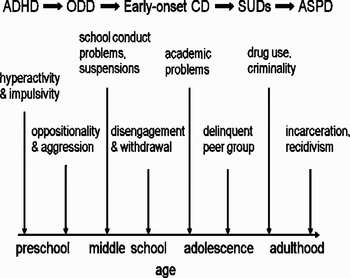
DSM-IV (APA, 2000) specifies three disruptive behavior disorders including attention-deficit/hyperactivity disorder (ADHD), oppositional defiant disorder (ODD), and conduct disorder (CD). These diagnoses are usually restricted to childhood and adolescence, although ADHD can also be diagnosed among adults. In contrast, ASPD and most other PDs are typically (though not always) diagnosed in those over age 18 (see above). However, Robins (Reference Robins1966) noted long ago that a diagnosis of ASPD virtually requires childhood conduct problems. In fact, adults with ASPD almost invariably traversed a developmental pathway that began early in life with the hyperactive–impulsive or combined subtype of ADHD, followed by preschool ODD, preadolescent CD, and late adolescent and adult substance use disorders (Loeber & Hay, Reference Loeber and Hay1997; Loeber & Keenan, Reference Loeber and Keenan1994; Lynam, Reference Lynam1996, Reference Lynam1998). As noted above, this progression from one disorder to others along the externalizing spectrum is an example of heterotypic continuity (see Figure 1). Among children who exhibit CD, earlier age of onset is associated with especially high risk of adult ASPD (Moffitt, Reference Moffitt1993, Reference Moffitt, Lahey, Moffitt and Caspi2003; Ridenour et al., Reference Ridenour, Cottler, Robins, Compton, Spitznagel and Cunningham-Williams2002). Any developmental theory of antisocial behavior must account for this life-long pattern of externalizing conduct.
A heterotypically continuous developmental trajectory to antisocial personality disorder (ASPD) that begins with hyperactivity and impulsivity in preschool. ADHD, attention-deficit/hyperactivity disorder; ODD, oppositional defiant disorder; CD, conduct disorder; SUDs, substance use disorders.

It is also important to note that in our discussion of antisocial personality development we are not referring specifically to psychopathy, although some psychopathic individuals are likely captured by the discussion to follow. Psychopathy has a much lower prevalence rate (0.5–1%) than ASPD (see, e.g., Hare, Reference Hare1993, Reference Hare1996), and appears to have a unique genetic loading (Larsson, Andershed, & Lichtenstein, Reference Larsson, Andershed and Lichtenstein2006). Although many if not most psychopaths meet criteria for ASPD, most of those with ASPD are not psychopaths. We refer interested readers to Patrick (Reference Patrick2005) for detailed discussion of the psychopathy construct.
Biological approaches
Antisocial, aggressive, and criminal behaviors have been studied for well over a century. During this time, most research has assessed the main effects of single variables on antisocial outcomes, an approach that until recently was characteristic of most psychological science (Miller & Keller, Reference Miller and Keller2000; Porges, Reference Porges2006). Some of the earliest models of delinquency focused on biological vulnerabilities for aggression, criminality, and related constructs. For example, Eppinger and Hess (Reference Eppinger, Hess, Krause and Jelliffe1910/1915) proposed that an autonomic imbalance favoring the parasympathetic nervous system was the principal biological vulnerability for aggression. This deficiency was the proposed neural substrate of low resting heart rate, which is observed consistently in delinquent, conduct-disordered, and psychopathic samples (see Lorber, Reference Lorber2004). Although the “vagotonia” hypothesis was eventually proven wrong (see Beauchaine, Reference Beauchaine2001), it spawned several generations of research (including a number of studies in the last decade) leading to more refined models of autonomic and central nervous system liability for conduct problems, delinquency, and antisocial behavior (see, e.g., Beauchaine, Hong, & Marsh, Reference Beauchaine, Hong and Marsh2008; Beauchaine, Katkin, Strassberg, & Snarr, Reference Beauchaine, Katkin, Strassberg and Snarr2001; Gatzke-Kopp, Raine, Loeber, Stouthamer-Loeber, & Steinhauer, Reference Gatzke-Kopp, Raine, Loeber, Stouthamer-Loeber and Steinhauer2002; Raine, Reference Raine1996; Raine, Venebles, & Mednick, Reference Raine, Venebles and Mednick1997).
Other studies of biological vulnerabilities for antisocial behavior have focused on genetic, neural, and neuroendocrine factors (for reviews, see Blair, Reference Blair2001; Pliszka, Reference Pliszka, Quay and Hogan1999; Raine, Reference Raine2002a, Reference Raine2002b; Slutske, Reference Slutske2001). These studies show consistent evidence that antisocial behavior is (a) part of a spectrum of externalizing conduct in which heritable impulsivity is a core predisposing vulnerability (Krueger et al., Reference Krueger, Hicks, Patrick, Carlson, Iacono and McGue2002, Reference Krueger, Markon, Patrick, Benning and Kramer2007); (b) associated with abnormalities in serotonergic and dopaminergic neurotransmission; and (c) linked to functional abnormalities in striatal, orbitofrontal, and anterior cingulate cortex activity (Blair, Reference Blair2004; Gatzke-Kopp et al., in press; Lee & Coccaro, Reference Lee, Coccaro, Flannery, Vazsonyi and Waldman2007; Rubia et al., Reference Rubia, Halari, Smith, Mohammed, Scott and Giampietro2008). In sections to follow, we focus on genetic mechanisms of serotonergic and dopaminergic dysfunction. Readers interested in neuroimaging findings on antisocial behavior and related constructs are referred elsewhere (e.g., Durston, Reference Durston2003; Patrick & Verona, Reference Patrick, Verona, Flannery, Vazsonyi and Waldman2007; Pridmore, Chambers, & McArthur, Reference Pridmore, Chambers and McArthur2005).
Environmental risk approaches
In contrast to biological theories of antisocial behavior, a considerable yet largely separate literature exists on environmental risk factors for conduct problems, delinquency, and criminality. This research follows from seminal work by Glueck and Glueck (Reference Glueck and Glueck1950), who suggested that family environments and broader contextual influences shape antisocial behavior. The environmental risk factors approach is currently instantiated in coercion theory (Patterson, Reference Patterson1982; Patterson, DeBaryshe, & Ramsey, Reference Patterson, DeBaryshe and Ramsey1989; Patterson, DeGarmo, & Knutson, Reference Patterson, DeGarmo and Knutson2000), which specifies operant reinforcement contingencies through which antisocial behavior is shaped and maintained within families. Other environmental risk approaches include those that emphasize economic disadvantage and neighborhood violence on the development of delinquency, (e.g., Ingoldsby & Shaw, Reference Ingoldsby and Shaw2002), and experimental work demonstrating that deviant peer group affiliations increase delinquent behavior (e.g., Dishion, McCord, & Poulin, Reference Dishion, McCord and Poulin1999).
Biology × Environment interaction models
More recently, Biological Vulnerability × Environmental Risk models of antisocial behavior have emerged (see, e.g., Hiatt & Dishion, Reference Hiatt, Dishion, Beauchaine and Hinshaw2008; Tremblay, Reference Tremblay2005). These models stem from studies demonstrating joint effects of both classes of variables on antisocial outcomes (see Raine, Reference Raine2002b). For example, in a landmark molecular genetics study, Caspi et al. (Reference Caspi, McClay, Moffitt, Mill, Martin and Craig2002) found that the combination of child maltreatment and a polymorphism in the monoamine oxidase A gene (MAOA) predicted both juvenile and adult antisocial behavior. Those who experienced maltreatment and inherited the low MAOA activity genotype, which encodes for an enzyme that metabolizes both serotonin (5-HT) and dopamine (DA), were at much higher risk for engaging in antisocial behavior than those who experienced maltreatment but did not inherit the low MAOA activity genotype. Similarly, children who are impulsive, which is a highly heritable trait, are at greater risk for delinquency in neighborhoods high in socioeconomic disadvantage, violence, and crime (Lynam et al., Reference Lynam, Caspi, Moffitt, Wikström, Loeber and Novak2000; Meier, Slutske, Arndt, & Cadoret, Reference Meier, Slutske, Arndt and Cadoret2008).
Interaction models of both antisocial behavior and borderline pathologies have revealed that the combined effects of biological vulnerabilities and environmental risk factors are often synergistic rather than additive (Crowell et al., Reference Crowell, Beauchaine, McCauley, Smith, Vasilev and Stevens2008; Raine, Reference Raine2002b). In fact, significant Biology × Environment interactions are sometimes observed in the absence of main effects (Beauchaine et al., Reference Beauchaine, Neuhaus, Brenner and Gatzke-Kopp2008). Thus, it is critical that the joint effects of vulnerabilities and risk factors be explored, even when each in isolation is only weakly associated with adverse outcomes. For example, in the Caspi et al. (Reference Caspi, McClay, Moffitt, Mill, Martin and Craig2002) study described above, the MAOA genotype explained less than 1% of the variance in antisocial behavior. However, the joint effects of maltreatment and genotype explained about 65%. Had only main effects been assessed, the authors would have concluded that the MAOA genotype was unrelated to antisocial behavior.
Traditional Approaches to Studying Borderline Pathology
When compared with ASPD, theoretical and empirical work on BPD and its developmental precursors has been relatively limited. Although there were early clinical descriptions of affected individuals (Kernberg, Reference Kernberg1967; Knight, Reference Knight1953; Stern, Reference Stern1938), the diagnosis was not formally recognized in the DSM until its third instantiation, in which BPD was defined as a disorder of late adolescence or (more frequently) adulthood (APA, 1980). According to both past and current diagnostic conventions, a formal diagnosis of BPD is proscribed among younger individuals (APA, 2000). However, diagnostic criteria also require that the individual be persistently and pervasively affected by the disorder for at least 1 year (adolescents) or 2 years (adults), suggesting that there may be impairing precursors to the diagnosis that have not been recognized as such. Thus, as a consequence of diagnostic convention, those studying borderline pathology have often neglected to examine the disorder and its precursors among youth. As discussed below, noteworthy exceptions to this rule have been limited by small sample sizes and reliance on diagnostic criteria that do not translate well to the behavioral repertoires of children and young adolescents. This is in stark contrast with the identification of child-specific criteria for antisocial pathology, as summarized in the above discussion and in Figure 1. For these reasons, much of the relevant developmental research on BPD has emerged only in the past decade, replacing an impoverished literature that neither identified vulnerable youth nor described their development along a potentially devastating behavioral trajectory.
Definitions and developmental issues
The nine diagnostic criteria for BPD can be grouped into four broad areas of dysregulation: emotional, behavioral, interpersonal, and cognitive. For a formal diagnosis of BPD, five of these criteria must be met. However, when considering the application of these symptoms to children, only two are clearly downward extendable (i.e., to children below age 9): (a) affective instability and (b) inappropriate intense affect. Four other criteria could be appropriately modified to fit behaviors typical of young children. These include (c) frantic efforts to avoid abandonment, which could manifest as persistent separation anxiety/worrying; (d) self-damaging impulsive acts, which might take the form of running into traffic or rough and harmful playground behavior; (e) a pattern of unstable, intense interpersonal relationships, which could manifest as an extremely volatile relationship with one or more primary attachment figures, siblings, or peers; and (f) paranoid ideation or dissociative symptoms, likely in the form of hostile attributional biases and depersonalization (e.g., Crick, Murray-Close, & Woods, Reference Crick, Murray-Close and Woods2005). An additional symptom, (g) recurrent suicidal or nonsuicidal self-injurious behaviors, probably emerges in later childhood or early adolescence, with as many as 30% of adults with BPD reporting the initiation of self-injurious behaviors before the age of 12 and another 33% reporting initiation between the ages of 12 and 18 (Zanarini et al., Reference Zanarini, Frankenburg, Ridolfi, Jager-Hyman, Hennen and Gunderson2006). Finally, (h) chronic feelings of emptiness and (i) identity disturbance are more likely to manifest in late adolescence or adulthood.
Even though it may be possible to modify and apply diagnostic criteria for BPD to children and adolescents, there is considerable debate regarding how to assess emerging borderline features, at what age a formal diagnosis is appropriate, and which of the diagnostic criteria are stable or traitlike and therefore likely to have greater predictive validity (for a review, see Miller, Muehlenkamp, & Jacobson, Reference Miller, Muehlenkamp and Jacobson2008). As with research on PDs among adults described above, evidence suggests that BPD can be identified reliably among adolescents in single time-point assessments (Becker et al., Reference Becker, Grilo, Morey, Walker, Edell and McGlashan1999; Becker, McGlashan, & Grilo, Reference Becker, McGlashan and Grilo2006; Blais, Hilsenroth, & Fowlder, Reference Blais, Hilsenroth and Fowlder1999; see also Geiger & Crick, Reference Geiger, Crick, Ingram and Price2001), yet longitudinal research indicates considerable instability of the diagnosis over time, with at least 50–70% of adolescents moving to a subclinical levels of symptoms at subsequent assessments (Bernstein et al., Reference Bernstein, Cohen, Velez, Schwab-Stone, Siever and Shinsato1993; Chanen et al., Reference Chanen, Jackson, McGorry, Allot, Clarkson and Yuen2004; Grilo et al., Reference Grilo, Becker, Edell and McGlashan2001). However, in contrast to symptom-based research, studies examining temperamental or traitlike features of BPD have shown much greater temporal stability (Cloninger, Reference Cloninger1987; Crawford, Cohen, & Brook, Reference Crawford, Cohen and Brook2001) as have those following more severely affected individuals (see Levy et al., Reference Levy, Becker, Grilo, Mattanah, Garnet and Quinlan1999). This suggests that although diagnostic multifinality may be common, biologically based temperamental vulnerabilities are likely to be more enduring and more predictive of long-term impairment (Lenzenweger & Castro, Reference Lenzenweger and Castro2005), consistent with research on other PDs (see above; Clark, Reference Clark2007).
Existing developmental research can be divided roughly into two broad categories. One line of research is based on the assumption that borderline-like features exist in youth and can be identified and labeled using existing measures. For example, Paris and colleagues have explored “borderline pathology of childhood” (also referred to as multiple complex developmental disorder; Cohen, Paul, & Volkmar, Reference Cohen, Paul, Volkmar, Cohen and Donnellan1987) using a modified version of the Diagnostic Interview for Borderlines (Zanarini, Gunderson, Frankenburg, & Chauncey, Reference Zanarini, Gunderson, Frankenburg and Chauncey1989). Their findings suggest that affected children are neuropsychologically distinct from controls and likely to have encountered a number of early environmental stressors (Paris, Zelkowitz, Guzder, Joseph, & Feldman, Reference Paris, Zelkowitz, Guzder, Joseph and Feldman1999; Zelkowitz, Paris, Guzder, & Feldman, Reference Zelkowitz, Paris, Guzder and Feldman2001). However, most of their participants have not developed BPD as adults, which may be because of small sample sizes, or because children who meet criteria for BPD are distinct from those who develop the disorder in adulthood (Zelkowitz et al, Reference Zelkowitz, Paris, Guzder, Feldman, Roy and Rosval2007). Interestingly, and consistent with the multifinality hypothesis set forth in this paper, longitudinal research following those with borderline pathology of childhood indicates that “borderline” males tend to develop ASPD in adulthood rather than BPD (see Lofgren, Bemporad, King, Lindem, & O'Driscoll, Reference Lofgren, Bemporad, King, Lindem and O'Driscoll1991). In contrast to research applying the BPD label to children, other work is based on the philosophy that developmental precursors to BPD do not necessarily take the same form as the adult diagnosis. Rather, the development of BPD is likely characterized by Gene × Environment interactions that manifest differently depending on age (e.g., Crowell, Beauchaine, McCauley, et al., Reference Crowell, Beauchaine, McCauley, Smith, Vasilev and Stevens2008; Crowell et al., in press). Thus, research on the development of BPD differs depending on whether one assumes the disorder is characterized by a pattern of homotypic versus heterotypic continuity.
In this article we suggest that, similar to the development of ASPD, the development of BPD is likely characterized by a pattern of heterotypic continuity that is better described in terms of early predisposing traits rather than specific BPD symptoms. Although the exact characteristics of those on a BPD trajectory are not yet known, there are data to suggest that self-injuring adolescents represent one population at high risk for a later borderline diagnosis (for a review, see Crowell, Beauchaine, & Lenzenweger, Reference Crowell, Beauchaine, Lenzenwger, Beauchaine and Hinshaw2008). Specifically, as we discuss below, there is a growing body of research indicating that self-injuring adolescents and adults with BPD overlap on a number of biological vulnerabilities and psychosocial risk factors. Among both populations there is now consistent evidence to suggest that comorbidity across both the internalizing and externalizing spectra characterize adults with BPD, self-injuring and suicidal adolescents, and adolescents who eventually meet criteria for BPD (e.g., Crawford et al., Reference Crawford, Cohen and Brook2001; Zelkowitz et al., Reference Zelkowitz, Paris, Guzder, Feldman, Roy and Rosval2007). This suggests that the combination of poor impulse control and early emotional lability may characterize youth at risk for both self-injurious behaviors and a later BPD diagnosis.
Biological approaches
Although many early accounts of borderline pathology posited an underlying biological substrate (Gunderson & Singer, Reference Gunderson and Singer1975), empirical evidence has only recently emerged to support this proposition. Research addressing the biology of BPD has focused primarily on behavioral genetics and neuroimaging. As with ASPD, these studies suggest that BPD is (a) partly heritable and (b) linked to functional abnormalities in orbitofrontal and anterior cingulate (as well as amygdala) activity (Ceballos, Houston, Hesselbrock, & Bauer, Reference Ceballos, Houston, Hesselbrock and Bauer2006; Donegan et al., Reference Donegan, Sanislow, Blumberg, Fulbright, Lacadie and Skudlarski2003; New et al., Reference New, Hazlett, Buchsbaum, Goodman, Mitelman and Newmark2007; Putnam & Silk, Reference Putnam and Silk2005; Silbersweig et al., Reference Silbersweig, Clarkin, Goldstein, Kernberg, Tuescher and Levy2007). In addition, molecular genetics data linking specific susceptibility loci to borderline traits point toward altered dopaminergic and serotonergic functioning. Although we do not review the neuroimaging literature in this article, we elaborate on heritability immediately below, and on molecular genetics in later sections.
Behavioral genetics and family history studies indicate a reliable heritable component to BPD. In a recent twin study, 69% of the variance in BPD symptoms was attributable to additive genetic effects (Torgersen et al., Reference Torgersen, Lygren, Oien, Skre, Onstad and Edvardsen2000). Slightly smaller estimates have been observed in other samples, with 35–42% of the variance in borderline features explained by heritability (Distell et al., Reference Distel, Trull, Derom, Thiery, Grimmer and Martin2007; Livesley, Jang, & Vernon, Reference Livesley, Jang and Vernon1998; Torgeson et al., 2008). Of importance, behavioral genetics research exploring the overlap between ASPD and BPD has revealed that shared genetic and environmental risk factors for the disorders are greater than those common to all four Cluster B PDs (Torgersen et al., Reference Torgersen, Czajkowski, Jacobson, Reichborn-Kjennerud, Røysamb and Neale2008). This overlap is likely because of shared vulnerability for impulsivity. Indeed, Nestadt et al. (Reference Nestadt, Eaton, Romanoski, Garrison, Folstein and McHugh1994) found that the two disorders overlapped significantly on a factor characterized primarily by impulsivity, substance abuse, and norm violations.
Family studies suggest that two traits, affective instability and impulsivity, likely account for most of the heritability of BPD. These traits are more common among relatives of those with BPD than among those with other PDs (Silverman et al., Reference Silverman, Pinkham, Horvath, Coccaro, Klar and Schear1991). Moreover, for individuals with BPD, there is significant familial aggregation of impulse control disorders (White, Gunderson, Zanarini, & Hudson, Reference White, Gunderson, Zanarini and Hudson2003). Behavioral genetics studies indicate that both emotional lability and impulsivity are largely heritable, with respective heritability coefficients of around 50% and 80% (Livesley & Jang, Reference Livesley and Jang2008; Livesley, Jang, & Vernon, Reference Livesley, Jang and Vernon1998; Price, Simonoff, Waldman, Asherson, & Plomin, Reference Price, Simonoff, Waldman, Asherson and Plomin2001; Sherman, Iacono, & McGue, Reference Sherman, Iacono and McGue1997; Widiger & Simonson, Reference Widiger and Simonsen2005).
Environmental risk approaches
There are several developmental theories of BPD, each of which outlines potential environmental risk factors for the disorder (Fonagy, Target, & Gergely, Reference Fonagy, Target and Gergely2000; Gunderson & Lyons-Ruth, Reference Gunderson and Lyons-Ruth2008; Judd & McGlashan, Reference Judd and McGlashan2003; Kernberg, Reference Kernberg1967, Reference Kernberg1975, Reference Kernberg1976). One of the most thoroughly delineated models (Crowell et al., Reference Crowell, Beauchaine and Linehan2009; Linehan, Reference Linehan1993) proposes that the emotional lability observed in adults with BPD emerges within an invalidating family environment (see also Fruzzetti, Shenk, & Hoffman, Reference Fruzzetti, Shenk and Hoffman2005). According to this model, vulnerable youth are at increased risk for BPD when placed in an environment characterized by intolerance toward the outward expression of private emotional experiences. Although empirical data testing this model are limited, it nevertheless remains a predominant contemporary theory that we return to in later sections where we describe our own developmental model.
Much has also been written about the life histories of individuals with BPD. These studies have focused primarily on disturbed parent–child relationships, disrupted attachment, and early traumatic experiences including abuse and neglect (Herman, Perry, & vander Kolk, Reference Herman, Perry and van der Kolk1989; Levy, Reference Levy2005; Paris, Zweig-Frank, & Guzder, Reference Paris, Zweig-Frank and Guzder1994; Zanarini, Reference Zanarini2000). Unfortunately, most of these studies have been retrospective, with all of the associated caveats vis-à-vis recall biases and reliability. Recently, however, researchers have begun to examine the development of borderline features in longitudinal samples (e.g., Crick et al., Reference Crick, Murray-Close and Woods2005), including children at high risk for ASPD and BPD (e.g., Cohen et al., Reference Cohen, Chen, Gordon, Johnson, Brook and Kasen2008; Lyons-Ruth, Reference Lyons-Ruth2008; Lyons-Ruth, Holmes, & Hennighausen, Reference Lyons-Ruth, Holmes and Hennighausen2005) and among the children of parents with the disorder (e.g., Herr, Hammen, & Brennan, Reference Herr, Hammen and Brennan2008; Macfie, Reference Macfie2009). We elaborate on some of these findings in later sections.
Biology × Environment interaction models
To date, although Biology × Environment interaction models of BPD have been articulated (e.g., Crowell, Beauchaine, & Lenzenweger, Reference Crowell, Beauchaine, Lenzenwger, Beauchaine and Hinshaw2008, Crowell et al., Reference Crowell, Beauchaine and Linehan2009; Putnam & Silk, Reference Putnam and Silk2005), data supporting such models have again been limited. In a notable exception, Cloninger and colleagues (Joyce et al., Reference Joyce, McKenzie, Luty, Mulder, Carter and Sullivan2003) examined the joint effects of early childhood adversity and temperament on the later development of borderline pathology in a sample of 188 depressed outpatients. The combination of (a) neglect and abuse experiences and (b) temperamental novelty seeking and harm avoidance accounted for significant variance in the development of BPD. Importantly, novelty seeking and harm avoidance are temperamental traits that are rooted in dopaminergic and serotonergic neurotransmission, respectively (see Cloninger, Reference Cloninger1987).
In our own research on self-injurious behaviors among adolescent girls, described in detail below, we examined the effects of both peripheral 5-HT and mother–daughter conflict during a discussion task on self-injuring behaviors. Although the main effects of 5-HT and dyadic conflict were modest, their interaction accounted for 64% of the variance in self-injury (Crowell, Beauchaine, McCauley, et al., Reference Crowell, Beauchaine, McCauley, Smith, Vasilev and Stevens2008), providing support for the notion that biological vulnerabilities interact with adverse experiences to potentiate BPD-related behaviors.
Interim summary
A long history of research on conduct problems, delinquency, and related constructs has produced rich theoretical models of biological vulnerabilities and environmental risk factors for antisocial behavior. More recently, Biology × Environment interaction models have emerged following important studies demonstrating how adverse experiences moderate the expression of genetic vulnerability. Thus, it is now clear that antisocial personality development results from the interplay of genes and environment.
In contrast to ASPD, although elaborate theoretical models of the effects of environment on BPD development have long been articulated, empirical studies of etiology have emerged only recently. As with ASPD, these studies suggest that BPD is both genetically and environmentally influenced, and that trait impulsivity confers vulnerability to the disorder. We now turn to a detailed discussion of the role of trait impulsivity in the development of ASPD and BPD.
Impulsivity and Vulnerability to Antisocial and Borderline Pathologies
As stated above, ASPD in adulthood is almost invariably preceded by a developmental progression that begins with hyperactivity–impulsivity very early in life. Thus, impulsivity appears to be the primary vulnerability for the heterotypically continuous pathway depicted in Figure 1. This interpretation is supported by behavioral genetics research indicating that a single latent trait, which is about 80% heritable (Price et al., Reference Price, Simonoff, Waldman, Asherson and Plomin2001; Sherman et al., Reference Sherman, Iacono and McGue1997), predisposes to disorders across the externalizing spectrum, including impulsivity, CD, drug and alcohol dependencies, and adult antisocial behavior (Kendler, Prescott, Myers, & Neale, Reference Kendler, Prescott, Myers and Neale2003; Krueger et al., Reference Krueger, Hicks, Patrick, Carlson, Iacono and McGue2002; Krueger & Markon, Reference Krueger and Markon2006). Similarly, heritable impulsivity appears to be a principal vulnerability to borderline personality development (Crowell, Beauchaine, & Lenzenweger, Reference Crowell, Beauchaine, Lenzenwger, Beauchaine and Hinshaw2008, Crowell et al., Reference Crowell, Beauchaine and Linehan2009).Footnote 2 In writing this article, we focus on this heritable vulnerability, among other predispositions. We acknowledge, however, that there are multiple equifinal pathways to the impulsivity phenotype that are either partially or fully independent of inherited impulsivity (see Sonuga-Barke, Reference Sonuga-Barke2005). The origins of such pathways include brain injuries as a result of head trauma, hypoxia, or other central nervous system insults (Gatzke-Kopp & Shannon, Reference Gatzke-Kopp, Shannon, Beauchaine and Hinshaw2008), and exposure to teratogenic agents such as alcohol, stimulant drugs of abuse, and lead (Fryer, Crocker, & Mattson, Reference Fryer, Crocker, Mattson, Beauchaine and Hinshaw2008). Such risk factors may produce a phenotype that is indistinguishable from that derived from trait impulsivity. Although we do not wish to minimize the importance of impulsivity derived from these sources, our developmental model begins with heritable vulnerability, expressed early in life as impulsivity, which interacts with environmental risk across the life span to produce ASPD and BPD.Footnote 3
Impulsivity and central DA functioning
Most contemporary accounts of temperamental impulsivity emphasize (a) structural and functional abnormalities in evolutionarily old brain regions including the mesolimbic DA system and/or (b) serotonergic networks including the septohippocampal system (discussed below). The mesolimbic DA network matures very early in ontogenesis, and is a primary neural substrate of disinhibition in both children and adults (see Beauchaine et al., Reference Beauchaine, Katkin, Strassberg and Snarr2001; Castellanos, Reference Castellanos, Quay and Hogan1999; Gatzke-Kopp & Beauchaine, Reference Gatzke-Kopp, Beauchaine, Coch, Dawson and Fischer2007; Kalivas, & Nakamura, Reference Kalivas and Nakamura1999; Sagvolden, Johansen, Aase, & Russell, Reference Sagvolden, Johansen, Aase and Russell2005). Mesolimbic theories of impulsivity follow from seminal research on learning, motivation, and substance dependence conducted with rodents and nonhuman primates. This research demonstrates that electrical and pharmacological stimulation of dopaminergically rich mesolimbic structures is reinforcing (see Milner, Reference Milner1991); neural activity increases within mesolimbic structures during both reward anticipation and reward-seeking behaviors and following administration of DA agonists (see Knutson, Fong, Adams, Varner, & Hommer, Reference Knutson, Fong, Adams, Varner and Hommer2001; Phillips, Blaha, & Fibiger, Reference Phillips, Blaha and Fibiger1989); and DA antagonists reduce and sometimes block the rewarding properties of food, water, and stimulant drugs of abuse (e.g., Rolls et al., Reference Rolls, Rolls, Kelly, Shaw, Wood and Dale1974).
Based primarily on these observations, several authors have advanced theories of impulsivity that explain individual differences in approach behavior as variations in activity and reactivity of mesolimbic structures. Perhaps the most famous of these theories is that offered by Gray (Reference Gray, Stahl, Iversen and Goodman1987a, Reference Gray1987b), who proposed a mesolimbic behavioral approach system as the neural substrate of appetitive motivation. Following from Gray and others who offered similar theories (e.g., Cloninger, Reference Cloninger1987), clinical scientists interested in impulsivity turned to dopaminergic accounts of approach motivation to explain the excessive reward-seeking behaviors of children with ADHD, CD, and related behavior disorders (e.g., Fowles, Reference Fowles1988; Quay, Reference Quay1993).
Although these early theories correctly identified the mesolimbic DA system as a neural substrate of impulsivity, most clinical scientists at the time assumed that excessive dopaminergic activity led to impulsive behavior. However, more recent findings suggest an inverse correspondence between mesolimbic DA activity and impulsivity. For example, studies using positron emission tomography and single photon emission computed tomography indicate that the primary mechanism of action of DA agonists such as methylphenidate is increased neural activity in the striatum, a mesolimbic structure (e.g., Vles et al., Reference Vles, Feron, Hendriksen, Jolles, van Kroonenburgh and Weber2003; Volkow, Fowler, Wang, Ding, & Gatley, Reference Volkow, Fowler, Wang, Ding and Gatley2002). Thus, by increasing mesolimbic DA activity pharmacologically, hyperactivity, impulsivity, and aggression are reduced (e.g., Hinshaw, Henker, Whalen, Erhardt, & Dunnington, Reference Hinshaw, Henker, Whalen, Erhardt and Dunnington1989; MTA Cooperative Group, 1999).
Furthermore, individual differences in central DA expression correspond with individual differences in trait-positive affectivity, and DA agonists induce pleasurable affective states (see Ashby, Isen, & Turken, Reference Ashby, Isen and Turken1999; Berridge, Reference Berridge2003; Forbes & Dahl, Reference Forbes and Dahl2005). In contrast, low levels of striatal DA activity predict trait irritability (Laakso et al., Reference Laakso, Wallius, Kajander, Bergman, Eskola and Solin2003), a common symptom of externalizing psychopathology (Mick, Spencer, Wozniak, & Biederman, Reference Mick, Spencer, Wozniak and Biederman2005), and according to some theorists an alternative manifestation of approach behavioral tendencies (e.g., Harmon-Jones et al., Reference Harmon-Jones, Abramson, Sigelman, Bohlig, Hogan and Harmon-Jones2002). An inverse correspondence between central DA functioning and impulsivity is also supported by recent neuroimaging studies, indicating reduced mesolimbic activity during reward tasks among children and adolescents with ADHD and CD (Durston et al., Reference Durston, Tottenham, Thomas, Davidson, Eigsti and Yang2003; Vaidya et al., Reference Vaidya, Austin, Kirkorian, Ridlehuber, Desmond and Glover1998). Thus, underactivation of striatal DA leads to increases in impulsive approach behaviors, which function to raise activity within the mesolimbic system (Beauchaine, Gatzke-Kopp, & Mead, Reference Beauchaine, Gatzke-Kopp and Mead2007; Gatzke-Kopp & Beauchaine, Reference Gatzke-Kopp, Beauchaine, Coch, Dawson and Fischer2007; Sagvolden et al., Reference Sagvolden, Johansen, Aase and Russell2005). In other words, reward insensitivity results in increased impulsive responding to upregulate a chronically aversive mood state, the hedonic byproduct of an underactive mesolimbic DA system (Ashby et al., Reference Ashby, Isen and Turken1999; Forbes & Dahl, Reference Forbes and Dahl2005; Laakso et al., Reference Laakso, Wallius, Kajander, Bergman, Eskola and Solin2003).
In addition to mesolimbic theories of impulsivity, much has been written about mesocortical (frontal) substrates of disinhibition (see Gatzke-Kopp & Beauchaine, Reference Gatzke-Kopp, Beauchaine, Coch, Dawson and Fischer2007). We do not consider frontal dysfunction as an early predisposing vulnerability because these brain regions mature very late in adolescence, and are therefore less likely to underlie the early expression of impulsivity (Halperin & Schulz, Reference Halperin and Schulz2006). Nevertheless, the neurodevelopment of frontal regions may be affected (through mechanisms of neural plasticity, programming, and pruning) by early experiences that are themselves a product of impulsivity (Beauchaine et al., Reference Beauchaine, Neuhaus, Brenner and Gatzke-Kopp2008; Sagvolden et al., Reference Sagvolden, Johansen, Aase and Russell2005). Thus, heritable compromises in the functioning of early maturing brain regions that give rise to impulsivity may affect neurodevelopment of later maturing brain regions that are responsible for executive functioning and planning, especially following environmental risk exposure. This conceptualization highlights the interactive nature of the brain in affecting behavior, and of behavior in affecting later brain development. It therefore follows that early vulnerability, expressed as deficient mesolimbic DA functioning, may be compounded in adolescence by mesocortical dysfunction, thereby exacerbating preexisting impulsivity. This may account in part for the increase in ASPD and BPD symptoms in this age range. Interested readers are referred to Halperin and Schulz (Reference Halperin and Schulz2006) and Gatzke-Kopp and Beauchaine (Reference Gatzke-Kopp, Beauchaine, Coch, Dawson and Fischer2007) for detailed accounts of later-developing frontal mechanisms of impulsivity.
Given that depression is often comorbid with both ASPD and BPD (see above), it is also important to note that recent neuroimaging studies have revealed reduced reactivity to reward cues in the striatum, a DA-rich mesolimbic structure, in children and adolescents who are depressed (e.g., Forbes, & Dahl, Reference Forbes and Dahl2005; Forbes, Shaw, & Dahl, Reference Forbes, Shaw and Dahl2007). Thus, central DA dysfunction appears to characterize both internalizing and externalizing psychopathology and is a likely neural substrate of low positive affectivity (see above). Furthermore, central DA dysfunction may account for the co-occurrence of both externalizing and internalizing symptoms among comorbid individuals (see Beauchaine & Neuhaus, Reference Beauchaine, Neuhaus, Beauchaine and Hinshaw2008; Beauchaine et al., Reference Beauchaine, Neuhaus, Brenner and Gatzke-Kopp2008).
Impulsivity and central 5-HT functioning
Although it now appears that an underresponsive mesolimbic DA system confers considerable vulnerability to externalizing behavior, central DA dysfunction is not the only route to impulsivity (see, e.g., Beauchaine, Reference Beauchaine2001; Beauchaine & Neuhaus, Reference Beauchaine, Neuhaus, Beauchaine and Hinshaw2008), which can also arise from deficient trait anxiety, a personality attribute that is mediated primarily by central serotonergic networks (Gray & McNaughton, Reference Gray and McNaughton2000). Normal levels of trait anxiety, or behavioral inhibition, curtail impulsive behaviors. When behavioral inhibition is compromised, impulsivity may emerge even in the absence of central DA dysfunction (see e.g., Beauchaine, Reference Beauchaine2001; Beauchaine et al., Reference Beauchaine, Katkin, Strassberg and Snarr2001). Accordingly, much has been written about the role of serotonergic functioning in impulsive aggression and antisocial behavior in animals and humans, including several recent reviews (e.g., Gollan, Lee, & Coccaro, Reference Gollan, Lee and Coccaro2005; Lee & Coccaro, Reference Lee, Coccaro, Flannery, Vazsonyi and Waldman2007; van Goozen, Fairchild, Snoek, & Harold, Reference van Goozen, Fairchild, Snoek and Harold2007). There is also overwhelming evidence that 5-HT dysfunction is associated with borderline pathology, self-injury, and suicide (Kamali, Oquendo, & Mann, Reference Kamali, Oquendo and Mann2002; Joiner, Brown, & Wingate; Reference Joiner, Brown and Wingate2005; Lis, Greenfield, Henry, Guile, & Dougherty, Reference Lis, Greenfield, Henry, Guile and Dougherty2007).
Serotonergic projections of the septohippocampal system are involved in the inhibition of prepotent responses, whether approach or avoidance related, when an organism is faced with competing motivational objectives (Gray & McNaughton, Reference Gray and McNaughton2000). The septohippocampal system induces anxiety, facilitating behaviors aimed at resolving the conflict. The role of the septohippocampal system in anxiety is supported by the finding that anxiolytic drugs (e.g., benzodiazepines) produce behavioral effects in animals that are qualitatively similar to the effects of septohippocampal lesions. Anxiolytics affect the serotonergic system and, of course, decrease anxiety. In contrast to DA-mediated impulsivity, disinhibition among individuals low in trait anxiety derives from a failure to monitor punishment cues and inhibit ongoing behaviors (Beauchaine & Neuhaus, Reference Beauchaine, Neuhaus, Beauchaine and Hinshaw2008).
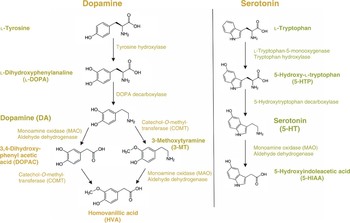
Impulsive aggression manifests in ASPD largely in the form of violence and in BPD largely in the form of relational aggression (see, e.g., Crick et al., Reference Crick, Murray-Close and Woods2005). Impulsive aggressive behaviors are also observed in many other disorders associated with dysregulated 5-HT function, including substance abuse, mood disorders, and posttraumatic stress disorder (see Gollan et al., Reference Gollan, Lee and Coccaro2005). Research with rodents and nonhuman primates indicates that 5-HT depletion leads to aggressive behavior (for review, see Lucki, Reference Lucki1998). Cross-sectional research with humans also links low 5-HT to aggression (Brown, Goodwin, Ballenger, Goyer, & Major, Reference Brown, Goodwin, Ballenger, Goyer and Major1979). For example, early research with aggressive children demonstrated reduced levels of the 5-HT metabolite, 5-hydroxyindoleacetic acid (5-HIAA), in cerebrospinal fluid (Kruesi et al., Reference Kruesi, Rapoport, Hamburger, Hibbs, Potter and Lenane1990). More importantly, longitudinal studies of at risk children with disruptive behavior disorders implicate reduced 5-HT in later aggressive and antisocial behavior (Kruesi et al., Reference Kruesi, Hibbs, Zahn, Keysor, Hamburger and Bartko1992).
In a recent study, reduced 5-HT reactivity to fenfluramine among children predicted antisocial personality traits 9 years later (Flory, Newcorn, Miller, Harty, & Halperin, Reference Flory, Newcorn, Miller, Harty and Halperin2007). Fenfluramine causes synaptic 5-HT release, which results in limbic–hypothalamic release of peripheral prolactin (Pine et al., Reference Pine, Coplan, Wasserman, Miller, Fried and Davies1997). Lower levels of peripheral prolactin indicate lower levels of 5-HT release following fenfluramine challenge. In heterogeneous sample of comorbid PD subjects, reduced reactivity to fenfluramine was related to recent impulsive aggression (Coccaro, Kavoussi, & Hauger, Reference Coccaro, Kavoussi and Hauger1997). This finding has also been observed in antisocial violent offenders (O'Keane et al., Reference O'Keane, Loloney, O'Neil, O'Connor, Smith and Dinam1992) and nonhuman primates (Botchin, Kaplan, Manuck, & Mann, Reference Botchin, Kaplan, Manuck and Mann1993).
Some researchers believe that impulsive aggression may also be directed at the self and involve similar mechanisms as externalized aggression (Gollan et al., Reference Gollan, Lee and Coccaro2005). Consistent with this view, individuals with histories of self-injury have increased levels of sociopathy, anger, and aggression (Simeon & Favazza, Reference Simeon, Favazza, Simeon and Hollander2001). Furthermore, a substantial amount of research relates suicide and self-injury, independent of psychiatric diagnosis, to serotonergic dysfunction (see for a review, Mann, Reference Mann2003). Many studies have found lower levels of 5-HT and 5-HIAA in the cerebrospinal fluid of suicide victims and attempters. Low levels of this metabolite have been found in suicide attempters, relative to nonattempters with the same psychiatric disorder, including PDs (Mann et al., Reference Mann, Malone, Psych, Sweeney, Brown and Linnoila1996, Reference Mann, Huang, Underwood, Kassir, Oppenheim and Kelly2002).
As with DA, we do not consider frontal dysfunction of 5-HT, despite its relationship to adult impulsive aggression and suicide, to be an early predisposing vulnerability to trait impulsivity because these brain regions mature very late in adolescence. However, 5-HT neurons are likely to influence the development of the frontal cortex (Jacobs & Azmitia, Reference Jacobs and Azmitia1992). Research indicates clearly that 5-HT neurons affect the development of other brain functions, such as GABAergic neurotransmission and anxiety during key stages of development. 5-HT also modulates the activity of other neurotransmitters, including DA (Rogeness, Javors, & Pliszka, Reference Rogeness, Javors and Pliszka1992).
Like impulsivity derived from central DA dysfunction, trait anxiety is highly heritable (see Derryberry, Reed, & Pilkenton-Taylor, Reference Derryberry, Reed and Pilkenton-Taylor2003). However, the two traits have dissociable neural substrates, and appear to be largely independent in their heritable contributions to behavior. Thus, an individual may be high or low on either or both traits, with specific implications for behavioral functioning (Beauchaine & Neuhaus, Reference Beauchaine, Neuhaus, Beauchaine and Hinshaw2008). For example, impulsive children with ADHD and high trait anxiety, the latter reflective of greater sensitivity to environmental cues because of a more responsive septohippocampal system, respond better to treatment than children with ADHD who are low in trait anxiety (Jensen et al., Reference Jensen, Hinshaw, Kraemer, Lenora, Newcorn and Abikoff2001). In contrast, high impulsivity and low trait anxiety may reflect a “double vulnerability” to psychopathology and more serious externalizing behavior as these individuals respond strongly to reward but not to punishment. As noted by several authors, psychopaths exhibit excessive approach behavior coupled with a disturbing lack of anxiety and fear (see Fowles & Dindo, Reference Fowles, Dindo and Patrick2006).
Molecular genetics of impulsivity
From the above discussion, it is not surprising that molecular geneticists studying impulsivity have focused on genes that encode for dopaminergic and serotonergic neurotransmission. A brief overview of synthesis and metabolism pathways suggests a number of points at which DA and 5-HT function might be influenced by genes that affect neurotransmitter or conversion enzyme activity (see Figure 2).
Simplified synthesis and metabolism pathways for (left) dopamine (DA) and (right) serotonin. These pathways suggest a number of points at which dopaminergic and serotonergic function might be affected by, for example, genes that encode for neurotransmitter activity or conversion enzyme activity. DA is also converted into norepinephrine by DA β-hydroxylase, which in turn is converted into epinephrine by phenylethanolamine-N-methyltransferase (not shown). [A color version of this figure can be viewed online at journals.cambridge.org/dpp]

Both DA and 5-HT are biogenic amine neurotransmitters. This classification follows from a structural similarity derived from a common amine functional group. DA is synthesized from l-tyrosine, which is converted to l-dihydroxyphenylanaline (l-DOPA) by tyrosine hydroxylase. l-DOPA is then converted to DA by DOPA decarboxylase. In turn, DA is metabolized into other catecholamines (norepinephrine, epinephrine) by DA β-hydroxylase. All catecholamines are degraded by MAO and catechol-O-methyltransferase (COMT).
In contrast to DA, 5-HT is synthesized from l-tryptophan, which is converted to 5-hydroxy-l-tryptophan by tryptophan hydroxylase. Tryptophan hydroxylase is then converted to 5-HT by 5-hydroxytryptophan decarboxylase. Like DA, 5-HT is degraded by MAO (Figure 2).
These synthesis and metabolism pathways, along with knowledge of receptor densities and subtypes, reveal a number of mechanisms through which individual differences in impulsivity and other personality attributes such as depression and trait anxiety might be conferred (see, e.g., Cloninger, Reference Cloninger1987, Cloninger, Svrakic, & Svrakic, Reference Cloninger, Svrakic and Svrakic1997). In part because MAO degrades DA and 5-HT, which affects the availability of both neurotransmitters, genes that encode for MAO activity have received considerable attention in research on both externalizing and internalizing outcomes. Genes that encode for COMT activity, which affects the rate of DA metabolism, have also been studied. We therefore begin with brief descriptions of research on these genes, which we follow with discussion of genes that encode for DA and 5-HT receptor and transporter expression. Note that the biochemistry and functions of each gene discussed could be described in a full length article. Because of space constraints, our descriptions are necessarily concise.
MAOA
MAO is an enzyme that catabolizes all biogenic amines, including DA and 5-HT. A long history of research links MAO dysfunction to conduct problems, aggression, substance use, and depression (Reich, Hinrichs, Culverhouse, & Bierut, Reference Reich, Hinrichs, Culverhouse and Bierut1999; Shih & Thompson, Reference Shih and Thompson1999). MAO activity is encoded by two subtypes of MAO genes, MAOA and MAOB. Given the association between MAOA and 5-HT function, it is of particular interest in research on antisocial and borderline pathologies. Polymorphisms in the MAOA gene (locus Xp11.23–11.4), including a variable number tandem repeat (VNTR) in the promotor region, have been identified. Longer repeats (3.5, 4, and 5) are associated with higher production of MAOA, and thus more efficient clearance of DA and 5-HT, in contrast to the three repeat allele. Variation in this gene has been linked with aggression, antisocial behavior, alcoholism, and depression (Cravchik & Goldman, Reference Cravchik and Goldman2000; Gutierrez, et al., Reference Gutierrez, Arias, Gasto, Catalan, Papiol and Pintor2004; Rottmann et al., Reference Rottmann, Smolka, Syagailo, Okladnova, Rommelspacher and Winterer1999). Knockout mice in which the MAO gene is deleted are aggressive, yet their behavior is normalized by restoring MAO levels (Cases et al., Reference Cases, Seif, Grimsby, Gaspar, Chen and Pournin1995; Shih & Thompson, Reference Shih and Thompson1999).
Research associating the MAOA gene with personality and clinical impairment is plagued by inconsistent findings. There are at least three reasons for this. First, MAOA gene function is especially sensitive to environmental regulation, highlighting the importance of environmental variables in mapping genotype → phenotype relations. This is illustrated in the recent study by Caspi et al. (Reference Caspi, McClay, Moffitt, Mill, Martin and Craig2002), who reported no main effect of the MAOA VNTR polymorphism on antisocial behavior but reported a significant MAOA × Child Maltreatment interaction (see above).
Second, in addition to the effects of environment in moderating genetic risk, vulnerability conferred by MAOA gene polymorphisms may also be potentiated by allelic variation in other high-risk genes. For example, Wang et al. (Reference Wang, Huang, Lin, Lo, Wu and Wang2007) found an MAOA VNTR 4-repeat allele × DA receptor D2 (DRD2) A1/A1 allele interaction in predicting alcoholism in males. Although research on Gene × Gene interactions remains limited, such studies are important given that genetic liability to most psychiatric disorders, including ASPD and BPD, is likely to be complex, with many different alleles contributing (see, e.g., Castellanos & Tannock, Reference Castellanos and Tannock2002; Gottesman & Gould, Reference Gottesman and Gould2003).
Finally, sex appears to moderate vulnerability conferred by polymorphisms in the MAOA gene. For example, although neither of the above interactions applied to women, Yu et al. (Reference Yu, Tsai, Hong, Chen, Chen and Yang2005) reported increased frequency of the 4-repeat allele in female patients with major depressive disorder, and better antidepressant (fluoxetine) responses in depressed women who were 3-repeat homozygous. Thus, MAOA gene polymorphisms confer vulnerability for psychopathology, which in turn, is moderated by other genes, environmental experiences, and sex. Sex effects, which predispose to externalizing behaviors among males and internalizing behaviors among females, may help to explain why males and females are at differential risk for ASPD and BPD.
COMT
COMT is an enzyme involved in the catabolism of catecholamines, including DA, epinephrine, and norepinephrine. A codon substitution resulting in a replacement of the methonine amino acid with the valine amino acid results in an increase in COMT enzyme activity. Thus, individuals with the val/val genotype (locus 22q11) have significantly higher COMT activity than those who are heterozygous or met/met homozygous (Lotta et al., Reference Lotta, Vidgren, Tilgmann, Ulmanen, Melen and Julkunen1995). This increased COMT efficiency results in lower synaptic DA activity. Val/val homozygotes therefore require excessive DA release to achieve the same level of post synaptic activation as those with at least one met allele.
The COMT gene has been implicated in the pathogenesis of both antisocial behavior and depression, which may be linked in part with sex differences in gene expression. High COMT enzymatic activity is observed in depressed women (Puzynski, Hauptmann, & Zaluska, Reference Puzynski, Hauptmann and Zaluska1983), and the val genotype confers vulnerability to mood episodes following stressful life events (Mandelli et al., Reference Mandelli, Serretti, Marino, Pirovano, Calati and Colombo2007). Furthermore, early-onset major depression is characterized by a higher prevalence of the val/val COMT genotype (Massat et al., Reference Massat, Souery, Del-Favero, Nothen, Blackwood and Muir2005). Finally, researchers recently identified both a main effect for the val/val genotype, and a Gene × Environment interaction with low birth weight (a condition frequently associated with hypoxia) in predicting the severity of antisocial symptoms in a group of 240 mostly male children with ADHD (Thapar et al., Reference Thapar, Langley, Fowler, Rice, Turic and Whittinger2005). Thus, although evidence remains preliminary, COMT polymorphisms may confer vulnerability following environmental risk exposure differentially based on unexplained sex effects.
DRD4
The DRD4 gene (locus 11p15.5) has well-characterized variants, including the 7-repeat (long) allele. This polymorphism has been linked consistently to ADHD (Faraone, Doyle, Mick, & Biederman, Reference Faraone, Doyle, Mick and Biederman2001; Swanson & Castellanos, Reference Swanson, Castellanos, Jensen and Cooper2002), novelty-seeking (Benjamin, Patterson, Greenberg, Murphy, & Hamer, Reference Benjamin, Li, Patterson, Greenberg, Murphy and Hamer1996; Ebstein et al., Reference Ebstein, Novick, Umansky, Priel, Osher and Blaine1996), blunted responding to DA agonists (Van Tol et al., Reference Van Tol, Wu, Guan, Ohara, Bunzow and Civelli1992), and exploratory behavior in animals (Fink & Smith, Reference Fink and Smith1980), effects that may derive from underresponsive postsynaptic receptors (Missale, Nash, Robinson, Jaber, Caron, Reference Missale, Nash, Robinson, Jaber and Caron1998). Genetic association studies suggest that the 7-repeat allele confers about a 1.5 relative risk for ADHD (Smalley et al., Reference Smalley, Baily, Palmer, Cantwell, McGough and Del-Homme1998). Thus, although the effects of this polymorphism on impulsivity appear to be modest, they are nevertheless consistent, and may interact with other high risk genes to potentiate risk for psychopathology (see below).
DA transporter (DAT1)
An additional candidate gene in the etiology of impulsivity is the DAT (locus 5p15.33), which modulates both synaptic and extrasynaptic DA levels, the primary regions at which psychostimulants exert their effects (Grace, Reference Grace, Solanto, Arnsten and Castellanos2001). The 10-repeat allele, which reduces the availability of synaptic DA through more efficient reuptake (Swanson et al., Reference Swanson, Flodman, Kennedy, Spence, Moyzis and Schuck2000), has been linked consistently with ADHD (Swanson & Castellanos, Reference Swanson, Castellanos, Jensen and Cooper2002). Neuroimaging studies indicate that this DAT1 polymorphism exerts its effects on behavior through altered DA activity within the striatum, a mesolimbic structure (Durston et al., Reference Durston, Fossella, Mulder, Casey, Ziermans, Vessaz and Van Engeland2008). Consistent with the deficient DA hypothesis of impulsivity, methylphenidate downregulates DAT activity, resulting in higher levels of striatal DA (Vles et al., Reference Vles, Feron, Hendriksen, Jolles, van Kroonenburgh and Weber2003).
There is also evidence of DAT1 gene involvement in both depression and BPD. For example, Haeffel et al. (Reference Haeffel, Getchell, Koposov, Yrigollen, DeYoung and Klinteberg2008) reported that DAT1 polymorphisms interacted with maternal rejection to predict depression in a sample of Russian male juvenile detainees. Furthermore, Joyce and colleagues (Reference Joyce, McHugh, McKenzie, Sullivan, Mulder and Luty2006) found that the nine-repeat allele of the DAT1 gene was associated with BPD among depressed adults. Within suicidal and nonsuicidal self-injuring populations, however, there is a more reliable association between DA deficiency and self-injurious behaviors (see Pitchot et al., Reference Pitchot, Reggers, Pinto, Hansenne, Fuchs and Pirard2001; Ryding, Ahnlide, Lindstrom, Rosen, & Traskman-Bendz, Reference Ryding, Ahnlide, Lindström, Rosén and Träskman-Bendz2006; Sher et al., Reference Sher, Oquendo, Li, Burke, Grunebaum and Zalsman2005). However, the precise genetic mechanisms have yet to be elucidated, and this research has largely been conducted among males and with small sample sizes, necessitating further investigation.
DRD2
The DRD2 receptor modulates DA synthesis and regulates DAT activity (Mayfield & Zahniser, Reference Mayfield and Zahniser2001). Although relations between the DRD2 gene (locus 11q23) and ADHD have been inconsistent (see Sagvolden et al., Reference Sagvolden, Johansen, Aase and Russell2005), DRD2 polymorphisms have been associated with risk for alcoholism, particularly when comorbid with symptoms of CD and/or ASPD (Lu, Lee, Ko, & Lin, Reference Lu, Lee, Ko and Lin2001). This relationship may be mediated in part by the effects of the DRD2 A2/A2 allele on reward-related impulsivity (Limosin et al., Reference Limosin, Loze, Dubertret, Gouya, Ades and Rouillon2003). Other researchers, however, have implicated the A1/A1 and A1/A2 alleles in sensation seeking and active avoidance of aversive states (Berman, Ozkaragoz, Young, & Noble, Reference Berman, Ozkaragoz, Young and Noble2002). Although these seemingly discrepant findings need to be disentangled in future research, there appears to be some link between the DRD2 gene and vulnerability to externalizing psychopathology.
5-HT transporter (5-HTT)
5-HT is clearly implicated in the pathogenesis of depression (see above), and manipulation of this neurotransmitter represents the most common pharmacological treatment for mood disorders. 5-HTT is an important protein in the regulation of synaptic 5-HT. Genetic variation in the promoter region of this gene (locus 17q11.2) results in two common variants: short (s) and long (l) alleles. The long allele results in high production of 5-HTT, which is presumed to induce more rapid turnover, leading to less synaptic 5-HT. The 5-HTT gene has been associated repeatedly with depression. Those who are s/s homozygous are at increased risk for mood disorders, especially when they encounter adversity and early familial dysfunction (Taylor et al., Reference Taylor, Way, Welch, Hilmert, Lehman and Eisenberger2006), indicating an important Gene × Environment interaction (Wilhelm et al., Reference Wilhelm, Mitchell, Niven, Finch, Wedgwood and Scimone2006). This vulnerability to depression following stressful life events appears to be much stronger in women than in men (Mandelli et al., Reference Mandelli, Serretti, Marino, Pirovano, Calati and Colombo2007).
Violence has also been associated with disrupted 5-HT signaling (see above), and a variant of the 5-HTT gene has been linked with childhood aggression (Beitchman et al., Reference Beitchman, Baldassarra, Mik, De Luca, King and Bender2006). Homologous findings have been documented in animals, in which the s/s allele is associated with both excessive anxiety and aggressive behavior in response to novelty among primates with poor maternal caregiving histories (Suomi, Reference Suomi2004). Furthermore, primates with one or two copies of the s allele exhibit reduced 5-HT turnover following social stress (see Wrase, Reimold, Puls, Keinast, & Heinz, Reference Wrase, Reimold, Puls, Keinast and Heinz2006). Among young adult humans, the s allele has been linked to both ASPD and BPD symptoms (Lyons-Ruth et al., Reference Lyons-Ruth, Holms, Sasvari-Szekely, Ronai, Nemoda and Pauls2007). Of importance, males and females with the s allele are reactive to different types of stressors, and these Gene × Stress × Sex interactions result in different symptom profiles (Sjoberg et al., Reference Sjoberg, Nilsson, Nordquist, Ohrvik, Leppert and Lindstrom2006). The association between the 5-HTT gene and aggression is more prominent in males (Verona, Joiner, Johnson, & Bender, Reference Verona, Joiner, Johnson and Bender2006). In contrast, genetically vulnerable females are more likely to engage in self-injury. Some of our research, described both above and below, indicates an interaction between peripheral 5-HT and family dysfunction in predicting self-injury among adolescent girls. Thus, both overt aggression and self-injury must be considered in 5-HT– and 5-HTT–behavior relations (Courtet et al., Reference Courtet, Baud, Abbar, Boulenger, Castelnau and Mouthon2001).
Replicated associations between the 5-HTT gene and seemingly disparate behaviors such as aggression and depression indicate that the gene may mark broad vulnerability to psychopathology, perhaps conferred in part through negative affectivity (Perez et al., Reference Perez, Burns, Brown, Sachs-Ericsson, Plant and Joiner2007). Such a model is consistent with recent behavioral genetics conceptualizations of comorbidity, where a single latent liability is expressed in seemingly different ways because of moderating influences (Krueger & Markon, Reference Krueger and Markon2006), including sex effects. Viewed in this way, a common vulnerability to negative affectivity may lead to expressions of both depressive affect and aggressive behavior, with sex or sex-specific genetic and/or socialization mechanisms potentiating the particular expression of this trait (see e.g., Beauchaine, Hong, et al., Reference Beauchaine, Neuhaus, Brenner and Gatzke-Kopp2008). This provides yet another example of sex effects moderating links between genetic vulnerability and behavior.
Gene × Gene interactions
As alluded to above, recent research has indicated that high risk alleles may interact to increase risk for psychopathology, over and above the main effects of single genes. Schmidt, Fox, and Hamer (Reference Schmidt, Fox and Hamer2007) assayed both the 5-HTT and DRD4 genes in a sample of 108 children who were 7 years old. Those who had a short copy of the 5-HTT allele and a long copy of the DRD4 allele scored highest on both internalizing and externalizing behaviors. Given the sex effects discussed above, one question that emerges from this study is whether sex moderated the Gene × Gene interaction effect, with externalizing behaviors more likely among males and internalizing behaviors more likely among females. Unfortunately, the authors did not include sex in their models. In contrast, in a large sample of adults, Mandelli et al. (Reference Mandelli, Serretti, Marino, Pirovano, Calati and Colombo2007) reported a 5-HTT × COMT interaction in predicting the onset of major depression following exposure to significant life stressors, mainly among women. These findings illustrate the importance of (a) assessing Gene × Gene interactions in characterizing polygenic vulnerability to psychopathology and (b) evaluating the effects of environment on genetic vulnerability.
Interim summary
Trait impulsivity, which derives from both dopaminergic and serotonergic mechanisms, appears to confer vulnerability to both antisocial and borderline pathologies. A number of genes that affect dopaminergic and serotonergic neurotransmission, including MAOA, COMT, DRD4, DAT1, DRD2, and 5-HTT, have been implicated in the expression of impulsivity, aggression, anxiety, depression, or some combination of these traits. For several of these genes, phenotypic expression of vulnerability may be moderated by poorly understood sex effects. The MAOA polymorphism appears to confer vulnerability to externalizing behaviors among males and internalizing behaviors among females. Similarly, the Val/Val COMT genotype, which renders carriers more vulnerable to psychopathology following stressful life events, may be more likely to potentiate antisocial behavior among males versus depression among females. Furthermore, although sex effects have not been reported for the DAT1 gene, longer repeats have been linked to ADHD, depression, and BPD. Finally, the short allele of the 5-HTT appears more likely to confer vulnerability to aggression among males and self-injury among females. These Gene × Sex interactions may help to explain why similarly vulnerable males and females develop ASPD and BPD, respectively. However, replications are needed before firm conclusions can be drawn. We now follow up our earlier discussion by elaborating on the influence of environment on the expression of antisocial and borderline pathologies.
Environmental Risk for Antisocial and Borderline Personality Development
Antisocial behavior
As noted above, there is a long tradition of research addressing environmental risk factors for antisocial personality development. Although much of this research has focused on middle childhood and adolescence, evidence suggests that parent–child relationships are compromised as early as infancy among children at risk for later conduct problems and antisocial behavior (Lyons-Ruth, Reference Lyons-Ruth2008), and that parents who had CD themselves offer adverse rearing environments for their children, including disrupted parenting, socioeconomic disadvantage, and relationship violence (Jaffee, Belsky, Harrington, Caspi, & Moffitt, Reference Jaffee, Belsky, Harrington, Caspi and Moffitt2006). Thus, Gene × Environment correlations are clearly operative in the development of ASPD (Moffitt, Reference Moffitt2005).
Research from the Harvard Family Pathways Study (Lyons-Ruth et al., Reference Lyons-Ruth, Holmes and Hennighausen2005), a longitudinal research project in which participants were followed from infancy to young adulthood, indicates some potential mechanisms through which genetic vulnerabilities and environmental risk factors combine to potentiate the development of antisocial and borderline pathologies. In this study, infants who were referred for home visits because of poor quality of care were more likely than their peers to exhibit antisocial and borderline symptoms as adolescents. In addition, children of mothers who withdrew from attachment cues during lab visits, and children who experienced significant trauma during their upbringing, were more likely to develop antisocial and borderline symptoms (Lyons-Ruth, Reference Lyons-Ruth2008). Furthermore, participants with two copies of the 5-HTT s allele had a fourfold risk of antisocial and borderline pathologies as adults (Lyons-Ruth et al., Reference Lyons-Ruth, Holms, Sasvari-Szekely, Ronai, Nemoda and Pauls2007). Thus, consistent with findings summarized above, the s allele conferred particular vulnerability to environmental risk exposure.
In later childhood, coercive family processes contribute to further development and maintenance of externalizing behaviors (Patterson et al., Reference Patterson, DeBaryshe and Ramsey1989, Reference Patterson, DeGarmo and Knutson2000). In an elegant series of studies, Snyder and colleagues (Snyder, Edwards, McGraw, Kilgore, & Holton, Reference Snyder, Edwards, McGraw, Kilgore and Holton1994; Snyder, Schrepferman, & St. Peter, Reference Snyder, Schrepferman and St. Peter1997) demonstrated that dyadic interaction patterns in the families of aggressive children are characterized by coercive exchanges that negatively reinforce both aggression and emotional lability. In such exchanges, parents of aggressive children tend to match and at times exceed the aversiveness and arousal level of their child, who in turn, matches or exceeds the aversiveness and arousal level of his/her parent. Eventually, this escalation terminates the antagonistic interaction, reinforcing aggression, heightened autonomic arousal, and emotional lability. Such coercive exchanges often begin in the first 5 years of life (Campbell, Pierce, Moore, Marakovitz, & Newby, Reference Campbell, Pierce, Moore, Marakovitz and Newby1996; Patterson, Capaldi, & Bank, Reference Patterson, Capaldi, Bank, Pepler and Rubin1991) and are enacted thousands of times over the course of development, producing automated patterns of aversive behavior and negative emotional responding (see Beauchaine et al., Reference Beauchaine, Gatzke-Kopp and Mead2007). Importantly, both parents and children contribute to the coercive process. Impulsive children elicit reactions from caregivers that exacerbate their preexisting genetic vulnerabilities (O'Connor, Deater-Deckard, Fulker, Rutter, & Plomin, Reference O'Connor, Deater-Deckard, Fulker, Rutter and Plomin1998). Such evocative gene–environment correlations occur when children's challenging behaviors are met with ineffective and coercive parenting, which amplifies risk for progression to more serious externalizing behaviors. This process also involves passive gene–environment correlation, as impulsive children are more likely to have impulsive parents who overreact to defiant or provocative behavior.
In addition to the family environment, both peer influences and neighborhood effects contribute to the development and continuance of antisocial behavior (see, e.g., Hiatt & Dishion, Reference Hiatt, Dishion, Beauchaine and Hinshaw2008). Dishion and colleagues (Nelson & Dishion, Reference Nelson and Dishion2004; Piehler & Dishion, Reference Piehler and Dishion2008) have demonstrated powerful longitudinal associations between deviant peer group affiliations in adolescence and later antisocial behavior in adulthood. Importantly, these findings are not merely correlational. Experimental research in which at-risk adolescents are assigned randomly to group-based interventions often result in increases in delinquency among treated participants compared with nontreated controls (Dishion et al., Reference Dishion, McCord and Poulin1999; Dodge, Dishion, & Lansford, Reference Dodge, Dishion and Lansford2006).
Finally, impulsive children who are reared in neighborhoods characterized by socioeconomic disadvantage, violence, and crime are at higher risk for delinquency than their peers. For example, Lynam et al. (Reference Lynam, Caspi, Moffitt, Wikström, Loeber and Novak2000), using both neuropsychological tests and self-report measures, demonstrated that impulsive boys are far more likely than nonimpulsive boys to engage in both status offenses and violent crimes, yet only when they live in low socioeconomic status neighborhoods with high rates of delinquency. No such relation was found in moderate to high socioeconomic status neighborhoods. Given the considerable heritability of impulsivity, this likely reflects a Gene × Environment interaction that has since been replicated in an impressively large sample (Meier et al., Reference Meier, Slutske, Arndt and Cadoret2008).
Following from the above discussion, we have proposed a biosocial developmental model of ASPD that begins with preexisting genetic vulnerabilities, which predispose to trait impulsivity (Beauchaine et al., Reference Beauchaine, Gatzke-Kopp and Mead2007). In high risk contexts in which coercive family processes are operative, this genetic vulnerability is potentiated, leading to aggression, emotional lability, and significant risk for serious conduct problems. Children along this trajectory are especially vulnerable to the influences of deviant peer groups and high-risk neighborhoods characterized by violence and criminality. Our biosocial developmental model of ASPD is summarized in Figure 3.
A biosocial model of antisocial and borderline personality development. (Left) Genetic vulnerability interacts with environmental risk to produce oppositional behavior and chronic emotion dysregulation, eventuating in antisocial behavior among boys and borderline traits among girls. (Right) A protective environment buffers vulnerable children from developing emotional and behavioral dysregulation. Adapted from “Polyvagal Theory and Developmental Psychopathology: Emotion Regulation and Conduct Problems From Preschool to Adolescence,” by T. P. Beauchaine, L. Gatzke-Kopp, and H. K. Mead, Reference Beauchaine, Gatzke-Kopp and Mead2007, Biological Psychology, 74. Copyright 2007 Elsevier. Adapted with permission. [A color version of this figure can be viewed online at journals.cambridge.org/dpp]

Borderline pathology and self-injurious behavior
As noted, the development of BPD has not been studied as extensively as the development of antisocial behavior. Consequently, no clear etiological pathways to BPD have been identified to date. Nevertheless, it is likely that there are impairing precursors to the disorder (Crick, Woods, Murray-Close, & Han, Reference Crick, Woods, Murray-Close, Han, Freeman and Reinecke2007), with emerging evidence supporting a similar developmental progression to that described above for ASPD. Longitudinal studies conducted over impressively long periods of time now indicate that parent–child relationships characterized by early disrupted attachment, poor quality of care, and significant trauma confer risk for the development of borderline symptoms in adulthood (Lyons-Ruth, Reference Lyons-Ruth2008). Thus, early childhood experiences are similar for those who develop ASPD and those who develop BPD (see above). This confirms earlier retrospective reports (e.g., Norden et al., Reference Norden, Klein, Donaldson, Pepper and Klein1995), and is consistent with the observation that individuals with ASPD and individuals with BPD often are reared within the same families (Goldman et al., Reference Goldman, D'Angelo and DeMaso1993).
Limited empirical work has appeared describing risk factors for BPD in middle and later childhood. Nevertheless, evidence suggests that by late childhood and adolescence, borderline features, including hostile attributional styles and relational aggression, can be identified, and are moderately stable (see, e.g., Crick et al., Reference Crick, Murray-Close and Woods2005, Reference Crick, Woods, Murray-Close, Han, Freeman and Reinecke2007). Furthermore, heterotypic continuity in symptoms from early childhood to late adolescence and early adulthood has been observed. For example, Caspi and colleagues assessed genetic, temperamental, and environmental risk factors for personality disturbance in a high risk sample (e.g., Caspi, Moffitt, Newman, & Silva, Reference Caspi, Moffitt, Newman and Silva1996). When participants reached age 18, Caspi and Silva (Reference Caspi and Silva1995) described a group who were undercontrolled/impulsive as 3-year-olds. As young adults, many of these individuals identified themselves as mistreated or victimized. In addition, they were danger seeking and impulsive, prone to react with negative emotional lability to daily events, and deeply involved in adversarial relationships. In other words, these impulsive and maltreated children later experienced dysregulation across behavior, emotions, cognitions, and interpersonal relations.
As with ASPD, family processes also appear to be important in the development of borderline pathology. Although no empirical data exist describing coercive interaction processes in families of those with borderline features, Linehan (Reference Linehan1993) has proposed similar socialization mechanisms. According to her model, emotion dysregulation is socialized through negative reinforcement within an invalidating family context characterized by reciprocal transactions between a challenging child and an ineffective caregiver. More specifically, Linehan proposed that emotion dysregulation emerges within an environment typified by a lack of tolerance for the outward expression of private emotional experiences (i.e., those that cannot be validated by external events). Within such an environment, vulnerable children are unable to learn appropriate strategies for understanding, labeling, and coping with their emotions. Concurrent with this emotional invalidation, caregivers intermittently reinforce extreme expressions of emotion, communicating to their child that his/her needs are more likely to be met following angry or dysregulated outbursts. Thus, an invalidating family environment reinforces intense emotional displays while simultaneously communicating that such emotions are unwarranted and/or inappropriate. As a consequence, the child struggles with the appropriate expression of emotion and instead vacillates between the extremes of lability and inhibition.
Although longitudinal data testing Linehan's theory have yet to be reported, limited cross-sectional findings are consistent with her model. For example, in the recent study of biological and behavioral correlates of self-injury among adolescent females described above, we reported that peripheral 5-HT, a putative marker of trait impulsivity (see above), was reduced among self-injuring teens (Crowell et al., Reference Crowell, Beauchaine, McCauley, Smith, Stevens and Sylvers2005). Independently, however, peripheral 5-HT was only a weak predictor of lifetime self-injurious events. Yet in conjunction with observational ratings of negativity and conflict within the mother–daughter dyad, peripheral 5-HT accounted for a remarkable 64% of the variance in self-injurious behaviors (Crowell, Beauchaine, McCauley, et al., Reference Crowell, Beauchaine, McCauley, Smith, Vasilev and Stevens2008). This statistical interaction indicates that the behavioral effects of low peripheral 5-HT are moderated by aversive family interaction patterns. Thus, as with ASPD, biological vulnerabilities to BPD appear to be potentiated by high risk family environments.
Much has also been learned about environmental risk for self-injury. Although not all self-injuring adolescents are on a BPD trajectory, the two populations overlap significantly. As noted above, both conditions are characterized by comorbidity of internalizing and externalizing psychopathology (e.g., Verona, Sachs-Ericsson, & Joiner, Reference Verona, Sachs-Ericsson and Joiner2005). Moreover, there is a high rate of self-inflicted injury among those with BPD, with approximately 40–90% engaging in nonsuicidal self-injury or making a suicide attempt during their lifetime (APA, 2000). Overlapping environmental risk factors include poverty and familial chaos, neglect, and invalidation (Johnson, Cohen, Brown, Smailes, & Bernstein, Reference Johnson, First, Cohen and Kasen2008; Johnson et al., Reference Johnson, Cohen, Brown, Smailes and Bernstein1999). Self-injurious behaviors are often impulsive, while also serving to regulate overwhelmingly negative mood (Klonsky, Reference Klonsky2007).
As with ASPD, peer influences contribute to the development and persistence of self-inflicted injury and suicidal ideation. In a ground-breaking series of studies, Prinstein, Boergers, Spirito, Little, and Grapentine (Reference Prinstein, Boergers, Spirito, Little and Grapentine2000) have demonstrated contagion effects of self-injury and suicidal ideation, which are often learned from deviant peers. Furthermore, many adolescents who engage in self-injury do so in part for social reinforcement purposes (Nock & Prinstein, Reference Nock and Prinstein2004, Reference Nock and Prinstein2005). Thus, these borderline features appear to emerge from the combination of trait impulsivity, adverse family contexts, and deviant peer group affiliations.
Following from this discussion, our biosocial developmental model of BPD, which parallels the previously discussed pathway to ASPD, is depicted in the left panel of Figure 3. We propose that trait impulsivity is the primary vulnerability to borderline pathology. Within high risk (i.e., invalidating and coercive) family environments, this vulnerability is potentiated, primarily among girls, through intermittent reinforcement of emotional lability and aggression (physical and/or relational), leading to heightened negative affectivity, interpersonal conflict, and chronic dysregulated mood. Children on a BPD trajectory are also at risk for continued failure to navigate developmental and social challenges, perhaps because of a hostile or paranoid attributional style. By adolescence, the combination of impulsivity, mood symptoms, and disrupted interpersonal relationships, in conjunction with deviant peer group affiliations, increases risk for more extreme maladaptive regulatory behaviors such as self-inflicted injury. Although not all people with BPD engage in self-injury, the function that the behavior serves is common to nearly all adults with BPD. Dysregulated, mood-dependent behaviors (e.g., self-injury, explosive anger, substance abuse) are a primary means of coping among those with the diagnosis.
Interim summary
In addition to the common biological vulnerabilities outlined in earlier sections, risk factors for antisocial and borderline personality development are quite similar. For both disorders, environmental risk, including poor quality of care, disrupted attachment relationships, socioeconomic disadvantage, and abuse and neglect, is often expressed beginning in infancy. By early childhood, coercive and invalidating family processes become operative. These family interaction patterns, which are enacted countless times over the course of development, negatively reinforce emotional lability, aggression, and in some cases interpersonal violence. Thus, at-risk children acquire automated response patterns of emotional dysregulation, which are overlaid onto heritable trait impulsivity. In later childhood and adolescence, deviant peer group affiliations emerge in which boys on an antisocial trajectory learn delinquent behaviors from their friends and in which girls on a borderline trajectory learn self-injurious behaviors from their friends. These parallel processes can be captured by a single developmental model.
Concluding Remarks
In this article we have proposed a unified theory of antisocial and borderline personality development that accounts for a number of overlapping biological vulnerabilities, environmental risk factors, and outwardly expressed features of ASPD and BPD. To date, the literatures on these two disorders have been largely disconnected, with a few notable exceptions (e.g., Norden et al., Reference Norden, Klein, Donaldson, Pepper and Klein1995; Paris, Reference Paris1997).
A primary advantage of specifying etiological pathways to psychopathology is the development of targeted interventions that address causal processes directly (see, e.g., Beauchaine & Marsh, Reference Beauchaine, Marsh, Cicchetti and Cohen2006). For example, identifying family coercion in the etiology of delinquency (Patterson, Reference Patterson1982) led to more refined interventions for conduct problems that target the specific parent and child behaviors that maintain and advance antisocial behavior patterns (e.g., Webster-Stratton & Hammond, Reference Webster-Stratton and Hammond1997). To our knowledge, comparable middle childhood interventions for borderline personality development do not yet exist. However, if Linehan's (Reference Linehan1993) theory of etiology is correct and similar family processes support borderline personality development, interventions can and should be formulated that target the invalidation and negative reinforcement of emotional liability described above. Furthermore, knowledge of the etiology of borderline pathology tells us that girls who live in families with a delinquent boy should not be overlooked when a parent–child intervention targeting the boy is initiated.
It is important to note that several aspects of our theory, especially those specific to BPD development, need to be confirmed through additional studies. As we acknowledge above, much less empirical work has described trajectories to BPD, and Linehan's (Reference Linehan1993) invalidation model needs to be verified. Doing so will require painstaking coding of family interactions, similar to the work conducted by Snyder and colleagues describing microsocial behavior patterns in the families of delinquent and aggressive children (e.g., Snyder et al., Reference Snyder, Schrepferman and St. Peter1997).
Finally, our shared etiology hypothesis rests on the assumption that at least some high-risk genes confer differential vulnerability to aggression and mood dysregulation in boys versus self-injury and mood dysregulation in girls. Although we provided preliminary support for this assumption, several findings need to be replicated in future studies. Whether or not such replication is realized, we hope that our common theory of antisocial and borderline personality development provides an organizing framework for future studies that advance our understanding of these two very costly mental health conditions.