Collaboration and the Internet
Recent research shows that the Internet, by sharply reducing the real costs of sharing information, has profoundly impacted collaboration between faculty in different departments. Using information on spatial-temporal Bitnet connections, Agrawal and Goldfarb (Reference Agrawal and Goldfarb2006) find that Internet connectivity increased collaboration between those connected universities by 85%. Extensively analyzing faculty productivity at the top 25 universities during the last three decades, Kim, Morse, and Zingales (Reference Kim, Morse and Zingales2006) report that the Internet has significantly lowered department-specific research externalities in economics and finance by giving those outside of top schools access to productive research colleagues within top schools. Concomitant with this decline in location-specific externalities, they also report that salaries at those top universities have increased since the universities are less able to appropriate any rent based on research productivity created by physically being located at that university. One of the reasons that physical location is less important is e-mail. Walsh and Maloney (Reference Walsh and Maloney2003), using information from four fields (experimental biology, mathematics, physics, and sociology), find that e-mail has significantly reduced coordination problems in research collaboration.
In this paper we examine the effect of the Internet on inter-department collaboration in the fields of political science and economics. We felt justified in including the economic journals in the analysis, in part, because of the high regard that political scientists have for the top economics journals. In the most recent rankings of journals (Garand and Giles Reference Garand and Giles2003), political scientists ranked the American Economic Review and the Journal of Political Economy, both of which we use in the analysis, first and sixth in terms of the overall quality of the articles published. We are particularly interested in the differential impact that the Internet has had on researchers outside the top-tiered departments. Historically, researchers within the top departments had the advantage of access to a high quantity of select collaborators in the form of departmental colleagues. The Internet, however, should have diminished this advantage by reducing the location-specific knowledge externalities that existed across departments so that it is no longer necessary to be at a top research lab or university department to be able to collaborate with the best intellects in a given field.
In the sections that follow we first develop a simple model of co-authorship for political science and economics research. Our model suggests that as the Internet reduced coordination costs of working with others outside scholars' own departments, the number of inter-departmental collaborations should have increased, especially among those outside the top universities. We then empirically test the predictions of the model using data from both political science and economics. The empirical results provide evidence supporting our hypotheses.
Internet and Research Access
We restrict our analysis to articles with multiple authors in order to examine the effect of the Internet on the likelihood of choosing a co-author outside of the same department, relative to the likelihood of choosing a co-author within the same department. Our model captures this simple case by assuming that outside and inside co-authors are perfect substitutes, once their potential productivity on the prospective paper has been taken into account.
Assume that researchers can produce an article by combining their own ability-adjusted efforts (E) with other resources (R). These other resources can come within the researcher's own department (D) or from other (O) sources outside of the department. In particular, with respect to co-authoring, D are the efforts of a co-author within the department and O are the co-authoring efforts of someone outside the department. These other co-authoring resource efforts, R, are such that

so that the marginal value of a departmental co-author's effort is λd, and the marginal value of an outside co-author's effort is λo. The additive nature of these research possibilities implies that they are perfect substitutes in the production of the article, once productivity differences in λd and λo are taken into account. So whether a researcher who needs a co-author will either go inside or outside the department depends on the relative costs and benefits of each option. Formally, let c d be the coordination costs of using a departmental co-author, and c o be the coordination costs of using an outside co-author. The implicit costs of the researchers own efforts being ψ. Then the problem the researcher faces is to optimize the value of publications net of costs (written as a constrained maximization problem to allow for corner solutions, in which either only a D-type or only an O-type co-author will be chosen):

where
V(E,R) = V(E,λd D + λoO) = value of publications
E = the researcher's own efforts
D = the research efforts of a co-author within the department
O = the research efforts of someone outside the department
C = total costs
λd = value of research effort from a departmental colleague
λo = value of research effort from a colleague outside the department
c d = cost of coordinating with a departmental colleague
c o = cost of coordinating with a colleague outside the department
ψ = cost of own efforts in producing an article
θ = LaGrange multiplier for the optimization problem
The solution, with respect to using a within or outside co-author, is to use an outside co-author if the relative marginal benefits of an outside co-author exceeds the relative marginal costs, i.e., if λ0/λd ≥ c o/c d then use O, otherwise if λ0/λd < c oc d then use D. The Internet may reduce c d slightly, but will yield a relatively large reduction in c o as it becomes much easier to pass research documents, copies of related research, computer programs, and data sets between individuals possibly separated by great distances. This causes the ratio c o /c d to fall, increasing the likelihood of using an outside co-author for co-authored papers. This will be true for both those within top-10 departments and elsewhere. However, those within top-10 departments will have a relatively low λ0/λd ratio (because top-10 departments, on average, have higher quality departmental co-authors than other departments), so we hypothesize that the Internet will have a larger impact on outside co-authorship for those outside of top-10 departments.
Hence we have two hypotheses:
H1: the Internet will increase the amount of interdepartmental co-authorships (i.e., decrease the amount of same department co-authorships), and
H2: this effect will be stronger outside the top-10 universities.
Data Sources
To test these hypotheses, we collected data on articles published from the American Political Science Review (APSR), American Journal of Political Science (AJPS), and Journal of Politics (JOP) for our analysis of the political science field, and articles published in the American Economic Review (AER), Journal of Political Economy (JPE), and Quarterly Journal of Economics (QJE) for our analysis of the economics field. We chose these journals because they have been consistently ranked as some of the most influential and important general-interest journals within their respective disciplines (for economics see Malouin and Outreville Reference Malouin and Outreville1987; Figlio Reference Figlio1994; for political science see Giles, Patterson, and Mizell Reference Giles, Patterson and Mizell1989; Garand and Giles Reference Garand and Giles2003) and have been used before in similar studies (e.g., Fisher et al. Reference Fisher, Cobane, Vander Ven and Cullen1998 in political science). All data for the articles used in this paper were retrieved from Journal Storage (JSTOR) electronic files available through the Internet,Footnote 1 put into Excel, and were then transferred to SAS data files. Once the files were in a SAS format, we generated co-author and same department dummy variables. Also, different journals have different formats that they use to report an author's name and affiliation. By working with several journals in the same data sets we had to account for this, so for both political science and economics we went through the data set and corrected the names of the authors and their affiliations so that they would be consistent across all observations.
In constructing the data, we also coded whether the affiliations of the authors were top-10 universitiesFootnote 2 and noted whether the article involved any statistical test (i.e., a t-test, regression, or one of its derivatives) and labeled this as an empirical paper. We controlled for whether the article was empirical because earlier research has shown a strong correlation between empirical articles and co-authoring (De Maio and Kushner Reference De Maio and Kushner1981; Fisher et al. Reference Fisher, Cobane, Vander Ven and Cullen1998).
The primary goal of this paper is to test how increased Internet use, for the purpose of research collaboration, among academics has affected inter-department co-authoring rates. To measure the extent that academics are using the Internet for the purpose of research collaboration, we chose to use the fraction of working papers listing an e-mail address. The theoretical reason for this decision is that political scientists and economists, like most academics, are rewarded for the quantity and quality of their publications. So researchers are motivated to get working papers out quickly and get feedback on research that often becomes dated, either because they realize that it is likely that others may be doing similar research or because what is considered a hot topic changes frequently. Tools that give them a comparative advantage in speeding up this process will be readily adopted. Listing one's e-mail address on working papers is one such tool.
The oldest and largest research working paper series available comes from the National Bureau of Economic Research (NBER). This series goes back a couple of decades, is readily available on the Internet, and is extensive both in the number of economic subfields listed and the quantity of articles listed in each subfield. This makes it the ideal series to benchmark Internet activity among social science researchers. Another reason to use the NBER working series for an analysis of political science and economic research is that the papers and authors in the NBER series are of the same high quality that get published in the APSR, AJPS, JOP, AER, JPE, and QJE.
Using the NBER series, we found virtually no working papers with e-mail addresses before and including December 1995 and virtually all papers have e-mail addresses beginning January 1999.Footnote 3 Between December 1995 and January 1999, the number of papers with e-mail addresses increased proportionately. Since there is a lag between when a paper is included in a working paper series and when it gets published, for the Internet variable we used a one-year lag of the variable that had been generated from the working paper series. This allowed us to control for the diffusion of the Internet based on the actual publication date of the paper, and thus all reported results for Internet are for the one-year lag. The effect of the Internet is then measured as zero up until December 1996 and one beginning January 1999, increasing linearly in between.
We also considered deriving our Internet measure using a working papers series in political science. However, the problem is that unlike economics, which has the NBER, political science does not have an organization collecting and posting large numbers of working papers from authors based outside the journal- or institute-affiliated organization. Working paper series in political science are run by institutes or departments where the participating authors are located full-time. Using such working paper series to estimate the level of Internet use among political scientists would likely underestimate the true level of use because many authors may not feel the need to put their contact information on the papers since it is already available on the same web site.
Although we did not use the political science working papers series directly in our estimation, we checked to make sure that the general trend in the NBER series we use matches those of the political science series that were available. Among the institutional and department working paper series that were available,Footnote 4 the correlation ranged from .56 to .94, giving us greater confidence that our measure closely captures Internet use among both political scientists and economists.
Empirical Model and Results
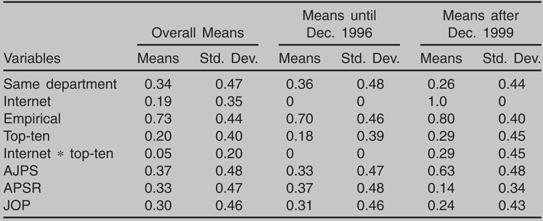
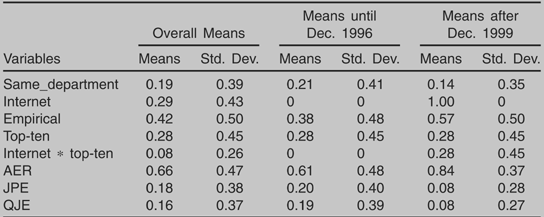
The means of the variables in the data set can be found in Table 1 for political science and Table 2Footnote 5 for economics. These tables also contain the means before the diffusion of the Internet as well as after, in order to compare and contrast the two periods. As the data show, there has been a drop in the percentage of co-authored papers where the co-authors are entirely located in the same department. However, these means may reflect trends that started before the Internet. To see how the Internet has affected the propensity to co-author within one's own department, and the Internet's differential impact for those at top-10 departments, we estimated the following regression model:

The controls include dummy variables for year, season of the journal issue, and whether the paper was empirical or not. For each author in the sample, αi is a separate effect, treated both as a fixed effect (so that each author's logit regression has a separate intercept) and as a random effect in the modeling. It allows us to control for everything time invariant with respect to each author, such as gender, graduate school, origin of birth, native ability, etc. We concentrate on examining the fixed effect estimates as they are the most robust, as they yield consistent estimates under the greatest variety of stochastic modeling assumptions, including when the individual author effect (αi) is correlated with the other variables in the model (including the Internet and whether the individual is at a top-10 university). The advantage of fixed-effects estimation is that each individual acts as his or her own control, so the effect of time changing characteristics (such as the Internet) can be estimated without bias. In Tables 3 and 4, these results are presented in the first column. While we do not discuss the random effects estimation, which comes from estimating a hybrid logistic model, we do present these results in the other two columns of Tables 3 and 4. Since we do not discuss the results of the hybrid logistic model we do not discuss the methodology in the paper, but do provide a discussion of these models in the Appendix.
Means for Political Science Analyses

Notes: N = 3,518. Different journals report names and affiliations differently and so we went through the data and corrected the names and affiliations so that they would be consistent. Also, while the effect of the Internet was calculated as a linear relationship increasing from 0 to 1 starting at 0 before January 1996 and reaching 1 by January 1999, the variable Internet used in the regressions is a one-year lag on the variable created such that the effect doesn't begin until January 1997 and is in full force by January 2000. This was done because there is a lag between submitting a working paper and actually getting it published in a journal.
Means for Economics Analyses

Notes: N = 11,117. Different journals report names and affiliations differently and so we went through the data and corrected the names and affiliations so that they would be consistent. Also, while the effect of the Internet was calculated as a linear relationship increasing from 0 to 1 starting at 0 before January 1996 and reaching 1 by January 1999, the variable Internet used in the regressions is a one-year lag on the variable created such that the effect doesn't begin until January 1997 and is in full force by January 2000. This was done because there is a lag between submitting a working paper and actually getting it published in a journal.
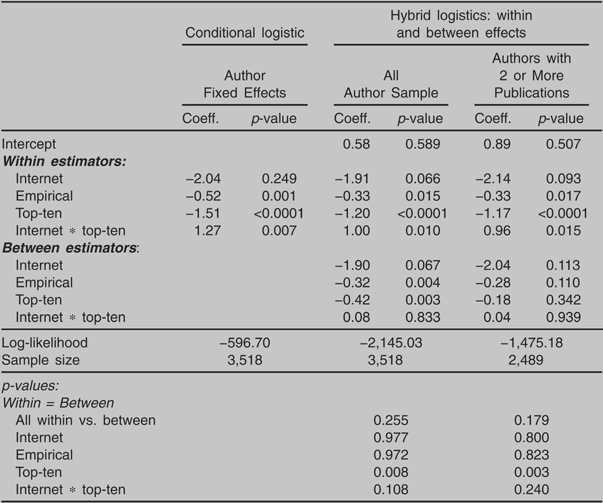
Political Science Same Department Co-Author Logistic Regressions

Note: All specifications included year dummies, journal dummies, and issue dummy variable effects. In the hybrid model, we used normalized pages = pages/(mean pages) as weights (hence, the average weight was one). Sample period 1980–2003. Random effects for each individual author were estimated in the hybrid model. Robust standard error probability significance levels (White covariance adjustments) were virtually identical to the model standard error probability significance levels reported here for the hybrid model.
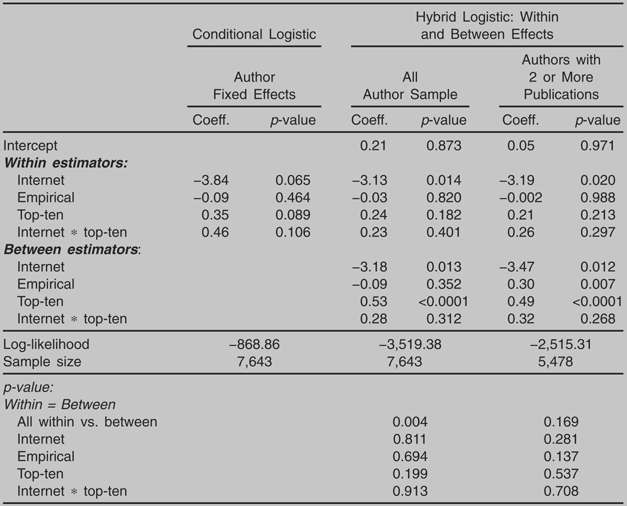
Economics Same Department Co-Author Logistic Regressions

Note: All specifications included year dummies, journal dummies, and issue dummy variable effects. In the hybrid model, we used normalized pages = pages/(mean pages) as weights (hence, the average weight was one). Sample period 1980–2003. Random effects for each individual author were estimated in the hybrid model. Robust standard error probability significance levels (White covariance adjustments) were virtually identical to the model standard error probability significance levels reported here for the hybrid model. The probability significance levels are for two-tailed tests of the coefficients. The models were run again using the original Internet variable without the lag. The sign switched for Internet, but became statistically insignificant in the first regression but stayed statistically significant in the second. The other variables stay the same in sign, magnitude, and statistical significance.
In the regressions reported the key response variables are Internet and Internet∗top-ten interaction. The variable Internet was generated using a one-year lag on the NBER working paper series and the variable Internet∗top-ten was generated by interacting the Internet variable with the dummy variable top-ten, which equals one if the given author was affiliated with a top-10 political science or economics program at the time of publication and zero otherwise. All model specifications used also included dummy variables for whether the article was empirical, whether the author was at a top-10 department, and the year, journal, and month of publication.
Recall that we derived two predictions from our model: (H1) that the Internet would increase the amount of collaboration (in the form of co-authorships) between departments, and (H2) that this effect would be smaller for those in top-10 departments. If the first prediction is correct, there will be a negative coefficient on the variable Internet, showing that fewer co-authored papers have authors who are all at the same school. If the second prediction is correct, the Internet∗top-ten interaction variable will be positive, showing that the Internet has had less of an impact on individuals at top-10 departments.
The results for the Internet and Internet∗top-ten variables are given in Tables 3 and 4 and show that with the exception of the Internet variable in the political science regression (i.e., Table 3) all of the results are significant at the 10% level or better.Footnote 6 Further, for both political science and economics, these variables are large in magnitude and have the predicted sign: the Internet had a large impact in increasing co-authorship across departments (the negative coefficient on Internet), but this effect was considerably smaller for those in top-10 departments (the positive coefficient on the Internet * top-ten interaction).
A rough approximation of the Internet's impact can be calculated by taking the derivative of the probability of being in the same department with respect to the Internet to get the percentage point reduction in the likelihood of co-authoring within one's own department that the Internet causes. In political science the difference between those in at top-10 departments and everyone else is huge. For those outside of the top-10 departments the Internet reduced the likelihood of co-authoring within one's own department by 45 percentage points; in contrast, there was only a 17 percentage point reduction for those at top-10 departments. This shows that the impact of the Internet significantly depended on whether one was at a top department.
We also checked for whether these effects varied based on the gender and seniority of the author. The results of these further analyses showed that there is not much evidence that there is a gender effect, but that there is evidence that seniority matters. For those at the top departments, greater seniority was related to an increased impact of the Internet on co-authoring with people from other departments. The effect was the exact opposite for those outside of the top departments where greater seniority was related to a decreased impact of the Internet on co-authoring with people from other departments. For space considerations we do not present these full results here, but are happy to provide them upon request.
Our model suggests that the reason that the impact of the Internet depended on whether one was at a top department is because individuals outside of the top departments were disadvantaged in having access to high-quality research expertise (in the form of potential co-authors) within their own departments. The Internet has helped to overcome this disadvantage by equalizing access to research expertise, and by allowing researchers greater ability to communicate and coordinate research efforts with individuals at other institutions, which has sharply increased the amount of inter-departmental collaboration among those outside the top-10 departments.
Conclusions and Future Directions
Traditionally, one of the advantages of being at a top department was that it was easier to find a co-author of high research expertise among one's own colleagues. Using data on co-authorship in some of the top journals in political science and economics, we have found evidence that the Internet has diminished this inequity by having an equalizing effect on access to research expertise. In particular, we have shown that for those papers that are jointly authored the Internet has increased the propensity to expand beyond one's own department to work with individuals from other locations; the effect is especially large for those outside the top-10 departments.
While we have looked at articles published in some of the top journals in political science and economics, the Internet may have had a very different impact on journals of lesser renown. It would be interesting to generate larger data sets that include more journals and include some variable for the rankings of the journals. This would help establish the effect of the Internet based on the quality of the journal.
Appendix
The results in the two left most columns of Tables 3 and 4 are from hybrid logistic regressions. One advantage of hybrid logistic regressions is that they allow one to test for the fixed vs. random effects formulation (Allison Reference Allison2005, 66). In addition to allowing for a test of the random effects model (relative to a fixed effects formulation), these hybrid regressions allow for the inclusion of both time-invariant (which must be excluded in fixed effects estimation) as well as time-changing regressors. In addition, the hybrid logistic model indicates what the source of parametric identification is—whether an estimated effect seems to be coming from differences in researchers publishing before and after the Internet was in place (between variation), or whether an estimated effect arises because of changes faced by a given individual (within variation).
To sort out within and between effects we transformed the longitudinal data given on the right hand side of equation into within differences (deviations from the mean that results in a fixed effect type of analysis), and between researcher differences (using the overall mean of the variables for each researcher):

By including both the deviations of variables about their mean to measure the within effect, and the average values for each researcher to measure the between effect, we generate two coefficients for each of our time varying regressors in equation 1. If identification of the Internet effect comes from within variation, then that coefficient on the deviation variable (X it − Xi) will be statistically significant. This is the source of identification we want from our model because we do not measure innate ability or quality of graduate education in our data, and to control for such time-invariant factors, we want to use the within researcher variation.
We present these hybrid logistic (within and between effects) regressions using the dependent variable same_department and looked only at jointly published papers to see the effects of our independent variables on publishing a co-authored paper with others from the same department, both for political science and economics, for the whole sample as well as for only those authors with at least two publications, as well as conditional logistic (for fixed effects see Chamberlain Reference Chamberlain1980) regressions for the same model. These results can be found in Tables 3 and 4 for political science and economics respectively. Tests for the feasibility of the random effects relative to the fixed effects models are given in the bottom of Tables 3 and 4 using Score tests.