


“All oppression creates a state of war. And this is no exception.” (De Beauvoir Reference De Beauvoir[1949] 2009)
INTRODUCTION
In 2015, some Palestinians began to support a type of resistance that falls outside traditional social science models of resistance: unstructured, individual violence.Footnote 1 Palestinian civilians—not members of violent groups, and without clearly articulated political goals—approached armed soldiers and attempted to stab them with kitchen knives.Footnote 2 Most were shot on sight. Israel had absolute territorial control, clear military superiority, and reliable intelligence to deter attacks, yet these civilians did not “comply” with the state (e.g., Kalyvas Reference Kalyvas2006). This violence had regional variation: some areas experienced many of these attacks, whereas others experienced few or none at all. In this article, I explore civilian support for this unstructured, individualized violence. Focusing on two areas of the West Bank, one in which this violence was common and another in which it did not occur, I inductively build theory about the nature and causes of support for this type of resistance, and discuss implications for civilian and state use of force in other contexts.
For Palestinians living in the West Bank’s Hebron Governorate, state-based violence structures daily life. Yet individuals respond to this violence differently. In Hebron’s divided city of al-Khalil, people live caged in an internationally renowned maze of checkpoints and closure obstacles, subject to circadian state violence, including surveillance, disruption, property damage, and (threats of) bodily harm. Al-Khalil’s Palestinians routinely express anger and frustration. Despite explicitly reporting no hope of relief from this state violence, they are largely supportive of individual, rather than collective, resistance against state oppression—and notably (although not exclusively) violent individual resistance.
Far south of al-Khalil sprawl the rural, arid villages in South Hebron Hills, a significant portion of which is designated as an Israeli military training ground (Firing Zone 918). Villagers here also experience daily, institutionalized state violence. The checkpoint apparatus and military training exercises around this region subject residents to surveillance, physical violence, movement restrictions, disruptive military exercises, and severe living conditions. Yet, despite low odds of dismantling the state’s role in this region, and in the face of rising unstructured violence across the rest of the West Bank, villagers here actively eschew the unstructured individual violence. Instead, they doubled down on collective organizing against state violence, voicing hope that their collective, nonviolent resistance would eventually shift their political circumstances. Why do residents of H2 support unstructured, individual civilian violence, whereas members of Firing Zone 918 eschew it?
I propose that Israel’s “built environment of conflict”—the physical apparatus states exert over contested spaces during ongoing conflicts—structures and curtails social relationships and processes in al-Khalil to such an extent that it not only changes individuals’ capacity for collective resistance (by making collective resistance more difficult) but also impacts their preference for collective organizing itself.Footnote 3 Here, checkpoint-induced social isolation fostered a sense of hopelessness that changed the way people thought about resistance and spawned a type of violent resistance that existing political science theories do not fully explain.
A state’s “built environment of conflict” can include checkpoints, closure obstacles, guard towers, or other surveillance networks built on physical landscapes. It is an expression of state power that surveils and disciplines individual behavior (e.g., Foucault Reference Foucault1975); disrupts community life; inhibits economic productivity; and instills physical violence, humiliation, and frustration on its subjects.Footnote 4 A state’s built environment of conflict can impact how individuals living in conflict areas think about resistance.Footnote 5 Checkpoints (Longo, Canetti, and Hite-Rubin Reference Longo, Canetti and Hite-Rubin2014), like other forms of state violence in the West Bank (Arnon Reference Arnon2018), increase civilian support for violent resistance.Footnote 6 However, these built structures are varied: states deploy checkpoints differently in different places, and therefore have different effects on daily life and social behavior.
I focus on checkpoints’ effects on social connection and social isolation. Social ties facilitate communities’ abilities to organize both violent (Parkinson Reference Parkinson2013; Petersen Reference Petersen2001; Staniland Reference Staniland2014; Weinstein Reference Weinstein2006) and nonviolent collective resistance efforts (Chenoweth and Stephan Reference Chenoweth and Stephan2011; Zunes Reference Zunes1994). Different checkpoint structures variously dismantle, augment, or leave intact social connections, which are fundamental to how people in conflict spaces muster the hope, drive, and agency to partake in collective struggle. I argue that checkpoints’ various effects on social connection (and isolation) foster support for divergent forms of resistance.
I focus on variation in the built environments of conflict in H2 (the Israeli military–controlled zone within al-Khalil) and Firing Zone 918 (the Israeli military–controlled zone within the South Hebron Hills). Specifically, checkpoints around villages in Firing Zone 918 impose personal, physical, and economic oppression but do not introduce social isolation among community members. Residents here supported collective, nonviolent resistance aimed to reduce their subjection to state violence. In contrast, H2’s checkpoint apparatus restricts freedom of movement within residents’ communities.Footnote 7 It isolates and frustrates individuals, fractures the social ties that help individuals cope with oppression, and limits individuals’ interest in engaging in collective resistance (as well as their practical ability to do so). These isolated individuals lack belief in the possibility of change, which, I argue, fundamentally alters their preferences or predispositions toward different resistance modalities. Feeling they have little more to lose and little hopeful to gain, harming a state actor allows individuals to express grievances. I suggest these individuals support unstructured, individual violent resistance as a result of their checkpoint-induced disconnection rather than because of a cost/benefit assessment of different resistance approaches.
This research centers on seventy-one original life-story and semistructured interviews, which I conducted in 2015–16 during the Intifada of Individuals, primarily among Hebron olive-farming communities. Olive farming represents a century-long economic and cultural centerpiece of Palestinian life, the continued existence of which is threatened by the current Israeli occupation. This approach allows me to inductively identify the relationships between checkpoint-induced social isolation or connection and support for various forms of resistance.
West Bank Palestinians’ daily experience of state violence are emblematic of broader and perhaps defining features of twenty-first-century governance. States encounter a tension between defending their publics from terrorist threats (real or imagined), on the one hand, and avoiding overtly targeting an unconvicted subset of their populace with undue rights restrictions, on the other. A purportedly innocuous solution for states is to increase “nonviolent” measures of state control, such as surveillance, checkpoints, and closure obstacles—actions that states justify as necessary to ensure security.
Meanwhile, although organized groups (e.g., al-Qaeda, the KKK, or the Irish Republican Army) dominate our heuristic models of terrorism, states experience unstructured individual violence at increasingly high rates. These attacks strain conventional understandings of terrorism and disrupt civilians’ sense of security. In this contemporary context marked by unstructured civilian violence—from certain mass shootings in the United States to car rammings in Europe to the West Bank’s Intifada of Individuals—understanding why individuals support unstructured, violent forms of resistance is a central research objective and policy question of this political moment.
Contributions
This research makes four contributions. First, it identifies and conceptualizes a type of resistance (unstructured violence) that political science theories do not fully explain. Twenty-first-century experiences of violence go beyond organized groups. Understanding how support for these sorts of unstructured violence comes about is of critical importance, not only to the West Bank but also to the United States and other countries that see increasing politicized violence that extends beyond terrorist groups. To examine this phenomenon, I develop a typology of resistance that encompasses the breadth of resistance activities and allows for the possibilities that both groups and individuals can leverage a range of resistance approaches (both violent and nonviolent, individual and collective) across time. I highlight that people who do not resist collectively or violently do not necessarily demobilize or comply (Kalyvas Reference Kalyvas2006). Instead, certain types of state violence might limit certain resistance activities, meanwhile activating others from within people’s broader repertoires of resistance.
Second, I center the role of built structures in conflict zones. Although scholars acknowledge that geography can impact conflict process (e.g., “mountainous terrain”; Fearon and Laitin Reference Fearon and Laitin2003) and an emerging literature focuses on the role of built structures in various political phenomena (Amir Reference Amir2013; Carter and Poast Reference Carter and Poast2017; Getmansky et al. Reference Getmansky, Grossman and Wright2019; Longo, Canetti, and Hite-Rubin Reference Longo, Canetti and Hite-Rubin2014; Tawil-Souri Reference Tawil-Souri2011), political science studies of conflict give short shrift to the impact of built structures on conflict processes. Built structures are an important ideological and symbolic (as well as physical and strategic) implement in conflict ecosystems—and also have significant variation. No modern repressive or powerful state exists without a built apparatus to sustain it. If states’ increased capacity to police and control citizenry fosters unstructured, individualized violent resistance, states may be at once stifling traditional, collective threats from violent groups and increasing the length of the conflict by radicalizing civilians and, potentially, precluding opportunities for negotiated settlement (e.g., no organized nexus with whom to negotiate).
Third, my research uncovers a crucial new mechanism for understanding civilian support for resistance modalities: social isolation’s role in shaping not only capacity to organize collectively but also the preference for collective organizing. This mechanism requires greater attention to the social processes (Walsh Reference Walsh2004; Sinclair Reference Sinclair2012) that shape civilian attitudes.Footnote 8 Centralizing civilian experiences of, and engagement in, violence and examining violent events in their local contexts (Brass Reference Brass1997; McCauley and Moskalenko Reference McCauley and Moskalenko2008) allow me to contribute to recent scholarship about the ways in which civilians and their communities experience and shape the macro-texture of conflict (Balcells Reference Balcells2011; Blattman Reference Blattman2009; Dorff Reference Dorff2017; Gilligan, Pasquale, and Samii Reference Gilligan, Pasquale and Samii2014; Parkinson Reference Parkinson2013; Shesterinina Reference Shesterinina2016; Wood Reference Wood2003, Reference Wood2008).
Finally, this piece models an innovative, inductive methodological approach centered around the use of life-story interviews. Life histories can give insight into how individuals understand their experiences of the state and “construct” their own beliefs (Atkinson Reference Atkinson1998; Bruner Reference Bruner2003, Reference Bruner2009), providing insight into mechanisms we could not observe from other observational/experimental techniques. These data have potential for understanding subtleties and mechanisms in conflict contexts (Bouka Reference Bouka2013) and also in how individuals understand and experience state use of force (e.g., understanding the impacts of structural racism). This piece thus joins a body of work attempting to situate individuals in their complex networks and to generate new understanding by introducing nuance into existing knowledge of conflict (Fujii Reference Fujii2009; Parkinson Reference Parkinson2013; Shesterinina Reference Shesterinina2016; Wood Reference Wood2003).
BACKGROUND: PALESTINIAN LIFE AMID CHECKPOINTS
Checkpoints in the West Bank
Israel faces long-standing security threats. Antisemitism persists as one of the greatest global threats to equality. The Israeli government maintains a robust security apparatus, including checkpoints around Israeli Settlements in the West Bank, because many Israelis believe Palestinian terrorism threatens Israel’s existence as a state. However, human rights groups (B’tselem, Breaking the Silence, Checkpoint Watch), scholars (Amir Reference Amir2013; Grinberg Reference Grinberg2010; Hammami Reference Hammami2004; Kutz-Flamenbaum Reference Kutz-Flamenbaum2012; Manekin Reference Manekin2013; Tawil-Souri Reference Tawil-Souri2011, Reference Tawil-Souri2010), and the United Nations Mission to the Occupied Territories agree that enhancing Israeli security is neither checkpoints’ only use nor their sole consequence.Footnote 9 Indeed, in contrast to state claims that “checkpoints prevented hundreds of terrorist attacks against the Israeli population” (Longo, Canetti, and Hite-Rubin Reference Longo, Canetti and Hite-Rubin2014, 1), researchers show that checkpoints increased civilian militancy in Iraq, the West Bank, and the Philippines (Berman, Shapiro and Felter Reference Berman, Shapiro and Felter2011; Condra et al. Reference Condra, Felter, Iyengar and Shapiro2010) and demonstrate that checkpoints humiliate respondents, which in turn engenders civilian support for militant action against the state (Longo, Canetti, and Hite-Rubin Reference Longo, Canetti and Hite-Rubin2014).
Checkpoints are difficult for those living throughout Hebron Governorate. When asked what most framed their thinking about the “situation” (Occupation) in the West Bank today, respondents from throughout Hebron Governorate frequently focused on checkpoints. One respondent said, “There are 534 checkpoints in the West Bank. You can’t go anywhere …If you want to go anywhere you are trapped, worried all the time, held … I don’t like to cross checkpoints because it is dangerous, and so difficult.”Footnote 10
Checkpoints are commonly understood as security points that monitor passage between two disputing populations. However, envisioning checkpoints as boundaries between two sides occludes a central outcome, if not purpose: to exert violence over and control a select population. In the West Bank, IDF checkpoints serve four primary functions. First, they separate Israeli and Palestinian populations and regulate Palestinians entering Israeli-dominated spaces to reduce Palestinian terror attacks.Footnote 11 Second, they surveil the Palestinian population, purportedly in response to social unrest. Third, checkpoints physically and psychologically control and intimidate individuals, akin to Fanon’s (Reference Fanon1961) “colonized mindset.” Checkpoints frequently expose individuals to violence, rude language, long wait periods, and strip searches (Amir Reference Amir2013; Grinberg Reference Grinberg2010; Hammami Reference Hammami2004; Kutz-Flamenbaum Reference Kutz-Flamenbaum2012; Manekin Reference Manekin2013; Tawil-Souri Reference Tawil-Souri2011, Reference Tawil-Souri2010). Fourth, checkpoints restrict vehicle travel for targeted populations and prohibit certain groups from driving on designated roads or accessing their own fields. Thus, checkpoints simultaneously construct different classes of citizenship, demonstrate state power over subjects’ bodies, and set up a contrast between ownership and being owned, between possession and dispossession. Razack (Reference Razack2010, 97) observes, “Palestinians do not simply walk or ride to work or school, but instead scramble, crawl or climb.”
Checkpoints have an additional outcome in this context: they become imbued with meaning as agents of the state responsible for Palestinian struggles (Tawil-Souri Reference Tawil-Souri2011) and shape how people think about resistance. By denying certain persons entry or passage while others are permitted to pass, by searching one person’s physical body while leaving another untouched, and by confining some people while affording others free movement, checkpoints represent and reify power and privilege within a society (Blomley Reference Blomley2003; Feldman Reference Feldman1991; Laws Reference Laws1994). Cast as nonviolent and innocuous, checkpoints disguise and protect state violence from public recognition (Cover Reference Cover1985). Figure 1 displays a map of Hebron Governorate with my research sites circled.
Hebron Governorate Interview Sites. Source: Land Research Center Reports; Available at LRC, Accessed August 2, 2016

Al-Khalil: Hebron’s Old City (H2)
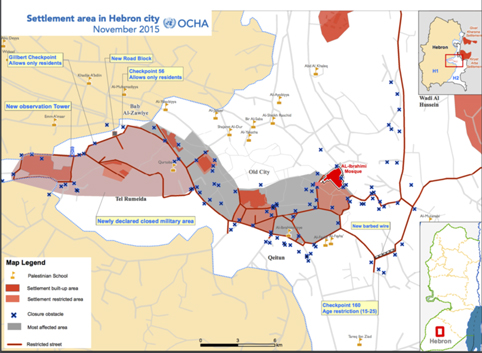
A grove of gnarled and ancient olive trees stands tall above the white buildings of the bustling, checkpoint-ridden Old City within Hebron Governorate’s capital, al-Khalil. Al-Khalil is a bifurcated city. H1 is a modern economic hub of the West Bank governed by the Palestinian authority. H2, containing most of al-Khalil’s Old City, is an Israeli military–controlled zone (see Figure 2 in Appendix A.3). H2’s caged maze of checkpoints and closure obstacles surveils individuals, damages private property, and threatens bodily harm as part of the city’s social fabric, woven into residents’ everyday social and professional experiences.
Map from OCHA for the Occupied Territories
Source: http://www.ochaopt.org/documents/ocha_opt_the_humanitarian_monitor_2014_12_11_english.pdf, Accessed November 7, 2016. Updated 2018 Map at: https://www.ochaopt.org/content/humanitarian-impact-israeli-settlements-hebron-city-0

H2 is home to roughly 35,000 Palestinians. It contains the only Israeli Settlements amid a preexisting Palestinian city in the West Bank. Therefore, H2’s checkpoints fracture Palestinian daily life more directly than do checkpoints surrounding Settlements elsewhere in the region. In 2015, violence in al-Khalil escalated from limited state-run security measures and minor civilian counterprotests to constant state surveillance, weekly civilian deaths at the hands of state agents, and a surge of makeshift violent Palestinian counterattacks. When I conducted fieldwork in autumn 2015, H2 was divided by more than 109 permanent barriers, fifty-three temporary blockades, and eighteen military-style checkpoints. The entire H2 zone was closed to Palestinian-owned vehicles and sometimes pedestrians, and in October 2015, some neighborhoods in H2 became a closed military zone, requiring residents to register for special permits to return to their own homes.Footnote 12 Figure 2 maps al-Khalil closures and checkpoints as of November 2015.
Because Palestinian protestsFootnote 13 are common in al-Khalil’s H2 zone, the IDF frequently deploys crowd-control weapons around checkpoints, including tear gas, sound grenades, rubber bullets, skunk water, and, occasionally, live rounds. Given the IDF’s level of control; its extensive surveillance network; and the sheer number of guard towers, checkpoints, and troops, H2 can be considered a place in which Israel has “control over territory” (Kalyvas Reference Kalyvas2006). Palestinians furthermore experience high levels of quotidian harassment, disturbance, and brutal physical violence from the Settlers in the area. The result of these daily experiences of violence is a widespread feeling of social isolation among Palestinians living in H2.
South Hebron Hills: Firing Zone 918
The arid, rural villages and fields in the South Hebron Hills’ Firing Zone 918 have been used as an active military training ground for the last twenty years. Each village comprises several extended families (with 75–150 residents per village). The several thousand Palestinians in Firing Zone 918 live in close proximity to military exercises that disrupt their daily lives. In the 1990s and into the 2000s, these activities included live fire practice. Today, military training exercises continue to disturb livestock, disrupt farming practices, and destroy crops. Soldiers, tanks, and helicopters appear at frequent random intervals in the area.Footnote 14 Palestinian villagers are often denied permits to build permanent structures, so they are frequently forced to relocate or to live in caves and tents. Home demolitions, a feature of Area C in the West Bank, are also common here. In 1999, the twelve villages within Firing Zone 918 were evicted under IDF military orders. This effectively rendered the inhabitants of those villages homeless and forced them to take temporary refuge together in al-Tuwani, a village just outside the Firing Zone (B’tselem 2017a).
Settlers and IDF soldiers frequently harass the Palestinian residents of Firing Zone 918.Footnote 15 Checkpoints between Firing Zone 918 and Yatta (the closest Palestinian city) introduce major challenges to residents. Yet compared with the isolating cage of H2, the state’s checkpoint and civilian-control apparatus in this arid expanse are not present between or within the villages of Firing Zone 918. Instead, checkpoints establish a constrictive perimeter, isolating residents from the rest of the West Bank, but without restricting a community’s internal freedom of movement or ability to maintain social connections (Appendix A.3, Figure 3, maps the region). As a result of this differently structured built environment of conflict, social and familial ties between and within villages remain intact and closely knit, even reinforced by the checkpoint-induced perimeter. Select villagers’ forced, temporary relocation to al-Tuwani strengthened cross-village ties. For years, the entire community has sustained a large-scale and often successful nonviolent resistance movement.
Repertoires of Resistance Typology, with Examples of Resistance from This Context. These Are Not Exhaustive

TYPOLOGY OF RESISTANCE ACTS
I propose a typology (Figure 3) that aids in understanding the unstructured, individual violence evident during the Intifada of Individuals in al-Khalil’s H2 zone. Existing research suggests that selective violence will subdue civilian support for violent resistance (Bhavnani, Miodownik and Choi Reference Bhavnani, Miodownik and Choi2011; Kalyvas Reference Kalyvas2006, Reference Kalyvas2012). If we subsume all civilian violence into a one-dimensional concept of violent resistance, then H2-dwelling Palestinians, who experience the state’s capacity to exert selective violence against those who support antigovernment activity, should instead comply with the state. However, Palestinians living in H2 demonstrated the highest support for violent resistance of any of my interview respondents, including support for unstructured, individual violence, with little or no expectation of shifting political circumstances.
Many studies of resistance employ a violence–nonviolence binary (Dorff Reference Dorff2019). Yet no movement is entirely violent; violent movements use nonviolent tactics (propaganda, leaflets, sit-ins, marches, political parties, in-person communication, etc.) as part of broader resistance approaches. Many nonviolent movements also apply violent tactics (especially if we consider stone-throwing or property damage violent). For example, South Africa’s African National Congress (ANC) and its military wing, Umkhonto we Sizwe, strategically leveraged complementary violent and nonviolent tactics against the brutally repressive South African apartheid system. Bifurcating the study of resistance into mutually exclusive categories limits our ability to conceptualize fully the complexities of resistance.
Each act in which an individual or group engages is but one of many at their disposal. People may use many different types of resistance modalities throughout the course of a conflict (Shesterinina Reference Shesterinina2019). I build on work that considers resistance modalities along a spectrum (Keen Reference Keen2005; Petersen Reference Petersen2001; Staniland Reference Staniland2017; Wood Reference Wood2003) and bring what we have learned about individual and collective resistance, as well as violent and nonviolent resistance, into conversation with one another. This reconceptualization also accounts for the reality that state violence will almost always yield resistance in some form (Scott Reference Scott1985)—including radicalization (McCauley and Moskalenko Reference McCauley and Moskalenko2008)—if not always the collective resistance on which political scientists tend to focus (Tilly Reference Tilly1991). My approach moves away from an implausible assumption: that any type of state violence could yield perfect civilian compliance.
These dimensions reflect the following observations: (1) while movements are rarely (if ever?) exclusively violent, specific acts are, (2) each resistance act is either individual or collective, (3) individuals do not—indeed, cannot—resist at all times (resistance is exhausting), and (4) individuals can (and often do) participate in both solitary and collective, as well as violent and nonviolent, resistance efforts over time. These dimensions of resistance are not insular but rather dynamic and interactive. As such, this typology of resistance acts creates a framework in which to conceptualize an individual’s approach to resistance.
Other types of resistance provide comparisons that help us understand why individuals might be supportive of unstructured, individual violence. I focus particularly on collective, nonviolent resistance for two reasons. First, the vast majority of individuals to whom I spoke considered themselves to be participating in some sort of “existence as resistance” effort; in Palestine, resistance-oriented refusal to cooperate with state agents is known as sumud.Footnote 16 Yet, this type of resistance was rarely the only sort that an individual supported; it can thus be considered a background “constant” in this space.
Second, because the organized terrorist/rebel groups in the West Bank have been dismantled, the collective/violent category is less relevant in this context (although some respondents expressed support for Hamas launching rockets from Gaza). As well, the extensive body of research regarding how and why people might consider supporting these sorts of groups (e.g., Crenshaw Reference Crenshaw2010) addresses this corner of the typology. Thus, to aid in understanding why civilians in H2 might have supported the unstructured, individual violence conducted during the Intifada of Individuals, I evaluate a case in which citizens eschewed that sort of violence (Firing Zone 918).Footnote 17
THEORY: SOCIAL ISOLATION AND REPERTOIRES OF RESISTANCE
Checkpoints, Social Connection, and Social Isolation in Conflict Zones
Major human rights treaties recognize freedom of movement as essential to equality, social justice, and nondiscrimination.Footnote 18 Free movement is crucial to social functions; across cultures, physical touch is critical to forming and maintaining human connection (Suvilehto et al. Reference Suvilehto, Glerean, Dunbar, Hari and Nummenmaa2015). Physical space, including urban geography and topography, can greatly influence individuals’ opportunities for this crucial human connection (Lefebvre Reference Lefebvre1991). In conflict spaces, the built environment—specifically checkpoints—delimits and circumscribes mobility. Checkpoints—by preventing travel or intimating targeted persons into avoiding travel—structure people’s opportunities for social connection in vastly unequal and discriminatory ways (Pallitro and Heyman Reference Pallitro and Heyman2002). I suggest that the unique structure of checkpoints in a given area shapes individuals’ support for different modalities of resistance by engendering social isolation or connection.
Social Connection and Collective Resistance
Two observations frame this section: residents of H2 to whom I spoke did not believe individualized violence would work, and they supported it anyway, whereas residents in Firing Zone 918 did not believe individualized violence would work and therefore did not pursue it. Civilians in Firing Zone 918 and the surrounding towns perpetrated no attacks during the Intifada of Individuals (as of 2019, see Footnote 17). However, people here did believe change was possible—they retained hope for the future. They therefore channeled their efforts toward collective resistance activities they believed were likely to be successful. They cited social connection as the bedrock of their hope and of these collective efforts.
Thus, I suggest that in places where individuals have strong social connections, collective modalities of resistance may have considerable opportunity to thrive. Social connection is fundamental to how people muster the hope, drive, and agency to partake in collective struggle. Social connection facilitates collective resistance through at least four mechanisms, the last of which is most visibly evident in Firing Zone 918. First, interpersonal relationships (“social support”) function as a “buffer,” which partly shields individuals from stressful events and helps develop resiliency (Dean and Lin Reference Dean and Lin1977; Janicki-Deverts and Cohen Reference Janicki-Deverts and Cohen2011; Kessler, Price, and Wortman Reference Kessler, Price and Wortman1985). This may be particularly true in conflict zones, where violence has been shown to increase both collective action and prosocial behavior via increased reliance on “collective coping mechanism[s in] which individuals who have few options to flee band together to cope with threats” (Gilligan, Pasquale, and Samii Reference Gilligan, Pasquale and Samii2014). In the context of conflict and resistance, this ability to process and surmount both psychological and practical daily stress is likely fundamental to engage in collective struggle.
Second, social connection is a foundational component of trust. Trust, in turn, is critical to one’s willingness to engage in risky collective-action activities, which require individuals to depend on others to achieve success in their shared endeavors (Kramer, Brewer, and Hanna Reference Kramer, Brewer and Hanna1996).Footnote 19 Third, social connections facilitate practical organization requisite to building a movement. Scholars demonstrate the role social networks play in recruiting civilians into military groups (Crenshaw Reference Crenshaw2010; Horgan Reference Horgan2003; Sageman Reference Sageman2011) and as critical social resources for violent (Parkinson Reference Parkinson2013; Petersen Reference Petersen2001; Staniland Reference Staniland2014; Weinstein Reference Weinstein2006) and nonviolent resistance movements (Chenoweth and Stephan Reference Chenoweth and Stephan2011; Schock Reference Schock2005; Zunes Reference Zunes1994).
Finally, social connections can enable a feeling of optimism about the possibility for meaningful change. Braithwaite (Reference Braithwaite2004, 128) finds that any time “individuals seek to achieve an outcome as a group, hope is inevitably involved.” My inductive research, detailed below, suggests that this process of building a collective sense of hope—requisite to collective action—requires robust social connection. This hope was critical not only to the support of civilians in Firing Zone 918 for collective resistance but also in their decision to eschew individual violent resistance. I suggest that the connectedness this community experiences was fundamental to outlining these preferences. A community’s belief in the possibility of change may result from a fundamentally social process of generating hope. In Firing Zone 918, a group of activists took it on themselves to build and sustain a nonviolent movement. I suggest that the checkpoints here cordoned off this community from others in the West Bank—and thus forced village residents to double down on their within-community social connections. This gave them the strength and motivation to act strategically, and with hope for success, against the state. In short, this type of built environment facilitated hope that enabled this community to eschew the unstructured, individual civilian violence in which the rest of the West Bank was mired and instead support collective, nonviolent action.
Social Isolation and Individual Resistance
In places where the checkpoint apparatus divides and sunders social networks, individuals will be physically prevented from connecting with others; residents feel isolated. I suggest that social isolation is an understudied mechanism in our understanding of civilian engagement with resistance. Social isolation creates a sense of hopelessness, a sense that change is not possible (because change “never happens”) and that good things do not happen here (because they “never have”).Footnote 20 As a result, civilians feel diminished enthusiasm about the possibility of collective efforts with strategic goals because they do not believe those collective efforts will work. Indeed, many view holding a belief that those efforts might work as childish or naive.Footnote 21 However, these civilians do not simply demobilize. They are livid, hurt, and frustrated at the daily realities they face. Thus, they remain extremely committed to the idea of resistance, but their preference for resistance modalities shifts. In this case, civilians expressed support for types of resistance that are more a venting of frustration—in some ways akin to politically motivated suicide—than an act that is designed to advance a specific political goal with an expected impact.
People do not resist every moment; sometimes they simply go about their lives. Thus, when we see any sort of resistance in this space, we should understand this as a choice to resist over the choice to disengage. Equally, residents of H2 have access to internet and the ability to communicate by phone (even when travel is restricted); thus they have a minimal ability to coordinate collective resistance, and on occasion (e.g., the October 2015 “Day of Rage” to return bodies of the dead), they do. This makes the overwhelming emphasis on individual modes of resistance all the more striking and demonstrates that is not capacity alone that precludes collective resistance efforts in this space.Footnote 22
I suggest that in addition to affecting the practical concerns about collective resistance (e.g., the physical ability to meet frequently), which are well-documented considerations to the success of collective resistance movements (both violent and nonviolent), this social isolation has three effects as yet largely unexplored by scholars of resistance. First, it leaves individuals feeling powerless, frustrated, and angry, but without hope for change. Second, this isolation hinders the process of generating hope and devising collective resistance approaches. Third, hopelessness (an individual’s sense that she has little to lose) makes collective resistance unlikely.
I suggest that individuals who support collective resistance tend to believe that there is some chance that this resistance might, together with other acts, affect some modicum of change. Collective resistance is often attached to a strategic rationale that is able to bring together a broad base of people around an agreed-upon strategy. In contrast, individual modalities of resistance could be either strategic or expressive. When someone believes they have little left to lose, collective resistance—and, indeed, hope itself—is “dangerous.”Footnote 23 Hope invites a belief that change is possible where none can be and renders people already facing daily trials vulnerable to renewed disappointment, failure, or loss.
Other scholars add texture to this premise. Anticolonial activist Franz Fanon (Reference Fanon1961) sees revolution as the inevitable response to oppression, while James Scott (Reference Scott1990, Reference Scott1985) conceives of resistance extremely broadly and argues that preferences for resistance are likely to be hidden from public view. Finally, Spaaij (Reference Spaaij2011) argues that violent resistance can be both a personal and a political act. I suggest that support of the Intifada of Individuals was not motivated to directly change state actions and therefore was not subdued by state violence designed to combat collective resistance modalities.
Individual resistance can take many forms. Most frequently, individuals will likely partake in small, “pointless” nonviolent resistance acts—saying something rude or making something slightly more difficult for the opposition. Most of us have participated in such acts. We might “drag our feet” at work when frustrated with a boss or delay contact with a feuding family member. In conflict settings, people might mark a wall with graffiti, throw a rock at a house or guard tower, or engage in—in this context—“clashes.” This is not something anyone thinks will make a difference in the broader conflict, but it makes us feel “better” anyway. Yet, because it is still resistance, it is also still political.
Others will adopt violent forms of individual resistance. Supporting violent individual resistance actions includes condoning car-ramming attacks, stabbing attacks against soldiers, or other acts that are designed to cause harm to state agents or structures (including attacks against Israeli civilians). Many residents in H2 expressed feelings of checkpoint-induced social isolation and support for individualized violence. They reported believing that individual violent resistance was justified and worth doing, indeed, stating that people should do it, despite harboring beliefs that this resistance would not cause broader change, because they consider change in this context to be impossible. Here any action that harms the opposition is a success: by limiting their access to social connection and making life so difficult, I suggest that checkpoints took away these people’s hope for change. I suggest that this fundamentally altered the way they thought about resistance and what sort of resistance they considered supporting, turning toward violent individual resistance in addition to—or instead of—other resistance modalities, but certainly relative to socially connected individuals. Social isolation may therefore incubate civilian support for individualized violence.
Likely Confounders
A range of plausible alternative explanations for these two communities’ support for resistance exist. First is the movement organizer in Firing Zone 918: in this view, the organizer is responsible for the success of this resistance movement; if H2 had an equivalent organizer, they would have collective resistance. Second, H2 experiences more direct violence than Firing Zone 918, and it is the raw amount of violence that dictates these different responses. Third are rural–urban divides: people in urban areas have busier lives, less time/energy for collective resistance, and coordinated resistance is more difficult in urban areas. No explanation can be categorically ruled out in an inductive design, and with complex social processes, multiple factors likely relate to any outcome of interest. However, in the pages to follow, I evaluate the aggregate evidence and consider how it stacks up with my explanation and relative alternatives.
METHODS AND DATA: LIFE-STORY INTERVIEWS IN HEBRON
Case Selection
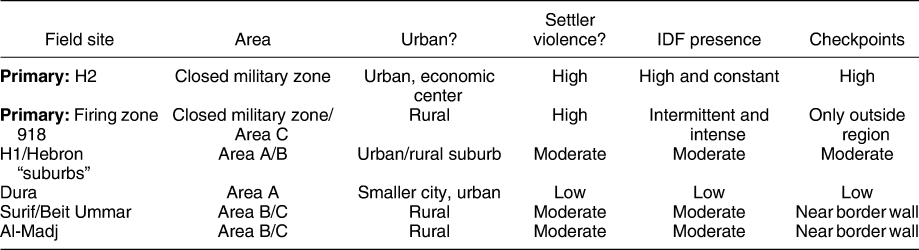
I conduct a comparative case study analysis (Lijphart Reference Lijphart1971; Tarrow Reference Tarrow2010) of two communities living in “closed military zones” in Hebron Governorate: H2 and Firing Zone 918.Footnote 24 I supplement this analysis with interviews in additional al-Khalil and rural areas.Footnote 25 My comparative case study framework uses the similarities and differences across these two cases to inductively build a theory, posit causal relationships between variables of interest, and identify mechanisms that connect explanatory and outcome variables (Tarrow Reference Tarrow2010, 245). Civilian exposure to violence varies dramatically across the West Bank. Respondents in H2 and Firing Zone 918 experience similar levels of Settler violence—indeed, the South Hebron Hills and H2 are known for their radical Settler populations. These two communities face very different types of IDF environments of violence, particularly those governing freedom of movement and exposure to military training operations (described above). The additional field sites experience differing levels of Settler and IDF presence and violence, have varying types and numbers of checkpoints, and are in different West Bank “Areas.” Table 1 compares field cites on key variables.
Comparing Field Sites on Key Variables

Respondent Selection: Olive-Farming Communities in Hebron Governorate
Rather than attempting to obtain a representative sample of the Palestinian population in the West Bank, I focused my research on in-depth studies of olive-farming communities.Footnote 26 These groups provide valuable windows into how built-environment dynamics unfold within communities—specifically those (like olive-farming communities) whose symbolic importance resonates with others in Palestine.Footnote 27 Olive farming occurs in urban and rural areas alike (some groves are so old that they preexisted the houses surrounding them) and thus serve as a unifying thread in the broader Palestinian historical and cultural narrative.Footnote 28 Because land, and connections to it, lies at the center of the Israeli–Palestinian conflict, olives become a symbolic way for communities to establish legitimacy and reify ideals of resistance, perseverance, and legal claims for Palestinian property (Blomley Reference Blomley2003; Braverman Reference Braverman2009; Delaney Reference Delaney2002; Meneley Reference Meneley2011). Indeed, the olive tree has become symbolic “of the [Palestinian] struggle for land and legitimacy” (Meneley Reference Meneley2011), and olive farming represents a subtle act of civil resistance.
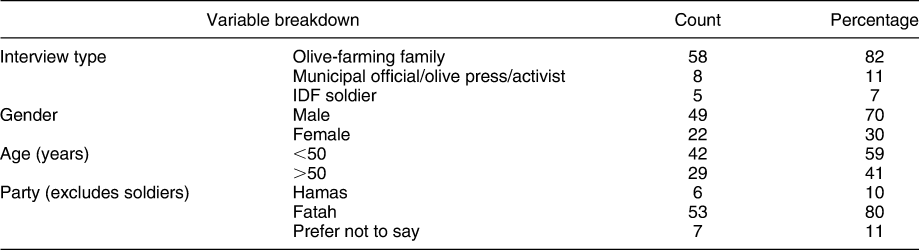
I conducted fifty-eight life-story-style interviews of olive farmers (Table 2).Footnote 29 I also conducted eight semi-structured interviews of Palestinian ministry officials and activists and five semi-structured interviews of IDF soldiers. I conducted these interviews in fall 2015, with a follow-up trip in December 2016, during the Intifada of Individuals. My time spent in these olive-farming communities involved picking olives, staying in houses of interlocutors, and sharing meals and conversations with family members of interview respondents. Each of these experiences contributed a fuller understanding of how violent events and the built environment affect civilians in the context of their personal lives and their communities (see Supplementary Materials A.3 for further discussion).
General Information about Respondents

Methodological Advantage of Life-Story Interviews and Micro-studies of Conflict
Micro-level studies of conflict can provide insight into processes not observable at the country-year level (Kalyvas Reference Kalyvas2012). Understanding attitude or belief formation in the context of conflict requires time on the ground and face-to-face interaction. This allows researchers to integrate questions not answerable at the cross-national level, to engage in theory-building that stretches the parameters of existing scholarship (Fujii Reference Fujii2009; Lake Reference Lake2014; Tarrow Reference Tarrow2007; Wood Reference Wood2003), and to situate individual interviewees into the “broader social and organizational context” in which they operate (Shesterinina Reference Shesterinina2016, 414; Parkinson Reference Parkinson2013, 420). Indeed, intensive studies of specific communities are ideally suited for research seeking to understand the underlying mechanisms of contentious politics (Tarrow Reference Tarrow2007, 592).
A life-story approach has several advantages over survey or other observational/experimental approaches to studying attitudes. This technique provides a window into how individuals process their experiences, because “it is through story that we gain context and recognize meaning” (Atkinson Reference Atkinson1998, 125; Bruner Reference Bruner2009, Reference Bruner2003). Exploring life stories provides critical insight into how individuals “construct” their own lives and beliefs. I coupled this life-story approach with a series of structured questions designed to offer standard points of comparison, as well as a questionnaire to measure violence exposure.Footnote 30
EVALUATING EVIDENCE
This section provides anecdotes and interview quotations that represent the observable similarities and variations between H2 and Firing Zone 918 (Supplementary Materials, Section A provides contextualizing evidence from additional field sites as well as additional quotations from these sites). I selected the anecdotes and quotes that were representative of the general sentiments I observed among life-story interviews in each particular community.Footnote 31
Social Isolation and Civilian Violence in Al-Khalil’s Old City (H2)
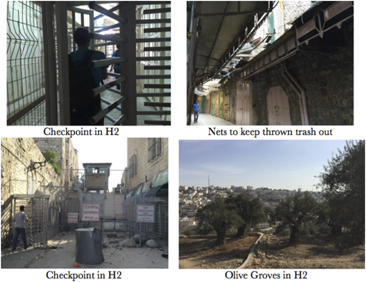
As a result of this built environment and state-based violence, the Palestinian community structure in H2 has been deeply fractured. Today, only about 400 people live in the once-thriving city center (Sherwood Reference Sherwood2015). Those who remain are concentrated in disconnected enclaves and are poorer or stay as part of sumud: existence as resistance (Meari Reference Meari2014). Most families here have relatives and friends outside of H2, but these friendship and kinship networks are severely strained by difficulty of travel. Indeed, to avoid undue inconvenience, humiliation, and violence, most avoid passing through checkpoints when possible (Figure 4).
Checkpoints and Olive Groves in H2, 2015. Photographs by the Author

Respondents in H2 describe structural restrictions on movement, constant searches, violence, and curfews as greatly restricting their economic activities, access to essential services (e.g., groceries or medical care), and the very fabric of social life. Respondents mention the stress of living close enough to checkpoints that one can smell tear gas frequently, hear the crack of live rounds or the boom of sound grenades, and feel reverberations from the IDF air force’s frequent flyovers. Concerns about violence, lost freedom of movement, and lack of social connections appear to work in tandem to affect residents’ lives. Fear and isolation together provide the undercurrent framing these experiences: “The greatest challenge for me is living in this isolated place. Even with people all around we are so alone, because there is no way to get safely to see our neighbors or go home to see my family …When I was younger I used to feel afraid all the time and now after everything that has happened to me I feel brave—what else can they take? They have taken everything and I am still here.”Footnote 32
Respondents overwhelmingly described feeling extremely isolated and reported difficulty maintaining family and friendship networks. One respondent stated, “In the past, before all the soldiers and checkpoints in H2, relationships were stronger. People could talk to one another and they weren’t so afraid. Now people are separate. Those times made me happy, those are my best memories, but this is much harder.”Footnote 33 Checkpoints here appear to prevent the collective coping mechanism, which has been shown to increase collective prosocial behavior (Gilligan, Pasquale, and Samii Reference Gilligan, Pasquale and Samii2014).
Importantly, when people describe the occupation, they describe built structures, not the government or abstract constructs, indicating that it is these structures that embody the occupation for Palestinians: [What is the biggest challenge facing the West Bank today?] “The occupation! The walls, the guards, the checkpoints, all of it. It is the reason for everything that’s going on. It’s like diabetes, when it hits you, things go badly for you all over your body.”Footnote 34
The fragmentation of community consistently emerged as a primary source of respondents’ frustration. This was a theme among a strong majority of H2 interview respondents, and the lack of social connection was frequently woven into these responses. When respondents spoke about what they most wished would change about their lives, respondents frequently said they wished for greater opportunities for connection with friends and family and raised this in conjunction with concerns for their own personal physical safety. For example, one woman I interviewed described traveling internationally as the turning point in her life, because it exposed her to the freedom she observed among people living in other places.Footnote 35 She linked these experiences directly to her support for resistance. When asked about her reasons for supporting violent resistance, her family’s isolation framed her thinking and choices:
[Do you support resistance to Israel? Like the boycott?] “Yes absolutely! I very much support it. We must do this.” [What about other forms of resistance, like launching rockets from Gaza?] “Yes! They should launch all the rockets!” [And the current intifada?] “Yes absolutely!” [Do you think the situation here could ever get better?] “No. It is impossible. Things might get worse but not better.” [What about a new peace process?] “No, that is not possible…” [What made you think [violent] resistance was the best solution?] “All they have done to us … After all of this, I don’t want any problems and I don’t want anything back, I just want them [Settlers, Israeli Army] to leave …We are alone here—just us and no one else—we have to be strong.”Footnote 36
Another man in H2, when asked about resistance, specifically said that social disruption increased his support for individual, violent resistance. The way movement is limited and the inability to redress grievances augment the horror of violent events, making individual violence appear to be the only possible response, and the only way to express grievances: “We are punished here for being alive. We can’t go anywhere; we have to wait for hours every time …A boy is walking with his father and they beat him [the father] right in front of their eyes. And they can’t even file a complaint! And if they go to try, they have to wait for hours—they have to wait so long it interferes with their lives so they would rather just go home. That of course leads to a desire for revenge—and it forces people toward violence.”Footnote 37
People in this space seemed to think about the possibility of change or hope for the future as ludicrous or impossible. Many respondents—from H2 and surrounding districts—explicitly stated that they felt change was not possible and hope was fruitless. When asked if change was possible here, one respondent replied, “Things are only getting worse. The situation can only get worse. Change is only possible if you’re talking about change for the worse.”Footnote 38 Another stated change was possible: “Only for the worst. Change is not possible in this country, other places but not here.”Footnote 39 One respondent actually laughed at me when I asked, and simply said, “No.”Footnote 40 Respondents in H2 were also extremely dismissive of the idea of peace or a state-based peace process. One man stated, “Peace here is impossible …As a cat could never murder a donkey, there will never be peace …Most of the land has been taken by Settlers …Peace is just a word, it can’t happen.”Footnote 41
Respondents indicated that their anger and frustration over the violence they experience from the IDF and Settlers convinced them to “stay and resist.” They considered staying as a source of pride, as resistance itself, and as a modicum of agency against the broader occupation that claims so much control over their own lives. Respondents described that state policies restricting movement, and the very experience of living in the socially isolated H2, changed their political preferences. As a result of these experiences, they believed that fighting back against this oppression—even in small, daily ways that they themselves did not believe would change the broader situation—was the right course of action.
When asked about the timeline of their evolution toward their support for different resistance modalities (e.g., the Intifada of Individuals), older respondents stated that they came to believe violent retaliation was merited, even if it would not “work”—and that peace attempts were not justified—after being cut off from the rest of the West Bank, from family in the diaspora, and from family in Gaza: “Endless restrictions and all this violence only leads to more hate …The Occupation brings violence …I could never trust or love an Israeli while they keep doing such things to me and to my family—while they keep me here with nothing I can do about it. Until I see peace from them, and freedom, I wouldn’t support peace at all.”Footnote 42
In considering alternative explanations, material factors, including economic incentives and physical threats, while clearly important to people’s lived experiences, appear not to be the sole dictators of civilian attitudes toward different resistance modalities in this community. Contrary to claims that checkpoints would deter violence, my interviews demonstrate that the constant and real threat of violence did not deter support for individual, violent resistance. Indeed, I observed more support for individual violent acts in H2 than in any other area. Respondents reacted to H2’s violent built environment of conflict with an attitude of loss and desperation (“what else can they do to me?”) and increased support for individual violent resistance against their oppressors.
Although surely not a universal response, this finding in even some members of the population provides an important corrective to scholars’ tendency to assume civilians are motivated entirely by material/strategic concerns. Respondents reported that state restrictions only fueled hate and rage. Checkpoint-induced isolation emerged as a primary complaint and source of frustration, and in the absence of social support, respondents resorted to support for individual violence as a reasonable recourse against state actions that were causing them physical harm, humiliation, economic oppression, and isolation, even though they did not believe it would alter their political fortunes.
Eschewing Individual Violence and the Power of Social Connection in Firing Zone 918
In contrast to my interviews in H2, respondents in the Firing Zone explicitly rejected the idea of unstructured individual violence and instead embraced collective efforts, seeming to feel empowered by the strength of their community. [Do you support the current Intifada?] “No. We don’t even throw stones—no one here will throw stones. Of course that is a legitimate form of resistance, but if we do it, they [Israel] will call it violence. Then we go from being the victims to being cast as the aggressor …Instead, what we do is the steadfastness. We exist and as we live our lives, we resist. We work with the Committee. This is the only resistance that will work. You can’t give them an excuse to take us down …[he smiles and says] It is hard, but then life without struggle has no meaning.”Footnote 43
Despite the violence they have experienced, Palestinians in this region of the South Hebron Hills have developed a vibrant, nonviolent civil resistance movement and speak from a place of personal power and agency. The history of nonviolent, collective resistance in Firing Zone 918 runs deep (King Reference King2007; Norman Reference Norman2015; Pearlman Reference Pearlman2011), with major successes (see Supplementary Materials, Appendix A).
Respondents view the IDF’s ever-present military interventions and training as incredibly destructive to their lives. When asked how they cope with the loud, disruptive air, and ground military exercises in the area, one respondent said, “Together. We are close friends with those in other villages, and together we are strong.”Footnote 44 People talk about community as integral to their daily lives. They report being stronger together and relying on one another to get through these “hard times.”Footnote 45
Residents here cite community connections as the primary factor that makes collective nonviolent resistance efforts possible: [What convinced you that nonviolent resistance was the right path?]Footnote 46 “Well it all started in 2000. The main point was that we shouldn’t lose people to being shot all the time. Every person matters here—we are a small village and each person matters a lot. We can’t lose anyone. We decided this [civil resistance] is a good and effective way not to give any excuse to harm us …The community bond is the most important part of the civil resistance effort …and we never forget the rule which is that we need one another …So we are resisting.”Footnote 47
During an interview, one of the founders of the committee in the area pointed to community connection as the key element that made civil resistance possible:
[How did you decide this was the way to resist? How did you make it work?] “This was very difficult to do …I realized that it was the goal of the Occupation to make us use force …because then they have a reason to put us down. So then I had to convince everyone that I was right. So we had meetings—very deep conversations—over and over and over, where we talked about it.” [How did you convince them?] “It was very hard, very slow. And everyone had to agree. I walked to all the villages around in the area so everyone would agree. At first it was just me but then it was others.” [Why do you think people listened to you?] “This is only about how strong the community is. It is about how we are all in it now for one another and about how kinship between the people made it easier to spread the message and keeps us strong. We all convinced and reinforced one another so it was not just me alone. It was all of us together.”Footnote 48
Two crucial aspects of social connection are implicit in this response: the value of preexisting community relationships and the ability to travel and to communicate freely in order to maintain those social ties. This connection, in this respondent’s view, made this collective civil resistance possible.
Community connection underlies every part of the nonviolent resistance movements’ successes in this part of South Hebron Hills, including individual residents’ ability to continue to take part in this resistance strategy. One of the movement’s founders said (of another member of the community), “This man, he is almost a therapist for me! I go to him for support and guidance and wisdom. He has the whole Quran memorized and he takes much time to think through things. He is someone I can talk to about the hardest things. Without him, I do not know what I would do.”Footnote 49 Other members of the community also cite social connections, and the interpersonal trust that results, as the critical component to their support for an organized, nonviolent approach to resistance, rather than an expressive violent one: [Why is civil resistance possible here?] “Unity and trust built between the people here is what makes it possible. Everyone feels a part of this, of one another. And also everyone has full trust in the Committee [the local Popular Resistance Committee] because they know they [the Committee] will run to help when anyone calls. And because of this people who left before have all come back. The community is the biggest part of the nonviolence.”Footnote 50
In considering alternative explanations, the community organizer in Firing Zone 918, as well as the rural nature of the community, clearly facilitated support for collective, nonviolent resistance. Indeed, it is likely that without the organizer, resistance might not have taken place, and without it, residents might have turned toward individualized violence instead. However, a similar committee was attempted in H2 and several other parts of the West Bank, and none succeeded. There is no denying that the organizer’s individual charisma facilitated the movement’s growth, but the organizer himself gave credit to the community itself. Other respondents repeatedly stated that it was the community, not the organizer himself, that was responsible for the resistance. There is a reason authoritarian regimes so often restrict public gathering: without this, the connection and hope so critical to organizing are more difficult to grasp.
Likewise, although a rural area likely enabled resistance, many other rural areas in the West Bank, and other parts of Hebron District, were unsuccessful at consolidation and support for collective resistance efforts. In the case of Beit Einun, a rural area outside of Hebron City, consistent within-community checkpoints in this rural space (road closures, flying checkpoints) seemed also to leave respondents feeling isolated and disconnected, specifically stating that they had no hope for change.Footnote 51
Despite expressing similar amounts of frustration and anger as their counterparts in H2, the community connections among the villages in Firing Zone 918 enabled them to hope for an abatement of violence, believe in the viability of collective resistance itself, and share a willingness to resist occupation “together.” The lack of isolation was striking, relative to H2 residents’ experiences. When asked about identity, residents in other parts of the West Bank would say they were “Palestinian” or “Muslim” first. When members of the communities in the Firing Zone 918 were asked about their identity, some joked that they were “Tuwani!” (the principal village) and then said, “No, no, Palestinian, and Muslim.”Footnote 52 The sense of community connection and willingness to identify on a local level was palpably stronger here than in other communities where I conducted interviews. Finally, respondents in the villages of Firing Zone 918 talked about hope. Indeed, people here were comparatively radically optimistic about the possibility of change, with one woman stating, “We are struggling against a very radical ideology here [Settlers] and that makes the struggle so hard and so complicated. But sooner or later we will make change …We have a saying: ‘If you start, you will reach it.’”Footnote 53
No one else in my interviews mentioned anything akin to hope, nor the possibility for things to get better. When respondents were asked directly whether positive change was possible, outside of Firing Zone 918, all respondents said “no,” or they expected change “only for the worse.” Yet among respondents in Firing Zone 918 villages, many reported that “change was possible.”
CONCLUSIONS
This article has argued that daily, tactile engagement with the West Bank’s built environments of conflict represents state power, engenders civilian anger against the state, and facilitates civilian support for resistance. The specific checkpoint structure imposed on a given community affects that community’s social connections, which in turn shapes the forms of resistance resident support.
Specifically, checkpoints that sunder social connections leave individuals feeling isolated, frustrated, and powerless to challenge their experiences of state oppression. Socially isolated interviewees from al-Khalil’s H2 zone harbored support for individualized, violent forms of resistance. By contrast, checkpoints imposed on villages throughout Firing Zone 918 left social connections intact, and here, villagers eschewed individualized violence and instead engaged in collective, nonviolent resistance. In neither H2 nor Firing Zone 918 did checkpoints quell resistance or achieve citizen compliance with the state. On the contrary, state constraints engendered civilian support for resistance. However, the make-up of checkpoint structures, and how they impacted social connections, had significant effects on the various forms of resistance civilians supported.
This study has two important limitations. First, this research was limited to two indicative but “extreme” cases of social isolation or connection in the Hebron Governorate. Additional large-n comparative studies can explore and test the broad applicability of these results. Second, life-story interviews help identify mechanisms but confine researchers to observational data of a small section of respondents. Future research should build on this inductive theory to evaluate the causal relationship between social connection, isolation, and support for modalities of resistance.
The theory that emerged from this inductive research has several important policy implications. First, it challenges state assumptions that surveilling, disempowering, and isolating civilians will demobilize civilian resistance efforts. Instead, government actions to sunder communities may subtly foster (rather than inhibit) support for violent resistance. Scholars and policy-makers should consider how these dynamics negatively impact human life and exacerbate violent tensions in conflict areas. As well, this study highlights the role that social isolation (especially government induced social isolation) can play in exacerbating or encouraging support for violence, and possibly the perpetration of violent acts themselves. Indeed, it seems plausible that social isolation in the United States may play a role in shifting individuals toward to unstructured, individual, political violence in the form of (some) U.S. mass shootings.
Second, this research suggests a broadly applicable association among built environments of conflict, restrictions on free movement, social connection, and civilian support for various forms of resistance. The checkpoints throughout Hebron parallel South Africa’s apartheid restrictions of black South Africans’ mobility—restrictions that helped fuel local anti-apartheid resistance efforts. Contemporary forms of territorial control that restrict targeted civilians’ mobility in Iraq, Syria, Somalia, and Pakistan could similarly yield unanticipated, violent resistance tactics. As political, economic, and climate instabilities throughout the world increase international migration, the United States and other industrialized countries must consider the effects their militarized border checkpoints could have on migrants, as well as the effects checkpoints and walls have on the cities and communities they divide. Although it is small scale, individualized violence can provoke fear, uncertainty, and anger over time, with impacts for state functions.
These insights about state control, physical space, and civilian experiences extend beyond conflict areas to contexts of heightened national security concerns. Industrialized democracies routinely suspend liberal principles and use nonlethal violence in the name of national security. In the United States, these forms of violence include forced removal of community members (e.g., raids on undocumented residents), intensive policing and surveillance, mass incarceration, migrant detention without trial, and enhanced interrogation techniques. Security scholars must strengthen their focus on liberal states’ choices to discriminatorily enact extrajudicial policies that erode democratic norms and deny rights to unconvicted portions of their citizens, residents, and asylum seekers. This study demonstrates that even the most comprehensive, structural, and targeted efforts to quell resistance can instead engender it. Where there is oppressive state power, there is likely to be resistance (Foucault Reference Foucault1978).
SUPPLEMENTARY MATERIAL
To view supplementary material for this article, please visit https://doi.org/10.1017/S0003055420000015.






Comments
No Comments have been published for this article.