





Introduction
Traumatic injury is one of the leading causes of death world-wide with 93% of fatalities occurring in developing countries. Road traffic accidents alone account for approximately 1.2 million deaths annually. 1,2 The situation is particularly severe in Thailand, where road traffic accidents are reported as the leading cause of death. In 2023, over 14,000 deaths were recorded, averaging three fatalities every hour. 3 Trauma-related mortality is classically categorized into three phases, known as the “trimodal distribution of death.” Reference Lansink, Gunning and Leenen4,Reference Rauf, von Matthey and Croenlein5 While immediate deaths are often unavoidable, early deaths can be prevented by enhancing prehospital trauma care systems. Reference Koch, Hagebusch, Lefering, Faul, Hoffmann and Schweigkofler6,Reference Jin, Akau’ola and Yip7
Hemorrhagic shock is the primary cause of preventable trauma death that can be addressed starting in the prehospital phase. Damage control resuscitation has become the standard of care in severe trauma. By intentionally limiting crystalloid infusion to maintain a mean arterial pressure (MAP) of 60-65 mmHg, this strategy effectively averts dilutional coagulopathy and hyperchloremic metabolic acidosis, thereby disrupting the progression of the lethal diamond. Reference Cannon, Khan and Raja8,Reference Wray, Bridwell and Schauer9 The definitive treatment for massive hemorrhage is the rapid initiation of a Massive Transfusion Protocol (MTP). Reference Cannon, Khan and Raja8 Recent evidence demonstrates that every minute of delay in blood transfusion significantly increases the probability of mortality, particularly within the first four hours post-injury. Reference Torres, Kenzik and Saillant10 Although prehospital MTP activation has been proven feasible and effective in reducing time to transfusion in several developed countries, Reference Botteri, Celi and Perone11,Reference Aichholz, Lee and Farr12 in Thailand, prehospital MTPs are currently unavailable due to resource and staffing constraints within the Emergency Medical Service (EMS) system. Furthermore, many emergency departments (EDs) lack on-site storage for essential blood components, specifically packed red blood cells, fresh frozen plasma, and platelets, thereby further delaying necessary transfusions. To facilitate early activation and readiness for massive blood transfusion, various clinical prediction tools have been developed to identify patients who require it. In 2018, the Assessment of Blood Consumption (ABC) score and Shock Index (SI) demonstrated excellent discriminatory power in the United States, with the SI noted for its simplicity. Reference Schroll, Swift and Tatum13 Subsequent studies introduced more complex systems, such as the Extremity/Mechanism/SI/GCS (EMS-G) score, which demonstrated superior, although not statistically significant, performance compared to ABC and SI. Reference Kovar, Carmichael and McIntyre14 In South Korea, the Reverse Shock Index multiplied by Glasgow Coma Scale (rSIG) was validated, out-performing traditional shock indices by incorporating neurological status. Reference Lee, Bae and Cho15 More recently, the Revised Assessment of Bleeding and Transfusion (RABT) score in Canada and the National Early Warning Score (NEWS) in Korea have shown high sensitivity and predictive accuracy, though the latter requires more comprehensive vital sign data. Reference D’Souza, Norman and Greene16,Reference Kim, Wi and Lee17
Despite the development of these scoring systems, significant research gaps remain. Most existing validation studies have focused on data obtained upon ED arrival rather than prehospital parameters recorded at the scene. Furthermore, there is a profound lack of comparative evidence regarding the performance of these tools within the specific trauma landscape of Thailand, where the mechanisms of injury and the EMS system differ from other settings previously studied. Therefore, accurate initial assessment at the scene and timely transport to an appropriate facility are essential strategies to reduce the time to blood transfusion and improve patient survival. This study aims to compare the predictive performance of prehospital scoring tools (SI, rSIG, NEWS, ABC, and RABT scores) to predict massive transfusion (MT) and 24-hour mortality in trauma patients.
Method
Study Design and Settings
This prognostic accuracy study has a retrospective observational cohort design. Clinical data were extracted from the electronic medical records of a university-affiliated Level 1 Trauma Center in Bangkok, Thailand. The facility manages approximately 6,000 trauma cases annually. Of these presentations, nearly 700 are classified as Emergency Severity Index Level 1 and Level 2. Notably, patients transported by EMS comprise 20% of this population.
Participants
The study included adult trauma patients, defined as individuals aged 18 years and older, who were managed and transported by EMS to the ED from January 1, 2019 through December 30, 2024. Patients experiencing prehospital traumatic cardiac arrest or those who were pregnant were excluded from the analysis.
Data Collection
To ensure data validity and reliability, the dataset was systematically retrieved from the hospital’s electronic medical records by the information technology department. The investigators subsequently performed rigorous data cleaning to resolve inconsistencies, duplicates, and outliers. A complete-case approach was applied, including only patient records with complete documentation for the final analysis. For each eligible patient, investigators recorded demographic characteristics, mechanism of injury, EMS response tier, and all prehospital time intervals. To capture the patient’s initial physiological state, the first set of vital signs documented by EMS personnel at the incident scene was used. These initial measurements included respiratory rate, heart rate, systolic blood pressure (SBP), oxygen saturation, body temperature, and the Glasgow Coma Scale (GCS) score. The prehospital medical records also documented early field interventions, including airway management, oxygen supplementation, tranexamic acid administration, and fluid resuscitation volumes. These interventions were summarized descriptively and were not entered into the prediction score calculations.
These baseline physiological parameters enabled the calculation of five specific prehospital scoring tools: the SI, the rSIG, the NEWS, the ABC score, and the RABT score. The components of these instruments are detailed in Supplementary File 1 and briefly described below:
-
• Shock Index (SI): Determined by heart rate divided by SBP. While a typical SI value is generally below 0.7, values exceeding this limit are early indicators of hemodynamic compromise and clinical shock. Reference Lee, Bae and Cho15,Reference D’Souza, Norman and Greene16
-
• Reverse Shock Index multiplied by GCS (rSIG): An integrative tool that combines hemodynamic parameters with neurological status by multiplying the rSI by the GCS score. Lower rSIG values are predictive of severe trauma and are highly correlated with the necessity for MT. Reference Lee, Bae and Cho15
-
• National Early Warning Score (NEWS): A cumulative weighted system derived from six primary physiological observations: respiratory rate, oxygen saturation, temperature, SBP, heart rate, and level of consciousness. A higher aggregate score signifies greater clinical deterioration and mandates a rapid clinical response. Reference Guan, Lee, Begg, Crombie and Mnatzaganian18
-
• Assessment of Blood Consumption (ABC) Score: A non-weighted, binary system that assigns one point for each of the following criteria: penetrating injury mechanism, prehospital tachycardia (heart rate >120), prehospital hypotension (SBP < 90), and a positive Focused Assessment with Sonography in Trauma (FAST) exam. A cumulative score of two or more is highly predictive of MT. Reference Schroll, Swift and Tatum13
-
• Revised Assessment of Bleeding and Transfusion (RABT) Score: Refines transfusion prediction by evaluating four specific components: a SI > 0.9, the presence of a pelvic fracture, a positive FAST result, and penetrating trauma. Similar to the ABC score, higher values indicate a significant likelihood of requiring massive blood component therapy. Reference D’Souza, Norman and Greene16
Outcome Measures
The primary endpoint was the requirement for MT. This endpoint was selected because it is a clinically relevant and commonly used surrogate for life-threatening hemorrhage and MT protocol activation in trauma studies. Massive Transfusion was defined as the administration of either ten or more units of packed red cells (PRCs) within the first 24 hours of hospital arrival or three or more units of PRCs during the first hour of ED resuscitation. The early transfusion criterion was included to capture patients requiring immediate blood product support and to reduce survivorship bias inherent in a 24-hour transfusion-only definition. The secondary endpoint was 24-hour mortality after ED admission, chosen to reflect early trauma deaths most closely related to hemorrhage, initial resuscitation, and prehospital triage decisions. Reference Botteri, Celi and Perone11,Reference Jenpanitpong, Yuksen and Trakulsrichai19
Sample Size
The minimum required sample size for evaluating the prediction models was calculated using the methodological framework proposed by Riley, et al. Reference Riley20 This approach aims to ensure mathematical stability and minimize the risk of over-fitting. The calculation relied on three strict criteria: achieving a global shrinkage factor more than 0.9, maintaining an absolute difference ≤ 0.05 in Nagelkerke’s R-squared between apparent and adjusted performance, and estimating the overall outcome risk with a margin of less than 0.05.
Assuming an anticipated outcome proportion of 0.1220 and an expected C-statistic of 0.80 with seven candidate predictor parameters, the largest sample size derived from these criteria was 323 participants. This sample size corresponds to approximately 39 events of MT.
Data Analysis
Data analyses were performed using STATA software, version 16.0 (StataCorp LLC; College Station, Texas USA). Descriptive statistics were used to summarize baseline demographics, injury characteristics, prehospital time intervals, vital signs, and prehospital interventions. Categorical variables were expressed as frequencies and percentages. Continuous variables were summarized as medians and interquartile ranges (IQR) because physiological trauma data were not normally distributed.
To assess the discriminatory performance of each prehospital scoring tool, Area Under the Receiver Operating Characteristic (AUROC) curves were constructed. The DeLong method was applied to compare AUROCs among the tools. For practical clinical application, the maximum Youden’s index guided the selection of optimal cut-off thresholds. Comprehensive diagnostic performance metrics, including sensitivity, specificity, positive predictive value, and negative predictive value, were calculated and reported with their corresponding 95% confidence intervals (CI). Because the analysis prioritized effect estimates for secondary endpoints, the 95% confidence intervals have not been adjusted for multiplicity and should be interpreted as descriptive rather than confirmatory.
Model calibration was evaluated using visual calibration plots and the Observed-to-Expected (O:E) ratio, calibration slope, and Calibration-In-The-Large (CITL). Internal validation was performed using 1,000 bootstrap resamples with replacement to derive bias-corrected 95% confidence intervals for AUROCs and to assess the stability of the performance estimates. Formal hypothesis testing was limited to AUROC comparisons of the prognostic scoring tools, and a two-sided P value of less than 0.05 defined statistical significance.
Ethical Approval
The Human Research Ethics Committee of the Faculty of Medicine Ramathibodi Hospital, Mahidol University, Bangkok, Thailand granted ethical clearance for this research protocol. The official approval reference number is COA. MURA 2024/724.
Results
Study Population and Baseline Characteristics
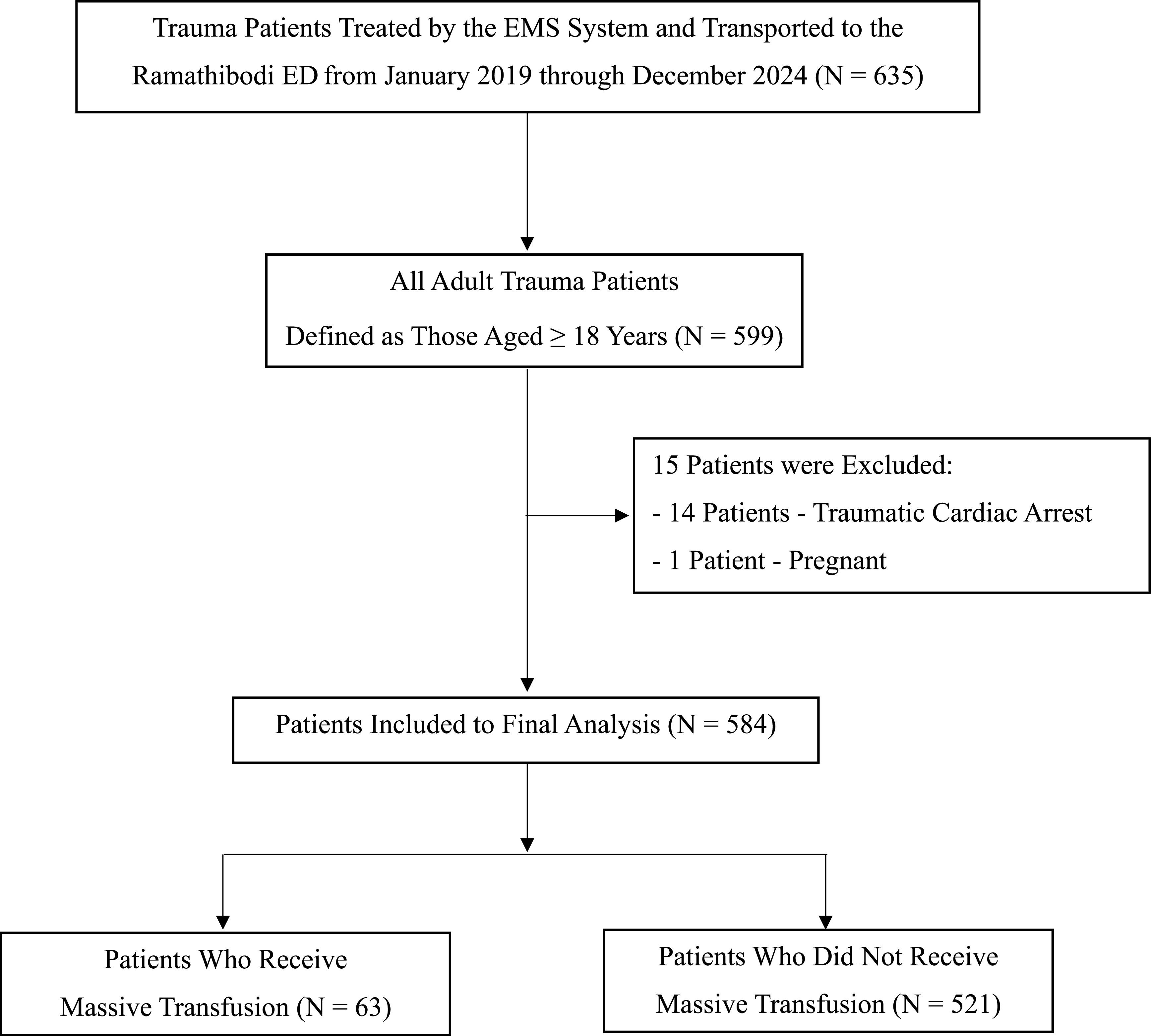
During the period from January 2019 through April 2024, the EMS system managed and transported 635 trauma patients to the ED. Ultimately, 584 of these individuals met the pre-defined eligibility criteria and were included in the final analysis (Figure 1).
Study Flow Diagram.
Abbreviations: EMS, Emergency Medical Services; ED, Emergency Department.

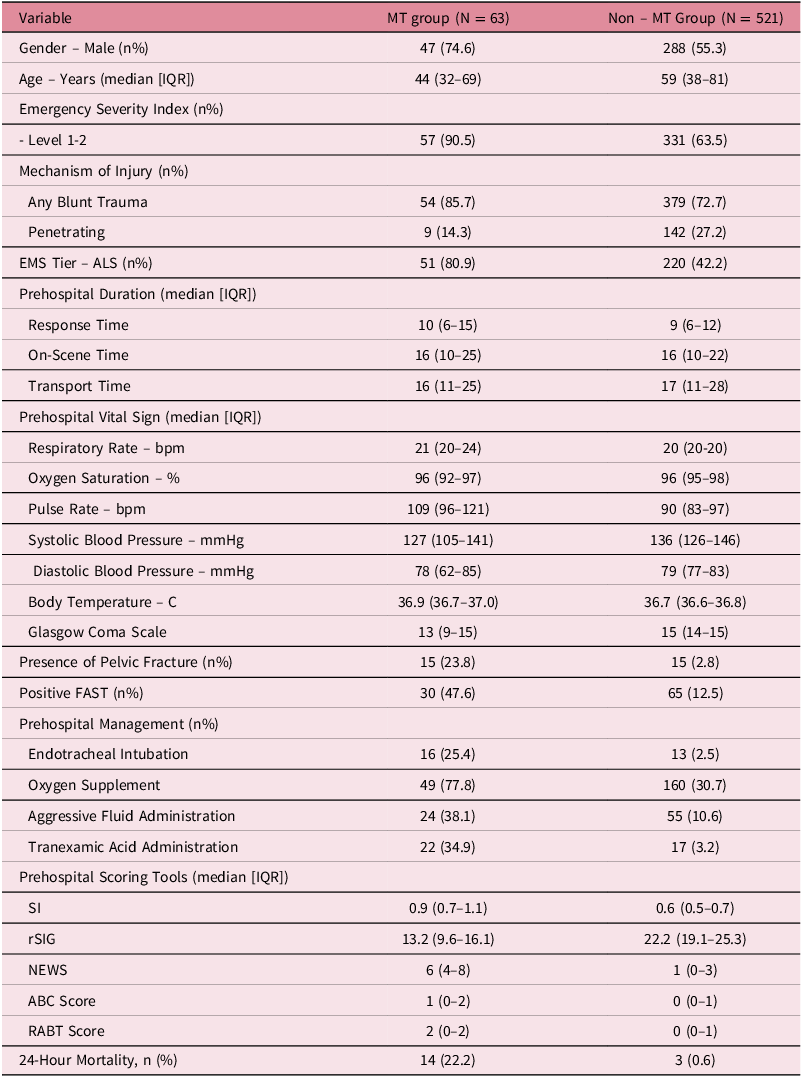
Baseline characteristics were summarized for patients in the MT and non-MT groups. Within the cohort, 63 (10.8%) patients received MT. Demographic characteristics, mechanisms of injury, initial prehospital vital signs, and field interventions are presented in Table 1. The MT group was younger (median 44 years [IQR 32-69] versus 59 years [IQR 38-81]) and had a higher proportion of Emergency Severity Index Levels 1–2 (90.5% versus 63.5%). Blunt trauma was the predominant mechanism in both groups. Prehospital time intervals were broadly similar, with median response, scene, and transport times of approximately ten, sixteen, and sixteen minutes in the MT group and nine, sixteen, and seventeen minutes in the non-MT group.
Baseline and Prehospital Characteristics of the Study Population by Massive Transfusion Status

Table 1. Long description
The table compares baseline and prehospital characteristics of patients by massive transfusion (MT) status. It has 25 rows and 10 columns. The columns are labeled as Variable, MT group (N = 63), and Non-MT Group (N = 521). The rows include variables such as Gender, Age, Emergency Severity Index, Mechanism of Injury, EMS Tier, Prehospital Duration, Prehospital Vital Sign, Presence of Pelvic Fracture, Positive FAST, Prehospital Management, Prehospital Scoring Tools, and 24-Hour Mortality. Each row provides specific data points for both the MT group and the Non-MT group. For example, the MT group has 47 males (74.6 percent) with a median age of 44 years (IQR 32-69), while the Non-MT group has 288 males (55.3 percent) with a median age of 59 years (IQR 38-81). The table also includes detailed information on various prehospital management practices and scoring tools.
Note: Values are n (%) or median (IQR).
Abbreviations: MT, Massive Transfusion; EMS, Emergency Medical Services; ALS, Advanced Life Support; FAST, Focused Assessment with Sonography in Trauma; SI, Shock Index; rSIG, Reverse Shock Index multiplied by GCS; NEWS, National Early Warning Score; ABC, Assessment of Blood Consumption; RABT, Revised Assessment of Bleeding and Transfusion.
Descriptive physiological differences were evident at the initial EMS assessment. Compared with the non-MT group, patients in the MT group had a higher median pulse rate (109 [IQR 96-121] versus 90 [IQR 83-97] beats per minute), lower median GCS score (13 [IQR 9-15] versus 15 [IQR 14-15]), and higher median NEWS (6 [IQR 4-8] versus 1 [IQR 0-3]). Pelvic fracture (23.8% versus 2.8%) and positive FAST (47.6% versus 12.5%) were also more common in the MT group. Prehospital interventions were more frequent among patients who ultimately required MT, including endotracheal intubation (25.4% versus 2.5%), oxygen supplementation (77.8% versus 30.7%), aggressive fluid administration (38.1% versus 10.6%), and tranexamic acid administration (34.9% versus 3.2%). These differences likely reflected the higher injury severity recognized by EMS personnel. Because reliable serial post-intervention vital signs were not consistently available, individual physiological responses to prehospital interventions could not be quantified. The 24-hour mortality proportion was higher in the MT group (22.2% versus 0.6%).
Discriminatory Performance for Massive Transfusion
The discriminatory performance of prehospital scoring tools for MT is depicted in the ROC curve analysis (Figure 2a). Evaluated as continuous variables, the NEWS demonstrated the highest AUROC at 0.84 (95% CI, 0.79–0.90), followed closely by the rSIG at 0.83 (95% CI, 0.76–0.90) and the SI at 0.78 (95% CI, 0.72–0.86). The trauma-specific scores, RABT 0.74 (95% CI, 0.66–0.81) and ABC 0.69 (95% CI, 0.63–0.77), showed lower discriminatory power. The DeLong test confirmed a statistically significant difference in predictive performance among these tools (P < 0.001). Internal validation via bootstrapping (1,000 resamples) corroborated these findings, yielding bias-corrected AUROCs that were nearly identical to those from the primary analysis, suggesting minimal model optimism.
Receiver Operating Curve (Overall) of Prehospital Scoring Tools to Predict: (a) Massive Transfusion; and (b) 24 - Hour Mortality.
Abbreviations: SI, Shock Index; rSIG, Reverse Shock Index multiplied by GCS; NEWS, National Early Warning Score; ABC, Assessment of Blood Consumption; RABT, Revised Assessment of Bleeding and Transfusion.

Figure 2. Long description
Two receiver operating characteristic (ROC) curves compare the performance of various prehospital scoring tools in predicting (a) massive transfusion and (b) 24-hour mortality. Panel A: The ROC curve for predicting massive transfusion includes five lines representing different scoring tools: SI (blue), rSIG (red), NEWS (green), ABC (orange), and RABT (brown). The x-axis represents 1-specificity, and the y-axis represents sensitivity. The area under the curve (AUC) values are provided for each tool: SI (0.78), rSIG (0.83), NEWS (0.84), ABC (0.69), and RABT (0.74). The DeLong test p-value is less than 0.001, indicating statistical significance. Panel B: The ROC curve for predicting 24-hour mortality includes the same five lines representing the scoring tools. The x-axis represents 1-specificity, and the y-axis represents sensitivity. The AUC values are provided for each tool: SI (0.79), rSIG (0.91), NEWS (0.93), ABC (0.72), and RABT (0.70). The DeLong test p-value is 0.025, indicating statistical significance.
Discriminatory Performance for 24-Hour Mortality
Regarding the secondary endpoint of 24-hour mortality, physiological scoring systems maintained their superiority (Figure 2b). The NEWS generated an outstanding AUROC of 0.93 (95% CI, 0.91–0.96) and the rSIG achieved an AUROC of 0.91 (95% CI, 0.81–1.00). The standard SI provided moderate discrimination AUROC of 0.79 (95% CI, 0.64–0.94). Meanwhile, the ABC and RABT scores performed less effectively, producing AUROCs of 0.72 (95% CI, 0.57–0.87) and 0.70 (95% CI, 0.55–0.86), respectively.
Optimal Cut-off Points
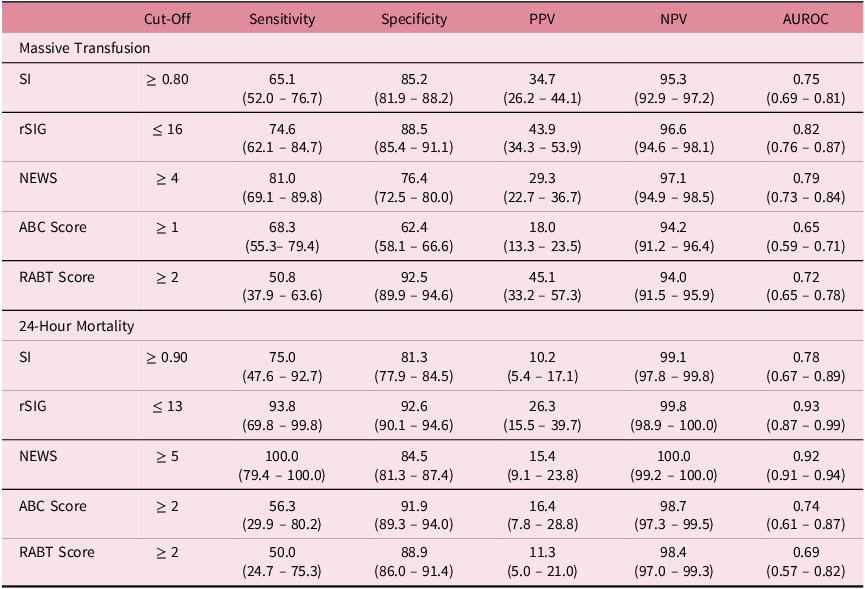
Upon analysis, applying standard cut-off values from previous literature showed suboptimal sensitivity for this cohort. Consequently, population-specific optimal cut-offs were derived based on the maximum Youden’s index to achieve the most clinically appropriate balance between sensitivity and specificity, prioritizing early detection and minimizing under-triage (Table 2).
Predictive Performance of Prehospital Scoring Tools at Optimal Cut-Off Points for Massive Transfusion and 24-Hour Mortality

Table 2. Long description
The table compares the predictive performance of various prehospital scoring tools for massive transfusion and 24-hour mortality. It has two main sections: Massive Transfusion and 24-Hour Mortality. Each section lists different scoring tools with their respective cut-off values, sensitivity, specificity, positive predictive value (PPV), negative predictive value (NPV), and area under the receiver operating characteristic curve (AUROC). The table includes the following columns: Cut-Off, Sensitivity, Specificity, PPV, NPV, and AUROC. Each row provides specific values for these metrics. For Massive Transfusion, the scoring tools listed are SI, rSIG, NEWS, ABC Score, and RABT Score. For 24-Hour Mortality, the same scoring tools are evaluated. The values indicate the performance of each tool at their optimal cut-off points.
Note: Point estimates with 95% unadjusted confidence intervals. AUROCs in this table represent the performance of the dichotomized scores at the specified cut-off points, distinct from the overall model performance shown in Figure 2. The widths of the 95% confidence intervals have not been adjusted for multiplicity, and they should not be used in place of hypothesis testing.
Abbreviations: SI, Shock Index; rSIG, Reverse Shock Index multiplied by GCS; NEWS, National Early Warning Score; ABC, Assessment of Blood Consumption; RABT, Revised Assessment of Bleeding and Transfusion; PPV, Positive Predictive Value; NPV, Negative Predictive Value; AUROC, Area Under the Receiver Operating Characteristic.
For predicting MT, a NEWS threshold of four or higher provided the most clinically useful triggers, achieving 81.0% (95% CI, 69.1–89.8) sensitivity. An rSIG threshold of ≤ 16 offered a balanced diagnostic profile with 74.6% (95% CI, 62.1–84.7) sensitivity and 88.5% (95% CI, 85.4–91.1) specificity. Conversely, trauma-specific tools like the RABT of two or higher and an ABC of one or higher demonstrated significantly lower sensitivities 50.8% (95% CI, 37.9–63.6) and 68.3% (95% CI, 55.3–79.4), respectively. Although the RABT score offered excellent specificity 92.5% (95% CI, 89.9–94.6), its low sensitivity rendered it more appropriate as a confirmatory tool rather than an initial screening mechanism.
For 24-hour mortality prediction, optimal thresholds indicated severe physiological decompensation. A NEWS score of five or higher exhibited 100.0% (95% CI, 79.4–100.0) sensitivity, successfully flagging all subsequent mortalities within the cohort. And rSIG cut-off of ≤ 13 also performed exceptionally well, capturing 93.8% (95% CI, 69.8–99.8) sensitivity.
Evaluating the conventional SI, the simplest field calculation revealed moderate predictive utility across both endpoints. For MT, an SI ≥ 0.80 showed a sensitivity of 65.1% (95% CI, 52.0–76.7). For 24-hour mortality, an SI ≥ 0.90 resulted in 75.0% (95% CI, 47.6–92.7) sensitivity. While these values represented fair discrimination, the sensitivity of SI was notably lower than that of NEWS and rSIG, suggesting a higher potential for under-triage if SI was used as the predictor in complex trauma patients.
Model Calibration of Prehospital Scoring Tools
Calibration analysis assessing the agreement between predicted probabilities and observed clinical outcomes for MT demonstrated excellent model fit. All evaluated scoring tools displayed an Observed-to-Expected (O:E) ratio of 1.000, a calibration slope of 1.000, and a Calibration-In-The-Large (CITL) of 0.000 (Figure 3). These calibration metrics represented the apparent performance within the derivation cohort. While the near-perfect statistical alignment indicated by the slope and intercept was anticipated during the initial model development phase, the reliability and stability of these predictive estimates were further confirmed through internal validation using a 1,000-resample bootstrap.
Calibration Plots of Prehospital Scoring Tools to Predict Massive Transfusion.
Abbreviations: MT, Massive Transfusion; SI, Shock Index; rSIG, Reverse Shock Index multiplied by GCS; NEWS, National Early Warning Score; ABC, Assessment of Blood Consumption; RABT, Revised Assessment of Bleeding and Transfusion.

Discussion
Interpretation
The Scoring Indices Assessment for Massive Transfusion in Trauma (SIAM-T) analysis indicates that comprehensive physiological scoring instruments, particularly NEWS and rSIG, demonstrate higher prognostic accuracy for predicting MT in the prehospital setting than the traditional SI and trauma-specific scores (ABC and RABT). By integrating respiratory metrics and neurological status alongside basic hemodynamics, these composite scores more effectively capture patients in a state of compensated hemorrhagic shock. An exploratory analysis of 24-hour mortality further supports the predictive utility of these physiology-based assessments.
The selected endpoints reflect pragmatic early trauma outcomes. The MT definition combined a conventional 24-hour transfusion threshold with an early one-hour transfusion criterion to identify patients requiring immediate blood product support, whereas 24-hour mortality was used as a marker of early potentially preventable death after injury. These endpoints were chosen to align the score evaluation with prehospital decision making, where the main objective is to accelerate preparation for hemorrhage control and transfusion before definitive hospital treatment.
Previous Studies
The NEWS achieved the highest discriminatory performance for MT (AUROC 0.84). This finding aligns with literature suggesting that composite physiological scores may out-perform isolated vital signs in predicting critical outcomes. Reference Kim, Wi and Lee17,Reference Jenpanitpong, Yuksen and Trakulsrichai19 While the NEWS was originally developed to detect clinical deterioration in non-trauma patients, its utility in trauma has been debated. Previous studies have primarily focused on the SI as the standard screening tool due to its simplicity. However, the SI with an AUROC of 0.78 offers only moderate predictive value. This discrepancy likely arises because the SI relies solely on heart rate and SBP. In the early stages of hemorrhage (compensated shock), young and healthy trauma patients often maintain SBP despite significant blood loss, rendering the SI less sensitive. Reference Schroll, Swift and Tatum13,Reference Pottecher, Ageron and Fauché21
In contrast, the superior performance of NEWS in this cohort can be attributed to its inclusion of respiratory rate and oxygen saturation. As observed in the baseline characteristics, the MT group showed subtle differences in respiratory rate and oxygen saturation in addition to more pronounced tachycardia and lower GCS. These findings suggest that respiratory compensation may precede overt hemodynamic instability. By capturing these early physiological shifts, NEWS provides a more sensitive screening signal than hemodynamic-only markers, consistent with evidence that respiratory derangement is an early predictor of adverse outcomes in trauma.
Similarly, the enhanced performance of the rSIG over the conventional SI highlights the critical role of neurological assessment in trauma triage. Hemorrhagic shock frequently induces cerebral hypoperfusion, which manifests as a depressed GCS. The lower median GCS observed among patients requiring MT in this study corroborates prior validation research demonstrating that the rSIG out-performs the SI. Integrating neurological status appears particularly crucial in blunt trauma populations, where traumatic brain injury and systemic bleeding frequently coexist. Reference Yuksen, Angkoontassaneeyarat, Thananupappaisal, Laksanamapune, Phontabtim and Namsanor22
Interestingly, the lower discriminatory power of the ABC and RABT scores contrasts with several prior investigations that reported high accuracy for these tools. This divergence is largely explained by differences in injury mechanisms. Both the ABC and RABT systems assign substantial predictive weight to penetrating injuries and positive prehospital ultrasound (FAST) examinations. Reference D’Souza, Norman and Greene16,Reference Motameni, Hodge and McKinley23 Because blunt force trauma overwhelmingly dominated the current study population, the mechanism-driven components of these scores contributed minimally to risk stratification. Furthermore, relying on complex diagnostic criteria or operator-dependent tools like ultrasound can lead to under-triage in predominantly blunt trauma scenarios, whereas physiological deterioration remains a universal indicator of injury severity.
Clinical Implications
Early recognition of severe hemorrhage remains essential for pre-arrival notification and preparation of blood bank resources before the patient reaches the ED. In the current EMS system, the median transport time was only 16 minutes in the MT group; therefore, a prehospital score should not be interpreted as a reason to prolong scene time or delay transport. Rather, the most practical role of a score is as a rapid communication trigger calculated from routinely collected vital signs and GCS during initial packaging or transport.
Even within a 10- to 20-minute prehospital window, an early alert can allow the receiving ED to prepare the trauma team, blood bank, blood warmers, transfusion equipment, airway resources, operating room, or interventional radiology pathway. In Thailand, where prehospital blood products are generally unavailable and many EDs do not store all blood components on site, the value of SIAM-T is primarily to shorten the time from arrival to blood product availability rather than to guide prolonged field resuscitation.
Prehospital management in this cohort was more aggressive in patients who later required MT, with higher use of oxygen, endotracheal intubation, fluid resuscitation, and tranexamic acid. These interventions were not analyzed as baseline predictors because they were clinical responses to observed severity and may lie on the causal pathway between initial assessment and outcome. The studied EMS approach prioritizes rapid transport, hemorrhage control where feasible, early tranexamic acid when indicated, and limited crystalloid resuscitation. For suspected uncontrolled hemorrhage without traumatic brain injury, resuscitation is generally titrated to avoid normalization of blood pressure and to maintain perfusion at approximately MAP 60-65 mmHg or SBP 80-90 mmHg, consistent with damage control resuscitation principles. Reference Cannon, Khan and Raja8 A higher blood pressure target is used when hypotension could worsen secondary injury, particularly in patients with suspected traumatic brain injury.
Thus, the findings do not suggest that EMS personnel should delay departure to complete scores or deliver additional interventions. Rapid transport remains central. The proposed clinical value is to integrate simple scoring into routine prehospital documentation or electronic medical records so that ED preparation begins earlier without increasing scene time.
Research Implications
Because the statistical analyses for the secondary endpoint of 24-hour mortality did not incorporate adjustments for multiplicity, these findings should be interpreted cautiously as hypothesis-generating rather than definitive conclusions. The distinct performance gap observed between physiological and mechanism-driven scores emphasizes the necessity for broader prospective validation. Future multicenter studies should investigate how these prehospital triage indices function across diverse EMS systems, particularly comparing cohorts with varying proportions of blunt versus penetrating injuries. Future work should also capture serial prehospital vital signs, exact intervention timing, crystalloid volume, airway management, tranexamic acid administration, and physiological response after field treatment to determine whether dynamic changes improve prediction beyond the first EMS measurements.
Limitations
This analysis is subject to several inherent limitations. First, the retrospective design relies on prehospital documentation, which occasionally suffers from missing or estimated values. Parameters such as respiratory rate are notoriously difficult to measure precisely in the field and are often approximated by emergency medical personnel. Second, only initial vital signs and field interventions were consistently available for analysis. The study could not quantify physiological responses to prehospital oxygen supplementation, endotracheal intubation, tranexamic acid, or fluid resuscitation because serial post-intervention vital signs and exact intervention timing were inconsistently documented. This limitation is particularly relevant because transient normalization of vital signs can occur after prehospital fluid administration. Third, the cohort overwhelmingly consisted of blunt trauma presentations. This distribution restricts the generalizability of the findings to trauma systems where penetrating injuries are highly prevalent. Fourth, the relatively low absolute number of MT events produced wide confidence intervals for certain diagnostic metrics. Finally, the analysis utilized a single snapshot of initial vital signs recorded upon EMS contact and did not capture dynamic physiological trajectories during transport.
Conclusion
In the prehospital setting, comprehensive physiological scoring systems including NEWS and rSIG predicted the requirement for MT and 24-hour mortality more accurately than the traditional SI and trauma-specific scores (ABC and RABT). Overall, NEWS demonstrated the highest screening sensitivity for identifying MT, while rSIG provided a balanced diagnostic profile by directly incorporating neurological status. The standalone SI maintained predictive value comparable to or exceeding that of the more complex trauma-specific models in this predominantly blunt trauma cohort. These tools should be used to support early pre-arrival notification and blood bank preparation, not to delay rapid transport or definitive hemorrhage control.
Supplementary material
The supplementary material for this article can be found at https://doi.org/10.1017/S1049023X26109005.
Author Contributions
Sorawich Watcharakitpaisan: Conceptualization; Data Curation; Formal Analysis; Investigation; Methodology; Statistical Analysis; Writing - Original Draft. Chaiyaporn Yuksen: Conceptualization; Methodology; Project Administration; Supervision; Validation; Writing - Review and Editing. Satariya Trakulsrichai: Visualization; Writing - Review and Editing. Pungkava Sricharoen: Visualization; Writing - Review and Editing. Chetsadakon Jenpanitpong: Conceptualization; Methodology; Project Administration; Supervision; Validation; Writing - Review and Editing.
All authors reviewed and approved the final version of the manuscript and agreed to be accountable for all aspects of the work.
Competing Interests/Funding
The authors declare no competing interests. The authors received no financial support for the research, authorship, or publication of this article.
Use of Artificial Intelligence (AI) Technology
Generative AI tools were not used for data extraction, statistical analysis, interpretation of results, or figure creation. Any administrative language or formatting assistance was reviewed and verified by the authors, who take full responsibility for the submitted content.



 Open access

