Religions vary in how they structure political power. They may resemble an elected autocracy, a parliamentary democracy or something akin to a monarchy, in which heredity plays a primary role. These differing power arrangements call for different types of strategic behavior in the fight for control over church doctrine and finances. They also induce different institutional responses. I offer examples of cases in which screening is highly institutionalized and when the age of a person may be an important strategic factor in choosing a leader. For example, to tame the power of an elected-for-life autocrat vis-à-vis the electoral body, the electoral body will tend to choose older individuals as leaders so that the leader will not have enough time to amass even greater power. In contrast, when the leader chooses his successor, the leader would like to have influence long after he is gone. This is best accomplished by anointing a young person as leader. Secondary institutions that arise to mitigate the negative effects of the organizational structure may also affect the age at which people are appointed to leadership positions. For example, there is always uncertainty about how a person will act once appointed to a leadership position. This is of particular concern when a person is appointed for life. In response, religions that have lifelong leadership positions will tend to screen potential leaders over a longer period of time than those in which appointment is only for a term at a time so that this uncertainty is reduced. This additional screening time also accounts for ‘leaders for life’ being older when first appointed than leaders elected to a term are. But when the present leader, rather than an electoral body, appoints his successor (typically a family member or close associate), fewer people are screened, which takes much less time. Instead, the intervening time is used to groom the leader in waiting for his future role.
This article helps to explain what otherwise might be very puzzling differences in the age of appointment to leadership positions across religions. For example, the average age of appointment to prophet in the Church of Christ of Latter-Day Saints is nearly seventy-three, to pope of the Roman Catholic Church is nearly sixty-five, to Archbishop of Canterbury (Church of England) is fifty-nine, to head of the Lutheran Missouri Synod is fifty-two and to Rebbe of Chabad Lubavitch is just under forty years old. This article also explains changes within a church over time. For example, the theory predicts the dramatic shift in average age from seventy to fifty-nine of the president of the Episcopal Church after 1926. The analysis need not be limited to religions. Toward the end of the article, I show how the same arguments can be used to explain politics more generally. I show why the Doges of Venice were appointed at an older age than the Doges of Genoa and predict within five years the age of appointment of recent Chinese leaders.
In a more general perspective, this article can be viewed as an illustration of how individual behavior mitigates certain institutional differences between organizations (for example, the ostensible power difference between a leader elected for a term and an autocrat elected for life is reduced when older and less powerful leaders are elected as autocrats). The article can also be viewed as an illustration of how secondary institutions mitigate some of the problems inherent in the primary institution (for example, choosing the wrong leader is more serious when the leader is elected for life than when he is elected for a term, so more pre-election screening occurs in the former). Although most of the article treats the institutional structure for choosing leaders as a given, I also discuss when and where this structure is most subject to change.
There is a large body of social science research on religion, but for the most part, the focus and/or methodology is only distantly related. Weber, who elsewhere discussed the nature of bureaucracies, showed little interest in the internal structure of religions in The Sociology of Religion.Footnote 1 Rational actor models of religion have a prominent place in sociology (see for example, Young), but most of this line of research has focused on religious competition (Finke) or why religions are strict (Iannaccone).Footnote 2 Historians have written numerous books about the struggle for power within a particular religion. For example, see Baumgartner, Penton and Reese. But, their methodology is different from that employed here, as they did not undertake a quantitative study over time and across denominations.Footnote 3 Adam Smith compared the Episcopal (top down) and the Presbyterian religious structures.Footnote 4 I also consider these two types, but the focus is different. Whereas Smith emphasized the disorder that arose when the people of the parish could elect their own pastor, I show how the inherent power differences in these two forms of organization lead to different strategic behavior of the selectorate.Footnote 5 Since Smith, economists have devoted considerable attention to the internal structure of firms. The classic paper by Jensen and Meckling considers agency costs under different ownership structures.Footnote 6 This article considers agency costs in a different context (religion) with different means of control. Nearer in subject matter is work by Allen, and Mao and Zech.Footnote 7 They show how doctrinal concerns put limits on the organizational form of the religion. Thus Roman Catholic doctrine implies a more hierarchical arrangement than Baptist doctrine. This article takes a further step. It asks how structure (for example, whether the leader is elected for life or not) influences the degree of pre-electoral screening and the age of the leader when first appointed. The field of political science has numerous works on democratic elections, dictatorships and forms of governance in between.Footnote 8 Parliamentary democracy and autocracy roughly correspond to the organization of the American Episcopal Church and the Catholic Church, respectively. But the focus of this political science literature is considerably different; it concentrates on policy outcomes and coalition formation rather than on age. Nevertheless, I employ a voting model to characterize church elections, and I will cover the related research when I introduce the formal model. Because I consider the issue of succession, previous work on the role of succession in autarchy, particularly that of Tullock, is also relevant.Footnote 9 Because Tullock considers autocracies in which power usurps formal rule (for example, the Soviet Union, particularly in its earlier years), he asks different questions and provides more speculative answers than the present study, which treats the formal rules as operative. Perhaps the closest work is Giuriato's study of the Catholic Church, which she views as an elected autocracy.Footnote 10 But there the overlap ends; like all the other studies, it does not deal with age.
Theory
I consider a variety of religions with a number of structural differences, but I focus on the following key variables: (1) who chooses the new leader (the present leader or the assembly), (2) the length of the appointment (for life or for a fixed term length) and (3) how powerful the leadership position is (figurehead, does not make legislative decisions or autocrat). I work backwards down the decision tree. I first start with a voting model and then show how candidates for leadership are groomed and selected in light of the voting.Footnote 11 I make the following assumptions.
Voter utility when candidate C is chosen as leader equals
 $${(1 {\rm A}) \quad{{U}^i} (C)\, = \,{\rm{ - }}B{{({{\hat{x}}_i}\,{\rm{ - }}\,{\rm{[}}w{{x}_c}\,{\rm{ + }}\,{\rm{(1}}\,{\rm{ - }}\,w){{\hat{x}}_m}{\rm{]}}\,)}^2} \,{\rm{ - }}\,{{{\rm{(}}\hat{a}\,{\rm{ - }}\,{{a}_c}{\rm{)}}}^{\rm{2}}} \,{\rm{ + }}\,{{K}_c}$$
if C has been a leader before, and
 $${ (1{\rm B})\quad{{U}^i} (C)\, = \,{\rm{ - }}QB{{({{{\hat{x}}}_i}\,{\rm{ - [}}w{{x}_c}\,{\rm{ + }}\,{\rm{(1}}\,{\rm{ - }}\,w){{{\hat{x}}}_m}{\rm{]}}\,)}^2} \,{\rm{ - }}\,{\rm{0}}{\rm{.5[1}}\,{\rm{ - }}\,Q{\rm{]}}\,B{{({{{\hat{x}}}_i}\,{\rm{ - }}\,{\rm{[}}w{{x}_c}\,{\rm{ + }}\,{\rm{(1}}\,{\rm{ - }}\,w){{{\hat{x}}}_m}{\rm{]}}\,{\rm{ + }}\,{\epsilon}\,)}^2} \cr & {\rm{ - 0}}{\rm{.5[1}}\,{\rm{ - }}\,Q{\rm{]}}\,B{{({{{\hat{x}}}_i}\,{\rm{ - }}\,{\rm{[}}w{{x}_c}\,{\rm{ + }}\,{\rm{(1}}\,{\rm{ - }}\,w){{{\hat{x}}}_m}{\rm{]}}\,{\rm{ - }}\,{\epsilon}\,)}^2} \,{\rm{ - }}\,{{{\rm{(}}\hat{a}\,{\rm{ - }}\,{{a}_c}{\rm{)}}}^{\rm{2}}} \,{\rm{ + }}\,{{K}_c} $$
if C has not been chosen before.
Starting with the first line,
 $$${{\hat{x}}_i}$$$
is voter i's most preferred policy position. Differences in policy position may reflect differences over the appropriate church doctrine and what is best for the religion's survival, or they may represent more mundane concerns.Footnote
12
xc
is candidate C's most preferred position (known to all).Footnote
13
w is a weighting factor that depends on other variables (to be discussed later). If w = 1, then xc
will be implemented if C is chosen as leader. If w = 0, then
 $$${{\hat{x}}_m}$$$
, the median voter's most preferred position, will be implemented. The further the implemented position is from the voter's preferred position, the less utility the voter will have. B denotes the importance to the voters of the leader's policy relative to other characteristics of the candidate.
The next variables are the leader's valence characteristics – dimensions that are perpendicular to the issue space and valued the same by all participants. In contrast to policy, where voters disagree about which policy is best, there is general agreement among voters concerning valence (regardless of the voter's preferred position).Footnote 14
 $$$\hat{a}$$$
is the optimal age of a leader and ac
is candidate C's age. A leader's age has both intrinsic and strategic value. With regard to intrinsic value, the optimal age,
 $$$\hat{a}$$$
, is the optimal balance between declining energy and increasing wisdom as a person gets older. When a leader's age is above the optimal, the leader's increased wisdom is not sufficient to overcome his loss of energy; when the leader's age is below the optimal, the leader's energy is not sufficient to overcome his lack of experience. It is possible that on occasion, a potential leader is both young and experienced or old and energetic, but we are dealing here with averages, not particular cases. The model does not critically depend on age having an intrinsic value. Therefore, if the reader is bothered by the assumption, the term
 $$${{(\hat{a}\,{\rm{ - }}\,{{a}_c})}^2} $$$
can be removed from the utility function.
Kc > 0 is C's charisma – how well the members of the religion relate to the person. A larger value means that more people will be attracted to (and stay with) the religion. While I do not have an empirical measure of charisma, I include it to acknowledge that there may be valence characteristics that influence a person's vote and to show that the main propositions will hold in this more general setting.
I now concentrate on the voter's expected utility when the candidate has not been elected to office before. Not surprisingly, there is uncertainty about the candidate's policy preference, which is captured by the stochastic term (ɛ). Each voter has an unbiased estimate of the candidate's policy preference. The larger Q is, the more certain the voters are about the candidate's policy preference.Footnote 15 If an individual has been the leader previously, the die has been tossed: the person's type has been revealed (as long as w > 0) and the uncertainty no longer exists.Footnote 16
When the appointment is for a term at a time, w will be relatively small, possibly 0. The leader needs to worry about re-election, so his policies while in office will bend more toward the median voter. When the appointment is for life, w is much closer to 1, as the re-election constraint no longer applies. The longer the leader has been in office, the more powerful he is (that is, the larger his scope of control), and the larger w will be. w is a positive concave function of t (length of time as leader) and L (L = 1 when the appointment is for life and 0 otherwise). For convenience, I assume that no two candidates are identical on all dimensions.
Proposition 1: Under the above conditions, there is a median voter.
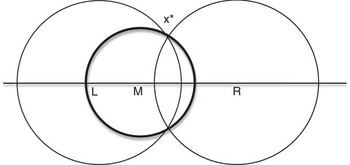
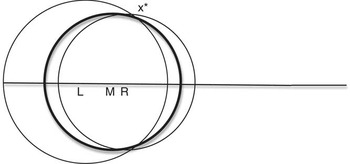
Figures 1A and 1B demonstrate this proposition, where B = 1, Q = 1, w = 1 and Kc is the same for all candidates. A more general proof is found in Online Appendix A. There are three voters whose preferences are on a left-right continuum: L (a voter weakly to the left of M), M (the median voter) and R (a voter weakly to the right of M).Footnote 17 The valence characteristic of the candidate (age) is measured vertically. The optimal age is on the horizontal line, and the center of each indifference circle is on this line as well. If one concentrated on charisma (where more is better) rather than age, then only the lower hemisphere would be relevant. The candidate strictly closest to M is labeled x*.
Every point that is preferred by a majority to x* is preferred by M: x* is to the right of M and to the left of R Note: any point preferred by L and R to x* must also be preferred by M to x*. If x* is the closest candidate to M, then there is no other candidate preferred by a majority of voters

All three voter-indifference curves are drawn through this point. For visual clarity, M's indifference curve is drawn with a heavier line. In Figure 1A, x*'s policy position is between the preferred positions of M and R; in Figure 1B, x*'s policy position is to the right of the preferred positions of L, M and R. It is readily apparent that the only set of points preferred by both L and R to x* are also preferred by M to x*. But we have assumed that x* is the closest candidate to M's most preferred position. So x* is the candidate that is preferred by a majority of voters to all other candidates.
Every point that is preferred by a majority to x* is preferred by M: x* is to the right of L,M and R. Note: any point preferred by L and R to x* must also be preferred by M to x*. If x* is the closest candidate to M, then there is no other candidate preferred by a majority of voters.

While the main focus of this article is on age of appointment being used as a strategic variable in exercising control, the model presented contributes to election theory qua theory. Groseclose has shown that with one issue dimension and one valence dimension, there are no pure-strategy equilibria when candidates care only about winning.Footnote 18 The intuition for the lack of equilibrium in his case is that the higher-valence candidate will try to choose a position similar to the lower-valence candidate, thereby getting all the votes. At the same time, the lower-valence candidate will want to distance himself from the higher-valence candidate in order to get some votes from those who gain sufficiently from the issue to compensate for the inferior valence. So there is no pure-strategy equilibrium, as the high-valence candidate chases the low-valence candidate, who runs away from the high-valence candidate. In contrast, in my model, candidates care about policy, and promises to act differently are not credible (except to a limited degree, as outlined in the model). So there is no chase. In Online Appendix C, I outline how the model can be extended to the multiple-issue case. This too is a contribution to theory. The standard way of handling a multidimensional issue space is to assume that voters vote probabilistically (that is, they sometimes vote for the candidate that makes them worse off). But in the n-dimensional version of the model presented here, there is an equilibrium even when voters always vote for their preferred candidate because credibility limits each candidate to one point.
There are two natural extensions to the basic framework: (1) allowing for a more complex relationship between age and utility, and (2) allowing different cohorts to have different optimal age preferences. The first is easily taken care of. Let f(a) be a positive monotonic transformation of a. Then one can simply substitute
 $$${{[f(a)\,{\rm{ - }}\,f(\hat{a})]}^2} $$$
for
 $$${{(\hat{a}\,{\rm{ - }}\,{{a}_c})}^2} $$$
. The vertical axis is now measured in differences between f(a) and
 $$$f(\hat{a})$$$
instead of differences between a and
 $$$\hat{a}$$$
. Proposition 1 still holds under these more general conditions.
The second extension requires a bit more work. Assume k cohorts of n voters, where each cohort lives for k generations (equivalently, k terms of office). Both n and k are odd. Hence, at the end of every generation, one cohort dies and a new one replaces it. Assume further that the median voter in each cohort has the same preference; otherwise, the distribution of policy preferences may differ from one cohort to another. Finally, allow different cohorts to have different age preferences that are monotonically increasing or decreasing according to the age of the cohort, although within-cohort preferences are the same regarding age preference.
Proposition 2: The median voter in the (k + 1)/2 cohort will be the median voter overall.
For the proof, see Online Appendix B.
I now turn to the comparative static results. Assume initially that the leader is not just a figurehead (that is, B is large).
Proposition 3: When voting bodies elect leaders, leaders elected for life will be older when elected than leaders elected for a term are when they are first elected.
There are several strategic reasons for this proposition. Candidates elected for life compromise less on their policy preferences than candidates elected for a term who would like to be re-elected and therefore compromise more on their preferences. That is, candidates elected for life have larger w values, and therefore their policies are likely to be farther away from the median voter. This increases the potential for conflict between the leader and the voting body. At the margins, there is a tug of war between the electing body and the leader over control. The longer the leader is in power, the more power the leader amasses and the less influence the electing body has on the margin. An important method for the electing body to curb the leader's power is to elect the person when he is old and therefore less dynamic, and with less time to accumulate power that distorts policy from the median. Other methods of controlling the elected-for-life leader, such as writing pre-election contracts, will be covered when I discuss particular religions.
On the other side of the equation, when candidates are elected for one term at a time, an option value arises. This option value is greater for younger candidates. The logic is as follows: once elected, the uncertainty about the candidate's preferences is resolved. If the median voter is pleased with the outcome, then the leader is likely to be re-elected. This option is more valuable when the leaders are younger and more likely to live long enough to serve several terms in office. Therefore, other things being more or less equal, younger candidates will be preferred over older candidates when neither candidate has been elected to office before. This option value is missing for leaders elected for life. It is true that being re-elected increases the leader's power, but in order to be re-elected, the leader's choices must be reasonably aligned with the electorate. Therefore, the leader would have used his power to pursue actions that are in line with the median voter's preferences.
Of course, other things need not be equal – a younger candidate for life leadership may have preferences closer to those of the electorate than an older candidate would. But over the course of many elections, we would expect those who are elected for life to be older than those who are not.
The formal election model is embedded in a more general informal ‘model’ in which similar issues arise. Candidates for leadership do not simply appear. They typically have revealed some of their views beforehand. When mistakes are irreversible, as is the case when a leader is elected for life, there is a need for a better and more time-consuming pre-election screening process that reduces the uncertainty (ɛ) about each candidate's preference to a reasonable level and eliminates people whose preferences are far from the median. More screening means that the electorate will have more information about the candidate's preferences than otherwise, but this takes more time. As a consequence, candidates will be older in religions that elect for life. This reinforces the results of Proposition 3.
Proposition 4: A leader for life will tend to choose a younger successor than the leader for life chosen by the electorate.Footnote 19
Recall that the leader has a similar preference structure to (but potentially different preferences from) those held by voters. That is, the leader also values policy and charisma. Choosing a younger person as the next leader gives the present leader influence over the church long after his death. The alternative is for the leader to choose an older person as a successor, who will then choose an older person as a successor, etc. But this method tends to be more risky than choosing a younger leader in the first place, as each successor is only an imperfect agent of the previous leader. When a ‘leader for life’ chooses a successor, there is a random walk of preferences that is exacerbated by choosing older leaders who live for fewer terms, thereby creating more random walks and more risk.
To illustrate, suppose that in each period t, a leader chooses a person who is old and will only lead in the next period, t + 1. To further simplify, suppose that the leader in time t with the most-preferred position
 $$${{\hat{x}}_t}$$$
can choose a new leader in time t + 1 with expected preference
 $$$E({{\hat{x}}_{t\, + 1}})\, = \,{{\hat{x}}_t}$$$
. Then a leader with the most-preferred position
 $$${{\hat{x}}_t}$$$
will have a Q chance of choosing a leader with a most-preferred position
 $$${{\hat{x}}_{t\, + \,1}}\, = \,{{\hat{x}}_t}$$$
, a 0.5[1 − Q] chance of choosing a leader with a most-preferred position
 $$${{\hat{x}}_{t\, + \,1}}\, = \,{{\hat{x}}_t}\, + \,{\epsilon}$$$
and a 0.5[1 − Q] chance of choosing a leader with a most-preferred position
 $$${{\hat{x}}_{t\, + \,1}}\, = \,{{\hat{x}}_t}\,{\rm{ - }}\,{\epsilon}$$$
.
Under this scenario, the present leader knows that there will be a random walk of policy with
 $$${k}-{\rm{1}}$$$
steps over
 $$${k}-{\rm{1}}$$$
generations. Because utility is a concave function of the difference between the present leader's preferred position and the future leader's preferred position, the present leader is risk averse. With regard to policy, a less risky strategy for the existing leader would be to choose a new leader who is only one generation old. Then the random walk takes place only once over the
 $$${k}-{\rm{1}}$$$
generations – when the young leader is appointed and rules for a long period. In contrast, when there is an election, the assembly is still intact after the old leader dies, so the problem of the random walk disappears over time as it restarts from the most-preferred candidate of the median voter in the assembly, which changes more slowly (if at all). Appointing a younger leader means that the leader will garner more power over time. This is desirable from the old leader's perspective, but, as argued earlier, when the assembly appoints a leader, it prefers one who is weaker vis-à-vis the assembly, which requires appointing an older leader. There will be greater uncertainty about a younger person's preferences regardless of who is appointing the new leader, but as argued above, there are benefits that accrue to the leader that do not accrue to the assembly when appointing a younger leader.
It is reasonable to believe that the correlation of a leader's preferences with his/her adult child's preferences is likely to be positive, even if not perfectly so. This means that in comparison to appointing an unrelated successor, there is less risk in appointing for life the leader's adult offspring while they are still relatively young. Coupled with other added benefits of hereditary succession, it is not surprising that offspring are often chosen as successors, even if there is no such explicit rule. When one's offspring step into the leadership role, grooming for the leadership role can start at a very early age. At the same time, screening is limited to the leader's children, which allows for a relatively rapid elimination of the weaker candidates for leader. This reinforces the results of Proposition 4. Particularly when life expectancy was short, such hereditary succession resulted in the appointment of very young leaders.
When leaders cannot be removed from office, the leadership position can sometimes be stripped of power. For example, the devolution of power of the English monarchy and, more germane to the topic of this article, the Protestant Reformation's denial of the pope's power. In Protestant religions, power is considerably devolved so that the leader is much weaker. In extreme cases, the leader is only a figurehead and the voters’ utility functions no longer depend on the leader's ideological position, xc ; that is, B = 0. In such cases, the most important characteristics are the leader's age and charisma, Kc . The leader is the human embodiment of the abstract religious principles. This human connection between the leader and the followers becomes stronger the longer the leader has been in this role. We thus have the following proposition:
Proposition 5: When the assembly appoints a leader for life, leaders without power (that is, where B = 0) will be elected at a younger age than those who are powerful (where B is much larger).
Because the leader's power is weaker and can be controlled, the risks of electing a younger person are greatly reduced. On the other side of the equation, the longer the leader has been the embodiment of the church, the stronger the connection the followers feel. Hence, symbolic leaders will tend to be appointed at a younger age.
All of the above deal with succession in existing religions. But founders of new religions do not have to conform with the existing power structure, because there is none. In particular, they do not have to travel up the steps of the pyramid. Instead, they compete with other religions to gain members. Therefore it should not be surprising that founders will tend to be younger when first recognized as the leader of a new religion than subsequent leaders in the established religion.Footnote 20
The Structure of Churches and the Age of Their Leaders When First Appointed
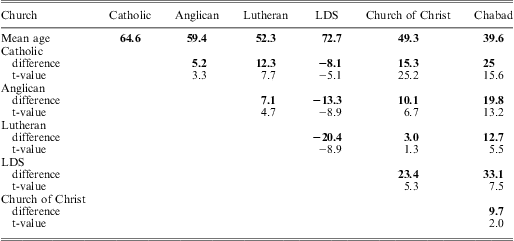
The theory developed in the previous section will now be used to provide insight into particular religions. The starting line for the data is the closest appointment to 1776, as that was about the time that the Episcopal Church of the United States split from the Church of England; since that time, a number of American churches have been created.Footnote 21 The relevant data is found in Table 1, which shows that the pair-wise comparisons between religions have statistically significant differences in the age of (first) appointment to the leadership. The data behind Table 1 is found online in Tables 1A and 1B.
Differences in Age and T-values

Note: age and age differential are in bold.
Roman Catholic Church: The Pope and the Cardinals
The Roman Catholic Church is centralized and hierarchical. The College of Cardinals elects the pope, who serves until he dies.Footnote 22 This is an elected autocracy, and the pope has considerable power over church policy. The College of Cardinals is not a legislative body and has no de jure ruling power, except when there is a papal vacancy (and even then, its powers are extremely circumscribed). In turn, the pope elects new cardinals to the college.
I have argued that, other things being equal, electing a leader for life results in the electoral body electing older religious leaders than would be the case if the leader were elected for a term. This effect is magnified when the leader is an autocrat, as there are then fewer ways to limit the damage from the leader. In turn, this requires a longer period of pre-electoral screening for the right types. In the Catholic Church, screening is done through discrete steps (priest, bishop and cardinal) that result in election at an older age. Since 1775, the average age of a pope when elected is sixty-five and the average term length for popes has been fifteen years.Footnote 23
The College of Cardinals might try other ways besides electing older leaders to limit the influence of the pope. One method is to have the prospective pope promise to carry out certain policies. For example, in 1352 the College of Cardinals had prospective popes sign a formal ‘capitulation’. But the commitment was not credible. After his election, Pope Innocent VI declared the capitulation invalid.Footnote 24 Much of the history thereafter followed a similar pattern of broken promises until the practice of writing capitulations died out in the sixteenth century.Footnote 25
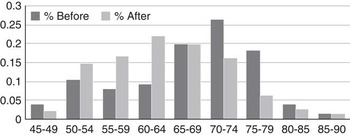
The College of Cardinals elects the pope, but the pope elects new members to the College of Cardinals, thereby influencing the election of the next pope. It would seem that successive popes might expand their influence on the future by increasing the size of the college and filling it with like-minded young cardinals. But from 1587, when Sixtus V fixed the number of cardinals at seventy (in Postquam verus) until 1970, when Pope Paul VI increased the size of the electorate to 120, there were no increases in the size of the electorate.Footnote 26 Why did Sixtus limit the size to seventy? If he were merely interested in adjusting the number of cardinals to be optimal for administering the size of the Church, then he would not need to fix the size in a Papal Bull; he could have announced a ratio of cardinals to bishops instead. It seems plausible that he wanted to prevent an upward creep in the size of the electorate that would arise if each pope tried to increase his influence. But why did future popes accept the limit rather than increase it by issuing their own Papal Bulls? If the next pope increased the number of cardinals, then the pope after that would likely increase the number as well. So seventy became a focal point and took on a life of its own. Finally in 1967–70, Pope Paul VI limited the electorate to cardinals under eighty years of age and increased the size of the electorate to 120 (so that the total number of cardinals could be much higher). This enabled Paul VI to expand the influence of the church in both the east (by making patriarchs of the Eastern Catholic Church into cardinals) and the south (by expanding the influence of the church in Africa and South America).Footnote 27 And more to the point of this article, it enabled him to drastically change the makeup of the electors. Note that most of the cardinals still kept their positions after the age of eighty (the main exception being the Roman curia) as well as the pope himself; so it was not so much about energizing the day-to-day operations of the church as influencing future elections.Footnote 28 Of those elevated to cardinal in the thirteen years before Paul VI was elected pope, 18.1 per cent were in the seventy-five to seventy-nine age group. In the thirteen years after Paul VI made his announcement, only 6.3 per cent were in this age group (this shift in the distribution can be seen in Figure 2). Because bishops are made cardinals only at the occasion of consistories (which are held at irregular times), appointing cardinals from the seventy-five to seventy-nine age group could mean that they would be too old to vote in the near future and that the present pope might not have the chance to replace them (unless the pope chose to exceed the 120 limit). More important, appointing too many cardinals in the seventy-five to seventy-nine age group would mean an even greater expansion of the College of Cardinals when they reached eighty.
Age of appointment to cardinal before and after Pope Paul VI reform

Although I have focused this article on the period starting with the founding of the Episcopal Church in the United States, it is insightful to compare the age and length of reign of popes before and after Pius V (in 1775). I start with Innocent VII in 1404 because that is the first time that the pope's date of birth is available. In the first period, the average age of election to pope was sixty-two, while the average reign was 7.5 years; in the second period, the average age of election was sixty-five, while the average length of reign doubled to fifteen years. Now that life expectancy is longer and hence the expected length of reign for any given age of election is longer, it is not surprising that the average age at election is older.
The Church of England
The Church of England is an obvious religious institution for comparison to the Roman Catholic Church. Until Henry VIII, the Catholic Church in England was under the authority of Rome, and the Church of England still considers itself to be a Catholic Church.Footnote 29 And until 1975, the Archbishop of Canterbury was appointed for life.Footnote 30 But there are significant differences, all of which make the archbishop far less influential. The British monarch has the constitutional title of supreme governor of the Church of England, and the canon law of the Church of England acknowledges that the monarch ‘is the highest power under God in this kingdom, and has supreme authority over all persons in all causes, as well ecclesiastical as civil’. In the early years after Henry VIII, the archbishop was clearly subservient to the monarch. Queen Elizabeth suspended Archbishop Grindal from his office from 1577 until his death in 1583, and Archbishop William Laud was impeached by the Long Parliament in 1640 and eventually beheaded. Over time, the influence of the monarch (and later the parliament and the prime minister) on the Church greatly waned. Nevertheless, as recently as 1991, Margaret Thatcher implicitly vetoed Lord Sheppard from becoming the next archbishop. But this devolution of power to the Church did not mean that the archbishop gained power, as power is now in the hands of the General Synod, whose membership includes bishops, elected clergy and elected laity (there are no cardinals). The archbishop can use his rhetorical skills, but he has virtually no legal power and therefore there is, at best, only a modest need to constrain his power by appointing him at an older age. Indeed, because human connections deepen with time, it makes sense to appoint the living embodiment of the Church at a younger age (Proposition 5).Footnote 31
The American Episcopal Church
The American Episcopal Church was organized shortly after the American Revolution, when it was forced to break with the Church of England because the Church of England clergy were required to swear allegiance to the British monarch, which, of course, was treasonable. It thus makes sense to compare the Episcopal Church and the Church of England because they are so close in theology, but differ in structure.
In the American Episcopal Church, bishops are ordained by three or more existing bishops. Before 1926, the first person to be ordained bishop became the presiding bishop of the Episcopal Church. Not surprisingly, this meant that the average age at taking office was seventy (see Table 1A online). Then the rules changed. The role of presiding bishop became an elected position and it was no longer for life. Since 1926, the average age of election for presiding bishops has been fifty-nine. In contrast, for the Church of England, the average age of appointment to archbishop decreased by only six months, while for the Catholic Church, the average age of election to pope increased by five years since 1926. This evidence supports the arguments made earlier.
The Lutheran Church – Missouri Synod
The Lutheran Church–Missouri Synod was founded in 1847. It is the second-largest Lutheran body in the United States after the Evangelical Lutheran Church of America, which formed in 1988 from the merger of three Lutheran churches (and thus is too young to make statistical comparisons). The Lutheran Church–Missouri Synod is led by a president who is chosen at a Synod (composed of professional clergymen and lay representatives from the member congregations). The convention is held every three years, which corresponds to the term of the presidency. The Synod, let alone its head, has virtually no influence on the individual churches. Article VII of the Synod's constitution states the following:
In its relation to its members, the Synod is not an ecclesiastical government exercising legislative or coercive powers, and with respect to the individual congregation's right of self-government it is but an advisory body. Accordingly, no resolution of the Synod imposing anything upon the individual congregation is of binding force if it is not in accordance with the Word of God or if it appears to be inexpedient as far as the condition of the congregation is concerned. … Membership of a congregation in the Synod gives the Synod no equity in the property of the congregation.
Because there is no need to further limit the power of the president, it should not be surprising that the average age of the president when first elected is fifty-two.
Church of Christ of Latter-day Saints
The Mormon Church was founded by Joseph Smith in 1830. There was a succession crisis after his death in 1844, and the Church split into several branches.Footnote 32 In this section, I consider the Mormon Church that is based in Salt Lake City and known as the Church of Christ of Latter-day Saints (LDS). The Latter-day Saints consider Brigham Young to be the leader following Smith.
The Church is hierarchical and headed by a president (the prophet), the Quorum of the Twelve Apostles and the First Presidency (which includes the president and two counselors, often chosen from the Quorum of the Twelve Apostles).Footnote 33 Except for Joseph Smith, who was ordained when he was twenty-four, the average age of ordination to president is seventy-three.Footnote 34 On the other hand, the average age of appointment to the Quorum of the Twelve Apostles is forty-nine.Footnote 35 The theoretical construct derived earlier explains this difference, as well as other unusual aspects regarding age.
Because Joseph Smith was the founder of Mormonism, we should not be surprised that he was young and that most of his followers were young. And for similar reasons, the second generation is also likely to be young, especially when the leader dies at a young age, as Smith did at age thirty-eight. Brigham Young, his successor, was the second youngest to assume the role of president of the LDS Church at age forty-six.
But why did all the others assume the role of president at such an old age (the youngest was sixty and the average since Brigham Young has been seventy-six)? As was the case in the early years of the Episcopal Church, the presidency is in the order of appointment. But for the LDS Church, the critical appointment is to the Quorum of the Twelve Apostles.Footnote 36 In order to be president, everyone appointed before you has to die. So even if you were appointed at a very young age, you could be a very old man by the time you become president if others before you were also young when they were appointed (which has been the case, particularly in the earlier years). There are also positive reasons for the long wait – the members of the Quorum are being groomed for the job during this time.
Throughout this article, I have treated most of the institutions as fixed, but some are more fixed than others. As already mentioned, the Episcopal Church changed its method of appointment to the presidency from the order of ordination as bishop to an election. In that case, the power was in the hands of the bishops, not the presidency, and most of the bishops preferred to have a president of their own choosing rather than a mechanical ordering. In contrast, the LDS Church is hierarchical and the president, as well as a majority of the Quorum of Twelve, has little to gain from holding an election. So, unless power becomes more diffuse, elections to the presidency itself seem very unlikely.
When a vacancy arises in the Quorum of Twelve Apostles, appointment to the Quorum is by unanimous decision of the First Presidency and the Quorum. It seems likely that the president is far more influential than the unanimity requirement suggests. One general implication of Proposition 4 is that the age of new appointees should be, on average, less than that of the existing appointees, both because the appointments take place later in time and because younger appointees are more likely to survive long enough to be president. The president chooses the next president, subject to a death lottery. All of this is most evident when adding heredity to the mix (Proposition 5 again). Five Quorum of Twelve members were appointed by their fathers when president: Brigham Young, Jr. (appointed at thirty-one by Brigham Young), John W. Taylor (appointed at twenty-six by John Taylor), Abraham Woodruff (appointed at twenty-five by Wilford Woodruff), Hyrum M. Smith (appointed at twenty-nine by Joseph F. Smith) and Joseph Fielding Smith (appointed at thirty-four by Joseph F. Smith).Footnote 37 The age of appointment was significantly younger for these five than the average age of appointment to the Quorum of Twelve (forty-nine, which includes these five).Footnote 38 However, the death lottery was not kind to some of them – Abraham Woodruff died at thirty-one and Hyrum Smith died at forty-five.
At this juncture, it is useful to remember that the statement is ‘other things being equal, a leader prefers to choose a younger rather than an older person as the new leader’. In the days of polygamy, Mormon leaders had many sons who were often of a roughly similar age. In such cases, the leaders chose the son who was most promising as a future leader to be a member of the Quorum of Twelve. And outside the nepotism circle, there has been a process of selecting and grooming people for future leadership positions.
Community of Christ
The Community of Christ, formerly known as the Reorganized Church of Jesus Christ of Latter-Day Saints, is a Mormon church. Like the LDS Church, its founder is Joseph Smith, Jr. The Community of Christ also shares many structural elements with the LDS church, including a presidency and a Quorum of the Twelve Apostles. Despite these similarities, there are certain dramatic differences between the two churches, some of which are played out with regard to age. The average age of appointment to president of the Community of Christ is forty-four, in comparison to the average age of appointment to the president of the LDS Church, which is seventy-three.
The president chooses his successor in the Community of Christ, and until 1996 all of the presidents were descendants of Joseph Smith. In 1996, Wallace Smith retired (only the second prophet to do so). Since he did not have any male heirs (and for some reason did not want to choose a nephew) he selected W. Grant McMurray, who was thirty-nine at the time. McMurray retired under a cloud eight years later and appointed Stephen Veazey, forty-eight. As argued above, when leaders choose their successors, the successors tend to be young. There is little advantage to choosing an older person, since the successor and the successor's chosen successor are subject to a random walk. Because the president who does the appointing is now out of the picture, he will not be choosing his successor's successor, as is the case with the cardinals in the Roman Catholic Church.
Chabad Lubavitch
The Chabad Lubavitch movement is a branch of Hasidism founded by Rabbi Schneur Zalman around 250 years ago. We now turn our attention to this movement because in certain ways, the Community of Christ is more similar to Chabad Lubavitch than it is to LDS. Chabad Lubavitch has a ‘hereditary-like’ structure, in that all successor Rebbes have been sons or sons-in-law of the previous Rebbe.Footnote 39 Particularly in earlier years, when people died younger, this would mean that a son would take over at a very young age. Indeed, in one case, the son was only twenty-three when his father died; the position was left open for ten years until he was older and more experienced. The average age of appointment is forty.Footnote 40 Rebbe Menachem Schneerson had no children, and when he died in 1994 there was no system for anointing a new Rebbe (in part because many of his followers believed that he was the Messiah and that there would be no need for one). As a result, there has been no new Rebbe and the group has struggled to maintain its coherence.
Jehovah's Witnesses
We have looked at the power struggle between the electing body and the elected-for-life leader that results in older leaders being elected under such circumstances. This power struggle is very evident in the short time period that the Jehovah's Witnesses have existed; the relative power of the leader vis-à-vis the electing body has rapidly changed from one leader to the next. Unfortunately, the secretiveness of the Jehovah's Witnesses, the amorphous structure of power and the short time period for each episode does not allow for a quantitative study. Nevertheless, a general outline is still insightful.
Charles Taze Russell co-founded Zion's Watch Tower Tract Society (now known as the Jehovah's Witnesses) in 1881, and in 1884 the corporation was officially registered in Pennsylvania, with Russell as president. Like many other religious founders, he was young (twenty-nine) when he co-founded the religion. Joseph Franklin Rutherford was forty-seven when he was installed as the second president of the corporation. He envisioned the Watch Tower Society as a theocracy and undertook steps to centralize power, including the appointment of leaders for each congregation. A power struggle erupted between Rutherford and four of the seven members of the Board of Directors, who accused him of autocratic behavior.Footnote 41 But Rutherford gained a legal opinion that these four were not legally directors and replaced them with four new (sympathetic) directors. However this was not the end of the litigation, and eventually the four ousted directors obtained a court opinion that claimed Rutherford's actions were ‘wholly unlawful’.
At the age of thirty-five, Nathan Knorr was named the third president of the Watch Tower Bible and Tract Society. It appears that he never had the power of his predecessor, and before his death, the power of the presidency was completely absorbed by the Governing Body.Footnote 42
Today, the president is in charge of the day-to-day operations of the society (for example, the printing of tracts), but he has nothing to do with theological concerns or the structure of the Jehovah's Witnesses. Religious policy is instead determined by the nine-member Governing Body, which requires a two-thirds majority for a proposal to pass.
Members of the Governing Body are appointed for life, and when a member dies the remaining members appoint his replacement. There are a number of crosscurrents that make a prediction about age more difficult. Nevertheless, we can make limited predictions. We start by comparing the Jehovah's Witnesses to the Catholic Church. Both are hierarchical and, in both, appointment to the leadership position (the pope of the Catholic Church and to the Governing Body of the Jehovah's Witnesses) is for life. Both of these lead to appointments at an older age. However, in the case of the Jehovah's Witnesses, each member of the Governing Body has only one-ninth of the power, and there is no need to advance through a hierarchy of priest, bishop and cardinal in order to be appointed to the Governing Body as there is little hierarchy below it. Furthermore, as the existing members age, they appoint people to carry on their policies after they die. For all these reasons, one would expect the members of the Governing Body to be much younger on average when first appointed than popes in the Catholic Church. And indeed, this appears to be case. For the set of members as of January 2012, the average age of appointment was fifty-five. We would also expect the age at appointment to the Governing Body to be older than the age of appointment to leader in a hereditary system. And this too, holds.
The Dalai Lama and the Gelug School of Tibetan Buddhism
So far the analysis has concentrated on how leaders are reined in when there are constraints on what those who appointed the leader can do. But in the absence of such constraints, there are other ways – besides voting for older leaders – to ensure that the leader follows the dictates of those who appointed him. This section will discuss these other ways.
At first blush, the Dalai Lama could be viewed as a prime counterexample to the arguments made in this article, as he is appointed at a very young age and holds his position for life. But, as will be seen, the facts accord with the theory. In practice the tenure has been extremely short, and in the eighteenth and nineteenth centuries, tenure as leader was far shorter than any of the other religions we have examined.Footnote 43
As I have suggested throughout this article, the issue is how to control a leader who is elected for life. The Tibetan Buddhists employ several methods that I have not considered up to now. Dalai Lamas are raised in monasteries and subjected to intense indoctrination as they grow up. But as most parents realize, their children do not always become the adults the parents want. And so the Dalai Lama may grow up being more interested in wine, women and song than in spiritual matters (as was the case for the sixth Dalai Lama), and even if he is more serious, his politics may clash with others.
So how is the Dalai Lama constrained? First, there are regents who are in charge while the Dalai Lama is a minor. Sometimes the regent remains in charge even when the Dalai Lama is much older, and when the fifth Lama died, it was seventeen years before his death was announced. However all of these methods are limited, so more serious measures may need to be taken. The sixth Dalai Lama was kidnapped and killed at the age of twenty-three in 1704, and a number of other Dalai Lamas were killed by poisoning in the following 200 years.Footnote 44 From 1678 until 1895, Dalai Lamas ruled for a total of eight years (see online Table 2). So the real power was in the hands of other religious leaders (more or less the equivalent of cardinals) or foreign interlopers (the Chinese) or a combination of the two. Unfortunately the palace intrigue is secret, so we cannot say how the powers behind the throne accrued their power.Footnote 45
Until now, we have been looking at the struggle for power within religions. However, these internal struggles pale in comparison to the struggle between Tibetan Buddhists and the Chinese government that has occurred since the Chinese invaded Tibet in 1950. This power struggle magnifies the behavioral relations that we have been discussing and at the same time creates greater pressure for institutional change within the religion.
In order to move the discussion forward, we need to know more about Tibetan Buddhism. It is not a centralized religion; rather, it is a complex association of religious orders or schools. Even within a school, each monastery uses its own set of commentaries and texts. In recent centuries, the Dalai Lama, as leader of the Gelug School, has been the temporal head of Tibet and the most important spiritual leader. But in earlier centuries, the Sakya and then the Kagyu School ruled Tibet. Within the Gelug School, the two most important spiritual leaders are the Dalai Lama and the Panchen Lama. The Dalai Lama must recognize the reincarnation of the Panchen Lama and vice versa, but otherwise neither is granted spiritual authority over the other. So historically there has been a lot of competition for power.
In 1959, after the Chinese had quashed a rebellion by the Tibetans, the Dalai Lama fled from Tibet to India. He is now seventy-four. Locked in a power struggle with the Chinese over control of Tibetan Buddhism, the Dalai Lama needs to alter the traditional arrangements. In particular, he needs to avoid the power vacuum that could occur until the reincarnated Dalai Lama reaches maturity. The most important method is to appoint a regent who commands spiritual respect and is young enough to be a vibrant presence over the next decades. The likely regent is the seventeenth Karmapa, spiritual head of the Karma Kagyu School, who is now twenty-seven.Footnote 46 Even though it is traditional to have someone from the Gelug School as regent, it should not be surprising that internal differences pale in the face of the Chinese onslaught and that the Dalai Lama would want to install a young person for the reasons discussed above.Footnote 47 The Dalai Lama has spoken of the possibility of ending reincarnation, but the problem is that many Tibetan Buddhists would continue believing that the Dalai Lama will be reincarnated, and the Chinese will take advantage of this. The Dalai Lama has also talked about reincarnating before he dies. He claimed that under a doctrine called madey tulku, he can select his own reincarnation while still alive. This would allow him to shorten the period without a leader and control the education of his replacement.Footnote 48
A Cross-Section Test
I have also undertaken a cross-section comparison of religious leaders. Making use of a Wikipedia list of religious bodies in the United States that is based on data reported by the US Census Bureau, I was able to gather the requisite information for forty-three religious organizations, including those whose leadership is based outside the United States, such as the Salvation Army and the Coptic Orthodox Church. Appointment for LIFE and the leader CHOOSES the next leader are the two independent variables, while AGE when first appointed to the leadership position is the dependent variable. The hypotheses predict that the coefficient of LIFE is positive and that the coefficient of CHOOSES is negative; hence we have one-tailed tests. Note that a necessary condition for the leader choosing the next leader is that the present leader has a lifelong appointment. The results are as follows:
 $${\rm{AGE}}\,{\rm{ = }}\,{\rm{61}}{\rm{.7}}\,{\rm{ + }}\,{\rm{6}}{\rm{.6}}\,{\rm{LIFE}}\,{\rm{ - }}\,{\rm{3}}{\rm{.7}}\,{\rm{CHOOSES}}$$
The one-tailed test that the coefficient of LIFE is positive is significant at the 0.029 level and the one-tailed test that the coefficient of CHOOSE is negative is significant at the 0.09 level. The joint test on these two hypotheses is significant at the 0.028 level. The R-squared is 0.10, which is surprisingly large. As noted already, the theoretical model is a simplification. The empirical model simplifies much further. Age is only one factor in choosing a leader. Other factors include leadership skills (such as charisma) relative to the other candidates and preferences of the leader vis-à-vis the preferences of the voting body and the other contenders for the leadership position. I am not able to measure these other factors.
Politics More Generally
I have provided a convenient metric, age, which allows for comparisons both over time and across religions. While I have focused on politics within religious institutions, the same analysis should hold for politics more generally. An insightful comparison is between the doges of Venice and Genoa.Footnote 49 The former were appointed for life, while the latter (after 1527) were appointed for two-year terms. According to the theory presented here, the Venice doges should have been appointed at an older age. Unfortunately, for Genoa, I have only been able to obtain birthdates for those who became doges after 1700. For Venice, a consistent series starts a century earlier. Napoleon ended the reign of both doges in 1797. For Genoa the average age at appointment was 60.4, and for Venice since 1700 the average age of appointment was 66.9; the difference between the mean ages is three standard deviations, making these results highly statistically significant. For Venice since 1600, the average age of appointment was 69.2; the difference between the mean ages of appointment between Genoa and the extended series on Venice is 5.9 standard deviations. The average reign for Venice was 6.2 years since 1600 and 8.8 years since 1700. So here, too the age of appointment was used to rein in the power of the leader.
Extending the analysis to succession in non-democratic governments is not an easy task, as the power relationships may not at all resemble the stated legal relationships. Can the leader really be removed by the parliament? Is the real power in the hands of the presidency or the generals? And has the structure of power changed dramatically over short periods of time, despite there being no change in the legal basis for the allocation of power?
With these caveats in mind, let us look at China. The Politburo Standing Committee (PSC) of the Communist Party of China is the center of power in the country.Footnote 50 The size of the committee has varied between five and eleven members, and like the Jehovah's Witnesses’ governing body, many of the internal workings are mysterious. However, since Deng Xiaoping became leader, it is clear that the former leaders (and, to a lesser extent, the former members) are very influential in choosing the new leader and the other members of the PSC.Footnote 51
The term ‘paramount leader’ is often employed by commentators because the true leader is not necessarily connected to a particular office. The paramount leader has typically been the chairman of the Communist Party of China (and later, the general secretary of the Communist Party) and sometimes the chairman of the People's Republic of China (later, the president of the People's Republic of China) and the chair of China's Central Military Commission. However, Deng Xiaoping never held the first two of these offices, and he was considered the paramount leader even during 1987–92, when he was no longer a member of the PSC and Jiang Zemin was the general secretary of the Communist Party of China. Indeed, Deng continued to exert influence after his retirement from all government positions in 1992 until his death in 1997. For reference, the paramount leaders have been Mao Zedong, Hua Guofeng, Deng Xiaoping, Jiang Zemin, Hu Jintao and now Xi Jinping. The power of the leader has devolved since Deng so that the party leader is now closer to being ‘first among equals’.
As noted earlier, the founders of a religion tend to be young. The same holds true for the Chinese Communist Party. Even after engaging in a long war of ‘liberation’, the average member age at the start of the ten-year de facto PSC beginning in 1945 was forty-nine: Mao Zedong was fifty-two and Zhou Enlai and Liu Shaoqi were both forty-seven. However, Mao held onto power in his role as chairman of the Communist Party of China until his death at age eighty-two in 1976. Zhou Enlai also died in 1976 at age seventy-eight (Liu Shaoqi had been expelled from the party in 1968 and died shortly thereafter).
By the end of 1978, Deng Xiaoping had become the de facto leader of China until his retirement at age eighty-eight in 1992. There were three areas, all in reaction to Mao, that needed to be resolved by Deng and those who followed him: (1) to implement a more pragmatic economic policy and have a more stable political climate, (2) to prevent a continuation of leadership by gerontocracy and (3) to prevent another Mao from arising. I now consider each in turn.
-
(1) After the trauma of Mao's chaotic and ideology-driven policies, Deng shifted to a more pragmatic economic approach by opening China to foreign investment, the global market and limited private ownership. These policies continue today. The desire for a more stable political climate and the dominance of the Communist Party also resulted in the military suppression of the protests in Tiananmen Square and the continued control of political information.
-
(2) With the exception of Hua GuoFeng's 2-year rule, between 1963 and 1992 China's paramount leaders have been in their seventies and eighties, including Deng. This long rule by the very old was certainly suboptimal. As early as 1982, Deng argued for the mandatory retirement of older state (but not party) leaders.Footnote 52 In 1997, Jiang Zemin officially instituted forced retirement at age seventy so that all members who had reached that age, except Jiang himself, were ineligible to serve on the fifteenth PSC. In 2002, China instituted a rule requiring the retirement of all Politburo members after they reached the age of sixty-eight.Footnote 53 Specifically, a person could not be appointed or reappointed to the next five-year term of the PSC if he would reach age sixty-eight before the next party congress.
-
(3) Mao is the horrible history lesson for the Chinese Communist Party. To prevent the rise of another leader as powerful as Mao (or even as powerful as Deng Xiaoping), other means had to be devised. As argued earlier, a major method of reducing the power of the autocrat is to reduce his time in the leadership position, thereby reducing his ability to accumulate more power. Since Mao's time, only one leader, Jiang Zemin, has been general secretary of the Communist Party of China for more than ten years (Jiang was head for thirteen years). And even if we consider paramount leaders, only Deng and Jiang served more than ten years (nearly fourteen and twelve years, respectively).Footnote 54 Now that there is a retirement age for party leaders, the accumulation of power is curtailed by appointing leaders who are too old to serve more than two terms (because they will have reached retirement age before a possible third term) and by appointing most of the other PSC members when they are too old to serve more than one or two terms. I will now go into greater detail.
I start with those who were appointed leader after 1997, when the retirement age became official policy. I have already mentioned Jiang Zemin. Hu Jintao reached sixty-eight before the end of his two five-year terms and therefore could not be on the PSC, let alone be head, for a third term starting in 2012. The same will hold true for Xi Jinping, as he will reach sixty-eight before 2022. Next looking at the members of the PSC (including the leaders), there have been twenty-five members from 1997 until now. Of those, only four could have served more than ten years before being forced to retire. And of those, two were Hu Jintao and Xi Jinping. It makes sense that they served on the PSC before they became leaders, because in this way they could serve as apprentices. At least half of the rest of the members of the PSC have not been eligible to serve more than one term.
The youngest member to be appointed to the PSC since Mao is Hu Jintao, who was appointed at age forty-nine in 1992. As argued earlier, when a leader anoints his successor, the leader wants his successor to be in power as long as possible. Deng Xiaoping and Jiang Zemin appointed Hu Jintao to the PSC in 1992. In retrospect it was clear that the plan in 1992 was for Jiang to be in charge until 2002 and Hu Jintao to be in power from 2002 until 2012.Footnote 55 In this case, Deng not only chose his successor, Jiang Zemin, but also his successor's successor, Hu Jintao. Hu Jintao was not as powerful as Deng was, but during his last five-year term there were only two Politburo members who could be in power for at least ten years after he retired – Xi Jinping and Li Keqiang. The latter could be in power for five more years after Xi Jinping retires in 2022 – or longer if Xi dies before then and Li is his replacement.Footnote 56 Essentially, the fear of creating another Mao means that the leadership position is held for ten years. Given that constraint, the present leader influences future leaders by choosing a member of the PSC who is young enough to take office after the first successor has to retire. The more powerful the about-to-retire present leader is, the longer the shadow he can cast on the future. In any event, the present leader and his fellow members of the PSC cast a shadow on the future as they choose their immediate successors.Footnote 57 And as already noted, the immediate successors are young enough to remain in power for ten years, but too old to remain in power for longer.
Concluding Remarks
I have shown how different institutional arrangements affect the choice of a leader. One might argue that a more fundamental question is why the particular institutional arrangement was chosen in the first place. But this ‘more fundamental’ question cannot be fully answered until one knows the effects of various institutional arrangements. That is, without knowing the effects of different institutional arrangements, one cannot explain why a particular arrangement was chosen. While it is conceivable that institutions do not matter, it has been shown that when it comes to the age of the leader when first chosen, they do matter.
Some religions that are relatively similar in religious doctrine have significantly different power arrangements, while other religions that differ greatly in religious doctrine have similar methods of appointing leaders. This variation means that religious institutions are a natural laboratory in which to study elections and the politics of power.
Some religions limit the power of the church leader by placing policy in the hands of a synod and electing the leader for a set term. In other religions, the power of the church leader is less constrained because there is no legislative body and the appointment is for life. In such cases, the main methods of control are longer screening periods and electing a leader who will be in power for a relatively short time. Today, the main method of accomplishing these objectives is to elect older leaders; at other times and places, murder was another option.
In contrast, the leader's main way of exerting influence beyond the grave is to directly choose the next leader (or if he cannot directly choose the next leader, to choose the electors who will choose the next leader). In the former case, this leads to younger leaders being chosen; in the latter case, leaders tend to ‘stack the deck’ of electors by increasing the size of the electoral body and possibly eliminating some of the electors who were chosen by previous leaders.