1 Introduction
1.1 Preaspiration in northwest Europe
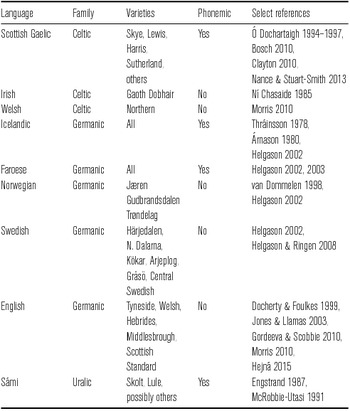
The preaspiration of voiceless oral stops is generally described as a rare linguistic feature, having been identified in no more than a few dozen of the world's languages. (For inventories of such languages, consult Silverman Reference Silverman2003, Clayton Reference Clayton2010, and Hejná Reference Hejná2015; on the possibility that preaspirating languages have been significantly undercounted, see Hejná Reference Hejná2015.) Despite this apparent scarcity, a cluster of preaspirating languages and language varieties can be found in northwestern Europe (Table 1), concentrated among the languages of Scandinavia and the British Isles (Hansson Reference Hansson and Brinton1999). This cluster includes members of the Uralic language family, such as Skolt Sámi (McRobbie-Utasi Reference McRobbie-Utasi and McFetridge1991) and Lule Sámi (Engstrand Reference Engstrand1987); representatives of the Celtic branch of Indo-European, including Scottish Gaelic (Ní Chasaide Reference Ní Chasaide1985, Ó Dochartaigh Reference Ó Dochartaigh1994–1997, Bosch Reference Bosch2006, Clayton Reference Clayton2010, Nance & Stuart-Smith Reference Nance and Stuart-Smith2013), Irish (Ní Chasaide Reference Ní Chasaide1985), and Welsh (Morris Reference Morris, Meyerhoff, Adachi, Daleszynska and Strycharz2010); and a number of Germanic languages, including Icelandic (Thráinsson Reference Thráinsson1978, Árnason Reference Árnason1980, Helgason Reference Helgason2002), Faroese (Helgason Reference Helgason and Solé2003), Norwegian (Helgason Reference Helgason2002), and Swedish (Helgason & Ringen Reference Helgason and Ringen2008). In addition, recent studies have described preaspiration in several varieties of English: Tyneside (Docherty & Foulkes Reference Docherty, Foulkes, Foulkes and Docherty1999), Middlesbrough (Jones & Llamas Reference Jones, Llamas and Solé2003), and Aberystwyth English (Morris Reference Morris, Meyerhoff, Adachi, Daleszynska and Strycharz2010, Hejná Reference Hejná2015). Preaspirated fricatives have been described in Scottish Standard English (Gordeeva & Scobbie Reference Gordeeva and Scobbie2007, Reference Gordeeva, Scobbie, Fuchs, Toda and Żygis2010) and Aberystwyth English (Hejná Reference Hejná2015).
Languages of northwestern Europe which feature preaspiration in at least some dialects.

Finally, preaspirated voiceless stops have been reported in the English varieties spoken in the Hebrides, the island chain on Scotland's west coast (Shuken Reference Shuken and Trudgill1984, Reference Shuken and Görlach1985; Clayton Reference Clayton2015). Referring to the island of Lewis, Borgstrøm (Reference Borgstrøm1940: 15) observes that ‘postvocalic k, t, p are usually rendered by Lewismen as hk, ht, hp, and nobody seems to be aware that this is not the proper English pronunciation’; meanwhile, Borgstrøm says, he has not observed that other varieties of Hebrides English outside of Lewis feature preaspiration. Wells (Reference Wells1982) also remarks on the preaspiration of English final /p t k/ in final position by Scottish Gaelic–English bilinguals (he does not mention preaspiration of medial stops), and ascribes this preaspiration to interference from their Scottish Gaelic L1 (hereafter SG).
Shuken (Reference Shuken and Trudgill1984, Reference Shuken and Görlach1985) provides the most detailed existing account of preaspiration in Hebrides English (hereafter HE). Shuken observes that preaspiration in HE is similar to the SG pattern, in that it occurs primarily after stressed vowels, and always before voiceless stops, never voiced stops. She also reports that preaspiration is more common in slow speech and heavily stressed words, and that it may be lengthened for emphasis. Like Borgstrøm (Reference Borgstrøm1940), Shuken finds that preaspiration is often heard in Lewis English, but notes that it is more common among rural Lewis bilingual speakers than among English monolinguals from Stornoway (the main town on the island). Further, Shuken reports that preaspiration also occurs among speakers from Harris, though less frequently than on Lewis, and even more infrequently among speakers from Skye.
Though intriguing, these previous descriptions of preaspiration in HE have provided very limited information about the phonetic form of preaspiration in this population of speakers, its phonological status, or its demographic distribution. They are also limited in their scope to the Lewis, Harris, and Skye varieties of English, and have little to say about the other varieties of English spoken in the Hebrides.
1.2 Defining preaspiration
An explanation of the term preaspiration (sometimes pre-aspiration) as it used here is now in order. The term is generally taken to refer to a period of voiceless glottal frication intervening between a sonorant and some following consonant, brought about by the abduction of the vocal folds before the articulation of the consonant, without sufficient simultaneous downstream occlusion to produce additional fricative noise (Ladefoged & Maddieson Reference Ladefoged and Maddieson1996). Typically, the preceding sonorant is a vowel, and the following consonant a voiceless oral stop, but preaspirated fricatives have also been identified (Gordeeva & Scobbie Reference Gordeeva and Scobbie2007, Reference Gordeeva, Scobbie, Fuchs, Toda and Żygis2010; Hejná Reference Hejná2015). The term voice offset time (VOffT) has sometimes been used to refer to preaspiration (Catford Reference Catford1977, Pind Reference Pind1998, Steriade Reference Steriade1999).
However, the actual phonetic realization of preaspiration may vary substantially from one language to the next, or even within a particular language (Silverman Reference Silverman2003, Stevens & Hajek Reference Stevens, Hajek, Trouvain and Barry2007). In particular, a component of breathy voice [ɦ] in addition to or in place of voiceless glottal frication [h] is not unusual. Glottal realizations of the type [hC ~ ɦC] have been described as prototypical preaspiration (Clayton Reference Clayton2010). This is the type found in Icelandic (Helgason Reference Helgason2002), Mongolian (Svantesson et al. Reference Svantesson, Tsendina, Karlsson and Franzén2005), Tohono O'odham (Voegelin, Voegelin & Hale Reference Voegelin, Voegelin and Hale1962, Alvarez & Hale Reference Alvarez and Hale1970), and the Lewis dialect of SG (Ladefoged et al. Reference Ladefoged, Ladefoged, Turk, Hind and Skilton1998, Bosch Reference Bosch, Watson and Macleod2010, Clayton Reference Clayton2010, Nance & Stuart-Smith Reference Nance and Stuart-Smith2013), for instance. Because breathy voice realizations may function perceptually as preaspiration on a par with fully voiceless glottal frication (Ní Chasaide Reference Ní Chasaide1985), but precede a full offset of voicing, the term ‘voice offset time’ (VOffT) may in fact not be ideal, since this term implies that any breathy voice component be excluded from consideration or measurement.
Forms with oral instead of glottal frication are also found, as in Fox [fp st xk] (Jones Reference Jones and Boas1910) and Bora [xp xt xts xk] (Aschmann Reference Aschmann1993). Finally, some languages exhibit a mix of oral and glottal frication, including most surviving dialects of SG, with the principle exception of Lewis (Bosch Reference Bosch, Watson and Macleod2010, Clayton Reference Clayton2010). The oral type has sometimes been called preaffrication (Helgason Reference Helgason2002, Jones & Llamas Reference Jones, Llamas and Solé2003).
Preaspiration is characteristically associated with word-medial and word-final voiceless stops, rather than with voiced stops, or with stops in initial position (Steriade Reference Steriade1999, Silverman Reference Silverman2003, Clayton Reference Clayton2010). This is true in, for example, SG (Ladefoged et al. Reference Ladefoged, Ladefoged, Turk, Hind and Skilton1998, Clayton Reference Clayton2010, Nance & Stuart-Smith Reference Nance and Stuart-Smith2013), Icelandic and Faeroese (Helgason Reference Helgason2002, Reference Helgason and Solé2003; Clayton Reference Clayton2010), Tohono O'odham (Voegelin et al. Reference Voegelin, Voegelin and Hale1962, Alvarez & Hale Reference Alvarez and Hale1970, Clayton Reference Clayton2010), and Skolt Sámi (McRobbie-Utasi Reference McRobbie-Utasi and McFetridge1991). Some exceptions occur. In Sienese Italian, both underlying medial geminates and derived initial geminates (via raddoppiamento sintattico) may be phonetically realized as preaspirates (Stevens & Hajek Reference Stevens, Hajek, Bel and Marlien2004, Reference Stevens, Hajek, Trouvain and Barry2007; Stevens Reference Stevens2007). The South American language Bora features preaspirates in initial position, postvocalically (Aschmann Reference Aschmann1993). Two more apparent exceptions, Huatla Mazatec (Pike & Pike Reference Pike and Pike1947) and Chamicuro (Parker Reference Parker1994), are probably better analyzed as having initial /hC/ clusters rather than initial preaspiration per se, since the /C/ can be a wide variety of consonant types in these languages, not just voiceless stops (Clayton Reference Clayton2010).
The phonological status of preaspiration also varies. Many preaspirating languages feature a phonemic contrast between two sets of voiceless stops, one set plain, the second aspirated. In such languages, the aspiration contrast is typically realized as postaspiration in initial position, but as preaspiration in medial and final position (Steriade Reference Steriade1999, Clayton Reference Clayton2010). Where preaspiration has been phonologized in this manner, such that it is produced predictably by a majority of speakers, and its absence would lead to neutralization of contrast or to an aberrant pronunciation, it has been called normative preaspiration (term due to Helgason Reference Helgason2002). Icelandic, for instance, follows this pattern: the language features a set of plain voiceless stops which contrast with a set of aspirated voiceless stops. There is in addition a quantity contrast. In initial position, the aspiration contrast is realized as postaspiration; in medial and final positions, underlyingly aspirated geminates are predictably realized as preaspirated singletons, as in the minimal pair hagga [h
 kːɐ] ‘to budge’ vs. hakka [h
hkːɐ] ‘to hack’ (Thráinsson Reference Thráinsson1978, Helgason Reference Helgason2002). Preaspiration has therefore been described as normative in Icelandic (Helgason Reference Helgason2002). Other languages or language varieties that appear to feature normative preaspiration include most extant varieties of SG (Dorian Reference Dorian1978, Ní Chasaide Reference Ní Chasaide1985, Ladefoged et al. Reference Ladefoged, Ladefoged, Turk, Hind and Skilton1998, Bosch Reference Bosch2006
Clayton Reference Clayton2010, Nance & Stuart-Smith Reference Nance and Stuart-Smith2013), Skolt Sámi (McRobbie-Utasi Reference McRobbie-Utasi and McFetridge1991), Mongolian (Svantesson et al. Reference Svantesson, Tsendina, Karlsson and Franzén2005), and Tarascan (Foster Reference Foster1969).
In languages where preaspiration is non-obligatory, one of several possible phonetic variants of the associated consonant, or employed by a minority of speakers, it has been termed non-normative (Helgason Reference Helgason, Ohala, Hasegawa, Ohala, Granville and Bailey1999, Reference Helgason2002). Non-normative preaspiration is found in Irish (Ní Chasaide & Ó Dochartaigh Reference Ní Chasaide, Dochartaigh, Higgs and Thelwall1984, Ní Chasaide Reference Ní Chasaide1985), certain dialects of Swedish (Hansson Reference Hansson and Brinton1999, Helgason Reference Helgason2002) and Norwegian (Oftedal Reference Oftedal1947, van Dommelen Reference van Dommelen, Branderud and Traunmüller1998, Helgason Reference Helgason2002), and Goajiro (Holmer Reference Holmer1949). Preaspiration also seems to be non-normative in all varieties of British English where it has thus far been described (Docherty & Foulkes Reference Docherty, Foulkes, Foulkes and Docherty1999; Jones & Llamas Reference Jones, Llamas and Solé2003; Gordeeva & Scobbie Reference Gordeeva and Scobbie2007, Reference Gordeeva, Scobbie, Fuchs, Toda and Żygis2010; Morris Reference Morris, Meyerhoff, Adachi, Daleszynska and Strycharz2010; Hejná Reference Hejná2015).
1.3 Research questions
This study investigates the speech of 24 bilingual speakers of HE and SG, in order to address the following research questions:
-
1. How widespread is preaspiration in HE?
-
2. What are the phonetic characteristics of preaspiration in HE, in terms of its realization, duration, and frequency?
-
3. How do these phonetic characteristics interact with linguistic factors like place of articulation, word position, stress, and vowel context?
-
4. How are demographic factors like geographic origin, gender, and age relevant to the abundance and realization of preaspiration in HE?
-
5. Is preaspiration normative in HE, in the sense used by Helgason (Reference Helgason2002)?
The remainder of the paper is organized as follows. Section 2 describes a production experiment involving 24 bilingual speakers of HE and SG, designed to examine preaspiration in HE in a variety of phonological contexts. Section 3 describes the results of the study, considering the effects of both linguistic and social variables on the realization, frequency, and distribution of preaspiration. Section 4 considers certain of these issues in greater detail, in particular the interaction between place of articulation and the duration and frequency of preaspiration, as well as the origin of preaspiration in HE and its status as a normative feature. Section 5 summarizes the study's results and conclusions.
2 Method
The production study described in this paper was one of six production and perception experiments carried out on the Isle of Skye by a team of visiting researchers, which except for this study all concerned the phonetics and phonology of SG (see Archangeli et al. Reference Archangeli, Johnston, Sung, Fisher, Hammond and Carnie2014, Sung et al. Reference Sung, Archangeli, Johnston, Clayton and Carnie2015, Clayton Reference Clayton2015, Ussishkin et al. forthcoming). Each participant made a single visit to the study site, and required about two hours to complete all six experiments.
2.1 Participants
There were two main criteria for the inclusion of participants in this study: first, participants must be native speakers of SG, defined as those individuals who had been monolingual in SG until school age and who continued to use the language into their adult lives; second, participants must be literate in both SG and English. Since for all practical purposes, all native SG speakers are also bilingual in English, it was not necessary to further specify that participants be fluent in that language.
An important consideration was that SG is an endangered language with approximately 58,000 remaining fluent speakers, according to the most recent census in 2011 (National Records of Scotland 2015). While a traditional SG stronghold has been the Scottish Highlands and the Hebrides island chain in the northwest of the country, the language has by the early 21st century effectively retreated to the Outer Hebrides and the Isle of Skye, though a small number of speakers can be found in other parts of Scotland. There are also several thousand native speakers in the urban areas of Glasgow and Edinburgh, the majority of them migrants from the Hebrides. Within the Hebrides, some islands have relatively large numbers of SG speakers (notably Lewis with approximately 10,000), while others have much smaller populations, like Barra (700), Harris (1400), or Tiree (350) (National Records of Scotland 2015; approximate numbers according to the 2001 Scotland census). Further, the speaker population is heavily weighted toward those 40 years and over, as one might expect for a language which has experienced a steady reduction in intergenerational transmission (National Records of Scotland 2015). Given these limitations, it was not practically feasible to balance the participant group for age or origin: the researchers were happy to include any available speakers of SG, regardless of these factors. It was possible to more nearly balance participants in terms of gender, however.
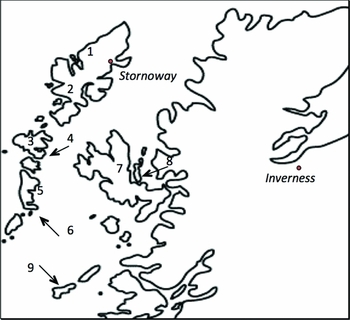
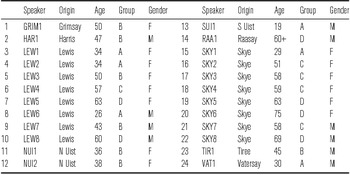
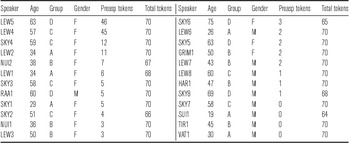
The final participant pool for the present study included 24 bilingual speakers of SG and English, ten of them male, fourteen female. All participants had been monolingual in SG until age 5–6 years. All continue to use SG regularly in their adult lives, and are literate in both languages. Nine islands were represented by the 24 participants (Figure 1). The islands of Skye and Lewis were particularly well represented with eight representatives each, followed by North Uist with two; the remaining six islands were represented by one individual per island. Participants ranged in age from 19 years to 75 years. All speakers except SUI1 (19 years, male) and SKY2 (50 years, female) had a university-level education. To aid statistical comparison, speakers were grouped by age quartile: those at or below the first quartile were placed in group A (19–35 years, six members), those at or below the second quartile were group B (36–50 years, seven members), those at or below the third quartile composed group C (51–59 years, six members), and those over the third quartile were placed in group D (60 years and over, five members). Participants were paid UK£50 for their time (about US$80 at the time of the study). The origin, age, and gender of participants are provided in Table 2.
The Scottish Hebrides, illustrating the origins of study participants: 1 Lewis, 2 Harris, 3 North Uist, 4 Grimsay, 5 South Uist, 6 Vatersay, 7 Skye, 8 Raasay, 9 Tiree.

Study participants by origin, age, age group (A–D) and gender.

2.2 Materials
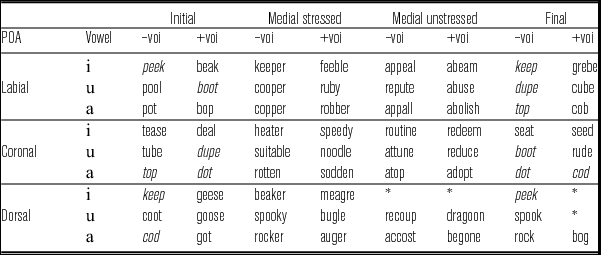
Stimuli consisted of 61 real English words chosen to illustrate the English consonants /p t k b d ɡ/ in initial, word-medial stressed, word-medial unstressed, and word-final positions (Table 3). Though preaspiration cross-linguistically tends to be associated with word-medial and word-final voiceless stops (Steriade Reference Steriade1999, Clayton Reference Clayton2010), stimuli representing initial and voiced conditions were also included in the stimulus set, and functioned as distractors. Target stops occurred adjacent to the stressed vowels [i u a ɔ], either before the vowel for initial and medial unstressed conditions, or following the vowel in the final and medial stressed conditions. There was some variation in the production of low vowels between speakers: some speakers produced [a] where others produced [ɔ], for instance in the word pot; the two vowels are conflated in the following discussion and analysis, and will be identified collectively as [a]. A small number of lexical gaps meant that not all target consonants could be represented in each condition; these gaps are indicated with asterisks in Table 3.
Stimuli used in the experiment. Items in italics are listed in the table twice because they were used to satisfy more than one condition. Asterisks indicate lexical gaps for which no suitable English word was readily available.
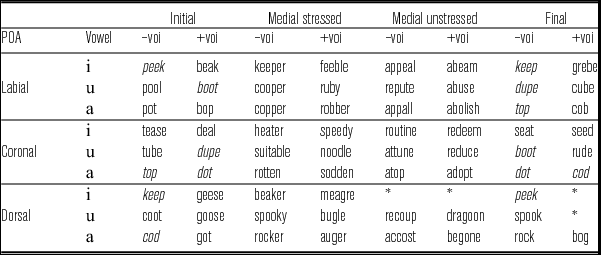
Each stimulus was presented twice during the experiment. Each participant thus encountered in the stimuli 16 voiceless stops in medial unstressed contexts (i.e. following an unstressed vowel), 18 in medial stressed contexts (i.e. following a stressed vowel), and 36 in final stressed contexts, for a total of 70 potential contexts for preaspiration. In addition to the target stimuli, the experiment included the four practice words cat, dog, knock, and bake, presented once each at the outset of the experiment, which were not included in the subsequent analysis.
2.3 Recording
Participants were recorded using a Shure SM93 omnidirectional, lapel-mounted lavalier microphone with an 80–20 kHz frequency response, and a Zoom H4n digital recorder set for a 44.1 kHz sampling rate and 16-bit quantization. Participants were given verbal instructions, during which they were told that the researchers were not interested in the ‘correct’ or ‘proper’ pronunciation of each word, but rather in a conversational, informal pronunciation. (It is nevertheless likely that the linguistic behavior elicited in a structured reading task like this one was more formal than a less directed but more natural conversational setting might have produced.) Stimuli were presented singly to the participants on a laptop computer screen, in a predetermined random order, within the carrier sentence I said X two times, where X was the target word. The four practice words occurred first, and were clearly identified as such. All participants saw the stimuli in the same order. Each participant was presented with the entire set of stimuli once, and then after a brief break presented with the full set a second time, in a different random order from the first. Excluding the four practice words, this provided a total of 122 tokens. Participants advanced through the stimulus list at their own rate by pressing the space bar to move to the next screen and the next stimulus.
The frequency response associated with the Shure SM93 microphone prompts a concern that the f0 in some speakers might be attenuated during recording, particularly for male participants, thus introducing a gender bias in the analysis of periodicity. However, the lowest mean token f0 noted for any of the male speakers during stimulus production was 109 Hz, well within this microphone's response range.
Twenty-one of the twenty-four participants were recorded in a quiet room provided by Sabhal Mòr Ostaig, the Gaelic-language college on the Isle of Skye. The remaining three participants were recorded in a conference room provided by the community center in the village of Staffin, Isle of Skye. Each participant required approximately 15–20 minutes to complete the experiment, including the verbal instruction period.
2.4 Acoustic analysis
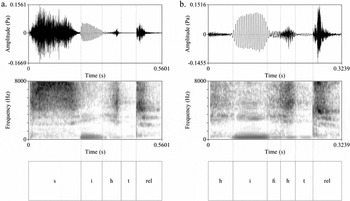
All recordings were analyzed using Praat (Boersma & Weenink Reference Boersma and Weenink2015). Preaspirated tokens were identified through visual inspection of the waveform and spectrogram. Where preaspiration was realized as glottal frication [h], the beginning of preaspiration could be identified as the point where the periodic vocalic waveform ceased, and a span of aperiodic mid to high-frequency energy commenced. The end of preaspiration was marked as the point where this high-frequency energy ceased, and the comparatively flat closure waveform commenced. Preaspiration was measured as the interval between the offset of the modal voicing component of the preceding vowel, and the closure associated with the following stop, measured in the waveform from zero crossing to zero crossing (see Nance & Stuart-Smith Reference Nance and Stuart-Smith2013). An example is provided in Figure 2a. Measured tokens ranged in length from 12 ms to 144 ms. Tokens with a span of noisiness or aperiodicity shorter than 10 ms were not labeled as preaspirated in order to exclude possible artifacts of such non-linguistic factors as the movement of saliva in the mouth.
Example segmentations: (a) the word seat, showing fully glottal preaspiration [h] as produced by LEW4; (b) the first portion of the word heater as produced by LEW5, showing preaspiration realized as breathy voice [ɦ] transitioning to a glottal fricative [h].

Slightly less than one-third of the tokens of preaspiration (54 of 166, 32.5%) were realized partly or entirely as breathy voice [ɦ]. Breathy voice could be identified as a jagged yet still periodic waveform visible between the less noisy vowel waveform and the flatter closure period, and in spectrograms as an interval of mid to high-frequency energy (> 2000 Hz) readily distinguished from the preceding vowel and the following closure (Gordon & Ladefoged Reference Gordon and Ladefoged2001). In some cases, breathy voice transitioned to glottal frication [h] prior to the closure, as in Figure 2b. Where breathy voice was identified, it was both measured separately, and also included within the overall measures of preaspiration duration (see Ní Chasaide Reference Ní Chasaide1985, Nance & Stuart-Smith Reference Nance and Stuart-Smith2013). Realizations of preaspiration, including breathy voice, will be discussed in further detail in section 3.1.
Non-preaspirated tokens were typically modally articulated. However, 14 speakers (seven men, seven women) also produced tokens that were preglottalized. Preglottalized tokens could be identified by visible irregularities in the timing of vocal fold pulsations (‘jitter’), and in the amplitude of the associated waveforms (‘shimmer’). Sharp fluctuations in the pitch track provided by Praat could also be observed in preglottalized tokens. These fluctuations either took the form of abrupt drops in f0 (Gordon and Ladefoged Reference Gordon and Ladefoged2001, Kane, Drugman & Gobl Reference Kane, Drugman and Gobl2013), or in the cessation of the pitch track altogether before the cessation of identifiable voicing. In all, 163 voiceless preglottalized tokens were identified. In addition, eight speakers also produced fully glottal tokens of /t/ in medial position (so-called ‘T-glottalling’, see Wells Reference Wells1982, Stuart-Smith Reference Stuart-Smith1999). While a detailed description of preglottalization and T-glottalling in HE is beyond the scope of the present paper, a more comprehensive analysis is provided elsewhere (Clayton Reference Clayton2016).
3 Results
3.1 Realizations of preaspiration
The majority of observed tokens of preaspiration (115 tokens of 166, 69.3%) were realized as glottal frication [h]. The remaining 51 tokens (30.7%) were realized either partly or entirely as breathy voice [ɦ] (Table 4). This result was not unexpected, since full or partial breathy voice realizations of preaspiration have also been noted in SG (Ní Chasaide Reference Ní Chasaide1985, Clayton Reference Clayton2010, Nance & Stuart-Smith Reference Nance and Stuart-Smith2013), Irish (Ní Chasaide Reference Ní Chasaide1985), Welsh English (Hejná Reference Hejná2015), and Sienese Italian (Stevens & Hajek Reference Stevens, Hajek, Trouvain and Barry2007). Oral realizations such as [x] or [ç] were not observed in the HE data, including those tokens associated with dorsal stops. In this respect, HE most closely resembles the Lewis dialect of SG, in which preaspiration is generally realized as some glottal variant [h ɦ] rather than as homorganic oral frication, regardless of the stop's place of articulation (Ladefoged et al. Reference Ladefoged, Ladefoged, Turk, Hind and Skilton1998, Clayton Reference Clayton2010, Nance & Stuart-Smith Reference Nance and Stuart-Smith2013), though realizations before palatal stops approximating [çc] have been reported (Borgstrøm Reference Borgstrøm1940). By contrast, other extant varieties of SG feature both oral and glottal realizations [hp ht xk], only oral realizations [xp xt xk], or no preaspiration at all, depending on the dialect in question (Ó Dochartaigh Reference Ó Dochartaigh1994–1997, Bosch Reference Bosch, Watson and Macleod2010, Clayton Reference Clayton2010).
Number of preaspirated tokens realized partly or entirely as breathy voice, according to the place of articulation of the following stop, and the quality of the preceding vowel.
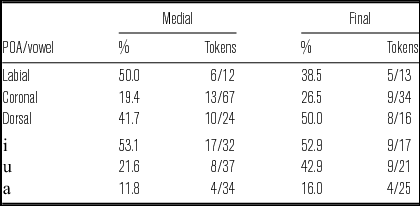
A logistic regression model conducted using the lrm function in R (Harrell Reference Harrell2016) found that partial or full breathy voice realizations of preaspiration in HE were significantly more abundant after high vowels than after low vowels ([i]: coef. = 1.780, z = 3.56, p < .001; [u]: coef. = 1.108, z = 2.25, p = .025). Breathy voiced realizations were also more abundant before dorsal stops than labials or coronals, though this difference did not achieve statistical significance. Tokens of preaspiration either partially or fully realized as breathy voice were also much more common in stressed contexts than unstressed: 50 of 134 stressed tokens (37.3%) featured at least some breathy voice, while only four of 32 unstressed tokens did so (12.5%). While breathy voice periods in unstressed contexts appeared to be shorter than those in stressed contexts (22 ms unstressed, 42.9 ms stressed), there were too few tokens of breathy voice in unstressed contexts to permit a useful statistical comparison. Among stressed tokens, a linear regression model (using R's lm function) indicated no significant difference in the proportion of breathy voice within the overall duration of preaspiration according to the following stop's place of articulation, or the quality of the preceding vowel (F = 0.619, df = 7 and 39, p = .737).
3.2 Frequency of preaspiration
To assess the effects of linguistic and social variables on the frequency of preaspiration, a logistic mixed-effects model was fit to the data in R (R Core Team 2014), using the glmer function of the lme4 package (Bates et al. Reference Bates, Maechler, Bolker and Walker2015). Model selection began by including preaspiration as the dependent variable and word position (medial, final) as a fixed effect. Because there was considerable variation in the frequency at which individual participants preaspirated, the initial model also included random intercepts for speaker, as well as random intercepts for item. Model selection proceeded by sequentially adding fixed effects for stress (stressed, unstressed), place of articulation (labial, coronal, dorsal), vowel (low, high front, high back), gender, age group (A, B, C, D), and island of origin. Predictors were retained in the model only if model comparison by ANOVA indicated a significantly better fit with the predictor included.
A note about the statistical analysis of origin is necessary. The speaker pool was seriously imbalanced in this respect. Of the nine islands represented, Skye and Lewis were represented by eight speakers each. Of the remaining seven islands, one (North Uist) was represented by two speakers, while six (Grimsay, Harris, South Uist, Raasay, Tiree, and Vatersay) were represented by only one speaker each. This imbalance means that no statistical comparison between these seven islands could be meaningfully conducted that was not also being accomplished by the inclusion of speaker as a random effect in the statistical model. Consequently, within the condition island of origin, speakers were grouped into three levels with eight speakers each: Skye, Lewis, and Other.
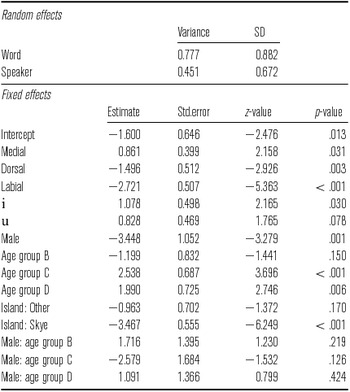
The final mixed-effects model is presented in Table 5. The model found that gender, age group, island of origin, word position, place of articulation, and vowel quality were all significant predictors of preaspiration. There was also a significant interaction between gender and age group, such that there was little contrast among the four age groups for men, while female speakers did vary significantly according to age group. Each of these predictors will be discussed in greater detail in the following sections.
Logistic mixed-effects model of the frequency of preaspiration. Intercept represents female speakers, age group A, isle of Lewis, coronal place, vowel [a].

3.2.1 Island of origin
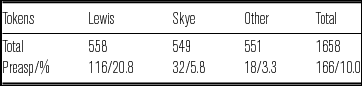
Previous researchers have commented on the prominence of preaspiration in the Lewis variety of HE, noting that it is restricted to Lewis (Borgstrøm Reference Borgstrøm1940), or at any rate is more common among Lewis speakers than those from Skye or Harris (Shuken Reference Shuken and Trudgill1984, Reference Shuken and Görlach1985). This study broadly parallels those earlier observations. While 20 of the 24 participants in the study provided at least one preaspirated token (Table 6), the participants from Lewis did so more reliably than those from the other islands (Table 7): all eight participants from Lewis produced at least some preaspiration. Skye speakers were significantly less likely to preaspirate than those from Lewis (estimate = –3.467, z = –6.249, p < .001). Speakers from the remaining seven islands were also less likely to preaspirate than Lewis speakers, though in this case the difference did not achieve statistical significance (estimate = –0.963, z = –1.372, p = .170).
Tokens of preaspiration by speaker, out of 52 possible stressed and 16 unstressed contexts.

Number of tokens produced by Lewis speakers, Skye speakers, and all remaining speakers collectively.
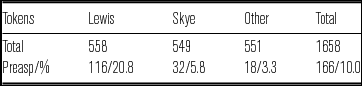
Even among the eight Lewis speakers, there was considerable variation in the rate of preaspiration. Notably, the two oldest female Lewis speakers, LEW4 (57 years), and LEW5 (63 years), produced far more preaspirated tokens than any of the remaining 22 speakers in the study. LEW5 preaspirated in 46 of 70 possible contexts (65.7%), including 44 of 54 (81.5%) possible stressed vowel contexts and two of 16 possible unstressed vowel contexts (12.5%). LEW4 preaspirated in 45 of 68 possible contexts (64.3%); 43 of these were in stressed contexts (79.6%), and two were in unstressed contexts (12.5%). The six remaining Lewis speakers preaspirated much less abundantly than LEW4 and LEW5, ranging from 11 tokens (LEW2) to a single token (LEW8).
Since the two top producers of preaspiration, LEW4 and LEW5, are from widely separated communities, it was not possible to localize preaspiration more specifically within Lewis. LEW5 is one of two participants from the village of Carloway, on the west side of Lewis, while LEW4 is the single representative from the village of Col, about twenty miles distant on the eastern side of the island. The participant pool did include a second Carloway speaker, LEW3 (50 years, female); however, she produced only three preaspirated tokens. Thus, we see that preaspiration is neither limited to Carloway speakers, nor universal among such speakers. Unfortunately, a second speaker from Col was not among the participants to permit a similar comparison for that village.
Among the remaining 16 remaining non-Lewis participants, preaspiration was much less abundant, or else absent altogether. Notably, none of them, of whatever origin, age, or gender, were anywhere near as prolific as LEW4 or LEW5. Of the Skye speakers, the top preaspirator was SKY4 (57, female), who produced 12 tokens; she was followed by SKY1 (29, female), SKY3 (58, female), and SKY2 (51, female), with five, five, and four tokens respectively. One North Uist speaker, (NUI2, 38, female), produced seven tokens, while the second North Uist representative (NUI1, 36, female) produced three. The single Raasay speaker (male, 60+) produced five tokens. The lone Grimsay speaker (50, female) produced two preaspirated tokens, and the single Harris speaker (47, male) one. Representatives of the remaining regions – South Uist, Vatersay, and Tiree – produced no preaspirated tokens.
3.2.2 Gender and age
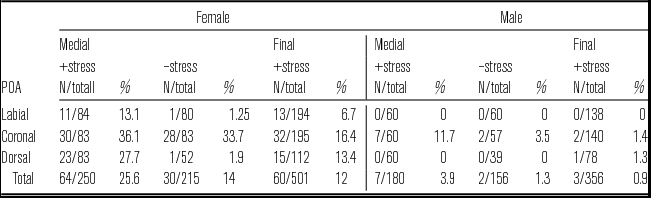
The results indicate a strong relationship between the frequency of preaspiration and gender: men were significantly less likely to preaspirate than women (estimate = –3.448, z = –3.279, p = .001). Of the 1658 tokens produced by all speakers, 966 were produced by women. Of these, 154 (15.9%) were preaspirated. Of the 692 tokens produced by male speakers, 12 were preaspirated (1.7%). If we sort participants by the number of preaspirated tokens they produced (Table 6), we see that eleven of the twelve participants in the upper 50% are female; the single exception was the Raasay speaker. By contrast, the remaining nine male speakers are all in the lower 50%, and the bottom eight are all male, including the four participants who did not provide any tokens of preaspiration at all. Breakdowns for each gender by word position, stress, and place of articulation are provided in Table 8.
Preaspirated tokens by gender, word position, stress, and place of articulation.

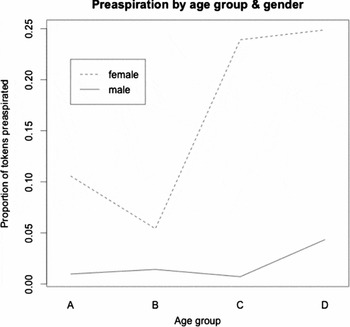
An effect of age can also be seen. Simple correlation between age and rate of preaspiration is very weak (cor = 0.139, t = 5.7103, df = 1656, p < .001, by Pearson's product-moment correlation). However, if we consider age groups separately by gender, we see a relationship emerge: Among women, the rate of preaspiration rises sharply in age groups C (estimate = 2.538, z = 3.696, p < .001) and D (estimate = 1.990, z = 2.746, p = .006), while remaining nearly flat among men (Figure 3).
Mean proportion of preaspirated tokens, by age group and gender.

Much of this greater frequency among older female speakers is due to the outsize contributions of LEW4 (57 years, 45 tokens) and LEW5 (63 years, 46 tokens). While LEW4 and LEW5 are the two oldest female representatives from Lewis, they are not the oldest participants overall: SKY6 (75 years, female) and SKY8 (69 years, male) are older. But if age and geographic origin are considered together, they suggest that speakers who habitually preaspirate are to be found primarily among older women from Lewis. Outside of this demographic group, preaspiration was far less common among this study's participant population.
An important consideration, however, is that the only older Lewis male in the study was LEW8 (60 years); while he produced only one preaspirated token, it would be useful to examine the English of other older male Lewis speakers to determine if any of them preaspirate at a rate comparable to that of their female counterparts.
3.2.3 Word position, stress, and place of articulation
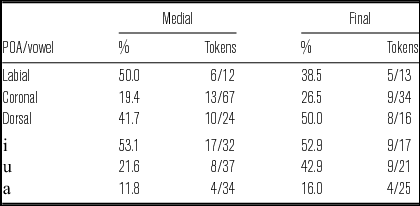
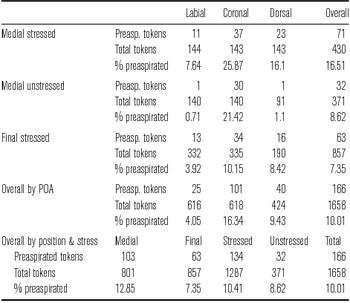
Word position, stress, and place of articulation all significantly affected the frequency of preaspiration (Table 9). Stops were significantly more likely to be preaspirated in word-medial position than in final position. Of 857 word-final tokens, 63 were preaspirated (7.35%), while 103 of 801 medial tokens were (12.85%, estimate = 0.861, z = 2.158, p = .03). Similarly, stress was slightly favorable to preaspiration: stops in a stressed environment (i.e. following a stressed vowel, like the [t] in dot) were more likely to be preaspirated than those in an unstressed environment (i.e. following an unstressed vowel, like the [t] in atop). Of 1287 stressed tokens, 134 were preaspirated (10.41%), while 32 of 371 unstressed tokens were preaspirated (8.62%). That said, stress alone was not a statistically significant predictor of preaspiration. This is likely because stress was highly collinear with word position, which was significant: all the unstressed contexts were also medial.
Number of preaspirated tokens according to word position, stress, and place of articulation.

Place of articulation was also an important predictor of preaspiration. Coronal stops were most likely to be preaspirated (101 of 618 tokens, 16.34%), significantly more than dorsals (40 of 424 tokens, 9.43%) (estimate = –1.496, z = –2.926, p = .003), followed by labials (25 of 616, 4.05%) (estimate = –2.721, z = –5.363, p < .001). The preference for coronals was even more prominent in unstressed environments (i.e. when a medial stop was preceded by an unstressed vowel, as in the word atop): in this context, 21.42% (30 of 140) of coronal tokens were preaspirated, but only one labial token was preaspirated (of 140, 0.7%), and one dorsal token (of 91 total, 1.1%).
3.2.4 Vowel height and backness
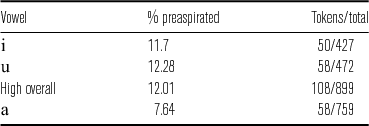
Vowel height was a significant predictor of preaspiration frequency (Table 10), while vowel backness was not. Overall, high vowels were more likely to be associated with preaspiration than low: 7.64% of tokens in the low vowel condition were preaspirated, while 11.7% of those in the [i] condition were preaspirated (estimate = 1.078, z = 2.165, p = .03), and 12.3% of those in the [u] condition, though this did not reach significance (estimate = 0.828, z = 1.765, p = .077).
Proportion of tokens preaspirated, according to preceding vowel.

3.3 Durational characteristics of preaspiration
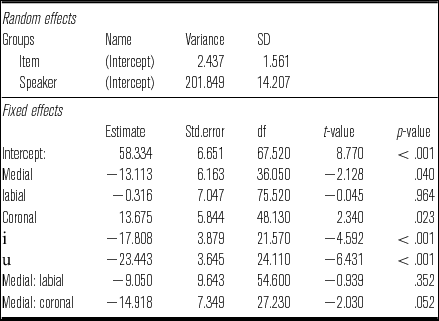
A linear mixed-effects model was used to assess the effect of linguistic and demographic variables on the duration of preaspiration. The model was fit to the data in R (R Core Team 2014), using the lmer function of the lme4 package (Bates et al. Reference Bates, Maechler, Bolker and Walker2015). The initial model included duration of preaspiration as the dependent variable and word position and vowel quality as fixed effects. The initial model also included random intercepts for speaker and item. Model selection proceeded by sequentially adding fixed effects for place of articulation (labial, coronal, dorsal), stress (stressed, unstressed), gender, age group (A (youngest), B, C, D (oldest)), and island of origin. Expanded models were compared with the initial model by ANOVA. Ultimately, the only additional predictor to yield an improved fit was the interaction between place of articulation and word position. The final model (Table 11) therefore included fixed effects for vowel (3 levels: [i a u]), place of articulation (3 levels: labial, coronal, dorsal), word position (2 levels: medial and final), and an interaction term between position and place of articulation.
Linear mixed-effects model of preaspiration duration. Intercept represents final word position, dorsal place of articulation, vowel [a].

3.3.1 Word position and stress
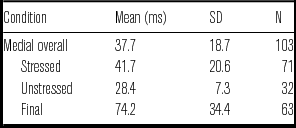
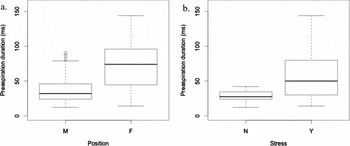
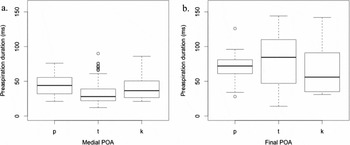
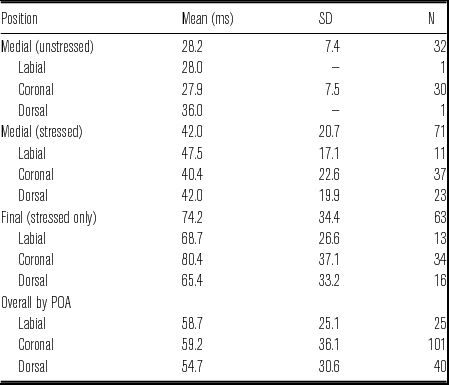
The statistical model indicates a significant effect for word position, such that preaspiration in medial position is shorter than in final position (estimate = –13.113, t = –2.128, p = .040) (Table 12, Figure 4a). These results are similar to those found for SG (Ní Chasaide Reference Ní Chasaide1985, Clayton Reference Clayton2010), Icelandic (Clayton Reference Clayton2010), and Welsh (Morris Reference Morris, Meyerhoff, Adachi, Daleszynska and Strycharz2010), in which medial preaspiration was found to be shorter than final preaspiration.
Preaspiration duration by word position and stress. All word-final tokens are stressed.

Duration of preaspiration according to word position (a), and stress (b).

Preaspiration was also found to be shorter in unstressed contexts than stressed (Table 12, Figure 4b). Stress was not explicitly included as a predictor in the mixed-effects model, because a stressed-unstressed contrast was available only in medial contexts. However, a Welch's two-sample t-test indicates that the difference is significant (t = –4.966, df = 97.617, p < .001). Again, this is reminiscent of the situation in other examples of preaspiration, in which preaspiration is greatly reduced in duration or altogether absent following unstressed vowels, including SG (Borgstrøm Reference Borgstrøm1940, Clayton Reference Clayton2010) as well as Icelandic and Faeroese (Helgason Reference Helgason2002).
3.3.2 Place of articulation
The place of articulation of the associated stop was found to be a significant predictor of preaspiration duration only for coronals, and then only in final position. In final position, preaspiration before coronal stops was significantly longer than before dorsal or labial stops (estimate = 13.675, t = 2.340, p = .023) (Figure 5; means and standard deviations provided in Table 13). Place of articulation was not a significant predictor of duration in medial position, where preaspiration before coronals was in fact slightly shorter than elsewhere, though not significantly so. This result is somewhat surprising, given that place of articulation has been found to be a robust predictor of preaspiration duration in a variety of other languages. Preaspiration has generally been found to be longest before dorsals, shortest before labials in SG (Ní Chasaide Reference Ní Chasaide1985, Ladefoged et al. Reference Ladefoged, Ladefoged, Turk, Hind and Skilton1998, Clayton Reference Clayton2010, Nance & Stuart-Smith Reference Nance and Stuart-Smith2013) and in Central Swedish (Helgason & Ringen Reference Helgason and Ringen2008), while preaspiration of labials is generally shorter than that of coronals or dorsals in Icelandic (Clayton Reference Clayton2010).
Preaspiration duration according to the following stop in medial position (a) and final position (b).

Mean duration of preaspiration by place of articulation, word position, and stress. Since only one token each of unstressed medial [p] and [k] was included, no standard deviation is provided for those conditions.

3.3.3 Vowel height, backness, and length
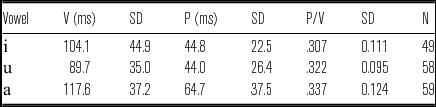
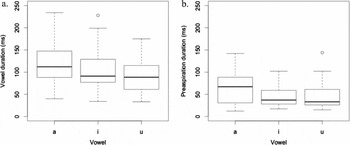
The duration of preaspiration varied according to the preceding vowel (Table 14). This effect was significant for vowel height, but not for backness. Preaspiration was shorter after high vowels than low vowels ([i]: estimate = –17.808, t = –4.592, p < .001; [u]: estimate = –23.443, t = –6.431, p < .001). Similar results are reported in Nance & Stuart-Smith (Reference Nance and Stuart-Smith2013) for SG and in Hejná (Reference Hejná2015) for Welsh English.
Mean duration of vowel (V), of preaspiration (P), and mean ratio of preaspiration to vowel duration (P/V), according to quality of preceding vowel.

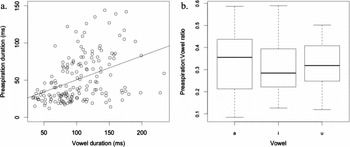
However, the duration of preaspiration also co-varied with that of the associated vowels, such that longer vowel duration was associated with a longer preaspiration period (Figure 6). A Spearman correlation test confirmed a positive correlation between the duration of the preceding vowel duration and preaspiration of the following stop (rs = 0.464, p = < .001) (Figure 7a). Since high vowels tend to be shorter than low vowels generally (Peterson & Lehiste Reference Peterson and Lehiste1960, Lisker Reference Lisker1974), there was a potential confound here, so normalization across vowel types was also desirable. This normalization was accomplished by calculating preaspiration duration and vowel duration as a proportion of their total duration. This method permits easy comparison of their relative length: for example, a ratio of .5 indicates that preaspiration duration is equal to vowel duration (see Gordeeva & Scobbie Reference Gordeeva and Scobbie2007). If we consider preaspiration and vowel duration in terms of this ratio, instead of in absolute terms (Figure 7b), we see that there is some variation according to vowel (Table 14), and a slight decrease in this ratio with an increase in vowel height. However, linear regression (performed with the lm function in R), using the ratio of preaspiration duration to vowel duration as the dependent variable and vowel height as the independent variable, indicates that these differences are not statistically significant.
Vowel duration (a), and preaspiration duration by vowel context (b).

Correlation between preaspiration duration and vowel duration (a), and ratio of preaspiration to vowel duration (b).

A correlation between vowel duration and preaspiration duration is not altogether unexpected. On the one hand, it is true that in a number of languages, preaspiration either does not occur with phonemically long vowels, or else is markedly shorter in that environment. This is the case in SG, for example: in many dialects, such as those of Harris, Lewis, and Skye, preaspiration is shorter after phonemically long vowels than short (Ní Chasaide Reference Ní Chasaide1985, Clayton Reference Clayton2010, Nance & Stuart-Smith Reference Nance and Stuart-Smith2013), while in North Argyll Gaelic, preaspiration does not occur after long vowels at all (Iosad, Rammsamy & Honeybone Reference Iosad, Rammsamy and Honeybone2015). Similarly, preaspiration does not occur after phonemically long vowels in Icelandic (Pind Reference Pind1982, Ní Chasaide Reference Ní Chasaide1985, Helgason Reference Helgason2002), while in Central Swedish (Helgason Reference Helgason2002) and Welsh English (Hejná Reference Hejná2015), preaspiration is shorter after long vowels. This inverse relationship does not always hold, however. For example, in Tohono O'odham, an Uto-Aztecan language spoken in Arizona, preaspiration is longer after phonemically long vowels than it is after short vowels (Clayton Reference Clayton2010).
However, it is important to distinguish between a phonemic contrast in vowel length, and non-contrastive phonetic variation in absolute vowel duration. If we consider the latter we sometimes do see a positive correlation between phonetic vowel duration and the duration of preaspiration. For example, in Icelandic, though preaspiration can only occur after phonemically short vowels, the duration of preaspiration correlates positively with the duration of the associated vowel (Pind Reference Pind1982, Helgason Reference Helgason2002). A similar relationship holds in Central Swedish, where preaspiration occurs after both phonemically short and long vowels (Helgason Reference Helgason2002). Likewise, preaspiration duration appears to increase proportionally to vowel duration in Scottish English fricatives (Gordeeva & Scobbie Reference Gordeeva and Scobbie2007). It is quite possible that this correlation between vowel duration and preaspiration is simply due to a speech rate variation: a faster rate of speech naturally shortens the length of the individual segments in an utterance, and we seem to be seeing evidence that vowels and preaspiration respond similarly to variations in speech rate.
3.3.4 Demographic factors
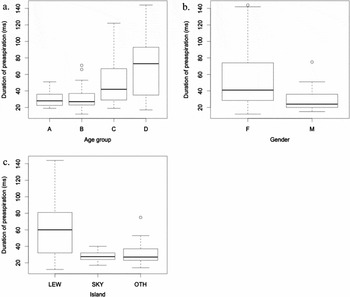
The demographic factors of age group, gender, and origin were not statistically significant predictors of duration in preaspiration in HE. It is nevertheless useful to briefly explore these factors. A consideration of means within these variables suggests that each should be significant. An analysis of overall duration by age group indicates a large difference between the two younger brackets (A, B) and the two older brackets (C, D), and even a noticeable difference between C and D, suggesting that older speakers preaspirate for longer periods than younger speakers (Figure 8a). This difference is similar to that found between older and younger SG speakers (Nance & Stuart-Smith Reference Nance and Stuart-Smith2013). Similarly, we see that preaspiration on average is much longer among women than men (Figure 8b). Finally, preaspiration is longer among Lewis speakers than Skye speakers, or speakers from the remaining islands collectively (Figure 8c).
Duration of preaspiration according to age group (a), gender (b), and island group (c).

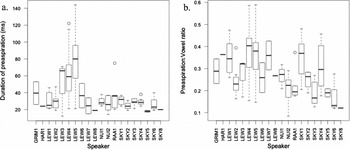
However, if we consider by-speaker means for absolute duration (Figure 9a), we see that in the results in these instances are being driven by a small subset of speakers: LEW4 (57 years, female), LEW5 (63 years, female), and to a lesser extent LEW3 (50 years, female). Recall that LEW4 and LEW5 were also the two speakers who preaspirated by far the most frequently of all 24 speakers (see Table 9 above). Thus, it appears that not only do these two older female speakers from Lewis preaspirate much more frequently than the remaining speakers, but also that the overall duration of preaspiration in their utterances is rather longer than that of other speakers, except for LEW3. But once preaspiration duration is normalized as the ratio of preaspiration to vowel duration, so that we have factored out speech rate (Figure 9b), LEW4 and LEW5 are much less noticeably different from the remaining speakers in terms of preaspiration duration, though they continue to be outstanding in terms of frequency.
Duration of preaspiration by speaker in absolute terms (a), and as a ratio to vowel duration (b).

4 Discussion
Two topics are addressed here in greater detail. First, the effect of place of articulation on the duration and frequency of preaspiration is considered. Second, comments are provided on the probable source of preaspiration in HE, and on whether preaspiration in HE should be considered normative (see Helgason Reference Helgason2002, Gordeeva & Scobbie Reference Gordeeva and Scobbie2007).
4.1 The effect of place of articulation on duration and frequency
A number of previous studies have found that both the duration of preaspiration and the frequency with which it occurs are sensitive to place of articulation. In general, these studies have indicated that a dorsal place of articulation is most favorable to preaspiration in both respects – that is, dorsal stops are associated with longer and more frequent preaspiration – while a labial place of articulation is least favorable. For example, Ladefoged et al. (Reference Ladefoged, Ladefoged, Turk, Hind and Skilton1998), Clayton (Reference Clayton2010), and Nance & Stuart-Smith (Reference Nance and Stuart-Smith2013) find that in SG, dorsal stops generally have longer preaspiration than coronals or labials. Helgason & Ringen (Reference Helgason and Ringen2008) find the same for Central Swedish, as does Clayton (Reference Clayton2010) for Icelandic. With regard to frequency, Clayton (Reference Clayton2010) reports that in SG, labial stops are less likely than coronals or dorsals to be preaspirated; Stevens & Hajek (Reference Stevens, Hajek, Bel and Marlien2004) report a similar result for preaspirated geminates in Sienese Italian. Preaspiration in HE appears to follow a similar though not identical pattern with regard to both the duration and frequency of preaspiration.
In terms of duration, the situation in HE differs substantially between medial and final position. No statistically significant difference in duration could be found according to place of articulation among word-medial tokens, though a comparison of means suggests that coronals are actually slightly shorter than labials or dorsals in this environment (Table 13). Among tokens in final position, there was a significant difference: coronals were instead longer than labials or dorsals. In this respect, preaspiration of stops in final position in HE appears to most closely resemble the situation in Welsh, in which preaspiration is also longer before coronals than labials or dorsals (Morris Reference Morris, Meyerhoff, Adachi, Daleszynska and Strycharz2010).
Place-related effects on the duration of post-aspiration are well attested, of course: VOT tends to increase as the associated stop becomes more posterior, an effect is which is cross-linguistically robust (Peterson & Lehiste Reference Peterson and Lehiste1960, Lisker & Abramson Reference Lisker and Abramson1964, Cho & Ladefoged Reference Cho and Ladefoged1999). This pattern has been explained in both articulatory and aerodynamic terms. First, it may be that the relatively higher air pressure behind a dorsal articulation, compared to a coronal or labial one, requires a longer time to drop far enough to allow sufficient movement of air through the glottis for phonation to commence. Meanwhile, the larger mass of air before a dorsal articulation in turn takes a longer period to fully commence vibrating in response to that phonation (Hardcastle Reference Hardcastle1973, Maddieson Reference Maddieson, Laver and Hardcastle1997, Cho & Ladefoged Reference Cho and Ladefoged1999). Second, the relative mobility of the articulators in question may be at work: dorsal and coronal VOT may be longer than labial VOT because the tongue body takes appreciably longer to release a closure than do the lips (Hardcastle Reference Hardcastle1973, Kuehn & Moll Reference Kuehn and Moll1976).
A number of previous studies of preaspiration have appealed to similar arguments to account for place-related differences in preaspiration duration (e.g. Ní Chasaide Reference Ní Chasaide1985, Ladefoged et al. Reference Ladefoged, Ladefoged, Turk, Hind and Skilton1998, Helgason & Ringen Reference Helgason and Ringen2008, Clayton Reference Clayton2010), on the supposition that the relevant articulators (i.e. the tongue versus the lips) exhibit similar relative mobility whether we are speaking of VOT or preaspiration. The aerodynamic factors should not be regarded as identical between VOT and preaspiration, however. For example, the subglottal pressure required to initiate oscillation of the vocal folds is higher than that required to maintain the oscillation, and may therefore be lower at voicing offset (i.e. at the commencement of a voiceless preaspiration period) than at voicing onset (the commencement of voicing following a closure) (Lucero Reference Lucero1999, Koenig, Mencl & Lucero Reference Koenig, Einar Mencl and Lucero2005). This predicts that the period of a voiceless offset should be shorter than the corresponding onset time, and indeed, this is precisely what Koenig et al. (Reference Koenig, Einar Mencl and Lucero2005) find in their comparison of voicing offset and onset relative to peak vocal fold abduction in intervocalic [h]: voicing offset periods were shorter than onsets. But where direct comparisons have been made, preaspiration duration often appears to be longer than the corresponding VOT, for instance in SG (Ní Chasaide Reference Ní Chasaide1985, Nance & Stuart-Smith Reference Nance and Stuart-Smith2013), even when fully voiceless offsets are considered and breathy voice periods are excluded. Thus, it would appear that preaspiration duration is not exclusively a product of aerodynamic effects, either.
Finally, durational differences may be interacting in complex ways with syllable weight, and these interactions may vary substantially from one language to the next. If preaspiration is assumed to make a net positive contribution to syllable weight (Iosad et al. Reference Iosad, Rammsamy and Honeybone2015), a straightforward explanation follows for situations like that in SG and Icelandic, where preaspiration is either shorter after phonemically long vowels than after short vowels, or altogether absent in that context (Pind Reference Pind1982, 1993; Ní Chasaide Reference Ní Chasaide1985; Helgason Reference Helgason2002; Clayton Reference Clayton2010; Nance & Stuart-Smith Reference Nance and Stuart-Smith2013). On the other hand, preaspiration may be best analyzed as not making a net contribution to syllable weight in those situations where its duration correlates positively with that of the preceding vowel, as in HE and Tohono O'odham (Clayton Reference Clayton2010). In short, the duration of preaspiration appears to be governed by a complex set of factors, either individually or collectively depending on the language in question.
In terms of frequency, coronals, not dorsals, are the most favorable to preaspiration in HE. While 16.34% of coronal tokens in this study were found to be preaspirated, only 9.43% of dorsals were (Table 9). Labials continue to fit the general pattern observed elsewhere, though: only 4.22% were preaspirated. Such differences in frequency according to place may come down to the relative perceptual robustness of the preaspiration cue, i.e. the perceptibility of the voiceless offset period plus any associated breathy voice, compared to the absence of such a period in unaspirated stops. (For discussion of the contribution of breathy voice to the perception of preaspiration, consult Ní Chasaide Reference Ní Chasaide1985.) Since the length of this preaspiration cue in labials is shorter than it is in coronals or dorsals, whether for aerodynamic or articulatory reasons, and if the cue is therefore less perceptually salient than a longer one, it may be of relatively less value to speakers in maintaining contrast.
This suggestion is supported by the perception study reported by Clayton (Reference Clayton2010), which investigated the ability of native SG, Polish, and American English speakers to distinguish between unaspirated and preaspirated stimuli in medial and final position in otherwise identical pairs like [aʰpa] ~ [apa], [aʰta] ~ [ata], [aʰk] ~ [ak] as produced by native SG speakers. Participants from all three language groups exhibited a higher confusion rate in the labial condition than in the coronal or dorsal conditions, suggesting that they found preaspiration in labials to provide a less salient contrast than in coronals or dorsals.
4.2 The origin and status of preaspiration in Hebrides English
Linking preaspiration in HE to its presence in SG (Borgstrøm Reference Borgstrøm1940, Wells Reference Wells1982, Shuken Reference Shuken and Görlach1985) is an obvious step: it would be an odd coincidence indeed if preaspiration happened to develop in HE in parallel to preaspiration to SG, but without the one instance being connected to the other in any way. It is far more likely that preaspiration has been transferred to HE from SG, facilitated by the fact that SG speakers are in effect universally bilingual in English. Bilingualism is of course a well-documented channel for such transfer (e.g. Odlin Reference Odlin1989, Jarvis & Pavlenko Reference Jarvis and Pavlenko2008).
The proposal has been considered before. Both Borgstrøm (Reference Borgstrøm1940) and Wells (Reference Wells1982) attribute preaspiration in HE to phonological interference: bilingual speakers are transferring a phonological feature from their first language, Gaelic, to their second language, English. Preaspiration may not be the only such feature to have been transferred between the two languages in this way. Two additional examples will illustrate. First, stops lack a voicing contrast in some HE speakers, e.g. building > [pɪltɪŋ] (example from the author's notes). This is reminiscent of SG, most dialects of which have two stop series distinguished by aspiration, not voicing (see Ladefoged et al. Reference Ladefoged, Ladefoged, Turk, Hind and Skilton1998). A retroflex sibilant in /rs/ clusters also occurs in some HE speakers, e.g. first [f
 ʂt], years [j
ʂ] (examples produced by speaker LEW4, see Wells Reference Wells1982, Shuken Reference Shuken and Trudgill1984, Stuart-Smith Reference Stuart-Smith, Kortmann and Upton2008); such productions resemble a phonological pattern in ScG in which the sequence /rs/ is realized as [rʂ], e.g. spors [spoːɹʂ] ‘sport’, dearrsach [tʲaɹʂax] ‘bright’. In similar fashion, SG may have acquired preaspiration through contact with Norse speakers; extensive contact between the two languages in the Outer Hebrides during the medieval period may have provided optimal conditions for such a transfer (Marstrander Reference Marstrander1932, Oftedal Reference Oftedal1956, Borgstrøm Reference Borgstrøm1974, Hansson Reference Hansson and Brinton1999; for arguments that preaspiration is instead an internal development, see Ó Baoill Reference Ó Baoill1980 and Ó Murchú Reference Ó Murchú1985).
However probable it is that preaspiration in HE originates in SG, it seems most likely that this transfer happened historically; it is unlikely that many HE speakers are actively transferring preaspiration to their English in any synchronic sense, though of course it is possible that this happens among some speakers, particularly older speakers who are SG-dominant. But such transfer must not be systematic, or else we should expect it to be much more robustly represented among bilingual speakers, particularly among those older, more conservative speakers who are likely to be SG-dominant, so long as the variety of SG they spoke itself featured preaspiration. The fact that Shuken (Reference Shuken and Görlach1985) found preaspiration in both SG/English bilinguals and English monolinguals from Stornoway and Portree provides further evidence that preaspiration must have been an established feature in HE on both Lewis and Skye at least by the time of her study, if not earlier.
By contrast, in the present study preaspiration is concentrated in a very specific demographic group: older Lewis women. Notably, the three oldest speakers in the study, RAA1 (male, 60+, probably mid-70s in fact), SKY6 (female, 75), and SKY8 (male, 69) did not preaspirate nearly as abundantly as LEW4 and LEW5, though they are likely to be no less Gaelic-dominant. A comparable situation obtains in Lewis Gaelic, where preaspiration has been found to be both shorter and less noisy (measured in terms of zero-crossing rate) among younger speakers compared with older, and hence appears to be receding among younger generations (Nance & Stuart-Smith Reference Nance and Stuart-Smith2013).
Another possibility well worth considering is whether some speakers have spent a great deal of time away from the islands, and have consequently lost (or given up) aspects of their distinctive linguistic identity through exposure to other varieties of English. Though full biographies of all study participants are not available, enough is known to allow us to conclude that time away from the islands is not a crucial factor. Once again, consider LEW4 and LEW5. Both women are socially prominent individuals who originate from different villages on Lewis: LEW4 (57 years) is from Col, a village on the eastern side of the island, while LEW5 (63 years) is from Carloway, a village on the western side of Lewis. LEW5 is a well-known singer and exponent of island lore and Gaelic culture, who did travel for performances when she was younger, but otherwise has spent most of her life on the islands. By contrast, LEW4 lived away from the islands for many years. In fact, during her participation in this study, she speculated informally to the investigators about whether her time away may have led to a reduction in her island accent. This expectation seems to have been belied at least in part by her high rate of preaspiration, which was very similar to that of LEW5 despite their significantly different histories.
A more likely hypothesis is that preaspiration had become well-established in certain varieties of HE by the early twentieth century: certainly in that of Lewis, but possibly in others as well, such as Skye. Judging by Borgstrøm's (Reference Borgstrøm1940) description, which gives the firm impression that preaspiration uniquely typified the Lewis variety of HE, we can conclude that the feature was normative by that time in Lewis English, in Helgason's (Reference Helgason2002) sense. Outside of Lewis, preaspiration seems not to have been so well-established at the time of Borgstrøm's research, and possibly could not be described as having been normative as in the Lewis variety. It is unlikely that preaspiration was completely absent outside of Lewis as Borgstrøm suggests, however, since Shuken found it among Harris and Skye speakers four decades later, though less abundantly, and it was of course found at least on a small scale among most of the non-Lewis speakers in this study as well.
Sixty-five years ago, Borgstrøm (Reference Borgstrøm1940) described preaspiration as a defining characteristic of Lewis English. Thirty years ago, Shuken (Reference Shuken and Trudgill1984, Reference Shuken and Görlach1985) described widespread preaspiration in rural Lewis speakers, but less frequent preaspiration among those living in Stornoway, and among those from other islands. Shuken's descriptions indicate that at the time of her study, a retreat of the normative preaspiration pattern into a more conservative rural population of Lewis was underway. In turn, the evidence from the present study suggests that that retreat has continued in the intervening three decades since Shuken's work, and that a pattern of habitual and frequent preaspiration is now confined to a minority of conservative Lewis speakers. Taken to its logical conclusion, this trend hints that the pattern is likely to disappear from HE within another generation, though of course it is difficult to be certain about the precise trajectory of this change.
A number of questions remain about the distribution of preaspiration in HE. In general, these questions could be answered by examining the English of a broader range of HE speakers.
Since the present study includes only bilingual speakers, it can say nothing about whether monolingual speakers of HE still preaspirate as bilinguals do, as Shuken (Reference Shuken and Görlach1985) found. Also, including a broader sample of speakers from the islands underrepresented in this study is important to illustrate more clearly the extent of preaspiration outside of Lewis and Skye. We also do not yet have a very fine-grained understanding of the distribution of preaspiration within Lewis English. The oldest male Lewis speaker in this study, LEW8 (60 years), did not preaspirate at a very great rate, producing only one token. However, the author has anecdotally observed preaspiration in the English of other older male Lewis speakers, none of whom could be included in this study, so it seems probable that frequent preaspiration is not exclusively confined to older female Lewis speakers. Finally, it would be valuable to learn whether preaspiration serves any sociolinguistic functions, for instance as an index of island or Gaelic-speaking identity. It may be, for instance, that preaspiration occurs at greater rates in speakers who affiliate with an island origin or the Gaelic language, while those who instead wish to express an affiliation with the broader Scottish community may preaspirate at lower rates.
5 Conclusions
This study has confirmed that HE should be included among the growing list of English varieties known to feature preaspiration. The study has shown that the frequency and duration of preaspiration in HE are sensitive to linguistic factors, including the place of articulation of the following stop, whether the stop occurs word-medially or word-finally, and the quality and duration of the preceding vowel. Social factors including gender, age, and geographic origin are also relevant to the form and distribution of preaspiration in HE. Preaspiration appears to be particularly abundant among speakers from Lewis, but is found in speakers from a range of other islands as well. Preaspiration was both longer and more frequent in the speech of women than that of men; this was particularly true of older women from Lewis. Among men, younger speakers, and those from islands other than Lewis, preaspirated stops were less common or absent altogether. It is suggested that while preaspiration may once have been normative in the Lewis dialect, the phenomenon is obsolescent in this variety, and quite possibly in HE generally. Preaspiration in HE thus contrasts with that found in other varieties of English such as Tyneside or Aberystwyth, where it appears instead to be an innovative feature (Docherty & Foulkes Reference Docherty, Foulkes, Foulkes and Docherty1999, Foulkes, Docherty & Watt Reference Foulkes, Docherty and Watt2001, Hejná Reference Hejná2015).
Acknowledgements
This research was supported by the United States National Science Foundation (award #BCS11443818, ‘Experimental and Descriptive Investigations of Gàidhlig Initial Consonant Mutation’, PI Andrew Carnie, co-PIs Diana Archangeli, Michael Hammond, Adam Ussishkin, and Natasha Warner). The author would like to thank Muriel Fisher, Andrew Carnie, Diana Archangeli, Michael Hammond, Adam Ussishkin, Samuel Johnston, Nicholas Kloehn, and Joshua Meyer for their invaluable support and assistance, Natasha Warner for her advice on statistical analysis, and Valerie Fridland for her feedback on early versions of this paper. Great thanks are also due to the speakers who generously contributed their time to this study, and to Sabhal Mòr Ostaig and the Staffin Columba 1400 Center for their hospitality and the use of their facilities. Finally, the author extends thanks to Adrian Simpson and to the anonymous reviewers for their many helpful suggestions and insights. All errors of course remain my own.