I. INTRODUCTION
The use of the 57–64 GHz frequency band is a promising solution for Gigabit short range wireless communication systems. Up to 7 GHz unlicensed bandwidth was allocated around the world for various communication applications and the standardization is developing under the IEEE standard 802.15.3c [1], 802.15.11ad [2], and the European Computer Manufacturers Association (ECMA) standard 387 [3]. Another advantage beside the high unlicensed bandwidth is the fact to have low interference with other electrical systems in the vicinity. This is due to the high amount of energy absorption by oxygen molecules around 60 GHz.
Therefore, many potential products are under development for Gigabit Wireless Local Area Network (WLAN) in the recent years. The first consumer products are available to transmit wireless high-definition video signals, was developed e.g. by the WirelessHDTM consortium [4].
This paper describes novel applications for communication at the 60 GHz band. Two of these scenarios are based on 60 GHz point-to-multipoint connection, which will be implemented in an aircraft for the in-flight entertainment (IFE) and inside a car for the in-car entertainment. Furthermore, a point-to-point connection from a vendor (the kiosk) to a user is described at the kiosk scenario. A focus is on the special requirements of these scenarios. For the IFE scenario, a very high number of users (up to 50) have to be connected to one access point. The kiosk scenario is pushing the boundaries of the data rate of wireless communications towards tens of Gbits/s, and is expected to open the gate for even higher data rates [Reference Fettweis, Guderian and Krone5].
Additionally, this paper emphasizes the various implementation aspects, which are important to demonstrate the functionality of the system in a relevant environment. For the IFE scenario and the in-car entertainment scenario, the antenna placement analysis by ray-tracing simulations is described and integration aspects of the antenna into an airplane passenger seat are analyzed. The very high data rate of 10 Gbit/s for the kiosk scenario requires a re-thinking of traditionally digital-oriented system designs with serialized processing. Hence, at the kiosk scenario the main implementation challenges are the digital signal processing and the advanced receiver concept.
II. IN-FLIGHT ENTERTAINMENT (IFE) SCENARIO
A) Scenario description
The IFE system onboard aircraft is currently based on wired connections with disadvantages in terms of lower flexibility and higher installation efforts. These disadvantages could be eased by the implementation of a wireless IFE system. However, the high demands on data distribution capacity for Audio/Video On Demand in a large aircraft with many passengers/users, as well as the fact that the system must be operable worldwide, has made it difficult to find a commercially available wireless point-to-multipoint solution. Therefore, the main objective of the IFE scenario is to demonstrate the capabilities of the 60 GHz WLAN components and systems by integrating these into an aircraft cabin mock-up and to provide very high data rate in a bi-directional communication links.
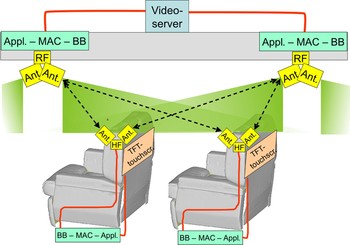
The IFE-data links consist of access-points (APs) at the aircraft ceiling over the aisle and seat terminal transceivers (STTs) in each row of seats, one for a group of three seats. The aim is that each AP should provide a data rate of one Gbit/s. Each seat should be supplied with 20 Mbit/s down-link and 5 Mbit/s up-link. The passengers will have display terminals with a touch screen to interact with the media server to view the desired contents, to update the local contents at the seat or to interact with other passengers. Figure 1 depicts the arrangement of the IFE-scenario.
Illustration of the general arrangement of the IFE-scenario demonstrator.

In the 60 GHz frequency range shadowing of the signal by persons is remarkable and consequently a line of sight connection is required. In order to ensure a high quality of service, a redundant connection is required. Therefore, macro diversity is applied by two antennas for a group of seats. The antennas of the STTs point to different APs, so that two APs are accessible for a bi-directional communication link. A seamless-handover between both communication links is required.
Special requirements for this scenario are:
• A point-to-multipoint connection with up to 50 STTs for one AP.
• A redundant connection with a seamless handover to ensure the high quality of service, which is necessary for a video streaming without interruption.
• Integration aspects of the antenna into an airplane passenger seat (see paragraph B2).
The first two requirements influence the geometrical arrangement of the system, which are discussed in paragraph B1. The software-related aspects (Media Access Control (MAC) layer and baseband) are not within the scope of this paper.
B) Implementation aspects
1) Antenna placement analysis
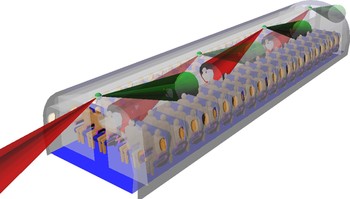
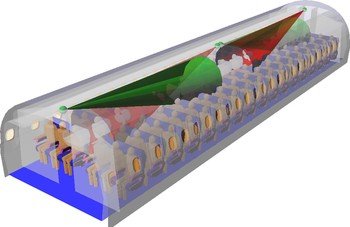
In order to achieve a good performance of the wireless IFE system, radio coverage optimization is to be performed for the aircraft of interest. In the presented case a typical European single aisle aircraft has been chosen as target environment for the IFE application. Since ray-tracing has been shown to be an appropriate tool for simulating 60 GHz indoor and in-cabin wave propagation [Reference Lostanlen, Corre, Louët, Le Helloco, Collonge and El-Zein6, Reference Felbecker, Keusgen and Peter7], a detailed 3D model of a part of an aircraft passenger in-cabin room was drawn up to make corresponding analyses. The model is shown in Figs 2 and 3. The dimensions of the part of the in-cabin room are 15 × 4.0 × 2.1 m (L × W × H). There are 17 rows of passenger seats with 6 seats in each row and a center aisle. The environment and the 102 passengers are characterized by 35 380 triangular and 12 285 rectangular surfaces. Transmission and reflection measurements have been carried out to determine the electrical properties of involved materials [Reference Felbecker, Keusgen, Kortke and Peter8]. The simulations incorporate antenna patterns of 2 × 1 symmetrically-balanced-fed antennas on Low Temperature Co-Fired Ceramics (LTCC) with a gain of approximately 9 dBi [Reference Vazquez, Holzwarth, Oikonomopoulos-Zachos and Rivera9].
Ray-tracing model of a part of the aircraft passenger in-cabin room with access point configuration 1.

Ray-tracing model of a part of the aircraft passenger in-cabin room with access point configuration 2.

With regard to given boundary conditions the APs are mounted at the cabin ceiling at a height of 2.1 m. Two different AP setups and associated configurations are compared. Configuration 1 corresponds to a symmetric AP setup with two directional antennas radiating in opposite directions, whereas configuration 2 involves APs being equipped with a single directional antenna. For a particular scenario only one type of AP is considered, either symmetric or asymmetric, so that APs are interchangeable. The antenna tilt (elevation angle) is identical for all APs. The arrangement of the STTs and the transmitted data rates are given by the scenario description (see above). The tilt of the STTs is determined by the STT with the largest distance to the closest neighboring AP and is identical for all.
AP arrangement 1, which is based on the symmetric AP setup, is shown in Fig. 2. APs are symbolized by green balls. Two APs are located at the front and rear partition wall, respectively; the other two are in between with equal spacing. Red and green cones illustrate the antenna beam directions and the down tilt. Figure 3 shows AP configuration 2, which is based on the asymmetric AP setup. In this case the APs at the partition walls radiate only toward the center of the cabin. The other two APs are concentrated at the same location and radiate into opposite directions along the aisle.
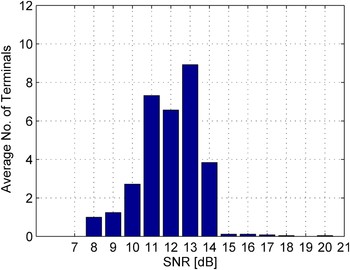
The achievable Signal-to-Noise Ratio (SNR) has been used as the basis for a comparative study of the different AP configurations. Physical layer parameters as well as implementation constraints are included in the calculations. Based on a noise-effective bandwidth of 1.75 GHz we assume that the thermal noise power is −81.6 dBm. Additionally, we take a 10 dB Rx noise figure and 5 dB implementation losses into account. An effective SNR above 6 dB is assumed to be sufficient to achieve a cumulative downlink rate of 1 Gbits/s with Orthogonal Frequency-Division Multiplexing (OFDM) – Quadrature Phase-Shift Keying (QPSK) modulation, equalization and efficient channel coding, whereas a lower SNR leads to an outage. Numerous simulations were carried out under various conditions like the 3D model with sitting passengers, with shadowing by randomly distributed standing passengers (10% of the passengers were standing on average) and with shadowing by the cabin crew moving a trolley up and down the aisle. Collecting the SNR for every STT in each simulation run, an average number of STTs attaining a certain SNR has been calculated. Figure 4 shows an exemplary SNR distribution which results from the scenario with shadowing by the cabin crew involving 25 simulation runs. The achievable SNR always exceeds 7 dB for each of the STTs.
SNR distribution (average No. of STTs for a given SNR) for access point configuration 1 under the influence of shadowing by the cabin crew.

The overall results of the ray-tracing simulations show that without shadowing four APs are sufficient to supply all STTs regardless of the AP configuration. However, when shadowing by passengers or by the cabin crew is taken into account, AP configuration 1 outperforms configuration 2 in both cases and hence should be preferred. Despite the achievable SNR is sufficient in most cases, sporadic outages cannot be prevented completely. They occur with 2.0% probability for configuration 1 with shadowing by passengers under the above-mentioned assumptions (calculated over 60 simulations with 34 STTs, which leads to 2040 STTs in total; 41 STTs exhibit less than the achievable SNR and are rounded down to 2%). Although it is not possible to make quantitative statements on the duration of those events for lack of spatio-temporal models for passenger movement, it is obvious that data buffering is an effective way to significantly alleviate this problem.
2) Antenna integration into passenger seats
One major issue for the final realization of the IFE system is the implementation of the 60 GHz RF-Front-end into an airplane passenger seat. Two aspects were evaluated:
• The RF-characterization of the materials used in an airplane seat.
• The performance of the installed antenna.
Hence, in a first measurement campaign the attenuation of commonly used seat materials was measured by transmission line measurements. The materials were placed in a measurement set-up between two horn antennas and the magnitude of the transmission factor was determined. The analyzed materials were different kinds of seat covers like fur, leather, or cloth and the used foam. The measured attenuations of all materials are for normal incidence of the wave less than −1.5 dB.
In order to evaluate the performance of the installed antenna and to measure the influence of the integration of the antenna on its pattern and therefore on the overall link budget, two aspects were evaluated: The location for the integration at the backrest of the seat and the influence of the surrounding materials of the antenna.
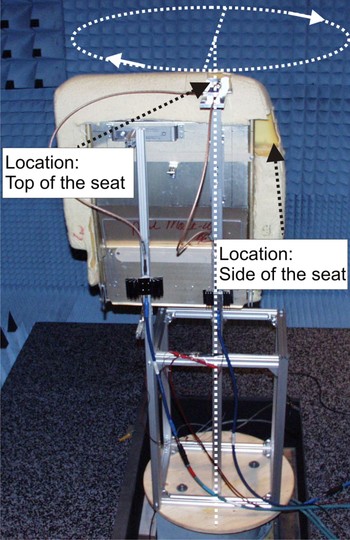
A metallic frame was designed which permits to mount the back of an airplane passenger seat onto the antenna measurement set-up inside an anechoic chamber. The antenna is positioned in the center of rotation and at a constant height for every pattern measurement. Figure 5 shows a photograph of the frame from behind the mounted seat. The center and direction of rotation are also illustrated in the picture.
Photograph of the seat from behind. White marks: center and direction of rotation. Black marks: different locations for the integration at the seat.

For the measurements, a LTCC-integrated 2 × 1 aperture antenna array was used, which was also developed in the context of the EASY-A project [Reference Vazquez, Holzwarth, Oikonomopoulos-Zachos and Rivera9]. The center frequency of the antenna was 58 GHz and therefore the pattern measurements were performed at this frequency.
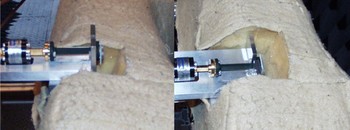
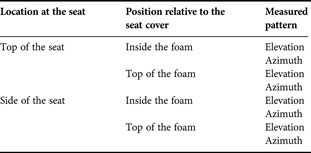
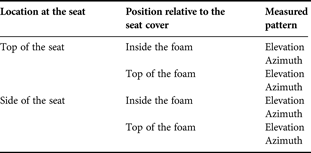
The pattern in azimuth and elevation were measured for two locations of the antenna (see Fig. 5) and for two different positions relative to the foam (see Fig. 6). Table 1 summarizes all measured cases.
Different position of the antenna relative to the seat cover: top of the foam (left side) and inside the foam (right side).

Overview of overall possible cases for the measurement.
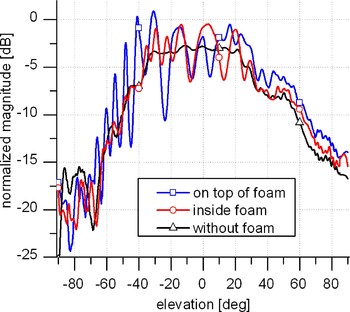
As an example for all measurements performed Fig. 7 shows the antenna elevation pattern measurement, for which the antenna is located on top of the seat. The figure compares the antenna pattern of both positions relative to the seat cover with the pattern of the stand-alone antenna. The antenna radiates in horizontal direction for 0° elevation, for positive angles upwards and for negative angles downwards.
Elevation pattern measurements. The antenna location was at the top of the seat.

The measurement shows, that there is a strong influence of the foam and the seat cover on the antenna pattern. If the antenna was placed on top of the foam, the first high degradation of the pattern occurred at −23°. At this angle, the antenna radiates directly towards the edge of the seat cover. For angles between −90° and −23°, there is a strong ripple at the pattern, but even for angles between −23° and 90° there is an influence of the foam and the seat cover. If the antenna was placed inside the foam, the antenna radiates towards the edge of the seat cover for an angle of approximately 20°. For this position, the influence of the foam and the seat cover is not as much as if the antenna was placed on top of the foam. A similar pattern characteristic occurs for the azimuth pattern measurement, if the antenna was located at the side of the seat.
The previous material characterization showed, that the attenuations of the seat materials could not explain the pattern disturbance. The reason for the distortion of the antenna pattern was interference of the direct antenna beam with reflections from the surface of the seat cover.
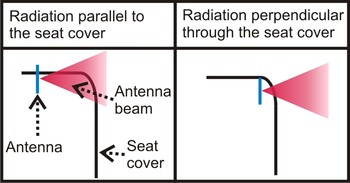
To overcome the problem with interferences from the seat cover, the antenna could be placed in a way, that it radiates perpendicular through and not parallel to the seat cover. Figure 8 illustrates both cases.
Illustration of the radiation of the antenna relative to the seat cover.

In summary, it was demonstrated that the interference of the signal with the seat cover plays a significant role for the integration of the antenna into the passenger seat. But with a smart placement of the antenna relative to the seat cover, the interference can be minimized.
III. IN-CAR ENTERTAINMENT SCENARIO
A) Scenario description
60 GHz communications technology is very beneficial for different use cases within the car. Primarily it can be used for high quality video transmission with high data rates and high demands on robustness. The main use cases are in-car video transmission, integration of consumer electronic devices and integration of after-market equipment.
In-car video transmission, e.g. rear seat entertainment systems, front seat passenger displays or even ceiling mounted displays can comfortably be realized by simply connecting to the car's infrastructure by a 60 GHz communication link. Also the transmission of real-time video streams of one of the several driver assistance cameras by a 60 GHz communication system is feasible. The video streams can be transmitted compressed (e.g. H.264 or MJPEG) or uncompressed, depending on the performance of the 60 GHz communication system and the requirements of the particular use case.
Consumer electronic devices, as soon as they have an integrated standardized 60 GHz communication interface, can easily be connected to the car. In particular it is reasonable to use the consumer electronic device as an additional in-car display or as an entertainment server for high quality video content.
Wireless 60 GHz communication allows a fast and simple integration of additional after-market electronics equipment into the car. Thus, it will be possible to easily upgrade the car. Examples are the already mentioned; rear seat entertainment system or the integration of a supplementary driver assistance camera (e.g. rear view camera).
From today's view, the most important use cases for 60 GHz communications technology within the car can be seen in the integration of a wireless rear seat entertainment system as well as the integration of consumer electronic devices as soon as they have the appropriate 60 GHz interface built in. It is obvious that the briefly described use cases will need high data rates and a high robustness and reliability not only in a static but also in a dynamic environment with moving people and devices within the car. The following measurements and analysis describe the 60 GHz in-car channel and the potential performance of a 60 GHz communication system within a car.
B) Channel investigations and implementation aspects
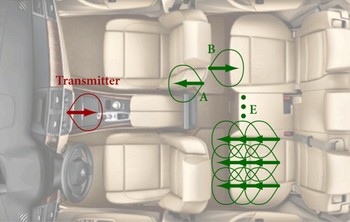
A comprehensive channel measurement campaign has been carried out in order to investigate 60 GHz wave propagation inside the car and to derive conclusions on system design and performance [Reference Peter, Felbecker, Keusgen and Hillebrand10]. In this section we give a brief overview on the measurement scenarios and point out basic results. As shown in Fig. 9 the transmit antenna was mounted perpendicularly to the front panel. Open-ended waveguides with a gain of ~8 dBi served as antennas at both the Tx and the Rx side. Scenarios A/B and E refer to rear seat entertainment and consumer electronic devices communication, respectively. There is a direct line-of-sight (LOS) between the Tx and the Rx antenna for Scenario A if the car is empty. In contrast, for Scenario B, the Rx antenna is pointing to the rear window and the transmission relies on reflections inside the car.
Antenna arrangement for Scenario A, B, and E – top view.

To evaluate the achievable coverage of the rear seats for consumer electronic devices (Scenario E), 20 Rx measurement positions at a height of approximately 30 cm above the seat have been considered as indicated in Fig. 9. In order to additionally assess the influence of varying propagation conditions, measurements with and without passengers, closed and open doors as well as outside and inside a garage have been carried out. Additional measurements focused on the influence of interference from a 60 GHz wireless system in another car [Reference Peter, Felbecker, Keusgen and Hillebrand10].
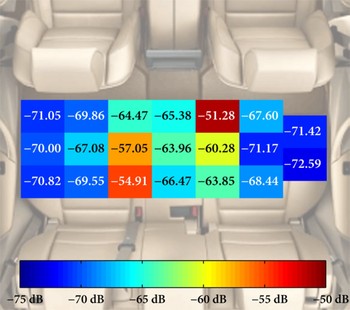
Figure 10 illustrates the results obtained for the channel gain (the inverse of the path loss including antenna gains) for Scenario E. Relatively high values above −60 dB are observed at some locations near the middle of the rear seat, as they benefit from LOS conditions. However, for most of the positions the LOS was obstructed by the driver's seat, a front passenger seat, or the screen on the center console, resulting in values down to −72.6 dB. Since there are only small gaps of few centimeters between the seats and the screen, even slight variances in the antenna position could give rise to significantly differing propagation conditions, which is the cause for non-symmetric results.
Scenario E – Back seat coverage analysis: color coded values for the channel gain at 20 Rx positions.

The overall analysis shows that the Root Mean Square (RMS) delay spread of the channel ranges from 0.57 to 4.1 ns, which is very low compared to typical indoor [Reference Xu, Kukshya and Rappaport11] and aircraft in-cabin results [Reference Peter, Keusgen and Schirrmacher12], and that neither the environment (outdoor/garage) nor the conditions of the doors (open/closed) have a significant influence on the in-car wave propagation. Passengers do not have a relevant impact as long as they do not obstruct the LOS. Furthermore it reveals that Scenario A with aligned antennas always outperforms Scenario B relying on multipath propagation, even if the LOS is obstructed by passengers. Assuming a transmit power of 10 dBm, a thermal noise power of −84 dBm (based on 1 GHz system bandwidth) and a receiver noise figure of 6 dB, an SNR between 15.3 dB (worst case with severe shadowing) and 36.6 dB can be achieved. These results show that a millimeter wave indoor system which is capable to cope with non-LOS conditions will perform well inside the car and encourage using 60 GHz for high data rate in-car communication.
IV. KIOSK SCENARIO
A) Scenario description
The classical application for the kiosk scenario is the download of very large amounts of bulk data (e.g. movies in HDTV quality) from a vendor machine. The user is situated in front of the machine, at a distance of less than 1 m. The amount of scatterers in the direct vicinity is strongly limited; transmitter and receiver have a line-of-sight connection. The downloaded data is not directly used (e.g. for video streaming), but stored on the user terminal. The data should be transferred in an acceptable amount of time, typically less than 10 s. The user terminal will be a battery powered handheld device, with corresponding constraints on the form factor and power consumption. Both constraints are less severe for the vending machine, which will have access to mains supply.
For this scenario, the following set of general requirements holds for an appropriate system design:
• The required data rate on top of the physical layer is 10 Gbit/s. The data storage capacity at the transmitter and the receiver has to be on the order several tens of GBytes. The storage medium must be able to support a write speed in excess of 10 Gbit/s, i.e. 1.25 GByte/s.
• “Error-free” transmission on top of the transport layer is required, i.e., bit error rates in the range of 10−12 have to be ensured with appropriate retransmission protocols. The packet error rate must be low enough to ensure acceptable performance of the transport/network layer (e.g. Transmission Control Protocol/Internet Protocol (TCP/IP)).
• The physical layer design (de-/modulation, de-/coding, synchronization, etc.) has to ensure lowest complexity and reasonable power consumption of the user terminal. (See also chapter IV.B)2), receiver concept.)
• Very long packets with a size on the order of several kBytes are required for lowest physical layer overhead.
• Time division duplexing will be optimal to separate uplink and downlink, due to the small transmission range and highly asymmetric traffic.
• Latency requirements are rather relaxed. The maximum delay induced by the physical layer should be below 10 ms to ensure a correct functioning of higher layer protocols (e.g. TCP/IP).
• The radio channel (excluding antennas and analogue transceiver front-ends) is rather frequency-flat and Additive White Gaussian Noise (AWGN)-like. Spatial diversity is limited to polarization diversity.
B) Implementation aspects
1) Digital baseband and data storage
For the implementation of the digital baseband, the main challenge is the digital signal processing with a throughput of 10 Gbit/s. The clock frequency of suitable state-of-the-art digital signal processing devices such as Digital Signal Processors (DSPs), Application-Specific Integrated Circuits (ASICs) and Field-Programmable Gate Arrays (FPGAs) is typically below 1 GHz, and a throughput of 10 Gbit/s can only be achieved with a high degree of parallelization. Low-power digital signal processors have nowadays a clock frequency of around 300 MHz, which would require at least 30− to 40-fold parallelization to process data bits at 10 Gbit/s.
Concerning the hardware-related need for parallelization, it is convenient to incorporate the parallelism already in the physical layer design, such that the bit sequence to be transmitted is split into number of lower rate bit sequences that are mapped to different resources. For the anticipated single-carrier QPSK modulation with 2 × 2 spatial multiplexing (using two polarizations), a 10 Gbit/s bit sequence can be easily split into four parallel sequences at 2.5 Gbit/s, which are then mapped to the two complex and two spatial dimensions. For a packet oriented file transfer with lowest complexity, it is further convenient to divide the payload of each data packet into blocks with bits from parallel (interleaved) code words. For a bit sequence at 2.5 Gbit/s with 32-fold parallelization, each parallel en-/decoder will then only process a subsequence of data bits at 78.125 Mbit/s. Three types of parallelism are thus jointly used to match the target data rate of 10 Gbit/s to a digital processing speed in the range of 100 MHz: (a) code words that are en-/decoded in parallel, (c) in-phase and quadrature phase of the transmitted QPSK symbols (which is also possible with differential modulation), (b) two polarizations.
Another critical implementation aspect relates to the storage of the large amount of data at the transmitter and especially at the receiver. Today's solid state disks achieve write access on the order of 250 MByte/s, and the underlying Serial Advanced Technology Attachment (SATA) interface is specified for up to 3 Gbit/s. It is thus clear that one bottleneck for the system implementation is the performance of the data storage devices, when restricted to non-volatile memory and not using storage devices in parallel. For the physical layer implementation in the EASY-A project, the problem is tackled by caching the data in a double data rate 2 (DDR2) memory with sufficiently large access rate.
2) Receiver Concept
The main challenges for GBit/s transmission rates of handheld devices are low power consumption and low cost components.
Therefore, a receiver concept was adopted which
• reduces power consumption through an all-analog demodulation of the employed differentially encoded QPSK signals,
• reduces cost through monolithic integration of down converter and analog demodulator, and
• reduces cost further through the use of a very low-cost technology (Telefunken Semiconductors SiGe2RF npn hetero-bipolar, 0.8 µm minimum feature size, fT = 80 GHz) for the monolithic integrated circuit (IC). Additionally, a low-cost substrate (Rogers 5880) and standard chip on board mounting techniques with wire bonding are chosen.
The system concept calls for two data streams with a net data rate of 5 GBit/s (symbol rate 3.456 GHz) transmitted on two orthogonal antenna polarizations. The targeted receiver noise figure is 10 dB, with 9 dB receive antenna gain.
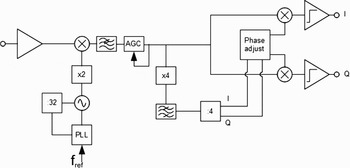
The receiver concept is shown in Fig. 11. After low-noise amplification (the LNA, is an external IC in IHP SG25H1 SiGe BiCMOS technology), the signal is down converted to a 5 GHz intermediate frequency (IF). From the QPSK modulated IF signal, the carrier is then recovered by quadrupling the signal. As the QSPK signal can be written as

with m in {0,1,2,3} and φn an unknown phase, the quadrupled signal is

Concept of the ultra-high-rate cordless receiver with analogue QPSK demodulation.

The modulation content has thus been completely removed. The time-variant amplitude A(t)4 still introduces spurs in the spectrum around 4 ωc, which are subsequently removed in the band-pass filter. The divide-by-four block restores the carrier frequency, and at the same time creates quadrature signals. The recovered carriers then undergo a static phase adjustment in active all-pass filters and demodulate the QPSK signals in two Gilbert cell type four quadrant analog multipliers. The amplitude is restored in limiting amplifiers. Because clock recovery is provided in the subsequent FPGA board implementing the digital baseband, this function has not been implemented in the analogue demodulator.
For the final demonstrator, two receiver front-ends will be needed. Each consists of two semiconductor ICs (the LNA and the down converter/demodulator IC). The band-pass filter needs a quality factor which is significantly beyond what can reasonably be integrated on a semiconductor IC; it is fabricated as a planar filter on the Rogers 5880 substrate that serves as the platform for the receiver system, and also carries the antennas. In the present state of the implementation, the receiver front-end consists of three ICs, because the down converter and the demodulator are still separated. Details of the receiver and the demodulator will be described in [Reference Cagri Ulusoy13].
As almost no equalization and digital impairment correction can be done with e.g. 1-bit resolution, very strict specifications are imposed on the gain flatness of all circuit blocks and the quadrature accuracy of the QPSK modulator. For those reasons, it is crucial to enhance the modeling accuracy of the components and circuit blocks involved, while reducing the system complexity to its minimum. In this context, the direct-conversion architecture is a viable solution, which can be implemented on RF technologies featuring active devices capable of approximately 200 GHz transit frequencies. Those devices are suitable for the design of all the required basic circuit blocks operating at 60 GHz. At a circuit level, the strict gain flatness specification can be addressed by relying on multi-stage higher-order matching networks in all the inter-stage sections of the system, whereas quadrature accuracy must be the result of accurate electromagnetic modeling of all passive structures and interconnects of the fabricated circuits. In addressing both issues, the use of distributed transmission lines and their validated models are required for all the on-chip matching and connecting elements. The interface between the integrated circuits and the rest of the system presents very specific modeling challenges at both the digital baseband and the antenna ends. In both cases, bond wire technologies can be a suitable and a cost-effective solution, but the availability of accurate models is crucial to meet the strict requirements on gain flatness and quadrature accuracy.
V. CONCLUSION
Three novel wireless communication systems were described, which will expand the currently announced 60 GHz applications in terms of number of users (IFE) and data rate (kiosk scenario). Implementation aspects are pointed out, which are important to demonstrate the functionality of the system in a relevant environment and are key aspects to develop the related products.
In order to analyze the geometrical arrangement of the wireless system ray-tracing simulation of the aircraft cabin and the car interior as well as pattern measurements of the passenger seat-integrated antennas were performed. For the ultra-high data rate kiosk scenario an adopted receiver reduces the power consumption and costs for the handheld devices.
The next steps are to demonstrate the functionalities of the wireless systems in a relevant environment (e.g. in the IFE scenario the next objective is to demonstrate the scenario performance inside a typical LR (long range) aircraft mock up with two APs and two STTs).
ACKNOWLEDGEMENTS
The authors would like to thank Alexander Lay, Airbus Operations GmbH, for supporting the EASY-A project.
Further, thanks to Ernesto Zimmermann for his contributions and valuable comments in the early phase of the EASY-A project.
This work is supported by the German Bundesministerium für Bildung und Forschung (BMBF) under the contract “EASY-A” (#01B40904). Further information about the project could be found at its website (http://www.easy-a.de).
 Benedikt Schulte received the diploma degree in electrical engineering from the University of Siegen, Siegen, Germany, in 2008. He is currently working toward the Ph.D. degree in electrical engineering at EADS Innovation Works, Ottobrunn, Germany. His research interests include highly integrated microwave front-ends (e.g. tunable filters and electronic steerable antenna arrays) for communication and radar systems.
 Michael Peter was born in Wertheim, Germany, in 1977. He received his diploma degree in electrical engineering and information technology from the University of Karlsruhe, Germany, in 2004. In 2005 he joined the Fraunhofer Heinrich Hertz Institute in Berlin. His research activities focus on 60 GHz communication, wideband channel modeling and physical layer design of wireless broadband communication systems.
 Robert Felbecker was born in 1980. He received his Dipl.-Ing. (M.S.E.E.) degree from the RWTH Aachen University, Germany, in 2007. Since 2007 he is with the Fraunhofer Heinrich Hertz Institute in Berlin, Germany. He is involved in the fields of measurement and simulation of electromagnetic wave propagation.
 Wilhelm Keusgen was born in Rheinbach, Germany, in 1973. He received the Dipl.-Ing. (M.S.E.E.) and Dr.-Ing. (Ph.D.E.E.) degrees from the RWTH Aachen University, Aachen, Germany, in 1999 and 2005, respectively. From 1999 to 2004, he was with the Institute of High Frequency Technology, RWTH Aachen University, where he worked on multiple antenna systems, microwave front-end technologies and microwave antennas. In 2004 he has joined the Fraunhofer Heinrich Hertz Institute, Berlin. Now he leads a research group, which is focused on the design and implementation of broadband mobile communication systems. His main research areas are millimeter wave communication, car-to-car communication and digital compensation of RF impairments especially for power amplifiers.
 Rainer Steffen received his diploma in electrical engineering and his Dr.-Ing. degree both from Technische Universität München (TUM). Since 2006 he is working as a project manager at BMW Group Research and Technology where he is responsible for different research projects in the field of automotive communication technology. His main research topics are new wireless and wired in-car communication systems.
 Marcus Hellfeld received the Dipl.-Ing. degree in electrical engineering from the Technical University of Dresden in 2005 with honors. From 2005 till 2008, he investigated event driven continuous dynamical systems. In 2008, he changed to 60 GHz circuits. His current research interest is analog oriented circuits design for signal processing directly in the 60 GHz domain. Currently, he is working towards his Ph.D. as a scientific research employee in Dresden University of technology in the field of RF circuit design.
 Atheer Barghouthi received his B.Sc. in electrical engineering in 2004 from Birzeit University in Palestine and received his M.Sc. in microelectronics and microsystems from Hamburg University of Technology in 2008. Currently, he is working toward his Ph.D. as a scientific research employee in Dresden University of technology in the field of RF circuit design.
 Stefan Krone received his Dipl.-Ing. (MSEE) from TU Dresden, Germany, in 2007. From 2001 to 2006 he was research assistant at Fraunhofer IPMS in Dresden and Fraunhofer IIS in Erlangen, Germany. Since 2007, he is research associate at the Vodafone Chair Mobile Communications Systems at TU Dresden, Germany, working towards his Ph.D. In 2010, he was research visitor at the University of California in Santa Barbara, USA. His research interests include physical layer design for ultra-wideband communications, signal processing with low-resolution data conversion and information theory.
 Falko Guderian received his MS in Business Informatics and MS in Industrial Engineering and Management from TU Dresden, Germany, in 2006 and 2007, respectively. Thereafter, he was Automation Engineer for mask data processing at Advanced Mask Technology Center Dresden, Germany, a joint venture of AMD and Toppan Photomasks. Since 2008, he is research associate at the Vodafone Chair Mobile Communications Systems at TU Dresden, Germany. His research interests include rapid prototyping in digital signal processing and design space exploration of multi/many-core systems.
 Gerhard Fettweis earned his Ph.D from RWTH Aachen, Germany, in 1990. Thereafter, he was visiting scientist at IBM Research in San Jose, USA, and scientist at TCSI Inc., Berkeley, USA. Since 1994 he is Vodafone Chair Professor at TU Dresden, Germany, with currently 20 companies from Asia/Europe/ USA sponsoring his research on wireless communications and chip design. He has spun-out nine start-ups in Dresden, so far. He is IEEE Fellow, and has received many awards. He has been actively involved in organizing conferences, most notably being TPC Chair of the IEEE ICC 2009 in Dresden, Germany.
 Hermann Schumacher received his doctorate in engineering (Dr.-Ing.) degree from RWTH Aachen, Aachen, Germany in 1986. After working for Bellcore, Red Bank, NJ, from 1986 to 1990, he joined Ulm University as a professor in the School of Electrical and Computer Engineering. He is currently the director of the Institute of Electron Devices and Circuits, and the director of the Communications Technology international M.Sc. program. His research interest range from compound semiconductor devices for micro- and millimeter-wave applications to high-frequency microsystems, including low-cost mm-wave communication solutions and impulse-radio ultra-wideband techniques for biomedical sensing.
 Volker Ziegler received his Dipl.-Ing. degree in electrical engineering and his Dr.-Ing. degree (with honors) both from the University of Ulm, Germany, in 1997 and 2001, respectively. From 2002 until 2003, he was member of the “Knowledge Exchange Group for Research and Technology” at the DaimlerChrysler AG in Stuttgart, Germany. Since January 2003, he is working with EADS Innovation Works, in Ottobrunn, Germany. He is an EADS Expert for “Microwave Technologies and Systems” and is responsible for the acquisition and managing of national and international research projects in the field of key microwave technologies for advanced radar and communication systems.