1. INTRODUCTIONFootnote 1
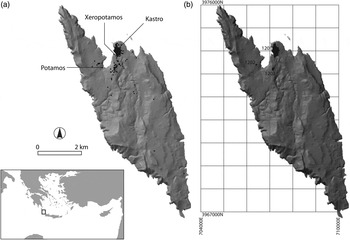
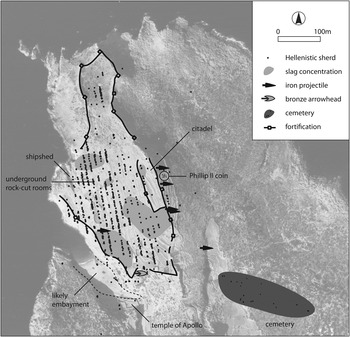
In this paper, we offer an overview of the post-Bronze Age and pre-Roman pottery deriving from an intensive survey of the Greek island of Antikythera, Hellenistic and Roman ‘Aegila’,Footnote 2 with particular attention to ceramic finds from a nucleated settlement of the Hellenistic period. Antikythera is one of the smallest (20.8 km2, maximum elevation 379 m) and most physically remote inhabited islands in the Mediterranean, but also lies along major shipping lanes, between the Peloponnese and Crete and between the Adriatic and Aegean seas (Fig. 1). Its history of human exploitation begins some 7000 years ago, but is very patchy, with periods of clear occupation followed by others of near or total abandonment. Perhaps the best-known archaeological discovery associated with the island is a first-century bc shipwreck off the north coast that produced the so-called Antikythera mechanism (an intricately-geared astronomical device) as well as an impressive range of bronze statues, ceramic and glass finds (most recently Freeth et al. Reference Freeth, Bitsakis, Moussas, Seiradakis, Tselikas, Mangou, Zafeiropoulou, Hadland, Cate, Ramsay, Allen, Cawley, Hockley, Malzbender, Gelb, Ambrisco and Edmunds2006, with further references). Of course, the contents of this unfortunate passing ship, while confirming the island's location in the middle of a risky maritime thoroughfare, say little about the communities living on Antikythera itself. However, there have also been important finds from a limited number of terrestrial investigations, beginning in the latter half of the nineteenth century (e.g. Zervos-Iakovatos Reference Zervos-Iakovatos1972; see also Tsaravopoulos Reference Tsaravopoulos, Vasilopoulou and Katsarou-Tzeveleki2009), and focusing on a fortified settlement on the northern side of the island known locally as the Kastro. In 1880, Valerios Stais discovered a votive inscription and statue of Apollo by the harbour of Xeropotamos immediately southwest of the Kastro (Stais Reference Stais1889) and suggested it was from a local sanctuary. The same area was much later also briefly investigated by Ioannis Petrocheilos (Reference Petrocheilos1987). Since 2003, both the temple and the settlement have seen a renewed programme of excavation by Aris Tsaravopoulos and colleagues (e.g. Papatsaroucha Reference Papatsaroucha2002; Tsaravopoulos Reference Tsaravopoulos2004–9; Tsaravopoulos Reference Tsaravopoulos, Vasilopoulou and Katsarou-Tzeveleki2009): as part of this programme, a shipshed on the north side of the Kastro has also been explored, along with a contemporary Hellenistic cemetery to the east (Fig. 2; also Martis et al. Reference Martis, Zoitopoulos, Tsaravopoulos, Luca and Sîrbu2006), and several clusters of Late Roman cist graves elsewhere on the island (Pyrrou et al. Reference Pyrrou, Tsaravopoulos, Bojica, Luca and Sîrbu2006).
Maps of Antikythera showing (a) the island's general location in the Aegean and the distribution of Classical to Hellenistic (mainly Hellenistic) sherds recovered from systematic survey, and (b) the location of denser artefact scatters along with the UTM grid (zone 34N, WGS84) used in the catalogue.

Plan of the Kastro with standing remains, special finds and pottery from stage-one survey shown (the background image dates from February 1944; courtesy of the UK Aerial Reconnaissance Archive).

In addition, a complementary picture of human activity on Antikythera has recently been provided by a separate programme of intensive surface survey covering the whole island – the Antikythera Survey Project (ASP). ASP has involved input from a broad range of specialists interested in the long-term human ecology of the island, in all periods of its history (e.g. Bevan et al. 2008; Bevan and Conolly 2009). The surface survey itself was one aspect of this research effort and its first stage (the only one to be invoked in this paper) was conducted in 2005–6 by five-person teams walking across the island in lines 15 m apart. ASP counted over 65,000 potsherds in this manner and made a permanent collection of about 7725 ‘feature’ sherds for subsequent study (i.e. all rims, bases, and handles and all those with paint, glaze or other decoration). Of these collected finds from first-stage survey, about 1550 are judged as possibly or certainly dating from the Classical to Hellenistic period. This paper offers a detailed assessment and selected catalogue of this sample, ultimately to accompany (i) a less discursive, but comprehensive publication of all ASP datasets in digital form and (ii) a more general monograph on the survey results to be published elsewhere.
The discussion below is broken up into general remarks, particular treatment of the earliest material, a catalogue of selected sherds and finally some concluding discussion. The catalogue uses a single running number sequence throughout, but readers should also take note of the associated field identifiers (in brackets) as these are the ones physically marked on the finds and used in other ASP publications. All measurements are in centimetres.
2. GENERAL REMARKS
The pre-Roman material of the Iron Age gathered during the survey comes almost entirely from the Kastro area and its immediate surroundings, with singular exceptions here and there plotted in Figs. 1 and 2. Only two areas beyond the Kastro exhibit sufficient sherds to warrant an interpretation as dedicated activity areas: a scatter of material around a possible fortified Hellenistic tower on the hill opposite the Kastro (1203) and a much smaller group of amphorae above and immediately to the west of the modern harbour (1202). The corpus is also very different from that encountered in other surveys, as will be seen in the figures, catalogue entries and discussion that follow. Because closely datable material (e.g. to century-long spans or less) is scarcely apparent, the duration, or potentially multiple durations, of occupation are not easily discerned, not least during the transition from Late Hellenistic to Early Roman, while the question as to whether there was continuous occupation throughout the Hellenistic period is also difficult to address with the present dataset.
Roughly 1550 pieces are at least possibly Classical or Hellenistic in date, and of these 1050 are amphorae or probably amphorae, 150 small open pots, 100 cooking pots, 70 larger open or wide-mouthed pots, 30 tile, 8 lamps, 5 lids, and 5 pithoi, while 140 are largely unidentifiable as shapes (though 65 of these latter are handles, probably of amphorae). Two general chronological points about this assemblage are worth making immediately: first, the vast majority of the total material is from the broad area around the Kastro, with very little found elsewhere on the island. Second, while only a small percentage can be given a close chronological date, the earliest pieces can be safely placed c.350–300 bc, with one probable heirloom from an earlier period (1); there is no clearly diagnostic material of the period c.250–100 bc, while that from the first century bc consists largely of amphora fragments that cannot be closely dated within the period 100 bc–ad 10.
Turning to the overall functional character of the assemblage, it is first worth noting that about 1100 amphora sherds were judged to have been either surely or probably of Classical or Hellenistic date. Overall, 810 of these are handles, 175 rims, 95 toes and 20 body sherds with diagnostic slip, carination, etc. Of this total set of amphorae possibly dating from this broad phase, 485, of which 425 are handles, can be assigned to the Classical–Hellenistic (and most likely just Hellenistic) period with greater confidence. 45 rims are generically of ‘mushroom’ shape; many are of the more drooping, or very drooping, type (Lawall Reference Lawall2004a, 450–3), indicating a later or considerably later date than the fourth century bc. A similar number of such rims (c.40) has been documented by survey on the neighbouring island of Kythera (Johnston, work in progress; the Kythera Island Project), but, from 3500 amphora sherds of Classical–Hellenistic date, most are of earlier types, though we note some later pieces below, in footnote 4.
Compared with other surveyed areas around the Mediterranean with material of the same period, the most striking difference lies in the imbalance of tile against amphora, the former remarkably low, the latter exceptionally high. Clearly, the two patterns need not necessarily be linked, and different social and economic factors are likely to be behind each of them. With regard to amphorae, a good range of possible explanations is available, but perhaps rather fewer with respect to roofing. While the general character of the few tiles found is unremarkable, the white paint on 88 does stand out, suggesting it does indeed come from the temple which was located close by. It can also be added that there are two fragments of tile of local stone from the Kastro (4300-15-1-45-O1 and 4318-27-1-35-O1), which are clear imitations of ceramic types, with a chamfered edge, and possibly Hellenistic. A plausible explanation for the discarded amphorae is that they are indicative of a passing trade in shipping wine and other goods, while lack of tiles could indicate much reed and mud roofing, especially if we consider roofing practice in recent centuries, or, less likely, removal of tiles by inhabitants emigrating from the island.Footnote 3
A generally recognised difficulty in dealing with pottery of the Late Classical and Hellenistic periods in the Aegean is the increasing uniformity of shapes and techniques, and a certain conservatism, that in combination make it difficult to discern local production or stylistic preferences. The island of Antikythera lies between two centres of local power in the period concerned: Sparta and Crete, together with their respective allies. It should be stressed here that Kythera, to the north, has produced very little archaeological material belonging to the main period of habitation on Antikythera. This vacuum would be conveniently explained by a historical model proposing that Cretan groups from the south, perhaps from Phalasarna as the evidence from the Kastro excavations very strongly suggests, drove out the inhabitants of Kythera, while a small sailors' sanctuary on the islet of Mikri Dragenera off Kythera flourished as a temporary stopover rather than as an indication of local prosperity (Papatsaroucha Reference Papatsaroucha2002; Tsaravopoulos Reference Tsaravopoulos2004–9). However, the Antikytheran survey material does not fully support this notion of exclusively Cretan involvement, despite the aforementioned difficulties of regional ceramic identification. For example, Laconian Hellenistic pottery is scantily known, while Cretan has been more fully excavated and published. Yet despite this imbalance in research, the amount of survey material of clearly Cretan origin from Antikythera is slight, while there are rather more pieces of probably Laconian origin, especially in the earliest period of reoccupation, with due notice of the fact that distinctions are more difficult to make in the later material. Fine pottery of the two broad areas uses similar clays, and the main small drinking shapes – kantharos, skyphos and echinus bowl – are panhellenic in character. One of our fragments (7) is from a large Cretan cylinder cup or small oinochoe, a hydria rim is probably Cretan (8) and at least a dozen amphorae are of Cretan types or clay, though of uncertain date. Of the 10 or so pieces more clearly Laconian (all black-glazed) most could still be of the fourth century; they are largely small open vessels, but there is a lamp and a probable jug (the latter a handle fragment not catalogued here).
Some 135 pieces can be loosely called black-glaze, although the term covers a range of finishes, from dull, dark slip (on a few tiles) to a fine gloss finish. While, as noted, 10 can be confidently taken as Laconian, only one seems clearly Attic, and most are impossible to assign any further regional provenance. With respect to shape, nearly 100 can only be termed smaller open pots, while 10 are too worn to judge whether they are open or closed; the remaining 28 are spread thinly: tile and lamp (6 each), lekane and generic large closed vases (4 each), cooking pot and generic large open vases (2 each) and lid, krater, amphora and unguentarium (1 each).
The painted small open pots mainly comprise generic bowls, and especially their ring-feet, which amount to some 34 in all, only 9 of which can be given to more specific shapes (3 fishplates, 2 plates, 1 each of pyxis, salt-cellar, kantharos and skyphos). By contrast, kantharoi feature heavily among handles and body sherds, largely because they are more diagnostic in this respect, while 3 echinus bowls are also identified by body sherds. 15 rims break down into 6 kantharoi, 5 plain vertical (one of which is thickened and flat-topped), 2 echinus bowls and 2 ledge rims. A few elaborate feet and body sherds are catalogued below.
This suite, apart from a few of these last peculiarities, is typical enough of the range of Hellenistic black-glaze overall, and in particular of the earlier part of the period; we should note the lack of more specifically Cretan types (tulip cup, Cretan kantharos and the like).
3. THE MATERIAL
3.1 Possible earlier material (i.e. prior to the later fourth century bc)
Neither survey nor excavation has yet uncovered any evidence for activity on the island after the Third Palace period in the Bronze Age and prior to the Late Classical period (see Pentedeka et al. Reference Pentedeka, Kiriatzi, Spencer, Bevan and Conolly2010). While some uncertainty about this absence must remain in the light of our partial knowledge of regional coarsewares (and hence identification via survey) over this timeframe, the overall pattern does suggest the wholesale cessation of permanent settlement. The bulk of the evidence for a subsequent recolonisation is firmly late fourth century bc as we shall see below, but it is first worth noting that the overall assemblage also provides some very limited evidence for ‘pre-Macedonian’ material, with all due respect to the problems associated with dating ceramic material within the approximate period 350–320 bc (Rotroff Reference Rotroff2007, 810). Among the pieces that contribute to this conclusion, one seems to be an isolated example, while others must hover more generically in a ‘fourth century, not late’ category, given the current state of our knowledge.Footnote 4 The exception is a fragment of a foot of an Attic large vase, krater or hydria, 1, which it would be difficult to place as late as the fourth century and is probably earlier than this. Other feet which would be better placed earlier rather than later in the fourth century are that of a mortar, 2, and the disc bases of two Laconian small pots, 3 and 4. Item 5 is a salt-cellar or pyxis perhaps no later than 350 bc, and one body sherd, 6, has very fine black glaze. Some ring-foot fragments of smaller open vases (26–8) have a grooved resting surface and could be pre-Hellenistic, though an early Hellenistic date cannot be ruled out (Rotroff Reference Rotroff1997, 11). A few amphora fragments also seem relatively early, though they are not as diagnostic. While there are no mushroom rim fragments of the type with flat top, generically indicative of a fourth-century date, some feet could be so placed, for example 76.
The find of a much-worn bronze coin of Philip II (Fig. 9) on the Kastro also does a little to support an early date for the (re-)settlement, but clearly cannot be pressed as evidence; flan size and thickness merely suggest an earlier rather than later date, while the types are not easily paralleled. We may merely speculate who in the area may have been using such a coin, rare in places so far south, or whether it was brought there casually or not. One possibility of course is that it relates to mercenary pay from one side or other of a conflict, although, with only one such piece, it remains impossible to do more than speculate.Footnote 5
In sum, the material evidence from the survey is largely consistent with a foundation of the stronghold c.325 bc. Tsaravopoulos (Reference Tsaravopoulos2004–9) has argued that it was an anti-Macedonian measure taken under the financial support of the Persian king with strong support from Cretan cities, especially Phalasarna. The evidence for this from epigraphic and literary sources is strong, and in general terms can be accepted. There is a strong possibility that there was occasional use of the site a little earlier, seen especially in pottery of Laconian origin. The limited evidence would suggest that 1 is an heirloom, whatever the precise dating of the other pieces in this category.
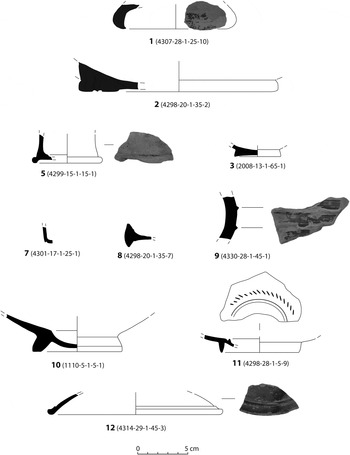
1 (4307-28-1-25-10) 707230E, 3973912N
Pedestal base of larger Attic vase, krater or hydria. Foot diameter c.13 cm. Black-glazed outside, reserved under. Date: Footnote 6 450–400 bc? (Fig. 3)
2 (4298-20-1-35-2) 707194E, 3973964N
Base fragment of mortar. Foot diameter c.20 cm. Burnt. Dark grits on floor. Two grooves on underside. Its condition does not allow accurate estimation of origin, but the general type is close to material from Kythera of the Classical period. Date: 5th–4th century bc. (Fig. 3)
3 (2008-13-1-65-1) 707440E, 3973455N
Base fragment of open vase, probably cup. Foot diameter 4.7 cm. Traces of paint on underside and inside. Laconian. Open vases with disc-feet are not surely attested, at least in published material, in Laconia in the Hellenistic period, though the fabric of this piece is not typically Classical. Date: 4th–3rd century bc? (Fig. 3)
4 (4314-20-1-25-4) 707263E, 3974027N
Disc-foot of a small pot. Foot diameter 3 cm. Inside worn; outside black-glazed. Laconian. Fabric seems earlier rather than later, though such bases do appear on small closed pots, which this piece could perhaps be, in the Hellenistic period; see Cavanagh Reference Cavanagh1996, fig. 15.4:1, 4–5.
5 (4299-15-1-15-1) 707229E, 3973994N
Base and wall of a salt-cellar or pyxis. Foot diameter c.7.5 cm. Wholly black-glazed. The fabric is not Attic, perhaps Laconian. The profile would allow the possibility of this being a skyphos, except perhaps for the very flat underside. The form of ring-foot is perhaps more at home in the 5th century, but the relatively thin inner wall might take this piece into the Late Classical period or after; see Sparkes and Talcott Reference Sparkes and Talcott1970, 136–7. (Fig. 3)
6 (4328-27-1-5-2) 707342E, 3973991N
Body fragment of a small cup with good black glaze on interior and exterior. Maximum preserved dimension 1.8 cm. Probably Laconian. Classical.
3.2 A selection of the later material (late fourth century to first century bc)
3.2.1 Fine ware
7 (4301-17-1-25-1) 707182E, 3974102N
Wall and base fragment of a mug. Maximum preserved dimension 5.5 cm. Groove at base of wall, at the turn to a base that is at least in part flat. Perhaps from a Cretan cylinder cup or small olpe. Date: Mid-Hellenistic. (Fig. 3)
8 (4298-20-1-35-7) 707193E, 3973965N
Rim of hydria? Maximum preserved dimension 5.3 cm. Fine buff clay. Substantial diameter. Perhaps Cretan. (Fig. 3)
9 (4330-28-1-45-1) 707341E, 3973847N
Body fragment; curious thick, concave sherd with ribs, most strangely, on the inside. Maximum preserved dimension 7.3 cm. Good black glaze in and out. Possibly from a large stand. Date: 4th–3rd century bc. (Fig. 3)
10 (1110-5-1-5-1) 707317E, 3974108N
Foot and body of fish-plate. Foot diameter 9.2 cm; maximum preserved dimension 14.5 cm. A large plate, with remains of black glaze inside and out. Rather massive foot and no groove at join of floor and wall. Compare Edwards Reference Edwards1975, 132; akin to Morel Reference Morel1981, type 1122a but with heavier foot; see also remarks by Rotroff Reference Rotroff1997, 146–7, on the variability of detail in Hellenistic plates. Date: Probably later 3rd century bc. (Fig. 3)
11 (4298-28-1-5-9) 707227E, 3973933N
Foot and part of body of fish-plate. Foot diameter 8 cm. Rather upright and narrow foot; marked ridge at floor/bowl join. Wholly black-glazed; a band of rouletting on the floor. Date: Probably 3rd century bc. (Fig. 3)
12 (4314-29-1-45-3) 707284E, 3974051N
Lid? Maximum preserved dimension 6.2 cm. Black glaze on interior and exterior; incised groove above rim. (Fig. 3)
Some thirty sherds are from various black-glazed kantharos and cup-kantharos types, though eleven, found at location 1203 (Fig. 1), belong to probably only three pots (17–19). Five are of cup-kantharoi with a large moulded rib below the rim; another five have vertical fluted or grooved decoration on the body. Two are feet and many of the rest handles. The material is generically of the third century bc.
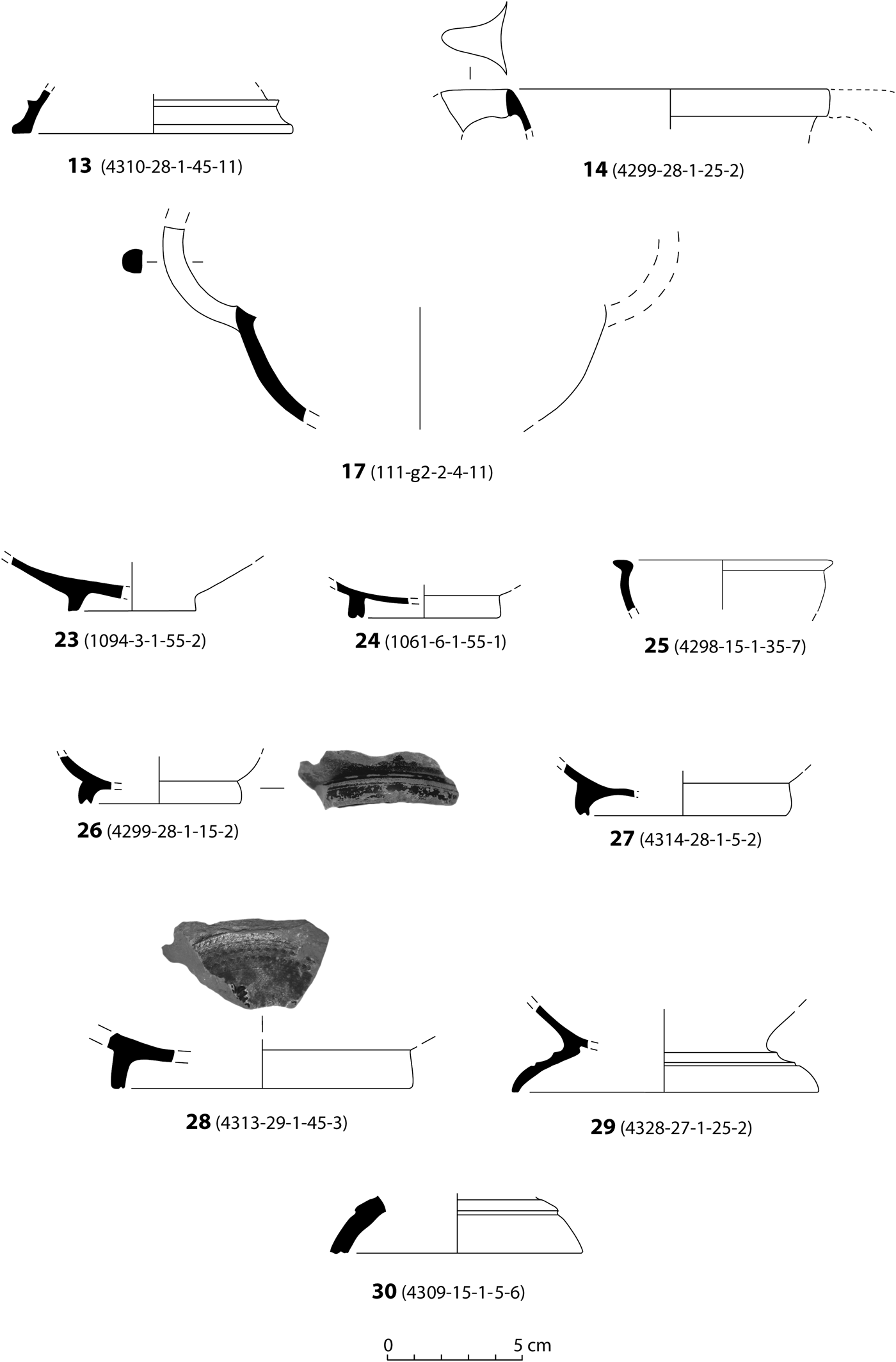
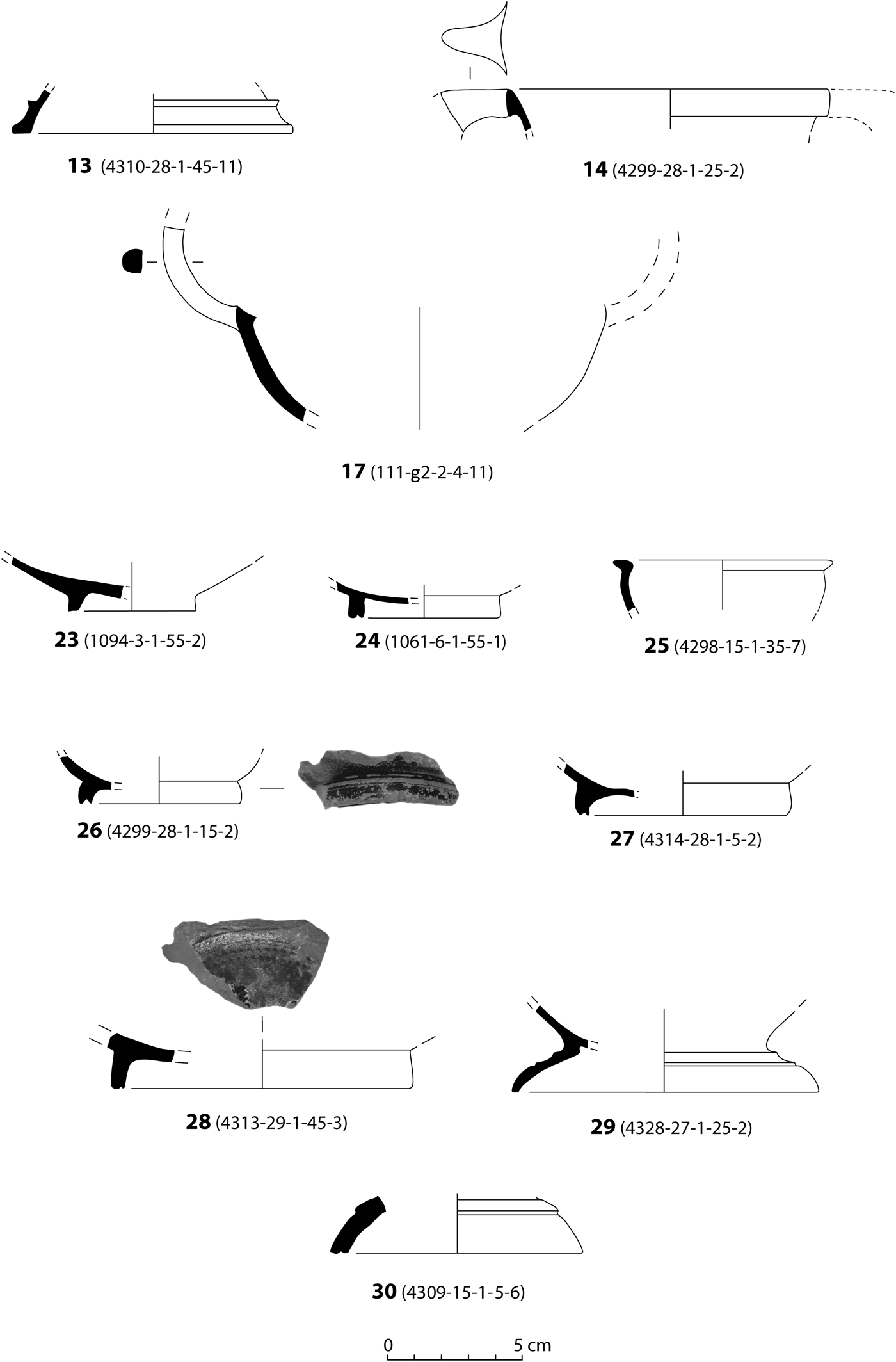
13 (4310-28-1-45-11) 707303E, 3973893N
Foot of kantharos. Maximum preserved dimension 3.8 cm; foot diameter 6 cm. Wholly glazed. Laconian. (Fig. 4)
14 (4299-28-1-25-2) 707214E, 3974004N
Handle and rim fragment of kantharos. Maximum preserved dimension 6.5 cm; lip diameter 12.3 cm. Wholly glazed. (Fig. 4)
15 (4298-15-1-45-2) 707232E, 3973979N
Wall and handle root of fluted kantharos. Maximum preserved dimension 3.3 cm.
16 (4307-26-1-25-3) 707217E, 3973901N
Part of double reed handle of a kantharos. Maximum preserved dimension 6.3 cm.
17 (111-g2-2, 111-g2-4 and 111-g2-11) 707104E, 3973363N
Three joining sherds of handle and body of large kantharos or cup-kantharos. (Fig. 4)
18 (111-g2-9) 707106E, 3973363N
Body fragment of kantharos or cup-kantharos. Maximum preserved dimension 1.8 cm. Rouletting on inside.
19 (111-g2-6 and 111-g2-7) 707103E, 3973363N
Two joining fragments of moulded rim of cup-kantharos.
20 (1108-7-1-25-1) 707216E, 3974205N
Moulded rim of cup-kantharos. Maximum preserved dimension 3.7 cm.
21 (60-gg1-1) 707957E, 3972137N
Rim fragment of kantharos. Maximum preserved dimension 4.2 cm.
22 (5070-1-1-25-1) 708059E, 3973691N
Moulded rim fragment of cup-kantharos. Maximum preserved dimension 2.6 cm.
Other black-glazed materialFootnote 7
23 (1094-3-1-55-2) 707234E, 3974309N
Foot of bowl. Maximum preserved dimension 7 cm. Foot diameter 5 cm (only); medium red-brown. (Fig. 4)
24 (1061-6-1-55-1) 707127E, 3973374N
Grooved ring-foot of bowl. Maximum preserved dimension 5.5 cm. Foot diameter 7 cm. (Fig. 4)
25 (4298-15-1-35-7) 707233E, 3973969N
Slight ledge rim of bowl or cup; maximum preserved dimension 4.4 cm. Lip diameter c.9 cm. Wholly glazed. Laconian. (Fig. 4)
26 (4299-28-1-15-2) 707215E, 3973997N
Bowl; grooved, ring-foot, maximum preserved dimension 7.2 cm, foot diameter 7 cm. (Fig. 4)
27 (4314-28-1-5-2) 707242E, 3973992N
Vertical ring-foot, grooved, with black glaze on interior and exterior. Maximum preserved dimension 7.5 cm. Foot diameter 8 cm, Light pink-red. (Fig. 4)
28 (4313-29-1-45-3) 707295E, 3973997N
Tall ring-foot of bowl, maximum preserved dimension 5.9 cm, foot diameter 11 cm. Slight groove on stand-ring. One stamped palmette preserved and four rows of degenerate tongue or leaf pattern. Early 3rd century bc? (Fig. 4)
29 (4328-27-1-25-2) 707345E, 3973978N
Large deep bowl. Maximum preserved dimension 8 cm. Foot diameter c.13 cm; elaborately profiled, flaring pedestal foot; comparatively thin wall. Wholly glazed. (Fig. 4)
30 (4309-15-1-5-6) 707252E, 3973873N
Profiled pedestal foot of larger black-glazed vase. Maximum preserved dimension 4.0 cm. Foot diameter c.9 cm. Grooved resting surface. (Fig. 4)
31 (2010-2-1-55-2) 707469E, 3973323N
Rim of echinus bowl, black-glazed, maximum preserved dimension 3.2 cm. Lip diameter c.13 cm.
3.2.2 Larger bowls
32 (4302-29-1-45-1) 707150E, 3974064N
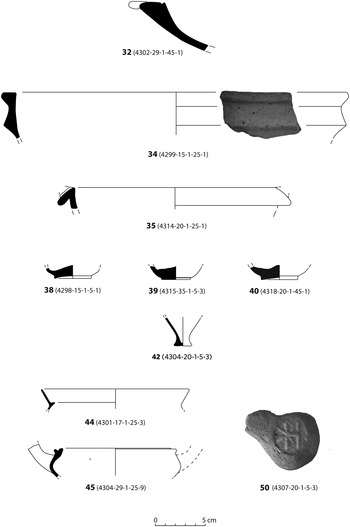
Mortar, part of lug handle; ledge rim with groove under edge; maximum preserved dimension 16.7 cm. Lip diameter 32 cm. Near-coarse, buff-brown. (Fig. 5)
33 (4307-29-1-5-1) 707188E, 3973920N
Lekane; lip diameter c.32 cm, maximum preserved dimension 7.2 cm. Ledge rim with horizontal handle under. Near-fine medium-brown clay.
34 (4299-15-1-25-1) 707226E, 3974011N
Tall concave rim of basin; maximum preserved dimension 9 cm, lip diameter c.35 cm; buff. (Fig. 5)
35 (4314-20-1-25-1) 707265E, 3974018N
Rim of bowl; maximum preserved dimension 5.9 cm; lip diameter c.20 cm. Downwards-sloping rim with handle scar atop. (Fig. 5)
36 (4304-29-1-25-4) 707163E, 3973989N
Thickened flat-topped rim of large bowl; some traces of black glaze. Maximum preserved dimension 5.7 cm.
37 (4307-28-1-5-6) 707228E, 3973928N
Hooked ledge rim of bowl, maximum preserved dimension 4.7 cm, lip diameter c.22 cm; buff-brown.
3.2.3 Lamps and unguentaria
Lamps are represented by two black-glazed nozzles, one with rather dull, more brown glaze, 4312-28-1-15-11, another from outside the Kastro, 1062-5-1-85-4, and four bases, three illustrated here (Fig. 5):
38 (4298-15-1-5-1) 707240E, 3973940N
Maximum preserved dimension 52 cm; foot diameter 3.3 cm. (Fig. 5)
39 (4315-35-1-5-3) 707268E, 3974059N
Maximum preserved dimension 5.2 cm; foot diameter 3.5 cm. Laconian. (Fig. 5)
40 (4318-20-1-45-1) 707174E, 3974154N
Maximum preserved dimension 5.2 cm; foot diameter 4.1 cm. Underside reserved. (Fig. 5)
41 (3157-10-1-45-1) 706135E, 3973311N
Foot diameter 3.6 cm; generically is of the same general type as the above.
42 (4304-20-1-5-3) 707226E, 3973933N
Foot of an unguentarium. Foot diameter 1.8 cm; maximum preserved dimension 3.0 cm. The only such piece found in the survey. There is a splash of glaze on the wall and very slight grooving around the lowest wall. (Fig. 5)
Line drawings of sherds 1–3, 5, 7–12.

Line drawings of sherds 13–14, 17, 23–30.
Line drawings of sherds 32, 34–35, 38–40, 42, 44–45, 50.

3.2.4 Cooking pots
Cooking pots are known from perhaps 50 fragments, but dating is not easy; approximately 35 are handle fragments only and two knobs of lids. Cylindrical handle fragments come from tracts 1062, 1064 and 1094, and a body fragment with part of the ledge from a casserole from 1104.
43 (3010-3-1-35-3) 705999E, 3973854N
Folded rim, height 0.8 cm, maximum preserved dimension 3.1 cm; handle scar below rim. Purple-brown.
44 (4301-17-1-25-3) 707183E, 3974096N
Chytra rim, ledge and wall; red-brown, with mica; dark paint on interior. Maximum preserved dimension 5.1 cm. (Fig. 5)
45 (4304-29-1-25-9) 707163E, 3973986N
Rim and handle root of shallow dish, lopas; bifurcated rim. Maximum preserved dimension 5.2 cm. Grey exterior. (Fig. 5)
46 (4302-17-1-15-2) 707125E, 3974074N
Rim of plain, shallow bowl, burnt; coarse, if thin, ware. Maximum preserved dimension 4 cm. Fragments of round cooking-pot handles were collected in the same pass.
47 (4319-35-1-45-1) 707150E, 3974213N
Slightly concave, vertical rim, height 1.5 cm, maximum preserved dimension 2.7 cm; micaceous and other small inclusions. Probably from a cooking pot.
48 (4307-20-1-15-3) 707201E, 3973913N
Rim, ledge and handle root of chytra. Maximum preserve dimension 3 cm. Orange with grey core.
49 (4298-28-1-25-21) 707222E, 3973954N
Lower rim, ledge and part of high rising handle of a chytra. Maximum preserved dimension 4.7 cm. Red-brown surface; highly micaceous.
3.2.5 Amphorae
We illustrate the one stamp and then a range of rims and feet, more to express the diversity of finds than to suggest provenances. Quercia et al. (Reference Quercia, Johnston, Bevan, Conolly and Tsaravopoulos2011) have already indicated the range of material belonging to the last two centuries bc or slightly later, and 10 of the entries catalogued there come from the Kastro. However, it is worth stressing that the majority of clearly Roman pottery comes from other locations on the island in contrast to the very small percentage of Classical to Hellenistic pieces from beyond this zone. Here we merely give skeleton entries for four pieces from the Kastro for which Quercia et al. give a probably Hellenistic date (54–57, the corresponding catalogue numbers in Quercia et al. Reference Quercia, Johnston, Bevan, Conolly and Tsaravopoulos2011 are prefaced ‘Q’ ), and note that Q60–64 may belong to the earlier imperial period, with Q71 substantially later. It is not possible to insist on desertion of the site in the mid-first century bc from this evidence alone, but when compared with the paucity of fine wares of the period c.100 bc to ad 50 (Q1–3 at most) the case becomes compelling.
50 (4307-20-1-5-3) 707200E, 3973925N
Stamped handle. Maximum preserved dimension 8.1 cm; 2.8 × 1.9 cm, near handle join; orange-brown clay with mixed inclusions. The stamp is circular, diameter 1.6 cm, and consists of a ligature not easily interpreted; ΗΡΑΚ would be a possibility, but the alpha is uncertain since there is no sign of an extension of the right leg; beta seems to be present. Very similar is the square stamp from Alexandria, Sztetyłło Reference Sztetyłło1992, 177 no. 53. Not so close is one of the set of Chian stamps from Delos (Grace and Savvatianou-Petropoulakou Reference Grace, Savvatianou-Petropoulakou and Bruneau1970, 358, E233); the clay and handle profile of our piece are similar. The ‘syntax’ of the ligature is also close to the Boethos stamp on jars from Rhodes or its Peraia of the middle of the 3rd century (Şenol and Doğer Reference Şenol, Şenol and Doğer2004, 359). Date: c.250–100 bc (probably Chian). (Fig. 5)
51 (4303-17-1-45-1) 707135E, 3974018N
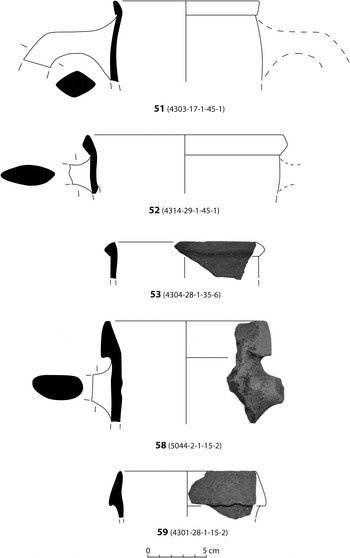
Low folded lip; rather rhomboid handle. Light-brown clay with phyllite inclusions. Maximum preserved dimension 10.2 cm; lip height 1.4 cm; handle 3.7 × 2.4 cm. The clay could tentatively be taken as Cretan. The existence of Cretan amphorae in the Hellenistic period is problematic. Vogeikoff-Brogan and Apostolakou (Reference Vogeikoff-Brogan and Apostolakou2004) have presented some candidates from the east of the island, but Marangou (forthcoming) argues for a later date for some. Large-scale production appears only at the end of the period, making the pieces catalogued by Quercia et al. from the Kastro (2011, catalogue nos. 60–64) most probably ‘post-destruction’. (Fig. 6).
52 (4314-29-1-45-1) 707285E, 3974048N
Small angular lip, slightly everted. Red-brown clay with phyllite inclusions. Maximum preserved dimension 7 cm. Handles near to strap shape. Again perhaps Cretan clay. (Fig. 6)
53 (4304-28-1-35-6) 707129E, 3973969N
Slight lip. Medium-brown, near-fine clay. Maximum preserved dimension 6.9 cm; lip diameter 12 cm. Perhaps Rhodian. (Fig. 6)
54 (4299-29-1-25-1 = Q52, q.v.) 707172E, 3974005N
Late Rhodian amphora, rim. Diameter 7 cm, height 4 cm. Fine and hard reddish-yellow clay. Late 1st century bc to mid-2nd century ad.
55 (4314-20-1-35-1 = Q53, q.v.) 707262E, 3974031N
Late Rhodian amphora, rim. Diameter 12 cm, height 2.7 cm. Quite fine and hard reddish-yellow clay. Late 1st century bc to mid-2nd century ad.
56 (4303-20-1-15-13 = Q40, q.v.) 707142E, 3974042N
Amphora, rim; Pascual 1 or Dressel 1B? Diameter 11 cm, height 6.8 cm. Rough and hard red clay with frequent black inclusions. From the second half of the 1st century bc to the second half of the 1st century ad, although the majority of datable finds from northwestern Europe tend to be Augustan in date.
57 (4300-28-1-25-4 = Q47, q.v.) 707205E, 3974053N
Cyrenaic amphora, rim. Diameter 17 cm, height 4.3 cm. Quite fine and hard ‘sandwich’ clay (the core is red - 5YR 7/8, the surfaces are black). Mid-2nd to the end of the 1st century bc/early 1st century ad.
58 (5044-2-1-15-2) 707641E, 3973622N
Tall folded lip, rather flattened handle. Lip diameter 12.5 cm, handle 4.1 × 2.2 cm. Red-brown clay with ample small inclusions. Perhaps Lamboglia 2, 1st century bc or later. (Fig. 6)
59 (4301-28-1-15-2) 707199E, 3974089N
Rather thin vertical rim. Maximum preserved dimension 6.9 cm. Dressel 1C. 1st century bc. (Fig. 6)
60 (4298-28-1-15-11) 707223E, 3973951N
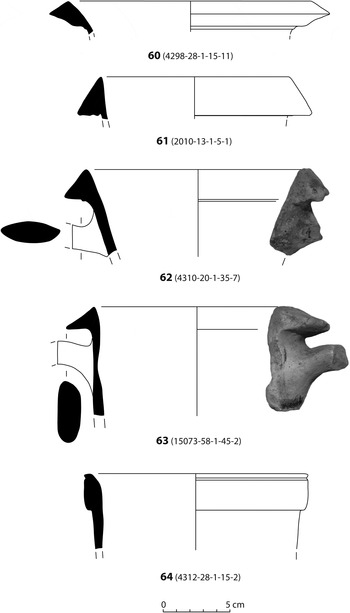
Flaring mushroom rim, with modelling underneath. Maximum preserved dimension 13.9 cm; lip diameter 18 cm. Near-fine orange-brown clay. Probably still 4th century bc. (Fig. 7)
61 (2010-13-1-5-1) 707516E, 3973247N
Triangular mushroom rim. Maximum preserved dimension 5.4 cm; lip diameter 17 cm. Near-coarse, micaceous red-brown clay. From a site a little inland from the Kastro area. (Fig. 7)
62 (4310-20-1-35-7) 707280E, 3973870N
Mushroom rim, rather flat handle and neck tapering downwards. Maximum preserved dimension 9.2 cm. Pink-buff clay with many mixed inclusions. Related to Solocha 1 jars, of varied provenance (Buzoianu Reference Buzoianu and Garlan1999, 205, with bibliography) but the taper is very marked. 4th to 3rd century bc? (Fig. 7)
63 (15073-58-1-45-2) 707346E, 3973806N
Mushroom rim and flattened handle. Distinct layering of vari-coloured clay. Maximum preserved dimension 11.8 cm; lip diameter 19 cm; handle 4.5 × 1.9 cm. (Fig. 7)
64 (4312-28-1-15-2) 707273E, 3973907N
Folded vertical rim; slight notch near the top outside. Maximum preserved dimension 8.5 cm; lip height 2.8 cm, lip diameter c.17 cm. Fine light-brown clay with grey core; black paint remains inside, suggesting this may be from a table amphora. (Fig. 7)
65 (4314-28-1-35-1) 707238E, 3974024N
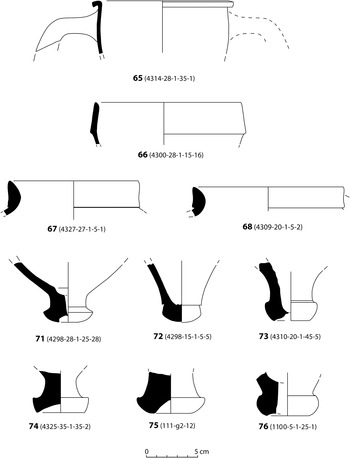
Unusual slight ledge rim. Maximum preserved dimension 10.9 cm; handle 3.9 × 2.1 cm; lip diameter c.14 cm. Orange-red clay with mixed inclusions. (Fig. 8 – without handle profile)
66 (4300-28-1-15-16) 707206E, 3974045N
Folded rim, 1.5 cm high, lip diameter c.16 cm. Medium-brown clay. (Fig. 8)
67 (4327-27-1-5-1) 707331E, 3974053N
Punic amphora rim. Near-fine salmon clay. Maximum preserved dimension 9.5 cm; lip height 2.4 cm; lip diameter 13 cm. (Fig. 8)
68 (4309-20-1-5-2) 707209E, 3973873N
Punic amphora rim. Red-brown clay with mixed inclusions. Maximum preserved dimension 6.5 cm. (Fig. 8)
69 (4298-17-1-15-4) 707210E, 3973948N
Rim of Mana type C1. Maximum preserved dimension 7.4 cm. 3rd or 2nd century bc; North African. Empereur and Hesnard Reference Empereur, Hesnard, Lévêque and Morel1987, 38–40. Compare Q46 and 47 from sites beyond the Kastro.
70 (4307-20-1-45-15) 707208E, 3973878N
Rim of Mana type C1. Maximum preserved dimension 4.7 cm. As 69.
71 (4298-28-1-25-28) 707224E, 3973953N
Button-foot, hollowed under; full body. Maximum preserved dimension 8.2 cm. Rather grey-brown clay with small mica. Perhaps Knidian. (Fig. 8)
72 (4298-15-1-5-5) 707238E, 3973941N
Small button-foot attached to long toe. Maximum preserved dimension 5.4 cm; foot diameter 3.7 cm, foot height 1.7 cm; buff-brown. Nikandros group? Cf. Lawall Reference Lawall2004b, 182. (Fig. 8)
73 (4310-20-1-45-5) 707278E, 3973879N
Hollow button-foot, base not preserved. Maximum preserved dimension 6.8 cm. Red-brown clay. Perhaps Cretan, from clay. (Fig. 8)
74 (4325-35-1-35-2) 707139E, 3974120N
Disc-foot with hollow under; solid stem. Maximum preserved dimension 5.7 cm. Foot diameter 5.4 cm. Near-fine medium-brown clay. Cretan? (Fig. 8)
75 (111-g2-12) 707104E, 3973362N
Deep hollow under; solid stem. Maximum preserved dimension 6.5 cm. Pink-buff clay with mixed inclusions. Found in association with kantharos fragments 18–20. (Fig. 8)
76 (1100-5-1-25-1) 707398E, 3974309N
Collared button base; low floor. Maximum preserved dimension 6 cm. Light-brown clay with small mica. (Fig. 8)
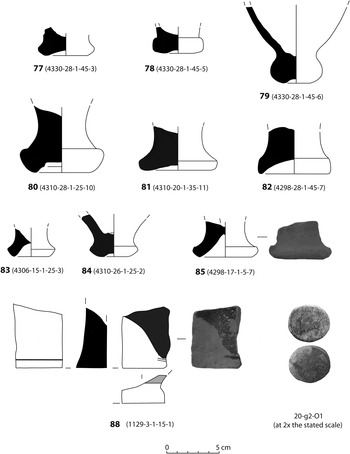
77 (4330-28-1-45-3) 707340E, 3973854N
Ring-foot; large shallow hollow under; solid stem part-preserved. Maximum preserved dimension 5.5 cm; foot diameter 5.6 cm. Near-fine, red-brown clay. Cretan? (Fig. 9)
78 (4330-28-1-45-5) 707340E, 3973851N
Short stem; shallow depression under. Maximum preserved dimension 5.6 cm; foot diameter 5.3 cm. Near-fine, red-brown clay. Cretan? (Fig. 9)
79 (4330-28-1-45-6) 707340E, 3973849N
Large button, shallow hollow under. Maximum preserved dimension 8.4 cm; foot diameter 5 cm. Orange-red clay, some white inclusions. (Fig. 9)
80 (4310-28-1-25-10) 707307E, 3973864N
Solid base with rounded ring-toe. Maximum preserved dimension 8.3 cm. Buff clay with orange core. (Fig. 9)
81 (4310-20-1-35-11) 707279E, 3973871N
Flaring stemmed foot. Maximum preserved dimension 5.8 cm. Light-beige clay with mica. (Fig. 9)
82 (4298-28-1-45-7) 707220E, 3973972N
Solid stem, hollow under; very worn. Maximum preserved dimension 4.9 cm; foot diameter 7 cm. Pink-brown clay, with small mica and other mixed inclusions. (Fig. 9)
83 (4306-15-1-25-3) 707106E, 3973986N
Flaring low disc-foot, broad hollow under. Maximum preserved dimension 5.7 cm; foot diameter 5 cm. Near-coarse clay. (Fig. 9)
84 (4310-26-1-25-2) 707293E, 3973867N
Flaring disc-foot. Maximum preserved dimension 7 cm; foot diameter 5 cm. Beige clay. (Fig. 9)
85 (4298-17-1-5-7) 707212E, 3973931N
Flaring stem, deep hollow under. Maximum preserved dimension 6.1 cm; foot diameter 6.2 cm. Near-fine pink-brown clay. (Fig. 9)
3.2.6 Tiles
About half the tile fragments, catalogued because they have an edge or some paint preserved, are of the broad Classical to Hellenistic period, some 30 in all, of which 80% are from the Kastro. Two-thirds of these have a thickened chamfered edge. Six preserve paint, of varying character, on the upper, concave surface; three have straight edges, probably the upper edge in two examples, but one has two adjacent straight edges. Only one seems to be a cover tile. The survey unit, where 63 was found, also yielded a tile, with chamfered edge, 1.9 cm thick (15073-58-1-45-1; maximum preserved dimension 9.4 cm); the coarse yellow clay could perhaps suggest a more recent date than Hellenistic, despite it being fairly thick. Two other tiles probably and one more certainly represent the period outside the Kastro:
86 (1062-6-1-35-2) 707127E, 3973304N
No edge preserved. Maximum preserved dimension 4.8 cm. 1.7 cm thick. Probable paint remains. A corner fragment from the same site is not closely datable.
87 (3207-19-1-45-1) 706259E, 3973051N
Straight edge. Maximum preserved dimension 8.5 cm. 1.4 cm thick. Near-fine orange-buff clay.
88 (1129-3-1-15-1) 707264E, 3973761N
Fragment of an eaves tile, preserving front edge only, which is thickened. Part of the black-glazed top surface is preserved, with a shallow groove near the front. The front surface is worn, but has a white band at the top. The underside is plain, with a light groove near the front. The find comes from the surface of the temple of Apollo, situated near the modern-day beach and at the foot of the Kastro. Lack of lateral curvature does not assist interpretation, but it may be noted that Petrocheilos (Reference Petrocheilos1987, 38) also noted the presence of a Corinthian tile fragment at this site. If indeed this temple had a Corinthian roof it would be of considerable interest in view of the use, albeit restrained, of Laconian tiles elsewhere on the island. It would point towards Crete as the architectural origin. (Fig. 9)
4. COMMENTARY
Material of the Greek period found during the survey is confined very largely to the area of the Kastro and its surrounding zone, in great contrast to the evidence from other periods (e.g. Bevan and Conolly 2009, 962). The vast bulk consists of pottery, notably transport amphorae, though the picture is rounded out, from survey and excavation, by some scatters of metalworking slag in several parts of the town, stone catapult balls, iron and bronze arrowheads, lead sling bullets and coins (Fig. 2; Tsaravopoulos Reference Tsaravopoulos2004–9). Two tiles in stone stand out when compared with the very few clay tiles found in the entire survey.
Chronologically, pottery from the survey of the Kastro area is broadly consistent with a start date in the late part of the fourth century bc and an end date in the first century bc, but there is nonetheless at least a hint of slightly earlier material on the island (whether heirlooms or the residue of light visitation), and the end date is also hard to define with absolute confidence, though it should certainly lie somewhere in the first century bc. In our publication of the Roman material (Quercia et al. Reference Quercia, Johnston, Bevan, Conolly and Tsaravopoulos2011) a small number of sherds, mainly of amphorae, could only be generically dated to a period between the second century bc and first century ad. From preserved literary sources, notably Plutarch, Life of Pompey 29, we would expect at least a drastic reduction in habitation after 69–67 bc as a result of Metellus' Cretan and ‘anti-piracy’ campaign, and there is nothing in the archaeological record which forbids such a conclusion. In considering the nature of naval activities conducted from the island, we should certainly heed de Souza's caution on overstating the extent of blatantly piratical activity (de Souza Reference Souza1999, 58–9), but the near lack of non-maritime resources to support the population of the island does make piracy a more plausible major source of livelihood for the inhabitants, or their masters.
With respect to the earliest datable material from the period under consideration here, it may be noted that it includes one probable heirloom and several pieces of Laconian ware which prima facie appear to be still of Classical date, though the repertoire of production in Laconia in the later fourth century is very poorly attested. There are fewer hints of Cretan presence in the pottery remains, though they do exist; here again, our current knowledge of Cretan amphora production for most of the Hellenistic period is very limited, and suggestions made in the catalogue above are based more on the clays than on typological aspects. Moving beyond the ceramic record, the probability that Phalasarna and Antikythera were fortified at roughly the same period is suggestive of a political link between the two, although it should be noted that the published material used to date Phalasarna is very limited and not immediately comparable to that from the Kastro (Hadjidaki and Iniotakis Reference Hadjidaki and Iniotakis2000, 55; the piece illustrated in their fig. 8 could well be later than the suggested construction date of c.335–30 bc; Sekunda Reference Sekunda2004–9). The results from survey on Kythera to the north suggest a drastic if not total reduction in Late Classical period occupation in the area surveyed, at roughly the time Antikythera is re-populated. From the ceramic records of the two islands it is difficult to discern the respective participation of Sparta and Cretan cities in opposing Macedonian pressure in the period concerned.
Line drawings of sherds 51–53, 58–59.

Line drawings of sherds 60–64.

Line drawings of sherds 65–68, 71–76.

Line drawings of sherds 77–85, 88 and coin.

To conclude, ASP has provided an interesting and often challenging selection of material which can or may date from the Hellenistic period. It will in due course be complemented by more material, some stratified, from the ongoing excavations on the Kastro site. The main picture that emerges is of a site handling a great deal of amphora traffic, concentrated at either end of the Hellenistic period, as far as the record of more closely datable material allows us to judge. A scatter of both storage and fine wares appears on other sites, but most are close (even in Antikytheran comparative terms!) to the Kastro, for example some amphorae, the tile 88 and a lamp (41) from the area to the west of the modern harbour, with 43 from further northwest. 22 is from east of the Kastro, not far from a known cemetery area. Nearly all finds probably of the period at any further distance from the Kastro are singletons, perhaps some 30 sherds, largely amphorae of types found at the Kastro; there are some black-glazed pieces, including 21 from the central part of the island and a body fragment of a small echinus bowl from the southernmost tip. There is a broad representation of ceramic shapes; the lack of large storage vessels need not surprise us in view of the obvious availability of amphorae. Only a small percentage of these jars can be given a firm provenance, but it is clear that they hail from many parts of the Mediterranean (though none obviously from the Pontus, though Heraclean jars are known from the Kastro excavation). How many may be reasonably local remains an unknown factor in view of the dearth of published material from western Crete; certainly the southern Peloponnese is an unlikely source. No double-barrelled Koan or pseudo-Koan handles were collected, which may be a chronological pointer to their production being largely of a date after 75–50 bc, though the excavations of Tsaravopoulos and colleagues on the Kastro have yielded some examples.
Can we discern piratical activity from this record? While the fort was almost certainly founded as some form of civic undertaking, best exemplified by the temple with its probable Cretan roof, it is difficult to discern the character of the activities of its inhabitants throughout the period in question. There is no fertile hinterland, such as led the Cilicians to copy others' amphora types in or after their piratical heyday (Rauh Reference Rauh2004). Brulé (1978, part iii, esp. 156–62) has demonstrated from literary and epigraphic evidence how outlaw maritime activity was a deep-rooted feature of Cretan society from perhaps as early as the fifth century, sometimes blurring the borderline between warfare and piracy. Our pottery assemblage cannot throw light on these matters, though the lack of clearly diagnostic material from the period c.250–150 bc does raise points of interest. The period coincides with the acme of Cretan privateering; we would expect occupation by Cretans, and some of the lead bullets found on the Kastro may date to the later third century (Tsaravopoulos Reference Tsaravopoulos2004–9, esp. 334–5). In contrast, the possible pottery lacuna does arguably fit reasonably well with an early to mid-third century date for a Rhodian assault on the island suggested by epigraphic evidence (Segre Reference Segre1932, 456–61; Martis et al. Reference Martis, Zoitopoulos, Tsaravopoulos, Luca and Sîrbu2006, 125–6), which may thus have led to a period of abandonment and our possible archaeological blank. We can merely surmise that Cretan groups did retain usage, principally as a refuge (conceivably later to be attacked by Philip V or Nabis, or indeed both), while epigraphic evidence shows their eagerness to dispose of booty, human or otherwise, as speedily as possible, leaving little archaeological trace. Certainly the lack of finds beyond the Kastro suggests a period of uncertainty and discontinuity.