


Non-technical Summary
A total of 12 ostracodes species belonging to 10 genera are reported for the first time from the lower Pliocene Takikawa Formation in Takikawa City, Hokkaido, northern Japan, and Woodeltia sorapuchiensis new genus new species is described. We hypothesize that Woodeltia sorapuchiensis is an important species for new genus Woodeltia, showing the group’s adaptation to cold environments and migration to the coast of North America.
Introduction
During the early to middle Miocene (ca. 16.5–13 Ma), the climate was warmer worldwide than at the present day, with a higher level of atmospheric greenhouse gases. The average temperature was approximately 6°C warmer than today, especially at the peak of the Mid-Miocene Climatic Optimum (MMCO) (ca. 16.9–14.7 Ma) (Zachos et al., Reference Zachos, Dickers and Zeebe2008). After the MMCO, the climate cooled and had become nearly the same as that of today by the early Pliocene (ca. 5 Ma) (Zachos et al., Reference Zachos, Dickers and Zeebe2008). Hokkaido, northern Japan, was located at a high latitude throughout the Neogene, and its molluscan fauna changed with the climatic fluctuations. Seven early Miocene to early Pliocene molluscan assemblages have been recognized in Hokkaido (Uozumi, Reference Uozumi1962; Amano, Reference Amano1986; Ogasawara, Reference Ogasawara1994; Suzuki, Reference Suzuki2000, Reference Suzuki2003). During the early to middle Miocene (ca. 17–15 Ma), the “Kunnui Fauna,” characterized by subtropical species, the “Takinoue Fauna,” of warm-temperate species, and the “Chikubetsu Fauna,” of cool-temperate species, flourished. In the middle Miocene (ca. 15–13 Ma), the “Kaigarabashi Fauna,” characterized by warm-temperate species, and the “Atsunai Fauna,” dominated by cool-temperate species, are known. The middle to late Miocene (ca. 13–8 Ma) saw the “Togeshita Fauna,” dominated by cool-temperate species, followed by the “Takikawa-Honbetsu Fauna,” of cool-temperate species, during the Plio–Pleistocene (ca. 6–2 Ma).
Ostracodes are small bivalved Crustacea (Oligostraca), and their abundant fossil record extends back to the Early Ordovician (Whatley et al., Reference Whatley, Siveter, Boomer and Benton1993). Ostracodes are useful for reconstructing paleoenvironments and paleobiogeography because they have no planktonic larval stage during their life and exhibit high endemism (Whatley et al., Reference Whatley, Siveter, Boomer and Benton1993). Japanese Plio–Pleistocene ostracodes have been reported chiefly from Honshu: Tohoku (Ishizaki, Reference Ishizaki1966; Ishizaki and Matoda, Reference Ishizaki, Matoda and Ikeya1985; Tabuki, Reference Tabuki1986; Irizuki, Reference Irizuki1989; Yamada et al., Reference Yamada, Irizuki and Tanaka2002; Yamada, Reference Yamada2003; Irizuki and Ishida, Reference Irizuki and Ishida2007; Tanaka, Reference Tanaka2009); Chubu (Cronin and Ikeya, Reference Cronin and Ikeya1987; Ikeya and Cronin, Reference Ikeya and Cronin1993; Ishizaki et al., Reference Ishizaki, Irizuki, Sasaki, McKenzie and Jones1993; Cronin et al., Reference Cronin, Kitamura, Ikeya, Watanabe and Kamiya1994; Ozawa, Reference Ozawa1996; Ozawa and Kamiya, Reference Ozawa and Kamiya2001, Reference Ozawa and Kamiya2005; Shoji et al., Reference Shoji, Irizuki, Yamada and Tanaka2002; Yamada, Reference Yamada2003; Yamada et al., Reference Yamada, Tanaka and Irizuki2005; Irizuki and Ishida, Reference Irizuki and Ishida2007; Irizuki et al., Reference Irizuki, Kusumoto, Ishida and Tanaka2007; Ozawa et al., Reference Ozawa, Nagamori and Tanabe2008; Goto et al., Reference Goto, Nasuno, Irizuki, Ohira and Hayashi2014); Shikoku (Ishizaki, Reference Ishizaki1983; Ishizaki and Tanimura, Reference Ishizaki and Tanimura1985; Iwatani et al., Reference Iwatani, Irizuki, Iwai, Kondo and Ikehara2009); Kyusyu (Iwatani and Irizuki, Reference Iwatani and Irizuki2008; Iwatani et al., Reference Iwatani, Irizuki and Goto2011; Yano and Iwatani, Reference Yano and Iwatani2023); and the Ryukyu Islands (Tanaka and Nomura, Reference Tanaka and Nomura2009) (Fig. 1). There have been three reports of ostracodes from Miocene deposits in Hokkaido (Mukai and Tanaka, Reference Mukai and Tanaka2023a, Reference Mukai and Tanakab, Reference Mukai and Tanaka2024), and only a few studies on Plio–Pleistocene ostracods from Hokkaido have been conducted (Cronin and Ikeya, Reference Cronin and Ikeya1987; Hayashi, Reference Hayashi, Hanai, Ikeya and Ishizaki1988; Hanai and Ikeya, Reference Hanai and Ikeya1991).
Paleogeographical map of the Japanese Islands during the Pliocene (ca. 5–2.6 Ma). 1, Takikawa Formation (this study; Mukai and Tanaka, Reference Mukai and Tanaka2024); 2, Daishaka Formation (Tabuki, Reference Tabuki1986); 3, Sasaoka Formation (Ishizaki and Matoda, Reference Ishizaki, Matoda and Ikeya1985; Irizuki, Reference Irizuki1989; Yamada et al., Reference Yamada, Irizuki and Tanaka2002; Yamada, Reference Yamada2003; Irizuki and Ishida, Reference Irizuki and Ishida2007); 4, Tatsunokuchi Formation (Ishizaki, Reference Ishizaki1966; Tanaka, Reference Tanaka2009); 5, Kuwae Formation (Shoji et al., Reference Shoji, Irizuki, Yamada and Tanaka2003; Yamada, Reference Yamada2003; Yamada et al., Reference Yamada, Tanaka and Irizuki2005; Irizuki and Ishida, Reference Irizuki and Ishida2007; Irizuki et al., Reference Irizuki, Kusumoto, Ishida and Tanaka2007); 6, Yabuta Formation (Cronin et al., Reference Cronin, Kitamura, Ikeya, Watanabe and Kamiya1994); 7, Ogikubo Formation (Ozawa et al., Reference Ozawa, Nagamori and Tanabe2008); 8, Omma Formation (Cronin and Ikeya, Reference Cronin and Ikeya1987; Ikeya and Cronin, Reference Ikeya and Cronin1993; Ishizaki et al., Reference Ishizaki, Irizuki, Sasaki, McKenzie and Jones1993; Ozawa, Reference Ozawa1996; Ozawa and Kamiya, Reference Ozawa and Kamiya2001, Reference Ozawa and Kamiya2005); 9, Ananai Formation (Ishizaki, Reference Ishizaki1983); 10, Sadowara Formation (Iwatani and Irizuki, Reference Iwatani and Irizuki2008); Takanabe Formation (Iwatani and Irizuki, Reference Iwatani and Irizuki2008; Iwatani et al., Reference Iwatani, Irizuki and Goto2011); Ikime Formation (Yano and Iwatani, Reference Yano and Iwatani2023); 11, Shimajiri Group (Tanaka and Nomura, Reference Tanaka and Nomura2009).

Here we document Pliocene ostracode assemblages from the Fukagawa Group, Takikawa Formation, Fukagawa Group, Ishikari Plain, Sorachi area, Hokkaido, for the first time and discuss the paleoenvironmental setting of this formation using the fossil ostracode assemblages. One new genus and species, Woodeltia sorapuchiensis n. gen. n. sp., is also described.
Geological setting
Late Miocene–Pliocene marine deposits are widely distributed in the northern part of the Ishikari Plain. Different names of groups and formations have been established in each area of the Ishikari Plain (Fig. 2). In the Ebishima area, the Shintotsukawa Group unconformably overlies the Paleogene Ishikari and Tappu groups. The Fukagawa Group conformably overlies the Shintotsukawa Group and is composed of the Horokaoshirarika Formation and the Ichinosawa Formation in ascending order (Watanabe and Yoshida, Reference Watanabe and Yoshida1995). In the Moseushi and Shintotsukawa areas are the Horokaoshirarika Formation, the Ichinosawa Formation, and the Bibaushi Formation in descending order (Kobayashi et al., Reference Kobayashi, Kakimi, Uemura and Hata1957, Reference Kobayashi, Hata, Yamaguchi and Kakimi1969; Hata et al., Reference Hata, Satoh, Kakimi, Yamaguchi and Kobayashi1963); in the Fukagawa area, the Chippubetsu Formation and the Ichian Formation occur (Wada et al., Reference Wada, Maeda, Igarashi, Tonosaki and Ohmura1985); and in the Takikawa and Akabira areas, the Takikawa Formation is subdivided into the Horokura Sandstone and Mudstone Member and the Samebuchi Conglomerate and Sandstone Member (Geological Survey Team Related to Takikawa Kaigyu, 1984).
Comparison of the stratigraphic divisions of the Cenozonic sedimentary layers in each region of the Sorachi district, central Hokkaido, applied by previous researchers (Ebishima: Watanabe and Yoshida, Reference Watanabe and Yoshida1995; Moseushi and Shintotsukawa: Kobayashi et al., Reference Kobayashi, Kakimi, Uemura and Hata1957, Reference Kobayashi, Hata, Yamaguchi and Kakimi1969; Fukagawa: Wada et al., Reference Wada, Maeda, Igarashi, Tonosaki and Ohmura1985; Takikawa and Akabira: Geological Survey Team Related to Takikawa Kaigyu, 1984). Paleo = Paleocene; U = Upper; gps = groups; G = group; F = formation; S and M M = sandstone and mudstone member; C and S M = conglomerate and sandstone member.

There have been many paleontological studies of the upper Miocene–Pliocene marine deposits of the northern parts of the Ishikari Plain, including of large vertebrate fossils (e.g., Furusawa and Kimura, Reference Furusawa and Kimura1982; Furusawa, Reference Furusawa1988; Furusawa and Numata Fossil Research Group, Reference Furusawa1990; Yamashita and Kimura, Reference Yamashita and Kimura1990; Furusawa et al., Reference Furusawa, Maeda, Yamashita, Sogayama, Igarashi and Kimura1993; Kohno et al., Reference Kohno, Tomida, Hasegawa and Furusawa1995; Ichishima and Kimura, Reference Ichishima and Kimura2000; Tanaka, Reference Tanaka2016) and molluscan fossils (e.g., Nomura, Reference Nomura1935; Uetoko and Chiba, Reference Uetoko and Chiba1937; Fujie and Uozumi, Reference Fujie and Uozumi1957; Azuma, Reference Azuma1960; Ohara, Reference Ohara1966; Kobayashi et al., Reference Kobayashi, Hata, Yamaguchi and Kakimi1969; Matsui, Reference Matsui1988; Nakajima and Majima, Reference Nakajima and Majima2000). In particular, the Takikawa–Honbetsu Fauna, which is characteristic of the Pliocene molluscan faunas, was named on the basis of the fossils from this study area and has contributed greatly to the paleontological elucidation of the molluscan faunas of the northernmost Pliocene strata of Japan.
Materials and methods
The Horokura Sandstone and Mudstone Member of the Takikawa Formation is distributed along the Sorachi River and its tributary in Sunagawa City, Takikawa City, and Akabira City (Fig. 3). This member is composed mainly of grayish-blue fine sandstone and thin gray mudstone. The lower part of the Horokura Sandstone and Mudstone Member consists of a thin conglomerate bed and contains many shells of Fortipecten takahashii Yokoyama, Reference Yokoyama1930. The Geological Survey Team Related to Takikiawa Kaigyu (1984) reported a fission-track age of ca. 4.1 ± 0.7 Ma for the Dammanosawa Tuff, which occurs in the lower part of the Horokura Sandstone and Mudstone Member. Furthermore, the Geological Survey Team Related to Takikawa Kaigyu (1984) recognized the Denticulopsis seminae var. D. kamtschatica Zone of Koizumi (Reference Koizumi1973a, Reference Koizumi, Creager, Scholl, Boyce, Echols and Fullamb, Reference Koizumi1975). Furusawa (Reference Furusawa1988) estimated that the Horokura Sandstone and Mudstone Member was deposited at ca. 3.7–2.5 Ma on the basis of the paleomagnetic and diatom stratigraphy for the Northwest Pacific established by Koizumi (Reference Koizumi1985). To sum up, the Horokura Sandstone and Mudstone Member was deposited during the early Pliocene (Zanclean, 4.8–3.7 Ma).
Distribution of Neogene (Miocene–Pleistocene) strata in Hokkaido (Suzuki, Reference Suzuki2000). (1) Location map of the USr and LSr sections in Takikawa City, Sorachi district, central Hokkaido. (2) Map of Hokkaido and a detailed map of the Sorachi district and distribution of the Horokura Sandstone and Mudstone Member (greenish yellow filled areas). (3) Map of the study area in Takikawa City, along the Sorachi River.

Ostracode samples were collected from the main stream of the Sorachi River, which is the type locality of the Horokura Sandstone and Mudstone Member of the Takikawa Formation. At the river, observable outcrop was exposed for a distance of approximately 1.9 km. In this study, we call the upstream side of the Sorachi River section the “USr section” and the downstream side the “LSr section.” The USr section corresponds to the lower part of the Horokura Sandstone and Mudstone Member defined by the Geological Survey Team Related to Takikawa Kaigyu (1984).
The USr section consists of alternating layers of well-sorted grayish-blue fine-grained sandstone, grayish-blue mudstone beds (~30 cm thick), and a massive granule stone layer with a matrix of poorly sorted gray fine-grained sandstone as a matrix (~30 cm thick). In the uppermost part of the section, cross-lamination is developed in the gray-blue fine-grained sandstone (~20 cm thick) (Fig. 4). Three dense layers of Fortipecten takahashii were observed in the massive grayish-blue fine-grained sandstone. In some of the layers, these shells were preserved as detached fragments. Therefore, these bivalves were concluded to have been allochthonously derived. In the granule stone beds, many individuals of Mya sp. were preserved upright relative to bedding, indicating that they were preserved in life position. Disarticulated shells of Acila nakajimai Otuka, Reference Otuka1934 were also found as allochthonous elements in the conglomerate bed. Two ostracode samples were collected from the fine conglomerate layer (sample USr-01) and the fine-grained sandstone layer with many shells of F. takahashii (sample USr-02).
Columnar sections of the USr sections of the lower and middle part of the Horokura Sandstone and Mudstone Member. Bold numbers on the right side of each column show the collecting horizons of the ostracode samples in this study. Sample USr-01 contains many well-preserved fossil ostracodes. The matrix is well-sorted sand, and the granules consist of abundant shell fragments. ms = muddy sand; f = fine; m = medium; c = coarse; g = granule; p = pebble.

The Lsr section is approximately 4 m thick and consists of well-sorted massive grayish-blue fine-grained sandstone, alternating layers of tuffaceous fine sandstone (~10 cm thick), and a fine-grained granule stone layer (~40 cm thick). In the uppermost part of the section, trough-type cross-lamination is developed in the grayish-blue fine-grained sandstone (~40 cm thick) (Fig. 5). Four condensed layers of F. takahashii were observed in the massive grayish-blue fine-grained sandstone. In some of the layers, bivalves were observed for which the shell had dissolved and that were not in life position. In two granule stone layers, shells of Mya sp. were found preserved upright relative to the bedding plane, indicating preservation in life position. Many shells of Acila nakajimai were found in the fine conglomerate bed, also preserved in life position. Six ostracode samples were collected: two samples from the condensed layers containing F. takahashii (LSr-01, 02); one sample from the medium sandstone (LSr-03); one sample from the conglomerate bed (LSr-04); one sample from the dense Turritella layers (LSr-06); and one sample from a calcareous nodule (LSr-05).
Columnar section of the LSr sections of the lower and middle part of the Horokura Sandstone and Mudstone Member. Bold numbers on the right side of each column show the collecting horizons of the ostracode samples in this study. Sample LSr-03 contains many well-preserved fossil ostracodes. The matrix is well-sorted sand, and the granules consist of abundant shell fragments. ms = muddy sand; f = fine; m = medium; c = coarse; g = granule; p = pebble.

All samples were dried in an oven for one week at 35°C. Then samples were softened by adding approximately 5% hydrogen peroxide to semi-consolidated fine sandstone and fine conglomerate samples, and sodium tetraphenylborate buffer (Yasuda et al., Reference Yasuda, Takayanagi and Hasegawa1985) to the consolidated calcareous nodule. The samples were then washed with tap water by connecting a sieve with an opening diameter of 125 μm under a sieve with an opening diameter of 1 mm. The residue was dried, and ostracodes were picked using a fine brush under a binocular stereomicroscope (Zeiss Stemi 2000-C). Ostracode specimens were counted as one individual if there was either an articulated carapace or a single valve. Selected specimens were imaged by using a scanning electron microscope (SEM; VHX-D500/510) at Kumamoto University. For observing internal structures, such as hingement, radial pore canals, and adductor muscle scars, a right valve was immersed in glycerin and photographed with different focal depths using a digital camera under a transmitted optical microscope (BX41, OLYMPUS, Japan). After that, the line drawing was created using Adobe Illustrator 2023 (Adobe Inc. USA).
Repository and institutional abbreviation
Types specimens examined in this study are deposited in the following institution: Institute of Geology and Palaeontology, Tohoku University, Sendai (IGPS).
Systematic paleontology
Class Ostracoda Latreille, Reference Latreille1802
Order Podocopida Müller, Reference Müller1894
Suborder Cytherocopina Baird, Reference Baird1850
Superfamily Cytheroidea Baird, Reference Baird1850
Family Trachyleberididae Sylvester-Bradley, Reference Sylvester-Bradley1948
Subfamily Trachyleberidinae Sylvester-Bradley, Reference Sylvester-Bradley1948
Genus Woodeltia new genus
Type species
Woodeltia sorapuchiensis n. sp., by original designation.
Other species
Woodeltia blizhnii (Brouwers, Reference Brouwers1993); Woodeltia japonica (Ishizaki, Reference Ishizaki1981); Woodeltia palmensis (Brouwers, Reference Brouwers1993); Woodeltia pointmanbiensis (Brouwers, Reference Brouwers1993); Woodeltia subreticulata (Irizuki and Yamada in Irizuki et al., Reference Irizuki, Yamada, Maruyama and Ito2004); Woodeltia sp. (Tabuki, Reference Tabuki1986).
Diagnosis
Carapace large and subquadrate in lateral view. Coarse reticulations surrounding shallow pits. Dorsal margin straight, ventral margin weakly concave at two-fifth from the anterior end, anterior margin obliquely rounded toward anteroventral direction, posterior margin nearly straight in dorsal half and convex in ventral half. Several rows of pits at anterior area. Fish-hook-shaped vestibulum developed along anterior inner margin.
Occurrence
Lower Miocene to Recent, West to North Pacific Ocean regions.
Etymology
In honor of Professor Adrian M. Wood (Coventry University) for his remarkable work on the genus Celtia.
Remarks
Woodeltia n. gen. is similar to Celtia Neale, Reference Neale1973 in its outline, patterns of reticulation, distribution pattern of muscle scars, and hinge. However, Woodeltia has an unclear carina (C2 in Wood, Reference Wood2005), C1 extends parallel from ventral to posterior, and the C3–6 carinae do not extend to the central area on the carapace. Woodeltia is similar to Acuticythereis Edwards, Reference Edwards1944 in its outline; however, it differs in that it has one V-shaped frontal muscle scar and four adductor muscle scars. This new genus differs from Doratocythere, proposed by McKenzie (Reference McKenzie1967), in having two anterior teeth on the anterior element of the hinge, a pivot-like dorsal scar, and more than 70 radial pore canals (Doratocythere has about 50). Woodeltia differs from Moosella, described by Hartmann (Reference Hartmann1964), in having many fossa on the outer shell surface, two anterior teeth of equal size (Moosella has four small teeth and one large tooth), and a well-developed vestibulum.
Woodeltia sorapuchiensis new species
SEM images of fossil ostracodes from the Takikawa Formation. (1) Baffinicythere robusticostata Irizuki, Reference Irizuki1996, male LV, from USr-01. (2) Bythoceratina sp. female LV, from USr-01. (3) Cytherois sp. male RV, from LSr-01. (4) Howeina sp. A. Schornikov and Zenina, Reference Schornikov and Zenina2014, male LV, from USr-01. (5) Howeina sp. A. Schornikov and Zenina, Reference Schornikov and Zenina2014, female, LV, from USr-01. (6) Kotoracythere tatsunokuchiensis Ishizaki, Reference Ishizaki1966, male RV, from LSr-03. (7) Neomonoceratina tsurugasakensis (Tabuki, Reference Tabuki1986), male LV, from USr-01. (8) Palmenella limicola (Norman, Reference Norman1867, female LV, from USr-01. (9) Semicytherura mainensis (Hazel and Valentine, Reference Hazel and Valentine1969), female RV, from USr-01. (10) Semicytherura? sp. female LV, from LSr-03. (11) Woodeltia sorapuchiensis Mukai and Tanaka n. gen. n. sp. male RV, from LSr-03. (12) Woodeltia sp. male RV, from USr-01. (13) Yezocythere hayashii Hanai and Ikeya, Reference Hanai and Ikeya1991, male LV, from LSr-03. LV = left valve; RV = right valve. Scale bars = 100 μm.

SEM images of Woodeltia sorapuchiensis Mukai and Tanaka n. gen. n. sp. (1, 2) Holotype, male, sample LSr-03 (IGPS–112957): (1) RV external view; (2) RV internal view. (3, 4) Paratype, female, sample LSr-03 (IGPS–112958): (3) RV external view; (4) RV internal view. (5–8) Allotype, female, sample LSr-03 (IGPS–112959): (5) RV internal view; (6) line drawing of internal view of 5; (7, 8) muscle scar and its line drawing. RV = right valve. (1–6) Scale bars = 100 μm; (7, 8) scale bars = 20 μm.

Holotype
Male carapace, IGPS–112957 from sample LSr-03 (length [L] = 989.2 μm; height (H) = 437.5 μm). Paratype, female carapace, IGPS–112958 from sample LSr-03 (L = 1021.0 μm; H = 527.3 μm). Allotype, male carapace, IGPS–112959 from sample LSr-03 (L = 836.6 μm; H = 360.0 μm).
Diagnosis
As for Woodeltia n. gen.
Occurrence
Sample LSr-03 of the Horokura Sandstone and Mudstone Member of the Takikawa Formation (Pliocene) at Sorachi River, Takikawa City, Hokkaido northern Japan (43°33′43"N, 141°56′57"E).
Description
Valve subquadrate in lateral view. Anterior margin evenly rounded anteroventrally, dorsal margin straight but slightly sinuate with two-fifths length from anterior end gradually sloping toward posterior. Ventral margin weakly sinuate and concaved at two-fifths from the anterior end. Coase reticulation with stout muri in dorsal, ventral, and central areas. Fossae well developed in posteroventral area and posterior area of eye tubercle, running parallel to ventral margin. Normal pore canals sparsely distributed throughout valve; fine pits well developed in anterior area. Eye tubercles inconspicuous. Prominent sexual dimorphism. In male, dorsal margin straight; in female, dorsal margin widely arched.
In internal view, marginal area developed on both anterior and posterior margins (Fig. 7.5, 7.6). List well developed. Fish-hook-shaped vestibulum developed along anterior inner margin (Fig. 7.5, 7.6). Marginal pore canals straight, sinuate, and divided, numbering 41 anteriorly, 20 ventrally, and 14 posteriorly (Fig. 7.6).
Hinge amphidont (Holamphidont) (Fig. 7.6) in right valve, anterior element with an oblong molar-shaped tooth with a small socket, median element with crenulated bar, posterior element with a smooth elliptical tooth. Four adductor muscle scars form a vertical row (Fig. 7.7, 7.8); dorsal and ventral scars elliptical in shape, second scar from dorsal side boomerang-shaped, third from dorsal side has fusiform shape. One Y-shaped frontal at front of adductor muscle scars, one elliptical mandibular scar in anteroventral area. One dorsal scar protruded like a pivot in anterodorsal area.
Etymology
From the Ainu language of Takikawa City, which is the type locality of this species.
Remarks
Woodeltia sorapuchiensis n. gen. n. sp. resembles Woodeltia palmensis (Brouwers, Reference Brouwers1993), reported from the Gulf of Alaska, in its lateral outline; however, it differs from the latter in lacking a carinal ridge on the anterior and posterior margins, the development of shallow fine pits in the anterior area, and the large number of marginal pore canals present from the central to the ventral parts of the anterior margin. The new species is similar to Woodeltia subreticulata (Irizuki and Yamada in Irizuki et al., Reference Irizuki, Yamada, Maruyama and Ito2004) reported from the lower Miocene Akeyo, Agi, and Toyama formations, Gifu Prefecture, central Japan, in its patterns of ornamentation and adductor muscle scars, but differs in possessing a wider duplicature, fine pits in the anterior area, an arched posterior margin, and a lower number of normal pore canals. The new species compares to Celtia quadridentata (Baird, Reference Baird1850) reported from northern Europe (Neale, Reference Neale1973) in its lateral outline but differs in its slender outline of the middle two adductor muscle scars, the pattern of ornament in the anterior area, the lack of anterior marginal spines, and the outline of the vestibulum.
Results
Fossil ostracode assemblages
A total of 12 species in 10 genera were identified from two samples (LSr-03 and USr-01) (Fig. 6; Table 1). In total, 135 individuals per 320 g of sample were recovered from sample USr-01, and 68 individuals per 320 g of sample were recovered from sample LSr-03 (Table 1). Two species, Yezocythere hayashii Hanai and Ikeya, Reference Hanai and Ikeya1991 (Fig. 6.17) and Woodeltia sorapuchiensis n. gen. n. sp. (Figs. 6.15, 7) were dominant in sample LSr-03. In sample USr-01, Y. hayashii Hanai and Ikeya, Reference Hanai and Ikeya1991 (Fig. 6.17) and Howeina sp. A. Schornikov and Zenina, Reference Schornikov and Zenina2014 (Fig. 6.4, 6.5) were dominant (Table 1).
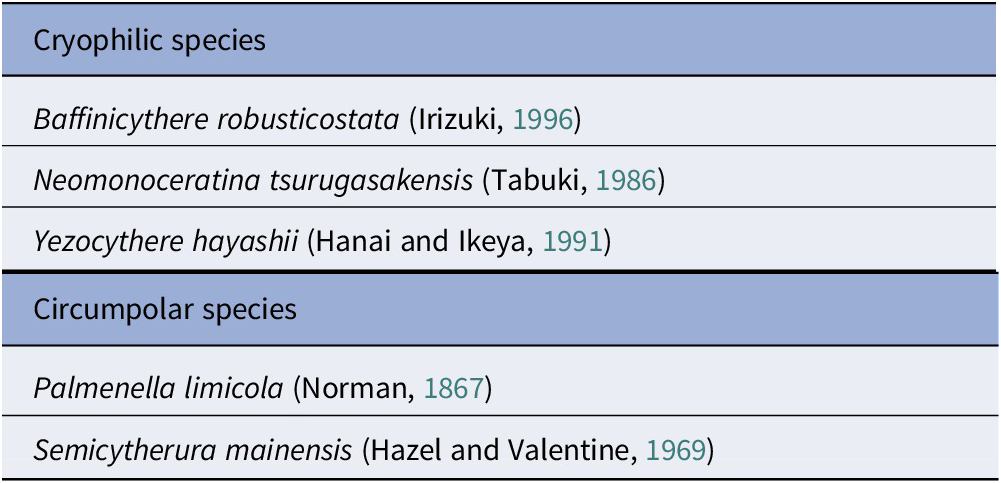
Circumpolar and cryophilic ostracode species from the Takikawa Formation (based on Cronin and Ikeya, Reference Cronin and Ikeya1987; Ikeya and Cronin, Reference Ikeya and Cronin1993; Cronin et al., Reference Cronin, Kitamura, Ikeya, Watanabe and Kamiya1994; Ozawa, Reference Ozawa1996, Reference Ozawa2003; Yamada et al., Reference Yamada, Irizuki and Tanaka2002; Ozawa and Kamiya, Reference Ozawa and Kamiya2005).

Species diversity and equitability
The Shannon–Weaver diversity index (H′) was calculated for two ostracode samples (LSr-03 and USr-01). H′ was calculated using the following formula (Shannon and Weaver, Reference Shannon and Weaver1949).
 $$ \mathrm{H}^{\prime }=-\sum \mathrm{piln}\mathrm{pi} $$
where pi = production frequency. The H′ values of both samples were low: 0.92 for USr-01 and 1.24 for LSr-03. The equitability index (E) of the assemblages of two samples was calculated by using the following formula described by Buzas and Gibson (Reference Buzas and Gibson1969):
 $$ \mathrm{E}={\mathrm{e}}^{\mathrm{H}\prime }/\mathrm{S} $$
where S = species number, and H′ = diversity index. The equitability indices were also relatively low: 0.28 for sample USr-01 and 0.57 for LSr-03.
Discussion
Characteristic species, paleo-water temperature, and paleo-salinity
The ostracode assemblage from the Horokura Sandstone and Mudstone Member contained the cryophilic species Baffinicythere robusticostata Irizuki Reference Irizuki1996, Neomonoceratina tsurugasakensis (Tabuki, Reference Tabuki1986), and Y. hayashii (Cronin and Ikeya, Reference Cronin and Ikeya1987; Ikeya and Cronin, Reference Ikeya and Cronin1993; Cronin et al., Reference Cronin, Kitamura, Ikeya, Watanabe and Kamiya1994; Ozawa, Reference Ozawa1996, Reference Ozawa2003; Yamada et al., Reference Yamada, Irizuki and Tanaka2002; Ozawa and Kamiya, Reference Ozawa and Kamiya2005) and the circumpolar species Semicytherura mainensis (Hazel and Valentine, Reference Hazel and Valentine1969) and Palmenella limicola (Norman, Reference Norman1867 (Cronin and Ikeya, Reference Cronin and Ikeya1987) (Table 2). No temperate species were recovered from the samples, indicating that the Horokura Sandstone and Mudstone Member of the Takikawa Formation was deposited under extremely cold water conditions without an influence of warm water masses.
List of fossil ostracode species from the Takikawa Formation.

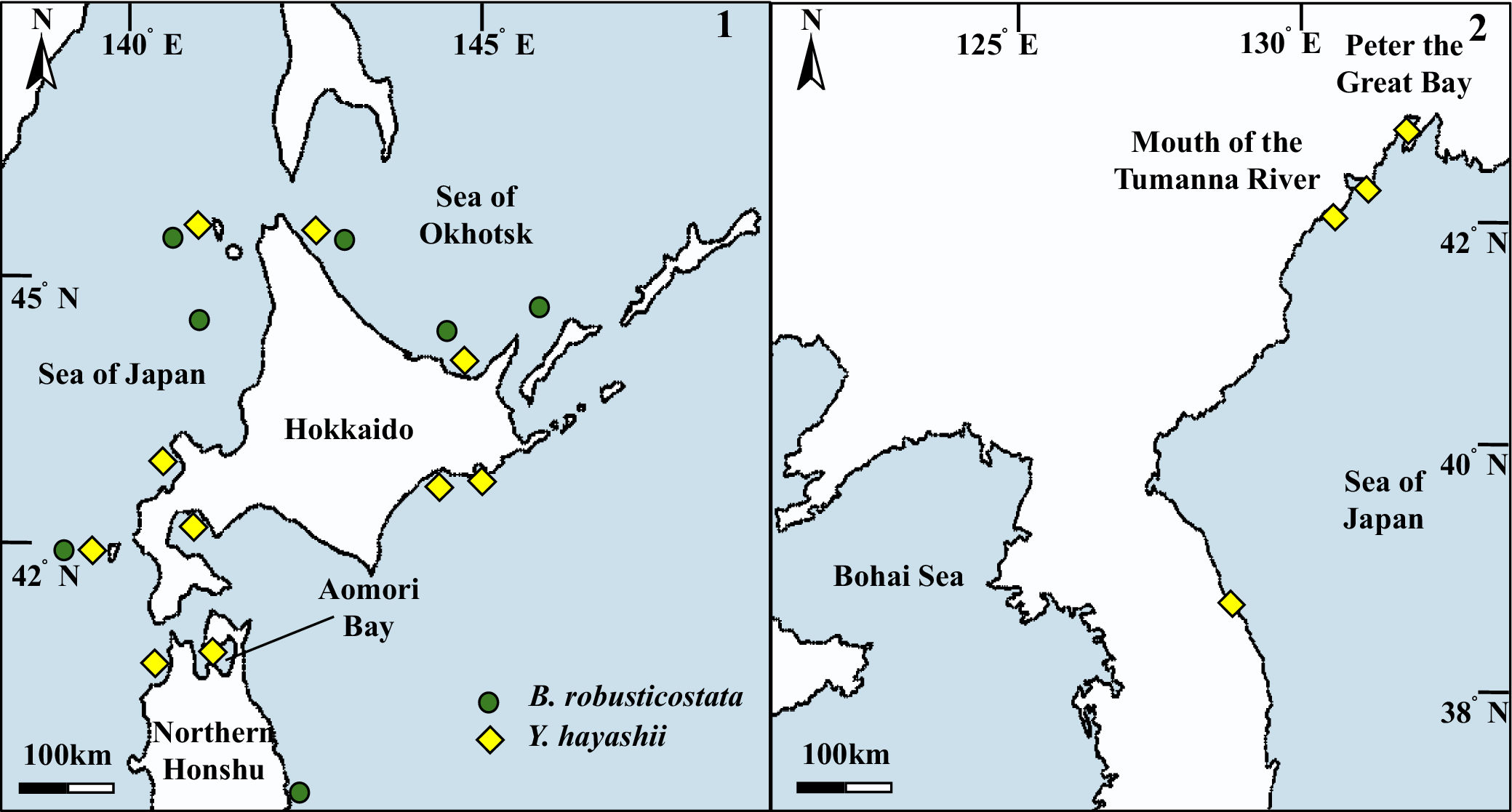
Cryophilic ostracode species have been reported around the Sea of Japan side of the Japanese Islands (Ishizaki, Reference Ishizaki1971; Schornikov and Sokolenko, Reference Schornikov and Sokolenko1999; Schornikov, Reference Schornikov and Martin2000; Schornikov and Chavtur, Reference Schornikov and Chavtur2001; Ozawa Reference Ozawa2003; Ozawa et al., Reference Ozawa, Kamiya, Itoh and Tsukawaki2004a; Ozawa and Kamiya, Reference Ozawa and Kamiya2005; Schornikov and Zenina, Reference Schornikov and Zenina2007, Reference Schornikov and Zenina2014: Zenina and Schornikov, Reference Zenina and Schornikov2008; Zenina, Reference Zenina2009) and around the Sea of Okhotsk (Ozawa, Reference Ozawa2004; Ozawa et al., Reference Ozawa, Kamiya, Kato and Tsukawaki2004b; Ozawa and Tsukawaki, Reference Ozawa and Tsukawaki2008). Extant specimens of Yezocythere hayashii have been reported from surface sediments of the Japanese Islands from Aomori Bay (Ishizaki, Reference Ishizaki1971; Irizuki et al., Reference Irizuki, Kobe, Ohkushi, Kawahata and Kimoto2015), the Sea of Japan side of northern Honshu and Hokkaido (Ikeya and Cronin, Reference Ikeya and Cronin1993; Ozawa. Reference Ozawa2003; Ozawa et al., Reference Ozawa, Kamiya, Itoh and Tsukawaki2004a, Reference Ozawa, Kamiya, Kato and Tsukawakib; Ozawa and Kamiya, Reference Ozawa and Kamiya2005), and the Sea of Okhotsk (Ozawa and Tsukawaki, Reference Ozawa and Tsukawaki2008) (Fig. 8.1, 8.2). The temperatures of the bottom water in which Y. hayashii occurs are 5–20°C (summer) and 5–10°C (winter) in Aomori Bay and 5–7°C (summer) and 0–5°C (winter) in Honshu, Hokkaido, and the Sea of Okhotsk. Yezocythere hayashii also occurs in Peter the Great Bay and at the mouth of the Tumanna River, where the temperature ranges 13–17°C in summer and 0–2°C in winter.
Distribution of extant cryophilic and the circumpolar species. (1, 2) Distribution of the cryophilic species Baffinicythere robusticostata. Daishakacythere posterocostata, Howeina camptocytheroidea, and Yezocythere hayashii around Japan, Russia, the Korean peninsula, and China.

B. robusticostata have been reported from around Hokkaido (Ikeya and Cronin, Reference Ikeya and Cronin1993; Ozawa et al., Reference Ozawa, Kamiya, Itoh and Tsukawaki2004a, Reference Ozawa, Kamiya, Kato and Tsukawakib; Ozawa and Tsukawaki, Reference Ozawa and Tsukawaki2008); and the distribution of B. robusticostata also extends to the Pacific side of northern Honshu, Japan (Fig. 8.1) (Ikeya et al., Reference Ikeya, Zhou, Sakamoto, Ishizaki and Saito1992). These three species have been reported from areas in which the annual bottom water temperature is ~0–10°C.
The circumpolar species Palmenella limicola has been reported from off Hokkaido (Ozawa, Reference Ozawa2004; Ozawa et al., Reference Ozawa, Kamiya, Kato and Tsukawaki2004b; Ozawa and Tsukawaki, Reference Ozawa and Tsukawaki2008), off Anadil (Gemery et al., Reference Gemery, Cronin, Cooper, Dowsett and Grebmeier2021), the Arctic Ocean (e.g., Gemery et al., Reference Gemery, Cronin, Briggs, Brouwers, Schornikov, Stepanova, Wood and Yasuhara2017), the Gulf of Maine (Hazel and Valentine, Reference Hazel and Valentine1969), and off the Scandinavian Peninsula (e.g., Tabuki, Reference Tabuki1986) (Fig. 9.1, 9.2). The present-day distribution of Semicytherura mainensis is limited around the northwest coast of North America (Fig. 9.2) (Gemery et al., Reference Gemery, Cronin, Briggs, Brouwers, Schornikov, Stepanova, Wood and Yasuhara2017, Reference Gemery, Cronin, Cooper, Dowsett and Grebmeier2021). These two circumpolar species have been reported from areas in which the annual bottom-water temperature is lower than 5°C.
(1, 2) Distribution of the circumpolar species Palmenella limicola and Semicytherura mainensis around Japan, the Northeastern Pacific, and the Arctic Sea.

The cryophilic species Y. hayashii has been designated as Japan Sea Central Assemblage (JSCA) species (Ozawa Reference Ozawa2003, Reference Ozawa2004; and Ozawa and Kamiya, Reference Ozawa and Kamiya2005). The circumpolar species P. limicola has been designated as a Japan Sea Intermediate-Proper Assemblage (JSI-PA) species (Ozawa Reference Ozawa2003, Reference Ozawa2004; Ozawa and Tsukawaki, Reference Ozawa and Tsukawaki2008). JSCA species and JSI-PA species have been reported from areas with annual bottom temperatures of ~3–15°C and ~0–10°C, respectively; the salinities for both assemblages are approximately 34 PSU.
To summarize, the water mass during deposition of the Horokura Sandstone and Mudstone Member was estimated to have had a water temperature of ~3–10°C and a salinity of 34 PSU.
Paleobathymetry
According to Irizuki (Reference Irizuki1989) and Irizuki and Matsubara (Reference Irizuki and Matsubara1994), the species diversity and equitability indices of ostracode assemblages are affected by water depth and substrates. For example, species diversity and equitability values are low in the mud bottom of the inner bay and sub-bathyal zone but tend to be high in coastal areas and shallow seas with a depth of approximately 100 m. In this study, we compare the Horokura Sandstone and Mudstone Member with similar sedimentary environments in northern Japan from after the late Miocene (Fig. 10; for details, see Mukai and Tanaka, Reference Mukai and Tanaka2024).
Diagram showing the positions of recent (1, 2) and ostracode assemblages with species diversity, equitability, and number of species. (1) Large ellipses show samples from recent ostracode assemblages. a, Nakanoumi Estuary (Ishizaki, Reference Ishizaki1969); b, inner section of Uranouchi Bay (Ishizaki, Reference Ishizaki1968); c, deeper section in Aomori Bay (Ishizaki, Reference Ishizaki1971); d, outer section of Uranouchi Bay (Ishizaki, Reference Ishizaki1968); e, shallow section in Aomori Bay (Ishizaki, Reference Ishizaki1971); f, the East China Sea (Ishizaki, Reference Ishizaki1981); IO, inner section of Osaka Bay; MO, mouth of Osaka Bay (Yasuhara and Irizuki, Reference Yasuhara and Irizuki2001). (2) Large ellipses show samples from recent ostracode assemblages. a, inner bay, (0–40 m); b, outer bay (deeper than 50 m); c, central inner bay (10–50 m); d1, estuary (0–10 m); d2, outer bay (50–100 m) in Sendai Bay (Ikeya and Itoh, Reference Ikeya and Itoh1991). OI, outer section of Otsuchi Bay; OII, central section of Otsuchi Bay; OIII, inner section of Otsuchi Bay (Ikeya et al., Reference Ikeya, Zhou, Sakamoto, Ishizaki and Saito1992).

The diversity and equitability indices of the fossil assemblages from the Horokura Sandstone and Mudstone Member tend to show similar values to those of three recent ostracode assemblages from the inner section of Osaka Bay with a water depth of less than 10 m (IO in Fig. 10.1); the innermost part of the Otsuchi Bay, with a water depth of less than 30 m (OIII in Fig. 10.2); and the central inner bay of Sendai Bay (water depth 10–50 m) (c in Fig. 10.2).
The two assemblages from the Horokura Sandstone and Mudstone Member plotted in the same areas as the assemblages of the Middle Pleistocene Paleo-Tokyo Bay (PTI in Fig. 11.1) and the Noma Formation (NO in Fig. 11.2). All comparable Recent and fossil ostracode assemblages were (possibly) recovered from shallow water with a depth of less than 50 m and were weakly affected by water masses from the open sea.
Diagram showing the positions of Neogene ostracode assemblages with species diversity, equitability, and number of species. (1) Large ellipses show samples from Pleistocene ostracode assemblages. HI, HII, and HIII, Hamada Formation (Pleistocene) (Ozawa and Domitsu, Reference Ozawa and Domitsu2010); PTI and PTII, Paleo-Tokyo Bay (Irizuki et al., Reference Irizuki, Naya, Yamaguchi and Mizuno2011); KI, KII, and KIII, Kazusa Group (Ozawa and Ishii, Reference Ozawa and Ishii2014). (2) Large ellipses show samples from Pliocene–Pleistocene ostracode assemblages. MI, MII, Mita Formation (Goto et al., Reference Goto, Nasuno, Irizuki, Ohira and Hayashi2014); OM, Omma Formation (Ozawa, Reference Ozawa1996); SI, SII, Sasaoka Formation (Irizuki, Reference Irizuki1989); NO, Noma Formation (Irizuki and Hosoyama, Reference Irizuki and Hosoyama2000).

Yezocythere hayashii were designated Japan open sea–inner bay species by Ozawa et al. (Reference Ozawa, Kamiya, Itoh and Tsukawaki2004a), consistent with the depositional environment inferred from species diversity and equitability indices. Moreover, the mode of preservation of Mya bivalves indicated that those fossils were autochthonous. Mya is widely distributed in sandy-bottomed bays at depths shallower than 20–30 m (Matsui, Reference Matsui1985, Reference Matsui1990; Suzuki, Reference Suzuki, Kawamura, Oka and Kondo1997; Higo et al., Reference Higo, Callomon and Goto1999), which does not contradict the paleobathymetric estimation based on the diversity and equitability of the ostracode assemblages.
Significance of new genus and species
Brouwers (Reference Brouwers1993) and Wood (Reference Wood2005) described how the northern Pacific Celtia species group shared a morphology, valve shape and size, muscle-scar pattern, and ornamentation. Wood (Reference Wood2005) recognized the difference between Celtia from Europe and “Celtia” from the Pacific and stated that these were different lineages. In this study, we propose the new genus “Woodeltia” for “Celtia” from the Pacific on the basis of its sub-elliptical lateral outline, surface ornamentation, V-shaped frontal muscle scar, and amphidont type hinge (see Systematic paleontology). Wood (Reference Wood2005) reviewed the genus Celtia and recognized two subgenera, Celtia (Celtia) and Celtia (Amabilicythere). Woodeltia sorapuchiensis n. sp. n. gen. belongs to the “Celtia” blizhnii species group tentatively defined by Wood (Reference Wood2005) because the carina (C2 in Wood, Reference Wood2005) at the anterior margin is unclear, and C1, which runs parallel to the ventral margin from the posterior margin, and the carinae (C3–C6) that branch off from C1 and extend to the central area are not extensive. Wood (Reference Wood2005) listed six “Celtia” species that have been reported from Japan and the northeast Pacific and were not included in Celtia sensu stricto: “Celtia” blizhnii Brouwers, Reference Brouwers1993; “Celtia” japonica Ishizaki Reference Ishizaki1981; “Celtia” palmensis Brouwers, Reference Brouwers1993; “Celtia” ponitmanbiensis Brouwers, Reference Brouwers1993; “Celtia” subreticulata (Irizuki and Yamada in Irizuki et al., Reference Irizuki, Yamada, Maruyama and Ito2004), and “Celtia” sp. of Tabuki (Reference Tabuki1986) (Fig. 12). We attribute these species to the new genus Woodeltia. On the basis of the morphological similarity, Wood (Reference Wood2005) suggested that Celtia evolved from Olimfalunia during the middle Miocene in the central Tethys Sea. By contrast, Woodeltia flourished around the northern Pacific. The oldest fossil record of Woodeltia is W. subreticulata (Irizuki and Yamada in Irizuki et al., (Reference Irizuki, Yamada, Maruyama and Ito2004) from the lower Miocene Akeyo and Toyama formations and from the lower Miocene Arakida Formation (Yamada et al., Reference Yamada, Irizuki and Nakajima2001), Central Japan. The second-oldest fossil record of the genus is Woodeltia sp. of Tabuki (Reference Tabuki1986) from the Plio–Pleistocene of Japan. Woodeltia sorapuchiensis n. gen. n. sp. from the early Pliocene (Zanclian; 4.8–3.7 Ma) Takikawa Formation fills this gap in the fossil record of Woodeltia. We estimate that Woodeltia appeared in Central Japan during the early Miocene, migrated northward to Hokkaido at least until the early Pliocene, and finally expanded to the northern Pacific region.
Recent and fossil species of Woodeltia n. gen. reported from Japan and around the Pacific Ocean. (1) Woodeltia blizhnii (Brouwers, Reference Brouwers1993). (2) W. japonica (Ishizaki, Reference Ishizaki1971). (3) W. palmensis (Brouwers, Reference Brouwers1993). (4) W. pointmanbiensis (Brouwers, Reference Brouwers1993). (5) W. subreticulata (Irizuki and Yamada in Irizuki et al., Reference Irizuki, Yamada, Maruyama and Ito2004). (6) Woodeltia. sp. (Tabuki, Reference Tabuki1986). (7) W. sorapuchiensis Mukai and Tanaka n. gen. n. sp.

Irizuki et al. (Reference Irizuki, Yamada, Maruyama and Ito2004) described Woodeltia subreticulata (Irizuki and Yamada, Reference Irizuki, Yamada, Maruyama and Ito2004) from Toyama, Akeyo, and Agi formations (ca. 18 Ma, M1b), Association CE (Irizuki et al., Reference Irizuki, Yamada, Maruyama and Ito2004). This association included mild temperate ostracode species; therefore, they seem to have lived in relatively cooler environments. M1b is cooler than the MMCO but warmer than present throughout the early to middle Miocene. Consequently, we estimated W. subreticulata distributed in a temperate environment. During the early Miocene, W. subreticulata inhabited the area around Japan under a temperate environment, and some Woodeltia expanded north of Japan. Until that, the area around Hokkaido had experienced a warm environment (Uozumi and Fujie, Reference Uozumi and Fujie1966), but after the MMCO, the environment became colder. Some Woodeltia species moved northward and adapted to cooler environments. During the early Pliocene, W. sorapuchiensis n. sp. appeared around Hokkaido, indicating adaptation to a cold environment at that time. From the Pliocene to the Pleistocene, Woodeltia migrated northeastward, possibly via the coast of the Bering Sea land bridge that had formed during late Plio–Pleistocene (Marinkovich, Reference Marinkovich2000; Gladenkov et al., Reference Gladenkov, Oleinik, Marincovich and Barinov2002; Gladenkov and Gladenkov, Reference Gladenkov and Gladenkov2004), finally reaching North America (Fig. 13).
Possible migration route of Woodeltia after the early Miocene. Woodeltia occurred in Japan in the early Miocene, migrated northward to Hokkaido in the Pliocene, and expanded to North America in the Pleistocene. Mio = Miocene; Plio = Pliocene; Pleist = Pleistocene.

Conclusions
A total of 12 species of ostracodes, including one new species, are identified from the early Pliocene Horokura Sandstone and Mudstone Member of the Takikawa Formation. This study is the first report of Pliocene ostracodes from Hokkaido, northern Japan. Abundant cryophilic and circumpolar species suggest the depositional environment was located in cold-water conditions. The species diversity index and equitability index of the ostracode assemblages are similar to those of the Recent ostracode assemblages of innermost Otsuchi Bay and Osaka Bay (water depth 10–30 m). One new genus and species, Woodeltia sorapuchiensis n. gen. n. sp., is described. The new species of Woodeltia, W. sorapuchiensis n. gen. n. sp. from the Takikawa Formation, Hokkaido, is an important species when considering the migration of the genus.
Acknowledgments
We are grateful to T. Komatsu and H. Matsuda (Faculty of Advanced Science and Technology, Kumamoto University) for their critical advice and discussion. We are grateful to reviewers for their helpful reviews. We thank the editorial staff of Journal of Paleontology. We thank L. Muir from Edanz (https://jp.edanz.com/ac) for the English language editing of a draft of this manuscript.
Competing interests
The authors declare none.