Genetic technology is advancing rapidly. For example, it is now possible to accurately and reliably edit DNA using techniques such as CRISPR-Cas9 (Oude Blenke et al., Reference Oude Blenke, Evers, Mastrobattista and van der Oost2016). Such advances are likely to have substantial implications for human society. Some researchers have even suggested that in the near future, we will be able to eradicate major disorders and diseases, such as Huntington’s disease (Feng et al., Reference Feng, Liu and Kawauchi2018).
However, these technological advances can only be implemented if humans are willing to see them applied. Many promising advances—such as genetically modified (GM) crops and nuclear energy—have not been as widely implemented as some would have hoped because of psychological (rather than technological) factors (Scott et al., Reference Scott, Inbar and Rozin2016). In other words, psychology is often the bottleneck through which new technology is adopted or discarded. This observation highlights the need to better understand the psychological concerns toward emerging gene editing technology to predict how it will be received by the public and incorporated into society.
Perhaps unsurprisingly, surveys have shown that people differ quite notably in their perceptions of and attitudes toward gene editing (Calnan et al., Reference Calnan, Montaner and Horne2005; Hendriks et al., Reference Hendriks, Giesbertz, Bredenoord and Repping2018; McCaughey et al., Reference McCaughey, Budden, Sanfilippo, Gooden, Fan, Fenwick, Rees, MacGregor, Si, Chen, Liang, Pébay, Baldwin and Hewitt2019; Xiang et al., Reference Xiang, Xiao, Gou, Li, Zhang, Wang and Feng2015). For example, recent work found that 59% of respondents agreed with “genetic editing of cells in children or adults to cure a life threatening disease,” with 31% responding with “neutral” or “don’t know” and 10% reporting that they disagreed with its use. The variability was even more pronounced on the issue of “genetic editing of cells in embryos to alter any non-disease characteristic”: here, 27% reported agreeing with its use, 30% responded “neutral” or “don’t know,” and 43% reported that they disagreed with its use (McCaughey et al., Reference McCaughey, Sanfilippo, Gooden, Budden, Fan, Fenwick, Rees, MacGregor, Si, Chen, Liang, Baldwin, Pébay and Hewitt2016).
Variability in response to gene editing issues aside, little research to date has sought to characterize the psychological factors that might account for these differences in opinion. The current study sought to address this gap in the literature with a special focus on pathogen disgust sensitivity.
The case for pathogen disgust sensitivity
Why pathogen disgust sensitivity? The argument builds on the theory that disgust sensitivity stems from the adaptive need for humans (and many other species) to avoid contact with toxins and pathogens (Schaller & Park, Reference Schaller and Park2011). Work in this vein has established that pathogen disgust sensitivity is both relatively automatic and inflexible—for example, knowledge that a dog-poo-shaped chocolate is harmless does not make the morsel readily edible (Rozin et al., Reference Rozin, Millman and Nemeroff1986). Moreover, there appears to be a sensitivity bias such that a disgust response is commonly deployed even without direct exposure to a disease vector. For example, and of special relevance to the current study, disgust responses have been shown to emerge following exposure to entities that are seen as unnatural, such as cultured meat (Siegrist et al., Reference Siegrist, Sütterlin and Hartmann2018), GM animals (Pivetti, Reference Pivetti2007), or trypophobia-inducing objects (Imaizumi et al., Reference Imaizumi, Furuno, Hibino and Koyama2016), rather than exclusively pathogen threats. The rationale is that pathogen disgust sensitivity favors false alarms because the implications of making a false positive are markedly less than the implications of a false negative with regard to maintaining bodily integrity.
Several recent studies have bolstered this perspective in closely related domains. For example, individuals who score higher on pathogen disgust sensitivity have been reported to show lower levels of support for GM foods (Clifford & Wendell, Reference Clifford and Wendell2016; Scott et al., Reference Scott, Inbar and Rozin2016). Another study observed that individuals who scored higher on the purity measure from the Moral Foundation Questionnaire (which contains a number of items assessing disgust proneness) were less likely to show support for stem cell research (Koleva et al., Reference Koleva, Graham, Iyer, Ditto and Haidt2012). And GM crops are routinely referred to as “Frankenstein food,” illustrating that concerns over unnatural manipulation and mutation in this domain are omnipresent in the public’s mind (Tenbült et al., Reference Tenbült, de Vries, Dreezens and Martijn2005). This observation also draws parallels with the use of the term “designer baby”—indicating something artificial and unnatural, which, as suggested previously, has been shown to elicit disgust responses (Scott et al., Reference Scott, Inbar and Rozin2016). In sum, then, there is good reason to hypothesize a link between higher levels of pathogen disgust sensitivity and opposition to the use of gene editing.
Additional psychological factors?
While there is a clear case for expecting pathogen disgust sensitivity to (at least partially) underpin attitudes toward gene editing, it is also clear that a variety of other variables likely play a role. These include resistance to change, on the grounds that gene editing represents a fundamental shift in how we practice medicine (among other things) and so is likely to be opposed by those who are sensitive to change; trait neuroticism, on the grounds that those who are more prone to negative affect may be especially likely to anticipate deleterious, unanticipated consequences of gene editing; risk taking, on the grounds that those who can tolerate or value risky environments and decisions will be more inclined to support gene editing despite the potential for it doing harm; and trust in scientists, on the grounds that gene editing at its core represents a scientific breakthrough, and thus perceptions concerning the motives and trustworthiness of scientists will be a relevant factor in determining support for or opposition to the technology.
Additionally, age, educational attainment, knowledge of gene editing, and sex have been shown to predict gene editing attitudes in previous studies (Calnan et al., Reference Calnan, Montaner and Horne2005; Gaskell et al., Reference Gaskell, Bard, Allansdottir, da Cunha, Eduard, Hampel, Hildt, Hofmaier, Kronberger, Laursen, Meijknecht, Nordal, Quintanilha, Revuelta, Saladié, Sándor, Santos, Seyringer, Singh and Zwart2017; McCaughey et al., Reference McCaughey, Budden, Sanfilippo, Gooden, Fan, Fenwick, Rees, MacGregor, Si, Chen, Liang, Pébay, Baldwin and Hewitt2019; Weisberg et al., Reference Weisberg, Badgio and Chatterjee2017) and so warrant inclusion here both as predictors in their own right, as well as to rule out potential confounding of our hypothesized psychological links to gene editing attitudes (e.g., women are more disgust sensitive [Tybur et al., Reference Tybur, Bryan, Lieberman, Caldwell Hooper and Merriman2011] and more likely to oppose gene editing [Weisberg et al., Reference Weisberg, Badgio and Chatterjee2017]).
As well as being candidate predictors, a number of variables are plausible mediators of the putative link between pathogen disgust sensitivity and gene editing attitudes. In particular, higher levels of religiosity and political conservatism have been reported to be positively associated with pathogen disgust sensitivity (Inbar et al., Reference Inbar, Pizarro and Bloom2009; Terrizzi et al., Reference Terrizzi, Shook and McDaniel2013) and opposition to gene editing (Critchley et al., Reference Critchley, Nicol, Bruce, Walshe, Treleaven and Tuch2019; Weisberg et al., Reference Weisberg, Badgio and Chatterjee2017). We posit religiosity and political conservatism as mediators in line with work suggesting that ostensibly nonpolitical individual differences constructs, such as pathogen disgust sensitivity, are commonly argued to be antecedent to politics and religion (Lewis, Reference Lewis2018; Roets & Van Hiel, Reference Roets and Van Hiel2011; Wink et al., Reference Wink, Ciciolla, Dillon and Tracy2007). In turn, one’s political and religious views are commonly argued to give rise to specific policy positions (Jost et al., Reference Jost, Federico and Napier2009).
The current study
With the above in mind, we sought to examine a number of hypotheses:
-
H1: Pathogen disgust sensitivity will be positively associated with opposition to gene editing.
-
H2: Pathogen disgust sensitivity will be positively associated with opposition to the use of broader biotechnology—that is, vaccinations, GM foods, and cultured meat.
-
H3: Opposition to gene editing will be positively associated with political conservatism, religiosity, neuroticism, and resistance to change, as well as negatively associated with subjective knowledge of gene editing, objective knowledge of gene editing, risk taking, and trust in scientists.
-
H4: The positive association between pathogen disgust sensitivity and opposition to gene editing will be independent of age, sex, educational attainment, resistance to change, subjective knowledge of gene editing, objective knowledge of gene editing, risk taking, trust in scientists, and neuroticism.
-
H5: The association between pathogen disgust sensitivity and opposition to gene editing will be mediated by (i) political conservatism and (ii) religiosity.
-
H6: The positive association between pathogen disgust sensitivity and opposition to vaccinations, GM foods, and cultured meat will be independent of age, sex, educational attainment, resistance to change, subjective knowledge of gene editing, objective knowledge of gene editing, risk taking, trust in scientists, and neuroticism.
-
H7: The association between pathogen disgust sensitivity and opposition to vaccinations, GM foods, and cultured meat will be mediated by (i) political conservatism and (ii) religiosity.
Methods
Participants
The study sample consisted of 347 participants (96 male, 249 female, 2 other). Their mean age was 36.88 years (SD = 12.87). Participants were recruited from Prolific Academic, a web-based recruitment service where members of the public can complete surveys and experiments for payment. Prolific Academic provides high-quality data on a far broader subset of the population than would be represented in an undergraduate or opportunity sample. Participants were recruited from residents of the United Kingdom and were a minimum of 18 years old.
Our sample size was guided by a set of power analyses (using G*Power3) considering the required N to detect a modest effect in our core tests—that is, the correlational and linear regression analyses (see Steps 2 and 3). The median effect size in the social/personality literature (Gignac & Szodorai, Reference Gignac and Szodorai2016), as well as typical effect size in recent work on pathogen disgust sensitivity and political conservatism (Tybur et al., 2015), is approximately r = .15. To achieve 80% power to detect an r of ≥.15 and an increase in R 2 of ≥ .02 at alpha of .05 (two-tailed) indicated a need for N of 346 and 344, respectively. With this mind, we sought to collect at least 346 usable participant data sets.
Exclusion criteria. Participants who failed to fully complete each section of the questionnaire, failed the attention check, or showed evidence of spurious responding (i.e., completing the survey in a time less than 2.5 standard deviations of the mean completion time) were excluded from the analyses. Recruitment was planned to stop once 346 participants met these criteria.Footnote 1
Measures
Gene editing attitudes. Participants were provided with a brief introduction to gene editing technology (modified from recent related work in the field; see Weisberg et al., Reference Weisberg, Badgio and Chatterjee2017): “Recently, scientists have figured out a way to edit genes. This technology means they might be able to correct disease-causing genes. It may also mean they are able to add genes that are protective against future health problems. It also means they may be able to improve genes to enhance normal traits.”
Participants were then asked to indicate their view on 15 items (see the Appendix) concerning gene editing spanning the treatment of mental and physical illness and the enhancement of mental and physical capabilities and lifespan in human adults and embryos and in nonhuman animals. Example items included, “How likely would you be to support the use of gene editing in adults for the treatment of a mental disorder like depression or anxiety?”; “How likely would you be to support the use of gene editing in embryos for the following enhancements? [physical strength].” These items used a 4-point scale, with responses options being 1, “highly unlikely”; 2, “unlikely”; 3, “likely”; and 4, “highly likely.” Scale scores were constructed following the exploratory factor analyses, as detailed more fully later, with higher scores indicating greater opposition to gene editing.
Biotechnology attitudes. A brief description of cultured meats, GM crops (derived from Wilks & Phillips, Reference Wilks and Phillips2017), and vaccinations was given, and then participants were asked to report on whether they eat meat or are vegetarian/vegan, followed by five questions concerning the use of cultured meat, GM crops, and vaccinations: “How willing would you be to eat cultured meat compared to soy substitutes?”; “How willing would you be to eat cultured meat compared to traditionally farmed meat?”; “How willing would you be to eat genetically modified crops compared to traditionally farmed crops?”; “How likely would you be to have a vaccination?”; “How likely would you be to have your child vaccinated?” These items used a 4-point scale, with responses options being 1, “highly unlikely”; 2, “unlikely”; 3, “likely”; 4, “highly likely.” The two cultured meat items and the two vaccination items were combined into mean scores. Responses were reverse-coded such that higher scores reflected higher levels of opposition to the respective biotechnology.
Three-domain disgust scale (TDDS) (Tybur et al., Reference Tybur, Lieberman and Griskevicius2009). This 21-item measure assesses disgust sensitivity in three domains—pathogen disgust, sexual disgust, and moral disgust. For the purposes of the current study, only the pathogen disgust items were included. Responses to items ranged from 0, “not at all disgusting” to 6, “extremely disgusting.” Scale scores were constructed as the sum of the item responses. Higher scores indicated higher levels of pathogen disgust sensitivity.
Disgust scale-revised. To control for the possibility of response sets that may occur by using pathogen disgust sensitivity alone (as the TDDS is scored in one direction), participants were also measured on core disgust, which is a subscale of the broader Disgust Scale-Revised (Olatunji et al., Reference Olatunji, Williams, Tolin, Abramowitz, Sawchuk, Lohr and Elwood2007). Core disgust is a 12-item measure selected because of its high correlation in previous work with the pathogen disgust sensitivity measure in the TDDS. Note that because of a coding error, only the first six of the core disgust items were included in this survey (the six true/false items in the scale), alongside six items from the other two subscales (these items were not analyzed here and so are not discussed further). Scale scores were constructed as the sum of the item responses. Reverse scoring was used so that higher scores indicated higher levels of core disgust sensitivity.
Neuroticism. Neuroticism was measured using the 12-item scale from the Big Five Inventory-2 (BFI-2) (Soto & John, Reference Soto and John2017). Responses to all items were given on a 7-point Likert scale, reverse-coded where necessary, with responses ranging from 1, “strongly disagree,” to 7, “strongly agree.” Scale scores were constructed as the mean of the item responses. Higher scores indicated higher levels of neuroticism.
Risk taking. Risk taking was measured using the six-item Recreational Risk Taking subscale from the Domain-Specific Risk-Taking (DOSPERT) scale (Blais & Weber, Reference Blais and Weber2006). Responses to all items were given on a 7-point Likert scale, with responses ranging from 1, “extremely unlikely,” to 7, “extremely likely.” Scale scores were constructed as the mean of the item responses. Higher scores indicated higher levels of risk taking.
Political ideology. Political ideology was measured using the mean of two items—one each for social and economic political ideology: “On [economic/social] issues, where overall would you consider your views to be on the left-right spectrum?” Responses to both items were given on a 7-point Likert scale, with responses ranging from 1, “very much on the left,” to 7, “very much on the right.” Higher scores indicated higher levels of political conservatism/right-leaning politics.
Religiosity. Religiosity was measured using the mean score of three items used in previous work (Lewis & Bates, Reference Lewis and Bates2013): “How religious are you?”; “How important is religion in your life?”; “How important is it for you—or would it be if you had children now—to send your children for religious or spiritual services or instruction?” Responses to all items were given on a 4-point scale, with responses ranging from 1, “not at all,” to 4, “very.” Higher scores indicated higher levels of religiosity.
Trust in scientists. Trust in scientists was measured using the mean of four items, taken from the Trust in Science and Scientists scale (Nadelson et al., Reference Nadelson, Jorcyk, Yang, Jarratt Smith, Matson, Cornell and Husting2014): “I trust that the work of scientists make life better for people”; “We should trust the work of scientists”; “We cannot trust scientists to consider ideas that contradict their own”; “Scientific theories are trustworthy.” Responses to these items were given on a 7-point Likert scale, reverse-coded where necessary, with responses ranging from 1, “strongly disagree,” to 5, “strongly agree.” Higher scores indicated higher levels of trust in scientists.
Genetics knowledge. Objective genetics knowledge was measured with five items taken from previous research (Fitzgerald‐Butt et al., Reference Fitzgerald‐Butt, Bodine, Fry, Ash, Zaidi, Garg, Gerhardt and McBride2016). Example items included “A person with an altered (mutated) gene may be completely healthy”; “A person has thousands of genes” (see the Appendix for a full list). These items are responded to as either “true” or “false.” The percentage of correct answers was used for analysis. Higher scores indicated higher levels of genetics knowledge. Note that because of a coding error, a measure of subjective knowledge of genetics was not included in the study survey, and so analyses regarding this variable are not reported here.
Resistance to change (Oreg, Reference Oreg2003). Resistance to change was measured with the 17-item Resistance to Change scale. Example items include “I generally consider changes to be a negative thing”; “Often, I feel a bit uncomfortable even about changes that may potentially improve my life.” Responses to all items were given on a 7-point Likert scale, with responses ranging from 1, “strongly disagree,” to 7, “strongly agree.” Scale scores were constructed as the mean of the item responses. Higher scores indicated higher levels of resistance to change.
Demographics. Participants were asked to indicate their religious affiliation, educational attainment, age, sex (male = 1, female = 2), and ethnicity.
Attention check. We included an item toward the end of the survey that stated, “Some participants don’t always read the instructions carefully. Just to check you are paying attention please select the ‘other’ option and type ‘hi there.’” Those who did not correctly complete this attention check were excluded from the analyses.
Analysis Plan
Our analysis plan was preregistered and accepted by the editor prior to data collection. We detailed the following steps:
-
Step 1. We will first perform a parallel analysis on the gene editing items to establish their underlying factor structure. If a single factor is identified, we will use principal component analysis to determine how the items load on the first component. A mean score will be created from all items that load > .40. If two or more factors are identified, we will perform an exploratory factor analysis (principle axis factoring with promax rotation) and create mean scores corresponding to each factor based on the items that load > .40 (and do not load > .40 on any other factor).
-
Step 2. We will next perform correlational analyses (using a Pearson product-moment correlation) to test for zero-order associations between pathogen disgust sensitivity, core disgust sensitivity, gene editing attitudes, objective and subjective level of knowledge, political ideology, neuroticism, resistance to change, religiosity, risk taking, trust in scientists, and the broader biotechnology attitudes, as specified in our hypotheses (H1, H2, H3…).
-
Step 3. We will then perform a linear multiple regression analysis to test whether pathogen disgust sensitivity is an independent predictor of our gene editing dependent variables when considering potential confounding variables (H4). To this end, we will enter age, sex, objective and subjective level of knowledge, educational attainment, resistance to change, risk taking, trust in scientists, neuroticism, and pathogen disgust sensitivity as predictors into the model in a single step.
-
Step 4. Should pathogen disgust sensitivity be an independent predictor of gene editing attitudes in Step 3, we will examine whether this association is mediated (using a path modeling approach implemented in the R package lavaan [Rosseel, Reference Rosseel2012]) by political ideology and religiosity (H5).
-
Step 5. Step 3 and 4 will be repeated for each of the vaccination, GM foods, and cultured meat dependent variables (H6 and H7).
-
Step 6. To examine whether the pathogen disgust responses are susceptible to response sets, Steps 3 and 4 will then be repeated, using the core disgust sensitivity measure as a sensitivity check.
Results
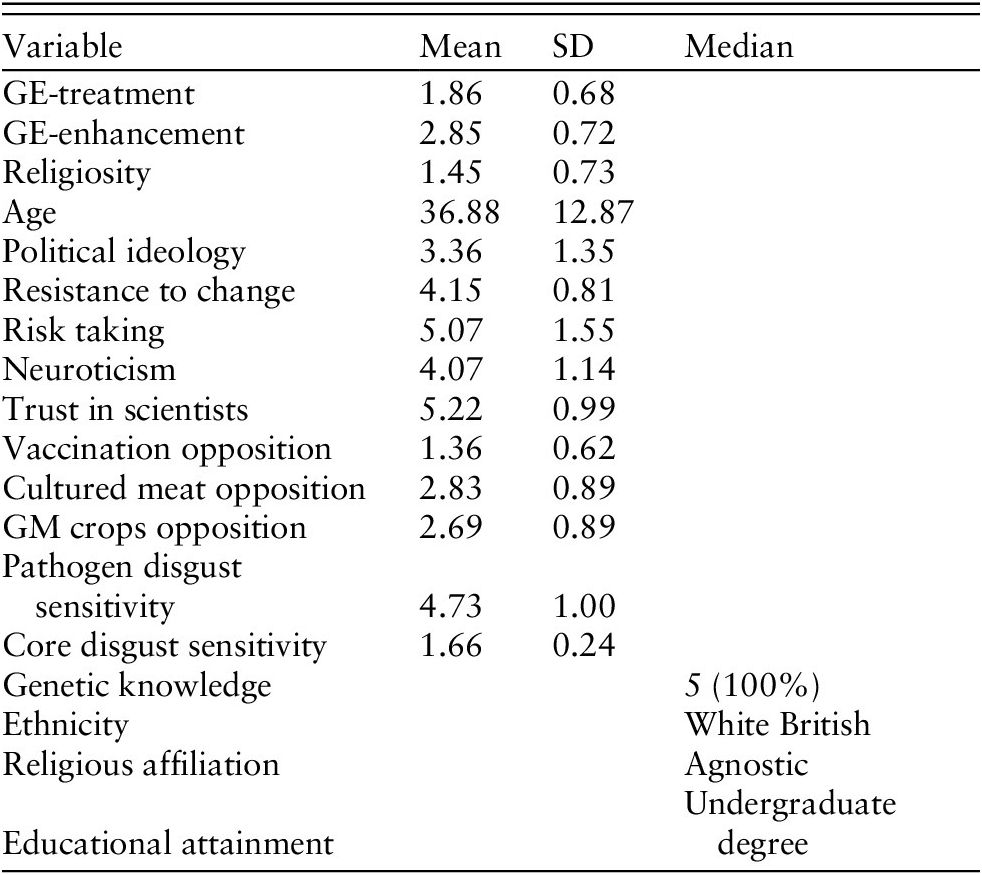
Descriptive statistics for study variables are detailed in Table 1. Participants’ level of genetics knowledge was high, with a median score of 5 out of 5 correct answers. They were not especially religious (M = 1.45, SD = .73) and were slightly left leaning in their political ideology (M = 3.36, SD = 1.35).
Descriptive statistics of study variables.

Parallel and exploratory factor analyses
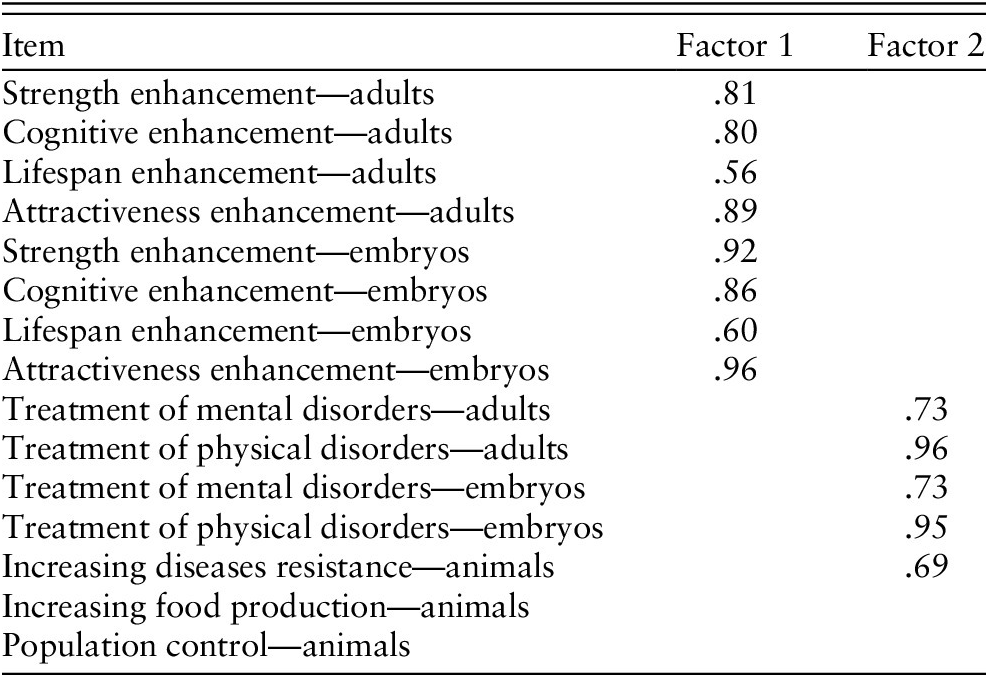
A parallel analysis indicated that the 15 gene editing items were best characterized by two underlying latent factors. Therefore, we submitted these items to an exploratory factor analysis (promax rotation) specifying the retention of two factors. Factor loadings from this analysis are detailed in Table 2. Factor 1 was labeled “enhancement” because of the consistent loading on items concerning the use of gene editing to enhance human performance/ability. Factor 2 was labeled “treatment” because of the consistent loading on items concerning the use of gene editing to treat human disease.
Factor loading results for the gene editing items.

Note: Factor loadings < .40 have been suppressed.
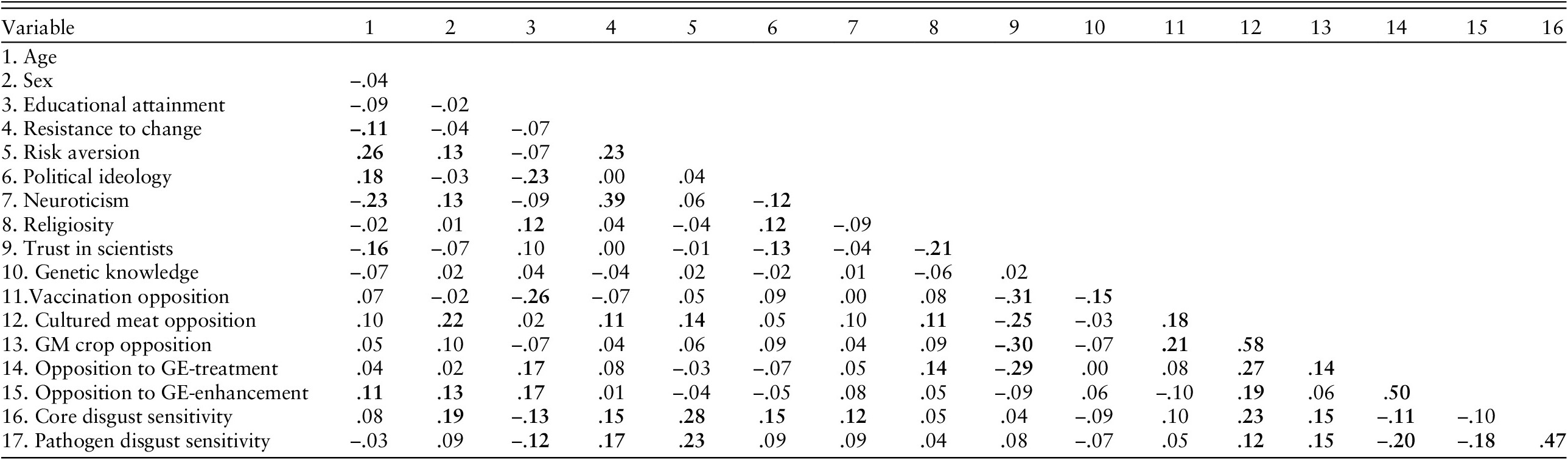
To operationalize these factors for further analyses, we created scales from the mean score of the five treatment items and the eight enhancement items, respectively. We refer to these scales herein as GE-treatment and GE-enhancement, with higher scores on these measures corresponding to higher levels of opposition to gene editing in these domains. Cronbach’s alpha for the GE-enhancement and GE-treatment scales were excellent: α = .92 and α = .84, respectively. Participants were favorable toward gene editing for treatment (M = 1.86, SD = 0.68) but not enhancement (M = 2.85, SD = 0.72). As indicated in Table 3, GE-treatment and GE-enhancement showed a significant positive correlation (r = .50. p < .001). Statistical tests are two-tailed unless otherwise noted.
Intercorrelations for study variables.

Note: Bold indicates p < .05, two-tailed; 1 = male, 2 = female.
H1: Pathogen disgust sensitivity will be positively associated with opposition to gene editing. Contrary to prediction, pathogen disgust sensitivity showed a significant negative correlation with both opposition to GE-treatment (r = –.20, p < .001) and opposition to GE-enhancement (r = –.18, p < .001).
H2: Pathogen disgust sensitivity will be positively associated with opposition to the use of broader biotechnology. In line with our prediction, we saw a significant positive relationship between pathogen disgust sensitivity and opposition to cultured meat (r = .12, p = .032) and GM crops (r = .15, p = .006), although no statistically significant association was seen between pathogen disgust sensitivity and opposition to vaccinations.
H3: Opposition to gene editing will be positively associated with political conservatism, religiosity, neuroticism, and resistance to change, as well as negatively associated with subjective knowledge of gene editing, objective knowledge of gene editing, risk taking, and trust in scientists. Opposition to GE-treatment, in line with predictions, was positively associated with religiosity (r = .14, p = .008) and negatively associated with trust in scientists (r = –.29, p < .001). There was also a positive association with educational attainment (r = .17, p = .002), opposition to cultured meat (r = .27, p < .001), and opposition to GM crops (r = .14, p = .035), which we did not predict a priori. In contrast to predictions, we did not observe a statistically significant association between opposition to GE-treatment and the following variables: political conservatism, neuroticism, resistance to change, objective knowledge of gene editing, and risk taking.
Opposition to GE-enhancement, against prediction, did not show a statistically significant association with any of the following variables: political conservatism, religiosity, neuroticism, resistance to change, objective knowledge of gene editing, risk taking, and trust in scientists. There were, however, positive associations observed with age (r = .11, p = .047), educational attainment (r = .17, p = .002), sex (r = .13, p < .001), and opposition to cultured meat (r = .19, p < .001), which we did not predict a priori.
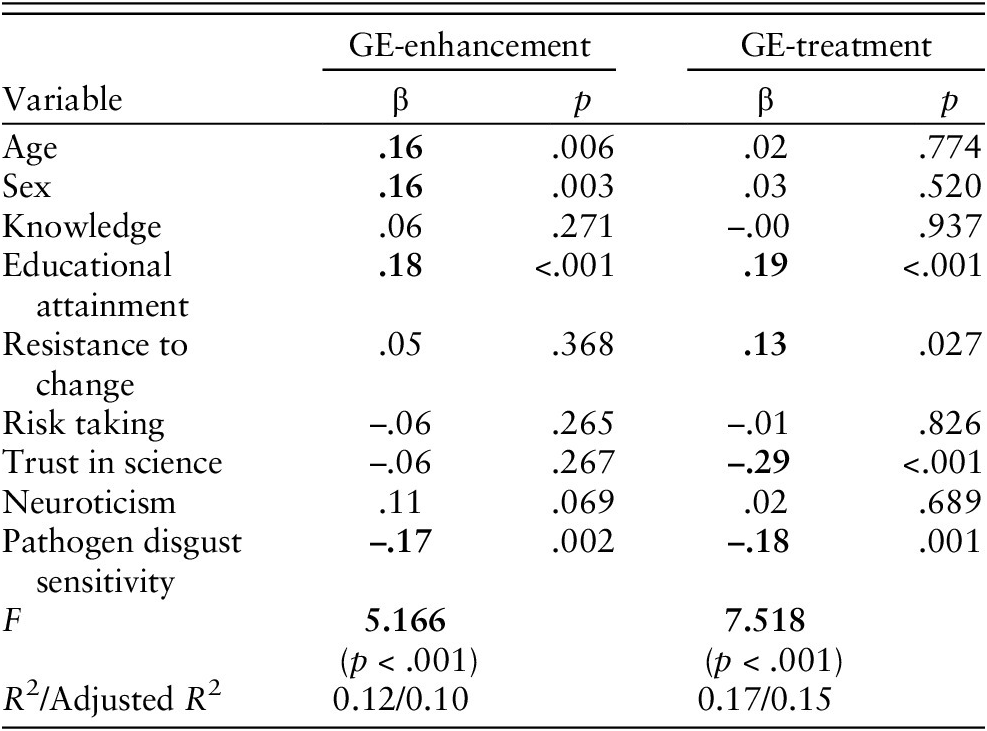
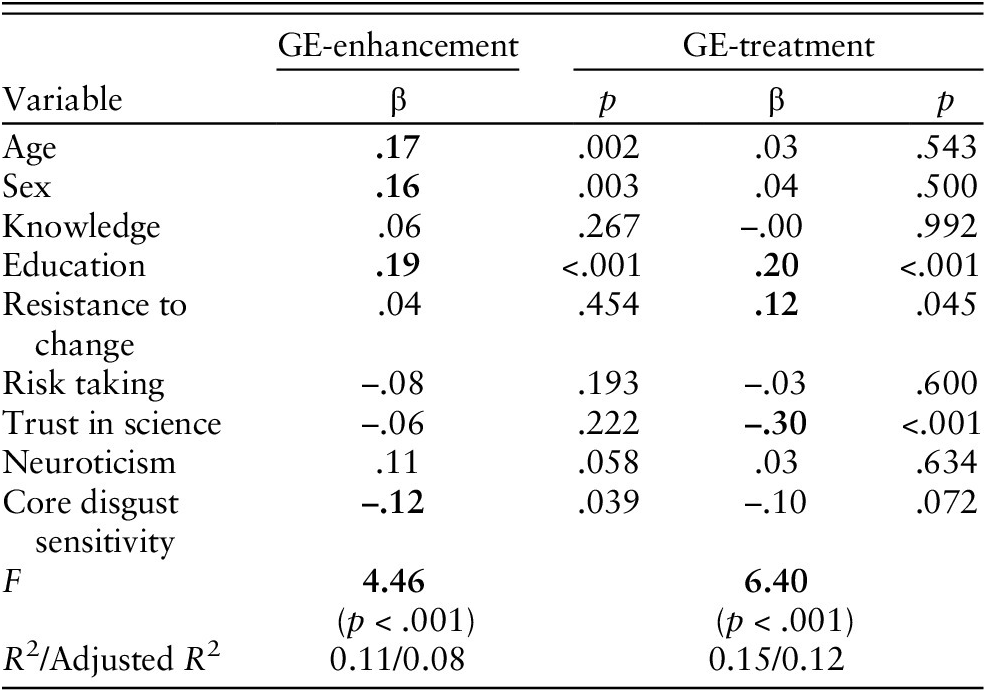
H4: The positive association between pathogen disgust sensitivity and opposition to gene editing will be independent of age, sex, educational attainment, resistance to change, subjective knowledge of gene editing, objective knowledge of gene editing, risk taking, trust in scientists, and neuroticism. Although the initial correlational findings went in the opposite direction to prediction, because of the significant observed associations, we next sought to establish whether pathogen disgust sensitivity continued to predict support for GE-enhancement and GE-treatment when a range of plausible confounders were modeled. To this end, we used linear multiple regression and included either GE-enhancement or GE-treatment as our dependent variable and pathogen disgust sensitivity, age, sex, educational attainment, resistance to change, genetics knowledge, risk taking, trust in scientists, and neuroticism as our independent variables.
GE-enhancement model: Age, sex, educational attainment, and pathogen disgust sensitivity were each independent, significant predictors of opposition to GE-enhancement. The adjusted R 2 of the model for enhancement was 0.10. Those who were older (β = .16, p = .006), more educated (β = .18, p < .001), female (β = .16, p = .003), and less sensitive to pathogen disgust (β = –.17, p = .002) were more likely to oppose gene editing for enhancement. The full model results are presented in Table 4.
Regression model results with opposition to GE-enhancement and GE-treatment as dependent variable.

Note: Bold indicates p < .05, two-tailed; 1 = male, 2 = female.
GE-treatment model: Educational attainment, resistance to change, trust in science, and pathogen disgust sensitivity were independent, significant predictors of GE-treatment. The adjusted R 2 of the model for enhancement was 0.15. Those who were more resistant to change (β = .13, p = .027), more educated (β = .19, p < .001), less trusting in science (β = –.29, p < .001), and lower in pathogen disgust sensitivity (β = –.18, p = .001) were more likely to oppose gene editing for treatment. The full model results are presented in Table 4.
H5: The association between pathogen disgust sensitivity and opposition to gene editing will be mediated by (i) political conservatism and (ii) religiosity. Although the predicted association between gene editing opposition and pathogen disgust sensitivity was significantly negative (for both GE-treatment and GE-enhancement) rather than positive, we still examined whether these associations were mediated by political ideology or religiosity. To this end, we fitted two models: with political ideology and religiosity mediating the path from pathogen disgust sensitivity to either GE-treatment or GE-enhancement.
In the models with pathogen disgust sensitivity, the direct effect in all models was significant (all β > –.18, all p < .004), but there was no evidence for mediation in any of the models (all indirect pathways were p > .104, apart from religiosity predicting opposition to GE-treatment model, (β = .16, p = .010).
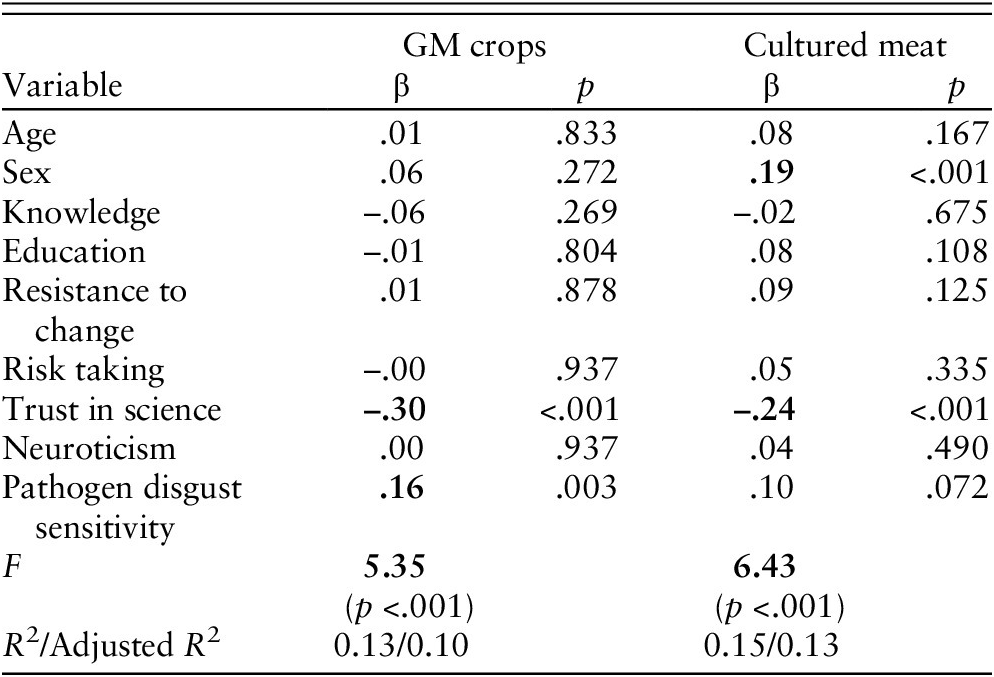
H6: The positive association between pathogen disgust sensitivity and opposition to vaccinations, GM foods, and cultured meat will be independent of age, sex, educational attainment, resistance to change, subjective knowledge of gene editing, objective knowledge of gene editing, risk taking, trust in scientists, and neuroticism. We next sought to establish whether pathogen disgust sensitivity continued to predict opposition to GM crops and cultured meats when a range of plausible confounders were modeled. To this end, we used linear multiple regression and included either GM crops or cultured meat as our dependent variable and pathogen disgust sensitivity, age, sex, educational attainment, resistance to change, genetics knowledge, risk taking, trust in scientists, and neuroticism as our independent variables.
GM crops model: Trust in science and pathogen disgust sensitivity were independent, significant predictors of GM crops. The adjusted R 2 of the model was 0.10. Those who were less trusting in science (β = –.30, p <.001) and higher in pathogen disgust sensitivity (β = .16, p = .003) were more likely to oppose GM crops. The full model results are presented in Table 5.
Regression model results with opposition to GM crops and cultured meat as dependent variables.

Note: Bold indicates p < .05, two-tailed; 1 = male, 2 = female.
Cultured meat model: Sex and trust in science were independent, significant predictors of cultured meat. The adjusted R 2 of the model was 0.13. Those who were female (β = .19, p < .001) and less trusting in science (β = –.24, p < .001) were more likely to oppose cultured meat. Pathogen disgust sensitivity showed a nonsignificant positive association (β = .10, p = .072). The full model results are presented in Table 5.
Although we did not observe zero-order correlations between pathogen disgust sensitivity and opposition to vaccinations, we carried out the regression analyses in line with our preregistration, details of which may be found in the supplementary materials. In short, we did not find an association between pathogen disgust sensitivity and vaccination opposition in this analysis.
H7: The association between pathogen disgust sensitivity and opposition to vaccinations, GM crops, and cultured meats will be mediated by (i) political conservatism and (ii) religiosity. To test this hypothesis, we fitted a model with pathogen disgust as a predictor of GM crop opposition, mediated by religiosity political ideology. While the direct path was significant (β = .14, p = .017), there was no evidence of mediation (indirect pathways were p > .054).
Although there was no significant independent effect of pathogen disgust sensitivity on either opposition to vaccinations or cultured meat after regression analyses, in line with our preregistration, we carried out mediation analysis. These results are reported in the supplementary materials. In short, these tests found no evidence for mediation in any of the models.
Sensitivity Checks
In a series of sensitivity checks (as noted in our preregistered analysis plan), we next examined whether our results were robust to replacing pathogen disgust sensitivity with a closely related measure: core disgust sensitivity. In aggregate, these results aligned well with those reported earlier for pathogen disgust sensitivity.
As with pathogen disgust sensitivity, opposition to GE-treatment showed a significant negative correlation with core disgust sensitivity (r = –.11, p = .039). Opposition to GE-enhancement did not show a significant correlation with core disgust sensitivity, although the association was in the same direction as seen for pathogen disgust sensitivity (r = –.10, p = .062).
When controlling for the potential confounders noted earlier, we saw a reversal of this pattern: GE-treatment was no longer significant (β = –.10, p = .072), whereas GE-enhancement was significant (β = –.12, p = .039) (see Table 6). Of note, the point estimates were virtually unchanged across the two analyses and so interpretations regarding nominal significance (or lack thereof) should be made with caution. And as with pathogen disgust sensitivity, we observed no evidence for mediation by political ideology or religiosity (all indirect pathways were p > .391).
Regression model results with opposition to GE-enhancement and GE-treatment as dependent variables (including core disgust sensitivity as an independent variable).

Note: Bold indicates p < .05, two-tailed; 1 = male, 2 = female.
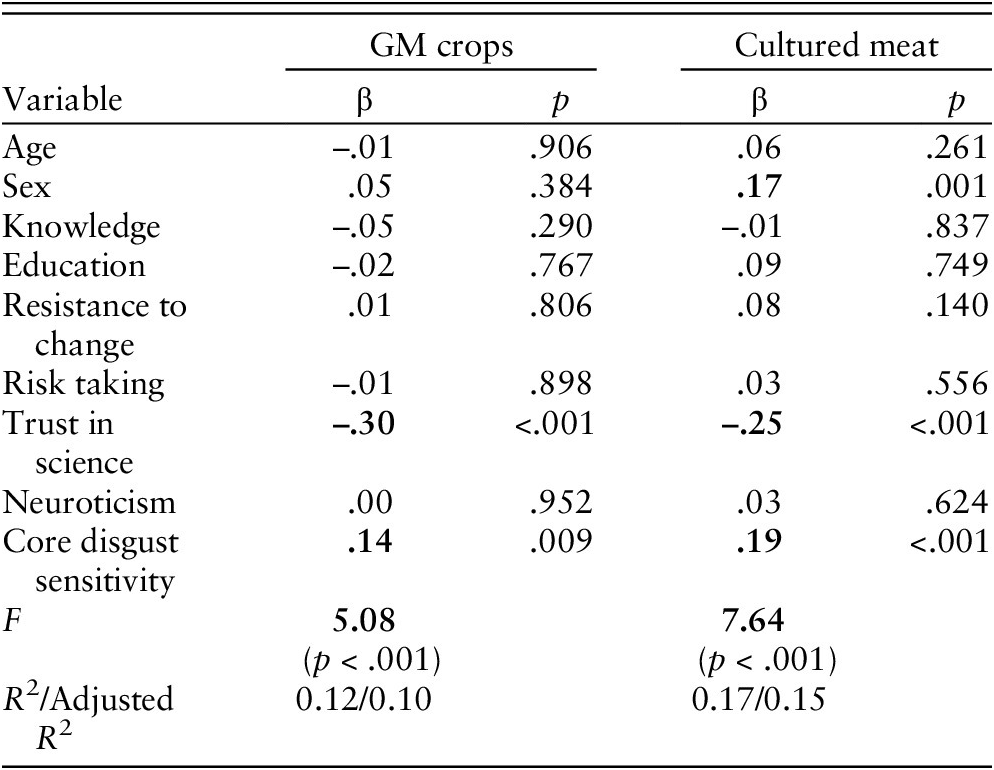
We saw a significant positive relationship between core disgust sensitivity and opposition to cultured meat (r = .23, p < .001) and GM crops (r = .15, p = .010) (although no statistically significant association was seen with opposition to vaccinations). These significant associations were robust to the inclusion of the potential confounders noted above (see Table 7). However, and as with pathogen disgust sensitivity, we observed no statistically significant evidence for mediation by political ideology or religiosity (all indirect pathways were p > .268).
Regression model results with opposition to GM crops and cultured meat as dependent variables (including core disgust sensitivity as an independent variable).

Note: Bold indicates p < .05, two-tailed; 1 = male, 2 = female.
Discussion
The central goal of this study was to examine whether pathogen disgust sensitivity predicted opposition to gene editing. In contrast to this prediction, pathogen disgust sensitivity was negatively correlated with two observed aspects of opposition to gene editing: enhancement and treatment (these aspects are discussed in more detail later). In other words, individuals who self-rated as being higher on pathogen disgust sensitivity were more likely to support gene editing for enhancing human traits and for treating disease.
These associations were relatively modest in magnitude; however, they remained statistically significant when controlling for a selection of plausible confounding variables, including age, sex, risk taking, resistance to change, trust in science, educational attainment, genetics knowledge, and neuroticism. Of further note, and contrary to prediction, the relationships between pathogen disgust sensitivity and gene editing attitudes were not mediated by either political ideology or religiosity. In fact, and perhaps surprisingly, gene editing attitudes were unrelated to political ideology.
Pathogen disgust sensitivity was positively correlated with opposition to GM crops and cultured meat, although no statistically significant association was observed with opposition to vaccinations. Similarly, we did not observe a significant link between gene editing attitudes and opposition to vaccinations. However, we did observe a significant positive relationship between opposition to gene editing and opposition to cultured meat and GM crops. These findings partially replicate recent work reporting positive associations between disgust sensitivity and biotechnology attitudes (Sanyal et al., Reference Sanyal, McAuliffe and Curry2019; Scott et al., Reference Scott, Inbar and Rozin2016; Siegrist et al., Reference Siegrist, Sütterlin and Hartmann2018) . Of note, then, pathogen disgust appears to play a different role depending on the technology: relating to support for gene editing but to opposition in the case of other biotechnology issues.
Given that our central prediction—that pathogen disgust sensitivity would be related to opposition to gene editing, what might account for the opposite finding? One possibility is that our participants did not view gene editing as an invasive, pathogenic procedure but rather as a relatively benign technique that simply treats or enhances human disease or “weaknesses” with no danger to the individual. As such, it is conceivable that pathogen disgust sensitivity in turn predicted support for gene editing treatment and enhancement in order to treat illness and “imperfection.” Indeed, recent work has noted that disgust sensitivity predicts health purity-related behaviors, such as a preference for organic food over GM foods and support for regulation of smoking and illegal drugs (Clifford & Wendell, Reference Clifford and Wendell2016) as well as dislike of the overweight (Lieberman et al., Reference Lieberman, Tybur and Latner2012) and increased likelihood of being anorexic (Aharoni & Hertz, Reference Aharoni and Hertz2012). This suggestion could be tested in future research by examining the effect of message framing in relation to gene editing. For example, the negative relationship observed here may be attenuated, or even reversed, if risks such as off-target genetic mutations following gene editing treatments are explicitly highlighted.
As noted earlier, attitudes toward gene editing reflected two broadly distinct—albeit moderately correlated—latent factors concerning treatment and enhancement. This finding had been hinted at in recent work (Gaskell et al., Reference Gaskell, Bard, Allansdottir, da Cunha, Eduard, Hampel, Hildt, Hofmaier, Kronberger, Laursen, Meijknecht, Nordal, Quintanilha, Revuelta, Saladié, Sándor, Santos, Seyringer, Singh and Zwart2017; Robillard et al., Reference Robillard, Roskams-Edris, Kuzeljevic and Illes2014; Xiang et al., Reference Xiang, Xiao, Gou, Li, Zhang, Wang and Feng2015), but prior to the current study had not been formally established. As such, these results indicate that future research into gene editing attitudes should consider using distinct scales with regard to these issues as well as seeking to further understand and establish the latent architecture of attitudes in this domain. For example, it is yet to be established whether the factor structure observed here generalizes across cultures or countries. In addition, these results indicate that adult, embryo, and animal gene editing attitudes are largely fungible concepts (at least within the categories of treatment and enhancement), although further work is recommended to more definitively confirm this suggestion.
Some weaknesses of the current study are noteworthy. First, the sample consisted solely of adult participants from the United Kingdom. However, attitudes toward gene editing may differ by country, as is the case for GM crops (Brosig & Bavorova, Reference Brosig and Bavorova2019), thus limiting the generalizability of our findings. A similar concern is reflected in the observation that our sample was very knowledgeable about genetics (scoring a median five out of five on our knowledge measure), and so our findings may not generalize to less well-educated or knowledgeable populations who may hold different opinions about genetics and gene editing. Second, we used a cross-sectional study design, which limits our ability to infer causation. To build on the current findings, future work might wish to use an experimental design—for example, inducing participant disgust in the laboratory and assessing whether this in turn increases willingness to use gene editing technology.
In summary, the current study highlighted two key findings. Pathogen disgust sensitivity predicts attitudes toward gene editing (albeit in the opposite manner to that predicted): those who are more sensitive to pathogen disgust are more likely to support gene editing both for treating disease and for enhancing human traits. Moreover, these associations were independent of a range of potential confounding variables, including age, sex, risk taking, resistance to change, trust in science, education, genetic knowledge, and neuroticism. Second, individual differences in gene editing attitudes are underpinned by two related, but largely distinct, latent factors reflecting sentiment regarding gene editing being used for enhancement and for treatment. These findings provide a platform for future research into the psychometric structure and antecedents of gene editing attitudes and suggest that experimental methods (e.g., message framing, disgust induction) and cross-cultural work, among other approaches, are now required to make further headway on this important basic and applied science issue.
Supplementary Materials
To view supplementary material for this article, please visit http://dx.doi.org/10.1017/pls.2020.12.
Appendix: Complete list of the gene editing items used in the study
Adults:
-
1. How likely would you be to support the use of gene editing in adults to increase a person’s resistance to a mental disorder such as depression or anxiety?
-
2. How likely would you be to support the use of gene editing in adults to increase a person’s resistance to a physical disorder such as heart disease or cancer?
-
3–6. How likely would you be to support the use of gene editing in adults for the following enhancements?
-
• Physical strength
-
• Cognitive ability/Intelligence
-
• Lifespan
-
• Attractiveness/looks
Embryos:
-
7. How likely would you be to support the use of gene editing in an embryo to increase resistance to a mental disorder like depression or anxiety?
-
8. How likely would you be to support the use of gene editing in an embryo to increase resistance to a physical disorder like heart disease or cancer?
-
9–12. How likely would you be to support the use of gene editing in embryos for the following enhancements?
-
• Physical strength
-
• Cognitive ability/Intelligence
-
• Lifespan
-
• Attractiveness/looks
Animals:
-
13. How likely would you be to support the use of gene editing in animals to increase their resistance to disease?
-
14. How likely would you be to support the use of gene editing in animals to increase food production?
-
15. How likely would you be to support the use of gene editing in animals to control their population?
Genetics objective knowledge items:
-
1. A person with an altered (mutated) gene may be completely healthy. (True)
-
2. Altered (mutated) genes can cause disease. (True)
-
3. A gene is a piece of DNA. (True)
-
4. The child of a person with an inherited disease will always have the same disease. (False)
-
5. A person has thousands of genes. (True)