1. Introduction
A multirobot system is a system containing multiple robots, such as unmanned aerial vehicles (UAVs) and unmanned ground vehicles (UGVs), that are moving around in a given environment to accomplish tasks cooperatively. Compared with their single-robot counterparts, multirobot systems can increase functionalities, improve efficiency, enhance adaptability, and provide robustness [Reference Jin, Qi, Luo, Li and Shang1–Reference Nfaileh, Alipour, Tarvirdizadeh and Hadi3]. Multirobot systems have been applied to deal with labor-consuming or dangerous missions, such as assembly, disaster rescue, environmental protection, traffic monitoring, military reconnaissance, cargo delivery, and many other fields [Reference Zhou and Tokekar4–Reference Jazi, Keshmiri, Sheikholeslam, Shahreza and Keshmiri6].
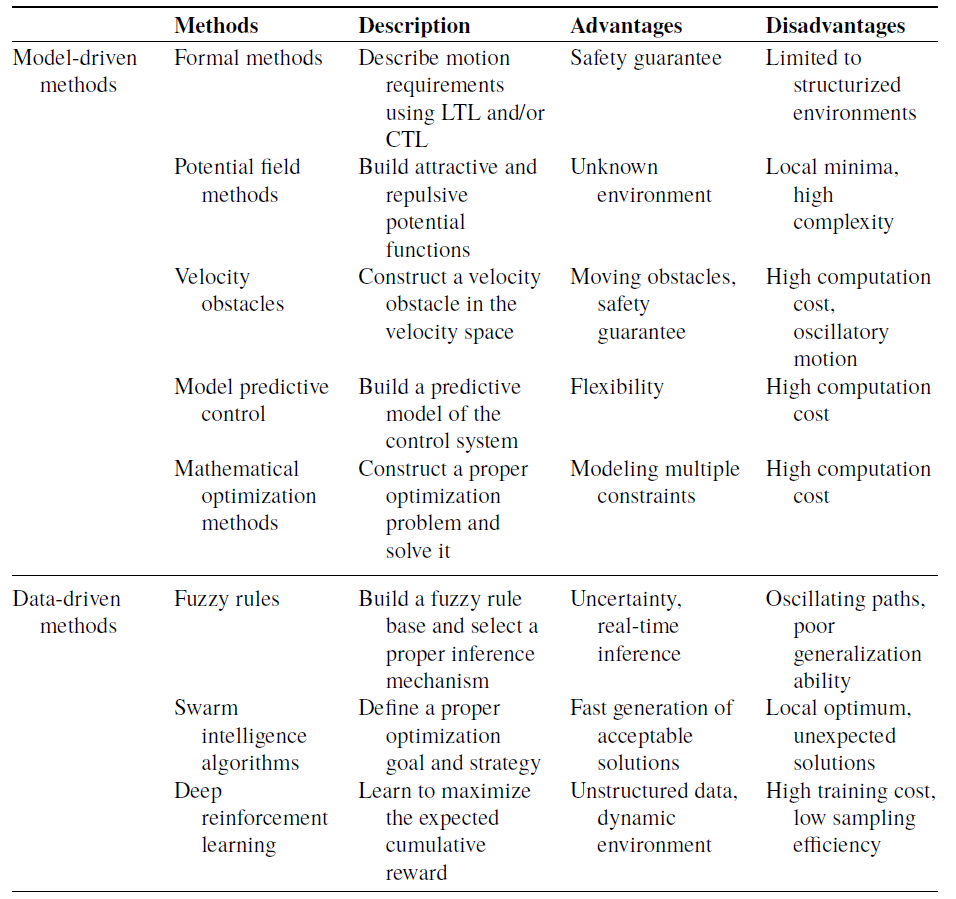
Coordinated motion is one of the most important requirements in a multirobot system. However, due to the complexity of the environment and the simultaneous motion of robots, collisions are common in coordinated motion. Many methods have been proposed to avoid collisions during robot motion. They can be mainly classified into two categories: model-driven methods and data-driven methods. Model-driven methods, such as formal methods [Reference Yu and Dimarogonas7, Reference Kantaros, Malencia, Kumar and Pappas8], discrete event system methods [Reference Zhou, Hu, Liu and Ding9–Reference Zhou, Hu, Liu, Lin and Ding11], potential field methods [Reference Tanner and Boddu12], velocity obstacles (VOs) [Reference Van den Berg, Lin and Manocha13, Reference van den Berg, Guy, Lin and Manocha14], model predictive control [Reference Lindqvist, Mansouri, Agha-Mohammadi and Nikolakopoulos15], and mathematical optimization methods [Reference Zhou, Hu, Liu, Lin and Ding16], rely on the models of robots and/or environments. Specifically, formal methods apply the technologies such as formal verification and model checking to control robots’ motion [Reference Yu and Dimarogonas7, Reference Kantaros, Malencia, Kumar and Pappas8]. Discrete event system methods apply supervisory control theory to avoid collisions and deadlocks for multirobot systems [Reference Zhou, Hu, Liu and Ding9–Reference Zhou, Hu, Liu, Lin and Ding11]. Potential field methods define proper attractive potential functions and repulsive potential functions to lead a robot to its target while avoiding obstacles [Reference Tanner and Boddu12]. VO-based methods compute a collision-free velocity from the union velocity space of all obstacles at each time instant [Reference Van den Berg, Lin and Manocha13]. Model predictive control applies an explicit model to describe the control system and obtains a sequence of control inputs by solving an optimization problem based on the model [Reference Lindqvist, Mansouri, Agha-Mohammadi and Nikolakopoulos15]. Mathematical optimization methods generate control actions by modeling the collision avoidance problem as an optimization problem [Reference Zhou, Hu, Liu, Lin and Ding16]. Data-driven methods are learning-based methods using sample data to learn proper controllers, such as fuzzy rules [Reference Lindqvist, Mansouri, Agha-Mohammadi and Nikolakopoulos15], swarm intelligence algorithms [Reference Tang, Xiang, Pang and Zhanxia17], and deep reinforcement learning (DRL) [Reference Thumiger and Deghat18, Reference Han, Chen, Wang, Zhang, Gao, Hao and Pan19]. Detailedly, fuzzy rules generate an action via fuzzy inference of the rules extracted from the collected data [Reference Lindqvist, Mansouri, Agha-Mohammadi and Nikolakopoulos15]. Swarm intelligence algorithms iteratively search for actions in the region defined by the previous optimal movements of the robot and its neighbors [Reference Tang, Xiang, Pang and Zhanxia17]. DRL formalizes the collision avoidance problem as a Markov decision process, which is solved by learning a decision policy mapping from the state space to the action space [Reference Thumiger and Deghat18, Reference Han, Chen, Wang, Zhang, Gao, Hao and Pan19]. Table I gives a brief summary of each method and its advantages and disadvantages. Even though collision avoidance has been widely studied, there are some challenging problems that are not adequately addressed. First, most of the model-driven methods can guarantee safety but require high computation costs. Second, data-driven methods leverage offline learning to improve online computation efficiency but cannot provide collision-free guarantees.
Summary of different collision avoidance methods.

In this paper, a new real-time collision avoidance approach, named Fuzzy-VO, is proposed to guarantee safety and computation efficiency for multirobot systems with sensing uncertainty and linguistic data. It combines fuzzy rules and VOs. On the one hand, considering uncertainties in sensing data, linguistic requirements may exist for a robot’s motion, for example, moving slowly and turning right slightly. Fuzzy rules are a well-established tool to (1) deal with not only crisp data but also uncertain and linguistic data and (2) express the behavior of a system in an interpretable way. However, most of the current fuzzy rule-based methods are for a single robot [Reference Lilly20, Reference Wen, Zhou and Wang21]. The design of fuzzy rules for collision avoidance in a multirobot system is still challenging since: (1) the form of a fuzzy rule is dependent on the number of robots; (2) the number of fuzzy rules increases exponentially with the number of robots [Reference Edward22]; and (3) a robot’s motion may oscillate because of the large number of rules (the claim will be empirically validated in experiments). On the other hand, VO-based methods, such as optimal reciprocal collision avoidance (ORCA) [Reference van den Berg, Guy, Lin and Manocha14], are well defined and generally applicable techniques for reactive obstacle avoidance with the existence of dynamic obstacles [Reference Van den Berg, Lin and Manocha13]. However, computing an optimal velocity for a robot in a multirobot system is still challenging since: (1) the scale of the problem (e.g., the number of constraints) increases with the number of robots, and so does the computation cost and (2) the robot may have few velocity candidates if numerous obstacles are around.
To mitigate the above drawbacks, Fuzzy-VO first uses a unified intruder selection method to generate fuzzy rules with an arbitrary number of robots. Specifically, given a robot, Fuzzy-VO divides its sensing region into a fixed number of sectors. In each sector, the robot applies the VO technology to evaluate and select the most dangerous robot to perform collision avoidance. Hence, the maximal number of robots to be avoided by a robot is constant. In this way, Fuzzy-VO can determine the form and the number of fuzzy rules. Then, sample data are collected via ORCA to learn a fuzzy rule base. Thus, the robot can compute the candidate motion in realtime via fuzzy inference on the rule base. Second, to guarantee that the final motion is collision-free, Fuzzy-VO applies the VO technology to check and fine-tune, if necessary, the candidate motion. Since each robot only needs to retrieve the current states of its neighbors, which can be obtained immediately, Fuzzy-VO is fully distributed. The same right-of-way, such as the turn-right rule, is applied to guarantee mutual exclusion during distributed decision making. A set of simulations are carried out with multiple UAVs. The results demonstrate the effectiveness of Fuzzy-VO in addressing potential collisions. Extensive comparison results show that Fuzzy-VO can reduce the number of rules and generate smoother paths compared with the conventional fuzzy rule approach and improve computation efficiency compared with the ORCA method.
The main contributions of this paper are threefold:
-
1. Based on sensing region partition and intruder selection, a practical strategy is proposed to build a fuzzy rule base with an arbitrary number of robots.
-
2. For each robot, a strategy is developed to generate collision-free velocities based on fuzzy rule inference and VO-based fine-tuning. It leverages the computation efficiency of data-driven methods and the safety guarantee of model-driven methods.
-
3. Based on the above two strategies, a fully distributed and real-time collision avoidance method, Fuzzy-VO, is proposed for multirobot systems with an arbitrary number of robots.
The rest of this paper is organized as follows. Section 2 summarizes the related work. Section 3 states the problem solved in this paper. Section 4 gives an overview of Fuzzy-VO. Sections 5 and 6 present the procedures for intruder selection and collision-free velocity generation, respectively. Section 7 provides the detailed algorithms, as well as the complexity analysis. Simulations are conducted in Section 8 to demonstrate the effectiveness and efficiency of Fuzzy-VO. Conclusion and future work are finally provided in Section 9.
2. Related work
This paper is related to the topic of collision avoidance, which is a key and popular topic in robotics. Many methods have been proposed in this area. For example, Wang et al. [Reference Wang, Savkin and Garratt23] proposed a three-dimensional navigation strategy for nonholonomic robots with moving obstacles, where the robot’s motion direction maintains a constant angle with the obstacles’ boundary tangents to avoid collisions. Lindqvist et al. [Reference Lindqvist, Mansouri, Agha-Mohammadi and Nikolakopoulos15] formalized the collision avoidance problem as an optimization problem in the framework of model predictive control and resolved it using OpEn solver. In [Reference Kownacki and Ambroziak24], a potential field-based collision avoidance approach was proposed for nonholonomic UAVs, which took the velocity direction of an obstacle into consideration during the design of potential field functions.
Among the existing approaches, fuzzy rules are a promising tool to deal with data uncertainties and linguistic requirements for multirobot systems. Llorca et al. [Reference Llorca, Milanés, Alonso, Gavilán, Daza, Pérez and Sotelo25] proposed a fuzzy control-based autonomous collision avoidance system. In this system, the lateral displacement and the actual speed of the vehicle are used as fuzzy inputs, and the output of the fuzzy steering controller is the steering-wheel position. Vadakkepat et al. [Reference Vadakkepat, Miin, Peng and Lee26] proposed a fuzzy behavior-based architecture for the control of mobile robots in a multiagent environment. In ref. [Reference Lilly20], a fuzzy obstacle avoidance controller is proposed for an autonomous vehicle using both negative fuzzy rules and traditional positive rules. The proposed architecture can be decomposed into four robot roles, 12 robot behaviors, and 14 robot actions, where obstacle avoidance is fulfilled by independent behaviors. However, the major drawback of these works is the generalization ability, that is, they are unsuitable for scenarios with a variable number of robots. Wen et al. [Reference Wen, Zhou and Wang21] divided the sensing regions of the ultrasonic sensors on a UAV into three groups: front, left, and right, and then took each group’s minimum obstacle distance as the inputs of its fuzzy controller. Chang et al. [Reference Chang, Shi, Dostovalova, Cao, Kim, Gibbons and Lin27] proposed a two-layer fuzzy logic controller for multirobot coordination, which divides the scanning area into seven sectors and selects the shortest distance to a detected obstacle in each sector as input. But the selection may miss obstacles that are threatening and emergent in each sector.
VO-based methods are another kind of promising methods for collision avoidance. VO is first proposed by Fiorini and Shiller [Reference Fiorini and Shiller28]. It is a velocity-based approach to avoiding collisions with moving obstacles. In VO, the velocity space of a robot is divided into collision and collision-free velocities, and an appropriate collision-free velocity is computed at any time instant. However, VO suffers from some weaknesses such as undesirable oscillatory motion and reciprocal dances [Reference Kim and Oh29, Reference Cai, Wang, Cheng, De Silva and Meng30]. Some improved variations, such as reciprocal VO [Reference Van den Berg, Lin and Manocha13] and ORCA [Reference van den Berg, Guy, Lin and Manocha14], have been proposed. van den Berg et al. [Reference van den Berg, Guy, Lin and Manocha14] proposed the sufficient condition for multiple robots to avoid collisions and guarantee collision-free motion. By solving a linear program, each robot selects its optimal velocity from the intersection of all possible half-planes in the velocity space. Jenie et al. [Reference Jenie, Kampen, de Visser, Ellerbroek and Hoekstra31] proposed a cooperative autonomous collision avoidance algorithm named selective velocity obstacle (SVO), which is also an extension of the original VO. Especially, when SVO needs to avoid a possible collision according to the detection, the right-of-way rules for manned flight are taken into account in the decision-making process. Recently, Han et al. [Reference Han, Chen, Wang, Zhang, Gao, Hao and Pan19] combined VO with DRL to deal with the reciprocal collision avoidance problem under limited information scenarios. In ref. [Reference Wang, Li, Wang, Ma and Yu32], VO is applied to deduce the collision conditions in connected and automated vehicles. However, these VO-based methods require high computation costs in crowded environments [Reference Douthwaite, Zhao and Mihaylova33].
Compared with the aforementioned methods in the literature, the method proposed in this paper aims to achieve real-time computation efficiency and safety guarantees simultaneously for multirobot systems.
3. Problem statement
The scope of this paper is the cooperative motion of a set of robots moving in a 2D space, for example, a set of UGVs moving on the ground or multiple UAVs moving at the same height. Assume that there are
 $N$
holonomic robots moving in the same environment. For nonholonomic robots, it is recommended to read refs. [Reference Wang, Savkin and Garratt23, Reference Kownacki and Ambroziak24] for more details. Note that to perceive the environment, each robot is equipped with different sensors, for example, cameras and LiDARs. However, due to measurement errors, uncertainties may exist in the sensing data. The motion task for a robot
 $r_i$
is to move from its initial position
 ${\textbf{p}}_i^0 \in \mathbb{R}^2$
to the target position
 ${\textbf{p}}_i^f\in \mathbb{R}^2$
within a given duration
 $\tau$
, where
 $\mathbb{R}^2$
is the 2D Euclidian space. Each robot
 $r_i$
has a reference speed
 $v_i^{ref}$
, where
 $v_i^{ref}\leq v_{\max }$
, and
 $v_{\max }$
is the upper bound of the robot speed. Moreover, it is assumed that each robot cannot move backward. Since multiple robots are moving in the same environment, different robots need to avoid collisions with each other. In this work, each robot is modeled as a sphere, and its position is identified by its center. Each robot regards other robots as dynamic obstacles. For simplicity, other dynamic obstacles are not considered.
Before giving the problem statement, some symbols and definitions are defined. Given a robot
 $r_i$
, its position and velocity at time
 $t$
are denoted as
 ${\textbf{p}}_i(t)$
and
 ${\textbf{v}}_i(t)$
, respectively. Clearly,
 $\forall t \gt 0$
,
 $\|{\textbf{v}}_i(t)\|\leq v_{\max }$
. Since the motion is assumed in a 2D space,
 ${\textbf{p}}(t)\in \mathbb{R}^2$
and
 ${\textbf{v}}(t)\in \mathbb{R}^2$
. The state of a robot, denoted as
 $s$
, is a vector containing the robot’s position and velocity, that is,
 $s=({\textbf{p}},{\textbf{v}})$
. The set of all possible states of a robot
 $r_i$
is denoted as
 ${\mathcal{S}}_i$
. The trajectory of a robot
 $r_i$
, denoted as
 $Tr_i$
, is a time-parameterized function mapping from
 $\mathbb{R}^+$
to
 ${\mathcal{S}}_i$
, that is,
 $Tr_i(t)=s_i(t)=({\textbf{p}}_i(t),{\textbf{v}}_i(t))\in{\mathcal{S}}_i$
. By discretizing the time into discrete time instants with the same time step, that is,
 $0=t_0, t_1, \ldots, t_K=\tau$
, the motion of
 $r_i$
can be formalized as
 \begin{align} &{\textbf{p}}_i(t)={\textbf{p}}_i(t_k)+{\textbf{v}}_i(t_k)(t-t_k), \ t\in [t_k,t_{k+1})\nonumber \\[5pt] &{\textbf{p}}_i(t_0)={\textbf{p}}_i^0,\quad{\textbf{p}}_i(t_K)={\textbf{p}}_i^f, \nonumber \\[5pt] & \textbf{v}_i(t_k)=[v_i(t_k)\cos \theta _i(t_k), v_i(t_k)\sin \theta _i(t_k)]. \end{align}
where
 $v_i(t_k)\in \mathbb{R}$
and
 $\theta _i(t_k)\in \mathbb{R}$
are the speed and motion direction of robot
 $r_i$
at
 $t_k$
, respectively.
At any time instant, a robot needs to monitor a proper region, denoted as collision region, with respect to its current position. The body frame of a robot
 $r_i$
is denoted as
 $\mathcal{C}_i$
. It is a Cartesian coordinate system whose origin is the center of
 $r_i$
, the
 $y$
-axis is the same as
 ${\textbf{v}}_i$
, and the
 $x$
-axis is perpendicular to the
 $y$
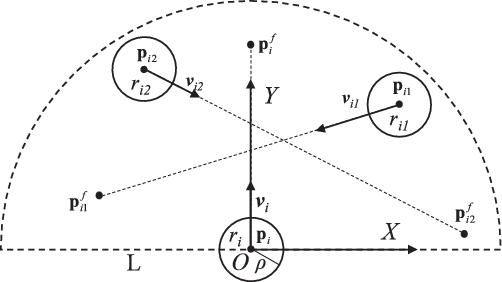
-axis. As shown in Fig. 1, at the current instant,
 $r_i$
is at
 $O$
, and its velocity is
 ${\textbf{v}}_i$
. Then the related
 $\mathcal{C}_i$
is
 $XOY$
, where the
 $Y$
-axis is
 ${\textbf{v}}_i$
. Since each robot cannot move backward, the possible motion area is
 $\{(x,y)| y\geq 0\}$
. Hence, the collision region of a robot
 $r_i$
at time
 $t$
can be defined as
 $CR_i(t) =\{(x,y) \in \mathcal{C}_i | 0\leq x\leq L\cos\!(\theta ), 0\leq y\leq L\sin\!(\theta ), 0\leq \theta \leq \pi \}$
, provided that the sensing range is
 $L$
. To guarantee safety, each robot needs to avoid collisions with other robots in its collision region. At any time
 $t$
, two robots
 $r_i$
and
 $r_j$
are in a collision if
 $\|{\textbf{p}}_i(t)-{\textbf{p}}_j(t)\|_2\lt 2\rho$
, where
 ${\textbf{p}}_i(t)\in{\mathcal{S}}_i$
,
 ${\textbf{p}}_j(t)\in{\mathcal{S}}_j$
, and
 $\rho$
is the safe radius for each robot. Hence, there is the following definition.
Robot
 $r_i$
with two intruders
 $r_{i1}$
and
 $r_{i2}$
(i.e., the three circles) in the body frame
 $\mathcal{C}_i$
. The semicircle area is the collision region of the robot
 $r_i$
.

Definition 1
(Intruder). A robot
 $r_j$
is called an intruder of
 $r_i$
at time
 $t$
if
 ${\textbf{p}}_j(t)\in CR_i(t)$
and
 $\exists t'\in (t,\tau )$
such that
 $\|{\textbf{p}}_i(t')-{\textbf{p}}_j(t')\|_2\lt 2\rho$
, where
 ${\textbf{p}}_i(t')={\textbf{p}}_i(t)+{\textbf{v}}_i(t)(t'-t)$
and
 ${\textbf{p}}_j(t')={\textbf{p}}_j(t)+{\textbf{v}}_j(t)(t'-t)$
.
For example, as shown in Fig. 1, the three robots,
 $r_i$
,
 $r_{i1}$
, and
 $r_{i2}$
, are moving to
 ${\textbf{p}}_i^f$
,
 ${\textbf{p}}_{i1}^f$
, and
 ${\textbf{p}}_{i2}^f$
, respectively. At the current time,
 $r_i$
detects that
 $r_{i1}$
and
 $r_{i2}$
will collide with it if all of them keep their current velocities, so
 $r_{i1}$
and
 $r_{i2}$
are intruders of
 $r_i$
.
Based on the above descriptions, to generate a collision-free trajectory for a robot, the robot needs to determine its velocity at the discrete time instants. Hence, the problem studied in this paper can be described as follows:
Problem 1. Given a set of robots, each of which may contain uncertain sensing data during its motion, decide the motion of each robot, that is, its velocity vectors, such that the robot can always detect and avoid potential collisions with its intruders.
4. Overview of the proposed method
To deal with uncertainties in sensing data and guarantee real-time efficiency, a VO-aided fuzzy inference method is proposed to generate collision-free motion for each robot. This section gives the framework of the proposed Fuzzy-VO, while the details are given in the following sections.
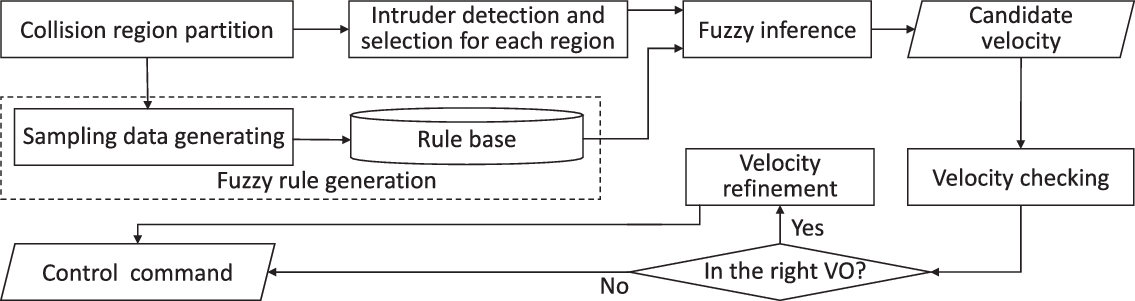
Figure 2 shows the high-level workflow of Fuzzy-VO. The main idea is to restrict the number of fuzzy rules by selecting a proper and fixed number of intruders for collision avoidance rather than considering all intruders. In this way, Fuzzy-VO can be adopted to a different number of robots and guarantee flexibility and scalability. It mainly contains three processes, that is, intruder selection, fuzzy rule generation and inference, and velocity generation.
Framework of Fuzzy-VO.

Intruder selection. For each robot, the first step is to partition its collision region into a set of disjoint sectors. A sector may contain several intruders, and different sectors may contain a different number of intruders. Hence, to generate a universal method for a different number of robots, a proper number of intruders should be selected in each sector. In this paper, only the most dangerous intruder is selected for each sector based on the technology of VOs.
Fuzzy rule generation and inference. Fuzzy rule-based collision avoidance technology is used to generate a candidate motion command. First, to build the fuzzy base, the conventional motion planning algorithms are applied to generate corresponding sampling data. Then, fuzzy rules can be extracted from the collected data. When the rule base is constructed, at any instant, the robot can perform fuzzy inference based on the current selected intruders and generate a candidate velocity.
Velocity generation. Since the fuzzy rules are generated based on sampling data rather than exact system models, the reasoning results cannot always guarantee collision avoidance. Hence, validation of the candidate velocity is required to generate the actual velocity. In this paper, it is assumed that each robot moves to its right side to avoid collisions. Hence, the robot only needs to check whether the generated velocity is in the VOs of the right intruders and fine-tunes the candidate velocity if needed.
5. Intruder determination and selection
This section describes the method to select a proper number of intruders for collision avoidance by the robot. Specifically, the partition of the collision region is first introduced, followed by the VO-based intruder selection method to retrieve the most dangerous intruder in each partition.
5.1. Collision region partition
At any time instant,
 $r_i$
’s collision region
 $CR_i(t)$
is partitioned into
 $l$
equal sectors, that is,
 $l_i=\{(x,y)| 0\leq x\leq L\cos\!(\theta ), 0\leq y\leq L\sin\!(\theta ), (i-1)\pi/l\leq \theta \leq i\pi/l\}$
,
 $i=1,2,\ldots, l$
. Consequently, an appropriate value of
 $l$
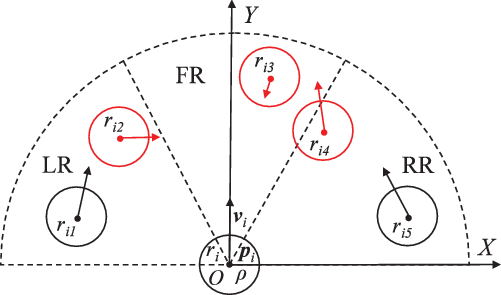
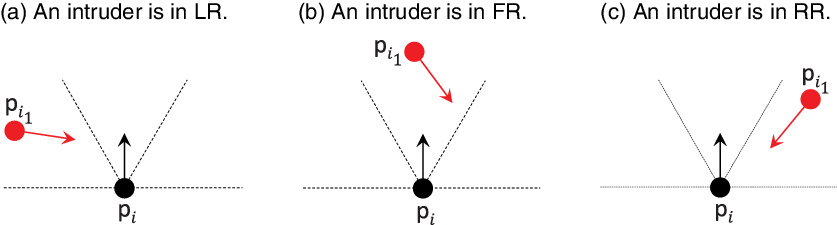
should be selected. Considering that many real-world mobile robots are equipped with three groups of sensors in the front, such as [Reference Shen, Wang, Jiang, Ji, Wang and Huang34, Reference Liu, Yao, Zhang and Zhang35], in this paper, the collision region is equally partitioned into three sectors: the left region (LR), the front region (FR), and the right region (RR). The robots in LR are left intruders, those in FR are front intruders, and in RR are right intruders. For example, Fig. 3 shows the three sectors of
 $r_i$
, where each sector has a central angle of
 $\pi/3$
.
 $r_{i1}$
and
 $r_{i2}$
are in LR,
 $r_{i3}$
is in FR, and
 $r_{i4}$
and
 $r_{i5}$
are in RR. They are the intruders of
 $r_i$
at the current instant.
Partition the collision region into three sectors and screen the most dangerous intruder in each sector.

5.2. VO-based intruder selection
To avoid the explosion of the number of fuzzy rules with the number of intruders, in this subsection, a VO-based method is proposed to select a proper intruder in each sector such that the generated rules with a finite number, independent of the number of robots.
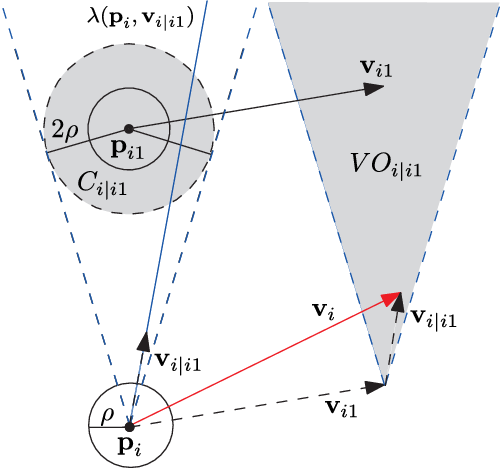
The main idea of VO is to select a velocity of a robot outside the VO, which is the set of velocity that may cause collisions with other robots or obstacles. As shown in Fig. 4, suppose robot
 $r_i$
currently is at
 ${\textbf{p}}_i$
. It detects an intruder
 $r_{i1}$
in its collision region
 $CR_i$
, whose position and velocity are
 ${\textbf{p}}_{i1}$
and
 ${\textbf{v}}_{i1}$
, respectively. So
 $r_i$
should select a velocity
 ${\textbf{v}}_i$
to avoid collision with
 $r_{i1}$
. At the current time instant,
 $r_i$
’s collision region with respect to
 $r_{i1}$
can be described as
 $C_{i|i1}=\{{\textbf{p}}(i) \in \mathbb{R}^2 | \|{\textbf{p}}(i)-{\textbf{p}}_{i1}\|_2\lt 2\rho \}$
, that is, the region within the dashed circle in Fig. 4. The relative velocity of
 $r_i$
with respect to
 $r_{i1}$
can be described as
 ${\textbf{v}}_{i|i1}={\textbf{v}}_i-{\textbf{v}}_{i1}$
. The relative motion can be defined as
 $\lambda ({\textbf{p}}_i,{\textbf{v}}_{i|i1}) = \{{\textbf{p}}_i + t{\textbf{v}}_{i|i1} |t \gt 0\}$
, that is, the blue ray in Fig. 4. Clearly,
 $r_i$
and
 $r_{i1}$
will collide in the future if
 $\lambda ({\textbf{p}}_i,{\textbf{v}}_{i|i1})\cap C_{i|i1}\neq \emptyset$
. Hence, the VO of
 $r_i$
related to
 $r_{i1}$
is defined as
 $VO_{i|i1}=\{{\textbf{v}}_i|\lambda ({\textbf{p}}_i,{\textbf{v}}_{i|i1})\cap C_{i|i1}\neq \emptyset \}$
, that is, the gray cone in Fig. 4.
Illustration of VO.
 $VO_{i|i1}$
is the velocity obstacle of
 $r_i$
. Each velocity in
 $VO_{i|i1}$
will cause a collision with
 $r_{i1}$
in some time instant of the future.

Based on VO, a method is proposed to select the most dangerous intruder in each section according to the collision risk, which is defined as the potential collision time. Furthermore, the collision time criterion is defined to evaluate the collision risk.
Definition 2
(Potential Collision Time). The potential collision time of
 $r_i$
with respect to
 $r_j$
, denoted as
 $\Delta T_i^c(j)$
, is the estimated shortest time duration from the current time instant to the occurrence of a potential collision between
 $r_i$
and
 $r_j$
with their current velocities.
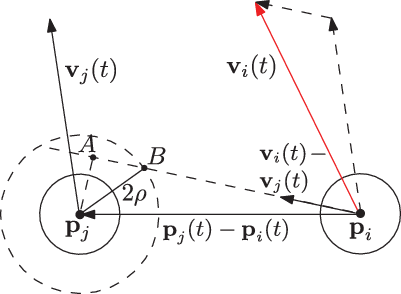
In detail, the computation of potential collision time is as follows. Consider the relative motion of
 $r_i$
with respect to
 $r_j$
. As shown in Fig. 5, for the relative motion,
 $r_j$
is with zero velocity, and
 $r_i$
has a relative velocity
 ${\textbf{v}}_i(t)-{\textbf{v}}_j(t)$
. Clearly, the minimum distance is reached at the time when the relative motion reaches position
 $A$
. The distance from
 ${\textbf{p}}_i$
to
 $A$
is
 \begin{equation} d({\textbf{p}}_i,A)=\frac{({\textbf{p}}_j(t)-{\textbf{p}}_i(t))^T({\textbf{v}}_i(t)-{\textbf{v}}_j(t))}{\|{\textbf{v}}_i(t)-{\textbf{v}}_j(t)\|_2} \end{equation}
The relative motion of
 $r_i$
with respect to
 $r_j$
.

Hence, the estimated time from
 ${\textbf{p}}_i$
to
 $A$
is
 $\dfrac{d({\textbf{p}}_i,A)}{\|{\textbf{v}}_i(t)-{\textbf{v}}_j(t)\|_2}$
, that is,
 \begin{equation} \Delta T_i(j) = \frac{({\textbf{p}}_j(t)-{\textbf{p}}_i(t))^T({\textbf{v}}_i(t)-{\textbf{v}}_j(t))}{\|{\textbf{v}}_i(t)-{\textbf{v}}_j(t)\|_2^2}. \end{equation}
Based on the procedure of VO, if
 ${\textbf{v}}_i\in VO_{i|j}$
,
 $d_i(j)\lt 2\rho$
, and vice versa. In this case, a collision between
 $r_i$
and
 $r_j$
happens when the relative motion arrives at position
 $B$
, as shown in Fig. 5. Hence,
 $\Delta T_i^c(j)$
can be computed as follows:
 \begin{eqnarray} \Delta T_i^c(j) &=& \Delta T_i(j) - t(B,A)\nonumber \\[5pt] &=&\Delta T_i(j) - \frac{\sqrt{4\rho ^2-d_i^2(j)}}{\|{\textbf{v}}_i(t)-{\textbf{v}}_j(t)\|_2}. \end{eqnarray}
Clearly, the smaller
 $\Delta T_i^c(j)$
is, the more dangerous
 $r_j$
is, and the higher priority it has for collision avoidance. According to the estimated collision time, the most dangerous intruder is selected in each sector, that is, the intruder with the smallest
 $\Delta T_i^c(j)$
in each sector. For example, as shown in Fig. 3, the selected intruder in LR is
 $r_{i2}$
as it has smaller collision time than
 $r_{i1}$
.
6. Collision avoidance using fuzzy rules and velocity obstacles
In this section, following the collision region partition, the process to build a fuzzy rule base is first presented, and then the procedure for velocity generation is provided.
6.1. Introduction of fuzzy rules
This subsection first gives a brief introduction of fuzzy rules, and the details can be found in ref. [Reference Ding, Zhou and Zhou36]. Let
 $U$
be the domain of discourse and
 $u\in U$
. A fuzzy set
 $\phi$
in
 $U$
is characterized by a real-value function
 $\mu _{\phi }\;:\; U \to [0,1]$
, which assigns each element in
 $U$
with a real number in the interval
 $[0, 1]$
.
A single fuzzy IF-THEN rule (or simply fuzzy rule) is defined on linguistic variables with the form:
 \begin{equation*} {\textbf{IF }} x \text { is } A \text { (premise}) {\textbf{ THEN }} y \text { is } B \text { (consequence}) \end{equation*}
where
 $x$
and
 $y$
are two fuzzy
 $/$
linguistic variables. A and B are two fuzzy sets. A more general type of fuzzy rules in practice can be described as:
 \begin{equation*} {\textbf {IF }} x_1 \text { is } A_1 \wedge \cdots \wedge x_p \text { is } A_p {\textbf { THEN }} y_1 \text { is } B_1 \wedge \cdots \wedge y_q \text { is } B_q, \end{equation*}
where
 $p\geq 1$
and
 $q\geq 1$
are integers.
6.2. Fuzzy rule generation
On one hand, according to the selection of intruders, the input of a fuzzy rule is the collision time
 $\Delta T^c$
of the selected intruders. On the other hand, since the kinematic model of each robot considered in this paper is unicycle kinematics, the output variables of fuzzy rules are set as the speed ratio
 $\alpha$
and the orientation change
 $\Delta \theta$
. The new speed is
 $v'_{\!\!c} = \alpha v_c$
, which adjusts the current speed
 $v_c$
according to a proper ratio
 $\alpha$
. Note that, to guarantee mutual exclusion during distributed decision making and avoid collisions, each robot is expected to turn right with a proper direction, so
 $\Delta \theta \in [0,\pi/2]$
, and the new orientation is
 $\theta _i-\Delta \theta$
, where
 $\theta _i$
is the current orientation of
 $r_i$
. Then, the selected velocity is
 ${\textbf{v}}'_{\!\!i}=(v'_{\!\!c}\cos\!(\theta _i-\Delta \theta ), v'_{\!\!c}\sin\!(\theta _i-\Delta \theta ))$
. Note that the outputs of fuzzy rules are determined by the robot kinematics described in (1), rather than robot dynamics, such as inertia.
In the sequel, the generation of fuzzy rules is described, that is, fuzzification, data sampling, and rule determination.
6.2.1. Fuzzification
The main task of fuzzification is to translate crisp variables into the corresponding linguistic ones. Hence, for each crisp variable
 $x$
, the set of fuzzy terms and their corresponding membership functions should be determined. Users can select any membership function as long as it can map the crisp data into desired degree of memberships. In this paper, the triangular membership function is applied for each fuzzy set as (1) it has been proven to have good quality results and computational efficiency in many practical applications (including robot motion control) [Reference Kreinovich, Kosheleva and Shahbazova37, Reference Ping and Yu38] and (2) it shows good performance in our simulation experiments.
First, consider the fuzzification process of the input variable
 $\Delta T^c$
. Usually, a robot needs a time duration, say response time, to perform collision avoidance, including collision prediction and decision execution. Based on the configurations of a robot and its history motion records, the minimal and maximal response time of the robots can be determined, denoted as
 $t_1$
and
 $t_2$
, respectively. If
 $\Delta T^c$
is less than
 $t_1$
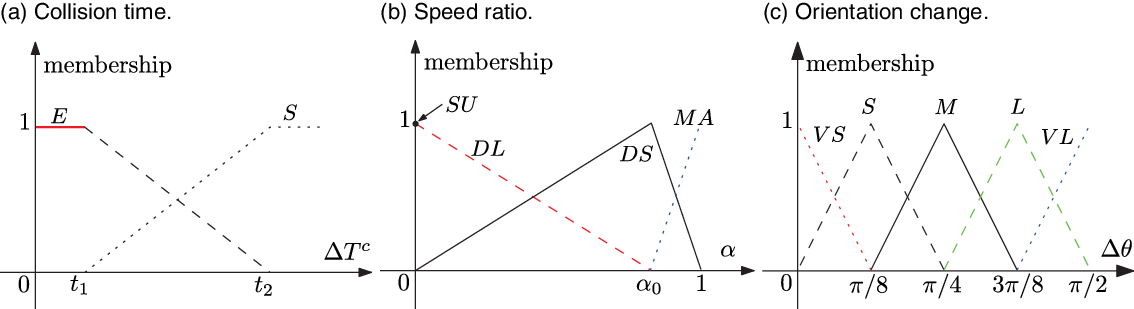
, then the situation is very emergent, and the robot needs to perform some special actions, for example, stop immediately, to avoid collisions. Otherwise, if
 $\Delta T^c$
is small, meaning that the remaining time to take collision avoidance actions is short, then this situation is dangerous, and the robot needs to do its best to avoid collisions; while if
 $\Delta T^c$
is large, meaning that the robot has enough time to avoid collisions, then the current motion is safe. Hence, three fuzzy sets, that is,
 $E$
(emergent),
 $D$
(dangerous), and
 $S$
(safe), are defined to describe
 $\Delta T^c$
. Their membership functions are shown in Fig. 6(a). Moreover, the formal definitions of all membership functions are given in the appendix.
Membership functions for all variables. (a) Membership function of
 $\Delta T^c$
; (b) membership function of
 $\alpha$
; (c) membership function of
 $\Delta \theta$
.

Second, consider the fuzzification of the output variables. (1) The speed variable is partitioned into four fuzzy sets:
 $MA$
(maintain),
 $DS$
(decelerate slightly),
 $DL$
(decelerate largely), and
 $SU$
(stop urgently). Since the level of speed deceleration is related to the current speed, the ratio of the new speed (
 $v'_{\!\!c}$
) to the current speed (
 $v_c$
), denoted as
 $\alpha$
, is the inputs of the three membership functions. Note that
 $0\leq \alpha \leq 1$
. The graphical representation of these membership functions is given in Fig. 6(b), where
 $\alpha _0$
is the threshold of a maintaining action and can be determined by an expert or based on users’ requirements. (2) For the change of orientation, five fuzzy sets are applied to describe its values:
 $VS$
(very small),
 $SM$
(small),
 $M$
(medium),
 $L$
(large), and
 $VL$
(very large). Their membership functions are shown in Fig. 6(c). Note that one can define more fuzzy sets for speed and orientation change if needed.
6.2.2. Building of fuzzy rules
As described before, to avoid an exponential increase in the number of fuzzy rules, a robot selects at most one intruder in each sector to perform collision avoidance. Hence, the premise of a rule contains at most three fuzzy propositions, each of which has four possible forms, including the empty situation. So there are
 $4^3-1=63$
possible premises. The consequence of a rule contains at most two independent fuzzy propositions, and they have four and five possible forms, respectively. Hence, the number of candidate rules is 63*(4 + 5) = 567. However, proper rules should be selected from the candidates. For each premise, the next step is to determine the consequences related to the two output linguistic variables, respectively. The rule selection is based on supporting degrees described in ref. [Reference Ding, Zhou, Pu and Zhou39]. For each premise, the supporting degrees of all candidate rules are computed, and only the rule with the maximal one is selected. Note that rules whose supporting degrees are zero are also filtered.
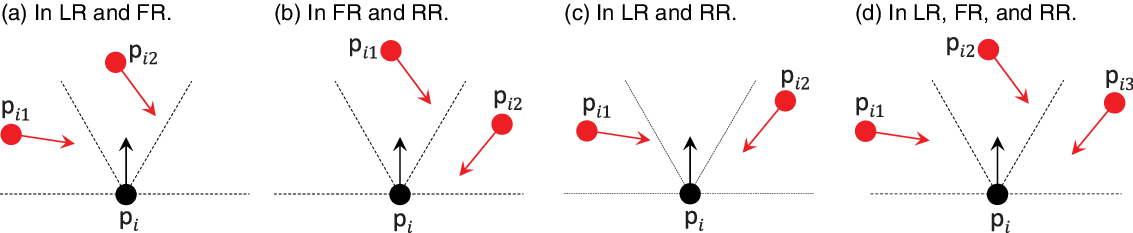
Based on the partition of the collision region and intruder selection, there are three kinds of scenarios during the generation of fuzzy rules. The first one is that there is only one sector existing a selected intruder, as shown in Fig. 7. For each one shown in Fig. 7, the sampling data are generated from multiple simulation runs by setting different status of the intruder. For each run, the ORCA algorithm is performed to generate the cooperative motion data between
 $r_i$
and the intruder. For example, suppose at time instant
 $t$
, the robot
 $r_i$
, with the state
 $({\textbf{p}}_i(t),{\textbf{v}}_i(t))$
, detects an intruder
 $r_{i1}$
, whose state is
 $({\textbf{p}}_{i1}(t),{\textbf{v}}_{i1}(t))$
, in LR, and the ORCA method generates a new velocity
 ${\textbf{v}}_{i,\text{ORCA}}(t)$
for
 $r_i$
. Let
 $\theta _{{\textbf{v}}_i}(t)$
and
 $\theta _{{\textbf{v}}_{i,\text{ORCA}}}(t)$
denote the orientation angle of
 ${\textbf{v}}_i(t)$
and
 ${\textbf{v}}_{i,\text{ORCA}}(t)$
in the inertial frame
 $XOY$
. When
 $\theta _{{\textbf{v}}_{i,\text{ORCA}}}(t) \leq \theta _{{\textbf{v}}_i}(t)$
and
 $\|{\textbf{v}}_{i,\text{ORCA}}(t)\|_2 \leq \|{\textbf{v}}_i(t)\|_2$
, a sample
 $(L_{\Delta T^c}, \Delta T_i(i1), \alpha _i(t), \Delta \theta _i(t))$
is collected, where
 $\Delta T_i(i1)$
is computed based on (4), while
 $\alpha _i(t)$
and
 $\Delta \theta _i(t)$
are computed based on the following equations.
 \begin{align} \alpha _i(t) = \frac{\|{\textbf{v}}_{i,\text{ORCA}}(t)\|_2}{\|{\textbf{v}}_i(t)\|_2}, \end{align}
 \begin{align} \Delta \theta _i(t) = \theta _{{\textbf{v}}_i}(t) - \theta _{{\textbf{v}}_{i,\text{ORCA}}}(t) \end{align}
Scenarios that there is only one thread in a sector.

In this way, a total of 1664 valid records are generated from the first kind of scenarios. With all the records, six rules are generated, whose details are given in the appendix and the website
https://fuzzyvo.github.io/. Note that the original rules are in the form with single-input–single-output, such as “IF
 $L_{\Delta T^c}$
is
 $D$
, THEN
 $v_c$
is
 $DS$
”. However, the rules with the same premise can be combined, for example, for the rules “IF
 $L_{\Delta T^c}$
is
 $D$
, THEN
 $v_c$
is
 $DS$
” and “IF
 $L_{\Delta T^c}$
is
 $D$
, THEN
 $v_c$
is
 $L$
”, they can be combined as one “IF
 $L_{\Delta T^c}$
is
 $D$
, THEN
 $v_c$
is
 $DS$
and
 $\Delta \theta$
is
 $L$
”.
The second kind of scenarios is that there exist two sectors such that either of them contains an intruder, as shown in Fig. 8(a)–(c). Similarly, 29,347 samples are collected in this kind of scenarios, and 12 fuzzy rules are generated, which are given in the appendix. The third one is that each sector contains a selected intruder, as shown in Fig. 8(d). To generate proper rules for this kind of scenarios, a total of 5299 records are collected to train rules.
Scenarios with multiple intruders.

When the collision time related to the intruder in a sector is emergent, the robot should stop urgently. Hence, three emergent rules are also introduced, which are also given in the appendix. Finally, a rule base containing 29 fuzzy rules is built. All generated fuzzy rules are listed in the appendix.
6.3. Velocity generation via fuzzy inference
When the rule base is built, the velocities can be generated directly via fuzzy inference. In this paper, the Mamdani (min) inference mechanism is applied, whose output is a fuzzy set [Reference Figueiredo, Gomide, Rocha and Yager40]. The mechanism can be described as follows. Given an input
 $x^0=(x_1^0,\ldots,x_p^0)$
and the activated fuzzy rule “
 $rule_1\;:\; \textbf{IF } x_1 \text{ is } A_1 \wedge \cdots \wedge x_p \text{ is } A_p \textbf{ THEN } y \text{ is } B$
,” the inferential fuzzy set for the consequence is computed based on (7).
 \begin{eqnarray} inf(x^0, rule_1) &=&{A_1(x_1^0)} \wedge \ldots \wedge{A_p(x_p^0)} \nonumber \\[5pt] B(y, x^0, rule_1) &=& inf(rule_1) \wedge B(y) \end{eqnarray}
where
 ${A_1(x_1^0)} \wedge \ldots \wedge{A_p(x_p^0)}=\min \{{A_1(x_1^0)},\ldots,{A_p(x_p^0)}\}$
. For the activation of multiple rules, the final inferential fuzzy set is determined based on (8).
 \begin{eqnarray} B(y,x^0)&=&B(y,x^0,rule_{i1})\vee \ldots \vee B(y,x^0, rule_{ij})\nonumber \\[5pt] &=&\max \{B(y,x^0, rule_{i1}), \ldots, B(y,x^0, rule_{ij})\} \end{eqnarray}
Since
 $B(y,x^0)$
is a fuzzy set, defuzzification is required to generate a crisp value of the velocity for the robot. One of the common defuzzification methods is the center of gravity, which determines a crisp value based on the center of gravity of the generated fuzzy set [Reference Jiang and Li41]. The computation of the center of gravity is given in (9).
 \begin{equation} y^*=\frac{\int yB(y,x^0)dy}{\int B(y,x^0)dy} \end{equation}
Based on the above procedure, given the current states of a robot and its intruders, the collision times related to different intruders are first computed and the most dangerous intruder in each sector is selected. Then, a new velocity is generated via the following fuzzy inference process: (1) decide all possible premises, that is, all combinations of the fuzzy sets of the selected intruders’ collision time; (2) for each premise, activate the corresponding rule and return a fuzzy set based on (7); (3) compute the final fuzzy set based on (8); and (4) compute the speed ratio
 $\alpha ^*$
and the orientation change
 $\Delta \theta ^*$
based on (9). Hence, the new velocity can be described as
 \begin{align}{\textbf{v}}_i^g=[\alpha ^*v_c\cos\!(\theta -\Delta \theta ^*),\alpha ^*v_c\sin\!(\theta -\Delta \theta ^*)]^T \end{align}
Using the above three steps, a candidate velocity can be generated for each robot for collision avoidance.
6.4. Velocity fine-tuning
Since fuzzy inference is a learning-based method depending on the quality of the sampling data, the generated velocity may still result in a collision. Hence, fine-tuning is required to get a collision-free velocity.
In case the generated velocity for
 $r_i$
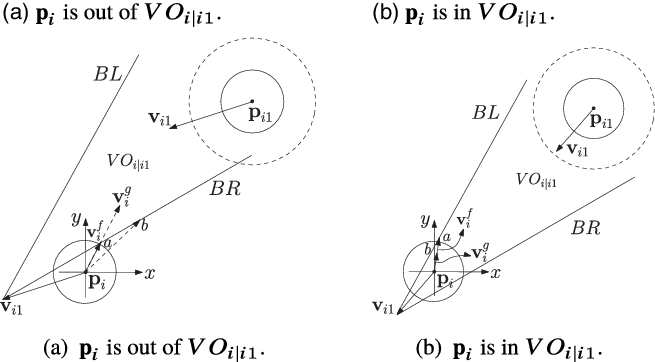
is still in the VO region of some selected intruders, the velocity should be adjusted such that it is out of the VO region. Indeed, any VO-based method can be applied, such as ORCA, to compute the current velocity. However, considering the computation cost, a heuristic fine-tuning method is proposed. As shown in Fig. 9,
 ${\textbf{v}}_i^g$
is the velocity obtained by fuzzy inference, BL and BR are the boundaries of the VO region. There are two situations based on the robot’s current position. The first one is shown in Fig. 9(a), where the current position
 ${\textbf{p}}_i$
is out of the VO
 $VO_{i|i1}$
. In this case, the solution is to decrease the generated speed
 $\|{\textbf{v}}_i^g\|_2$
to the boundary of VO (i.e., point
 $a$
in Fig. 9(a)) without changing the orientation of the velocity. The second one is shown in Fig. 9(b), where the current position
 ${\textbf{p}}_i$
is in the VO
 $VO_{i|i1}$
. In this case, the main idea is to increase the speed and
 $/$
or change the orientation of
 ${\textbf{v}}_i^g$
. However, since the built fuzzy rules prefer to decrease the speed to avoid collisions, the generated speed may be too small to guarantee collision avoidance by only changing the orientation. Hence, for this situation, the speed will be increased to the boundary (i.e., point
 $a$
in Fig. 9(b)).
Illustration of velocity refinement.
 ${\textbf{v}}_i^g$
is obtained from fuzzy inference,
 ${\textbf{v}}_i^f$
is refined velocity. (a)
 ${\textbf{p}}_i$
is out of
 $VO_{i|i1}$
. (b)
 ${\textbf{p}}_i$
is in
 $VO_{i|i1}$
.

7. Distributed algorithm for cooperative collision avoidance
This section summarizes the distributed collision avoidance algorithm based on fuzzy rules, as well as the analysis of the computation complexity.
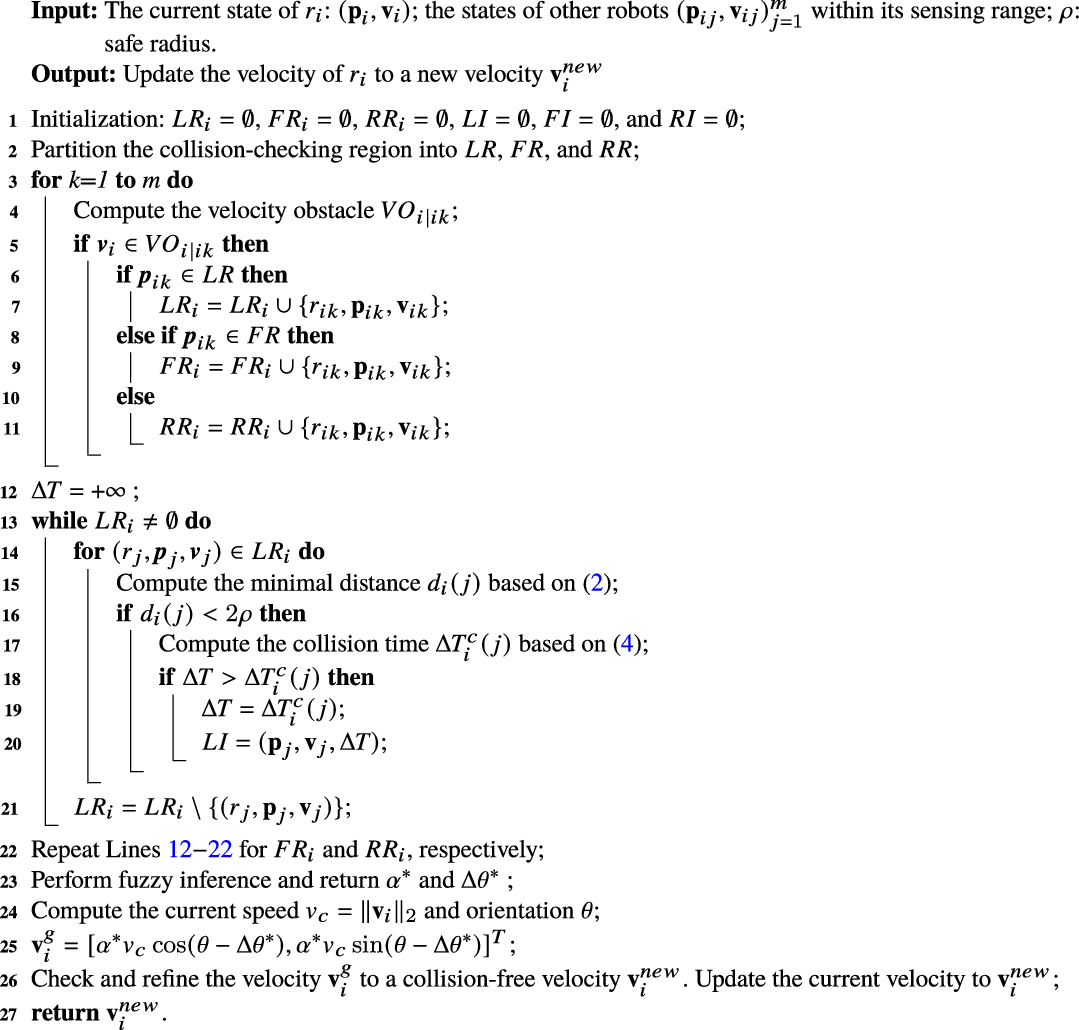
Update of collision-free velocity for
 $r_i$
at time instant
 $t$
.

Algorithm 1 describes the velocity computation at each time instant for a robot. In this algorithm, Lines 3
 $-$
11 classify the intruders into different sectors. Since there are
 $N_r$
robots in the system, in the worst case, a robot needs to check all other robots. So the computation complexity is
 $O(N_r)$
. Lines 12
 $-$
22 select an intruder in each sector. Hence, the computation complexity is
 $O(N_r)$
in the worst case. Line 23 execute fuzzy inference. Based on the described inference procedure, a robot activates multiple rules with different combinations of fuzzy sets of the selected intruders each time. In a general case, suppose each robot partitions its collision region into
 $q$
sectors, and each intruder is assigned with
 $f$
fuzzy sets. Hence, each time a robot activates at most
 $f^{q}$
rules, and the computation complexity is
 $O(f^q)$
. Once completing fuzzy inference, the robot computes the new velocity and updates its current velocity, the computation complexity is
 $O(1)$
. Hence, the total complexity of Algorithm 1 is
 $O(N_r+f^q)$
.
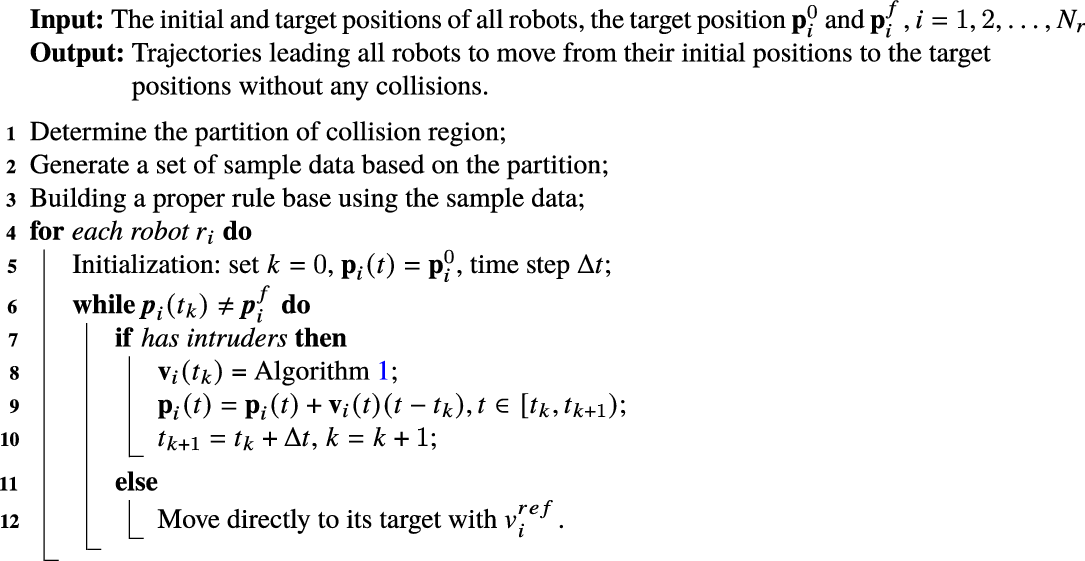
Algorithm 2 gives the distributed collision avoidance algorithm for a cooperative multirobot system. Sector partition and fuzzy rule generation are done offline before a robot starts to perform collision avoidance and move forward. The number of fuzzy rules depends on only the number of generated fuzzy sets and the number of divided sectors for each robot. With
 $q$
divided sectors and
 $f$
generated fuzzy sets, the maximal number of fuzzy rules is
 $(f+1)^q-1$
. Each robot in a system is controlled with the same rule base. Lines 6
 $-$
10 describe the motion control for each robot. Each robot executes this part in a distributed way by communicating with its neighbors to retrieve their current states. After initialization, at each time instant
 $t_k$
, a robot updates its velocity based on Algorithm 1 (Line 8), then moves with the new velocity in the next time duration
 $[t_k, t_{k+1})$
(Line 9). When time elapses, the robot updates the current time instant and check whether it arrives at its target position. If there are no intruders in its sensing range, the robot will update its speed to
 $v_i^{\text{ref}}$
and move directly to the target position (Line 12).
Distributed collision avoidance for a cooperative multi-robot system.

Note that since the rule generation depends on only the number of partitioned sectors of a robot’s collision region, Fuzzy-VO is suitable for systems with different numbers of robots, and even for a system changing the number of robots in real-time, such as deleting existing robots or adding new robots during the evolution of the system. However, Fuzzy-VO suffers from the challenge of Sim-to-Real transfer. The fundamental procedure in the proposed method is to generate a fuzzy rule base, which highly depends on the sampling data. Usually, the training data are collected from simulation since it is cost- and time-consuming to collect data from real-world execution. Due to the Sim-to-Real gap, a practical strategy is to fine-tune the rule base for real-world applications.
8. Simulation results
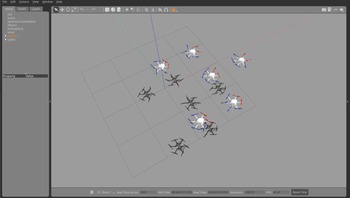
In this section, to demonstrate the efficiency of Fuzzy-VO, a set of simulations with different numbers of UAVs are conducted, equipped with generic odometry sensors, on RotorS, which is a micro air vehicle gazebo simulator with different multirotor models such as the AscTec Hummingbird, the AscTec Pelican, or the AscTec Firefly [Reference Furrer, Burri, Achtelik and Siegwart42]. Figure 10 shows a snapshot of a simulation with 6 AscTec Firefly UAVs. In simulations, all robots are flying to their target positions from initial positions at the same height. Each robot communicates with others through topic subscription and publication in ROS. In this way, the robot can subscribe to the states of others and publish its own state asynchronously in real-time. Even though assume that there are no other dynamic obstacles in the environment, each robot regards others as dynamic obstacles. Hence, the simulation results in all experiments can also extend to environments with various dynamic obstacles.
The simulation environment in Gazebo.

All simulation experiments are carried out on a Dell Precision Tower 5810 desktop running Ubuntu 16.04.6 LTS and ROS Kinetic, and equipped with Intel(R) Xeon(R) CPU E5-1650 v4 @ 3.60 GHz and 32.0 GB RAM. In experiments, the safe radius of each robot is
 $\rho = 0.55$
unit;
 $t_1$
and
 $t_2$
in Fig. 6(a) are equal to 1.2 and 8 s, respectively; the
 $\alpha _0$
in Fig. 6(b) is 0.8; the initial speed of each robot is 2 unit/s; the sensing range
 $L = 8$
units; and the time step
 $\Delta = 0.01$
s, which satisfies the default publishing rate of topics in RotorS.
8.1. Multiple robots moving in the same environment
To evaluate the effectiveness of Fuzzy-VO, the first simulation experiment is conducted with 4 AscTec Firefly UAVs, denoted as
 $r_1$
−
 $r_4$
. Their initial positions are
 $(0, 20)$
,
 $(0, 0)$
,
 $(20, 0)$
, and
 $(20,20)$
, respectively. They need to move to
 $(20, 0)$
,
 $(20, 20)$
,
 $(0, 20)$
, and
 $(0, 0)$
, respectively.
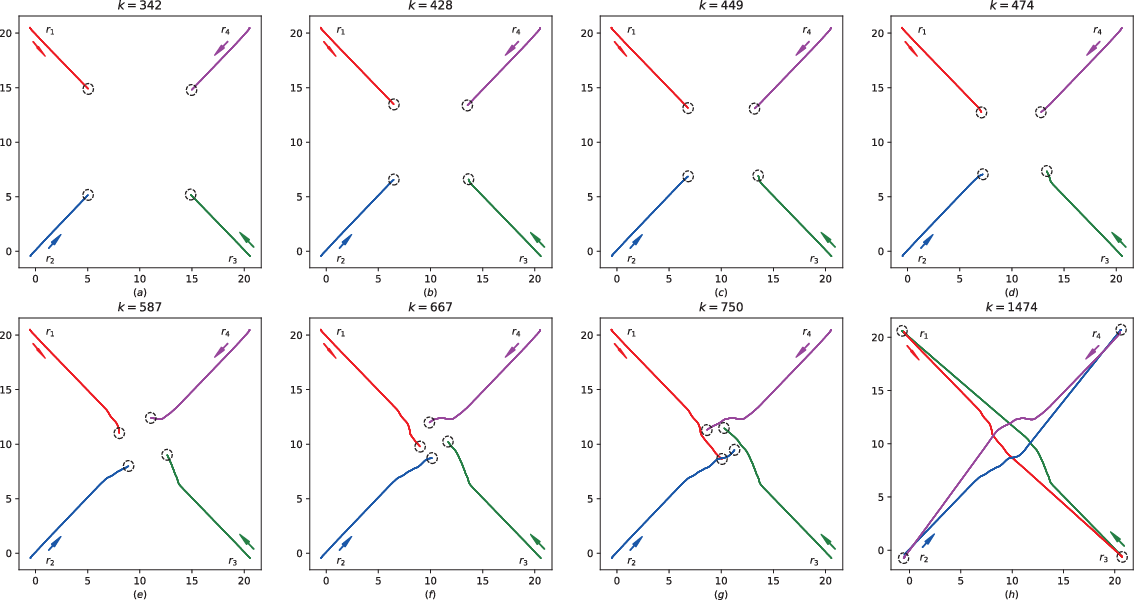
Figure 11 shows some snapshots of the motion of the four UAVs at different time instants. As shown in Fig. 11(a), from the start time to the time instant
 $k = 342$
(i.e.,
 $t=3.42$
s), each UAV detects that there are no intruders within its sensing range, so they move directly to their targets. When the time instant is
 $k = 428$
,
 $r_3$
arrives at
 $(14.135, 5.923)$
with a speed of
 $v_3 = 2$
units/s and an orientation
 $\theta _1 = 135.121^\circ$
. At this time, it detects that there are two intruders in its sensing range, namely,
 $r_2$
and
 $r_4$
, whose positions are
 $(6.218, 6.331)$
and
 $(13.808, 13.748)$
, respectively. With intruder selection,
 $r_3$
finds that
 $r_2$
is in its RR, while
 $r_4$
is in its LR. Thus,
 $r_3$
activates rules
 $15-18$
to generate the motion command. The motion command generated by Fuzzy-VO for
 $r_3$
at this time is:
 $\alpha = 0.285$
,
 $\Delta \theta = 43.423^\circ$
. Hence, as shown in Fig. 11(b) and (c),
 $r_3$
changes its motion to right from
 $k = 428$
to
 $k = 449$
. Similarly, during the motion from
 $k=449$
to
 $k=474$
,
 $r_2$
,
 $r_1$
, and
 $r_4$
detect intruders in their sensing ranges sequentially, so they turn a little bit to right to avoid collisions, as shown in Fig. 11(d). At
 $k = 474$
(
 $t=4.74$
s),
 $r_4$
is at
 $(12.787, 12.756)$
and detects
 $r_1$
,
 $r_2$
, and
 $r_3$
, whose positions are
 $(7.141, 12.635)$
,
 $(7.201, 7.049)$
, and
 $(13.546, 6.924)$
, respectively, are in its sensing range, so there are three intruders need to address for
 $r_4$
. Clearly,
 $r_1$
is in RR,
 $r_2$
is in FR, and
 $r_3$
is in LR. Since there is one intruder in each sector, rules
 $19-26$
are activated. The generated command is:
 $\alpha = 0.267$
,
 $\Delta \theta = 82.5^\circ$
. Hence,
 $r_4$
should turn greatly to right and slow down its speed, as shown by the paths in Fig. 11(e). At
 $t = 5.87$
s,
 $r_2$
detects
 $r_3$
is in its FR, so rules 3 and 4 are activated to generate command (
 $\Delta \theta = 23.279^\circ$
) for
 $r_2$
, which brings
 $r_2$
to turn right. After
 $t = 5.87$
s,
 $r_4$
does not detect any intruder in its sensing range, so
 $r_4$
only needs to move towards the target position. Such motion of them can be found in Fig. 11(f). When
 $k=667$
, that is,
 $t = 6.67$
s, the orientation of the four UAVs are −41.618
 $^\circ$
, 48.85
 $^\circ$
, 140.068
 $^\circ$
, and −129.561
 $^\circ$
, respectively. For
 $r_3$
and
 $r_4$
, the initial orientation is 135
 $^\circ$
and −135
 $^\circ$
, respectively. Based on the motion shown in Fig. 11(f) and (g), from
 $t = 6.67$
s to
 $t = 7.50$
s, each robot turns a little bit to right first to avoid collisions with other robots. When there are no intrudes in its sensing range, each robot turns to left to move directly to its target.
Detailed simulation process of collision avoidance for four UAVs.

As time elapses, the system reaches Fig. 11(g) at
 $t = 7.50$
s. From now on, even through there are others UAVs within their sensing ranges, the four UAVs detect that there are no collisions in the future, and all potential collisions are resolved. Hence, each UAV moves directly to its target again. As shown in Fig. 11(h), all robots reach their targets at
 $t = 14.74$
s. From their traversed trajectories, an observation is that in order to pass the intersection without any collision, each robot moves to its right side to avoid collisions. From their traversed trajectories, it is can be seen that in order to pass the intersection without any collision, each robot moves to its right side to avoid collisions. As in the ground traffic system, such motion of these robots is similar to the motion within a roundabout [Reference Zhou, Hu, Liu, Lin and Ding16].
Furthermore, more simulations are also conducted with 3, 4, 6, and 8 UAVs, respectively. All videos of simulations can be found at https://fuzzyvo.github.io/. It can be seen that Fuzzy-VO can serve as an effective and universal collision avoidance method, for multirobot systems with different numbers of robots, by leveraging the advantages of fuzzy rules and VOs.
8.2. Comparison of Fuzzy-VO with other fuzzy rule-based methods
Since our method improves fuzzy rule-based methods, which can deal with uncertainties and linguistic variables, we compare Fuzzy-VO with the pure fuzzy rule method on the number of rules and the smoothness of the generated paths. In addition, more experiments are also conducted to compare the performance of the proposed intruder selection method with other selection methods.
8.2.1. Comparison with pure fuzzy rule method
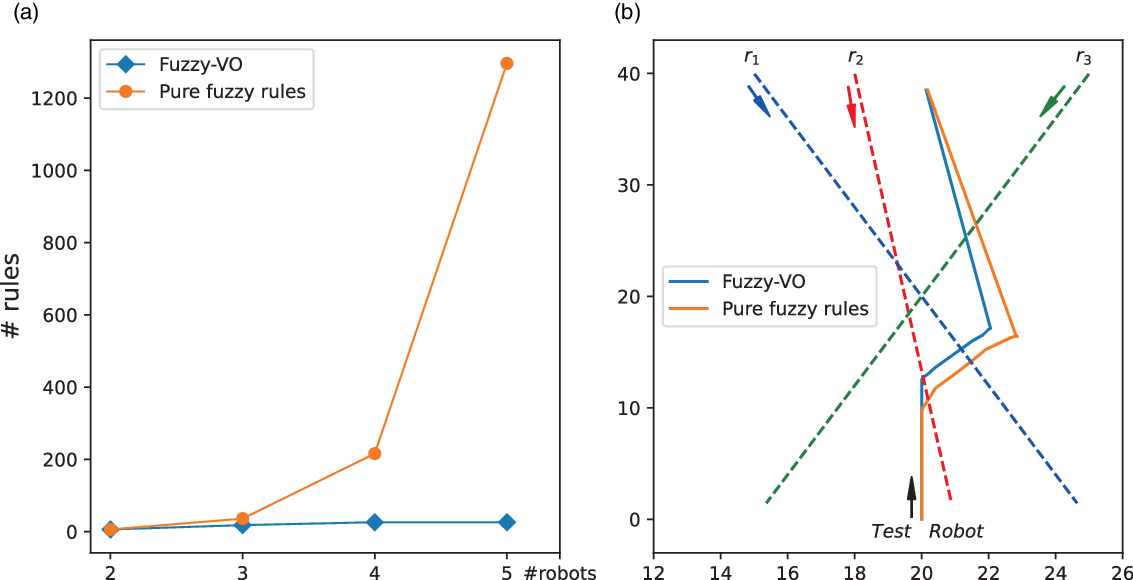
Let us first consider the number of rules. For the pure fuzzy control method, at any time instant, a robot evaluates the risks related to all other robots and then determines its motion. Hence, the rules are generated directly based on the number of robots in a system. Indeed, in this method, the number of rules increases exponentially with the number of robots in the system. Suppose the risk related to each robot is described by two fuzzy sets: dangerous and safe, and the orientation is described by three fuzzy sets: left, front, and right. If there are
 $M$
robots in a system, the possible rules are
 $6^{M-1}$
. For example, as shown in Fig. 12(a), when there are three, four, and five robots, respectively, the required numbers of rules is 36, 261, and 1296, respectively. However, in Fuzzy-VO, by intruder selection, the number of rules is fixed and does not change when the number of robots is larger than 3. As shown in Fig. 12(a), when there are two robots in the system, there is one obstacle to be processed, so only six rules required for both Fuzzy-VO and pure fuzzy rule control. There are 18 rules when the system contains three robots. When
 $M\geq 4$
, the number of rules in Fuzzy-VO is always 26 (without considering the emergent situation described before), which is independent of the number of robots. The result indicates that Fuzzy-VO decreases the number of fuzzy rules significantly by selecting a proper and fixed number of intruders.
The number of rules and the generated paths of Fuzzy-VO and pure fuzzy rule method. The dotted lines indicate the paths of the dynamic obstacles.

Let us further compare the paths generated by the two methods. Consider the situation that there are three dynamic obstacles (
 $r_1 - r_3$
) and a Test Robot. The Test Robot is placed to
 $(20, 0)$
with an initial speed is 2 units/s, and its target position is
 $(20, 40)$
. The three obstacles’ initial positions are
 $(15, 40)$
,
 $(18, 40)$
, and
 $(25, 40)$
, respectively; their missions are that
 $r_1 - r_3$
need to move directly to
 $(25, 0)$
,
 $(21, 0)$
, and
 $(15, 0)$
, respectively, with a fixed speed 2 units/s. Figure 12(b) shows the paths that the robots traversed. The solid lines represent the paths of the Test Robot. From the paths, an observation is that the path generated by Fuzzy-VO is smoother. Indeed, in pure fuzzy rule method, due to the excessive considering of the larger number of fuzzy rules, some unnecessary rules are activated to generate motion sometimes, which make the generated path oscillating. The result validates that the path of a robot may be oscillating when there are a large number of rules. Since it generates a proper number of rules, Fuzzy-VO can produce smoother paths.
8.2.2. Performance comparison of different selection methods
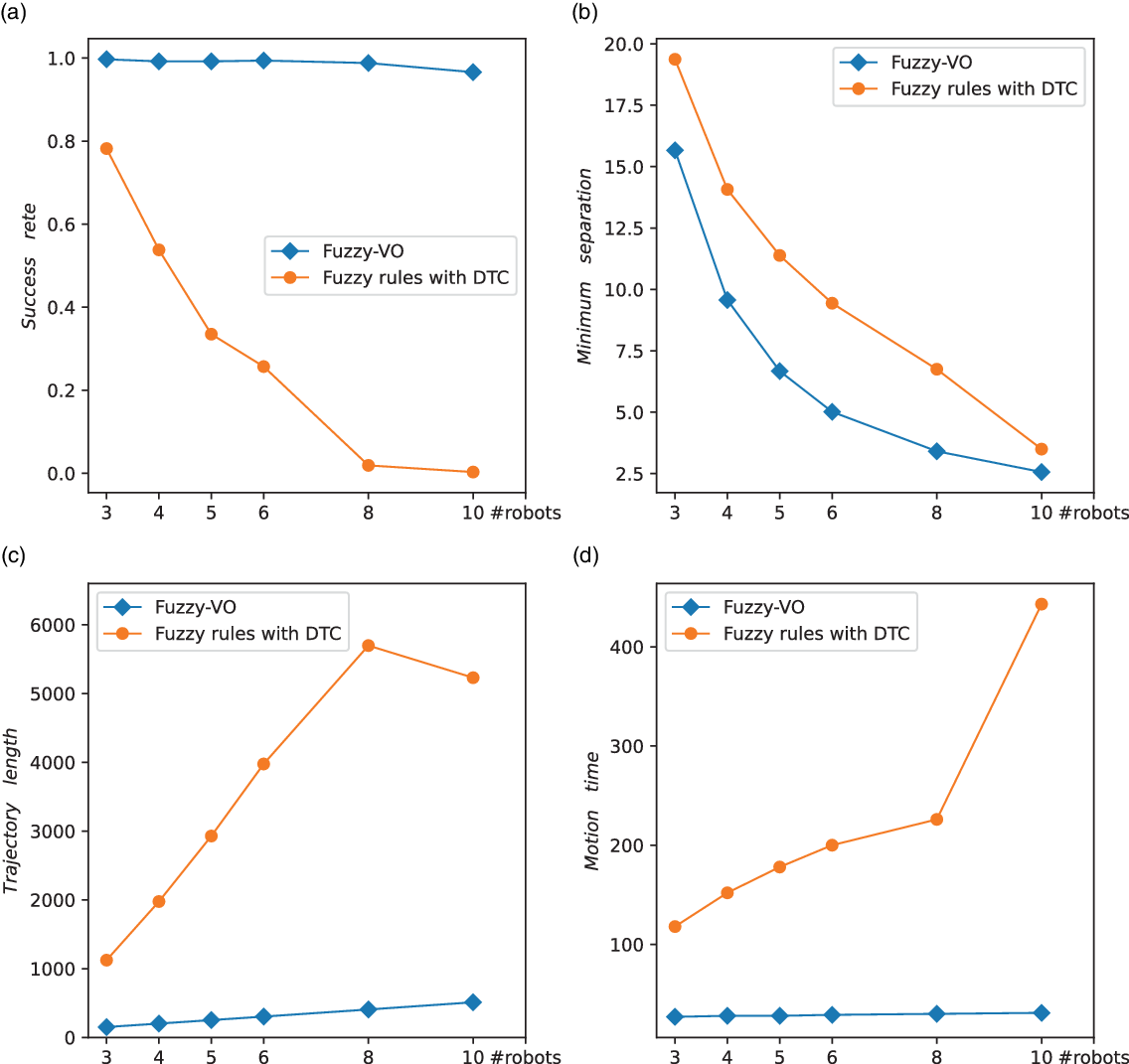
The common metrics to assess collision risks in a dynamic environment include: distance to collision (DTC), time to collision (TTC), and time to react (TTR) [Reference Katrakazas, Quddus, Chen and Deka43]. As mentioned before, this paper focuses on TTC, that is, potential collision time in Fuzzy-VO, to select the most dangerous intruder in each sector. In some scenarios, a robot can only determine the nearest obstacle considered in each region using its onboard sensor information directly, such as that of ultrasonic sensors and laser sensors. Thus, the collision risk in evaluated based on DTC, such as [Reference Wen, Zhou and Wang21]. For a deeper exploration of Fuzzy-VO, the performance comparison between the two methods is studied. The systems are initialized with 3, 4, 5, 6, 8, and 10 robots, respectively, using Monte Carlo simulation. For each system, 10,000 experiments are performed. In each experiment, the initial and target positions for each robot are randomly assigned. Then, Fuzzy-VO and the DTC-based method (the configurations of fuzzy sets, membership functions, and fuzzy rules are the same as [Reference Wen, Zhou and Wang21]) are run independently. The comparison metrics are as follows.
-
1. Success rate. It is defined as the ratio of the number of experiments in which each robot arrives at its target position successfully while maintaining a safe distance with other robots at any time instant.
-
2. Minimum separation. It is defined as the minimum distance between any two robots during their motion in each collision-free experiments.
-
3. Trajectory length. It is defined as the path length of a robot. Due to different initial and target positions, the trajectory length is normalized by the distance between each pair of initial and target positions. Hence, trajectory length can be computed as follows.
(11) \begin{eqnarray} L_{tr}(i) = \frac{\sum _{k} \|{\textbf{p}}_i(k+1)-{\textbf{p}}_i(k)\|_2 }{\|{\textbf{p}}_i^o-{\textbf{p}}_i^f\|_2} \end{eqnarray}
-
4. Motion time. It is defined as the discrete steps performed from the initial position to the target position of a robot.

For each system, the mean of each metric and the comparison results are shown in Fig. 13. As shown in Fig. 13(a), with the increase of robots, DTC-based selection cannot be applied anymore since most of the experiments are in collisions, while Fuzzy-VO is still with a low collision rate. In addition, from the average statistics aspect, compared to the DTC-based selection, the average success rate of Fuzzy-VOs can be increased by 306.5%. Note that the reasons for the happening of collisions in Fuzzy-VO are that: (1) since the initial and target positions are generated randomly, they may be in collisions when they are spawned; (2) currently, there are only two fuzzy sets associated to the collision time in Fuzzy-VO, so a robot in some situations may not be able to respond to collisions timely; it can be addressed by refining the collision time with more fuzzy sets; however, the more fuzzy sets, the more fuzzy rules; further study on how to balance the number of fuzzy sets and motion performance is one of future directions. Figure 13(b) shows that Fuzzy-VO can deal with collisions more precisely since it generates lower minimum separation in the context of collision avoidance. Figure 13(c) and (d) show that Fuzzy-VO can generate lower trajectory length and shorter motion time to complete the motion tasks.
Comparison of motion performance between Fuzzy-VO and DTC-based method.

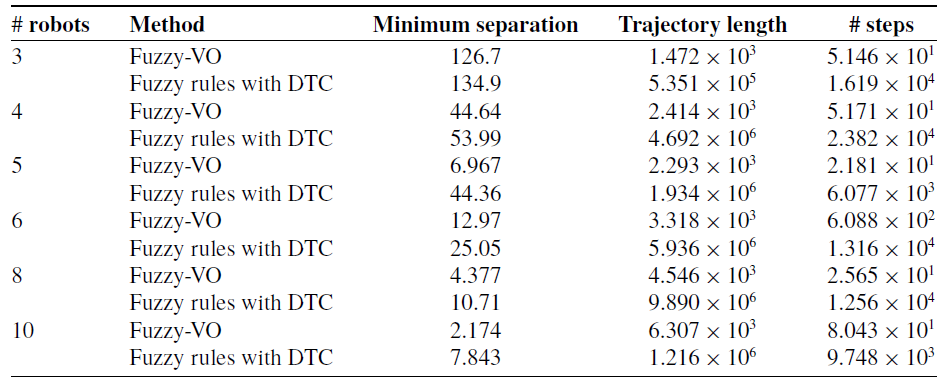
Additionally, the variances of minimum separation, trajectory length, and steps are shown as in Table II. It can be found that in all experiments, Fuzzy-VO can generate a smaller variance than fuzzy rules with DTC. Hence, it can be concluded that the proposed intruder selection method can assess the collision risk accurately and guarantee a higher success rate.
Comparison of the variances of minimum separation, trajectory length, and steps.

8.3. Comparison of Fuzzy-VO with ORCA
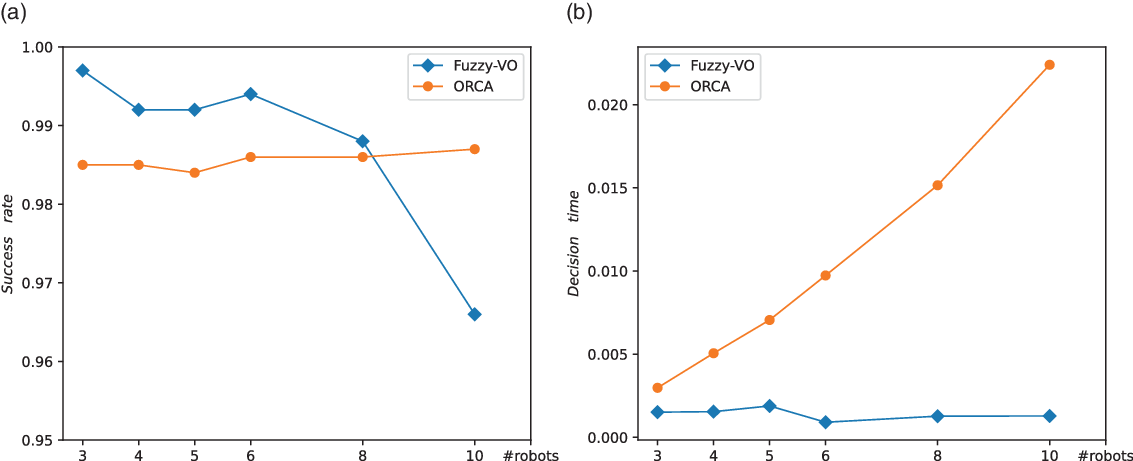
At last, the comparison between Fuzzy-VO and ORCA [Reference van den Berg, Guy, Lin and Manocha14] is carried out. It aims to investigate the real-time decision efficiency of Fuzzy-VO. The experiments on six systems are conducted with different robots, that is, 3, 4, 5, 6, 8, and 10 robots, respectively. For each system, running Fuzzy-VO and ORCA 10,000 times, respectively. Figure 14(a) shows different methods’ average success rates under the control of the two methods. It can be observed that even though the success rate decreases as the number of robots vary from 3 to 10, Fuzzy-VO can remain a high success rate. Note that in Fuzzy-VO, it is a trade-off between the number of selected intruders and the collision avoidance performance. If the number of selected intruders is too large, the computation cost will increase, and the smoothness of generated trajectory will decrease. If the selected intruders are too few, the generated velocities may cause collisions. Hence, sometimes, users need to determine an appropriate number of collision regions.
Comparison of avoidance performance between Fuzzy-VO and ORCA.

To further compare the real-time performance, the average one-step decision time (average time consumed for generating one candidate velocity) of the two methods is calculated. The results are shown in Fig. 14(b). From the results, it can be found that Fuzzy-VO has a shorter average decision time at each time step. With the increase of the number of robots, Fuzzy-VO can filter more nonurgent robots and has a less average one-step decision time for each robot. But the decision time of ORCA method increases with the number of robots in a system, as ORCA makes decision by resolving an optimization problem considering all other robots. The average one-step decision time of Fuzzy-VO is reduced by 740.9%, compared with the ORCA. This comparison results also further validate that Fuzzy-VO can improve the real-time decision efficiency without losing much success rate.
9. Conclusion
In this paper, a distributed and hybrid method, Fuzzy-VO, for collision avoidance in multirobot systems is proposed. The proposed method leverages the advantages of fuzzy rules and VOs simultaneously. It can deal with uncertain data and linguistic variables and also guarantee both safety and computation efficiency. It is suitable for multirobot systems with different numbers of robots. In the method, a fixed form and number of fuzzy rules are generated via collision region partition and intruder selection. To guarantee safety, Fuzzy-VO applies VO-based fine-tuning to further check and adjust the velocity generated by fuzzy inference. Experimental results with different scenarios show a 306.5% improvement in success rate and a 740.9% reduction in decision time, demonstrating the effectiveness of the proposed method.
Future work includes implementing Fuzzy-VO on real robot platforms to further investigate the performance of the proposed method. Another interesting topic is to study the combinations of other model-driven methods and data-driven methods and compare their performance and scopes of application.
Supplementary material
To view supplementary material for this article, please visit https://doi.org/10.1017/S0263574722001515.
Author Contributions
All authors conceived and designed the study. Wenbing Tang and Yuan Zhou implemented the research and wrote the manuscript. Zuohua Ding and Jing Liu developed the fuzzy-logic controller. Tianwei Zhang and Yang Liu reviewed and edited the manuscript.
Financial Support
This work was supported by the Natural Science Foundation of China under Grant Nos. 61751210, 61210004 and 61170015, Academic Research Fund Tier 2 by Ministry of Education in Singapore under Grant No. MOE-T2EP20120-0004.
Conflicts of Interest
The authors declare that there is no conflict of interests.
Ethical Approval
None.