Introduction
Although older adults are traditionally considered less mobile than younger adults (Nord, Reference Nord2013) and to prefer residential stability (Longino, Reference Longino2006), many of them will move at least once to another residence after retirement (Banks et al., Reference Banks, Blundell, Oldfield and Smith2012). Thus, for many older adults today, the question is not only whether to move or not – but also where to move.
Until recently, the answer to this second question was straightforward. Older adults could choose between two options: moving to a different home that is more suitable for their current and future physical state, or to move to a traditional long-term care facility (LTCF). Consistent with this approach, late-life relocation was viewed as a fixed route with three stages. According to Litwak and Longino's (Reference Litwak and Longino1987) lifecourse model of later-life migration, the first relocation is supposed to take place soon after retirement and is usually prompted by amenities that are offered by a desired place of residence. The second relocation tends to be characterised by moves back to a place of origin in order to receive support from family members. The third and final move to a LTCF typically occurs in response to an illness or onset of a disability and is meant to be ‘the final station’. However, during the last two decades, this fixed route has become more flexible, as more options were added to meet growing demands for alternative types of housing. In the last decade, one of the more recent options is to become a resident in a continuing care retirement community (CCRC).
CCRCs are privately owned facilities that offer a continuum of levels of care that range from independent living, assisted living to living in a nursing home with skilled nursing care. CCRCs feature amenities such as dining, health and wellness programmes, social and recreational activities, transportation and more within a secure environment. As such, CCRCs serve as a very flexible care alternative to the LTCF and allow older adults to maintain autonomy and independence, while providing assistance when needed (Doron and Lightman, Reference Doron and Lightman2003). As CCRCs include housing for independent older adults, residents generally move to a CCRC while still capable of performing daily activities. However, many residents eventually move to a higher level of care within the CCRC as their functioning declines (e.g. assisted living or nursing units) (Hunt et al., Reference Hunt, Feldt, Marans, Vakalo and Pastalan2015). As such, for many of them, the CCRC will replace the LTCF and become ‘the final station’ (Hays et al., Reference Hays, Galanos, Palmer, McQuoid and Flint2001).
Despite many benefits, moving in general and to a CCRC in particular, is not without fiscal and psycho-social cost. According to the environmental fit theory (Lawton et al., Reference Lawton, Lawton, Windley, Byerts, Byerts, Lawton and Windley1982), the decision to relocate is associated with the extent to which older persons perceive their surroundings as appropriate for their needs. If the home is in a poor state, or if access to it is difficult, the urge to move to a better-adjusted location would be stronger. In addition, according to Atchley's (Reference Atchley1989) continuity theory, older people strive to maintain the same lifestyle they are used to – both internally (thoughts, emotions) and externally (activities and physical and social environment). As such, their post-decision wellbeing – both of those who moved to a CCRC and those who decided to stay at home or to move elsewhere – depends on the ability of the environment to continue to supply the older adults’ needs. In addition, some have argued that the way in which a decision is made, and not just its outcome, might affect the extent to which it is regarded (Connolly and Zeelenberg, Reference Connolly and Zeelenberg2002). In other words – the extent to which the move to an assisted living facility was perceived as being forced (Lustbader, Reference Lustbader2013). Several additional factors can negatively influence the wellbeing of CCRC residents, including the relocation process and the need to adjust to a smaller housing unit (Ekerdt et al., Reference Ekerdt, Sergeant, Dingel and Bowen2004), weak boundaries between private and public spaces (Croucher et al., Reference Croucher, Pleace and Bevan2003), stigma associated with age-segregated dwellings (Erickson and Krout, Reference Erickson and Krout2012), and the need to adjust to communal living and a daily routine that is to some extent governed by the demands of the institution (Zisberg et al., Reference Zisberg, Kaabiya and Siegel2015). However, it appears that for many the benefits outweigh the costs, as the popularity of this living arrangement continues to grow (Wrights et al., Reference Wrights, Fain, Miller, Rejeski, Williamson and Marsh2015).
As CCRCs become more prominent, so does research. Studies to date have focused mainly on ‘pushing’ and ‘pulling’ influences on the decision to move, and on adjustment to this unique living arrangement. We know, for example, that current and future health conditions, a desire to not burden others, fear of loneliness and the physical condition of the person's current home (e.g. steps, narrow doors that do not allow a wheelchair to pass, isolation, renovation needs) can push people to decide to move to a CCRC, while attachment to place and stigma can pull them back from a decision to move (Rowels, Reference Rowels, Wahl, Brenner, Mollenkopf, Rothenbacher and Rott2006; Erickson and Krout, Reference Erickson and Krout2012). As for adjustment to the CCRC, it seems that support from family and friends (Sugihara and Evans, Reference Sugihara and Evans2000), cognitive state (Moen and Erickson, Reference Moen and Erickson2001) and engagement in various activities (Cutchin et al., Reference Cutchin, Marshall and Aldrich2010) positively contribute to adjustment.
Although we are starting to understand why people choose to move to a CCRC and how they adjust, some unanswered questions remain. For example, we still do not know exactly how relocation to the CCRC affects psychological and physical wellbeing and how wellbeing changes with time. A few studies have begun to address these issues. Roberts (Reference Roberts2013) used a longitudinal design to examine the quality of life of CCRC residents over time, and found that overall quality of life declined over five years. She concluded that participating in the CCRC formal activities may slow this process, but does not prevent it. However, her baseline measure was performed one year after moving into the CCRC, which could result in bias. As for health, one study found that, while indices of objective health indicated deterioration, subjective health remained stable (Gaines et al., Reference Gaines, Poey, Marx, Parrish and Resnick2011). Others have followed the occurrence and impact of depression over a two-year period. Mossey and Gallagher (Reference Mossey and Gallagher2004) found that even in the most independent group, depression was prominent and stable through the years. As for satisfaction with services, Croucher et al. (Reference Croucher, Pleace and Bevan2003) found that satisfaction soon after enrolment was high, and improved slightly two years later.
Knowing how satisfaction and wellbeing of CCRC residents change with time is important – but not enough. To understand fully the outcomes of moving to a CCRC, it is important to compare movers to comparable community-dwelling older adults. Thus, another unanswered question is what happens to those who did not move. At least two studies have tried to answer this question by comparing CCRC residents to non-residents. For example, Young et al. (Reference Young, Spokane, Shaw, Macera and Krout2009) explored the contribution of comprehensive services in CCRCs (mainly activities and medical services) to subjective and objective health. They compared residents from two CCRCs to community-dwelling older adults from the third wave of the US Longitudinal Study of Aging database who were interviewed during the same time frames (2000 and 2002). They found that CCRC residents were at less risk for activities of daily living (ADL) limitations and had better self-reported health two years after baseline measure. Gaines et al. (Reference Gaines, Poey, Marx, Parrish and Resnick2011) obtained similar results when comparing CCRC residents to community-dwelling older adults from the US Health and Retirement Study (HRS). They found that at follow-up two years later, CCRC residents reported more comorbidities, while having better subjective health.
While the gap between the subjective appraisal of health and its objective appraisal is well documented in the literature (e.g. Whitehead, Reference Whitehead2013), the discrepancy in favour of the subjective health is less intuitive. However, according to the response shift concept (Hinz et al., Reference Hinz, Häuser, Glaesmer and Brähler2016), a deterioration of health can cause the older adult to evaluate his or her health state in a more positive way. In addition, a few other variables were found to contribute to a positive subjective appraisal of health. These are social interactions, recreational activities (Panten et al., Reference Panten, Stone and Baker2017) and the availability of medical staff (Joseph et al., Reference Joseph, Choi and Quan2016). CCRCs address all of these factors simultaneously by offering various opportunities for activities for different levels of dependency, medical case management and round-the-clock social interactions. As such, it is not surprising that the subjective wellbeing of CCRC residents is higher than those who are not CCRC residents.
While comparing CCRC residents to community-dwelling older adults gives us important information, in order to understand the magnitude and the course of the changes fully we need to compare CCRC residents specifically to those who were interested in moving or those who were on waiting lists, but who eventually decided not to move. Furthermore, it is important to approach home-stayers interested in the same CCRCs as those who eventually moved. This is because there is significant variability in CCRCs specific to overall cost, services provided, number of residents and type of building (e.g. detached, condominium). In short, if you see one CCRC, you saw only one CCRC. While there appear to be no studies comparing CCRC residents to non-residents who inquired about enrolling in the same CCRC, two studies have interviewed residents and waiting list respondents (Sheehan, Reference Sheehan1995; Erickson and Krout Reference Erickson and Krout2012). However, neither of these studies interviewed those who did not enrol at a later time about their wellbeing.
The current study
The overarching goal of the current study was to address research questions related to outcomes (satisfaction with residence, wellbeing, number of health conditions and subjective health rating) of individuals who move to CCRCs and those who considered but do not move. Thus, we followed CCRC residents and former CCRC candidates of the same CCRCs shortly after the move or non-move and then again one year later. Our first aim was to investigate what differentiates between those who enrolled and those who considered enrolling but elected not to. In line with the current literature, we hypothesised that when first interviewed CCRC residents would hold more favourable attitudes towards CCRCs than those who chose not to move. We also expected that the subjective and objective health status of CCRC residents would be worse than home-stayers at baseline.
Our second aim was to explore whether living arrangement predicted long-term satisfaction with residence, wellbeing, and objective and subjective physical health. For satisfaction with residence and wellbeing, we hypothesised that, while there would be no difference at baseline, a long-term difference in favour of the CCRC residents would be found. We did not have specific hypotheses for objective health status at follow-up, as a one-year period might not be long enough to investigate this issue. However, in line with the literature, we did hypothesise that the subjective health of CCRC residents would be higher than CCRC candidates at follow-up.
Methods
Participants and recruitment
Participants (N = 101) were recruited from 13 CCRCs located in multiple cities in the United States of America. All belonged to an umbrella corporation: the Brookdale ETc. In each CCRC, two employees were identified to serve as a primary and a secondary liaison. These liaisons were trained by the research team to recruit participants. For residents, they were instructed to recruit all English-speaking residents as soon as possible after moving into the CCRC (within three months). They were also instructed to recruit all English-speaking home-stayers at the point when the latter informed the liaison of their decision to not move. Liaisons were instructed to use recruitment flyers and a script developed by the research team to obtain verbal consent to share the name and telephone number of potential participants with the research team.
Measures
Demographics
Participants self-reported gender, age, living status (alone or with a partner) and annual household income. They also reported the distance from their home to the CCRC they moved to (or visited).
Attitudes towards CCRC
Participants were presented at baseline with a series of nine positive and negative statements regarding CCRC: Comparing community CCRC is the right place for people like me; When people get old, they should move to CCRC to fulfil their needs; Comparing community, CCRC is too expensive for most of the people; Comparing community, CCRC is the best option; CCRC offers variety of social options that is hard to find in the community; CCRC offers variety of health services that is hard to find in the community; CCRC offers sense of security that is hard to find in the community; Comparing community, there is no privacy at the CCRC; Comparing community, you lose sense of control when you move to CCRC. The participants stated whether they agreed (‘true’) or disagreed (‘false’) with each of the statements, and after recoding, a sum of the positive answers was calculated. For this study, Cronbach's α = 0.70. Attitudes were calculated such that higher scores indicate the number of positive attitudes towards CCRCs. The baseline score range was 4–9.
Proximity to services and amenities
Proximity to services (health, leisure, financial, religious and food) was evaluated based on self-report, according to difficulty in accessing, ranging from 1 (‘very difficult’) to 5 (‘very easy’). A sum was calculated, and the baseline score range was 23–48.
Wellbeing
Wellbeing was assessed by the General Health Questionnaire (GHQ), a 12-item measure of psychological wellbeing (Goldberg and Williams, Reference Goldberg and Williams2000). It included questions regarding being capable of making own decisions, amount of strain and ability to engage in enjoyable activities. Baseline scores range from 8 to 35, with higher scores representing better wellbeing. For this study, Cronbach's α = 0.84.
Satisfaction with residence
This measure was adapted based on a review of the literature on satisfaction measures that identified several core domains of satisfaction (Moore, Reference Moore2004). Participants rated their agreement (1–5) on seven questions (I am satisfied with my overall living arrangement; I am satisfied with the recreational activities available to me within my living arrangement; I am satisfied with the appearance of my living arrangement; I am satisfied with the food available to me within my living arrangement; I am satisfied with the level of privacy available to me within my living arrangement; I am satisfied with the services available to me in my living arrangement; I am satisfied with the social support available to me within my living arrangement). The baseline score range is 14–28, and higher scores represent higher satisfaction. For this study, Cronbach's α = 0.70.
Objective health
Objective health was measured by a list of 18 common medical conditions diagnosed by a physician (e.g. heart attack, high blood pressure) (Shiovitz-Ezra and Ayalon, Reference Shiovitz-Ezra and Ayalon2010). For each participant, the number of medical conditions score was calculated. A higher score means more medical conditions, which reflects lower objective health status. The objective health score at baseline ranged from 0 to 11.
Subjective health
Subjective health was evaluated by the single question ‘How would you rate your health?’ (Brook et al., Reference Brook, Ware, Davies-Avery, Stewart, Donald, Rogers, Williams and Johnston1979). Answers ranged from 1 (‘excellent’) to 5 (‘very poor’). The subjective health score ranged from 2 to 5.
Limitations in ADLs and instrumental activities of daily living (IADLs)
Participants were asked if they can perform without any assistance (yes/no) six ADLs (showering, dressing, using the restroom, moving from place to place, bladder control, eating) and five IADLs (cooking, cleaning, launding, shopping, going to the post office or bank). The questions were adopted from the Katz et al. (Reference Katz, Downs, Cash and Grotz1970) index of ADLs and the Lawton and Brody (Reference Lawton and Brody1969) index of IADLs. The outcome variable was a count variable of all the ADL and IADL impairments. The total score ranged from zero to 11 limitations.
Procedures
Informed consent and all interviews were conducted by telephone with a trained research interviewer. The interviewer read an informed consent script and participants provided verbal informed consent. The interviewer then completed the baseline interview, reading items and response options in a consistent manner across participants. The interviewer confirmed the participant's contact information and obtained a back-up telephone number if the participant agreed to participate in a follow-up phone interview. The interviewer called approximately one year later to conduct the follow-up interview and administer the same measures plus the satisfaction with residence questions. The average time from baseline to follow-up was 369.25 days, with standard deviation (SD) of 13.11. The range was between 340 and 390 days. Participants were paid US $20 by mail for their participation. All materials and procedures were approved by the The University of South Florida Institutional Review Board.
Data analyses
To accomplish Aim 1 (baseline differences), a series of independent t-test and chi-square procedures was performed. For Aim 2 (predicting one-year outcomes), a multivariate longitudinal analysis was conducted, applying the generalised estimating equations procedure (SPSS version 19). Four outcomes were examined: satisfaction with residence, wellbeing, objective health (number of health conditions) and subjective health. Eleven participants from the baseline did not complete the 12-month follow-up interview. Nine were non-residents and two were residents. No differences were found between those who completed follow-up and those who did not in any of the demographic or outcome baseline variables. In addition, two participants who were originally designated as home-stayers at baseline were found to be CCRC residents at follow-up. We dropped them from this analysis in order to prevent bias in the longitudinal analysis. All home-stayers lived in their original baseline dwelling. Our main predictor was living arrangement (CCRC versus community dwelling). We focused on the living arrangement × time interaction as it reflects the predictor effect on the long-term change in the dependent variables.
Results
Aim 1: Baseline comparisons
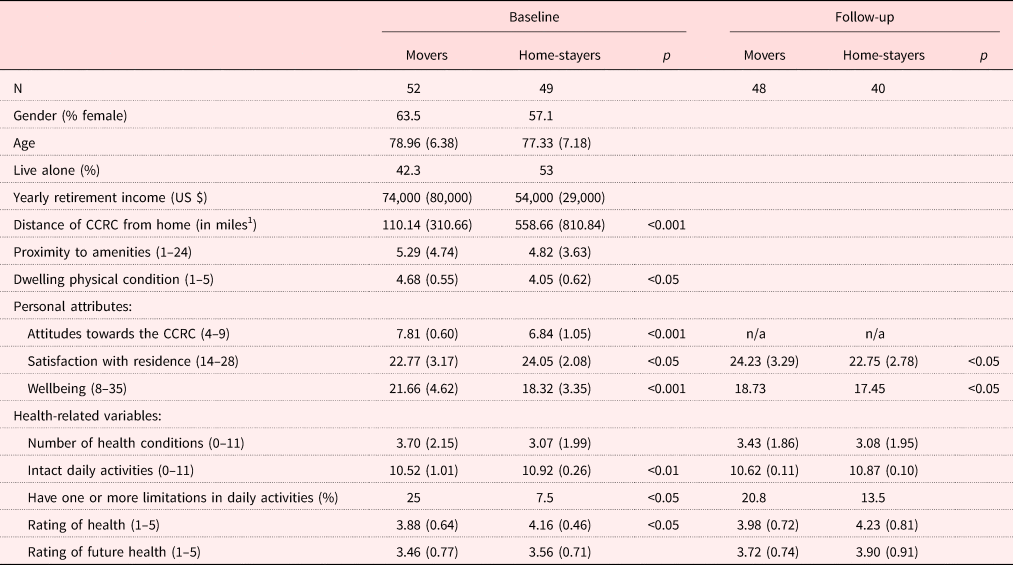
Table 1 presents the baseline comparisons between CCRC residents and home-stayers. It was found that CCRC residents and home-stayers were similar regarding all of the demographic characteristics, except distance of the CCRC from home. Interestingly, the CCRC was significantly closer in miles to the previous home of the CCRC residents (mean = 110.14, SD = 310.66) than it was for the home-stayers (mean = 558.66, SD = 810.84). About 50 per cent of the CCRC residents lived up to 20 miles from their previous home, whereas about 50 per cent of the home-stayers lived up to 50 miles from the CCRC.
Baseline and follow-up comparisons

Notes: Values are means (standard deviations in parentheses) or percentages. Higher numbers indicate a better score, except for number of health conditions (for which a higher number indicates more health conditions), and proximity to amenities (for which a higher number indicates closer proximity). Five outliers with a standardised value of four and above were kept out of the analysis. 1. For continuing care retirement community (CCRC) movers, the number reflects the distance between their previous dwelling to the CCRC. For home-stayers, number reflects the distance between their current dwelling to the CCRC. All the home-stayers have stayed at their original dwelling. n/a: not available.
As for personal attributes, a few differences emerged (see Table 1). CCRC residents at baseline reported more positive attitudes towards CCRCs (mean = 7.81) and wellbeing (mean = 21.55) but lower satisfaction with residence (mean = 22.77) compared to home-stayers (mean = 6.83, 18.32 and 24.05, respectively). No difference was found regarding family support.
A few differences were also found regarding health status. CCRC residents reported more ADL/IADL limitations (mean = 10.52), and had a higher percentage with at least one limitation (25%) than home-stayers (mean = 10.92; 7.5%). CCRC residents also rated their current subjective health status slightly lower (mean = 3.88) than former CCRC candidates (mean = 4.16). No differences were found regarding objective health.
Aim 2: One-year outcomes
Satisfaction with residence
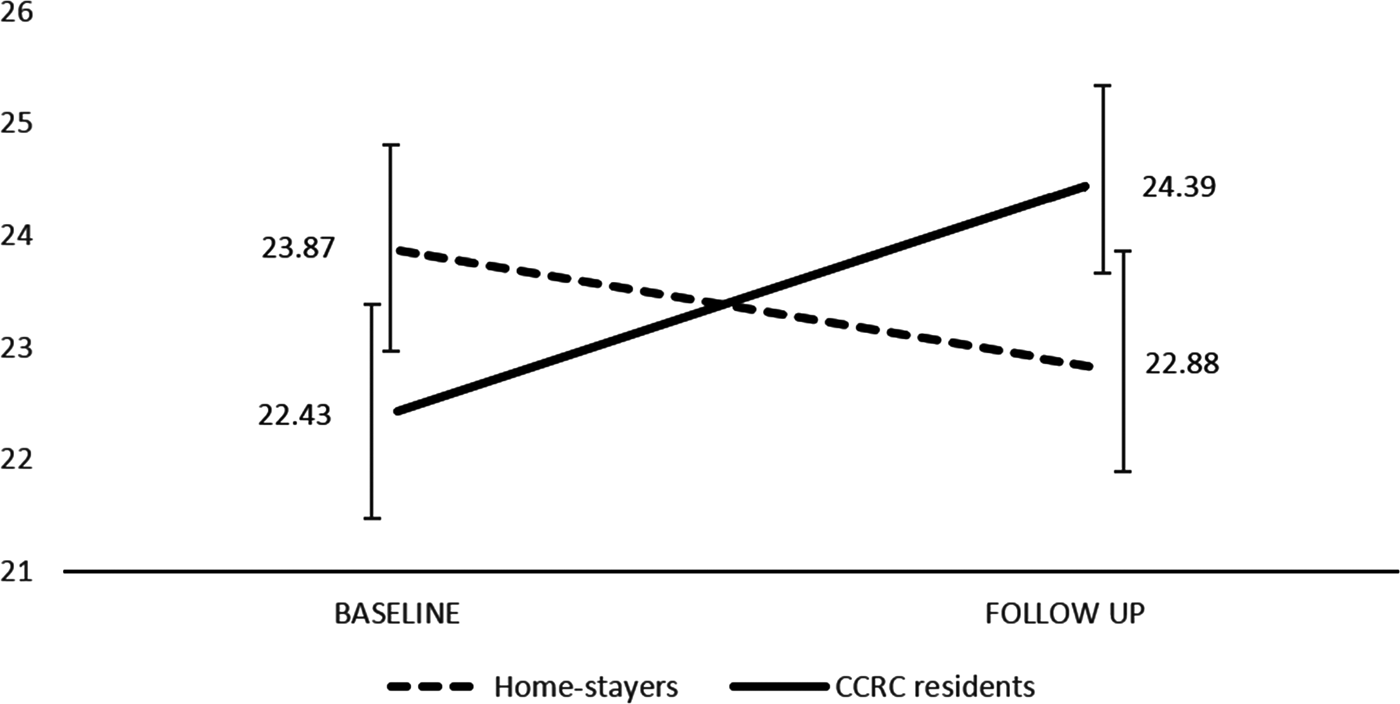
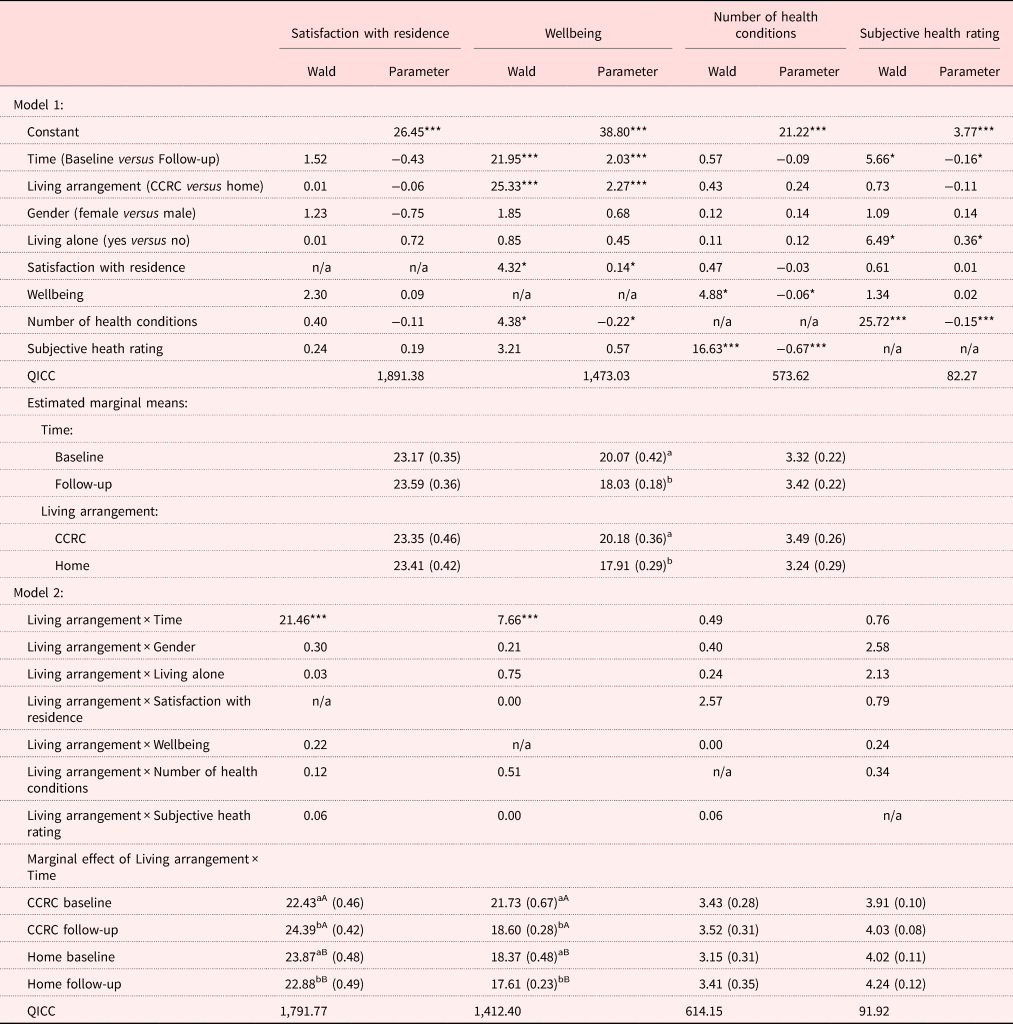
When predicting satisfaction with residence, no main effects were found (see Table 2). However, an interaction between living arrangement and time shows that CCRC residents experienced an increase in satisfaction, while satisfaction dropped for home-stayers (see Figure 1).
Residential satisfaction of continuing care retirement community (CCRC) residents and home-stayers at baseline (2010) and one-year follow-up (2011). Vertical lines represent the 95% confidence interval.

Longitudinal comparisons via generalised estimating equations with repeated measures

Notes: When both lower-case and upper-case letters appear, the lower-case letters refer to the ‘within same living arrangement’ effect, while upper-case letters were given to the ‘between time-point’ effect. CCRC: continuing care retirement community. QICC: corrected quasi likelihood under independence model criterion. N/A: not applicable. Values in parentheses represent the standard errors.
Wellbeing
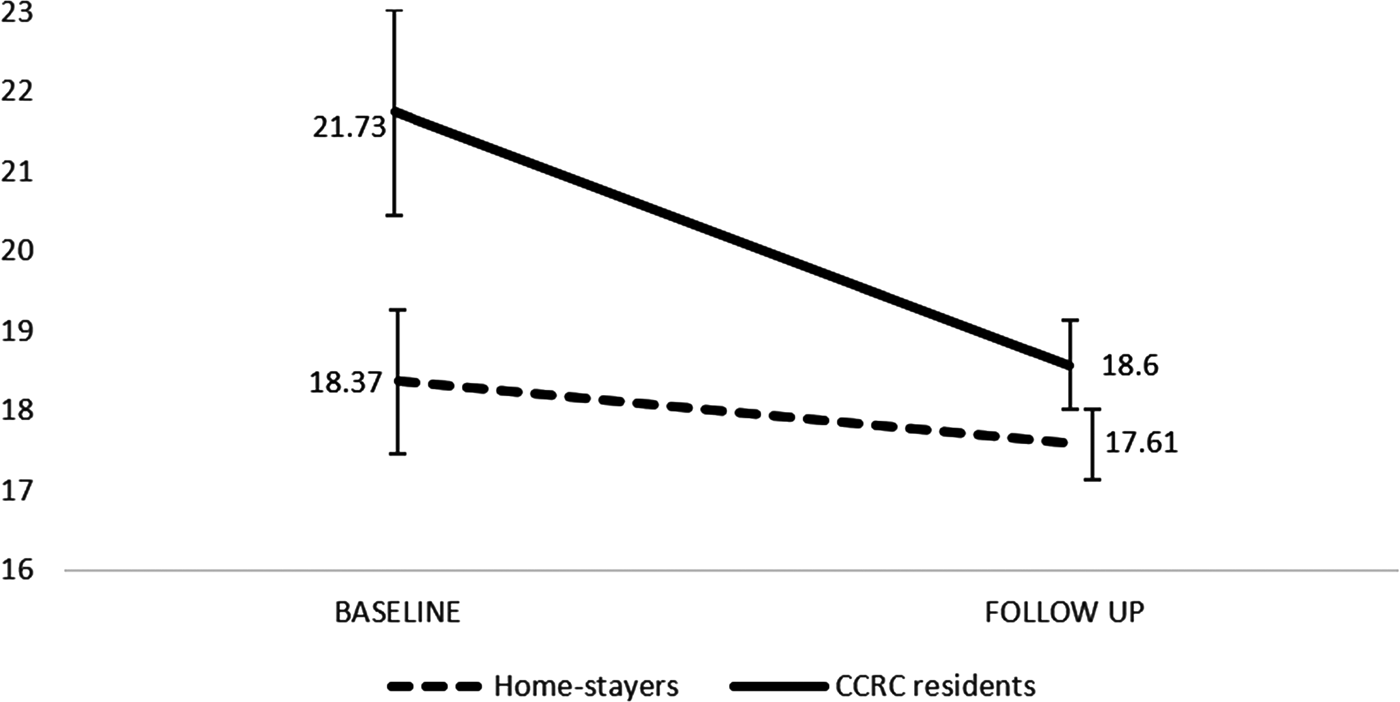
Main effects were found for time, living arrangement satisfaction from residence and number of health conditions (Wald = 21.95, p < 0.001; Wald = 25.33, p < 0.001; Wald = 4.32, p < 0.05; Wald = 4.38, p < 0.05, respectively) (see Table 2). Wellbeing declined from baseline to follow-up for all participants (b = 2.03, p < 0.001) and was higher for CCRC residents (b = 2.27, p < 0.001) in comparison with former CCRC candidates. It was also higher for those who were more satisfied with their residence (b = 0.14, p < 0.05) and lower for those with more health conditions (b = −0.22, p < 0.05). In addition, the interaction between living arrangement and time shows that while CCRC residents’ wellbeing was higher than the non-residents both at baseline and follow-up, they reported a sharper decline (see Figure 2).
Wellbeing of continuing care retirement community (CCRC) residents and home-stayers at baseline (2010) and one-year follow-up (2011). Vertical lines represent the 95% confidence interval.

Number of health conditions (objective health)
Main effects were found for wellbeing and subjective health (Wald = 4.88, p < 0.05; Wald = 16.63, p < 0.001, respectively) (see Table 2). Number of health conditions was higher for those with lower wellbeing (b = −0.06, p < 0.05) and lower subjective health (b = −0.67, p < 0.001). No interactions were found.
Subjective health
Main effects were found for time, marital status and number of health conditions (Wald = 5.66, p < 0.05; Wald = 6.49, p < 0.05; Wald = 25.72, p < 0.001, respectively) (see Table 2). Subjective health improved from baseline to follow-up for both movers and home-stayers (b = −0.16, p < 0.05), was higher for those who lived alone than who lived with others (b = 0.36, p < 0.05), but lower for those with a higher number of health conditions (b = −0.15, p < 0.001). No interactions were found.
Discussion
The aims of the current study were to compare residents and home-stayers of the same CCRCs at baseline and longitudinally. We explored whether there is a difference between residents’ and home-stayers’ change in satisfaction with living arrangement, wellbeing, and objective and subjective health throughout a period of one year.
Baseline comparisons showed that both groups share similar demographic backgrounds. Our results are not surprising as both started to plan their move and thought positively about the move, inquired about moving into the same CCRCs but eventually one group decided to remain in their own homes. Thus, it is reasonable to assume that they will share similar demographics with residents. Indeed, when Erickson et al. (2006) followed community-dwelling older adults to see which of them would eventually relocate to a CCRC, they found that those who considered moving but did not move differed from those who did not consider moving at all. However, we found an interesting similarity regarding proximity to amenities. Although CCRCs serve as a ‘one-stop shop’ for services, home-stayers still rated their potential proximity to CCRC amenities similar to residents. As the accessibility to amenities in the CCRC serves as one of the prominent pulling factors (Haigood and Crompton, Reference Haigood and Crompton1998), it is possible that this could explain why candidates chose not to move at this stage. However, a difference between the two groups is still possible, because the questions about distance were subjective, and baseline measures were assessed for residents after their move. Thus, it is possible that residents’ appraisal of their current proximity is biased.
While most of the demographic variables were the same between these two groups, some differences regarding health issues and personal attributes did emerge. For example, we found that those who did not move had slight higher functional independence, as measured by ADL and IADL indicators. In addition, and perhaps more importantly, their current home was on average 558 miles away from the CCRC, compared to only 110 miles for the residents. In other words, it seems that some of the ‘pushing’ and ‘pulling’ factors as found in other studies were less strong, leading to the final decision to stay. This can also explain the lower CCRC attitudes that the candidates had at baseline.
Our second and main aim was to compare the CCRC residents and former CCRC candidates longitudinally. We found several baseline and follow-up differences. One of the main differences was found in relation to satisfaction with living arrangement. At baseline, CCRC residents rated their satisfaction at the CCRC lower than candidates who rated their home. This may point to the initial hardship while trying to adjust to the CCRC. Indeed, during the initial period, the resident needs to adjust to a whole new way of living. This is because the move from independent living to the CCRC involves a shift in regulations, rules and space. Life in a group setting has a different socio-cultural system than the places in which most of residents lived before (Schwarz and Brent, Reference Schwarz and Brent1999). As a result, many new CCRC residents experience negative feelings during their first period of the relocation to the CCRC (Ayalon and Green, Reference Ayalon and Green2012).
While adjusting to the internal environment, it seems that residents also needed to adjust to a new environment outside the CCRC. Although almost 50 per cent of the CCRC residents moved only a relatively short distance (up to 20 miles), we should remember that even moving a short distance requires adaptation to new facilities (e.g. supermarkets) and service providers (such as bank tellers and physicians) (Green and Ayalon, Reference Green and Ayalonin press). This is especially true for residents who are no longer able to drive (Janssen-Grieve, Reference Janssen-Grieve2013).
Fortunately, it seems that the CCRC residents’ hardships did not last for long. One year later, the picture changed dramatically – the satisfaction of CCRC residents increased, bypassing that of home-stayers, which declined. Our results suggest that already after one year there is a benefit in favour of those in a CCRC. One source that can contribute to the change in satisfaction is residents’ comparisons to other residents. While their health condition remained the same through the year, they probably were exposed to other older adults with poorer health conditions. While the presence of older adults with poor health can be bothersome (Ayalon, Reference Ayalon2016), this could also lead to a positive result, as older adults tend to rate their health based on their comparisons to others (Smith and Goldman, Reference Smith and Goldman2011). This comparison could serve as evidence supporting their decision to move, thereby increasing satisfaction.
A more complex picture emerged regarding wellbeing. For both baseline and follow-up, CCRC residents’ wellbeing was higher than that of home-stayers. This is not surprising, as the GHQ-12 questionnaire addressed issues such as being capable of making decisions, amount of strain and ability to engage in enjoyable activities. These are the things that CCRCs offer, and these are the main expectations of CCRC residents (Bäumker et al., Reference Bäumker, Callaghan, Darton, Holder, Netten and Towers2012). In addition, relocating prior to physical deterioration can enhance wellbeing as it can alleviate future stress (Kahana et al., Reference Kahana, Lawrence, Kahana, Kercher, Wisniewski, Stoller, Tobin and Stange2002). Indeed, in our study, CCRC residents rated their health as good, and over three-quarters (76.9%) did not have any daily limitations at baseline. In other words, it seems that many of them moved proactively, a step potentially beneficial to wellbeing (Kahana et al., Reference Kahana, Lovegreen, Kahana, Settersten and Angel2011). On the contrary, those who chose to stay at home may have continued to cope with the stressful issues that originally prompted an interest in moving.
As time went by, both groups experienced a decline in wellbeing. This is in line with other works which found that older adults report similar experiences (Shin, Reference Shin2015), including those who are CCRC residents (Roberts, Reference Roberts2013). However, while the CCRC residents’ wellbeing was still higher than the home-stayers’ at follow-up, they suffered from a sharper decline. This is somewhat surprising, and even more surprising as their satisfaction with the living situation improved during the same time period. One possible explanation is that CCRC residents can be very satisfied with the CCRC and the services offered, but at the same time they fully understand that this place is not a regular home. In other words, even the best CCRC is still a CCRC. As time go by, the residents observe more proof for the reasons they chose to move in the first place. Seeing other residents with various mental and physical conditions and receiving regular notices of those who have died in the CCRC can be troubling as it is an ongoing reminder of how their life could be or end in the near future (Nelson, Reference Nelson2005). In other words, while the recognition that the CCRC is the right place for them can contribute positively to satisfaction with the CCRC, the reasons why is it the right place for them can negatively affect their wellbeing. However, while they suffered from a sharper decline, they still rated their wellbeing higher than the non-residents, perhaps because they perceive being in a safe place which aims to give them as much independence as possible. In other words, merely the fact that they are in a CCRC likely provides reassurance and relief.
As part of Aim 2, we also explored changes in objective and subjective health. Whereas we found a main (but negligible) effect of time for subjective health, the results show no long-term difference between residents and non-residents regarding both objective and subjective health. As for the baseline comparisons, it may be that changes in health were part of the pulling factors of both groups for being interested in moving to a CCRC in the first place (Crisp et al., Reference Crisp, Windsor, Butterworth and Anstey2013). However, they were not strong enough to influence their decision solely, given that many older adults consider moving to a CCRC as a way to deal with future health decline, not current health problems (Bekhet et al., Reference Bekhet, Zauszniewski and Nakhla2009). As such, a one-year time-frame may not be sufficient to detect health changes. Two recent studies support this possibility. Lea et al. (Reference Lea, Quiñones, Whitson, Bynum and Thielke2016) analysed data of Cohort 3 of the Medicare Health Outcome Survey, and found that two years after enrolment to the CCRC there was no difference between CCRC residents and non-residents in subjective health. Gaines et al. (Reference Gaines, Poey, Marx, Parrish and Resnick2011) compared CCRC-based or community-based older adults from the HRS, and found no difference in objective health between residents and non-residents. They found, however, better subjective health among CCRC residents. Anyhow, the fact that there is no decline in health for CCRC residents is encouraging. One explanation can be utilisation of services. Some evidence points out that involvement in various activities of the CCRC can mitigate health deterioration (Holmes et al., Reference Holmes, Beissner, Welsh, Krout, Krout and Wethington2003; Young et al., Reference Young, Spokane, Shaw, Macera and Krout2009). Future studies will benefit from addressing health changes over longer periods of time.
While this study contributes to the current knowledge regarding long-term adjustment to CCRCs, it is not without limitations. First, personnel at the CCRCs recruited participants with the research team's guidance, but no records were provided concerning who was invited to participate and who refused, resulting in potential selection biases. We strongly encouraged personnel to invite all new CCRC residents and all of those who had visited and declined to move, but we cannot determine how closely they followed this guidance. It is possible that the personnel chose participants who they thought would report more favourable attitudes about CCRCs. Another limitation is the time-frame of the baseline interviews, which took place up to three months after moving. Thus, we have no information regarding the CCRC residents’ state just before the move, which can be different from their state after initial enrolment. Future research is needed that interviews CCRC residents just prior to their move, and will continue to follow them years after the initial enrolment in order to understand fully the course of change in health and wellbeing. Future studies also are needed to follow those who left the CCRC. In addition, the way perceived social support from family members and friends is related to wellbeing also needs to be addressed, especially how new social ties emerge and shape.
Another possible limitation is the use of a telephone interviewing mode, rather than face-to-face interviews. Telephone interviews with older adults sometimes result in less interviewer assistance and a higher number of ‘don't know’ responses than in-person interviews (Clark et al., Reference Clark, Rogers and Allen2010). However, we addressed these limitations by using interviewers with a lot of experience in phone-interviewing older adults, by using short questions, and by planning our interview to last only up to about 30 minutes. Another limitation is related to the small number of participants and across several CCRCs. Whereas a variety of CCRCs could be a strength in a larger-scale study with more participants, in our case this fact could hinder generalisability, as each CCRC is represented by a relatively small number of participants.
Another limitation involves the baseline differences between the movers and non-movers. These differences, such as health status, might be related to some of the outcome variables. Our small sample size allowed us to control only for a few of the covariates in the multivariable analysis. Nevertheless, we should remember that these baseline differences may reflect the existing differences between movers and non-movers (Hunt et al., Reference Hunt, Feldt, Marans, Vakalo and Pastalan2015). In other words, these differences might be the reasons for their decision to move to a CCRC or to stay at home. Future studies might benefit from following CCRC candidates prior to their move, and comparing CCRC residents to those who did not move due to external reasons (e.g. availability of units in the CCRC).
Nonetheless, this study is one of the few longitudinal quantitative studies regarding CCRC adjustment, and one of the few to compare residents to candidates of the same CCRCs. We should remember that older adults come with a lot of expectations of CCRCs. Our study shows that these expectations might not be met during the initial period in the CCRC. Many CCRCs offer a ‘no-risk’ enrolment scheme which allows the resident to leave within a certain period, and indeed there are some older adults who take advantage of this offer due to initial adjustment hardships. However, our results show that negative feelings might not last for long. On the contrary, those who did not move experience a decrease both in wellbeing and satisfaction with residence, pointing out that that they might feel their decision was not the right one. In addition, CCRC candidates must remember that if they delay their move to the CCRC significantly, they will probably be less healthy and require more health services upon arrival. As many of the CCRCs require a certain level of independence on ADLs, this can both risk their enrolment and their ability to engage fully and enjoy what the CCRC has to offer. This might lead to worse decline in wellbeing and satisfaction. In other words, they can miss this train stop, which can result in a ‘final station’ in the shape of a long-term care facility.
Financial support
This work was supported by the Institute for Optimal Ageing.