Introduction
Since 2008, the End of Life Care Strategy (Department of Health, 2008) has considerably raised the profile of end-of-life care in England and has highlighted the need for improvement in planning and delivery to ensure that individuals have genuine choice about where they were cared for and die. The number of deaths each year in the United Kingdom is expected to rise by 17% between 2012 and 2030. Furthermore, the average age at death is predicted to increase, and those dying are likely to have increasingly complex co-morbidities (Gomes and Higginson, Reference Gomes and Higginson2008). These projections indicate that the funding and delivery of high-quality, appropriate end-of-life care is likely to pose a considerable challenge in the future.
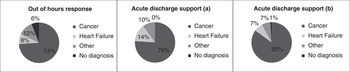
This paper draws on evidence from work with the three local health economies across England between 2007 and 2010. Preliminary scoping research in these communities identified that a greater proportion of patients with cancer access end-of-life care services (in acute and community sectors) than those with non-cancer conditions. Figure 1 highlights some of these findings from one of the local health economies that participated in this study, using data provided by a local internal audit of end-of-life care services.
Diagnostic breakdown of patients referred to end-of-life care services in case study site A (2006/2007)

Although the government strategy (Department of Health, 2008) has raised the profile of end-of-life care, and worked to improve access to services, there may now be more pronounced gaps in the availability of care for those with a non-cancer diagnosis – or perhaps a mismatch between availability and understanding the care needs of these patient populations. Although it could be argued that patients with a non-cancer diagnosis have less need for supportive care at the end of life, previous literature suggests otherwise – that there are ongoing gaps in understanding and meeting the needs of patients dying from causes other than cancer (Field and Addington-Hall, Reference Field and Addington-Hall1999; Addington-Hall and Higginson, Reference Addington-Hall and Higginson2001; Addicott and Ross, Reference Addicott and Ross2010). This article intends to identify and understand some of these barriers in accessing end-of-life care services by these patient populations.
Methodology
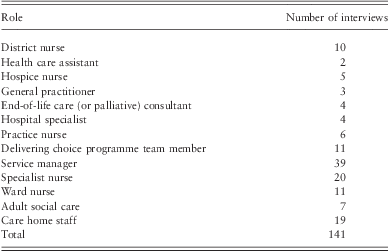
This paper is based on 141 interviews with National Health Service and other service providers (such as social care and voluntary sector organisations), across three local health economies in England (see Table 1).
Interviewees by role
The data from these interviews provided the basis to identify the common and frequent barriers to access for non-cancer patients, and to consider what strategies can be implemented to overcome any barriers identified. Common issues were identified across the three sites, and findings are thus presented thematically rather than through individual descriptions of each case study site.
Barriers and challenges for non-cancer patients
Although there are ongoing challenges in delivering high-quality end-of-life care to all patients across the board (Addicott and Ashton, Reference Addicott and Ashton2010), previous literature suggests that these may be more pronounced for patients with a non-cancer diagnosis (Field and Addington-Hall, Reference Field and Addington-Hall1999; Addington-Hall and Higginson, Reference Addington-Hall and Higginson2001; Addicott and Ross, Reference Addicott and Ross2010). In the three sites presented here, service provision was not adequate or appropriate for supporting non-cancer patients nearing the end of life, but had instead largely been designed around the care needs of people with cancer. Analysis of the data sought to identify what particular barriers exist for non-cancer patients in accessing end-of-life care support. The analysis revealed some common, broad issues that impact upon access. These broad themes are interrelated, and provide learning opportunities for those involved in the planning and delivery of end-of-life care. The findings have been grouped into five sub-sections and each of these will be discussed in more detail below:
1. Disease trajectory and patient identification
2. Care planning and prognostication
3. Referrals between provider services
4. Funding structures and processes
5. Workforce and training issues.
Disease trajectory and patient identification
Data collected across the three case study sites suggested that it is more difficult for clinicians to identify the stage at which non-cancer patients enter the end-of-life phase, or when they might benefit from more palliative support. Many service providers commented that they felt the more limited number of referrals for non-cancer patients to end-of-life care services was predominantly due to the unpredictable nature of the disease trajectories for non-malignant diseases, such as chronic heart or respiratory failure. Such unpredictability can render it difficult for clinicians to make an accurate prognosis of when an individual is approaching the end of life.
Some of the disease trajectories are more complex in non-cancer… I don't know much about heart failure but I've heard colleagues say that you can honestly think that a cardiac patient is terminal, they're breathing their last, and then in a couple of hours they're sat up in bed drinking tea and toast… So therefore it's very difficult to predict.
(Macmillan nurse)
The unpredictable nature of non-cancer disease trajectories, and the associated difficulty of identifying when an individual is nearing the end of life, were partially responsible for less frequent referrals to support and care services for non-cancer patients, as the referrer felt less able or confident in determining the point at which such a referral was appropriate. Related to this, referrers reported concerns about the cost and resource implications of referring non-cancer patients to end-of-life services – particularly for those who could be receiving such care for a long period of time.
If you're talking about palliative [end of life] care for somebody with MS [multiple sclerosis] you're looking at a very long period of time and support and I don't know if [dedicated end of life care providers] can sustain that, take that palliative patient on, because that could be 10, 20 years of their time.
(Macmillan nurse)
If professionals feel unable to make (and communicate) a confident prognosis about when a patient is nearing the end of life, they may refrain from making onward referrals to end-of-life care services, for fear of the resource and cost implications that may consequently arise. Clinicians were wary of repercussions from the local funding body (at the time of data collection, the Primary Care Trust) if inappropriate or costly referrals were seen to have been made.
Although a significant proportion of interviewees did attribute limitations in non-cancer referrals to the unpredictable nature of non-malignant disease trajectories, some interviewees – particularly disease specialists from non-cancer areas – commented that they do feel it is possible to determine with some certainty, the point at which a non-malignant patient enters the end-of-life phase.
There is a picture going round at the minute, which I agree with, that heart patients can dip and then they will bounce back again. But you reach the point where, in actual fact, they are not going to get sorted and back to where they were. Experience suggests that you can find that point and then they will die within a month.
(Service manager)
For a fair proportion of non-cancer patients it's fairly easy to discover when they're in the last three months I would say.
(Medical professional)
With the example of heart failure, a clinical nurse specialist commented that health care professionals can look for evidence of specific and individualised clinical symptoms and triggers over time, which can assist in recognising when a patient has entered a more end-of-life phase.
Their heart failure wouldn't be responding to treatment… the patient would probably be starting to go into renal failure and generally their condition would be deteriorating, they'd be able to do less and less… there's lots of triggers that you start to notice that the patient's coming towards end of life, rather than being in that preceding bit.
(Specialist nurse)
However, while acknowledging this range of clinical triggers, it was also suggested that these triggers would not necessarily be so easily identifiable to a generalist health professional, who may have had less of a history of interaction with a particular patient. Previous research has highlighted the value (and indeed, common practice) of involving both specialist and generalist clinicians at the end of life (Addicott and Ross, Reference Addicott and Ross2010; Goodwin et al., Reference Goodwin, Dixon, Poole and Raleigh2011). Consequently, the development of support and guidance in this area may be beneficial. Such support should consider the availability of existing tools to support end-of-life care providers in this area, and identify gaps in the availability of existing knowledge.
Care planning and prognostication
Although the above discussion indicated that they feel clinicians are actually able to successfully identify the point when non-malignant patients are nearing the end of life, they also reported that clinicians then frequently fail to discuss that prognosis and subsequent preferences and care planning with a patient.
… if you're with a patient and you're looking after them day after day, you might see them up and down, you can see a trend, an overall trend. And… what's going to have to change, what we're going to have to get better at, is being honest and open and having those discussions with people. There's more of an honesty in managing cancer patients about how things are, what the prognosis is, what the future holds, that doesn't exist in other diseases yet.
(Medical professional)
Another interviewee described how this particularly impacts within the hospital setting.
What we've seen is that the doctors are able to diagnose dying very successfully – which we actually thought that they probably weren't doing very well – but what they don't do necessarily is then put the appropriate management systems in place to support that. So, for example, they recognise that the patient's dying, but they find it very difficult to take down the drip, to stop the drug, to communicate to the patient and the relative that that's actually happening.
(Macmillan nurse)
Interviewees suggested reasons why clinicians may refrain from initiating these sorts of conversations with their patients. One medical professional commented that clinicians may simply ‘shy away from those sorts of conversations because they are difficult conversations to have’. Several interviewees referred to previously mentioned suggestions that many patients with non-malignant conditions may be in a end-of-life ‘phase’ for a prolonged period of time, which can consequently make it difficult to judge the appropriate point to initiate a conversation about prognosis and care planning. The quote above also indicates that acute care specialists may be reluctant to acknowledge ‘defeat’ and shift focus towards more end-of-life care. These interviewees described the difficulty of striking a balance between enabling an honest and open discussion while not wanting to eliminate a patient's hope. The balance between honesty and clinical optimism is complicated. However, such complications should not prohibit the supportive care planning to meet individual patient needs, as they change over time.
I was talking to a GP this week and he was saying how difficult it is to know because you've got a balance between maintaining their hope, because they could be living with this condition for some considerable time – when do you have that conversation?
(Senior service manager)
Related to this point, many interviewees considered that end-of-life care services cater for patients who are very near to the end of life (that is, the ‘terminal’ phase of their illness), rather than supporting a broader group of patients at the end of life, who may not be at that stage of their illness, but who still require supportive care.
It would appear that discussions with patients regarding their prognosis and preferred place of care are held quite near to the end of life, and consequently supportive services then tend to receive referrals for terminal care (that at the very end of life). Alternatively, palliative rehabilitation (working with patients to manage their symptoms and maintain or improve their functionality) or intermittent supportive care may be more appropriate for patients with long-term conditions, who go through peaks and troughs.
There would be benefits in providing end-of-life support to patients who are at an earlier stage in their disease trajectory. This is particularly the case for non-cancer patients, who are at risk of sudden death, and who require intervention and support intermittently in conjunction with the dips in their condition. In order for services to reach patients earlier in their end-of-life journey, there needs to be more timely identification of patients and subsequent communication regarding patient preferences. Responsive care planning of this manner may also assist to prevent unnecessary and costly hospitalisations.
Many clinicians spoke of their concerns regarding discussing prognosis and care preferences with patients. In the first instance, there was some anxiety about who should be having such discussions with patients. Many interviewees felt that it should be the role of the consulting doctor and specialists.
The family have got to be told that they are near to death. I would not go in and talk about discharge and fast track [funding] without that [conversation] being done first, and I don't think it's a nursing job… because there are normally more questions coming back. And the last thing I want to say is ‘actually, I don't know’.
(Ward nurse)
Further, some clinicians found it easier to have such discussions around patient preferences with the family and carers, rather than the patient directly.
It is very difficult. If I am honest, I don't tend to ask the patient – which is awful. I should do, I know. I tend to ask the family what their views are and then hopefully they discuss it with the patient.
(Practice nurse)
Many staff reported feeling anxious about when to have discussions with patients regarding prognosis and care preferences. As mentioned previously, there are particular concerns regarding maintaining a balance between having timely, realistic conversations with patients and giving patients some hope regarding their situation. This anxiety may then contribute to the tendency for discussions and referrals to occur quite near the end of a patient's life.
Second, some staff expressed anxiety about having discussions with patients regarding their preferences, as they were unsure whether there would be the support services available to meet these preferences. Ability to meet preferences may depend on what the preference is, the patient's place of residence and the patient's diagnosis. Particularly, patients who expressed a preference to be cared for in a hospice may be less able to achieve their wish because of the limited availability of inpatient hospice care in some regions – particularly for long or responsive periods of care. Similarly, it may be more difficult to support patients in the community who live alone because of the extent of their care needs. Such challenges in meeting patient care needs are not an issue specific to end-of-life care, but an ongoing difficulty in delivering care to a population within limited resources.
To offer choice you've actually got to have a full range of services to offer and actually we haven't got full choice for patients if we're honest. So it again goes back to that demography, it goes back to whether you've got a carer at home, whether you live in certain parts of the county, whether you get access to specialist services I would suggest as to whether you are likely to even be offered that choice but then whether that choice is actually realistic.
(Macmillan nurse)
As such, care packages also need to be able to be flexible and responsive to preferences (and when preferences may change). Flexible and bespoke care packages for individual patients, to meet their potentially fluctuating care needs, would have the potential to more evenly and fairly distribute resources. Although there are known difficulties in accessing appropriate care, there are also occasions where existing care packages are not reviewed or reduced in light of stability or improvement in a patient's condition.
Referrals between provider services
Several interviewees discussed the organisation of specialist teams, particularly how these teams manage patient care, and reflected upon how this may impact upon the referral of patients with non-cancer diagnoses to end-of-life care services. Across the three case study sites, heart failure and respiratory patients were typically managed by specialist teams in the community (led by a nurse specialist), who essentially case managed the patients. As specialist community teams often perform this ‘key worker’ function, they can also act as a gatekeeper to other services, particularly additional and specific support for end-of-life care. Several interviewees speculated that some disease specialists fail to either refer patients onto, or alert them to the existence of alternative end-of-life care services.
I don't know whether professionals are precious about the work that they do and think that can be dealt with [by themselves]… It's trying to make them realise that there is a lot more out there that they could be supported with – more than one individual can do.
(Service manager)
Further to this, some ward staff appeared to be quite protective of patients, and operated to their own preference that patients should remain in their care in the acute setting. In many instances, the reasoning was that patients were ‘too sick’ to be discharged to the community, whereas in other cases staff reported that they avoid having discussions with patients regarding their prognosis and preferences for other reasons.
I like to keep them with us because I think it's nice to nurse them right the way through, because we know how they are, we know the relatives.
(Ward nurse)
However, one interviewee suggested that this is not simply a case of disease specialists or institutions being deliberately ‘protective’ over their patients. Rather, some disease specialists may fail to refer onto end-of-life care teams or professionals because they are not familiar with the services.
A lot of my experience, wherever I've worked, is that people tend to refer patients to services that they have had experience of, and so… I would envisage that a lot of people from the non-cancer conditions won't necessarily have had a lot of experience of palliative care services, and therefore won't know when to refer and when not to refer.
(Senior service manager)
Further, several interviewees commented that patients with non-malignant conditions tend to be managed in an ‘acute’ manner. Patients with long-term conditions are often admitted to hospital so that their symptoms can be managed during a period of acute exacerbation. Once their symptoms have stabilised, they will then be discharged back into the community where they are predominantly managed under the care of a specialist team. Within this process, however, the specialists often failed to engage with end-of-life care services.
A heart failure patient will have an acute episode where the medication needs reviewing. And then, that may go on for… a week, two weeks… Medication will be reviewed and those symptoms will dissipate and they'll kind of factor out again. Now, for me, that patient is still palliative… I think they should be supported with a palliative care team who can resource an acute team – such as the British Heart Foundation – when these episodes happen. What happens is the other way. They're case-managed by the British Heart Foundation nurses who don't then refer to us as palliative.
(Service manager)
Conversely, some specialist providers commented that end-of-life care services are actually designed to only accommodate those patients who are at the very end of life. This means that patients with non-malignant conditions may not be referred into (or accepted by) appropriate services at an early enough stage to fully benefit.
It doesn't necessarily need to be, or we don't want it to be, in the terminal phase. It's nice to have some history with the family so that they know who we are prior to them being in that acute phase when they're really terminal. It can be any point in that palliative pathway, and this is what people don't understand. And this is where a lot of promotional work needs to be done.
(Service manager)
Funding structures and processes
The majority of interviewees emphasised that limitations in access to dedicated and responsive end-of-life care funding potentially acts as a barrier to the organisation of care provision, particularly for non-malignant patients. Historically, access to such expedited funding requires a health care professional to make a judgement that a patient is very close (e.g. six weeks) to the end of life, or has complex health care needs that require concentrated support. This system of funding allocation is less flexible to allow for support to be accessed in accordance with the peaks and troughs of some long-term conditions, or the gradual decline of other conditions or the frail elderly (who may not be considered ‘complex’).
[End of life care funding] isn't set up to respond to long-term condition patients with their exacerbations. Every exacerbation could be their terminal phase, and continuing care [funding] isn't responsive enough to put in care to meet that need. And sometimes it won't be their terminal phase, and we need to pull out continuing care [funding], and all the problems that causes for patients.
(Senior service manager)
The process for allocating funding is not particularly well tailored to the unpredictable disease trajectories of many non-malignant diseases. The organisation of care tends to require clinicians to make assessments for patients based on fairly rigid, time-bound prognoses. As asserted previously, making these judgements may be more difficult for non-cancer patients.
How do you know that they are actually dying? Proving that the patient is eligible [for end of life care funding] is actually very difficult. It's actually the criteria now that you have to document and prove cognitive impairment, altered mental state and the complexity of drugs, but with heart failure, you don't often have the complexity. It's actually really difficult to get. You don't always know if that is the final deterioration. I think that's where continuing care [funding] falls down – getting the funding. Because it's not like cancer, where they get there and they do deteriorate and then die.
(Specialist nurse)
As a result, many interviewees reflected on current inequalities in the system. The criteria by which expedited end-of-life care funding is allocated can be very narrow, and non-cancer patients may suffer as a result.
I remember as a district nurse, I can see her now – this little lady in her bed, we didn't actually know what she was dying of but we needed help for her. And she didn't have a cancer, but I wished she had – because if she had a cancer I could have accessed all sorts of care for her.
(Macmillan nurse)
In response to this problem, several interviewees commented upon the need to adapt the system by which funding is allocated – to re-assess the eligibility criteria so that the process can be more flexible and responsive to the nature of non-cancer patients’ disease trajectories. Clinicians called for a system that would enable them to access funding on a time-limited basis, when a patient is experiencing an acute exacerbation, but then to be able to reduce or withdraw funding as and when a patient reaches a point of relative stability.
However, it was suggested that this approach would need to be accompanied by support and communication skills training for health and social care professionals. Some interviewees discussed that it would be very difficult for clinicians to tell patients that care packages may be reduced or withdrawn.
Non-cancer patients can one day be fine, and the next day be completely dependent, and the next week are fine again. And, because of that, I think it's very hard for a district nurse to make a referral for additional resources that at some point they might have to then withdraw again.
(Senior service manager)
In this scenario, it is possible that some clinicians would avoid the assessment process altogether – particularly to avoid raising patient expectations regarding ongoing support. This could result in some patients failing to be identified as having end-of-life care needs, and therefore failing to access appropriate services.
Workforce and training issues
The findings presented thus far demonstrate that many of the barriers that currently exist in the provision of end-of-life care services for non-cancer patients are underpinned by the need for more advanced training and education. First, it may be appropriate to adopt an approach to challenge the interventionist culture reported to prevail among clinicians, particularly medics. It is necessary to foster greater dialogue around the concepts of death and dying, so that clinicians are less inclined to perceive death as a medical failing, but rather something to discuss with patients and plan for.
This in turn should encourage clinicians to adopt a more open and honest approach, and to feel more comfortable about initiating conversations regarding diagnosis and care planning with their patients.
The findings have repeatedly emphasised the need to promote greater integration between generalist, disease specialist and end-of-life care teams. However, these efforts will need to be supported and underpinned by education and training, to ensure that all groups can become familiar with the support provided by other services. For instance, end-of-life care professionals need access to training and education in end-of-life care for non-malignant diseases, particularly as many professionals working in end-of-life care tend to have a background in cancer care.
I think a lot of the workforce for palliative care probably came out of cancer services, so when you are looking at the [palliative] nurses a lot of them got experience in oncology and then transferred.
(Senior service manager)
Consequently, there may be limits and concerns around the levels of care that some palliative care professionals are able to provide for patients with other conditions, such as end-stage heart failure for example.
They're all just used to dealing with cancer. What heart failure looks like… I mean the medical differences – things like implantable defibrillators, breathlessness – is a really key issue with heart failure. So the end stage heart failure patients feel like their lungs are flooding and they're drowning, which can be really horrible for the patients. And you then have the question, ‘Are the nursing staff able to deal with that?’ Or, ‘Are they confident and capable?’ That's a training issue probably.
(Senior service manager)
There is also a need to ensure that disease specialists and generalists are given access to skills and resources, which will enable them to identify when an individual requires a more focused end-of-life care approach. A set of guidelines that specify clinical triggers may be useful for generalists to identify the signs to indicate that non-malignant patients are nearing the end of life. In addition to this, there is a need to consider the education of health care professionals more widely, so that end-of-life care becomes an integral part of mainstream health care, as opposed to a specialist, separate service.
If we're over-specialising it [end of life care] then it will only be done by specialist teams and therefore we need a huge amount of resources. But if we mainstream it into good care for all patients – and I think that's an education issue – right from a training point of view, from medical school, from nursing school.
(Macmillan nurse)
This section has highlighted some of the challenges that exist throughout the health care system, that potentially limit the ability of patients with a non-cancer diagnosis to access end-of-life care support. The following section will consider the implications of these findings and some possible actions to allow for increasing access.
Conclusions and recommendations
The findings from this research indicate that there are several interrelated reasons why access to end-of-life care services is more difficult for patients with a non-malignant diagnosis. There are fundamental differences in disease trajectories that make prognosis for non-cancer patients more difficult. As there is then limited interaction between specialist and generalist teams, knowledge and experience regarding prognostic indicators is not routinely shared. Generalist staff in particular have difficulties in identifying when patients with a non-cancer diagnosis would be regarded as nearing the end of life. As such, access to end-of-life care services is offered quite late in the patient journey.
This pattern is further entrenched by existing funding arrangements, which rely on a more specific prognostic decision than may be possible for non-cancer patients. As such, patients with cancer may also be likely to receive greater end-of-life care support in the last weeks of life than patients with a non-cancer diagnosis.
Provision of equitable and comprehensive end-of-life care requires the support of a multitude of both generalist and specialist service providers. It is fundamental that these providers are supported to communicate and interact on an ongoing basis, to ensure streamlined and high-quality end-of-life care for all patients.
The following actions may assist in improving communication and care planning for patients with a non-cancer diagnosis:
1. Training should be provided to general nursing and junior medical staff on the clinical indicators of deterioration in non-malignant conditions – to ensure widespread and comprehensive understanding of end-of-life care for non-cancer patients within the acute sector.
2. End-of-life care service providers should be encouraged to have clear and honest discussions with patients and their carers regarding the availability of community support, in order to meet patient needs, and to ensure that patients do not have unrealistic expectations about the care they are likely to receive.
3. Disease specialists should work more closely with end-of-life care providers and services during acute exacerbations, to ensure continuity of ongoing end-of-life care provision.
4. End-of-life care services could consider the development of mechanisms where more flexible and responsive services can be provided and scaled down quickly, as and when needs necessitate.
5. Commissioners should review the application guidance for funding, and consider steps to allow a more responsive system of provision to better meet the needs to patients with long-term, fluctuating care needs.
6. Development of joint training initiatives, across disease specialties – and across generalist and specialist care providers should be encouraged in an effort to improve understanding of disease trajectories and care needs for different clinical conditions.
End-of-life care is provided in a variety of organisational settings, by a variety of health and social care professionals. A whole systems approach to service improvement is necessary, whereby attention is given to the entire pathway of care to ensure that high-quality care can be achieved, regardless of location. This research highlights some of the ongoing challenges for the effective management of patients with end-of-life care needs. A whole systems approach benefits from a range of services being in place across the care pathway – for instance, discharge facilitation from the acute setting, rapid response services during out of hours periods and centralised coordination of care provision in the community. The combined impact of a range of services is greater than any single service on the organisation and delivery of end-of-life care.
This whole systems approach needs to be driven nationally by a funding system that offers the flexibility and responsiveness to address variation in patient care needs – both between individual patients and over time. There are continuing gaps in the funding and provision of care for all patients nearing the end of life (Addicott and Ashton, Reference Addicott and Ashton2010), and the above recommendations would go some way to improve access and quality of end-of-life care across the board. However, given the specific difficulties for those with a diagnosis other than cancer, this article highlights particular barriers and recommendations for these patient populations.
Training, information and communication are needed to underpin effective implementation – both across health and social care professionals, as well as with patients and their carers. Information is important to assist patients and carers in identifying their end-of-life care options and raising awareness of processes and outcomes.
As a result of the recent political and policy changes in England, end-of-life care delivery and funding mechanisms may look different in the future. However, given projections of the growing number of people nearing the end of life, at an older age, and with increasing comorbidities, policymakers would do well to continue efforts to improve care for these patients and ensure that resources are being sensibly and fairly distributed. High-quality and appropriate support for patients nearing the end of life has the potential to avoid unnecessary and costly hospital admissions.
Within the current financial climate, there is a risk that providers and commissioners shift focus away from efforts to redesign services. Yet, current patterns of care, unnecessary hospital admissions at the end of life and the ageing population all mean that there is a need for reform to improve the quality of care provision for all people nearing the end of life, and ensuring the best use of financial resources is more important than ever.