INTRODUCTION
Snake eels (Ophichthidae) comprise a little known family of anguilliforms (Anguilliformes) (e.g. Randall, Reference Randall1967; Leiby, Reference Leiby, Quero, Hureau, Karrer, Post and Saldanha1990; Casadevall et al., Reference Casadevall, Muñoz, Carrasson and Matallanas2001; McCosker, Reference McCosker and Carpenter2002; Bozzano, Reference Bozzano2003). Most of the foundation knowledge regarding true eel species (such as representatives of Ophichthidae and Synaphobranchidae) considers them free-living organisms. However, throughout the last 80 years several reports have been published of true eels found within the organs, body cavity or muscle of fish (e.g. Goode & Bean, 1895 in Walters, Reference Walters1955; Breder & Nigrelli, Reference Breder and Nigrelli1934; Caira et al., Reference Caira, Benz, Borucinska and Kohler1997). While the authors of some of these reports suggested a parasitic life style for the involved eels, others considered the phenomenon as accidental and denoted them as cases of ‘pseudoparasitism’. In this paper, the detection of a snake eel in the body cavity of common pandora, is discussed in order to shed light on the ecological role of the eels as prey or pseudoparasites reconsidering former records critically.
MATERIALS AND METHODS
Forty-five common pandoras (Pagellus erythrinus, Linnaeus, 1758) were captured during 2008 and 2009 at the Medes Islands Marine Reserve (42°02′51N 3°13′19E; north-western Mediterranean), by means of gill nets and long lines at depths between 11 and 55 m. Fish were killed and dissected within 2 to 4 hours after capture. Each fish was measured (total length (TL) in cm) and weighed (total weight (TW) and eviscerated weight (EW) in g). Fish body and viscera were deep-frozen (–20° C) separately for later parasitological examination and inspection for lesions and pathological indications (e.g. cysts). Stomach and intestine contents were also collected and examined. Condition factor (CF) was calculated following the formula: CF = [(TW(g) / TL3(cm))*100)] after Ricker (Reference Ricker1975).
Three snake eels were collected from three common pandoras; one was embedded in the body cavity and two were found in stomachs. Additionally, another ophichthid was found desiccated in May 2007, washed up on La Torre beach (Moncófar, 39°47′25N 0°08′10W; Castellón, western Mediterranean). All eels were identified using information in Bauchot (Reference Bauchot, Whitehead, Bauchot, Hureau, Nielsen and Tortonese1986) and Mercader et al. (Reference Mercader, Lloris and Rucabado2003) and those collected from common pandora exemplars were preserved in 70% ethanol. Total length (TL, cm) and wet weight (WW, g) of eels were determined subsequently.
RESULTS
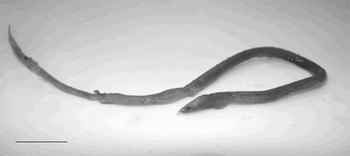
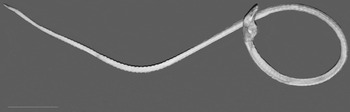
One female of common pandora (36 cm TL) was captured in June 2008, and exhibited an eel (22.2 cm TL, 1.1 g WW) in its body cavity entangled in the mesentery tissue. The eviscerated weight (EW = 588 g) and CF (1.4) of this individual was within the range observed for other common pandora captured during the same sampling month (34–45 cm TL; 495–1095 g EW; 1.1–1.4 CF; N = 22). Viscera of the common pandora showed a healthy aspect, and no injured organs, older cicatrizations or wounds were observed. The identified slender finless eel, Apterichtus anguiformis (Peters, 1877), exhibited a tubular anterior nostril and the number of vertebrae was 156. It was nearly complete and in good condition, its eyes well recognizable (Figure 1) and its consistency was hard, slightly dehydrated, and the body cavity and inner organs appeared shrunken and cavernous. Two other small true eels, assigned as ophichthids, were found partially digested and degraded inside the stomachs of two common pandoras (36 cm TL each, 615 g and 553 g EW, 1.4 and 1.3 CF, respectively). These ophichthids weighed 0.4 g and 2.5 g (WW) and number of vertebrae was 80 and 120, respectively. Bodies were not flexible and with missing parts. The European finless eel Apterichtus caecus (Linnaeus, 1758) (34.6 cm TL, 2.3 g dry weight) found in La Torre beach did not exhibit a tubular nostril and the number of vertebrae was 138 (Figure 2). It was thoroughly desiccated and nearly complete except for the inner organs.
Specimen of Apterichtus anguiformis found in the body cavity of a common pandora from Medes Islands (north-western Mediterranean). Scale bar: 2 cm.

Specimen of Apterichtus caecus found on La Torre beach (Moncófar, Castellón, western Mediterranean). Scale bar: 3 cm.

DISCUSSION
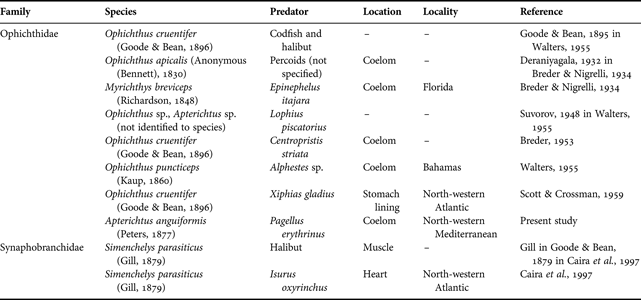
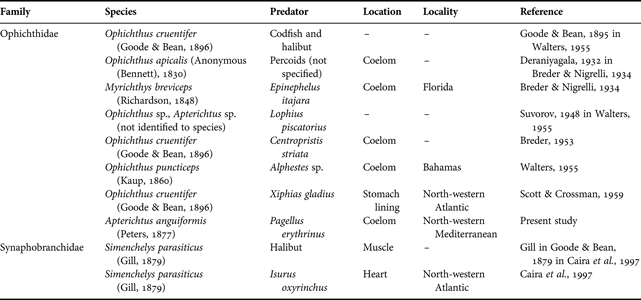
This is the first record of an Apterichtus species within the coelom of another fish. Both, Apterichtus anguiformis and Apterichtus caecus have been recorded free living in the Mediterranean Sea (e.g. Blache & Bauchot, Reference Blache and Bauchot1972; Bauchot, Reference Bauchot, Whitehead, Bauchot, Hureau, Nielsen and Tortonese1986; Castriota & Campagnuolo, Reference Castriota and Campagnuolo1998). Most of the published records of Apterichtus spp. are based on free-living specimens from other regions (e.g. Machida & Ohta, Reference Machida and Ohta1993; McCosker & Randall, Reference McCosker and Randall2005) and records of true eels inside freshly killed fish or processed fish muscle are scarce and sporadic (Table 1). As in the present case, eels have mainly been found in bodies of demersal and benthopelagic fish referring to a presumed predator–prey relationship in their habitats. It is suggested that in all cases, the eels likely entered the common pandora by being eaten. In the present study nearly 38% of common pandora examined exhibited otoliths and fishbones in the stomach content indicating fish as an important part of the diet. The indigested condition of the eel found located in the mesentery tissue may corroborate previous reports (Breder & Nigrelli, Reference Breder and Nigrelli1934; Breder, Reference Breder1953; Walters, Reference Walters1955) supposing an active piercing and leaving of the digestive system.
Ophichthids (Ophichthidae) and synaphobranchids (Synaphobranchidae) (Anguilliformes) reported from fish not as food items. Table is arranged according to year of publication. Accepted scientific names of species according to Froese & Pauly (Reference Froese and Pauly2009).
The common pandora from which the eel was taken appeared to be healthy and its CF and EW value did not reveal any anomaly compared to other specimens. It is supposed that lesions caused by the eel penetrating the gut wall were not life threatening to the predator and finally healed. It is known that some fish (e.g. deep hooked in the throat or stomach) are able to survive large wounds, blood loss and secondary infections (Gunter & Ward, Reference Gunter and Ward1961; Davis, Reference Davis2002; Prince et al., Reference Prince, Ortiz and Venizelos2002). As burrowing fish, ophichthids are considered to be well adapted to squeeze through narrow openings, benefiting from several morphological specializations (Smith, Reference Smith and Böhlke1989), which might have led some authors to presume some species to be parasitic borers or occasional parasites (Goode & Bean, 1895 in Walters, Reference Walters1955; Suvorov 1948 in Walters, Reference Walters1955). Other authors considered these incidences as ‘accidents’ (Breder, Reference Breder1953) or ‘pseudoparasitism’ (Walters, Reference Walters1955), which is ‘the chance of entry and survival of a free living organism in the body of another’ (Lincoln et al., Reference Lincoln, Boxshall and Clark1998). The use of this term is inappropriate and possibly misleading, as ‘pseudoparasitism’ might imply real parasites accidentally acquired by a wrong host, and ending in a blind alley (e.g. Moravec, Reference Moravec1994). However, following the definition of ‘host’ in ecology (e.g. Lincoln et al., Reference Lincoln, Boxshall and Clark1998), no typical host seems to exist for snake eels.
Summarizing, it is hypothesized that snake eels form a part of the diet of the common pandora and, consequently, very few ingested eels could survive being eaten and enter the body cavity where they die shortly after. Depending on the predator condition, lesions in its gut are healed and hence it survives. Considering current knowledge of ophichthid ecology and periodic records of found or caught specimens like in Moncófar the present observation is presumed to be an accidental record.
ACKNOWLEDGEMENTS
The authors thank the Universitat Autònoma de Barcelona and the Instituto de Ciencias del Mar (CSIC) for providing laboratory facilities, D. Lloris and R. Maestre for assistance in adding the study specimens to the collection of ICM, CSIC, and Mrs Yebra and Mrs Suck for the English revision of the manuscript. We are grateful to the anonymous referees for their valuable help to improve the text. This work has been supported by the BBVA foundation (Marine Protected Units in Chile and España, MAPUCHE, BIOCON06_035). M. Fernández was supported by an I3 Contract from the Ministry of Science and Innovation of Spain. The specimens found in the common pandoras were deposited in the Collection of Biological References (CRB) of the Instituto de Ciencias del Mar (ICM–CSIC), Barcelona (Identification No.: IIPB 1/2009, IIPB 2/2009, IIPB 3/2009). The specimen from Moncófar was preserved dry in the collection of the Cavanilles Institute of Biodiversity and Evolutionary Biology of the University of Valencia (Accession Number ICBiBE- Apcae-080801).