A consistent theme in the contentious politics literature is that contentious behavior is a difficult undertaking.Footnote 1 If domestic contention is difficult, there is every reason to think that coordinating and executing contentious behavior abroad is even harder.Footnote 2 Indeed, if we examine violent contention in the form of incidents of terrorism—the type of political activity for which there is probably the best quantitative data for both transnational and domestic activity—it becomes apparent that there is a great deal more domestic terrorism than transnational terrorism.Footnote 3 In a recent study that differentiates transnational from domestic terrorism in the Global Terrorism Database (GTD),Footnote 4 Enders, Sandler, and GaibulloevFootnote 5 identified 12,862 transnational terrorist incidents out of 66,383 total—or less than 20 percent of all incidents. Going abroad is costly, and many political organizations simply do not have the resources to do so, even if they wanted to.Footnote 6 This raises the question: which organizational factors or aspects of an organization's domestic or transnational political environment make it more or less likely to be active abroad? More specifically, how do different factors separately affect the choice to solicit external support or to use violent or nonviolent contention abroad?
Much of the variance in transnational activity by political organizations can be explained as a function of two primary concepts: opportunity and threat. Some factors increase the probability of organizations engaging in transnational activity because they offer resources or other opportunities that can strategically benefit the organization's cause at home. Foreign state support, diaspora support, and the ideological positions of organizations make certain types of transnational activity particularly attractive. However, in line with Keck and Sikkink,Footnote 7 the domestic political environment may be such that the organizations are “pushed” into trans national activity. We argue that political repression and state violence targeted toward organizations, as well as competition with other political organizations, raise the likelihood that organizations will pursue their cause internationally.
There is a well-developed literature on transnational terrorist activityFootnote 8 and nonviolent transnational activity in the social movements literature.Footnote 9 There is also a range of work on noncontentious transnational organizational behavior, focusing on nongovernmental organizations, human rights, and other activist groups,Footnote 10 and international and regional organizations.Footnote 11 Although these two segments of the literature do an admirable job of explaining the structural and organizational drivers of specific types of transnational activity, as well as aspects of organizational design and resultant efficacy and dysfunction, there are gaps in our understanding of transnational organizational behavior. Specifically, there is a lack of theory coupled with broad-based empirics that examines the impact of organizational and environmental threats and opportunity factors on why strategically minded political organizations choose to engage in specific kinds of transnational politics: soliciting external support, engaging in nonviolent contentious politics abroad, and engaging in transnational violence. This gap in the literature can be explained partly by limitations in cross-national data on political organizations. Quantitative analysis of transnational terrorism has focused primarily on state-level factors,Footnote 12 and the two most prominent data sets for studying transnational terrorism, the GTD and International Terrorism: Attributes of Terrorist Events (ITERATE),Footnote 13 are focused on terrorist incidents, rather than the organizations perpetrating them. There is a parallel limitation in the human rights literature, where, with a few recent exceptions,Footnote 14 there is generally a dearth of quantitative data on the organizational behavior of nonviolent activists.
Using the Minorities at Risk Organizational Behavior-Middle East data set (MAROB-ME), which contains yearly organization-level data for 104 ethnopolitical organizations in the Middle East and North Africa, we can compare the impact of different opportunity and threat factors on transnational activity by both violent and nonviolent organizations. Although these data are limited in the sense that they pertain only to ethnopolitical organizations in the Middle East and North Africa, they do allow us to extend the research on transnational political behavior by examining the impact of important variables on the different strategy choices at the organizational level of analysis. We are aware of no large-N study of social movements that takes this organizations-focused perspective. That said, when it comes to political violence and the export of political violence transnationally, the Middle East and North Africa are often an outlier—an issue that we will discuss later.
Types of Transnational Activity
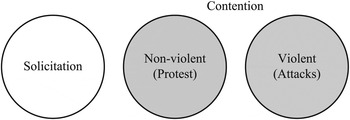
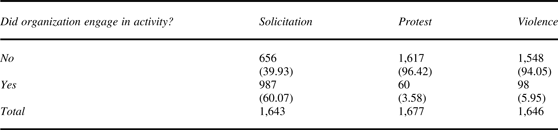
As the literature on transnational activism suggests,Footnote 15 and as the MAROB-ME data illustrate, engaging in political activity abroad is less likely than doing so at home, but it is not an insurmountable hurdle for many organizations. Not all external political activity, though, presents the same challenge to an organization, and we distinguish between two broad types of activity (see Figure 1): solicitation and contention, and then within contention, both violent and nonviolent activity. We believe that contentious politics should present a related but different challenge than soliciting support. Lobbying abroad, like lobbying at home is a “more routine form of political challenge”Footnote 16 than contention and, just like political activity in a domestic context,Footnote 17 protests and violence should be more challenging than “regular politics” internationally. The descriptive statistics from the MAROB data support this expectation with more than 60 percent of the organizational-years in the data set seeing organizations engaged in the transnational solicitation of support (see Table 1), which is defined as maintaining a foreign office or meeting with foreign officials or organizations. It is clear from the data that transnational contention is rare. Less than 4 percent of the organization-years in the data have an organization engaged in transnational protest activity (acts of symbolic resistance or demonstrations), and slightly less than 6 percent have organizations engaged in transnational violence (targeting security personnel, nonsecurity government personnel, or civilians).
Three types of transnational political activity

Frequency distribution of political activities abroad

Note: Unit of analysis is organization year; percentages are in parentheses.
Specific organizational and structural factors increase the probability that an organization will solicit external support and/or engage in violent and nonviolent contention. Sending representatives abroad to talk to nongovernmental organizations (NGOs), diaspora supporters, or foreign governments is a potentially resource-intensive activity, but it does not demand the kind of commitment, time, or planning as transnational contention.Footnote 18 All transnational contention is difficult, but we argue (and the descriptive statistics also suggest) that transnational violence is easier than transnational nonviolent contention (that is, protest). Our expectation in this regard is driven by the fact that terrorist acts do not generally require a large number of people to carry them out, whereas nonviolent contentious politics, public demonstrations in particular, often require large numbers of participants and/or supporters. Crenshaw,Footnote 19 discussing terrorism as a “weapon of the weak,” addresses this issue when she points out that “terrorism is attractive because it is a relatively inexpensive and simple alternative, and because its potential reward is high.”Footnote 20 Similarly, WeinsteinFootnote 21 finds that weak, “opportunistic” insurgent organizations are more likely to use indiscriminate violence to coerce their populations because they are unable to secure voluntary support. Given that transnational contention takes place far from an organization's natural recruitment pool and that violence can have a “powerful impact with minimal resources,”Footnote 22 from a collective action perspective,Footnote 23 the intuition is clear: transnational violence should be easier, because it requires fewer resources, and fewer people need to coordinate around and reconcile their “free riding” incentives vis-á-vis the “public good” of contention.
Our central argument is that when an organization encounters limitations or threats to their domestic political opportunities, they will be more likely to go abroad.Footnote 24 However, when subjected to such threats, the organization will be most likely to solicit external support and engage in transnational violence rather than nonviolent protest because these activities require the mobilization of fewer individuals. We expect that an organization's focus will shift to nonviolent contention when the transnational political opportunity structure is particularly amenable to mass mobilization on behalf of the organization, such as when they have a politically active diaspora. In contrast, more narrowly focused supporters, such as foreign states, should provide the kind of resources that may be particularly amenable to violent activity. In either case, external support provides organizations with additional opportunities to engage in costly transnational political behavior.
Overall, however, we expect a lower probability of engaging in these transnational activities if the organization is formally engaged in the political process at home. Involvement in elections, for example, leads the organization to view the domestic political environment as less threatening. Participation in the political process in an authoritarian or semi-authoritarian context—which is particularly relevant to the region on which our data are focused—strongly suggests cooptationFootnote 25 and likely involves government efforts to prevent the organization from engaging in transnational activism. Even within the context of democracies, Saideman, Lanoue, Campenni, and StantonFootnote 26 find that more inclusive electoral systems reduce the overall probability of ethnic protest and rebellion.
This discussion contains within it an implicit assumption that political organizations are, for the most part, strategically minded, instrumentally rational actors. In other words, we have highlighted the “logic of consequences” in organizational decision making, as March and Olsen refer to the approach.Footnote 27 However, although much of our theoretical framework is clearly derived from a rational choice perspective, we do not frame our analysis in opposition to nonrationalist theories. Instead, we explicitly acknowledge that since organizations face varying levels of grievances and are motivated by different types of ideologies, the identity and norms of an organization should also have an important impact on their behavior. However, there is an important body of work whose contributions we do not incorporate directly into our analysis—such as those highlighting how history and normative frameworks;Footnote 28 organizational “pathologies;”Footnote 29 and international socialization pressuresFootnote 30 can influence the decisions that organizations make. We see our findings as being complementary to this body of literature and believe that future research should examine how the “logic of appropriateness”Footnote 31 may serve as a lens through which organizations view the threat and opportunity drivers of transnational contention. However, empirical constraints preclude us from examining these perspectives here.Footnote 32
Opportunities
One important reason that organizations choose to engage in transnational political activity is to capitalize on opportunities and resources likely to strengthen their effectiveness at home. Foreign state support and diaspora support both create incentives for transnational activity, though they have stronger effects on certain types of activity. Having a primarily religious ideology increases the potential benefits from transnational activity, whereas a separatist ideology reduces them.
Foreign State Support
Domestic political organizations that receive support from foreign sources have long been thought to enjoy an advantage over other organizations because such support leads to a “disparity in capabilities.”Footnote 33 From a simple resource-based perspective, the costs of engaging in various foreign political activities should be reduced ceteris paribus when an organization receives external support. Foreign states also have powerful incentives to see the organizations they support engage in transnational political activities to further those states' own interests.
At a minimum, such activities should include, but should not be limited to, solicitation of support abroad. There is an important conceptual difference between the solicitation of external support and its actual receipt. An organization may ask for funds and technical support from a foreign sponsor, but the sponsor need not provide it. Inversely, a sponsor may seek out an organization to whom they wish to provide funds and technical support for their own ends without the organization having first asked. Thus, we do not believe that it is a tautology to say that we expect that organizations receiving foreign support are more likely to ask for foreign support.Footnote 34
Further, although we expect that solicitation of external support is comparatively less resource intensive than transnational contentious politics, it is not without costs. Projecting an organizational presence abroad implicitly requires a certain level of financial and logistical resources. Such activity should be a less costly endeavor if an organization already receives assistance from foreign sources. We also anticipate that the receipt of foreign support in one year will motivate the organization to maintain a foreign presence close to the source of that support to lobby for further support or, at a minimum, ensure the continued flow of support at extant levels in the next. Foreign support should be associated with continued external solicitation. Indeed, the complicated network of foreign state support for political organizations and insurgencies during the Cold War made such solicitation almost inevitable.Footnote 35
In terms of contentious politics, as the literature suggests,Footnote 36 foreign sponsors may have an acute interest in generating instability in other states, which can be accomplished at a relatively low cost (to the sponsoring state) through nonviolent or violent contention by sponsored organizations. Indeed, scholars have provided overwhelming evidence of an empirical link between foreign state support and the use of violence. Outside financing has been shown to increase the durability and impact of insurgencies,Footnote 37 prolong civil wars,Footnote 38 and increase the survivability of terrorist organizations.Footnote 39 Elbadawi and SambanisFootnote 40 demonstrate that foreign intervention in ethnically based conflicts, in particular, is likely to increase the duration of such conflicts. Although much of this research focuses on domestic forms of contention, they all assume that foreign state support reduces the costs of coordinating political and military activities by increasing organizational capabilities and resources.
But why might state support increase the probability of organizations engaging in these activities abroad? Assuming that foreign sponsors want the organization that they are supporting to succeed in their political goals, extraterritorial mobilization may bolster their chances.Footnote 41 In particular, transnational advocacy and transnational militant activities offer the advantage of putting the organization beyond “any one state's legal, political and coercive reach,”Footnote 42 and allow the organization to draw on human and material resources that may not be available in their home state. Indeed, the Bahrain Freedom Movement was able to use Iranian backing and a London-based office to maintain a presence from which they could publically critique Bahrain's Sunni-dominated government outside the reach of its security services.Footnote 43 Furthermore, this foreign presence allowed the organization to more easily publicize acts of repression against Shi'ites in Bahrain through sympathetic NGOs,Footnote 44 and to also meet with British government officials.Footnote 45
Recent work has also focused on the link between foreign state support and transnational terrorism, as interstate disputes increase incentives for terrorist organizations and their state sponsors to launch attacks abroad.Footnote 46 Iranian support of Lebanese Hezbollah allowed that group to pursue such violent foreign action as the 1992 attack on the Israeli Embassy in Buenos Aires, which killed twenty-nine people, and the 1994 attack on the Asociación Mutual Israelita Argentina in the same city, which killed eighty-four. In both cases, it is probable that Iranian support was integral to Hezbollah's ability to use violence abroad.Footnote 47 Additionally, Hezbollah's capacity to fire missiles into Israel during the 2006 Hezbollah-Israel conflict was attributable primarily to Iranian technical support.Footnote 48 Accordingly, we expect that foreign state support provides organizations with increased opportunity to engage in all political activity abroad, but that the effect will be greater for violent activity.
H1
Ethnic political organizations that receive support from a foreign state will be more likely to solicit external support and engage in contentious activities abroad. This effect will be greater for violent contentious politics than nonviolent.
Diaspora Support
Support from the diaspora or close kindred groups is expected to increase an organization's resource base. While living abroad, many ethnic communities continue to identify with their kin and maintain participation in political affairs at home.Footnote 49 An example of this phenomenon has been the continued financial and political support of the Western European Kurds for Kurdish separatists in the Middle East.Footnote 50 As with state support, sponsorship by the diaspora serves to increase the resources and capabilities of recipient organizations.
Solicitation is a natural activity that should be correlated with diaspora support because backing from the wider ethnic community gives an organization a resource advantage in establishing foreign offices and making foreign contacts. Indeed, the organizations may find that conducting their business abroad is more efficient because the organization's home government may restrict their domestic political activities.Footnote 51 Diaspora support has resulted in increased aid for Palestinian groups and has facilitated fundraising activity that might not be possible in the home-country environment for groups such as Hamas.Footnote 52 Similar to the logic behind the expected effect of foreign state support, we expect that diaspora support will motivate organizations to maintain presences abroad to cultivate and maintain that support. Diaspora support can also provide opportunities for launching nonviolent protest abroad, such as through the establishment of media outlets and advocacy campaigns, or through public support of domestically banned political organizations.Footnote 53 For this reason, we expect that diaspora support will be particularly likely to increase nonviolent transnational contention.
Of course, some segment of the diaspora may also support the more violent activities of these organizations. Diaspora support has been especially important in the areas of propaganda and financial support for violent insurgencies.Footnote 54 There is a strong argument that diaspora support should increase violence in the home country, and we believe the same logic should also apply to violence abroad.Footnote 55 Indeed, some members of the Palestinian diaspora have explicitly supported the Palestinian Liberation Organization (PLO), Hamas, and other militant organizations in transnational terrorist campaigns and cross-border raids.Footnote 56 In some cases, members of a diaspora may carry out the violence themselves, as was the case with the March 2005 London suicide attacks, which were carried out by British members of the South Asian Muslim diaspora on behalf of a transnational militant organization. We do not expect, however, that the impact of diaspora support should be as large on violence abroad because the potential costs of supporting transnational violence are higher than supporting violence in the home country. Indeed, diasporas are likely to support violence in their home (and not host) country precisely because they “do not suffer the consequences of violence, nor are they in day-to-day contact and accommodation with ‘the enemy.’”Footnote 57 Additionally, supporting violent contention abroad is much more likely to lead to backlashes and repercussions against the diaspora who may be viewed as supporters (or perpetrators) of violence that now threaten other communities.Footnote 58 We therefore expect that diaspora support increases the likelihood of transnational activity, but that the effect will be greater for nonviolent activity.
H2
Ethnic political organizations that receive support from their ethnic diaspora will be more likely to solicit external support and engage in contentious activities abroad. This effect will be greater for nonviolent contentious politics than violent.
Separatist Ideology
If an ethnopolitical organization espouses its ideology transnationally, it is likely that there are potential international sponsors or “constituents” whose preferences are close to the group's. This represents a more favorable transnational political environment for the organization—they are more likely to receive supportFootnote 59 and are better able to market themselves abroad—and thus, they should be more likely to do so.Footnote 60 Additionally, employing an inclusive transnational ideology means that the organization is more likely to have what Salehyan, Gleditsch, and CunninghamFootnote 61 call a “transnational constituency,” which is receptive to their appeals or willing to mobilize on their behalf. This should lead to the group seeing more opportunities for seeking support and taking advantage of those opportunities. A transnational ideology may also represent an effective use of “global issues frames”Footnote 62 and serve to open up the political opportunity space for the group by including more “conscience constituents,”Footnote 63 who may not share the group's ethnicity.
Given this logic, we expect less transnational activity from groups espousing a separatist ideology. An ideology that advocates for the creation of a separate state for an ethnic group should exert a broadly negative effect on the likelihood of an ethnopolitical organization soliciting external support or engaging in transnational contention, because as a potential marketing tool,Footnote 64 it is inherently narrow (except within the context of a diaspora community).
Our logic is driven by Bob'sFootnote 65 insight that social movements are competing in a global “marketplace” for foreign support and Saideman'sFootnote 66 and Davis and Moore'sFootnote 67 findings that transnational support for ethnic groups in conflict is primarily driven by co-ethnic ties between sponsoring states and potential recipients. We extrapolate from this that a publically espoused ideology focusing only on creating a new state for an ethnic group will have limited appeal for those who are not members of that ethnic group.Footnote 68 Assuming that the separatist ethnopolitical group is a strategic actor, the group will focus its appeals on states or organizations where its ethnic group has significant influence, which likely represents a more limited population of potential sponsors than those with a particular political or religious orientation. We expect, then, that groups with a separatist ideology will be less likely to solicit external support because they will have fewer opportunities to do so. It should be noted that there are findings in the civil war literature that separatist conflicts tend to last longer or be more resistant to peaceful resolution,Footnote 69 and this suggests that the parties to these conflicts would more readily seek outside resources given the exhausting nature of the conflicts. However, we believe that the severity of such conflicts will compel separatists to either limit their foreign appeals to only coethnics—a more probable source of support,Footnote 70 given resource constraints—or to resort to a more compelling transnational ideology.Footnote 71
Relatedly, we expect to see less transnational contention by separatist groups, both violent and nonviolent, because such organizations will have difficulty in attracting “conscience constituents”Footnote 72 to their banner, thereby limiting their capacity abroad. Because transnational contention is intended partly to raise awareness among potential supporters, we also expect fewer incentives for transnational contention because separatist groups will anticipate that such efforts will have a smaller impact, given the inherently limited appeal of their message. They will choose to expend their resources elsewhere across all types of transnational activity.
H3
Ethnic political organizations that primarily espouse a separatist ideology will be less likely to solicit external support or engage in violent or nonviolent contentious politics than nonseparatist organizations.
Religious Ideology
In examining the role of ideology on the decision to engage in political behavior abroad, we also focus on religion, given its particular salience in the Middle East and North Africa.Footnote 73 Like purely separatist organizations, religiously minded groups may choose to make claims regarding religion that pertain only to their home state or their ethnic group, but a broader religious ideology potentially gives them access to a wider transnational ideological base.Footnote 74 In line with scholars of social movements who emphasize the importance of framing as a mechanism of contentious politics and of the growth of social movements,Footnote 75 we believe that ethnic grievances can be framed in religious terms that serve to give them a meaning that is compelling and comprehensible to a broader audience of potential supporters.Footnote 76
Furthermore, transnational religious networks can assist in the dissemination of new tactics and technologies for contentionFootnote 77 —including new violent strategies, such as suicide bombing.Footnote 78 Broadly, we conceive of religious ideology as not being exogenously assigned to groups. Rather we assume, in line with ChandraFootnote 79 and Posner,Footnote 80 that actors possess multiple identities that can be activated strategically. We see a religious ideology as one such identity. With our emphasis on identity as a variable, we focus on its instrumental and strategic use rather than its driving or shaping organizational activity.Footnote 81 Beyond support seeking, we expect religious ideology to be associated with more violent than nonviolent contention because religious organizations are better able to demand extreme sacrifices from their members and, subsequently, are more likely to engage in violence than nonreligious organizations.Footnote 82
H4
Ethnic political organizations that espouse religious ideologies will be more likely to solicit external support and engage in contentious politics abroad than nonreligious organizations. This effect will be greater for violent activity than nonviolent.
Threats
Beyond the opportunity drivers of transnational activity, organizations may also engage in transnational activity if they encounter significant domestic threats. We argue that targeted and general repression by the state directly threatens an organization and its constituents, increasing the probability that they will consider taking their fight abroad. Direct conflict with other organizations also indicates an increased level of competitiveness in the political marketplace, which gives the organization an incentive to distinguish itself by engaging in activity elsewhere. Finally, insomuch as engagement in the domestic political process contributes to the relative long-term security of an organization, participation in elections reduces the benefits of transnational activity.
Participates in Elections
A traditional political opportunity structureFootnote 83 or resource mobilization perspectiveFootnote 84 might anticipate that electoral activity would be strongly associated with a more open political environment, making it easier for organizations to mobilize abroad. The literature that focuses specifically on transnational contention, though, finds that external contention is actually related to a closed domestic opportunity structure.Footnote 85 Keck and SikkinkFootnote 86 call this the “boomerang effect,” and they argue that organizations are most likely to work to create transnational ties and solicit external support internationally when “channels between domestic groups and their governments are blocked or hampered … [and] … where the target is a state's domestic policies or behavior.”Footnote 87 Generally, we expect that organizations involved in elections have less of a need to go abroad because they are not as constrained or threatened in their local political context as other organizations might be. Although some Middle Eastern ethnopolitical organizations, such as Hezbollah, which are active internationally, are involved in elections,Footnote 88 we do not believe that this is a pattern among ethnopolitical organizations in the region.
However, in the Middle East and North Africa, it is important to qualify the direct tie that is often made between open political environments and electoral activity. For many countries in the region, rather than indicating an open political environment, electoral activity captures the effective “channeling” and management of political opposition by “competitive authoritarian” regimes.Footnote 89 In such cases, the regimes will likely couple elections with coercive attempts to block nonstate actors' access to outside resources and expertise. A recent example of this can be seen in Egypt, where the post-Mubarak military regime has allowed opposition parties to compete in elections but has also clamped down on foreign democracy activists and those Egyptians believed to be connected with them.Footnote 90 Another mechanism through which electoral politics in a nondemocratic context can draw organizations away from external political activity is by offering organizations an avenue to power (and the related spoils of holding office).Footnote 91
Although elections are thus not a reliable identifier of an open political environment in the region, there are other reasons to assume that organizations involved in elections will be less likely to go abroad. Electoral campaigning requires a major investment of resources even in fully democratic countriesFootnote 92 and may be even more expensive for the candidates in countries that are not fully democratic.Footnote 93 We expect that organizations involved in electoral politics will have less to invest in external activity and thus should be less likely to do so.
Because of resource costs, and an increased likelihood of cooptation, we expect that in the Middle East and North Africa during the period covered by our data (1980–2004),Footnote 94 ethnopolitical organizations that run candidates for office will be less likely to engage in transnational activity. In line with the literature's accounts of incumbent machinations in the leadup to elections in authoritarian contexts,Footnote 95 we expect this effect to be even stronger in election years.
H5
Ethnic political organizations that engage in electoral politics will be less likely to solicit external support and engage in contentious politics abroad. This effect will be stronger in electoral years in which the organization puts forward candidates for office.
General and Targeted Repression
Conversely, political repression and state violence pose direct threats to an organization's existence and its ability to pursue its cause. Although much of the literature on the impact of repression and discrimination on political mobilization and dissent suggests that discrimination does not have a substantive impact, others have argued that it is a key factor.Footnote 96 There is a growing body of work, however, which uses different measures of discrimination and suggests that governmental discrimination and repression against ethnic groups indeed leads to increased mobilization and violence.Footnote 97 The literatures on nonviolent transnational activism and on transnational terrorism and insurgency both suggest that repression at home will lead to mobilization abroad.Footnote 98 Although the logic of violent and nonviolent contention is rarely examined in a synthetic fashion,Footnote 99 both literatures suggest that repression should act as an impetus for organizations to be active outside of their borders.Footnote 100 Crenshaw, for example, argues that because they faced challenging and oppressive opponents at home, Palestinian organizations were motivated to launch terrorist attacks abroadFootnote 101 and Bob cites similar motivations for the transnational activity of the Ogoni of Nigeria.Footnote 102 As we discussed earlier, Keck and Sikkink make perhaps the most well-known theoretical argument about this dynamic in their description of the “boomerang effect.”Footnote 103 Although Keck and SikkinkFootnote 104 explore the repression/discrimination driver of transnational contention by nonviolent organizations, BobFootnote 105 and Arquilla and RonfeldtFootnote 106 point out that the same logic should apply to violent organizations as well. Furthermore, discrimination and repression against the constituent group can be seen as both a motivator to seek outside support but also a tool for soliciting that support. Indeed, Kurdish activists claiming to represent Kurds discriminated against and repressed in a variety of countries in the Middle East have for years sought refuge and support from external sources, and have had particular success in international fundraising.Footnote 107 Thus, we expect government discrimination against ethnic groups will make it more likely that organizations identifying with these groups will pursue transnational political activity broadly.
H6a
Ethnic political organizations claiming to represent an ethnic group that is subjected to higher levels of discrimination or repression by their home government are more likely to solicit external support and engage in contentious politics abroad.
What the literature has not addressed to date, though, is if there is likely to be a difference between the effects of repression of an ethnic group in general and violence directed specifically at an organization representing that ethnic group. We believe that there are important differences between these two types of repression. Although general repression of the constituent group creates an incentive for broad mobilization, which is then affected by the opportunities and resources of the organization,Footnote 108 the same is not necessarily true of targeted state violence against the organization, which may elicit a narrower response. External nonviolent mobilization is comparatively difficult,Footnote 109 and we expect this to be the case because it requires a greater number of committed activists than violent contention. Thus, if state violence against an organization—rather than the constituent group—pushes an organization to mobilize abroad, we expect that the effect should be larger on violent contention than on other kinds of transnational contention.
H6b
Ethnic political organizations that are subject to targeted violent state repression are more likely to solicit external support and engage in contentious politics abroad. This effect will be greater for violent activity than nonviolent.
Interorganizational Conflict
Finally, threats may arise not only from governments but from other political organizations. We expect that groups experiencing even low levels of conflict with other organizations will be more likely to seek external support because of exacerbated security concerns. Additionally, conflict between substate actors will be indicative of a weak state environment in which ethnic groups and substate organizations are analogous to states in an anarchic interstate system.Footnote 110 Thus, concerns for their own security will drive them to do whatever they can to increase their probability of survival—this will include seeking outside aid.
In terms of transnational contention, we expect that interorganizational conflict will encourage an ethnopolitical organization to engage in transnational violence because of a desire to distinguish themselves from the groups with which they are implicitly competing. Mannes and colleagues have argued that interorganizational competition was one of the elements that drove Hezbollah to transnational attacks, conditional on the intensity of the competition.Footnote 111 Our expectations regarding the impact of interorganizational conflict is also is informed by the “outbidding” logic found in terrorism literature, whereby a group engages in higher levels of violence to set itself apart as being more capable of pursuing the constituent group's goals in the eyes of their domestic audience.Footnote 112 We expect a similar, but weaker, effect to exist for nonviolent transnational contention, given that it represents activity that indicates to the target audience the organization's commitment, but it does less to mark the organization as a “zealot”Footnote 113 than violent activity.
There is likely a certain threshold of interorganizational conflict that makes transnational activity infeasible. In other words, a high degree of interorganizational conflict has the potential to threaten an organization's existence so acutely that the organization will focus all of its resources on confronting the immediate threat at home. But we assume that most conflict between organizations does not reach this threshold, making transnational activity strategically beneficial to the organization in cases of such competition.Footnote 114
H7
Ethnic political organizations that are engaged in interorganizational conflict are more likely to solicit external support and to engage in contentious politics abroad. This effect will be greater for violent activity than nonviolent.
Data
The primary data set that we use to test our hypotheses is the MAROB, which includes organization-level, yearly data for ethnically based political organizations in the Middle East and North Africa from 1980–2004. To test our hypothesis for the effect of ethnic group-level political discrimination, we also use data from the Minorities at Risk (MAR) project. The use of these data presents both challenges and opportunities given the hypotheses being tested.
A key strength of the MAROB data is that its unit of analysis is the organization-year. Given that our theory is about the strategic decisions of organizations and is informed by the broader social movements literature, this makes it a particularly appropriate data set. Further, the MAROB data contain a broad range of specific behavioral and structural variables that map closely onto our hypotheses, eliminating the need to use ill-fitting proxy variables in our models. Essentially, by relying on organizational data, we limit the number of strong assumptions required to move from theory building to empirical testing and avoid a possible ecological fallacy—extrapolating organizational-level characteristics from country-level or ethnic group-level data. We are unaware of any other data set that provides the same opportunity to examine a range of transnational strategy choices by political organizations who are engaged in either violence, nonviolent protest, or traditional politics (the only comparable data set, NAVCO 1.1., looks at campaigns and not organizational years, and it includes only major campaigns that relate to secessions, regime change, or occupations).Footnote 115
Despite these strengths, it is important to note possible limitations of the data. Although the data set includes a broad representation of organizations and ethnic groups in the region,Footnote 116 results obtained from our empirical tests may not be generalizable outside of the region. When it comes to political violence and the export of political violence across national boundaries, the Middle East and North Africa is a unique region. Indeed, cross-national analysis of terrorism demonstrates that in recent years, the Middle East has played host to the greatest number of deadly terrorist attacks.Footnote 117 At least when it comes to terrorism and, more specifically, transnational terrorism, the Middle East is an outlier so we need to be careful of generalizing our conclusions until further data are available.
Also, given that our analysis is limited to ethnically based political organizations, generalization to social movements more generally should be done cautiously. We also make use of the ethnic group-level MAR data to test our hypothesis regarding the effect of state discrimination and repression against the broader ethnic group. Although MAR has come under criticism for possible selection bias,Footnote 118 we do not feel that our use of the data in testing H6a is vulnerable to this criticism, given that all of our hypotheses are about the behavior of ethnopolitical organizations that have already been mobilized, not the potential for various ethnic groups to form organizations.
Dependent Variables
All of our hypotheses are concerned with the effect of various organizational characteristics and aspects of the domestic and transnational political opportunity structure on three organizational behaviors: soliciting external support and engaging in either violent or nonviolent transnational contention. To correspond to these three behaviors, we developed three dependent variables from the MAROB-ME data. We operationalized soliciting external support by turning to one of the “organizational strategy variables” in the data, which measures the degree to which an organization “maintains... foreign offices, or ... the leadership meets with foreign officials or foreign organizations.”Footnote 119 We collapsed this ordinal scheme into a binary variable because we are interested in the organization's basic decision to solicit external support. For transnational contention, we collapsed MAROB's ordinal scheme measuring the scale of organizational protest activity outside its country of origin into a binary variable coded as 1 if the group organized any protests outside its home country. This can include acts of symbolic resistance like a walk-out or sit-in, or formal demonstrations, including large-scale protests. We followed a similar logic for transnational violence, deriving a binary variable coded as 1 if the organization engaged in any political violence outside of its home country in a given year. Although our binary coding schemes do not allow us to examine variation in the scale or frequency of activity by organizations, they are appropriate for our purposes given that we are concerned with an ethnopolitical organization's decision to go abroad, not the scale of their activity once they have made that decision.Footnote 120 In all of our models, we advance the dependent variables one year to account for possible endogeneity.
Independent Variables
H1 predicts that an organization is more likely to solicit external support or engage in contentious politics abroad when it receives support from a foreign state. To test this hypothesis, we included in our models a binary indicator coded as 1 if the organization received either financial, humanitarian, military, or political supportFootnote 121 from a foreign state in a given year. H2 makes a similar prediction regarding the effect of diaspora support, and accordingly we include MAROB's binary indicator for diaspora support.
Regarding ideology, H3 predicts a negative effect across the models for separatism. We included in our models a binary indicator coded as 1 if the organization's primary political grievance is related to “creating a separate state for the group or revanchist change in border of state.”Footnote 122 Because MAROB codes branches of organizations located abroad and that have a large measure of independence as separate organizations,Footnote 123 and because these branches are often capable of independent transnational action, it is necessary to address the question of how to treat the “separatist” ideology of such organizations. In line with the MAROB coding, the “home” branch of the organization was allowed to be coded as separatist, whereas foreign branches were not because the foreign branch, based in another country, is not advocating for separation from the country in which they are based. In the context of our hypotheses, we are interested in capturing the negative impact on transnational activity of a separatist ideology in its domestic context—rather than the impact of a group in one country advocating for a separate homeland in another country—which inherently invokes international actors. An example of this is Fatah's branch in Lebanon. Although it supports a separate Palestinian homeland from Israel, it is not coded as “separatist” because they do not desire an independent homeland from Lebanon.Footnote 124 To code Fatah-Lebanon as separatist and then run our models with this coding scheme could introduce a problem of tautology: we would be measuring the impact on transnational activity of having the primary goal of going abroad to found a new state.
Conversely to the expected impact of a separatist ideology, H4 predicts that an organization is more likely to solicit external support or engage in contentious politics abroad when it ascribes to a religious ideology. To test this hypothesis, we include in our models MAROB's binary indicator of whether the organization espouses an ideology that emphasizes the “incorporation of religion into public life”Footnote 125 in a given year. Given the regional focus of the data, we believe that this variable captures Islamism primarily.
H5 predicts that an organization will be less likely to solicit external support or engage in contentious politics abroad when it participates in electoral politics and that this effect will be stronger in election years. To test this hypothesis, we included in our models a trichotomous indicator of electoral activity, coded as 1 if the organization “has members in office or has announced intention to run members for office,” but it is not an election year, and coded as 2 if the organization “has members running for office and it is an election year.”Footnote 126
To test the effect of ethnic group-level repression and discrimination suggested by H6a, we include in our models the “Political Discrimination Index” from the MAR data. The index measures the degree of political discrimination that the home state government has subjected the ethnic group to in a given year and contains a 0 to 4 coding scheme that covers ranges of state behaviors toward the group, ranging from an absence of discrimination to “formal exclusion and/or recurring repression.”Footnote 127 H6b predicts that organizations subjected to targeted, violent repression by the home government will be more likely to go abroad for support or to engage in contentious politics. Accordingly, we add to our models a binary variable indicating whether or not the organization was subjected to lethally violent repression in a given year.Footnote 128
H7 predicts that interorganizational conflict will increase an organization's propensity to seek external support and to go abroad to engage in contention. We therefore include in our models a binary indicator from the MAROB data that is coded as 1 if the organization is engaged in conflict with another nongovernmental actor in the state in a given year.Footnote 129
Methodology and Results
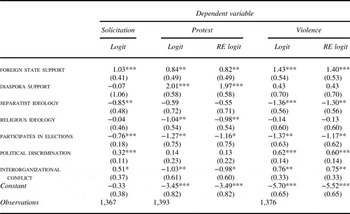
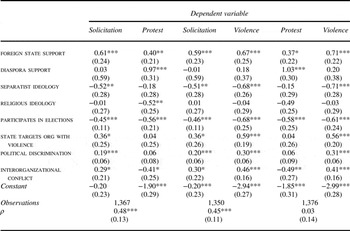
Given that our dependent variables are dichotomous, logistic regression is the standard approach. However, although solicitation abroad occurs frequently in the data set, both types of contention abroad account for a relatively small number of observations. Table 1 displays the frequency distribution of each of the dependent variables in the full MAROB data set. As King and ZengFootnote 130 have pointed out, logistic regression may underestimate the probability of a binary event occurring when the event is especially rare in the population. To account for this potential bias of the conventional logit approach, we also analyze the contention models (protest and violence) using rare events logistic regression with prior correction. The results of both the logit and rare events logit analyses are included in Table 2. As the table indicates, there are no substantial differences in the results of the two approaches, so we are comfortable interpreting empirical support for our hypotheses based on the results of the standard logistic regressions.Footnote 131
Determinants of transnational activity by Middle Eastern political Organizations, 1980–2004

Notes: Standard errors clustered on the organization are in parentheses. * p < .10; ** p < .05; *** p < .01 (one-tailed test).
Additionally, although a multinomial logistic regression provides a seemingly attractive option for modeling the unordered strategy choice of organizations, we feel that such an approach is ill-advised, given the large number of strategy choices that would need to be modeled. Specifically, given that there is no a priori reason to assume that in a given year an organization cannot engage in more than one type of transnational activity, we would need to include not only four “choices” (each transnational activity plus a base category of no activity), but would also need to include each possible combination of two of the three choices as well as all three being pursued in a given year (eight possible choices). Given the rarity in the data of an organization pursuing more than one type of transnational activity in one year—let alone three types—it is unlikely that the data would support such a model. We do, however, address the possibility that the decisions to engage in different types of activity are not independent of each other in bivariate probit model.
Our first two hypotheses expect positive relationships between external support (foreign state and diaspora) and all of our dependent variables. The results in Table 2 indicate that foreign state support significantly increases the probability of solicitation and nonviolent and violent contention, although diaspora support significantly influences only nonviolent contention. We also hypothesized that foreign state support will have a greater effect on violent than nonviolent contention. This is indeed the case: foreign state support increases the probability of violence by six percentage points, whereas it increases the probability of protest by three percentage points.Footnote 132 State support therefore influences violence to a greater degree, which suggests that our general logic regarding the comparative ease of violence is supported vis-á-vis foreign state support. It is plausible, however, that the effect of foreign state support may be an artifact of the Cold War, and that this drives the observable effect on our dependent variables. In robustness checks, we analyzed models controlling for the Cold War, and the results indicate that the effect of state support on solicitation and the use of nonviolent and violent contention is still significant and in the expected direction.
Similarly, we expect that diaspora support will have a positive effect on each of our dependent variables and that the effect will be greater for nonviolent contention. The results suggest, in fact, that diaspora support has a significant effect on the use of transnational nonviolent contention only. Although our hypothesis is not supported regarding solicitation or violent activity, our broader expectation regarding the suitability of a politically active diaspora to increasing nonviolent contention is supported. Diaspora support seems to have no impact on either solicitation or the use of violence. Taken together, it appears that foreign state support is useful to engage in any transnational political activity, whereas diaspora support is critical to the decision to protest abroad.
Our next set of hypotheses outline expectations about the role of organizational ideology on the decision to solicit support or engage in contentious politics abroad. Specifically, we expect separatist organizations to be less likely to engage in any of the three activities, whereas we expect religious organizations to be more likely to do so. The results in Table 2 partially confirm our expectations about separatist organizations. They are less likely to solicit external support and less likely to engage in violence abroad, although such an ideology does not significantly affect the use of transnational nonviolent contentious politics. Religious ideology, however, does not have a significant effect on solicitation or violence, but decreases the probability of protest.
Of all the independent variables included in our models, the most consistent observed effect is that of organizational participation in elections, which, in line with our expectation, is negatively associated with solicitation and nonviolent and violent contention abroad. This provides strong support for H5 because the variable is significant and negative across each dependent variable. Although our test is limited to the Middle East and North Africa, it should be emphasized that we do not believe that cultural or historical factors idiosyncratic to the region are driving this result. Rather, we believe that it is the high proportion of authoritarian regimes that employ elections and legislatures as a mechanism of control and management of the opposition.
Conversely, when the state actively uses violence against an organization, or when the ethnic group associated with the organization suffers from political discrimination, the organization will be more likely to solicit support and engage in violence abroad, and the effect is greatest for transnational violence in both cases. The use of violence against the organization and political discrimination both have a significant effect on solicitation and violence. Repression of the organization and repression of the ethnic group writ large are therefore both strongly associated with the decision to use violence. Taken together, the results for H6a and H6b provide support for our expectations regarding the comparative ease of transnational violence as a response to domestic repression.
Finally, we expect that conflict with other organizations should make organizations more likely to engage in all political activities abroad. The coefficients are significant and positive for solicitation and violence, indicating that interorganizational conflict positively predicts these activities. This finding partially supports our hypothesis and accords with the literature on outbidding. On the other hand, the effect of interorganizational conflict on protest is significant and negative. Domestic political conflict with other organizations, therefore, decreases the probability of nonviolent contention specifically.
Having identified the statistical relationships between the various organizational and structural factors and our three dependent variables, we now turn to a substantive interpretation of our results. We calculated predicted probabilities from our models by fixing variables of interest at theoretically important values and holding the other independent variables at their observed values in line with the recommendations of Hanmer and Kalkin.Footnote 133
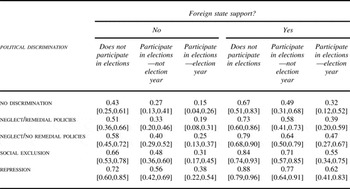
Tables 3 through 6 list predicted probabilities derived from the models. Below each probability is a 95 percent confidence interval around the prediction. We interpret those predictions where the confidence interval encompasses 0 as being statistically indistinguishable from 0. Table 3 displays the probabilities that an organization will solicit support given various levels of political discrimination, participation in elections, and foreign state support. It is first important to note from the confidence intervals that all predictions are greater than 0. Beyond this basic finding, the substantive effect of each variable is rather stark: an organization participating in elections during an election year, and representing an ethnic group that does not experience political discrimination, on average, has a 0.15 probability of solicitation if it does not receive foreign state support. If that same organization receives foreign state support, the probability more than doubles, to 0.32. Based on these characteristics, the most likely type of organization to solicit support abroad is an organization that receives foreign state support, does not participate in elections, and whose ethnic group is systematically repressed (0.88 probability).
Predicted probabilities of solicitation abroad

Notes: All other variables held at observed values. 95% confidence intervals are in brackets.
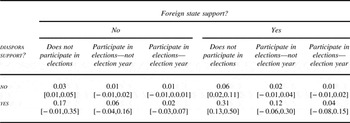
Table 4 displays the probabilities that an organization will engage in nonviolent protest abroad based on varying electoral participation, diaspora support, and foreign state support. Unlike solicitation, protest is a rare event, so the probabilities overall are much lower, with most of them statistically indistinguishable from 0 at the 95 percent confidence level. With this caveat, it is clear that diaspora support combined with foreign state support and a lack of participation in the electoral process has a large substantive effect on the decision to protest abroad (0.31 probability). The greatest substantive effect is the presence of diaspora support; this is fully in line with our theoretical expectation that diasporas are particularly amenable to providing the “bodies” necessary for transnational mobilization. Organizations not participating in elections are, on average, five times more likely to use nonviolent contention when they are supported by their diaspora community. It is clear then, that in certain contexts, diaspora support is a crucial determinant of transnational protest activity.
Predicted probabilities of protest abroad

Notes: All other variables held at observed values. 95% confidence intervals are in brackets.
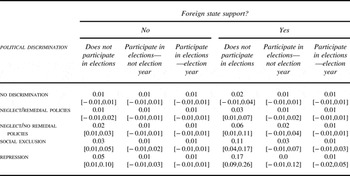
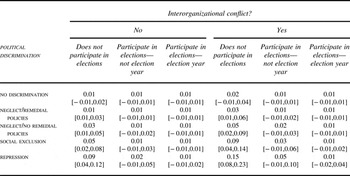
Finally, Tables 5 and 6 display the probabilities that an organization uses transnational violence. Table 5 varies political discrimination, electoral participation, and foreign state support, whereas Table 6 substitutes interorganizational conflict for foreign state support. Like protest, transnational violence is a rare event and so the probabilities are low (or indistinguishable from 0) in many cases. Notably, in every case, electoral participation makes the probability of violence almost nonexistent in line with our expectations on the effect of electoral behavior in a nondemocratic context. This suggests that electoral participation in the Middle East–North African context has a robust pacifying effect on transnational violence. On the other hand, organizations not participating in elections are increasingly likely to use violence abroad as discrimination increases. At its peak, political discrimination against these groups leads to a 0.05 probability of violence. Further, in every case, the probability of violence at least doubles if the organization is supported by a foreign state.
Predicted probabilities of violence abroad

Notes: All other variables held at observed values. 95% confidence intervals are in brackets.
Predicted probabilities of violence abroad

Notes: All other variables held at observed values. 95% confidence intervals are in brackets.
As Table 6 demonstrates, among the most dangerous organizations are those that are embroiled in conflict with other political organizations, do not participate in elections, and whose ethnic constituents experience systematic repression. On average, these organizations have a 15 percent chance of engaging in violence outside their country in a given year. Organizations that are subject to the same effects regarding constituent group repression and electoral activity, but who receive foreign support, are slightly more likely (17 percent chance) to engage in transnational violence in a given year. In all cases, reducing the level of repression, involving the organization in elections, removing foreign support, or ending interorganizational conflict significantly reduces the probability of transnational violence.
Interestingly, across our explanatory variables, there seems to be a strong similarity between violence and solicitation. This was not something that we had considered theoretically before conducting our analysis (and we thank one of our anonymous reviewers for pointing out the importance of these results). Indeed, protest and solicitation are similar only when it comes to the negative impact of participation in elections and the positive impact of foreign state support. Violence and solicitation, on the other hand, are similar in their relationship to every variable. This finding is both surprising and counterintuitive. We believe this is a finding that demands more investigation, but as we have previously argued, one possibility is that external protest is harder to maintain and conduct in some ways than both violence and solicitation, given the larger number of participants needed. Additionally, we might see similar trends for these two activities if groups most often solicit support with the specific intention of committing violence.
Sensitivity Analysis
We have already analyzed our hypotheses with both logit and rare events logit models in an effort to identify any potential bias in the data-generating process. It is possible, however, that the decision to solicit support abroad, or the decision to use nonviolent or violent contention abroad are not independent of each other. After all, some organizations engage in more than one type of behavior in the same year (though this is rare in our data). Still, we might expect that each of these decisions is interrelated, which would mean that the error terms in each of our logit models are correlated, and the probabilities of each dependent variable, therefore, would be jointly distributed. To account for this possibility, we reestimated our models as bivariate probits, pairing each of the dependent variables, and the results are listed in Table 7.
Bivariate probit models

Notes: Standard errors clustered on the organization are in parentheses. *p < .10; **p < .05; ***p < .01 (one-tailed test).
In the first column of Table 7, we assume that solicitation and nonviolent protest are jointly distributed, though the results of each individual probit are nearly identical to the original logit models. Foreign state support, elections, repression, political discrimination, and interorganizational conflict continue to drive solicitation, while protest continues to be a function of foreign state, diaspora support, and participation in elections. Religious ideology significantly affects protest, but this finding is not consistent in the other model that includes protest. Interorganizational conflict increases the probability of solicitation while decreasing the probability of protest (though weakly so). In the second column, we analyze the joint effect of our independent variables on solicitation and violence, and once again the results are comparable with our original analysis. Finally, the model analyzing both protest and violence (third column) also produces results similar to those we presented earlier. The correlation parameter (ρ), however is insignificant, indicating that the errors are not correlated, and the models of protest and violence can be safely estimated independent of each other.
Conclusion
Previous literature on transnational contention and advocacy has focused attention at the state level. Our analysis has examined a wide range of factors at the organizational level thought to influence the decision to engage in transnational politics. We have found evidence to support our expectation that transnational protest is the most difficult activity for organizations to engage in, with transnational violence and transnational solicitation being relatively easier. Our analysis has also clarified the relationship between various organizational and structural factors and the choice to engage in politics abroad. Our results suggest that diaspora support is a key driver of nonviolent transnational contention, while foreign state support, diaspora support, and interorganizational conflict all predict the use of violence. Religious ideology seems to discourage the use of nonviolent contention abroad, while a separatist ideology discourages solicitation and violence. Finally, supporting much of the literature on social movements, we find that incorporating organizations into the political process has a strong negative effect on all types of transnational political activity—though our regional focus means that our finding largely pertains to participation in systems that are not fully democratic. Conversely, discrimination against the ethnic group at home is associated with a greater likelihood of the organization turning to violence and solicitation in other countries.
These results offer important advances in our current understanding of transnational political activity, and perhaps most importantly, transnational violence. Key predictors of violence include foreign state support, interorganizational conflict, political discrimination, state repression, and electoral exclusion. However, given the regional restriction of our analysis and the fact that the Middle East is an outlier in terms of transnational violence, we encourage the collection of more organizational data to identify possible policy implications.
Our analysis suggests many areas for future research, since little empirical work has tested transnational political hypotheses at the organizational level. Although the logic behind most of our hypotheses is supported, some of the specific results demand more attention. For instance, we expected diaspora support to influence nonviolent protest more than the other types of political behavior but to still influence solicitation and violence, yet we find no significant relationship between diaspora support and those activities. Anecdotally, there are plenty of examples of diasporas contributing to violent transnational campaigns. But with the data at hand, we find no such relationship. Our data focus on organizations in the Middle East and North Africa only, and while we expect our findings to hold across regions, the quantitative data are simply not available at present. However, the history of some organizations outside of the Middle East and North Africa do suggest that these findings are likely to have wider applicability. For example, the Liberation Tigers of Tamil Eelam (LTTE) in Sri Lanka received prolonged foreign state support from India, but when India and the LTTE turned on each other, diaspora support was an important resource for the Tigers, who were able to conduct transnational attacks in India.Footnote 134 The solicitation of external support was also a major component of LTTE's portfolio of activity. Indeed, Byman and colleagues note that by 1998 the Tigers were represented in fifty-four countries.Footnote 135
We have also limited our focus to ethnopolitical organizations, yet there are other types of political organizations that might behave differently in the absence of ethnic motivations. Future work might also synthesize our broad findings with theories that emphasize the role that normative framing plays in organizational behavior—to what degree does the “logic of appropriateness”Footnote 136 serve as a lens through which organizations interpret their domestic and international threats and opportunities? In-depth organization narratives may provide a fruitful approach in this regard—complementary to our large-N results. Such future inquiries, combined with the results presented in this study, may allow us to better grasp the strategic decisions of political organizations to engage in politics abroad.