Introduction
Body–mind interactions are well recognised, and there is evidence that the two communicate with each other through hormones, neurotransmitters including neuropeptides, and cytokines. This can in turn trigger an individual to be biologically hypersensitive, and may lead to the creation of symptoms suggestive of allergic disorders such as allergic rhinitis, asthma and atopic dermatitis.Reference Gelis, Prokopakis, Helidonis and Velegrakis1
Psychological factors or stress may trigger several of the allergic symptoms. Furthermore, patients with allergic rhinitis, regardless of the type of rhinitis, may develop a group of psychological complaints related to symptom severity.Reference Bavbek, Kumbasar, Tugcu and Misirligil2
Studies in psychosomatic medicine have linked type I or immunoglobulin E mediated allergic disorders with psychological disturbances, in particular, negative affective states. These include neuroticism, depression, social anxiety and shyness.Reference Gauci, King, Saxarra, Tulloch and Husband3
A review of the literature shows a relationship between personality disorders and allergic rhinitis. The present study examined the association between personality traits and allergic rhinitis. There was a particular interest in the potential relationship between anxiety-related traits and allergic rhinitis. The study compared the personality traits of allergic rhinitis patients with individuals from the general population who had no symptoms of allergic rhinitis.
Materials and methods
A descriptive observational pilot study was carried out on 50 consecutive cases of allergic rhinitis who presented to the allergy clinic at St John's Medical College (a tertiary care hospital) in Bangalore, South India, between June and October 2010. These patients were evaluated for allergies as per the standard institutional protocol. Patients with overt psychiatric disorders were excluded from the study.
Patient information was recorded in the standard proforma of the clinic, and included demographics, a detailed history, findings of clinical examinations such as diagnostic nasal endoscopy, and results of investigations such as the skin prick test and assessments of total immunoglobulin E levels.
The skin prick test was carried out to test reactivity to 22 common aeroallergens such as fungi, pollens, dust mites, animal epithelia and insects, and included histamine and saline as controls. The test was considered positive if the size of the wheal was at least 3 mm more than that produced by saline. Patients with at least one positive reaction were considered to be atopic. Patients with allergic rhinitis were classified according to intermittent or persistent and mild or moderate-to-severe symptoms, based on the revised Allergic Rhinitis and its Impact on Asthma guidelines.Reference Brozek, Bousquet, Baena-Cagnani, Bonini, Canonica and Casale4
The study control group comprised 50 individuals from the general population. This group had no symptoms of allergic rhinitis.
In order to examine personality traits, both groups completed the International Personality Disorder Examination questionnaire, which is compatible with the International Classification of Diseases version 10 (ICD-10).Reference Armand and Aleksandar5 This is a validated self-assessment questionnaire consisting of 59 questions, for which responses are marked as true or false (Appendix 1). Patients were categorised into various personality traits based on their responses in the questionnaire, namely: paranoid, schizoid, dissocial, impulsive, borderline, histrionic, anankastic, dependent or anxious. For convenience of assessment, these personality traits were grouped into clusters corresponding to those described in the Diagnostic and Statistical Manual of Mental Disorders version four (DSM-IV), and the patients were classified as cluster A, B or C types accordingly (Appendix 2).
Results
Of the 50 allergic rhinitis patients analysed, 30 were males and 20 were females. The age of these patients ranged from 17 to 65 years, with a mean of 33.14 years (44 per cent of patients were between the ages of 21 and 30 years). The duration of symptoms varied between 6 months and 37 years, with a mean of 5.43 years.
In the control group, there were 32 males and 18 females, the ages of whom ranged from 20 to 66 years.
Allergic rhinitis evaluation
Of the 50 atopic patients (those with at least one positive skin prick test result), 14 patients (28 per cent) were positive for only one antigen, 17 patients (34 per cent) were positive for 2-5 antigens, 11 patients (22 per cent) were positive for 6-10 antigens and 8 patients (16 per cent) were positive for more than 10 antigens.
The majority of the patients were software engineers or businessmen (42 per cent). The other patients were homemakers (16 per cent), teachers (15 per cent), healthcare workers (12 per cent), agricultural workers (12 per cent) or students (3 per cent).
Personality trait evaluation
Based on the results of the International Personality Disorder Examination questionnaire, 3 patients were found to have a paranoid personality, 7 schizoid, 2 impulsive, 2 borderline, 2 histrionic, 18 anankastic, 9 anxious and 7 dependent. None of the atopic individuals in the study had a dissocial personality.
Thirty-four (68 per cent) of the atopic patients were classified as cluster C personality type, 10 (20 per cent) were cluster A and 6 (12 per cent) were cluster B.
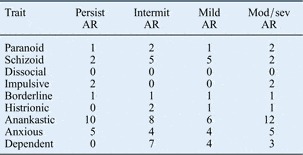
Cluster C patients tested positive for more antigens than the other personality types. With regards to the type of allergic rhinitis, the symptoms for 29 patients (58 per cent) were intermittent, with the remaining patients suffering from persistent allergic rhinitis. Nineteen patients (66 per cent) with intermittent symptoms and 15 (71 per cent) of those with persistent allergic rhinitis were classified as having a cluster C personality. With regards to the severity of allergic rhinitis, the majority of both mild and moderate-to-severe sufferers were classified as having a cluster C personality type. These results are summarised in Table I. Overall, the findings indicate that allergic rhinitis was associated with a dominant anxious trait.
Allergic rhinitis patient personality traits

Data represent numbers of patients. Persist = persistent; AR = allergic rhinitis; intermit = intermittent; Mod/sev = moderate-to-severe
In the control group, 5 individuals were found to have a paranoid personality, 19 schizoid, 1 dissocial, 5 impulsive, 1 borderline, 1 histrionic, 8 anankastic, 6 anxious and 4 dependent. These findings show that type A personality was the most dominant (48 per cent) in individuals without allergic rhinitis.
Type A personality is primarily representative of paranoid and schizoid traits. Paranoid individuals are likely to be suspicious, jealous, sensitive, resentful, bear grudges and have a strong sense of self importance. Schizoid individuals are emotionally cold, detached and lack a sense of enjoyment.
Type C personality is reflective of more anxious, dependent and anankastic traits. Anxious individuals tend to have feelings of tension, social inferiority and rejection, and avoid risky situations or social activity. Dependent individuals allow others to take responsibility, feel unable to take care of themselves and need excessive help to make decisions. Anankastic individuals are perfectionists. They are preoccupied by details, rules and so on, and are rigid and stubborn. They are excessively doubting and cautious, and expect others to submit to their ways.Reference Carrasco, Lecic-Tosevski, Gleder, Mayou and Cowen6
Discussion
Allergy and personality disorders
The relationship between psychological status and atopic disease has been studied since the early 1950s. It has been acknowledged that atopic disease is frequently accompanied by psychological disorders such as anxiety and depression.Reference Satish, Streufert, Dewan and Voort7
Studies have been carried out to examine the association between personality traits and allergic rhinitis, especially amongst women. This has revealed an increased preponderance of allergic rhinitis of the moderate-to-severe type in those with psychological traits that include neuroticism, depression, social anxiety and shyness. Most of those studies used the Minnesota Multiphasic Personality Inventory, which provides a thorough assessment of personality traits. However, this inventory is not sufficiently standardised to be included in the International Classification of Diseases version 10 or the Diagnostic and Statistical Manual of Mental Disorders version four.Reference Gauci, King, Saxarra, Tulloch and Husband3 Hence, we chose to use the International Personality Disorder Examination questionnaire for the assessment of our patients. Nevertheless, even with the use of this questionnaire, it is difficult to combine the psychiatric profile of individuals into groups, as results often show varying combinations of traits. Therefore, these traits were classified into clusters of A, B and C types in accordance with the Diagnostic and Statistical Manual of Mental Disorders version four guidelines in order to derive conclusions in a simplified manner.
• Specific personality traits may impact on allergic symptoms
• This study examined the relationship between personality traits, particularly anxiety, and allergic rhinitis
• Personality traits of allergic rhinitis patients were compared with a control group that had no symptoms of allergic rhinitis
• Cluster C personality type was positively correlated with the type and severity of allergic rhinitis; the controls were predominantly cluster A personality type
The possible pathomechanism of a causal relationship between allergic rhinitis and psychological disorders remains a matter of controversy. Tonelli et al. studied the pharmacogenetics of this relationship using molecular biology, psychoneuroimmunology and pharmacogenetics. They suggested that the allergy could directly influence the biochemical response of the central nervous system, which might lead to psychological disorders.Reference Tonelli, Holmes and Postolache8 However, to our knowledge, ours is the first study to examine the relationship between personality traits and atopic disease.
Allergic rhinitis and stress
Atopy is characterised by biological hypersensitivity to environmental stimuli. This in turn predisposes an individual to a number of clinically expressed disorders including allergic rhinitis, atopic dermatitis or eczema, and allergic asthma. There is evidence that psychological stress constitutes an increased risk for atopy.Reference Wright, Cohen and Cohen9
Stress is an imbalance between the body's demands and the capacity of the body to cope with them.Reference Montoro, Mullol, Jauregui, Davila, Ferrer and Bartra10 Repeated stress activates the hypothalamo-hypophyseal axis causing persistent secretion of glucocorticoids, which in turn reduces interleukin-12 secretion from antigen-presenting cells. This subsequently reduces the T-helper type 1 mediated response, thereby tilting the balance between T-helper types 1 and 2 in favour of T-helper type 2, which over time could induce increased susceptibility to allergic diseases.Reference Elenkov11
Each individual is unique in terms of their qualities and traits. Our personalities define our thoughts, feelings and behaviours in terms of how we think and feel, the decisions we make and the actions we take. Personality is determined, in part, by our genetics as well as our environment. It is the determining factor in how we live our lives. People with cluster C personalities are often viewed as anxious and fearful. These individuals are excessively afraid of social relations and have feelings of tension, apprehension, insecurity and inferiority. Over a period of time, this continued stress can manifest in the form of allergic diseases.
Conclusion
In psycho-allergological research, the potential relevance of personality factors in the maintenance and exacerbation of atopic symptoms is still a matter of debate.Reference Buske-Kirschbaum, Ebrecht, Kern, Gierens and Hellhammer12 More attention should be paid to the psychological status of allergic rhinitis patients, and appropriate treatment should be provided to improve their symptoms and quality of life.Reference Lv, Xi, Han and Zhang13 Some studies have shown that relaxing experiences such as listening to classical music, or pleasurable experiences such as kissing or laughing, can modify the behaviour of the immune cells in allergic patients. When these experiences last for periods of approximately 30 minutes, their effects can convert the T-helper type 2 response into a T-helper type 1 response, and reduce (prick test) positivity to allergens.Reference Kimata14–Reference Kimata17
Cluster C personality type was positively correlated with the type and severity of allergic rhinitis compared with controls. In controls, cluster A personality type was predominant. However, studies with larger data sets are necessary to reveal statistically significant findings.
Appendix 1. International Personality Disorder Examination questionnaire
Key:
T = true
F = false

Appendix 2. Diagnostic and Statistical Manual of Mental Disorders version four
Cluster A (odd or eccentric disorders)
Paranoid personality disorder (Diagnostic and Statistical Manual of Mental Disorders version four code 301.0) is characterised by irrational suspicions and mistrust of others.
Schizoid personality disorder (code 301.20) is associated with a lack of interest in social relationships, seeing no point in sharing time with others, anhedonia and introspection.
Schizotypal personality disorder (code 301.22) is characterised by odd behaviour or thinking.
Cluster B (dramatic, emotional or erratic disorders)
Antisocial (dissocial) personality disorder (code 301.7) is reflected by a pervasive disregard for the law and the rights of others.
Borderline personality disorder (code 301.83) is characterised by: extreme ‘black and white’ thinking; instability in relationships; and issues with self-image, identity and behaviour, which often leads to self-harm and impulsivity. Borderline personality disorder is diagnosed in three times as many females as males.
Histrionic personality disorder (code 301.50) is represented by pervasive attention-seeking behaviour including inappropriately seductive behaviour and shallow or exaggerated emotions.
Narcissistic personality disorder (code 301.81) is associated with a pervasive pattern of grandiosity, a need for admiration and a lack of empathy.
Cluster C (anxious or fearful disorders)
Avoidant (anxious) personality disorder (code 301.82) is represented by social inhibition, feelings of inadequacy, extreme sensitivity to negative evaluation and avoidance of social interaction.
Dependent personality disorder (code 301.6) is reflected by pervasive psychological dependence on other people.
Obsessive-compulsive (anankastic) personality disorder (not the same as obsessive-compulsive disorder) (code 301.4) is characterised by rigid conformity to rules, moral codes and excessive orderliness.