Large herbivores prefer certain habitat types and, consequently, are not uniformly distributed while foraging (Ferrar & Walker Reference FERRAR and WALKER1974, Hirst Reference HIRST1975). For African ungulates, day-to-day movement between habitats is determined by diverse factors including forage composition, availability and quality, water availability, topography, soil type (Ben-Shahar & Coe Reference BEN-SHAHAR and COE1992) and predation (Grand Reference GRAND2002). Additional seasonal movements relate to climatic conditions, the catenary level (Bell Reference BELL1969) and the effect of fire on vegetation (Crowe et al. Reference CROWE, SCHIJF and GUBB1981). We assessed how grass flushes, following dry-season fires, and availability of water influenced different ungulates’ seasonal movements in Ithala Game Reserve – a fenced South African reserve characterized by abrupt topography.
Although often started and controlled by management, fire is a natural and integral part of savanna ecosystems (Scholes & Walker Reference SCHOLES and WALKER1982). A few days after burning the residual tufts of grass drive out new growth, triggered by the fire-induced ‘heat shock’, provided enough soil moisture is available (Sturm Reference STURM1993). As plants age, their concentration of protein decreases whilst the proportion of relatively indigestible crude fibre increases – the young grass is thus high in protein and easily digestible, giving it high nutritive value (McDonald et al. Reference MCDONALD, EDWARDS and GREENHALGH1966), especially as elsewhere in the dry season food availability is low and grass quality poor (Huntley & Walker Reference HUNTLEY and WALKER1982). This attractiveness of newly burnt areas to large herbivores is widely recognized (Moe et al. Reference MOE, WEGGE and KAPELA1990, Wilmshurst et al. Reference WILMSHURST, FRYXELL, FARM, SINCLAIR and HENSCHEL1999), and the comparative usage of such areas by different herbivore species has been investigated (Tomor & Owen-Smith Reference TOMOR and OWEN-SMITH2002). Wilsey (Reference WILSEY1996) proposed that relative use of green flushes following burns among African ungulates was related to body size; larger animals utilizing them less due to their ability to survive on relatively lower quality foods (Illius & Gordon Reference ILLIUS and GORDON1992), consequent on the inter-relationships between body size, energy (Hungate et al. Reference HUNGATE, PHILLIPS, MCGREGOR, HUNGATE and BUECHNER1959) and protein turnover (Brody et al. Reference BRODY, PROCTOR and ASHWORTH1934) and gut capacity (Illius & Gordon Reference ILLIUS and GORDON1992).
The relationship between herbivores’ distance to surface-water and the season will vary according to the interplay between water availability and topography. Animals will remain within reach of water, according to their varying temporal requirements, and therefore if water sources are restricted animals will occur in higher concentrations in their vicinity than elsewhere. In such cases declining quality and quantity of forage over the dry season will force herbivores to forage further away from the water, leading to an increase in mean distance of herbivores from surface water (Redfern et al. Reference REDFERN, GRANT, BIGGS and GETZ2003). This will especially be the case in flatter regions where catena effects (Bell Reference BELL1969), which lead to better resources down the catena (i.e. closer to water), are minimal. At the other extreme, if water is freely available and places no restriction on animal range, animals will be distributed irrespective of surface water. Topography will again modify how dry-season forage shortage influences herbivores’ distance from water, but now flat areas would be expected to show little change whilst in hilly areas herbivores would be expected to move down the catena and hence closer to water. Consequently in areas where water is freely available with markedly varied topography, as in Ithala, mean distances to surface water would be expected to decrease in the dry season.
We hypothesized that (1) larger ungulates would be less attracted to grass flushes than smaller ungulates, and (2) ungulates’ mean distance to water would decrease in the dry season.
Ithala Game Reserve (29653 ha) is situated in northern KwaZulu Natal, South Africa (27°30′S, 31°25′E). Full details of the study site are given in O'Kane et al. (Reference O'KANE, PAGE and MACDONALD2014a). Over the 4-y study mean annual rainfall (632 mm) was below average, with annual rainfall in Year 2 noticeably lower (427 mm). The reserve carries moderate densities of impala Aepyceros melampus Lichtenstein (10 km−2), a mixed-feeder, but high densities of wildebeest Connochaetes taurinus taurinus Burchell (6 km−2) and zebra Equus burchelli Gray (5.6 km−2) (O'Kane et al. Reference O'KANE, PAGE and MACDONALD2014a, Reference O'KANE, PAGE and MACDONALDb).
Over a 6-d period each month, for 4 y, road transects covering a representative sample of the reserve's different vegetation types, and 23% of the reserve's total area, were carried out. Transects were driven at the same time during the morning and afternoon on each field trip, with midday avoided. Once within a classifiable distance with an unobstructed view of the individual/group of herbivores, the total number of animals, the species, their age and sex were determined as per Brooks (Reference BROOKS1985). Spatial data were collected over the last 2 y of the study and the coordinates of each sighting were imported into a GIS (ArcGIS 9 by ESRI). During the collection of spatial data, the presence or absence of a grass flush at each sighting was recorded. Grass flushes only occurred, following fire and then rainfall, over the dry season of the first year in which spatial data were gathered (Year 3). Taking the field trip where major flushes were observed and using the query builder in ArcGIS 9, all records where the sighting was situated on a flush were selected and converted to a separate shape file and added to the view. Polygons were then drawn, by eye, around each large concentration of herbivores on a flush, and flushes were grouped into those occurring on high, mid-, or low-elevation grasslands. By calculating the area of the polygons, densities of each herbivore species on the flush were determined. These same polygons were then used to determine densities on the same parcels of land 1 mo (i.e. one field trip) before the appearance of the major flush. The null hypothesis was that there was no difference between these densities and this was tested, for each herbivore species and each flush grouping, using Pearson's Chi-squared test with Yates’ continuity correction with P-values ≤0.05 taken as significant.
Ungulate species were analysed separately, with the null hypothesis being that there was no difference in the mean distance to water during the dry season compared with the wet season. Fisher's F-test was used to determine whether variances in means were significantly different, with the standard two-sample t-test (equal variances) or Welch's modified two-sample t-test (unequal variances) then used to test the null hypothesis. P-values ≤0.05 resulted in rejection of the null hypothesis, i.e. represented significant differences between mean distances to water in the dry versus wet season. Statistical procedures were carried out in S-PLUS (Mathsoft, Lucent Technologies, Inc., Murray Hill, USA).
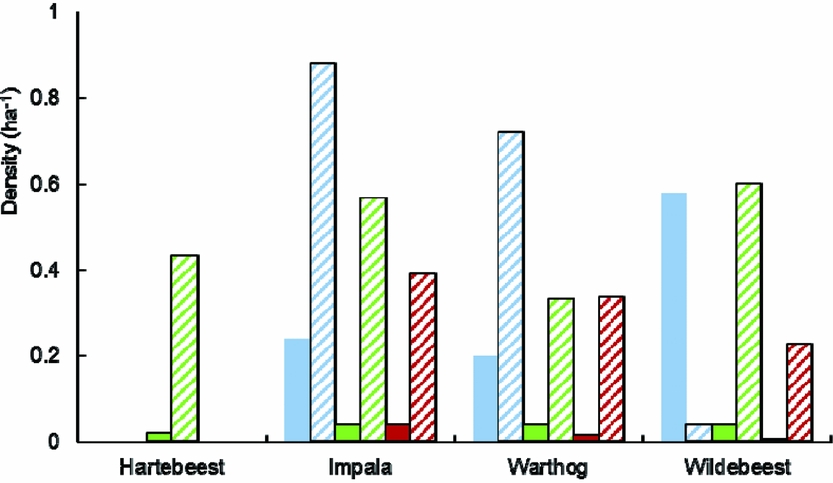
Impala and warthog Phacochoerus aethiopicus Pallas were significantly attracted to grass flushes at any elevation, wildebeest to those at mid- and lower elevations, whilst hartebeest Alcelaphus buselaphus Pallas only to those at mid-elevations (Figure 1). Although a few zebra were observed on grass flushes, there was no significant increase in their densities compared with prior to the flush. White rhino Ceratotherium simum Burchell was not observed on grass flushes.
Ungulates attracted to dry-season grass flushes in Ithala Game Reserve, South Africa. Ungulates that significantly (P≤0.05; Pearson's Chi-squared test with Yates’ continuity correction) changed density on grasslands in response to dry-season grass flushes are shown, with filled columns showing densities before the flush, hatched columns during the flush. Blue represents high-elevation, green mid-elevation and red low-elevation grasslands.

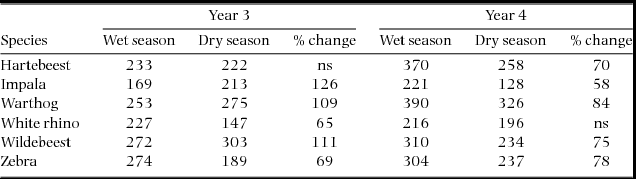
During the dry season of Year 3, the mean distance from water of impala, warthog and wildebeest was significantly greater than in the preceding wet season, whilst white rhino and zebra were significantly closer (Table 1). During the dry season of Year 4, the mean distances from water of all studied ungulates was significantly less than the preceding wet season, except for white rhino where this finding was not significant.
Ungulates’ mean distances (metres) to surface water in Ithala Game Reserve, South Africa. Where the mean distance to surface water for a herbivore species in the dry season was significantly (P≤0.05; standard two-sample t-test or Welch's modified two-sample t-test) different to that in the preceding wet season, this is shown as the percentage change going from wet to dry season (ns = not significant).

That impala, warthog and wildebeest made most use of flushes agrees with the findings of others (Crowe et al. Reference CROWE, SCHIJF and GUBB1981, Field & Laws Reference FIELD and LAWS1970, Gureja & Owen-Smith Reference GUREJA and OWEN-SMITH2002, Shackleton Reference SHACKLETON1992, Tomor & Owen-Smith Reference TOMOR and OWEN-SMITH2002, Wilmshurst et al. Reference WILMSHURST, FRYXELL, FARM, SINCLAIR and HENSCHEL1999, Wilsey Reference WILSEY1996, Wronski Reference WRONSKI2003), as does our finding that zebra made little use of them (Wilsey Reference WILSEY1996). As one of the larger grazers, wildebeest, was heavily attracted to grass flushes whilst the similar-sized zebra was not, our findings did not support our (first) hypothesis that larger ungulates would be less attracted to flushes than smaller ungulates. Wilsey (Reference WILSEY1996), although he first proposed this hypothesis, found only a weak (r² = 0.29; P>0.05) linear regression between body size and use of grass flushes in the Serengeti, with wildebeest showing marked use of flushes. Tomor & Owen-Smith (Reference TOMOR and OWEN-SMITH2002) did not find any significant relationship between body size and use of flush. This differential pattern of usage suggests that the missing part in Wilsey's proposal is the influence of gut morphology; namely ruminant versus non-ruminant. Ruminants, such as impala, warthog and wildebeest, being more dependent on quality of forage than quantity (Owen-Smith & Novellie Reference OWEN-SMITH and NOVELLIE1982), are likely to be more attracted during times of resource scarcity to flushes than non-ruminants, such as zebra, which can cope with such conditions by increasing their intake of lower-quality forage. Non-ruminants would be expected to still desire the quality new grass in the depths of the dry season, but ruminants' need would be greater as they have no easy alternative – thus zebra may be being competitively displaced from the flushes. Even where zebra have been seen on flushes to a more marked extent, they were observed to be the least restricted in their occupation of the different vegetation zones apparent in the flush area (Tomor & Owen-Smith Reference TOMOR and OWEN-SMITH2002) – again likely to be due to their non-ruminant digestion.
It was noticeable in our results that despite occupying high-elevation grasslands before the appearance of grass flushes, wildebeest left these areas apparently when flushes appeared. This was probably because burning occurred over the period when wildebeest, over all four years of the study, were seen to abandon the higher elevations and move down the catena. Even so it is interesting that for a species renowned at detecting and travelling large distances for fresh grass growth (Talbot & Talbot Reference TALBOT and TALBOT1963), wildebeest did not travel back up the catena to utilize this resource. The study highlighted the importance of the timing of management burns in relation to dry-season rainfall – over the dry season of Year 3 burning occurred just prior to substantial dry-season rains, producing a marked flush, but in Year 4 dry-season burning occurred well after the rains resulting in a very sparse flush.
Over the dry season when grass flushes did not occur (Year 4) ungulates’ mean distance to water decreased, thus supporting our (second) hypothesis. However when dry-season grass flushes did occur (Year 3) ruminant grazers increased their mean distance to water, as they moved higher up the catena to where most burning, and hence flushes, occurred. Non-ruminant grazers (white rhino and zebra) were not attracted to these flushes and thus, as expected, moved down the catena closer to water.
ACKNOWLEDGEMENTS
We thank the reserve management of Ithala Game Reserve, South Africa, for access to the reserve, and Bruce Page for help with data collection. Dr O'Kane holds the Kadas Research Fellowship at WildCRU, Department of Zoology, University of Oxford and is deeply grateful to Gyongyver and Peter Kadas for their support.