





Background
Chronic diseases represent an escalating global health challenge, with increasing multimorbidity among adults that substantially compromises quality of life, self-management capacity, and healthcare utilisation (Johnston et al., Reference Johnston, Crilly, Black, Prescott and Mercer2019; Zhou et al., Reference Zhou, Dai, Ni, Zeng, Cheng, Carrillo-Larco, Yan and Xu2023). In primary health care, where most people with multimorbidity are followed longitudinally, managing multiple conditions often requires adherence to complex and sometimes competing care regimens that include pharmacological treatments, lifestyle changes, and ongoing monitoring. These demands are frequently difficult to sustain over time and may exceed individuals’ personal, social, and contextual resources. As a result, there is a recognised need for innovative strategies that enhance patient engagement and support sustainable self-management within community and primary care settings (Seakamela et al., Reference Seakamela, Mashaba, Ntimana, Kabudula and Sodi2025).
Over the past decade, primary care research has increasingly highlighted a shift away from biomedical and disease-centered models toward more integrative and person-centered approaches to supporting adults with multimorbidity (Chen et al., Reference Chen, Xu and Xu2026). Rather than focusing solely on disease control or guideline adherence, this shift recognises that self-management encompasses more than adherence: it includes the ability to make informed choices, negotiate priorities, participate actively in care, and pursue meaningful life goals within everyday contexts. (Aramrat et al., Reference Aramrat, Choksomngam, Jiraporncharoen, Wiwatkunupakarn, Pinyopornpanish, Mallinson, Kinra and Angkurawaranon2022). Evidence shows that self-management support can improve individuals’ problem-solving skills, engagement with care teams, and overall health outcomes across a wide range of chronic conditions (Schuttner et al., Reference Schuttner, Theis, Wong, Staloff, McQueen, Nelson, Ralston, Coyle, Hagan, Schult, Solt, Ritchey and Rosland2025).
The Capability Approach (CA), developed by Amartya Sen and Martha Nussbaum (Sen, Reference Sen2001; Nussbaum, Reference Nussbaum2011; Robeyns, Reference Robeyns2017), provides a robust and theoretically grounded framework for understanding well-being by focusing on what individuals are effectively able to be and do, that is, their real opportunities to live a life they value (López Barreda et al., Reference López Barreda, Robertson-Preidler and Bedregal García2019). Unlike models centred exclusively on symptoms or functional loss, the CA emphasises capabilities (opportunities) and functionings (achieved states), as well as the contextual factors that enable or constrain these. Within health research, capability-informed perspectives have been increasingly applied to capture multidimensional aspects of empowerment, participation, and well-being that conventional outcome measures often overlook (Koetsenruijter et al., Reference Koetsenruijter, van Eikelenboom, van Lieshout, Vassilev, Lionis, Todorova, Portillo, Foss, Serrano Gil, Roukova, Angelaki, Mujika, Knutsen, Rogers and Wensing2016; Seakamela et al., Reference Seakamela, Mashaba, Ntimana, Kabudula and Sodi2025).
Alongside these conceptual developments, narrative and dialogic approaches have emerged as practical strategies to support self-management and shared decision-making in primary and community health care (Dohan et al., Reference Dohan, Garrett, Rendle, Halley and Abramson2016; Ford and Reuber, Reference Ford and Reuber2024). Narrative methods enable individuals to articulate experiences, values, and life contexts, supporting meaning-making processes and strengthening patient–professional relationships, principles widely recognised within patient education and counselling (Dudley et al., Reference Dudley, Squires, Petroske, Dawson and Brewer2023; Bataller-Alonso et al., Reference Bataller-Alonso, Aparisi-Torrijo, Estelles-Miguel and Peris-Ortiz2025). Recent community-based interventions involving adults with multimorbidity indicate that structured, reflective approaches can enhance quality of life, self-management capability, and patient-centred outcomes, particularly when adapted to local contexts and individual resources (Lim et al., Reference Lim, Al-Busaidi, Caya, Bricca, Mangin, Wilson and Haxby Abbott2025; Seakamela et al., Reference Seakamela, Mashaba, Ntimana, Kabudula and Sodi2025; Chen et al., Reference Chen, Xu and Xu2026). However, despite these advances, a gap remains between conceptual frameworks and their practical application in routine primary care. Existing person-centred and self-management tools, such as patient activation measures, structured self-management frameworks, shared decision-making aids, goal-setting approaches, and burden-of-disease instruments, often support important aspects of education, behaviour change, treatment choice, or care planning. However, they do not consistently provide structured and narrative ways to explore individuals’ real opportunities to achieve what they value in everyday life, nor the contextual factors influencing these opportunities, particularly in complex situations such as multimorbidity (Dohan et al., Reference Dohan, Garrett, Rendle, Halley and Abramson2016; Dineen-Griffin et al., Reference Dineen-Griffin, Garcia-Cardenas, Williams and Benrimoj2019; Ford and Reuber, Reference Ford and Reuber2024).
Building on this gap, the Capability Cards were developed through a collaboration between the Dutch welfare organization Bindkracht10 and the HAN University of Applied Sciences, responding to the need for practical tools that operationalise capability-based thinking in professional practice (Brummel et al., Reference Brummel, Jansen, Yerkes, Javornik, Wilken, Parpan-Blaser, Prosser, van der Pas and Jansen2024). Grounded in Sen’s and Nussbaum’s CA (Sen, Reference Sen2001; Nussbaum, Reference Nussbaum2011; Robeyns, Reference Robeyns2017), the tool was co-created to translate abstract theoretical concepts into a structured, dialogic instrument. The final design consists of 20 cards representing central capabilities, accompanied by a structured methodology to facilitate conversations about values, preferences, and contextual facilitators and barriers (Brummel et al., Reference Brummel, Jansen, Yerkes, Javornik, Wilken, Parpan-Blaser, Prosser, van der Pas and Jansen2024). By shifting interactions away from problem-oriented assessment towards value-driven dialogue, the Capability Cards align closely with current calls for person-centred, participatory approaches in primary care for adults living with multimorbidity (Chiappero-Martinetti et al., Reference Chiappero-Martinetti, Houghton Budd and Ziegler2017; Howaldt and Schwarz, Reference Howaldt and Schwarz2017).
The present study reports the cultural and linguistic adaptation of Capability Cards for the Spanish context. This work responds to the need to ensure that the tool is relevant and meaningful within the specific sociocultural and organisational context of Spanish primary care, where communication styles, health system structures, and patients’ lived experiences may influence how person-centred approaches are understood and applied. The adaptation aims to facilitate structured and meaningful dialogue in community-based primary care about personal capabilities, life goals, and contextual factors shaping everyday life. The validation process followed Pasquali’s four-phase methodology (Medeiros et al., Reference Medeiros, Júnior, Pinto, Vitor, Santos and Barichello2015), incorporating theoretical, empirical, and analytical procedures to ensure content validity and usability. By presenting the content and usability evaluation of the Spanish version, this study contributes evidence on the relevance and applicability of capability-based tools to support self-management, engagement, and participatory care among adults with multimorbidity in primary health care settings.
Methods
This study was conducted in Catalonia, Spain, within the public primary healthcare system. It details the validation process of the tool named Capability Cards in the Spanish context. The instrument aims to facilitate meaningful conversations and, in this study, was applied with adults who have multimorbidity to help them explore their desires and abilities in a structured yet flexible manner. The tool was used by community nurses, who guided participants through the process.
Study design
Content validation is crucial for ensuring the reliability and accuracy of instruments. This research was conducted into four main phases: (1) reviewing the literature for the translation and adaptation of the tool, (2) development of the content and usability validation questionnaire (CUVQ) for a panel of experts and adults with multimorbidity, (3) assessment of the expert panel, and (4) evaluation with adults with multimorbidity, adhering to the guidelines of the Pasquali model.
-
1. Reviewing the literature for the translation and adaptation of the tool
The Capability Cards tool was originally developed in the Netherlands, drawing on Nussbaum’s list of ten central capabilities (Nussbaum, Reference Nussbaum2011) as the conceptual foundation. An interdisciplinary team, two Dutch researchers (both Ph.D. holders), authors 3 and 4, and two Spanish health professionals, authors 1 and 6, collaborated to translate and culturally adapt the tool. This process followed a collaborative and iterative approach, including forward translation, team-based review and reconciliation, and consideration of semantic and conceptual equivalence to ensure cultural appropriateness in the Spanish context. To support this process, a literature review using the terms (‘multimorbidity’) AND (‘self-management’) AND (‘capabilities’) in PubMed, CINAHL, and Scopus identified evidence-based resources for adults with multimorbidity, which informed the refinement of the Spanish version. Elements of cognitive testing were also incorporated during pilot use to assess clarity, comprehensibility, and relevance of the adapted content.
-
2. Development of Content and Usability Validation Questionnaires
Two instruments were developed to assess content validity: The Content and Usability Validation Questionnaire for Experts and Professionals (CUVQEP), intended for specialists in community health and community healthcare professionals, and the Content and Usability Validation Questionnaire for the Target Audience (CUVQTA), designed for end-users. Their development was guided by structured validation methodologies previously described in health-education research, including the systematic procedures reported by Chang et al. (Chang et al., Reference Chang, Kuo, Suen, Yang, Hou, Sun, Lee and Huang2023) and Muzzolon et al. (Muzzolon et al., Reference Muzzolon, Morgan, Reis, Imoto and de Carvalho2025). Item generation was based on these previous validation studies, aiming to capture key dimensions such as content relevance, clarity, comprehensibility, usability, and motivational value of the tool. The initial versions of both questionnaires were reviewed by the research team and refined through iterative discussion to ensure coherence and appropriateness for both expert and target populations.
The CUVQEP comprised 20 items, including 19 closed-ended questions focused on Spanish Capability Cards and one open-ended question for additional comments and suggestions. The CUVQTA consisted of 16 items, with 15 closed-ended questions about the tool and 1 open-ended question to capture comments and suggestions. Responses to the closed-ended questions were recorded using a 5-point Likert scale. The options were assigned the following values: ‘Strongly Disagree’ (1), ‘Disagree’ (2), ‘Neither Agree nor Disagree’ (3), ‘Agree’ (4) and Strongly Agree (5).
Participants and data collection
The study population comprised community health experts and community health professionals, as well as adults with multimorbidity.
-
3. Assessment of the experts and professionals’ panels
Experts and community health professionals were recruited using purposive and snowball sampling. For the expert panel, inclusion criteria required participants to be Spanish-speaking professionals with recognised expertise in community health and/or the management of adults with chronic conditions. For the professional panel, inclusion criteria required participants to be Spanish-speaking primary care professionals actively involved in the care of adults with chronic diseases and to have at least five years of clinical experience.
The expert panel ultimately comprised 12 community health experts, including a range of profiles such as territorial community health nurse coordinators, initiators of community health projects, professionals working on social inequalities in health, young researchers, university professors, and academic leaders. The professional panel consisted of 19 community health professionals (5 nurses, 6 physiotherapists, 4 psychologists, and 4 nutritionists), offering a multidisciplinary perspective. The sample sizes for both panels was considered adequate for content validation procedures, which typically rely on small, purposive samples to enable in-depth evaluation and iterative refinement of the instrument (Yusoff, Reference Yusoff2019). The community health professionals’ panel was composed of participants based entirely in Catalonia, whereas the expert panel included members from several regions of Spain as well as Chile.
Data were collected through a combination of a two-round online expert panel and four in-person professional panels. Participants received the Spanish Capability Cards and the CUVQEP according to their respective modality, facilitating iterative feedback, discussion, and refinement of the instruments. The second online round was conducted only with the expert panel to review the revised version of the Spanish Capability Cards and confirm consensus after the initial feedback. Consensus was defined as a CVI of 0.80 or higher, complemented by a review of qualitative comments to identify convergence or relevant discrepancies. Items that received divergent feedback or falling below the predefined threshold were revised by the research team before being included in the final version of the tool.
-
4. Evaluation with the target audience (adults with multimorbidity)
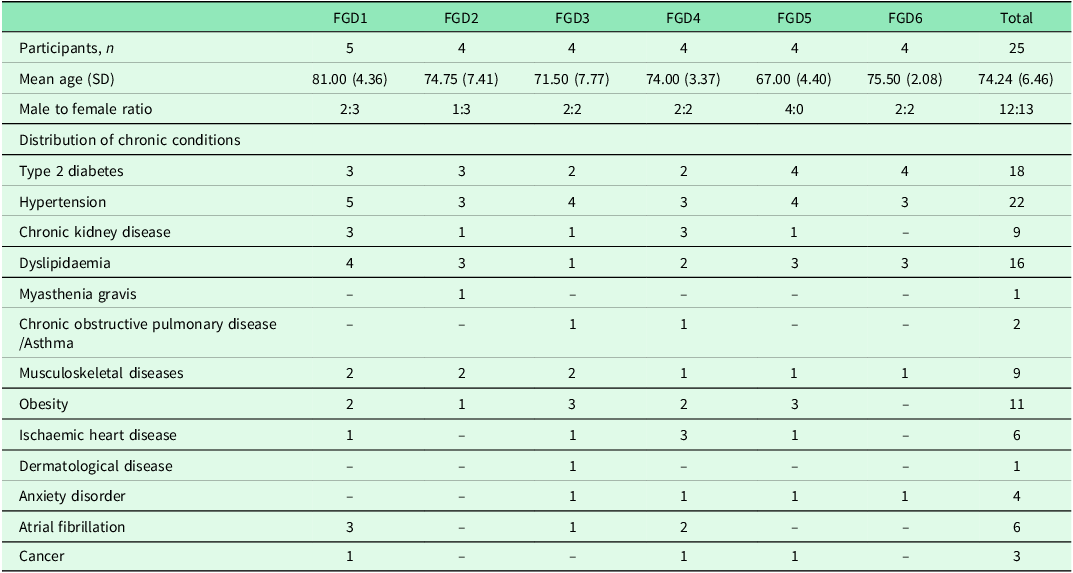
The tool’s content, semantic clarity, and usability were further assessed in six focus groups comprising a total of 25 adults living with multimorbidity (Table 1). This sample size was considered appropriate for assessing comprehension, acceptability, and usability in the context of pilot testing and content validation of health-related tools (Teresi et al., Reference Teresi, Yu, Stewart and Hays2022). Participants were eligible if they were 18 years or older, free from cognitive impairment, and able to ambulate independently. Absence of cognitive impairment was verified through review of medical records by the healthcare team. Individuals with severe communication difficulties were excluded from participation.
Characteristics of focus group discussion participants (n = 25)

Table 1. Long description
A table comparing characteristics of focus group discussion participants with chronic conditions. The table has 18 rows and 8 columns. The columns are labeled FGD1, FGD2, FGD3, FGD4, FGD5, FGD6, and Total. The rows are labeled Participants, n, Mean age (SD), Male to female ratio, Type 2 diabetes, Hypertension, Chronic kidney disease, Dyslipidaemia, Myasthenia gravis, Chronic obstructive pulmonary disease/Asthma, Musculoskeletal diseases, Obesity, Ischaemic heart disease, Dermatological disease, Anxiety disorder, Atrial fibrillation, and Cancer. Row 1: Participants, n, 5, 4, 4, 4, 4, 4, 25. Row 2: Mean age (SD), 81.00 (4.36), 74.75 (7.41), 71.50 (7.77), 74.00 (3.37), 67.00 (4.40), 75.50 (2.08), 74.24 (6.46). Row 3: Male to female ratio, 2:3, 1:3, 2:2, 2:2, 4:0, 2:2, 12:13. Row 4: Type 2 diabetes, 3, 3, 2, 2, 4, 4, 18. Row 5: Hypertension, 5, 3, 4, 3, 4, 3, 22. Row 6: Chronic kidney disease, 3, 1, 1, 3, 1, -, 9. Row 7: Dyslipidaemia, 4, 3, 1, 2, 3, 3, 16. Row 8: Myasthenia gravis, -, 1, -, -, -, -, 1. Row 9: Chronic obstructive pulmonary disease/Asthma, -, -, 1, 1, -, -, 2. Row 10: Musculoskeletal diseases, 2, 2, 2, 1, 1, 1, 9. Row 11: Obesity, 2, 1, 3, 2, 3, -, 11. Row 12: Ischaemic heart disease, 1, -, 1, 3, 1, -, 6. Row 13: Dermatological disease, -, -, 1, -, -, -, 1. Row 14: Anxiety disorder, -, -, 1, 1, 1, 1, 4. Row 15: Atrial fibrillation, 3, -, 1, 2, -, -, 6. Row 16: Cancer, 1, -, -, 1, 1, -, 3.
The research team conducted face-to-face sessions with groups of 4–5 adults with multimorbidity recruited from three Primary Care Centers in Lleida (Spain). Meetings were held in a classroom at the Faculty of Nursing and Physiotherapy of the University of Lleida. At the beginning of each session, the researcher introduced herself, explained the study objectives and procedures, and emphasized the voluntary nature of participation. Participants then interacted with the Spanish Capability Cards and completed the CUVQTA to evaluate their understanding, content relevance, motivation, and usability. They were also invited to propose modifications and improvements to the tool.
Data analysis
Statistical analysis and data processing were performed using RStudio (R version 4.3.2). For experts, community health professional and adults with multimorbidity, quantitative analyses were conducted using 5-point Likert scale responses to assess content validity and usability. For content validity analyses, Likert responses were dichotomized: ratings of 4 (‘agree/relevant’) or 5 (‘strongly agree/highly relevant’) were considered indicative of relevance and coded as 1, whereas ratings from 1 to 3 were coded as 0.
Content validity was assessed using the Content Validity Index (CVI), calculated as the proportion of ratings indicating relevance (scores of 4 or 5). A minimum agreement threshold of 0.80 was considered acceptable for item adequacy (Yusoff, Reference Yusoff2019). CVI was computed for each evaluated question, dimension (Content, Illustration, Language, and Formatting), and for each tool component (individual items/cards and environmental tokens). Overall CVI values were calculated by aggregating across all questions. Usability was assessed using an adapted Spanish version of the System Usability Scale (SUS) (Sevilla-Gonzalez et al., Reference Sevilla-Gonzalez, Moreno Loaeza, Lazaro-Carrera, Bourguet Ramirez, Vázquez Rodríguez, Peralta-Pedrero and Almeda-Valdes2020). The original SUS items were modified to reflect the characteristics of the Spanish Capability Cards while preserving the scale’s structure. The word ‘system’ that appears in the original SUS item descriptions was replaced with the word ‘tool’. Usability scores were summarised descriptively for each group and globally.
Results were reported separately for the expert panel and the professional health care panels, and combined across all healthcare professionals. For adults with multimorbidity, content validity and usability were evaluated at the overall tool level using the different dimensions established for patients.
Ethical considerations
This study was approved by the IDIAP Jordi Gol Drug Research Ethics Committee under code no. 22/141-P. All experts and participants provided informed consent, either online or in person, ensuring they fully read and understood the information before signing. Intellectual property protection was ensured through a certified digital registration process carried out by Clarke, Modet y Cía. S.L., using a blockchain-based record (Minchain, Alastria, and Ethereum).
Results
To contextualise the results presented below, a summary of the Spanish-adapted version of the Capability Cards is provided. The tool is designed to facilitate structured conversations about personal capabilities, life goals, and environmental factors among adults living with multimorbidity, fostering empowerment, self-management, and shared decision-making within community health settings. It is intended for adults aged 18 and older.
The material consists of one starting card, twenty Capability Cards, and twenty-seven environment tokens, along with one blank card and two blank tokens that allow for further personalisation. The starting card centres the prompt ‘This is what I value’, which can be adapted to different purposes (e.g., ‘…for my self-management’). Each Capability Card represents opportunities, aspirations, or meaningful life domains and includes a visual illustration to support interpretation, accompanied by optional clarifying prompts on the reverse side. The environment tokens help identify contextual elements, whether supportive or restrictive, that influence an individual’s ability to pursue what they value. Together, these components provide an accessible structure for reflection, dialogue, and exploration of personal priorities in the context of multimorbidity.
Content validity by the expert panel and community health professional panels
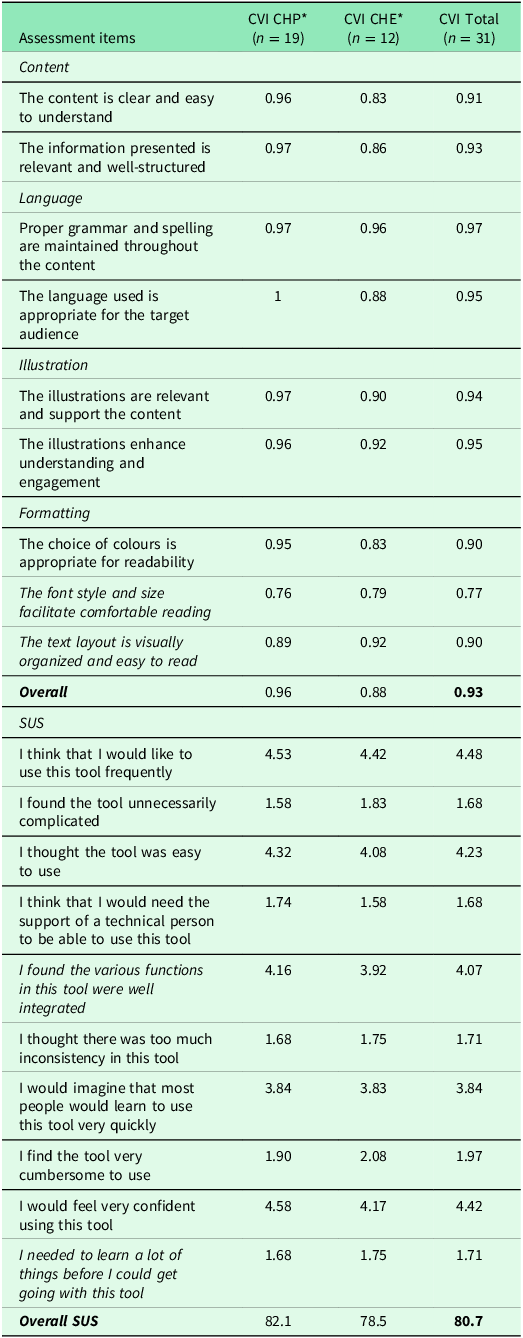
In the expert panel and community health professional panels’ evaluation of the Spanish Capability Cards almost all items exceeded the minimum CVI threshold of 0.80, resulting in an overall CVI of 0.93 (Table 2). Overall, the results showed consistently high CVI values across nurses, nutritionists, psychologists, physiotherapists. Detailed results for content validity and usability scores by professional group are provided in Supplementary Table S1. All items exceeded the minimum CVI threshold except for one formatting element related to font readability (CV of 0.65), the font style and size were revised to improve legibility (Supplementary Table S2). Responses to the open-ended CUVQEP question also suggested refining the wording of seven cards and ensuring that any illustrations containing text were fully translated into Spanish. The SUS results indicated that the Spanish Capability Cards were perceived as highly usable, with an overall SUS score of 80.7, which falls within the ‘excellent’ usability range.
Content validity of the Spanish Capability Cards assessed by a community health expert panel and community health professional panels (n = 31)

Table 2. Long description
A table comparing content validity and usability scores of Spanish Capability Cards by different professional panels. The table has 21 rows and 7 columns. The columns are labeled as Assessment items, Content, Language, Illustration, Formatting, Overall, and SUS. The rows are grouped under different headings such as Content, Language, Illustration, Formatting, and SUS. Each row lists specific assessment items and their corresponding CVI scores for community health professionals (CHP) and community health experts (CHE), along with the total CVI score. The table includes values for content clarity, relevance, language appropriateness, illustration relevance, formatting choices, and usability scores. Notable trends include high CVI scores across most items, with the overall CVI being 0.93 and the overall SUS score being 80.7.
CVI, content validity index; CHP*, community health professionals*; CHE*, community health experts.
Content validity by the target audience
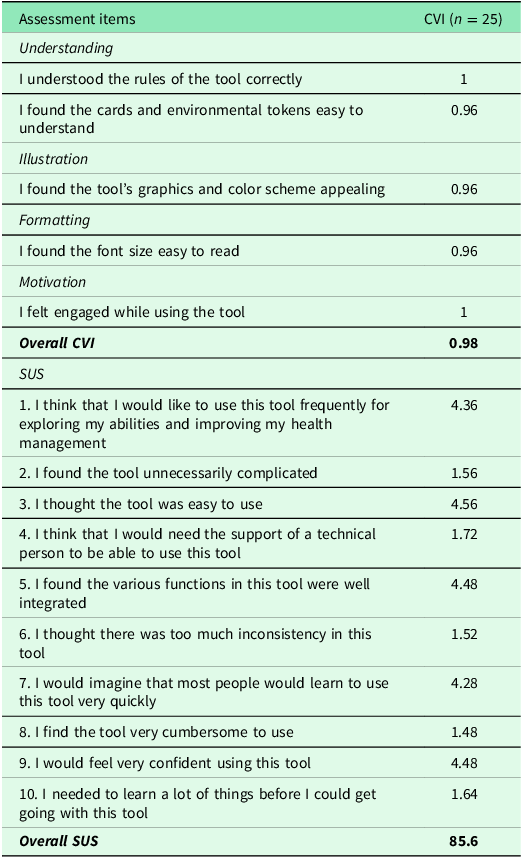
The target audience group consisted of 25 adults aged 62 to 81 years, of whom 12 (48%) were women, and 13 (52%) were men. In the target audience evaluation of the content validity of Spanish Capability Cards, CVI values remained above 0.96 for all questions, obtaining an overall CVI of 0.98 (Table 3).
Content validity of the Spanish Capability Cards by the target audience (n = 25)

Table 3. Long description
A table with two main sections: Content Validity Index (CVI) and System Usability Scale (SUS). The CVI section has five rows and two columns. The first column lists assessment items under categories like Understanding, Illustration, Formatting, and Motivation. The second column shows CVI values for each item, with an overall CVI of 0.98. The SUS section has ten rows and two columns. The first column lists statements about the tool’s usability, and the second column shows corresponding scores. The overall SUS score is 85.6. Each row in both sections provides specific data points related to the tool’s evaluation.
CVI, Content Validity Index.
Regarding the open-ended questions, participants suggested adding an environment token labelled ‘family/friends’, to highlight the importance of close social relationships in their daily lives. They also recommended improvements to the visual design, including increasing the contrast between the token background and the text and enlarging the font size to enhance readability. In addition, some participants suggested adapting the wording of certain cards to incorporate more informal and accessible verbs and nouns to better reflect everyday language. Most participants did not provide additional comments, while six offered these specific suggestions. All relevant modifications were incorporated into the final version of the Spanish Capability Cards.
The usability assessment also reflected a very positive user experience, with a SUS score of 85.6, placing the tool in the ‘excellent’ usability range. This indicates that older adults perceived the Spanish Capability Cards as intuitive and easy to use. The SUS results further support the strong acceptability of the tool, complementing the high content validity obtained.
Discussion
This study provides evidence supporting the content validity and usability of the Capability Cards adapted for Spanish-speaking adults living with multimorbidity in community health contexts (Figure 1). The findings indicate that the tool is perceived as meaningful, relevant, and easy to use by experts, health professionals, and participants. The tool appears to enable individuals to identify meaningful life domains and reflect on the interplay between their desires, capabilities, and contextual circumstances (Brummel et al., Reference Brummel, Jansen, Yerkes, Javornik, Wilken, Parpan-Blaser, Prosser, van der Pas and Jansen2024). By enabling structured reflection on aspirations, capabilities, and everyday constraints, the Capability Cards offer a practical way to support person-centred dialogue in primary and community health care. Feedback from experts, professional panels, and participants suggests that the tool is both meaningful and user-friendly, highlighting its potential to support foster patient agency and engagement rather than focusing solely on disease management. Similar findings have been reported in primary care, where structured tools such as the Assessment of Burden of Chronic Conditions have been shown to facilitate patient–professional communication, promote patient reflection, and support shared decision-making (Peters et al., Reference Peters, Keijsers, van Schayck, Muris, Vervloet and Gidding-Slok2026). The tool encourage individuals to take an active role in reflecting on and communicating what matters most in their lives, positioning patients as active contributors rather than passive recipients in the dialogue about their health and well-being. Differences between evaluator groups may reflect their distinct positions in relation to the tool. Experts and professionals tended to focus on conceptual accuracy, wording, and practical feasibility, whereas adults with multimorbidity placed greater emphasis on readability, accessible language, and the relevance of close social relationships. These differences are consistent with the complementary perspectives expected in cultural adaptation studies and support the value of involving both professional and end-user groups. However, they may also reflect prior familiarity with validation instruments among professionals, as well as potential response bias among participants.
Example of Spanish Capability Cards.

Existing literature highlights the importance of patient engagement and shared decision-making for improving communication, self-management, and health outcomes in adults with multimorbidity (Muscat et al., Reference Muscat, Shepherd, Nutbeam, Trevena and McCaffery2021; Barello et al., Reference Barello, Anderson, Bosio, Lane, Leo, Lobban, Trevisan and Graffigna2024; Perron et al., Reference Perron, Hudon, Roux-Levy and Poitras2024; Wehking et al., Reference Wehking, Debrouwere, Danner, Geiger, Buenzen, Lewejohann and Scheibler2024). Despite increasing policy and research emphasis on person-centred and capability-oriented approaches in primary care, reviews consistently highlight a lack of validated tools that help individuals reflect on their values, priorities, and the contextual enablers or barriers that shape their daily lives (Søgaard et al., Reference Søgaard, Andresen and Kristiansen2021; Barello et al., Reference Barello, Anderson, Bosio, Lane, Leo, Lobban, Trevisan and Graffigna2024; Sumner et al., Reference Sumner, Ng, Teo, Peh and Lim2024). The Capability Cards may contribute to addressing this gap by providing a structured yet flexible resource that supports reflective dialogue, strengthens patient agency, and enhances engagement in community health settings. Recent research in primary care further emphasizes that person-centred approaches must be grounded in patients’ social and contextual realities, particularly for individuals with chronic conditions and socioeconomic vulnerability, and highlights the importance of co-created, visually supported tools to facilitate meaningful dialogue (Søgaard et al., Reference Søgaard, Andresen and Kristiansen2021; Barello et al., Reference Barello, Anderson, Bosio, Lane, Leo, Lobban, Trevisan and Graffigna2024).
The Capability Cards should primarily be understood as a narrative and reflective tool that supports dialogue about what individuals value in their daily lives. Rather than functioning as an educational tool in itself, the cards facilitated storytelling and reflection, enabling individuals to express priorities, aspirations, and contextual challenges that may otherwise remain unaddressed in clinical encounters. This also aligns with participatory primary care research showing that co-created visual tools can help integrate patients’ daily life context, social conditions, and personal goals into clinical conversations, particularly in populations with multimorbidity and socioeconomic vulnerability (van Bommel et al., Reference van Bommel, van den Muijsenbergh, Bergsma, Burgers, Bischoff and van Loenen2025). This reflective process may contribute to more person-centred conversations and may be particularly valuable when integrated within community-based health education or self-management initiatives (Byrne et al., Reference Byrne, Campos, Daly, Lok and Miles2024). A key strength of the tool lies in its potential to rebalance traditional patient–professional roles, creating space for patients to take the lead in expressing what matters most in their lives while professionals adopt a more listening-oriented and facilitative role (Pulvirenti et al., Reference Pulvirenti, McMillan and Lawn2014). By encouraging reflection on personal values and contextual factors, the tool may strengthen shared understanding and support collaborative decision-making (Chi et al., Reference Chi, Wolff, Greer and Dy2017). However, this potential depends on the willingness and capacity of professionals and organisations to support communicative practices centred on listening, reflexivity, and dialogue, rather than directive or problem-focused approaches (Silver, Reference Silver2018).
From an implementation perspective, the use of such tools in routine primary care presents practical challenges. Time constraints, competing clinical priorities, and variability in professionals’ training may affect their integration into everyday practice. Furthermore, the successful use of dialogic and reflective tools requires not only acceptability among patients but also feasibility within existing care pathways and organisational structures. In this regard, the Capability Cards may be applied at different stages of the care process, particularly during care planning, follow-up consultations, or when exploring patients’ priorities and life context within self-management support. Their modular structure allows flexible use depending on the objectives of the encounter, enabling both brief applications within routine consultations and more in-depth reflective conversations. While the tool is designed to be intuitive, its effective use may benefit from basic training in person-centred communication and facilitation skills, as well as prior familiarisation by professionals. In addition, its use is best supported in a safe, open, and flexible environment that encourages reflection and allows conversations to evolve according to the individual’s priorities. Addressing these factors is therefore essential to ensure that capability-based tools can be meaningfully adopted in real-world settings.
The structured translation, adaptation, and validation process (Medeiros et al., Reference Medeiros, Júnior, Pinto, Vitor, Santos and Barichello2015) ensured cultural relevance and applicability for Spanish adults with multimorbidity, incorporating considerations highlighted in the literature (Alavi et al., Reference Alavi, Le Lagadec and Cleary2025) regarding conceptual, semantic, and operational equivalence. The involvement of community health experts, healthcare professionals, and patients provided a comprehensive perspective, enhancing the tool’s real-world applicability in community health contexts (Holleman et al., Reference Holleman, Hooge, Kemner and Hessels2020). Several limitations should be acknowledged. First, the study was conducted with a relatively small and context-specific sample, which may limit the transferability of the findings. Second, selection bias may be present, as participants with an interest in person-centred approaches may have been more likely to participate. Third, although the tool is intended for adults aged 18 years and older, the study sample consisted exclusively of older adults, which may limit its applicability to younger populations. Fourth, the cross-sectional design captures perceptions at a single point in time and does not assess long-term use or outcomes. Despite these limitations, the findings highlight the potential of the Spanish Capability Cards as an innovative narrative resource that supports reflection, empowerment, and patient participation in community health contexts. Their integration into multimorbidity care pathways could contribute to strengthening person-centred practices and promoting a more holistic understanding of health that extends beyond disease management (Alzghoul, Reference Alzghoul2024; Brummel et al., Reference Brummel, Jansen, Yerkes, Javornik, Wilken, Parpan-Blaser, Prosser, van der Pas and Jansen2024; Perron et al., Reference Perron, Hudon, Roux-Levy and Poitras2024).
Future research should examine the implementation of the Capability Cards within routine primary care and community-based interventions, using longitudinal or pre–post study designs to assess sustained impacts on patient engagement, capability development, and health-related quality of life. Exploration of digital or hybrid formats may further enhance accessibility and scalability across diverse populations and settings (Smith et al., Reference Smith, Wallace, Clyne, Boland and Fortin2021; Sun et al., Reference Sun, Gu, Gu, Su, Wang, Liang and Yang2025; Yu et al., Reference Yu, Parry, Yu, Xu, Wu, Zeng, Leng, Tong and Li2025).
Conclusion
The adaptation of the Capability Cards to the Spanish context demonstrated strong content validity and usability among experts, health professionals, and adults living with multimorbidity. This tool provides a structured yet flexible approach to exploring personal capabilities, life goals, and contextual factors relevant to everyday self-management. By facilitating reflective and dialogic processes, the Capability Cards complement existing primary care and community health interventions, including counselling, patient education, and self-management support. The culturally adapted design may enhance its relevance across diverse community health contexts and has the potential to support empowerment, engagement, and collaborative care. From a practice and policy perspective, the use of capability-based tools may contribute to strengthening person-centred approaches in primary health care, highlighting the importance of integrating training in reflective and dialogic communication skills within professional education. Overall, the Capability Cards represent a practical, person-centred resource with potential to contribute to multimorbidity care in primary health care. Further research is needed to assess their long-term impact and implementation in routine practice.
Supplementary material
The supplementary material for this article can be found at https://doi.org/10.1017/S1463423626101583.
Data availability statement
No new data were generated or analysed in support of this research.
Acknowledgements
The authors would like to thank all professionals and participants for their time and valuable contributions to this research.
Author contributions
Laia Llubes-Arrià: Conceptualization (lead); Data curation (lead); Formal analysis (supporting); Funding acquisition (lead); Investigation (lead); Methodology (lead); Writing – original draft (lead); Writing – review & editing (equal). Gwendolijn Boonekamp: Methodology (supporting); Resources (lead); Writing – review & editing (equal). Annica Brummel: Methodology (supporting); Resources (lead); Supervision (supporting); Writing – review & editing (equal). Joaquim Sol-Cullere: Formal analysis (lead); Validation (supporting); Writing – review & editing (equal). José Tomás Mateos: Conceptualization (supporting); Funding acquisition (supporting); Investigation (supporting); Methodology (supporting); Supervision (lead); Validation (lead); Writing – review & editing (equal). Sanna Salanterä: Methodology (supporting); Validation (supporting); Writing – review & editing (equal).
Funding statement
This work was supported by a research grant from the Official College of Nurses of Lleida, awarded under the 2022 call of the grant XII Beca COILL al Millor Projecte de Recerca Infermera and by the Department of Health of the Government of Catalonia within the framework of the Research and Innovation in Health Strategic Plan 2022-2027 [grant number SLT0035/24/000028].
Competing interests
None.
Ethical standards
This study received ethical approval from the IDIAP Jordi Gol Drug Research Ethics Committee (approval code: 22/141-P). All participants and experts involved provided informed consent before participation, either electronically or in person, after thoroughly reviewing and understanding the study information. To ensure the protection of intellectual property, a certified digital registration process was conducted by Clarke, Modet y Cía. S.L, utilizing a blockchain-based system (Minchain, Alastria, and Ethereum) to record all relevant data securely.


 Open access

