If you plant a tree, you nurture and give it support, so it grows to be a strong tree… But if you don't, especially from a very early age, it gets damaged in some way and it becomes twisted… Just as with children, they need that support… that's what the bereavement service does (Healthcare Professional)
INTRODUCTION
Every day in the United Kingdom, ~50 children are bereaved of a parent (Stokes, Reference Stokes2004) and research evidence indicates that these children are at an increased risk of short- and long-term psychiatric, psychological and psychosocial disorders, compared to those who have not experienced bereavement (Cerel et al., Reference Cerel, Frisad and Weller1999; Lecken, Reference Lecken2000; Harrison & Harrington, Reference Harrison and Harrington2001; Lowton & Higginson, Reference Lowton and Higginson2004). There is also evidence to suggest that bereaved children and their families should be offered individually tailored bereavement support (Pfeffer et al., Reference Pfeffer, Jiang and Kakuma2002; Sandler et al., Reference Sandler, Ayers and Wolchik2003; Christ, Reference Christ, Firth, Luff and Oliviere2005; Auman, Reference Auman2007). Support such as group therapy, family intervention, and work- and home-based counseling are available, and can be offered using multiple approaches to reflect the nature of the bereavement, the family circumstance, and the developmental stage of the child (Christ, Reference Christ, Firth, Luff and Oliviere2005; Monroe & Kraus, Reference Monroe and Kraus2005). Establishing comprehensive bereavement services in the United Kingdom is a key recommendation found in many recent Department of Health policies (Department of Health, 2006; National Institute for Clinical Excellence, 2004, 2005).
This article will describe the evaluation of a Child Bereavement Service (CBS) that was undertaken at the request of a cancer charity, Macmillan Cancer Support and a Primary Care Trust (PCT) in Northern England, who funded both the service and the evaluation. The emphasis will be on the user's perception of the appropriateness and effectiveness of the service. By the term “user” we are referring to those who have used, or are involved with the service. The evaluation was conducted while the new service was being introduced, and ran concurrently with the service during its implementation and development over a 3-year fixed period of funding.
Service Innovation and the Need for Evaluation
The stated aims of the newly established service were to provide:
• Information to empower the whole family to cope and support each other through the bereavement, and to encourage communication.
• An opportunity to meet others, who are/have been through similar experiences.
• One-to-one counseling, if appropriate.
• Training and education to those involved in the care of children who had been bereaved.
Evaluating the introduction, operation, and impact of the newly introduced CBS was essential to inform future developments of policy and practice in the locality. Independent service evaluations tend to fall into two broad categories: those that are built in at the planning stage, and those that are commissioned when a new service is underway. For new and complex services, such as a CBS, adopting methods that capture process and context are essential. In this evaluation, process and implementation evaluation were used, as both are “formative” in assessing service delivery (Ovretveit, Reference Ovretveit1998).
METHOD
As process and implementation evaluation are largely qualitative and rely heavily on the use of individual cases, a case study design (Yin, Reference Yin1991) was undertaken. Case study design draws on multiple sources of data and takes into account multiple perspectives to appraise structures, processes, and outcomes in individual units of study. In this evaluation, the case under study was the CBS. Quantitative data relating to access and use of the service were collected and analyzed. These included data on service user demographics, referrals, and support services provided (i.e., telephone advice, literature, and group and one-to-one counseling).
Ethical approval was granted by the Local Research Ethics Committee (LREC) to conduct interviews with the parent(s) families of children who had accessed the CBS, and healthcare professionals involved with the service. Unfortunately, approval was not given to conduct interviews with bereaved children, because members of the LREC thought this approach posed a risk of re-traumatizing the child.
Data Collection and Analysis
Semi-structured interviews with the CBS manager and other CBS staff were conducted to gain a detailed description of the introduction and operation of the service. As the service developed and the evaluation progressed, parents/carers and key professionals (hereafter referred to as healthcare professionals) from primary care mental health, educational psychology, counseling, child, and palliative care services were identified, approached, and interviewed.
Careful consideration was given to the conduct of interviews with parents/carers. One of the evaluators [AML] and the CBS manager went through an anonomized list of people who had accessed the service. From a list of ~260 referrals, the CBS manager identified ~200 suitable candidates. People were excluded if they were still receiving support or were deemed too vulnerable by the CBS manager. A small number could not be contacted because of a change of address/telephone number. Invitation letters to participate in the study were sent on behalf of the PCT. To minimize the inconvenience to parents/carers and their families, interviews were conducted by telephone. From the 200 letters sent to parents/carers there were only 20 replies, and all 20 who replied were interviewed.
Interviews involving healthcare professionals and parents/carers were conducted using a semi-structured interview topic guide. The topic guide ensured consistency of the questions asked, but allowed flexibility to explore particular areas in more depth. The interviews focused on the respondents experience, perceptions, and expectations of the CBS. The interviews were tape recorded with permission, and transcribed verbatim. The evaluation team coded the interviews separately. Through a series of meetings, themes were identified and verified by the evaluators. This iterative process of confirmation by consensus among several reviewers enhanced the validity of the results.
RESULTS
Planning and Implementation of the CBS
During the evaluation period, the CBS was headed by a manager, who was also a child bereavement counselor, a family intervention worker, and a number of volunteer, diploma-qualified counselors. Based on recommendations outlined in the NICE (2004) document, they provided support to:
• Professionals,
• Children,
• Parents.
A number of interventions were utilized during interactions with the bereaved. Interventions included pre/post bereavement support, individual work with the child, work with the family, and group work.
Impact of CBS on the Local Community
Impact on Professionals
Training sessions on how to support children early on in the grieving process were provided by the CBS staff to educational, social, health, and childcare professionals. To assess the usefulness of these sessions, the attendees were asked to evaluate the training sessions. The majority rated the sessions as either excellent or good, based on the topic content and appropriateness of the presentation. Below are examples of the comments made.
A very enjoyable study day which confirmed that I have a lot of skills to effectively give counseling/advice to school age children and their families. (Healthcare Professional)
Considering the content, a very enjoyable morning…Very well delivered and handled sensitively…This training should be obligatory for all child care professionals! (Healthcare Professional)
Overall, the attendees welcomed the mixture of presentations, case examples, and small group discussions. Topics discussed were described as “thought-provoking and challenging.”
Utilization of the CBS by Bereaved Children/Families
Referrals
The services of the CBS were offered to local children aged 2–18 years. Referrals to the service were much higher than anticipated. Naively, the CBS expected ~60 referrals per year, however, in the first year alone (May 2005 to May 2006) 255 referrals had been received. By May 2007, there were 439 referrals.
There was a small difference in the gender of those referred to the CBS, 48% were female, 51% were male, and 1% were not recorded. Figure 1 shows the age distribution. The majority were aged between 9 and 17 years, with 57% being between the ages of 12 and 15. The high percentage of teenage referrals may have been the result of the brutal murder of a schoolboy who attended a secondary school in the PCT. This unfortunate event led to the effective collaboration of many child, health, educational, and pastoral agencies to meet the bereavement needs of those affected. Pupils who attended the school were given leaflets and information on how to cope with their sudden loss. Approximately 120 pupils from the school sought further help, of which 34 were referred to the CBS.
Age of children and young people referred to the CBS.

Relationship to the Person who had Died/was Dying
The majority of those referred to the service had lost a close relative.
31% loss of father,
32% loss of mother,
14% loss of grandparent,
12% loss of other close relative,
11% loss of friend/significant other.
Causes of Death
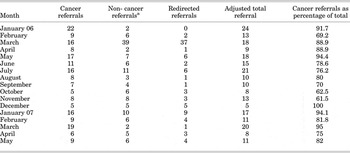
As the service was funded by a British cancer charity (Macmillan Cancer Support) it was anticipated that the majority of referrals made to this CBS would be cancer-related. However, a large number of children were referred to the service as a consequence of non-cancer bereavement. A decision was made by key members of the PCT and Macmillan Cancer Support to allow the CBS to accept up to 20% of children bereaved as a consequence of a non–cancer-related death. Non-cancer referrals included coronary heart disease, accidental deaths, murder, suicide, stillbirths, and other causes of death (Table 1).
Referral breakdown by cancer/non-cancer cause of death

aNon-cancer referrals include coronary heart disease, accidental deaths, murder, suicide, stillbirths, and other causes of death (high number of referrals March 2006 due to the brutal murder of a schoolboy).
Impact of Demand on Service Provision
Waiting Times
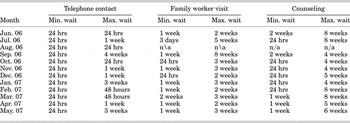
Waiting times for information, advice, interventions, and counseling were an increasingly important area by which the effectiveness of service delivery was measured. The aim of the CBS was to provide counseling within 2 months of the initial assessment. The unanticipated high demand for the CBS initially created challenges for the CBS manager and Family Intervention Worker (FIW). From Table 2 it can be seen that counseling was given within 2 months of the initial assessment. Waiting times varied according to numbers of referrals to the service. Lower referral rates and waiting times occurred when children were on school holidays.
Waiting period for CBS interventions

Perceptions of the Child Bereavement Service
The need for a child-specific bereavement service was evident, and expressed eloquently by this healthcare professional,
If you plant a tree, you nurture and give it support, so it grows to be a good strong tree… But if you don't, especially from a very early age, it gets damaged in some way and it can become twisted… Just as with children, they need that support… that's what the bereavement service does. (Healthcare professional)
Emergent Themes
Qualitative interviews with healthcare professionals and parents/carers resulted in three overarching themes:
Clarity and consistency,
Accessibility and communication,
Performance management.
Clarity and Consistency
As a result of good communication networks established by the manager of the CBS and local health and childcare services, there was a collective understanding of what the CBS provided, and did, for bereaved children in the locality. Service outcomes were reviewed regularly by the staff of the CBS, to ensure that information, support, and guidance met the needs of the local population.
I've seen it (CBS) do some really outstanding work, especially collaborative work with families. For example, if there's been a traumatic death, that service has worked with the children and made referrals quite appropriately through to adult services for the adult family members. (Healthcare professional)
We have a rolling program of delivering palliative care education… But it was nice to be able to bring [CBS manager] along and talk about it in terms of children, because we tend to focus on adults.
I think it really made people think about children…End of life care is for everybody and it's everybody's business…And bereavement will certainly feature in that. And we want to be central to that, so that we can support it, and ensure that it is delivered in a pro-active way. (Healthcare professional)
Accessibility and Communication
Respondents commended the CBS on the time it spent establishing partnerships with a variety of services to promote the well-being of bereaved children. The ability of the CBS to provide bereaved children/families with timely access to appropriate services was also noted.
Service accessibility and choice for children and young people is definitely one of its strengths. (Healthcare professional)
The workers involved are so dedicated and committed. I can't praise it (CBS) enough …Whether their role (CBS staff) is big or small, they actually work well together and we've worked equally as partners. (Healthcare professional)
From interviews with healthcare professionals and parents/carers, there was evidence to suggest that meeting the bereavement needs of the child was paramount. Parents expressed their gratitude at the good communication links established between the counselor, child, and parent/carer.
Everybody who I had contact with [at CBS], was very friendly and accommodating…They offered a wide range of options of things that you could do or access. (Parent)
Parents had more confidence in a child-specific service than a generic bereavement service, as expressed by the following parents,
… I was looking for something for my child really, rather than for an adult… I know that there's a lot of counseling services available for adults who've been bereaved, but I was struggling to find something that was specifically child-centered. (Parent)
You just got a real feeling of empathy and care when you are talking to [counselor]… [Counselor] was obviously dealing with a lot of children but she was treating [daughter] as an individual. She had respect for my husband and me as the parents. She did make us feel involved and that was fabulous. It was very reassuring to speak to her. (Parent)
Performance Management
The aim of the CBS was to provide a service that addressed problems before they became intractable. This mother had witnessed a timely intervention by the counselor:
…my daughter was self harming herself … The counselor seemed to pick up on that very quickly and helped her through that, and that stopped quite quickly …. Had I not had that service, I don't know what might have happened… (Parent)
… To be able to deal with it [bereavement] when you're young is a good thing… Than to go sort of twenty years and think this dreadful thing has happened to me and I've never had the chance to express it or deal with it. …she [daughter] had the opportunity to deal with it now, and that has been a huge bonus. (Parent)
Positive comments as to the appropriateness of having a child-specific bereavement service were also made by the healthcare professionals.
In the past, if we had children that were really struggling, they probably got referred to [CAMHS - children and adolescent mental health services] which was quite inappropriate…if a child goes to [CAMHS], they are stigmatized already. And the CBS has just prevented that stigmatism. Because at the end of the day, children are happy to go and speak to somebody who is a bereavement counselor than go to one associated with mental health… (Healthcare professional)
The CBS manager and her staff were also praised by all of the participants for their effective and efficient use of resources.
Our original idea was that we just had one person… I think we were quite naive in what we were expecting the service would provide. And I think it has provided us with much more than we had expected. Not just for patients and carers, but also for ourselves as professionals. (Healthcare professional)
I think she's [CBS manager] achieved a great deal with a small resource, and championed it really well. (Healthcare professional)
DISCUSSION
Death and dying are natural processes and people cope differently with their loss. People often get the help they need from their family and friends, but in certain circumstances it is beneficial to talk to someone more neutral, such as a counselor, or others in a similar situation (Beswick, Reference Beswick1996; Stokes, Reference Stokes2004; Dyregrov & Dyregrov, Reference Dyregrov and Dyregrov2008). Support from others can help children to grieve, but some children struggle to come to terms with death and bereavement (Dehlin & Reg, Reference Dehlin and Reg2009). Sociologists have attributed this situation to the decline of the extended family, tradition, and religion (Ribbens-McCarthy & Jessop, Reference Ribbens-McCarthy and Jessop2005). In these circumstances, children may be left alone trying to make sense of death and bereavement (Stokes, Reference Stokes1997, Reference Stokes2004; Harrison & Harrington, Reference Harrison and Harrington2001; Nolbris & Hellstrom, Reference Nolbris and Hellstrom2005; Ribbens-McCarthy & Jessop, Reference Ribbens-McCarthy and Jessop2005). The society we live in today, has changed, and so have the pressures and emotional needs of young people. Consequently, more and more children are developing diagnosable mental health problems, which are going unnoticed (Lecken, Reference Lecken2000; Ribbens-McCarthy & Jessop, Reference Ribbens-McCarthy and Jessop2005). How many of these could be related to unresolved grief issues we do not know, but a service like the CBS can go a small way to prevent what should be a normal process from becoming an unresolved grief reaction. Encouraging children to talk about their loss may help them to cope with what is happening (Christ, Reference Christ, Firth, Luff and Oliviere2005; Monroe & Kraus, Reference Monroe and Kraus2005). This can be achieved within the family setting (Dyregrov & Dyregrov, Reference Dyregrov and Dyregrov2008). However, if a change in the child's behavior persists, help can be sought via a service such as the CBS; a service that caters to the needs of children, parents/carers, and health care professionals.
From the interviews with parents, the CBS would appear to have had a positive effect on those accessing the service. However it is worth noting that only a small sample of parents was interviewed and they were all very complimentary of the service. It could be argued that non-responders may have had negative experiences, but this was beyond the remit of this evaluation. A major limiting factor was the inability to seek the views of bereaved children who had accessed the CBS. Consequently, the collection of data for this evaluation was not as robust as it could have been, because of these limitations, and the findings were not as comprehensive, as a result.
Despite the methodological shortcomings of this evaluation, the CBS appears to be meeting the existing and emerging needs of locally bereaved children and their families. The CBS was acknowledged as being sufficiently diverse, relevant, and sensitive to the present and future needs of children requiring support following the loss of a loved one. If the CBS was unable to provide support, it would refer children to other more appropriate agencies. Overall, the important factors identified in facilitating the successful implementation of the CBS have been communication, collaboration, and commitment. The CBS provides an effective model that supports and enhances the bereavement skills and education of fellow child and healthcare professionals.
ACKNOWLEDGMENTS
The authors thank Macmillan Cancer Support (British Cancer Charity), the manager and staff at the Child Bereavement Service, Ziv Amir (Director of the Macmillan Research Unit), and Susan Tizini (administrative support).