Evidence suggests that women with a physical, psychiatric or cognitive impairment face significant disadvantages in the areas of employment and health (Hosseinpoor, Williams, Jann, Kowal, Officer, Posarac, & Chatterji, Reference Hosseinpoor, Williams, Jann, Kowal, Officer, Posarac and Chatterji2012). This includes women with a disability being less likely to remain in the paid workforce and receiving lowered income in comparison to male peers (Australian Bureau of Statistics, 2010; Australian Institute of Health and Welfare, 2009; O’Reilly, Reference O’Reilly2007). Sub-optimal use of available healthcare services among adults with disabilities, particularly women, has also been identified (Miller, Kirk, Alston & Glos, Reference Miller, Kirk, Alston and Glos2013; Parish & Huh, Reference Parish and Huh2006; Robinson-Whelen, Taylor, Hughes, Wenzel, and Nosek, Reference Robinson-Whelen, Taylor, Hughes, Wenzel and Nosek2014; Williamson & Elliott, Reference Williamson and Elliott2013; Wood, van der Mei, Ponsonby et al., Reference Wood, van der Mei, Ponsonby, Pittas, Quinn, Dwyer, Lucas and Taylor2013).
These gendered differences have been linked to the specific issues and challenges faced by women with disabilities. This includes reproductive healthcare, with disabled mothers’ flagging concerns about their parenting abilities and general dissatisfaction with available support services (Lew-Starowicz & Rola, Reference Lew-Starowicz and Rola2013; Kirshbaum & Olkin, Reference Kirshbaum and Olkin2002). Emotional reactions to disability onset can also be challenging, with grief symptoms experienced differently by women (Niemeier, Reference Niemeier2008). In addition, comparative differences in illness perception have been identified, with females perceiving their health issues as unamenable to personal control or treatment (Stuifbergen, Phillips, Voelmeck, & Browder, Reference Stuifbergen, Phillips, Voelmeck and Browder2006).
Models of disablement
Feminist disability studies place these aforementioned issues in the context of women's rights and exclusions (Garland-Thomson, Reference Garland-Thomson2005). That is, disability is viewed as a phenomenon influenced by societal attitudes and governmental policies (Shakespeare & Watson, Reference Shakespeare and Watson2001). This social approach has been credited with promoting consumer-focussed service planning and delivery but also criticised for its limited conceptualisation of disability (Shakespeare & Watson, Reference Shakespeare and Watson2001; Taylor, Reference Taylor2005; Wade & Halligan, Reference Wade and Halligan2004). In comparison, multi-factorial models of disability propose that disability experience is determined by a reciprocal relationship between biological, environmental and social variables which, additionally, combine with a person's psychological resources (Engel, Reference Engel1977; Suls, Krantz & Williams, Reference Suls, Krantz and Williams2013; Wade & Halligan, Reference Wade and Halligan2004, World Health Organisation, 2001). This biopsychosocial perspective recognises the need to change one's physical and social contexts whilst acknowledging personal choice, responsibility, beliefs and attitudes in disability management (Wade & Halligan, Reference Wade and Halligan2004).
The biopsychosocial model is, however, broad in scope. As such, it is difficult to determine which specific factors – biological, personal or social - are most important for individuals with a disability at any one point in time (Suls et al., Reference Suls, Krantz and Williams2013). The practical application of disability-specific biopsychosocial assessment and treatment is also challenging in light of government policy and funding resource issues (Wade & Halligan, Reference Wade and Halligan2004). This is particularly true in an Australian context, where shortfalls in public health service provision have been identified (Duckett, Reference Duckett2011). Moreover, although a range of social and personal variables have been implicated in the gender-disability literature Australian-based studies are limited in quantity. It is important for disability studies to be conducted across a variety of settings and with different diagnostic groups, to increase our confidence in the accuracy and generalisability of the available findings to the larger population of women with disabilities.
Goals of the study
A pilot survey was undertaken to explore the lived experiences of adult women living with a disability in Australia. Our research questions were:
• What are the issues, frustrations and challenges faced by this population?
• How do women with a disability describe their current versus ideal lifestyle?
• What are the life goals that women with disabilities hope to achieve?
• What are the barriers as well as strategies to achieving these goals?
It was anticipated that these women would identify physical, social and emotional needs and that the results would highlight avenues for further gender and disability research.
Method
Research design
The study involved a cross-sectional survey of women with disabilities in Australia. Given the broad population and heterogeneity of diagnostic groups covered, online media was considered the most suitable method of participant recruitment (Danaher, Boles, Akers, Gordon, & Severson, Reference Danaher, Boles, Akers, Gordon and Severson2006). This methodology is also consistent with research identifying increased patterns of internet use among disability groups (Australian Bureau of Statistics, 2009; Drainoni, Houlihan, Williams, Vedrani, Esch, Lee-Hood & Weiner, Reference Drainoni, Houlihan, Williams, Vedrani, Esch, Lee-Hood and Weiner2004).
Participants and setting
Participants were recruited from social networking sites (i.e. Facebook, Twitter) of disability advocacy groups within Australia. The final sample of 116 respondents (after incomplete questionnaires for two respondents were removed) comprised a broad age range (18 to 75 years), with the majority being in the 25 to 44 age bracket (n = 66, 57%). Most reported having a diagnosed physical disability (n = 63; 54%; cerebral palsy, multiple sclerosis, spinal cord injury, osteoporosis). A significant minority (n = 29, 25%) had two or more diagnoses (e.g. physical and sensory disability). Ninety-seven percent (n = 113) of the sample resided in metropolitan locations throughout Australia.
Measure
A purposely-designed questionnaire was utilised (see online supplementary material). The questionnaire collected demographic and disability information (i.e. age group, location of residence, nature of disability) in order to broadly describe the sample's characteristics. A series of seven questions then focused on respondents’ opinions as women with disabilities. This included categorical response lists to ensure that the survey was brief, readable and concise to a range of individuals with varying degrees of physical and/or cognitive impairment (Danaher et al., Reference Danaher, Boles, Akers, Gordon and Severson2006).
Procedure
Following ethics approval (Human Research Ethics Committee, University of Adelaide, protocol no. 13/34), a list of potential organisations was created through a web search of not-for-profit and government organisations involved in disability advocacy within Australia. Identified organisations (N = 65) were emailed an invitation to assist with the distribution of our online survey, developed using Survey Monkey™. Of these, four organisations agreed to participate in the study. Snowball sampling was adopted, whereby each organisation was encouraged to share the survey amongst their members or acquaintances (Morse, Reference Morse2012). No incentives (monetary or otherwise) were provided for participation. Information to assure confidentiality was embedded in the preamble pages of the online survey.
Data analyses
Text responses were evaluated using two approaches. First, word clouds were used to visually demonstrate the frequency or usage of a particular word or phrase. The aim was to provide a basic understanding of the dataset (Cidell, Reference Cidell2010). Second, a content analysis approach (Busch, De Maret, Flynn et al., Reference Busch, De Maret, Flynn, Kellum, Le, Meyers, Saunders, White and Palmquist2012) was used to derive key categories. This involved: (a) raw text extraction; (b) development of category codes and; (c) grouping of ideas under coding groups. Analyses were conducted by the second author (D.D).
Results
Identified issues, frustrations and challenges
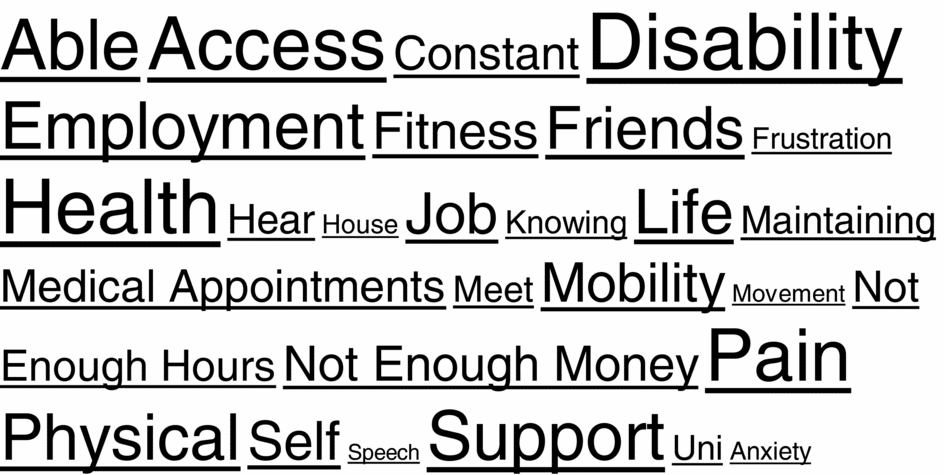
Word clouds identified socio-legal aspects of disability (n = 64, 55%) as a key issue and source of frustration (Figure 1). This included reference to the need for increased employment opportunities for women with a disability (n = 64, 55%). This was confirmed by categorical responses, with discrimination in the workplace consistently cited (n = 54, 47%), in addition to a need to improve educational access (n = 58, 50%).
Word cloud summarising issues and frustrations of concern.

These broad issues represented system-related problems. This included a subcategory related to financial limitations: “. . .not being fully funded through my support package. . .so I cannot support disability workers for everyday needs . . .,” “being told I’m incapable of working but still not qualifying for the DSP (disability support pension).” Recommendations were offered, including the need for additional government-based funding for personal care support.
A second subcategory related to accessibility issues (n = 61, 53%; Figure 1). This included reference to public housing and rental properties: “finding suitable (rental) accommodation without the need to make major modifications. . .is very difficult.” Air travel was also identified as problematic: “the airlines will take away my wheelchair at check-in even though I have a wheelchair that would fit into most overhead lockers and also meets the weight requirement. . .this means that I am no longer independent.”
A third category related to physical illness, with general medical and health concerns (n = 33, 28%) cited in addition to chronic (neuropathic) pain (n = 14,12%; Figure 1). This was exemplified by comments such as “struggling to function daily” (due to mobility issues). A final category related to psychosocial issues or the personal impact of disability. Supportive relationships, particularly friends (n = 21, 18%), was a frequently identified term (Figure 1). Less frequent words included self-confidence (n = 3, 3%) and anxiety (n = 2, 2%; Figure 1). Societal attitudes were additionally noted: “Overcoming people staring at me because I’m wheelchair bound and often asking me what happened. . .and (they) are strangers!”; “lack of understanding. . .empathy. . .by employers or colleagues. . .”
Women's perception of their current versus ideal lifestyle
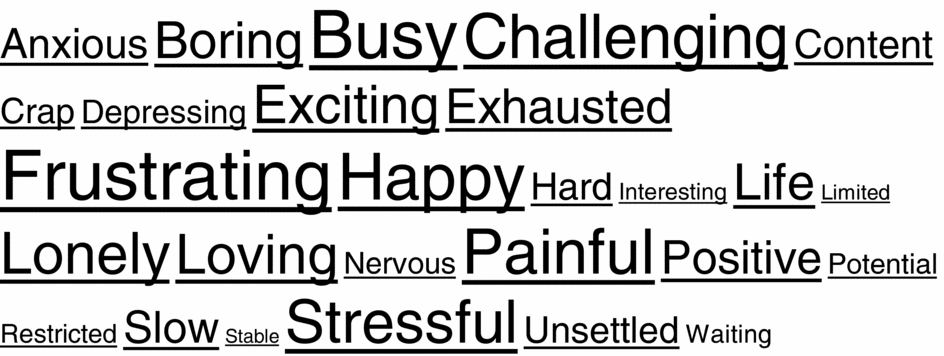
Respondents described both negative and positive aspects of their experience as women with disabilities (Figure 2). This included the use of words such as frustrating (n = 26, 22%), (emotionally) painful (n = 8, 7%), depressing (n = 2, 2%), happy (n = 15, 13%), and loving (n = 5, 4%). An overwhelming sense of psychological morbidity and unhappiness was, however, highlighted by text responses such as: “trying to survive, trying to convince people of my worth, trying to achieve appropriate support for my disability to enable my life to continue”; and “It sucks!! If it wasn't for my disability we would probably be living and working on a farm with room to grow our own vegies and plants and have animals.” A significant minority (n = 25, 22%) used terms that could be categorised as resilient behaviours and characteristics (Figure 2). This included expression of positive emotions: “being happy that I’m healthy”; and “being positive.”
Word cloud summarising current lifestyle as a women with a disability.
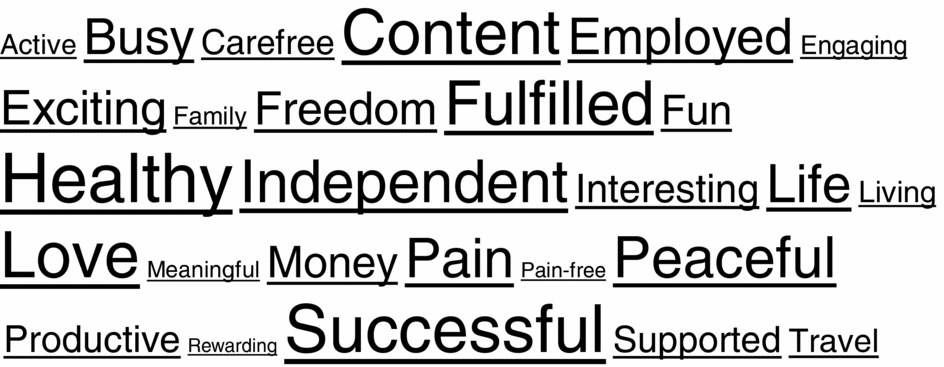
Respondents characterised their ideal lifestyle using words that reflected a combination of systemic, physical and psychological factors (Figure 3). This included the importance of being successful (n = 15, 13%), with specific reference to maintaining an active, fulfilled and engaging lifestyle, which included employment (n = 12, 10%) and nil financial restrictions (n = 3, 3%). Physical health (n = 15, 13%), in addition to the need to maintain some level of functional independence (n = 9, 8%) and being pain-free (n = 7, 6%) were considered important. Finally, respondents commented on their personal relationships, including a need for love (n = 10, 9%) and support (n = 3, 3%).
Word cloud summarising womens’ ideal lifestyle.
Established life goals and barriers vs. strategies to achieving these
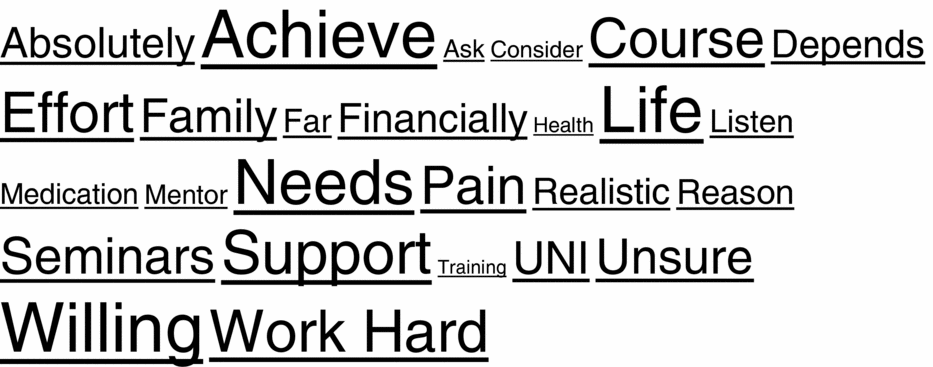
Figure 4 highlights key goals related to continued education and productive (paid) employment (n = 31, 27%), improved health behaviours such as weight loss, sleep patterns and pain management (n = 21, 18%), and supportive interpersonal (family and social) relationships (n = 18, 16%). An overwhelming majority (n = 82, 71%) reported limited finances as being a barrier to achieving these goals. Categorical responses revealed that individuals' own self-doubt (n = 44, 38%), low confidence (n = 42, 36%), fear (n = 36, 31%), procrastination (n = 36, 31%), and a need for perfectionism (n = 29, 25%) limited their potential.
Word cloud summarising future life goals.
Importantly, most expressed a willingness to engage in future behavioural change efforts (Figure 4). This motivation was noted in text responses: “I would be willing to do whatever way was shown to achieve my ideals”; “I think I’ve done all I can but I would be open to more”; “I’m willing to work as hard as anyone else”; “(I need to). . .break through my comfort zone, listen to others’ suggestions.” Practical strategies to goal achievement were additionally suggested, including peer support with coaching and mentoring, community networking and volunteering, and increased informational support: “anything. . .education, advocacy, information sessions.”
Discussion
Women with disabilities living in Australia identified systemic, physical and psychological issues contributing to their frustration and impacting on their ability to achieve vocational, health and relationship goals. The importance of addressing social structures that impact on the health of women with a disability, making the work environment “disability-friendly,” in addition to improving the physical infrastructure of public housing and transport systems was emphasised. A need for psychological growth and independence was also identified, with peer coaching, training and mentoring programs suggested.
This study supports previous research, with suggestion that women with disabilities require specialised supports due to their distinct life experiences (Hosseinpoor et al., Reference Hosseinpoor, Williams, Jann, Kowal, Officer, Posarac and Chatterji2012; Stuifbergen et al., Reference Stuifbergen, Phillips, Voelmeck and Browder2006). The findings also highlight the potential for targeted programs to meet the specific needs of this sub-group. Such programs might include a focus on educational and vocational development, with the aim being to promote self-confidence, self-worth and interpersonal relationships through goal setting and achievement. This is consistent with a flexible biopsychosocial approach to disability care which recognises the importance of balancing acute with preventive health interventions, including effective self-management (Wade & Halligan, 2006).
Implications for rehabilitation research
The current findings highlight some important avenues for research. Deeper insight into women's personal experience of disability could be gained through interview-based research. This might include email-facilitated interviews, which have demonstrated clinical feasibility among individuals with cognitive impairment (Egan, Chenoweth & McAuliff, Reference Egan, Chenoweth and McAuliffe2012). The pivotal role of employment in contributing to perceived lack of equal opportunity for women with disabilities, as suggested by this sample, also requires further investigation. Indeed, there is evidence that employment enhances resilient coping skills following physical disability (Kent & Dorstyn, Reference Kent and Dorstyn2014). Additional gender studies will also help to confirm the intersection of gender and disability. This includes research on context and life phases, including the transition from adolescence to adulthood and whether the impact of gender changes with age (Calasanti, Reference Calasanti2010; Miller et al., Reference Miller, Kirk, Alston and Glos2013).
Study limitations
These findings need to be considered within the context of the study's limitations. First, the majority of the sample lived in metropolitan suburbs and cities hence the data may not represent the views of the wider population of women with disabilities, including those residing in rural communities. Second, potential respondents may have been unintentionally excluded by having only contacted disability organisations that we had researched. In saying this, the sample was built via a range (albeit limited) of professional organisations, resulting in a group of users from target disability sectors (Morse, Reference Morse2012). A third limitation relates to the reliance on unstandardised, self-report data, which in itself presents issues with self-serving and social desirability biases (Bowling, Reference Bowling2005). Fourth, it was not possible to attribute direct quote statements to the distinct socio-demographic and disability characteristics of individual participants due to the reliance on categorical data. The unattributed statements limited the rich detail about human behaviour, emotions and personality that can otherwise be gained in qualitative text responses (Morse, Reference Morse2012).
Conclusion
The results provide some insight into the issues, prospective life goals and barriers experienced by women with disabilities; a population that has received limited attention in the Australian rehabilitation literature. In particular, the findings highlight a need to challenge the physical and psychosocial barriers perceived by these women in order to achieve financial stability, overcome accessibility issues and improve societal attitudes. This might include the development and provision of affordable and accessible training programs that focus on building women's self-development.
Acknowledgements
The authors are very grateful for the cooperation of individual respondents and disability organisations in this study.
Conflict of interest statement
The authors declare no conflict of interest.
Supplementary material
To view supplementary material for this article, please visit http://dx.doi.org/10.1017/jrc.2014.3